Invitation Homes Boosts Rents 11% As Housing Shortage (And Fed Stimulus) Persist

(Bloomberg) — The largest owner of U.S. rental houses isn’t seeing any let-up in demand, or in its ability to increase rents. 

Invitation Homes Inc., which owns more than 80,000 single-family rentals, raised prices by nearly 11% in the third quarter, according to a statement. The company boosted rents by 8% on renewals and 18% when leasing homes to new tenants. Rates are rising fastest in the Southwest, where rents increased 30% on new leases in Las Vegas, and 29% in Phoenix

“It’s a little bit crazy,” Chief Executive Officer Dallas Tanner said on a conference call with investors Thursday. “There just isn’t enough quality housing available right now.”

Rising rents have been a staple of the economy since early Covid lockdowns lifted in the middle of last year. Surging purchase prices have pushed homeownership out of reach for first-time buyers

Invitation’s properties, which tend be more centrally located than those owned by other institutional landlords, have been especially popular. And tenants tended to stay put: The company had a record-low turnover rate in the quarter, which reduced the expenses associated with preparing a house for leasing.

Invitation’s shares rose slightly to $40.77 at 12:49 p.m. New York time after the company raised its expectations for full- year revenue and net operating income. The stock is up 37% for the year.

As Milton Friedman once said, “If you put the federal government in charge of the Sahara Desert, in 5 years there’d be a shortage of sand.” In this case, The Federal government and Federal Reserve were put in charge of the Covid epidemic and we have shortages of almost everything. Including housing.

I don’t have Invitations rent growth chart, but here is Zillow’s YoY rent chart against The Fed’s balance sheet.

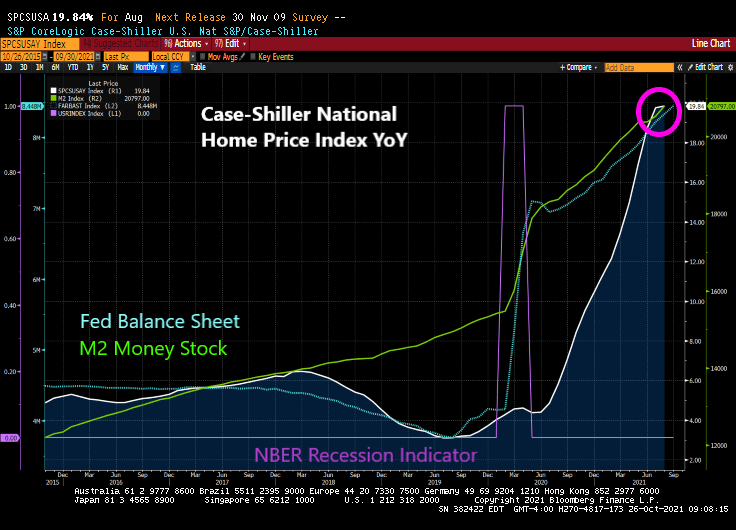
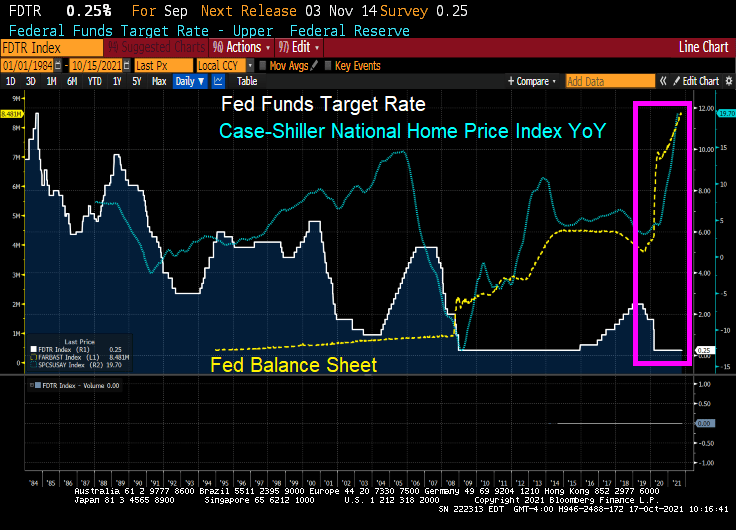
The good news? The 11% increase is almost half of the 20% YoY Case-Shiller National home price index.

Here is Treasury Secretary Janet Yellen making housing supply disappear.

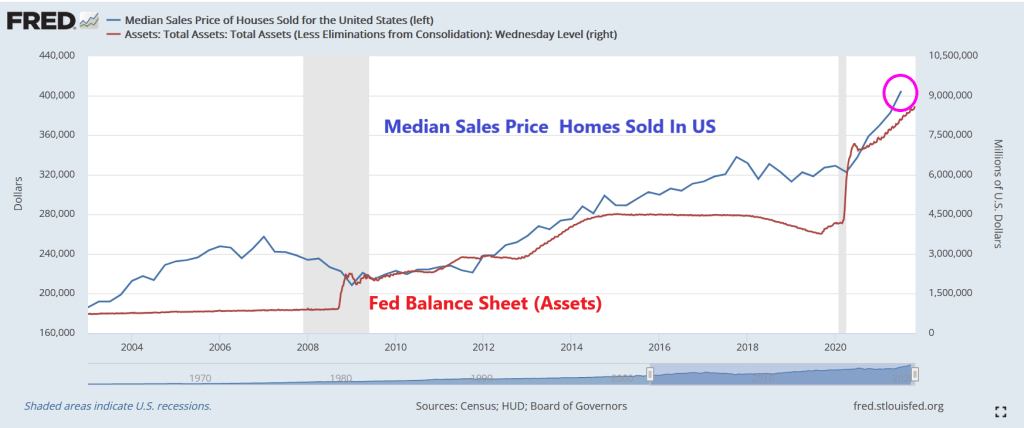
Median U.S. Home Price Just Passed $400,000 For First Time Ever! (Prices Could Rise Another 16% By End Of 2022)

In the third quarter the median home price hit $404,700, jumping nearly 13% since third quarter of 2020, when the median sales price was $358,700.

Though it’s an eye-catching number, the market has been hot of late, and a lack of inventory and high demand means foretold the rise in home prices.

According to a recent note from Goldman Sachs, home prices could rise another 16% by the end of next year. Goldman economist Jan Hatzius pointed out that of all the pandemic shortages, the housing shortage might last the longest and that a crash is very unlikely.

Sure Jan. That’s what economists were saying in 2007 too before housing prices crashed and burned. Although this time its different: The Federal Reserve hadn’t gone insane buying Treasuries and Agency MBS before the housing bubble burst in 2008/2009.

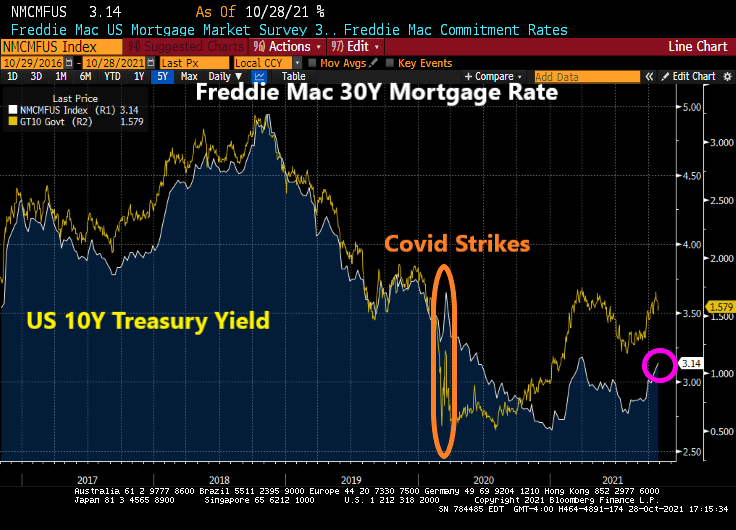
Freddie Mac 30-year Rate Rises To 3.14% (Nothing Has Been The Same Since Covid)

Freddie Mac’s 30-year mortgage rate rose today to 3.14%.

Notice how Freddie’s 30-year loan commitment rate tracked the 10-year Treasury yield … until Covid struck. Then there was a separation of the two rates.

U.S. Pending Home Sales Fell by More Than Expected in February (-7.19% YoY) With Sinking Real GDP Growth

US pending home sales declined -2.3% MoM and -7.19% YoY as US GDP sinks like a paralyzed falcon,

(Bloomberg) — The National Association of Realtors’ index of pending home sales decreased 2.3% in September from a month earlier to 116.7, largest drop since April, according to data released Thursday. 

The median estimate in a Bloomberg survey of economists called for a 0.5% advance.

Compared with a year earlier, contract signings were down 7.2% on an unadjusted basis”

Forecast range from -4.6% to 4.5% from 30 economists surveyed

Signings declined in all four U.S. regions from the prior month, led by a 3.5% drop in the Midwest
Unlike existing-home sales, which are calculated when a contract closes, the index of pending home sales is based on contract signings

Treasury Secretary Janet Yellen: “What, me worry?”

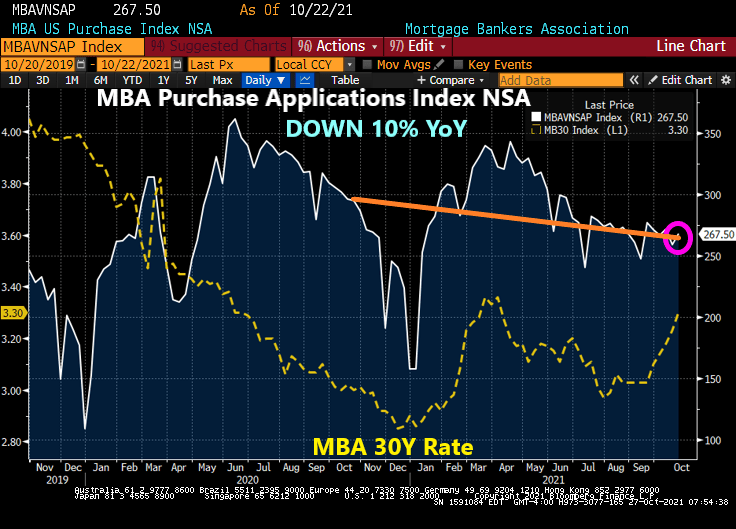
US Mortgage Purchase Applications UP 3.24% From Previous Week As Mortgage Rates Rose To 3.30% (But Purchase Applications Down 9.3% From Same Week Last Year)

Mortgage purchase applications rose 3.24% from the previous week, according to data from the Mortgage Bankers Association. However, purchase applications are down 9.3% from

Mortgage refinancing applications declined -1.57% from the previous week as mortgage rates rose from 3.23% to 3.30%.

Yellen Expects High Inflation Through Mid-2022 Before Easing (The Incredible Janet Yellenstone!!)

And with a wave of her magic wand, Treasury Secretary Janet Yellen (aka, the Incredible Janet Yellenstone) will make inflation magically return to less than 2% after mid-2020.

Treasury Secretary Janet Yellen said she expects price increases to remain high through the first half of 2022, but rejected criticism that the U.S. risks losing control of inflation.

Inflation is expected to ease in the second half as issues ranging from supply bottlenecks, a tight U.S. labor market and other factors arising from the pandemic improve, Yellen said on CNN’s “State of the Union” on Sunday. The current situation reflects “temporary” pain, she said.

“I don’t think we’re about to lose control of inflation,” Yellen said, pushing back on criticism by former Treasury Secretary Lawrence Summers this month. “Americans haven’t seen inflation like we have experienced recently in a long time. But as we get back to normal, expect that to end.”

On Friday, Federal Reserve Chair Jerome Powell sounded a note of heightened concern over persistently high inflation as he made clear that the central bank will begin tapering its bond purchases shortly but remain patient on raising interest rates. 

The S&P 500 Index posted its first decline in eight days, while benchmark Treasuries rallied to send 10-year yields down by the most in more than two months. Inflation expectations remain elevated — the 10-year breakeven rate of 2.64% is within 15 basis points of the record high reached in 2005 — and rates traders maintained bets the Fed will hike at least once within a year.

Powell said policies are “well-positioned” to manage a range of outcomes. 

So Janet, are you saying that home price growth is going to slow to 2% YoY after mid-2022? Or that the Biden Administration is going to build the Canadian pipeline to help ease energy costs? Or that west coast ports get magically unclogged? Or that chips for cars will magically begin appearing?

I forget. The Fed doesn’t consider housing or energy prices in their inflation measurements. So, Yellen and The Fed ignore that most important expenditures for households.

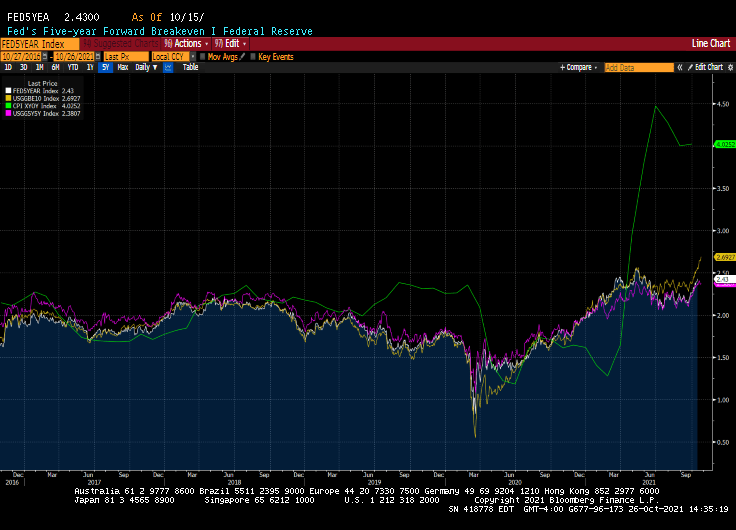
The Fed’s breakeven inflation rates are considerably lower than current core inflation (green line).

No wonder Yellen and Powell can make inflation magically disappear. Don’t count it!

Even former Fed chair Alan Greenspan sees sustained inflation well above The Fed’s 2% target rate.

US New Home Sales Rise 14% In September As Median Prices Rose 20.1% YoY (Fed Pumping Trillions Into Clogged Economic System)

US new home sales rose a whopping 14% in September as the median price of new home sales rose 20.1%.

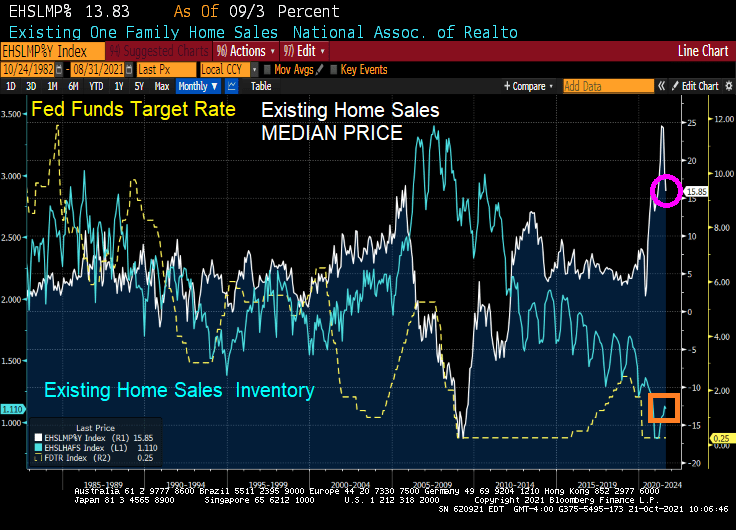
Existing home sales still remain low allowing median prices to soar with Fed money printing.

New home sales surged as The Fed turns a blind eye to out-of-control inflation in prices.

Thanks to The Fed, new homes under $150,000 have disappeared and new homes over $500,000 have grown to 31% of all new homes. Where have all the starter homes gone?

Between Fed stimulypto and massive over-spending by Congress and the Biden Administration, the economic system is clogged like an interstate toilet, driving construction prices soaring.

Apparently Fed Chair Jerome Powell and Treasury Secretary Janet Yellen have never experienced clogged plumbing in their homes. And President Joe Biden has probably forgotten.

I can’t wait to hear if Biden’s press secretary Jen Psnarki attempts to put a positive spin on this debacle.

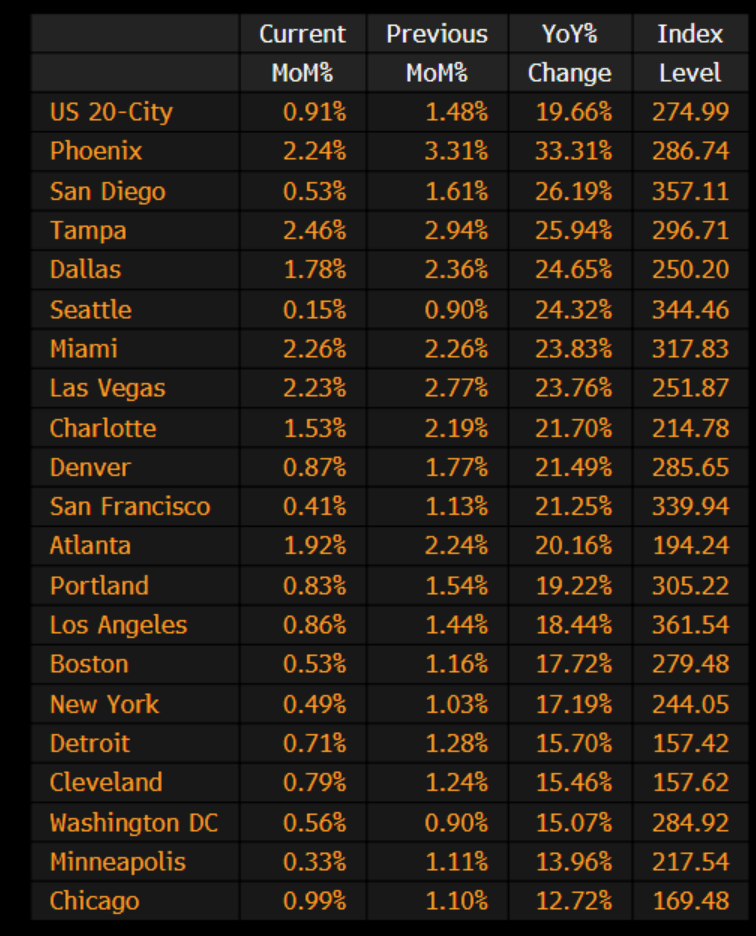
US Home Prices Still Soaring! Case-Shiller National HPI UP 19.84% YoY In August As Fed Stimulus Remains (Phoenix AZ UP 33.31%)

Between The Federal Reserve’s unorthodox monetary policy and insane spending from Congress and Biden Administration, we are seeing a near 20% rise in home prices for August.

Please note that pre-COVID the Case-Shiller home price index (national) was growing at 4%. Thanks to Fed Stimulypto, home prices are roaring at near 20% YoY.

Phoenix AZ home prices are growing at a 33.31% pace. The slowest growing? The US “shoot ’em up” capital, Chicago, is growing at 12.72% and is the slowest growing Case-Shiller 20 city.

I feel like I am living in the movie “Cloverfield” with The Federal Reserve as the uncontrollable monster.

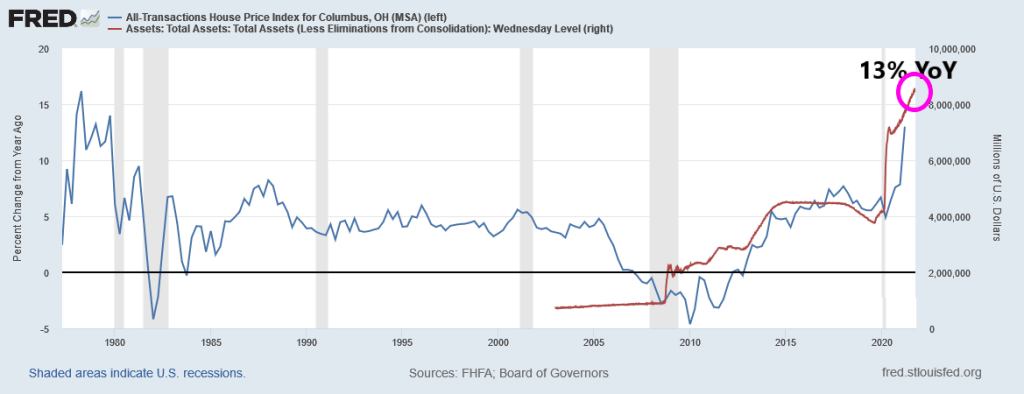
UPDATE: Columbus Ohio as of Q2 2021 is growing at a 13% YoY pace.

Are The Fed And Biden’s Vax Policies Creating A New Mortgage Tilt Effect? (Inflation-induced Unaffordability Problem)

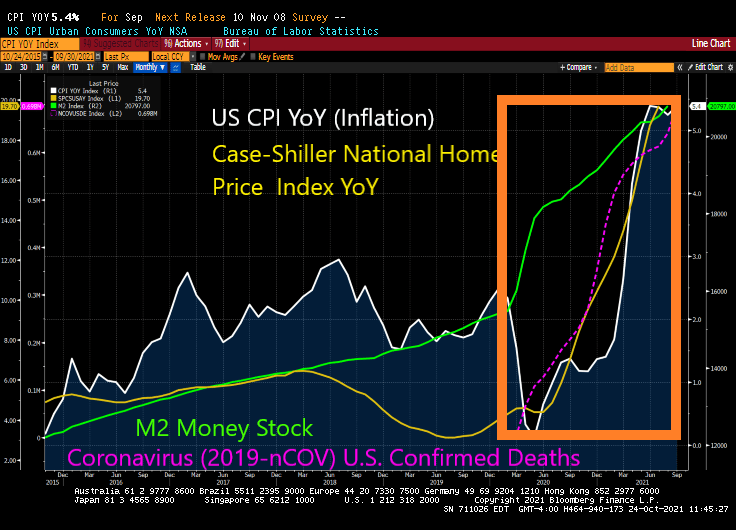
The Federal Reserve is helping to create inflation, particularly since their unorthodox surge in money supply around the Covid outbreak in early 2020. Home prices as of the latest Case-Shiller report are rising at nearly 20% year-over-year.

To add to the problem of The Fed’s overzealous money printing we have The Biden Administration (and puppy-torturer/killer Anthony Fauci) issuing Covid vaccine edicts that are wreaking havoc in labor markets further clogging the economic pipelines.

Between The Fed ZIRP policies and Biden/Fauci’s vax mandates, we are starting to see the rise (again) of the infamous MORTGAGE TILT EFFECT!

The Tilt Effect comes about as expected inflation gets priced into mortgage rates, the mortgage payment rises as the mortgage rate rises (of course), but the higher mortgage payment occurs with EXPECTED inflation in the future.

But not quite yet. Despite CPI inflation growing at 5.4% YoY, Freddie Mac’s 30-year mortgage survey rate is only 3.01% … for now.

As inflation continues to rise (thanks to ongoing Fed ZIRP policies and governments mandating Covid vaccine in order to keep your job, we should eventually see mortgage rates rise … leading to a return of THE TILT EFFECT. Which in turns make housing even MORE unaffordable.

We have tried numerous mortgage contracts in the past (mostly to offset Carter-era inflation) such as the PLAM (price-level adjusted mortgage) and the GPM (graduated payment mortgage). Now we have the PLUM (price level unadjusted mortgage) which is subject to the TILT EFFECT.

Homebuyer Demand Outstrips Supply As Mortgage Rates Creep Up (Demand Has Grown 15X Faster Than Supply Since 2019 And The Entrance Of The Fed And Federal Stimulus)

https://www.redfin.com/news/housing-market-update-pending-sales-up-47pct-from-2019/According to Redfin, forty-four percent more homes are pending sale than at this time in 2019, but only 3% more homes recently hit the market—down from 12% growth over 2019 just 7 weeks prior. As a result of the severe imbalance between the number of homes for sale and the number of buyers, the pace of the market is picking up at a time when it typically slows. A third of homes are finding buyers within a week of hitting the market, up from 30.8% at the end of the summer. This week, we’re comparing today’s market with the pre-pandemic fall market of 2019 to highlight how hot the market remains, even as most measures are settling into typical seasonal patterns.

“Comparing today’s sales and new listings numbers to the 2019 levels helps to reveal the stark shortage of supply we are facing,” said Redfin Deputy Chief Economist Taylor Marr. “The boost of housing supply that came on the market during the summer has already faded away, even as demand tapers off as we expected it to in the fall. Relative to the last ‘typical’ fall of 2019, demand remains steady and strong thanks to the increased urgency many buyers have as mortgage rates inch up. Rising rates also make buyers more price sensitive, so homes that are priced right are increasingly likely to receive offers right away.”

Shortage of supply, indeed. It is a mystery to me why the supply of homes for sale is not matching the demand.

But what happened after 2019? COVID and the entrance of massive Federal Reserve and Federal government stimulus. With limited supply hitting the market, home prices soared with the government stimulus.

We are likely to see rising prices until Federal Stimulypto stops or at least slows.