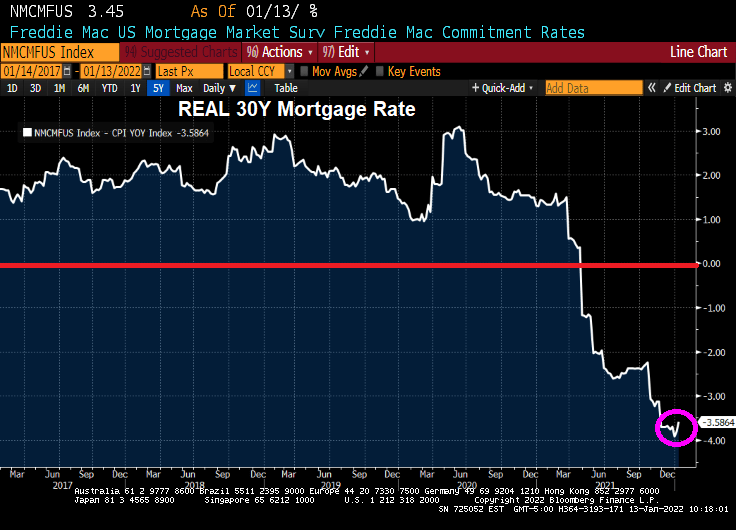
Mortgage Rates in the U.S. Soar to the Highest Since March 2020 (3.45% Nominal Rate, -3.59% REAL Rate)

Mortgage rates in the U.S. rose for a third straight week, reaching the highest point in almost two years. 

The average for a 30-year loan was 3.45%, up from 3.22% last week and the highest since March 2020, Freddie Mac said in a statement Thursday.

Rates tracked a jump in yields for 10-year Treasuries, which climbed to levels not seen since early 2020, before the pandemic roiled financial markets. Signs point to borrowing costs rising further as the job market improves and the Federal Reserve steps up its efforts to tame inflation.

That would increase the burden on homebuyers who are already stretching to afford a purchase. Rates for 30-year mortgages tumbled to a record low of 2.65% a little more than a year ago.

Cheap loans have helped fuel a housing rally that’s still running hot even as home prices soar out of reach for many Americans.

But wait! The REAL 30-year mortgage rate (nominal 30-year rate – CPI YoY) is -3.59%.
Lael Brainard, Biden’s nominee to be Vice Chairman of The Federal Reserve, has been one of the “inflation is transitory” crowd. US Senator Toomey is questioning Brainard in today’s hearing. From Toomey’s opening statement:

Last year, Governor Brainard repeatedly insisted that inflation was transitory. We have now had nine consecutive months where inflation has been more than two times the Fed’s 2% target. That makes it pretty clear that inflation is not transitory. Yesterday’s CPI release of 7.0%—the highest in 40 years—confirms that.

Inflation is a tax that is eroding Americans’ paychecks every day. Even though wages are growing, inflation is growing faster and causing workers to fall further and further behind.

At least the REAL mortgage rate is negative!

I hope Senator Toomey shows Brainard this chart of “transitory” negative wage growth.

Negative wage growth and negative REAL mortgage rates. What a total mess!
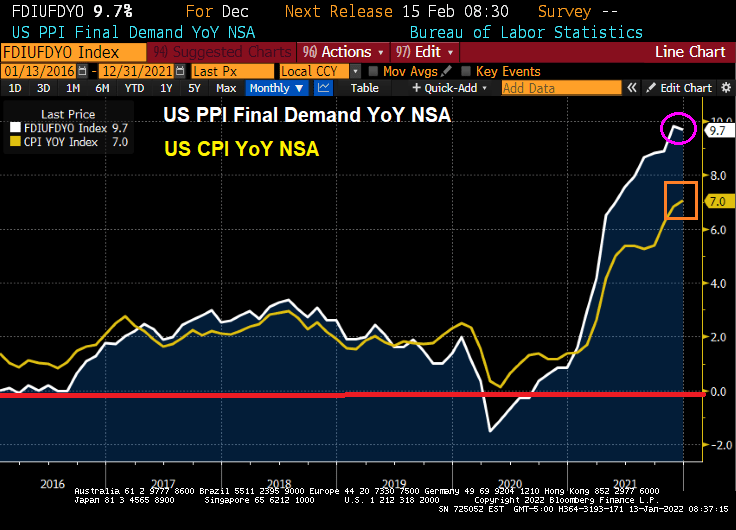
Inflation Nation! US PPI Final Demand Soaring At 9.7% YoY As CPI Soared 7.0% YoY (Energy Prices Lessened In Q4 But Are Surging Again In 2022)

Yesterday’s inflation report was the worst in 40 years. But at least today’s Producer Price Index Final Demand is down slightly from November. But PPI Final Demand YoY is still roaring at 9.7%.

The producer price index for final demand increased 0.2% from the prior month and 9.7% from a year earlier, Labor Department data showed Thursday. The annual advance was the largest in figures back to 2010. 

Excluding the volatile food and energy components, the PPI climbed 0.5% in December and was up 8.3% from a year earlier. 

Too much Federal government spending, too much Fed monetary stimulus, Omicron helping created labor shortages, etc. But the real killer has been ENERGY prices. Note that natural gas, gasoline and WTI crude oil were falling in November/December helping to slow PPI growth by a smidge. BUT energy prices are skyrocketing in January. So … look for higher PPI in January.

Here is the painting by Thomas Hart Benton that drove “Brokeback Biden” to try to destroy fossil fuel production. Or at least this is Washington DC’s idea of what Oklahoma and Texas are like.

10Y Treasury Yield Climbs To Almost 1.8% As Mortgage Rates Rise, Cryptos Bitcoin & Ethereum Having A Bad 2022

2022 should be an interesting year as the wheels come off The Fed’s constant stimulation of markets.

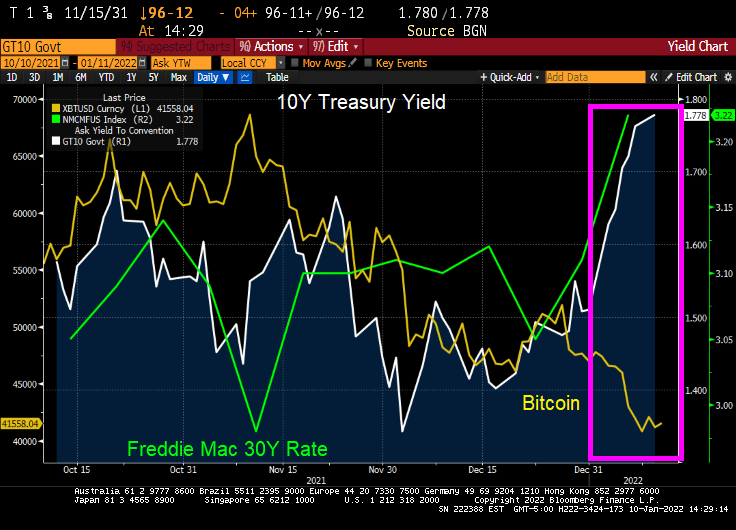
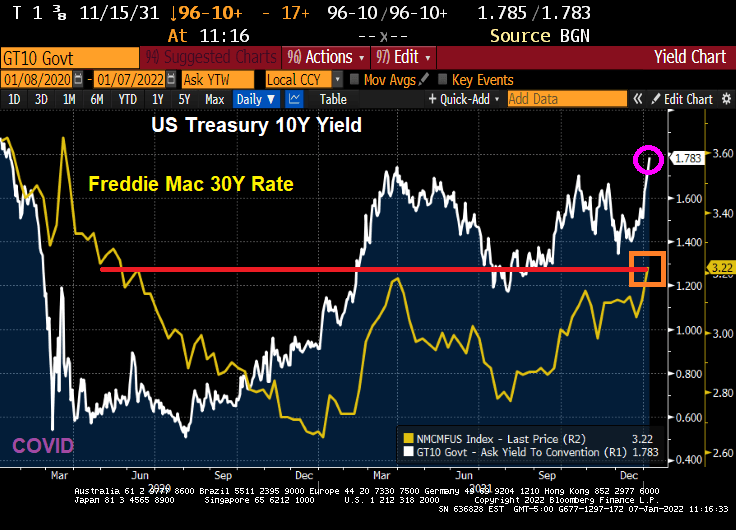
Today, we saw the 10-year Treasury Note yield almost hit 1.8% as mortgage rates rose to 3.22%.

Unfortunately for crypto investors, bitcoin is having a bad 2022. And ethereum is feeling some pain as well.

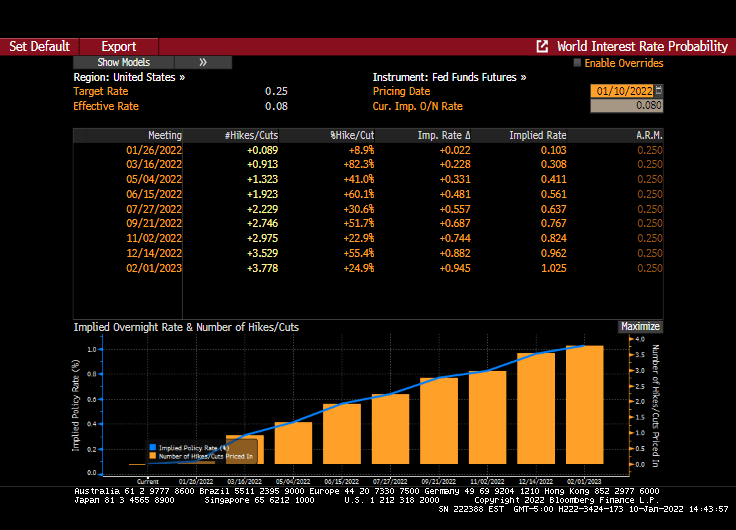
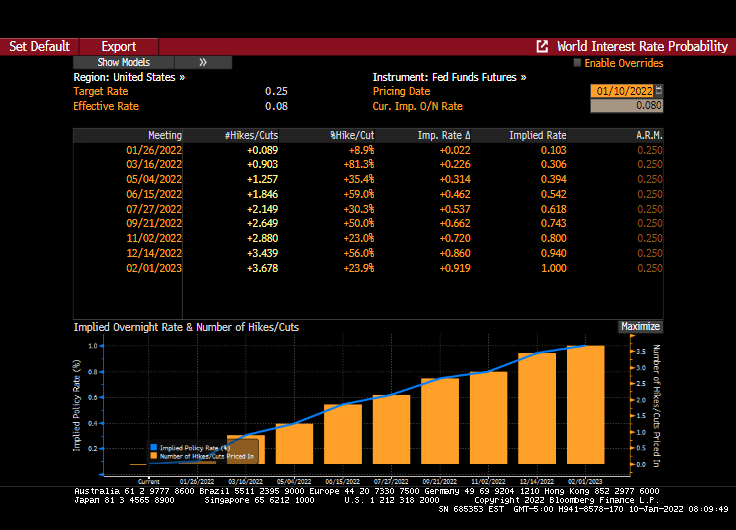
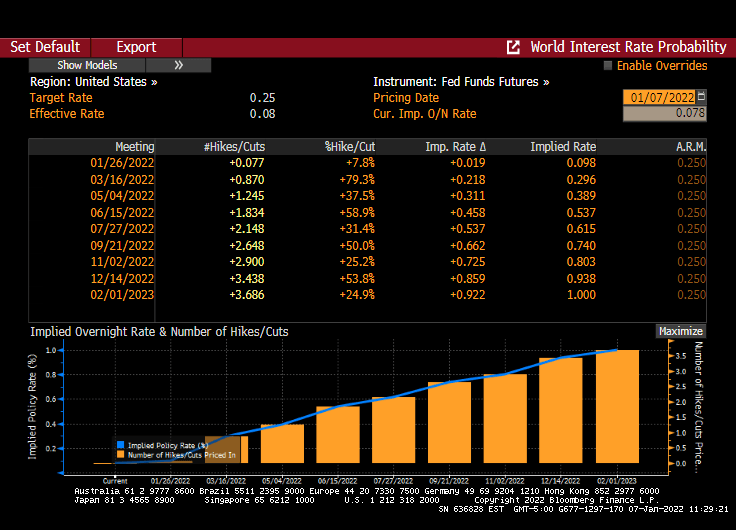
While Goldman Snakes predicted 4 rates increases in 2022, Fed Funds Futures are predicting almost 4 rates increases (3 in 2022 and 1 in Jan 2023 … almost).

So whatever is giving markets the jitters, I would follow the advice of Samuel L. Jackson from Jurassic Park: “Hold on to your butts.”

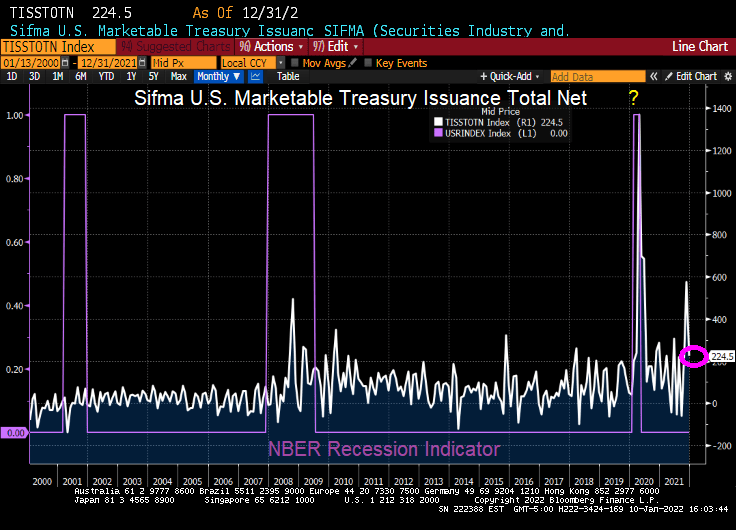
UPDATE: Did The Fed/Treasury seriously overreact due to COVID? Lool at Treasury issuance related to COVID recession versus the financial crisis (Great Recession) and the 2001 recession.

Birds Of War? Goldman Now Expects Four Fed Hikes, Sees Faster Runoff in 2022 (Negative Treasury Z-Scores)

Are The Fed voting members REALLY hawks? Or doves? Or just Birds of War?

(Bloomberg) — The Federal Reserve will likely raise interest rates four times this year and will start its balance sheet runoff process in July, if not earlier, according to Goldman Sachs Group Inc. 

Rapid progress in the U.S. labor market and hawkish signals in minutes from the Dec. 14-15 Federal Open Market Committee suggest faster normalization, Goldman’s Jan Hatzius said in a research note. 

“We are therefore pulling forward our runoff forecast from December to July, with risks tilted to the even earlier side,” Hatzius said. “With inflation probably still far above target at that point, we no longer think that the start to runoff will substitute for a quarterly rate hike. We continue to see hikes in March, June, and September, and have now added a hike in December.”


In its December meeting minutes, Fed officials signaled they are preparing to move quicker than the last time they tightened monetary policy in a bid to keep the U.S. economy from overheating amid high inflation and near-full employment. These conditions — along with a larger balance sheet that’s suppressing longer-term borrowing costs — “could warrant a potentially faster pace of policy rate normalization,” the minutes said.

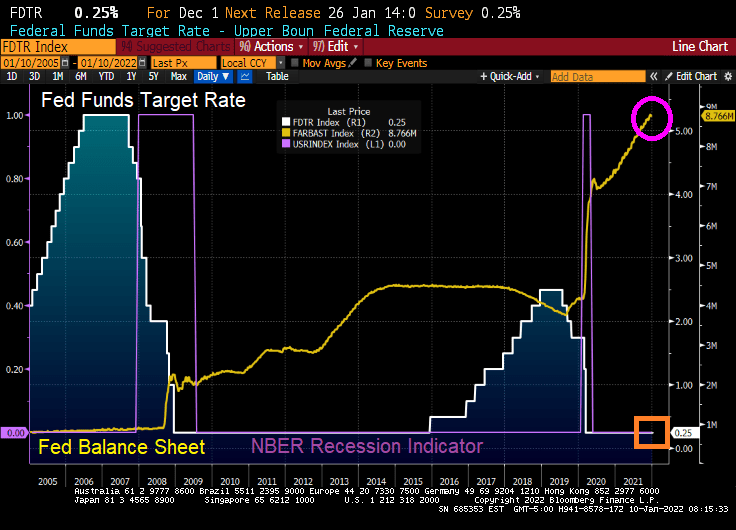
Officials also saw the timing of reducing the $8.8 trillion balance sheet as likely “closer to that of policy-rate liftoff than in the committee’s previous experience,” according to the minutes.

While Goldman sees 4 rate hikes in 2022, The Fed Funds Futures market only sees 3 rate hikes and the Fed Funds target rates hitting 1% by Feb 2023.

An increase to 1%? The Fed Funds target rate hit 5.25% during the housing bubble in 2006/2007 and markets are worried about an increase to 1%??

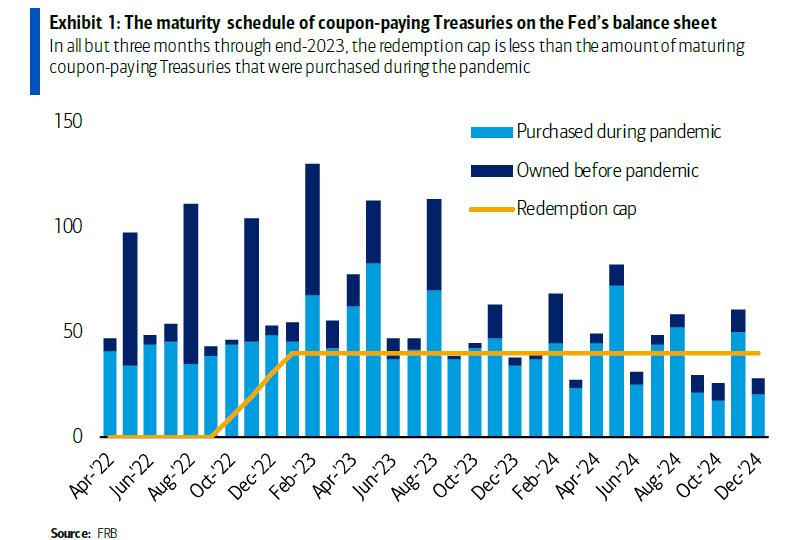
So, Goldman thinks that there will be faster “run-off” than expected. This simply means that The Fed will allow Treasuries and Agency MBS to mature rather than actually sell securities.

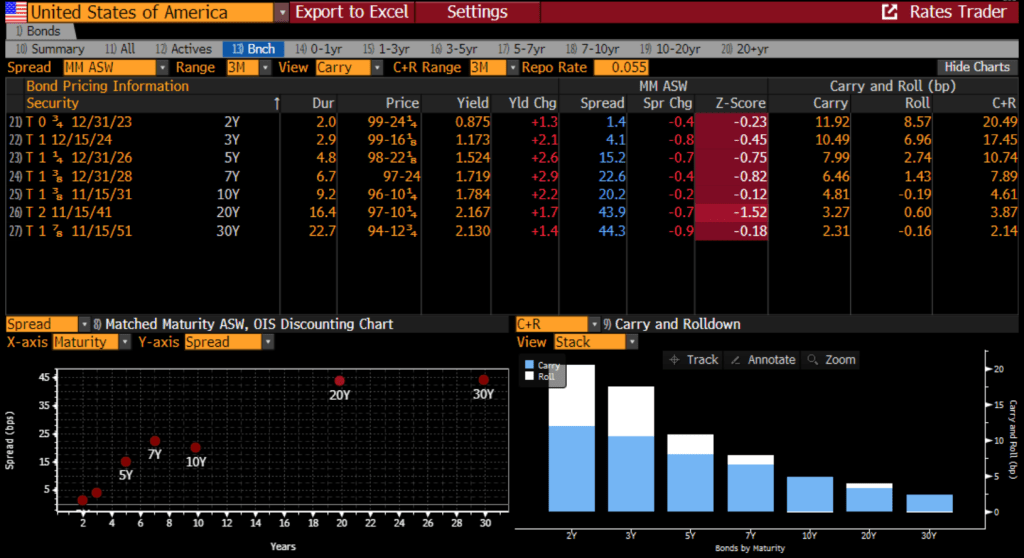
With the expectation of Fed activity, z-scores for Treasuries are negative across the board.

So we shall see if The Fed Open Market Committee are hawks, doves or “birds of war.”

Home Ownership More Affordable Than Renting in Majority of U.S. Housing Markets (Except Where I Live, Of Course)

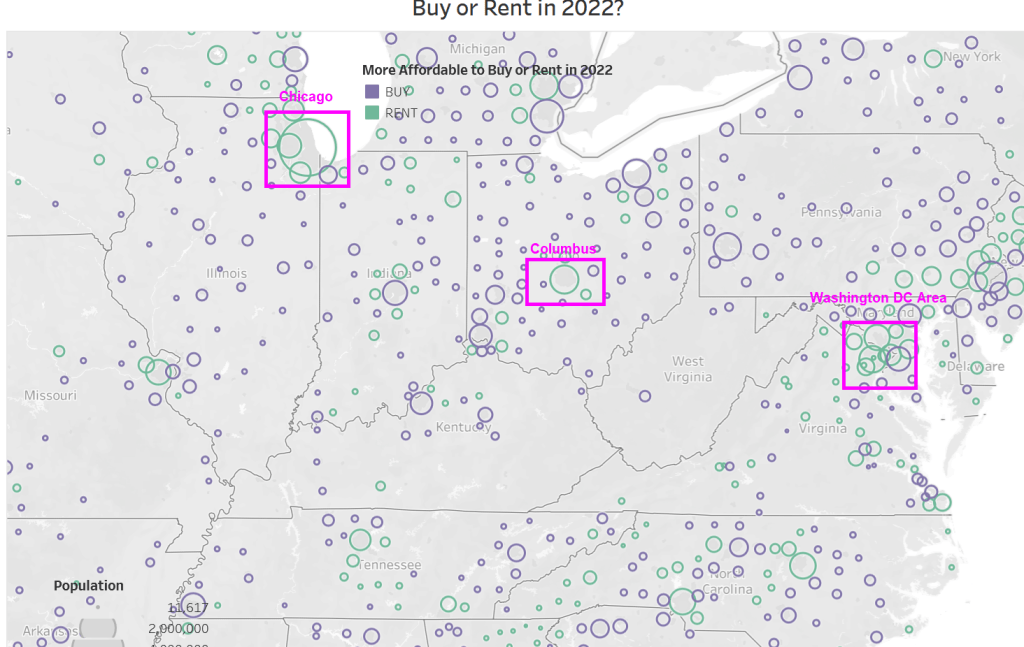
According to Attom, US home prices are growing faster than rents in nearly 90 percent of the nation; but prices are still more affordable in almost 60 percent of U.S. markets; Renting remains more financially viable in most-populous urban areas.

If we look at Attom’s map of affordability, you can see that in western states, it is more affordable to rent. And in megalopolis (Boston, New York, Philadelphia, Washington DC). And Miami. But elsewhere in the eastern states, it is more affordable to buy than to rent.

Of course, any where I live like Phoenix, Fairfax VA, Chicago IL, and Columbus OH it is more affordable to rent than to own.

You will notice that the areas where buying is more affordable than renting tend to be smaller towns with slower growth, while larger cities tend to be more affordable to rent.

People Get Ready! Value Stocks UP For 2022 While Growth Stocks DOWN (As Fed Expected To Withdraw COVID Stimulus)

People Get Ready! There’s a train a coming. Its called The Federal Reserve.

The market is pricing in 3 rate increases in 2022. And perhaps a faster than expected withdrawal of balance sheet stimulus.

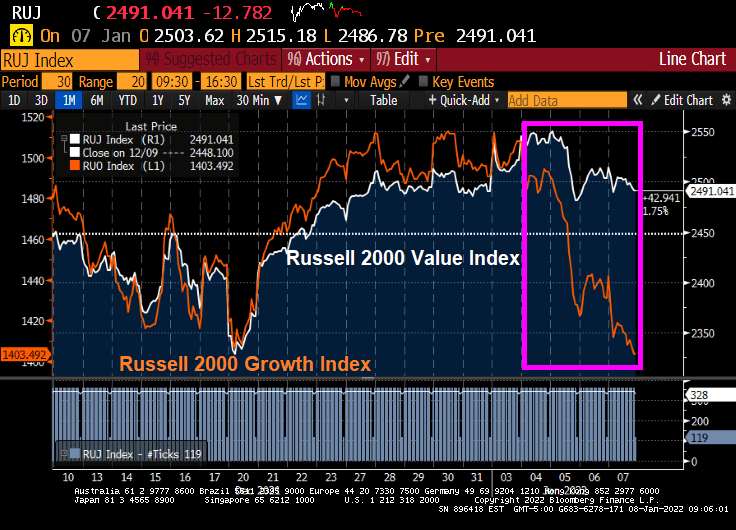
As a result, The Russell 2000 Growth index is plunging (orange line) relative to the Russell 2000 Value index (white line) which is down in 2021.

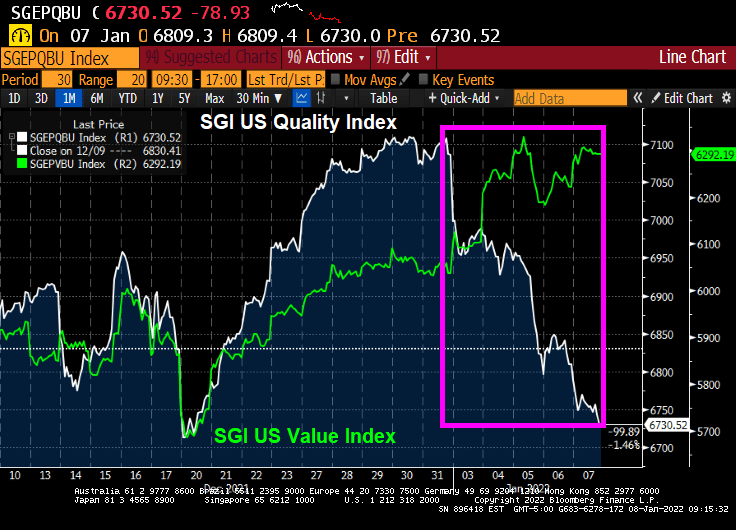
The Société Générale (SGI) US value and “quality” indices are telling the same story. The SGI US “Quality” index is falling like a paralyzed falcon while the SGI US Value index is up for 2022.

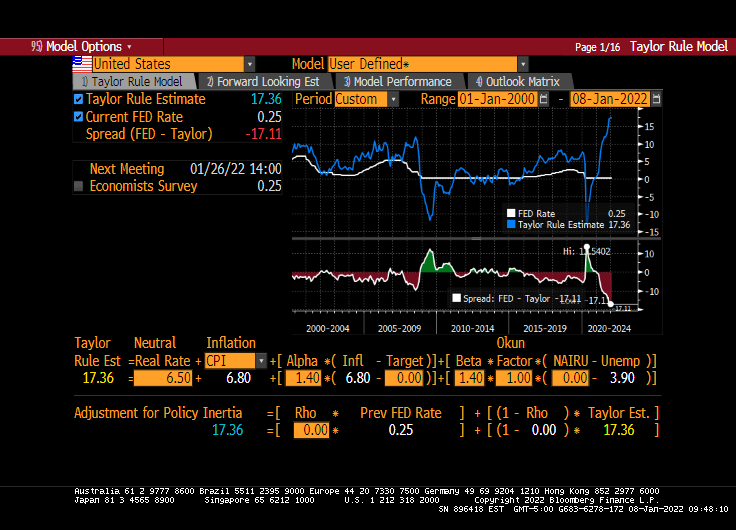
It is somewhat mystifying that markets would be soooooo sensitive to 3 rate increases from The Fed, particularly since the Taylor Rule suggests that The Fed’s target rate should be 17.36%. Even if you don’t like the Taylor Rule or disagree with its inputs, you must admit that the gap between where The Fed is (0.25%) and where they should be (17.36%) is … k-razy.

But here is where we sit.

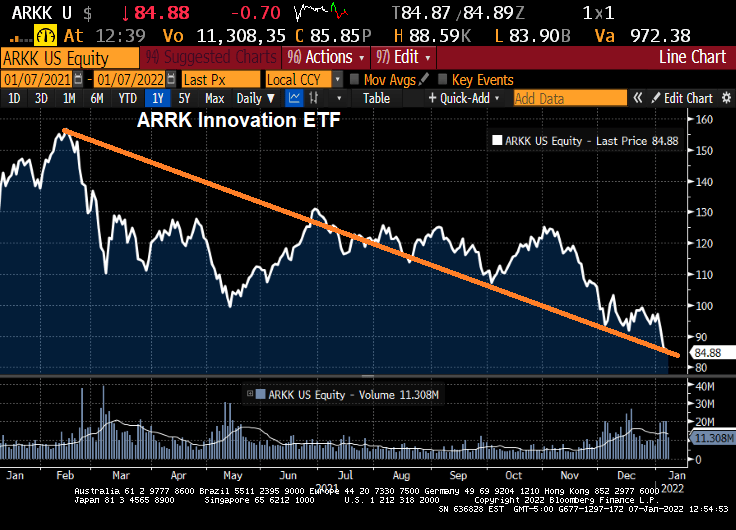
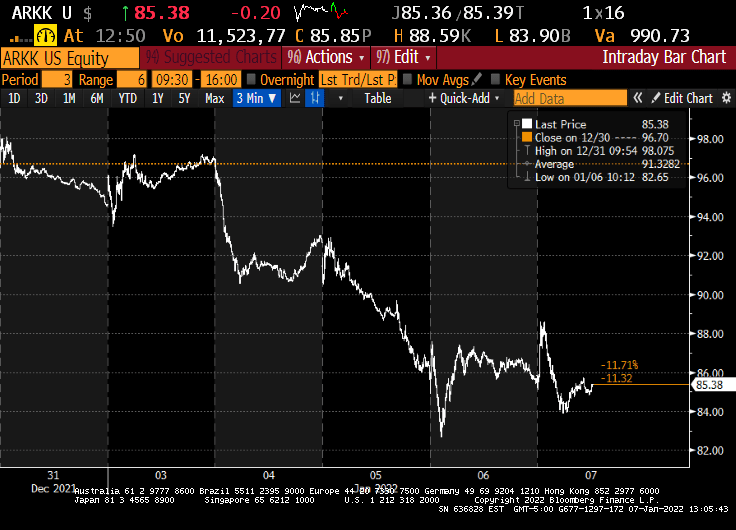
Is ARKK A Dog? ARRK Innovation ETF Down 46% Since Fed 12 (BARKK?)

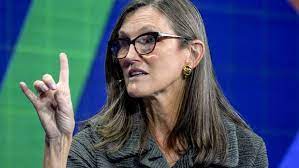
Is Cathie Wood’s flagship fund a dog? Maybe she should rename it BARKK.

ARRK Innovation ETF is down 46% since Feb 12, 2021.

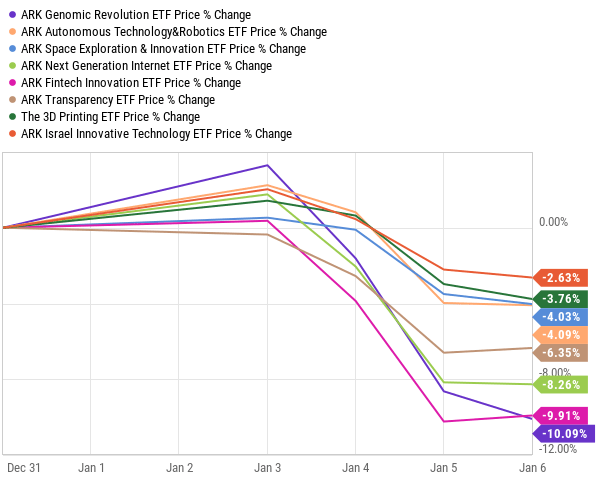
And this year? Same ETF, same dog.

The ARK universe should be renamed the BARK universe.

Way to go Cathie!

10Y Treasury Yield Climbs To 1.783% As Mortgage Rate Hits 3.22% (Highest Since May 2020) As Soaring Nominal Wage Growth Hits

It looks like markets are buying into the prospect of The Federal Reserve raising rates three times (Bob) in 2022. And ceasing COVID monetary stimulus.

Today, the 10-year Treasury yield rose to PRE-COVID levels of 1.783%. And the Freddie Mac 30-year mortgage commitment rate rose to 3.22%, the highest since May 2020.

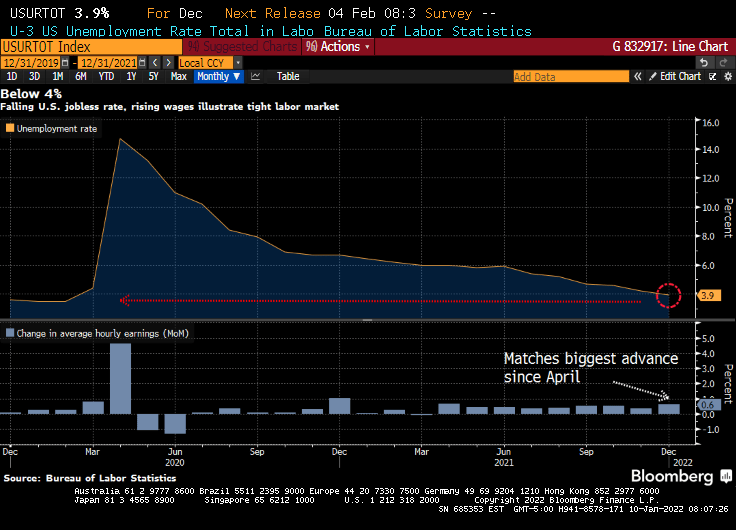
Today’s rising wage rates (although negative in terms of REAL wage rates) will likely put a Peruvian fire under The Fed’s behind. As of this morning, Fed Funds Futures are still pointing to three rate increases in 2022 (May, July and December).

And The Fed is supposed to be winding down the COVID monetary stimulus.

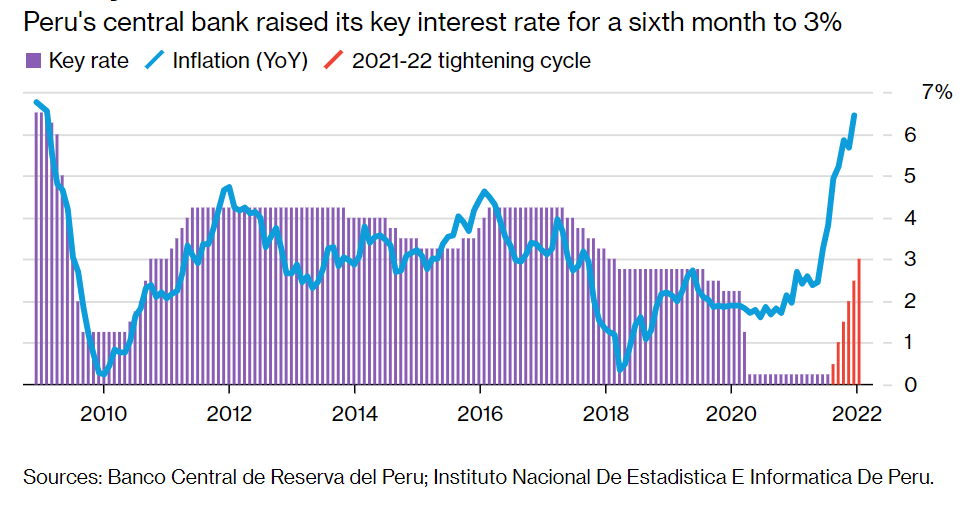
Why a Peruvian fire? Even Peru’s central bank is raising its key interest rate to 3% after soaring inflation.

Let’s see if Powell and The Gang follow through … or reveal themselves to be Peruvian Chickens.

Real Estate Hedge Against Inflation? Housing And REITs Did Better Than Inflation, NCREIF Not So Much

Now that inflation has reared its ugly head, how can investors protect themselves against the ravages of inflation?

Back in 1977, Fama and Schwert showed that housing acted as a hedge against inflation. Over the past year as inflation has reached its highest levels in 40 years, home prices have outpaced inflation by 19.08% to 6.8%.

How about real estate investment trusts? The NAREIT all-equity index rose by 35.6% YoY while inflation rose at 6.8%. The S&P 500 index rose 28.9% YoY.

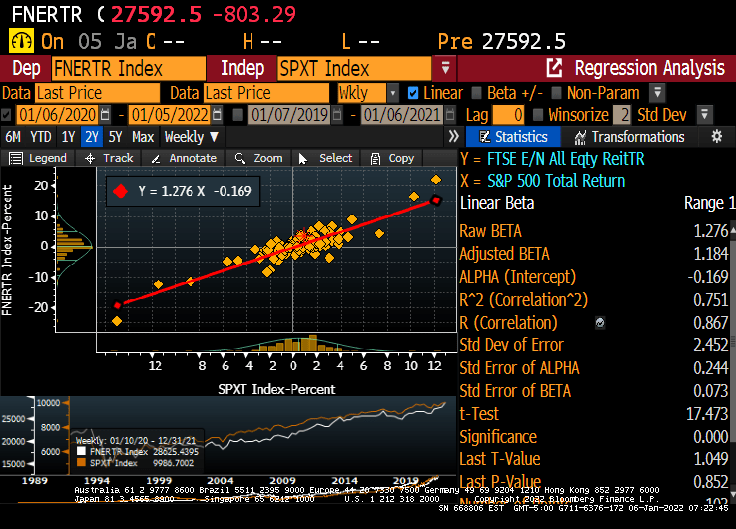
Of course, the NAREIT all-equity index has a beta of 1.276.

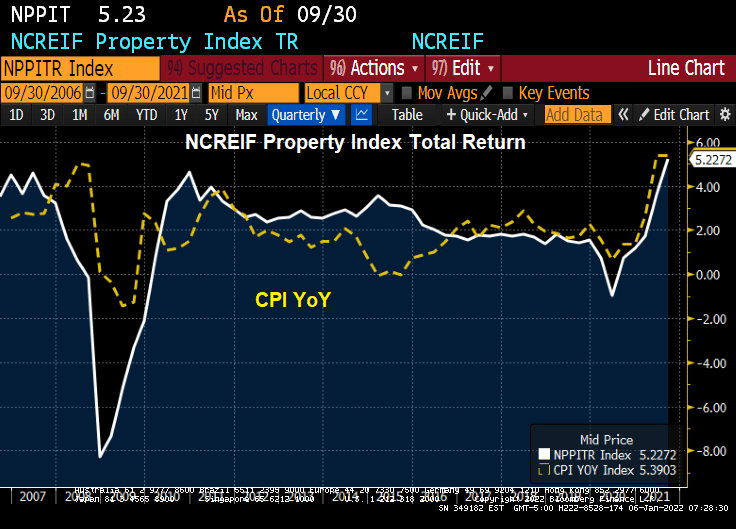
How about the NCREIF All-property commercial real estate index? For Q3, the NCREIF property index rose by 5.22%, less than the most recent inflation reading of 6.8%.

So for the past year, housing has beaten the pants-off inflation, REITs have earned a higher return than inflation, and the NCREIF index seems to be rising slower than inflation (but with its lag problems, I anxiously await the Q4 numbers which should be higher.

Fed Minutes Flag Chance of Earlier Hikes, Balance-Sheet Rundown (When Jay Powell Speaks, People Listen [Dow Drops, 10Y T-yield Increases])

Federal Reserve officials said a strengthening economy and higher inflation could lead to earlier and faster interest-rate increases than previously expected, with some policy makers also favoring starting to shrink the balance sheet soon after.

“Participants generally noted that, given their individual outlooks for the economy, the labor market, and inflation, it may become warranted to increase the federal funds rate sooner or at a faster pace than participants had earlier anticipated,” according to minutes published Wednesday of the Dec. 14-15 meeting of the U.S. central bank’s policy-setting Federal Open Market Committee, when it pivoted to a more aggressive inflation-fighting stance.

“Some participants also noted that it could be appropriate to begin to reduce the size of the Federal Reserve’s balance sheet relatively soon after beginning to raise the federal funds rate,” the minutes said.

The S&P 500 stock index extended declines following the release and was on track for its biggest loss in more than a month. Treasuries also extended losses and the dollar pared its decline.

At the conclusion of the December meeting, the FOMC announced it would wind down the Fed’s bond-buying program at a faster pace than first outlined at the previous meeting in early November, citing rising risks from inflation. The new schedule puts the central bank on track to conclude purchases in March.

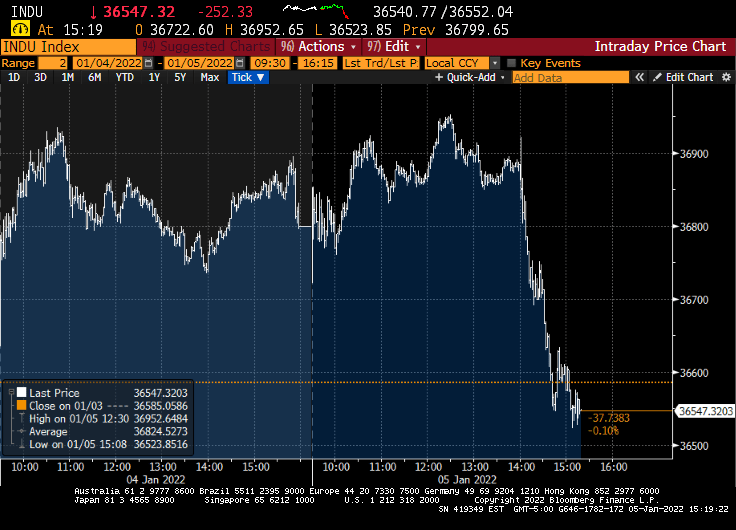
And with the minutes released, the Down dumped.

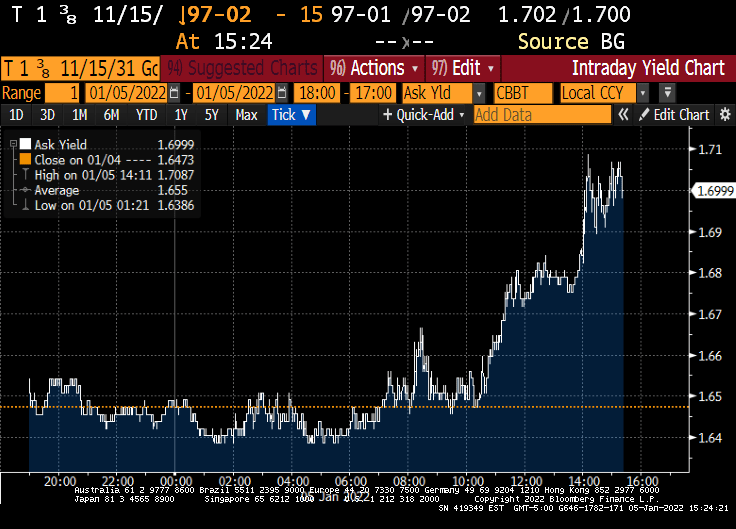
And the 10-year Treasury yield jumped 5.3 bps on the release.

When Jerome Powell speaks, people listen.