US Existing Home Sales Median Price Slows To 17.8% YoY In July On Continued Low Inventory For Sale (EHS Increased To 5.99M SAAR)

Feeling hot, hot, hot. Housing, that is!

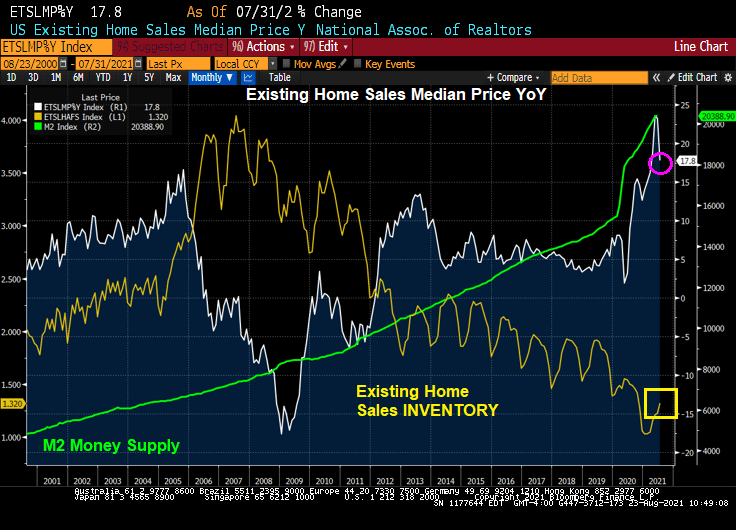
US existing home sales in July rose to 5.99 million SAAR, beating expectations. But the inventory of home available for sale remains low by historic standards.

The median price of existing homes declined to 17.8% YoY with The Federal Reserve pumping money into the system like there is no tomorrow.

Bloomberg had the following headline: “Sales of Existing Homes in U.S. Rise as Inventory Picks Up.” While that is a true statement, existing home sales inventory is still down 12% YoY.

I wonder if the attendees at the Jackson Hole Fed conference will be discussing the gut-wrenching home price growth? Rumor has it that Fed Chair Powell will use J-Hole as a platform to suggest paring back on the monetary stimulus.

Alarm! Hindenburg Omen Flashes Warning … Again! As Does The Buffet Indicator And Shiller’s CAPE Ratio

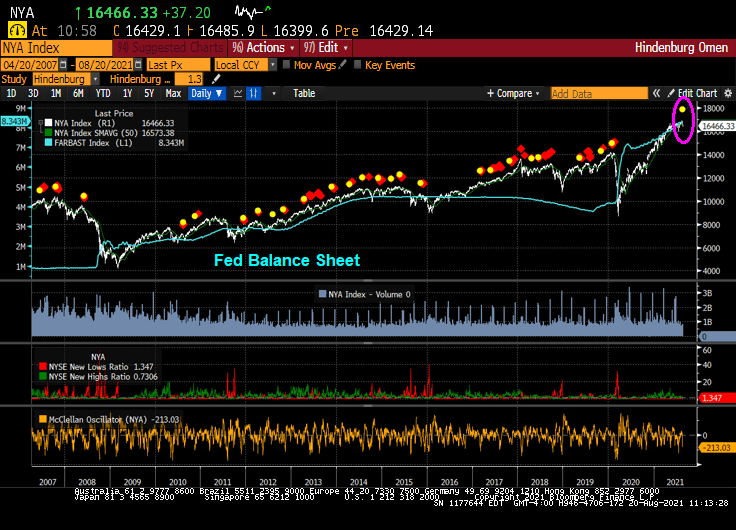
The famous Hindenburg Omen, the technical indicator that predicted the 2008 correction in the stock market, has just flashed “ALARM” again.

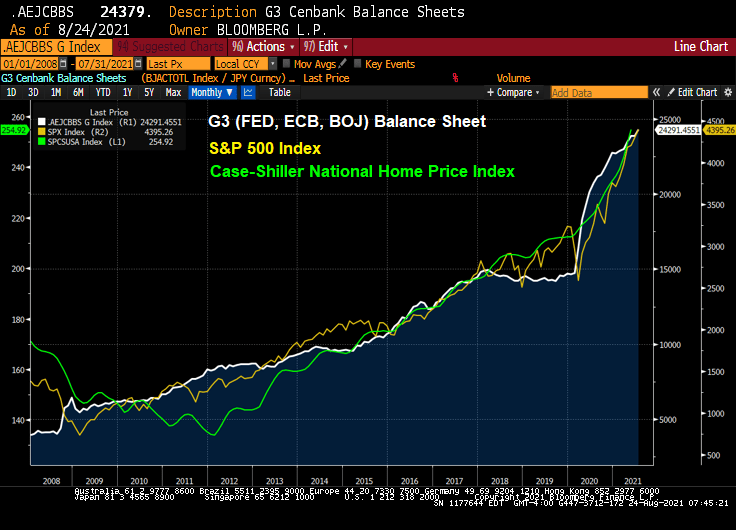
To be sure, there hasn’t been a major correction in the stock market since the financial crisis, primarily because The Federal Reserve has constantly goosed the markets since late 2008.

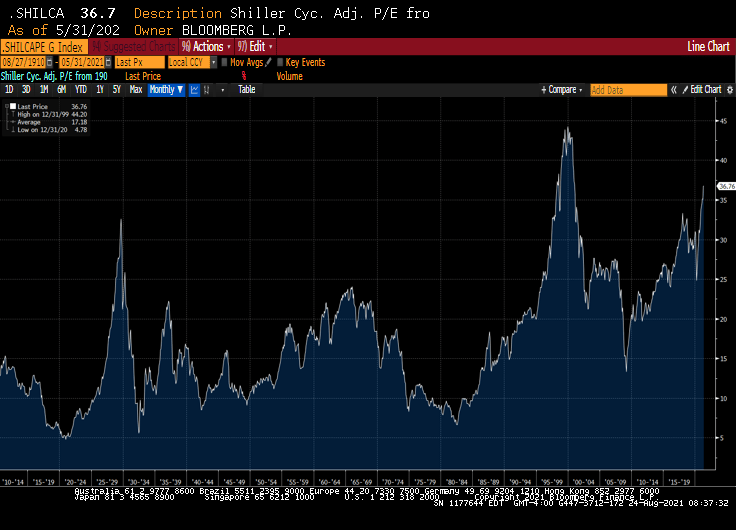
Just as the Shiller CAPE ratio is signalling ALARM!

As is the Buffet Indicator.

I have no doubts that the Fed will withdraw its monstrous stimulus from the market after the Jackson Hole Fed conference. … NOT!!!!

Maverick Capital posted this nugget today showing The Buffet Indicator (US equity market cap/GDP) and US Corporate Profits / GDP. All I can say is “simply unsustainable.”

Treasury And Mortgage Rates In A Never-Ending Balance Sheet World (REAL Mortgage Rates NEGATIVE With Skyrocketing Home Prices)

Headline! “Fed’s Kaplan says delta variant could cause him to rethink his tapering view”

Face it, the Federal Reserve may alter its growth path on asset purchases of Treasuries and Agency Mortgage-backed Securities, but it is doubtful that they will pare back their balance sheet. Call it “A Never-ending balance sheet for you” world.

Why? Seemingly never-ending Covid crisis, etc.

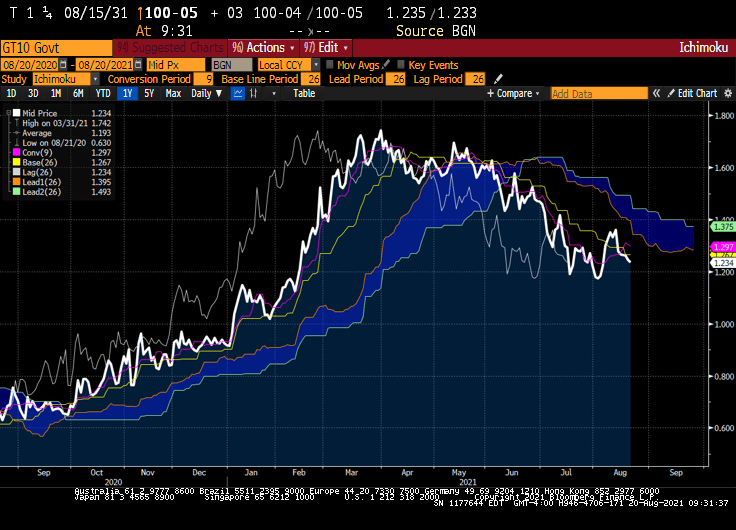
Let’s look at US Treasury yields today. The 10-year Treasury yield is up slightly to 1.25% as of 10am EST.

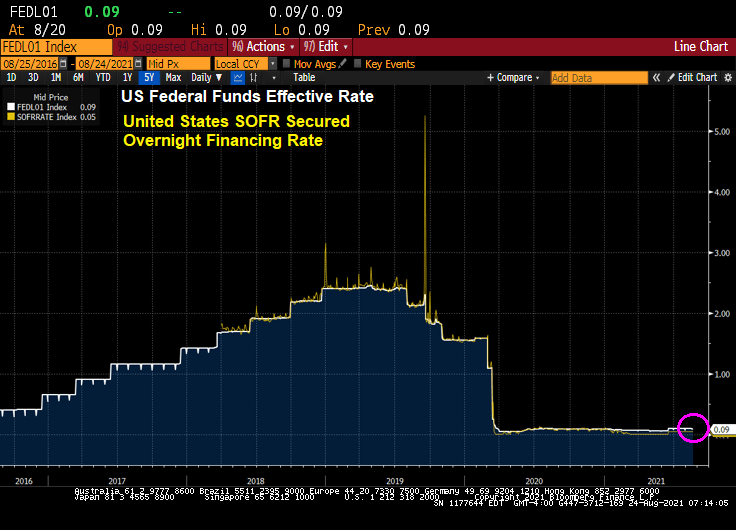
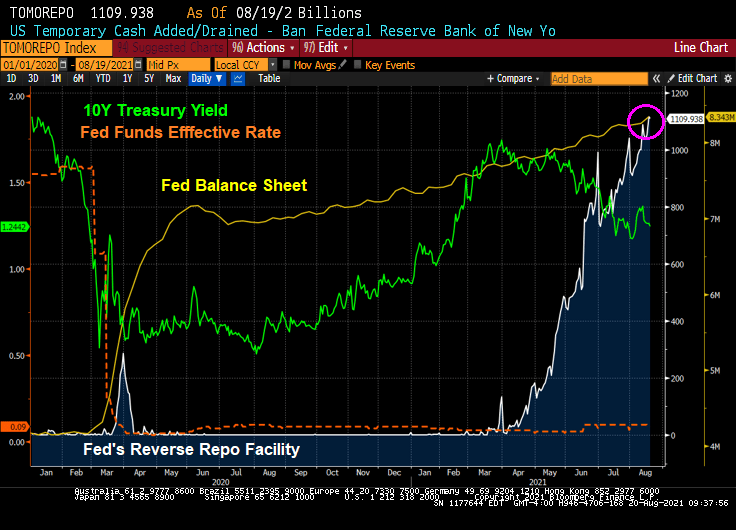
Here is a chart of the 10-year Treasury yield, Fed Funds effective rate, Fed Balance sheet and reverse repos since the Covid outbreak and Fed massive intervention. Bottom line, the have repressed the short-term interest rates and put downward pressure on the 10-year Treasury yield.

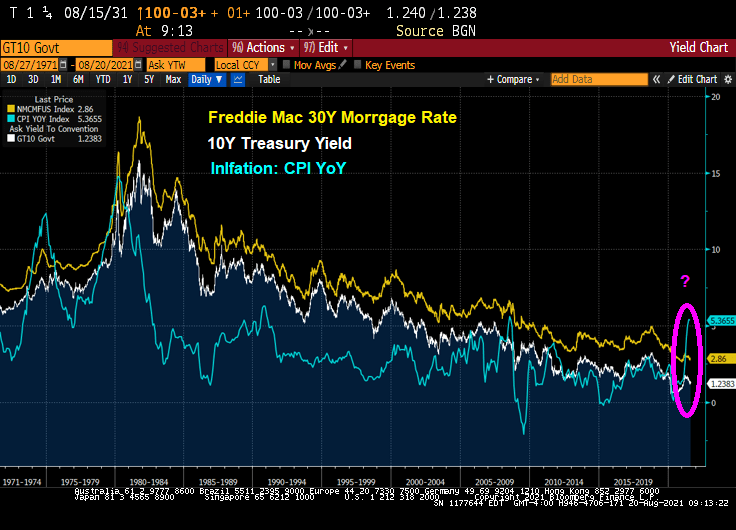
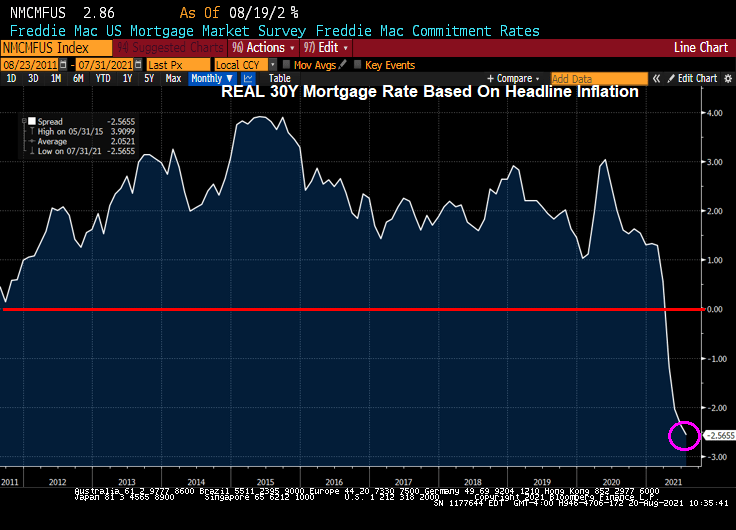
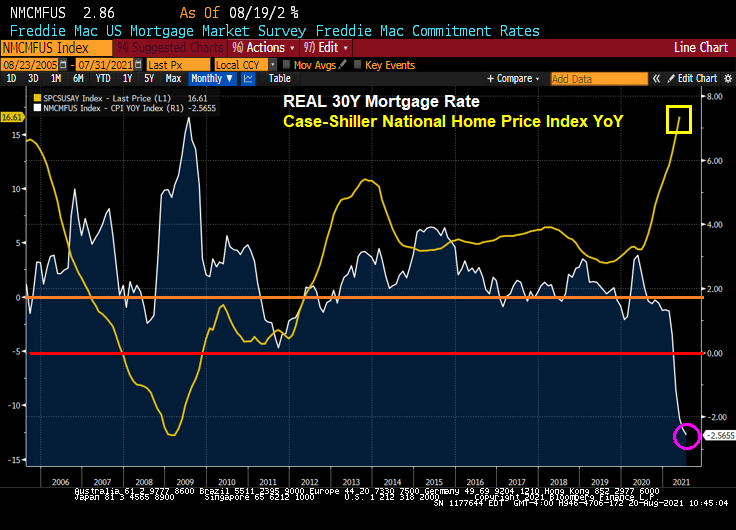
As the 10-year Treasury yield remains repressed DESPITE HIGHEST INFLATION RATE SINCE 2008, the Freddie Mac 30-year mortgage rate remains repressed as well. Yes, that mean NEGATIVE REAL MORTGAGE RATES.

This produces a REAL mortgage rate of -2.56%.

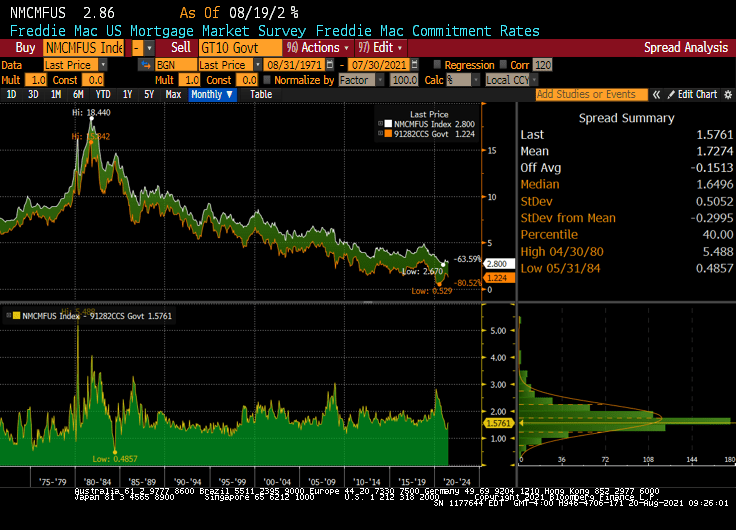
The spread of mortgage rates over the 10-year Treasury yield is about 173 basis point since 1971.

Where will Treasury yields go from hear? If we believe technical analysis like the Ichimoku Cloud, the 10-year Treasury rate will likely rise.

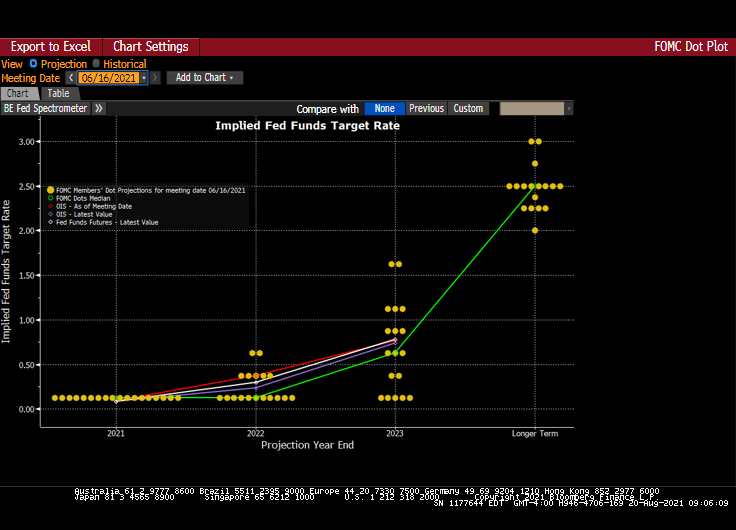
And The Fed’s Dots project also see rates rising (at least on the short-end.

Negative real mortgage rates and blistering home price growth?

Will the attendees at the KC Fed Jackson Hole conference discuss these matters? Or will it just be a Federal Reserve Soul Shake (dance)?

Fed Minutes: Taper Begins IFF Covid Doesn’t Harm Economy, Or An Arquillian Battle Cruisier Or (Fed Reverse Repos Keep Climbing)

To quote Tommy Lee Jones from the film Men In Black “There’s always an Arquillian Battle Cruiser, or a Corillian Death Ray, or an intergalactic plague that is about to wipe out all life on this miserable little planet, and the only way these people can get on with their happy lives is that they DO NOT KNOW ABOUT IT!”

That is what The Fed essentially said in their minutes, but not in so many words.

The minutes of the July Fed meeting suggest officials may signal an impending start to asset purchase tapering at the September gathering — provided jobs numbers remain on track in the interim — and make an announcement in November.

Rising infections counts have not spurred an uptick in new jobless claims. High-frequency data show some customers are shying away from eating out, but the overall impact on restaurant reservations is limited. The bigger challenge for many companies is retaining and hiring enough workers to meet strong demand, evident in low layoff counts and persistent mention of labor shortages.

In other words, IFF Covid doesn’t cause further economic damage (or governments don’t shut down economies), then The Fed will consider a mild taper of their balance sheet.

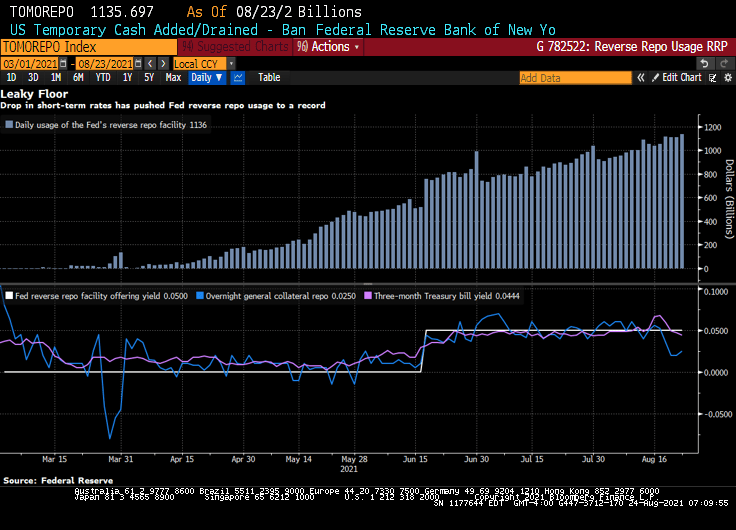
But as of this morning, The Fed’s reverse repo facility keeps on rising along with The Fed’s balance sheet. At least M2 Money Supply growth has leveled off.

That should result in an increase in Treasury yields and mortgage rates, all things being equal. And assuming the Biden Administration and governors don’t panic and go into economic lockdown … again.

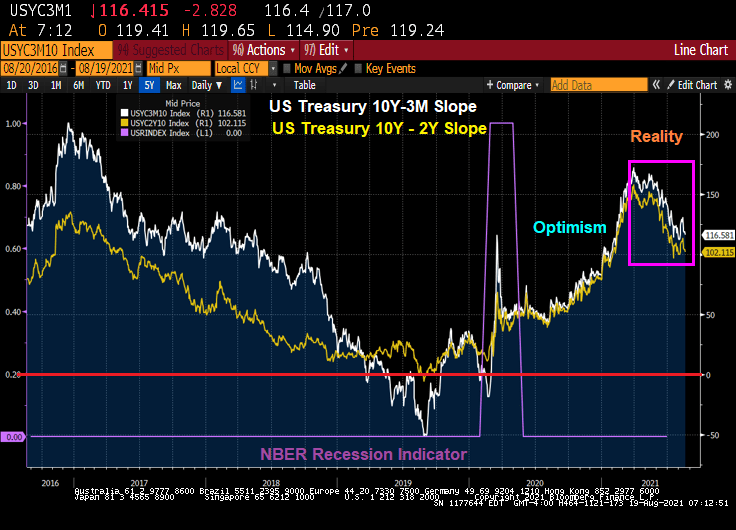
The US Treasury curves since the Covid recession of 2020 have shown optimism in recovery … then reality dawned.

The Federal Reserve Board of Governors meeting

Initial Jobless Claims And Continuing Claims Fall (Little Sign Of Covid Impacting Employment) Let The Taper Begin?

Well, it looks like The Fed will start tapering after all.

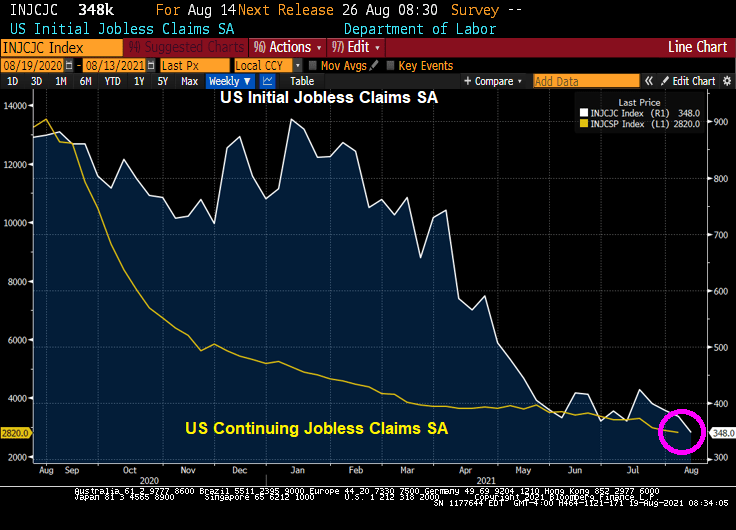
Initial jobless claims fell again to 348K and continuing jobless claims fell to 2,820K.

Unless Biden’s disastrous Afghanistan withdrawal sends shock waves through the global economy (or Covid Delta/Lamba variant strains get worse and hurt the economy), we should see The Fed start tapering their balance sheet.

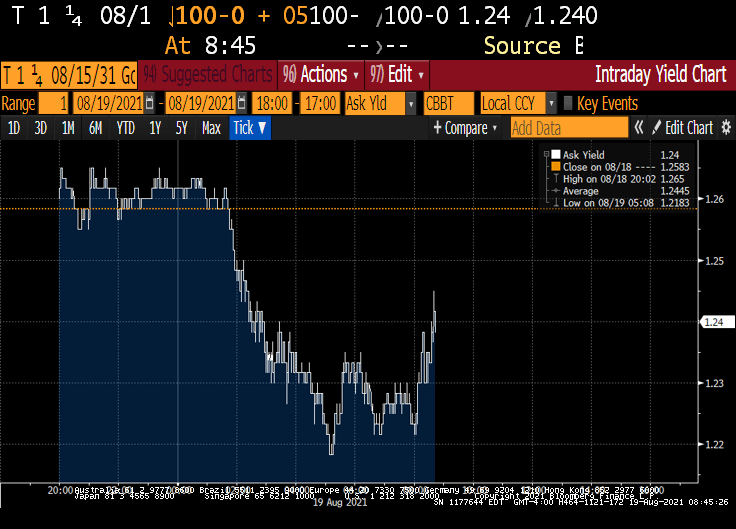
The 10Y Treasury yield rose slightly on the jobs report.

The Tapir, the symbolic mascot of The Fed’s tapering programs.

Fed’s $168.2 Trillion Nightmare That Powell Ignored In Written Testimony Before Senate Banking Committee (Bank Staggering Derivative Exposure)

Yes, Fed Chair Powell gave written testimony before the US Senate Banking Committee. He left out one important bit of information: US banks have $168.2 TRILLION in derivative exposure.

It could be that Chairman Powell had other things on his mind, like reverse repos over $1 trillion and a $8.26 trillion balance sheet.

United Wholesale Mortgage Plans To Begin Cryptocurrency Transactions In Q3 (Lender Accepts Cryptocurrency For Home Loans)

From Phil Hall at Benzinga:

United Wholesale Mortgage UWMC has announced plans to become the first national mortgage lender to accept cryptocurrency for home loans.

What Happened: CEO Mat Ishbia previewed the Pontiac, Michigan-based company’s expansion into the cryptocurrency realm during the second-quarter earnings call on Monday.

“We’ve evaluated the feasibility, and we’re looking forward to being the first mortgage company in America to accept cryptocurrency to satisfy mortgage payments,” Ishbia said. “That’s something that we’ve been working on, and we’re excited that hopefully, in Q3, we can actually execute on that before anyone in the country because we are a leader in technology and innovation.”

In an interview with the Detroit Free Press, Ishbia offered more details on which cryptocurrencies would be considered in transactions.

“I think we’re starting with Bitcoin, but we’re looking at Ethereum and others,” Ishbia said. “We’re going to walk before we run, but at the same time, we are definitely a leader in technology and innovation and we are always trying to be the best and the leader in everything we do.

“That’s the plan,” he added. “Obviously there’s no guarantees – we’re still working through some details. But absolutely.”

Why It Matters: One of the first homebuying deals in the U.S. involving cryptocurrency took place in 2014 with the $1.6 million sale of land in Lake Tahoe for a home site. The transaction was completed with payment via Bitcoin (CRYPTO: BTC).

However, the heavily regulated and risk-averse mortgage industry hasn’t embraced cryptocurrency. The government-sponsored enterprises that dominate the industry’s secondary market, Fannie Mae FNMA+ Free Alerts and Freddie MacFMCC+ Free Alerts, will not accept any transaction in a digital asset.

If UMC plans to package its cryptocurrency-based loans for secondary market sale, the borrower’s cryptocurrency payment would have to be converted into dollars and the borrower would need to provide documentation to verify ownership of the digital assets as part of the loan underwriting process.

US Homebuilder Confidence Drops To 13-Month Low As Building Material Prices Increase 19.4% Over Past Year

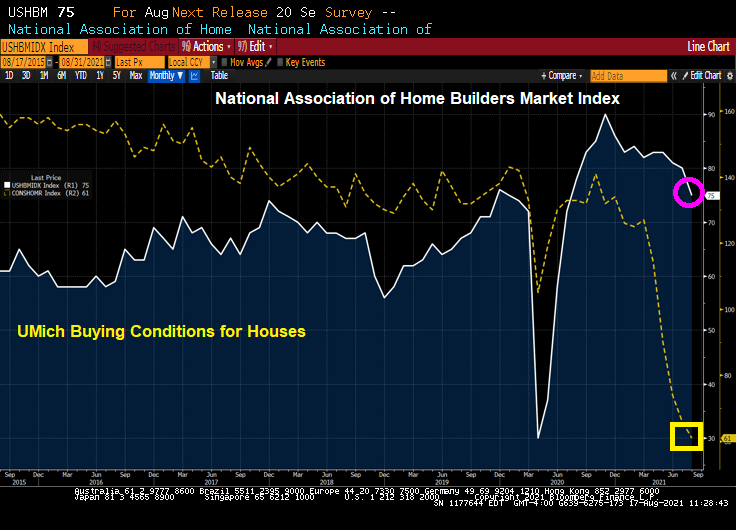
The NAHB Homebuilder confidence index dropped to a 13 month low as building materials rise by 19.4% YoY.

Of course, then we have the University of Michigan conditions for buying a home crashing as well.

Rising home prices and rising construction material costs? Yikes.

Of course, the NAHB had this to say:

“Our expectation is that production bottlenecks should ease over the coming months and the market should return to more normal conditions,” NAHB Chief Economist Robert Dietz said in a statement.

Perhaps, but The Fed needs to slow down its money printing as well.

The most powerful economists in the world?

Mortgage Investors Flood the Fed With Bonds for Sale (Fed’s O/N Rev Repo Purchases Still Above $1 Trillion)

(Bloomberg) — Last week was notable for the tsunami of agency mortgage bonds offered to the Federal Reserve during its routine purchase operations on Friday.

The central bank’s quantitative easing schedule called for it to buy $2.9 billion of 30-year uniform mortgage bonds Friday, and that was nothing outside of its usual pattern. However, mortgage investors flooded the Fed with $15.06 billion of bonds for sale, the largest daily amount offered during a single operation since April 1, 2020.

In terms of how that compares to the total amount purchased, investors offered 5.2 times as much as were eventually taken down by the central bank. That is well above the 2.3 times average for 30-year uniform mortgage bond operations seen during all of this round of quantitative easing, and the second-highest overall. The highest submission ratio was the 5.5 times seen on July 16, 2020.

There are a number of reasons this could have happened. Investors may have wished to lighten their positions before the summer doldrums of late August, when many desks are lightly staffed due to vacations. Also, tight sector valuations or concerns about a sooner-than-expected taper may have played a part.

While this may simply be a one-off event and no reason for concern, it is certainly something to keep an eye on in case it heralds a change in investor sentiment.

In related news, the Treasury’s overnight reverse repos purchases remain about $1 trillion.

S&P 500 Bubble Views: Buffett Indicator, Shiller CAPE, Ichimoku, Bollinger, Gold To SPX, SPX Versus Average Hourly Earnings (All Roads Point To Bubble)

There are a variety of measures of an asset bubble. And each one points to an unsustainable bubble in the stock market.

Let’s start with the Buffett Indicator. The ratio of Total Market Capitalization of all US stocks (WCAUUS ) to total nominal GDP of the United States (GDP CUR$ ).

There is also the GLOBAL Buffett ratio produced by Holger Zschäpitz. Global market cap now equal to 139% of global GDP, way above Buffett’s 100% bubble threshold.

Shiller’s Cyclically-adjusted Price-earnings ratio? Still climbing and resembles the Dot.com bubble of 2000.

How about gold to Average Hourly Earnings (similar to the Bichler and Nitzan “Power” measure. The spread (bottom chart) sees the S&P 500 index soaring away from average hourly earnings.

We also have the Gold to SPX ratio that is now back to pre-financial crisis levels.

How about the Ichimoku cloud, where the SPX is currently ABOVE the cloud?

SPX and Bollinger Bands? The SPX index is close to the upper band.

How about The Hindenburg Omen, a technical indicator that was designed to signal the increased probability of a stock market crash. It compares the percentage of new 52-week highs and new 52-week lows in stock prices to a predetermined reference percentage that is supposed to predict the increasing likelihood of a market crash.

So it looks like a have a bubble in the stock market.

Fed Chair Jerome Powell sees the ghost of the Dot.com bubble.