Housing Thunder? Pending Home Sales Surge 3.3% MoM (Highest Since Feb 2023)

Housing thunder? Or housing lightning!

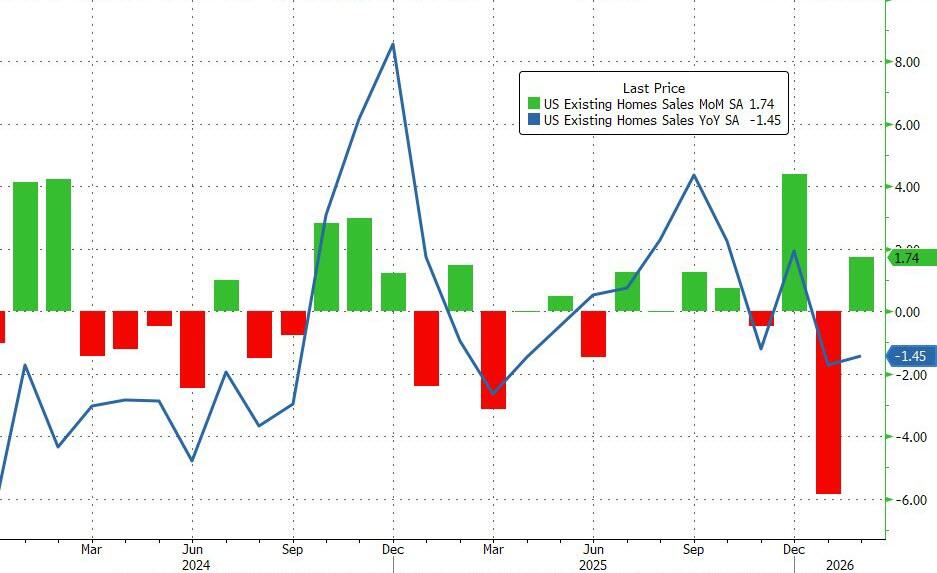
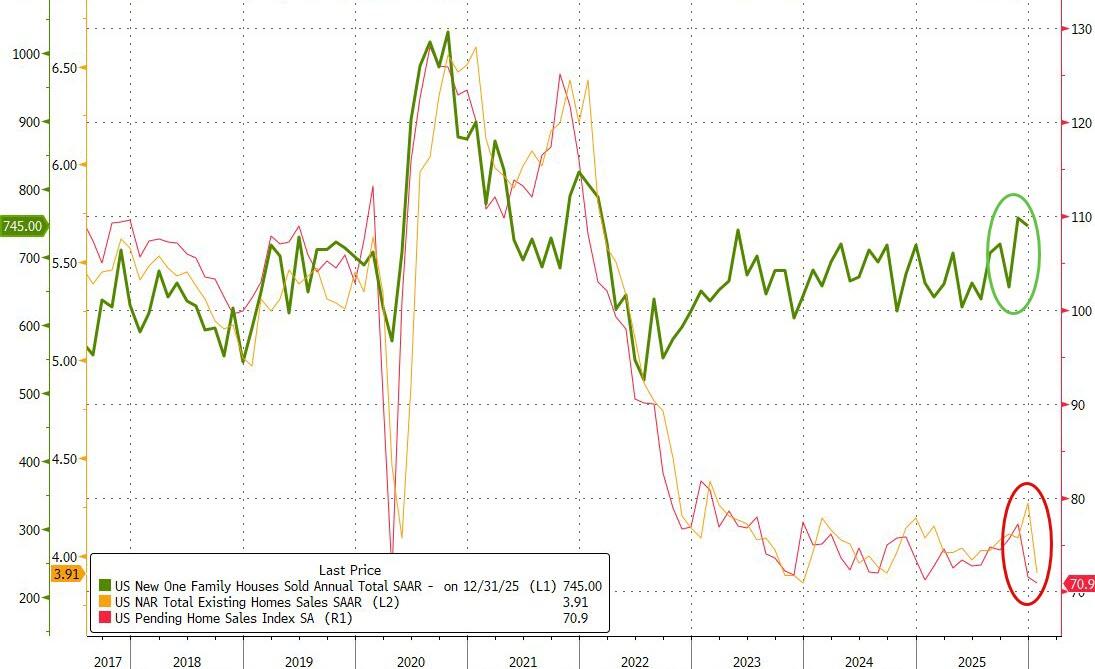
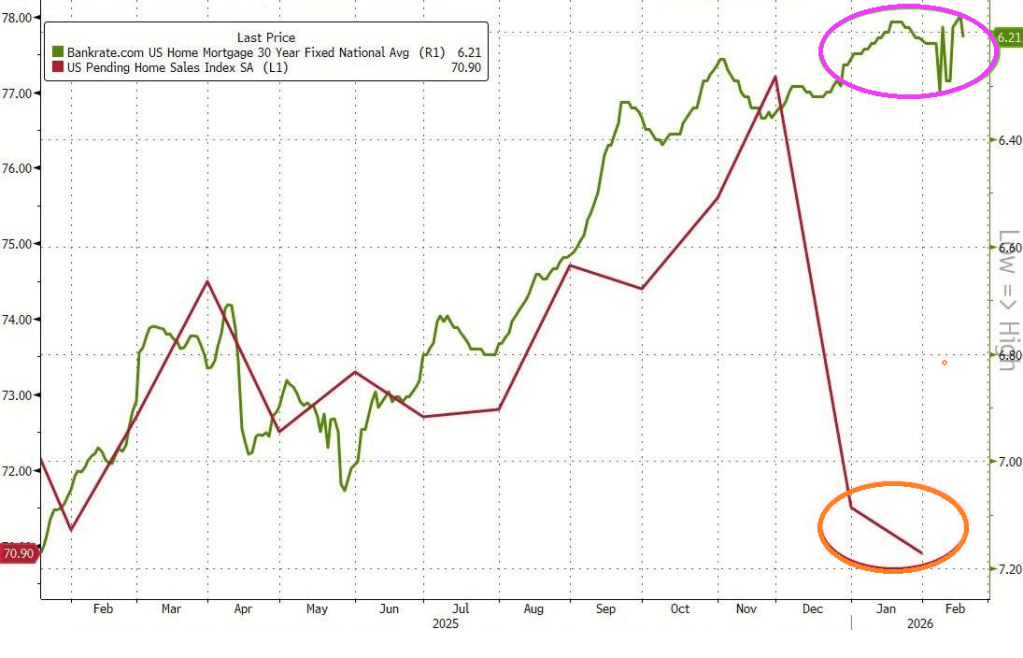
Pending sales of existing homes in the US surged 3.3% MoM (more than the expected 0.9% MoM move) in November as a modest improvement in prices and mortgage rates encouraged buyers.

The gain was broad-based across regions and exceeded all but one estimate in a Bloomberg survey of economists, but left the YoY change in sales somewhat stagnant on an NSA basis.

Signings have now increased for four straight months, matching a streak seen during the frenzied housing market of the pandemic.

The trade association’s report on Monday showed contract signings rose in each US region last month to their highest levels of the year. The West posted the largest increase, followed by the South, the nation’s largest home-selling region.

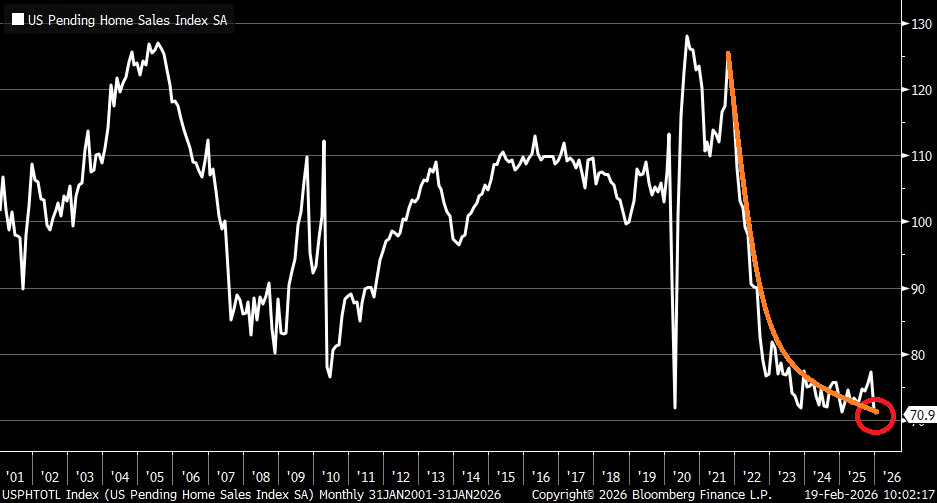
November’s surge dragged the Pending Home Sales Index to its highest since Feb 2023

Bloomberg reports that the recent data point to the gradual improvement many economists see for the housing market into 2026.

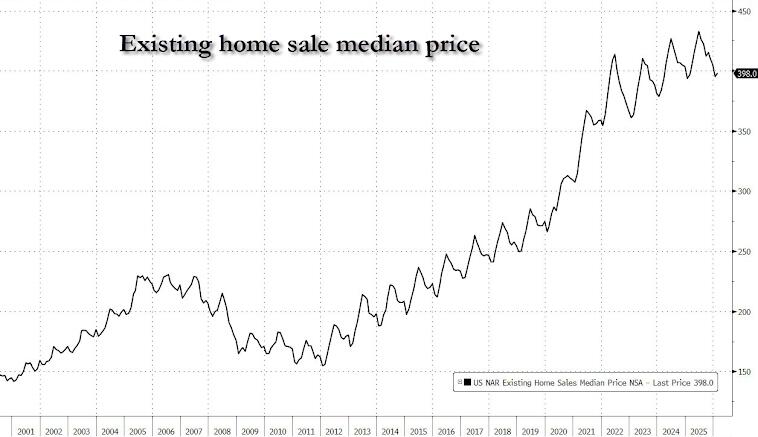
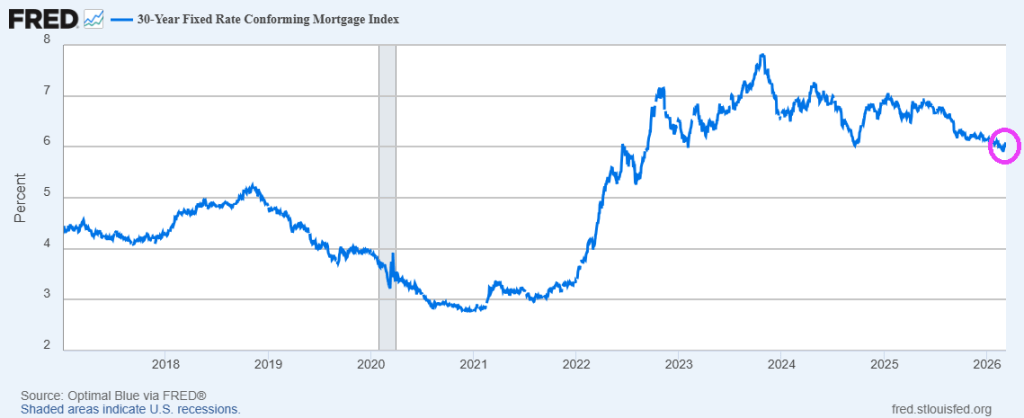
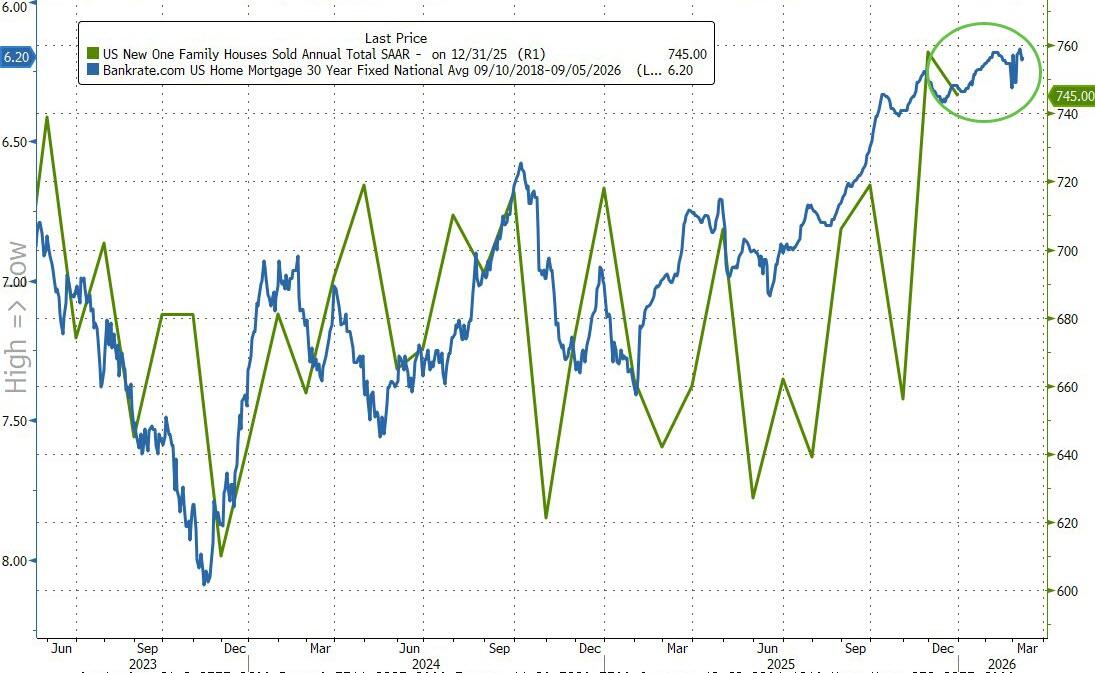
Mortgage rates that were close to 7% in May have since settled in the 6.3% to 6.4% range, and home prices are growing at a much slower rate compared to last year.

That’s helped fuel small gains in contract closings in recent months. However, economists and industry experts have widely different expectations for next year.

In a recent survey of nine market analysts, estimates for the home resale market ranged from 1.7% to 14% sales growth, with the rosiest projection coming from NAR’s Yun.

Pending-homes sales tend to be a leading indicator for previously owned homes, as houses typically go under contract a month or two before they’re sold.

Fly Like An Eagle! US Q4 Real GDP Forecast At 3% Following Tremendous Q3 Print Of 4.3%

Fly like an eagle should be the theme song for the Trump economy. Trump’s economy keeps on soaring.

The initial GDPNow model estimate for real GDP growth (seasonally adjusted annual rate) in the fourth quarter of 2025 is 3.0 percent on December 23. The first estimate of third-quarter real GDP growth released by the US Bureau of Economic Analysis was 4.3 percent, 0.8 percentage point above the final GDPNow nowcast.

Real gross domestic product (GDP) increased at an annual rate of 4.3 percent in the third quarter of 2025 (July, August, and September), according to the initial estimate released by the U.S. Bureau of Economic Analysis. In the second quarter, real GDP increased 3.8 percent.

Merry Christmas everybody!

Simply Unaffordable? A Different View Of US Housing Prices (Gov’t Needs To Stop Manipulating The Housing Market)

Politicians love to scream about housing being simply unaffordable. Like mayor-elected Mandami in New York City. But the reality is that housing prices vary by city and there are more affordable cities than New York City to choose from. Federal policies should not be focused on letting people staying a particular city.

When we look at housing prices compared to average hourly earnings, we see housing prices rising with average hourly earnings … as expected.

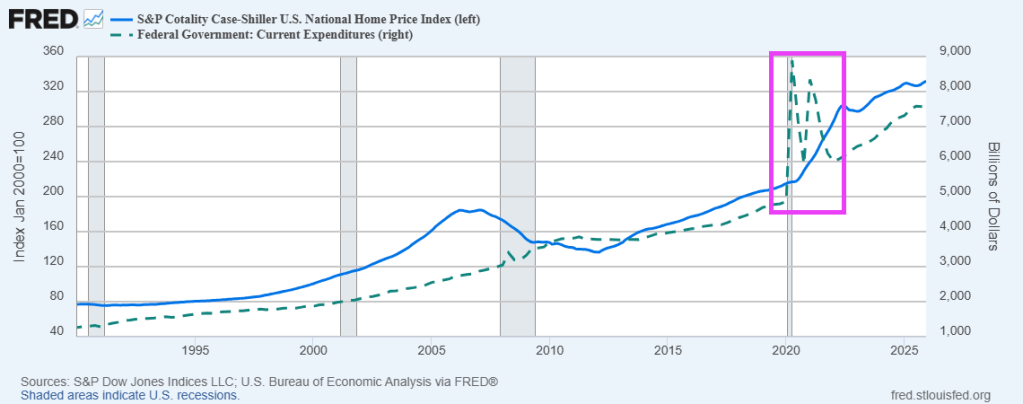
If we look at year-over-year changes, we see the Covid bump in housing prices corresponding with the surge in Federal spending. But things have simmered down since the bump in 2020-2023.

My suggestion is for the Federal government to stop interfering in the housing market.

Government Spending Helped Kill Mortgage Demand! Mortgage Demand Decreased 3.8 Percent From One Week Earlier

Nobody wastes money like government, particularly around events like Covid where Federal spending led to housing prices spiking after Covid outbreak in 2020. This made housing unaffordable for most households. This in turn helped kill the mortgage market.

Mortgage applications decreased 3.8 percent from one week earlier, according to data from the Mortgage Bankers Association’s (MBA) Weekly Mortgage Applications Survey for the week ending December 12, 2025.

The Market Composite Index, a measure of mortgage loan application volume, decreased 3.8 percent on a seasonally adjusted basis from one week earlier. On an unadjusted basis, the Index decreased 5 percent compared with the previous week. The seasonally adjusted Purchase Index decreased 3 percent from one week earlier. The unadjusted Purchase Index decreased 7 percent compared with the previous week and was 13 percent higher than the same week one year ago.

The Refinance Index decreased 4 percent from the previous week and was 86 percent higher than the same week one year ago.

Once again, the government response to the Wuhan Covid virus of 2020 helped drive up housing prices killing off mortgage demand.

Hallelujah! Mortgage Demand Increased 4.8% From Previous Week (Purchase Demand Increased 32%, Refi Demand Increased 14%)

Hallelujah, I love this economy so! Of course, former First Lady Jill Biden is on the national tour trashing the economy saying it was “perfect” under Joe Biden.

Mortgage applications increased 4.8 percent from one week earlier, according to data from the Mortgage Bankers Association’s (MBA) Weekly Mortgage Applications Survey for the week ending December 5, 2025. Last week’s results included an adjustment for the Thanksgiving holiday.

The Market Composite Index, a measure of mortgage loan application volume, increased 4.8 percent on a seasonally adjusted basis from one week earlier. On an unadjusted basis, the Index increased 49 percent compared with the previous week. The seasonally adjusted Purchase Index decreased 2 percent from one week earlier. The unadjusted Purchase Index increased 32 percent compared with the previous week and was 19 percent higher than the same week one year ago.

The Refinance Index increased 14 percent from the previous week and was 88 percent higher than the same week one year ago.

Compared to the prior week’s data, which included an adjustment for the Thanksgiving holiday, mortgage application activity increased last week, driven by an uptick in refinance applications,” said Joel Kan, MBA’s Vice President and Deputy Chief Economist. “Conventional refinance applications were up almost 8 percent and government refinances were up 24 percent as the FHA rate dipped to its lowest level since September 2024. Conventional purchase applications were down for the week, but there was a 5 percent increase in FHA purchase applications as prospective homebuyers continue to seek lower downpayment loans. Overall purchase applications continued to run ahead of 2024’s pace as broader housing inventory and affordability conditions improve gradually.

The average contract interest rate for 30-year fixed-rate mortgages with conforming loan balances ($806,500 or less) increased to 6.33 percent from 6.32 percent, with points increasing to 0.60 from 0.58 (including the origination fee) for 80 percent loan-to-value ratio (LTV) loans.

Little Tariff Effects! US Q3 Real GDP Growth At 3.5%, Real Estate Construction Growth Remains Negative

The US economy is goin’ home! The hysteria about tariffs is nonexistant.

Latest estimate: 3.5 percent — December 05, 2025

The GDPNow model estimate for real GDP growth (seasonally adjusted annual rate) in the third quarter of 2025 is 3.5 percent on December 5, down from 3.8 percent on December 4. After this morning’s personal income and outlays release from the US Bureau of Economic Analysis, the nowcast for third-quarter real personal consumption expenditures growth declined from 3.1 percent to 2.7 percent.

Unfortunately, residential and non-residential construction are negative as are imports.

Winter Effect! Mortgage Purchase Demand Fell 32% From Previous Week (Expected To Rise In January)

Mortgage demand is beginning to look a lot like Christmas. That is, mortgage demand will be listless in December (like the infamous Lake Erie snow effect), but leap upwards in January 202.

Mortgage applications decreased 1.4 percent from one week earlier, according to data from the Mortgage Bankers Association’s (MBA) Weekly Mortgage Applications Survey for the week ending November 28, 2025. This week’s results include an adjustment for the Thanksgiving holiday.

The Market Composite Index, a measure of mortgage loan application volume, decreased 1.4 percent on a seasonally adjusted basis from one week earlier. On an unadjusted basis, the Index decreased 33 percent compared with the previous week.  The seasonally adjusted Purchase Index increased 3 percent from one week earlier. The unadjusted Purchase Index decreased 32 percent compared with the previous week and was 17 percent higher than the same week one year ago.

The Refinance Index decreased 4 percent from the previous week and was 109 percent higher than the same week one year ago.

Mortgage rates moved lower in line with Treasury yields, which declined on data showing a weaker labor market and declining consumer confidence. The 30-year fixed mortgage rate declined to 6.32 percent after steadily increasing over the past month. After adjusting for the impact of the Thanksgiving holiday, refinance activity decreased across both conventional and government loans, as borrowers held out for lower rates. Purchase applications were up slightly, but we continue to see mixed results each week as the broader economic outlook remains cloudy, even as cooling home-price growth and increasing for-sale inventory bring some buyers back into the market.

The average contract interest rate for 30-year fixed-rate mortgages with conforming loan balances ($806,500 or less) decreased to 6.32 percent from 6.40 percent, with points decreasing to 0.58 from 0.60 (including the origination fee) for 80 percent loan-to-value ratio (LTV) loans.

Miami FL And Columbus OH Lead Nation In Closed Sales In October ’25 (Will Ohio State Beat Indiana For The Big 10 Championship?)

According to Bill McBride at Calculated Risk, In October, sales in these markets were up 2.4% YoY. Last month, in September, these same markets were up 7.7% year-over-year Not Seasonally Adjusted (NSA). The NAR reported sales were up 2.9% YoY NSA, so this sample is close.

Miami FL and central Florida lead the nation in closed sales of housing with Columbus OH second with 9.5% YoY growth in closed sales.

Let’s see if Ohio State beats Indiana for the Big 10 championship game on Saturday after OSU whooped Michigan 27-9 and won the gold pants this past Saturday.

Former Detroit Lions HC Matt Patricia, now OSU’s defensive coordinator.

Since The Federal Government Spending Spree Associated With Covid Ended, Median Household Income Has Declined, But So Have Home Prices

Roll out the barrel! As in Fed money printing.

How can the current housing disaster be fixed? One answer is to build more homes (made difficult by local government zoning and building policies). Another is increase household income. But Fed money printing is the easiest way to increase home prices.

Since the Federal government spending spree associated with Covid ended, median household income has declined. But so have home prices.

But in terms of home price growth compared to median household income, you can see that home price growth has slowed after the Covid spending spike, but so did median household income.

Pray that The Fed doesn’t resort to trying to fix the housing market. They will only make things worse.

October Saw Estimated 36.8% More Home Sellers Than Buyers (Biggest Gap Dating Back To 2013)

Yikes!

October saw an estimated 36.8% more home sellers than buyers, biggest gap in records dating back to 2013.