Fed’s Favorite Inflation Measure Surges At Fastest Pace In 30 Years As Spending, Incomes Rise!
Federal Reserve Chairman Mao Powell will be speaking at 10am EST in his virtual Jackson Hole KC Fed Conference speech. He might actually save his blockbuster comments for the next Fed meeting, instead just hinting at what The Fed might do to reduce the behemoth monetary stimulus. After all, The Fed has already slowed the growth rate of M2 Money to 12.1% YoY.
But before Chairman Mao Powell speaks, the PCE deflator numbers were released this AM showing that the PCE Deflator YoY rose to 4.2%. For households for a fixed income, this is bad news unless they receive a COLA (not a Pepsi, but a cost-of-living adjustment).
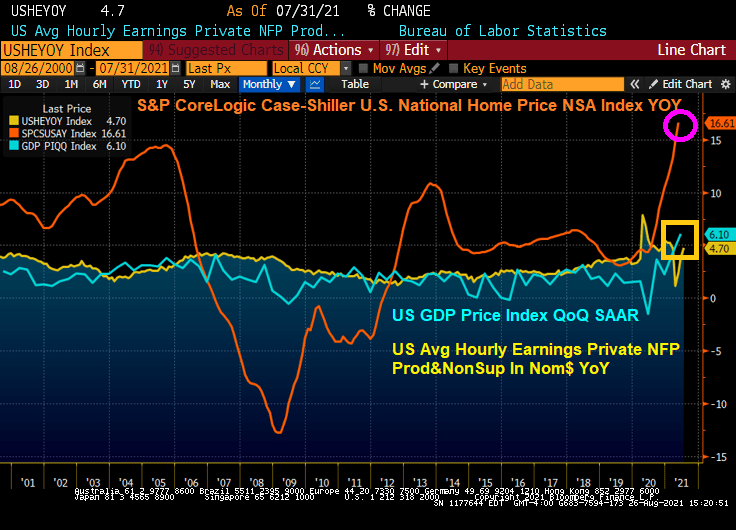
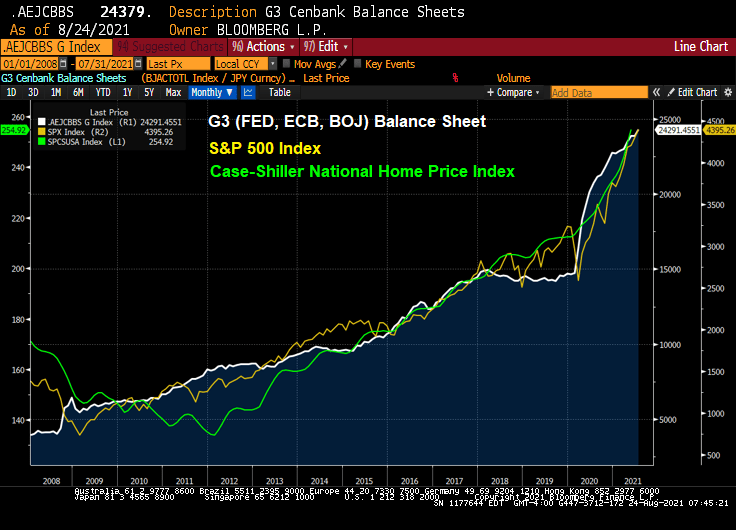
I would be remiss if I left out the largest assets for most households: housing. The Case-Shiller National Home Price Index is rising at a 16.6% YoY pace, making housing more expensive for those who are currently renting.
Speaking of which, the US Supreme Court overturned the Biden Administrations rent moratorium meaning that renters can be evicted for failure to make rent payments. (This sounds cut and dry, but the ability of landlords to evict non-paying rents varies from state-to-state and county-to-county).
Having said that, we can see that Personal Spending only grew by 0.3% in July while REAL personal spending fell by -0.1%.
Personal income grew by 1.1% in July and 2.7% YoY , which is lower than the PCE Deflator YoY of 4.2%.
University of Michigan sentiment is out at 10AM EST. Stay tuned!
Looks an awful lot like 2005 before the housing price crash, financial crisis and Great Recession. US home prices, HOUSING inflation, is growing at 16.61% YoY, GDP Price index QoQ (annualized) is growing at 6.10%, and average hourly earnings is growing at 4.20% YoY.
Let’s see what happens in Jackson Hole this weekend!
Policy makers should “get started” and begin to slow asset purchases even though the delta variant poses a risk to the U.S. economic outlook and to job growth, Federal Reserve Bank of Kansas City President Esther George said.
“The economy continues to grow at a strong rate,” George said, adding that in terms of the potential risk of the delta variant, “you can imagine that it might slow down some of the returns to the labor market. But I don’t expect at this point that it will derail the economy as we saw last year when we first had to deal with the virus.”
Yes, US GDP QoQ just checked in at a whopping 6.6% with personal consumption growing at 11.9% for Q2.
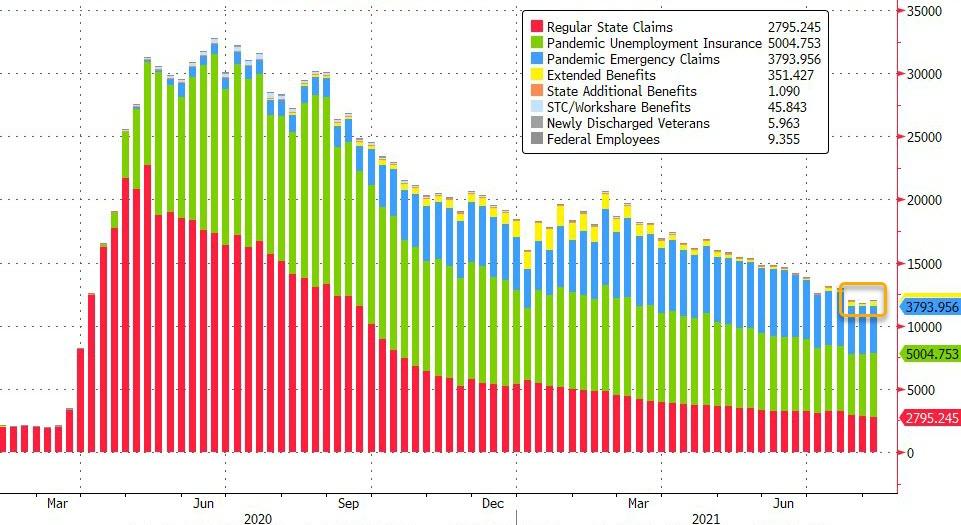
Of course, The Federal government and Federal Reserve have over stimulated the economy and financial markets. Compare the collected benefits (unemployment, pandemic, extended, etc.) compared to before Covid struck in March 2020.
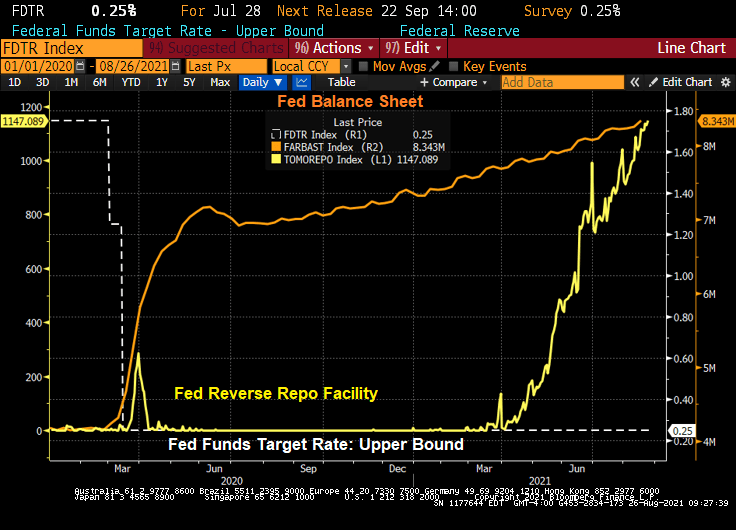
And compare The Fed’s monetary stimulus since Covid struck in March 2020.
Although Esther George is not a voting member of the FOMC, I think she has a good point. There is too much monetary stimulus in the market.
Will the Open Market Committee heed George’s warning? Or will they treat her like Ohio State great Eddie George as just another voice?
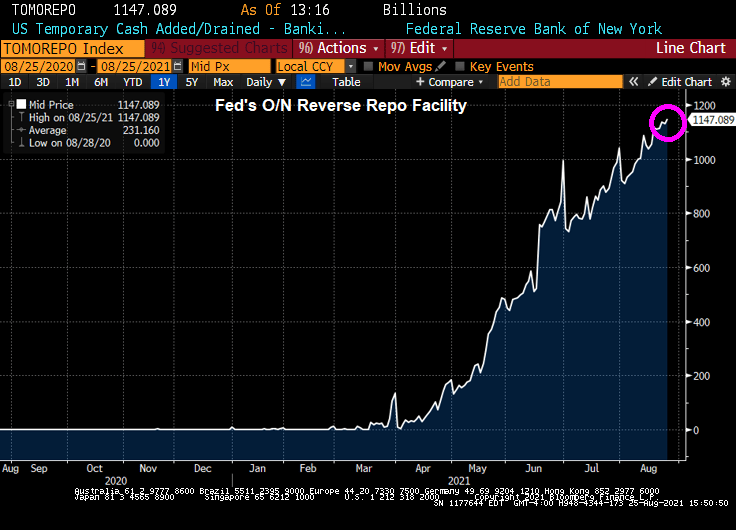
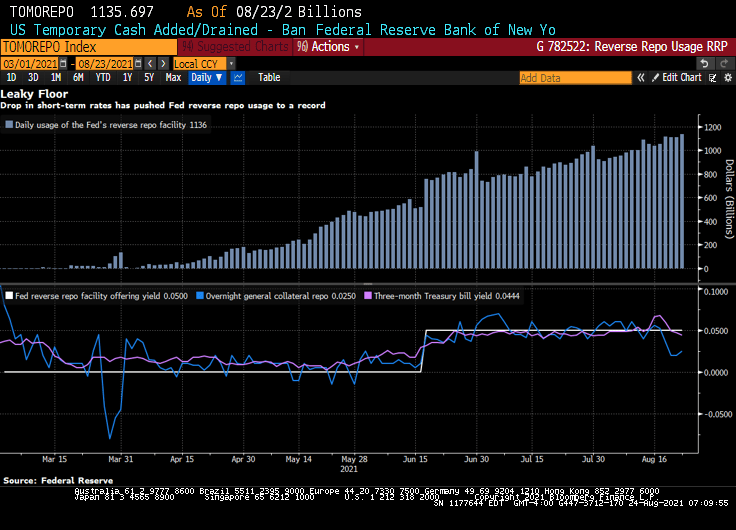
(Bloomberg) — Usage at the Federal Reserve’s facility for overnight reverse repurchase agreements Wednesday rose to a new all-time high.
Seventy-seven participants took $1.147 trillion, which exceeded Tuesday’s volume of $1.13 trillion, and the previous record of $1.136 trillion reached on Aug. 23.
The facility pays an overnight rate of 0.05%, helping to temporarily reduce the quantity of reserve balances in the banking system.
Nothing has been the same since late 2008 and shock troops from The Federal Reserve and their seemingly never-ending monetary stimulus.
The financial markets are overstimulated like a cranky child after too much sugar (aka, sugar rush). So what will happen to overstimulated markets if Fed Chair Powell announces withdrawal of monetary stimulus?
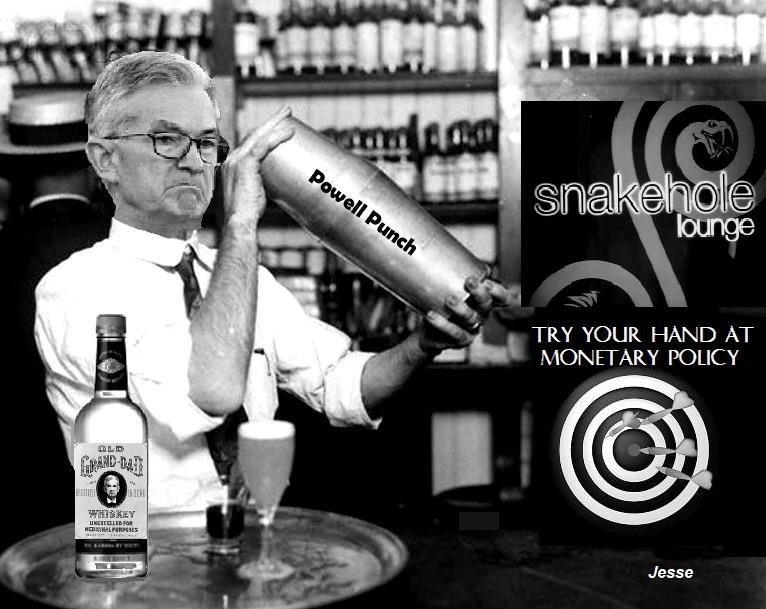
The famous Hindenburg Omen is already flashing WARNING ahead of this week’s Fed meeting at Jackson Hole. Will Powell take the punch bowl away?
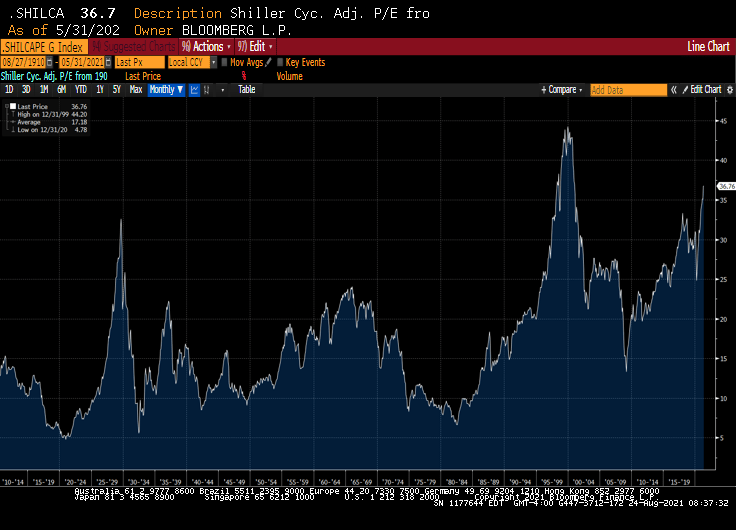
The Shiller CAPE ratio is at a high since the financial crisis and stock market correction in 2008 and early 2009.
I would expect Powell to walk softly since he has the opportunity to terrify financial markets. But I expect Powell will announce a small adjustment to the growth of The Fed’s balance sheet in line with The Fed’s DOTS project signalling interest rate increases in the futures.
Throw Covid, a slowing China and Europe into the mix, and Powell and the gang had better think long and hard about they are going to withdraw the record monetary stimulus from the cranky financial markets.
Meanwhile I hope that have a few beers from Bond’s Brewing Company, the best beer in Laramie, Wyoming!!
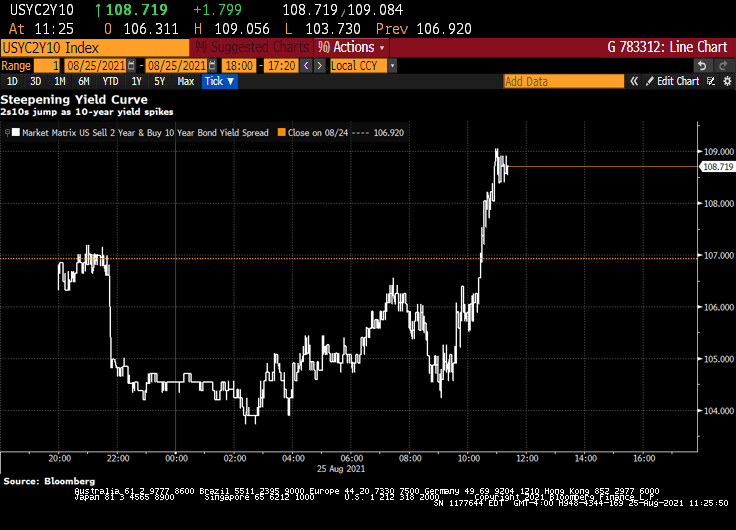
U.S. 10-year yields are spiking upwards in what was supposed to be a sleepy day before the Fed’s Jackson Hole conference. The 2s10s curve is the steepest in two weeks. Eurodollar yields too have risen sharply and are up 6-7 bps in the blue and gold packs.
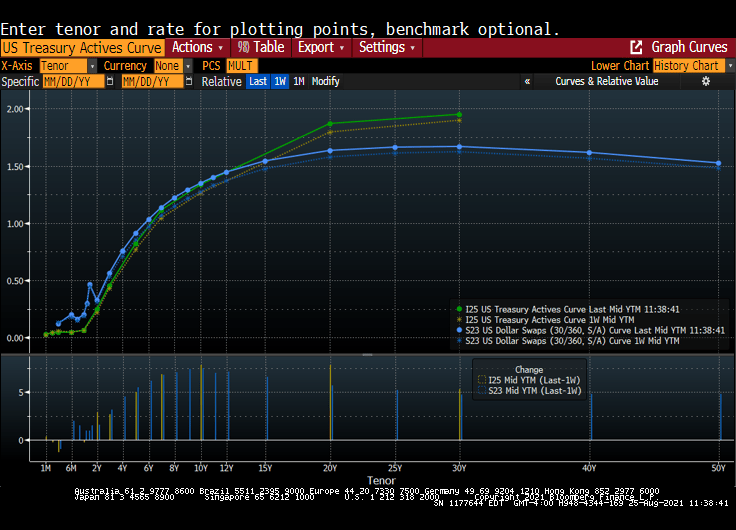
Over the last week, we have seen a steepening in the US Treasury Actives curve and the US Dollar Swaps curve.
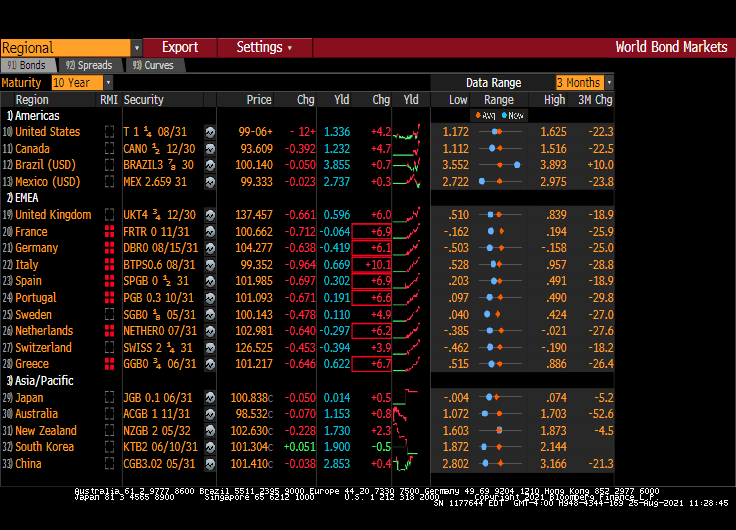
This may be linked to the range breach in German 10-years and Italian 10-years. In fact, France, Spain, Portugal, Netherlands and Greece has all seen 6 bps leaps in 10-year sovereign yields today.
Does this mean that Chairman Mao Powell is likely to announce the paring-back of Fed monetary stimulus at J-Hole?
Mortgage applications increased 1.6 percent from one week earlier, according to data from the Mortgage Bankers Association’s (MBA) Weekly Mortgage Applications Survey for the week ending August 20, 2021.
The Refinance Index increased 1 percent from the previous week and was 3 percent higher than the same week one year ago. You can clearly see the Refi Wave associated with the Covid outbreak and sudden Fed monetary stimulus resulting in a lowering of 30-year mortgage rates.
The seasonally adjusted Purchase Index increased 3 percent from one week earlier. Notice the general slowdown in purchase applications with soaring home prices.
The unadjusted Purchase Index increased 1 percent compared with the previous week and was 16 percent lower than the same week one year ago.
Since President Nixon helped take the US off the gold standard, the US Dollar has become FIAT currency. That is, not backed any precious asset such as gold, silver, platinum, etc. What ever happened to the Bretton Woods system?
The Bretton Woods system was the first example of a fully negotiated monetary order intended to govern monetary relations among independent states. The chief features of the Bretton Woods system were an obligation for each country to adopt a monetary policy that maintained its external exchange rates within 1 percent by tying its currency to gold and the ability of the International Monetary Fund (IMF) to bridge temporary imbalances of payments. Also, there was a need to address the lack of cooperation among other countries and to prevent competitive devaluation of the currencies as well.
So much for Bretton Woods. We now live in a FIAT world where The Federal Reserve can print money almost without any limitation.
Enter cryptocurrcies such as Bitcoin and Ethereum.
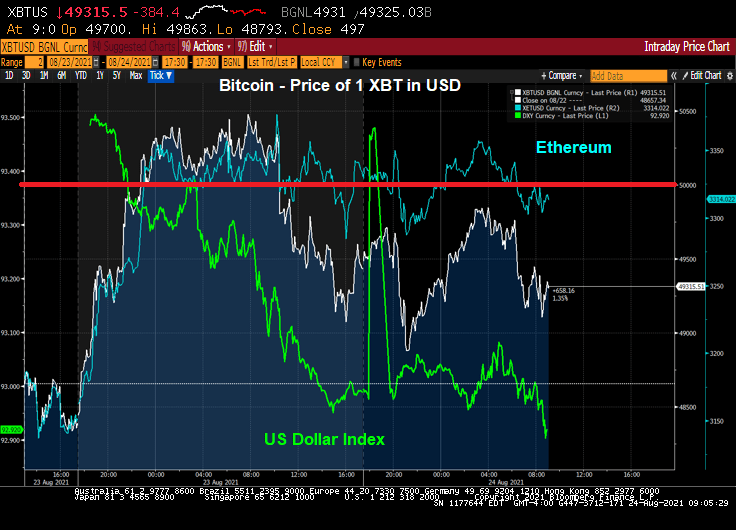
Bitcoin, the favorite of many, broke through the $50,000 barrier yesterday, only to level off below $50,000 this morning. Ethereum is level after rising yesterday. Meanwhile the US Dollar (the preferred FIAT model of The Federal Reserve) is falling.
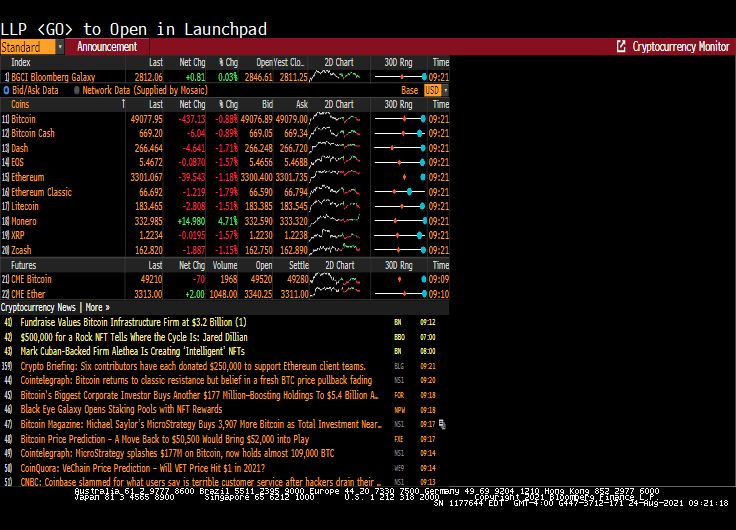
Here are some of the cryptos out there, but I only follow Bitcoin and Ethereum.
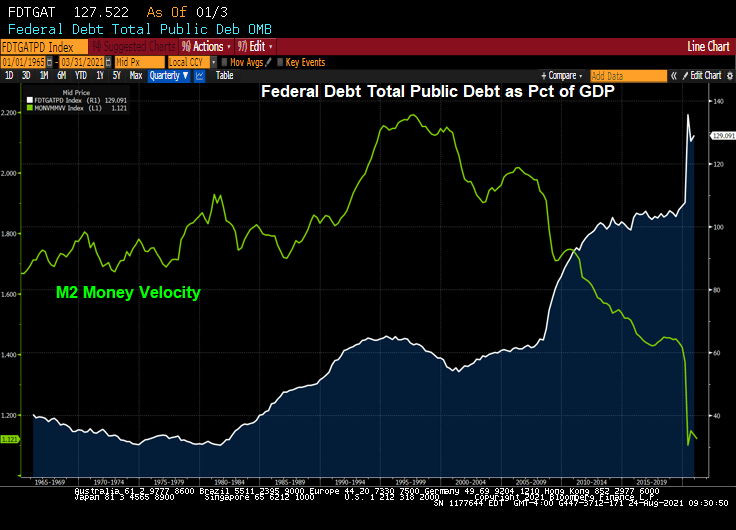
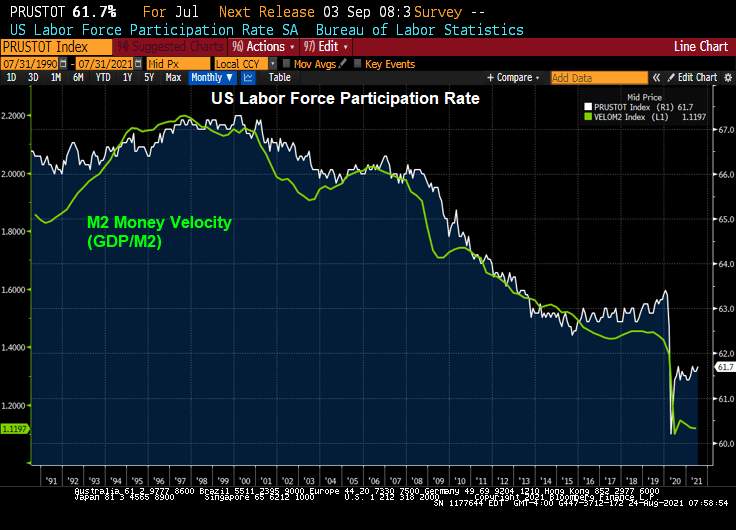
Since Nixon and dropping off the gold standard, we have seen US Federal debt (and spending) blow out of control with the decline in M2 Money Velocity to its lowest levels.
This should be the new emblem of the US Federal government AND The Federal Reserve.
Powell and The Fed’s policies have veered from their mandate requiring Chairman Powell to meet 350 times with Congress to sell The Fed’s policies.
Bloomberg) — The Federal Reserve’s floor for overnight funding markets is proving to be no match for the deluge of cash.
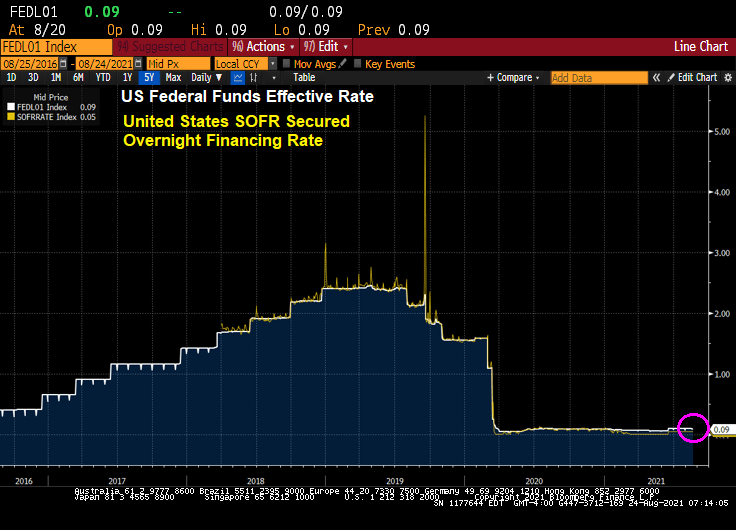
Money-market securities ranging from Treasury bills to repurchase agreements continue to trade below 0.05% — the offering rate on the overnight reverse repo facility, which is supposed to act like a floor for the front end. The Fed at its June meeting had raised the rate by five basis points to help support the smooth functioning of short-term funding markets.
Still, usage of the tool climbed to a record $1.136 trillion on Monday, eclipsing the previous high of $1.116 trillion on Aug. 18.
Demand for the so-called RRP facility has surged as a flood of dollars threatens to overwhelm funding markets. That’s in part a result of the central bank’s long-standing asset purchases and drawdowns of the Treasury’s cash account, which is pushing reserves into the system. As a result, liquidity has been swelling, especially as the Treasury cuts supply to create more borrowing room under the debt ceiling.
The pressure pushing down overnight rates toward zero is proving a major headache for money-market funds. It hampers their ability to invest profitably, and can lead to further disruptions as they begin to waive fees to avoid passing on negative rates to shareholders. A number of firms including Vanguard Group shut down prime money-market funds last year after struggling to cover operating costs in the low-interest-rate environment.
Yes, overnight rates such as the US SOFR rate, are near zero.
Powell’s Charm Offensive in Congress Positions Him to Keep Job
Perhaps that is why Federal Reserve Chair Jerome Powell is acting as a lobbyist with Congress for The Fed’s nontraditional approach to monetary policy.
(Bloomberg) Since he took the helm of the Fed in February 2018, through June of this year, he’s held at least 350 meetings, dinners or phone calls with members of Congress, according to his monthly calendars. That’s almost nine per month, and many of those included more than one lawmaker. The tally doesn’t count at least 16 appearances as chair before numerous congressional committees.
Well, the stock market has zoomed-up since Bernanke and The Fed adopted zero-interest rate (ZIRP) policies and the now famous quantitative easing (QE) policies in late 2008.
Congress member Alexandria Ocasio-Cortez asked Fed Chair Powell about the Fed helping with US unemployment. We are already at zero rates (on the short-end), and Congress should look at their policies on why labor force participation is slow to recover from the Covid epidemic.
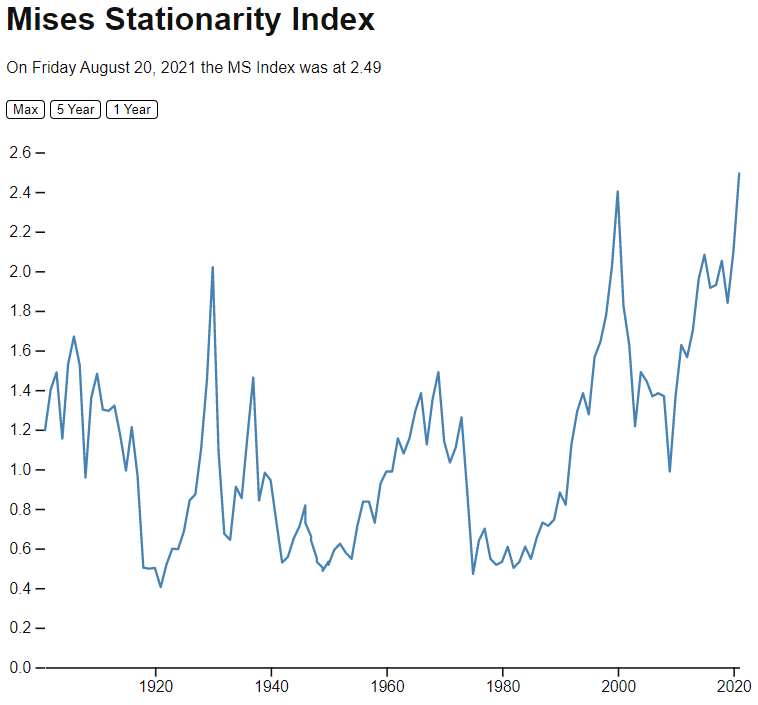
The Mises Stationarity Index is different than the Shiller CAPE index, which is showing equities as being overpriced, but not yet in dot.com bubble zone.
















You must be logged in to post a comment.