Not Big Mac! Freddie Mac House Price Index Increased in December By Up 4.0% YoY (Austin Tx Is Down -12.7% From Peak)

No, Freddie Mac is not a new cheeseburger from McDonald’s. Freddie Mac is a government sponsored enterprised (GSE) that purchases residential mortgages from lenders and assists in the bundling of mortgages into mortgage-backed securities (MBS). They also monitor home prices.

Freddie Mac reported that its “National” Home Price Index (FMHPI) increased 0.54% month-over-month on a seasonally adjusted (SA) basis in December. On a year-over-year basis, the National FMHPI was up 4.0% in December, up from up 3.9% YoY in November. The YoY increase peaked at 19.0% in July 2021, and for this cycle, bottomed at up 0.9% YoY in May 2023.

But let’s look at the dark side of home prices, which is price declines. Led by Communist enclaved Austin Texas, down -12.7% from peak. The next six cities are all in Florida.

I was watching Varney and Company on Fox Business and it dawned on me that Jonathan Hoenig from Capitalist Pig needs to lay off the caffeine!

Maybe Freddie Mac should partner with McDonald’s. After all, clumsy shooter Angel Reese from WNBA’s Chicago Sky just signed with McDonald’s.

Case-Shiller Home Prices Rise 3.9% YoY In September (Only NYC And Cleveland Top 7% YoY)

Rolling into Cleveland to the lake.

NEW YORK, NOVEMBER 26, 2024: S&P Dow Jones Indices (S&P DJI) today released the
September 2024 results for the S&P CoreLogic Case-Shiller Indices. The leading measure of U.S.
home prices recorded a 3.9% annual gain in September 2024
, a slight deceleration from the previous annual gains in 2024.

YEAR-OVER-YEAR
The S&P CoreLogic Case-Shiller U.S. National Home Price NSA Index, covering all nine U.S. census divisions, reported a 3.9% annual return for September, down from a 4.3% annual gain in the previous month. The 10-City Composite saw an annual increase of 5.2%, down from a 6.0% annual increase in the previous month. The 20-City Composite posted a year-over-year increase of 4.6%, dropping from a 5.2% increase in the previous month. New York again reported the highest annual gain among the 20 cities with a 7.5% increase in September, followed by Cleveland and Chicago with annual increases of 7.1% and 6.9%, respectively. Denver posted the smallest year-over-year growth with 0.2%.

Table 2 below summarizes the results for September 2024. Cleveland and New York top 7% YoY.

Thunderstruck! Mortgage Applications Decreased -10.8% WoW (Interest Rates Bear Steepening With Trump’s Election!)

Thunderstruck! The election of Donald Trump has rocked markets. But not mortgage applications … yet.

WASHINGTON, D.C. (November 6, 2024) — Mortgage applications decreased 10.8 percent from one week earlier, according to data fro m the Mortgage Bankers Association’s (MBA) Weekly Applications Survey for the week ending November 1, 2024. 

The Market Composite Index, a measure of mortgage loan application volume, decreased 10.8 percent on a seasonally adjusted basis from one week earlier. On an unadjusted basis, the Index decreased 12 percent compared with the previous week. The seasonally adjusted Purchase Index decreased 5 percent from one week earlier. The unadjusted Purchase Index decreased 7 percent compared with the previous week and was 2 percent higher than the same week one year ago.

The Refinance Index decreased 19 percent from the previous week and was 48 percent higher than the same week one year ago.

“Ten-year Treasury rates remain volatile and continue to put upward pressure on mortgage rates. The 30-year fixed rate last week increased to 6.81 percent, the highest level since July,” said Joel Kan, MBA’s Vice President and Deputy Chief Economist. “Applications decreased for the sixth consecutive week, with purchase activity falling to its lowest level since mid-August and refinance activity declining to the lowest level since May. The average loan size on a refinance application dropped below $300,000, as borrowers with larger loans tend to be more sensitive to any given changes in mortgage rates.”  

The refinance share of mortgage activity decreased to 39.9 percent of total applications from 43.1 percent the previous week. The adjustable-rate mortgage (ARM) share of activity increased to 7.0 percent of total applications.

The FHA share of total applications decreased to 15.5 percent from 16.4 percent the week prior. The VA share of total applications decreased to 12.5 percent from 14.6 percent the week prior. The USDA share of total applications increased to 0.5 percent from 0.4 percent the week prior.

The average contract interest rate for 30-year fixed-rate mortgages with conforming loan balances ($766,550 or less) increased to 6.81 percent from 6.73 percent, with points decreasing to 0.68 from 0.69 (including the origination fee) for 80 percent loan-to-value ratio (LTV) loans.  The effective rate increased from last week.

The average contract interest rate for 30-year fixed-rate mortgages with jumbo loan balances (greater than $766,550) increased to 6.98 percent from 6.77 percent, with points increasing to 0.65 from 0.49 (including the origination fee) for 80 percent LTV loans. The effective rate increased from last week.  

The average contract interest rate for 30-year fixed-rate mortgages backed by the FHA increased to 6.75 percent from 6.55 percent, with points decreasing to 0.87 from 0.94 (including the origination fee) for 80 percent LTV loans.  The effective rate increased from last week.

The average contract interest rate for 15-year fixed-rate mortgages decreased to 6.21 percent from 6.27 percent, with points decreasing to 0.55 from 0.77 (including the origination fee) for 80 percent LTV loans. The effective rate decreased from last week.

The average contract interest rate for 5/1 ARMs decreased to 6.05 percent from 6.20 percent, with points increasing to 0.84 from 0.59 (including the origination fee) for 80 percent LTV loans.  The effective rate decreased from last week. 

The bond market is reacting to the election of Trump with a clear Bear Steepening.

Bear steepening happens when yields move up across tenors, but long-end yields move up even faster than short-end yields.

This isn’t going to help mortgage applications due to lowering rates.

Mortgage Purchase Demand Dropped 14% Compared To 1 Year Ago

Mortgage applications decreased 3.9 percent from one week earlier, according to data from the Mortgage Bankers Association’s (MBA) Weekly Applications Survey for the week ending July 26, 2024.

The Market Composite Index, a measure of mortgage loan application volume, decreased 3.9 percent on a seasonally adjusted basis from one week earlier. On an unadjusted basis, the Index decreased 4 percent compared with the previous week. The seasonally adjusted Purchase Index decreased 2 percent from one week earlier. The unadjusted Purchase Index decreased 1 percent compared with the previous week and was 14 percent lower than the same week one year ago.

Note the decline in mortgage purchase demand after Biden/Harris were sworn into office in Janaury 2021.

The Refinance Index decreased 7 percent from the previous week and was 32 percent higher than the same week one year ago. The average contract interest rate for 30-year fixed-rate mortgages with conforming loan balances ($766,550 or less) remained unchanged at 6.82 percent, with points increasing to 0.62 from 0.59 (including the origination fee) for 80 percent loan-to-value ratio (LTV) loans.

Because of rising rates under Biden/Harris economic policies, mortgage refinancing demand has gotten crushed.

We are in the latter half of the year, so seasonalility will kill off purchase mortgage demand compared to the Spring and early Summer.

Something Stupid! Biden Proposes Rent Control Of 5% Annual Cap Rent Increases

President Biden was expected yesterday to propose a cap of 5% on annual rent increases for tenants of major apartment landlords, and he did. Whether it can happen is something else.

As the White House communicated on Tuesday, the administration is looking for Congress to pass legislation for landlords with more than 50 units in their portfolios, that being the proxy for institutional owners, although it would also affect private investors, family offices, and others that might own at least that many units. According to administration calculations, the total pool would cover 20 million rental units.

The law would then give landlords a choice. They could either restrict annual rent increases to no more than 5% a year or they would forfeit the ability to take fast depreciation of rental housing. There would be an exception for new construction or “substantial renovation or rehabilitation.”

So, Biden is dusting off the old Jane Fonda/Tom Hayden Santa Monica, CA rent control scheme.

I am guesing that this will not pass the House, but will probably pass in the Confederacy of Dunces: the US Senate.

Simply Unaffordable! Home Affordability in the US Sinks to Lowest Point Since 2007, Home Prices UP 35%, Mortgage Rates UP 148% Under Biden (Mortgage Purchase Applications DOWN 12% YoY)

Housing in the US is simply unaffordable. Particularly since home prices and mortgage rates have soared undier Biden.

.Owning a house is less affordable for average earners in the US than at anytime in 17 years.

The costs of a typical home — including mortgage payments, property insurance and taxes — consumed 35.1% of the average wage in the second quarter, the highest share since 2007 and up from 32.1% a year earlier, according to a new report from Attom.

Growth in expenses, along with mortgage rates hovering around 7%, have outpaced income gains as a persistent shortage of listings pushed the median home price to a record-high $360,000, Attom said. In more than a third of US markets, ownership costs ate up 43% of average local wages, far above the 28% considered to be a guideline for affordability.

BloombergEqualityDragons and Sex Are Now a $610 Million Business Sweeping PublishingMexico Avocado Inspections to Return to Full Capacity This WeekThe Amazon Rainforest Is Urban, TooItaly’s Women Battle ‘Take My Coat’ Culture in Bid for Top Jobs

The latest data “presents a clear challenge for homebuyers,” Rob Barber, chief executive officer of Attom, said in a statement. “It’s common for these trends to intensify during the spring buying season when buyer demand increases. However, the trends this year are particularly challenging for house hunters.”

Pricey markets in the West and Northeast had the biggest declines in affordability, including Orange and Alameda counties in California, and Brooklyn and Nassau County in New York.

Among the 589 counties analyzed, 582, or 98.8%, were less affordable in the second quarter than their historic affordability averages, Attom said.

It appears that the US housing market is addicted to gov. Doctor, doctor (Yellen), we’ve got a bad case of unaffordable housing.

On the mortgage side, mortgage applications decreased 2.6 percent from one week earlier, according to data from the Mortgage Bankers Association’s (MBA) Weekly Applications Survey for the week ending June 28, 2024.

The Market Composite Index, a measure of mortgage loan application volume, decreased 2.6 percent on a seasonally adjusted basis from one week earlier. On an unadjusted basis, the Index increased 8 percent compared with the previous week. The Refinance Index decreased 2 percent from the previous week and was 29 percent higher than the same week one year ago. The seasonally adjusted Purchase Index decreased 3 percent from one week earlier. The unadjusted Purchase Index increased 7 percent compared with the previous week and was 12 percent lower than the same week one year ago.

Getting Out Of Dodge! May’s Active Housing Inventory Explodes +27.5% YoY (Denver UP 75.2% YoY)

Gimme two steps to sell my house. Are people getting out of dodge?? Calfornia Gpvernor “Greasy Gavin” Newsom sold his Sacramento home and moved to Marin County for better schools. Sacrramento active housing inventory is up 65.6% YoY.

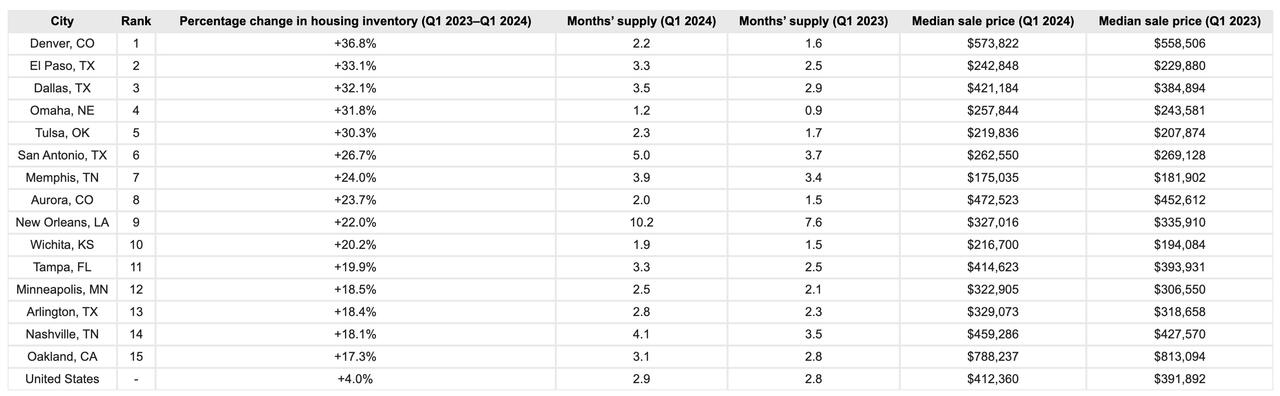
Active housing inventory in May is up 27.5% YoY nationally, with Denver leading at 75.2% YoY. I highlight Columbus Ohio at +32.9% since that is where I live.

While the government may be able to fake BLS and CPI data to gloss over the fact that 5.5% rates have already likely driven the nation into a deep recession, independent data on the housing market is showing a decades-long shortage in inventory starting to rebound. 

A new report from Construction Coverage has revealed where the largest increases in real estate inventory in the U.S. are taking place.

The report notes that the current housing shortage—which is now estimated to be between four million and seven million homes—can trace its beginnings to long before the COVID-19 pandemic. In the 10 years following the Great Recession, the United States constructed fewer new homes than in any other decade since the 1960s.

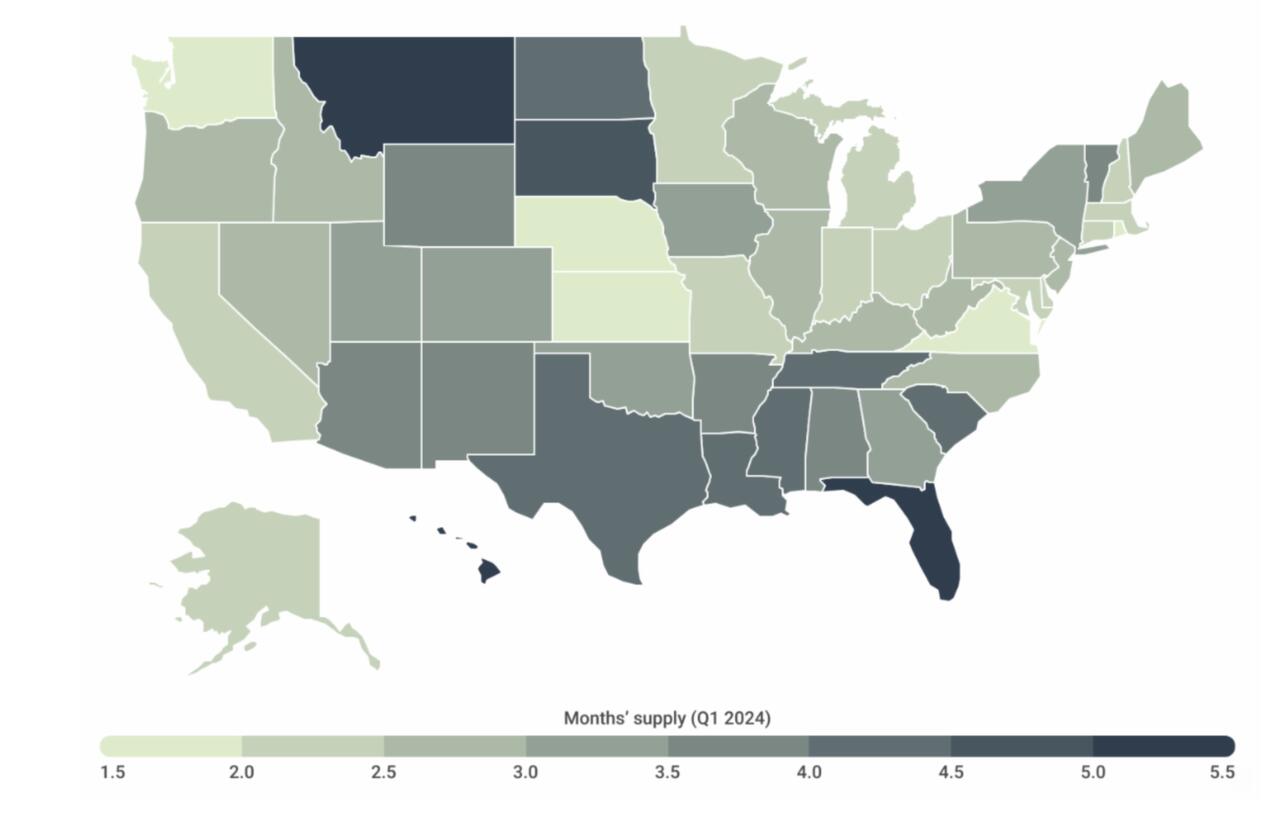
They write that the lack of housing affects certain areas more severely than others. Researchers ranked locations based on the percentage change in the average monthly housing inventory—the total number of active listings plus pending sales at the end of the month—between Q1 2023 and Q1 2024.

Data from a national level showed that U.S. housing inventory decreased from more than two million in 2012 to a low of approximately 630,000 at the start of 2022.

Over the same period, months’ supply—a measure of how long it would take existing inventory to sell if no new homes came on the market—plummeted from a national high of 7.5 months to a historic low of 1.1 months, the report adds.

It also noted that inventory has rebounded slightly since early 2022: throughout the first quarter of 2024, the national inventory hovered around 970,000 homes for sale, marking a 4.0% year-over-year increase.

Despite this uptick, existing inventory would sustain the current sales pace for just 2.9 months—a marginal increase from the 2.8 months’ supply recorded last year.

The report broke down trends by cities and states, finding that as of the first quarter of 2024, states with the lowest levels of supply are concentrated in and around the Midwest (such as Kansas with 1.5 months of supply) and the Northeast (including Rhode Island with 1.8 months of supply).

However, Washington also stands out for having some of the lowest levels of available housing nationally, with just 1.9 months of supply.

In contrast, several states in the South, led by Florida (5.2 months of supply), along with Hawaii (5.2 months) and Montana (5.1 months), present notably more favorable conditions for buyers.

Among the nation’s largest cities, Denver, El Paso, and Dallas recorded the largest year-over-year increases in housing inventory. At the opposite end of the spectrum, Las Vegas, Raleigh, and Chicago recorded the biggest declines.

The data is hardly a 2008-style collapse, but that doesn’t mean it isn’t noteworthy. 

While the ‘turning of the tide’ still remains muted, the housing market is so large it rarely corrects swiftly. It’s important to notice, however, that rising inventory ticking higher – combined with mortgage rates now over 7% – could easily be telegraphing a correction in prices heading into 2025.

Wasting Away Again In Bidenville! US New Home Sales Crashed In May (Near 7% Mortgage Rates Aren’t Helping)

It seems everything Biden touches turns to stone. This used to be called “The Medusa Touch” but I changing that to “The Biden Touch.” And that includes housing. Or we can simply sing along with the late Jimmy Buffet and “Wasting aways again in Bidenville.”

And near 7% mortgage rates aren’t helping (as The Fed continues its fight against Bidenflation).

US new home sales were expected to dip 0.2% MoM in May… but they didn’t..

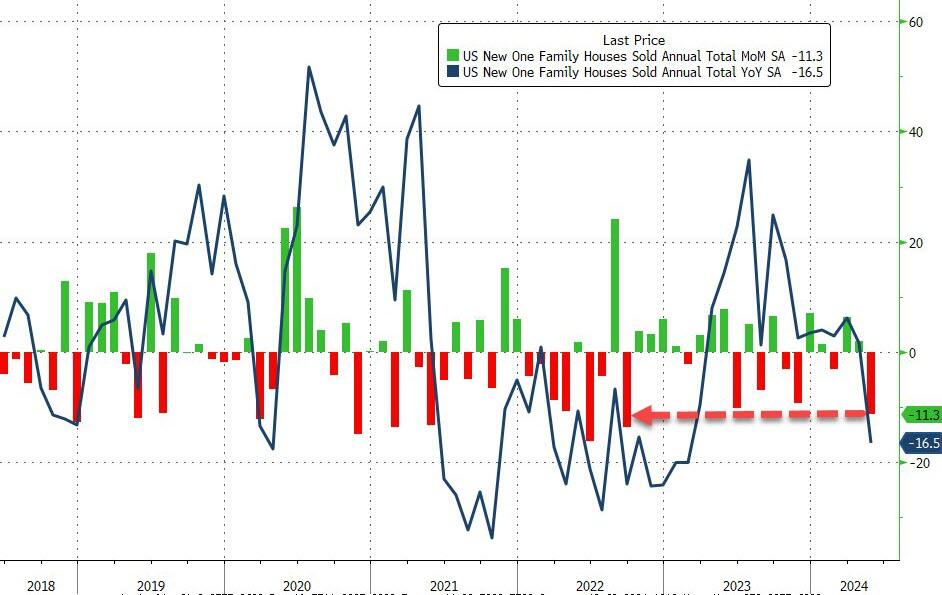
New home sales crashed 11.3% MoM (after April’s 4.7% drop was revised up to a 2.0% MoM rise). That is the biggest MoM drop since Sept 2022…

Source: Bloomberg

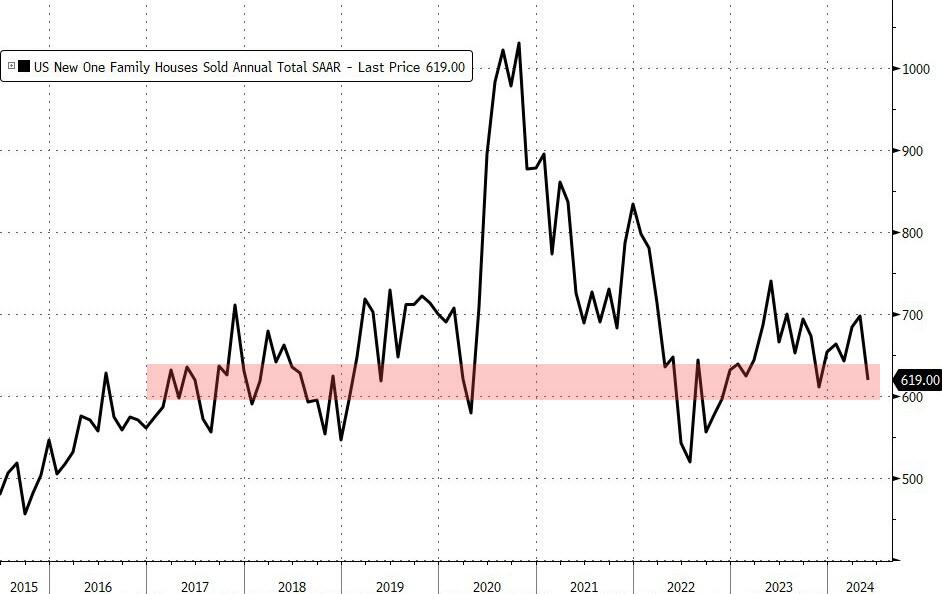
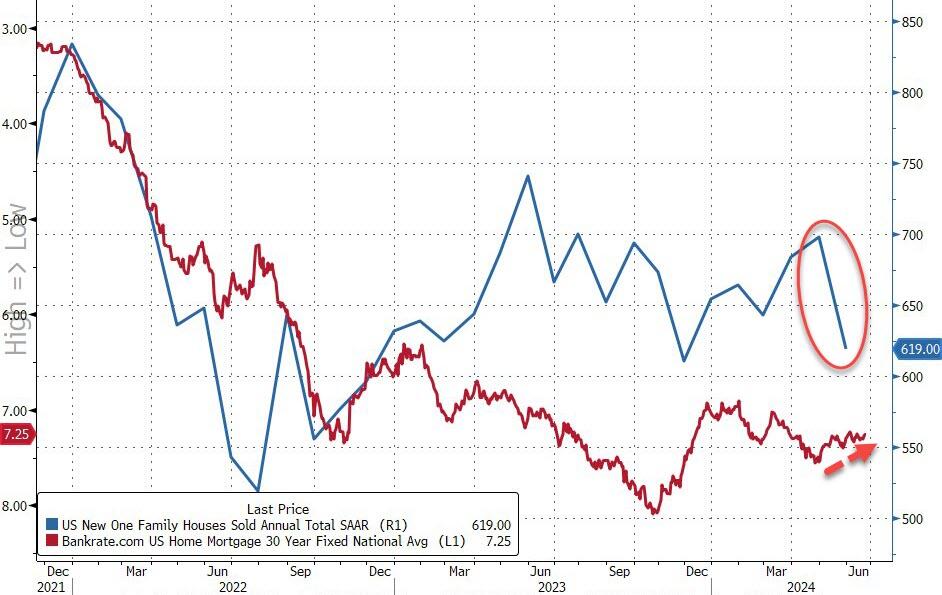
This is the biggest YoY drop since Feb 2023, taking the SAAR down to the same level as it was in 2016…

Source: Bloomberg

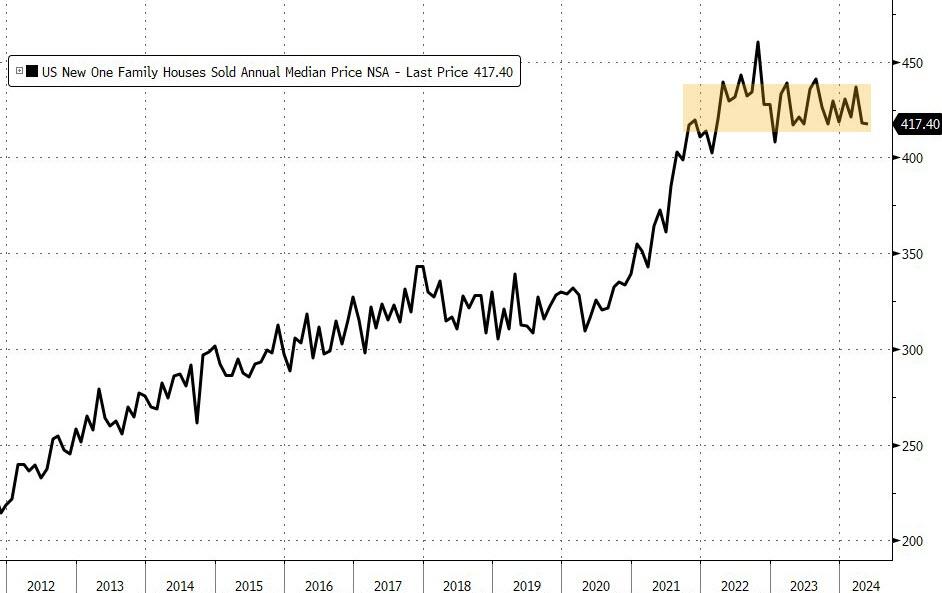
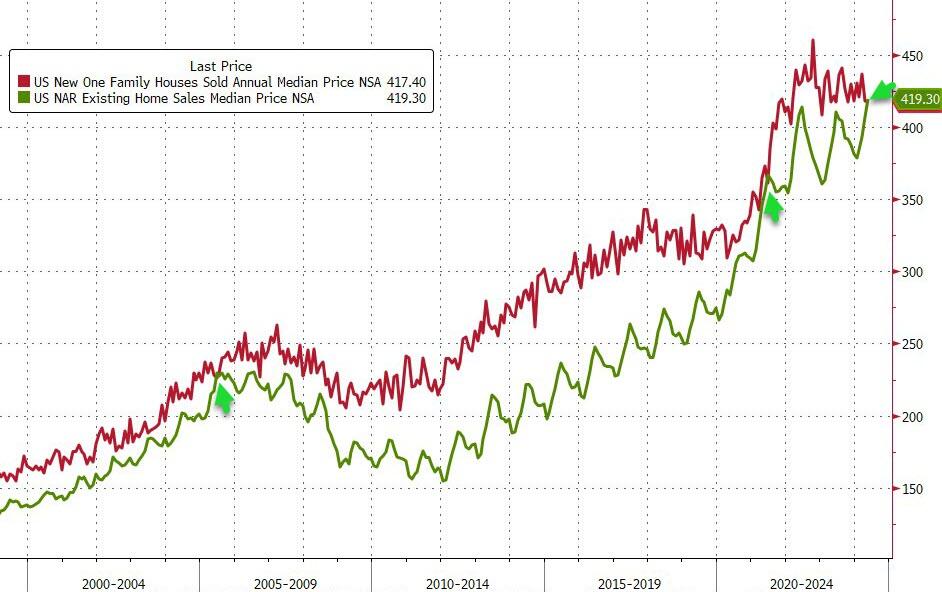
Median new home price fell 0.9% YoY to $417,400 – lowest since April 2023 – (with the average selling price at $520,000) with a big downward revision for April from $433k to $417k!…

Source: Bloomberg

For the first time since June 2021, median existing home prices are above median new home prices…

Source: Bloomberg

As BofA warned yesterday:

The US housing market is stuck, and we are not convinced it will become unstuck anytime soon. After a surge in housing activity during the pandemic, it has since retreated and stabilized. We view the forces that have reduced affordability, created a lock-in effect for homeowners, and limited housing activity will remain in place through our forecast horizon “

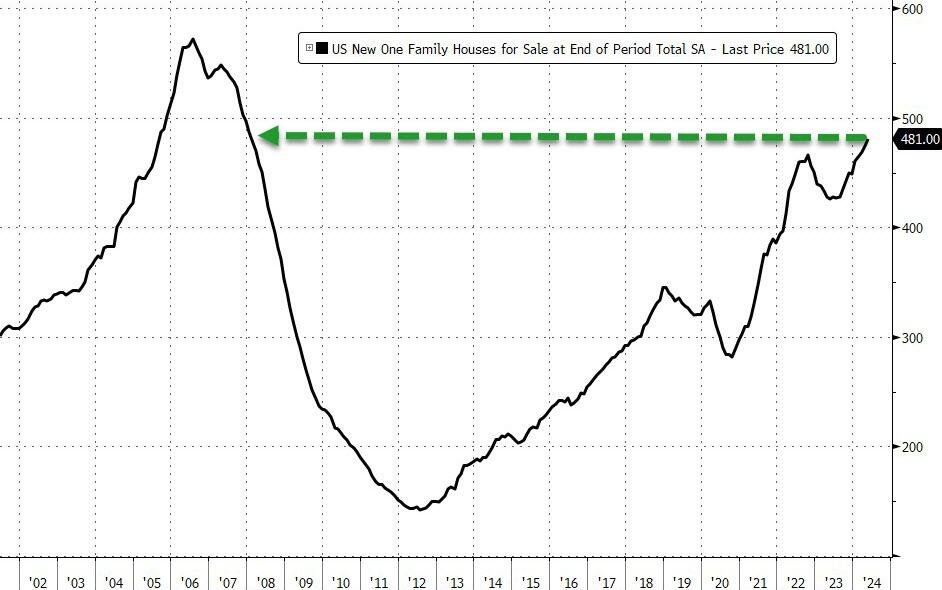
At the same time, the supply of available homes increased to 481,000, still the highest since 2008.

Source: Bloomberg

New home sales are catching down to the reality of mortgage rates continuing to hold above 7%…

Source: Bloomberg

It seems homebuilders finally gave up filling that gap in anticipation of an imminent Fed rate-cut to save the world.

Will Biden double down on his failed policies tonight in the CNN Presidential debate? Perhaps Joe can sing “Double Shot of Bidenomics.”