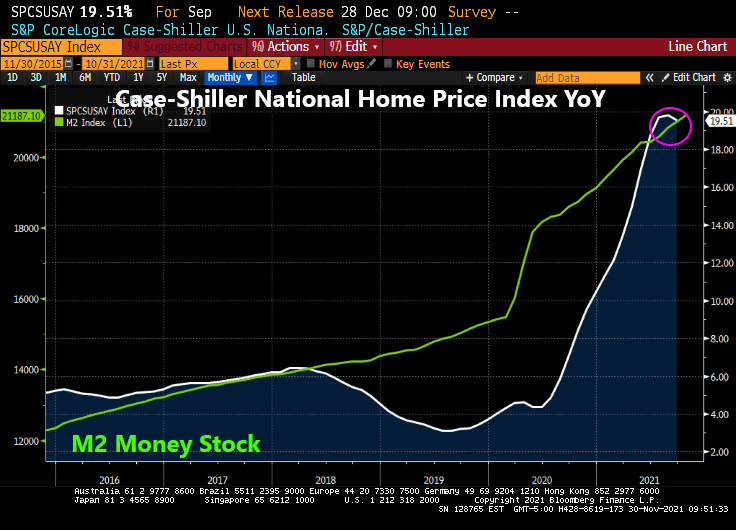
Once again, low available inventory of houses for sale coupled with outlandish Fed stimulus has resulted in a housing crisis where home price growth (+19.51%) exceeds hourly wage growth (+5.76%) by almost 4x.
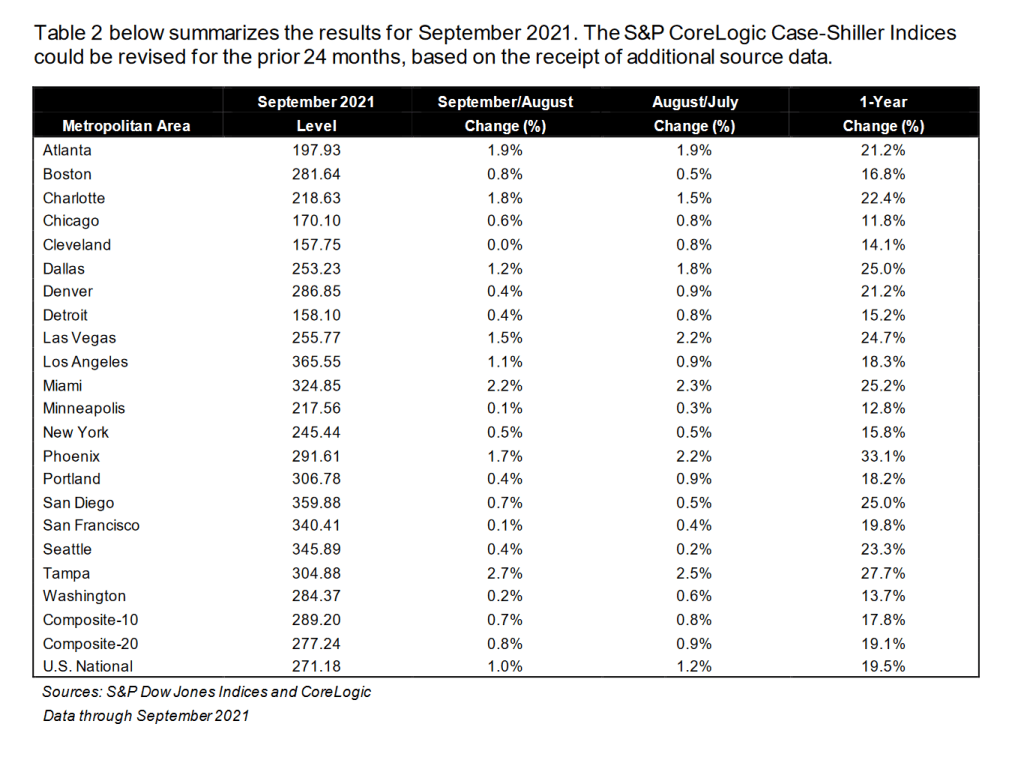
Where are all the home prices above 10% YoY? Every one of the 20 metro areas covered by Case-Shiller. Phoenix AZ leads at +33.1%. Chicago IL is the “slowest” at 11.8%.
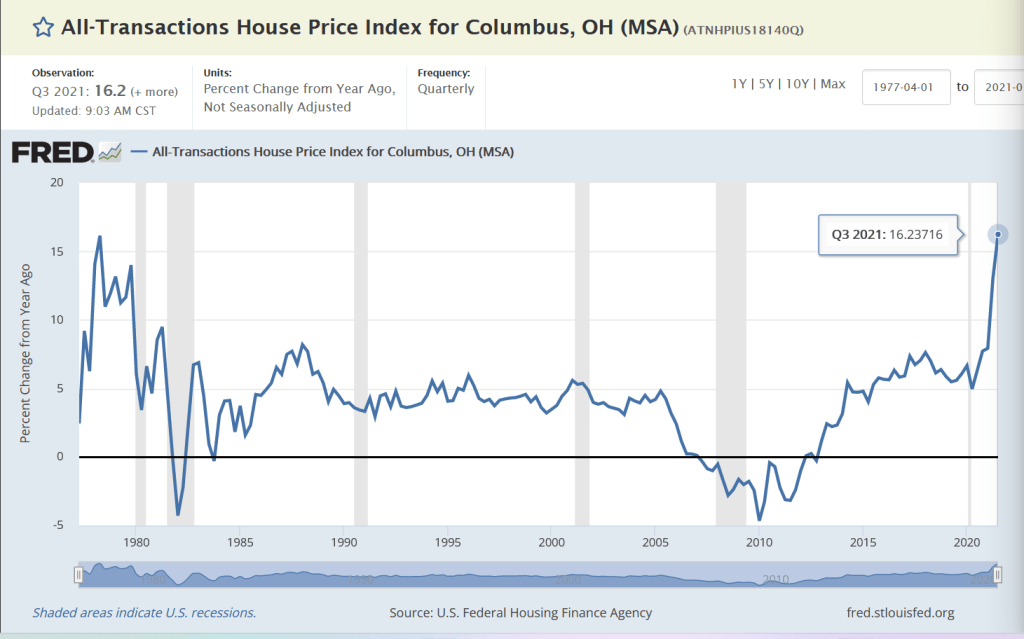
Although Columbus OH is the growth hub of the state, Case-Shiller only reports Cleveland. So here is Columbus’s all-transactions home price growth for Q3: +16.2% YoY placing Columbus at the top of the midwest metro areas of Detroit, Chicago, Minneapolis and Cleveland.
With the latest Omicron Variation (sounds like a Star Trek TV show episode), I will bet that The Fed will stay a little longer and keep rates low, leading to home price growth (with limited available inventory) to continue to grow at double digit speeds.
The latest scare hitting financial markets is the Omicron Variant (or Oh! Macron! Variant in France). While it caused an initial decline in global equity markets {Dow fell 900 points on early reports on Omicron), the Treasury market has been relatively unscathed.
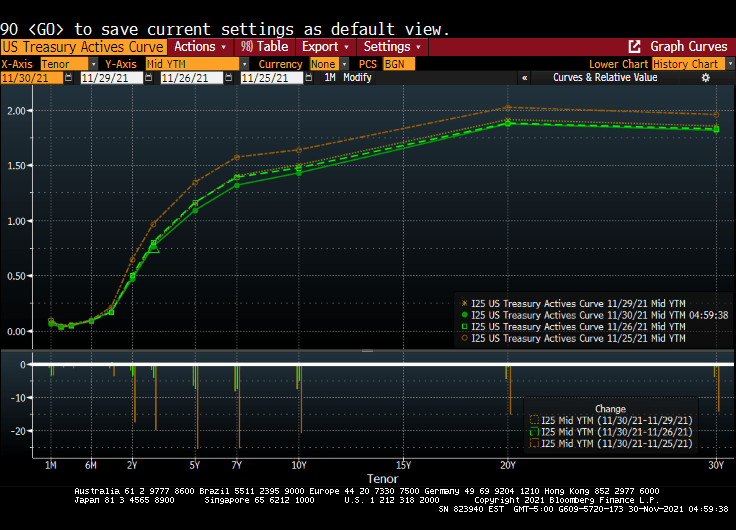
For example, the US Treasury Actives curve dropped last Friday (the orange line represents the Wednesday before Thanksgiving), while the remaining three lines represent last Friday, Monday and Tuesdays (today). In other words, the US Treasury Actives curve has been quiet so far this week after Friday’s flattening.
The US Dollar Swaps curve shows the same dynamics. The dark blue line is last Wednesday, while the remaining lines are last Friday, this Monday and today. Not a lot happening after the initial Omicron fear factor was priced in.
Federal Reserve Chairman Jerome Powell believes that the omicron variant of Covid-19 and a recent uptick in coronavirus cases pose a threat to the U.S. economy and muddle an already-uncertain inflation outlook.
“The recent rise in COVID-19 cases and the emergence of the Omicron variant pose downside risks to employment and economic activity and increased uncertainty for inflation,” Powell said in remarks he plans to deliver to Senate lawmakers on Tuesday. “Greater concerns about the virus could reduce people’s willingness to work in person, which would slow progress in the labor market and intensify supply-chain disruptions.”
Do I detect FEAR in Powell’s voice? The odds of rate increases for next year just fell to one rate increase at the September 2022 meeting.
On the equity side, it seems to be all about whether The Fed will withdraw its support. Back in early 2018, then Fed Chair Janet Yellen and the FOMC started to shrink the Fed balance sheet (green line). This resulted in the “Smart Money Index” declining. The S&P 500 index received a jolt with the Fed stimulus around the COVID outbreak and have taken off like a jackrabbit. Despite the Smart Money Flow index being lower than in 2017.
So, is Omicron the “planet killer” or just another mild flu-like outbreak? The data is pointing towards the latter, but FEAR may cause it to be a bigger deal than is warranted.
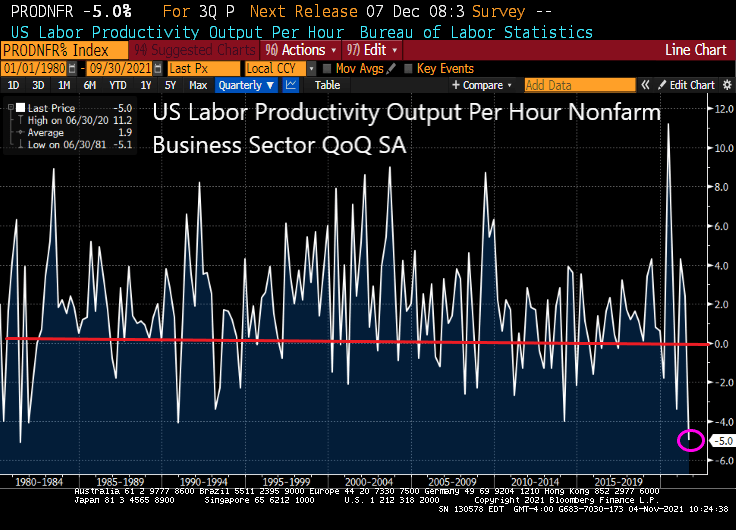
The last time we saw US labor productivity out per hour this low was in 1981 when President Reagan inherited stagflation from President Jimmy Carter.
As unit labor costs soar +8.3%.
Any wonder that the 1% have been doing so well relative to the bottom 50% in terms of wealth since entrance of The Fed in 2008 with zero-interest rate policies (ZIRP) and assets purchases (QE). And also after Covid struck.
“That will be $10,000 for your Big Mac, fries and a soda, please!”
Federal Reserve Chair Jerome Powell sounded a note of heightened concern over persistently high inflation as he made clear that the central bank will begin tapering its bond purchases shortly but remain patient on raising interest rates.
“The risks are clearly now to longer and more persistent bottlenecks, and thus to higher inflation,” Powell said Friday during a virtual panel discussion hosted by the South African Reserve Bank and moderated by Bloomberg’s Francine Lacqua.
“I would say our policy is well-positioned to manage a range of plausible outcomes,” he said. “I do think it’s time to taper and I don’t think it’s time to raise rates.”
Good luck with that, Jay! You are going to raise the short-end of the yield that will lead to a flattening of the Treasury yield curve. But you are going to continue to buy Treasuries and Agency MBS in order to monetize the rampant spending by Congress and the Biden Administration? C’mon man!
You can see where Powell spoke today. It is when gold tanked along with the 10-year Treasury yield. Both rebounded a bit, but the 10-year Treasury yield continue its fall to 1.6324%.
The US dollar (green) fell when Powell opened his pie-hole. But Bitcoin (blue) fell in advance as if they knew what Powell was going to say.
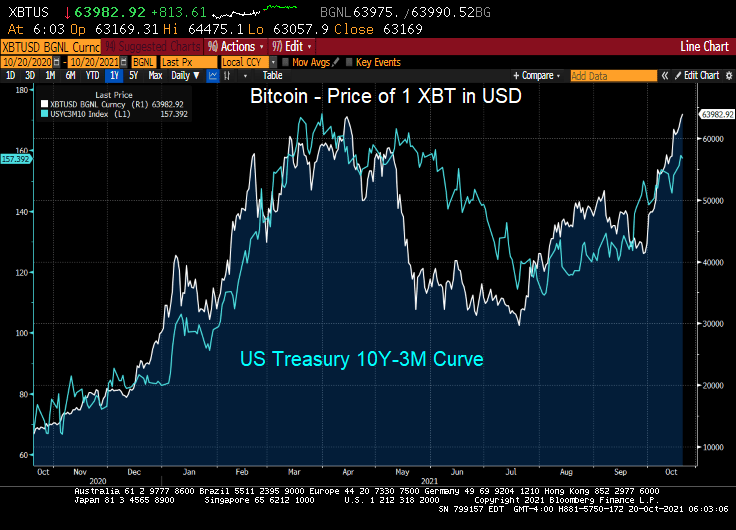
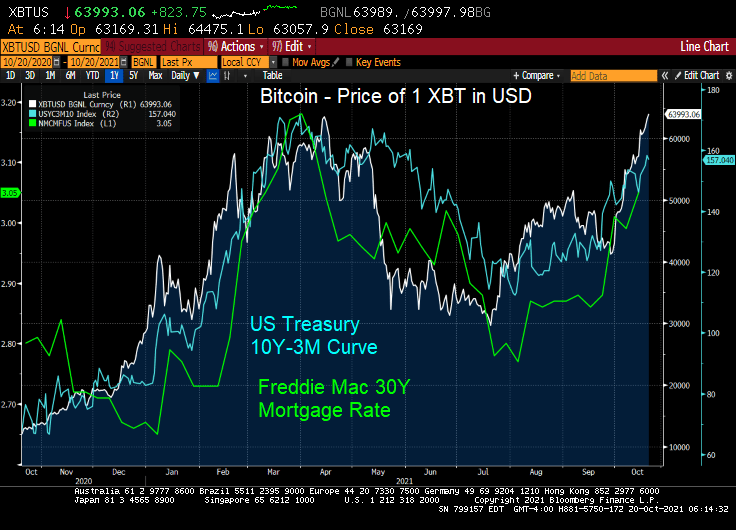
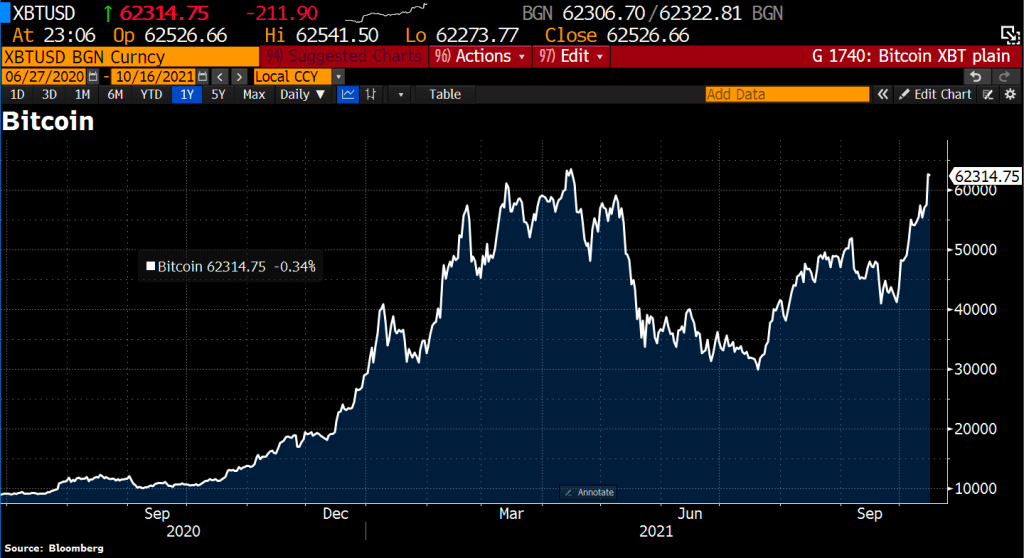
I have no idea why Jack Dorsey tweeted “705742.” But I do know that Bitcoin hit 63,982.92 this morning as the US 10Y-3M curve has been steepening.
Since the 3-month Treasury yield has been repressed to near zero, the 10Y-3M curve is pointing to rising 10-year yields. Which likely means that 30-year mortgage rates will be rising too.
UPDATE! Bitcoin hits 66,615 as Proshares Bitcoin Strategy E rises as well.
Like the poem, Casey At The Bat, the US economy struck out with a shockingly bad jobs report for September.
Oh, somewhere in this favored land the sun is shining bright; The band is playing somewhere, and somewhere hearts are light, And somewhere men are laughing, and somewhere children shout; But there is no joy in Mudville USA—mighty Casey Biden has struck out.
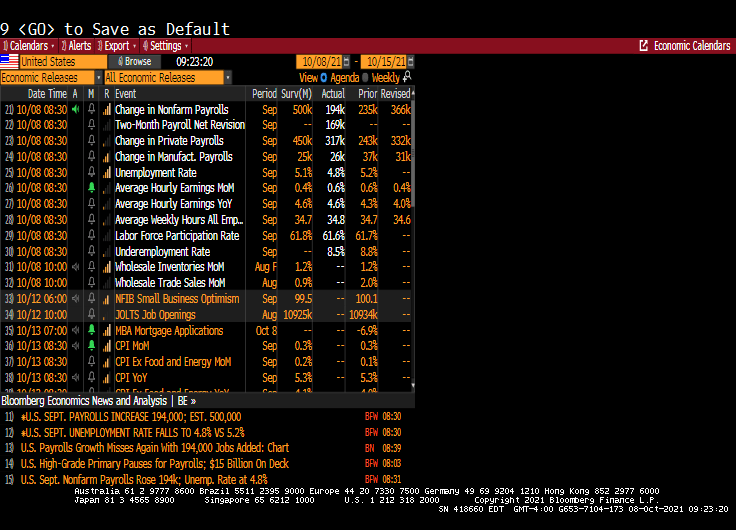
The U.S. economy added fewer jobs than forecast for a second straight month in September. Nonfarm payrolls increased by just 194,000 last month after an upwardly revised 366,000 gain in August, Labor Department figures showed Friday. 500K was expected.
The U-3 unemployment rate declined to 4.8% (meaning that the labor force shrank due to people dropping out of the labor force). In fact, 338,000 people dropped out of the labor force.
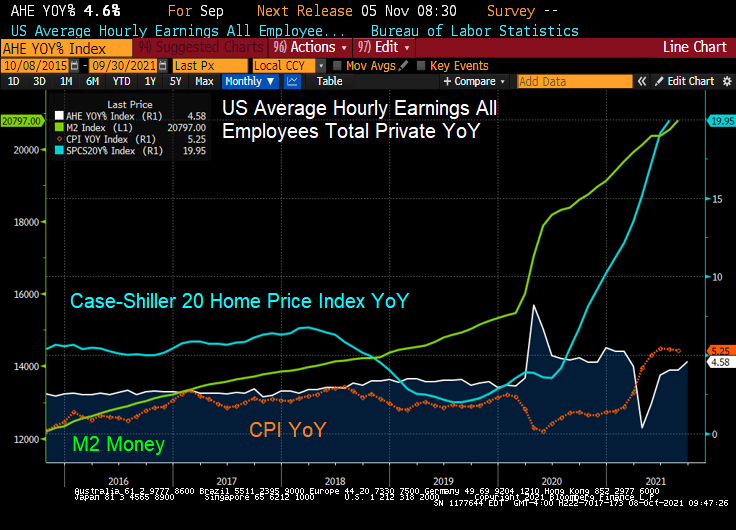
Average hourly earnings YoY rose to 4.6%. While that is an improvement, but it is lower than the inflation rate of 5.25% YoY and house price inflation of 20% YoY.
This miserable jobs report is a victory for Fed doves that don’t want to raise rates or slow down the balance sheet growth.
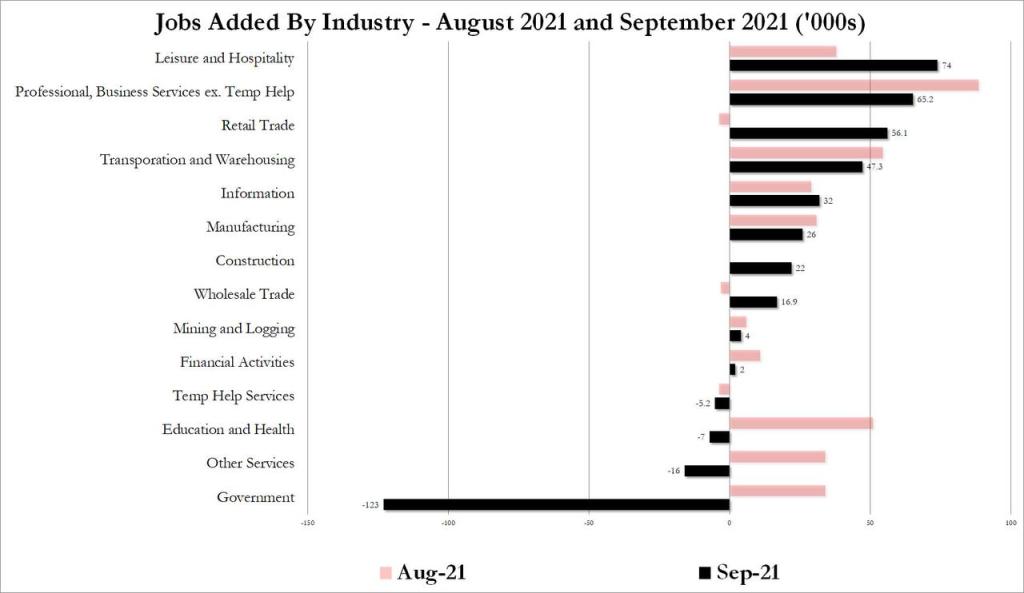
Where were the jobs created? Leisure and hospitality, as usual, leads in job gains.
Here they go again! A cautionary tale of a government gone wild resulting in gut-wrenching inflation and 76.7% of the population living in extreme poverty.
Venezuelais launching a new version of the bolivar in the latest attempt to salvage a currency so beaten down by years of hyperinflation that residents have adopted the U.S. dollar.
The so-called digital bolivar, which is being introduced Friday, effectively removes six zeroes from the “sovereign bolivar,” which started circulating just three years ago.
New banknotes and coins will be put into use. Bank accounts will be adjusted to reflect the redenomination. And debit and credit card purchases will become easier: there were so many digits involved in some transactions that merchants were forced to split the transaction into multiple card swipes.
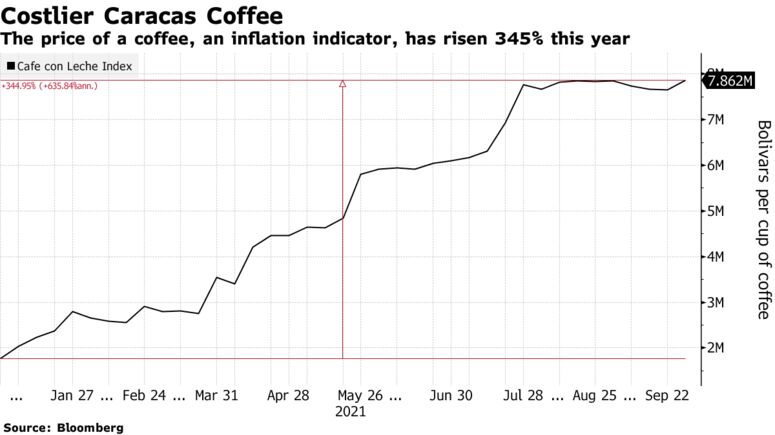
It’s another maneuver aimed at propping-up the national currency, even though President Nicolas Maduro’s government is permitting the use of the U.S. dollar as a way to cope with runaway inflation and shortages. The government has implemented two other currency changessince 2008, dropping eight zeroes. Hyperinflation, among the highest in the world, has slowed to 2,146% per year from more than 300,000% in 2019, according to Bloomberg’s Cafe Con Leche index.
Under Friday’s change, the largest former banknote, for 1 million bolivars — worth about $0.23 –will be replaced by a 1-bolivar coin. One dollar will fetch around 4.2 bolivars instead of 4.2 million bolivars at the official exchange rate.
“This is useless. Prices will continue to rise and, in a few months, the new bills will be useless,” said Leida Leon, a 37-year-old cleaning worker at a Caracas school.
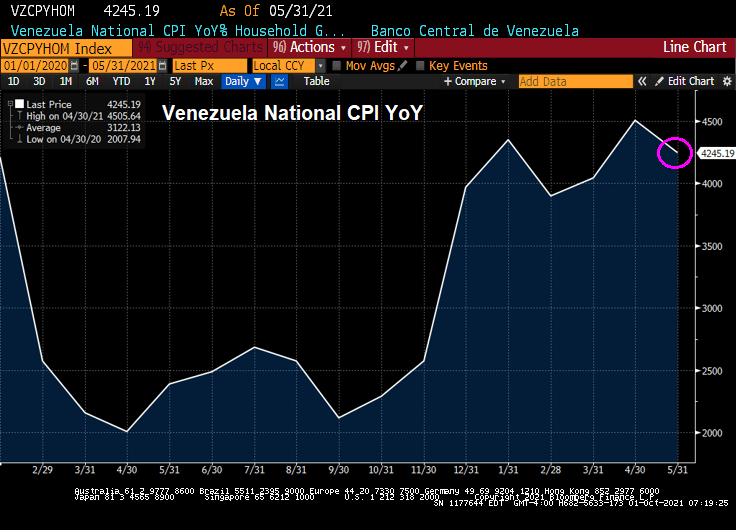
And Venezuela’s official inflation rate for household goods is a blood-curdling 4,245% YoY.
On Thursday, demand for dollars rose as people feared a prolonged suspension of banking services as the redenomination is rolled out, said Luis Arturo Barcenas, senior economist at Caracas-based financial analysis firm Ecoanalitica.
Two-thirds of retail transactions involve the U.S. dollar, according to Ecoanalitica. Yet, many Venezuelans need bolivars for everyday transactions, like bus fares and to buy gas subsidized by the government. While the government is attempting to boost the use of digital payments, many regions are beset by regular electrical blackouts that affect communications.
Venezuelans have faced disastrous government policies and pressure from U.S. sanctions that have put the country on the brink of its eighth-straight year of economic contraction. More than 5 million people have fled the country, once one of Latin America’s wealthiest.
An estimated 76.6% of Venezuelans are living in extreme poverty, up from 67.7% last year, according to a university survey on living conditions known as Encovi.
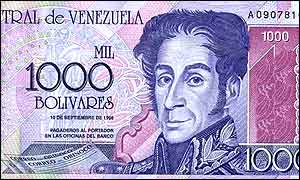
As least Venezuela’s Treasury Department could produce a likeness of Simón Bolívar (aka, Simón José Antonio de la Santísima Trinidad Bolívar y Ponte Palacios y Blanco) that doesn’t look like a bad cartoon character.
















 Confounded Interest - Anthony B. Sanders
You must be logged in to post a comment.