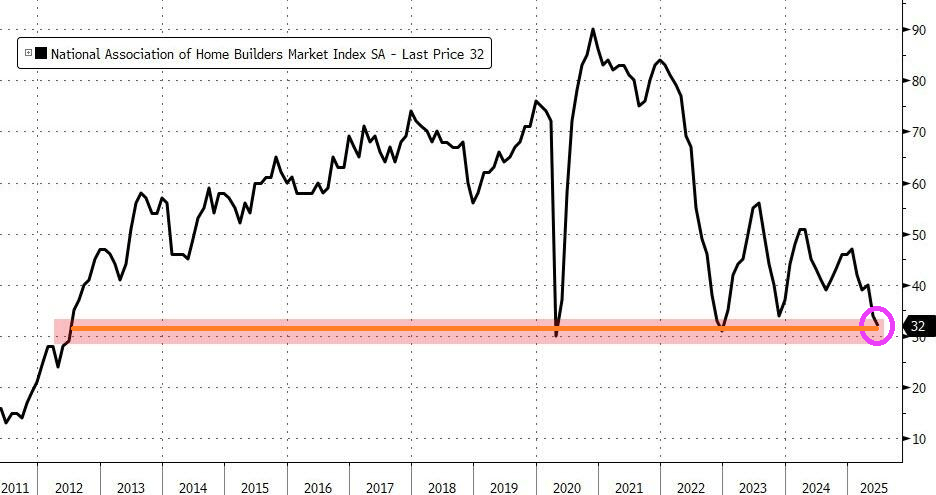
Existing-Home Sales Decreased To 4.02 Million SAAR In March, Down 2.4% YoY (Inventory Remains Depressed)

We are still suffering from Biden’s horrible economic policies. 10% Joe had a heart of fool’s gold.

Existing-home sales descended in March, according to the National Association of REALTORS®. Sales slid in all four major U.S. regions. Year-over-year, sales dropped in the Midwest and South, increased in the West and were unchanged in the Northeast.

Total existing-home sales – completed transactions that include single-family homes, townhomes, condominiums and co-ops – fell 5.9% from February to a seasonally adjusted annual rate of 4.02 million in March. Year-over-year, sales drew back 2.4% (down from 4.12 million in March 2024).


Total housing inventory registered at the end of March was 1.33 million units, up 8.1% from February and 19.8% from one year ago (1.11 million). Unsold inventory sits at a 4.0-month supply at the current sales pace, up from 3.5 months in February and 3.2 months in March 2024.

Till we can undo Biden’s policies.

Powell’d! Mortgage Applications Decline By 13% Since Previous Week (Refi Apps Down 20% From Previous Week)

Fed Chair Jerome Powell is apparently waiting for the tariff “war” to settle down before he pushes for interest rate cuts. Meanwhile, rising mortgage rates are hurting consumers and the mortgage industry.

Mortgage applications decreased 12.7 percent from one week earlier, according to data from the Mortgage Bankers Association’s (MBA) Weekly Mortgage Applications Survey for the week ending April 18, 2025.

The Market Composite Index, a measure of mortgage loan application volume, decreased 12.7 percent on a seasonally adjusted basis from one week earlier. On an unadjusted basis, the Index decreased 11 percent compared with the previous week. The seasonally adjusted Purchase Index decreased 7 percent from one week earlier. The unadjusted Purchase Index decreased 6 percent compared with the previous week and was 6 percent higher than the same week one year ago.

The Refinance Index decreased 20 percent from the previous week and was 43 percent higher than the same week one year ago.

Overall mortgage application activity declined last week, as rates increased to their highest level in two months. The 30-year fixed rate rose for the second straight week to 6.9 percent, an almost 30-basis-point increase over two weeks.

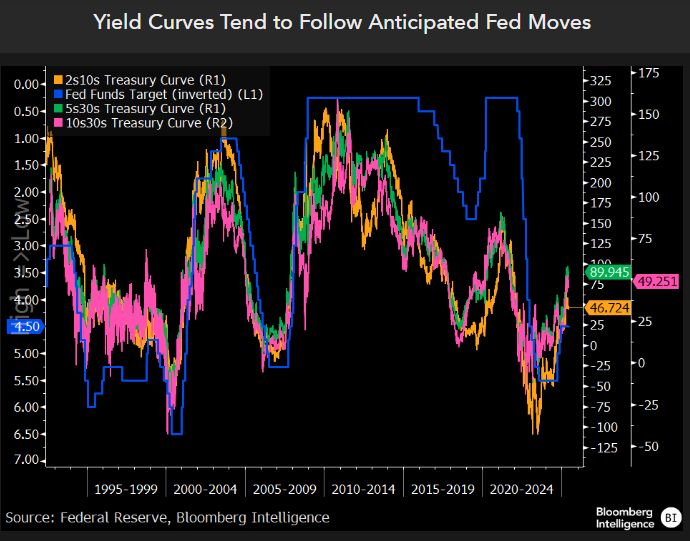
The 10Y-2Y Treasury yield curve is steepening.

Fed Chair Jerome Powell. Nyuk, Nyuk, Nyuk!

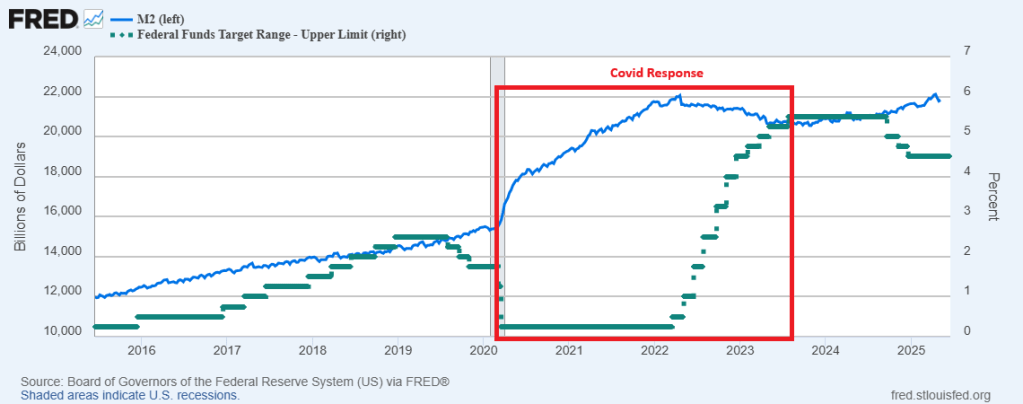
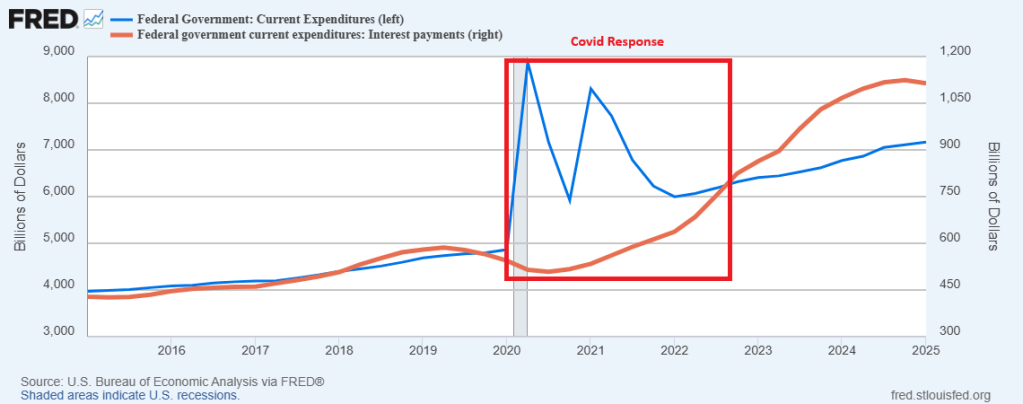
Home Price Growth Slows As Fed Prints Less Money (Keep On Printing??)

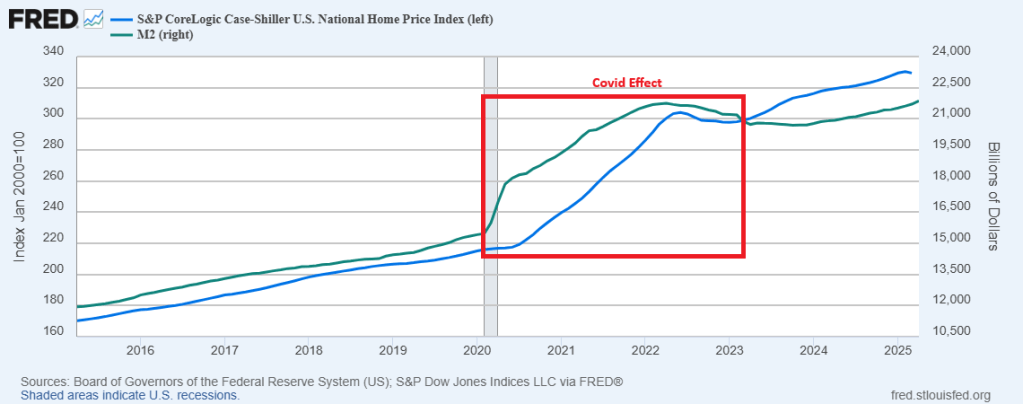
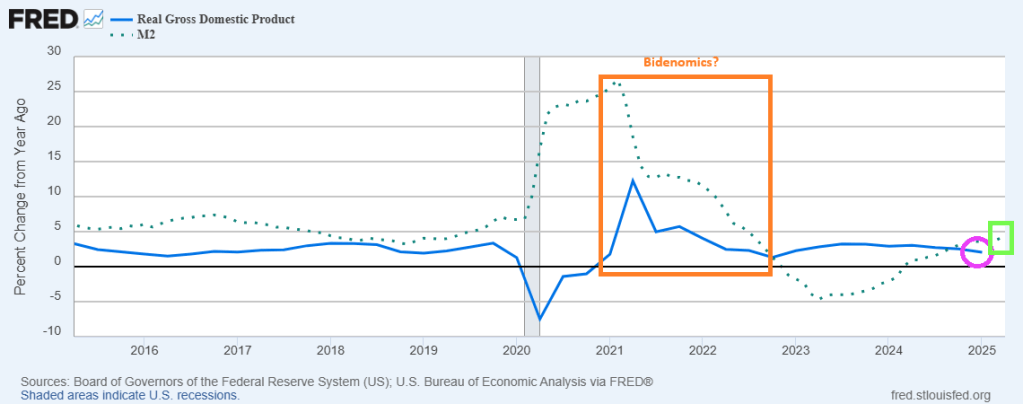
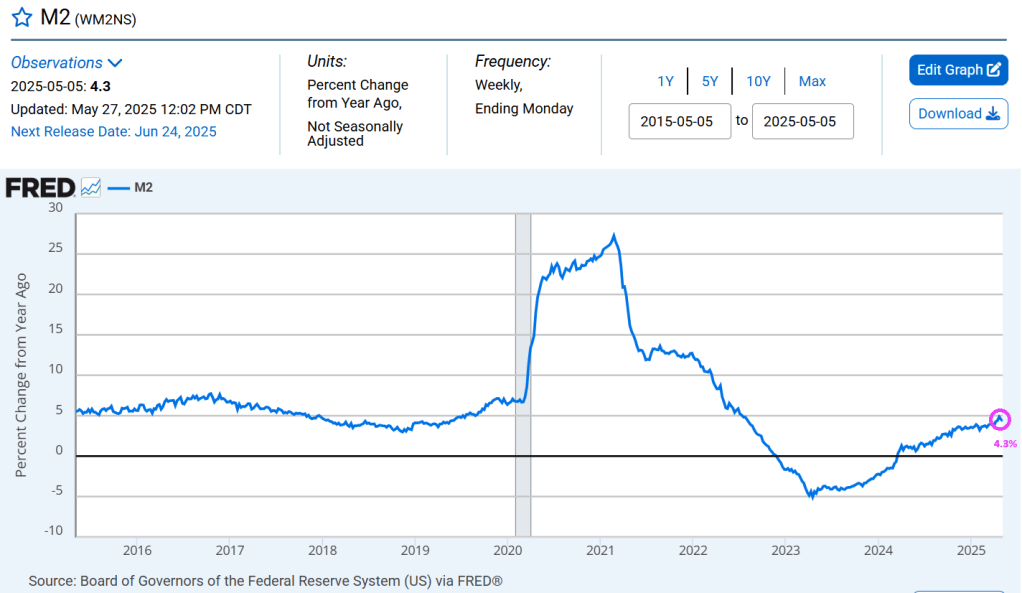
US home prices are slowing as Jerome Powell and The Fed slow down M2 Money printing.

Notice the lag effect between M2 Money growth (green dashed line) and the Case-Shiller National home price index (solid blue line). Both have slowed.

Should The Fed keep on printing money? We don’t need no stinkin’ Fed!

US Treasury 10Y-2Y Yield Curve Normalizes To Jan 2022 Levels, Adjustable Rate Mortgage (ARM) Share Back To Financial Crisis (2008) Levels

The good news? The US Treasury 10Y-2Y yield curve is normalizing to January 2022 levels.

One the mortgage side, adjustable rate mortgage (ARM) share is the highest since the financial crisis (2008).

As Trump continues to stand up for Americans and China (and Democrats) continues to fight, the S&P 500 index lags MSCI World index by most since 1993 (The Clintons).

One can only hope!

Adjustable-rate Mortgages (ARMs) Climb To Highest Origination Volume Share Since 2008 (Financial Crisis!)

ARMs??

Adjustable-rate mortgages (ARMs) have climbed to the highest origination volume share since 2008 as the yield curve steepens and bank lending demand picks up. The majority of ARM lending goes to high credit borrowers with jumbo-sized loans, which many banks see as a good fit to keep in their portfolios as they are seen to have relatively limited credit and interest-rate risk.

The Empire Strikes Out! Business Conditions Expectations Plunged To Lowest Since 9/11

The Emperor is actually China’s Xi Jinping! Causing the Empire Fed Manufacturing index to decline.

Despite the slump in ‘soft’ survey data, analysts expected Empire Fed Manufacturing to bounce back from March’s tumble to one year lows and they were right with the headline index rising from -20.0 to -8.1 (considerably better than the -13.5), but still negative. However, while current conditions jumped, expectations plunged to the lowest since 9/11/.

China Trade Uncertainty Causes VIX To Fall By 18.7 Pts, Largest In History (Correlation Between Stocks And Bonds Reverse To Positive)

Obama/Biden/Harris/Schumer/Pelosi have let the US be the punks for China. Trump is simply trying to level the playing field and China’s Xie doesn’t like the new equilibrium.

VIX Index fell by 18.7 points yesterday … largest one-day decline in history.

The correlation between stock prices and bond yields has returned to positive territory — hinting at a period of distress in equities and a regime shift in equity and bond markets where recession fears, rather than inflation, may be starting to drive direction of both. The correlation between the two asset classes was positive for the better part of 20 years prior to the pandemic, suggesting equities trended in the direction of yields as inflation mostly coincided with growth. Stocks held a negative correlation to yields throughout most of the 1980s and 1990s, when inflation hurt stocks — and that phenomenon returned for the 2022-24 bear market and recovery period.

Notably, major stock corrections occurred each time the correlation jumped out of its primary regime.

China’s Xi flashes a Hitler salute!

Thunderstruck! Tariff Turbulence Causing 10Y Treasury Volatility To Increase As MBS Spreads Widen

Thunderstruck! The tariff kerfuffle between the Trump Administration and China is causing turbulence in the Treasury market. The 10-year Treasury rate is soaring with China’s counterpunching.

MBS spreads are widening.

Along with volatility.

But corporate spreads are widening more than MBS spreads.

The 10Y-2Y yield curve has risen to the highest level since the early days of “China Joe” Biden.

On a related note, Freddie Mac serious delinquency rates on mortgages is now the highest since the financial crisis.

Tariff Town! Producer Prices Plunged Most Since COVID In March (US Dollar Decelerates!)

Washington DC is now Tariff Town.

Headline PPI fell (yes fell) 0.4% MoM (dramatically cooler than the 0.2% MoM rise expected), dragging the headline index down to +2.7% YoY.

The market is re-assessing the structural attractiveness of the dollar as the world’s global reserve currency and is undergoing a process of rapid de-dollarization.

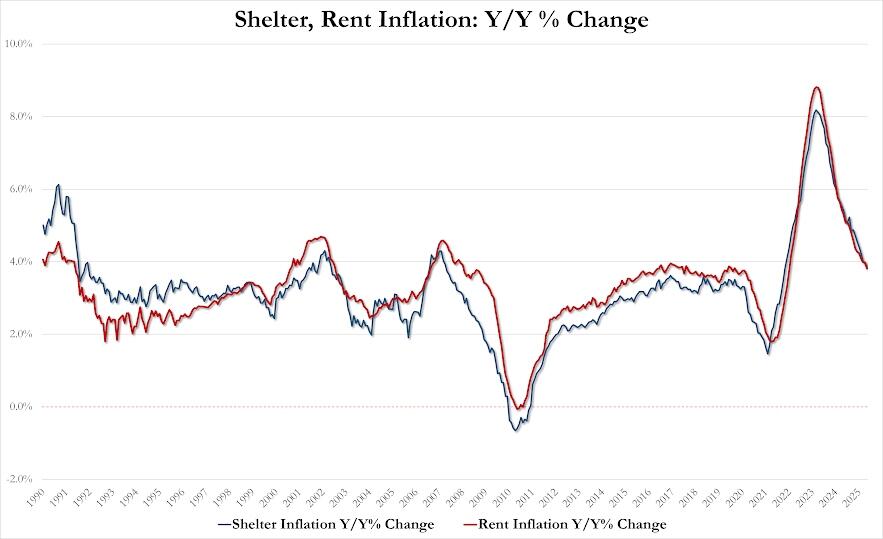
Hello Hello! March US Consumer Prices Fall Most In 5 Years (Rent Inflation Back To Pre-Biden Levels)

Hello Hello pre-Biden inflation levels!

The normally crucial consumer price index measure of inflation printing today for March is likely to take a back seat to the next red flashing headline on tariffs on everyone’s Bloomberg terminal, but under the hood – with the Trump Put now exposed – can a cooler than expected CPI print raise the Powell Put strike enough to enable a true tradable bottom here?

Having dipped lower in the previous month (following a few straight months of re-acceleration), expectations were for both headline and core measures to continue trending lower on a YoY basis… and they were.

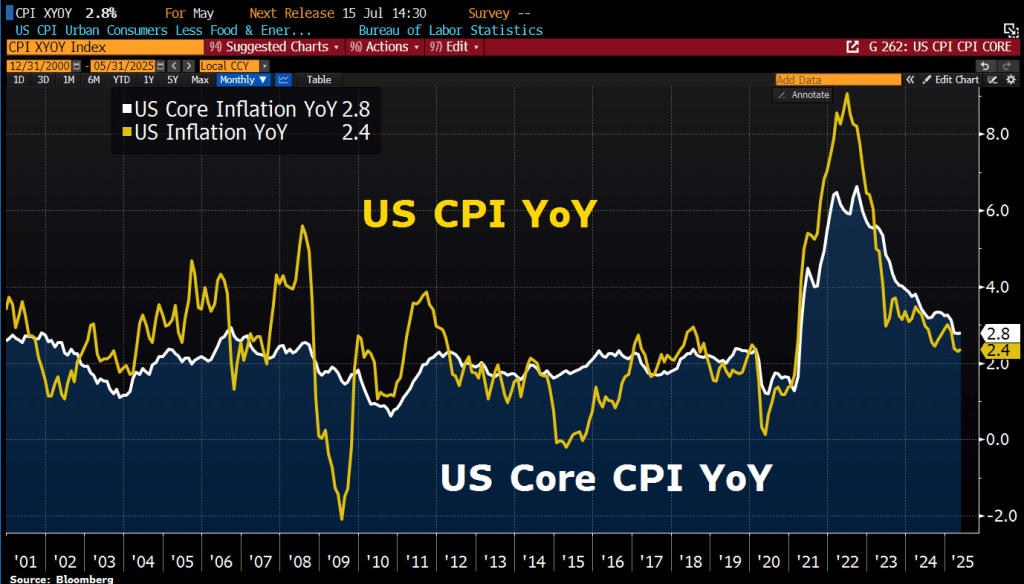
Headline CPI FELL 0.1% MoM (vs +0.1% exp), which dragged the YoY CPI to +2.4%, matching the September lows…

Source: Bloomberg

That is the weakest MoM print since May 2020.

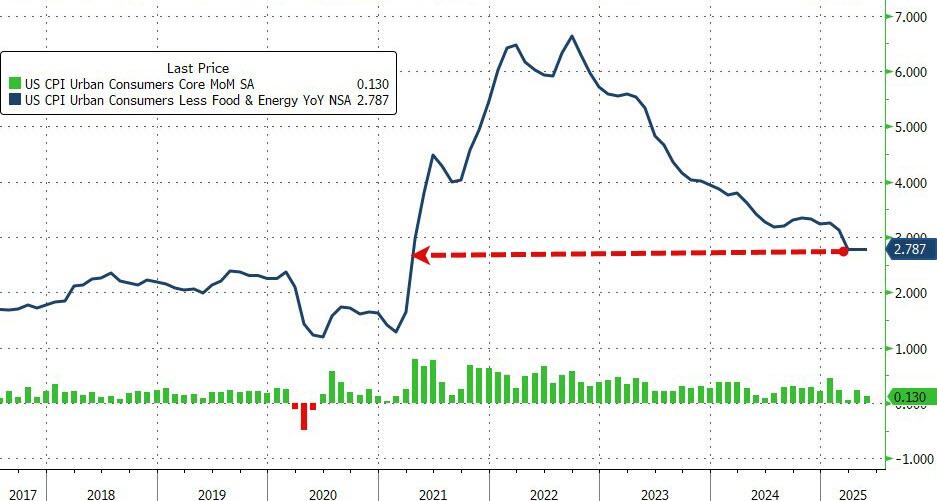
Core CPI also printed cooler than expected (+0.1% MoM vs +0.3% MoM exp), pulling the YoY print down t0 +2.8% YoY – the lowest since March 2021

Source: Bloomberg

Services inflation tumbled…

Source: Bloomberg

CPI breakdown:

Headline:

  • CPI decreased 0.1% after rising 0.2% in February, and below the +0.1% estimate. Over the last 12 months, CPI rose 2.4%, below the 2.5% estimate.
  • Energy CPI fell 2.4% in March, as a 6.3% decline in the index for gasoline more than offset increases in the indexes for electricity and natural gas.
  • Food CPI rose 0.4% in March as the food at home index increased 0.5% and the food away from home index rose 0.4 percent over the month.

Core CPI:

  • The index for all items less food and energy rose 0.1% in March, following a 0.2% increase in February.
    • Indexes that increased over the month include personal care, medical care, education, apparel, and new vehicles.
    • The indexes for airline fares, motor vehicle insurance, used cars and trucks, and recreation were among the major indexes that decreased in March.

Core CPI details (MoM increase):

  • The shelter index increased 0.2% over the month.
    • The index for owners’ equivalent rent rose 0.% in March and the index for rent increased 0.3%.
    • The lodging away from home index fell 3.5 percent in March.
  • The personal care index rose 1.0%in March.
  • The index for education rose 0.4% over the month, as did the index for apparel.
  • The new vehicles index also increased over the month, rising 0.1%.
  • The index for airline fares fell 5.3% in March, after declining 4.0% in February.
  • The indexes for motor vehicle insurance, used cars and trucks, and recreation also fell over the month.
  • The household furnishings and operations index was unchanged in March.
  • The medical care index increased 0.2% over the month.
  • The index for hospital services increased 1.1% in March and the index for physicians’ services rose 0.3% over the month. In contrast, the prescription drugs index fell 2.0% in March.

Core CPI details (YoY increase):

  • The index for all items less food and energy rose 2.8 percent over the past 12 months.
  • The shelter index increased 4.0 percent over the last year, the smallest 12-month increase since November 2021.
  • Other indexes with notable increases over the last year include motor vehicle insurance (+7.5 percent), medical care (+2.6 percent), recreation (+1.9 percent), and education (+3.9 percent).

While goods inflation is flat (zero-ish), services cost inflation is fading fast…

Source: Bloomberg

Shelter and Rent inflation is slowing fast:

  • Shelter inflation +0.3% MoM, +3.99% YoY, down from 4.25% in February (lowest since Nov 2021)
  • Rent inflation +0.3% MoM, +3.99% YoY, down from 4.09% in February (lowest since Jan 2022)

The so-called SuperCore CPI – Services Ex-Shelter – dropped 0.1% MoM dragging it down to +3.22% YoY – the lowest since Dec 2021…

Source: Bloomberg

Source: Bloomberg

Drill Baby Drill (and tariffs recession fears) have dragged energy prices lower and pulled CPI lower with it…

Source: Bloomberg