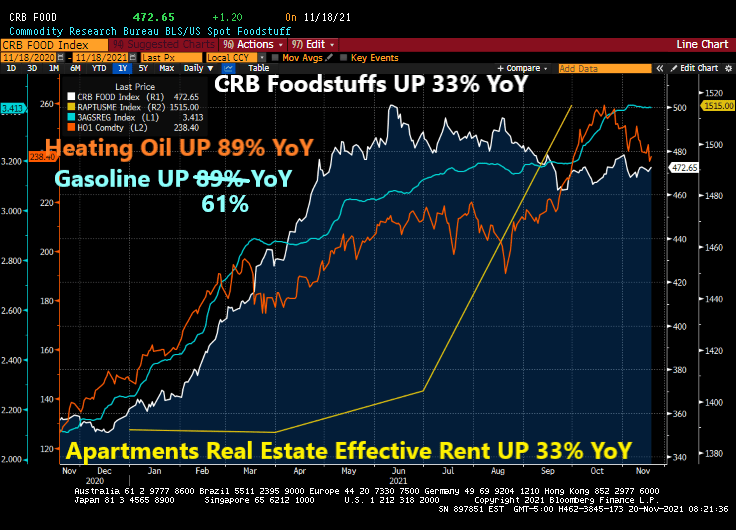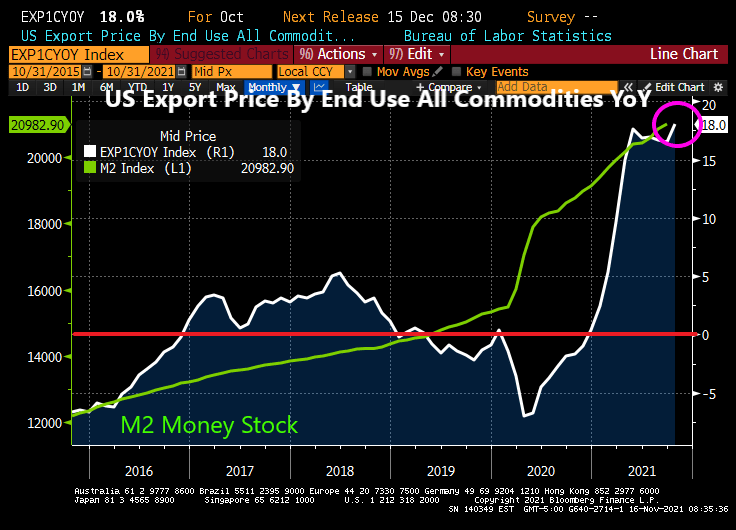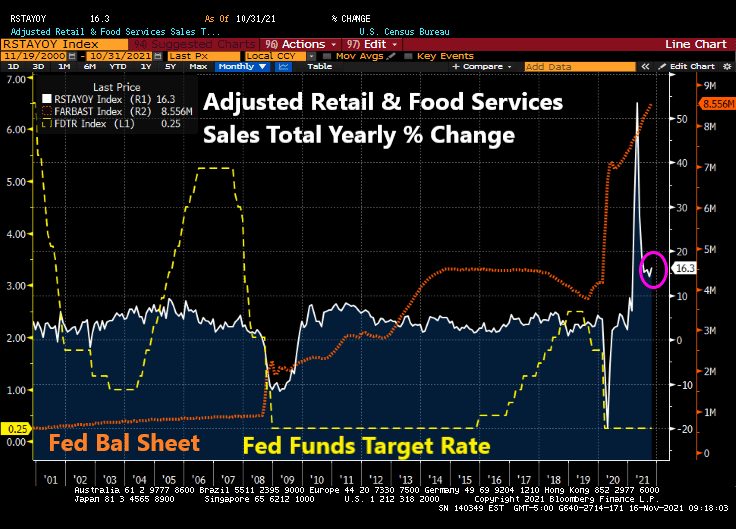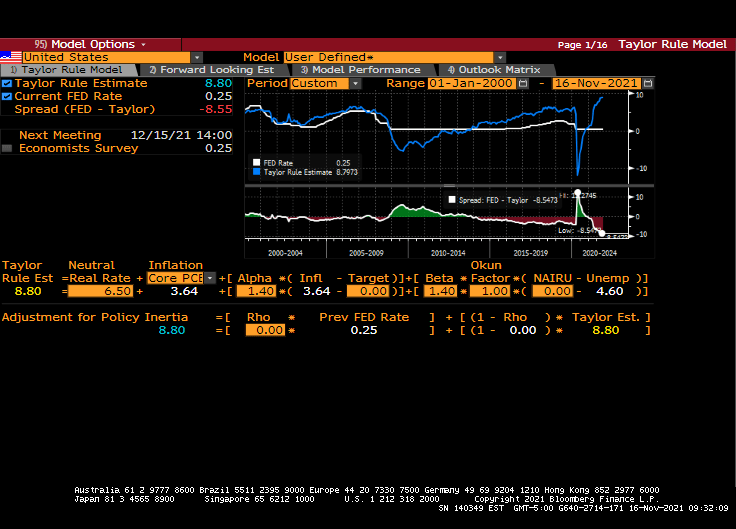
Where The Fed Sits In One Chart (Taylor Rule Hints At Target Rate Being 8.80% Instead Of 0.25%)

With The Federal Reserve leaving its target rate at 0.25%, but hinting at a tapering (slowdown) of asset purchases, I thought it would be good to present where The Fed sits at the moment.

You can see the rise in the effective Fed Funds rate from 2016 to early 2020, then KABOOM! COVID struck, the effective Fed Funds rate crashed while The Fed dramatically increased their purchases of Treasuries and Agency MBS. Both Treasury and Agency MBS purchases are projected to decline by mid-2022. The Fed’s target rate (purple line) is project to rise to 1% after 2023.

Where SHOULD The Fed Funds Target rate be? How about 8.80% instead of 0.25%.

So we still have over-stimulypto with The Fed projected to raise rates at a snail’s pace.

Face it, Wall Street wants interest rates low, even if inflation burns out of control.

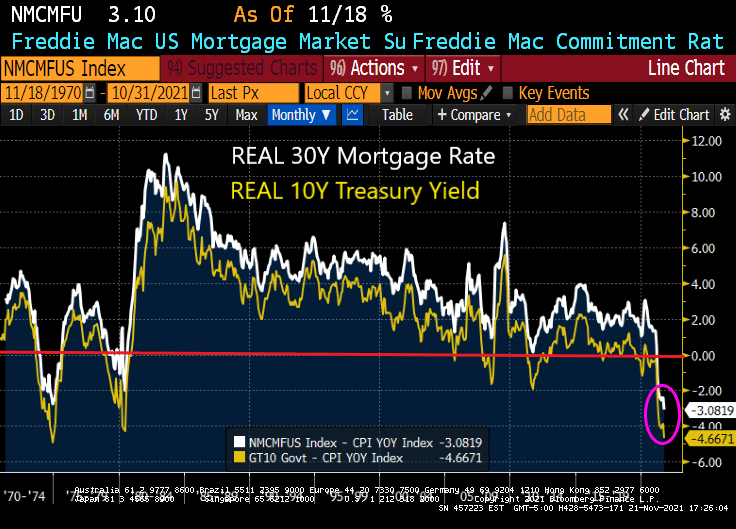
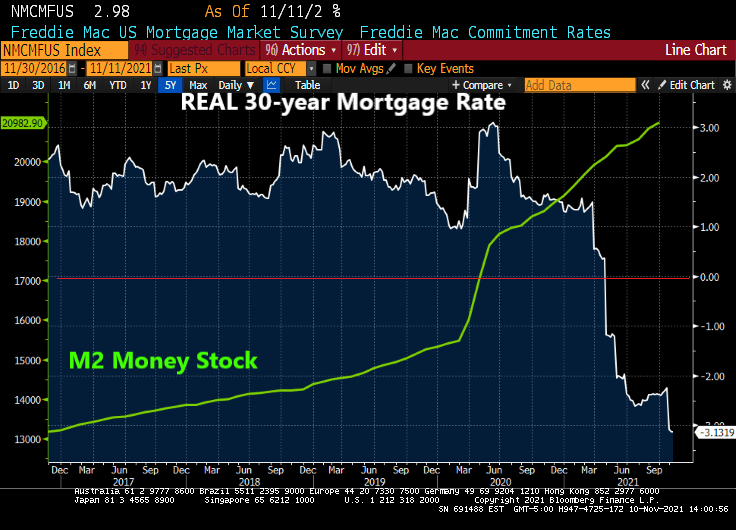
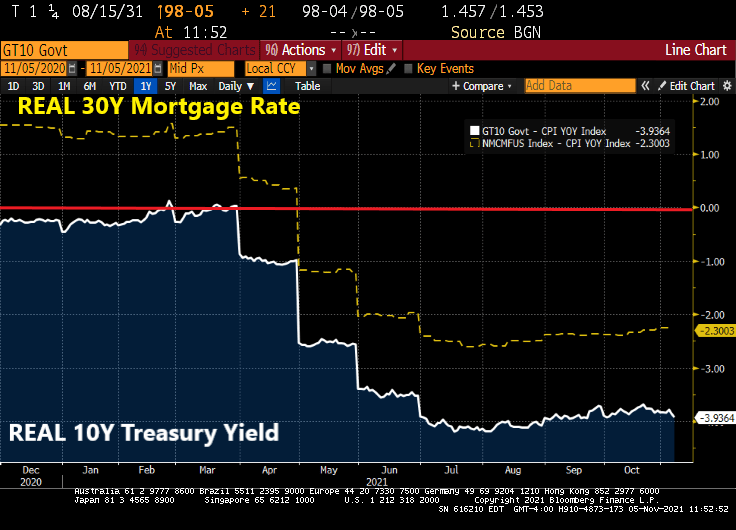
Stimulypto! 10-year REAL Treasury Yield Is -3.9364% And REAL 30-year Mortgage Rate Is -2.30%!

Yes, the US economy has been greatly overstimulated by the Federal government (fiscal stimulus) and The Federal Reserve (monetary stimulus). This has caused inflation that we haven’t seen in a long time.

How overstimulated in the economy? The REAL 10-year Treasury yield (nominal less CPI YoY) is now -3.9364% and the 30-year REAL mortgage rate is -2.30%.

When will Federal stimulypto end?

COVID And The CMBX Cliff (Retail and Office Sectors Still Limping Along Thanks To Shutdowns And Fearmongering)

Nothing has been the same since Covid struck in early 2020.

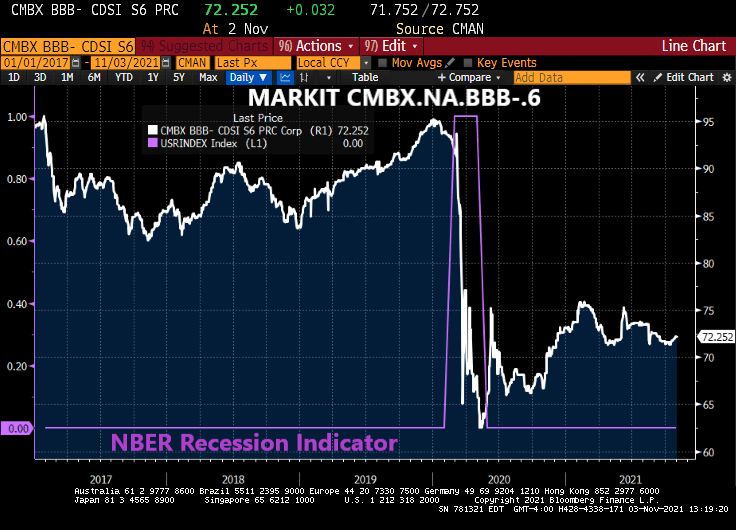
CMBX BBB-, the reference basket for CMBS 6, was climbing to around $95 prior to the Covid outbreak and resulting recession. The CMBX reference basket is now at $72.25.

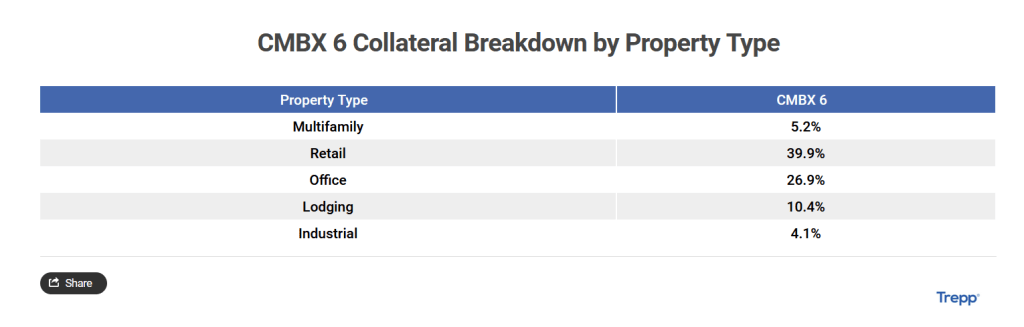
CMBX 6 is largely composed of retail and office, both hit hard by Covid and the ensuing lockdowns and fearmongering by the Federal government and main street media.

Escape From LA II? Corelogic Home Price Index UP 18% YoY, But Forecast To Slow To 1.9% YoY In 2022

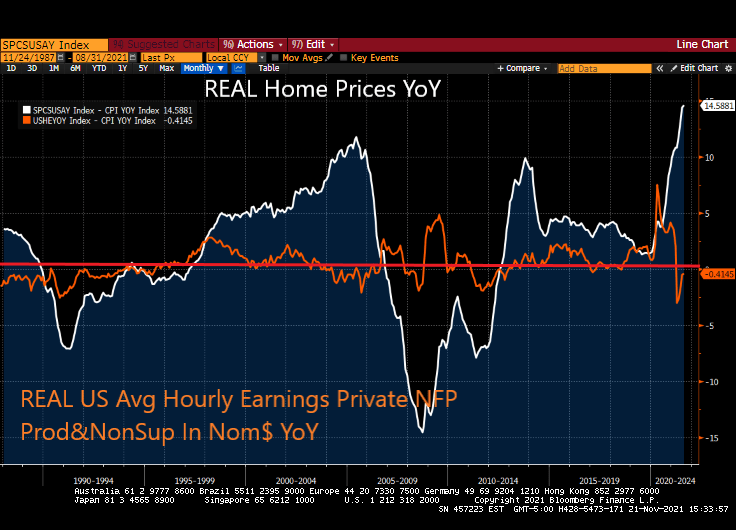
Yes, home prices are still growing at a super-hot pace of 18%, according to Corelogic.

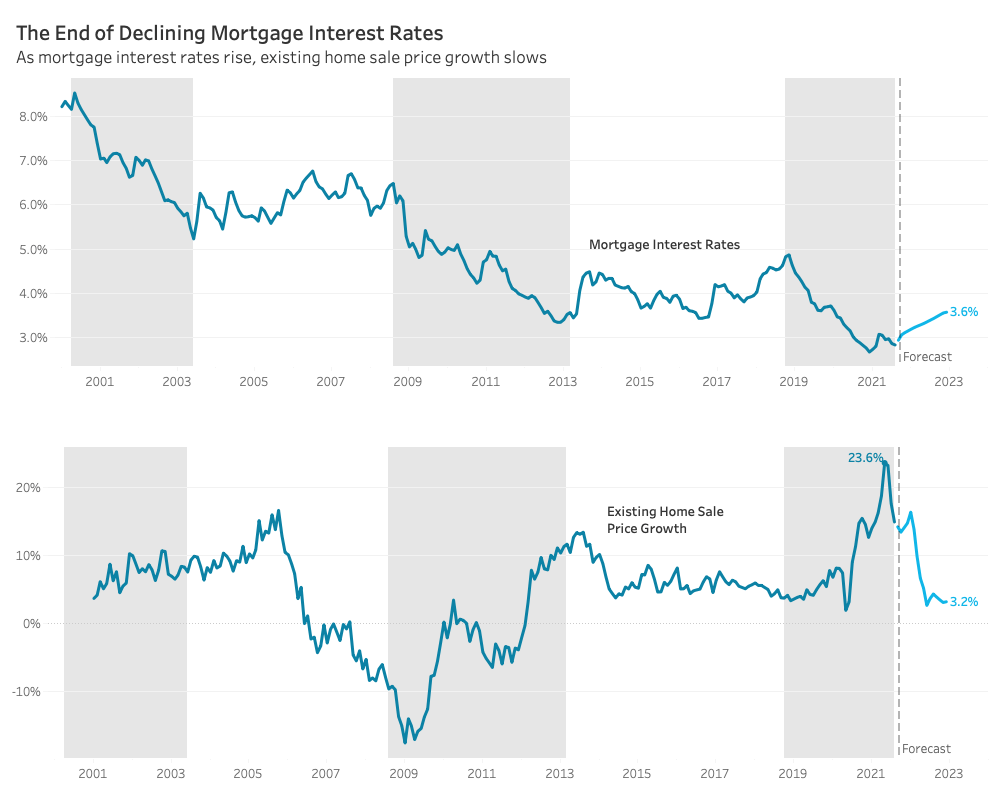
But the forecast for home price growth is for 1.9% YoY in 2022.

As home price growth crashes back to earth as wages don’t keep pace with home prices.

Home prices have been growing in most states out west where The Fed’s money pump has resulted in a boom in second homes and people escaping high tax California and Oregon for Nevada, Idaho, Arizona (again), Utah and Montana. The east coast is seeing the Carolinas booming along with Florida and Indiana. Escape from New York?

Escape from LA … to Arizona, Nevada, Idaho and Utah?

ECB’s Lagarde Sees Higher Inflation; Pushes Back On Rate-hike Bets (ECB Keeps Foot On Monetary Gas Pedal Despite Inflation)

Its the same all over the world … insane central bank policies and resulting inflation.

I have discussed the US Federal Reserve in depth, but its time to focus on Europe’s European Central Bank (ECB) and their President Christine Lagarde.

FRANKFURT, Oct 28 (Reuters) – European Central Bank President Christine Lagarde acknowledged on Thursday that inflation will be high for even longer but pushed back against market bets that price pressures would trigger an interest rate hike as soon as next year.

With central banks around the world signalling tighter policy amid rising prices, Lagarde said the ECB had done much “soul-searching” over its stance but concluded that inflation was still temporary, so a policy response would be premature.

Soul-searching? The ECB is just doing what Powell and the Fed (aka, Jerome Jett and the Blackhearts) are doing. Keeping the foot on the monetary gas pedal in the face of inflation.

Let’s start Eurozone inflation. It is now sitting a 4.10% YoY. And core inflation is sitting at 2.10% YoY. Inflation is now the highest since 2009 while core inflation is at the highest since 2001.

Like the Federal Reserve, the ECB still has its foot on the monetary accelerator pedal despite booming inflation.

So, Christine, 19 nations in “Europe” having negative 2-year sovereign yields isn’t low enough for you?

The ECB’s platform in Frankfurt reminds me of a bad TV quiz show where participants try to guess prices next year. Call it “The Price Is Wrong.”

Unless, of course, the ECB sees a massive depression ahead.

Invitation Homes Boosts Rents 11% As Housing Shortage (And Fed Stimulus) Persist

(Bloomberg) — The largest owner of U.S. rental houses isn’t seeing any let-up in demand, or in its ability to increase rents. 

Invitation Homes Inc., which owns more than 80,000 single-family rentals, raised prices by nearly 11% in the third quarter, according to a statement. The company boosted rents by 8% on renewals and 18% when leasing homes to new tenants. Rates are rising fastest in the Southwest, where rents increased 30% on new leases in Las Vegas, and 29% in Phoenix

“It’s a little bit crazy,” Chief Executive Officer Dallas Tanner said on a conference call with investors Thursday. “There just isn’t enough quality housing available right now.”

Rising rents have been a staple of the economy since early Covid lockdowns lifted in the middle of last year. Surging purchase prices have pushed homeownership out of reach for first-time buyers

Invitation’s properties, which tend be more centrally located than those owned by other institutional landlords, have been especially popular. And tenants tended to stay put: The company had a record-low turnover rate in the quarter, which reduced the expenses associated with preparing a house for leasing.

Invitation’s shares rose slightly to $40.77 at 12:49 p.m. New York time after the company raised its expectations for full- year revenue and net operating income. The stock is up 37% for the year.

As Milton Friedman once said, “If you put the federal government in charge of the Sahara Desert, in 5 years there’d be a shortage of sand.” In this case, The Federal government and Federal Reserve were put in charge of the Covid epidemic and we have shortages of almost everything. Including housing.

I don’t have Invitations rent growth chart, but here is Zillow’s YoY rent chart against The Fed’s balance sheet.

The good news? The 11% increase is almost half of the 20% YoY Case-Shiller National home price index.

Here is Treasury Secretary Janet Yellen making housing supply disappear.

Median U.S. Home Price Just Passed $400,000 For First Time Ever! (Prices Could Rise Another 16% By End Of 2022)

In the third quarter the median home price hit $404,700, jumping nearly 13% since third quarter of 2020, when the median sales price was $358,700.

Though it’s an eye-catching number, the market has been hot of late, and a lack of inventory and high demand means foretold the rise in home prices.

According to a recent note from Goldman Sachs, home prices could rise another 16% by the end of next year. Goldman economist Jan Hatzius pointed out that of all the pandemic shortages, the housing shortage might last the longest and that a crash is very unlikely.

Sure Jan. That’s what economists were saying in 2007 too before housing prices crashed and burned. Although this time its different: The Federal Reserve hadn’t gone insane buying Treasuries and Agency MBS before the housing bubble burst in 2008/2009.

Freddie Mac 30-year Rate Rises To 3.14% (Nothing Has Been The Same Since Covid)

Freddie Mac’s 30-year mortgage rate rose today to 3.14%.

Notice how Freddie’s 30-year loan commitment rate tracked the 10-year Treasury yield … until Covid struck. Then there was a separation of the two rates.

Stimulypto! US Q3 Real GDP Falls To 2% QoQ On Consumption Crash (Atlanta Fed GDPNow Falls To 0.195%)

Despite the staggering and unorthodox monetary stimulus from The Federal Reserve, US real GDP continues to fall. The Q3 real GDP report is out and real GDP QoQ fell to 2%. Not surprising given that the Atlanta Fed’s GDPNow tracker is at a dismal 0.195% and falling.

The culprit? Personal consumption fell to 1.6% in Q3 after hitting 12% in Q2.

The GDP price index actually declined slightly from 6.1% to 5.7%.

Of course, Bloomberg blames the decline in GDP on supply constraints … which were created by The Fed and Federal government dumping trillions of dollars of stimulus. While the monetary stimulus is still raging, Federal government stimulus has worn out. To paraphrase BB King, “The fiscal stimulus is gone.”

Yes, The Federal Reserve and the Federal government reacted insanely to the Covid crisis and created a total mess (including ill-advised government lockdowns of the economy, stimulus to households who already were employed, etc.)

Bloomberg News headline of “U.S. Posts Weakest Growth of Pandemic Recovery on Supply Woes” misses the point that The Fed and Federal Reserve CAUSED the supply woes. It reminds me of an episode from the British comedy series “Blackadder” with Rowan Atkinson, Hugh Laurie and Stephen Fry.

General Melchett:
[explaining why they can’t rescue Captain Blackadder] Now George, you remember when I came down to visit you when you were a nipper, for your sixth birthday? You used to have a lovely little rabbit, beautiful little thing, do you remember?

Lieutenant George:
Flossie.

General Melchett:
That’s right, Flossie! Do you remember what happened to Flossie?

Lieutenant George:
You shot him.

General Melchett:
That’s right! It was the kindest thing to do after he’d been run over by that car.

Lieutenant George:
By *your* car, sir.

General Melchett:
Yes, by my car. But that, too, was an act of mercy when you remember that that dog had been set on him.

Lieutenant George:
*Your* dog, sir.

General Melchett:
Yes, yes, my dog. But what I’m trying to say, George, is that the state young Flossie was in after we’d scraped him off my front tyre, is very much the state that young Blackadder will be in now: if not very nearly dead, then very actually dead!

For those of you who watched Blackadder, think of The Fed and Federal government as being populated by Baldricks.

Speaking of people acting like Baldrick …

US Mortgage Purchase Applications UP 3.24% From Previous Week As Mortgage Rates Rose To 3.30% (But Purchase Applications Down 9.3% From Same Week Last Year)

Mortgage purchase applications rose 3.24% from the previous week, according to data from the Mortgage Bankers Association. However, purchase applications are down 9.3% from

Mortgage refinancing applications declined -1.57% from the previous week as mortgage rates rose from 3.23% to 3.30%.