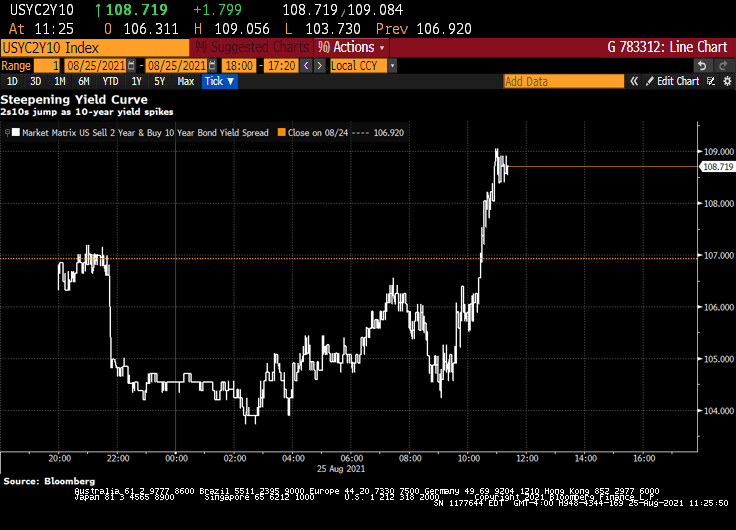
U.S. 10-year yields are spiking upwards in what was supposed to be a sleepy day before the Fed’s Jackson Hole conference. The 2s10s curve is the steepest in two weeks. Eurodollar yields too have risen sharply and are up 6-7 bps in the blue and gold packs.
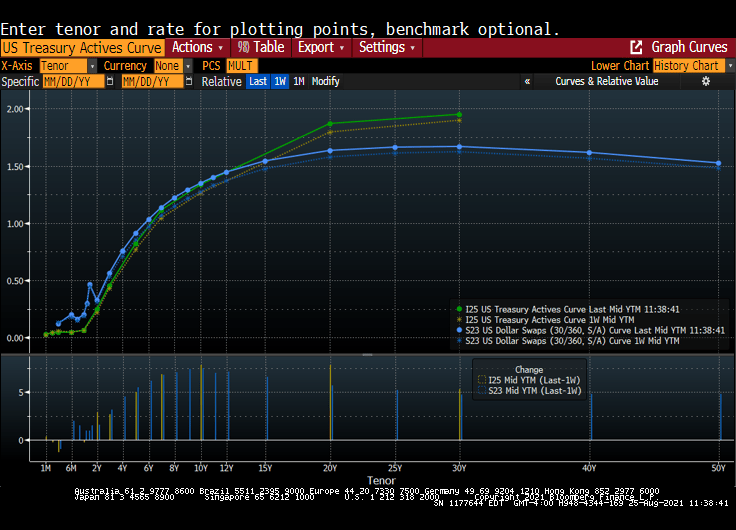
Over the last week, we have seen a steepening in the US Treasury Actives curve and the US Dollar Swaps curve.
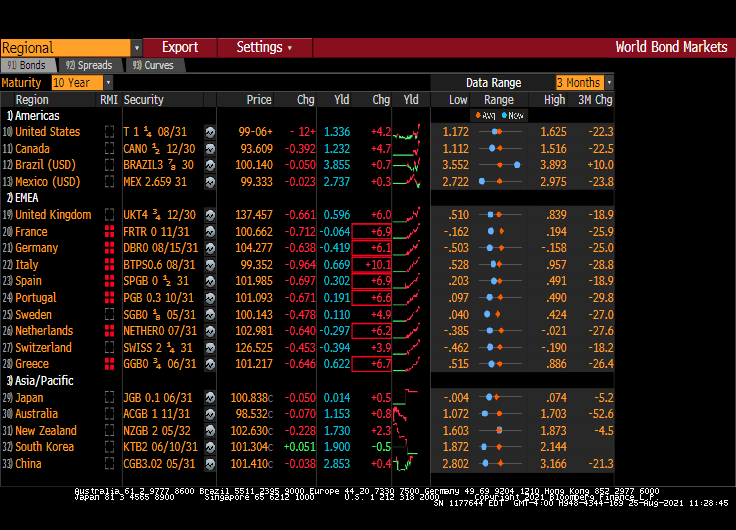
This may be linked to the range breach in German 10-years and Italian 10-years. In fact, France, Spain, Portugal, Netherlands and Greece has all seen 6 bps leaps in 10-year sovereign yields today.
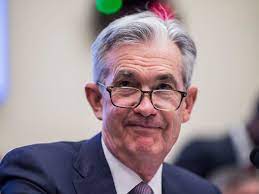
Does this mean that Chairman Mao Powell is likely to announce the paring-back of Fed monetary stimulus at J-Hole?
Mortgage applications increased 1.6 percent from one week earlier, according to data from the Mortgage Bankers Association’s (MBA) Weekly Mortgage Applications Survey for the week ending August 20, 2021.
The Refinance Index increased 1 percent from the previous week and was 3 percent higher than the same week one year ago. You can clearly see the Refi Wave associated with the Covid outbreak and sudden Fed monetary stimulus resulting in a lowering of 30-year mortgage rates.
The seasonally adjusted Purchase Index increased 3 percent from one week earlier. Notice the general slowdown in purchase applications with soaring home prices.
The unadjusted Purchase Index increased 1 percent compared with the previous week and was 16 percent lower than the same week one year ago.
Since President Nixon helped take the US off the gold standard, the US Dollar has become FIAT currency. That is, not backed any precious asset such as gold, silver, platinum, etc. What ever happened to the Bretton Woods system?
The Bretton Woods system was the first example of a fully negotiated monetary order intended to govern monetary relations among independent states. The chief features of the Bretton Woods system were an obligation for each country to adopt a monetary policy that maintained its external exchange rates within 1 percent by tying its currency to gold and the ability of the International Monetary Fund (IMF) to bridge temporary imbalances of payments. Also, there was a need to address the lack of cooperation among other countries and to prevent competitive devaluation of the currencies as well.
So much for Bretton Woods. We now live in a FIAT world where The Federal Reserve can print money almost without any limitation.
Enter cryptocurrcies such as Bitcoin and Ethereum.
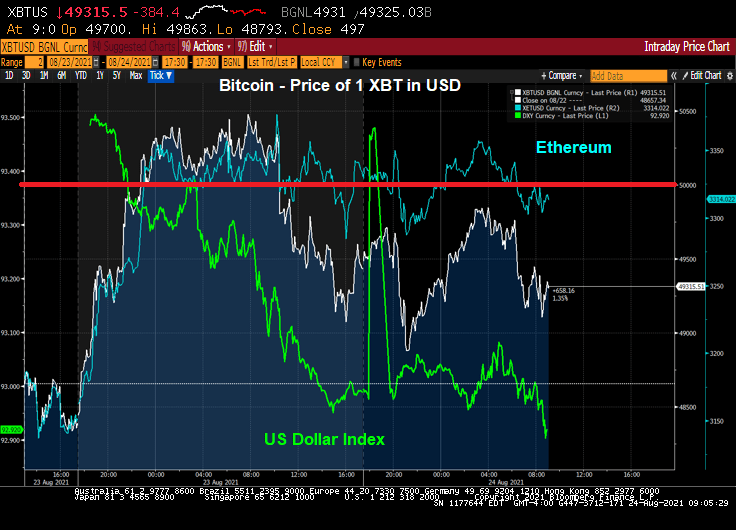
Bitcoin, the favorite of many, broke through the $50,000 barrier yesterday, only to level off below $50,000 this morning. Ethereum is level after rising yesterday. Meanwhile the US Dollar (the preferred FIAT model of The Federal Reserve) is falling.
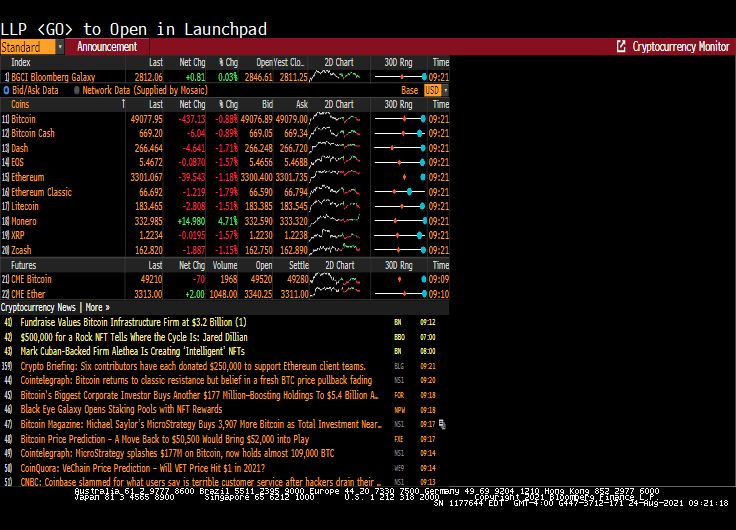
Here are some of the cryptos out there, but I only follow Bitcoin and Ethereum.
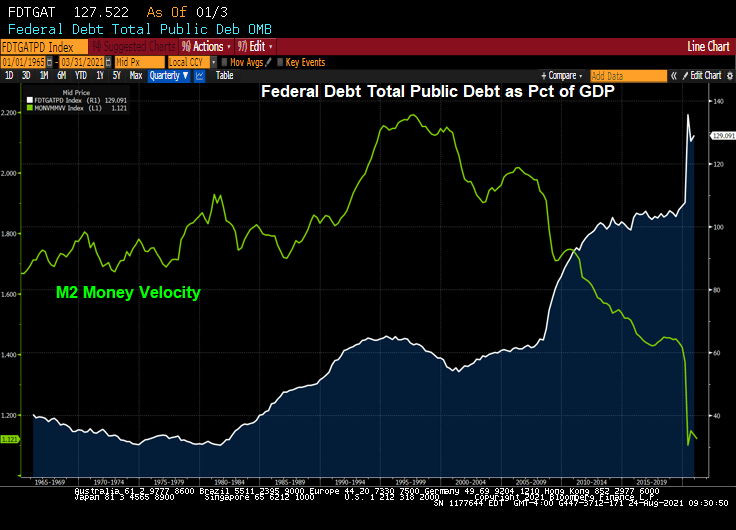
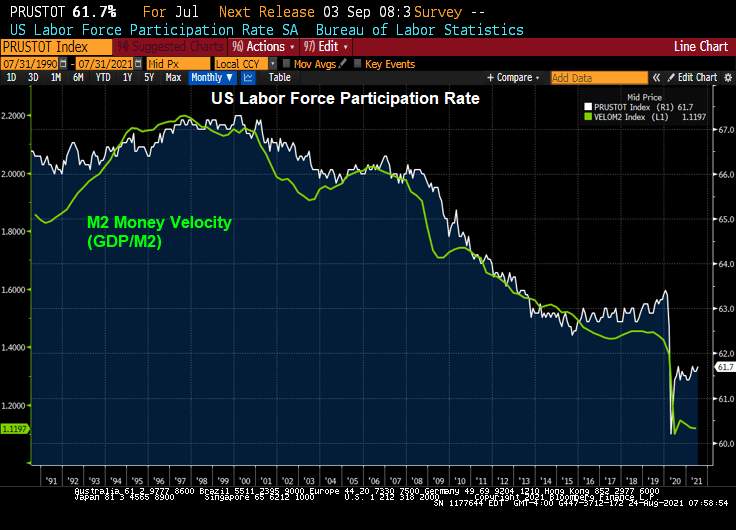
Since Nixon and dropping off the gold standard, we have seen US Federal debt (and spending) blow out of control with the decline in M2 Money Velocity to its lowest levels.
This should be the new emblem of the US Federal government AND The Federal Reserve.
Powell and The Fed’s policies have veered from their mandate requiring Chairman Powell to meet 350 times with Congress to sell The Fed’s policies.
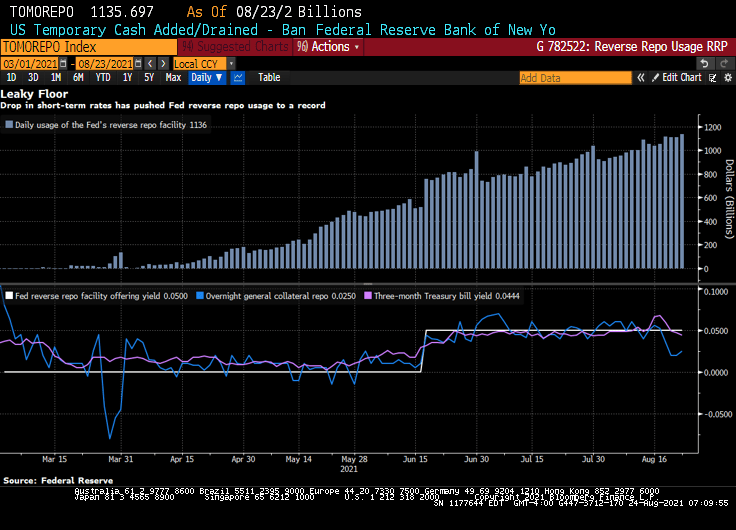
Bloomberg) — The Federal Reserve’s floor for overnight funding markets is proving to be no match for the deluge of cash.
Money-market securities ranging from Treasury bills to repurchase agreements continue to trade below 0.05% — the offering rate on the overnight reverse repo facility, which is supposed to act like a floor for the front end. The Fed at its June meeting had raised the rate by five basis points to help support the smooth functioning of short-term funding markets.
Still, usage of the tool climbed to a record $1.136 trillion on Monday, eclipsing the previous high of $1.116 trillion on Aug. 18.
Demand for the so-called RRP facility has surged as a flood of dollars threatens to overwhelm funding markets. That’s in part a result of the central bank’s long-standing asset purchases and drawdowns of the Treasury’s cash account, which is pushing reserves into the system. As a result, liquidity has been swelling, especially as the Treasury cuts supply to create more borrowing room under the debt ceiling.
The pressure pushing down overnight rates toward zero is proving a major headache for money-market funds. It hampers their ability to invest profitably, and can lead to further disruptions as they begin to waive fees to avoid passing on negative rates to shareholders. A number of firms including Vanguard Group shut down prime money-market funds last year after struggling to cover operating costs in the low-interest-rate environment.
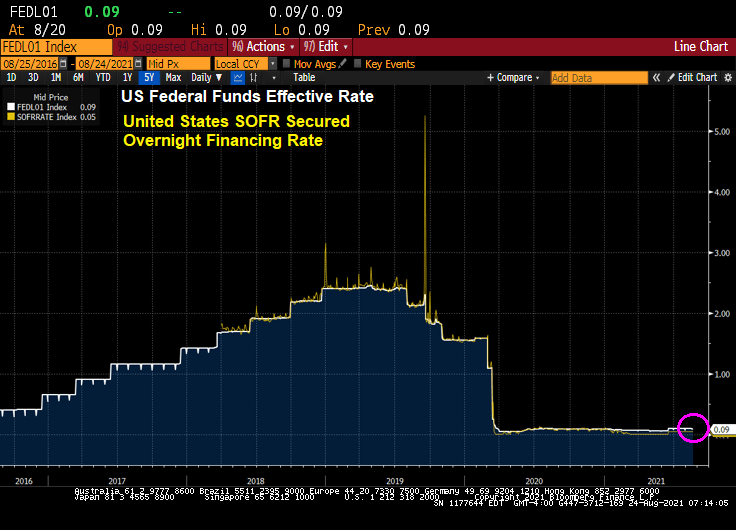
Yes, overnight rates such as the US SOFR rate, are near zero.
Powell’s Charm Offensive in Congress Positions Him to Keep Job
Perhaps that is why Federal Reserve Chair Jerome Powell is acting as a lobbyist with Congress for The Fed’s nontraditional approach to monetary policy.
(Bloomberg) Since he took the helm of the Fed in February 2018, through June of this year, he’s held at least 350 meetings, dinners or phone calls with members of Congress, according to his monthly calendars. That’s almost nine per month, and many of those included more than one lawmaker. The tally doesn’t count at least 16 appearances as chair before numerous congressional committees.
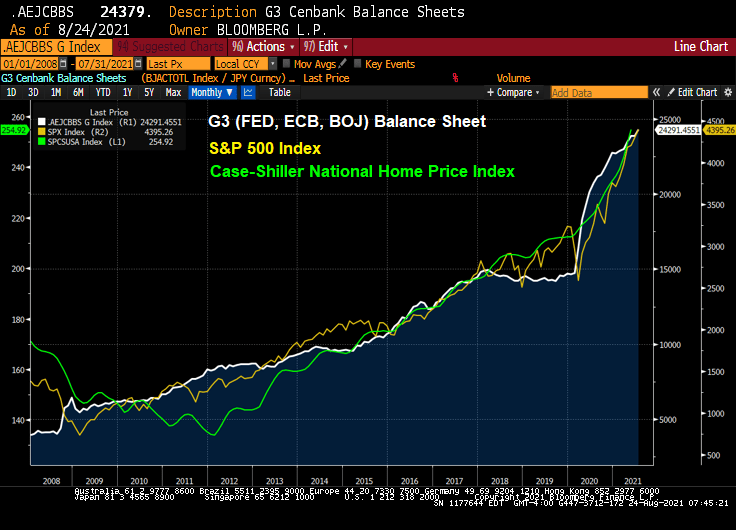
Well, the stock market has zoomed-up since Bernanke and The Fed adopted zero-interest rate (ZIRP) policies and the now famous quantitative easing (QE) policies in late 2008.
Congress member Alexandria Ocasio-Cortez asked Fed Chair Powell about the Fed helping with US unemployment. We are already at zero rates (on the short-end), and Congress should look at their policies on why labor force participation is slow to recover from the Covid epidemic.
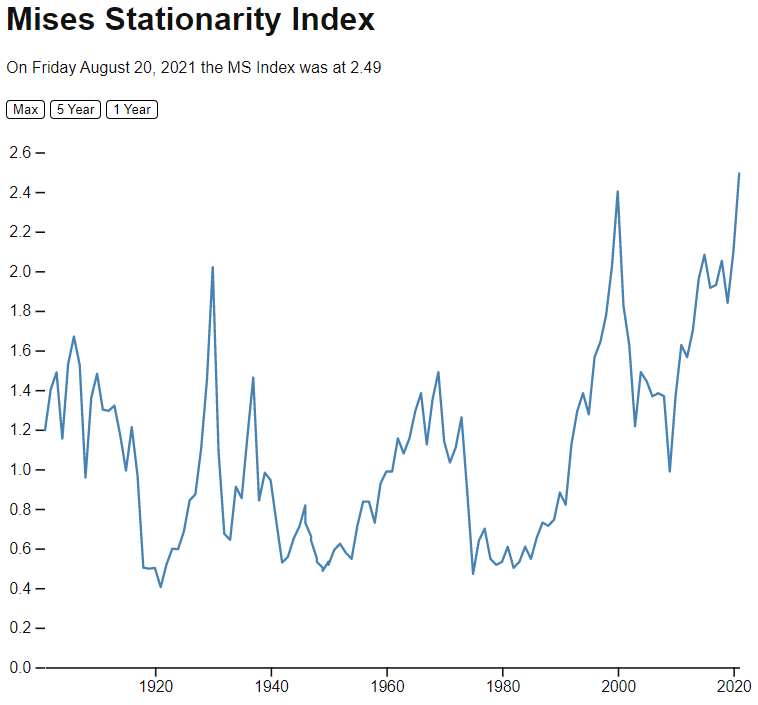
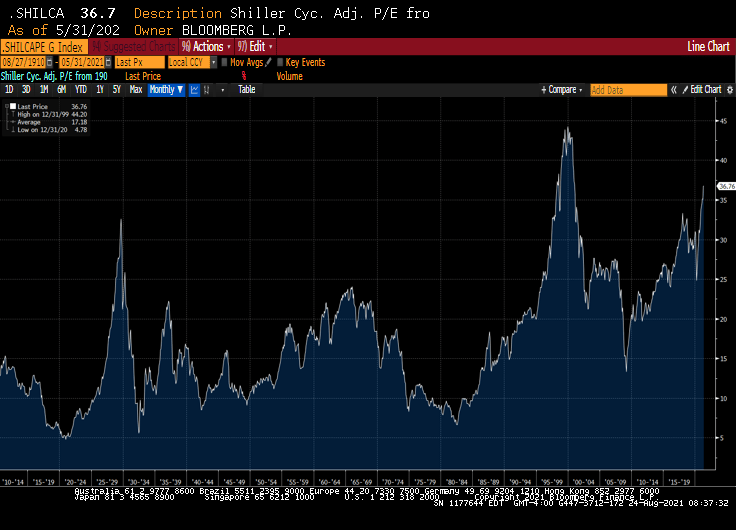
The Mises Stationarity Index is different than the Shiller CAPE index, which is showing equities as being overpriced, but not yet in dot.com bubble zone.
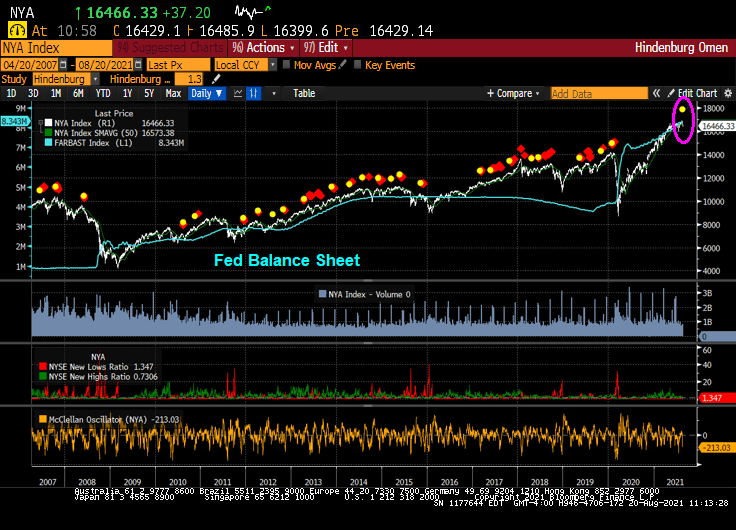
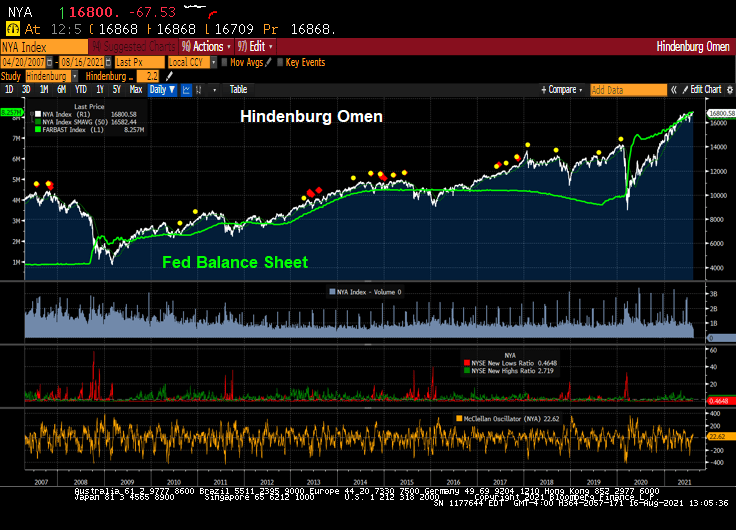
The famous Hindenburg Omen, the technical indicator that predicted the 2008 correction in the stock market, has just flashed “ALARM” again.
To be sure, there hasn’t been a major correction in the stock market since the financial crisis, primarily because The Federal Reserve has constantly goosed the markets since late 2008.
Just as the Shiller CAPE ratio is signalling ALARM!
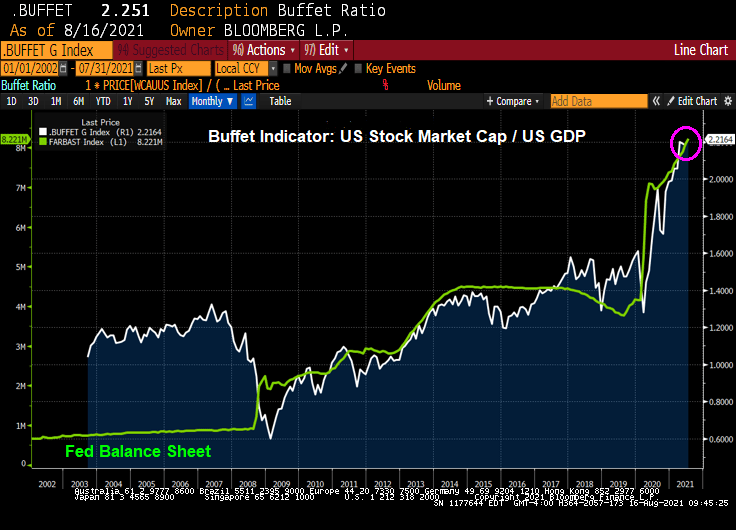
As is the Buffet Indicator.
I have no doubts that the Fed will withdraw its monstrous stimulus from the market after the Jackson Hole Fed conference. … NOT!!!!
Maverick Capital posted this nugget today showing The Buffet Indicator (US equity market cap/GDP) and US Corporate Profits / GDP. All I can say is “simply unsustainable.”
The minutes of the July Fed meeting suggest officials may signal an impending start to asset purchase tapering at the September gathering — provided jobs numbers remain on track in the interim — and make an announcement in November.
Rising infections counts have not spurred an uptick in new jobless claims. High-frequency data show some customers are shying away from eating out, but the overall impact on restaurant reservations is limited. The bigger challenge for many companies is retaining and hiring enough workers to meet strong demand, evident in low layoff counts and persistent mention of labor shortages.
In other words, IFF Covid doesn’t cause further economic damage (or governments don’t shut down economies), then The Fed will consider a mild taper of their balance sheet.
But as of this morning, The Fed’s reverse repo facility keeps on rising along with The Fed’s balance sheet. At least M2 Money Supply growth has leveled off.
That should result in an increase in Treasury yields and mortgage rates, all things being equal. And assuming the Biden Administration and governors don’t panic and go into economic lockdown … again.
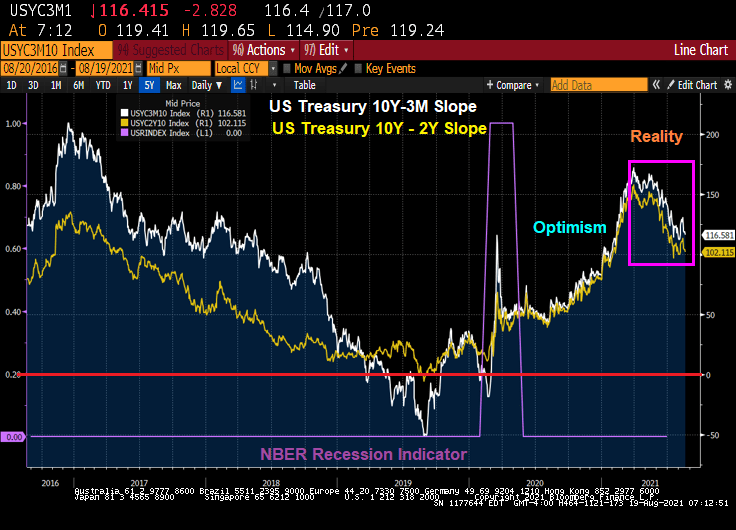
The US Treasury curves since the Covid recession of 2020 have shown optimism in recovery … then reality dawned.
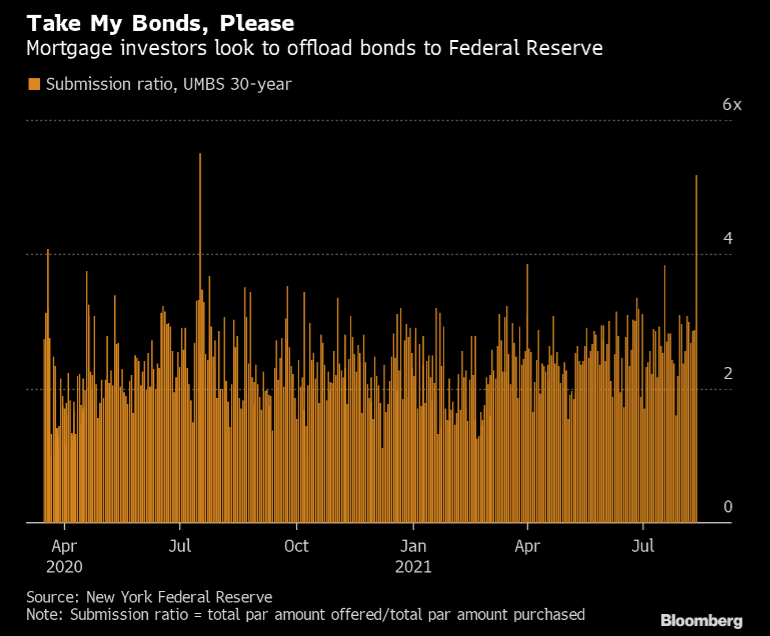
(Bloomberg) — Last week was notable for the tsunami of agency mortgage bonds offered to the Federal Reserve during its routine purchase operations on Friday.
The central bank’s quantitative easing schedule called for it to buy $2.9 billion of 30-year uniform mortgage bonds Friday, and that was nothing outside of its usual pattern. However, mortgage investors flooded the Fed with $15.06 billion of bonds for sale, the largest daily amount offered during a single operation since April 1, 2020.
In terms of how that compares to the total amount purchased, investors offered 5.2 times as much as were eventually taken down by the central bank. That is well above the 2.3 times average for 30-year uniform mortgage bond operations seen during all of this round of quantitative easing, and the second-highest overall. The highest submission ratio was the 5.5 times seen on July 16, 2020.
There are a number of reasons this could have happened. Investors may have wished to lighten their positions before the summer doldrums of late August, when many desks are lightly staffed due to vacations. Also, tight sector valuations or concerns about a sooner-than-expected taper may have played a part.
While this may simply be a one-off event and no reason for concern, it is certainly something to keep an eye on in case it heralds a change in investor sentiment.
In related news, the Treasury’s overnight reverse repos purchases remain about $1 trillion.
There are a variety of measures of an asset bubble. And each one points to an unsustainable bubble in the stock market.
Let’s start with the Buffett Indicator. The ratio of Total Market Capitalization of all US stocks (WCAUUS ) to total nominal GDP of the United States (GDP CUR$ ).
There is also the GLOBAL Buffett ratio produced by Holger Zschäpitz. Global market cap now equal to 139% of global GDP, way above Buffett’s 100% bubble threshold.
Shiller’s Cyclically-adjusted Price-earnings ratio? Still climbing and resembles the Dot.com bubble of 2000.
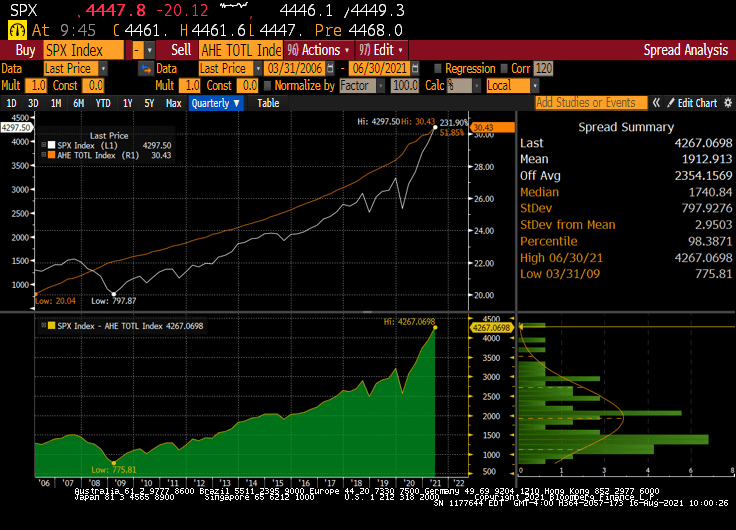
How about gold to Average Hourly Earnings (similar to the Bichler and Nitzan “Power” measure. The spread (bottom chart) sees the S&P 500 index soaring away from average hourly earnings.
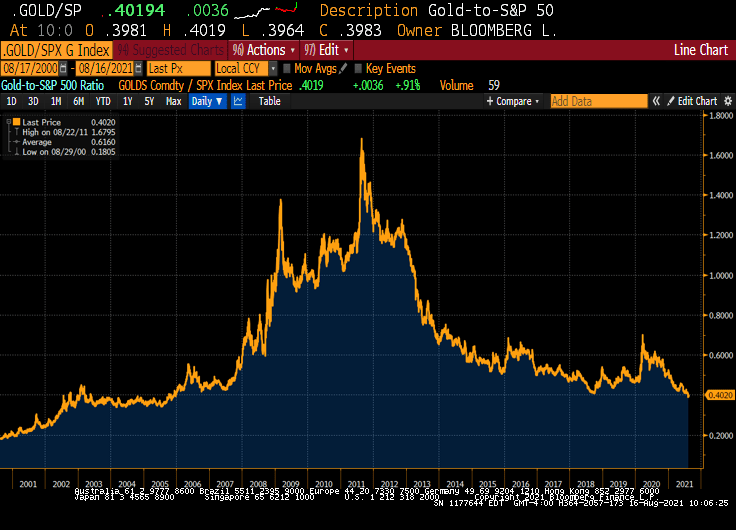
We also have the Gold to SPX ratio that is now back to pre-financial crisis levels.
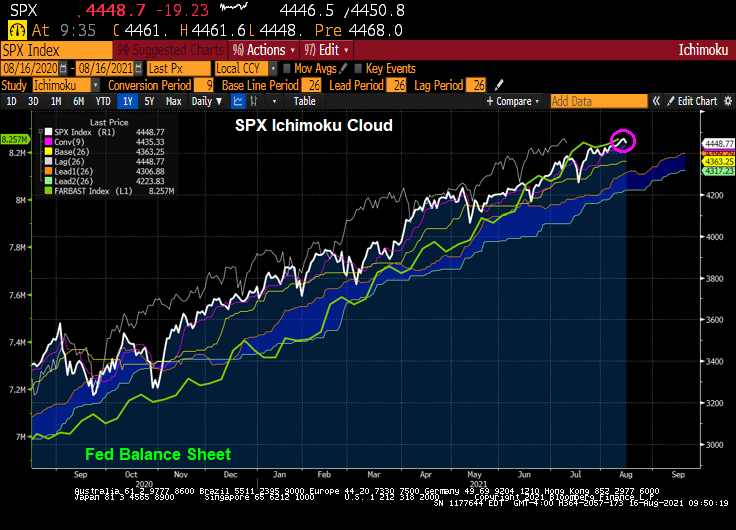
How about the Ichimoku cloud, where the SPX is currently ABOVE the cloud?
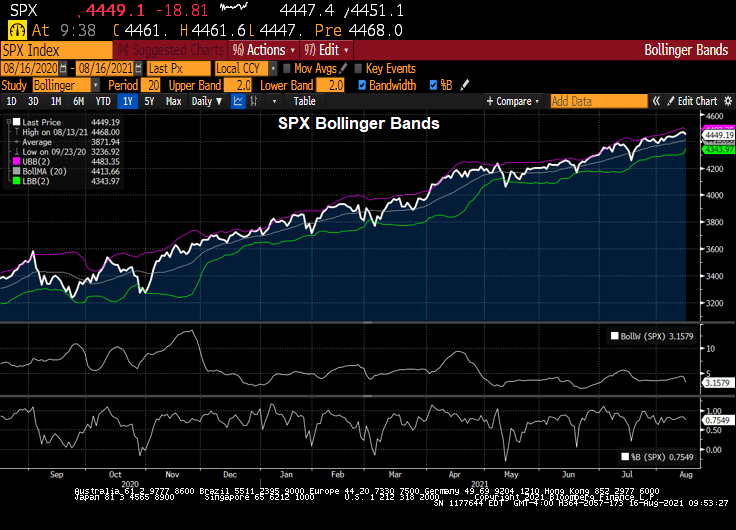
SPX and Bollinger Bands? The SPX index is close to the upper band.
How about The Hindenburg Omen, a technical indicator that was designed to signal the increased probability of a stock market crash. It compares the percentage of new 52-week highs and new 52-week lows in stock prices to a predetermined reference percentage that is supposed to predict the increasing likelihood of a market crash.
So it looks like a have a bubble in the stock market.
Fed Chair Jerome Powell sees the ghost of the Dot.com bubble.
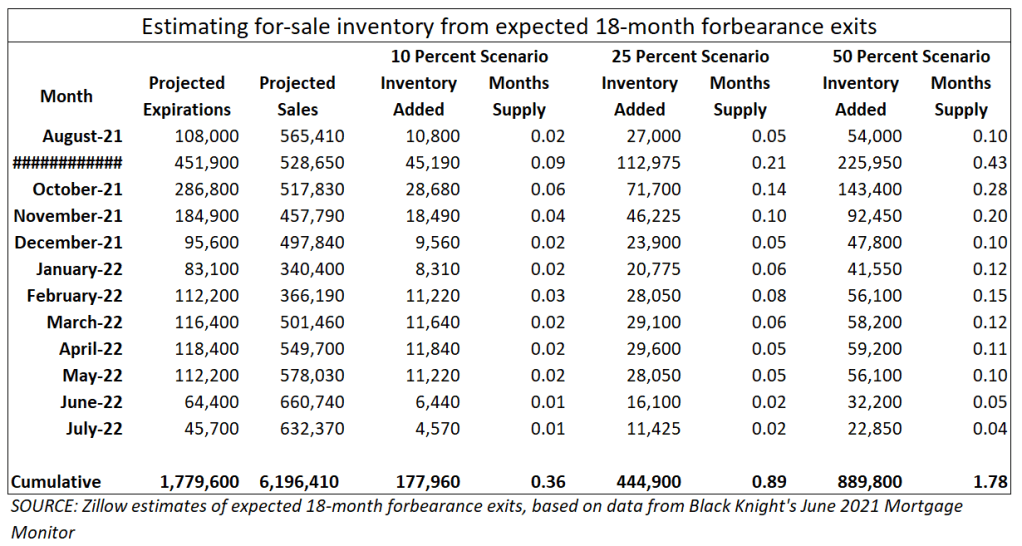
There will be more housing inventory hitting the market soon. As home prices are up and most are no longer in negative equity situations, some will decide to sell into this hot market. Obviously not paying your mortgage for 12, 14, 16, or even 18 months is a nice bonus that party is coming to an end.
Zillow’s research found that most are not going to bring their mortgage current. Assume someone took a forbearance and their monthly mortgage cost was $2,000 per month, some may be behind by up to $36,000 when the forbearance period ends. Okay, well what if you can’t make it current? You can defer the payments to the end of the mortgage but you still owe that and many got used to not even paying the regular monthly payment. So a sizable portion will be selling
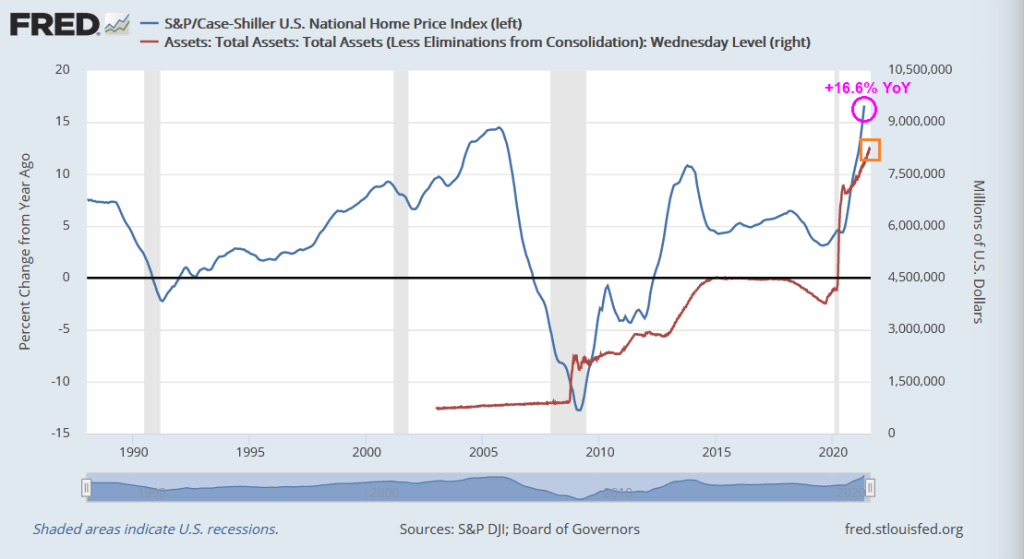
Could this be the end of the 16.6% YoY growth rate in home prices? Or will Congress and/or The Biden Administration extend the forbearance? Or will The Fed expand their balance sheet even further??





















You must be logged in to post a comment.