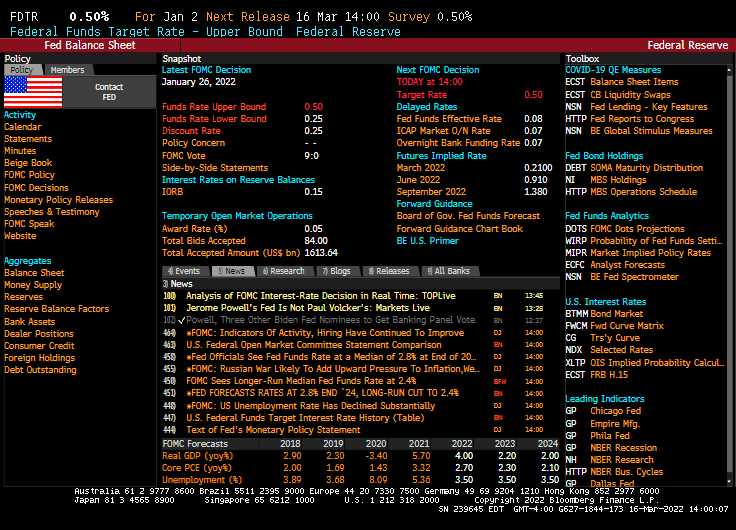
So, The Federal Reserve raised their target rate by … as expected … 25 basis points to 50 basis points.
The Taylor Rule suggests that the target rate should be 11.96%. So, Powell and The Gang are getting closer! /sarc
The short-term reaction to the measly rate increase? The Dow declined (but still in positive territory for the day) and the benchmark 10-year Treasury yield spiked to 2.23%.
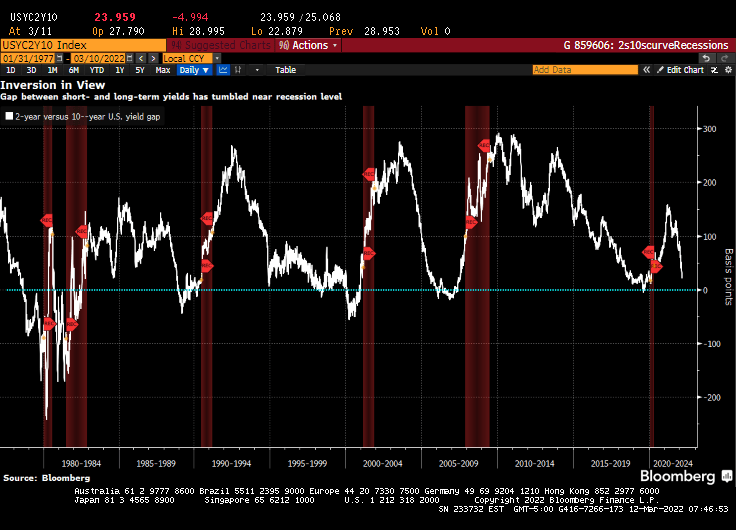
On Powell’s surrender to inflation, the US Treasury 10Y-2Y curve continued to flatten.
You can see The Fed’s sloth-like response to blood-curdling inflation in the lower right-hand part of the chart.
US Speaker of the House and American Oligarch Nancy Pelosi together with Senate Majority Oligarch Charles Schumer passed yet another massive spending bill that seemingly benefited them and not the American middle class.
This legislation would provide $774.4 million for the Members Representational Allowance, known as the MRA, which funds the House office budgets for lawmakers, including staffer salaries. This $134.4 million, or 21 percent, boost over the previous fiscal year marks the largest increase in the MRA appropriation since it was authorized in 1996, according to a bill summary by the House Appropriations Committee. For paid interns in member and leadership offices, the House would get $18.2 million.
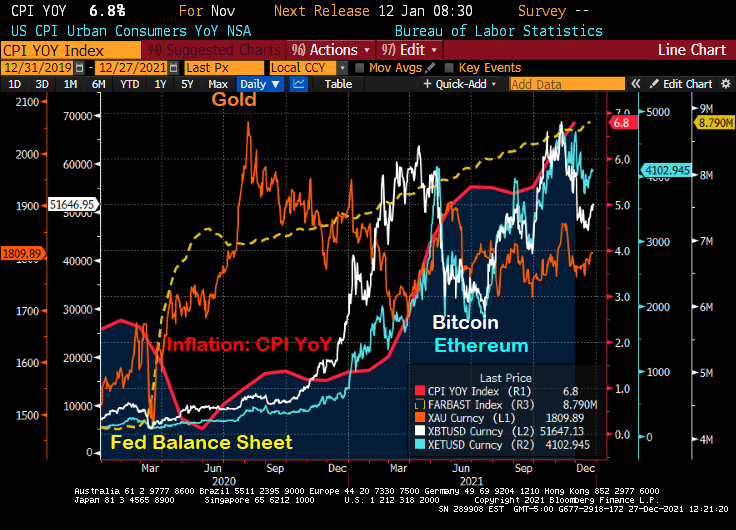
This is especially unfortunate given at inflation is growing at 7.9%. If we remove food and energy (two important categories for consumers and retirees), core inflation is growing at 6.4% YoY. As such, Social Security COLA doesn’t even keep pace with CORE inflation, let alone food and energy costs.
In August, Speaker Nancy Pelosi announced staffers’ salaries could exceed those of lawmakers. Members in both the House and Senate, with the exception of leadership, make an annual salary of $174,000. Staffers can make up to $199,300.
After an 11-year drought, congressional earmarks are back with vengeance.
The $1.5 trillion, 2,741-page omnibus spending package is loaded with funding for lawmaker pet projects, some of which could help incumbents in this fall’s elections.
The legislation includes more than 4,000 earmarks, according to a list of projects provided to The Hill by a Senate Republican aide that spanned 367 pages.
One of the biggest winners was New York — thanks to Senate Majority Leader Charles Schumer (D-N.Y.), who is up for reelection this year.
Schumer’s name is attached to 59 earmarks totaling nearly $80 million in the omnibus’s transportation and housing and urban development (HUD) section alone, according to a review by The Hill. He successfully requested funding for the projects either individually or with other lawmakers from his home state.
Is wild-spending Pelosi actually “The Bride of Chucky (Schumer)”?
Coindesk: The foundations of Bretton Woods II crumbled last week when the G7 seized Russia’s foreign exchange reserves, the investment bank said.
The Russian-Ukrainian war will create a new world financial order from which Bitcoin is set to benefit, according to Credit Suisse.
Zoltan Pozsar, global head of short-term interest rate strategy at the giant investment bank, wrote in a Monday report that Western sanctions on Russia are likely to cause a paradigm shift in the way the world organizes money and reserves, a “Bretton Woods III” kind of scenario.
“From the Bretton Woods era backed by gold bullion, to Bretton Woods II backed by inside money, to Bretton Woods III backed by outside money,” the strategist wrote.
Pozsar argues that the fall of Bretton Woods II ensued last week as G7 countries decided to seize Russia’s foreign exchange (FX) reserves, leading to a rise of outside money – reserves kept as commodities – over inside money – reserves kept as liabilities of global financial institutions.
“We are witnessing the birth of Bretton Woods III – a new world (monetary) order centered around commodity-based currencies in the East that will likely weaken the Eurodollar system and also contribute to inflationary forces in the West,” the report states.
Russia, a surplus agent in the financial system, can now no longer make use of the hefty FX reserves it accumulated through its commodity exports over the decades to defend its falling ruble or aid its local economy. Moreover, Russia’s ability to export its commodities has been severely hurt due to the “buyer’s strike” in the West.
“What we are seeing at the 50-year anniversary of the 1973 OPEC supply shock is something similar but substantially worse – the 2022 Russia supply shock, which isn’t driven by the supplier but the consumer,” the strategist wrote. “The aggressor in the geopolitical arena is being punished by sanctions, and sanctions-driven commodity price moves threaten financial stability in the West.”
Pozsar argues that while Western central banks cannot close spreads between Russian and non-Russian commodity prices as sanctions lead them in opposite directions, the People’s Bank of China can “as it banks for a sovereign who can dance to its own tune.”
“If you believe that the West can craft sanctions that maximize pain for Russia while minimizing financial stability risks and price stability risks in the West, you could also believe in unicorns,” Pozsar wrote.
As outside money keeps trumping inside money, this crisis will likely emerge and end differently than all others ever since Nixon broke off the gold standard in 1971 – which marked the end of the era of commodity-based money.
Meanwhile, US Treasury Secretary Janet Yellen said the U.S. dollar is in no danger of losing its status as the world’s dominant reserve currency as a result of sanctions imposed against Russia over its invasion of Ukraine.
“I don’t think the dollar has any serious competition, and is not likely to for a long time,” Yellen told reporters in response to questions following a speech in Denver on Friday.
Some commentators, including Credit Suisse Group AG interest-rate strategist Zoltan Pozsar, have warned sanctions that blocked Russia’s access to its foreign currency reserves could drive other countries away from the dollar.
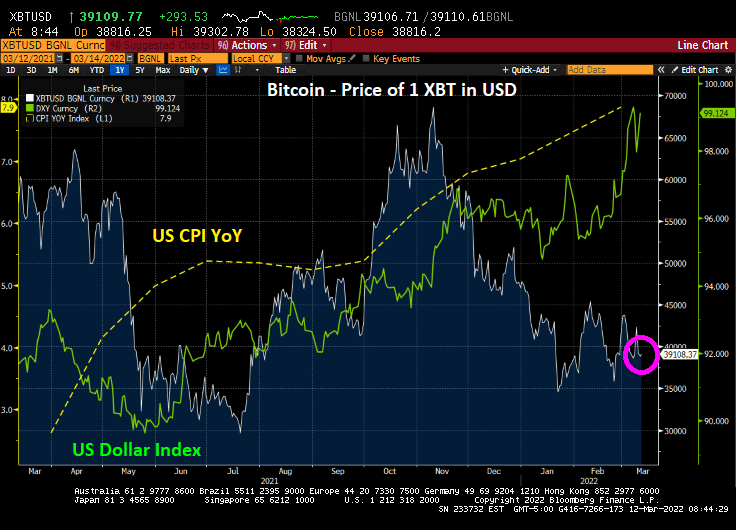
Well, what Zoltan says may be true, but not so far. Bitcoin has been plunging since November 2021 as inflation keeps rising.
Zoltan: “..and Bitcoin (if it still exists then) will probably benefit from all this.” The US Treasury yield curve is listing towards inversion, a signal of impending recession.
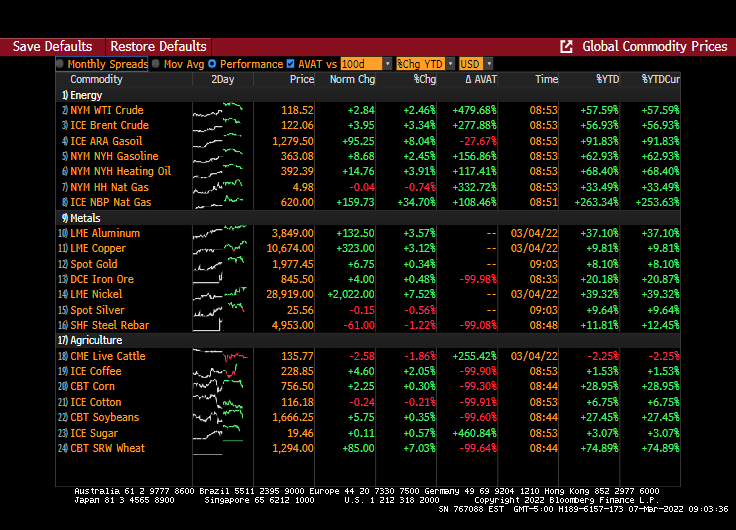
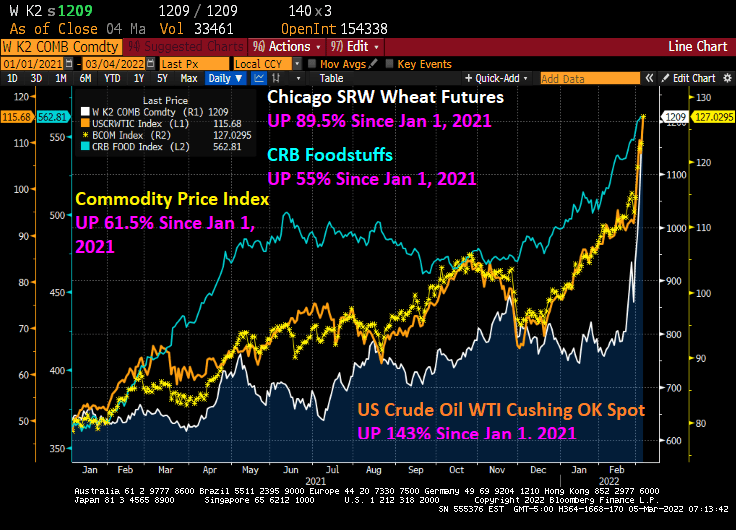
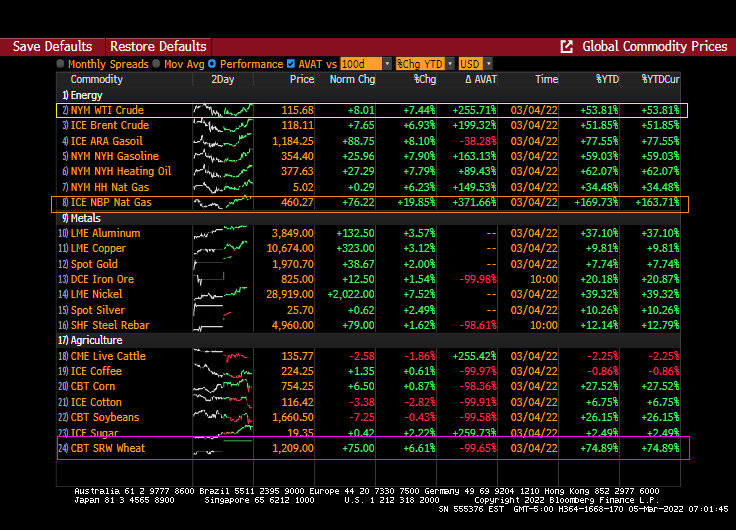
WTI Crude Oil spot price was up 91% from the beginning of 2021 to the Russian invasion of Ukraine. Now it is up 142% thanks to the invasion of Ukraine.
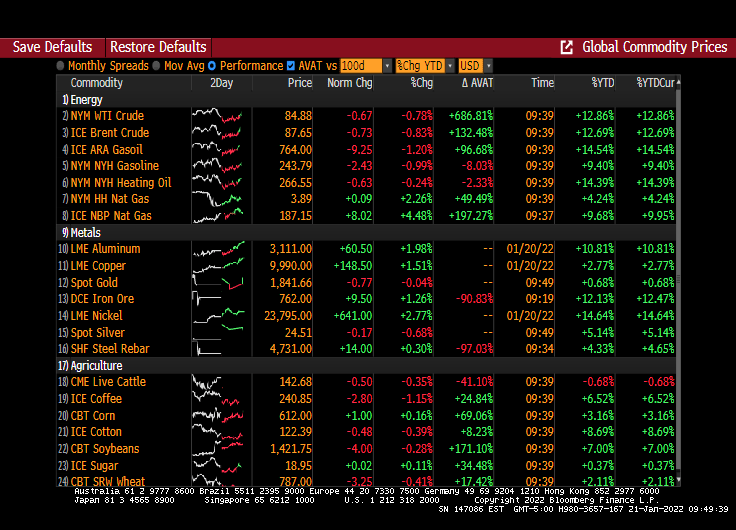
Energy prices are still soaring with UK Natural Gas prices up another 34.70% today with Brent Crude futures up 3.34%. Wheat futures are up 7.03%.
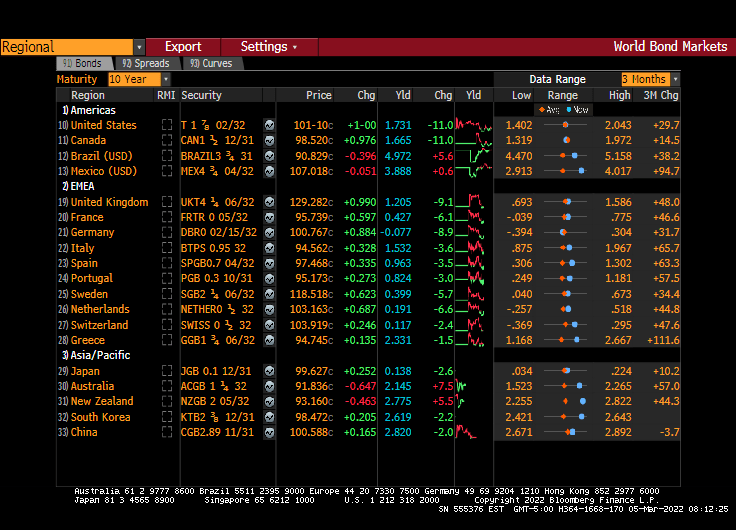
The US Treasury 10Y yield rose 6.8 bps this morning (UK takes the lead with a 10.3 bps increase).
The US Treasury 10Y-2Y yield curve slope continues to swoon to where it is now flatter than when President Biden entered office.
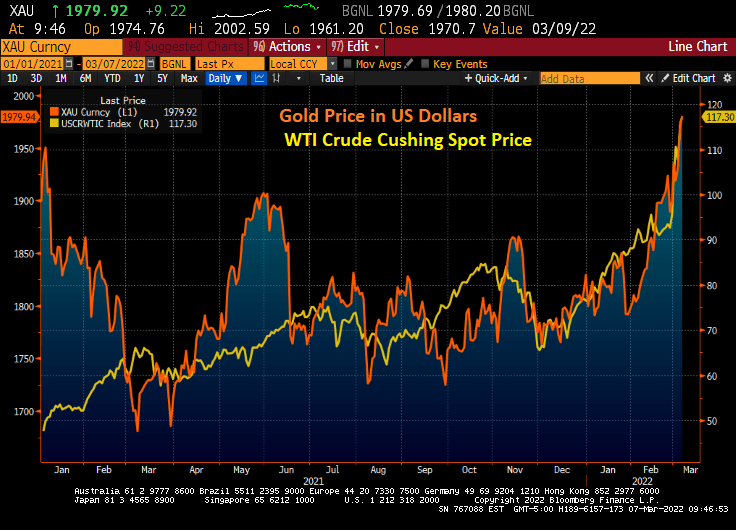
Gold is now at it highest level since before Biden was sworn-in as President as WTI Crude Oil soars.
Gold hit $2,000 before retreating back down.
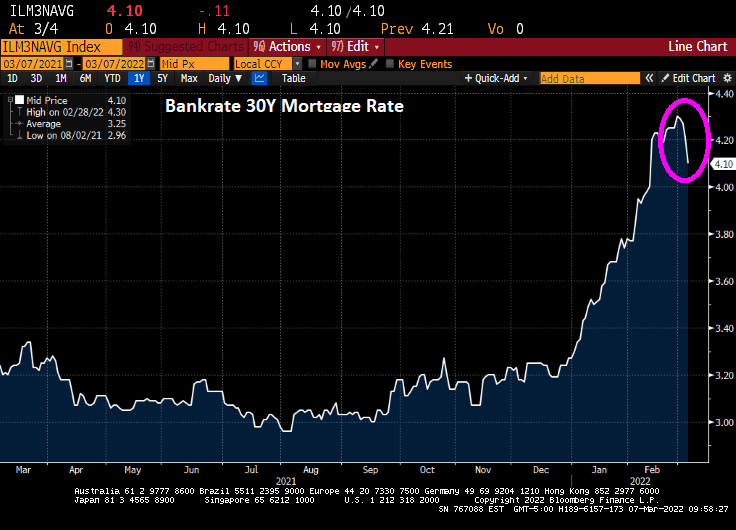
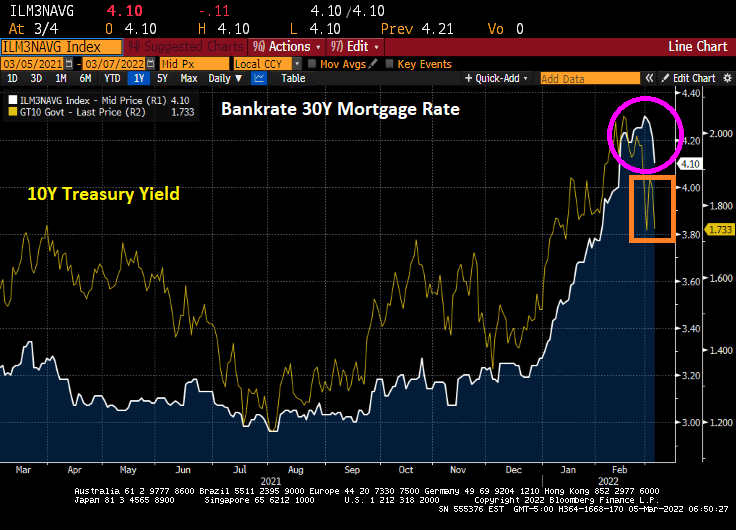
And Bankrate’s 30Y mortgage rate declined to 4.10%.
Russia is the world’s largest exporters of wheat and Ukraine is the 5th largest exporter.
This has been a brutal week for consumers. With the Russia/Ukraine conflict raging and Congress seems determined to not allow for additional oil and gas production, and Biden’s anti-fossil fuel edicts still in place, we are seeing dramatic price increases in wheat (UP 89.5% since January 1, 2021), WTI Crude (UP 143% since January 1, 2021), and food stuffs (UP 55% since January 1, 2021).
Bankrate’s 30-year mortgage rate has actually been falling the last several days, which is good for prospective home buyers as the 10-year US Treasury Note yield has been declining.
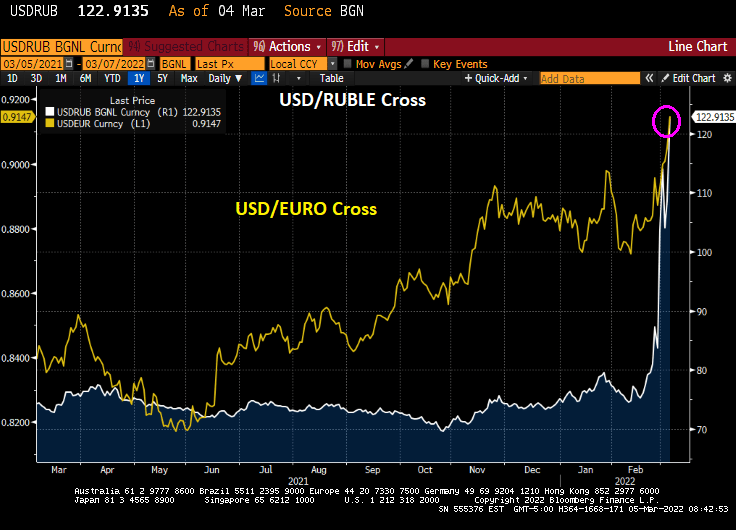
The USD/Russian Ruble cross is skyrocketing and the USD/Euro is doing likewise. Russians visiting the US will find that their trip is suddenly unaffordable (as do many American citizens will its rampant inflation). As Bruce Willis said in “Die Hard,” “Welcome to the party, pal.”
On Friday, the US Treasury 10-year yield declined 11 bps.
And energy prices continue to soar, particularly UK Natural Gas Futures that rose 19.85% overnight.
The US inflation data will be released on March 10th and the consensus is that February CPI inflation will rise to 7.9% YoY.
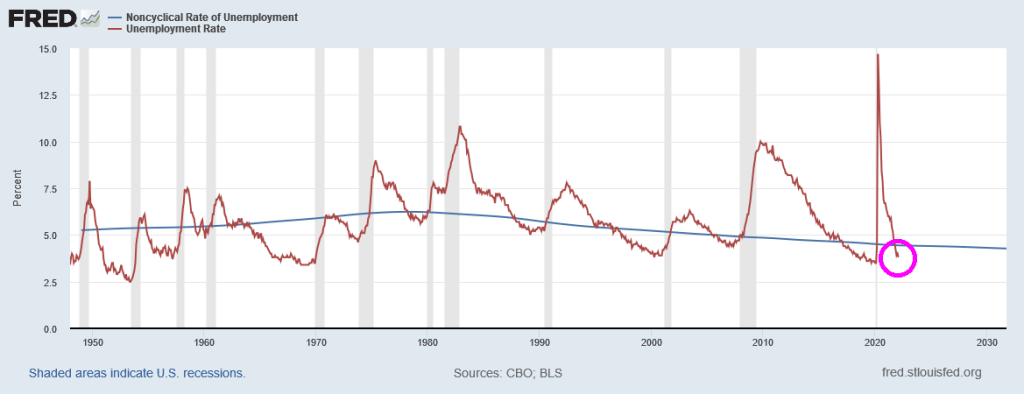
But even the latest unemployment rate report (3.8%) is signalling that The Fed should be raising interest rates since it is lower than the Natural Rate of Unemployment or NAIRU (4.44%).
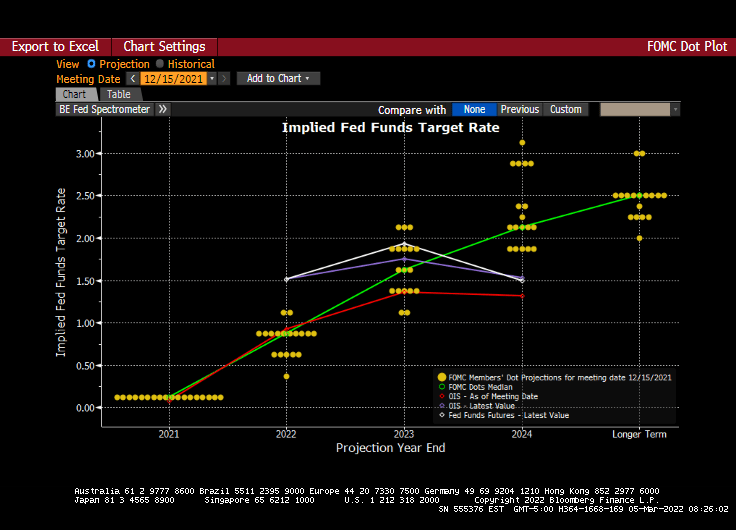
And we have the next Fed policy error on March 16th. The Fed dots plot looks like the glide slope for an aircraft, but the message is that rates will be going up at future meetings.
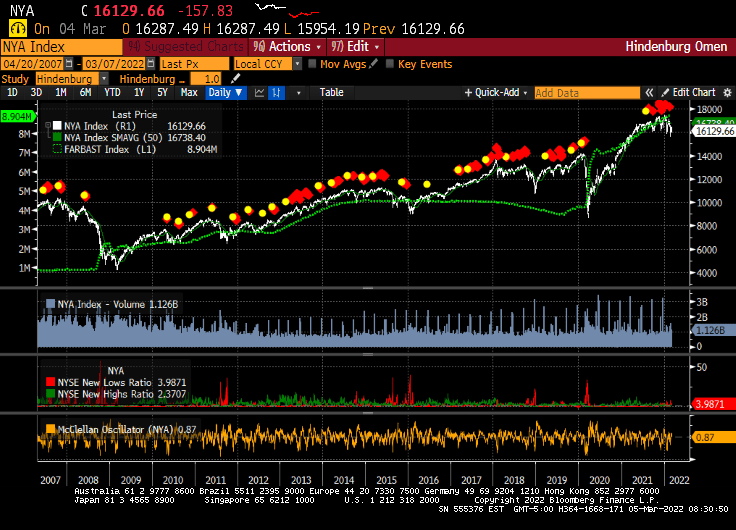
And just for amusement, I present to you the infamous Hindenburg Omen chart that forecast the 2008/2009 stock market correction. Since that correction, the Hindenburg Omen has been flashing “danger” but the only correction was the COVID-linked correction of early 2020. While the Hindenburg Omen is flashing red right now, The Federal Reserve’s balance sheet (green line) has protected against market corrections. Let’s see what happens if and when The Fed decides to remove the epic monetary stimulus.
Its anyone’s guess as to whether The Fed will actually tighten monetary policy.
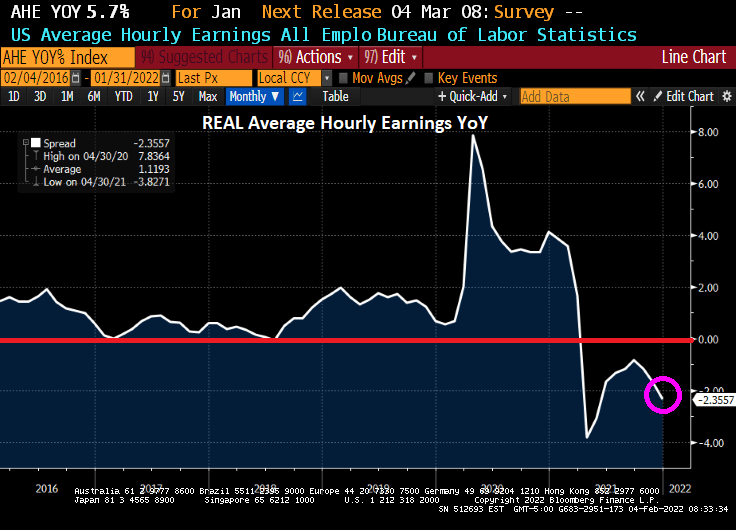
Well, the COVID hysteria from the Biden Administration and the media preparing us for a horrible jobs report was … incorrect. In fact, the January jobs report was “exceptional”. 467,000 jobs were added and average hourly earnings growth ROSE to 5.7% YoY.
The bad news? Thanks to surging inflation, REAL average hourly earnings growth YoY FELL to -2.36%.
Unemployment ROSE to 4.0% from 3.9% as more people dropped out of the labor force in January. On the bright side, labor force participation rate rose to 62.2% from 61.9%.
Leisure and hospitality employment (one of the most vulnerable to inflation) expanded by 151,000 in January, reflecting job gains in food services and drinking places (+108,000) and in the accommodation industry (+23,000).
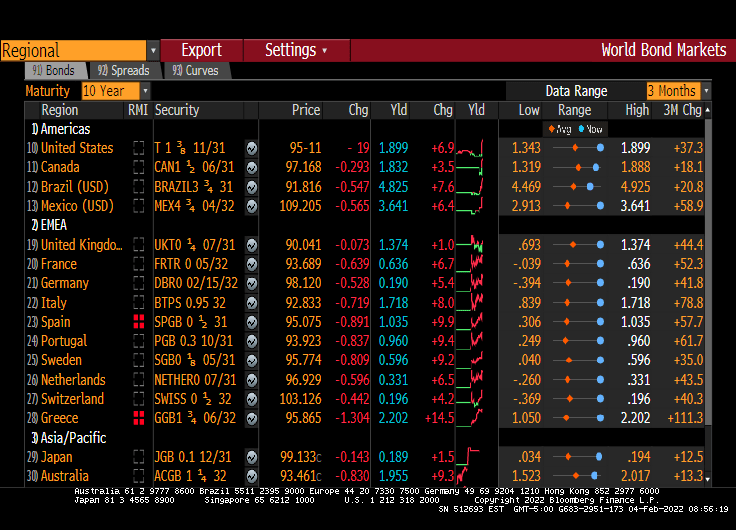
The reaction in the bond market? US 10-year yields are up 6.9 basis points as Eurozone is up across the board.
Energy prices are up (except natural gas futures).
Yes, its a cold one out there. But the Biden Administration is engaging in reducing fossil fuel supply and pushing towards “green” energy such as inefficient solar panels, eagle-killing wind turbines, and ocean turbines.
As a consequence, natural gas futures are up 93% from January 1, 2021 while coal futures are up 133% and WTI Crude spot price is up 82%.
Any wonder why food prices are up 40%?
Stay warm. It’s a cold one out there today. And The Federal government doesn’t care.
Treasury yields rose a second day, with five-year rates hitting the highest since before the pandemic took hold in the U.S., amid increasing conviction that the Federal Reserve will raise rates at least three times beginning in May.
The five-year Treasury note’s yield climbed as much as 3.8 basis points to 1.392%, the highest since Feb. 20, 2020, while 30-year yields bumped up toward their 200-day moving average.
Yields across the curve are rising for a second straight day, after Monday’s selloff lifted the 10-year note’s yield by nearly 12 basis points in its worst start to a year since 2009. The two-year yield topped 0.80% for the first time since March 2020.
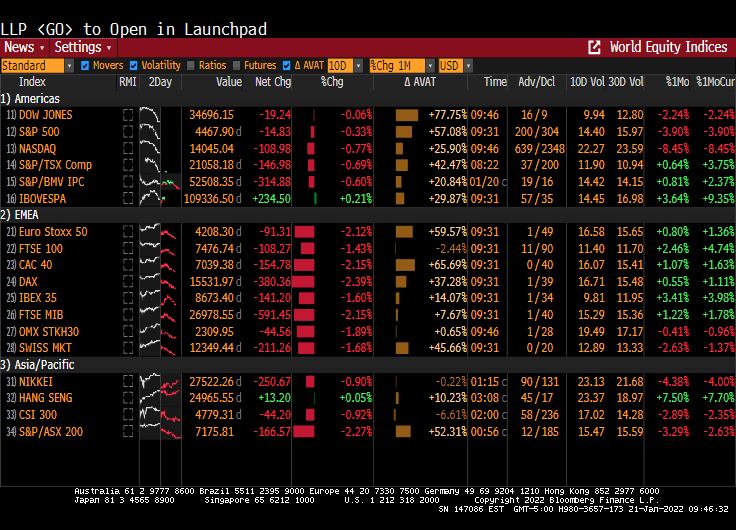
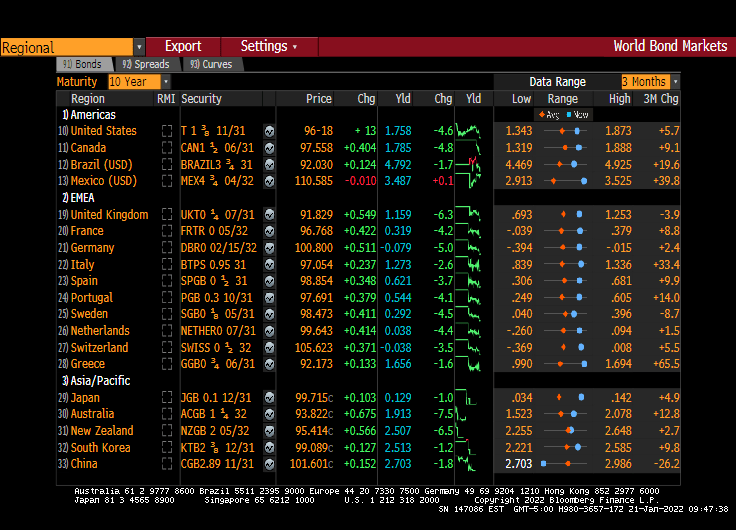
At the 10-year mark, we see Canada’s sovereign notes rising 18.7 basis points.
Also at the 10 year mark, we see the US 1-year breakeven inflation rate (red line) surging.
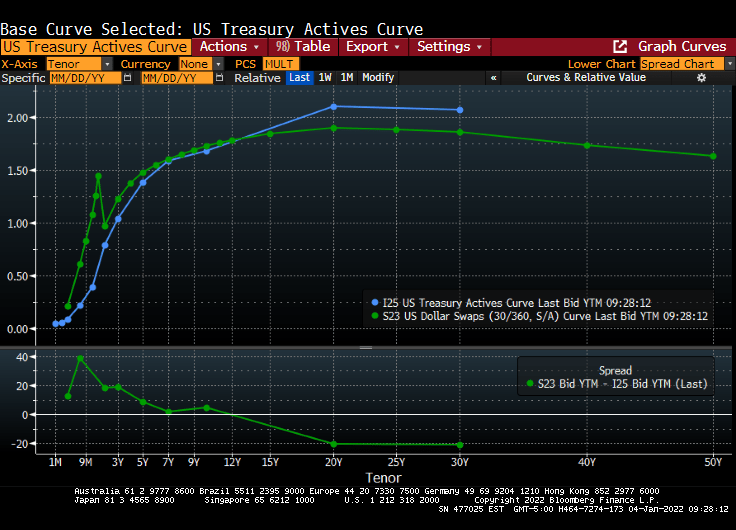
The US Treasury actives curve and Dollar Swaps curve remain steeply upward sloping.
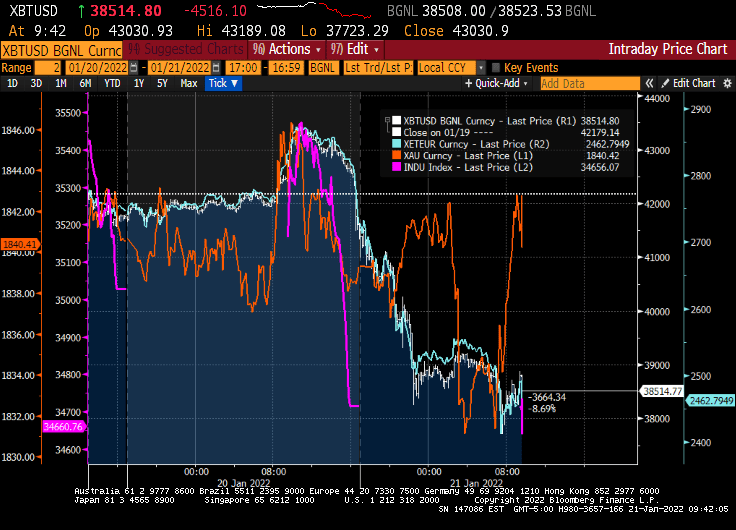
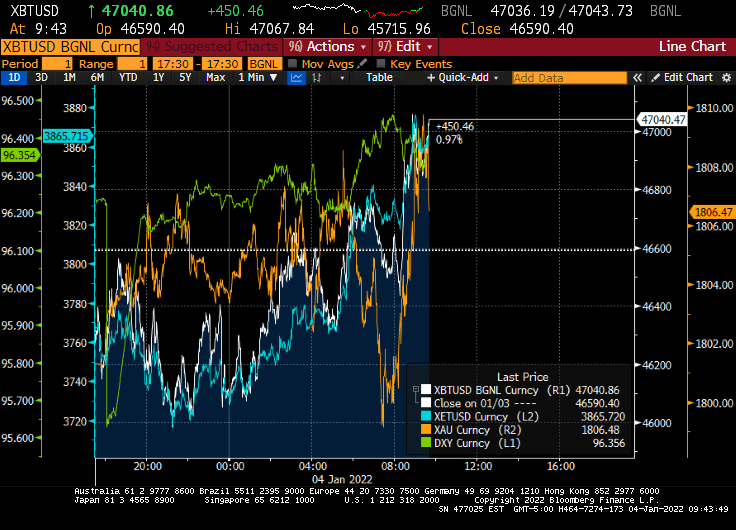
And on the crypto and gold front, gold surged this morning after tanking in the evening, while Ethereum (blue) is doing quite well along with Bitcoin.
My favorite non-bond, non-alt investment chart. The S&P 500 index charted against The Fed’s M2 Money Stock.
Following my friend Jesse’s habit of posting great French food dishes, here is one from my favorite Parisian eatery, Le Duc de Richelieu. Mmmmmmm.
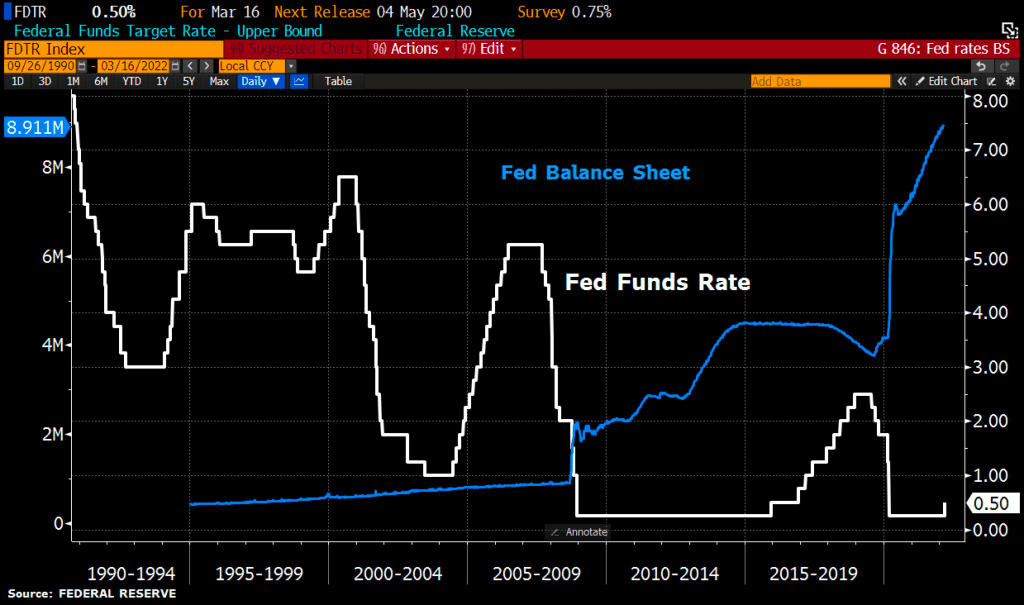
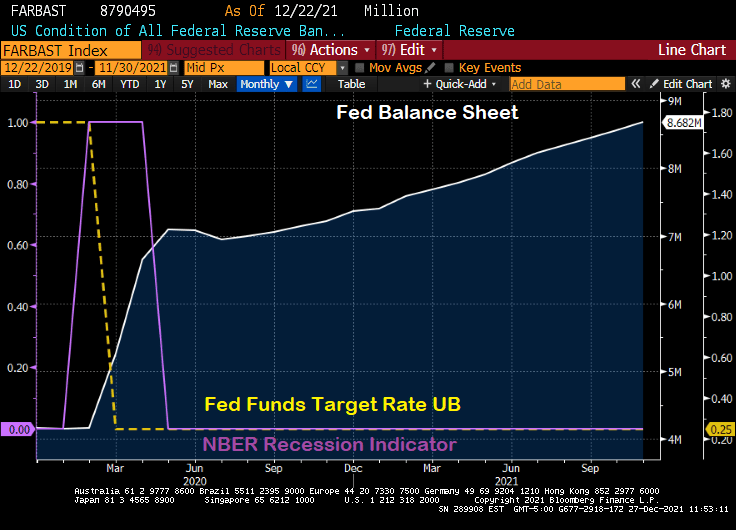
The global economy has certainly been turned on its head by the COVID outbreak in early 2020. Not so much by the virus itself, but by Central Bank hysteria in terms of rate lowering and balance sheet expansion. Which The Fed has not yet unwound.
Let’s look at what has happened since the mini-recession caused by COVID in early 2020. The shortest recession in US history, a measly 2 months. The Fed expanded its balance sheet from $4.17 million in February 2020 to $8.79 million today. That is, The Fed over doubled the size of their balance sheet in reaction to the shortest recession in US history. Overreaction much?
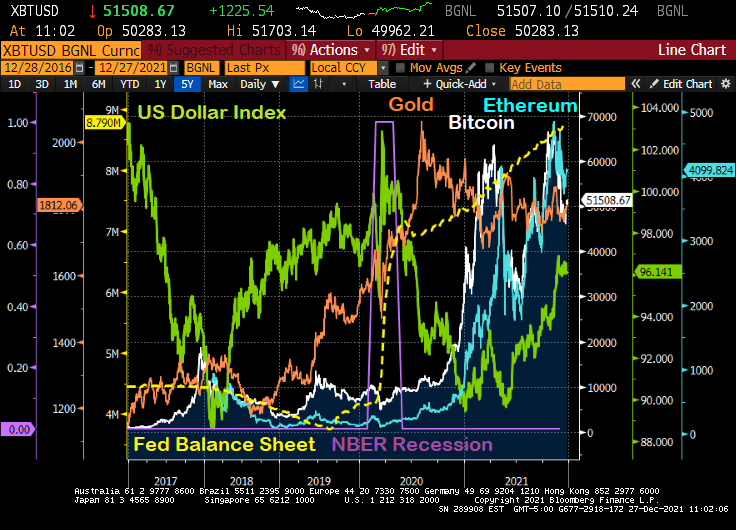
What has happened since the mini-recession and The Fed’s massive overreaction?
First, gold (gold line) surged then calmed down. Then cryptocurrency Bitcoin (while line) surged, then calmed down, then surged again only to calm down again. Then crypto Ethereum surged, calmed, surged, calmed. Meanwhile the US Dollar Index crashed only to start rising again.
The Fed’s overreaction and failure to withdraw excessive stimulus has led to the rise of alternatives to the deflating dollar due to inflation.
When will The Fed ACTUALLY start removing the overreaction stimulus? Let’s get it started.
Perhaps only April Ludgate can kill The Fed’s overreaction stimulus.

























 Confounded Interest - Anthony B. Sanders
You must be logged in to post a comment.