Are You Ready? Banks Postitioned For A Bail-in As Silicon Valley Bank Fails (FDIC, Fed Weigh Special Vehicle After SVB Collapses, AOC Alert!)

Are you ready?

Despite cries from Summers, Yellen and other the DC illuminati (Biden is oddly silent), US banks are NOT fine. In fact, banks in general are suffering from Fed rates increases due to holding of long-term Treasuries and MBS.

In fact, The Federal Reserve’s fight against inflation is causing serious problems, as exemplified by AOC. No, not THAT AOC. but bank Accumulated Other Comprehensive Income.

Accumulated Other Comprehensive Income (AOCI) are special gains and losses that are listed as special items in the shareholder equity section of a company’s balance sheet. The AOCI account is the designated space for unrealized profits or losses on items that are placed in the other comprehensive income category.

On the regulatory call reports, AOCI is added to regulatory capital. Since SVB’s AOCI was negative (because of its unrealized losses on AFS securities) as of Dec. 31, it lowered the company’s total equity capital. So a fair way to gauge the negative AOCI to the bank’s total equity capital would be to divide the negative AOCI by total equity capital less AOCI — effectively adding the unrealized losses back to total equity capital for the calculation.

Getting back to our list of 10 banks that raised similar red margin flags to those of SVB, here’s the same group, in the same order, showing negative AOCI as a percentage of total equity capital as of Dec. 31. We have added SVB to the bottom of the list. The data was provided by FactSet:

Or this chart of vulnerable banks from Morningstar of unrealized losses and liquidity risk.

Here is a snapshot of SVB’s balance sheet. Or UNbalanced sheet.

After Congress passed the greatly flawed Dodd-Frank banking legislation, bailouts of banks are prohibited. But bank BAIL-INs still exist. Banks use money from their unsecured creditors, including depositors and bondholders, to restructure their capital to stay afloat. Put simply, they can convert their debt into equity to increase their capital requirements. Although depositors run the risk of losing some of their deposits, banks can only use deposits in excess of the $250,000 protection provided by the Federal Deposit Insurance Corporation (FDIC).

In any case, the FDIC and Fed are weighing a special vehicle after SVB swiftly collapses. Special vehicle? Sounds an awful like the mega bank bailout of 2008 under Hank Paulson.

No, not THIS AOC!

February Jobs Report Comes In Hot, Hot, Hot (Avg Hourly Earnings UP 4.6% YoY, Too Bad Inflation Is At 6.4% YoY)

According to the US Bureau of Labor Statistics (BLS)https://www.bls.gov/news.release/empsit.nr0.htm, the February jobs report came in hot, hot, hot.

One indicator that the Biden Administration will herald is that average hourly earnings rose to 4.6% Year-over-year (YoY). Too bad headline inflation is still at a whopping 6.4% YoY.

More jobs were added to the US economy than forecast (311k actual versus 225k forecast). The U-3 unemployment rate rose to 3.6% from 3.4% in January.

The biggest gainer in jobs? Food services and drinking places, of course, at 69.9 k jobs added.

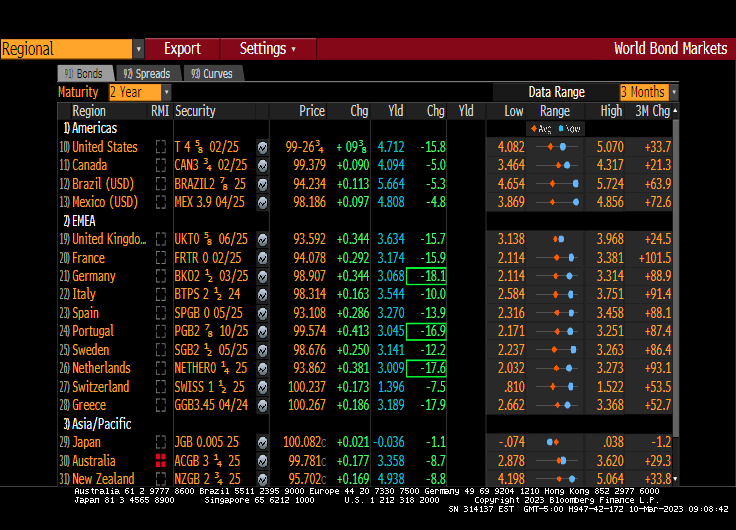
The aftermath of the jobs report? 2-year Treasury yields are down a whopping -15.8 basis points. But Europe is seeing double digit declines in sovereign yields as well.

At the 10-year tenor, we see the US Treasury yield drop -12.8 basis points. Much in line with European sovereign yield declines.

Just Like The Fed! M2 Broad Money Supply Growth Falls To -1.8% YoY, M1 Money Growth Falls To -3.6% YoY As US Job Layoffs Accelerate
Its just like The Federal Reserve to be cutting US money growth as US jobs cuts accelerate.

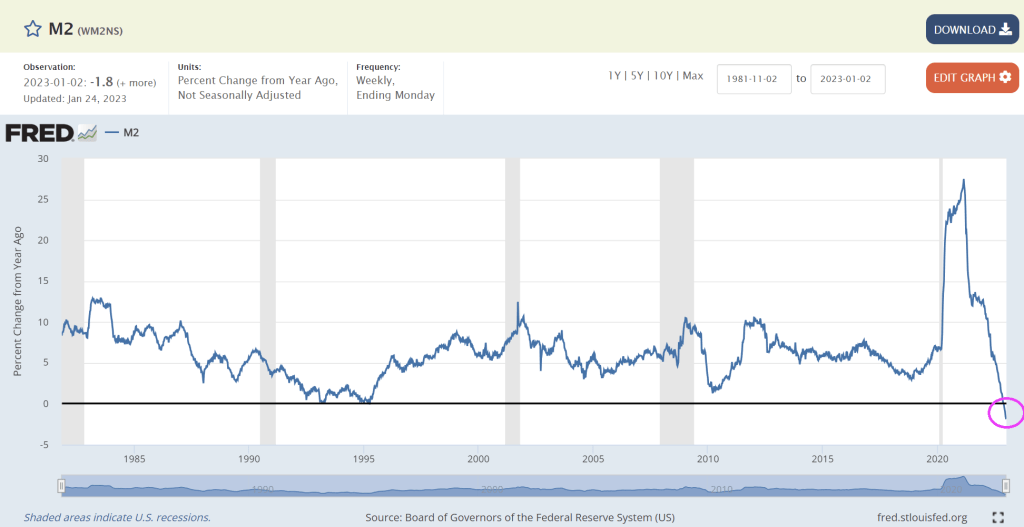
The latest US money growth numbers are out and they are daunting. M2 Money growth YoY is now negative at -1.8%.

M1 money, a narrower defition of money, is now down -3.6% YoY.

This is happening as the labor market is seeing a wave of layoffs.

As M2 growth YoY and The Fed balance sheet shrinks, so does Cathie Wood’s AARK.

We are just the stepping stone for The Fed.

As The Fed ponders inflation versus job growth, its a case of “Him or Me, What’s it going to be?”

Not Always Sunny! Philadelphia Fed Admits US Jobs “Overstated” By At Least 1.1 Million From March To June 2022 (Will Biden Retract “Greatest Economy In History Statement?)

Its NOT always sunny in Philadelphia. Here is a video of the Philly Fed economists explaining massively overstated job numbers to Fed Chair Jerome Powell.

The Federal Reserve Bank of Philadelphia estimates that the employment data was vastly overstated in 2022. 10k jobs added instead of 1.1 million reported from March to June of 2022.

Here is a chart (courtesy of Zero Hedge) showing reported payrolls and REVISED payrolls. Somehow, I don’t think Jean Pierre (Biden’s spokesperson, not the French chef) will be touting “Unlike Trump, our administration barely added any jobs in March, April, May and June 2022.

How will this revelation influence the Fed’s open market committee (FOMC) going forward knowing that the Biden Administrations job creation claims are wildly overstated?

Perhaps it doesn’t matter since Bernanke, Yellen and Powell don’t follow any rules (like the Taylor Rule), but generally with job creation almost nonexistant in March through June of 2022, The Fed should be cutting rates like mad. But wait! Can they with significant inflation?

The good news is that inflation is coming off its peak, but will take a while to get to The Fed’s 2% target. Hence The Fed may raise their target rate since they cannot achieve it will energy price up substantially since Biden became President.

MBA Mortgage Applications Rise 3.2% From Previous Week, But Purchase Applications Down 38% From Same Week Last Year As Fed Tightens

Mortgage applications increased 3.2 percent from one week earlier, according to data from the Mortgage Bankers Association’s (MBA) Weekly Mortgage Applications Survey for the week ending December 9, 2022.

The Refinance Index increased 3 percent from the previous week and was 85 percent lower than the same week one year ago. The unadjusted Purchase Index decreased 1 percent compared with the previous week and was 38 percent lower than the same week one year ago.

You can see the impact of seasonalilty on mortgage purchase applications (white line). They peaked in the week of May 6, 2022 and have been generally declining since. While refi applications (orange line) increased over the past week, they have been pummelled by The Fed tightening.

It is quiet today as investors wait for The Fed to announce a 50 basis point rate increase. Fed Funds Futures point to almost another 100 basis point hike by May 5, 2023, then a slow decline in The Fed Funds target rate (upper bound).

And here is Sam Bankman-Fried and his high-powered legal defense.

The Fed Needs To Take A Look At Itself: WSJ Editorial By Levy And Plosser (Taylor Rule Implied Target Rate Of 12.07%, Current Rate At 4%)

Paul Revere and the Raiders said it best about The Federal Reserve. Take a look at yourself.

Mickey Levy of Berenberg Capital and Charles Plosser wrote a great op-ed in the Wall Street Journal entitled “The Federal Reserve Needs a Hard Look in the Mirror.” Here is a Fed Reserve St Louis paper by Levy and Plosser entitled “The Murky Future of Monetary Policy.”

Abstract

In August 2020, the Federal Reserve unveiled its new strategic framework. One major objective of the Fed was to address its concerns over the potential consequences for the conduct of monetary policy when the policy rate was constrained by its effective lower bound. This article concludes that there are significant flaws in the new strategy and that it encourages a more discretionary approach to monetary policy and increases the risks of policy errors. The new framework is an overly complex and asymmetric flexible average inflation targeting scheme that introduces a significant inflationary bias into policy and expands the scope for discretion by broadening the Fed’s employment mandate to “maximum inclusive employment.” In a postscript, the article describes how quickly the flaws have been revealed and urges a reset toward a more systematic and coherent strategy that is transparent and broadly understood by the public.

I attended a speech by macoeconomist Gershon Mandelker at the National Association of Realtors where he called on the Federal Reserve to follow some observable rule rather than the complex (or seat of the pants) approach to monetary policy.

With today’s inflation report (core inflation YoY of 6%) results in a Taylor Rule estimate of The Fed Funds Target Rate of 12.07%. We are struggling to reach 5% as a “terminal” Fed target rate (currently at 4% and likely to rise 50 basis points at tomorrow’s Fed meeting).

The matrix of CPI and unemployment under the Taylor Rule shows that The Fed’s target rate isn’t at even 5% for any relevant combination of core CPI (inflation) and unemployment rate.

Note that since the financial crisis the Fed’s target rate (white line) has been consistely below the Taylor Rule implied rate (blue dashed line).

Here is Treasury Secretary and former Fed Chair Janet Yellen laughing at those who want some kind of observable Fed rule.

Bad Sign! What Interest Rates Are Telling Us (US 10Y-2Y Curve Inverts To -80 Basis Points, Euro 10Y Yields Falling, Fed Funds Rate Priced At 2.301% By January 2024)

What interest rates are telling us is a bad sign.

With an impending railroad strike that can torpedo the US economy (but if that is possible, why is the Biden Clan vacationing in Nantucket for Thanksgiving weekend when Joe should be talking with railroads and the unions to not let this happen?), let’s see what interest rates are telling us.

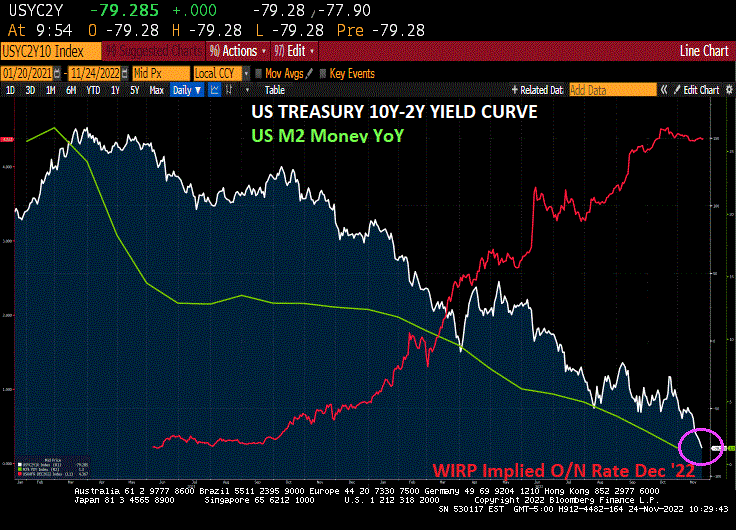
First, the US Treasury 10Y-2Y yield curve continues to descrend into the abyss (now at -80 basis points).

Second, the latest Fed Dot Plot (from September, new one will be issued during December) show that The Fed thinks that their target rate, while rising in 2023, will likely start falling again in 2024.

Third, since it is Thanksgiving Day, US bond markets are closed. But in Europe, the 10-year sovereign yields are falling, a sign that the ECB is reversing course by increasing monetary stimulus and/or a European are slow down.

Fourth, US mortgage rates have cooled since peaking (locally) at 7.35% on November 3, 2022 and now sit at 6.81%, a decline of 54 basis points. A clear sign of cooling.

Fifth, how about Fed Funds Futures data? It is pointing to a peak Fed Funds Target rate of 4.593% at the June FOMC meeting. Then a decline in rates to 2.301% by January 2024.

Now, go and enjoy your Thanksgiving dinner with friends and family (up 20% since last year), courtesy of Jerome Powell, Joe Biden, Nancy Pelosi and Chuck Schumer.

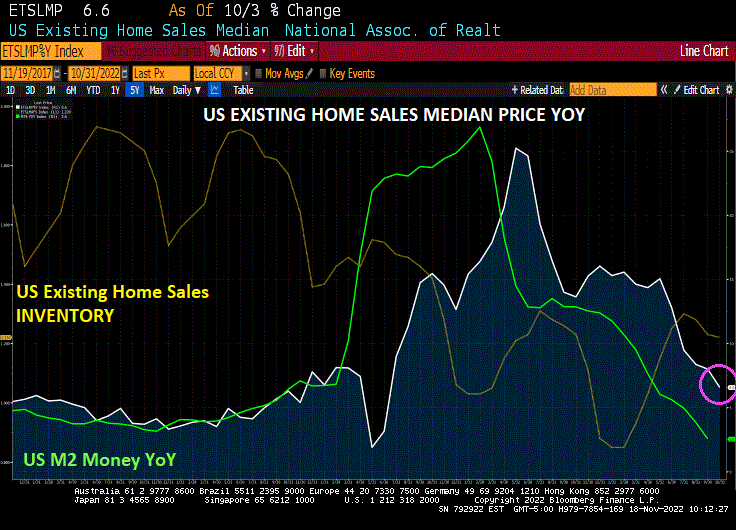
US Existing Home Sales In October Plunge -28.43% YoY As Fed Tightens Monetary Noose (EHS Median Price Growth YoY Slows To 6.6% As Inventory Declines)

As I mentioned on Varney and Company on Fox Business, housing is going to suffer when The Fed starts to tighten their monetary policy. And here we are, folks!

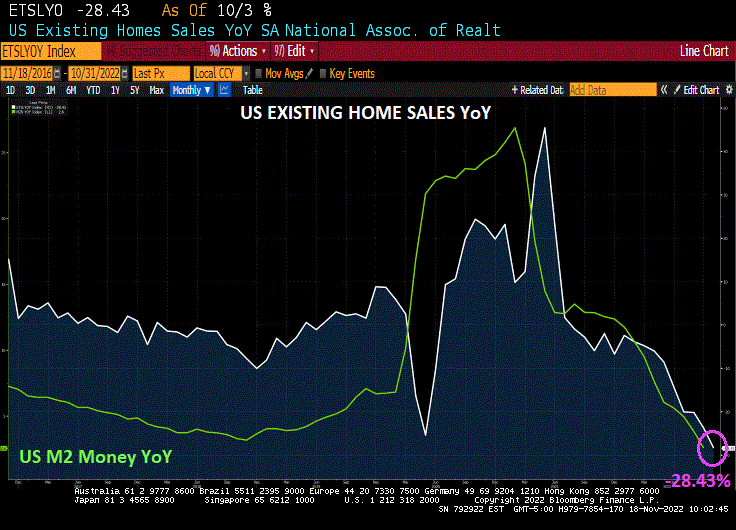
US existing home sales fell a staggering -28.43% YoY in October as M2 Money growth grinds to almost a halt.

October’s existing home sales YoY of -28.43% is the WORST since The Great Recession and collapse of Lehman Brothers.

The median price of existing home sales slowed to 6.6% YoY. Inventory of EHS remains below pre-Covid levels.

Unrelated to housing, Prince Imhotep (Federal Reserve Bank of Minneapolis President Neel Kashkari) said Friday that the whole idea of cryptocurrency is “nonsense” after the implosion of FTX revealed the industry’s shortcomings.

“This isn’t case of 1 fraudulent company in a serious industry,” Kashkari said on Twitter, commenting on an article about how investors fell for FTX. “Entire notion of crypto is nonsense. Not useful 4 payments. No inflation hedge. No scarcity. No taxing authority. Just a tool of speculation & greater fools.”

Or it could be that investors don’t trust The Fed or Federal government to act in their best interest.

Here is a crypto investor (in red fez) being lectured by Minneapolis Fed President Neel Kashkari.

Double Whammy! Mortgage Holders Lose $1.3 Trillion in Equity in Q3 As Price Correction Continues (Nationally, Homes Shed 2.6% of Value Over Past Three Months As Treasury Yield Curve Remains DEEPLY Inverted)

Yes, this is an economic double whammy!

First, according to Black Knight, US home values declined -2.6% over the past three months.

Second, the US Treasury 10Y-2Y yield curve remains near 1980s low.

There is a third whammy, rising utility costs (highest in a decade).

Yes, its a double whammy!

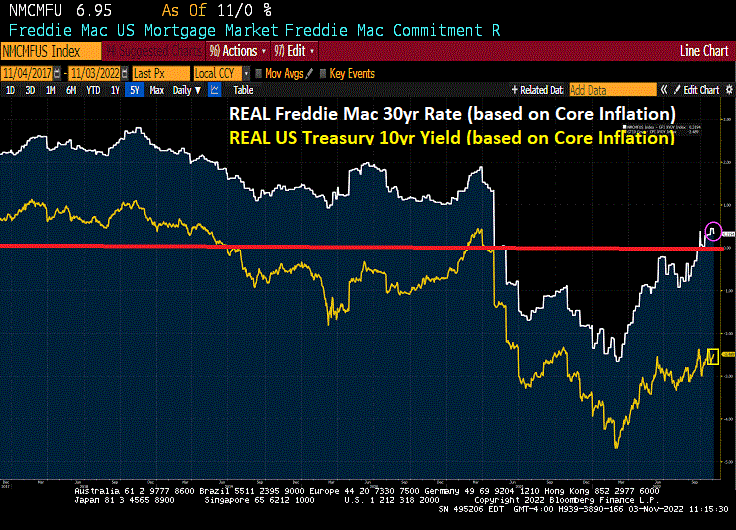
US REAL 30yr Mortgage Rates Finally Turn Positive (0.32%) While REAL 10yr Treasury Yields Remain Negative (-2.50%)

It has been a wild and mostly negative ride under Biden’s Reign of Error. 40-year highs in inflation (caused by Biden’s fossil fuel mandates and Federal spending) have left the US mortgage market FINALLY seeing positive REAL mortgage rates (now 0.32%), even though the REAL 10yr Treasury yield is still negative (-2.50%).