Trump has been President for 1 year and fighting against Biden and the Democrats economic misery.
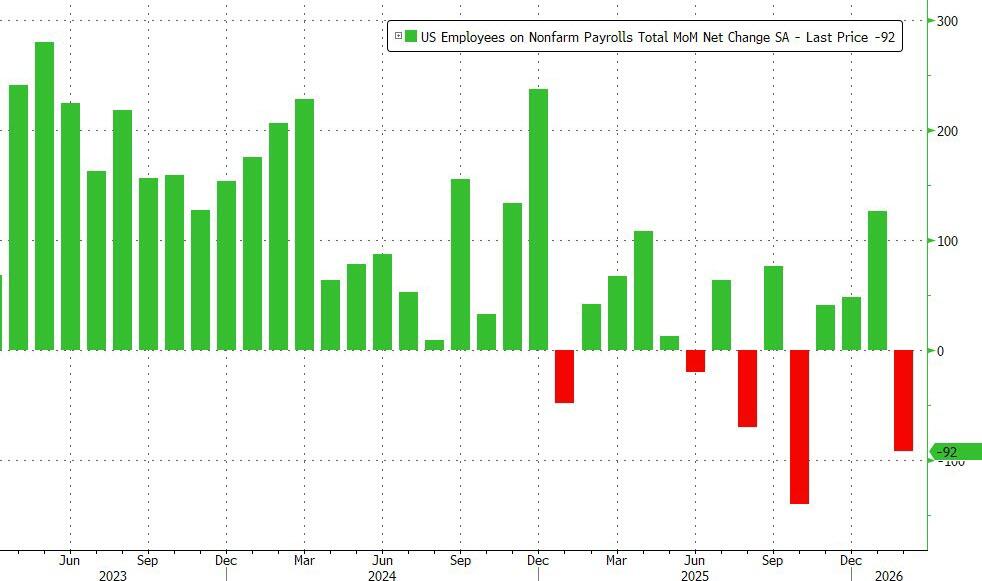
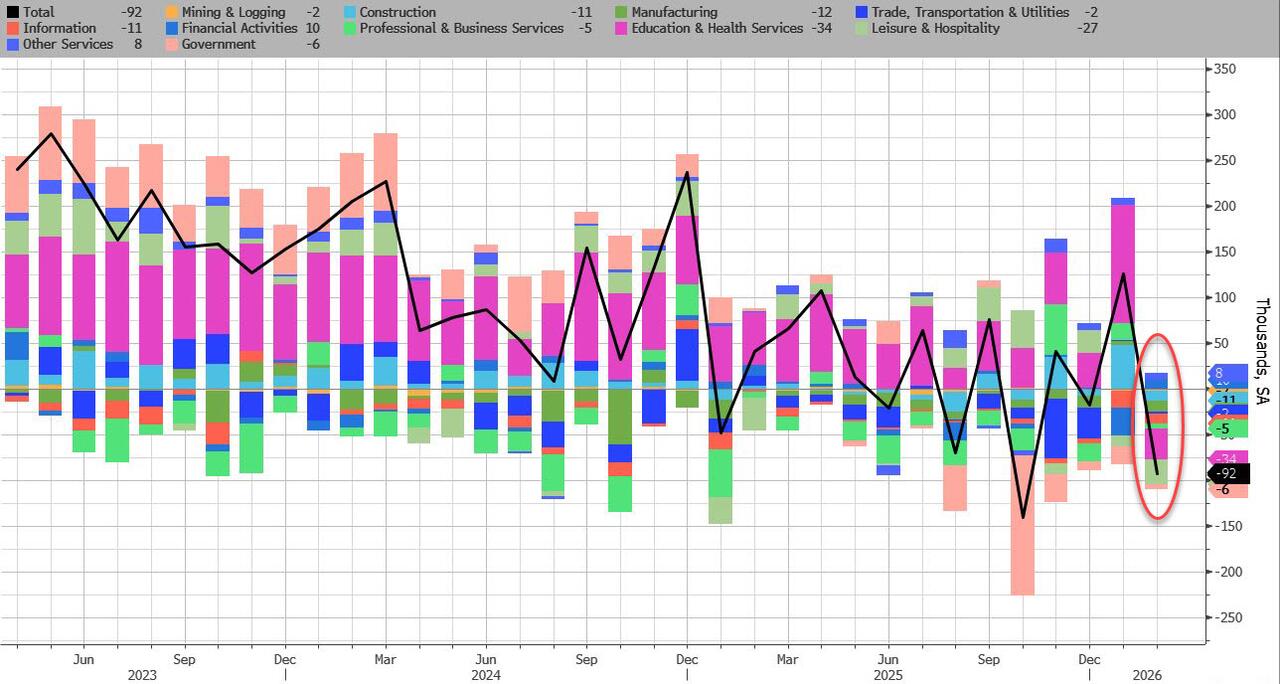
In February, the US lost 92,000 jobs, a huge drop from the downward revised 126K in January, and the second worst print since 2020 (only October’s shock -140K was worse), and this time, the massive drop can’t be dismissed as a one-time drop in government payrolls. The number of private payrolls dropped by 86K, also a huge miss to estimates of a 60K increase.
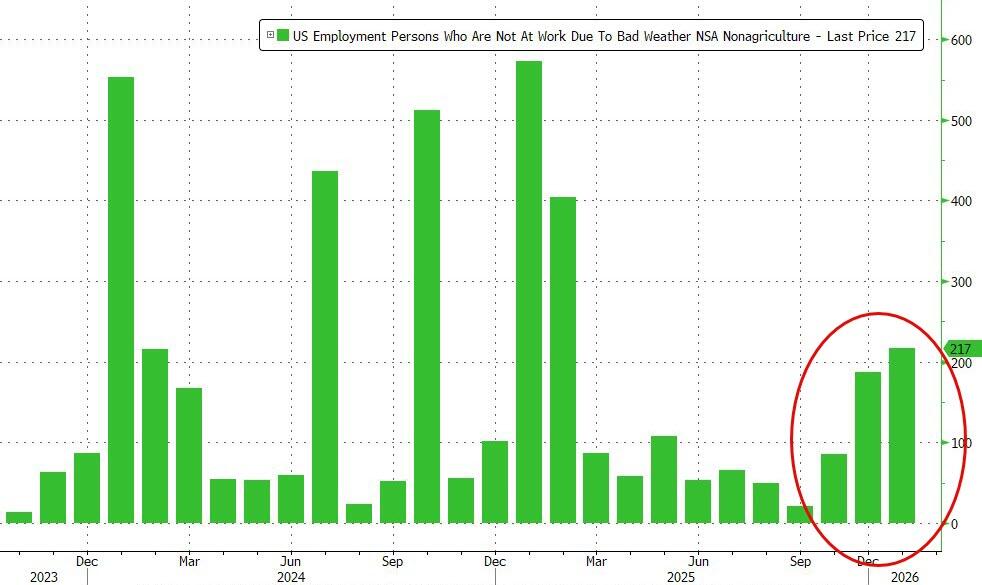
One potential mitigating factor: the number of people who were unable to work due to weather surged to 228K in February, well above last year’s level 167K, due to the powerful winter storms hitting the US.
The number of long-term unemployed (those jobless for 27 weeks or more) changed little at 1.9 million in February but is up from 1.5 million a year earlier. The long-term unemployed accounted for 25.3 percent of all unemployed people in February.
The number of people employed part time for economic reasons decreased by 477,000 to 4.4 million in February. These individuals would have preferred full-time employment but were working part time because their hours had been reduced or they were unable to find full-time jobs.
The number of people not in the labor force who currently want a job changed little in February at 6.0 million. These individuals were not counted as unemployed because they were not actively looking for work during the 4 weeks preceding the survey or were unavailable to take a job.
Among those not in the labor force who wanted a job, the number of people marginally attached to the labor force changed little at 1.6 million in February. These individuals wanted and were available for work and had looked for a job sometime in the prior 12 months but had not looked for work in the 4 weeks preceding the survey. The number of discouraged workers, a subset of the marginally attached who believed that no jobs were available for them, decreased by 109,000 in February to 366,000.
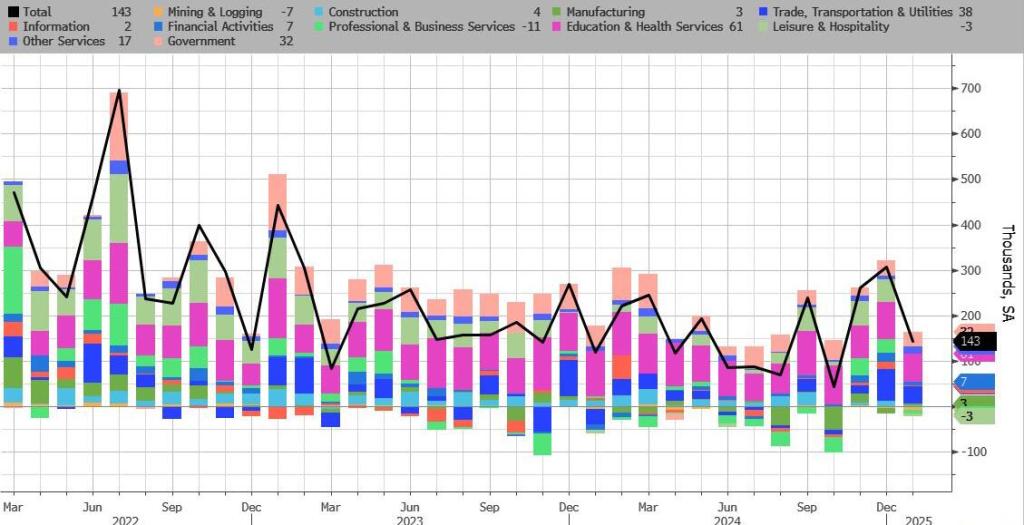
Turning to the establishment survey, which unveiled the shocking February drop, the BLS reported a broad-based decline, driven by striking employment workers:
Employment in health care decreased in February, reflecting strike activity. Employment in information and federal government continued to trend down. Payroll employment changed little on net in 2025.
Health care employment declined by 28,000 in February, following a large increase in January (+77,000). Offices of physicians lost 37,000 jobs in February, primarily due to strike activity. Hospitals added 12,000 jobs. Over the prior 12 months, health care had added an average of 36,000 jobs per month.
Employment in information continued to trend down in February (-11,000). The industry had lost an average of 5,000 jobs per month over the prior 12 months.
In February, federal government employment continued to decline (-10,000). Since reaching a peak in October 2024, federal government employment is down by 330,000, or 11.0 percent.
Employment in social assistance continued its upward trend in February (+9,000), driven by individual and family services (+12,000).
Transportation and warehousing employment changed little in February (-11,000). A job loss in couriers and messengers (-17,000) was partially offset by a gain in air transportation (+5,000). Employment in transportation and warehousing has declined by 157,000, or 2.4 percent, since reaching a peak in February 2025.
Employment showed little change over the month in other major industries, including mining, quarrying, and oil and gas extraction; construction; manufacturing; wholesale trade; retail trade; financial activities; professional and business services; leisure and hospitality; and other services.
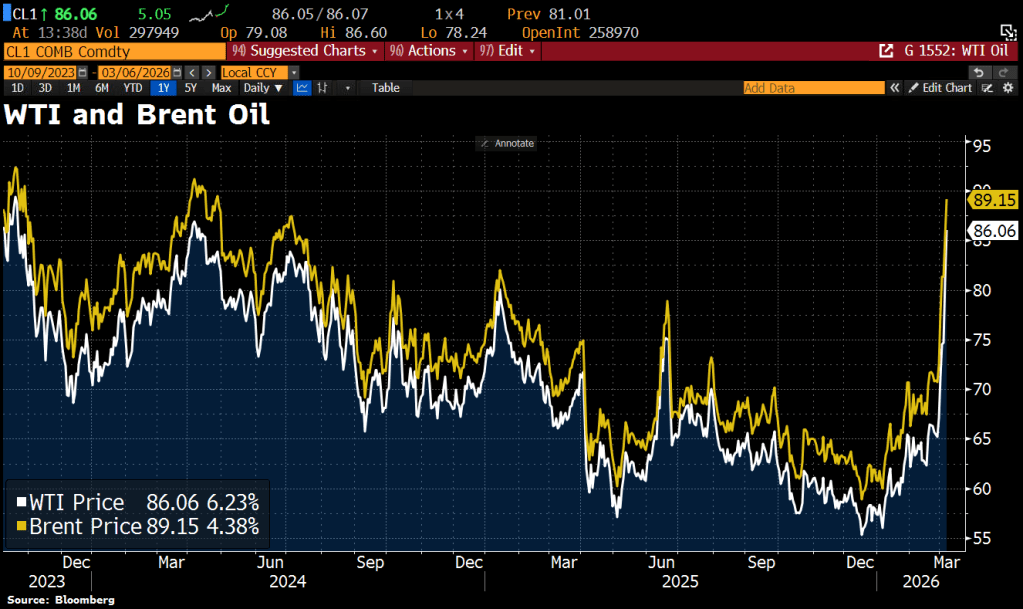
Switching to oil, we see the West Texas Intermediate and Brent Oil prices soaring on the attacks on Iran.
Biden is out and so are the crazy job preferences of his administration (e.g., green energy). There is a new sheriff in town (Donald Trump).
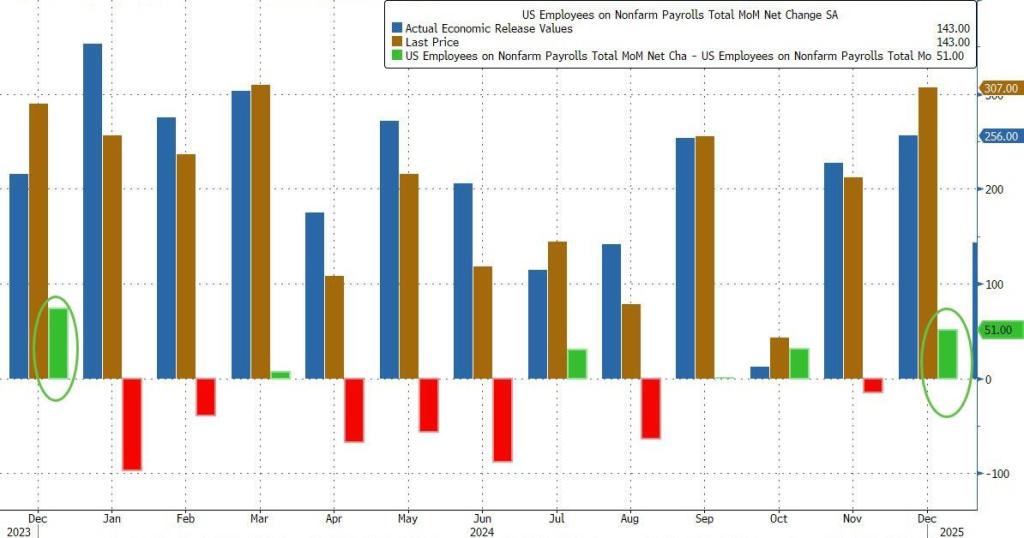
Here’s what the BLS reported in Trump’s first official jobs report since he returned to the White House: total payrolls printed at 143K.
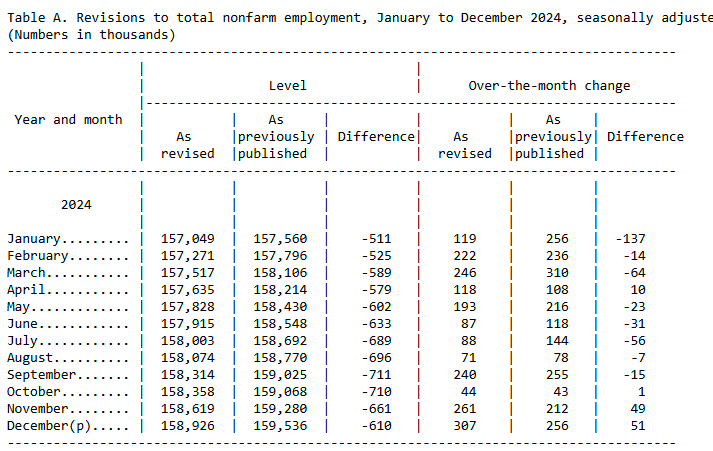
down sharply from an upward revised 307K (256K originally) and missing estimates of 175K.
Looking further back, the change in total nonfarm payroll employment for November was revised up by 49,000, from +212,000 to +261,000, and when adding the +51,000 revision to December employment in November and December combined is 100,000 higher than previously reported
But while the sequential change in the Establishment survey was notable, what was far more remarkable was the Household survey where we saw massive population related revisions (discussed last night), which pushed the civilian labor force higher by 2.2 million to 170.744 million, while the number of employed workers also increased by over 2.2 million to 163.895 million. As a result, the Household survey has finally caught up to Establishment survey.
This is the worst start to a fiscal year EVER: – Spending is up 10.9% – Receipts are down 2.2% – FYTD deficit up 39.4% at $711 billion They’re handing Trump a ticking time bomb!
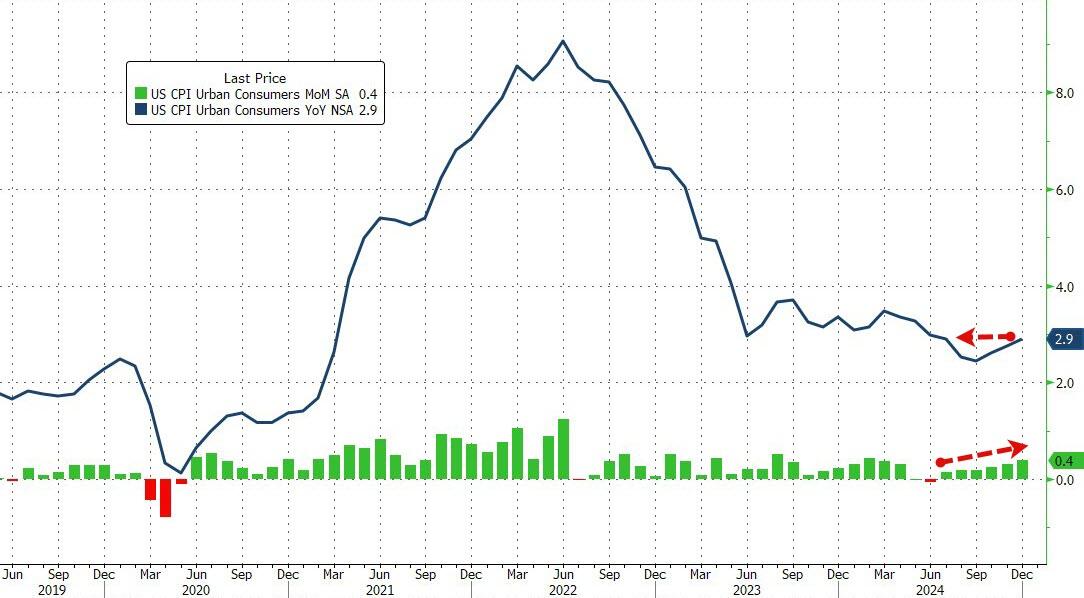
Speaking of Biden handing a ticking time bomb (according to Zero Hedge), after rising for 5 straight months, analysts expected headline consumer prices to continue accelerating in December (+0.4% MoM exp) and it did exactly that – the highest MoM print since March, leading the YoY CPI to rise 2.9% (the highest since July)…
Source: Bloomberg
CPI details:
Food
The index for food increased 0.3% in December, after rising 0.4% in November. The food at home index also rose 0.3% over the month. Four of the six major grocery store food group indexes increased in December. The index for cereals and bakery products rose 1.2% over the month, after falling 1.1% in November. The meats, poultry, fish, and eggs index increased 0.6 percent in December, as the eggs index rose 3.2 percent. The index for other food at home rose 0.3 percent over the month and the index for dairy and related products increased 0.2 percent.
Energy
The energy index increased 2.6% in December, after rising 0.2% in November. The gasoline index increased 4.4% over the month. (Before seasonal adjustment, gasoline prices decreased 1.1 percent in December.) The natural gas index rose 2.4 percent over the month and the index for electricity rose 0.3 percent in December. The energy index decreased 0.5 percent over the past 12 months. The gasoline index fell 3.4% over this 12-month span and the fuel oil index fell 13.1 percent over that period. In contrast, the index for electricity increased 2.8 percent over the last 12 months and the index for natural gas rose 4.9 percent.
All items less food and energy
The index for all items less food and energy rose 0.2 percent in December, after rising 0.3 percent in each of the 4 preceding months.
The shelter index increased 0.3 percent in December, as it did in November.
The index for owners’ equivalent rent also rose 0.3 percent over the month, as did the index for rent.
The lodging away from home index fell 1.0 percent in December, after rising 3.2 percent in November.
The medical care index increased 0.1 percent over the month, after rising 0.3 percent in October and November.
The index for physicians’ services increased 0.1 percent in December and the index for hospital services rose 0.2 percent over the month.
The airline fares index rose 3.9 percent in December, after rising 0.4 percent in the previous month.
The index for used cars and trucks rose 1.2 percent over the month and the index for new vehicles increased 0.5 percent.
Other indexes that increased in December include motor vehicle insurance, recreation, apparel, and education.
In contrast, the index for personal care fell 0.2 percent in December after rising 0.4 percent in November. The indexes for communication and alcoholic beverages also declined over the month. The household furnishings and operations index was unchanged in December
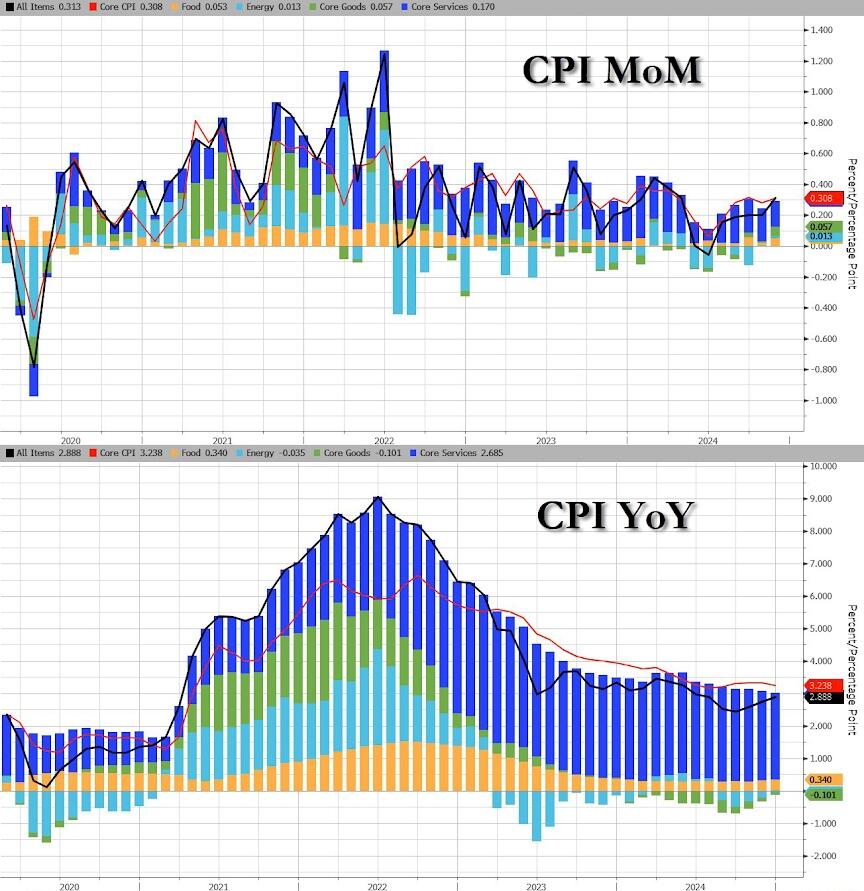
The resurgence of energy costs drove the hot headline CPI along with Core Services…
Source: Bloomberg
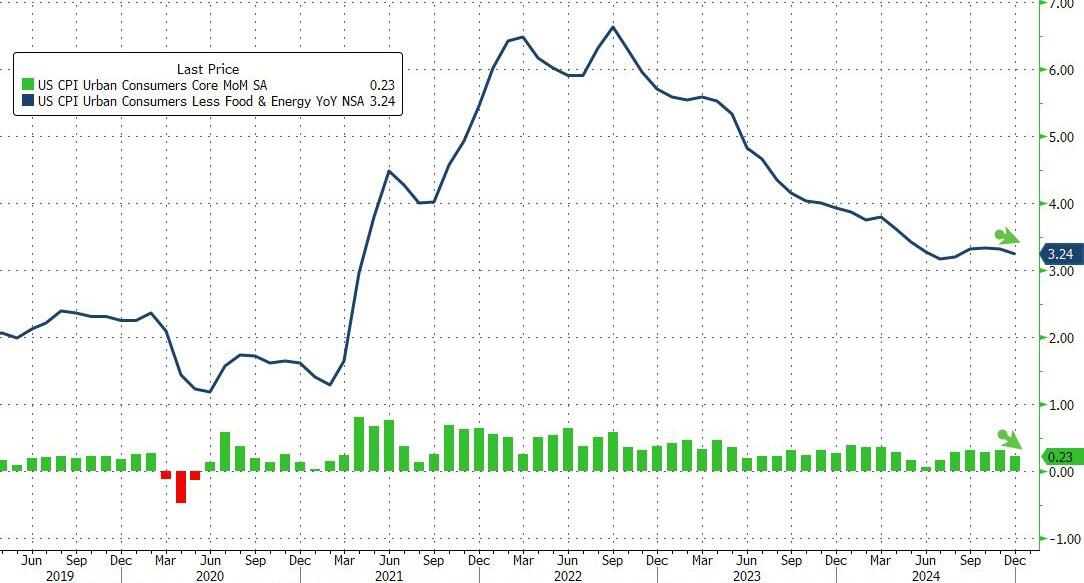
Core CPI (ex Food and Energy) dipped to +0.2% MoM (below the 0.3% exp) and the YoY pace of inflation slowed to 3.24% YoY. Core CPI rose EVERY month under Biden…
Source: Bloomberg
Core Goods price inflation slowed MoM (but deflation is gone on a YoY basis)…
Source: Bloomberg
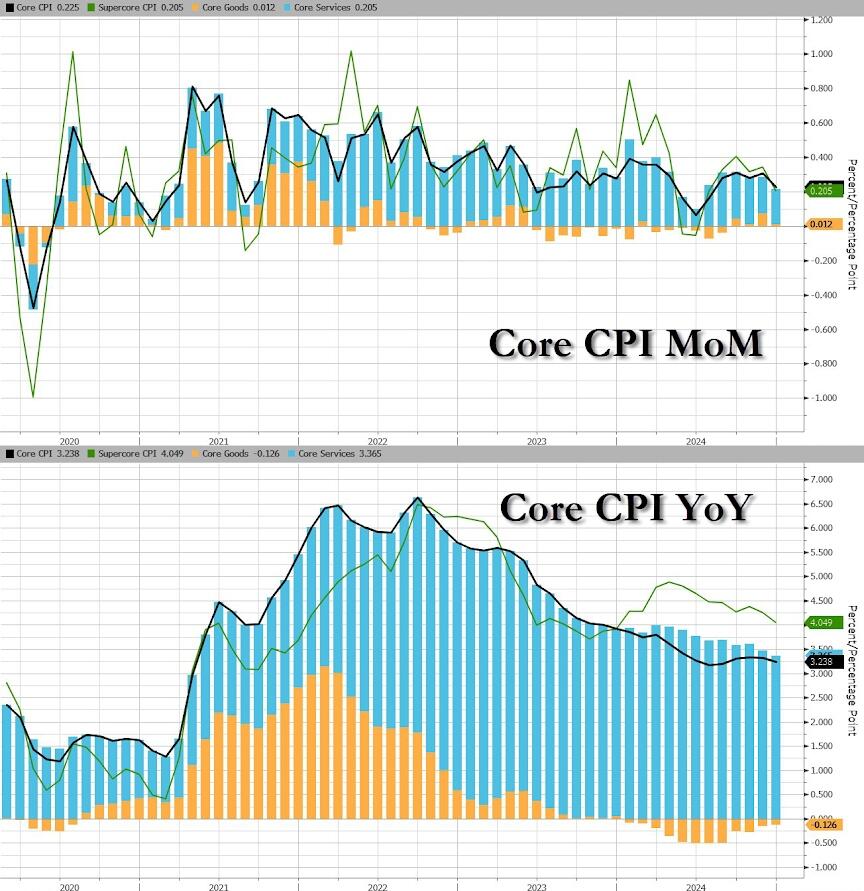
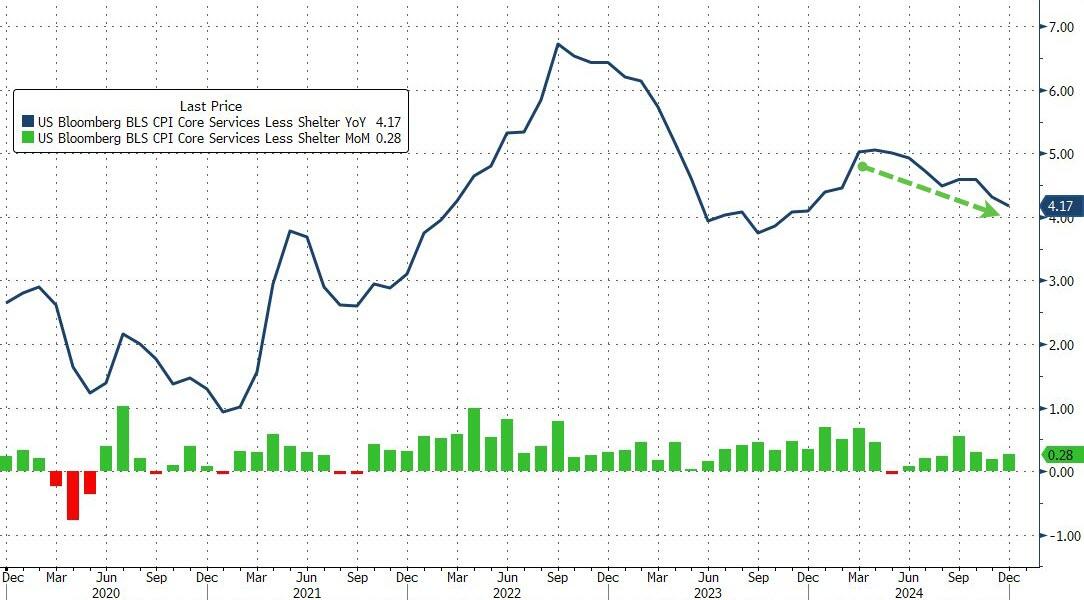
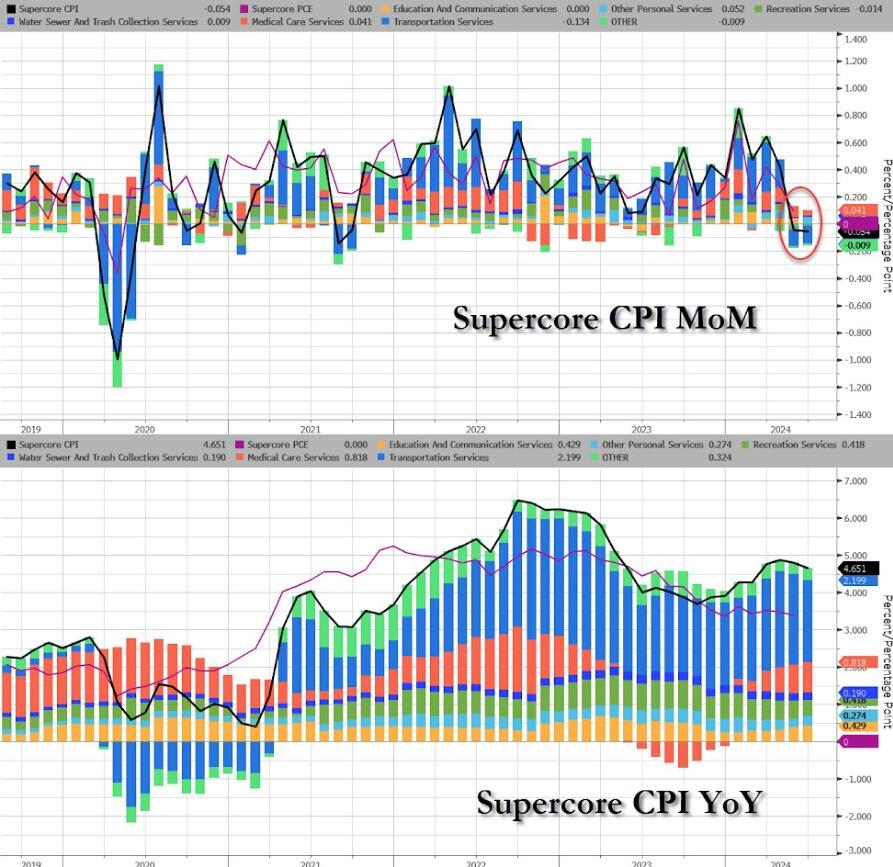
The Fed’s favorite indicator of the CPI bunch – SuperCore or Services CPI ex-Shelter – rose 0.28% MoM (slowing the pace of annual inflation to +4.17%)…
Source: Bloomberg
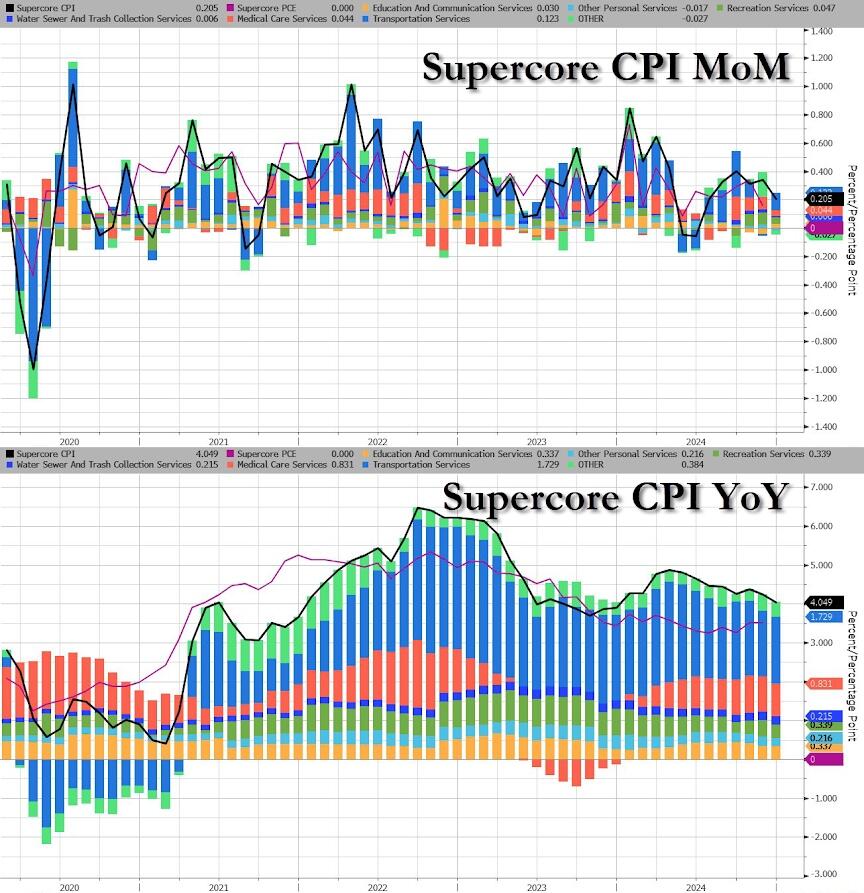
Transportation Services were not MoM…
Source: Bloomberg
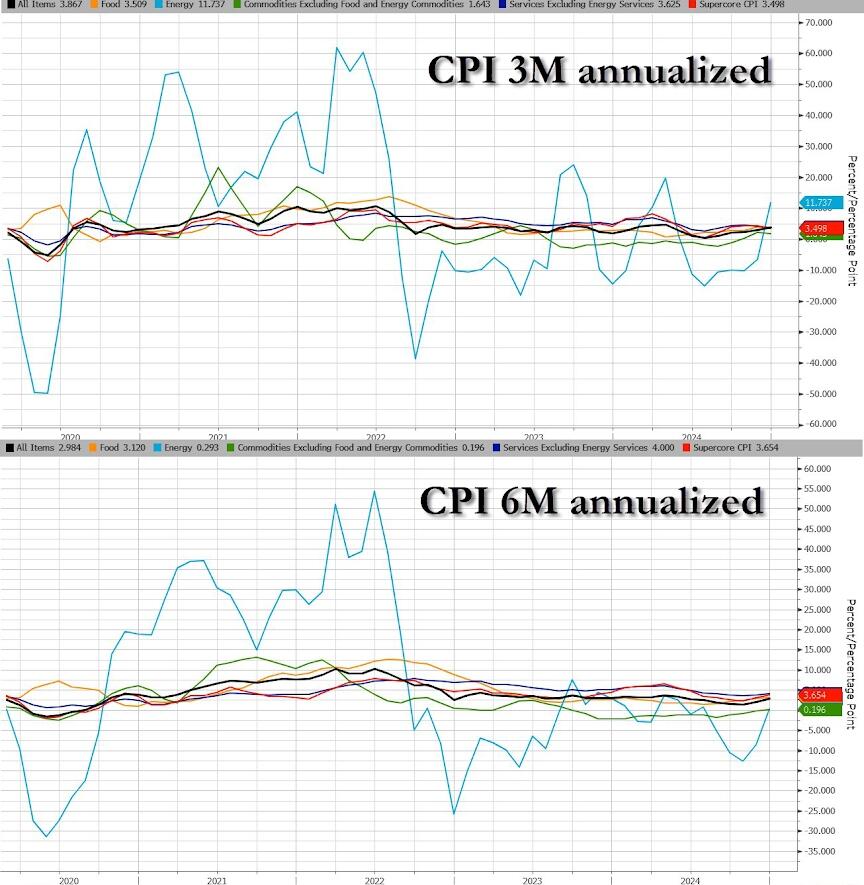
Overall, it’s energy costs that are re-emerging as a drive of inflation… thanks Joe!
Source: Bloomberg
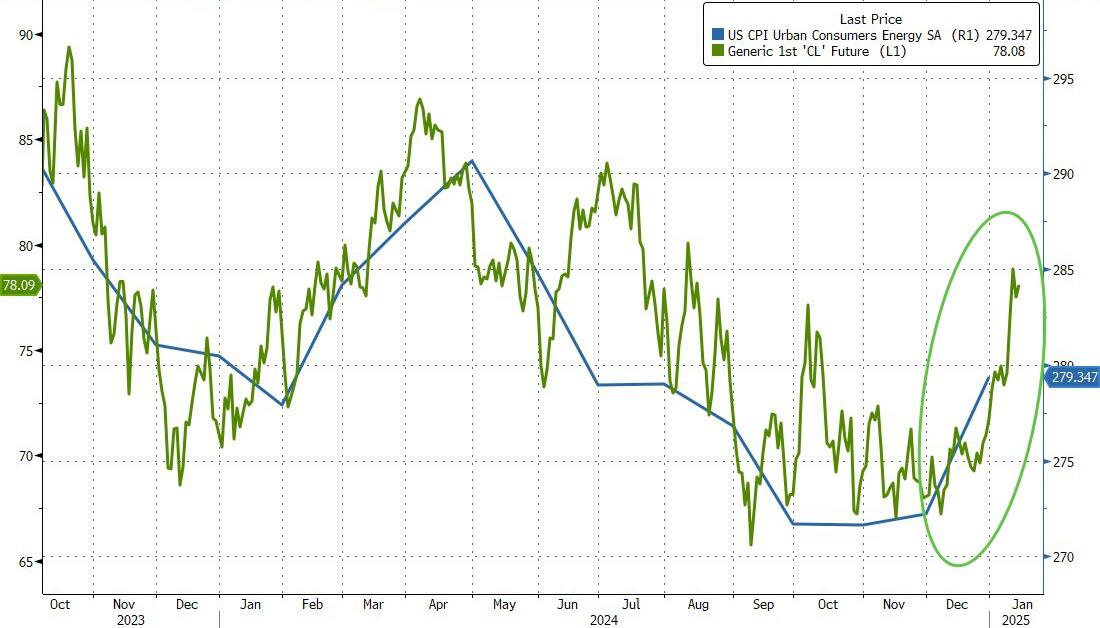
…and Energy prices aren’t going down anytime soon in the CPI world… thanks Joe!
Source: Bloomberg
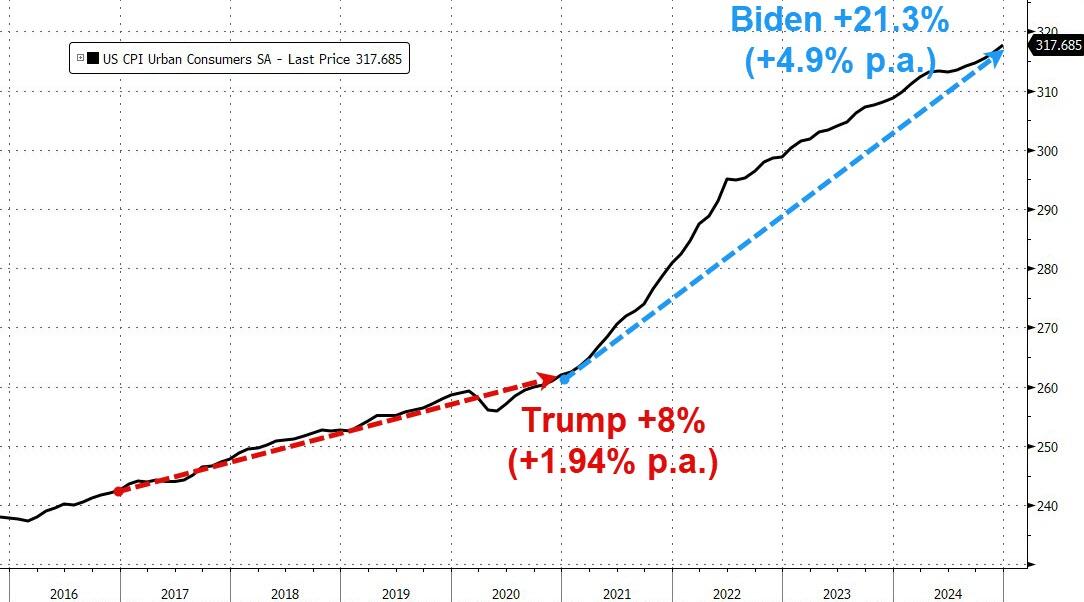
While Producer Prices under Biden rose at triple the rate they did under Trump, Consumer Prices soared 21.25% under Biden (+4.9% p.a.) vs 8%, 1.94% p.a. under Trump…
Source: Bloomberg
Finally, equity traders were braced for a volatile day ahead of the print, with options implying moves of 1.1% in either direction for the S&P 500, the most for a CPI day since March 2023.
The fact that economic conditions are getting worse is certainly not good news, but it is better to know in advance what is coming. After four years under Joe Biden, the U.S. economy is a giant mess. We have been witnessing a slow-motion collapse right in front of our eyes, and those at the bottom levels of the economic food chain have been experiencing more pain than anyone else. Of course this is one of the biggest reasons why Donald Trump won the election.
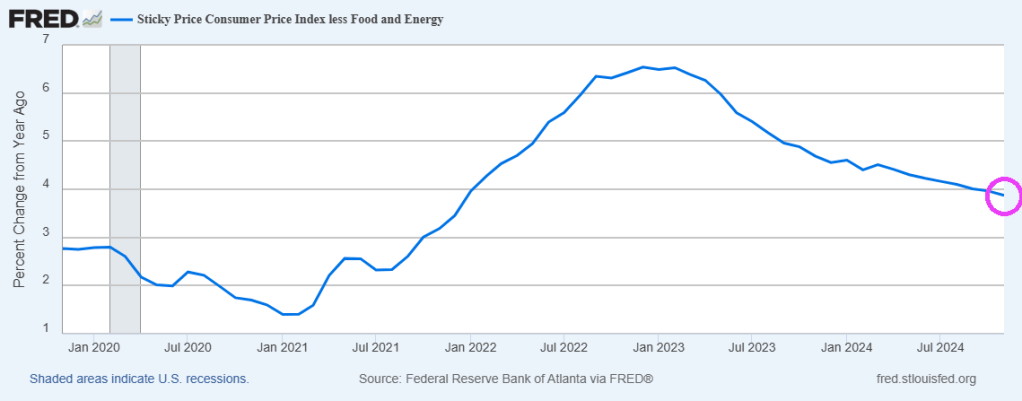
Example? Sticky inflation remains far higher under Biden/Harris than it did when Trump was President. Prices remain elevated as you will notice when Christmas shopping!
#1 When the economy is in good shape, holiday spending increases each year. In 2024, only 16 percent of Americans say that they are going to spend more than last year and 35 percent of Americans say that they are going to spend less…
Americans this holiday season say they are seeing a ghost of Christmas past: inflation.
The CNBC All-America Economic Survey finds inflation is still haunting the buying public, leading to what’s shaping up to be just an average season for retailers. Just 16% of respondents say they will spend more, down two points compared to last year. Forty-eight percent said that they’ll lay out the same amount for holiday gifts, up five points. At the same time, 35% say they’ll spend less, down two points as well.
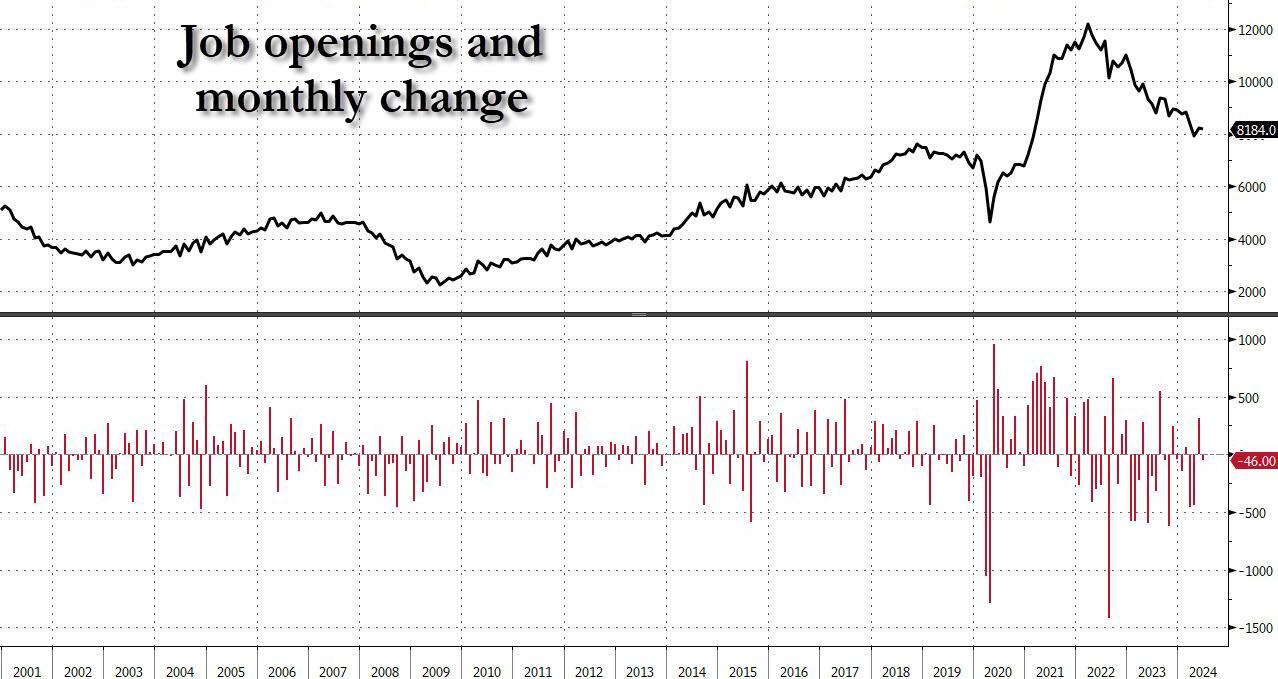
#2 The number of job openings in the U.S. is now the lowest it has been since January 2021, but unlike January 2021 we don’t have a pandemic to blame our poor performance on…
US job openings tumbled last month to their lowest level since January 2021, a sign that the labor market is losing some momentum. Still, posted vacancies remain well above pre-pandemic levels.
The Labor Department reported Tuesday that the number of job openings dropped to 7.4 million in September from 7.9 million in August.
Economists had expected the level of openings to be virtually unchanged. Job openings fell in particular at healthcare companies and at government agencies at the federal, state and local levels.
#3 The manufacturing numbers that we are getting are extremely dismal. For example, the Philadelphia Federal Reserve Manufacturing Index just experienced an extremely sharp decline…
The Philadelphia Federal Reserve Manufacturing Index, a critical gauge of the general business conditions in Philadelphia, has reported a significant drop. The actual figure stands at -16.4, a sharp decline that suggests worsening conditions for manufacturers in the region.
This figure starkly contrasts with the forecasted number of 2.9, highlighting a more severe downturn than initially predicted. Analysts had anticipated a positive shift, indicating improving conditions, but the actual data presents a different, more concerning situation.
Moreover, when compared to the previous index value of -5.5, the current reading of -16.4 further emphasizes the severity of the decline. This continuous drop indicates a concerning trend for manufacturers within the Philadelphia Federal Reserve district.
#4 Thanks to rapidly rising mortgage rates, the average U.S. homebuyer just lost $33,250 in purchasing power in just six weeks…
Mortgage rates hit 7% on October 28, the highest level since the start of summer and up nearly one percentage point from the 18-month low they dropped to in mid-September.
A homebuyer on a $3,000 monthly budget can afford a $442,500 home with a 7% mortgage rate, the daily average 30-year fixed rate on October 28. That buyer has lost $33,250 in purchasing power over the last six weeks; they could have purchased a $475,750 home with the 6.11% average rate on September 17. That was the lowest level since February 2023.
#5 Our cost of living crisis is officially out of control. According to Bank of America, almost a third of all households “spend more than 95% of their disposable income on necessities such as housing costs, groceries and utility bills”…
Many Americans are still in a tough spot: Nearly 30% of all US households this year said they spend more than 95% of their disposable income on necessities such as housing costs, groceries and utility bills, according to a Bank of America Institute report, up from 2019 levels.
#6 A recent Lending Tree survey discovered that nearly a quarter of all households couldn’t pay their entire power bill at some point within the past year…
LendingTree’s findings about electricity bill costs comes as it reported 23.4% of Americans experienced an inability to cover their entire energy bill or portions of it in the last year, based on Census Bureau Household Pulse Survey data.
#7 The same Lending Tree survey found that about a third of all households had to reduce spending “on necessary things” within the past year in order to pay utility costs…
Needing to cover utility bills prompted 34.3% of Americans to curb their spending on necessary things – or eliminate some altogether – in at least one instance in the prior year, LendingTree said.
#8 As I discussed last week, demand is at record levels at food banks all over the nation…
Why is demand at food banks all over the country higher than it has ever been before? The media keeps insisting that economic conditions are just fine, but it has become quite obvious to everyone that this is not true. In particular, the rising cost of living has been absolutely crushing households from coast to coast. In the old days, most of the people that would show up at food banks were unemployed. But now food banks are serving large numbers of people that actually do have jobs but that don’t make enough to pay for all of the basics. The ranks of the “working poor” are growing very rapidly, and this is creating an unprecedented crisis all over America.
#9 During normal times, troubled retailers would at least wait until after the holiday season to throw in the towel. But we haven’t even reached Christmas and Party City has already announced that it will be closing all stores…
Party City is closing down all of its stores, ending nearly 40 years in business, CNN has learned.
CEO Barry Litwin told corporate employees Friday in a meeting viewed by CNN that Party City is “winding down” operations immediately and that today will be their last day of employment. Staff were told they will not receive severance pay, and they were told their benefits would end as the company goes out of business.
Big Lots is beginning ‘going out of business’ sales at all its stores across the US, as it prepares to close its remaining locations.
The discount retail chain filed for Chapter 11 bankruptcy in September, and has already shut hundreds of stores nationwide.
In a press release Thursday, the company said it would begin the sales at its 963 remaining locations, after a sale to a private equity firm fell through.
#11 As of the end of November, more than 7,000 store closings had been announced in the United States. That is a 69 percent increase from last year…
According to a report from CoreSight Research, U.S. retailers had announced more than 7,100 store closures through the end of November 2024, which represents a 69% increase compared to the same time in 2023. These closures are spread across numerous different sectors of retail from auto parts to restaurants to pharmacies, leaving many consumers wondering which companies will survive. This brings us to GameStop, the beloved retail gaming store, which has not only been closing hundreds of retail store locations since 2020, but also appears to be on track to close hundreds more of its locations in the very near future.
Look at all of these beautiful Christmas decorations at the Crocker Galleria mall in San Francisco. It’s 4:47 PM and everybody should be shopping and buying Christmas presents for their family, but nobody is in this mall.
There are only three stores left that are open here. The escalators hum on inside this beautiful but empty decorated mall.
Outside on Market Street the fentanyl addicts lay folded over while a street performer sings Last Christmas to an empty Street.
Of course the lack of shoppers at that particular mall is just the tip of the iceberg.
California’s biggest downtown areas are crumbling under the weight of homelessness and drug addiction, causing a vital part of its economy to dry out.
Cities like Los Angeles and San Francisco have made countless headlines since the pandemic about their drug-infested streets where businesses are quickly pulling out due to high crime rates and low consumer passage.
The number of drug addicts in America is at the highest level ever.
The number of homeless people in America is at the highest level ever.
They are victims of our slow-motion economic collapse, and the holidays will not be very happy for them.
So if you still have food on the table and a warm home to sleep in, you should consider yourself to be incredibly blessed.
Sadly, more Americans are being forced out into the streets with each passing day as the slow-motion collapse of our economy accelerates.
I just watched Dennis Quaid in “Reagan”. Excellent film. But it reminded me of how Reagan sank the Soviet Union: by outspending the Soviet Union on the arms race. It worked! The Soviet Union, hamstrung by grossly inefficent central planning, couldn’t keep up and collapsed under President George H.W.Bush.
Fast forward to today. Starting with Barack Obama and Joe Biden in 2009, following the financial crisis in 2008. The Federal government ramped up Federal spending, and Federal debt. While The Federal Reserve, the hand maiden to the Federal government, ramped up M2 Money supply.
“You never want a serious crisis to go to waste. And what I mean by that is an opportunity to do things that you think you could not do before.” – Rahm Emmanuel
Then came Biden/Harris who drove Federal debt and spending to absurb level (orange box). Like the financial crisis, fans of big government and big government spending will utter the word “Covid.” But that is gross misleading. Covid was the excused for wild spending and debt issurance. And MORE Fed money printing. It’s almost as if Obama/Biden/Harris were replicating Reagan’s bankrupcy strategy in reverse! That is, collapsing the US from within.
As we are all painfully aware, the US Debt now stands at $36 TRILLION with $220.3 TRILLION in unfunded liabilities. Too bad total US Assets are only $217 TRILLON.
Do I believe that Obama/Biden/Harris want a “Great Reset”? Absolutley. Just look at our fiscally unsustable open borders and our politiicians blatanly lying to us. :Like Ohio’s Senator Sherrod Brown who brags about his helping write the border bill that would reverse Trump’s deportations and fund the speeding up of immigration.
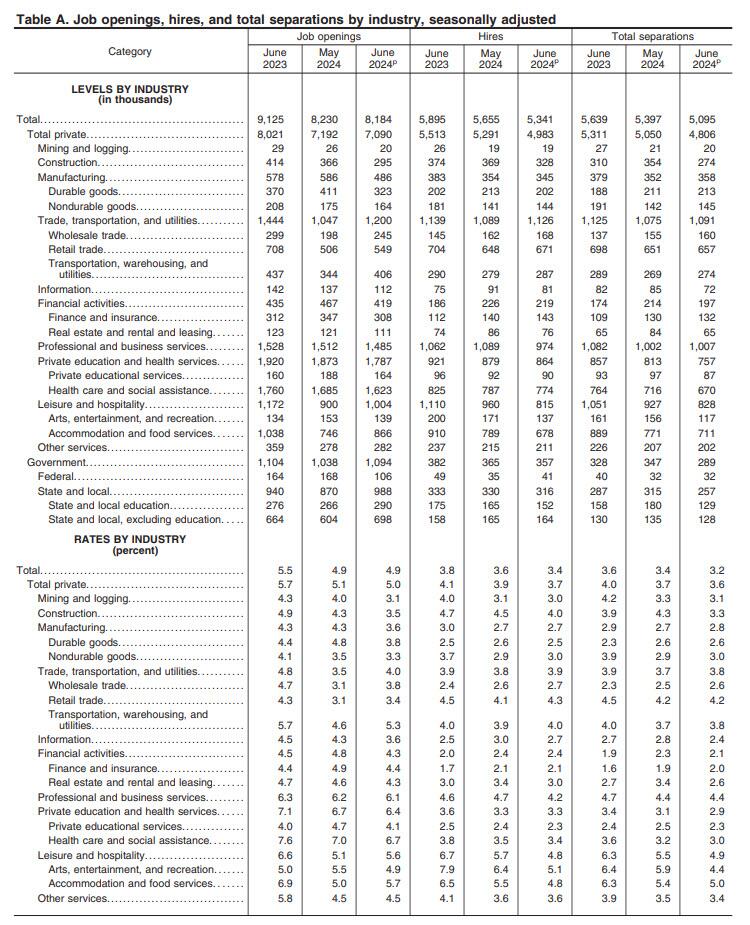
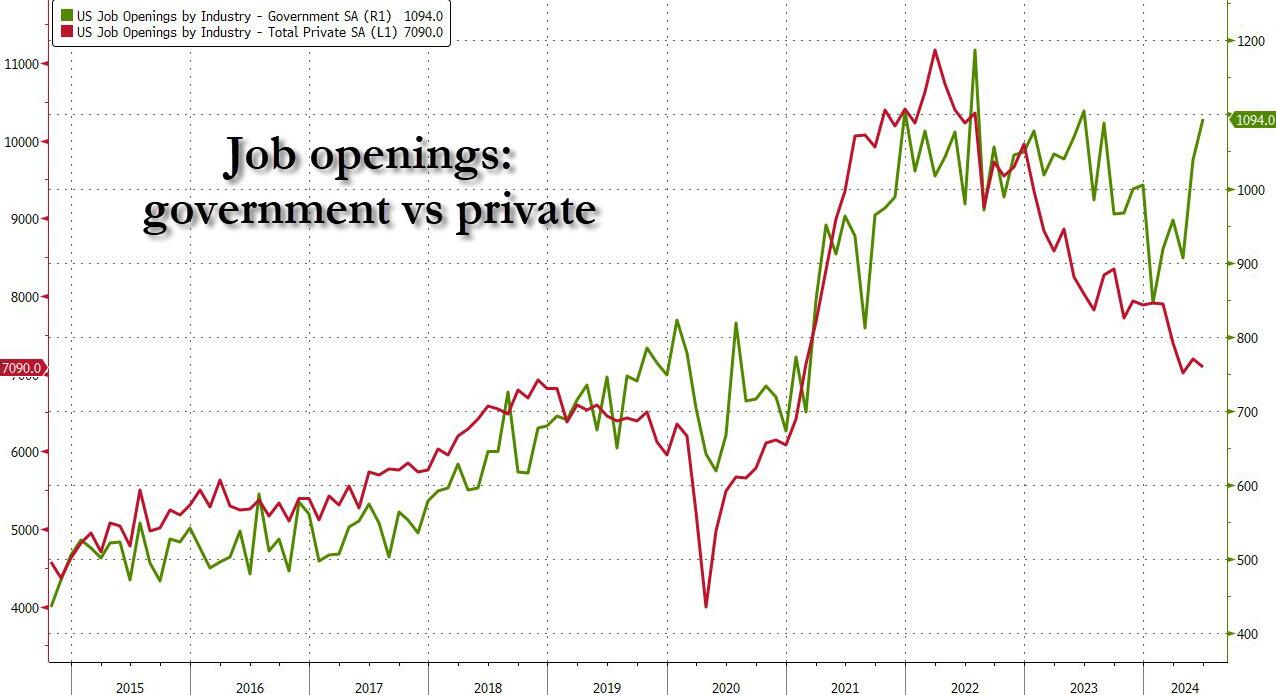
And yet, the same data rigging observed last month took place once again, because a quick look at the breakdown shows that while private jobs saw another broad drop in openings across private sectors…
… this was almost fully offset by the relentless surge in government job openings.
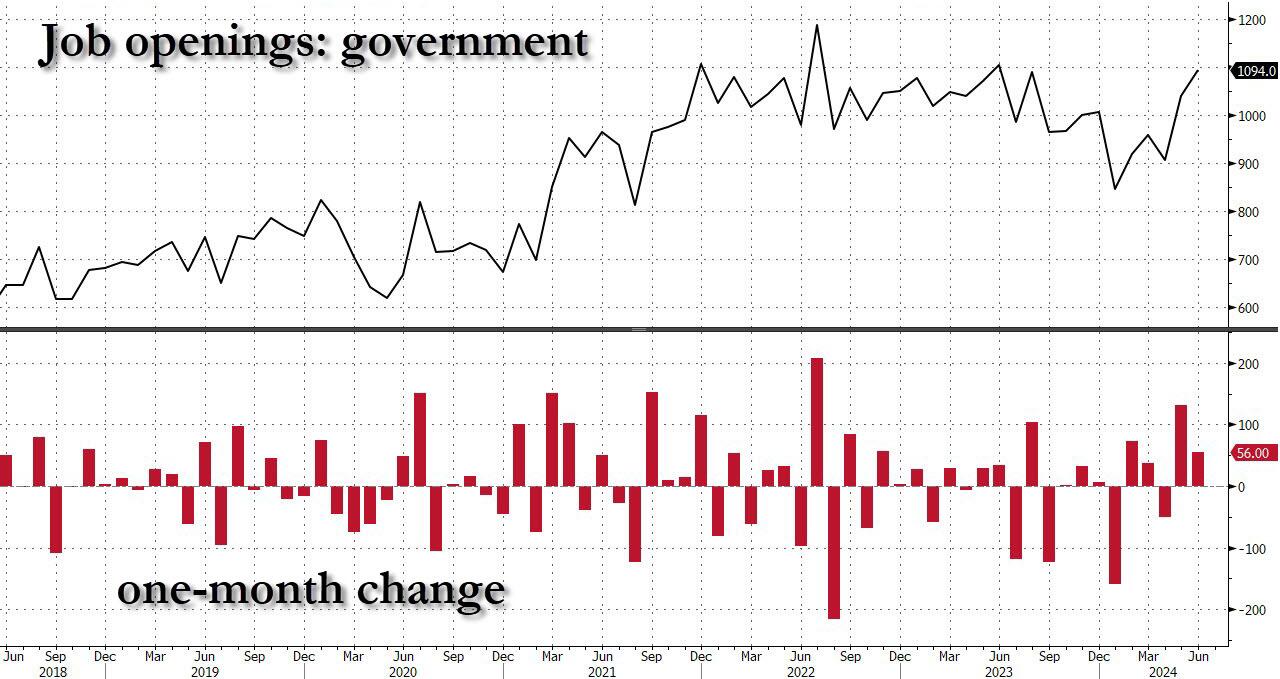
Yes, while May was indeed revised lower, June saw another bizarre jump in government job openings, surging to a near record 1.094 million, driven by a 118K spike in State and Local job openings.
Putting it all together, while private sector job openings plunged to a level seen back in late 2018, government job openings are just shy of a record high!
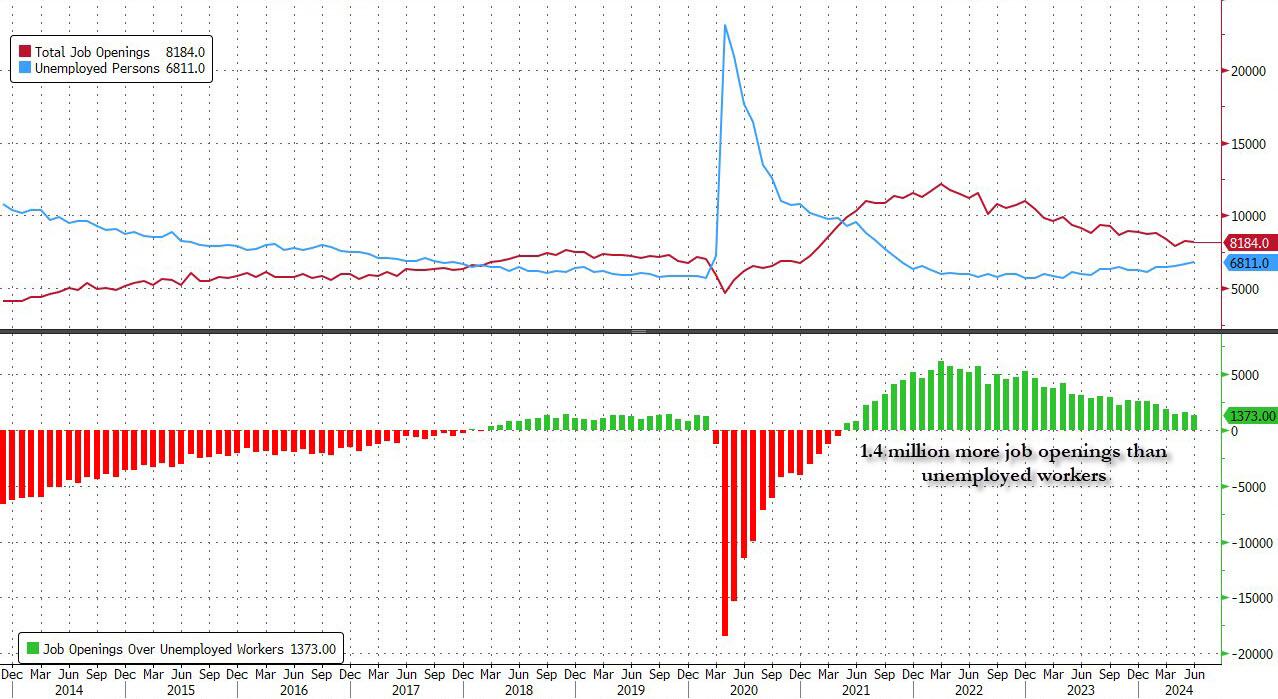
Ignoring the data manipulation, in the context of the broader jobs report, in June the number of job openings was 1.373 million more than the number of unemployed workers (which the BLS reported was 6.811 million), down from last month’s 1.581 million and the lowest since the summer of 2021.
Said otherwise, in April the number of job openings to unemployed dropped to just 1.24, a sharp slide from the March print of 1.30, the lowest level since June 2021 and now officially back to pre-covid levels.
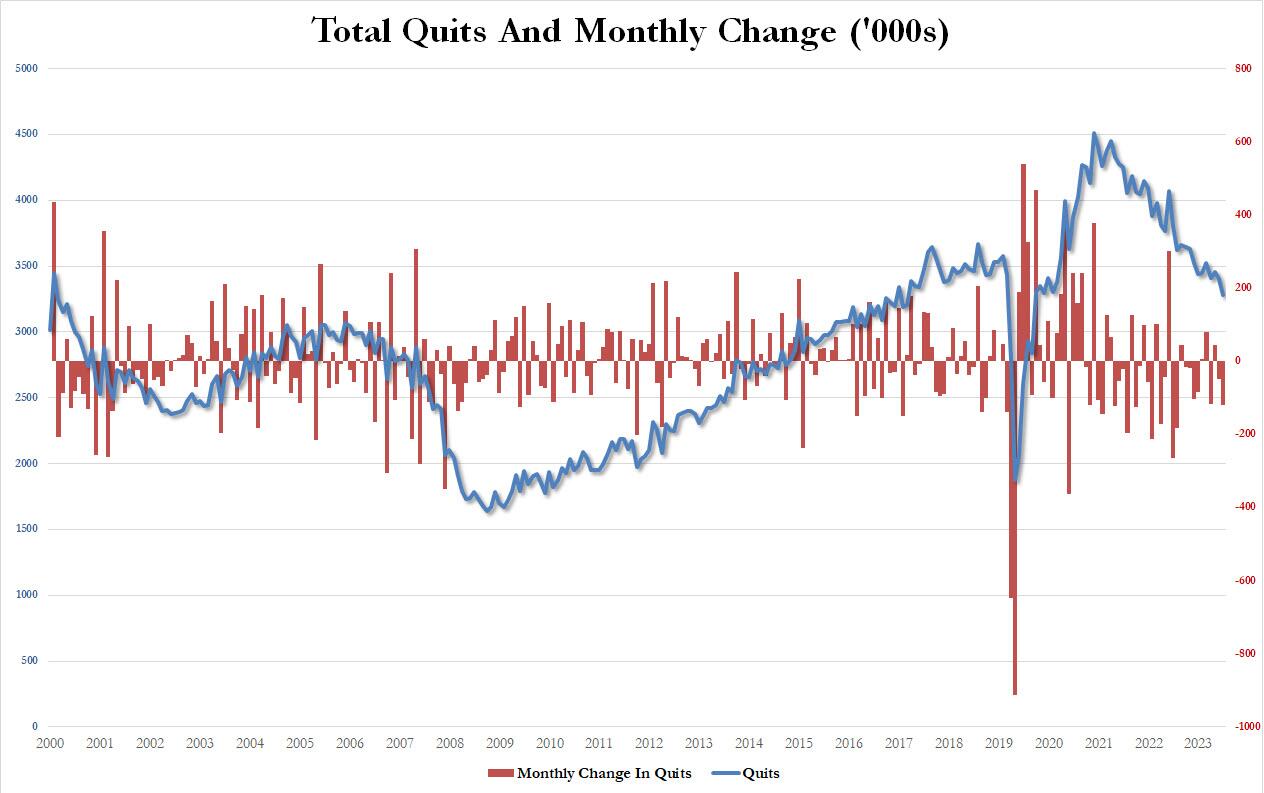
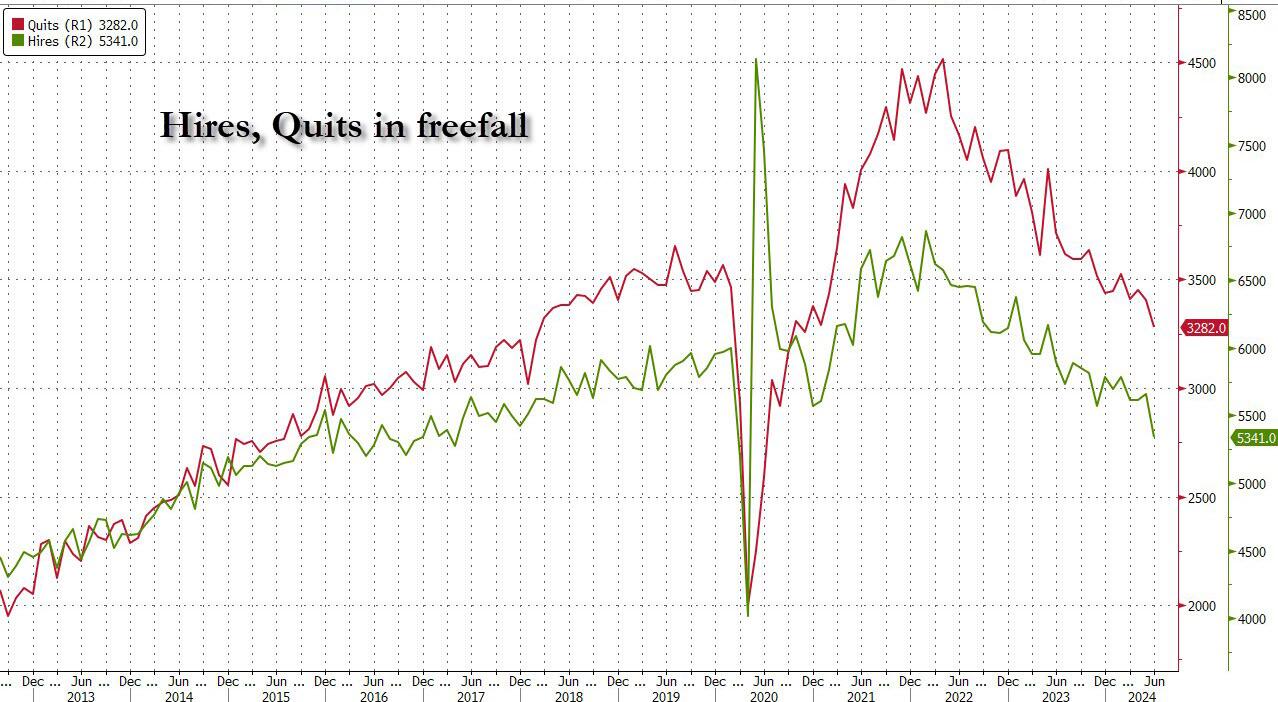
But wait there’s more: confirming that if one ignores the clearly manipulated jump in government job openings (“quick, let’s hire a ton more TSA agents and deep state apparatchiks to make it seems that Kamalanomics is working”), a quick look at the number of quits – an indicator closely associated with labor market strength as it shows workers are confident they can find a better wage elsewhere – showed a plunge in June, dropping by 121K, the most since July 2023, to just 3.282 million, the lowest since August 2020!
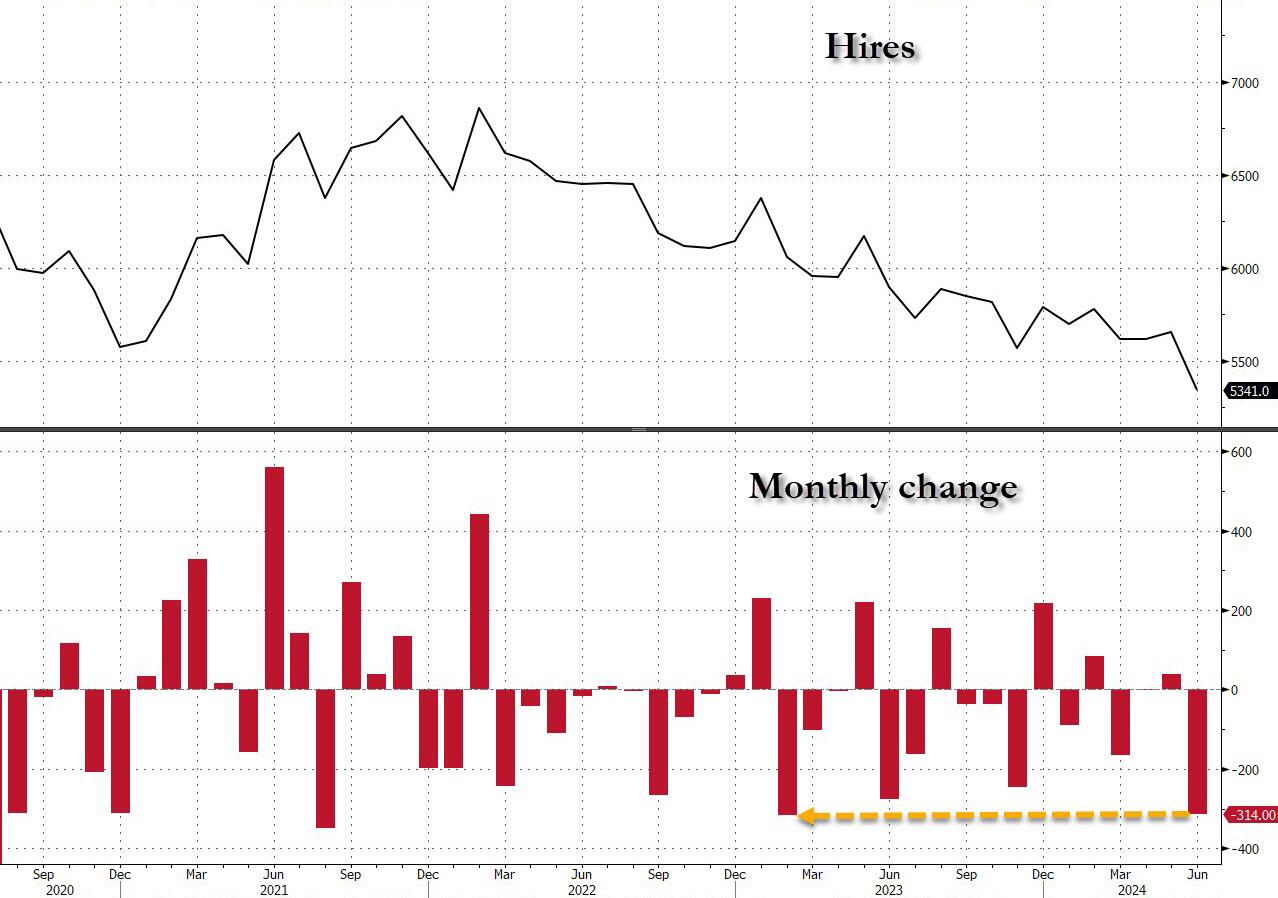
Finally, the piece de resistance was the number of actual hires, which in June also tumbled to just 5341, down a massive 314K in one month, the biggest monthly drop since February 2023…
… dragging the total to just 5.3 million, the lowest level since the depts of the covid lockdowns.
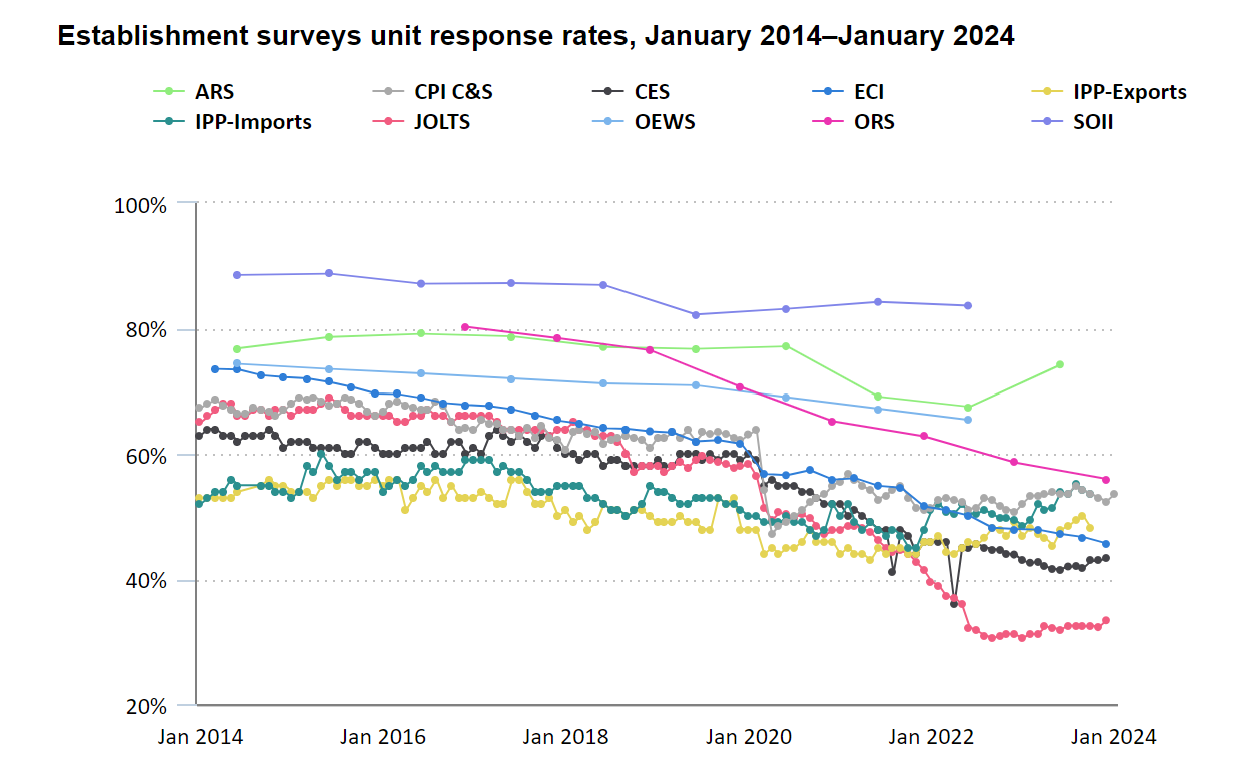
Finally, no matter what the “data” shows, let’s not forget that it is all just estimated, and it is safe to say that the real number of job openings remains still far lower since half of it – or some 70% to be specific – is guesswork. As the BLS itself admits, while the response rate to most of its various labor (and other) surveys has collapsed in recent years, nothing is as bad as the JOLTS report where the actual response rate remains near a record low 33%
In other words, more than two thirds, or 70% of the final number of job openings, is estimated!
And at a time when it is critical for Biden, pardon Kamala, to still maintain the illusion that at least the labor market remains strong when everything else in the economy is crashing and burning, we’ll let readers decide if the near record number of government job openings at a time when hiring and quitting are both crashing, is an accurate reflection of a strong labor market, or is merely a reflection of a debt-funded deep state gone full tilt. We’ll know the answer on Friday.
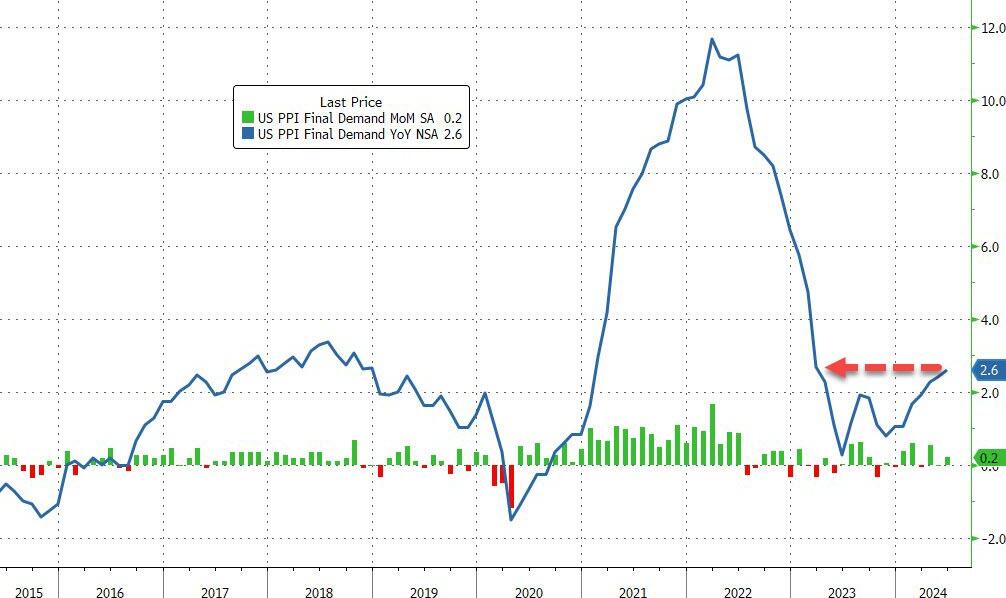
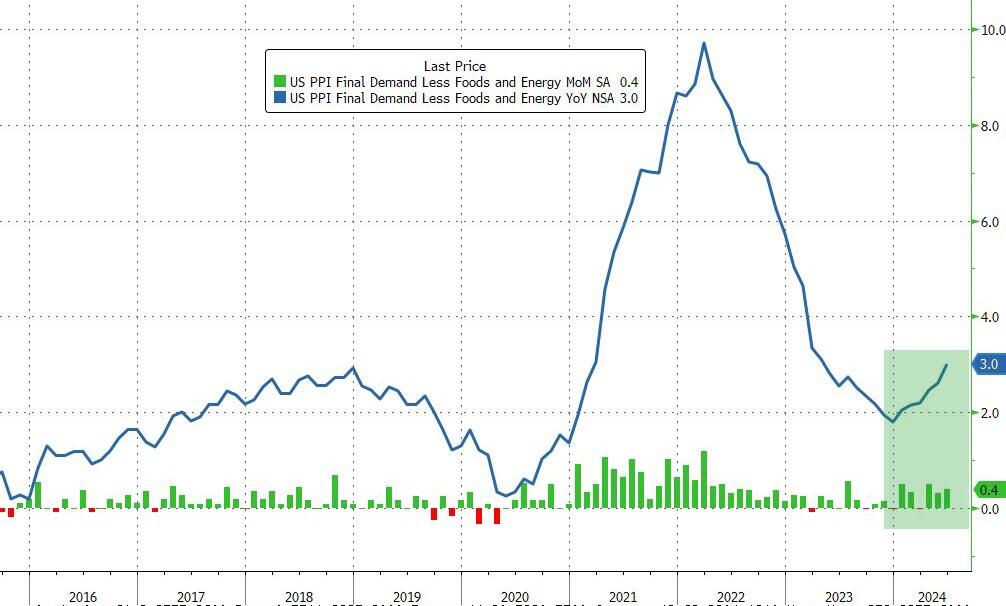
Core PPI rose by 0.4% MoM (double the 0.2% exp), sending the YoY price rise up by 3.0% (also the hottest since March 2023)…
Source: Bloomberg
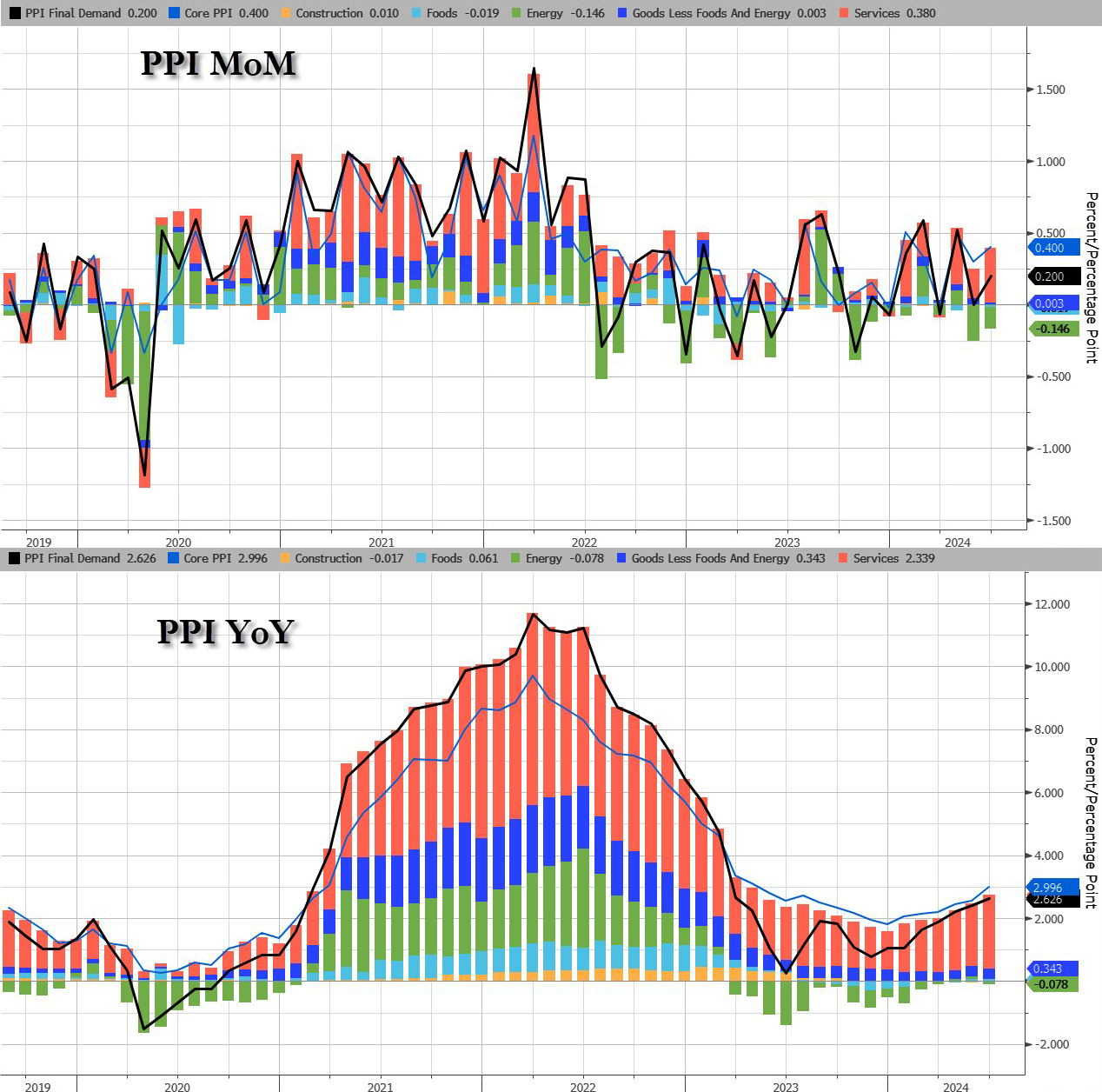
The jump in PPI was driven by a resurgence in Services costs as Energy remains deflationary (for now)…
Source: Bloomberg
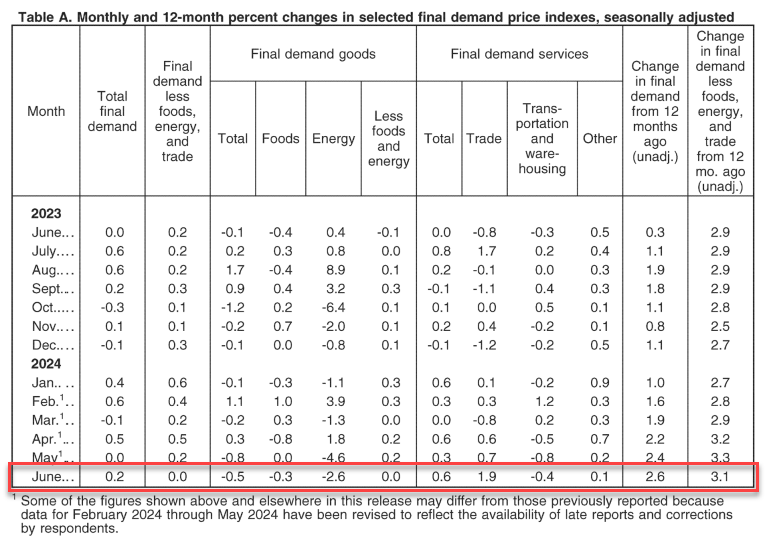
The June rise in the index for final demand can be traced to a 0.6-percent increase in prices for final demand services. In contrast, the index for final demand goods decreased 0.5 percent
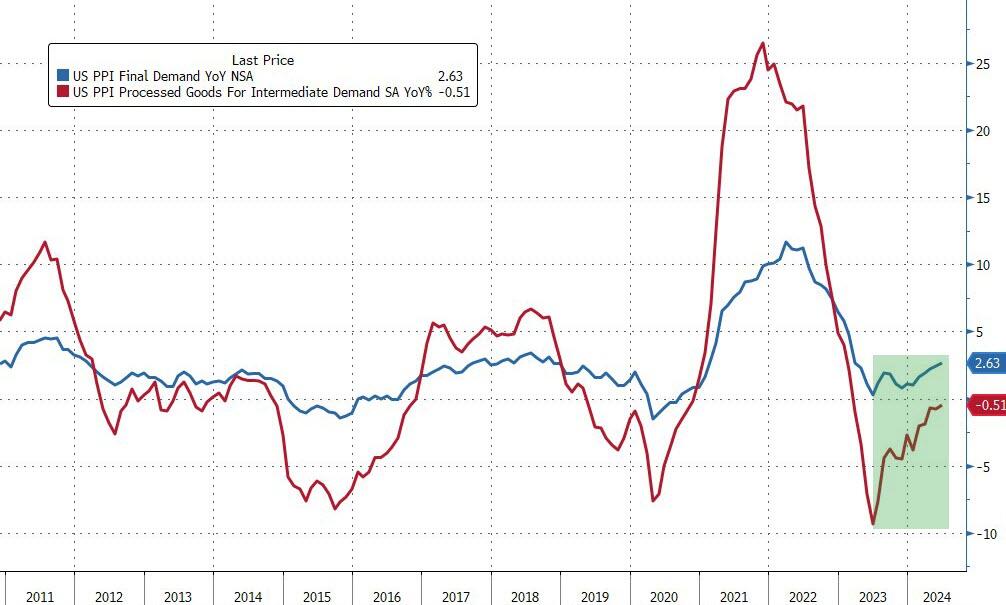
Perhaps worse still, the pipeline for PPI (intermediate demand) is accelerating…
Source: Bloomberg
On the housing side, buying conditions for housing tanks to all-time low.
Are you ready? You can tell an election is on the radar since inflation numbers are settling down for the most part. According to the BLS, overall inflation fell slightly in June to 3.0%.
Shelter CPI is up 5.14% YoY as M2 Money growth has been rising slowly … again.
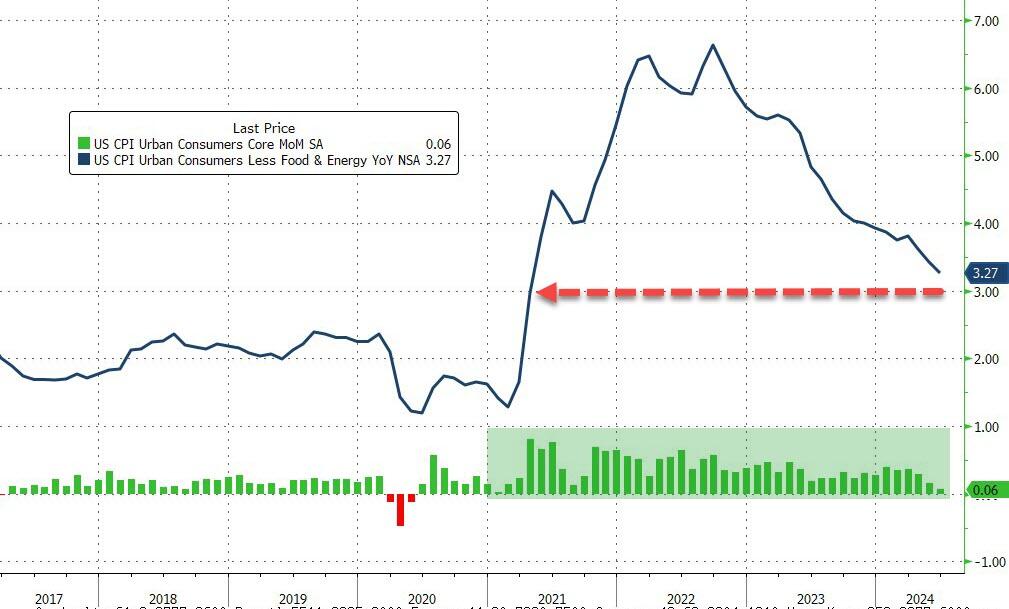
Core CPI also ‘missed’, rising just 0.1% MoM (vs +0.2% exp), dragging the YoY Core CPI down to +3.27% – its lowest since April 2021…
Source: Bloomberg
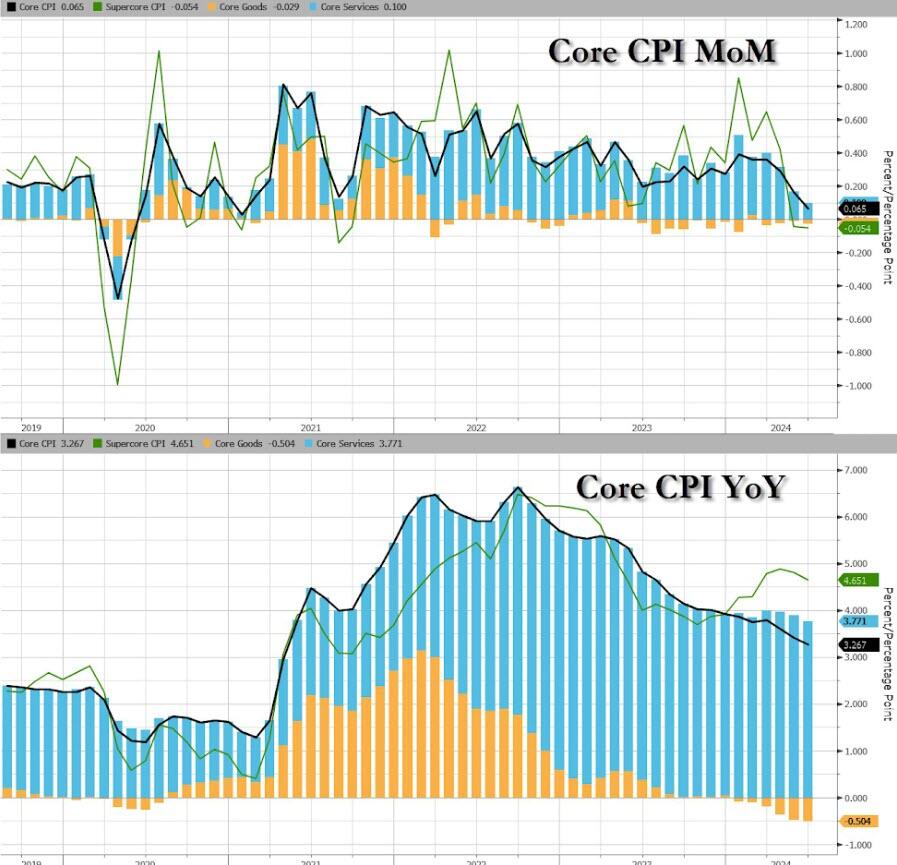
Goods deflation also dominates core prices disinflationary trend…
We do note that Core consumer prices have still not seen a single monthly decline since Bidenomics began.
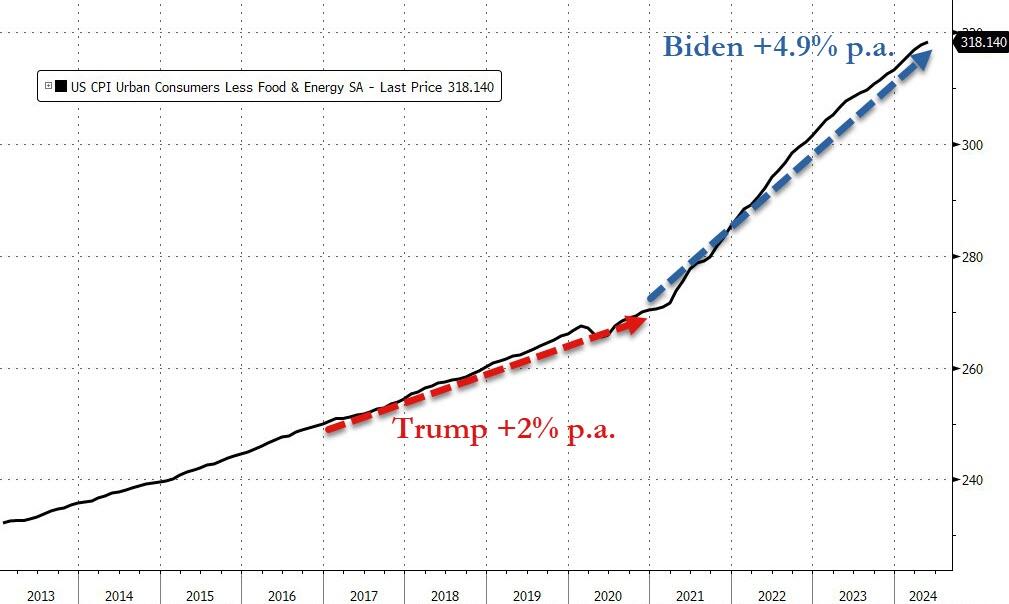
Core consumer prices are up just under 18% since Bidenomics began (+4.9% per annum) – that is dramatically higher than the 2.0% per annum Americans experienced under Trump…
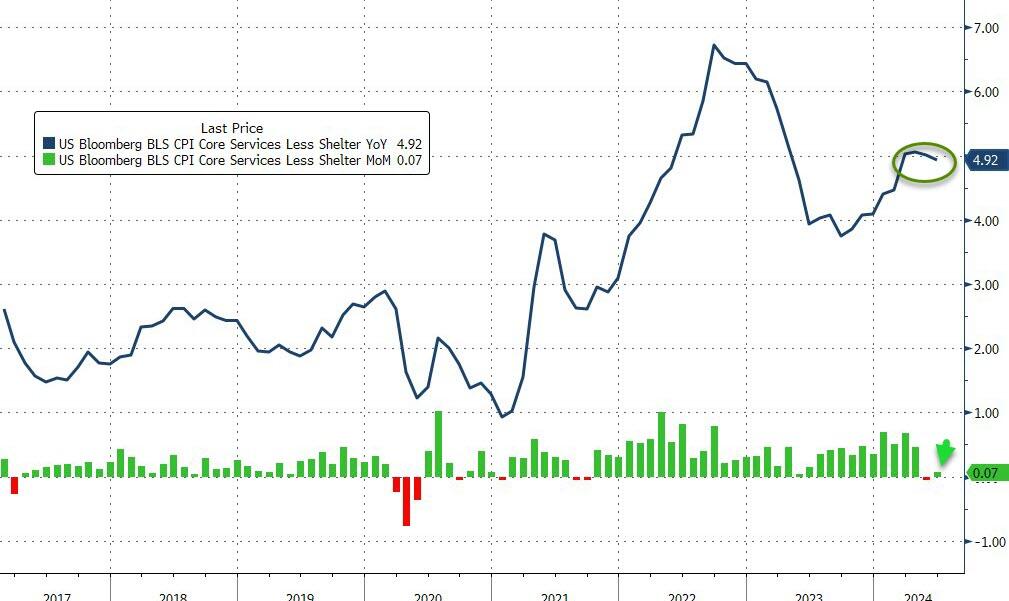
The much-watched SuperCore CPI rose on a MoM basis but declined (back below 5.0%) on a YoY basis (but obviously remains extremely elevated)…
Source: Bloomberg
Transportation Services are seeing prices fall…
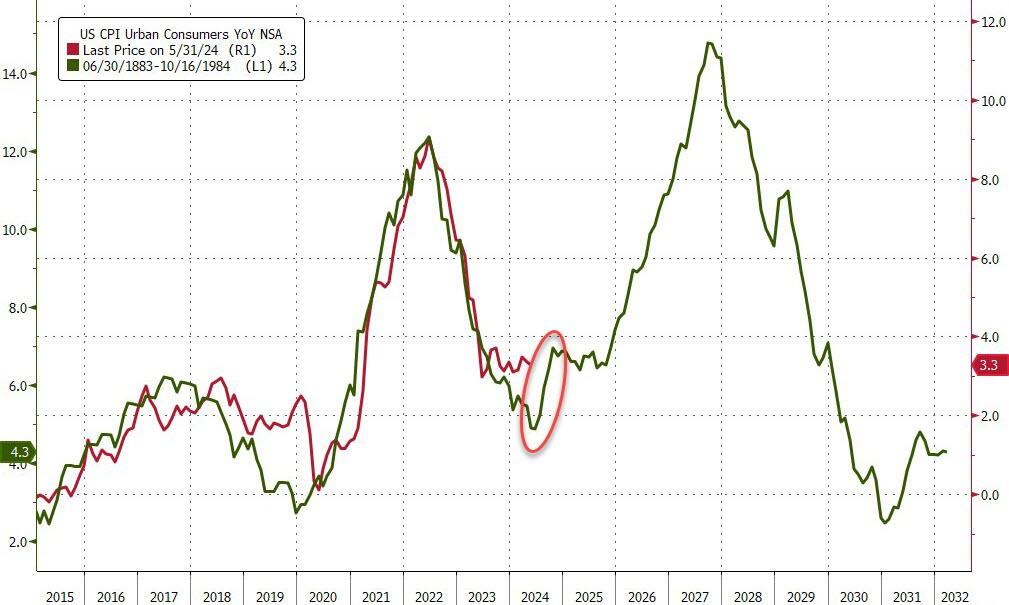
Finally, we can’t help but get a sense of deja vu all over again here. What if… The Fed cuts (because bad – recession – data), Biden loses (because dementia), and inflation re-accelerates (just like in the 80s)…
Source: Bloomberg
Challenger job cuts in construction we the highest since 2008 putting downward pressure on wages.
Stated differently, virtually everything the Fed does for the alleged benefit of the American economy is both unnecessary and a ruse. The Fed has actually become a captive of the Wall Street traders, gamblers and high rollers, and functions mainly at their behest.
The proof of this proposition starts with the startling historical fact that the post-war US economy did just fine without any interest rate targeting, heavy-duty bond-buying or general macroeconomic management help from the Fed at all. For all practical purposes today’s omnipresent Fed domination of the financial and economic system was non-existent at that point in time.
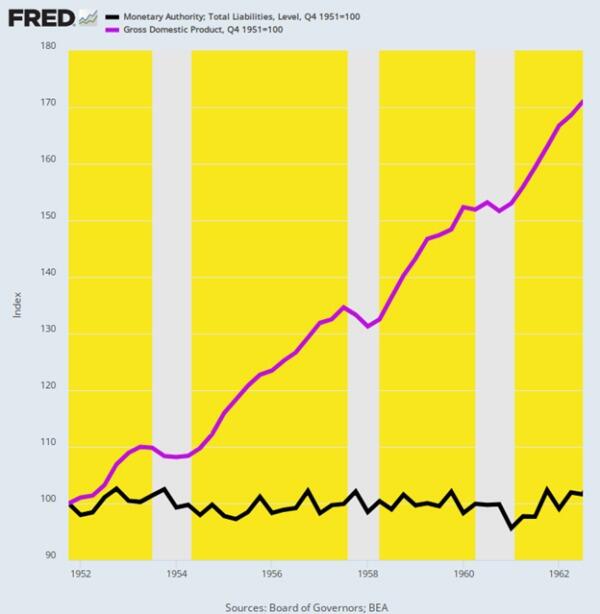
We are referring to the full decade between Q4 1951 and Q3 1962 when the balance sheet of the Fed remained flat as a board at just $51 billion (black line). Yet the US economy did not gasp for lack of monetary oxygen. GDP grew from $356 billion to $609 billion or by 71% (purple line) during the period. That’s nominal growth of 5.1% per annum, and the majority of it represented real output gains, not inflation.
Change in Federal Reserve Balance Sheet Versus GDP, Q4 1951 to Q3 1962.
As it happened, this halcyon span encompassed the immediate period after the so-called Treasury-Fed Accord of March 1951, which finally ended the WWII expedient that had pegged Treasury bills at 0.375% and the long-bond at 2.5o% in order to finance the massive flow of war debt.
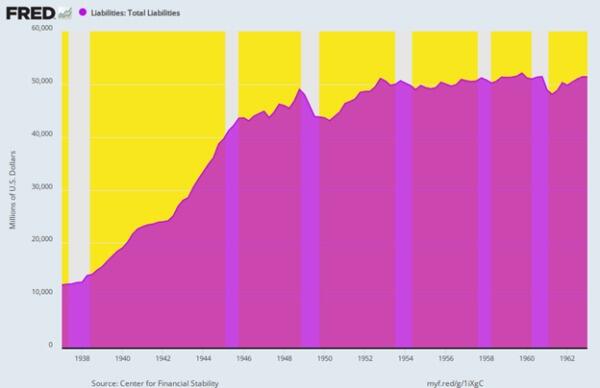
The effect of the WWII pegs, of course, was that the Fed had been obliged to absorb any and all US Treasury supply that did not clear the market at the target yields. Not surprisingly, the Fed’s 1937 balance sheet of $12 billion had risen by 4.3X to $51 billion by the time of the Accord, thereby reflecting what amounted to the original version of backdoor monetization of the public debt, which was justified at the time by the exigencies of war.
By contrast, in the post-peg period shown below interest rates were allowed by a newly liberated Fed to find their own market clearing levels. So there was no continuous guessing game on Wall Street about where the next monthly Fed meeting would peg short-term interest rates. Back then, it was understood that the forces of supply and demand down in the bond pits of Wall Street were fully capable of discovering the right interest rates, given the financial and economic facts then extant.
The combination of high growth, robust investment, strong wages and smartly rising real family income, on the one hand, and rock-bottom inflation on the other, surely constitutes the gold standard of performance for a modern capitalist economy.
And yet, and yet. It was all accomplished under a regime of persistent “light touch” central banking that assumed free market capitalism would find its own way to optimum economic growth, employment, housing, investment and main street prosperity. No monetary Sherpa at the Eccles Building was necessary.
Even more crucially, no money printing was necessary, either. The sterling economic results depicted below happened during a 11-year period when the Fed did not purchase one net dime of U.S. Treasury debt!
Per Annum Change, Q4 1951 to Q3 1962
Real Final Sales: +3.8%.
Real Domestic Investment: +4.1%.
Nonfarm productivity growth: +2.5%.
Real hourly wages: +3%.
Real Median Family Income: +2.3%.
CPI Increase: +1.3%
Federal Reserve Liabilities, 1937 to 1962
There is absolutely nothing about this period that makes the superior macroeconomic performance summarized above aberrational, flukish or unreplicable. In fact, President Eisenhower cut defense spending sharply and eliminated the fiscal deficit entirely during his second term. So, the cumulative increase in the public debt during this 11-year period was just $30 billion or a tiny 0.6% of GDP owing to Korean War borrowing early in the period.
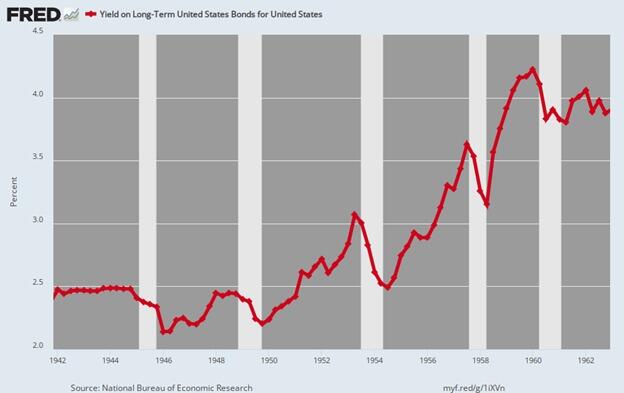
But even this modest debt increase wasn’t monetized by Fed bond-buying. Instead, it was effectively financed out of private savings in the bond pits. Long-term bond yields, therefore, actually rose from the 2.5% pegged level shown below for 1942 to 1951 to upwards of 4% by the end of the period, as dictated by supply and demand. Still, the CPI averaged just 1.2% during 1959-1962, meaning that real yields bordered on +3.o% during the early 1960s.
That is to say, at the time, the Fed had seen no need to push real rates to zero and even into negative territory as has been the case for much of the last two decades. The fact is, the main street economy prospered mightily even when inflation-adjusted rates were providing a solid return to savers and investors.
Long-Term US Treasury Bond Yield, 1942 to 1962
What ended the benign economics of 1951 to 1962, of course, was the scourge of War Finance. LBJ (Lyndon B. Johnson) escalated the Vietnam War dramatically after 1963, causing the debt to soar and the 10-year UST to climb to nearly 6% by early 1968. But Johnson was not about to allow market clearing interest rates to fund his misbegotten venture in bringing the blessings of the Great Society to southeast Asia.
So he gave “the treatment” to the Fed Chairman at his Texas ranch and ordered to cut the Federal funds rate to accommodate LBJ’s surging Federal deficit. The latter had grown from $4.8 billion and -0.8% of GDP in 1963 to $25.2 billion and -2.8% of GDP by 1968.
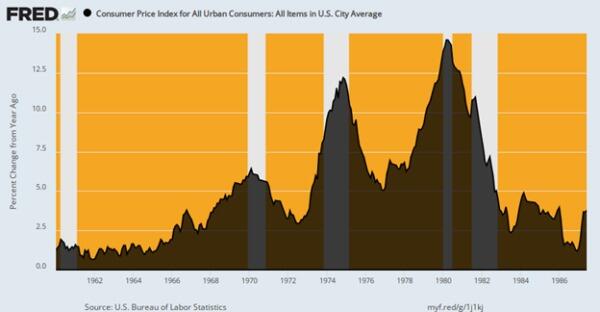
Unfortunately, after steadily and appropriately raising the Fed funds rate from 2.9% in December 1962 to 5.75% by November 1966 as Johnson’s inflationary deficits grew, the funds rate was brought down rapidly to 3.8% by July 1967. In turn, that unleashed a red-hot wave of speculation and inflation, with the CPI rising from a 1% Y/Y (year-on-year) gain in August 1964 to a +6.4% peak in February 1970.
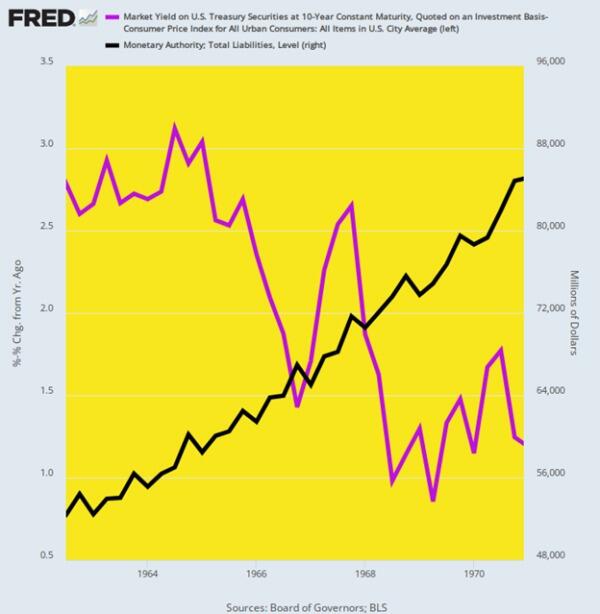
There is no mystery as to why the inflationary genie was now out of the bottle. Between Q3 1962 and Q4 1970, the Fed’s heretofore flat balance sheet (black line) soared skyward, rising from $52 billion to $85 billion over the eight-year period. That amounted to a 6% per year gain, meaning that the precedent for aggressive balance sheet expansion had now been firmly established.
Inflation-Adjusted Yield on 10-Year UST Versus Fed Balance Sheet Growth, 1962 to 1970
The first victim, of course, was inflation-adjusted bond yields (purple line above). As shown above, the healthy +3% real yield of 1962 fell to barely +1% by the end of 1970.
Yet the crucial essence of this “guns and butter” breakdown cannot be gainsaid. To wit, the Fed was not driven to this first round of post-war money-printing and debt monetization because the private economy had gone into a mysterious swoon or failure mode and therefore needed a helping hand from the nation’s central bank.
To the contrary, this was a Washington driven departure from sound central banking pure and simple. And as we will amplify below, it was off to the races of Rogue Central Banking from there.
Once the inflation genie was out of the bottle with the CPI clocking in at 6% by the fall of 1970, the Fed struggled for more than a decade to put it back. Consequently, any focus on stimulating growth, jobs, housing and investment was infrequent and definitely secondary to inflation-fighting.
We amplify the 1970s flood of central bank money and the resulting inflationary mess below, but it is important to note at the onset that despite four recessions (1970, 1975, 1980 and 1981) and very little pro-growth help from what was now an inflation-preoccupied Fed, the US economy did expand at a decent clip during the interval between Q4 1969 and Q2 1987.
The economic growth rate (real final sales basis) averaged a solid +3.1% per annum, but that occurred due to the inherent growth propensities of private capitalism and despite the roadblocks thrown up by periodic bouts of monetary stringency. In fact, three Fed chairman served during that 17.5-year interval—Burns, Miller and Volcker—and with varying degrees of success their focus was overwhelmingly on suppressing inflation, not goosing growth.
As it happened, the growth rates of jobs, productivity and real median family income during this period were not especially outstanding, but these metrics didn’t plunge into an economic black hole, either.
Self-evidently, these outcomes on main street were the work of market capitalism, not the central bank. The latter was leaning hard against inflation during most of the period—so this absence of central bank “help” is just further proof that easy money stimulus is not necessary for solid growth and main street prosperity.
Per Annum Change, Q4 1969 to Q2 1987
Real Final Sales of Domestic Product: +3.1%.
Labor hours employed: +1.5%.
Nonfarm productivity: +1.8%.
Real Median Family Income: +1.2%.
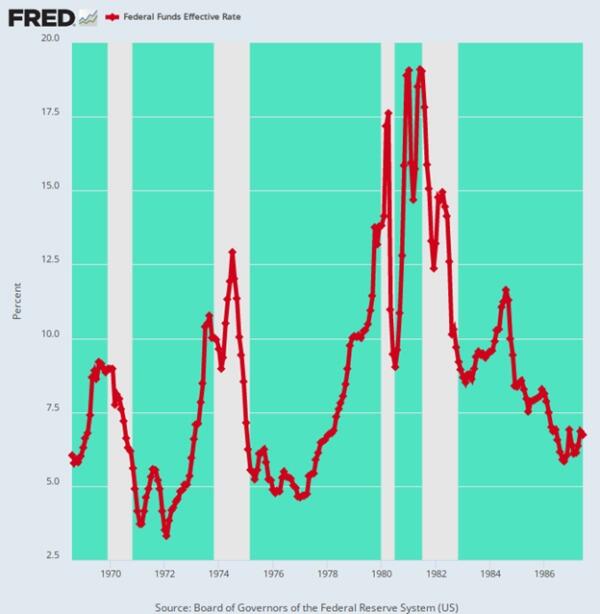
For avoidance of doubt, here is the path of the Federal funds rate as the above macroeconomic performance was unfolding. To wit, the Fed’s recurrent anti-inflation initiatives caused the funds rate to gyrate wildly like some kind of monetary jumping bean. In the run-up to each of the four recessions designated by the shaded areas of the graph, the increase in the Fed funds rate was as follows:
1970: +340 basis points.
1974: +960 basis points.
1980: +1,290 basis points.
1981: +440 basis points.
Needless to say, these successive rate-raising campaigns amounted to hammer blows to the main street economy. There is no way that these violent interest rate swings and the consequent start and stop economic cycles—four recessions in only 17 years— were a tonic for growth during this era of high and volatile inflation.
In effect, the reasonably solid macroeconomic performance quantified above represents a kind of free market minimum. It reflects the relentless drive of workers, consumers, entrepreneurs, businessmen, investors, savers and speculators to better their own economic circumstances—even in the face of inflationary roadblocks and anti-inflation financial manipulation by the central bank.
Federal Funds Rate, August 1968 to June 1987
Of course, the inflationary roadblocks were enormous, and far beyond any prior peacetime experience. Compared to the 1.3% inflation average during 1951 to 1962, the CPI rose at a 5.6% rate over 1969:4 to 1987:2.
And that included the benefit of the sharp drop in inflation engineered by Paul Volcker during the final four years of the period. Thus, during the decade of the 1970s through the Y/Y inflation peak at 14.6% in April 1980, the CPI rose by an average of 7.7% per annum.
In turn, this introduced the wage-earning classes for the first time to the treadmill of robustly rising nominal wage rates, which become almost entirely consumed by sharply rising consumer prices. Thus, during the decade ending in the inflationary peak of Q2 1980, average hourly earnings in nominal terms rose by 7.6% per annum. But, alas, what stuck to the walls of workers’ bank accounts was a gain of only 1.1% per annum during the same period. All the rest was eaten up by inflation.
Y/Y Change in the CPI, 1960 to 1987
If the wage/price treadmill effect introduced after 1969 was the whole story, the impact might be considered minimally tolerable. The resilience of market capitalism was shown to be sufficiently strong so as to overcome much of the inflationary headwinds, along with the Fed’s punishing cycles of anti-inflation tightening.
Unfortunately, however, what also materialized out of the 1970s inflation era were two exceedingly harmful corollaries.
The first was the notion that the job of the central bank was to manage the rate of change in the general price level, rather than the far more modest original remit. The latter presumed the presence of noninflationary gold-backed money—so inflation-management would have been an oxymoron.Consequently, the Fed’s actual statutory mandate was simply to provide liquidity and reserves to the banking system based on market rates of interest. The Fed heads didn’t need to know from the CPI, PCE deflator or any other modern inflation measuring stick that had not yet been invented.
As it happened, however, management of the short run pace by which the general price level is rising was a fateful portal into statist central banking and the plenary management of the macro-economy in which the inflation indices are inextricably embedded. Eventually the bastard son of this strategic opening to vastly expanded state power materialized as the holy grail of 2% inflation.
Yet, here’s the thing. Until the gold-backed dollar was deep-sixed by Nixon in August 1971 and the possibility of rising, persistent and eventually double-digit peacetime inflation materialized in the 1970s, the idea of central bank management of the inflation rate didn’t even exist. That’s because peacetime price stability was the default condition of the gold standard world. Indeed, from the Napoleonic Wars forward, “inflation” and wartime were pretty much synonymous because fiat money was almost invariably a temporary wartime expedient.
The other legacy of the inflationary 1970s was the breakout of high and ever rising unit labor costs in the US economy. This unnecessary but pervasive economic deformation eventually resulted in the massive offshoring of the US industrial economy.
The implication, of course, is that it would have been far better to stick with William McChesney Martin’s golden era of high growth, low inflation, a flat Federal Reserve balance sheet and interest rates driven overwhelmingly by supply and demand forces in the private financial markets. But as it happened, the Fed’s balance sheet during the decade of high inflation was the very opposite of flat.
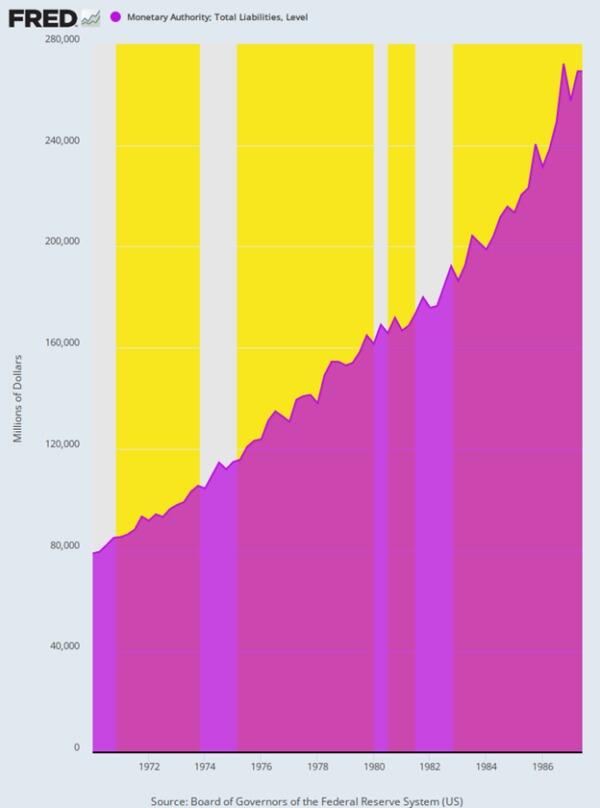
Under the three successive Chairmen, the Fed’s balance sheet grew at the following compound annual rates:
Arthur Burns (Feb. 1970 to March 1978): +6.9%.
William Miller (March 1978 to August 1979): +9.5%.
Paul Volcker (August 1979 to August 1987): +6.8%.
Growth Lift-off of Federal Reserve Balance Sheet, Q1 1970 to Q2 1987
In a word, Volcker sharply slowed the runaway growth of the Fed’s balance sheet which had occurred under the regime of William Miller – the hapless former CEO of a conglomerate which made golf carts, snowmobiles and Cessna aircraft. But when all was said and done, the Volcker Fed still pumped new money into the economy at a rate barely below that of Arthur Burns. And Burns, of course, was the villain central banker who had ignominiously succumbed to Nixon’s entreaties to “give me money, Arthur” in support of his re-election campaign in 1972.
The amount of money the US government spends on foreign aid, wars, the so-called intelligence community, and other aspects of foreign policy is enormous and ever-growing. It’s an established trend in motion that is accelerating, and now approaching a breaking point. It could cause the most significant disaster since the 1930s. Most people won’t be prepared for what’s coming. That’s precisely why bestselling author Doug Casey and his team just released an urgent video with all the details.
Lest we forget, M2 Money printing exploded with Covid and kept increasing under Biden’s Reign of (Economic) Error.
This isn’t the Sahm’s Club that is good fpr consumers. This is the club which crushes consumers. Better to be called Joe’s Club after our demented President Joe Biden.
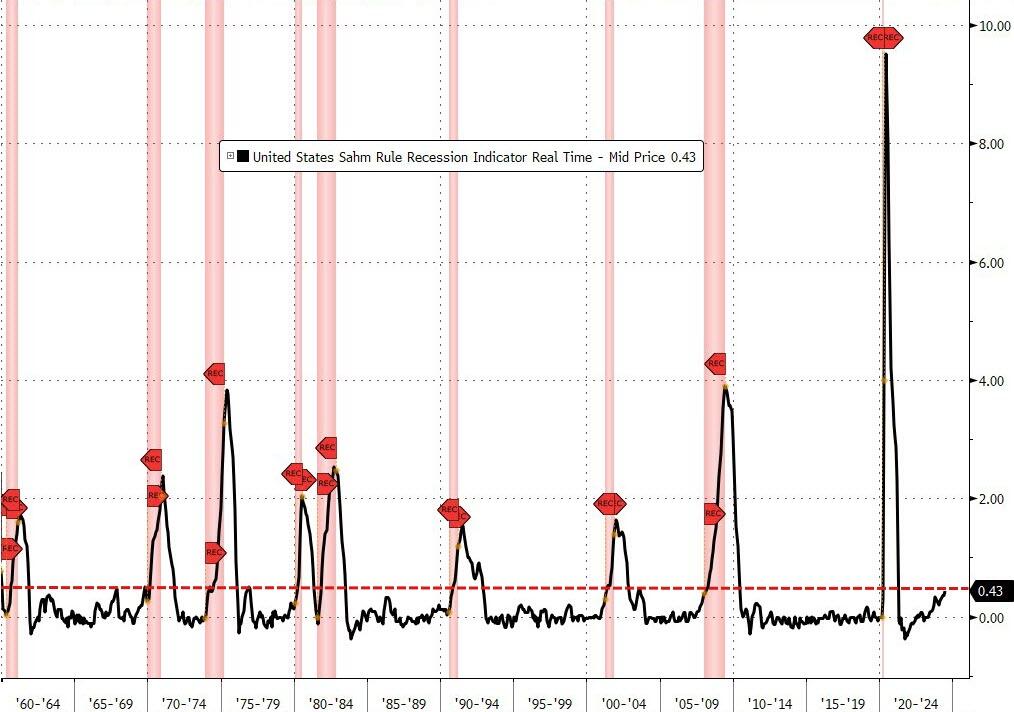
This uptick triggers the Sahm Rule, a real-time recession indicator, suggesting that the US economy is in, or is nearing, a recession. The Sahm Rule, developed by former Fed economist Claudia Sahm, is designed to identify the start of a recession using changes in the total unemployment rate.
According to the rule, a recession is underway if the three-month moving average of the national unemployment rate rises by 0.50 percentage points or more, relative to its low during the previous 12 months. With the June 2024 U-3 rate of 4.1 percent, the average of the last three months being 4.0 and the lowest 12-month rate of 3.5 percent in July 2023, this criterion has been met.
Sahm Rule indications (1960 – 2024)
Source: Bloomberg
Surveys had forecast the U-3 rate to hold steady at 4.0 percent in June, unchanged from May 2024. The seemingly small 0.1 percent uptick, however, carries substantial implications for the broader economy. One possible confounding effect of the signal is growth in the labor force: If the labor force grows rapidly and the economy does not generate enough jobs to match the increase, the unemployment rate might rise and the Sahm Rule may be triggered, even if overall employment is increasing.
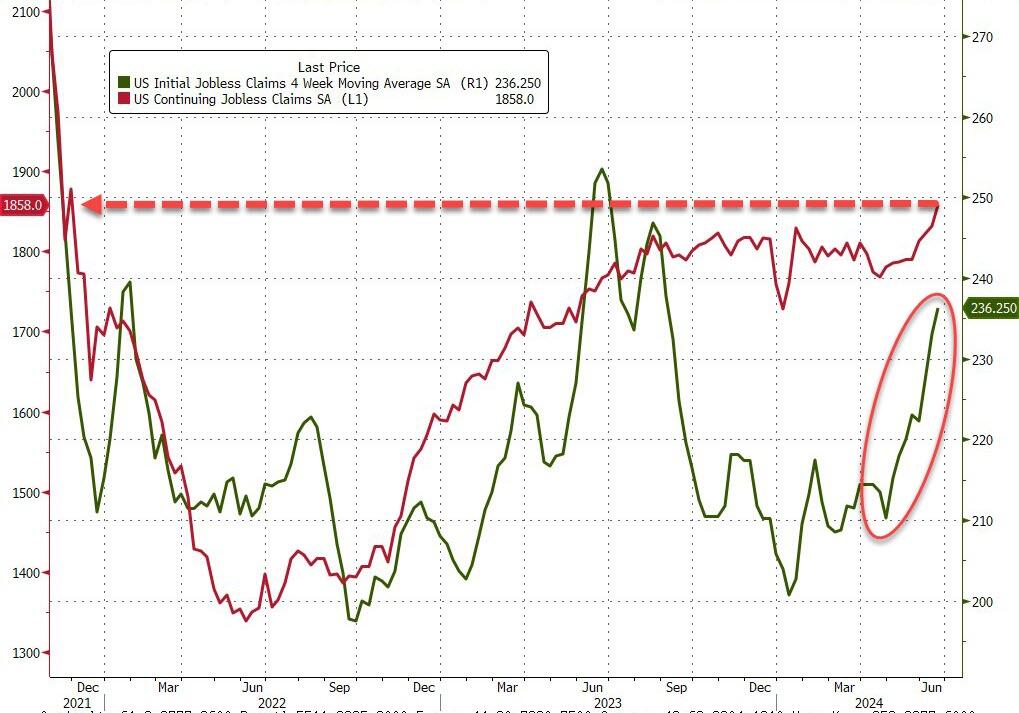
The rise of initial claims over the past few weeks, and nine consecutive increases in continuing claims, support the June 2024 Sahm indication.
Source: Bloomberg
Equity futures were flat just after the release, while Treasuries rallied across all maturities.
In recent months, Fed Chairman Jerome Powell has indicated that “unexpected weakness” may prompt a start to an accommodative policy stance without the additional data sought regarding the pace of disinflation. Historically, an increase in unemployment rates and the onset of a recession have led to policy adjustments aimed at stimulating economic growth and mitigating job losses, and the reversal of the rate hikes which began in 2022 to mitigate the highest inflation in four decades has been widely anticipated.
While more data will be required to confirm the Sahm Rule indication, the impact of accelerating prices, interest rates at their highest levels since 2007, and commercially suppressive pandemic policies have probably caught up with US producers and consumers.
Biden’s version of Sahm’s Club. Where the economy tanks and all he and his wife Jill care about is staying in Power. Perhaps we should call the sagging US economy “Joe’s Club.”

















 Confounded Interest - Anthony B. Sanders


You must be logged in to post a comment.