Hallelujah! Mortgage Demand Increased 4.8% From Previous Week (Purchase Demand Increased 32%, Refi Demand Increased 14%)

Hallelujah, I love this economy so! Of course, former First Lady Jill Biden is on the national tour trashing the economy saying it was “perfect” under Joe Biden.

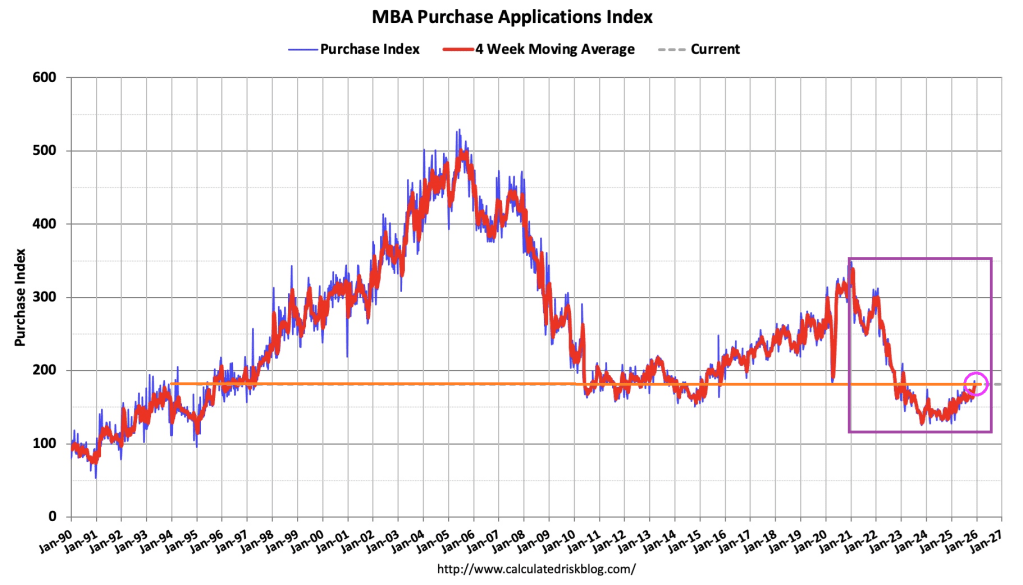
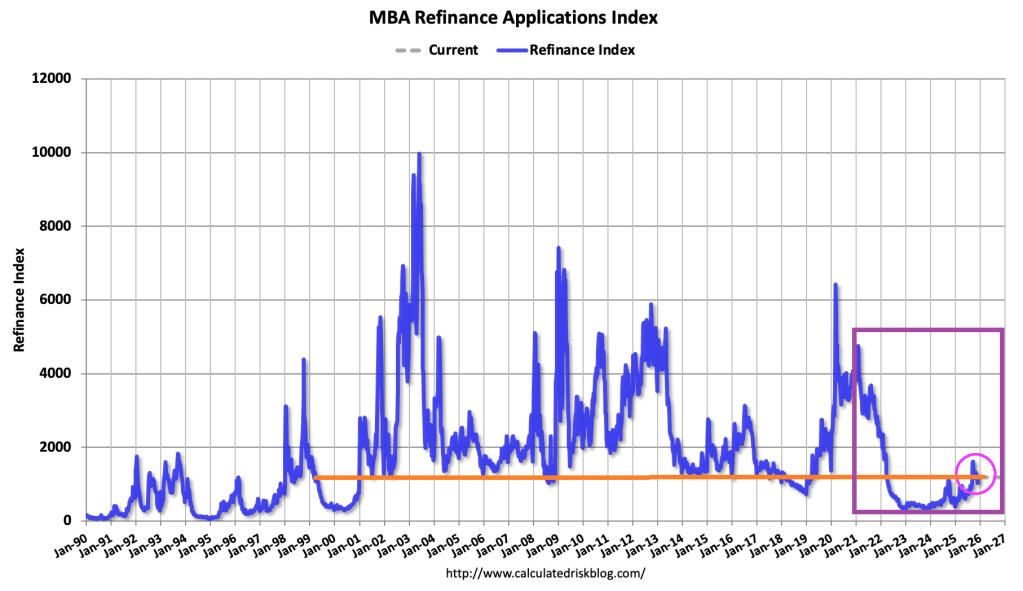
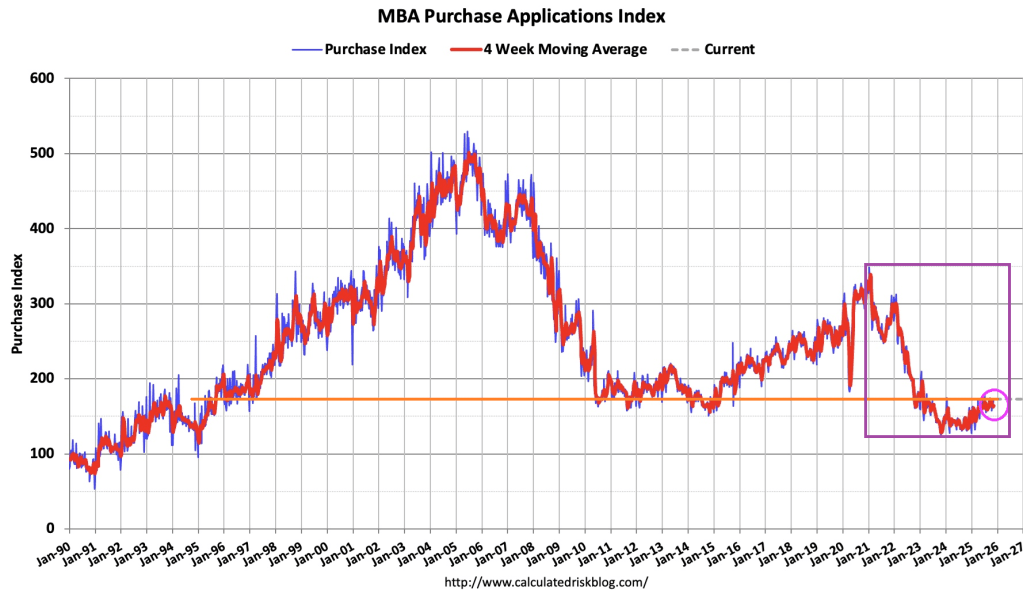
Mortgage applications increased 4.8 percent from one week earlier, according to data from the Mortgage Bankers Association’s (MBA) Weekly Mortgage Applications Survey for the week ending December 5, 2025. Last week’s results included an adjustment for the Thanksgiving holiday.

The Market Composite Index, a measure of mortgage loan application volume, increased 4.8 percent on a seasonally adjusted basis from one week earlier. On an unadjusted basis, the Index increased 49 percent compared with the previous week. The seasonally adjusted Purchase Index decreased 2 percent from one week earlier. The unadjusted Purchase Index increased 32 percent compared with the previous week and was 19 percent higher than the same week one year ago.

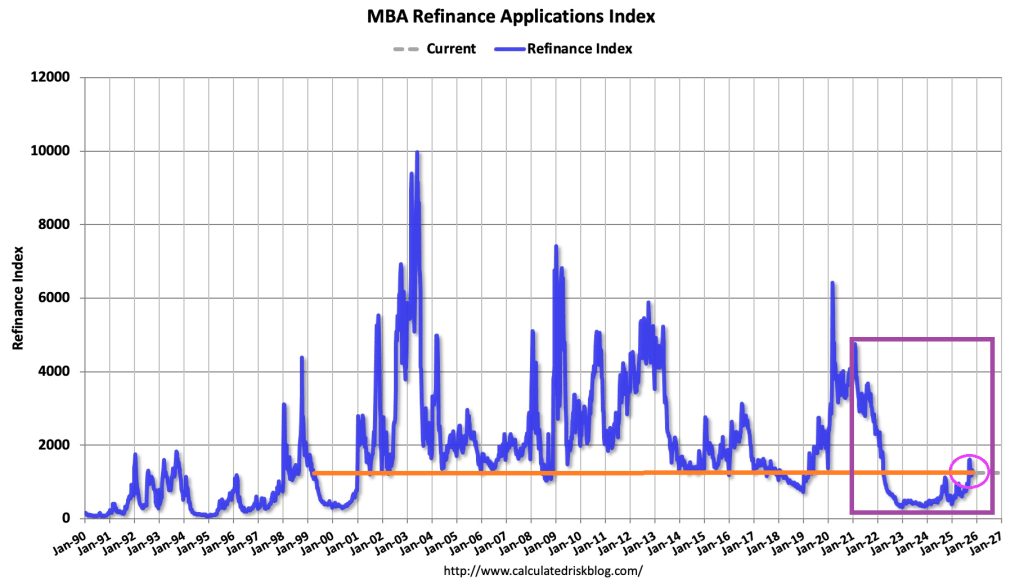
The Refinance Index increased 14 percent from the previous week and was 88 percent higher than the same week one year ago.

Compared to the prior week’s data, which included an adjustment for the Thanksgiving holiday, mortgage application activity increased last week, driven by an uptick in refinance applications,” said Joel Kan, MBA’s Vice President and Deputy Chief Economist. “Conventional refinance applications were up almost 8 percent and government refinances were up 24 percent as the FHA rate dipped to its lowest level since September 2024. Conventional purchase applications were down for the week, but there was a 5 percent increase in FHA purchase applications as prospective homebuyers continue to seek lower downpayment loans. Overall purchase applications continued to run ahead of 2024’s pace as broader housing inventory and affordability conditions improve gradually.

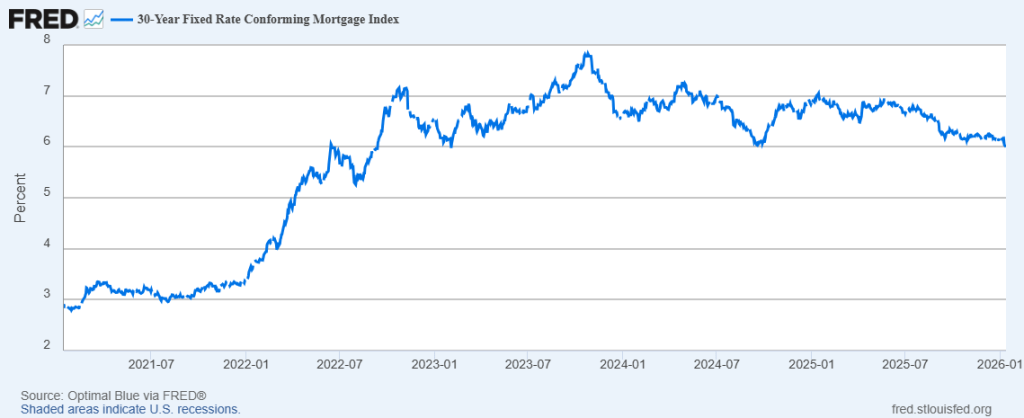
The average contract interest rate for 30-year fixed-rate mortgages with conforming loan balances ($806,500 or less) increased to 6.33 percent from 6.32 percent, with points increasing to 0.60 from 0.58 (including the origination fee) for 80 percent loan-to-value ratio (LTV) loans.

US Purchase Mortgage Demand Increased 3% From Previous Week (Pulte’s 50Y And Layaway Mortgages??)

The US mortgage market is “livin’ on a prayer.” As a result, former homebuilder and current FHFA Director Bill Pulter has suggested 2 mortgage products to make US homes more “affordable”, adding to the legacy of stupid government policies to increase homeownership.

But first, current mortgage demand. Mortgage applications increased 0.6 percent from one week earlier, according to data from the Mortgage Bankers Association’s (MBA) Weekly Mortgage Applications Survey for the week ending November 7, 2025.

The Market Composite Index, a measure of mortgage loan application volume, increased 0.6 percent on a seasonally adjusted basis from one week earlier. On an unadjusted basis, the Index decreased 1 percent compared with the previous week.  The seasonally adjusted Purchase Index increased 6 percent from one week earlier. The unadjusted Purchase Index increased 3 percent compared with the previous week and was 31 percent higher than the same week one year ago.

The Refinance Index decreased 3 percent from the previous week and was 147 percent higher than the same week one year ago.

Now on to Pulte’s stupid mortgage proposals.

Pulte Doubles Down After 50-Year Backlash, Proposes “Layaway Mortgage” 

The 50-year mortgage is a stupid idea. True, it can reduce the monthly mortgage payment by several hundred dollars. But it extends the life of the mortgage from 30 to 50 years, keeping the outstanding mortgage balance elevated for longer, exposing the lender (or mortgage owner) to greater losses in the case of default. Not surprising since the duration risk of a 50-year mortgage is greater than on a 30-year mortgage. Who is going to hold these mortgages??

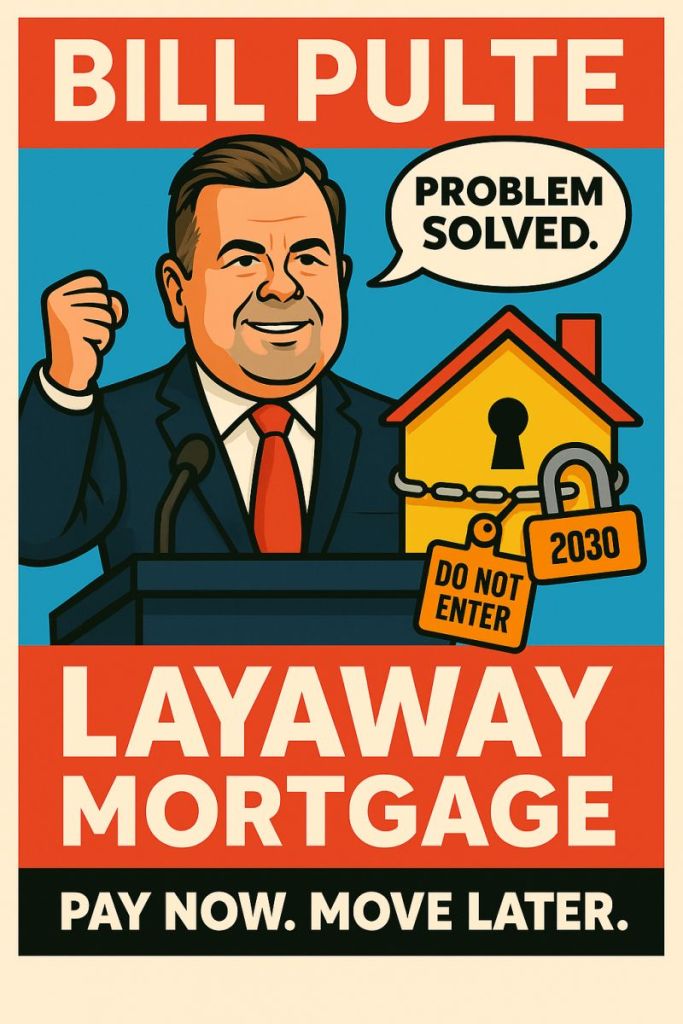
So, Pulte hearing that the mortgage market thinks this is a stupid idea, introduced another stupid mortgage idea: the “layaway mortgage” where buyers make payments for 5-10 years before they’re allowed to move into the home. This is a variation of “rent to own.”

Under Pulte’s Layaway Mortgage program:

▪️ Buyers select a home and begin making monthly payments immediately
▪️ They continue paying for 5-10 years (the “layaway period”)
▪️ During this time, they cannot live in the home, modify it, or even visit without an appointment
▪️ After the layaway period ends, buyers can move in and begin their 40-year mortgage
▪️ If they miss a payment during layaway, they forfeit everything and the home goes back on the market.

So, in other word, a 50-year mortgage (40+10 layaway).

Note: Japan used to offer 100-year mortgages during their housing bubble, but now 35-year mortgages are more common.

Hello Hello! March US Consumer Prices Fall Most In 5 Years (Rent Inflation Back To Pre-Biden Levels)

Hello Hello pre-Biden inflation levels!

The normally crucial consumer price index measure of inflation printing today for March is likely to take a back seat to the next red flashing headline on tariffs on everyone’s Bloomberg terminal, but under the hood – with the Trump Put now exposed – can a cooler than expected CPI print raise the Powell Put strike enough to enable a true tradable bottom here?

Having dipped lower in the previous month (following a few straight months of re-acceleration), expectations were for both headline and core measures to continue trending lower on a YoY basis… and they were.

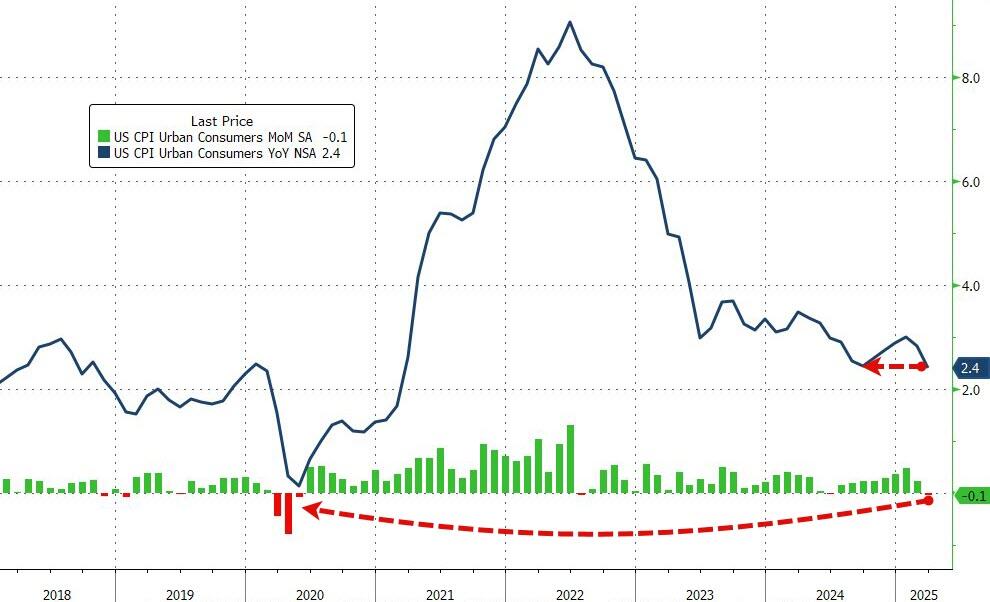
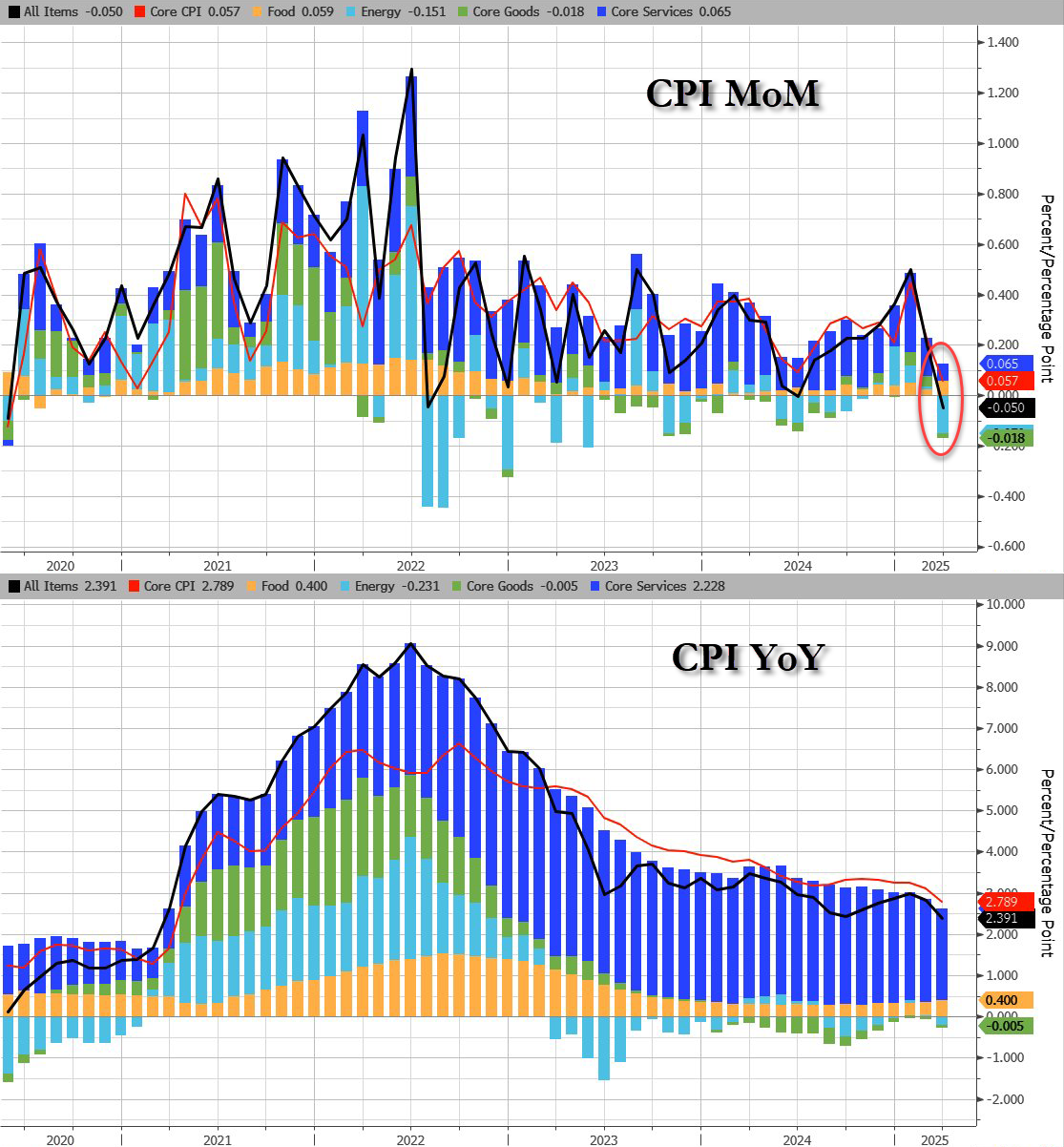
Headline CPI FELL 0.1% MoM (vs +0.1% exp), which dragged the YoY CPI to +2.4%, matching the September lows…

Source: Bloomberg

That is the weakest MoM print since May 2020.

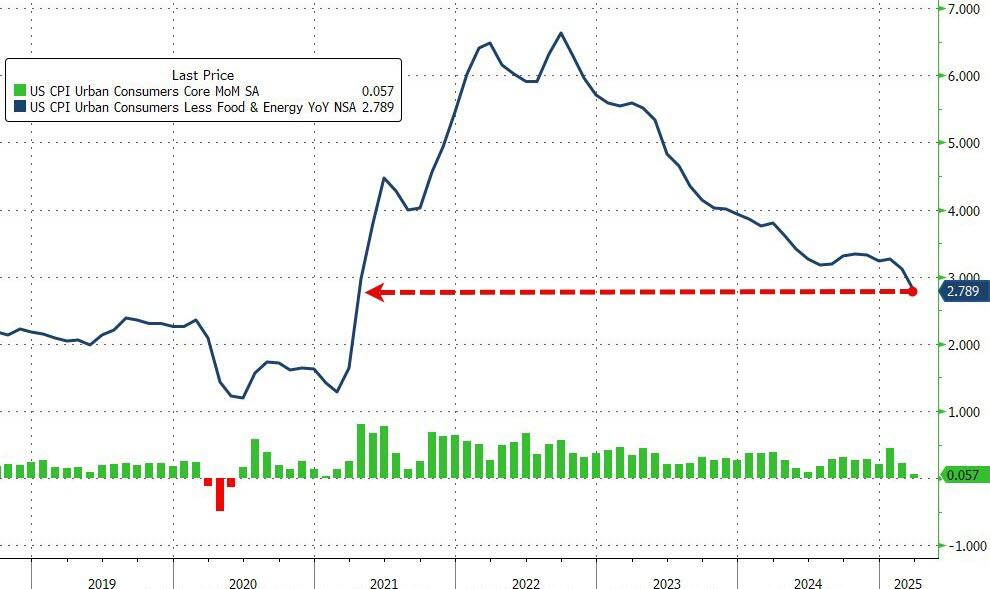
Core CPI also printed cooler than expected (+0.1% MoM vs +0.3% MoM exp), pulling the YoY print down t0 +2.8% YoY – the lowest since March 2021

Source: Bloomberg

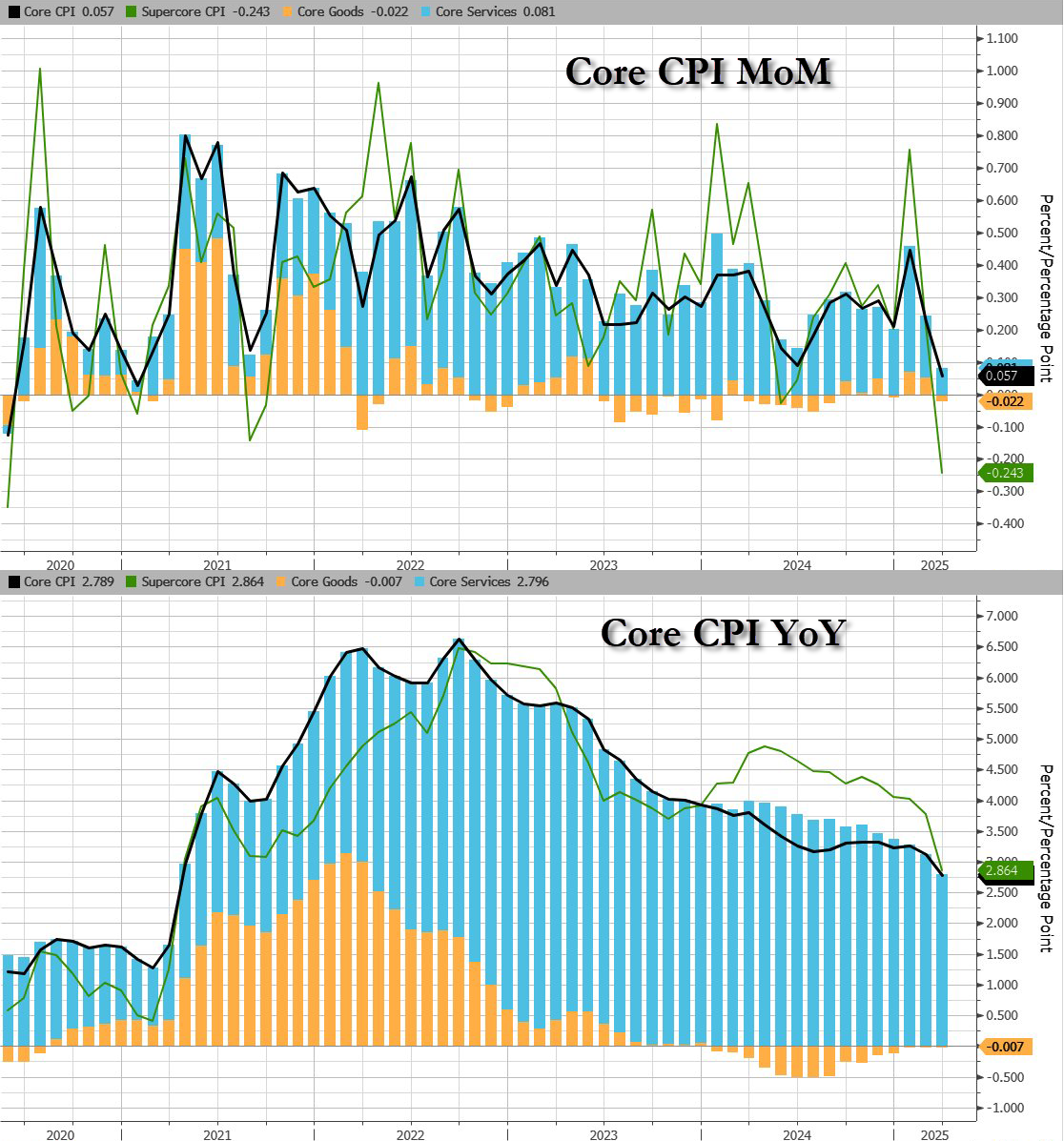
Services inflation tumbled…

Source: Bloomberg

CPI breakdown:

Headline:

  • CPI decreased 0.1% after rising 0.2% in February, and below the +0.1% estimate. Over the last 12 months, CPI rose 2.4%, below the 2.5% estimate.
  • Energy CPI fell 2.4% in March, as a 6.3% decline in the index for gasoline more than offset increases in the indexes for electricity and natural gas.
  • Food CPI rose 0.4% in March as the food at home index increased 0.5% and the food away from home index rose 0.4 percent over the month.

Core CPI:

  • The index for all items less food and energy rose 0.1% in March, following a 0.2% increase in February.
    • Indexes that increased over the month include personal care, medical care, education, apparel, and new vehicles.
    • The indexes for airline fares, motor vehicle insurance, used cars and trucks, and recreation were among the major indexes that decreased in March.

Core CPI details (MoM increase):

  • The shelter index increased 0.2% over the month.
    • The index for owners’ equivalent rent rose 0.% in March and the index for rent increased 0.3%.
    • The lodging away from home index fell 3.5 percent in March.
  • The personal care index rose 1.0%in March.
  • The index for education rose 0.4% over the month, as did the index for apparel.
  • The new vehicles index also increased over the month, rising 0.1%.
  • The index for airline fares fell 5.3% in March, after declining 4.0% in February.
  • The indexes for motor vehicle insurance, used cars and trucks, and recreation also fell over the month.
  • The household furnishings and operations index was unchanged in March.
  • The medical care index increased 0.2% over the month.
  • The index for hospital services increased 1.1% in March and the index for physicians’ services rose 0.3% over the month. In contrast, the prescription drugs index fell 2.0% in March.

Core CPI details (YoY increase):

  • The index for all items less food and energy rose 2.8 percent over the past 12 months.
  • The shelter index increased 4.0 percent over the last year, the smallest 12-month increase since November 2021.
  • Other indexes with notable increases over the last year include motor vehicle insurance (+7.5 percent), medical care (+2.6 percent), recreation (+1.9 percent), and education (+3.9 percent).

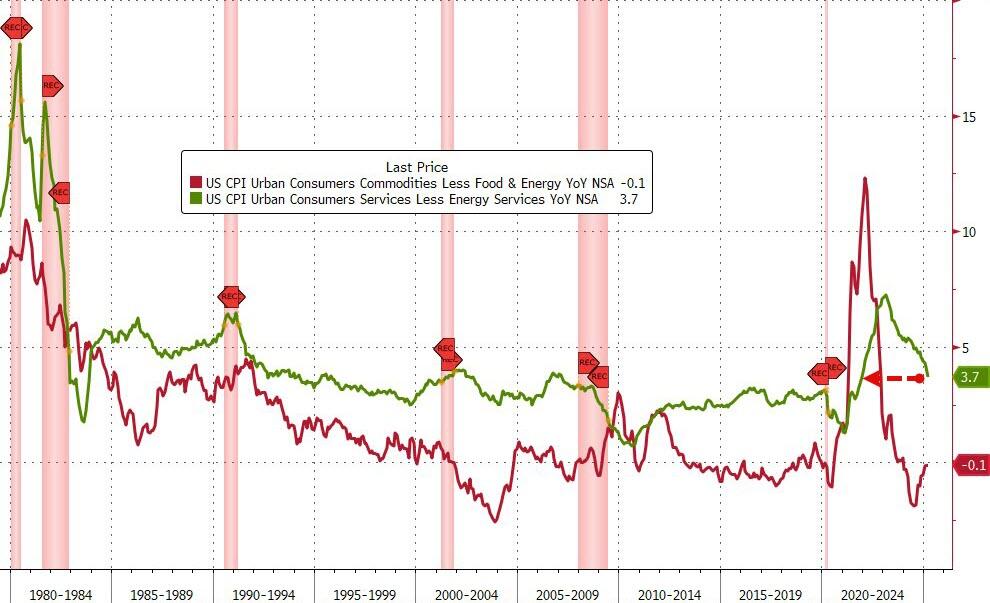
While goods inflation is flat (zero-ish), services cost inflation is fading fast…

Source: Bloomberg

Shelter and Rent inflation is slowing fast:

  • Shelter inflation +0.3% MoM, +3.99% YoY, down from 4.25% in February (lowest since Nov 2021)
  • Rent inflation +0.3% MoM, +3.99% YoY, down from 4.09% in February (lowest since Jan 2022)

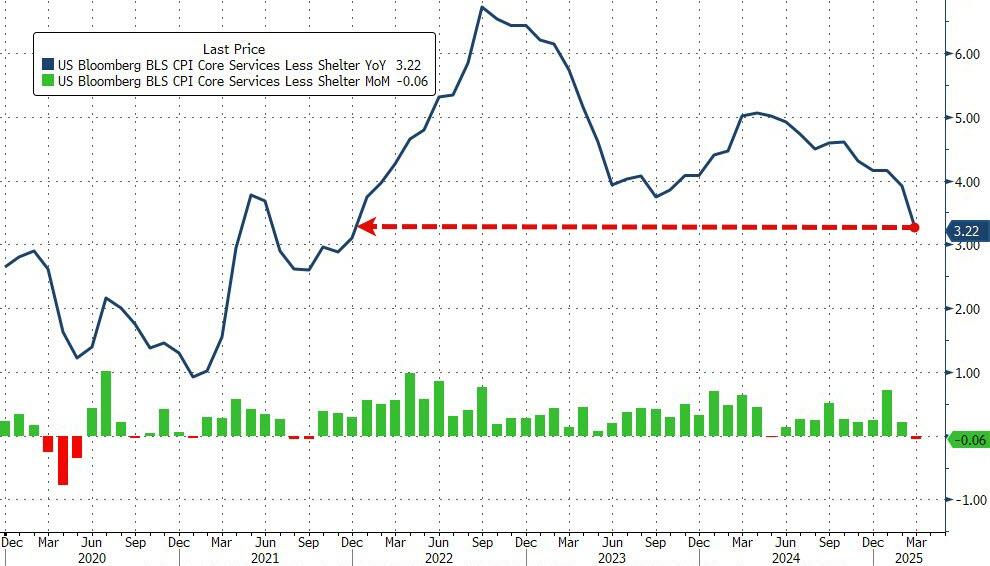
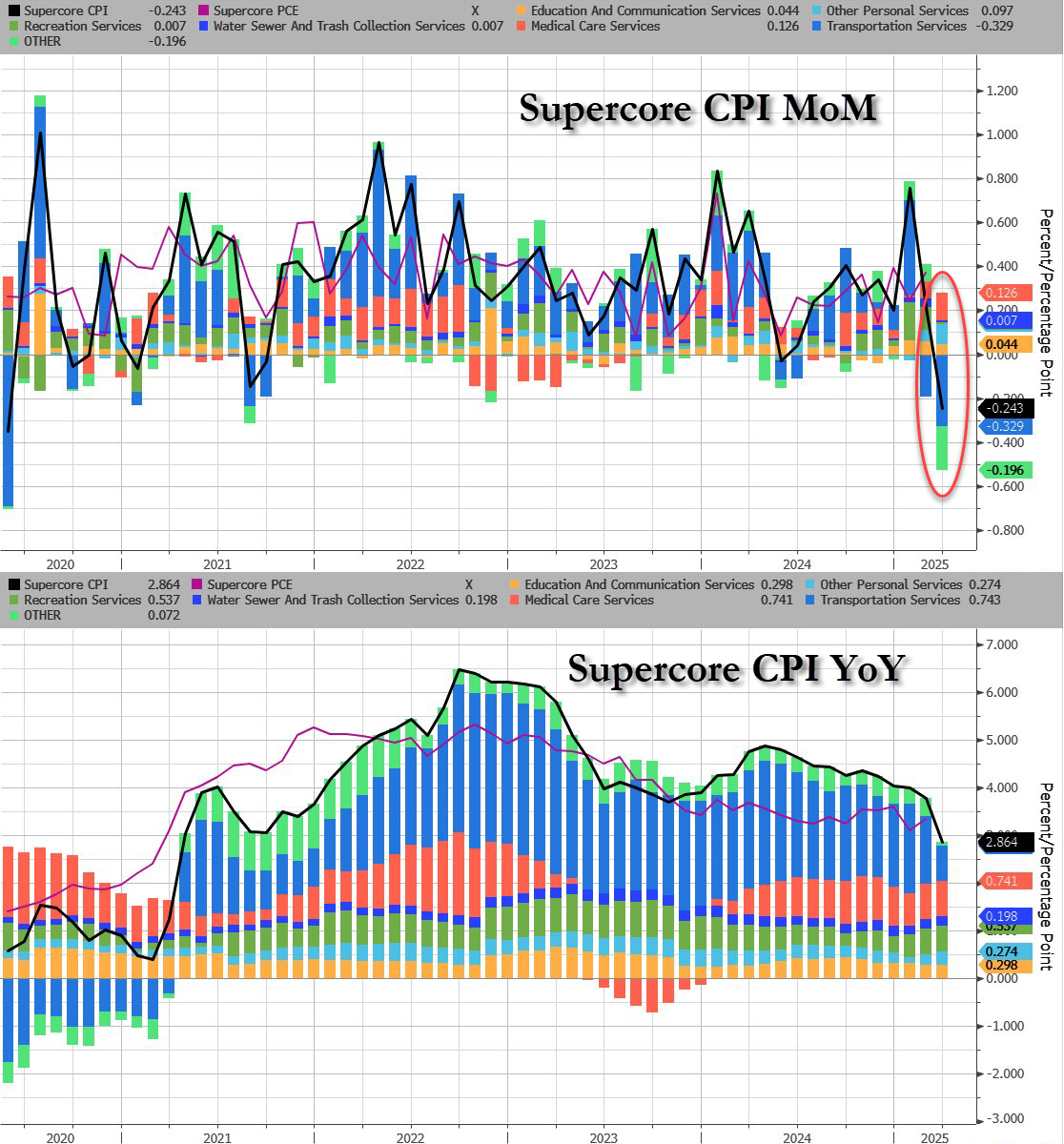
The so-called SuperCore CPI – Services Ex-Shelter – dropped 0.1% MoM dragging it down to +3.22% YoY – the lowest since Dec 2021…

Source: Bloomberg

Source: Bloomberg

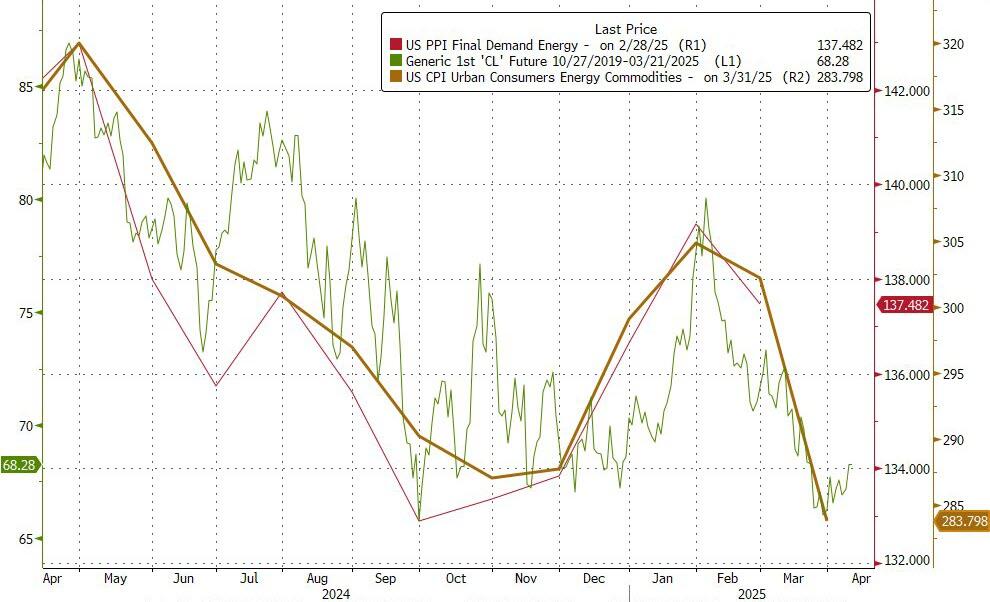
Drill Baby Drill (and tariffs recession fears) have dragged energy prices lower and pulled CPI lower with it…

Source: Bloomberg

The Urgent Need For D.O.G.E.! $4.7 Trillion In Virtually Untraceable Treasury Payments

Janet Yelllen, the former Federal Reserve Chair and Treasury Secretary under clueless Joe Biden was a disaster in every respect. As Fed Chair, she was noteworthy for her clinging to low rates for too long. And as Treasury Secretary, she is noteworthy for her gross fiscal mismanagement (look at the deficit and debt crisis!). Now Zero Hedge has this disastrous report of $4.7 TRILLION in virtuallly untraceable Treasury payments.

The Elon Musk-led Department of Government Efficiency (DOGE) on Monday revealed its finding that $4.7 trillion in disbursements by the US Treasury are “almost impossible” to trace, thanks to a rampant disregard for the basic accounting practice of using of tracking codes when dishing out money. 

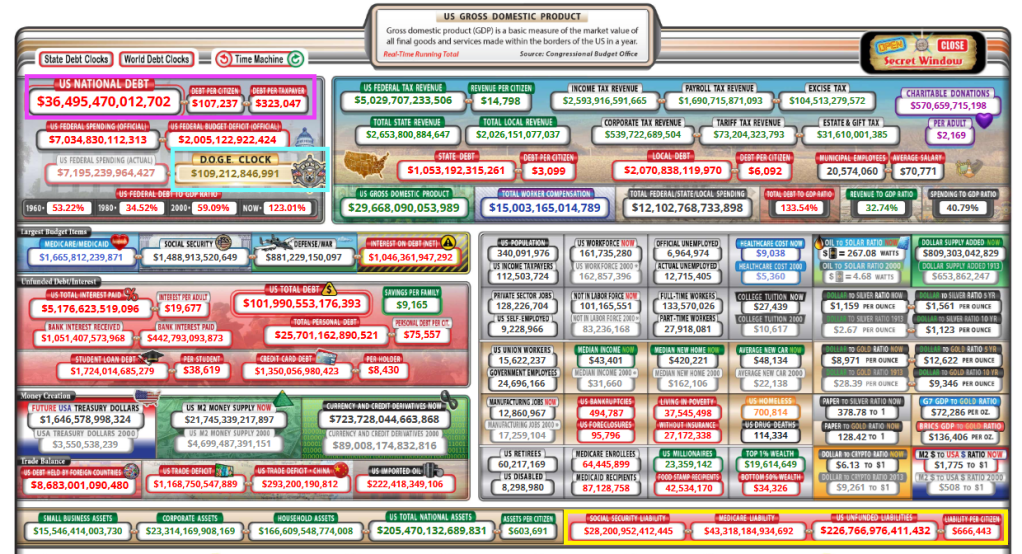
With a debt load of $36.5 trillion and D.O.G.E. clock at $109 million and growing. Not to mention the $227 trillion in unfunded liabilities.

Mind you, it’s not as if such a federal tracking system wasn’t already in place — it simply went casually unused for all sorts of payouts adding up to an almost unfathomable $4.7 trillion. Without Treasury Access Symbol (TAS) identification codes associated with those payouts, there’s little hope in figuring out where all that money went. 

“In the Federal Government, the TAS field was optional for ~$4.7 Trillion in payments and was often left blank, making traceability almost impossible,” DOGE announced via its X account. Thanks to DOGE, those “optional” days are over. “As of Saturday, this is now a required field, increasing insight into where money is actually going,” DOGE added. 

Musk celebrated the move. “Major improvement in Treasury payment integrity going live!” he tweeted. “This was a combined effort of DOGE, USTreasury and FederalReserve. Nice work by all.”

DOGE’s scrutiny of various government agencies is eliciting high-pitched shrieks from nearly every leftist in America, from establishment politicians who don’t want the curtain that hides their hijinks and grifting torn down, to your liberal sister-in-law who thinks the government has an endless supply of money and that it spends it all virtuously.  

Earlier this month, Treasury Secretary Scott Bessent pushed back on portrayals of DOGE employees as reckless rogues. “These are highly trained professionals,” he told Bloomberg“This is not some roving band going around doing things. This is methodical and it is going to yield big savings.”

In the wake of the latest revelation that makes normal people glad that DOGE teams are scouring the federal government, Democrats desperately tried to find a way to make it sound bad that DOGE exposed trillions in untraceable payouts and promptly instituted tighter accounting discipline. 

Meanwhile, leftists have also been foaming at the mouth over news that DOGE staffers are looking into the Social Security Administration’s (SSA) books, as if they were going to start rerouting funds to Tesla. Considering Social Security is careening toward mandatory benefit cuts as soon as 2033, everyone should welcome a team of financial professionals making sure the system isn’t being drained by improper payments

Of course, that appears to be exactly what’s been happening. On Sunday night, Musk said DOGE might be on the trail of “the biggest fraud in history,” as SSA data appears to show that 20.789 million Americans over the age of 100 are collecting Social Security retirement benefits. That includes 12 million who are purportedly over 120 years old

Bent on derailing DOGE, Democrats have sued to prevent the organization from accessing federal data associated with the Office of Personnel Management, and the Health and Human Services, Education, Energy, Transportation, Labor and Commerce departments. On Monday, the federal judge handling the request for a restraining order expressed skepticism over Democrats’ challenge, noting that their “evidence” was largely media speculation about potential harms springing from DOGE’s activities: “The courts can’t act based on media reports. We can’t do that.

A ruling is expected Tuesday. Here’s looking forward to DOGE proceeding to uncover a relentless string of scandals for months and months to come. 

Is The Mortgage Market Back?Mortgage Refinance Applications Increased in Weekly Survey (+10 Percent) While Purchase Applications Increased (+4 Percent)

The mortgage market is back in town!

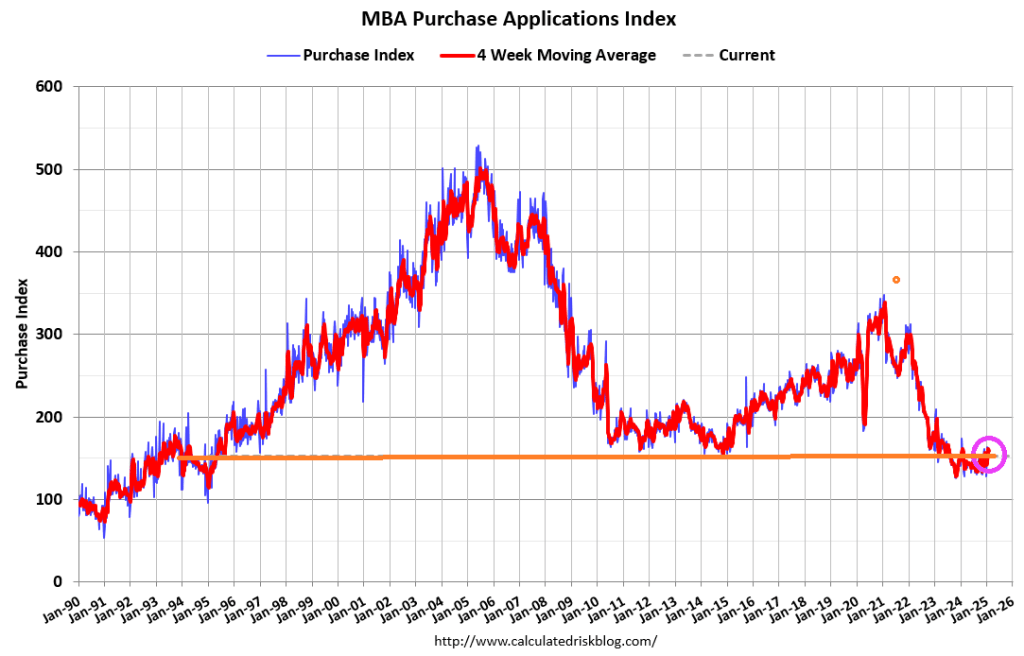
Mortgage applications increased 2.3 percent from one week earlier, according to data from the Mortgage Bankers Association’s (MBA) Weekly Mortgage Applications Survey for the week ending February 7, 2025.

The Market Composite Index, a measure of mortgage loan application volume, increased 2.3 percent on a seasonally adjusted basis from one week earlier. On an unadjusted basis, the Index increased 6 percent compared with the previous week. The unadjusted Purchase Index increased 4 percent compared with the previous week and was 2 percent higher than the same week one year ago. The seasonally adjusted Purchase Index decreased 2 percent from one week earlier.

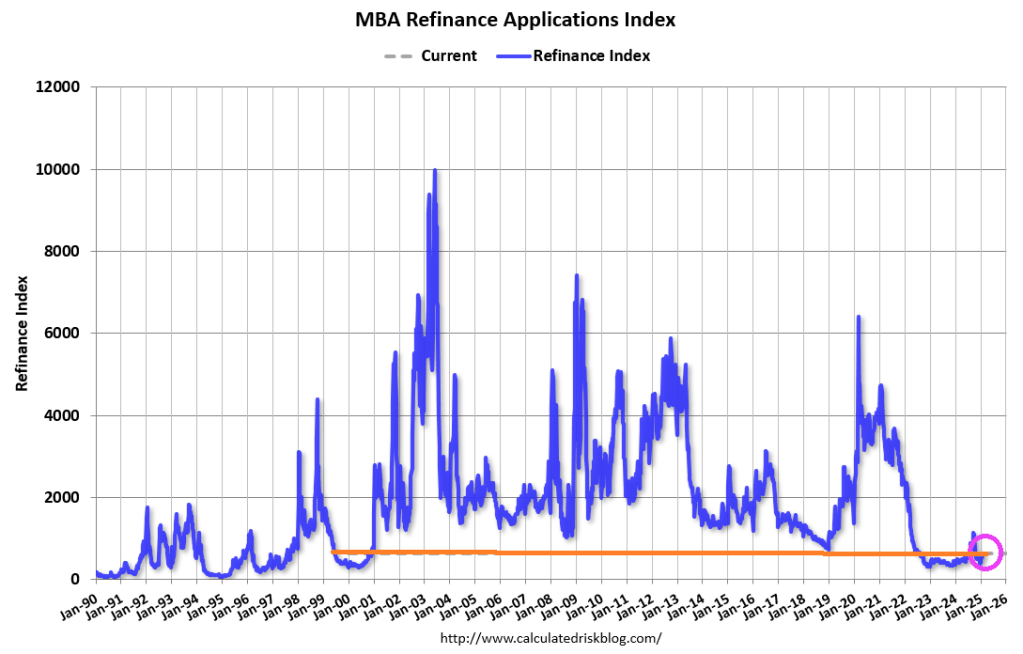
The Refinance Index increased 10 percent from the previous week and was 33 percent higher than the same week one year ago

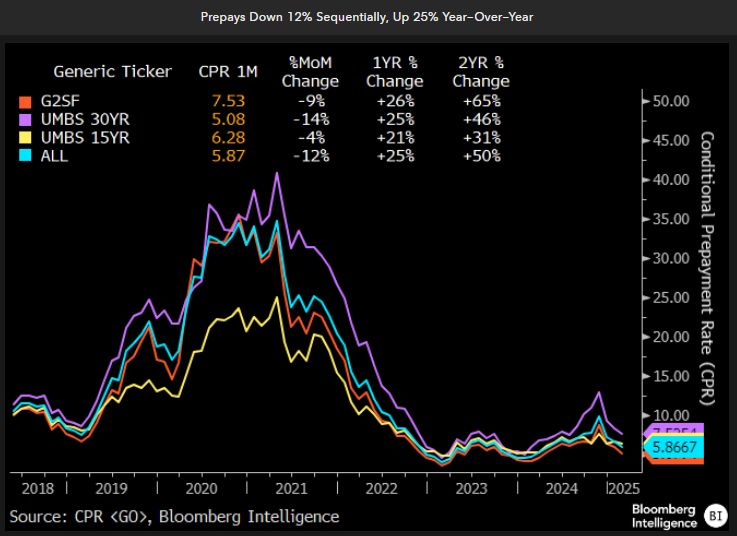
Prepays are down significantly since 2021 which marks the beginning of The Fed starting to raise rates.

Aggregate prepayments for agency mortgage-backed securities (MBS) fell 12% in January, with housing seasonals declining and mortgage rates lingering near 7%. MBS turnover speeds have bounced back considerably relative to 2023 lows, though high rates may be starting to take a toll. Even at current elevated rates, GNMA streamline refinancings are picking up as loans issued in spring of 2024 pass out of the refi lockout period.

Why Doge? Federal Deficit Is Up $306 Billion Compared to Same Period Last Year (Long-run Deficits Are Grim!)

When the (fiscal) music’s over. For corrupt politicians, that is!

Mike Shedlock (aka, Mish) had a great article on the fiscal dumpster fire facing the Trump Administration. After you get a load of the long-run deficits and debt load, you can understand why Trump wants to cut Federal waste (Doge).

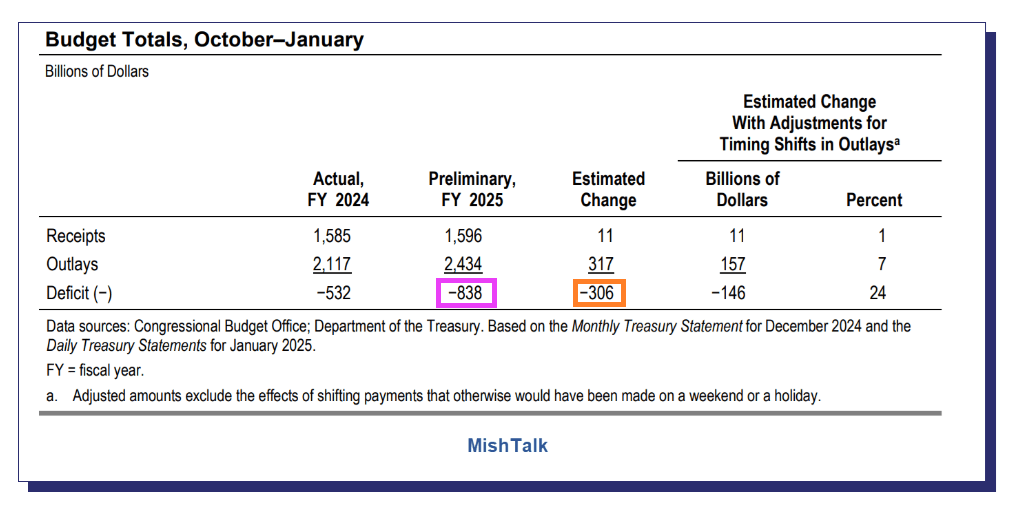
The US deficit for the first four months of fiscal Year 2025 is $838 billion, up $306 billion. Adjusted, the increase is more like $157 billion to $225 billion.

The federal budget deficit totaled $838 billion in the first four months of fiscal year 2025, the Congressional Budget Office estimates. That amount is $306 billion more than the deficit recorded during the same period last fiscal year. Revenues were $11 billion (or 1 percent) higher, and outlays were $317 billion (or 15 percent) higher.

The change in the deficit was influenced by the timing of outlays and revenues, which decreased the deficit during the first four months of fiscal year 2024 but increased it during the same period this fiscal year. Outlays in October 2023 were reduced by shifts in the timing of payments that were due on October 1, 2023, a Sunday. (The payments were made that September.) Outlays in the first four months of 2025 rose, on net, because payments due on February 1, 2025, a Saturday, were made in January. If not for those shifts, the deficit so far this fiscal year would have been $750 billion, or $146 billion more than the shortfall at this point last year. Part of the deficit increase in 2025 also arises from the postponement of some tax deadlines from 2023 to 2024 (described below), which boosted receipts in 2024.

The long-run deficits are grim, according to the CBO.

Outlays in the first four months of fiscal year 2025 were $2.4 trillion, CBO estimates, $317 billion more than during the same period last year. If not for the timing shifts discussed above, outlays so far in fiscal year 2025 would have been $157 billion (or 7 percent) greater than outlays during the same four months in fiscal year 2024. The discussion below reflects adjustments to exclude the effects of those timing shifts.

Maxine Waters is an unhappy girl along with most Democrats about Trump and Musk looking into USAID.

Welcome to a new world under Trump.

Bummer! January Jobs Growth Below Estimates Amid Massive Revisions, Job Gains At +143k (New Sheriff In Town!)

Biden is out and so are the crazy job preferences of his administration (e.g., green energy). There is a new sheriff in town (Donald Trump).

Here’s what the BLS reported in Trump’s first official jobs report since he returned to the White House: total payrolls printed at 143K.

down sharply from an upward revised 307K (256K originally) and missing estimates of 175K.

Looking further back, the change in total nonfarm payroll employment for November was revised up by 49,000, from +212,000 to +261,000, and when adding the +51,000 revision to December employment in November and December combined is 100,000 higher than previously reported

But while the sequential change in the Establishment survey was notable, what was far more remarkable was the Household survey where we saw massive population related revisions (discussed last night), which pushed the civilian labor force higher by 2.2 million to 170.744 million, while the number of employed workers also increased by over 2.2 million to 163.895 million. As a result, the Household survey has finally caught up to Establishment survey.

Where the jobs are.

Revisions?

The Presidential portrait of Joe Biden.

The Green Slime Effect! House Price Index Up 3.8% YoY In November As Fed Funds Rates Remain High (Fed Balance Sheet Remains Elevated)

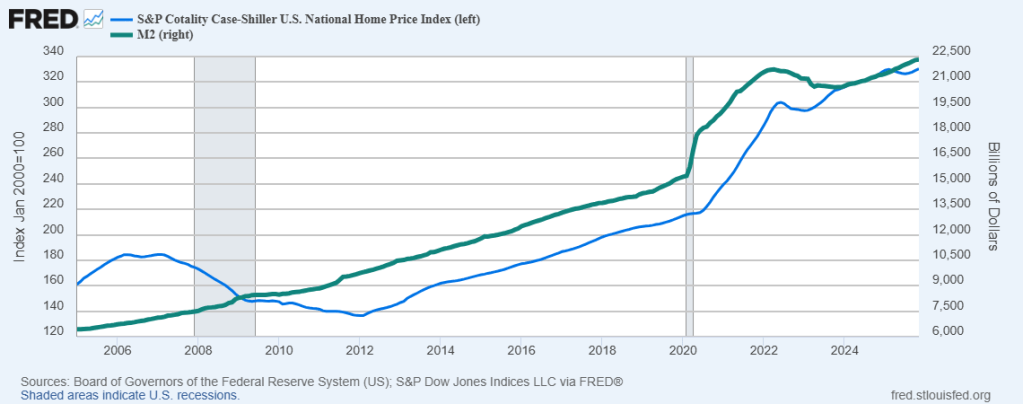
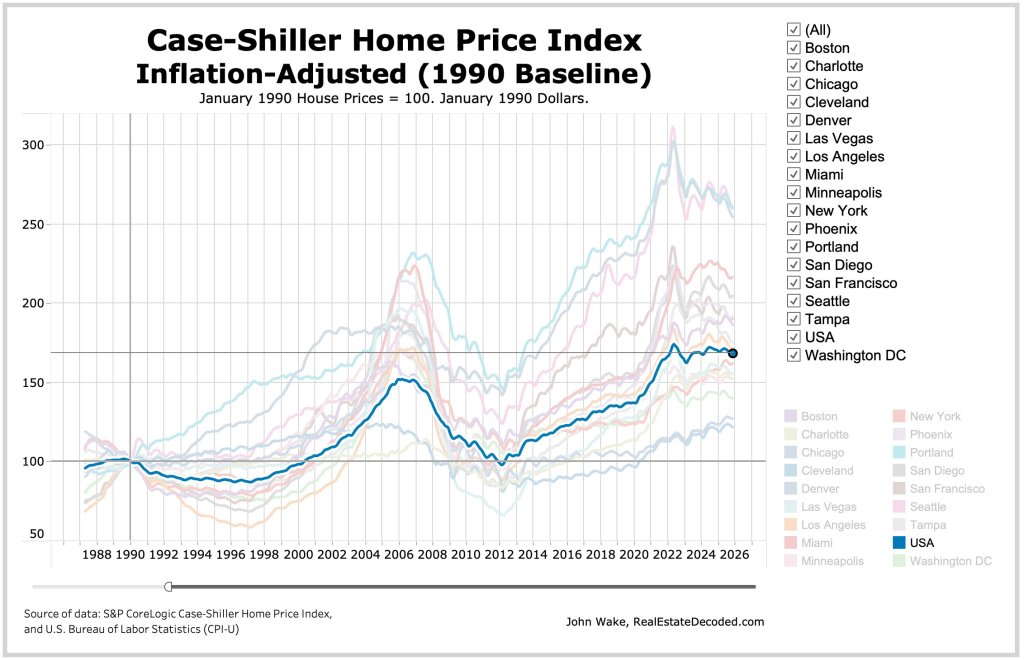
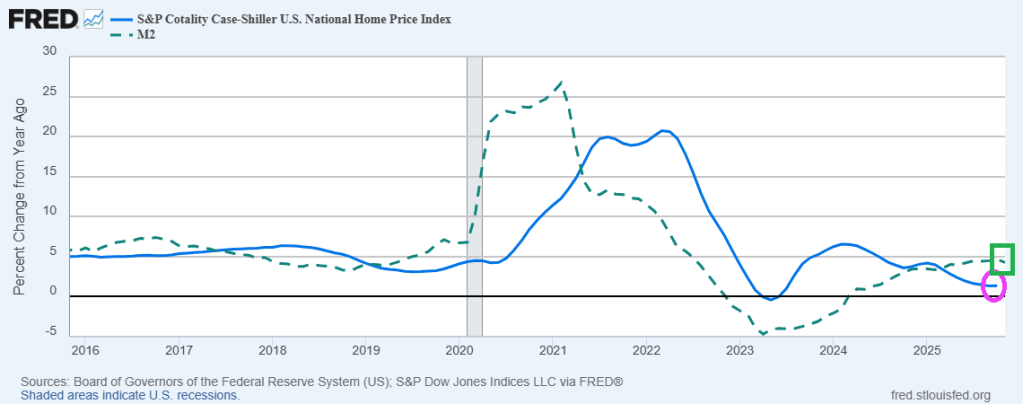
One reason that US home prices remain high (and unaffordable for many) is The Federal Reserve (aka, The Green Slime). Former Fed Chair (and Biden’s Treasury Secretary is no Luciana Paluzzi, the Italian beauty from the James Bond film Thunderball. Yellen is just a far-left economic hack.

Look at the Case-Shiller national home price index compared with The Fed funds target rate.

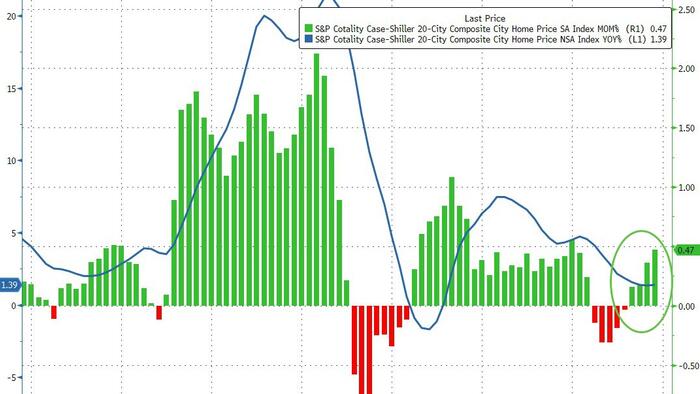
The S&P CoreLogic Case-Shiller U.S. National Home Price NSA Index, covering all nine U.S. census divisions, reported a 3.8% annual return for November, up from a 3.6% annual gain in the previous month. The 10-City Composite saw an annual increase of 4.9%, recording the same annual increase in the previous month. The 20-City Composite posted a year-over-year increase of 4.3%, up from a 4.2% increase in the previous month. New York again reported the highest annual gain among the 20 cities with a 7.3% increase in November, followed by Chicago and Washington with annual increases of 6.2% and 5.9%, respectively. Tampa posted the lowest return, falling 0.4%.

The pre-seasonally adjusted U.S. National, 20-City, and 10-City Composite Indices’ upward trends continued to reverse in November, with a -0.1% drop for the national index, while the 20-City Composite saw a -0.1% decline and the 10-City Composite was unchanged.

While the Fed Funds target rate gyrates, The Fed’s balance sheet remains high.

The Federal Reserve’s new logo!

My Mortgage Market Was Gone! Mortgage Purchase Applications Rise 7% Since Previous Week, But Refi Applications Fall 3%

As The Pretenders sang, “My City Was Gone.” That song was about Akron, Ohio. But it applies to the US Mortgage Market under Biden/Harris. The question is whether Trump’s deregulation plans can return to its former glory.

Mortgage applications increased 0.1 percent from one week earlier, according to data from the Mortgage Bankers Association’s (MBA) Weekly Mortgage Applications Survey for the week ending January 17, 2025.

The Market Composite Index, a measure of mortgage loan application volume, increased 0.1 percent on a seasonally adjusted basis from one week earlier. On an unadjusted basis, the Index increased 3 percent compared with the previous week. The seasonally adjusted Purchase Index increased 1 percent from one week earlier. The unadjusted Purchase Index increased 7 percent compared with the previous week and was 2 percent higher than the same week one year ago.

The Refinance Index decreased 3 percent from the previous week and was 42 percent higher than the same week one year ago.

The Pretenders’ lead singer Chrissie Hynde likely would have made a better Federal Reserve Chair and Treasury Secretary than Janet Yellen.

Consumer Prices Soared Over 21% Under Biden (Producer Prices Rose At Triple The Rate Under Biden Than They Did Under Trump) Worst Start To A Fiscal Year EVER!

This is the worst start to a fiscal year EVER: – Spending is up 10.9% – Receipts are down 2.2% – FYTD deficit up 39.4% at $711 billion They’re handing Trump a ticking time bomb!

Speaking of Biden handing a ticking time bomb (according to Zero Hedge), after rising for 5 straight months, analysts expected headline consumer prices to continue accelerating in December (+0.4% MoM exp) and it did exactly that – the highest MoM print since March, leading the YoY CPI to rise 2.9% (the highest since July)…

Source: Bloomberg

CPI details:

Food

The index for food increased 0.3% in December, after rising 0.4% in November. The food at home index also rose 0.3% over the month. Four of the six major grocery store food group indexes increased in December. The index for cereals and bakery products rose 1.2% over the month, after falling 1.1% in November. The meats, poultry, fish, and eggs index increased 0.6 percent in December, as the eggs index rose 3.2 percent. The index for other food at home rose 0.3 percent over the month and the index for dairy and related products increased 0.2 percent.

Energy

The energy index increased 2.6% in December, after rising 0.2% in November. The gasoline index increased 4.4% over the month. (Before seasonal adjustment, gasoline prices decreased 1.1 percent in December.) The natural gas index rose 2.4 percent over the month and the index for electricity rose 0.3 percent in December. The energy index decreased 0.5 percent over the past 12 months. The gasoline index fell 3.4% over this 12-month span and the fuel oil index fell 13.1 percent over that period. In contrast, the index for electricity increased 2.8 percent over the last 12 months and the index for natural gas rose 4.9 percent.

All items less food and energy

The index for all items less food and energy rose 0.2 percent in December, after rising 0.3 percent in each of the 4 preceding months.

  • The shelter index increased 0.3 percent in December, as it did in November.
    • The index for owners’ equivalent rent also rose 0.3 percent over the month, as did the index for rent.
    • The lodging away from home index fell 1.0 percent in December, after rising 3.2 percent in November.
  • The medical care index increased 0.1 percent over the month, after rising 0.3 percent in October and November.
  • The index for physicians’ services increased 0.1 percent in December and the index for hospital services rose 0.2 percent over the month.
  • The airline fares index rose 3.9 percent in December, after rising 0.4 percent in the previous month.
  • The index for used cars and trucks rose 1.2 percent over the month and the index for new vehicles increased 0.5 percent.
  • Other indexes that increased in December include motor vehicle insurance, recreation, apparel, and education.
  • In contrast, the index for personal care fell 0.2 percent in December after rising 0.4 percent in November. The indexes for communication and alcoholic beverages also declined over the month. The household furnishings and operations index was unchanged in December

The resurgence of energy costs drove the hot headline CPI along with Core Services…

Source: Bloomberg

Core CPI (ex Food and Energy) dipped to +0.2% MoM (below the 0.3% exp) and the YoY pace of inflation slowed to 3.24% YoY. Core CPI rose EVERY month under Biden…

Source: Bloomberg

Core Goods price inflation slowed MoM (but deflation is gone on a YoY basis)…

Source: Bloomberg

The Fed’s favorite indicator of the CPI bunch – SuperCore or Services CPI ex-Shelter – rose 0.28% MoM (slowing the pace of annual inflation to +4.17%)…

Source: Bloomberg

Transportation Services were not MoM…

Source: Bloomberg

Overall, it’s energy costs that are re-emerging as a drive of inflation… thanks Joe!

Source: Bloomberg

…and Energy prices aren’t going down anytime soon in the CPI world… thanks Joe!

Source: Bloomberg

While Producer Prices under Biden rose at triple the rate they did under Trump, Consumer Prices soared 21.25% under Biden (+4.9% p.a.) vs 8%, 1.94% p.a. under Trump…

Source: Bloomberg

Finally, equity traders were braced for a volatile day ahead of the print, with options implying moves of 1.1% in either direction for the S&P 500, the most for a CPI day since March 2023.