Banks And CRE Turmoil Worsens As Office Delinquencies Accelerate (Delinquency Rate Rose To 4.41% Last Month, Office Rose To 4.96%)

Its not a wonderful world for regional and small banks given the deterioration of office markets.

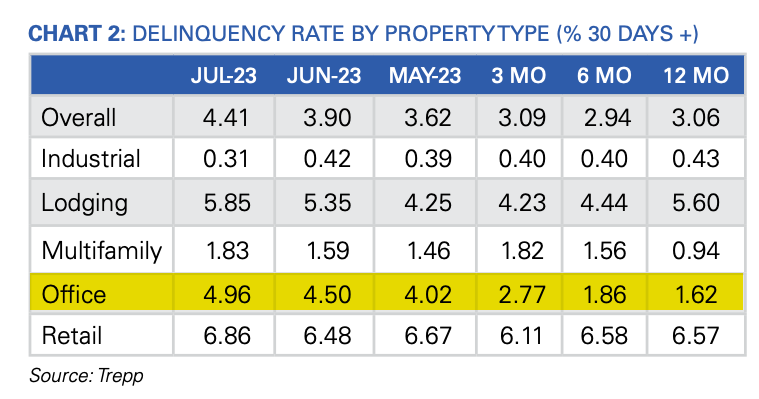
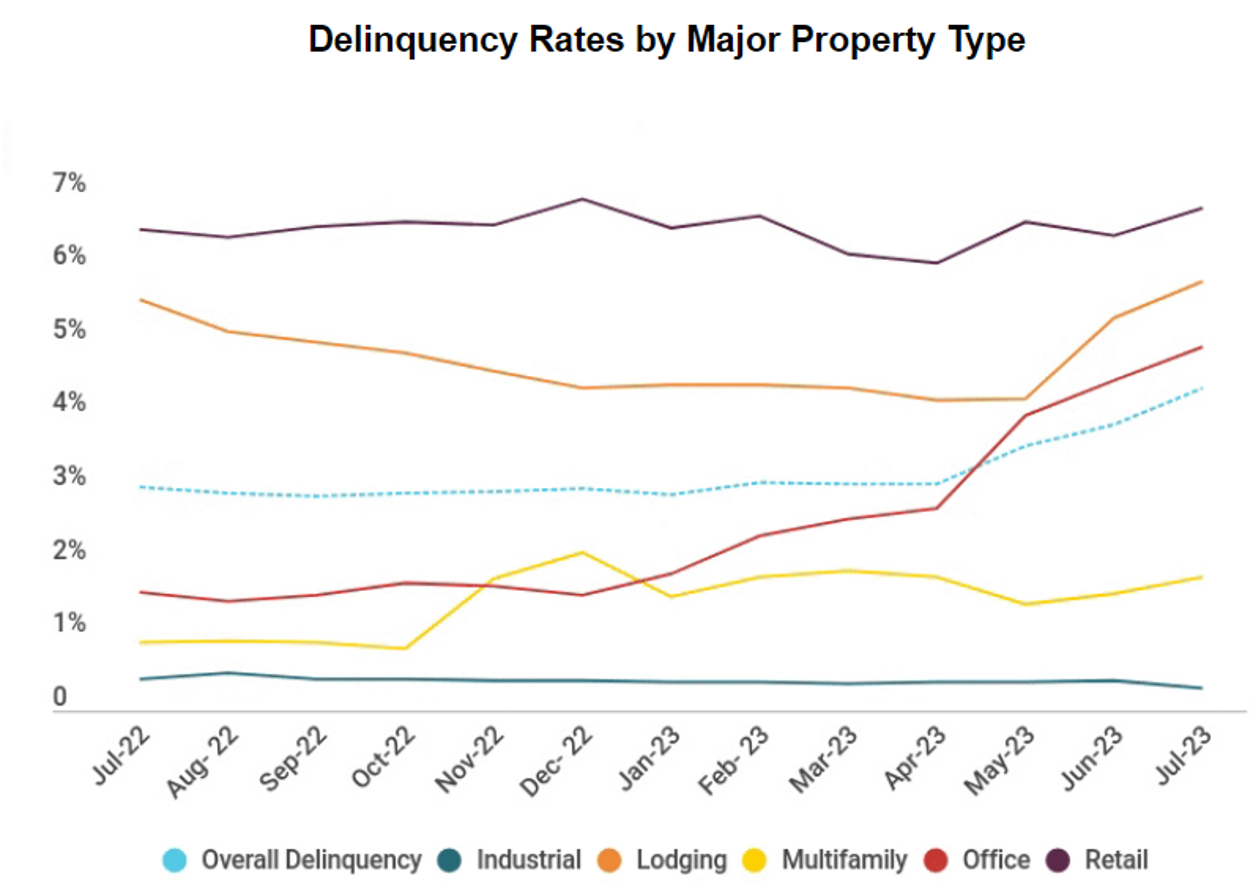
The latest data from Trepp, which tracks commercial mortgage-backed securities (CMBS) securities market data, shows the delinquency rate of commercial property loans packaged up by Wall Street jumped again in July, with four of the five major property segments posting increases. 

“While the rest of the US economy has seen relief in terms of higher equity prices, better-than-expected corporate earnings, and falling inflation numbers, the commercial real estate (CRE) market continues to be left behind,” Trepp wrote in the report. 

Trepp data found the delinquency rate rose 51 basis points to 4.41% last month — the highest level since December 2021. Office delinquencies increased by 46 basis points to 4.96% — up more than 350 basis points since the end of 2022. The deterioration in the office segment is intensifying at an alarmingly rapid pace. 
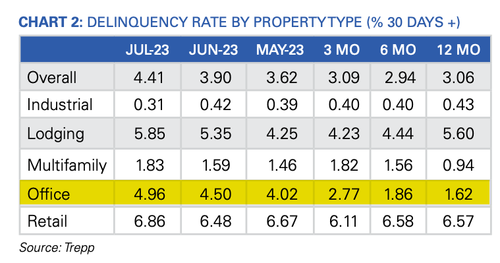
A broad overview of the US CMBS market shows the delinquency rate increased to 4.41%, a 51bps rise compared to the previous month, but still significantly lower than the 10.34% rate recorded in July 2012. The rate peaked at 10.32% in June 2020 during the government-forced Covid lockdowns. 
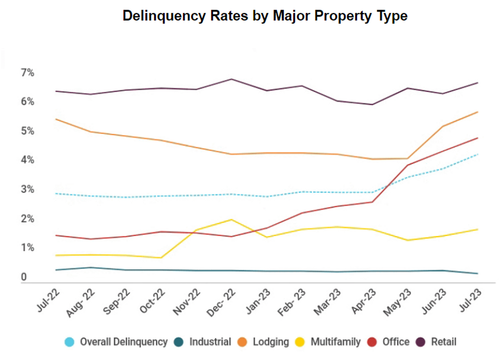
Here are more highlights from the report:

  • Year over year, the overall US CMBS delinquency rate is up 135 basis points.
  • Year to date, the rate is up 137 basis points.
  • The percentage of loans that are seriously delinquent (60+ days delinquent, in foreclosure, REO, or non-performing balloons) is now 3.92%, up 20 basis points for the month.
  • If defeased loans were taken out of the equation, the overall headline delinquency rate would be 4.64%, up 51 basis points from June.
  • One year ago, the US CMBS delinquency rate was 3.06%.
  • Six months ago, the US CMBS delinquency rate was 2.94%.

To better understand what might come next for the CRE market, Kiran Raichura, Capital Economics’ deputy chief property economist, recently warned in a note to clients that the office segment might experience a 35% plunge in values by the second half 2025 and “is unlikely to be recovered even by 2040.” 

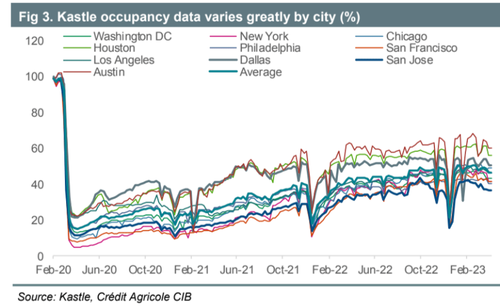
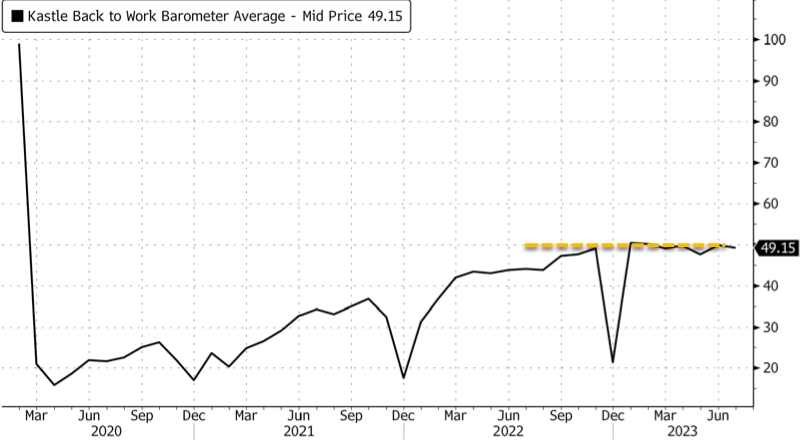
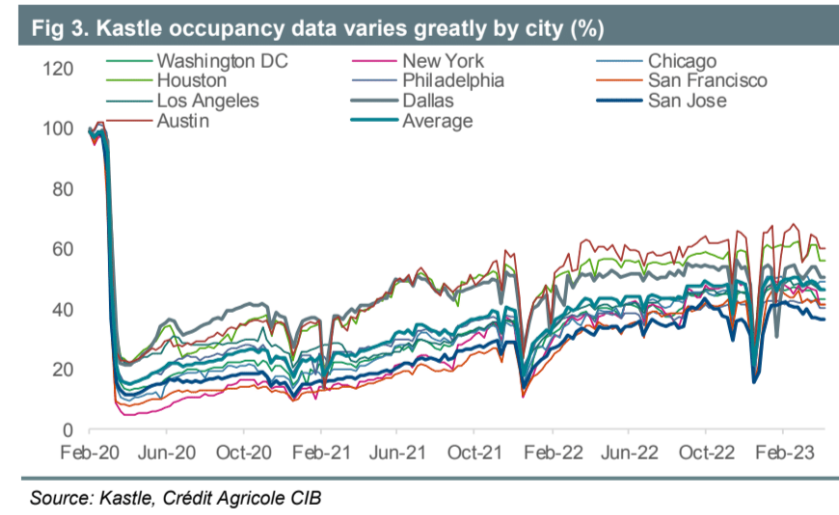
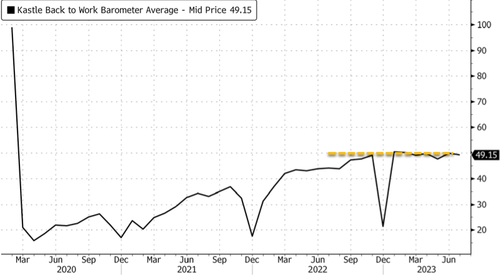
According to swipe data from Kastle Systems, the US office occupancy rate is less than 50%. The figure has plateaued since September, indicating a new reality of remote work. 
One major hurdle for CRE space is that “more than 50% of the $2.9 trillion in commercial mortgages will need to be renegotiated in the next 24 months when new lending rates are likely to be up by 350 to 450 basis points,” Lisa Shalett, chief investment officer for Morgan Stanley Wealth Management, wrote in a note to clients. 

Shalett expects a “peak-to-trough CRE price decline of as much as 40%, worse than in the Great Financial Crisis.” 

Bank of America analysts expect challenges in the CRE space but noted, “They are manageable and do not represent a systemic risk to the US economy.” 

Meanwhile, analysts at UBS warned: 

“About $1.3 billion of office mortgage loans are currently slated to mature over the next three years.

“It’s possible that some of these loans will need to be restructured, but the scope of the issue pales in comparison to the more than $2 trillion of bank equity capital. Office exposure for banks represents less than 5% of total loans and just 1.9% on average for large banks.” 

We’ve already seen major building owners returning their office towers and malls to lenders in California (here & here) and elsewhere (here). This will result in an uptick in CMBS delinquencies moving forward.  

… and remember what we wrote during the regional bank crisis earlier this year — the note was titled “Nowhere To Hide In CMBS”: CRE Nuke Goes Off With Small Banks Accounting For 70% Of Commercial Real Estate Loans. 

Meanwhile, The Federal Reserve is printing the night away.

Sam Cooke sang Joe Biden’s favorite song: “Only Sixteen.”

“So why did I give my heart so fast
It never will happen again
But I was a mere man of 80
I’ve aged a year since then.”


print-icon
print-icon

CRE Fire! Office Valuations Plummet As Fed Raises Rates To Fight Inflation (US Gross Domestic Income YoY Fell To -0.8% In Q1, NOT A Good Sign!)

Commercial real estate (CRE), particularly office space, reminds me of the Arthur Brown tune “Fire!” except that Jerome Powell of The Federal Reserve is the God of Hellfire! While fighting inflation caused by … The Federal Reserve and insane Federal spending (aka, Bidenomics). Call this the Over, Under, Sideways Down economy. The top 1% are doing quite well, while the lower 50% of net worth households are struggling.

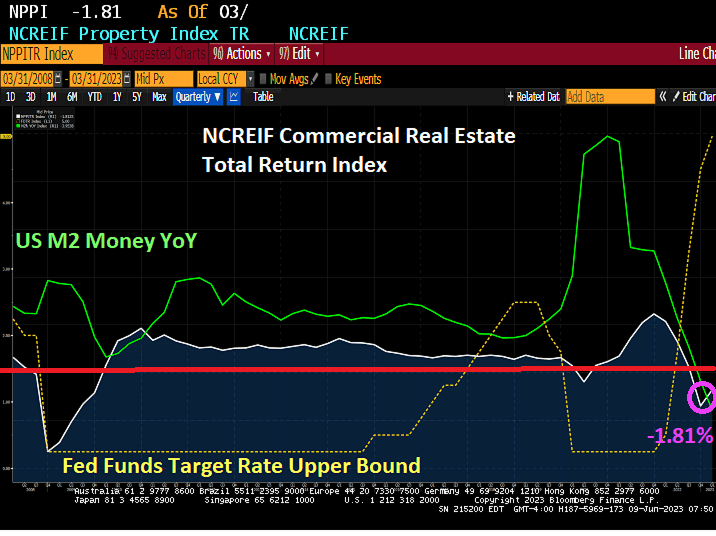
The Q1 2023 NCREIF Office property (value) index shows declining office value since Q2 2022 as The Fed began raising its target rate to combat inflation.

From Trepp, we have this shocking table showing the decline the average total value loss over the span of around a decade. The oldest buildings experienced the largest reduction in value of 60%, and the newest experienced the least (but quite substantial) reduction of 52%. Although the newest buildings performed the best relatively, their 52% value reduction is easily the most concerning, and displays truly how much distress is present in the office sector. This group has the highest percentage of Class A buildings, but its reduction value over the past decade is still approximately on par with buildings constructed over half a century prior. With north of $150 billion in securitized maturities beyond 2023, these trends set a gloomy tone for their future and the performance of office properties as a whole.

Then we have this alarming headline from Trepp: “Commercial Mortgage Sector Faces Another Wall of Maturities as $2.75 Trillion Rolls by 2027.” An estimated $528.7 billion of commercial mortgages mature this year, according to Trepp data, which projects that next year, maturities will increase to $532.8 billion. The projections are based on data for the first quarter compiled using the Federal Reserve’s flow of funds and made various assumptions regarding loan terms for each of the major lender categories. The data would indicate that the market is facing a wall, if not a mountain of maturities that would make the 2015-2017 wall of maturities look almost inconsequential. During that period, roughly $1.1 trillion of loans were scheduled to come due. But attention was focused on the CMBS market, as more than $335 billion of loans were set to mature during the period.

Well, REAL gross domestic income fell -0.8% YoY in Q1 2023 as M2 Money growth crashes. Not a good sign for the US economy or commercial real estate.

Here is the Trepp Report on declining office values.

Of course, office properties are suffering from almost out-of-control crime in major American cities and the desire of workers to work from home rather than commute to work in cubicles.

But never fear! We have massively corrupt and compulsive liar Joe Biden as President!! He is the President of The 1%! Not the other 99%.

Call him Deep State Joe! The bully from Delaware.

Sink The Economy! CMBS Storm Unfolds As Delinquent Office Loans Hit Five-Year High (They Call Biden “The Sleeze!”)

Biden and The Fed are playing their own version of Johnny Horton’s “Sink The Bismarck!” This version is called “Sink The Economy!”

The commercial real estate space is experiencing stress following the recent turmoil in the regional bank sector, with the rapid rise in interest rates, tightening lending standards, and structural changes, such as sliding demand for office buildings. 

Some structural factors, such as remote work and hybrid work, have doomed the office space segment. This has left empty office buildings scattered across major US cities as the number of landlords falling behind on repayments due to the difficulty of refinancing and high vacancies has hit a five-year high. 

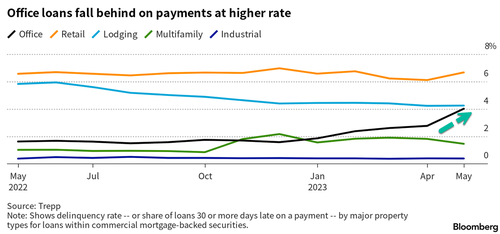
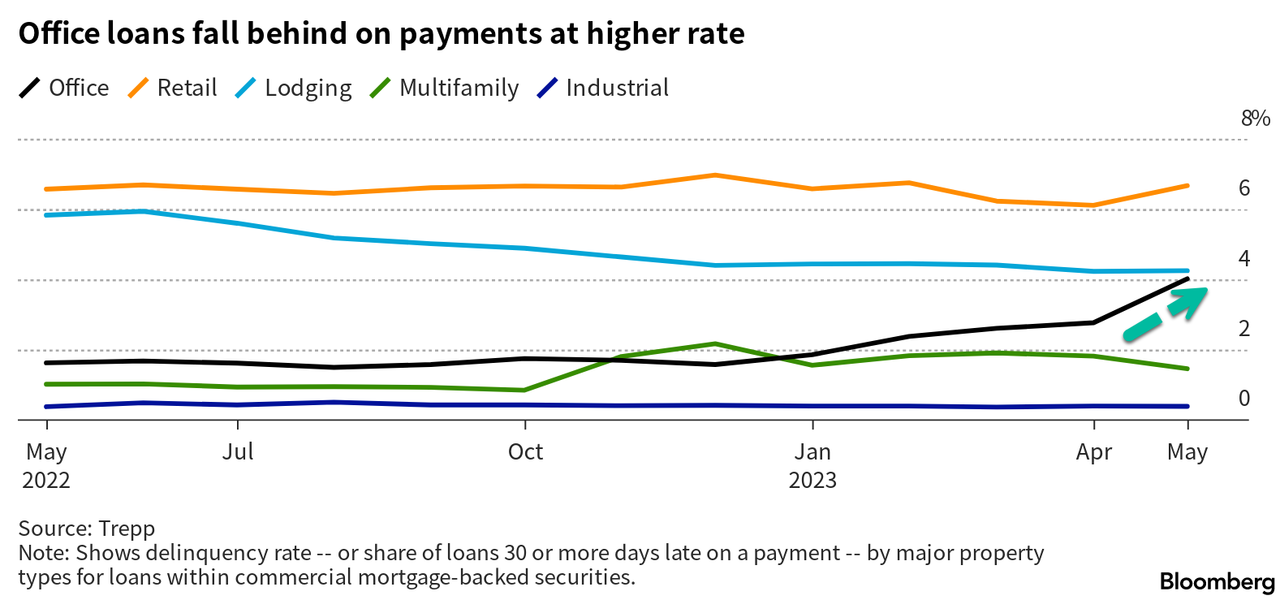
According to real estate data firm Trepp, more than 4% of office loans packed into commercial mortgage-backed securities were delinquent in the last 30 days as of May, the highest level since 2018.

Dan McNamara, the founder of Polpo Capital Management, told Bloomberg about impending CRE turmoil: 

“This is just the tip of the iceberg for office delinquencies as $35 billion in CMBS office loans are scheduled to mature this year and the refinancing market is effectively shut to this asset class.” 

The rise in delinquencies comes as security card swipe data from Kastle shows many workers have yet to return to their desks in major US cities, resulting in high office space vacancies nationwide. 

After banking failures, we first warned premium subs about the “CRE Nuke Goes Off With Small Banks Accounting For 70% Of Commercial Real Estate Loans in mid-March. 

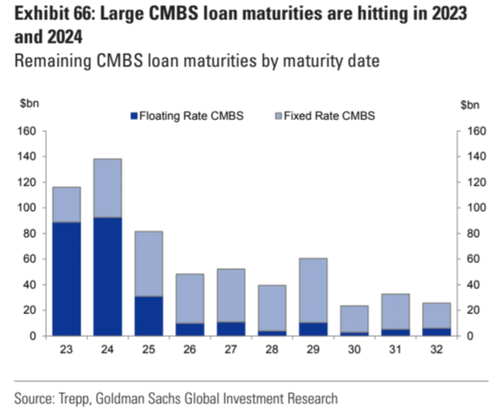
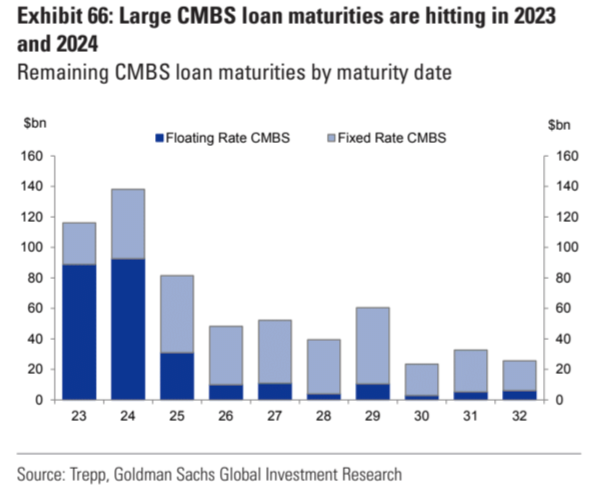
As Goldman pointed out to clients days ago, one major issue is a steep maturity wall of floating and fixed-rate CMBS loans due this year and next. The inability to refinance in these challenging market conditions will likely unleash a tidal wave of defaults in the second half of this year. 

Already, we have noted “CRE Giant Brookfield Defaults On $161 Million Debt For DC Office Buildings” and “San Fran’s CRE Apocalypse: The City’s Two Biggest Hotels Have Defaulted.” And also cited data from Moody’s Analytics that showed first-quarter CRE prices fell for the first time in over a decade

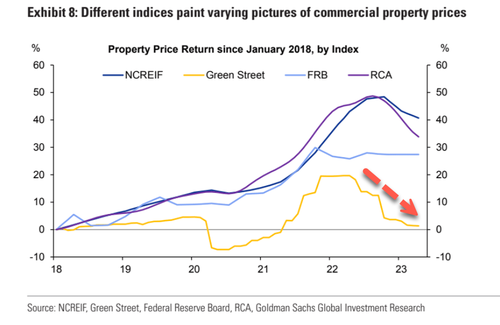
Goldman Sachs chief credit strategist Lotfi Karoui told clients last month, “the most accurate portrayal of current market conditions” is data via the Green Street Commercial Property Price Index, which suggests trouble ahead. 

Just how much danger? Karoui believes “Green Street indicates a 25% year-over-year drop in office property values and a 21% drop in apartment property values.” 

So the combination of high vacancies, sliding prices, and tightening lending standards is a perfect storm that could ignite an eruption of delinquencies in office loans in the coming quarters. 

And after the FBI confirmed that Joe and Hunter Biden received $5 million EACH in bribes by Burisma, the Ukrainian energy company, they call Joe Bidens “The Sleeze.”

Offices Across America Must Be Torn Down, Says Kyle Bass (Office Vacancy Rate Hits 20.2% In 2023), JPMC’s Dimon Orders MDs Back To The Office Or Be Fired!

  • Office vacancy rate in the US has climbed to 20.2% in 2023
  • Financing for residential building is tepid despite demand

The Covid economic shutdowns have a disastrous effect on small businesses as we know. But office space is really getting crushed in terms of vacancy rates. In fact, it is so bad the investor Kyle Bass is suggesting that office space be torn down across the US much in the same way that FDR’s Agriculture Secretary Henry Wallace ordered the mass execution of hogs in order to drive up prices in a deflationary economy.

(Bloomberg) Kyle Bass has some advice for real estate investors: Tear it down.

The founder of Dallas-based Hayman Capital Management says office buildings in cities need to be demolished because demand isn’t returning and it’s impractical to turn most towers into apartments.

“It’s one asset class that just has to get redone, and redone meaning demolished,” said Bass.

The Dallas-based investor shot to fame more than a decade ago betting against subprime mortgages before the US housing collapse. He’s since pushed a series of contrarian investments that have occasionally burned investors such as predicting the collapse of Japanese government debt and Hong Kong’s dollar. 

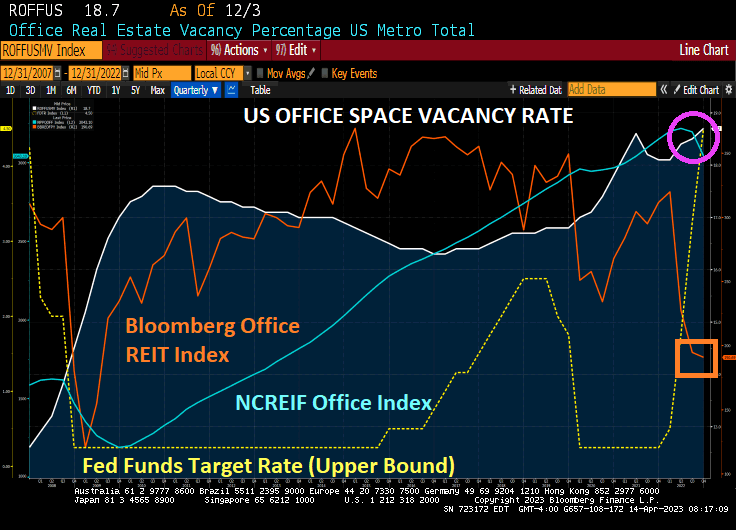
NCREIF’s office index is starting to decline, but Bloomberg’s Office REIT index (orange line) is really showing the pain being felt in the office market. But just wait to see what happens IF the market takes Bass’ advice and starts removing supply to help increase values. Unfortunately, my chart is only up through December 2022 and office vacancies have worsened in 2023 to a mind-boggling 20.2%.

In a classic Bill Lumbergh move (he was the office manager of Initech in Dallas Texas), JPMorgan now requires managing directors return to office 5 days a week and ‘be visible on the floor’ or else face ‘corrective action’.

An additional non-Bill Lumbergh issue is the rising crime in American cities causing companies like Whole Foods to leave their San Francisco (tenderloin district) location because 1) workers feel unsafe and 2) shop lifting is out of control. Even Washington DC where a large number of office building are leased by The Federal government is experiencing a boom in crime (particularly carjackings). And don’t get me started on Chicago (see Hey Jackass! for a Chicago crime map).

The face of micro-managing office managers, Bill Lumbergh. Or is this now JPMC’s CEO Jaime Dimon?

US Office Vacancies Hit All-Time High As Office Property Prices Decline (Fed Retreats)

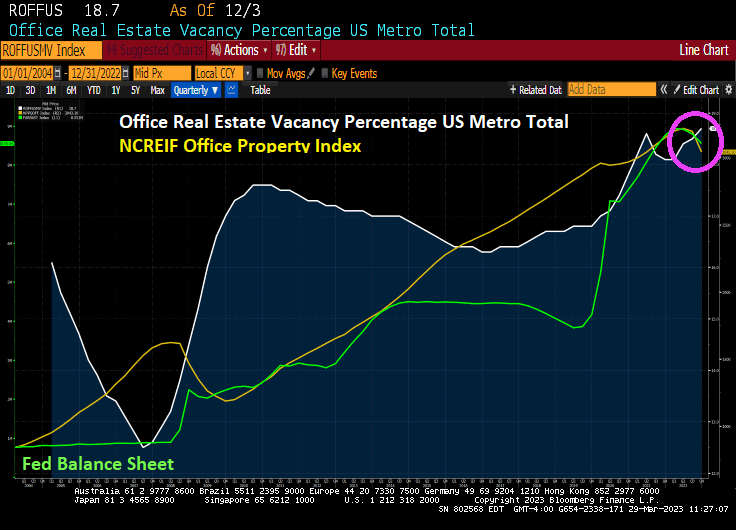
US metro office vacancies hit an all-time high in Q4 2022 and office properties values began to decline as The Fed retreats as it fights inflation.

So much money printing. Its The Fed’s claim to fame.

Inflation Nation! Commercial Real Estate Returns UP 22% YoY For Q4 2021 (Versus 19.66% YoY For Case-Shiller National Home Price Index)

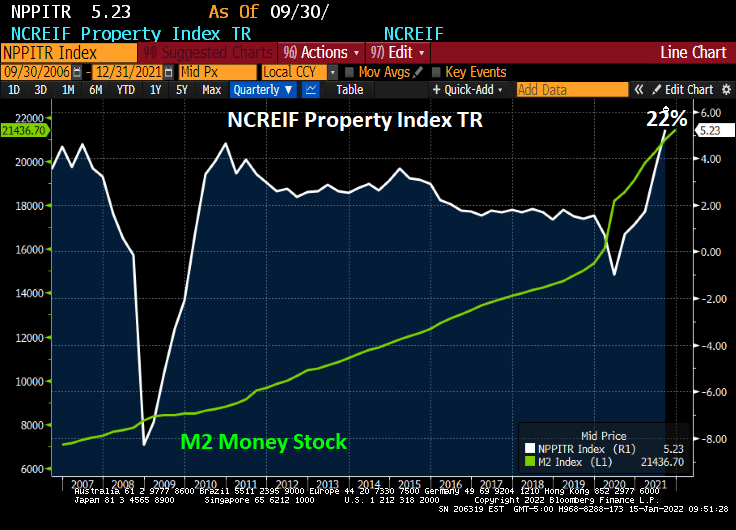
Inflation is burning out of control. While home price growth has been off the cherts (as Jean-Ralphio would say), commercial real estate has jumped incredibly at 22% YoY. The Bloomberg charting function hasn’t updated for the Q4 NCREIF report yet so I had to manually write-in 22% on the following chart.

To quote Dean Martin, “Ain’t that a kick in the head.” Commercial real estate returns are now higher than house price growth.

So, what will happen IF The Fed follows through with its monetary stimulus reduction? JPMC’s Jaime Dimon warns that The Fed could hike 7 times in 2022 and not be ‘sweet and gentle’.

But The Fed seems to be stuck in underworld and doing a terrible job at signalling their intentions if Dimon thinks that The Fed could raise rates 7 times in 2022.

Real Estate Hedge Against Inflation? Housing And REITs Did Better Than Inflation, NCREIF Not So Much

Now that inflation has reared its ugly head, how can investors protect themselves against the ravages of inflation?

Back in 1977, Fama and Schwert showed that housing acted as a hedge against inflation. Over the past year as inflation has reached its highest levels in 40 years, home prices have outpaced inflation by 19.08% to 6.8%.

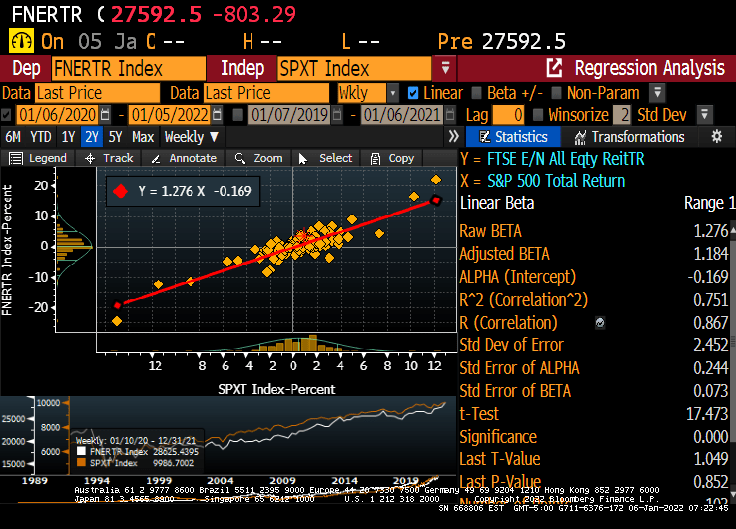
How about real estate investment trusts? The NAREIT all-equity index rose by 35.6% YoY while inflation rose at 6.8%. The S&P 500 index rose 28.9% YoY.

Of course, the NAREIT all-equity index has a beta of 1.276.

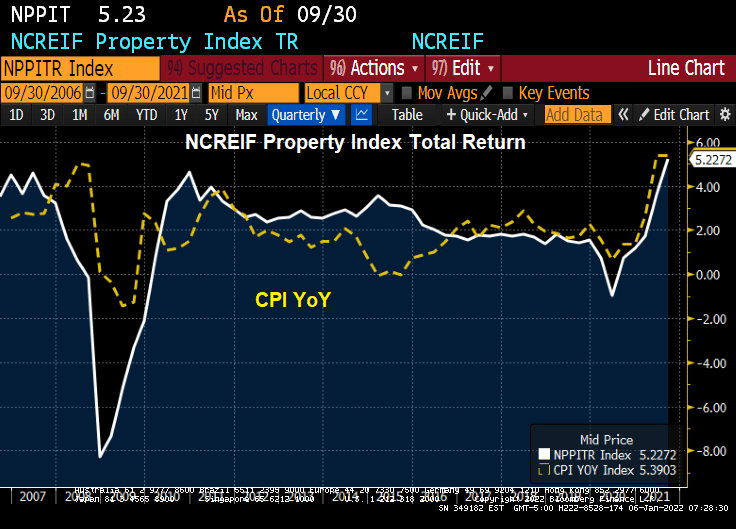
How about the NCREIF All-property commercial real estate index? For Q3, the NCREIF property index rose by 5.22%, less than the most recent inflation reading of 6.8%.

So for the past year, housing has beaten the pants-off inflation, REITs have earned a higher return than inflation, and the NCREIF index seems to be rising slower than inflation (but with its lag problems, I anxiously await the Q4 numbers which should be higher.

Retail REITs TRIPLE Whammy: House Bubble Burst, Online Shopping, COVID

It is tough to operate a retail Real Estate Investment Trust (REIT) in the face of the triple whammy that hit retail shopping. First, there was the housing bubble/subprime crisis of 2008-2009. Then there was the advent of on-line shopping, then COVID.

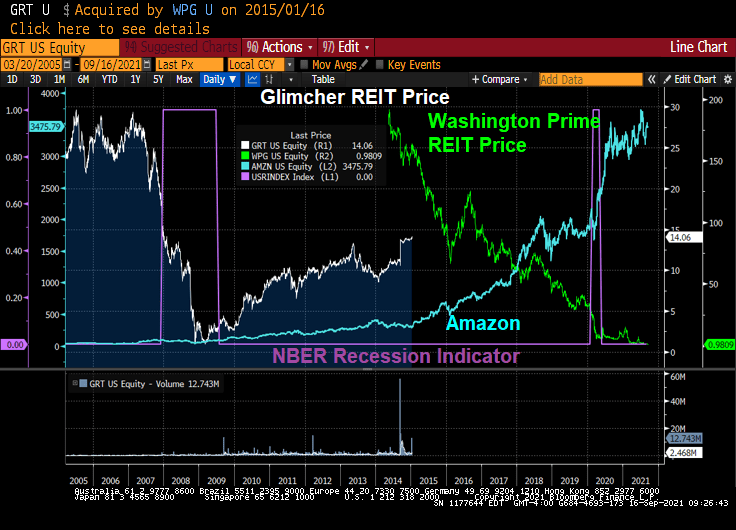
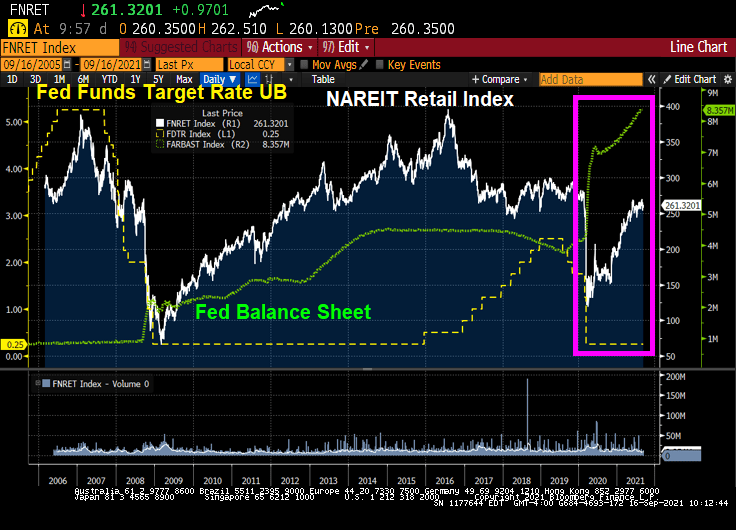
I look at the NAREIT retail index and two retail REITs for comparison: Simon Property Group and Washington REIT. And as a proxy for online shopping, I compare them to Amazon. Both Washington REIT and the NAREIT retail index were at loft valuations at the peak of the housing bubble, but crashed with the onset of the housing bubble burst and ensuing financial crisis. But following The Great Recession, both recovered by 2016 (along with Simon Property Group which actually far exceeded their pre-Great Recession peak.

ii

But then retail mall disaster struck. In the form of on-line shopping. I use Amazon to represent on-line shopping. While NAREIT Retail and Simon fell from their 2016 peak, Washington REIT got clobbered.

Then Covid struck. When combined with on-line shopping and fear mongering by Anthony Fauci, retail REITs got hit hard. But all three have rebounded slightly since their nadir in 2020.

An interesting case study is Glimcher REIT, a formerly privately-held commercial real estate development company from Columbus Ohio. Like other retail REITs, Glimcher was crushed by the financial crisis and Great Recession. Glimcher’s share price fought back to $14.06 per share (down considerably from $29.28 in February 2007).

Washington Prime Group Inc. acquired Glimcher Realty Trust for $4.3 Billion in stock and cash Including the assumption of Glimcher’s debt. Right as on-line shopping took off. And the Covid struck a death blow leaving Washington Prime trading at $0.98. Washington REIT is transforming into a multifamily REIT given the overbuilding of DC area office space and the triple whammy of retail centers.

Retail REITs have almost recovered from Covid, thanks to the massive monetary stimulus from The Federal Reserve. Not to mention fiscal stimulus from DC.

Yup, a triple whammy has hit retail REITs with some faring better than others.

But the NAREIT RESIDENTIAL Index has exploded with Fed stimulus.

Well done, Pazuzu Powell!