US Debt-to-GDP Has Doubled Since 2008, But Hourly Workers Are Seeing Negative REAL Wage Growth (The Government Is Here To Help??)

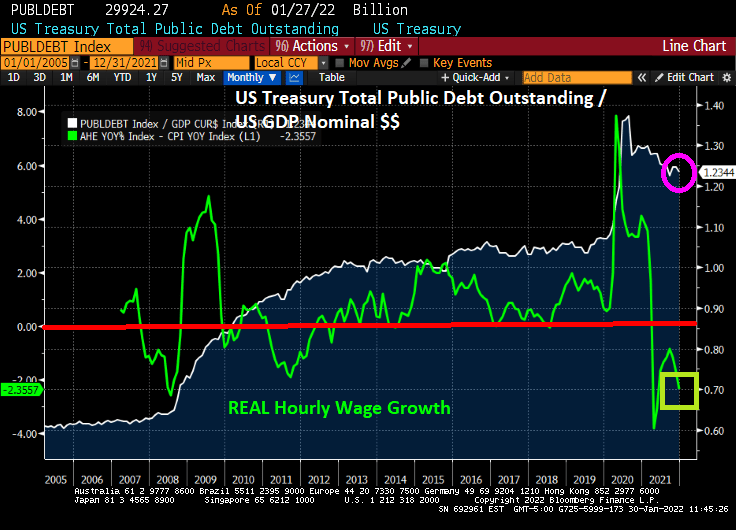
Nothing has been the same since the financial crisis of 2008 (except we still have insider-trading superstar Nancy Pelosi as US House Speaker). What has changed is that US Public Debt to GDP (nominal dollars) has doubled.

Has doubling Federal debt helped the hourly worker? Initially we saw a surge in REAL hourly wage growth in 2009 as the US began to recover from the housing bubble burst and ensuing financial crisis. Another surge in REAL wage growth occurred when Federal debt exploded as the COVID crisis took hold. BUT more recently we see that REAL wage growth is negative.

The other aspect of pain for hourly workers is inflation which has reached 7%, the highest rate in 40 years.

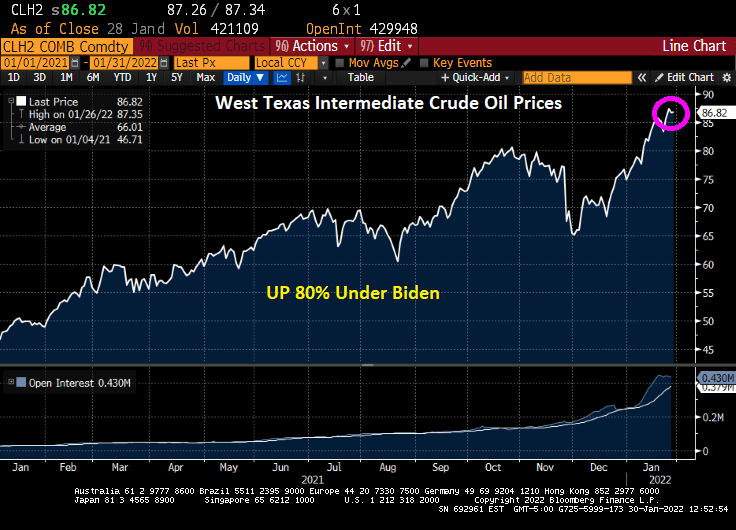
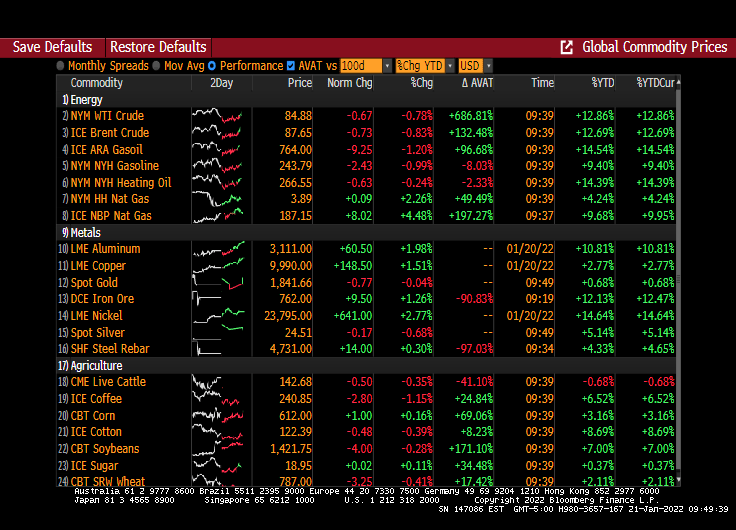
Adding to the frustration of hourly workers is energy prices rising 80% under President Biden’s reign of error.

Most hourly wage earners can’t buy a Tesla or a $100,000 electric Chevy Silverado to take advantage of Biden’s green energy policies.

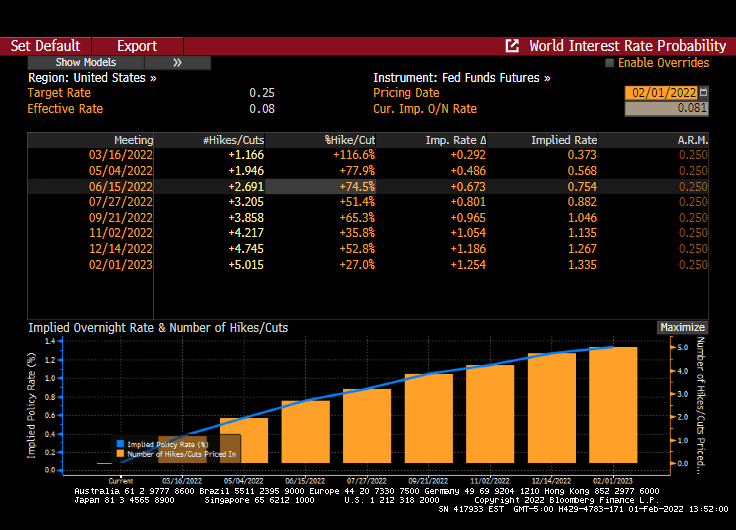
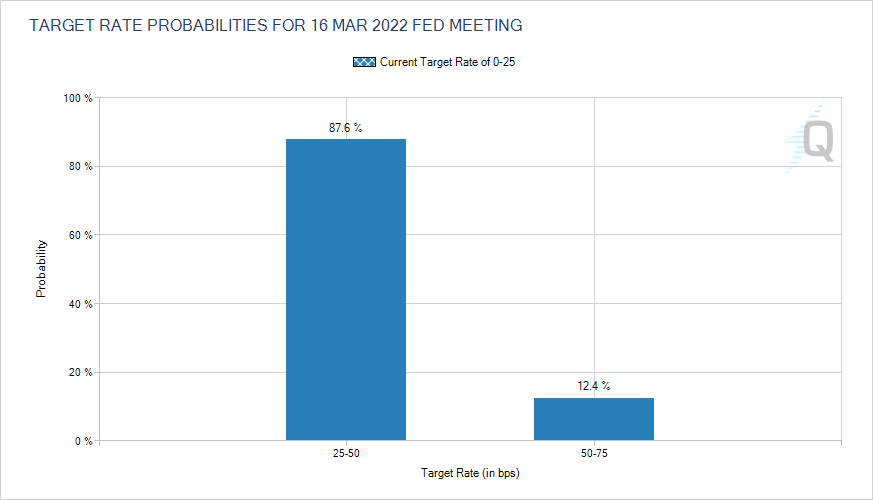
Will interest rates rise? Well, the Chicago Mercantile Exchange has Fed Watch tool. It is saying that there will likely be a 25 basis point increase at the March 2022 meeting.

As Ronald Reagan once said, “The most terrifying words in the English language are: I’m from the government and I’m here to help.”

Reversal Of Fortune: Yield Curve Drooping As 2022 Forecast To Be Slower Market For Housing

No, not the Klaus von Bulow type of “reversal of fortune” (when he killed his wife). I am talking about a reversal in fortune for America.

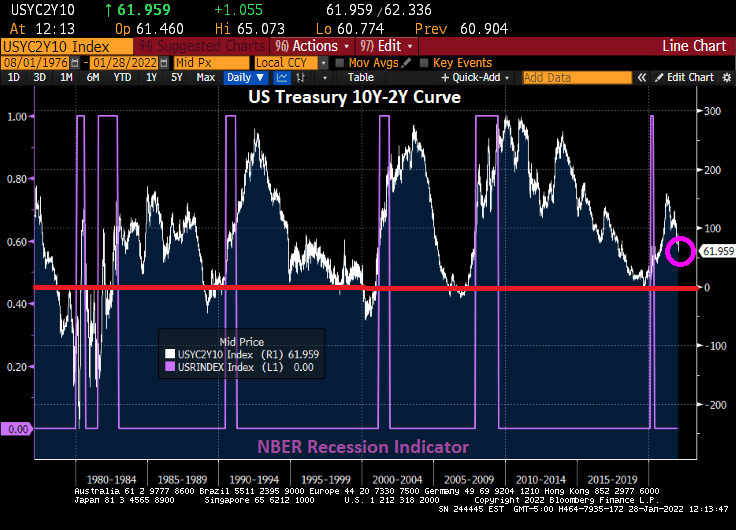
Let’s look at the 10Y-2Y Treasury curve. It typically falls below 0 basis points before every recession. Except the mini-COVID recession of 2020. But notice that the Treasury curve did not recover from the COVID recession as it typically did. More along the lines of 1984-1985.

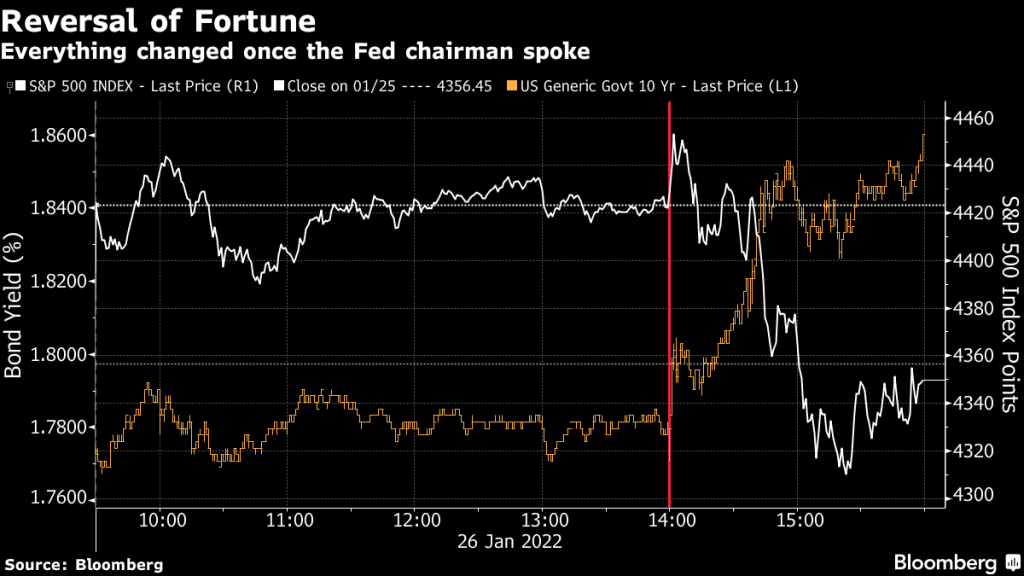
Speaking of Reversal of Fortune, everything changed once Fed Chair Powell started to speak after Tuesday’s FOMC meeting.

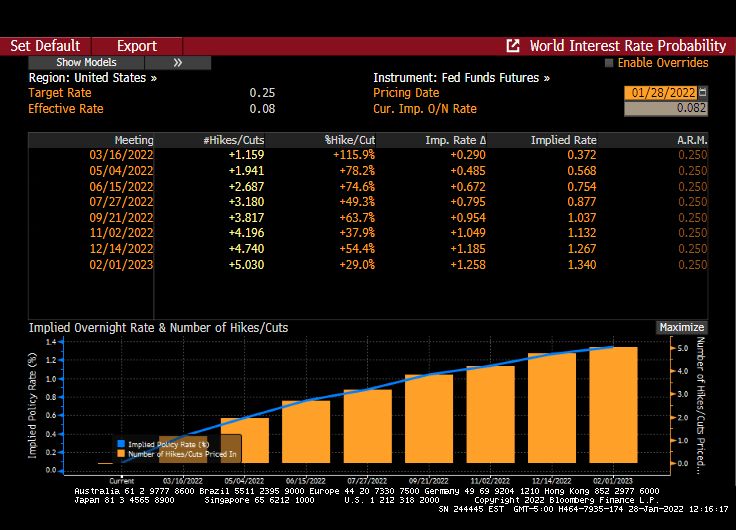
Hmm. Midterm elections, possible Russian invasion of The Ukraine, further problems in China, etc. While The Fed Funds Future data implies that The Fed may raise their target rate 5 times over the coming year, we’ll see.

I happen to agree with Fannie Mae’s Doug Duncan who says that he is less bullish about the housing market in 2022.

If 2021 was a great year for the US housing market, 2022 faces “a new normal” marked by a slowing down of home price rises, job layoffs in the mortgage industry, and concerns over rising inflation and interest rate hikes, according to Douglas Duncan (pictured), Fannie Mae’s senior vice president and chief economist.

Duncan said “a shift” was underway in the market and the wider economy, which would result in far more moderate home price appreciation, expected to be between 7% and 7.5% this year due to the ending of fiscal and monetary stimulus.

“One of the elements of the shift is that you’re going to see house prices up, but not nearly as far as they were in the last two years because that was driven hugely by the fiscal and monetary stimulus (now) being removed,” he told MPA.

Ominously, he added that low interest rates “may never be seen again”. Or at least until Biden appoints more doves to The Federal Reserve Board of Governors.

The doves at The FOMC.

Too Much Money! U.S. Consumer Spending Drops, Price Index Up Most Since 1982 (REAL Personal Spending Fell 1% In December)

This is a case of “Too much money” in the economy, courtesy of The Federal Reserve.

(Bloomberg) — U.S. inflation-adjusted consumer spending fell last month by the most since February, suggesting that Americans tempered their outlays amid the latest Covid-19 wave and the fastest inflation in nearly 40 years.

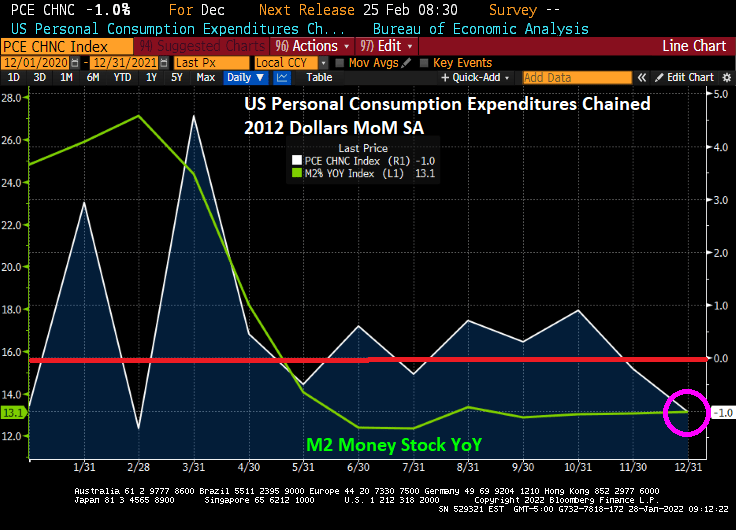
Purchases of goods and services, adjusted for changes in prices, decreased 1% from November, the Commerce Department said Friday. 

The personal consumption expenditures price gauge, which the Federal Reserve uses for its inflation target, rose 0.4% from a month earlier and 5.8% from December 2020, the most since 1982. Unadjusted for inflation, spending fell 0.6%, while incomes rose 0.3%.

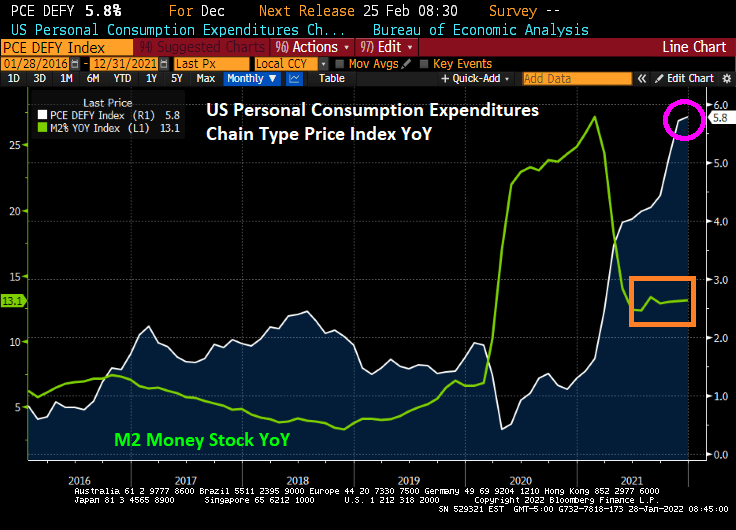
Yes, the PCE Deflator YoY rose to 5.8% as M2 Money Stock is growing at a 13.1% YoY clip.

REAL personal spending declined 1% in December as prices rose in part thanks to the 13.1% growth in M2 Money stock YoY.

Too much money! Time to slow down, Jay Powell! Stop sucking the life out people with inflation.

US New Home Sales Crash -14% YoY In December As Median Price Slows To +3.4% YoY (Mortgage Applications Decline As Mortgage Rates Increase)

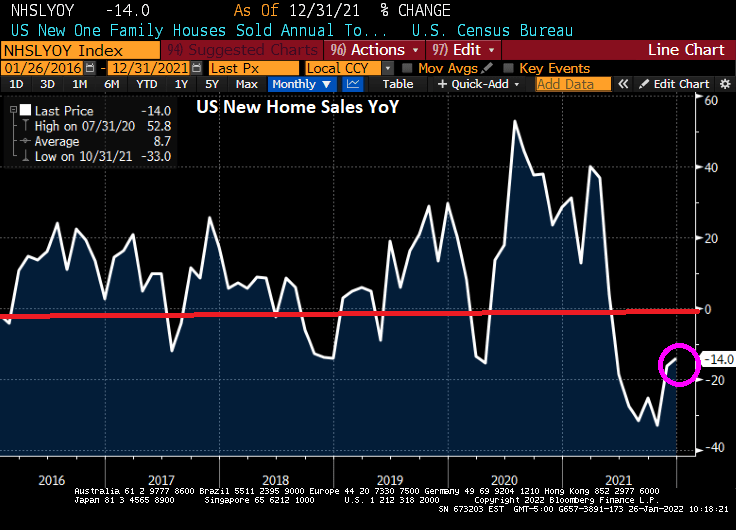
US new home sales spiked in December by 11.9% from November, but were down 14% year-over-year.

But the median price of new home sales (YoY) declined to 3.4%.

The Midwest saw a surge in new home sales (+56%).

The MBA’s mortgage applications index shows declining purchase applications (-1.83%) and declining refinancing applications (-12.60%) as mortgage rates increased from 3.64% to 3.72% for the week of 01/21.

Now, mortgage purchase applications rose for the week of 01/21 if we used non-seasonally adjusted data.

Fear! Crypto Crash Erases More Than $1 Trillion in Market Value (As Dow Tanks 430 Points)

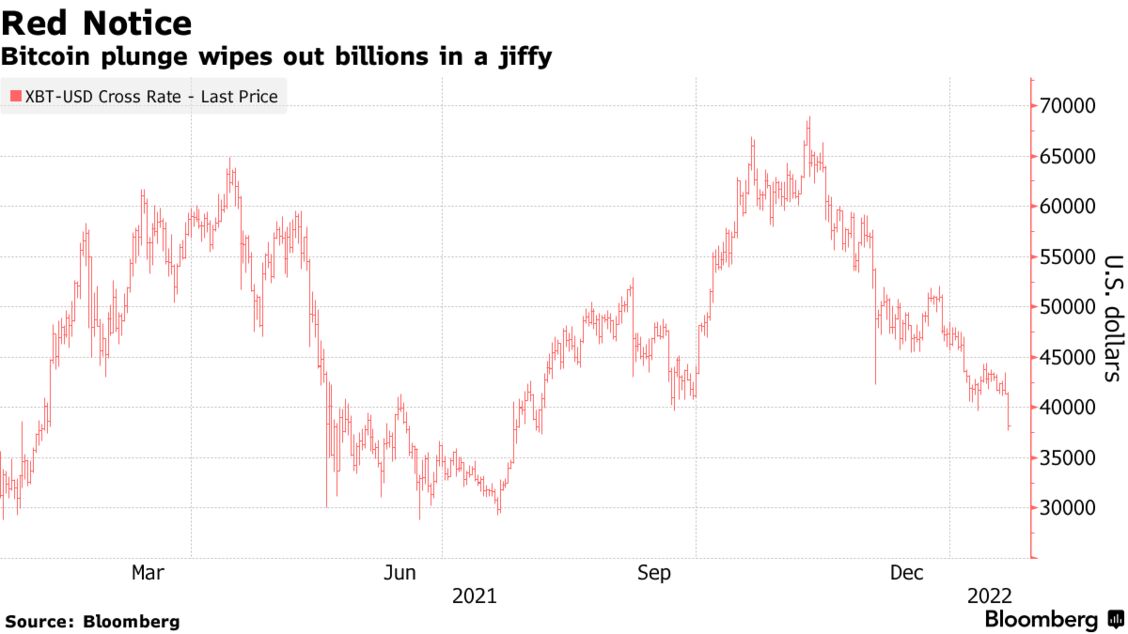
For Bitcoin, there’s only been one constant recently: decline after decline after decline. And the superlatives have piled up really quickly.

With the Federal Reserve intending to withdraw stimulus from the market, riskier assets the world over have suffered. Bitcoin, the largest digital asset, lost as much as 8.7% Friday and dropped below $38,000 to its lowest level in six months. Since its peak in November, it has lost 40% of its value. Other digital currencies have suffered just as much, if not more, with Ether and meme coins mired in similar drawdowns. 

Bitcoin’s decline since that November high has wiped out more than $570 billion in market value, and roughly $1.17 trillion has been lost from the aggregate crypto market. While there have been much larger percentage drawdowns for both Bitcoin and the aggregate market, this marks the second-largest ever decline in dollar terms for both, according to Bespoke Investment Group.

“It gives an idea of the scale of value destruction that percentage declines can mask,” wrote Bespoke analysts in a note. “Crypto is, of course, vulnerable to these sorts of selloffs given its naturally higher volatility historically, but given how large market caps have gotten, the volatility is worth thinking about both in raw dollar terms as well as in percentage terms.”

Bitcoin plunge wipes out billions in a jiffy
 Bloomberg

With the Fed’s intentions rocking both cryptocurrencies and stocks, a dominant theme has emerged in the digital-asset space: cryptos have twisted and turned in nearly exactly the same way as equities have. 

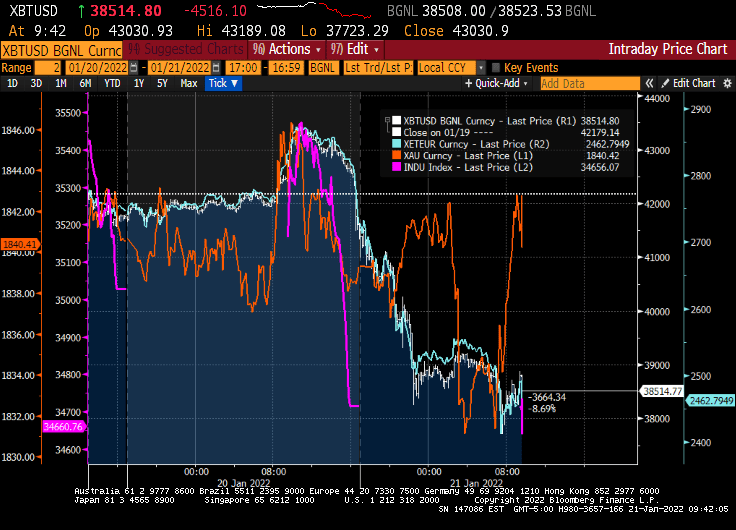
Bitcoin/Ethereum/Dow Slide As Gold Rebounds (Fun Times As $3.3 Trillion Options Expire)

Yes, it is fun times in markets this Friday as $3.3 trillion in options expire.

As of 9:52am EST, we see Bitcoin (white) and Ethereum (blue) falling along with the Dow (pink), while gold (gold) fell then rebounded.

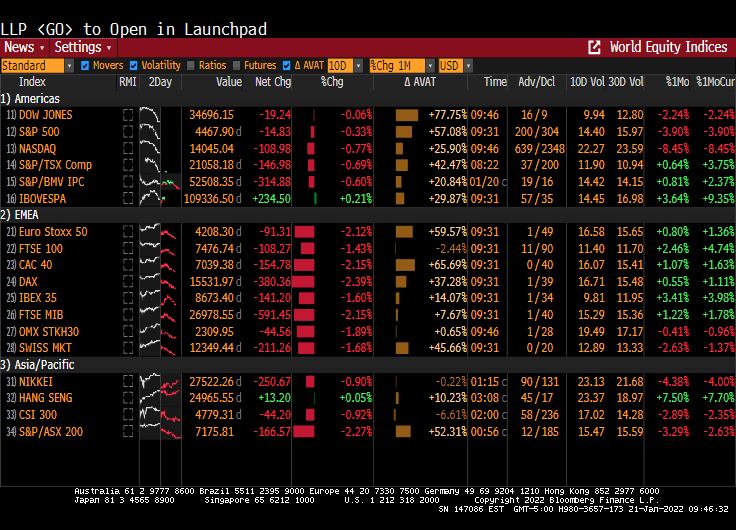
European stock markets are down 2% today.

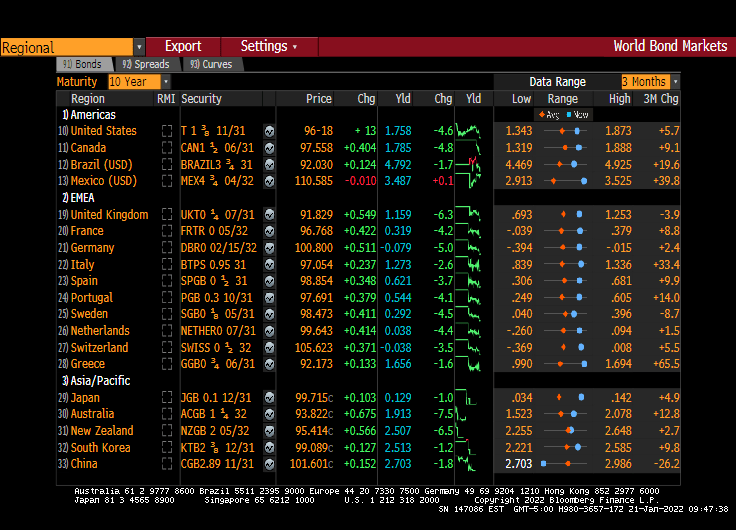
Global sovereign bond prices are up across the board internationally as yields decline.

Crude oil is down today while natural gas is soaring. In particular, look at UK natural gas prices!

Brrr.

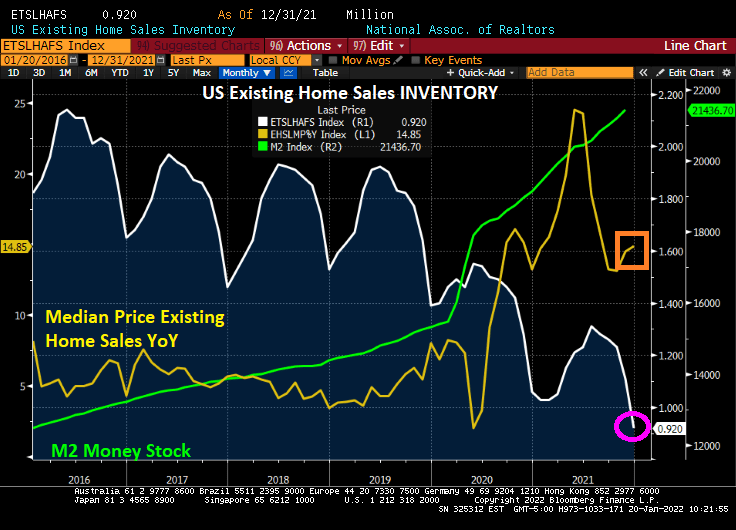
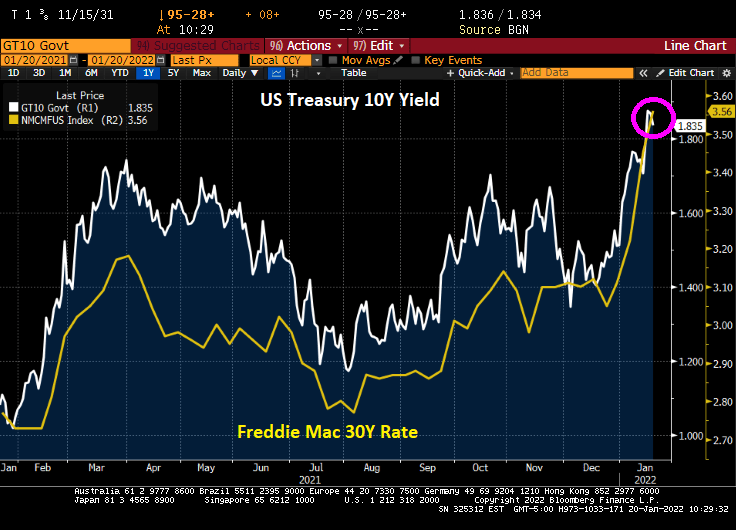
US Existing Home Sales: Still No Inventory, Median Price UP 14.85% YoY (Freddie’s 30Y Mortgage Rate Rise To 3.56%)

The banner headline is … US existing home sales declined 4.6% MoM in December. But that isn’t the interesting news. The interesting news is the mystery of the missing housing inventory. While various pundits told us that inventory would be returning … it isn’t. And the median price of existing home sales is up 14.85% YoY with insane Fed stimulus still in play.

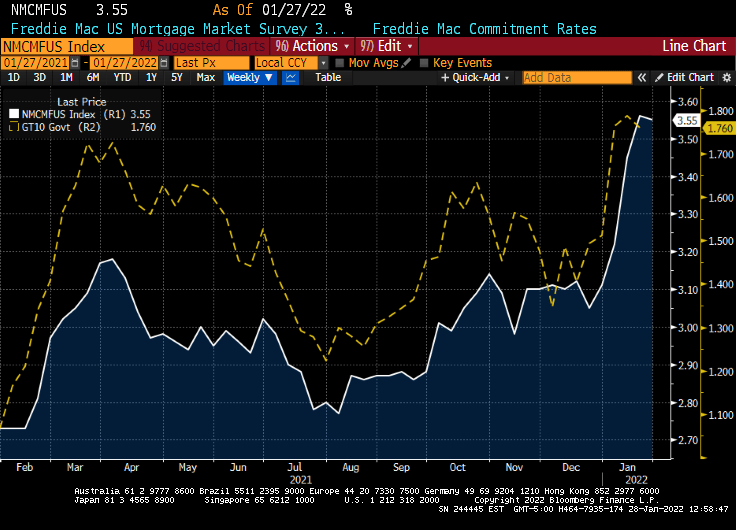
That was December. What will January bring with rising mortgage rates? Freddie Mac’s 30-year commitment rate rose to 3.56% today.

When will housing inventory for sale start to increase? Probably about the same time The Fed ACTUALLY starts raising interest rates and paring back on the monetary stimulus.

Simply Unaffordable! Fannie Mae Multifamily Financing Grew 23% … While Home Prices Grew 19.1% And Real Hourly Earnings Fell -2.36% (Rising Mortgage Rates Make The Affordability Problem WORSE)

Mortgage Orb has the tantalizing headline: “Fannie Mae’s Financing for Multifamily Affordable Housing Grew Over 23%.” At first, this sounds amazing … until you realize how simply unaffordable housing is much of urban/suburban America.

If you look at the following chart, you can see multifamily (5+ unit) starts remain elevated (pink box) which is not surprising given that home prices at growing at 19.1% YoY nationally (orange circle) and REAL hourly earnings have declined (yellow triangle) thanks to reemergence of inflation after 40 years.

Then we have the humming dragon, rising mortgage rates, that will reduce housing affordability even further.

Home ownership has become simply unaffordable much like steaks. Doctor, doctor (Yellen), we got a bad case of unaffordable home ownership.

5-Year Treasury Yield Highest Since Fed COVID Intervention As Canada 10Y Rises 18.7 BPS (Gold, Bitcoin, Ethereum Rise)

Treasury yields rose a second day, with five-year rates hitting the highest since before the pandemic took hold in the U.S., amid increasing conviction that the Federal Reserve will raise rates at least three times beginning in May.

The five-year Treasury note’s yield climbed as much as 3.8 basis points to 1.392%, the highest since Feb. 20, 2020, while 30-year yields bumped up toward their 200-day moving average.

Yields across the curve are rising for a second straight day, after Monday’s selloff lifted the 10-year note’s yield by nearly 12 basis points in its worst start to a year since 2009. The two-year yield topped 0.80% for the first time since March 2020.

At the 10-year mark, we see Canada’s sovereign notes rising 18.7 basis points.

Also at the 10 year mark, we see the US 1-year breakeven inflation rate (red line) surging.

The US Treasury actives curve and Dollar Swaps curve remain steeply upward sloping.

And on the crypto and gold front, gold surged this morning after tanking in the evening, while Ethereum (blue) is doing quite well along with Bitcoin.

My favorite non-bond, non-alt investment chart. The S&P 500 index charted against The Fed’s M2 Money Stock.

Following my friend Jesse’s habit of posting great French food dishes, here is one from my favorite Parisian eatery, Le Duc de Richelieu. Mmmmmmm.

RIP, Hap Jacobs.

Housing Inflation? Construction Materials Rising At 34.7% YoY In November While Median Price Of New Home Sales Rose 18.8%

Well, at least construction materials are growing more slowly than energy prices!

The Producer Price Index for Construction Materials rose at a 34.7% YoY pace in November.

So it is no surprise that the median sales price for new homes rose 18.8% YoY in November.