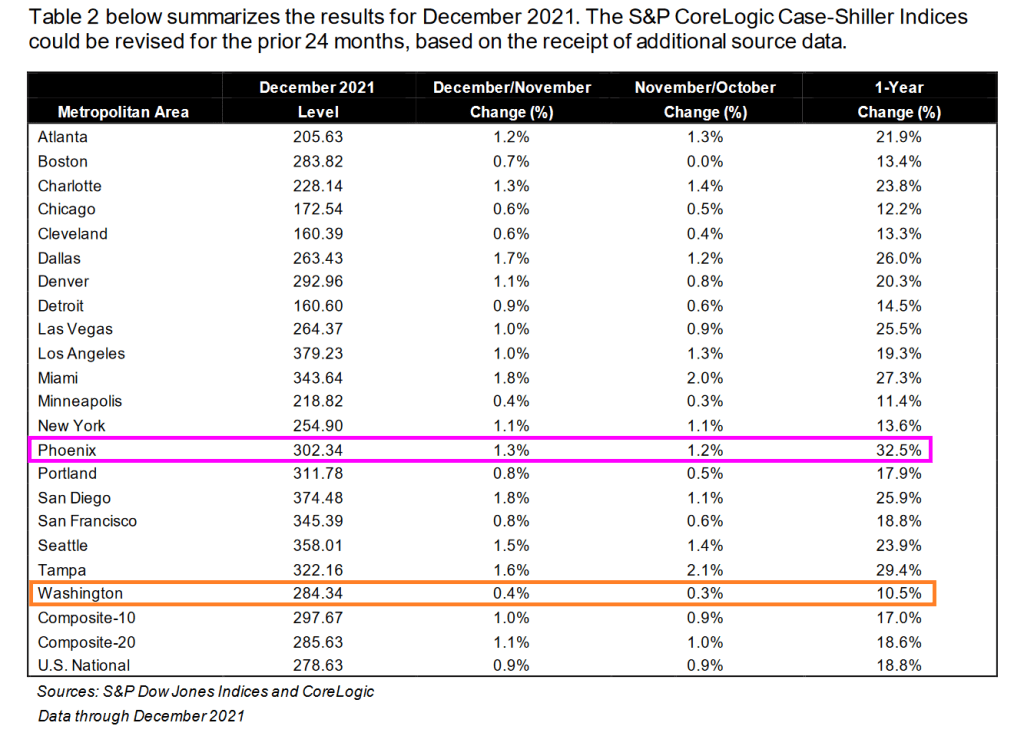
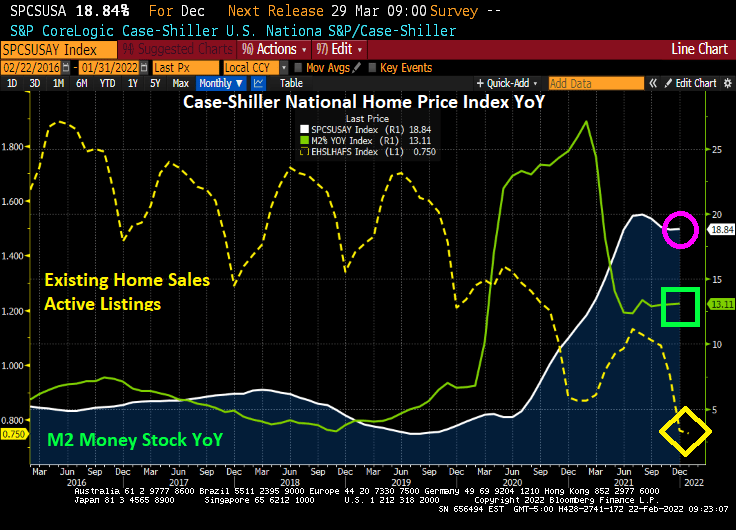
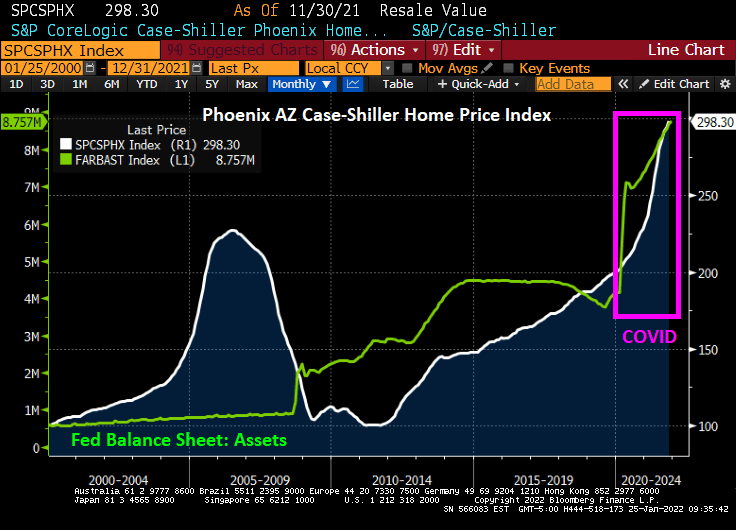
All 20 metro areas in the Case-Shiller 20 index grew at 10% or higher YoY with my former home city Phoenix leading the way at 32.5% YoY house price growth. Washington DC, aka Mordor on The Potomac, was in last place at 10.5% YoY.
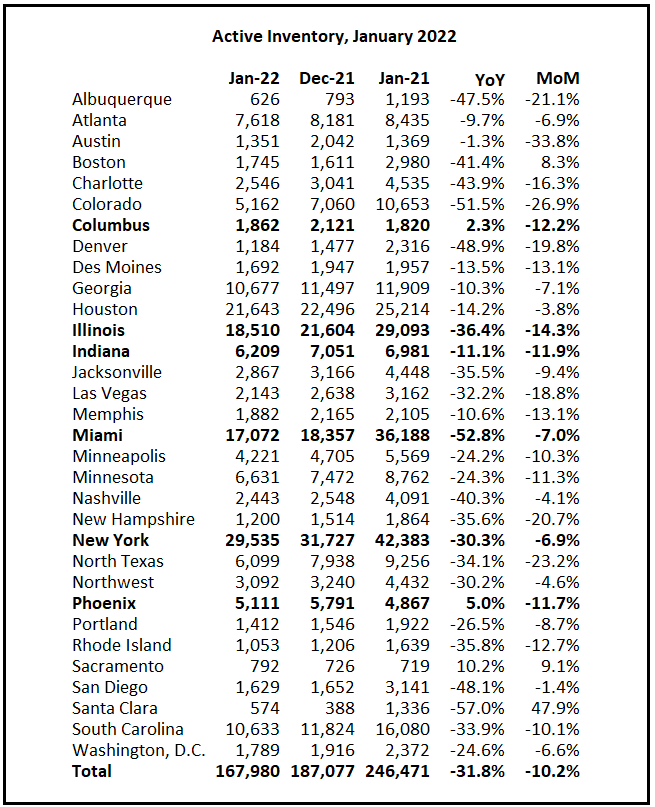
In terms of active inventory of housing, only Phoenix and Columbus Ohio are showing positive growth in active inventory YoY. But even Phoenix and Columbus saw a decline MoM (or month-over-month).
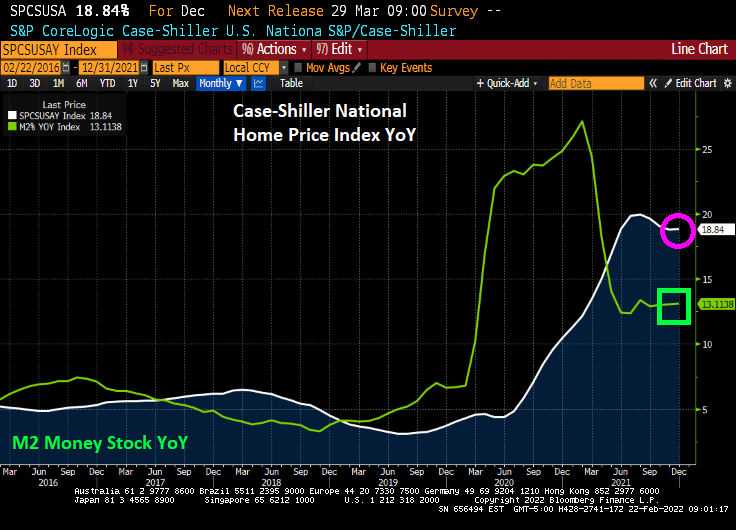
Including Existing Home Sales Active listings in the first chart, we see The Federal Reserve continuing to pump money at at 13.11% clip while active inventory is at an all-time low.
If The Fed does its expected “shock and awe” (or shock and awful), it will be more than the stock markets will crash. The housing market could crash too.
Take the current US housing situation with its limited inventory of listings combined with massive Fed stimulypto.
US 1-unit housing starts are down -4.1% in January. But heck, it is January! But on a year-over-year basis, 1-unit housing starts are down -2.4%. But what will happen if The Fed ACTUALLY withdraws its gargantuan monetary stimulus (green line)?
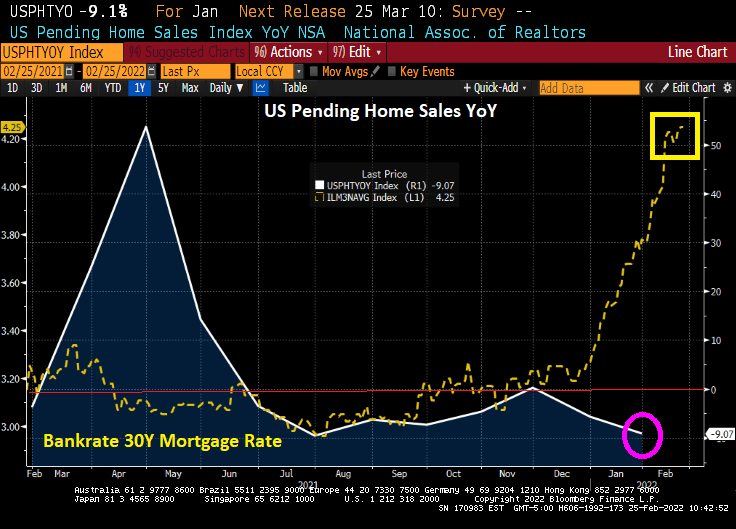
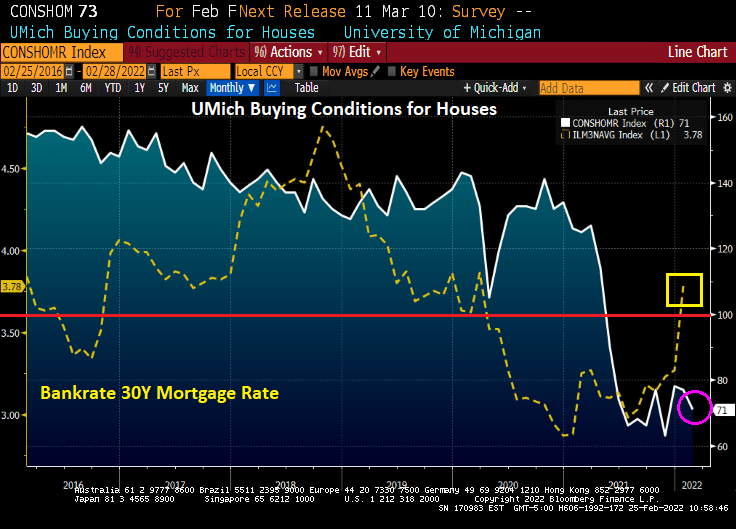
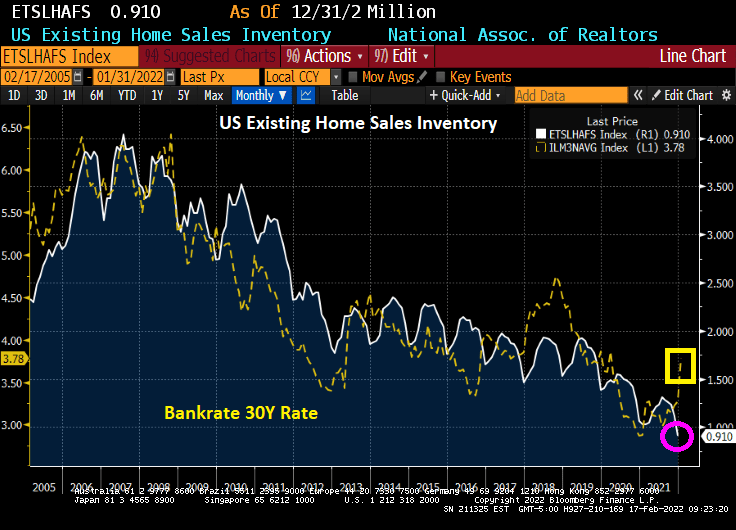
Existing home sales inventory continues to decline as Bankrate’s 30-year mortgage rate starts to climb with expectations of Fed “Shock and Awful.”
Say hello to The Federal Reserve Board of Governors!
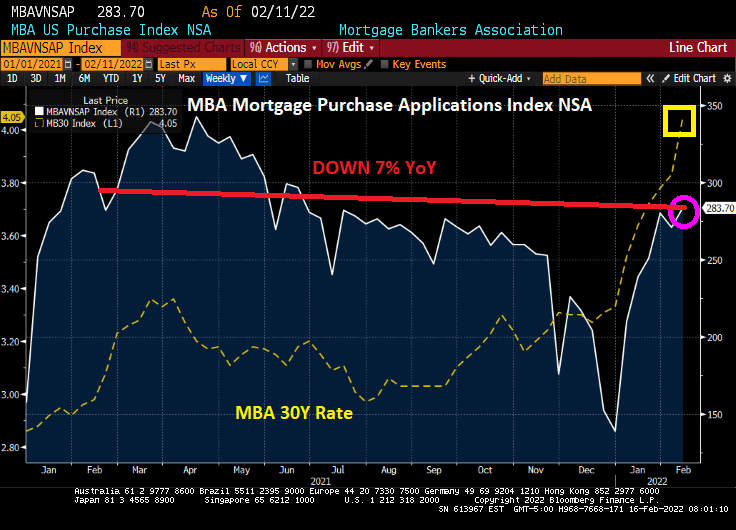
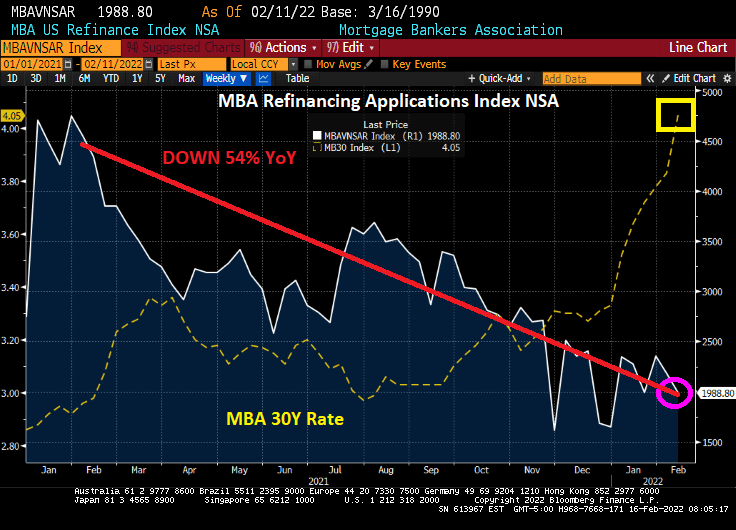
The good news is that borrowers are continuing to apply for a mortgage. The bad news is that they are applying at a 7% slower rate than the same time last year.
Mortgage applications decreased 5.4 percent from one week earlier, according to data from the Mortgage Bankers Association’s (MBA) Weekly Mortgage Applications Survey for the week ending February 11, 2022.
The seasonally adjusted Purchase Index decreased 1 percent from one week earlier. The unadjusted Purchase Index increased 5 percent compared with the previous week and was 7 percent lower than the same week one year ago.
The Refinance Index decreased 9 percent from the previous week and was 54 percent lower than the same week one year ago.
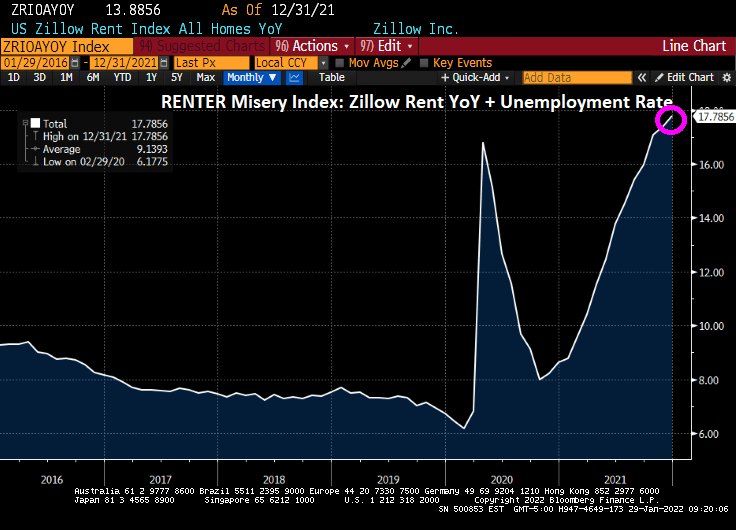
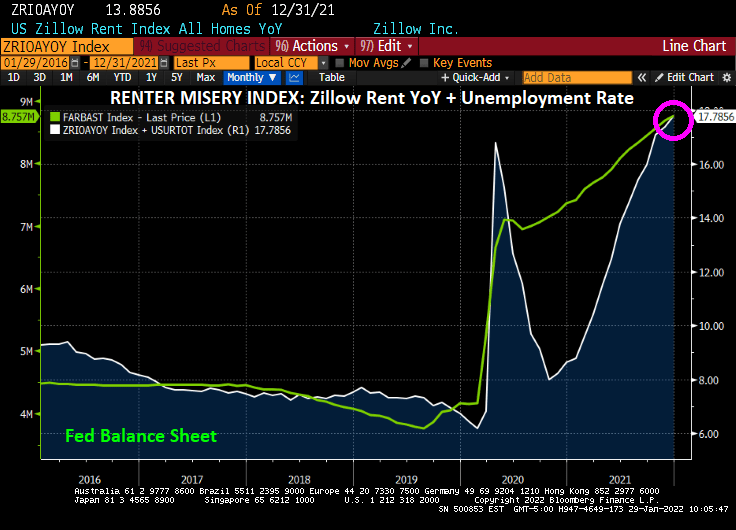
The misery index is traditionally inflation rate plus U-3 unemployment rate. The RENTER misery index is the Zillow Rent Index YoY + U-3 unemployment rate to demonstrate the hardship of renters because of soaring home prices.
Notice that because of rising home prices, the Renter misery index has overwhelmed the improvement in unemployment.
As I typically do, I will now include The Fed’s balance sheet (as a proxy for Fed stimulus and supporting Federal government expenditures). Yes, you can see that The Fed and Federal government are responsible for our modern day “Grapes of Wrath.”
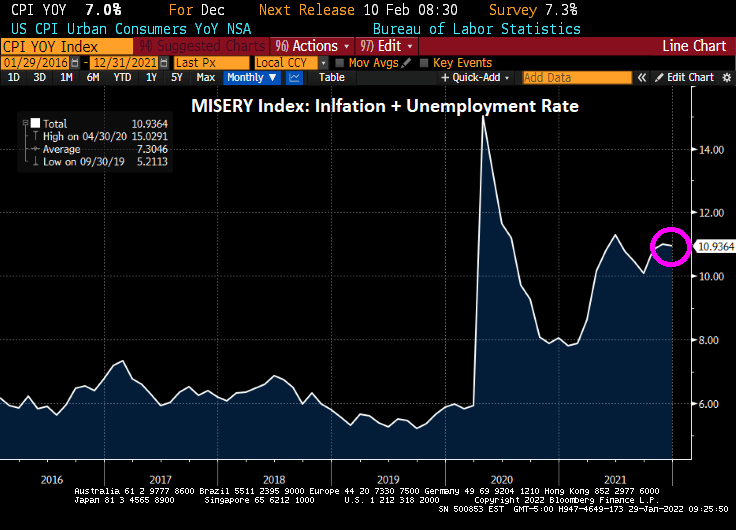
If we look at the TRADITIONAL misery index, we see that misery remains above 10 (it was below 6 prior to the COVID outbreak in early 2020).
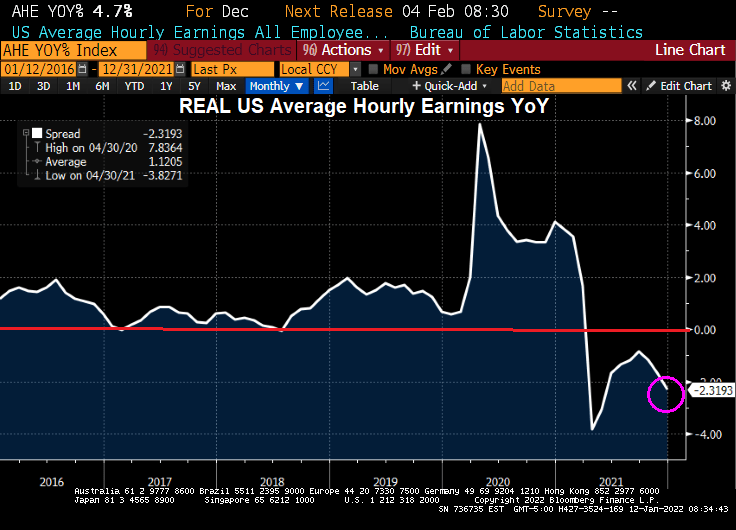
Remember that the REAL average hourly earning growth of Americans is NEGATIVE. Gains in wage growth more than offset by inflation.
I won’t even mention how inflation is crushing retirees since Social Security and pension plans rarely adequately compensate retirees for inflation.
Now for the really bad news. 81-year old senior, House Speaker Nancy Pelosi, has announced that she is running for Congress yet again from leftist-stronghold San Francisco. Although she has an expensive home in Georgetown and a beautiful vineyard in Napa Valley. Pelosi’s vineyard only sells grapes to other wine makers. Not bad for a career civil servant!
I really wanted Pelosi to produce a wine called “The Grapes of Wrath” in honor of her insider trading and massive wasteful spending of taxpayer money that has helped generate inflation, rampant government debt growth and hurting retirees and hourly workers.
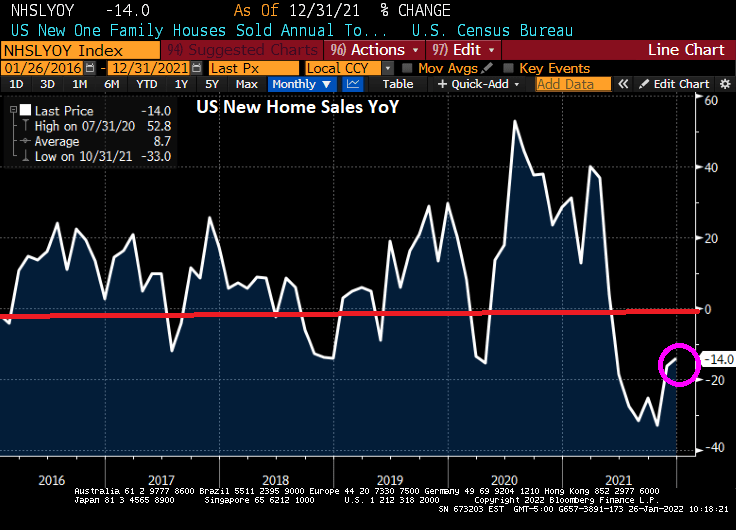
US new home sales spiked in December by 11.9% from November, but were down 14% year-over-year.
But the median price of new home sales (YoY) declined to 3.4%.
The Midwest saw a surge in new home sales (+56%).
The MBA’s mortgage applications index shows declining purchase applications (-1.83%) and declining refinancing applications (-12.60%) as mortgage rates increased from 3.64% to 3.72% for the week of 01/21.
Now, mortgage purchase applications rose for the week of 01/21 if we used non-seasonally adjusted data.
The Case-Shiller National home price index “slowed” to 18.81% YoY in November as The Fed continues its monetary stimulypto. Notice that The Fed is easing even when there is limited inventory available. Result? Hideous home price inflation.
Which metro area is growing the fastest, making housing even more unaffordable for renters? Phoenix AZ is growing at a 32.2% YoY clip while Washington DC is the slowest growing metro area at 11.1% YoY. The second faster growing metro area in Tampa FLA.
Phoenix AZ is growing at the fastest rate in the nation as The Fed still has its monetary stimulus at FULL SPEED AHEAD.
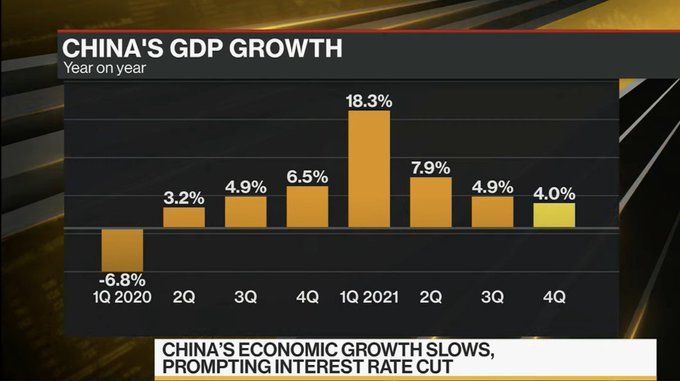
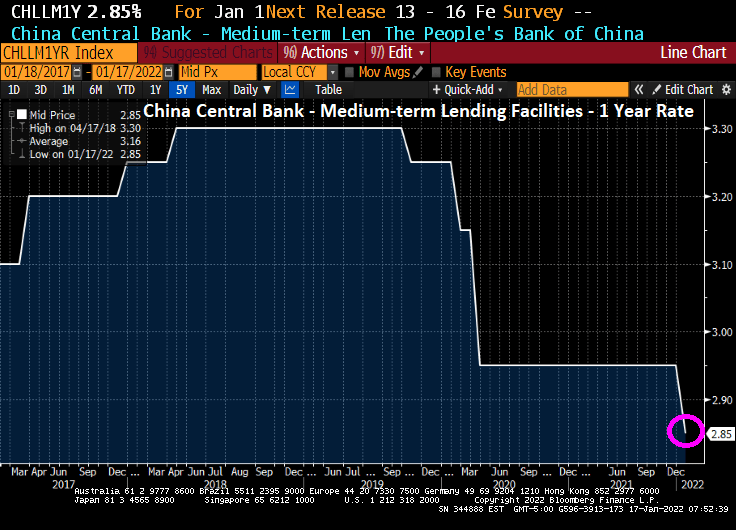
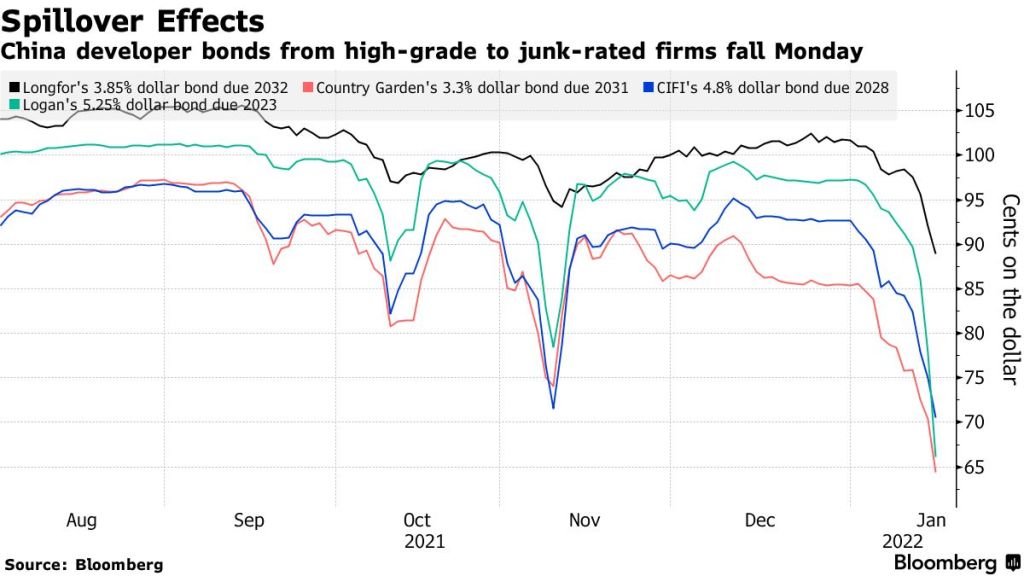
The Chinese Real Estate Developer Debacles continues to spread from Evergrande to other developers as China’s Central Bank cuts rates due to Omicron spread.
First, China’s Central Bank cut their 1 year medium-term lending rate to 2.85% from 2.95%. And the growing malaise in China’s real estate development continues.
Fresh turmoil rocked Chinese property bonds on Monday on concern over the true scale of the industry’s hidden debts, deepening a selloff among higher-rated firms.
A Logan Group Co. note due 2023 sank 14.1 cents to a record low 62.9 cents after Debtwire reported the developer could be on the hook for $812 million of guarantees on outstanding obligations due through 2023. Country Garden Holdings Co.’s bond due 2024 tumbled 12.9 cents to 67.7 cents, extending last week’s selloff for the country’s biggest developer.
Let’s see if the US Federal Reserve follows through with it rates increases when China is cutting their rates.
If you look at the following chart, you can see multifamily (5+ unit) starts remain elevated (pink box) which is not surprising given that home prices at growing at 19.1% YoY nationally (orange circle) and REAL hourly earnings have declined (yellow triangle) thanks to reemergence of inflation after 40 years.
Then we have the humming dragon, rising mortgage rates, that will reduce housing affordability even further.
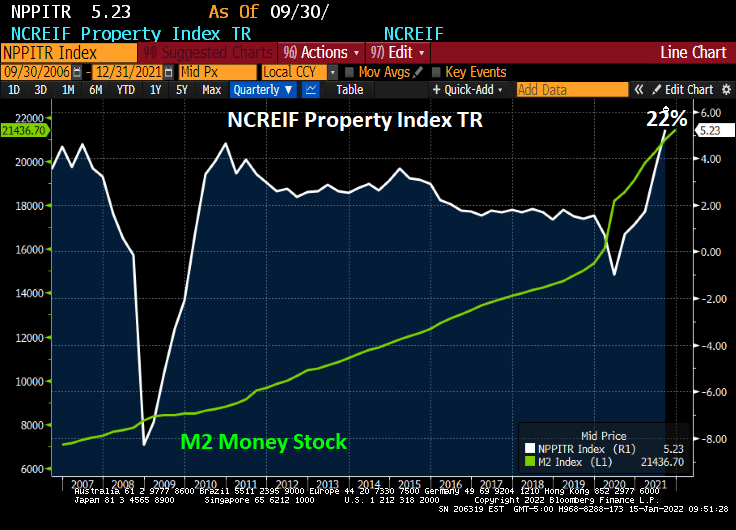
Inflation is burning out of control. While home price growth has been off the cherts (as Jean-Ralphio would say), commercial real estate has jumped incredibly at 22% YoY. The Bloomberg charting function hasn’t updated for the Q4 NCREIF report yet so I had to manually write-in 22% on the following chart.
So, what will happen IF The Fed follows through with its monetary stimulus reduction? JPMC’s Jaime Dimon warns that The Fed could hike 7 times in 2022 and not be ‘sweet and gentle’.
















You must be logged in to post a comment.