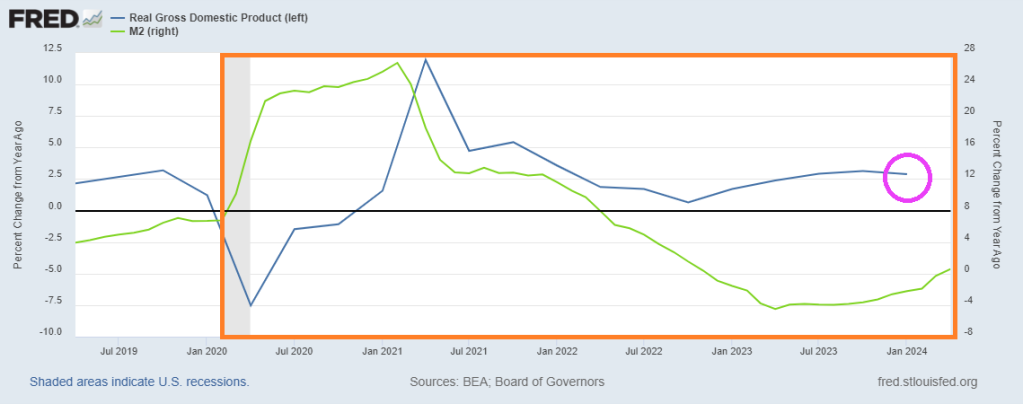
What I like about Biden’s economy … nothing. Most of Biden’s economic growth came from Trump’s spending and Fed monetary policy from the Covid shutdown of 2020.
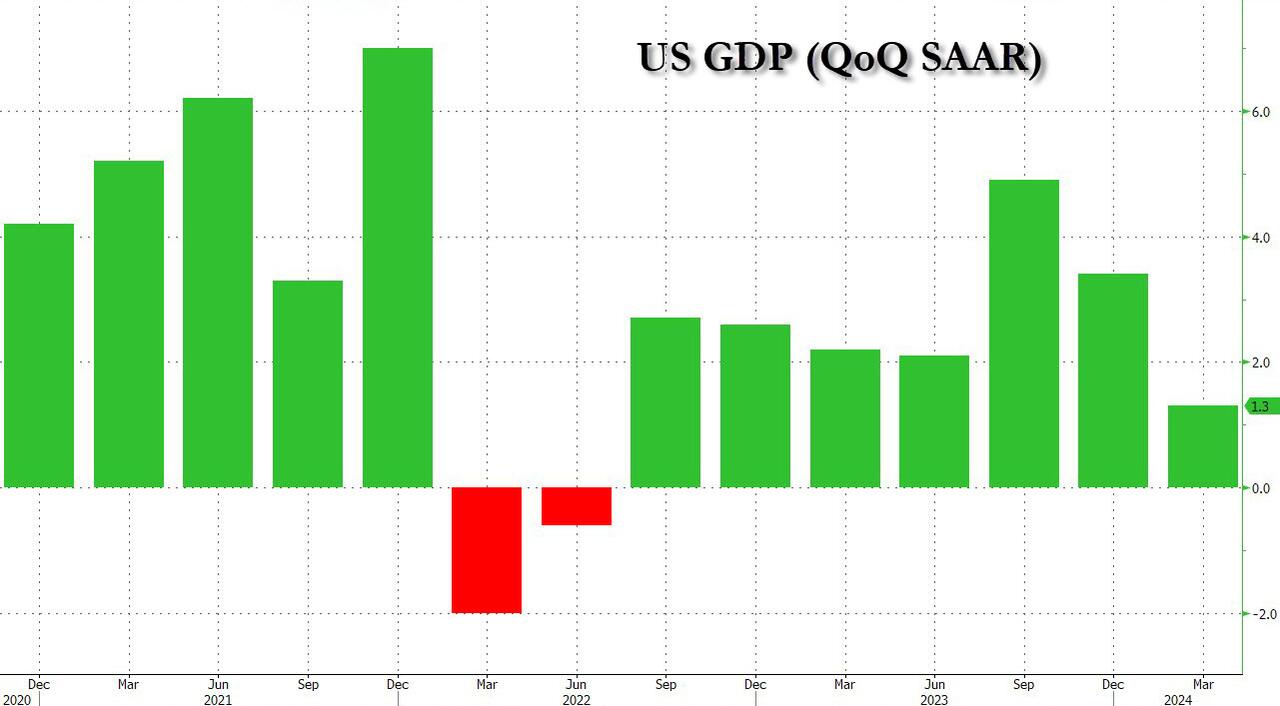
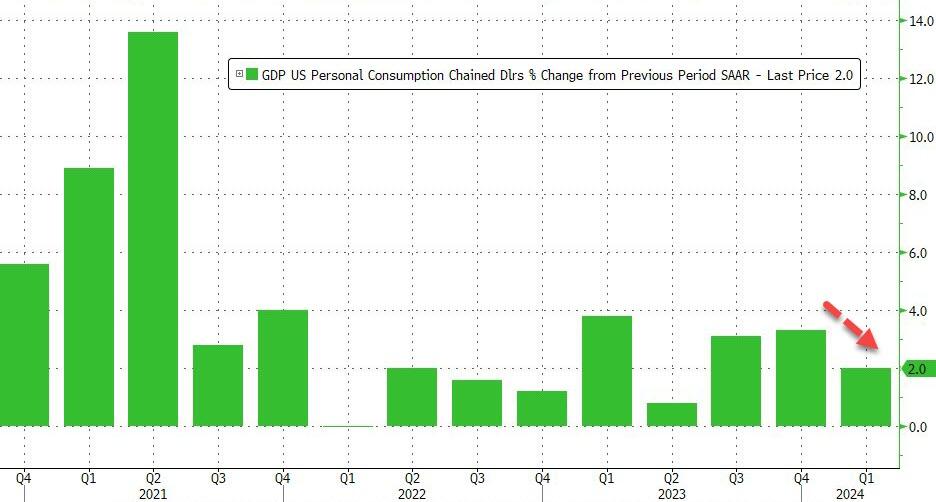
The sharp downward revision primarily reflected a downward revision to consumer spending, which rose 2.0% annualized, down from 2.5% in the first GDP report and below the 2.2% estimate.
Drilling down into the number, the 1.3% increase reflected increases in consumer spending (below previous forecasts) and housing investment that were partly offset by a decrease in inventory investment. Imports, which are a subtraction in the calculation of GDP, increased.
The increase in consumer spending reflected an increase in services that was partly offset by a decrease in goods. Within services, the leading contributors to the increase were health care as well as financial services and insurance. Within goods, the leading contributors to the decrease were motor vehicles and parts as well as gasoline and other energy goods.
The increase in housing investment was led by brokers’ commissions and other ownership transfer costs as well as new single-family housing construction.
The decrease in inventory investment was led by decreases in wholesale trade and manufacturing
In terms of bottom-line contributions, we find the following:
Personal consumption accounted for 1.34% (down from 1.68%), or more than the entire GDP print.
Fixed Investment added 1.02%, up from 0.91% in the first estimate.
The change in private inventories subtracted -0.45%, a deterioration from the -0.35% estimated previously.
Net trade (exports less imports), subtracted -0.89% from the bottom line print, comparable to the -0.86% detraction in the first estimate.
Finally, government added just 0.23%, up from 0.21% initially estimated, yet still the lowest contribution since Q2 2022.
Home buyers will be able to buy a home without putting any money down under a new program launched by United Wholesale Mortgage, one of the largest U.S. mortgage lenders.
The Pontiac, Mich.-based company’s new program will be available to first-time home buyers and people earning at or below 80% of an area’s median income, the company said in a press release.
UWM (UWMC) will give eligible buyers a second-lien loan of up to $15,000, in the form of down-payment assistance, for 3% of the home’s purchase price. The loan will not accrue interest or require a monthly payment.
“Homeownership is something we’re very passionate about,” Melinda Wilner, chief operating officer at UWM, told MarketWatch.
The company had previously allowed buyers to put down as little as 1% on their homes, but it wanted to go further to help home buyers, she said. The lender is anticipating a higher volume of borrowers with its new zero-down program, Wilner added.
Poor underwriting practices were a key driver of the subprime-mortgage crisis in the U.S., the International Monetary Fund wrote in 2008. But unlike the low- and no-down-payment loans that proliferated during that time – when lenders made loans to people who eventually were unable to pay them and lost their homes – UWM’s program is different, Wilner said.
“The aspect of this program that makes me nervous is the silent second mortgage,” Anneliese Lederer, senior policy counsel at the nonprofit Center for Responsible Lending, told MarketWatch in an interview. “It’s great that there’s no interest on it, but it’s a balloon payment, and borrowers need to understand what a balloon payment is.”
A balloon payment refers to a bigger-than-usual one-time payment that is required by the lender at the end of the loan term, according to the Consumer Financial Protection Bureau.
On its website, UWM states in the fine print at the bottom of the page that the second loan “has no minimum monthly payment requirements, a term of 360 months and is fully due as a balloon payment upon the occurrence of either a refinance of the [first mortgage], [or] payoff of the [first mortgage] or the final payment.”
Not Like 2008?!
Housing prices are stretched
The economy is slowing
The lender has no cushion against falling home prices
There are indications of steeply falling homes in many markets.
OK, we don’t have massive liar loans like we did in 2008. But mortgage affordability is the lowest ever, and unemployment is starting to tick up.
Anything to Keep the Bubble Going
To top it off, these mortgages are explicitly for people who make 80% or less of an area’s median income.
How dumb is that? In general, such borrowers have no down payment, if any savings at all, and many are already likely on the edge.
It would make more sense giving these mortgages to those who make 120% or more of an area’s median income, provided they also have little debt, and just lack the down payment.
President Joe Biden called on Congress to provide up to $25,000 in down-payment assistance to first-generation home buyers in his State of the Union Address.
These vote buying proposals to keep the economy humming long enough to win an election are always at the expense of those who fall for the scheme.
The loss of a job or any unexpected debt will throw these buyers right over the cliff.
The Commerce Department revised March durable goods orders from +2.6 percent to +0.8 percent. Now it reports a 0.7 percent gain vs an expectation of -0.5 percent.
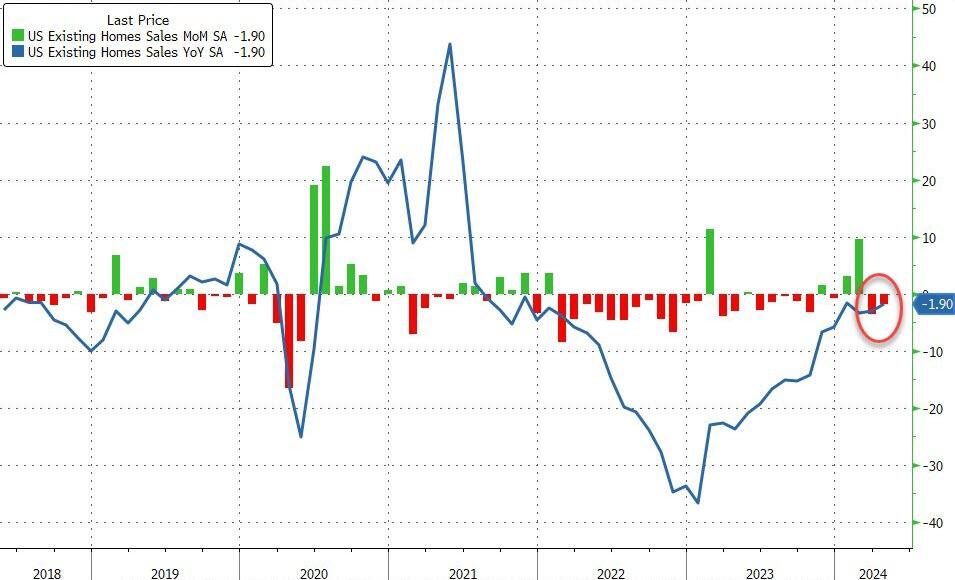
Existing-home sales fell 1.9 percent in April and are also down 1.9 percent from a year ago. Sales have not gone anywhere for 17 months.
Key Highlights
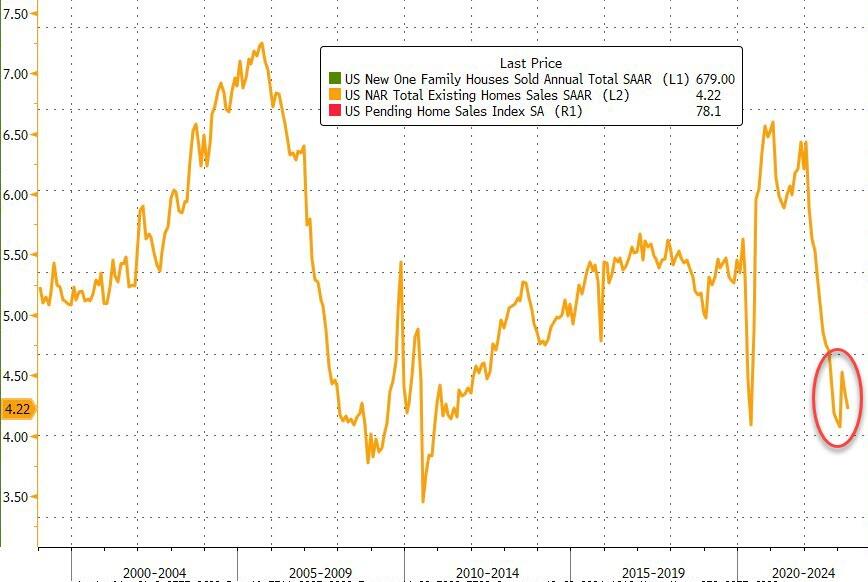
Existing-home sales faded 1.9% in April to a seasonally adjusted annual rate of 4.14 million. Sales also dipped 1.9% from one year ago.
The median existing-home sales price rose 4.8% from March 2023 to $393,500 – the ninth consecutive month of year-over-year price gains and the highest price ever for the month of March.
The inventory of unsold existing homes climbed 9% from one month ago to 1.21 million at the end of April, or the equivalent of 3.5 months’ supply at the current monthly sales pace.
Big Negative Revisions to BLS Monthly Jobs in 2023
On April 24 the BLS released a little-read jobs report that shows reported jobs in 2023 may be wildly overstated.
Business Employment Dynamics (BED) data and and Monthly Job Data both from the BLS, chart by Mish
The BED report is based on records on 9.1 million private sector establishments. Current Employment Statistics (CES) is the monthly jobs report based on 670,000 establishments.
Obviously, the BED report is more timely, but it lags. CES provides an opportunity for economists (and the president) go gaga over numbers likely to be wildly wrong.
CES Overstatement
2023 Q2 CES Overstatement: 489,000 Jobs
2023 Q3 CES Overstatement: 832,000 Jobs
Q2+Q3 Overstatement: 1.321 Million Jobs
Thus, the BLS says that the BLS monthly job reports for 2023 Q2 and Q3 are overstated by a total of 1.321 million jobs.
Zero Percent Down Synopsis
An economic slowdown is underway (see five previous links).
Jobs are overstated by 1.3 million, discretionary spending is faltering, and UWM (UWMC) is offering zero percent down mortgages to buyers most likely to get in trouble if anything goes wrong.
The Case-Shiller national home price index hit a new high in February. That’s the latest data. Economists don’t count this as inflation.
Other than the late stages of the 2008 housing bubble, there has been no worse time in history to offer zero percent down mortgages.
My own personal comments: Will UWM be retaining these loans on their balanace sheet? Or simply resellling them to Fannie Mae, Freddie Mac? Likely the latter.
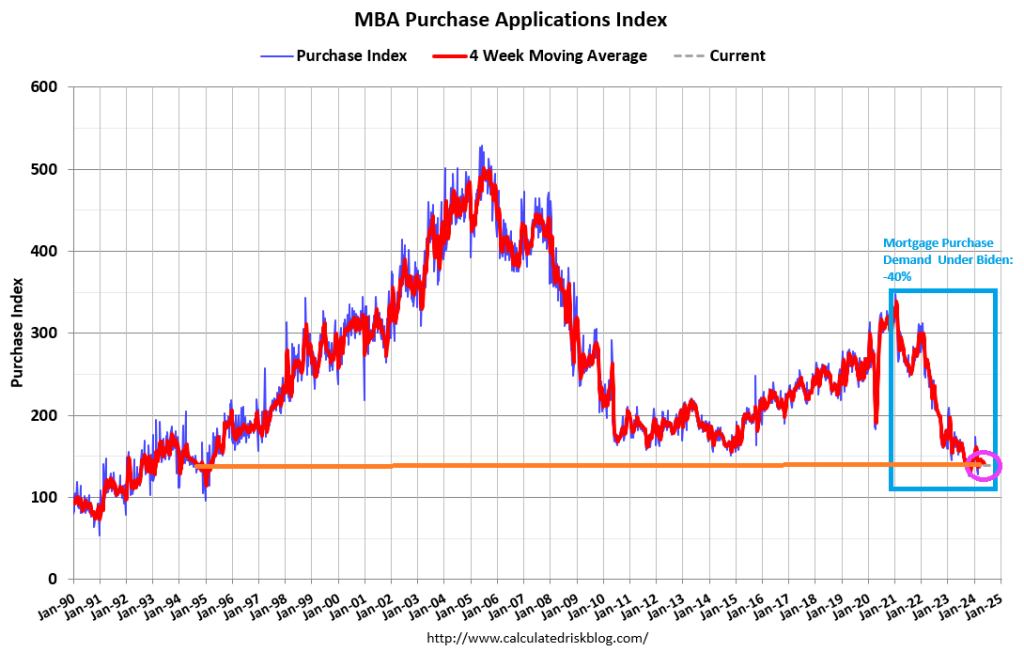
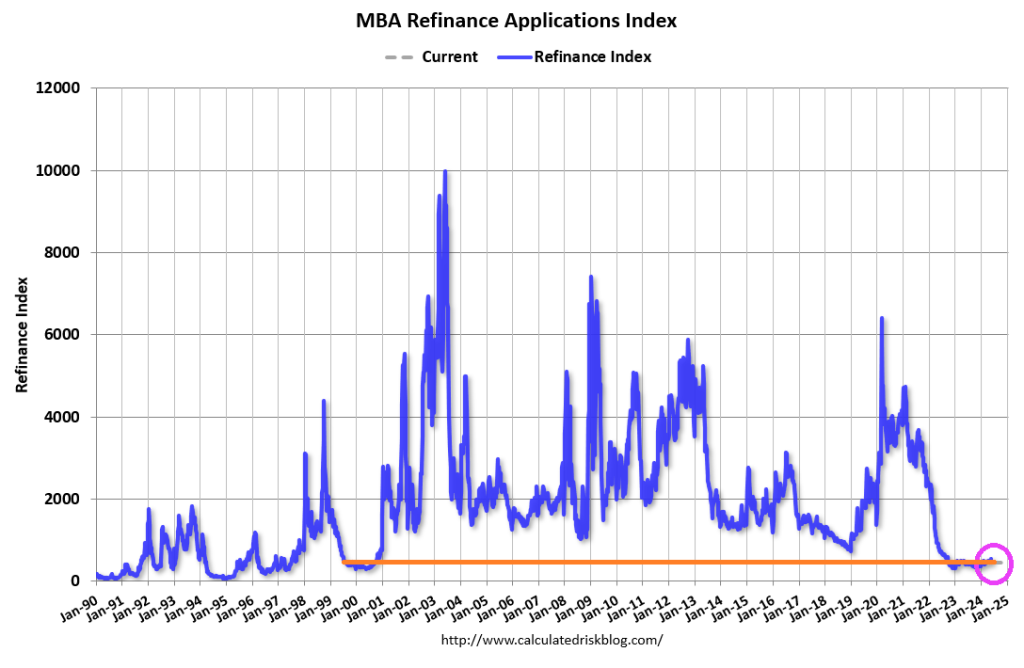
The Market Composite Index, a measure of mortgage loan application volume, decreased 5.7 percent on a seasonally adjusted basis from one week earlier. On an unadjusted basis, the Index decreased 6.3 percent compared with the previous week. The seasonally adjusted Purchase Index decreased 1 percent from one week earlier. The unadjusted Purchase Index decreased 3 percent compared with the previous week and was 10 percent lower than the same week one year ago. And -40% under Biden.
The Refinance Index decreased 14 percent from the previous week and was 12 percent higher than the same week one year ago.
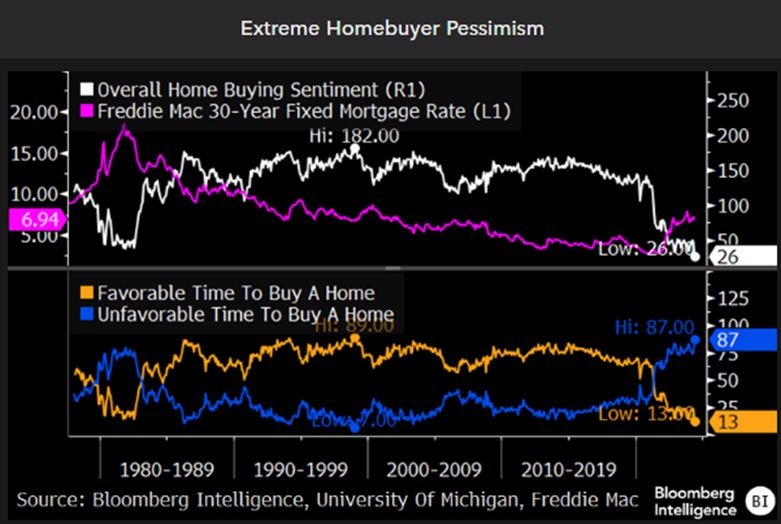
It is still an unfavorable time to buy a home!
From the film “Ronin” that sums up actor Robert DeNiro in one sentence.
Spence (Sean Bean): “You know, you think too hard.” Sam (Robert DeNiro): “Nobody ever told me that before.”
How would DeNiro consider the 40% drop in mortgage purchase demand under Biden?
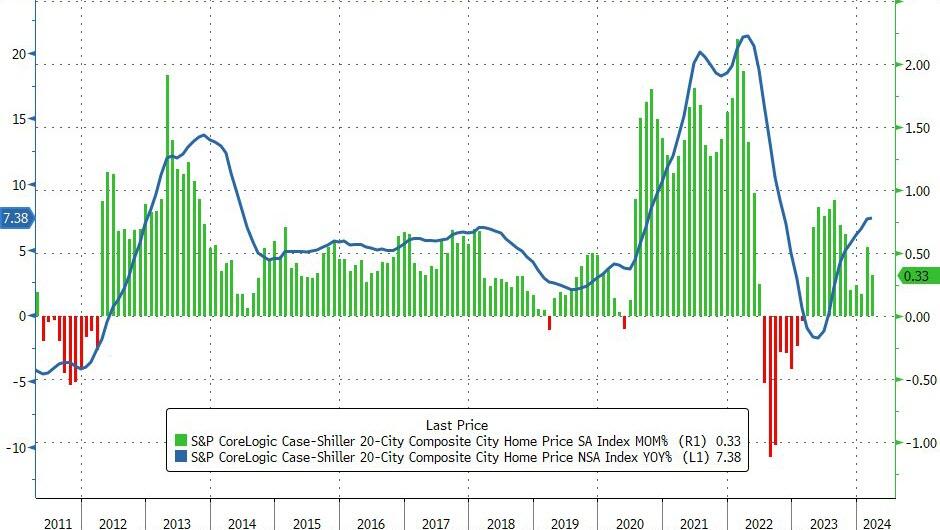
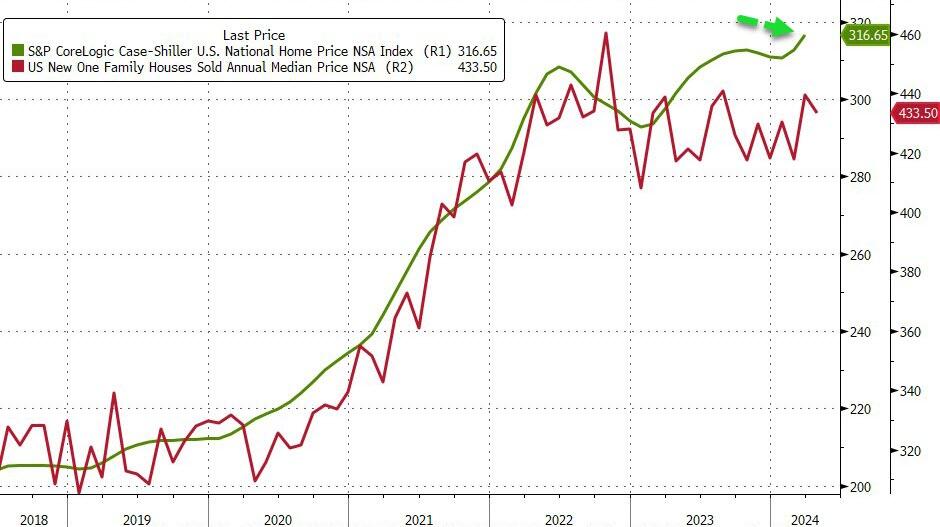
This pushed the price up 7.38% YoY – the fastest rise since October 2022…
“We’ve witnessed records repeatedly break in both stock and housing markets over the past year. Our National Index has reached new highs in six of the last 12 months.” says Brian D. Luke, Head of Commodities, Real & Digital Assets at S&P Dow Jones Indices.
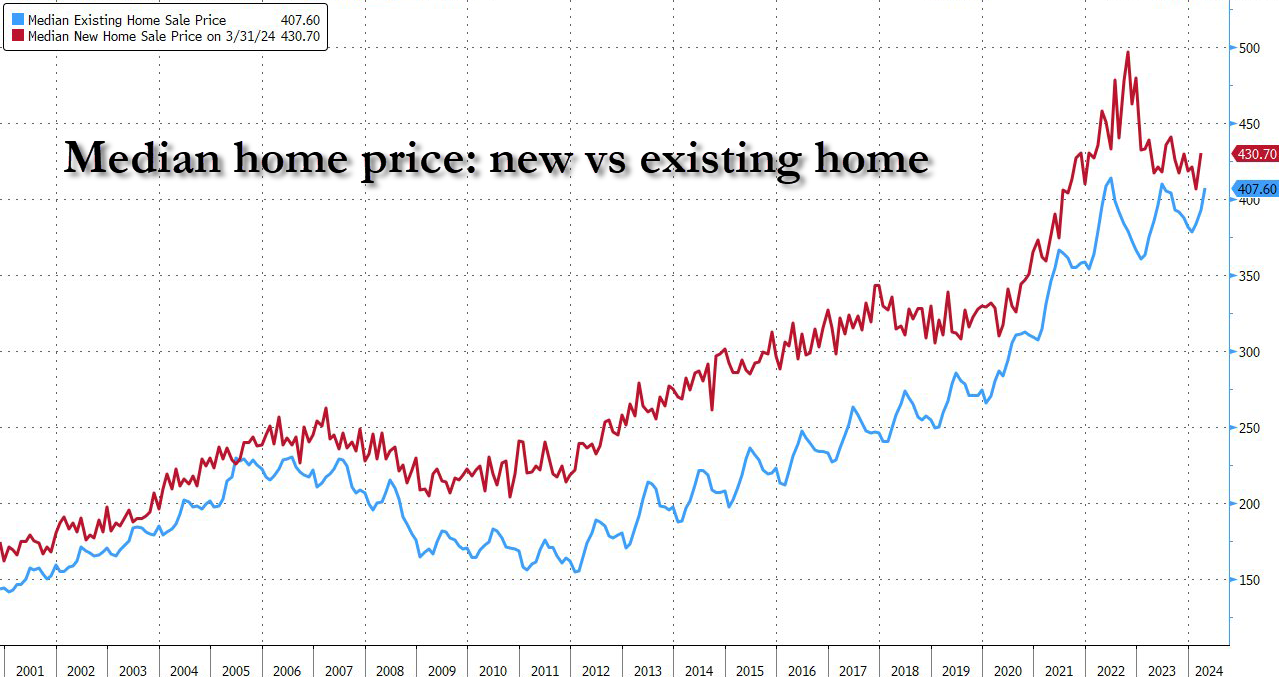
Overall, US home prices reached a new record high in March (as median new home prices began to fall)…
Source: Bloomberg
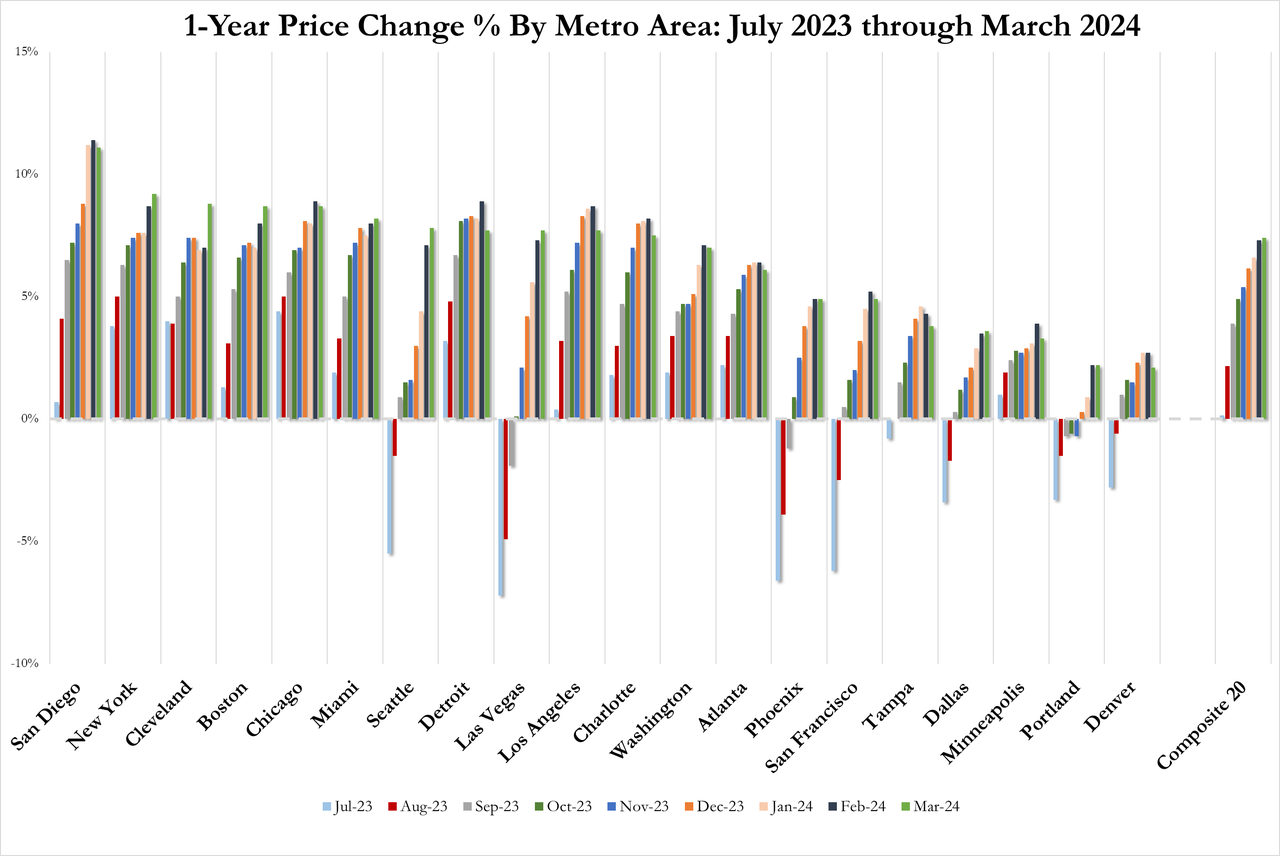
San Diego continued to report the highest year-over-year gain among the 20 cities this month with an 11.1% increase in March, followed by New York and Cleveland, with increases of 9.2% and 8.8%, respectively.
Portland, which still holds the lowest rank after reporting three consecutive months of the smallest year-over-year growth, posted the same 2.2% annual increase in March as the previous month.
Luke suggested this implies “a strong demand for urban markets.”
No city has seen a MoM decline in price in 2024.
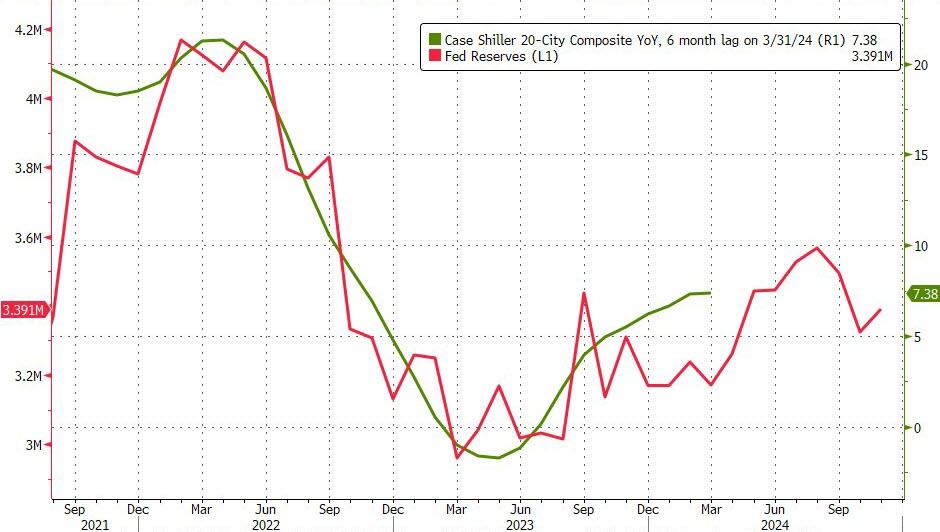
Home prices continue to track Fed Reserves closely, but a turning point may come soon…
Source: Bloomberg
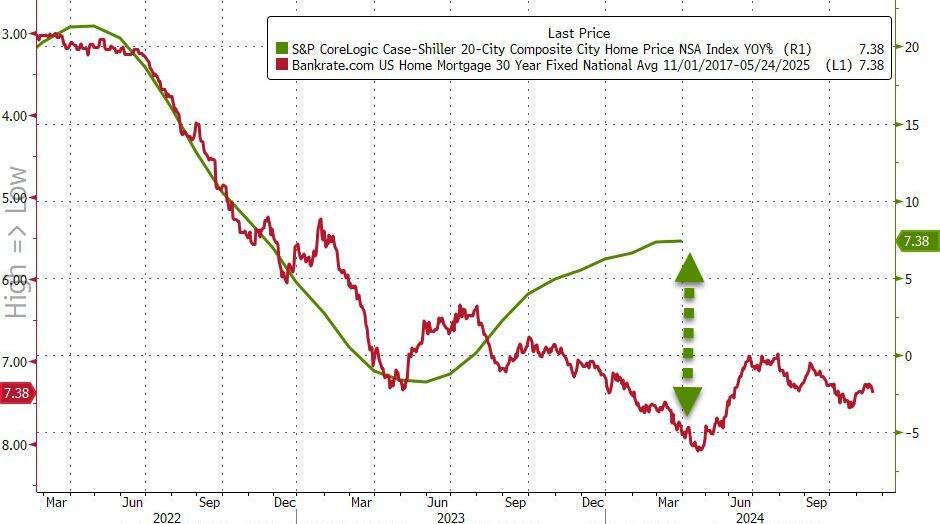
Given the smoothing and heavy lag in the Case-Shiller data, it’s hard to find a causal relationship between prices and mortgage rates…
Source: Bloomberg
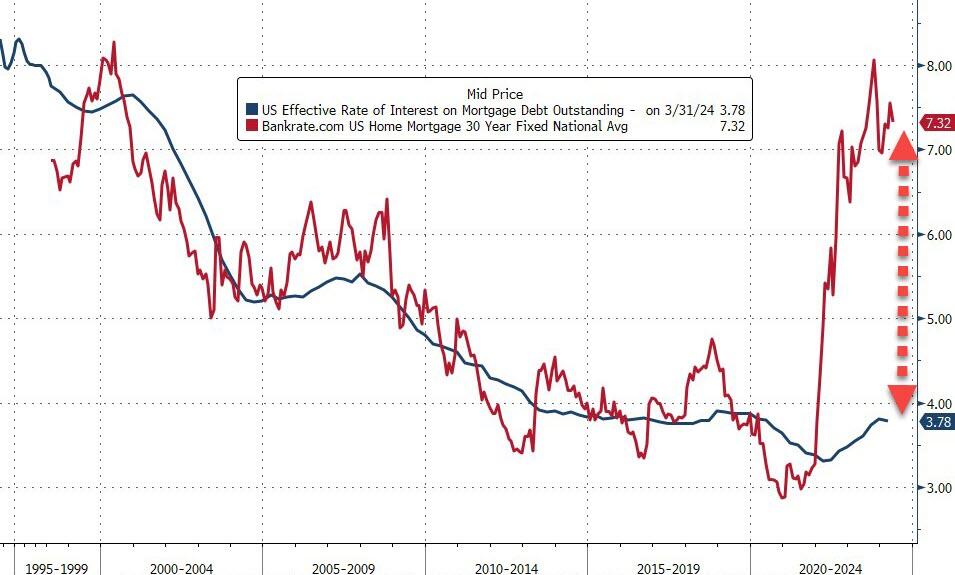
…but with rates remaining above 7%, it seems hard to believe prices can continue their advance.
Who the heck is HUD Secretary? It was Cleveland’s Marcia Fudge (a typical Biden political appointment). Now it is Adrianne Todman, from the US Virgin Islands and former executive director of the District of Columbia Housing Authority. Not exactly a high-powered resume for a cabinet post, Joe!
I saw former President Obama criticizing former President Trump for not passing “transformative” changes. That is, Trump didn’t sign any Obama-like transformative changes (like Obamacare). Truimp did try to slow down the damage done by Obama and his transformative agenda (e.g., open borders, wealth redistritution, green energy) that Biden has attempted to continue.
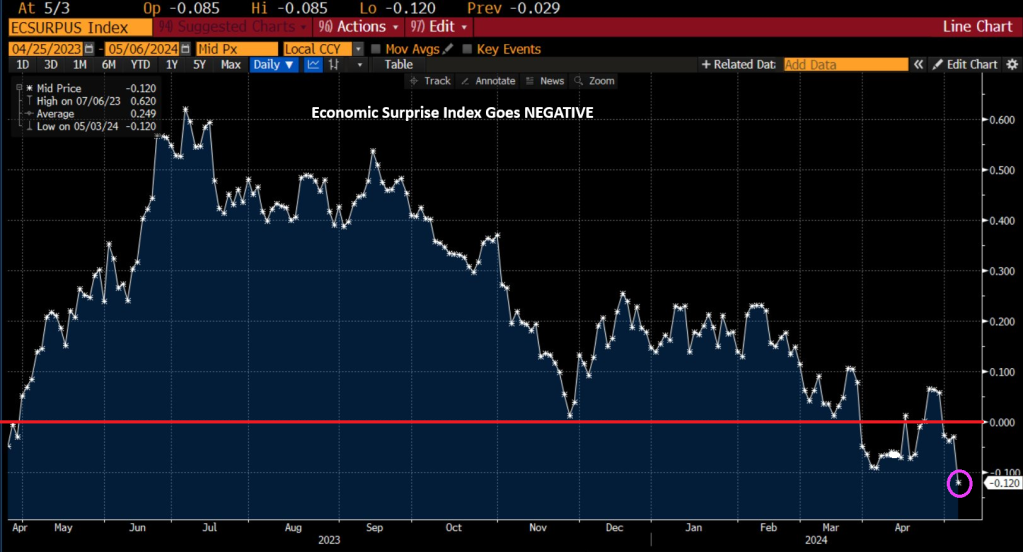
As we approach the party conventions and Presidential election of 2024, we saw the Economic Surprise Index (ESI) in May decline to -0.126.
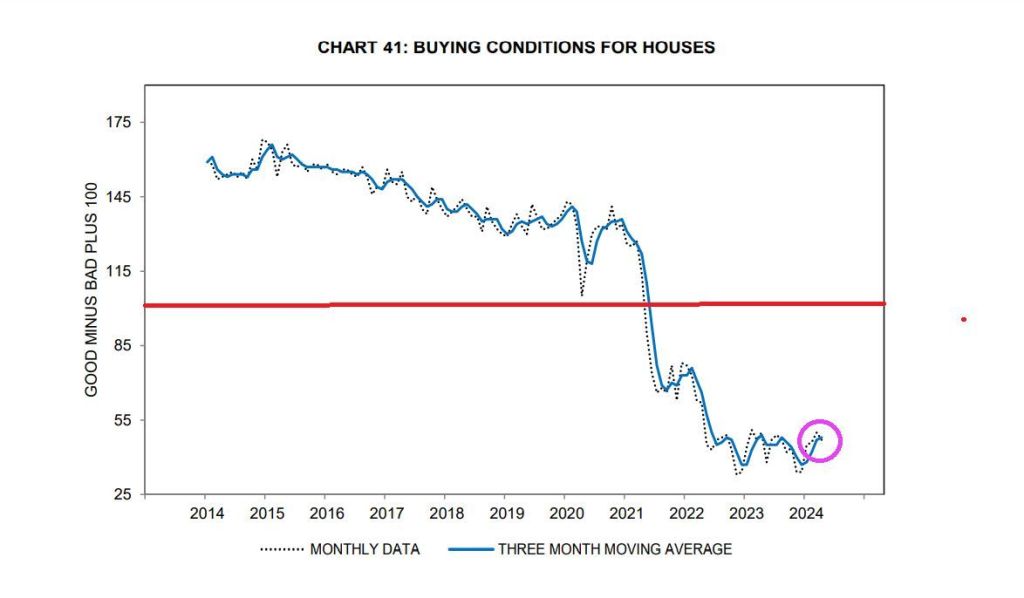
Coupled with Biden’s negative buying conditions for housing (higher mortgage rates and soaring house prices), Obama’s Jacobian transformative economic fantasty is on thin ice.
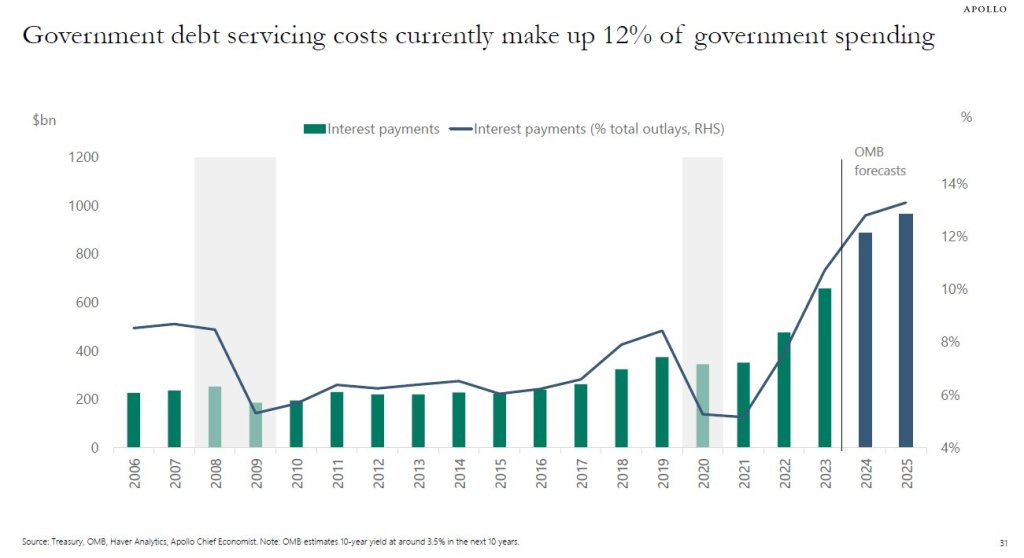
Speaking of higher interest rates, US debt servicing costs currently make up 12% of government spending. Jacobin revolution = Cloward-Piven.
Let’s hope the Obama/Biden Jacobin revolution doesn’t get to this point!
I was expecting MORE housing construction given the 10+ million illegal immigrants that Biden/Mayorkas have waived across the border.
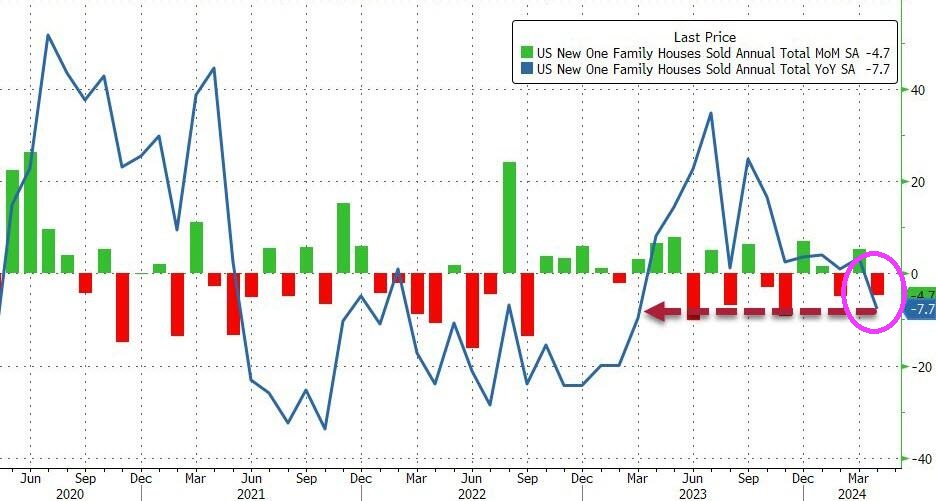
Sales of new single‐family houses in April 2024 were at a seasonally adjusted annual rate of 634,000, according to estimates released jointly today by the U.S. Census Bureau and the Department of Housing and Urban Development. This is 4.7 percent below the revised March rate of 665,000 and is 7.7 percent below the April 2023 estimate of 687,000.
The previous three months were revised down.
The second graph shows New Home Months of Supply.
The months of supply increased in April to 9.1 months from 8.5 months in March.
The all-time record high was 12.2 months of supply in January 2009. The all-time record low was 3.3 months in August 2020.
This is well above the top of the normal range (about 4 to 6 months of supply is normal).
After (unexpectedly) tumbling in March, existing home sales were expected to rise modestly (+0.8% MoM) in April. Analysts were wrong as March’s data was revised marginally up from -4.3% MoM to -3.7% MoM and April printed -1.9% MoM (a big miss). That left existing home sales down 1.9% YoY…
Source: Bloomberg
That pushed the existing home sales SAAR back near COVID lockdown lows…
Source: Bloomberg
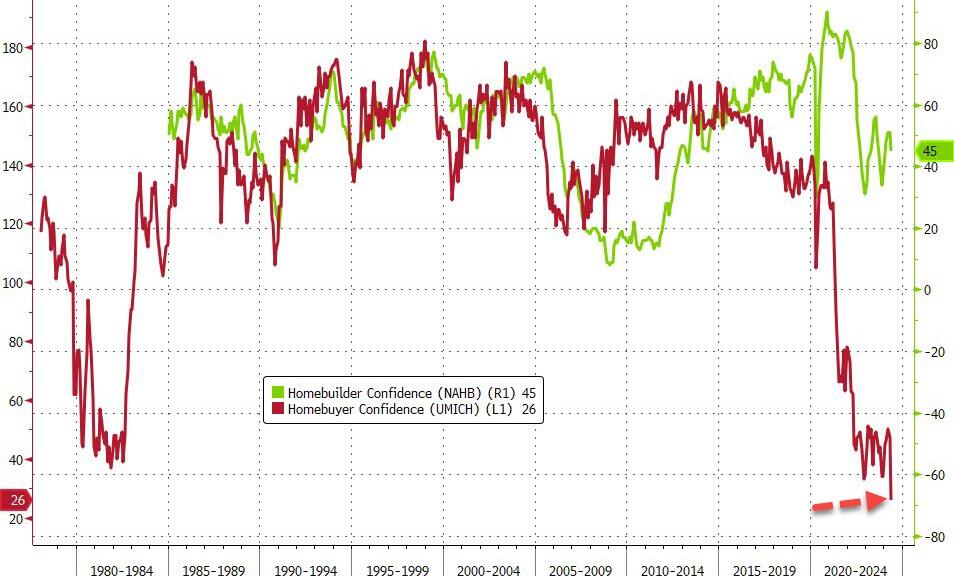
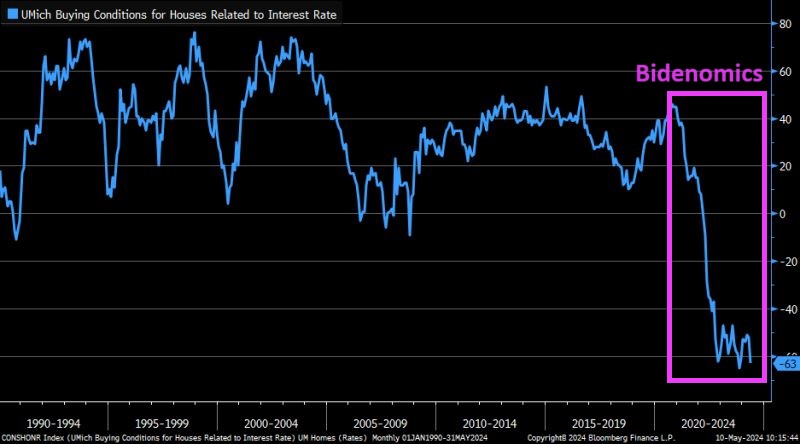
This really should not come as a surprise because, while homeBUILDERS remain optimistic that things will pick up, homeBUYERS are the least enthusiastic they have ever been about buying a home… going back almost 50 years…
Source: Bloomberg
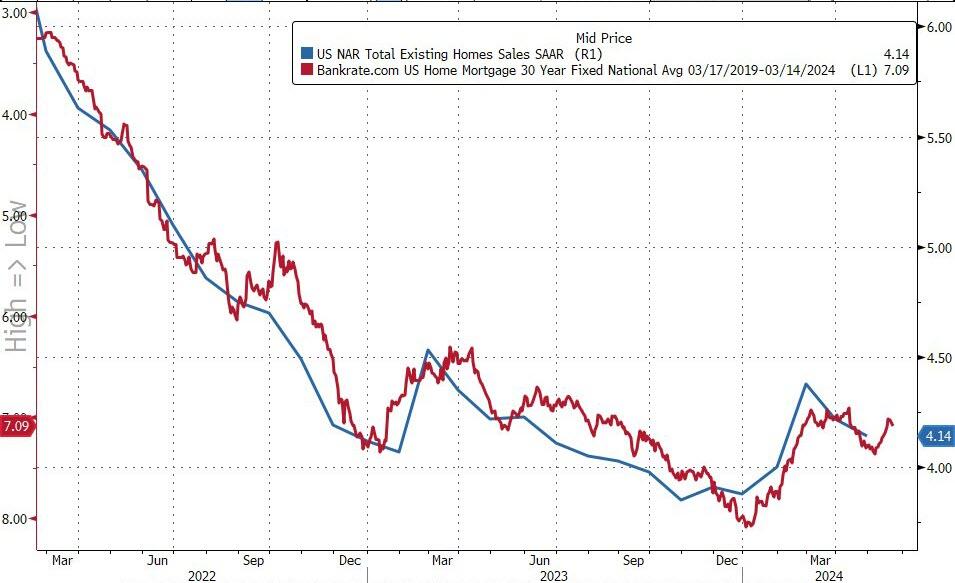
And with mortgage rates still above 7%, we don’t see things picking up meaningfully anytime soon…
Source: Bloomberg
…and then there’s this…
Source: Bloomberg
Sales declined in all four regions, including a 2.6% decrease in the West and a 1.6% drop in the South
The median selling price increased 5.7% from a year ago to $407,600 – the highest for any April in data back to 1999.
Unlike in the new-home market, where rising inventories and the prevalence of incentives by builders have pushed prices down on an annual basis, the home-resale market is experiencing rising year-over-year price growth.
“Home prices reaching a record high for the month of April is very good news for homeowners,” NAR Chief Economist Lawrence Yun said in a statement.
“However, the pace of price increases should taper off since more housing inventory is becoming available.”
About 68% of the homes sold were on the market for less than a month, up from 60% in March, while more than a quarter sold above the list price.
The US is on a “Highway to Hell!” thanks to flawed economic policies under Biden.
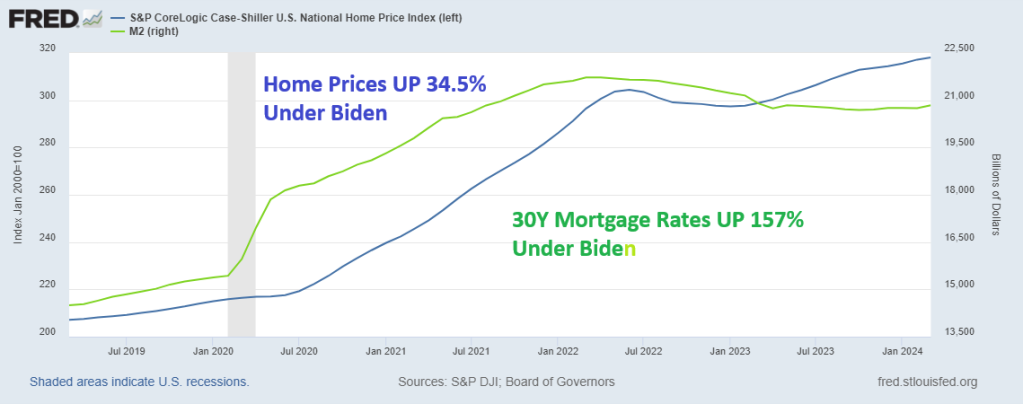
First, interest and mortgage rates under Biden have soared driving buying conditions for housing to all-time lows. Combine sky-high home prices with high mortgage rates and we have as serious affordability crisis.
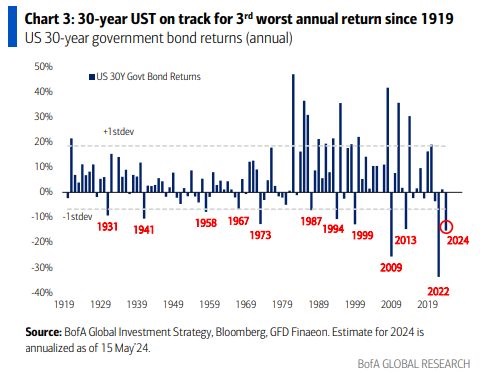
Second, on the interest rate front, the 30-year Treasury bond is on track for the 3rd worst annual return since 1919 and Russia’s invasion of Ukraine. Not not the current invasion, but the 1919 invasion.
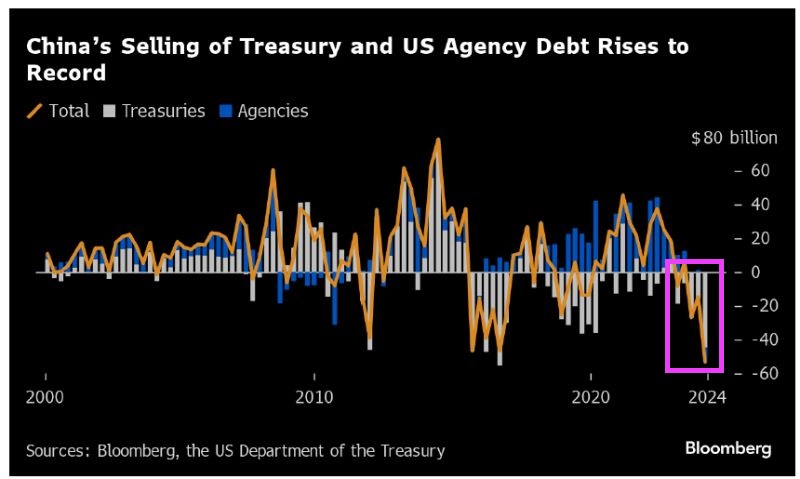
Third, China is dumping their holdings of US Treasuries and Agency Debt at record rates.
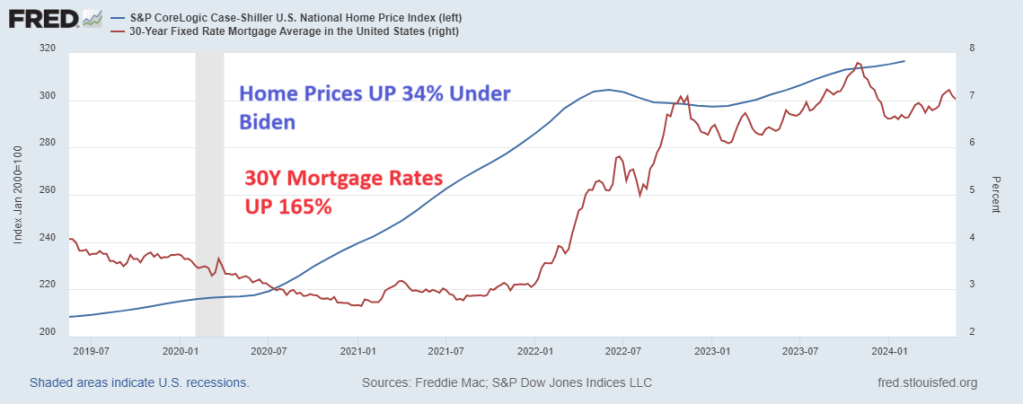
Of course, mortgage rates hit 18% in 1981. So, the term high mortgage rates is relative. The US had low rates for too long (Bernanke/Yellen) and mortgage rates are now in the 7% range, up 165% under Biden. And home prices are up 34% since Biden was sworn-in as President. Wow! Mortgage rates up 165% and home prices up 34% under Biden’s Reign of Error.
The US middle class and low-wage workers are back on the chain gang while the top 1% party hearty.
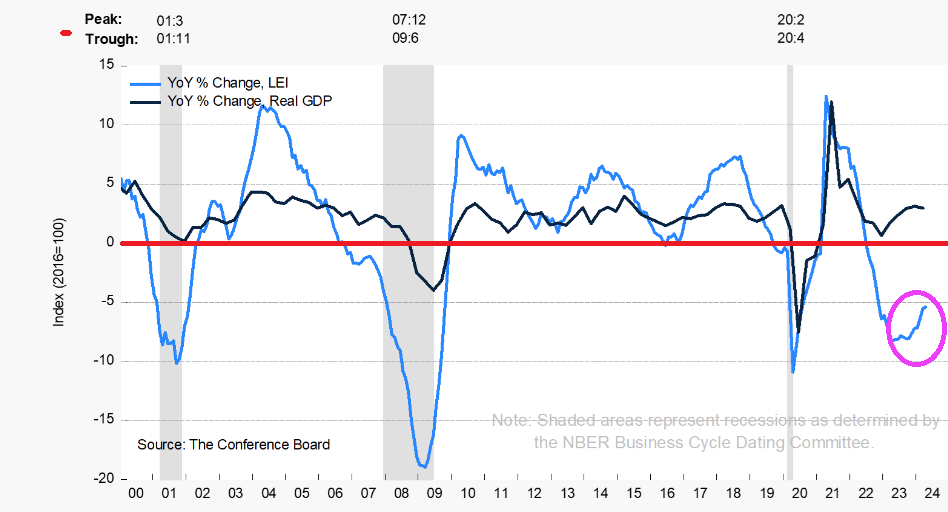
The Conference Board Leading Economic Index® (LEI) for the U.S. decreased by 0.6 percent in April 2024 to 101.8 (2016=100), after decreasing by 0.3 percent in March. Over the six-month period between October 2023 and April 2024, the LEI contracted by 1.9 percent—a smaller decrease than its 3.5 percent decline over the previous six months.
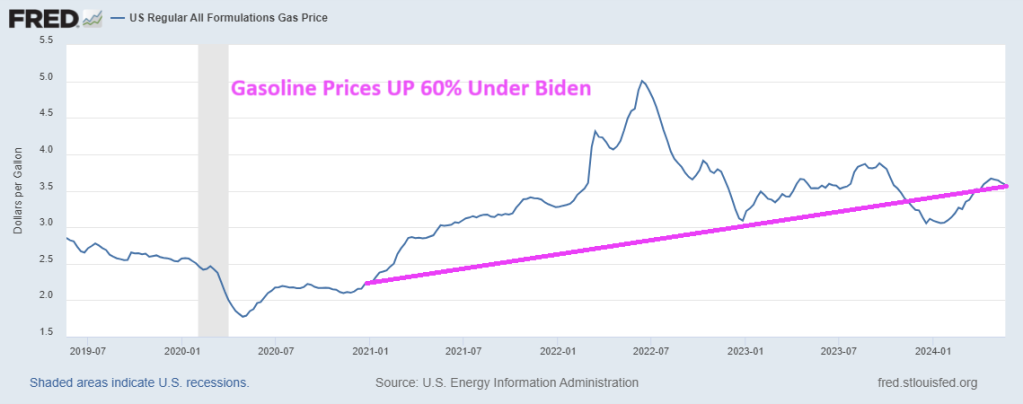
It is surprising that Americans trusts the millionaires in the Administration (like Biden) or Congress (like Schumer, McConnell, etc) to have our backs on the roaring inflation rate. At least Speaker Mike Johnson isn’t a millionaire … yet. But that might explain his selling out conservatives.








 Confounded Interest - Anthony B. Sanders


You must be logged in to post a comment.