Joe Biden can be called “Sloppy Joe” because of the economic havoc he has sprung on an unsuspecting middle class. The following seven charts are what keeps me up at night (unlike what keeps multimillionaire Michelle Obama up at nights).
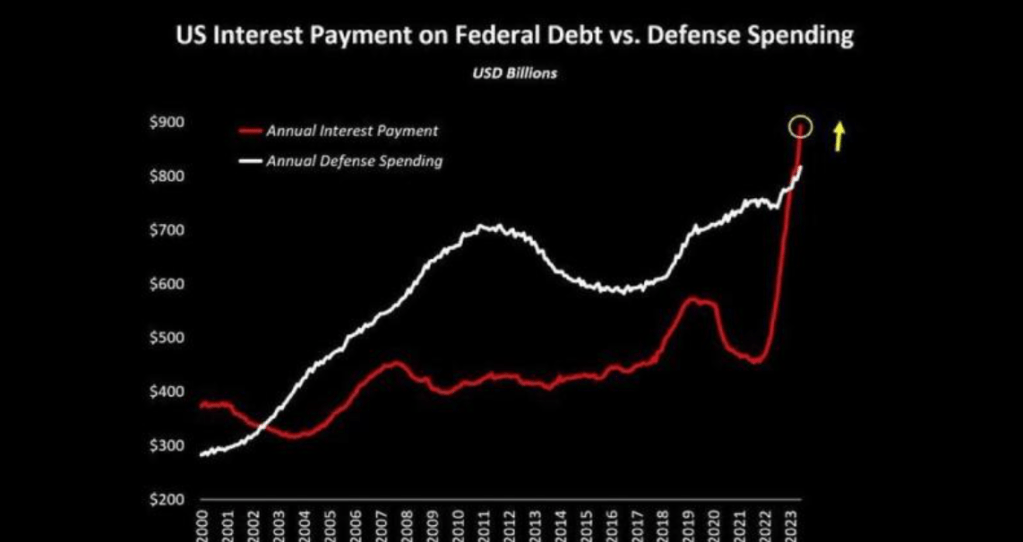
First, US interest payment on Federal debt is rising faster than our bloated military budget. Thanks mostly to The Fed raising rates to fight inflation under Biden.
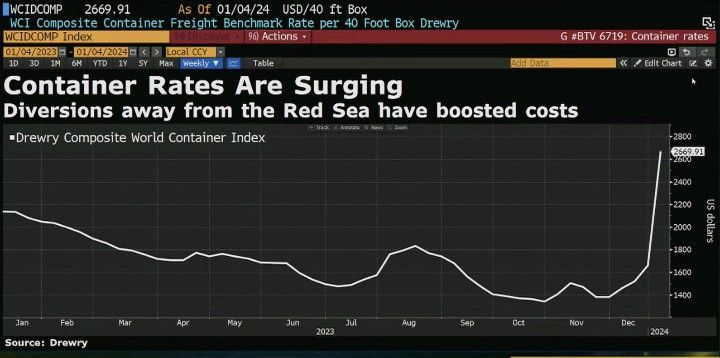
Second, contrainer shipping rates are soaring thanks to Iran’s interference in the Middle East and Biden’s failed diplomacy with Iran.
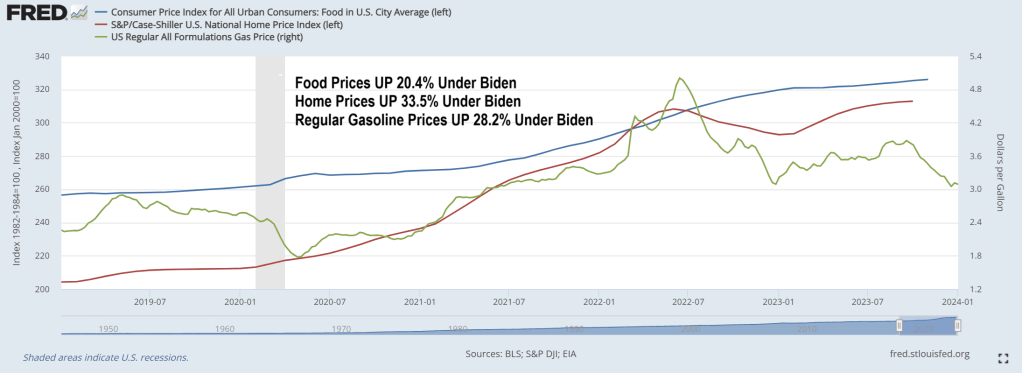
Third, food prices are over 20% more expensive under Biden while gasoline prices are over 28% more expensive under Biden. Housing is also more expensive under “Sloppy Joe” as in 33.5% more expensive.
Fourth, Bidenomics is about adding more non-productive government jobs.
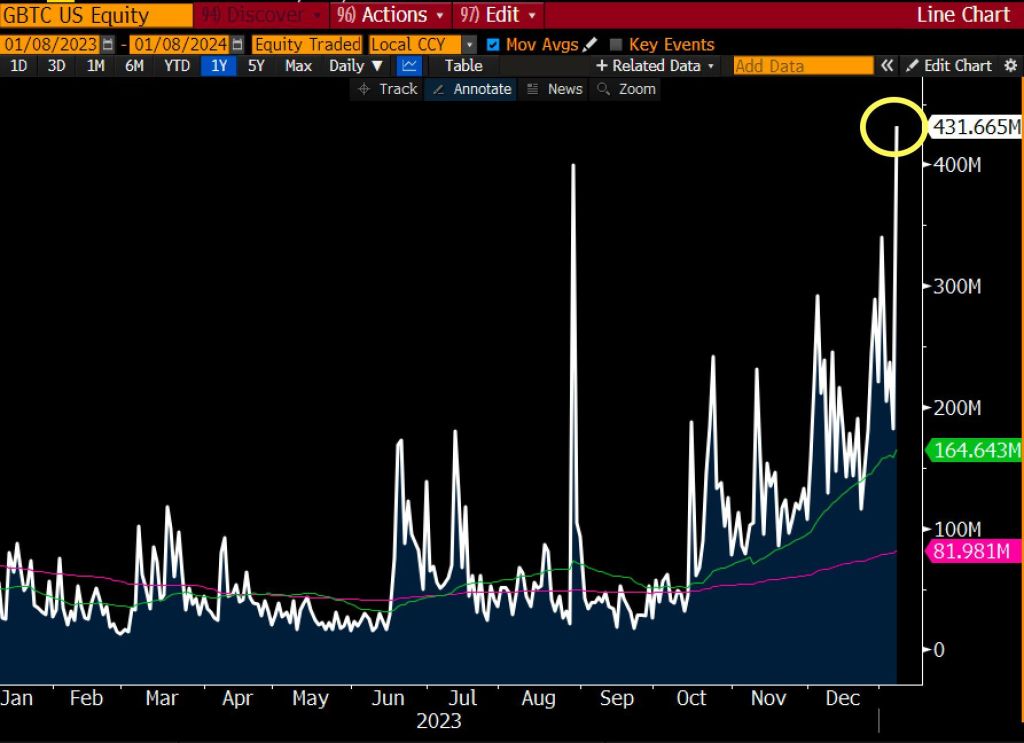
Sixth, Grayscale Bitcoin Trust $GBTC traded close to half a billion on Monday. Which shows the lack of confidence in Biden’s handling of the economy.
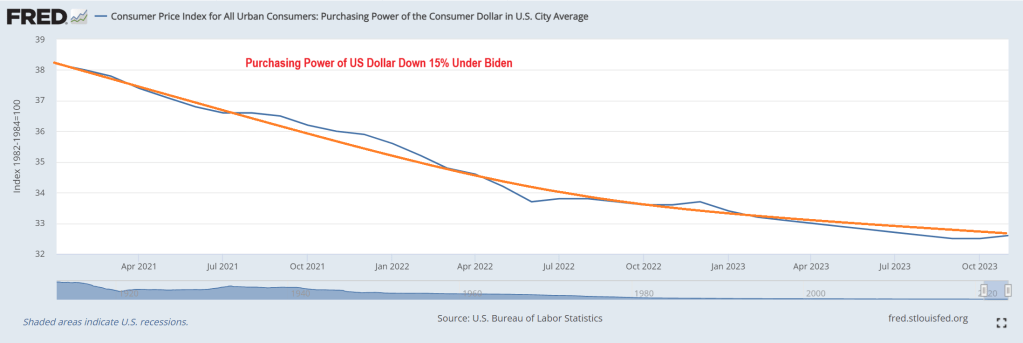
Seventh, purchasing power of the US Dollar is down 15% under Sloppy Joe.
While some may view Biden’s policies are planned destruction of the US economy, it could simply be that Biden (who is one of the stupidest people in Washington DC) simply is grossly incompetent and … sloppy.
Bidenomics has taken the US economy to the underworld. Where households have to run up credit cards to ridiculous levels to cope with inflation under Bidenomics. Under Bidenomics, food prices are up 20.4%, home prices are up 33.5% and regular gasoline prices are up 28.2%. Whip out those credit cards!!!!!
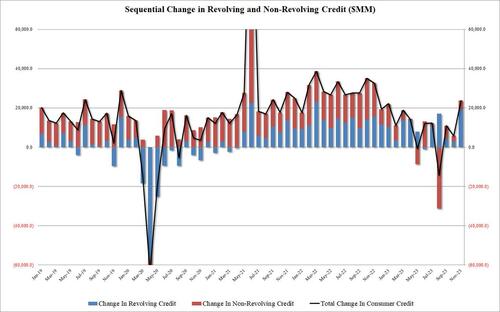
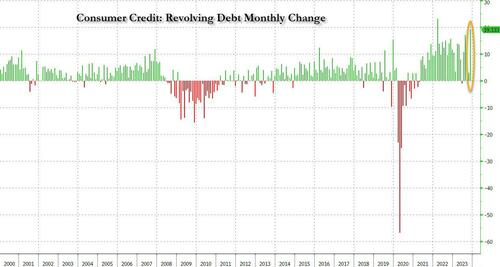
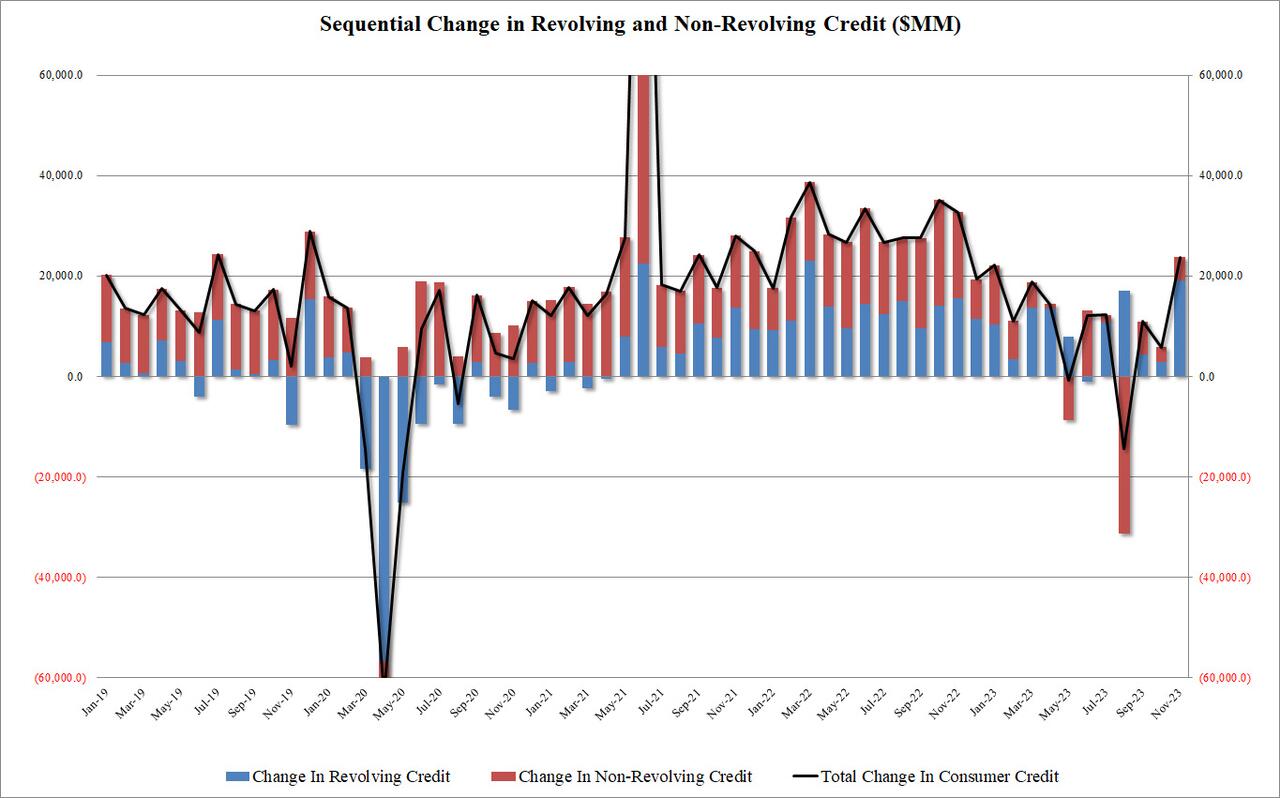
According to the latest monthly consumer credit report from the Fed, in November, consumer credit exploded higher by $24.75BN, blowing away expectations of a “modest” $9BN increase after the surprisingly subdued $5.8BN (upward revised from $.5.1BN) in October and the $4.3BN average of the past 6 months. This was the biggest monthly increase since last November, and was the first $20BN+ print since Jan 2023.
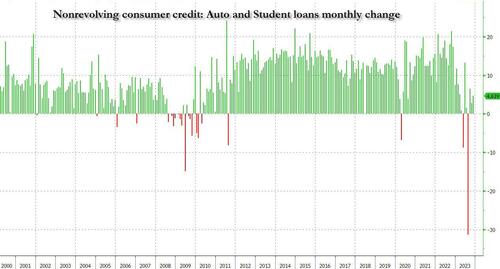
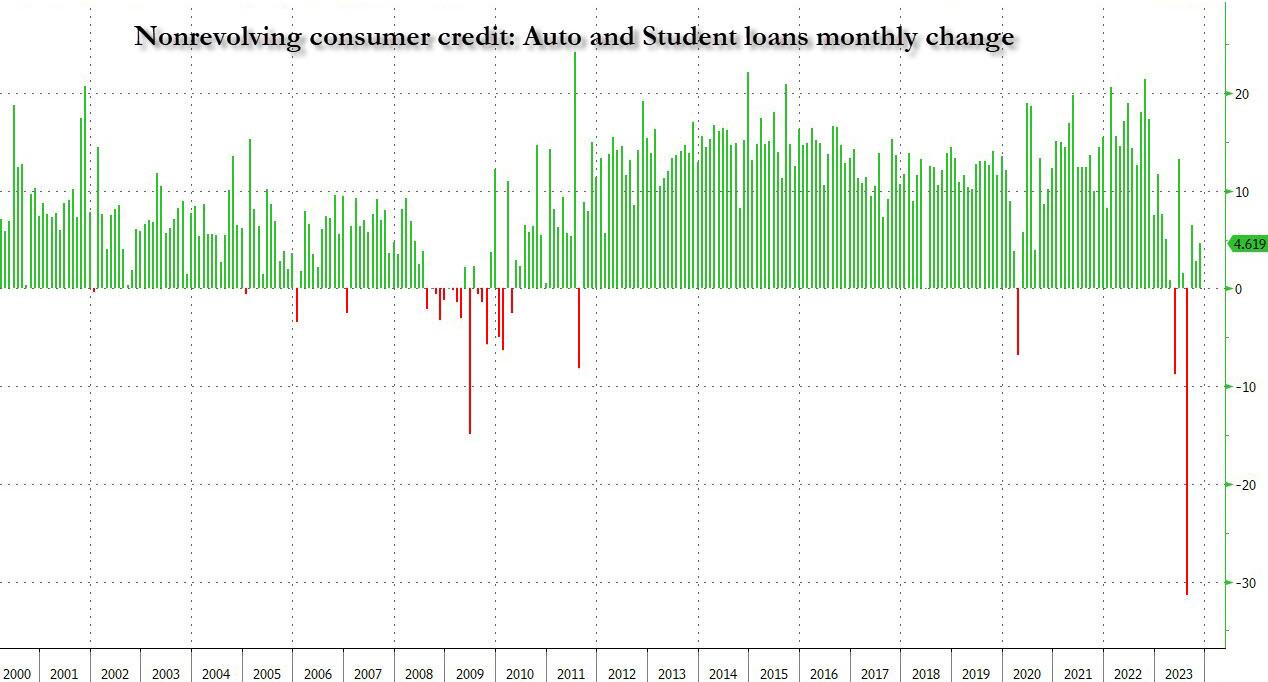
When looking into the details we find something remarkable: while non-revolving credit rose a modest $4.6BN…
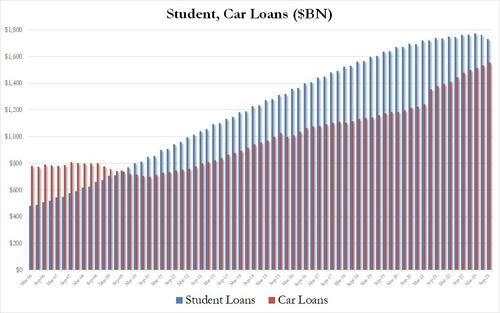
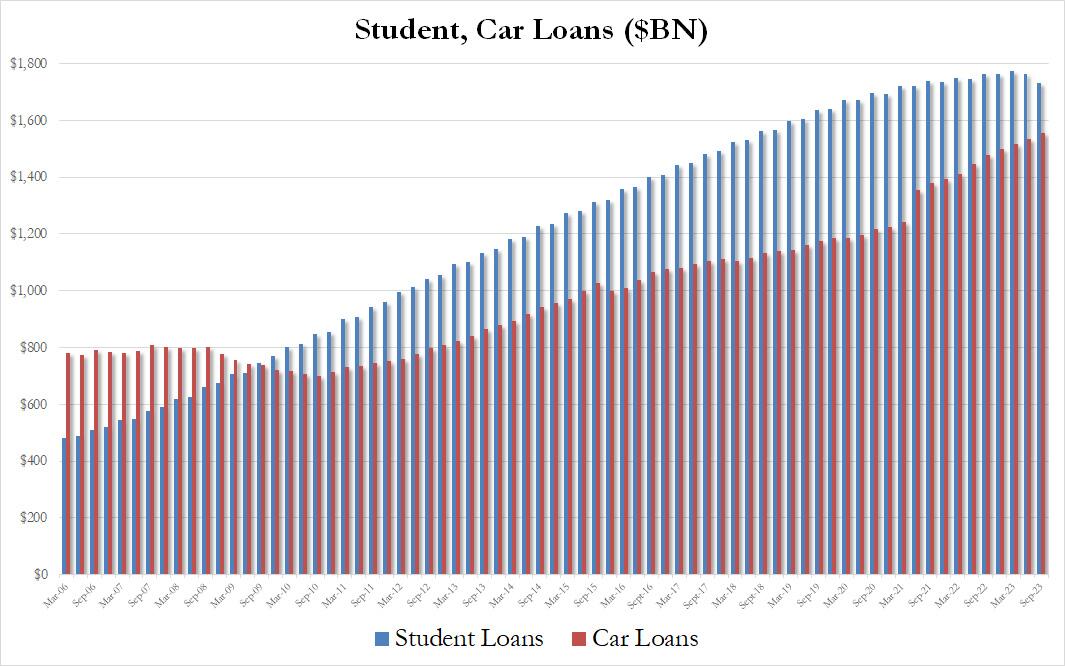
… in keeping with the subdued increase in recent months as rates on auto loans make them prohibitive for most consumers while student loans are actually shrinking for the 2nd quarter in a row…
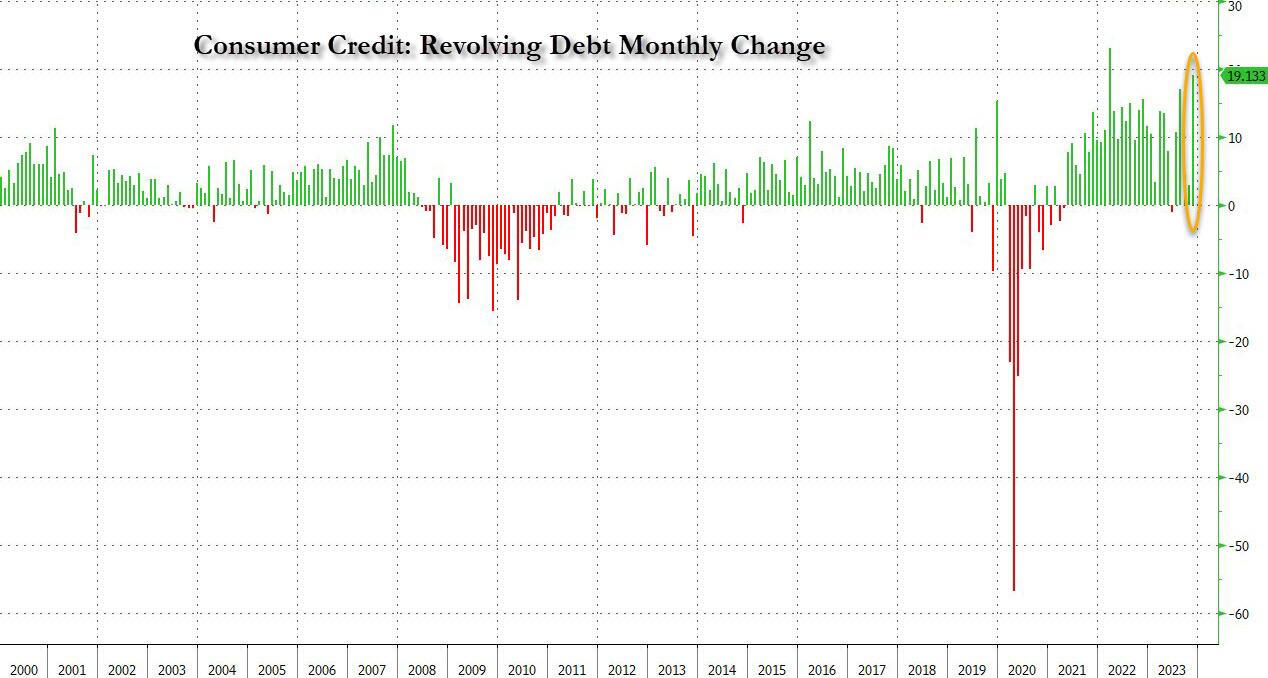
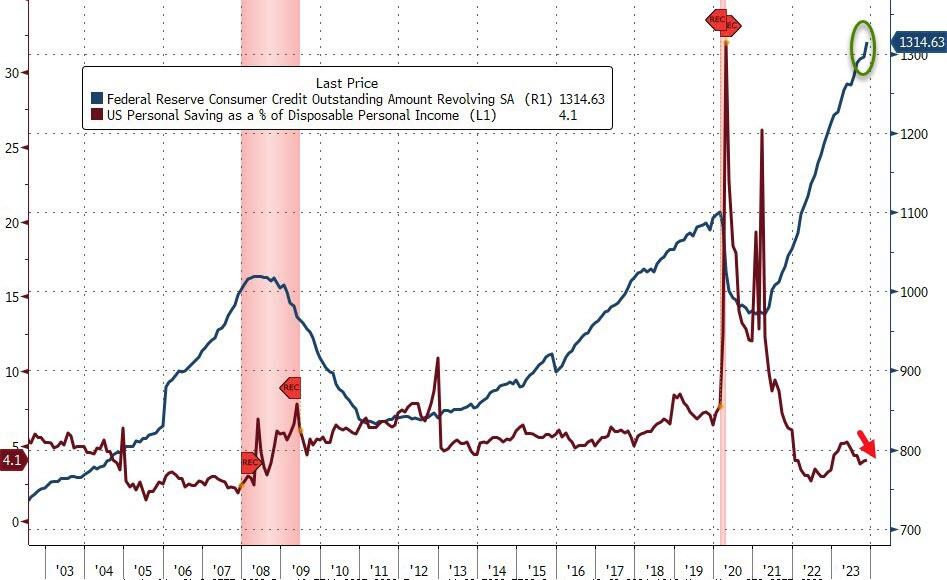
… what was the big shock in today’s data was the blowout surge in revolving credit, which in November exploded by a whopping $19.133BN, a record surge from the $2.9BN in October, and the second biggest monthly increase in credit card debt on record!
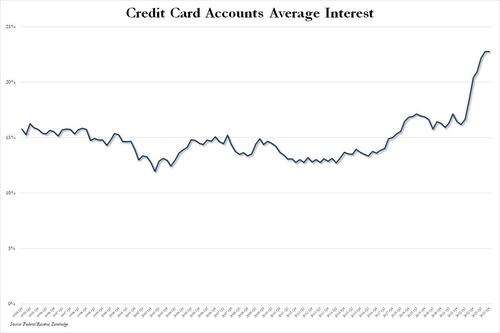
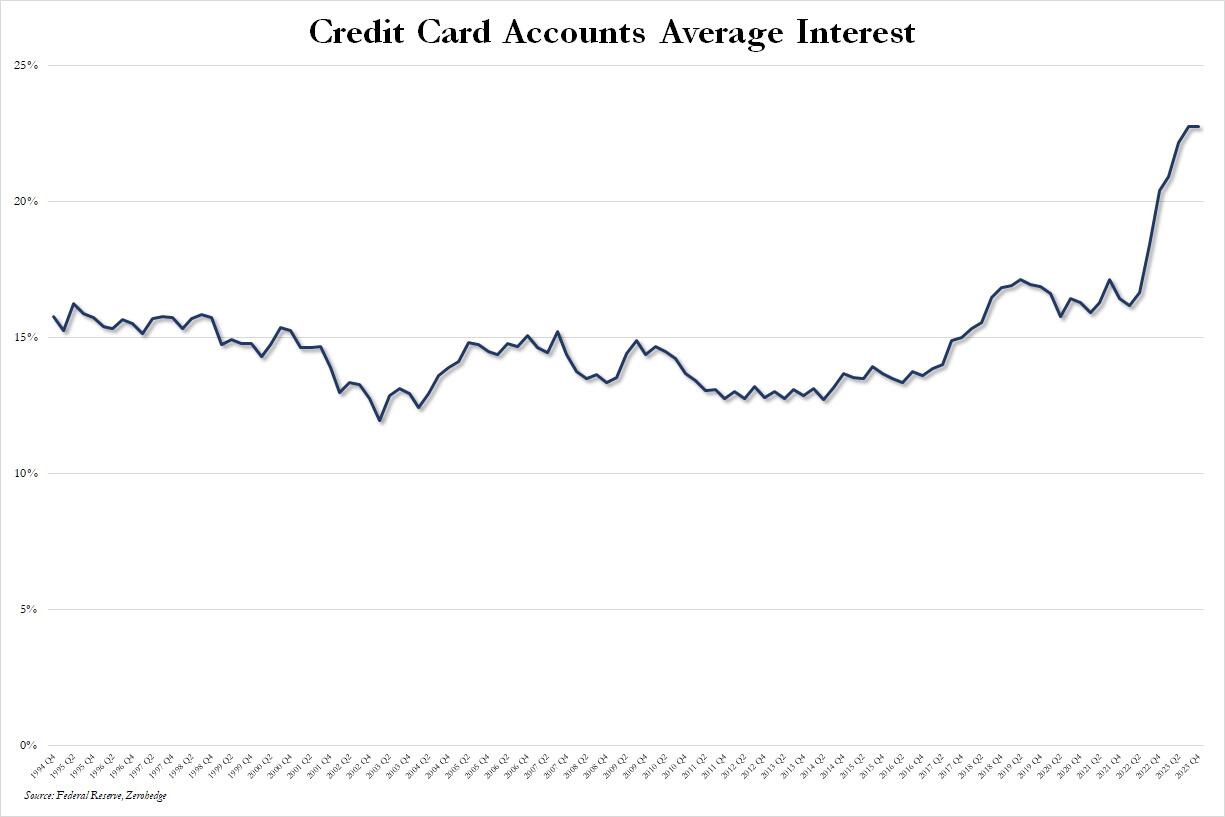
This, despite the average interest rate on credit card accounts in Q4 flat at a record high 22.75% for the second quarter in a row.
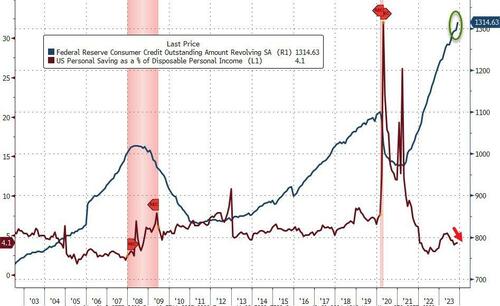
What is especially surprising about this conirmation that the bulk of holiday spending was on credit is that it takes place after several months of relative return to normaly, when consumers appeared increasingly reluctant to max out their credit cards due to record high rates, and at a time when the personal savings rate in the US has collapsed back near multi-decade lows in recent months.
Well, it now appears that Americans have once again done what they do so well: follow in the footsteps of their government and throw all caution to the wind, charging everything they can (and whatever they can’t put on installment plans which also hit a record late last year) including groceries, on their credit card, and praying for the best… or not even bothering to worry about what comes next.
While ”Angry Joe” Biden screams about democracy (while having his attorney general prosecute his likely Presidential election opponent), and he and Congress continue to spend and borrow like there is no tomorrow (not a bad assumption since Biden is a sickly 81, Pelosi is 83 and assorted other aging policitians in the District of Corruption will never live beyond 10 more years), we are now seeing more attention to the boiling frog problem facing our children and grandchildren. I call this “Biden Stew.”
Michael Cembalest, who runs JPMorgan’s market and investment strategy unit in the bank’s asset management division, predicted dire consequences for the economy if the Biden administration doesn’t start tackling the debt.
Cembalest wrote in a newsletter published last week by JPMorgan that the country cannot sustain higher deficits and ballooning net interest payments, which are soon expected to exceed the federal government’s total revenue by early next decade.
“The problem for the US is the starting point; every round of fiscal stimulus brings the US one step closer to debt unsustainability,” Cembalest wrote in the newsletter titled “Pillow Talk.”
“However, we’re accustomed to deteriorating US government finances with limited consequences for investors, and one day that may change (the boiling frog analogy).”
The “boiling frog” concept comes from a metaphor used to describe a situation whereby an undesirable set of circumstances is tolerated for an extended period of time — such as a frog that is thrown into water that is gradually heated.
Cembalest predicted that by early next decade, “all Federal government revenues will be consumed by entitlement payments and interest on the Federal debt.”
“Entitlement payments” refer to Medicaid, Medicare, Social Security, unemployment insurance and other aspects of the federal welfare safety net.
Cembalest wrote that before the next decade he anticipates that “a combination of market pressure and rating agency downgrades” will “force the US to make substantial changes to taxes and entitlements.”
In November, Moody’s lowered the US government’s credit ratings outlook from “stable” to “negative.”
Last summer, Fitch Rating downgraded the federal government’s long-term credit rating from AAA to AA+.
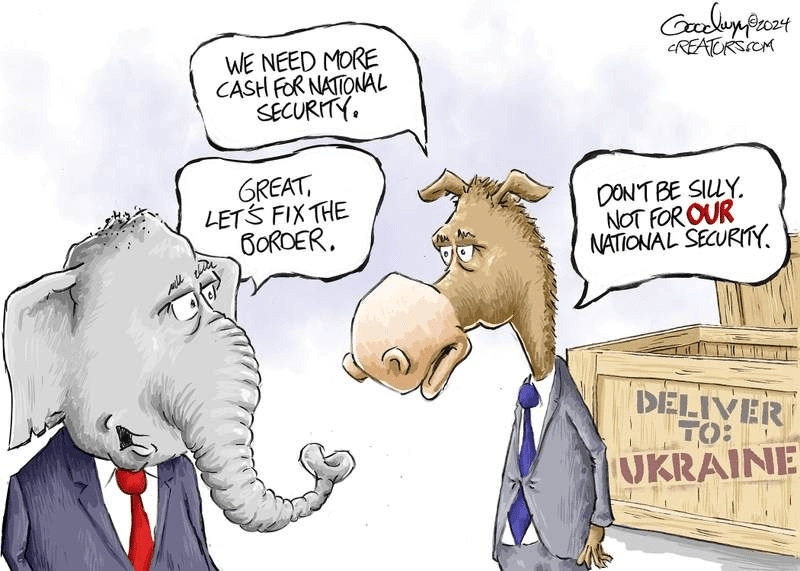
While Biden pushes for MORE Ukraine war funding and cancelling student debt (like a demonic Daddy Warbucks from Little Orphan Annie), he ignores unfunded entitlements of $213 TRILLION.
To be sure, the Biden Stew has been a trainwreck for decades, but Biden has the golden opportunity to act like a leader instead of “Angry Joe” screaming about Democracy as he and his minions attempt to cancel their politicial opponents.
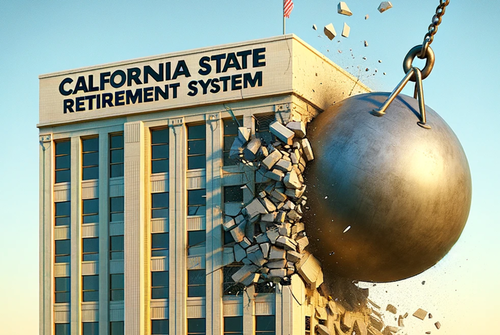
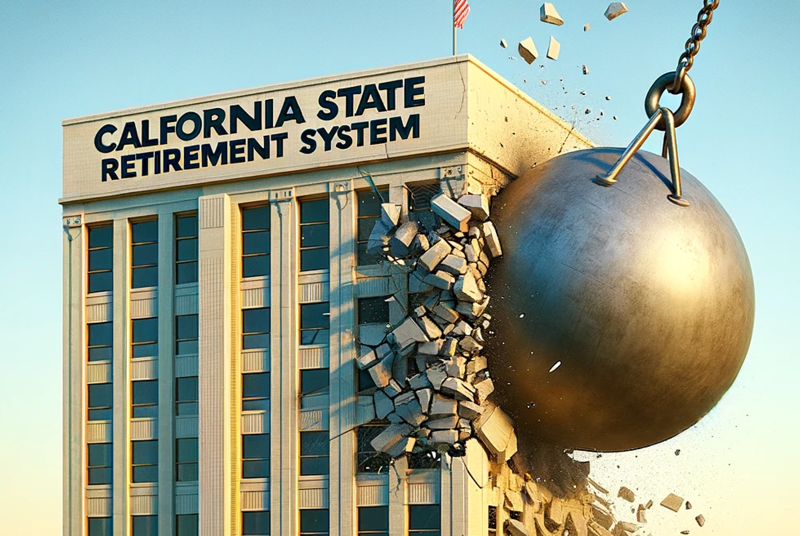
One of the biggest public pension plans in the US plans to borrow tens of billions of dollars to maintain liquidity instead of triggering a fire-sale of its assets.
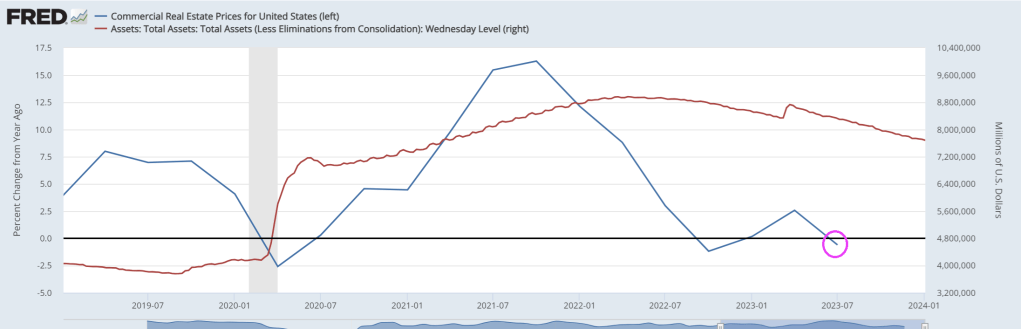
Borrowing to lever up its real estate-laden portfolio when CRE returns are negative??
Calstrs board members will review the first draft of the policy next Thursday. If approved, the leverage would be used “on a temporary basis to fulfill cash flow needs in circumstances when it is disadvantageous to sell assets,” a CalSTRS policy document stated.
According to Calstrs consultant Meketa Investment Group, the public pension fund already deploys leverage upwards of 4% of its portfolio, adding the proposed increased leverage won’t be used for a new asset allocation policy but rather used to smooth cash flow and as an “intermittent tool” to manage the portfolio.
The need to increase leverage comes after a report from the Financial Times last April explained that CalSTRS was planning to write down the value of its $52 billion commercial real estate portfolio after high interest rates crushed the values of office towers.
At the time of the FT report, CalSTRS Chief Investment Officer Christopher Ailman told the media outlet that:
“Office real estate is probably down about 20 percent in value, just based on the rise of interest rates,” adding, “Our real estate consultants spoke to the board last month and said that they felt that real estate was going to have a negative year or two.”
For Calstrs, CRE was one of the best-performing asset classes until Covid and the Fed embarked on the most aggressive interest rate hiking cycle in a generation. Real estate had delivered double-digit returns over a 10-year period for its million-member plan, according to an update last March.
FT noted real estate makes up about 17% of Calstrs’ overall assets.
We’re sure Calstrs is one of many pension plans under pressure from the CRE downturn. Also, regional banks have high exposure to CRE and are still not out of the woods.
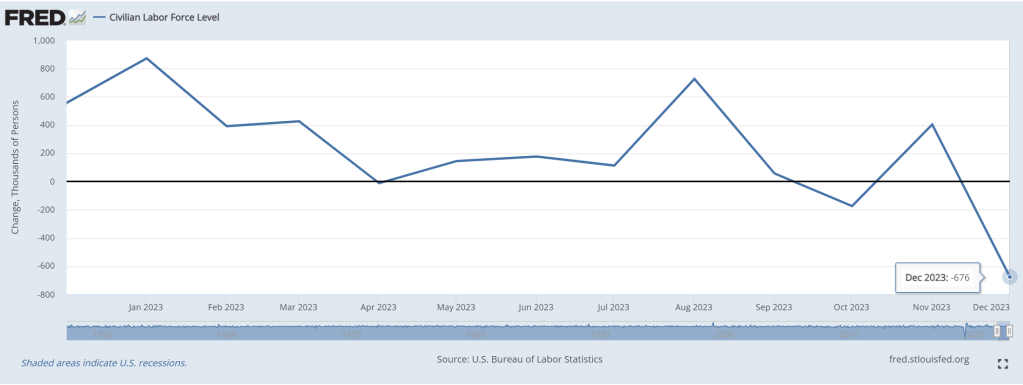
That means its initial jobs results were inflated by 439,000 positions, and the job market is not as healthy as the government suggests.
Since the government wiped out 439,000 jobs after the fact, the total percentage of jobs created by the government last year is even higher.
But just in December, the civilian labor force shrunk by 636,000 jobs.
Increased government hiring has been driving the jobs numbers higher. This is NOT good since government doesn’t produce anything other than regulations and red tape.
Again, the government sector in December ranked high in job creation.
The health care and social assistance sector, which relies heavily on money from government spending, created about 59,000 jobs.
The economy lost 1.5 million full-time workers since June of last year, while adding 796,000 part-time workers.
That means more workers are holding down multiple jobs to pay for a higher cost of living due to a cumulative 17.4% inflation rate under this White House.
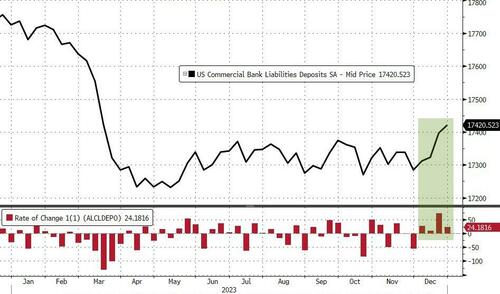
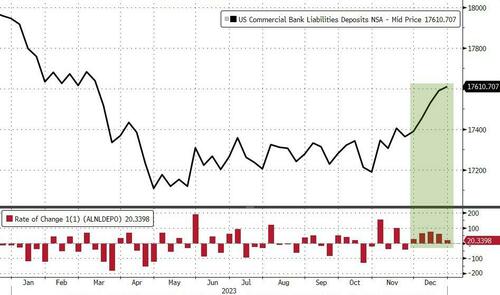
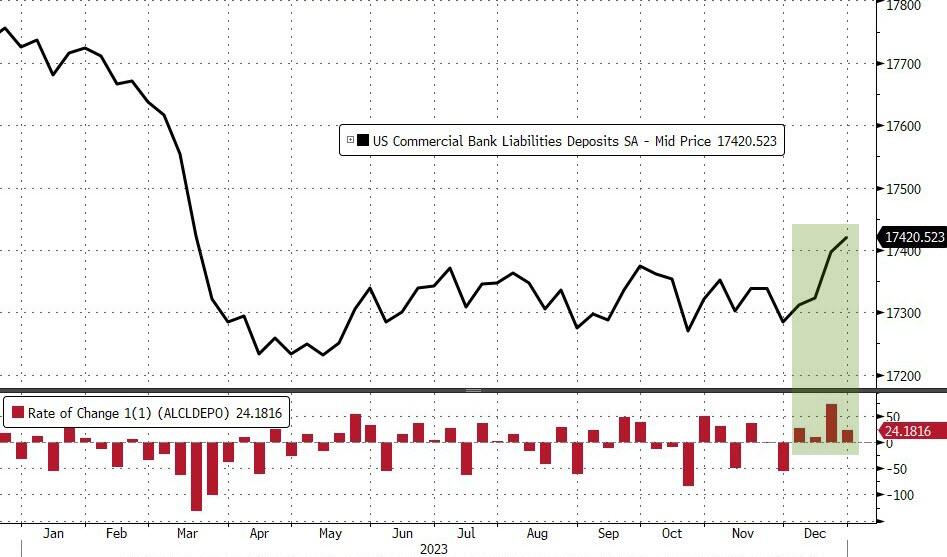
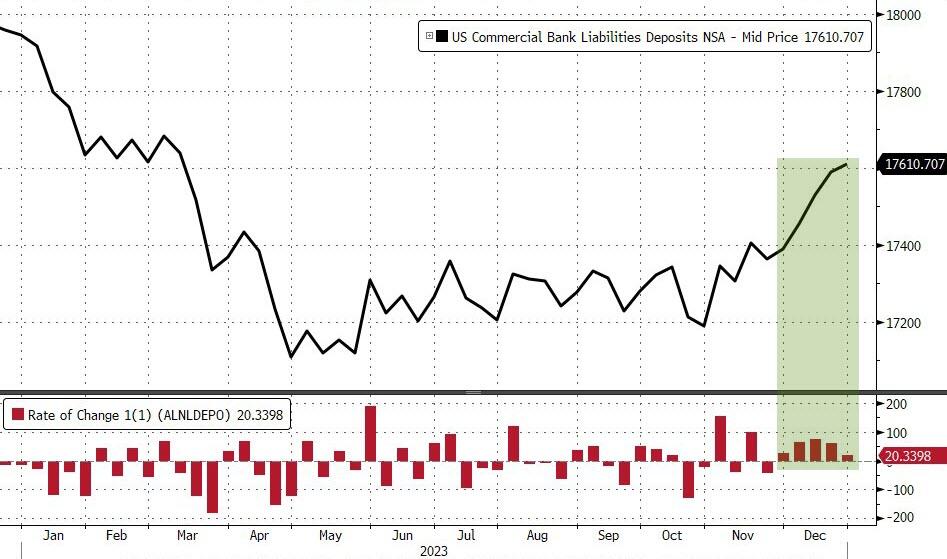
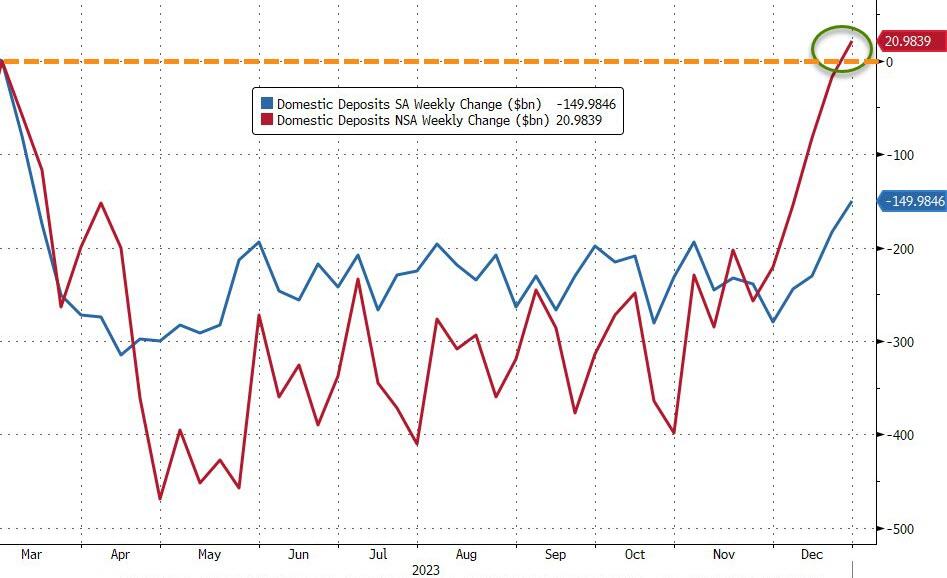
On a non-seasonally-adjusted basis, deposits rose almost in line, up $20.3BN (the fifth week of inflows in a row)…
Source: Bloomberg
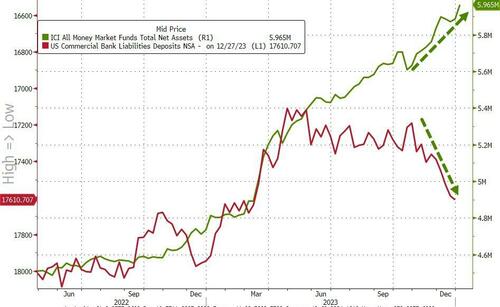
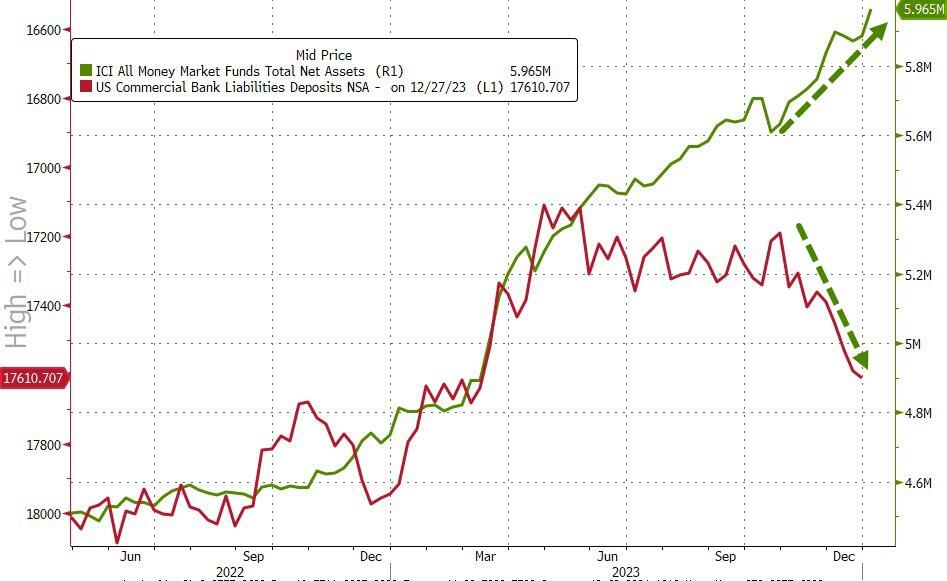
Interestingly the sizable deposit inflows are occurring alongside sizable money-market fund inflows…
Source: Bloomberg
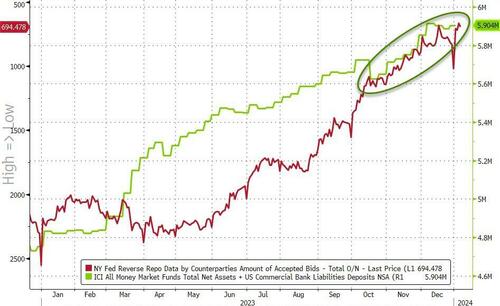
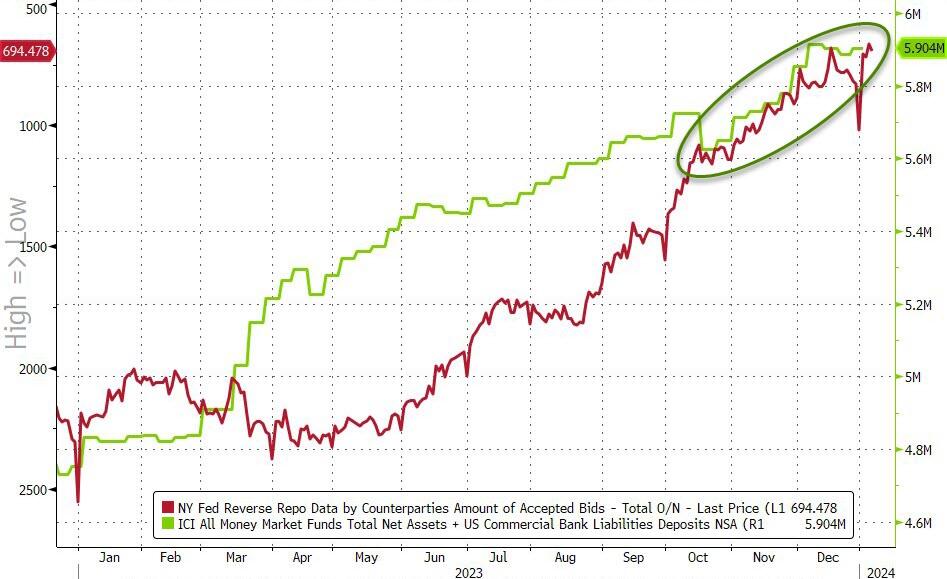
…now we know where all that reverse repo liquidation cash is going…
Source: Bloomberg
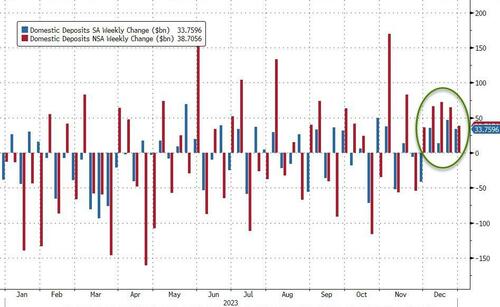
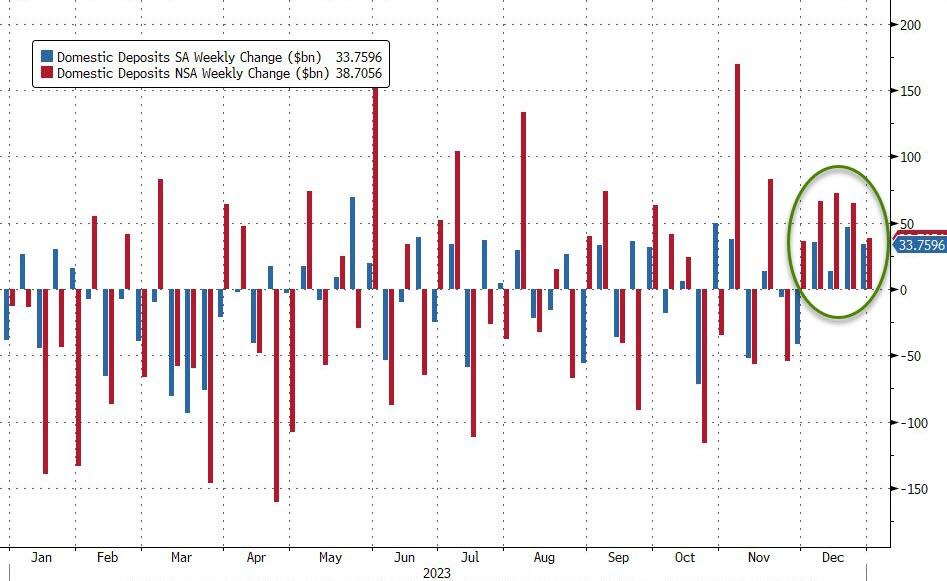
Excluding foreign bank flows, the picture is even rosier with domestic bank deposit inflows of $33.8BN (SA) and $38.7BN (NSA) – the 5th week in a row of NSA inflows…
Source: Bloomberg
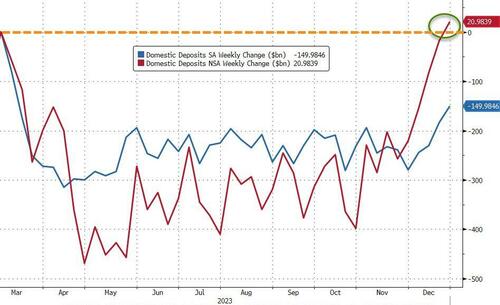
While it may surprise some, on an NSA basis, domestic bank deposits are now back above pre-SVB levels…
Source: Bloomberg
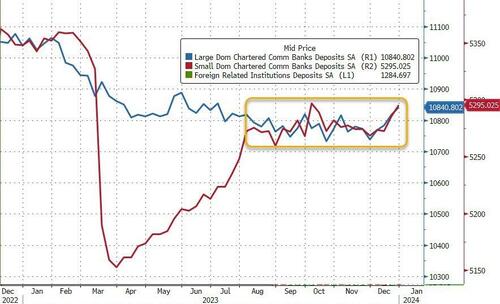
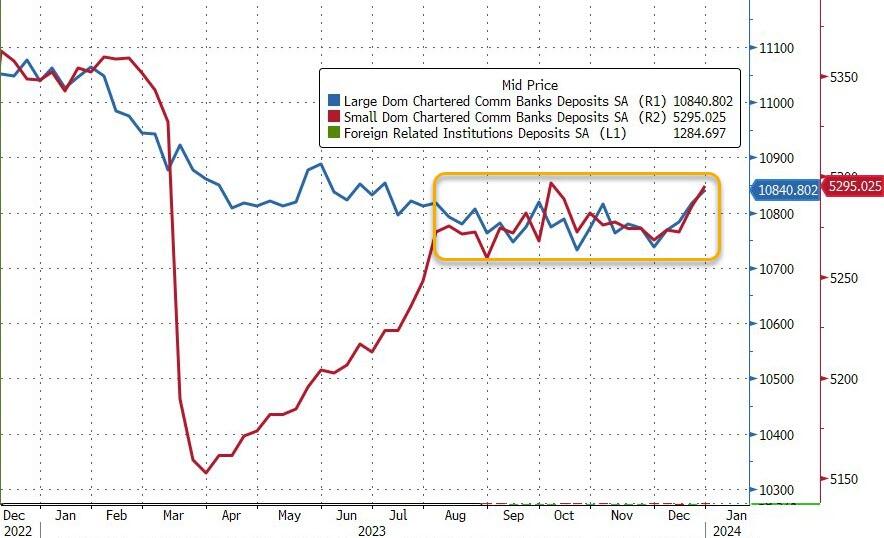
Large banks saw $24BN inflows last week and Small Banks $9.4BN (on an SA basis) and for the 5th week in a row both large and small banks saw NSA inflows (+$30BN and +$8.7BN respectively)…
Source: Bloomberg
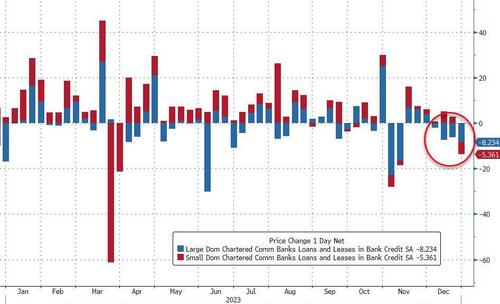
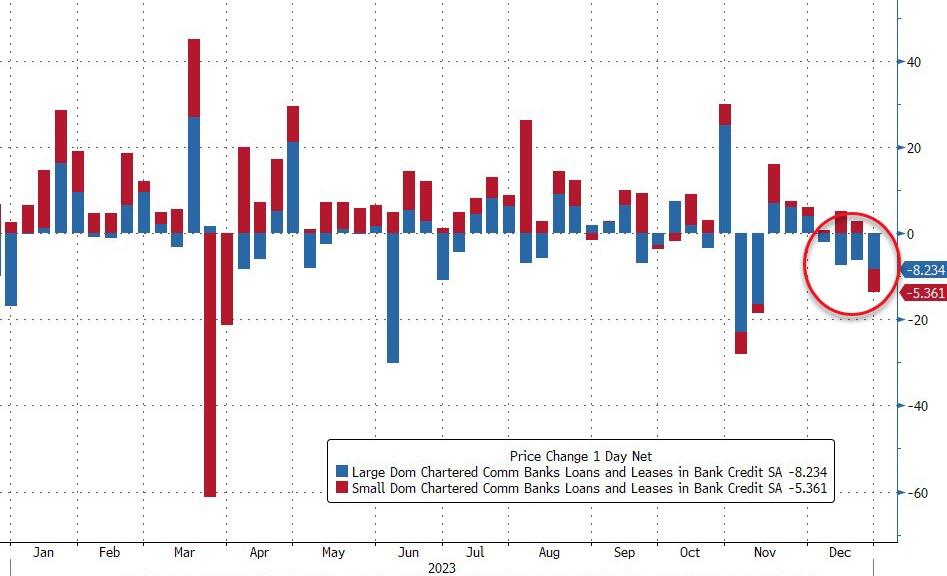
On the other side of the ledger, loan volumes continued to shrink (despite the deposit growth). Large bank loan volumes fell $8.2BN (the 4th week of falling loan volumes in a row)…
Source: Bloomberg
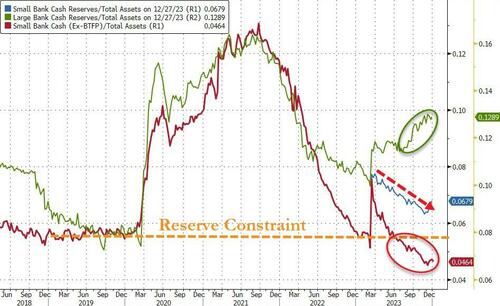
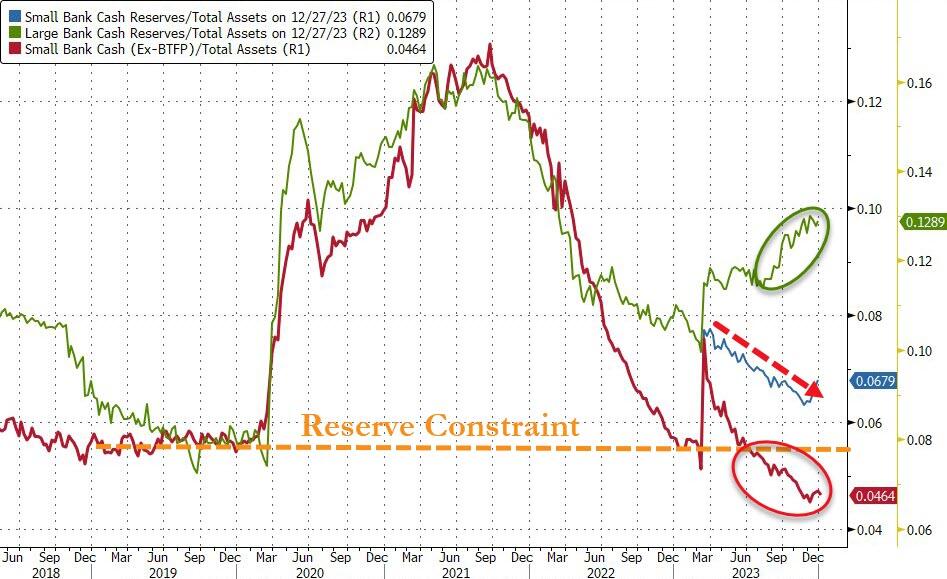
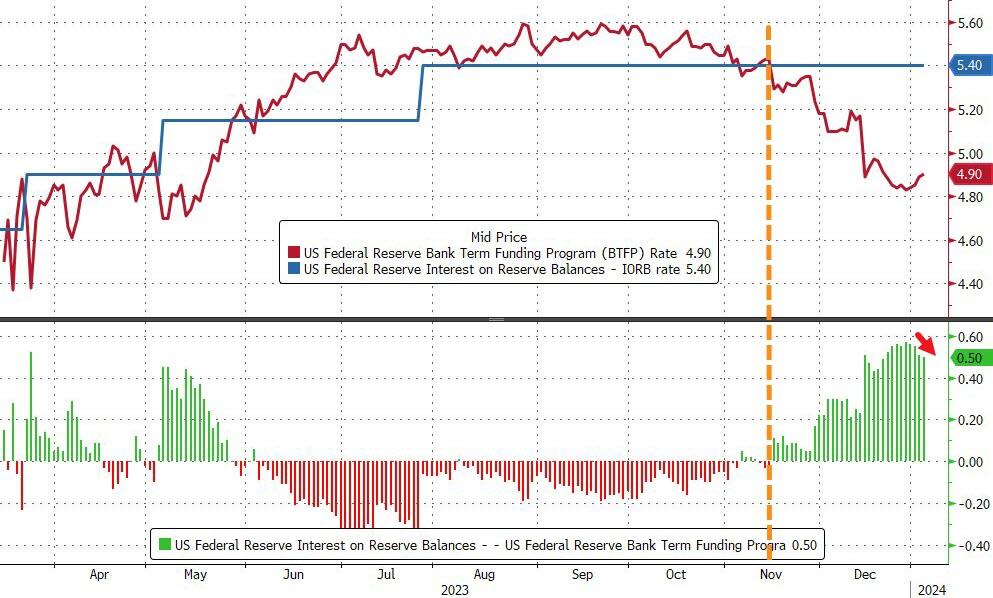
Which leave us continuing to highlight the fact that there is potential trouble brewing still as the key warning sign continues to flash red (Small Banks’ reserve constraint – blue line), supported above the critical level by The Fed’s emergency funds (for now)…
Source: Bloomberg
As the red line shows, without The Fed’s help, the crisis is back (and large bank cash needs a home – green line – like picking up a small bank from the FDIC).
All of which keep us wondering, are we setting up for another banking crisis in March as:
1) BTFP runs out…
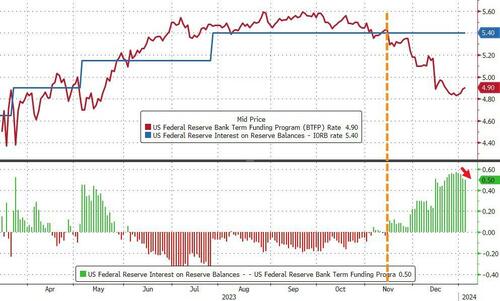
It was only a 12 month temporary program, and it is going to be hard for The Fed to keep it alive. The BTFP-Fed Arb continues to offer ‘free-money’ (and usage of the BTFP has risen by $32BN since the arb existed), but the spread has narrowed a smidge from a peak near 60bps to 50bps today…
Source: Bloomberg
Which will make it hard for The Fed to defend leaving the facility open after March when its “temporary” nature is supposed to expire.
“In justifying the generous terms of the original program, the Fed cited the ‘unusual and exigent’ market conditions facing the banking industry following last spring’s deposit runs,” Wrightson ICAP economist Lou Crandall wrote in a note to clients.
“It would be difficult to defend a renewal in today’s more normal environment.”
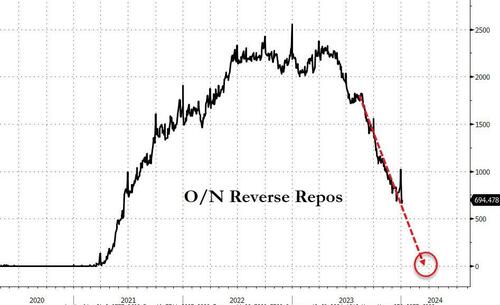
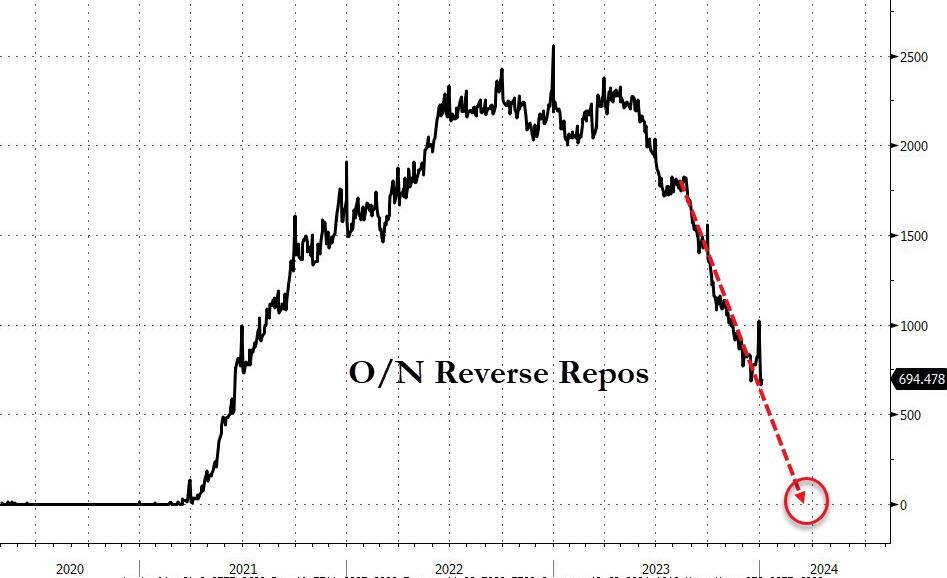
2) RRP drains to zero…
…at which point reserves get yanked which means huge deposits flight.
Source: Bloomberg
Is this the real reason why The Fed ‘pivoted’? It knows what’s coming??
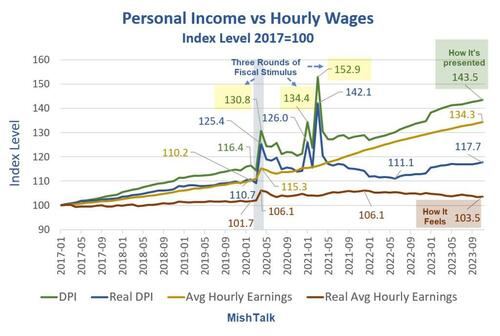
Income is rising and so are wages. Even real income is up. But real wages are another matter.
Personal income data from the BEA, hourly wages from the BLS, real hourly earnings and chart by Mish.
Personal Income vs Hourly Wages Notes
DPI means Disposable Personal Income. Disposable means after taxes.
Real DPI means inflation adjusted using the Personal Consumption Expenditures (PCE) deflator. Real DPI is a BEA calculation.
Average hourly earning are for production and nonsupervisory workers.
Real wages are deflated by the Consumer Price Index (CPI) not the PCE.
The BLS does not report a real hourly wage. I used the CPI-W index for production and nonsupervisory workers, produced by the BLS, as the deflator.
Personal Income Definition
The BEA defines personal income as “Income that people get from wages and salaries, Social Security and other government benefits, dividends and interest, business ownership, and other sources.”
Rental income is a part of other sources.
Three Rounds of Fiscal Stimulus
Round 1, March 2020: $1,200 per income tax filer, $500 per child(CARES Act) – Trump
Round 2, December 2020: $600 per income tax filer, $600 per child (Consolidated Appropriations Act, 2021) – Trump
Round 3, March 2021: $1,400 per income tax filer, $1,400 per child (American Rescue Plan Act) – Biden
The three rounds of free money fiscal stimulus (literally a helicopter drop), plus eviction moratoriums put an unprecedented amount of money in people’s hands. In addition, unemployment insurance paid people more to not work than they received working.
The third round of stimulus under Biden was totally unwarranted. However, it is also worth noting that Trump wanted a much bigger second stimulus package than the Republican Congress gave him. Trump is no fiscal hero.
The three stimulus packages, on top of supply chain disruptions, energy disruptions due to the war in Ukraine, and Bidenomics in general, set in motion the biggest wave of inflation in over 30 years.
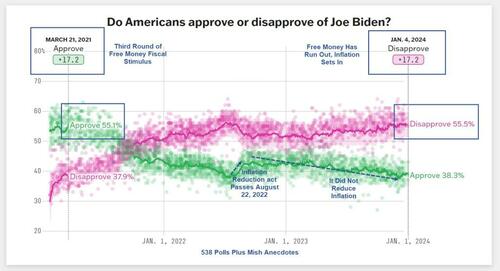
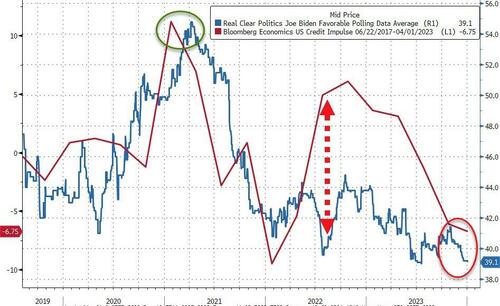
Biden went from an approval rating of 17.2 percent to a disapproval rating of 17.2 percent.
Peak Free Money
In addition to declining real wages, perhaps Biden’s big problem is the free money has run out.
Biden’s popularity peaked in March of 2021 along with stimulus. Was that a honeymoon impact or peak free money?
[ZH: While not a perfect indicator, the lagged US credit impulse perhaps provides a proxy for US fiscal excess and when overlaid with Biden’s approval rating, it is clear that 2022’s re-acceleration did nothing for people’s faith in him… and it’s only got worse…]
I suspect a bit of each coupled with hope of more free money, especially student loan forgiveness.
Sending free money to Israel and Ukraine does not help perceptions of how Biden is doing. And neither does the border or ridiculous energy regulations that cost people money.
Biden keeps telling people what a great job he has done.
I don’t believe it and most don’t either. And that shows up in the polls no matter what reason you assign.
Can Biden scrounge up some more stimulus? Because the private sector is not doing well under “Open Borders Biden.”
But to quote Cousin Eddie from Christmas Vacation, “Now hold on to your wad.” While the headline screamed remarkable, please note that the civilian labor force actually declined. As did the Employment-population ratio (to 60.1).
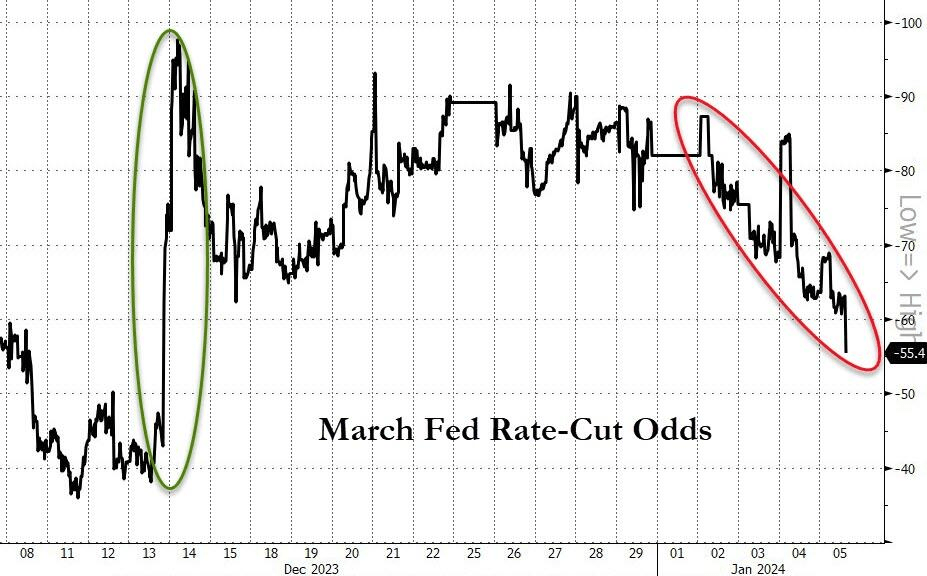
On the jobs report, the 2 year Treasury yield spiked to 4.4726%.
The odds of a March rate hike are decreasing.
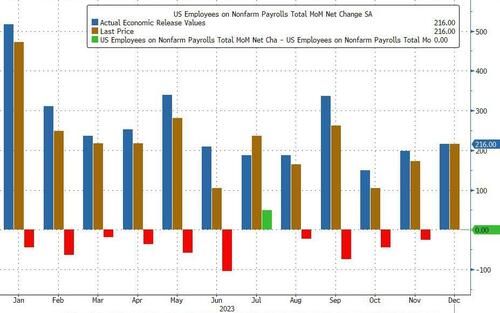
But next month today’s print will likely be revised sharply lower (perhaps even below 175K, meaning today was a miss). Why do we say that? Because once again the BLS revised not just one but both previous months sharply lower:
October revised down 45K from 150K to 105K
November revised down 26K from 199K to 173K
This means that ten of the past 11 jobs reports have been revised substantially lower.
There was some unexpectedly weakness in the labor force participation rate which dropped to 62.5% from 62.8%, missing expectations of an unchanged print. That’s because the number of people not in the labor force soared from 99.695MM to 100.540MM, an 845K increase largely due to a change in historical “data.”
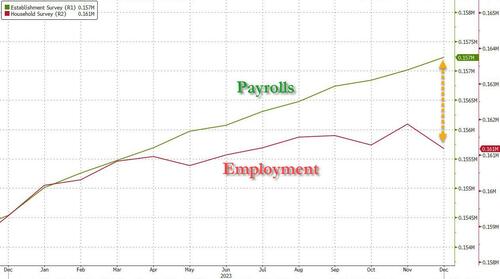
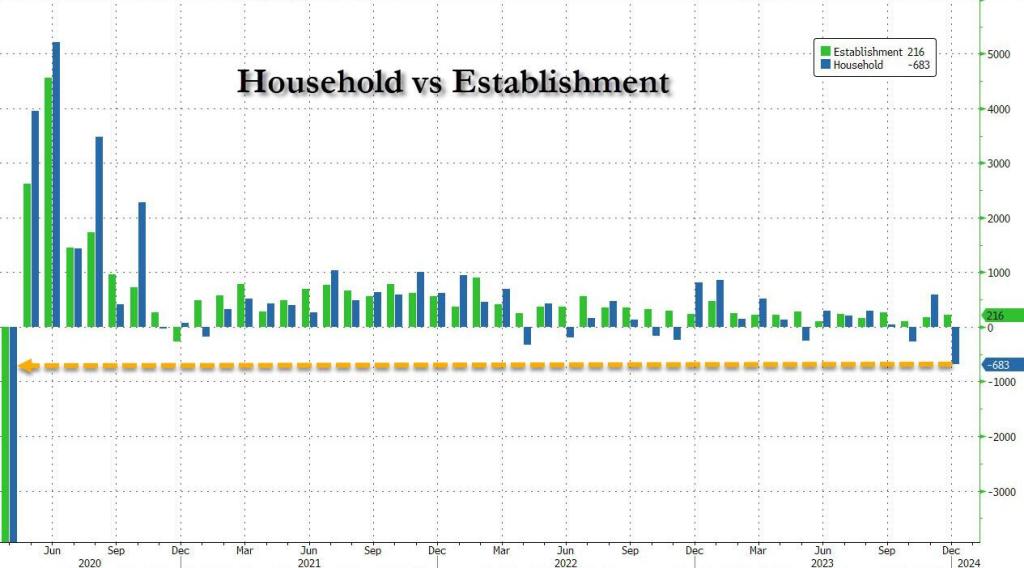
Consider the usual split between the Household and Establishment surveys: here, while payrolls reportedly increase by 216K (at least until they are revised lower next month), the Household Survey showed a plunge in employment of 683K!
Sadly, government employment increased by 52,000 in December. Employment continued to trend up in local government (+37,000) and federal government (+7,000). Government added an average of 56,000 jobs per month in 2023, more than double the average monthly gain of 23,000 in 2022.
But the biggest shocker is that the number of full-time jobs actually plunged by 1.5 million in December to the lowest since Feb 2023, while part-time jobs exploded higher by 762K to the highest on record. And there was another record: in the number of multiple jobholders. We will shortly have a post breaking all of this down.
The Household Survey showed a decline of an unprecedented 683K jobs.
So government is the largest growth in jobs (it is Biden after all and all he knows is government). Sad, since government produces nothing but taxes, regulations and debt. THAT is what Biden knows how to do!
Some content on this page was disabled on May 23, 2024 as a result of a DMCA takedown notice from Adtech lt, UAB. You can learn more about the DMCA here:
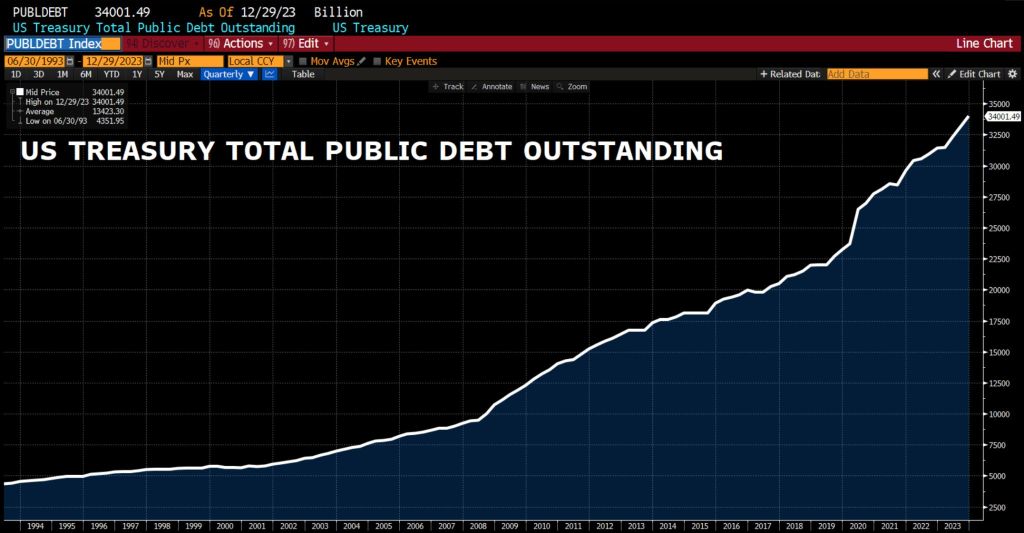
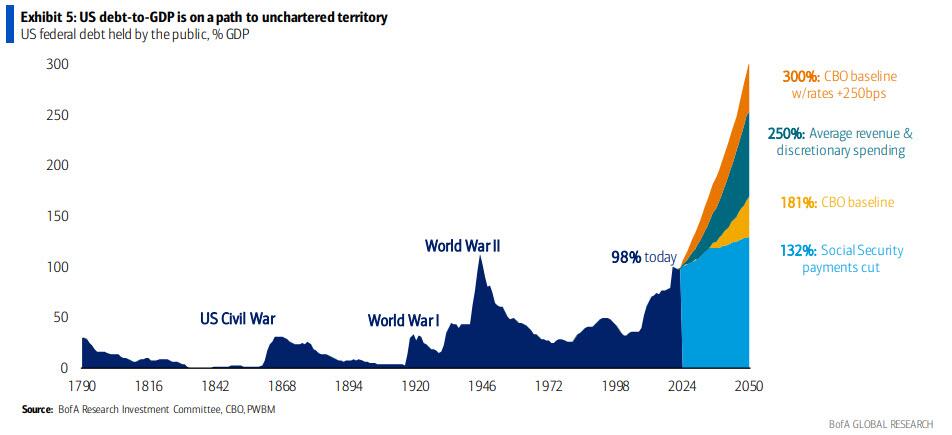
In another episode of “Government Gone Wild” we see that total Federal debt just broke through the $34 trillion mark.
Some context: US debt increased by…
$1 trillion in the past 3 months
$2 trillion in the past 6 months
$4 trillion in the past 2 years
$11 trillion in the past 4 years
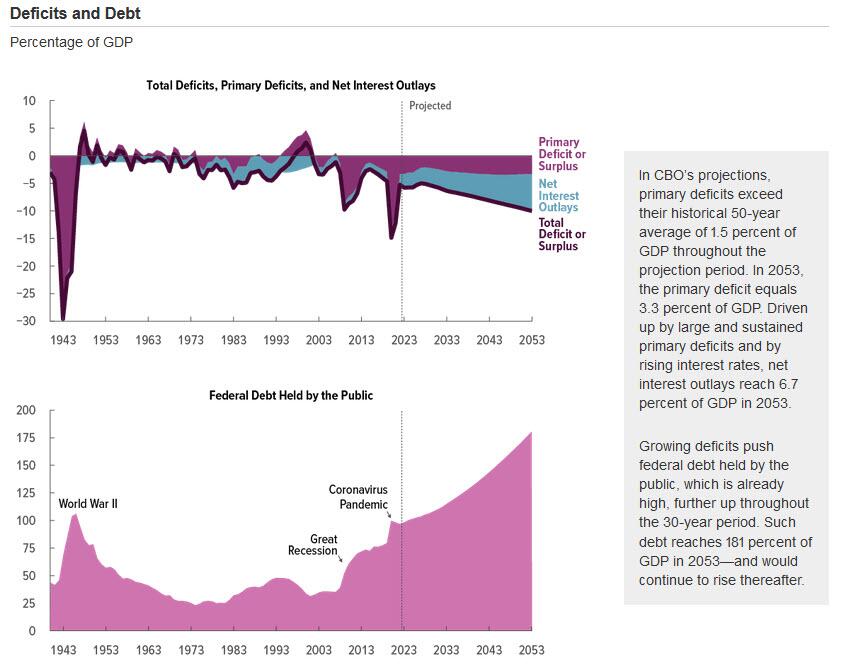
The Congressional Budget Office (CBO) is flashing the alarm.
Reckless spending in Washington DC by the administration and Congress is projected to drive US Debt to GDP to rise like the nuclear reactor in the film K-19: The Widowmaker.
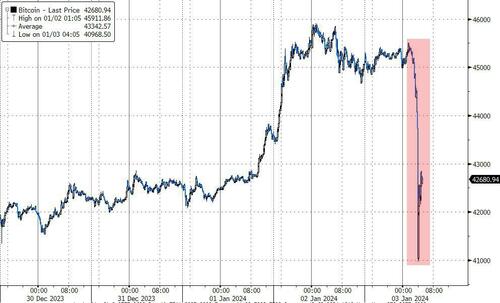
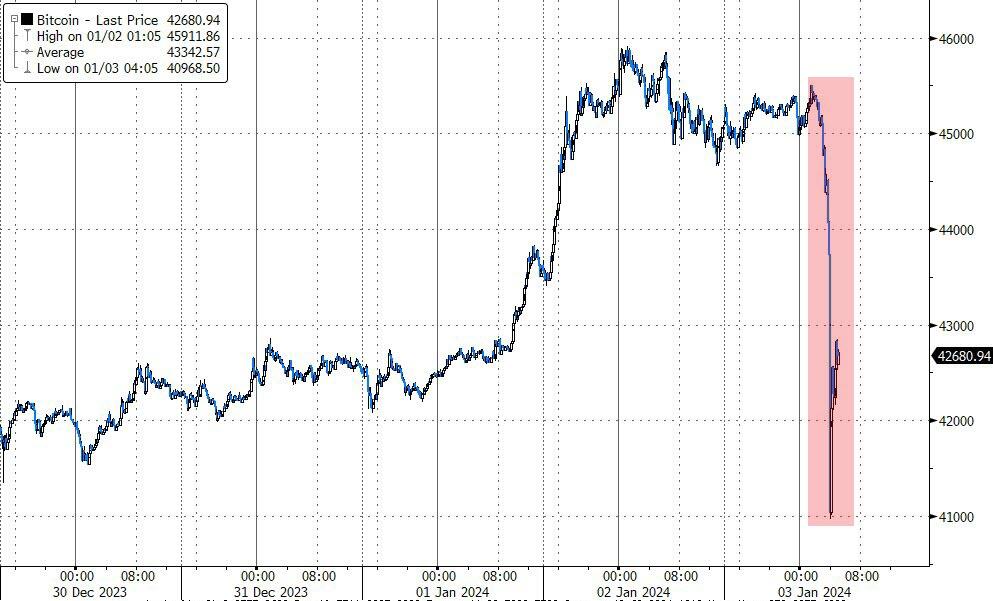
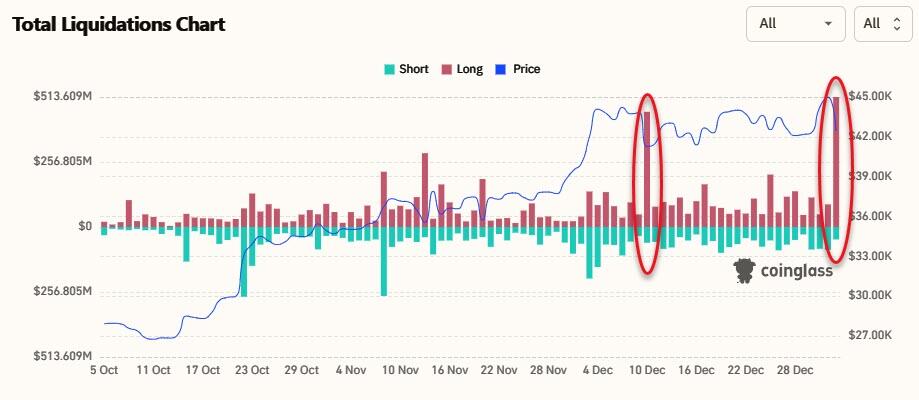
Today the crypto market flash-crashed this morning with Bitcoin instantaneously puking from $45,500 to $41,000…
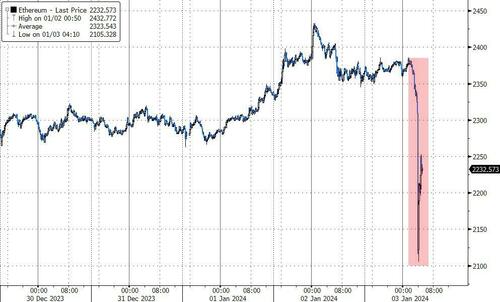
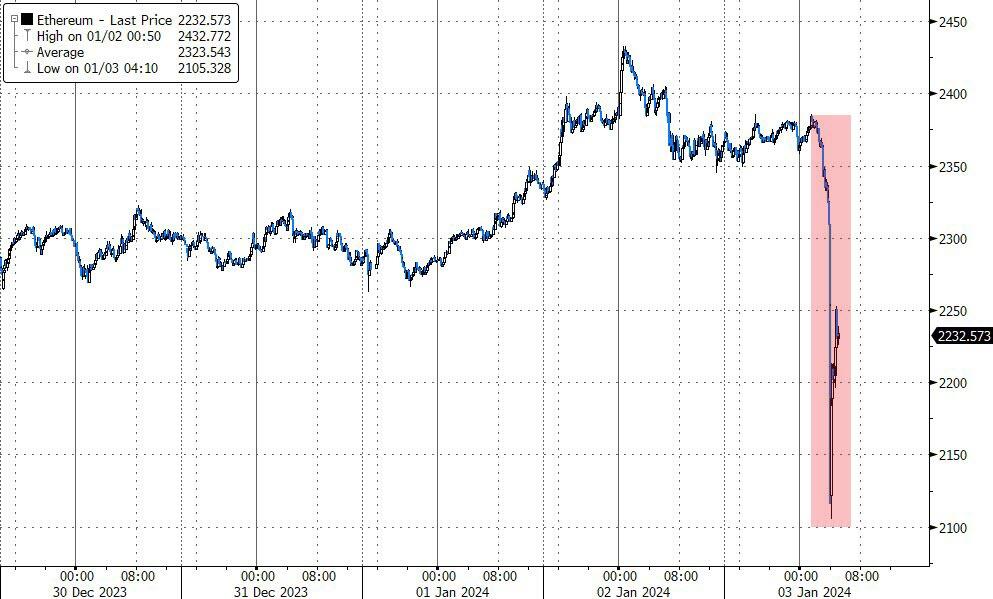
And Ethereum followed suite…
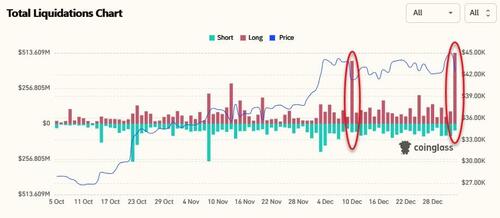
Over $550 million in crypto long positions were liquidated in the past 24 hours, per data from CoinGlass, including $104 million in Bitcoin longs in the past hour alone.
The extremely volatile cryptos are rallying. But still down on the day.














 Confounded Interest - Anthony B. Sanders


You must be logged in to post a comment.