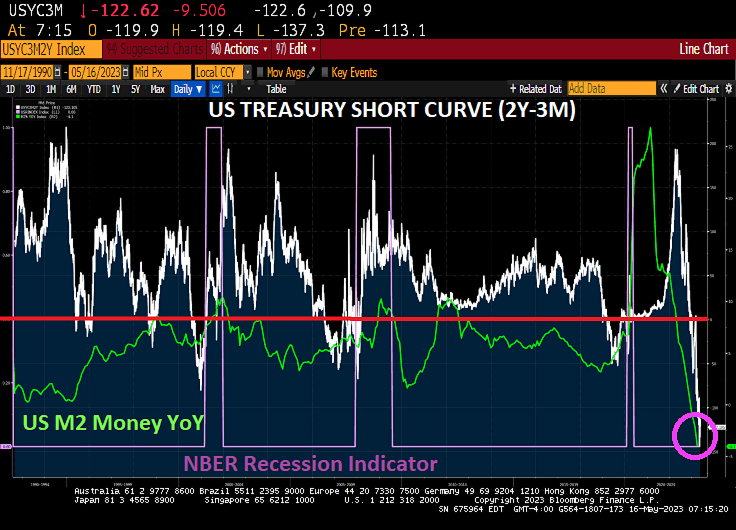
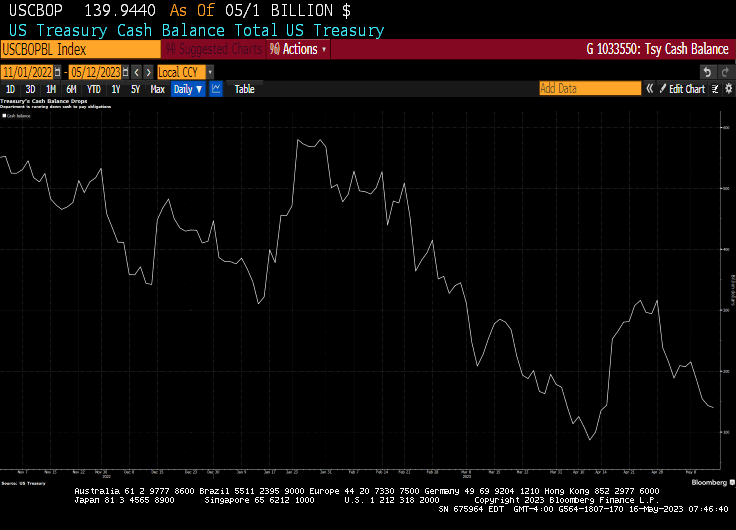
US Treasury Short Curve Remains Steeply Inverted As Yellen Warns ‘Time Is Running Out’ Ahead of Biden-McCarthy Meet (Treasury Cash Balance Getting Really Low)

I used to think that The Kabuki Theater surrounding the raising of the US debt limit and passing a Federal budget would be over by now. But since Biden is being controlled by the hard left “Progressives” in Washington DC, he may be reckless enough to let the US default just so he can blame Republicans. And with our useless and deeply-biased main street media (MSM) just repeating Democrat talking points blaming Republicans, we may actually see a US debt default.

So while Yellen is warning that time is running out, notice she never encourage Blaming Biden to negotiate his insane budget downwards, we see a deeply inverted US Treasury short curve (2Y-3M).
(Bloomberg) Treasury Secretary Janet Yellen warned that “time is running out” to avert an economic catastrophe from failing to raise the debt ceiling, in remarks released as President Joe Biden and congressional leaders prepared to meet on the standoff.
Speaker Kevin McCarthy issued his own notice Monday evening ahead of Tuesday’s 3 p.m. gathering, saying, “We only have so many days left to deal with this.”

The two sides showed little signs of agreeing on much else other than the countdown in the runup to the second White House encounter on the debt ceiling in two weeks. While senior staff have been negotiating for days, Republicans are still pressing for sweeping spending cuts, while Democrats are determined to protect the president’s legislative achievements.

“We are already seeing the impacts of brinksmanship: investors have become more reluctant to hold government debt that matures in early June,” Yellen said in remarks prepared for delivery to a banking conference on Tuesday. “The impasse has already increased the debt burden to American taxpayers.”

The Treasury chief issued a fresh letter to congressional leaders Monday restating that the Treasury risks running out of sufficient cash for all federal obligations as soon as June 1. The livelihoods of millions of Americans “hang in the balance,” she said in excerpts of her speech to the Independent Community Bankers of America Capital Summit released by the Treasury.

There is the evil Hobbit! Sending a letter to Congress essentially blaming McCarthy for the fiasco when Biden could downsize his budget request to reasonable levels. But Yellen is an authoritarian Statist, not a free market type.
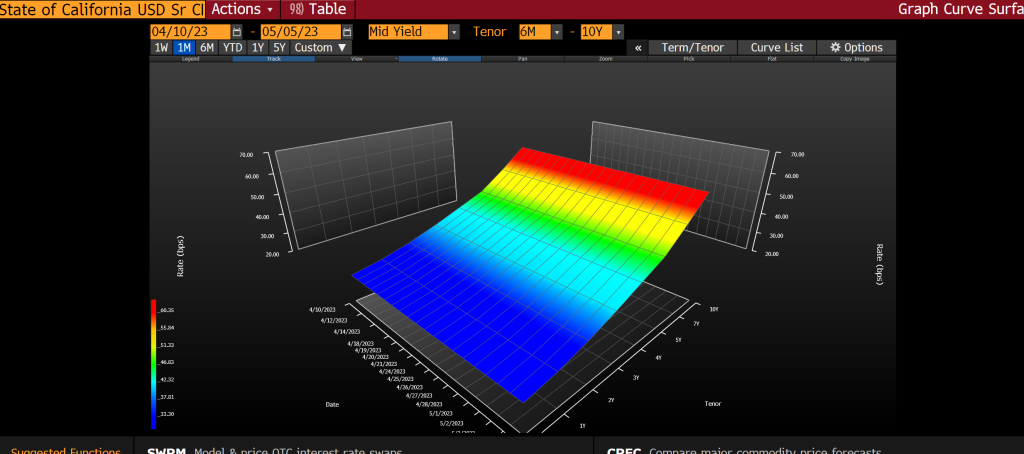
 

Gov’t Gone Wild! California Defaults on $18.6 Billion Debt, Now Businesses Have to Pay (Reparations Plan In California Could Cost The State Billions)

California just did what Slow Joe Biden and Senate Majority Leader Chuckles Schumer are threatening to do. Biden and Schumer still refuse to negotiate (allegedly) sending the US Federal government careening towards a staggering debt default. The source of both California and US Federal government fiscal problems? Out of control government spending, aka, government gone wild!

Now we have the State of California defaulting on $18.6 BILLION in debt. This is Governor Gavin Newsom (Nancy Pelosi’s nephew) bragging point to be President? Horrible fiscal management and a default?

In any case, California borrowed approximately $20 billion from the federal government to cover unemployment benefits during the pandemic, and with Gov. Gavin Newsom’s recent decision to not pay it back, employers are now saddled with the expense, according to experts.

“The state should have taken care of the loans with the COVID money it received from the government in 2021,” Marc Joffe, policy analyst at the Cato Institute—a public policy think tank headquartered in Washington, D.C.—told The Epoch Times.

In the proposed 2023–2024 budget, $750 million was allocated to start paying down the loans, but Newsom made changes to the plan in January and withdrew the funding.

The Epoch Times’ request for comment from Newsom’s office was not returned on deadline.

The decision leaves businesses in the state responsible for the loans—as mandated by federal regulations—so the federal unemployment tax rate of .6 percent is set to increase by .3 percent annually, starting in 2023, until the loan is extinguished.

“California is just not really an employer-friendly state,” Joffe said. “This one thing will not be a difference between a business remaining open or closing, but it’s just another burden on top of the many burdens the state puts on employers.”

Twenty-two states borrowed money for unemployment insurance from the federal government during the pandemic, with all but four—California, Colorado, Connecticut, and New York—paying back their debts.

California owes the most, by far, with approximately $18.6 billion outstanding as of May 2, followed by New York’s $8 billion, Connecticut’s $187 million, and Colorado’s $77 million, according to U.S. Treasury Department data.

The discrepancy in amounts borrowed and owed by states lies in the different approaches to managing the pandemic, with California’s stricter lockdown causing unemployment to remain higher and longer, according to experts

And CA CDS 1Y is tame (only 31), the CDS curve over a longer time frame looks miserable.

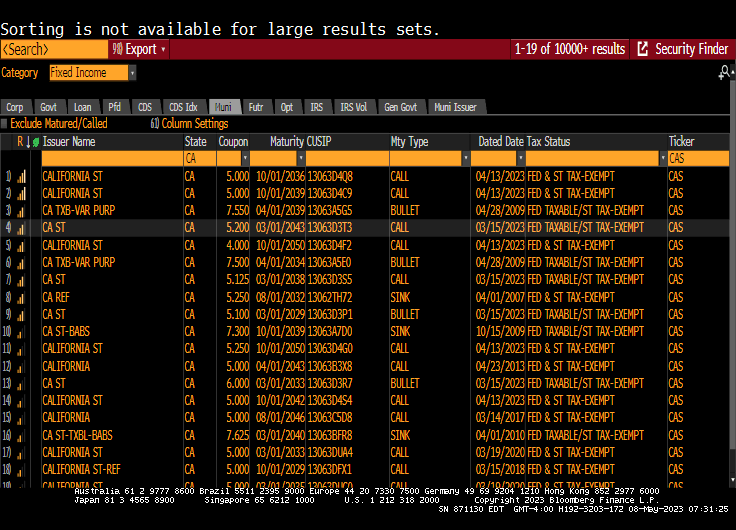
Now, Gruesome Newsom only default on Covid-related loans. The California municipal bond market is huge and CA has defaulted on those loans …. yet.

Speaking of insane fiscal “management,” a repartations plan in California could cost billions.

California’s reparations task force, which first convened nearly two years ago, has given the final approval to a list of recommendations on how the state may compensate and apologize to Black residents for historical discrimination.
“Reparations are not only morally justifiable, but they have the potential to address long standing racial disparities and inequalities,” Representative Barbara Lee (D-CA) said during a weekend meeting. The proposals now go to state lawmakers to consider reparations legislation and a final sum, which some economists could cost the state upwards of $800B, or almost 3x the state’s annual budget
.

To be initially eligible, applicants must be a descendant of Black people who were in the country by the end of the 19th century, thouqh there are not yet details on how the payments would be funded. Age, state residence, and other factors will also play a role in determining compensation.

There is the rub – how does California finance the reparations? Raise taxes (unfair to people who never did anything wrong to blacks)? Borrow billions? Given that Newsom just defaulted on loans to California might mean that there will be relucatance to lend CA billions more.

CA Governor Gavin “Slick” Newsom. The Defaulter In Chief of California.

Zoltan! Pozsar Says L-Shaped Recession Is Needed to Conquer Inflation (US 10Y-2Y Curve Inverts To -31.69 BPS)

  • Fed may have to hike to 5% or 6% as inflation now structural

Zoltan!

The US economy may need to undergo a deeper and longer recession than investors currently anticipate before inflation can be brought under control, according to Zoltan Pozsar of Credit Suisse Group AG

Markets expect the surge in consumer prices will soon peak and central banks will become less hawkish, but there’s a high risk that global cost pressures will remain elevated, Pozsar, global head of short-term interest-rate strategy at Credit Suisse in New York, wrote in a client note.

The world is being wracked by an economic war that’s undermining the deflationary relationships that have prevailed in recent decades where Russia and China supplied cheap goods and services to more developed nations such as the US and those in Europe, he said.

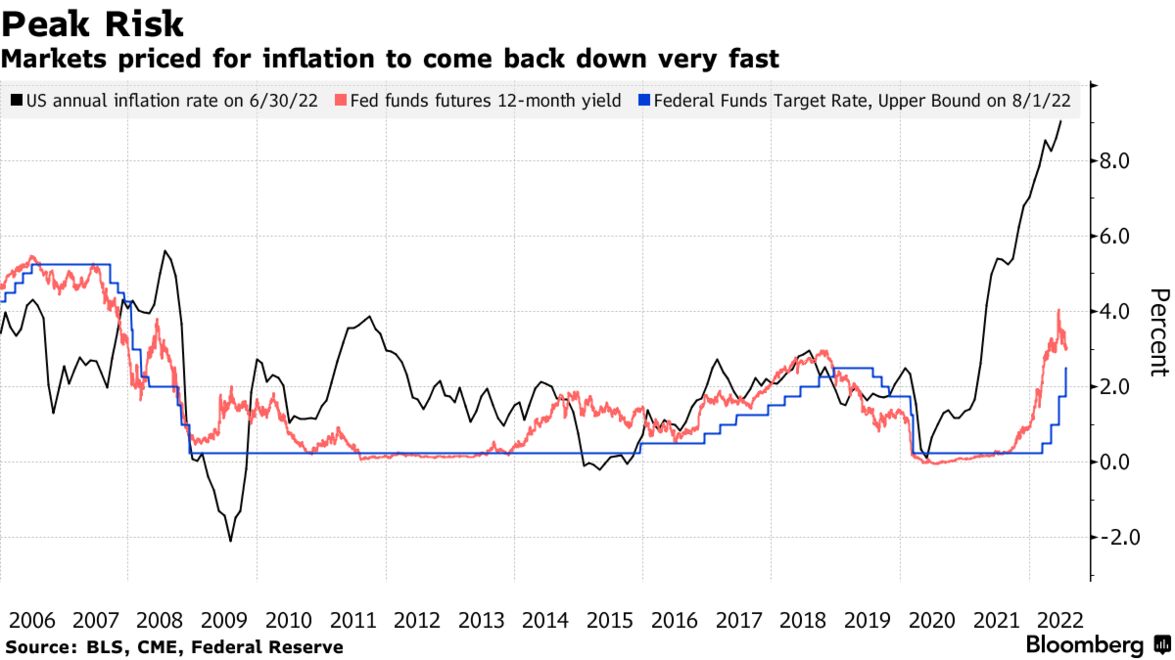
Markets priced for inflation to come back down very fast

“War is inflationary,” Pozsar wrote. “Think of the economic war as a fight between the consumer-driven West, where the level of demand has been maximized, and the production-driven East, where the level of supply has been maximized to serve the needs of the West.” That pattern held “until East-West relations soured, and supply snapped back,” he said.

The result is that inflation is now a structural problem, rather than a cyclical one. Supply disruptions have arisen from the changes in Russia and China, along with tighter labor markets due to immigration restrictions and a reduction in mobility caused by the coronavirus pandemic, Pozsar said.

There’s now a risk the Federal Reserve under Chair Jerome Powell has to raise interest rates to 5% or 6% and keep them there to create a substantial and sustained reduction of aggregate demand to match the tighter supply profile, he said.

‘More Misguided’

Connect the dots on the biggest economic issues.Connect the dots on the biggest economic issues.Connect the dots on the biggest economic issues.

Dive into the risks driving markets, spending and saving with The Everything Risk by Ed Harrison.Dive into the risks driving markets, spending and saving with The Everything Risk by Ed Harrison.Dive into the risks driving markets, spending and saving with The Everything Risk by Ed Harrison.

Sign up to this newsletter

Pozsar’s warning that inflation will stay elevated puts him at odds with the Treasury market, which rallied last month as investors switched their focus to recession risks from inflation concern. While an economic slowdown typically weighs on consumer prices, the latest annual US inflation reading of 9.1% for June remains far above the Fed’s 2% goal, although the price surge is forecast to slow for the first time in three months to 8.8% in July according to a Bloomberg poll of economists. 

The bond market is more misguided now than at any other time this year as traders wager the US central bank will start cutting rates in early 2023, Bloomberg Economics’ chief US economist Anna Wong and her colleagues said this week. Money markets are wagering on almost one percentage point of hikes by year-end followed by a quarter-point cut by June.

“Interest rates may be kept high for a while to ensure that rate cuts won’t cause an economic rebound (an ‘L’ and not a ‘V’), which might trigger a renewed bout of inflation,” Pozsar wrote in his note. “The risks are such that Powell will try his very best to curb inflation, even at the cost of a ‘depression’ and not getting reappointed.”

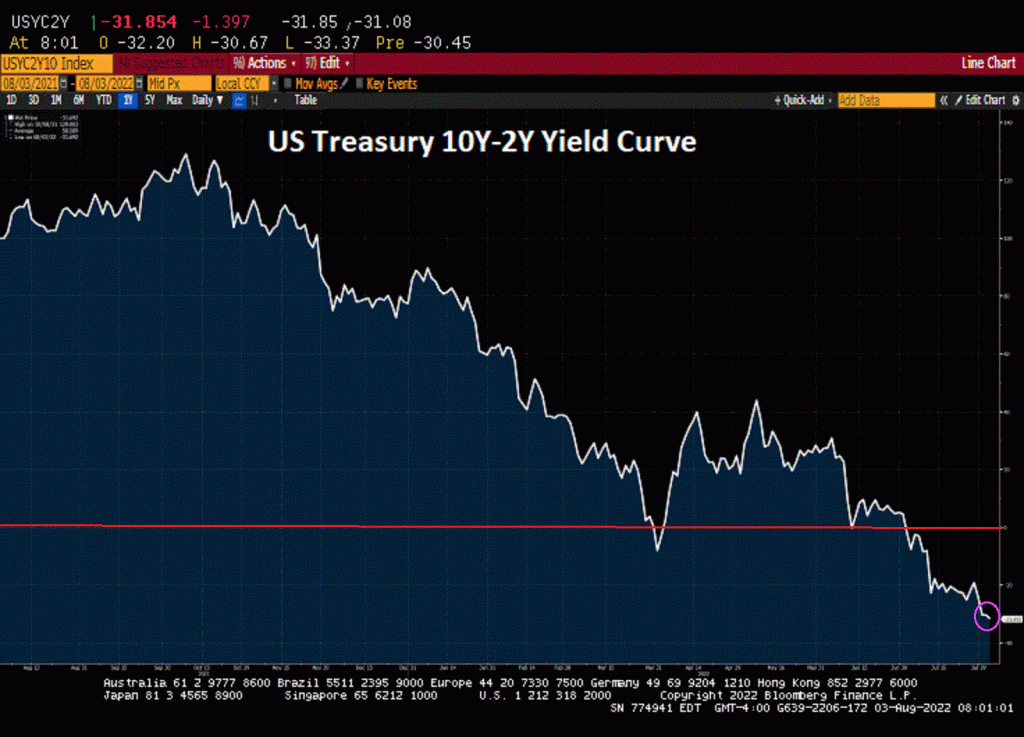
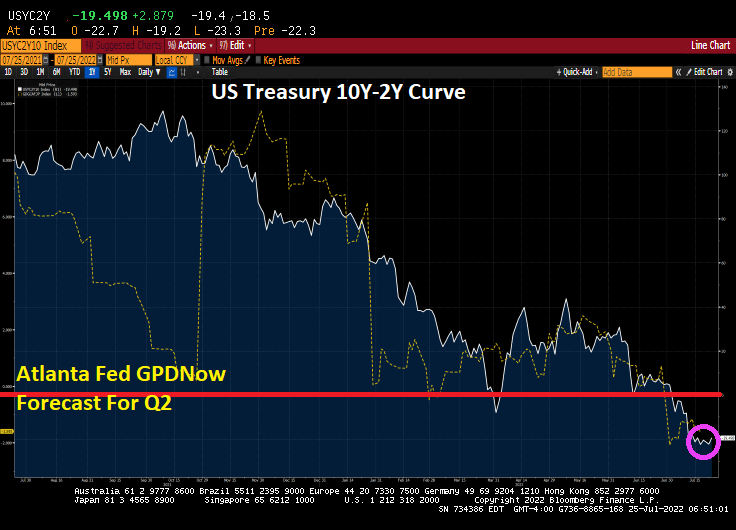
Speaking of “recession,” the US Treasury 10Y-2Y yield curve has inverted even further to -31.69 BPS.

Zoltan!

Inflation And The Fed Ahead of Wednesday’s FOMC Meeting (Will Fed 75 BPS Increase Tame Inflation With Inverted Yield Curve? Or Will Biden/Congress Raise Taxes To Fight Inflation?)

Hold on, The Fed is coming! To raise their target rate by 75 basis points at Wednesday’s FOMC meeting. Will this stem the tide of rising inflation?

Under Biden, we have seen regular gasoline prices rise 82% despite recent declines. Diesel fuel is up 121% and foodstuffs are up 46%. And house rents keep rising at a staggering 14.75% YoY. The recent declines is more due to the global economic slowdown and central bank rate increases than anything Washington DC is doing.

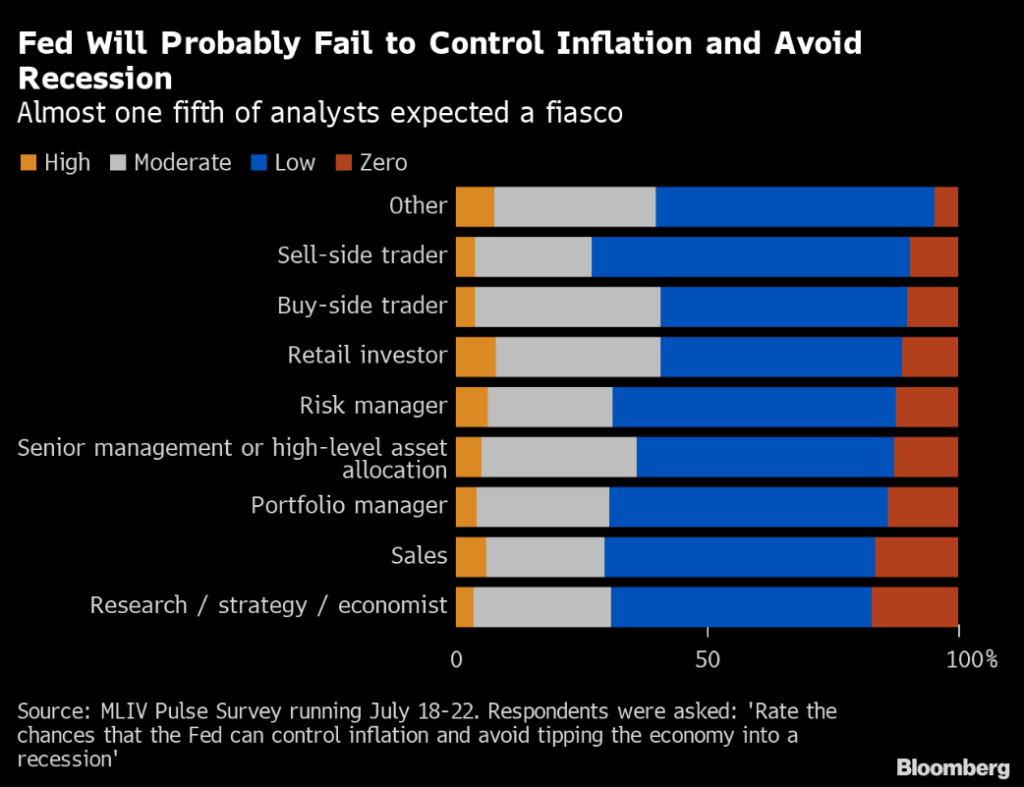
(Bloomberg) Investors are skeptical that the Federal Reserve can tame the worst inflation in four decades without driving the economy into a recession.

That’s bad news for Americans, who face the prospect of a downturn as their bills for food, rent and fuel swell. But to bond investors hit by deep losses this year, it may mean any further pain will be short-lived, as a recession will spark the US central bank to cut rates next year. That’s according to the results of the latest MLIV Pulse survey. 

Over 60% of 1,343 respondents in the survey said there’s a low or zero probability that the US central bank can rein in consumer-price pressures without causing an economic contraction. The survey was conducted July 18-22 and included retail and professional investors.

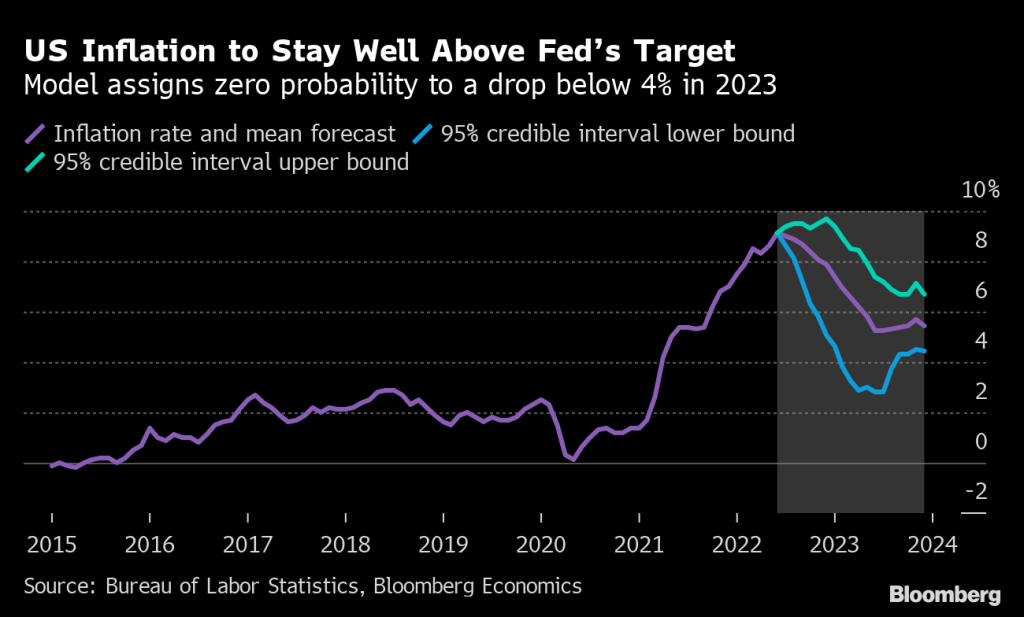
US inflation may be close to a peak, but it’s very likely to stay above 8% through year-end. Bloomberg Economics’ model assigns zero probability to a drop below 4% in 2023. Taken together with increasing recession risks, the Fed faces a tough balancing act as it attempts to bring stubborn price pressures under control without tipping the economy into contraction.

Of course, The Federal Reserve doesn’t really consider energy or food inflation, which are typically higher than core inflation. But going into Wednesday’s meeting, we see the US Treasury 10Y-2Y curve remains inverted (a signal of impending recession) and the Atlanta Fed GDPNow Q2 tracker at -1.6% after a negative Q1 reading.

Will raising the target rate (or ACTUALLY shrinking their balance sheet) reduce inflation? We shall see, but it has got to be better than Lawrence Summer’s suggestion to reduce inflation: raise taxes. Wait a minute, Larry. Inflation was caused by 1) overstimulus by The Fed combined with 2) massive Covid spending by Biden, Pelosi, Schumer and 3) Biden’s anti-fossil fuel policies. So instead of suggesting a decrease in Federal spending, Summer’s wants to give MORE of your money to Biden and Congress to spend. What an unbelievable nitwit.

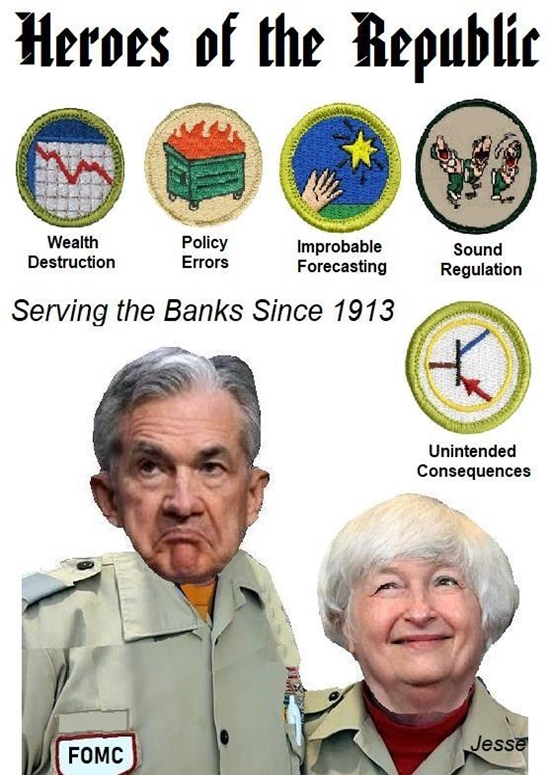
Here is a picture of Larry Summers, Jay Powell and Janet Yellen attending the FOMC meeting in Washington DC.

Slipping Into Darkness! Bidenflation And Fed’s Reaction Causing Social Security And Pension Funds To Get Clobbered (Mortgage Rates Keep Climbing)

US President Biden went green and signed executive orders on his first day to limit oil and natural gas exploration of Federal lands and offshore (also, killed the Keystone Pipeline), helping to drive up energy prices and food prices. These orders begat inflation (also caused by the massive Covid relief by the Federal government). The highest inflation in 40 years begat The Federal Reserve signalling a tightening of Fed monetary policy … to fight the problem caused by The Fed in the first place … too much monetary stimulus for too long. Fiscal and monetary fanaticism and ignorance is forever busy and needs feeding

There was an interesting article on MarketWatch entitled “Bond rout exposes Social Security’s insanity.” The headline was “Every dollar of yours that’s invested in the Social Security trust fund is invested in low-yielding government bonds.”

Yes, another disastrous consequence of The Fed’s lax monetary policy since 2008, helping to push Treasury yields extremely low. And REAL Treasury yields into negative territory.

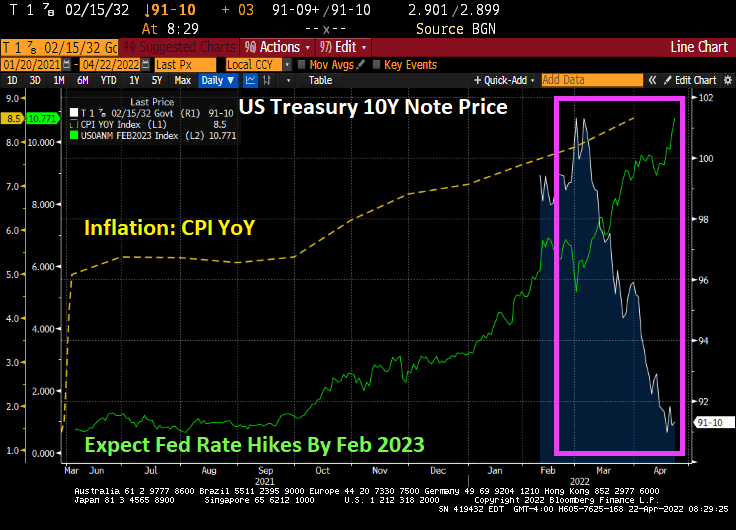
But here we sit today with The Fed threatening to trim their balance sheet and raise rates … to combat the inflation they helped create in the first place. Now we have the 10-year Treasury Note price falling like a paralyzed falcon with expected hate hikes going above rate hikes by February 2023 (based on Fed Funds Futures prices).

Most pension funds also invest heaving in US Treasuries, along with agency Mortgage-backed Securities (AgencyMBS).

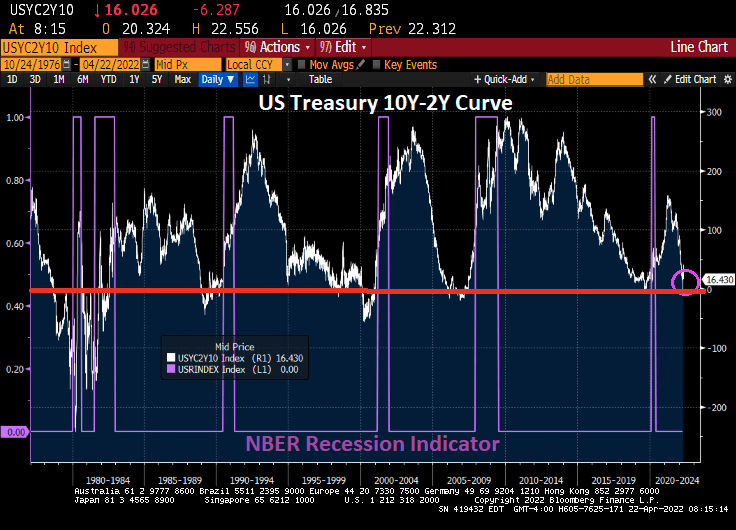
Plus we have the Treasury curve slipping into darkness.

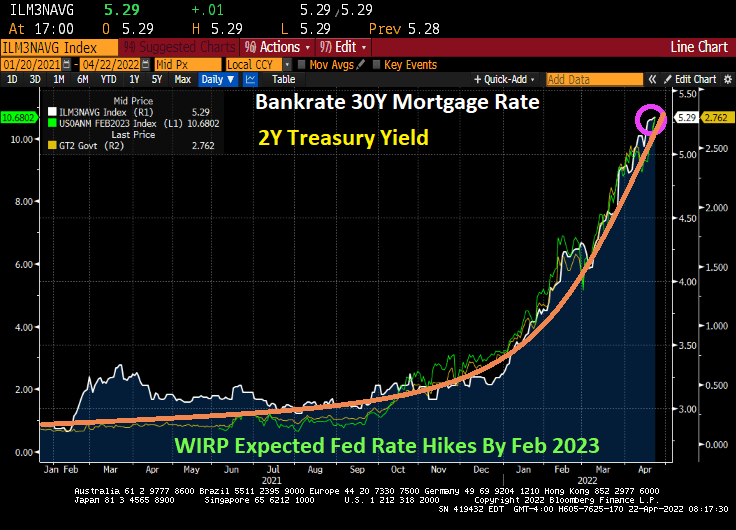
Speaking of “Slipping Into Darkness,” mortgage rates are soaring.

Meanwhile, Biden, Fed economists and Congress are merrily partying at some DC nightclub.

What is hip? NOT Biden, Pelosi, Schumer or Powell.