Taking The Credit For The Post-Covid Recovery In Unemployment (Trump, Biden, Pelosi Or Powell?)

I watched Biden’s Press Secretary Karine Jean Pierre giving Biden credit for the lowest unemployment rate in US history thanks to his economic policies. And Biden mentioned that he inherited a terrible economy from Trump.

Hmmm.

Let’s let the data talk.

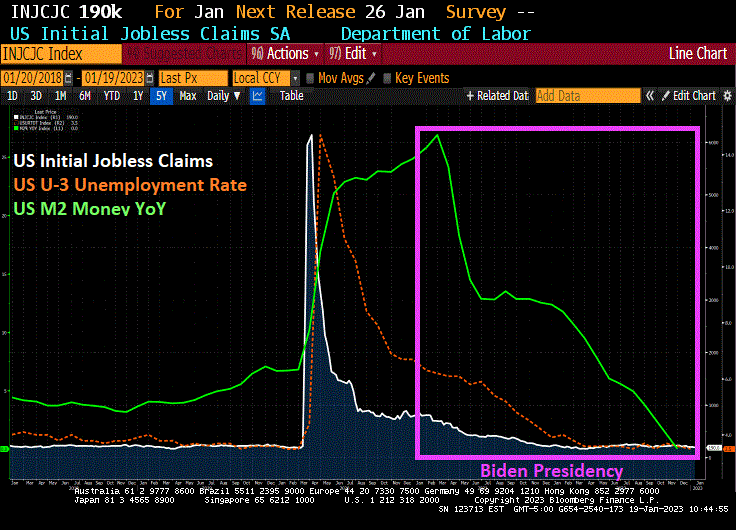
Covid was horrific (I almost died from it), but it was the government response to Covid there was disastorous. Government shutdowns (and the masking of the populace) killed off numerous small businesses and sent jobless claims soaring in 2020 (white line) and U-3 unemployment rate rose to the highest level since The Great Depression.

The response from The Federal Reserve was a massive printing of money (green line). And after governments stopped their economic shutdowns (coupled with massive money printing), we saw jobless claims and unemployment shrink rapidly BEFORE Biden took office as President.
The 1981 recession begat an epic borrowing of money by The Federal government (under House Speaker Tio O’Neill D-MA) and we saw another explosion in Federal debt under House Speaker Nancy Pelosi D-CA TWICE, once in 2009 following the financial meltdown and again in 2020 following the Covid economic lockdowns.

So does Trump get any thanks for the rapidly improving labor market before his ouster by Biden? Of course not. But who gets the blame for the staggering growth in Federal debt? House Speaker Nancy Pelosi.

The US did get positive wage growth under Biden, but due to inflation, American workers have experienced 21 straight months of NEGATIVE wage growth.

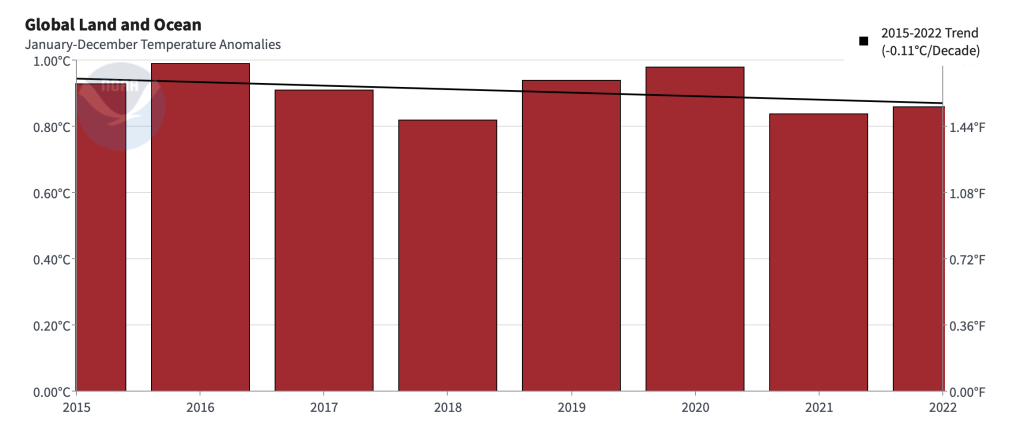
While Trump tried deregulation to free-up the US economy, Biden has consistently used regulation as a weapon of obidience. His slavish obidience to activist groups on the environment, which is a shame since temperatures have actually been coming down since 2016.
When you look at the data, Trump actually set in motion the jobs recovery, not Biden. Other than helping to create inflation, I can’t think of one positive thing Biden has done for the economy.

On an unrelated note, why is US FBI Director Chris Wray at the World Economic Forum in Davos Switzerland when there is a top secret document fiasco going on in DC and Delaware?

‘Soft Landing’ Narrative Nuked As US Industrial Production Plunges In December And New York Biz Leaders Survey Crashes To -21.4 (US Treasury 10Y Yield Drops -14.1 Basis Points)

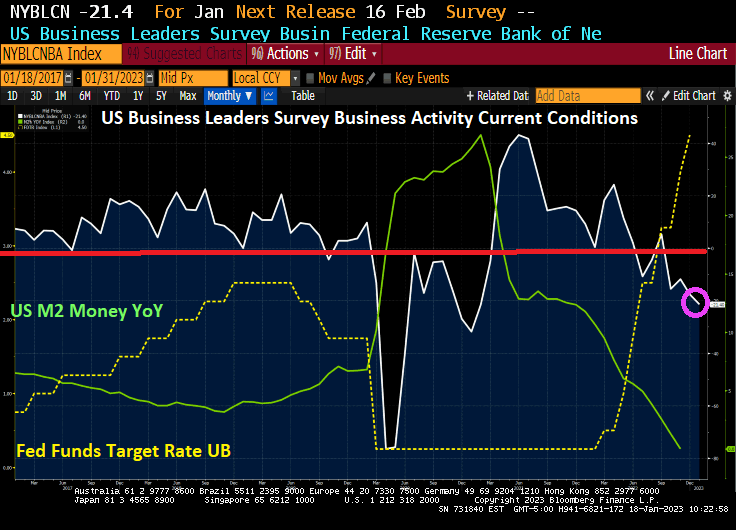
Soft landing for the US economy? It is looking less and less likely. The bond market (10-year Treasury yield) just shed -14.1 basis points. As I always told my investments students, any 10 basis point shift in the 10-year Treasury yield is significant.

Let’s start wit the US business leaders survey of current conditions. It just crashed to -21.4

Then we have US industrial production, down -0.7% in December. And is up only 1.65% year-over-year as M2 Money growth stalls.

Capacity Utilization plunged more than expected to 78.7% (79.5% exp).

Biden claiming the US economy is strong is pure Fantasy Island.

Today, Jean Pierre annouced that Biden’s economic plans are working.

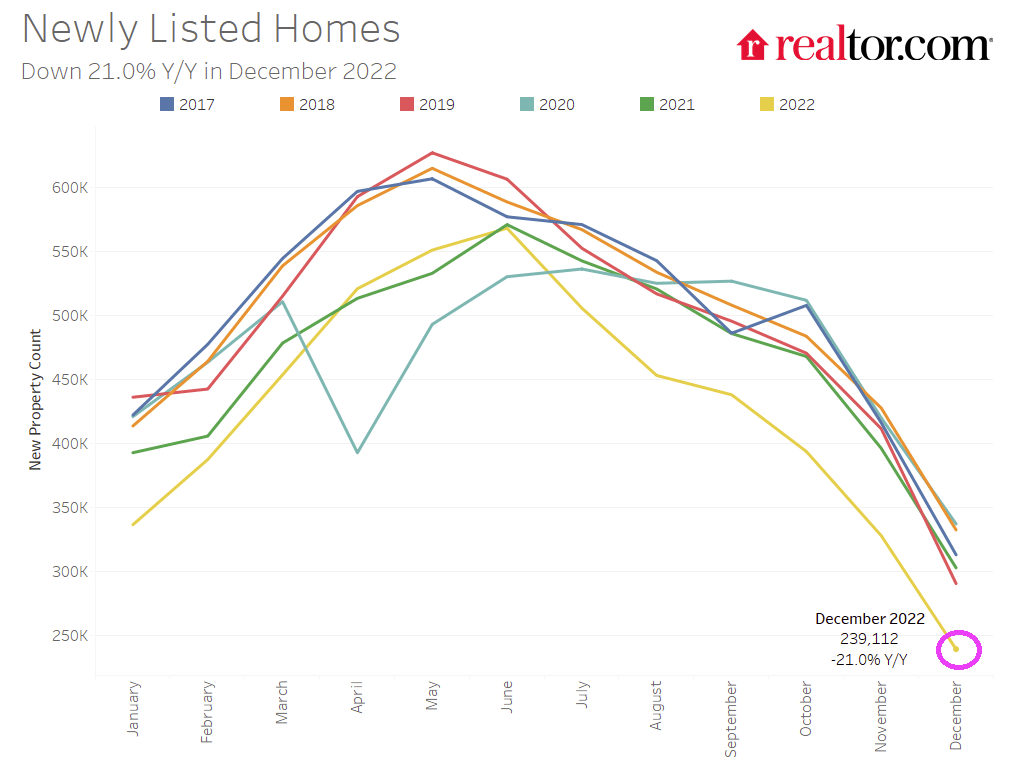
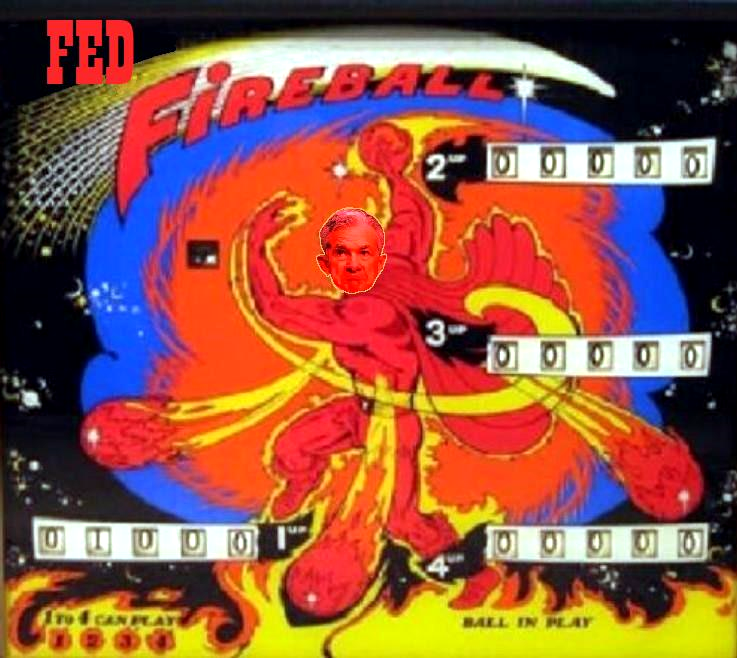
Fed Fireball! Newly Listed Homes Decline -21% YoY In December (Worst Decline In 6 Years) As Fed Tightens Monetary Noose

As The Federal Reserves attempts to combat inflation, the withdrawal of monetary stimulus is creating problems in the housing market. For one, as mortgage rates have risen, newly listed homes declined -21% YoY in December.

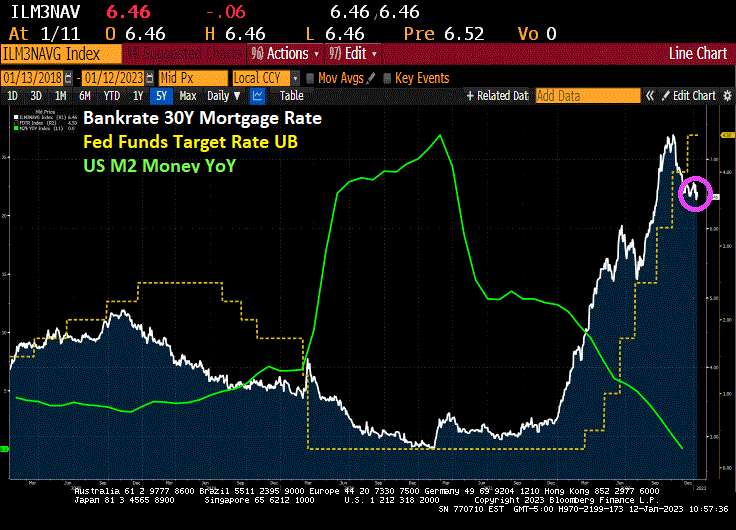
And yes, the 2022 vintage is the worst in 6 years as The Fed counterattacks inflation. And mortgage rates rose to over 7% before calming down to around 6.50%.

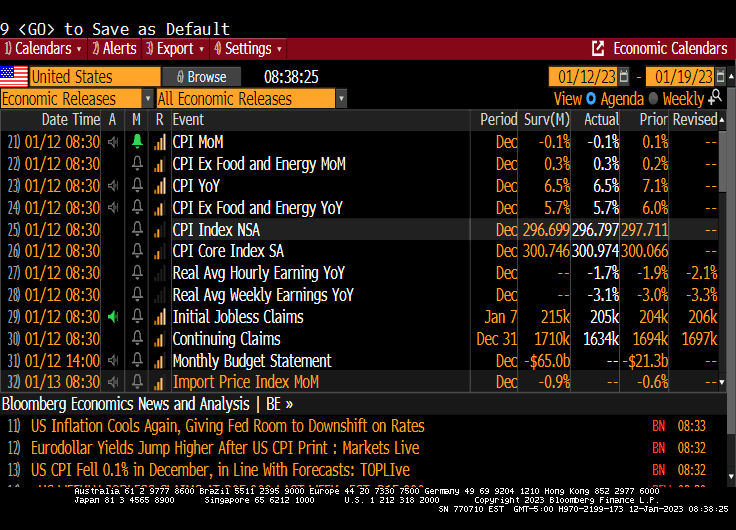
Magic? US Inflation Cools To -0.1% In December, 6.5% Year-over-Year YoY (REAL Weekly Earnings NEGATIVE For The 21st Straight Month At -3.1% YoY)

I don’t think this is a record that Biden can run on for re-election: 21 straight months of NEGATIVE REAL WAGE GRWOTH. Fortunately for Fed Chair Jay Powell, he is not an elected official.

The December inflation report still shows elevated inflation in the US, but only -0.1% since November (MoM), but still high compared to last year (6.5% YoY). That is still over 3x The Fed’s target inflation rate of 2%.

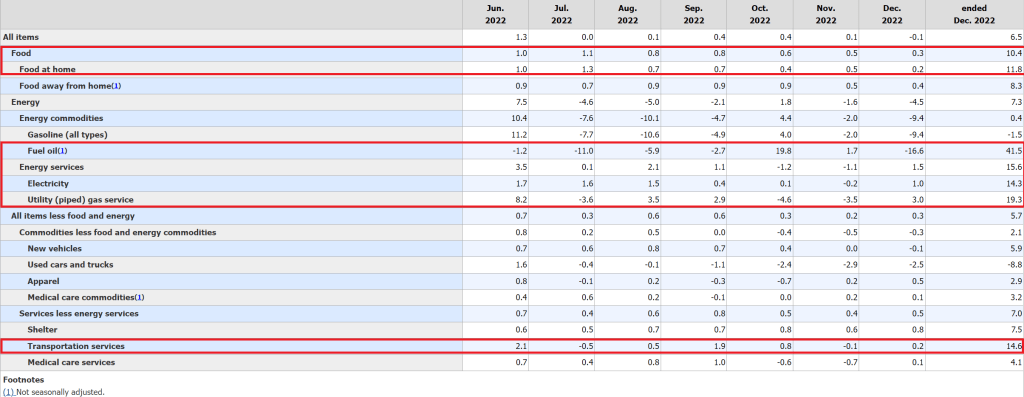
While headline inflation fell to 0.1% MoM, CORE inflation (removing food and energy) rose again 0.3% MoM and 5.7% YoY.

What exactly went up in price in December? Food and energy were all over 10% YoY growth.

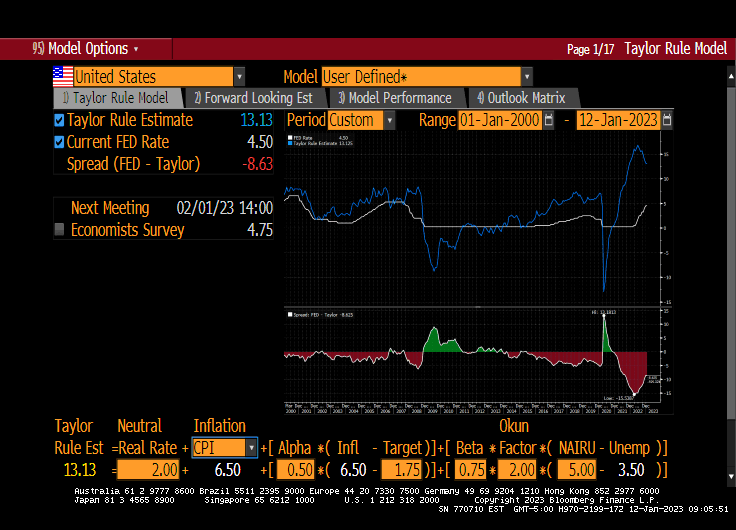
At 6.50% YoY headline inflation, the Taylor Rule suggests a Fed Funds Target rate of … 13.13%. Well, I guess that Powell will say there is more rate hikes to be done.

As if The Fed follows any sensible rule. Instead, The Fed relies on magic tricks.

Born Under A Bad Sign? US Residential Purchase Mortgage Demand Falls 44% YoY As Fed Tightens (Refi Apps Fall 86% YoY), But Apps UP In First Week Of 2023

The US residential mortgage market seems to be born under a bad sign … and if it wasn’t for The Federal Reserve, it would have no luck at all.

It is the start of a new year and, like clockwork, residential mortgage applications are rising (at least until May). But it is important to realize that purchase mortgage demand is down 44% from the same week last year (YoY). And refinancing mortgage applications are down 86% YoY.

Mortgage applications increased 1.2 percent from one week earlier, according to data from the Mortgage Bankers Association’s (MBA) Weekly Mortgage Applications Survey for the week ending January 6, 2023.

The Refinance Index increased 5 percent from the previous week and was 86 percent lower than the same week one year ago. The seasonally adjusted Purchase Index decreased 1 percent from one week earlier. The unadjusted Purchase Index increased 47 percent compared with the previous week and was 44 percent lower than the same week one year ago.

You can see the beginning of the new year in pink outline, purchase apps up 47% since the previous week (WoW). But you can see the general decline in both purchases and refinancing applications YoY as M2 Money growth stalls.

Talk about seasonality! If you want to feel optimistic about the mortgage market, just look at the first week of 2023. Declining mortgage rates are helping fuel short-term mortgage demand.

The Ravages Of Inflation: US Consumer Credit UP 7.9% YoY In November While Personal Savings Collapses -64.8% YoY

As we are painfully aware, inflation is still high at 7.1% Year-over-year (YoY). To cope with inflation, consumers have been gutting their savings and increasing their use of credit. In November, consumer credit increased 7.9% YoY while personal savings fell -64.8% YoY.

The good news? Inflation month-over-month is expected to be 0% tomorrow.

So, inflation will be gone in November?

Small Business Optimism Index Plunges Below 90 As Fed Tightens Money With M2 Money Growth YoY Hitting 0% (Baltic Dry Index Continues Downward Descent)

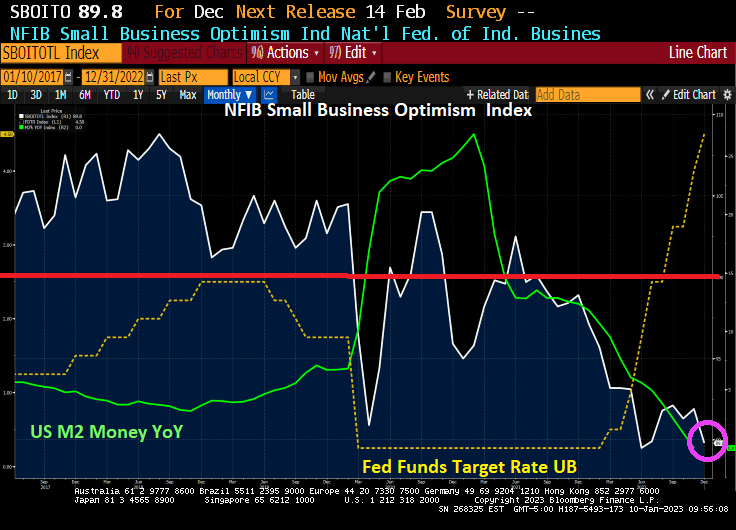
The NFIB Small Business Optimism Index is plunging and just fell below 90. The index was above 100 before the Wuhan virus outbreak in 2020, but has only been at 100 or above for only two months under Biden. And the trend is definitely looking bleak as The Federal Reserve fights inflation with M2 Money growth having collapsed to 0% YoY growth.

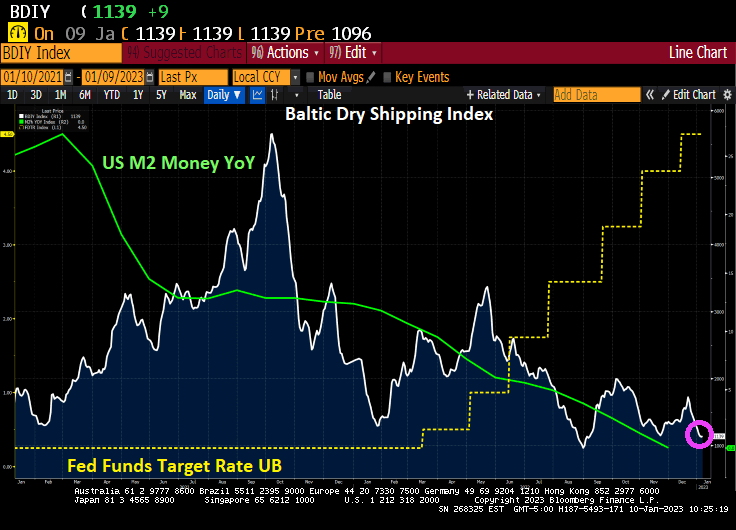
And the Baltic Dry shipping index is falling with M2 Money growth YoY.

I wonder what Fed Chair Jerome Powell is thinking?

Zoltan! Fed Will Restart QE to Stabilize Treasury Market During Summer 2023, Credit Suisse Group’s Pozsar Says

Zoltan!

The Federal Reserve will be the backstop of the Treasury market this year to alleviate dysfunction resulting from its increasing size and the retreat of regular buyers.  

That’s the view of Credit Suisse Group AG analyst Zoltan Pozsar, who in a note to clients Friday predicted the Fed will restart asset purchases during the summer of 2023. 

In Pozsar’s analysis, relative-value funds won’t buy Treasuries unless they cheapen a lot relative to overnight index swaps, and banks with sagging reserves are more likely to tap the funding markets than to buy Treasuries. FX-hedged buyers have been “priced out,” and geopolitical events have reduced large reserve managers’ appetite for US debt, he said.  

Flagging demand from marginal buyers will depress demand for Treasury auctions, sparking selloffs in equities, credit and emerging markets, according to Pozsar. 

“This is a ‘checkmate-like’ situation,” he wrote. “The Fed won’t be a pivot and the terminal rate may have to go higher still, neither of which augurs well for either risk assets or Treasuries.” 

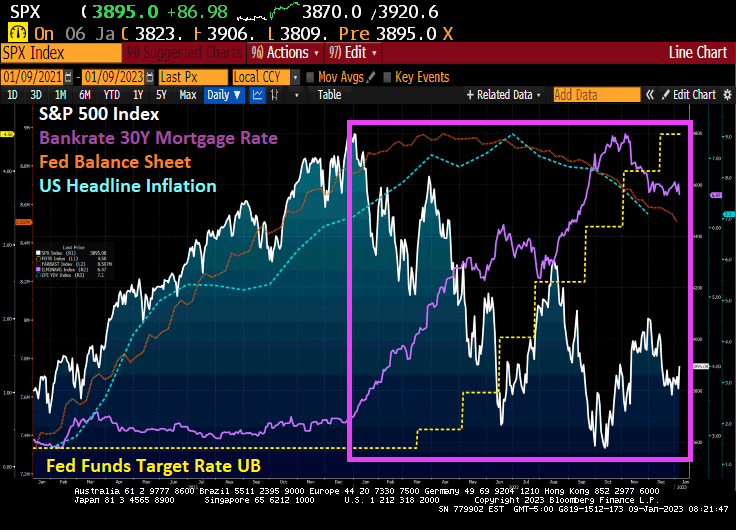
As The Fed started to raise rates (yellow line) to fight inflation (blue dashed line), the S&P 500 index started to fall. Note that The Fed’s balance sheet (purple line) is mirroring the inflation rate.

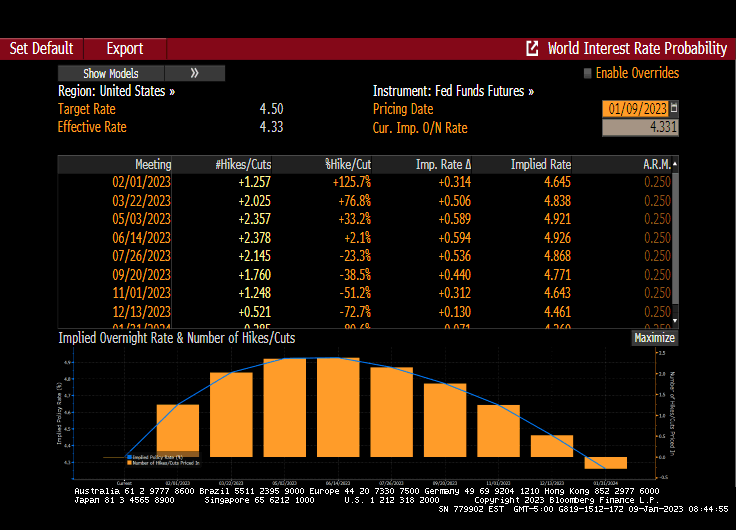
Fed Funds Futures point to Zoltan’s reversal in June 2023.

Will The Fed pivot? Zoltan says yes, the talking Fed heads say no.

A rare glimpse into The Fed’s open market committee meeting.

Or more explicitly, “Hail Fed” or “Hail Zorp” (Zero interest rate policies (ZoRP)).

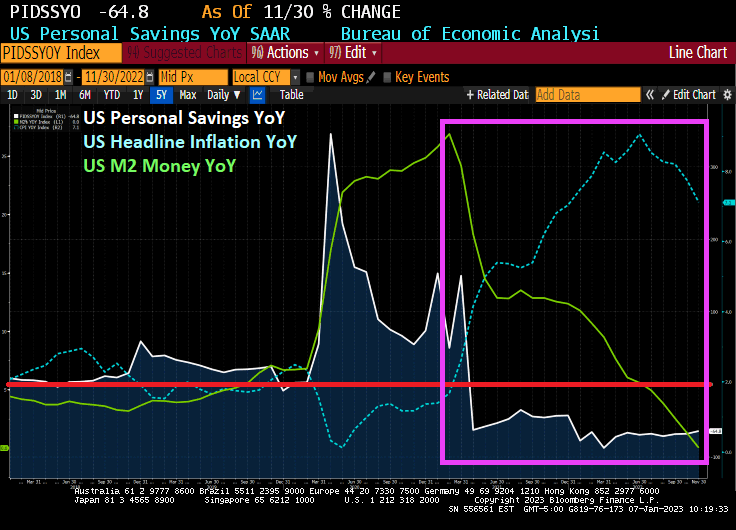
Coping With Inflation? US Personal Savings Declines -64.8% YoY In November As M2 Money Growth Falls To Lowest In History (0% YoY)

US headline inflation began to soar as soon as Joe Biden became President. A combination of massive stimulus spending related to the Covid economic shutdown and his war on fossil fuels, driving up gasoline and diesel fuel prices. In other words, headline inflation rose from 1.4% Year-over-year (YoY) at the end of December 2020 to 9.1% YoY in June 2021. It has now simmered down to 7.1% YoY as The Fed continues to remove monetary stimulus.

How have consumers coped with inflation caused by massive Federal spending and Biden’s anti-fossil fuel policies? In November, personal savings dropped -64.8% YoY. This marks 20 straight months of declining personal savings.

US M2 Money growth YoY is now … 0%. That is the lowest in US history.

Wow, when The Fed puts its foot on the brakes, …

Devil’s Tower? ISM New Orders Slump To 45.2 In December As ISM Prices Paid Slumps To 39.4 (Stimulus Is Already Gone, Recession In Sight)

To paraphrase The Eagles, US monetary stimulus is already gone.

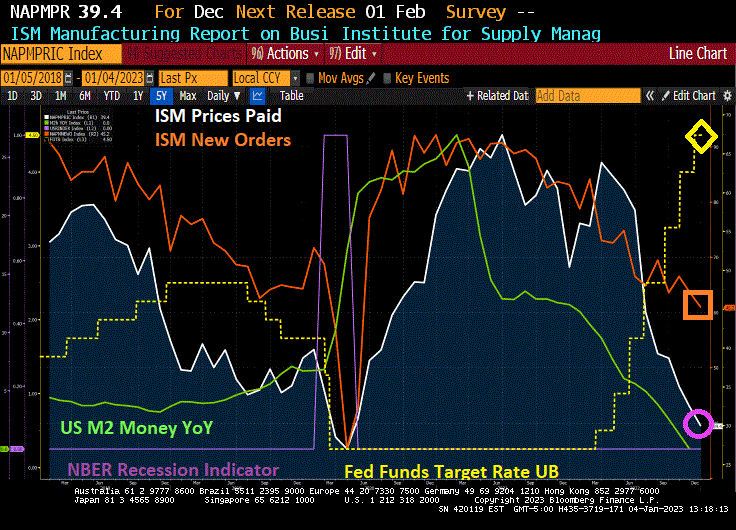
And with it, ISM Manufacturing Report for December is showing weakness. New orders (orange line) is down to 45.2 (below 50 is contraction) and the prices paid is down to 39.4 (white line). All this is happening as The Fed raises its target rate (yellow line) and removes monetary stimulus (green line).

This gives us “The Devil’s Tower” looking economic spike after massive Covid-related monetary stimulus and Federal government repeated stimulus.

Biden is probably hoping for MORE stimulus, like in Close Encounters of the Wrong Kind.

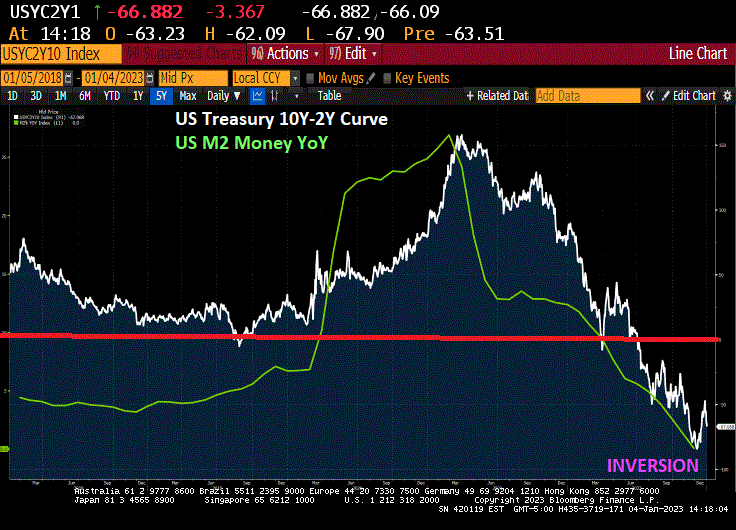
Speaking of Already Gone, look at the US Treasury 10Y-2Y yield curve with slowing M2 Money growth. Yield curve inversion is more about vanishing M2 Money growth than it is a forecast of recession.