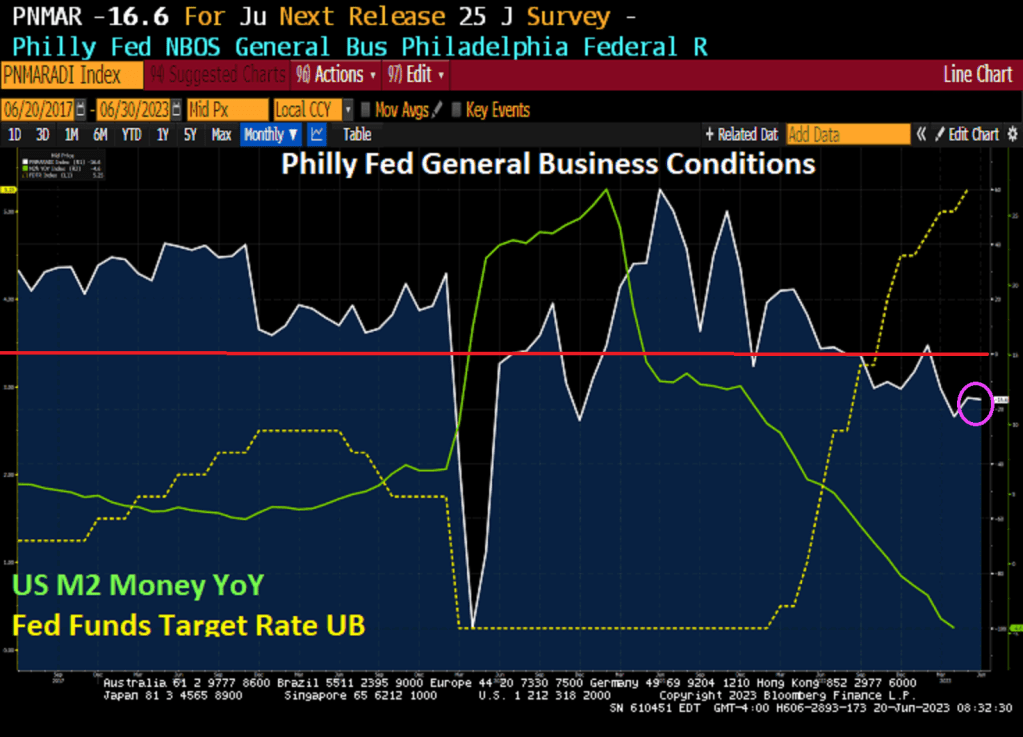
Now we have more evidence of an impending recession with the Philly Fed General Business Conditions index falling to -16.6 in June as Green Man (M2 Money growth) stalls.
Federal Reserve Chair Jerome Powell (aka, Green Man) will have an opportunity this week to clarify what many found a confusing message on the path of interest rates, with the added task of assuring Democrats and Republicans the economy is on track.
The Fed chief will face questions from lawmakers on Wednesday and Thursday, his first testimony on Capitol Hill since early March, before banking-sector turmoil prompted sharp criticism of the Fed and forced officials to rethink their policy strategy. Since then, the most acute financial strains have eased, but questions remain about the extent to which tighter credit will weigh on the economy, and what that means for the Fed.
Powell will need to reassure Republicans the Fed is not backing down from its campaign to contain price pressures, while pointing Democrats to the resilience of the economy as officials prepare to raise rates further this year.
“The Democrats are nervous because they would rather declare victory and move on,” said Stephen Myrow, a managing partner at Beacon Policy Advisors and a former George W. Bush Treasury official. “I think they’re going to try to caution this time against further increases. But Republicans are just going to hammer away and act like inflation hasn’t come down.”
Powell will be fresh off the Fed’s June 13-14 meeting, where he and his colleagues left rates unchanged for the first time in 15 months but signaled they may deliver two more hikes this year. Fed watchers and investors struggled to digest the message from Powell’s post-meeting press conference, and lawmakers last week said they planned to press him for an explanation.
“Right now there’s a lot of confusion about the next step,” Thom Tillis, a Republican senator from North Carolina, said Thursday.
Well, Senator Mel Tillis, there is no confusion. The DC Elites and Big Banks don’t want to disrupt the flow of money to the political donor class (including China and Ukraine payments to Biden’s family, now up to $30 million). The Fed may raise rates one more time and claim victory again their “War on Inflation!” then start cutting again as the Presidential election approaches.
While I am miserable under Biden and Yellen’s “Reign of Error,” apparently much of the USA is miserable under Biden/Yellen as well compared to the pre-Covid days of Donald Trump. 9.03% misery index (unemployment rate+ core inflation) today compared to 5.86% at the end of 2019 under Trump (before we got Fauci’d and Weingarten’d (the National Teachers’ Union President who pushed public school shutdowns)).
(Bloomberg) If a recession is going to come in the next 12 months — and most economists surveyed by Bloomberg say it probably is — then President Joe Biden should hope it begins sooner rather than later.
The last three one-term presidents — Jimmy Carter, George H.W. Bush, and Donald Trump — have all had their reelection hopes felled by an economic downturn.
But the list of presidents who survived recessions on their watch is just as long. Richard Nixon, Ronald Reagan and George W. Bush all won reelection — in the first two cases by landslides.
The difference, for the most part, is timing.
Two-term presidents get recessions out of the way early. One-term presidents have bad economic news as voters are deciding.
That means a short recession that begins soon — offering the chance for a rebound by Election Day 2024 — might be the best-case scenario for Democrats.
“The historical record suggests that a recession in the second half of 2023 would probably be less damaging to the president’s reelection prospects than a recession in the first half of 2024,” said Larry Bartels, who studies the intersection of politics and economics at Vanderbilt University. But he also said there’s not much that Biden can do at this point to change the direction of the economy in the short term.
The economic projections accompanying the Federal Reserve’s decision to hold interest rates Wednesday suggest that policymakers see less likelihood of a downturn than before. Officials’ median forecast for gross domestic product growth rose from 0.4% to 1% in 2023, with the expansion expected to pick up slightly in 2024 and 2025.
Bond traders responded to the rate decision with a signal that they’re expecting an increased likelihood of a recession in the next year.
A 65% Chance
The typical modern recession lasts 10 months, so an early, short and shallow recession would give Biden time to regain his economic footing. A late, long and deep recession could put Biden among the list of one-term presidents whose time in the White House was cut short by an untimely slump.
The consensus of economists in a Bloomberg survey shows a 65% chance of a recession in the next 12 months, up from 31% a year ago.
The same survey shows an expectation for a return to modest growth in real gross domestic product next year, with growth approaching 2%. That’s tepid in historical terms, but could be a welcome trajectory for Democrats.
“It’s not the absolute level of the economy. It’s the direction of the economy six months out from the elections that really influences the vote,” said Celinda Lake, who served as Biden’s pollster in 2020.
While they’ve largely directed their fire on each other over social and cultural issues, 2024 Republican presidential candidates have criticized Biden’s stewardship of the economy, blaming him for an inflation rate that in mid-2022 reached 9.1%, its highest point in four decades. But that spike has now ebbed to 4% in data out Tuesday.
Former Vice President Mike Pence mentioned “a looming recession” in his campaign announcement video last week, and former President Donald Trump has asserted for nearly a year that the US is already in a recession.
Biden, for his part, isn’t conceding that a recession is inevitable. “They’ve been telling me since I got elected we’re going to be in a recession,” he said earlier this year.
In a campaign speech to union members in Philadelphia Saturday, Biden touted the progress the economy has made since the pandemic recession, and said legislation on infrastructure, clean energy and semiconductors will help build for the long term.
“The investments we’ve made these past three years have the power to transform this country for the next five decades,” he said. “And guess who’s going to be at the center of that transformation? You.”
White House spokesman Andrew Bates said recession predictions “keep turning out like pollsters’ calls before the midterms: wrong.”
But in a Wall Street Journal op-ed this month, Biden also acknowledged that the US “must look out for risks and guard against them.”
Lake said that’s the right tone. “There was a time in the economic conversation when his optimism seemed out of touch with what’s going on,” she said. “Now he says, ‘I get it. It’s good but it’s not good enough.’”
‘Misery index’
Yes, the Misery Index remains elevated under Biden’s “Reign of Error” compared to pre-Covid levels under Trump.
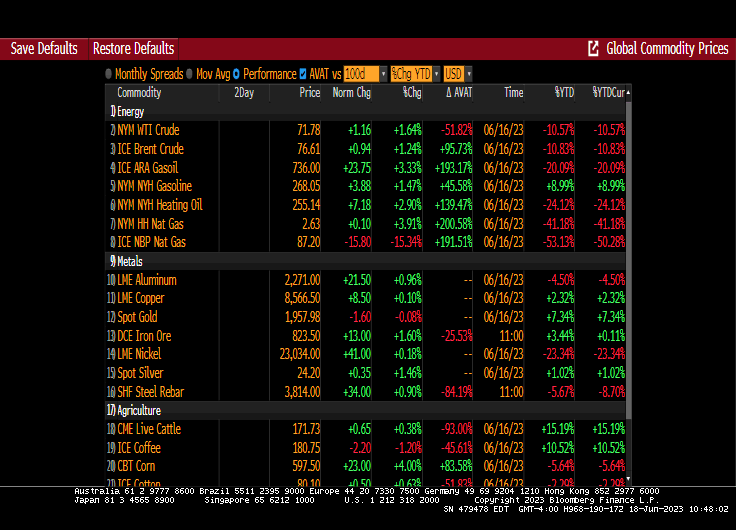
On the commodity side, Spot Silver is up 1.46%. Iron Ore is up 1.60%, but I don’t think my neighbors would appreciate me taking delivery on 10 tons of iron ore on my driveway! Heating oil is up 2.90%.
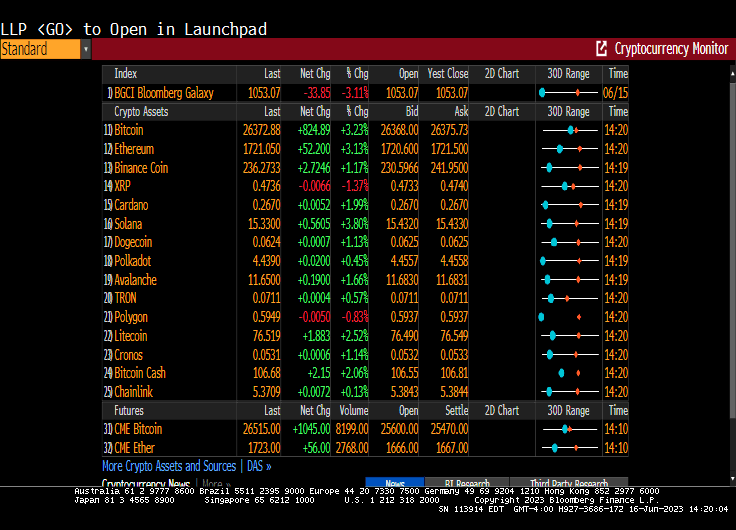
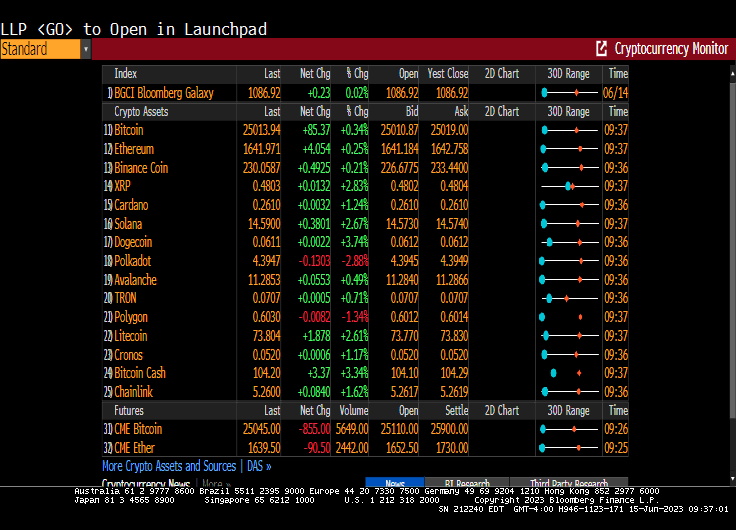
On the crypto side, bitcoin is up 20.84 (0.08%) with Ethereum up slightly more.
Bitcoin and silver doing well as the US Dollar loses ground since September 2022.
I wonder if Biden’s proposed railroad from the Pacific to the Indian Ocean will generate massive industrial production growth? Is this more Bidenomics??
Industrial production edged down 0.2 percent in May following two consecutive months of increases. The Bloomberg Econoday consensus was a small increase.
In May, the index for manufacturing ticked up 0.1 percent, while the indexes for mining and utilities fell 0.4 and 1.8 percent, respectively.
The index for motor vehicles and parts moved up 0.2 percent in May after jumping nearly 10 percent in April.
At 103.0 percent of its 2017 average, total industrial production in May was 0.2 percent above its year-earlier level.
Capacity utilization moved down to 79.6 percent in May, a rate that is 0.1 percentage point below its long-run (1972–2022) average.
Peak Months For 5 Indexes
Industrial Production: September 2022, 103.5
Manufacturing: October 2022, 101.2
Motor Vehicles and Parts, new high this month, 112.1
Consumer Durable Goods: April 2022, 109.4
Manufacturing Durable Goods: January and April 2023: 129.8
Despite the strength in autos, no debt led by Biden’s EV push and subsidies, manufacturing production is still below where it was seven month’s ago.
A long term chart better shows the trends.
Industrial Production Index Since 1972
Industrial production data from the Fed, Chart by Mish
Recession Lead Time After Industrial Production Peak
Industrial production data from the Fed, peak calculation and Chart by Mish
Peaks in industrial production tend to mark recessions.
Industrial production and manufacturing industrial production peaked eight and seven months ago respectively.
Politically speaking, if you are going to have a recession on your watch, it’s much better to have it early in your term than heading into an election campaign. But here we are.
Inflation is still not under control, and this economy is certainly not firing on all cylinders.
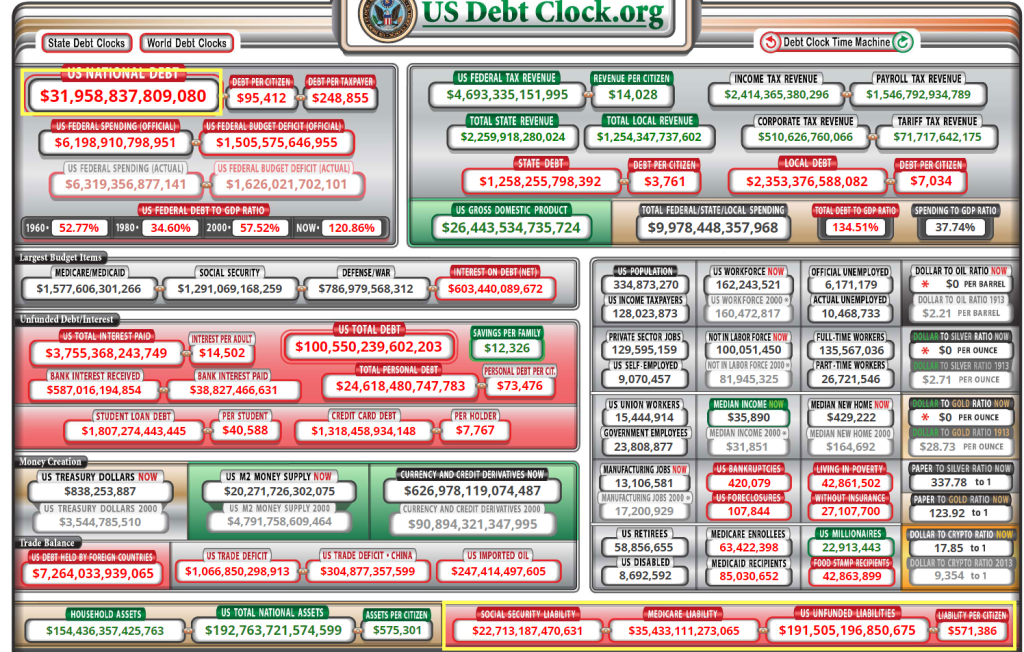
So, since the coronation of King Barack in 2009, US public debt has grown by 200% and just breached $32 trillion. US M2 Money is up 152% since Obama/Biden and The Fed’s Balance sheet is up 275% and M2 Money Velocity is down -30% since Obama/Biden.
Fridays are always fun in the market. Bitcoin is up 3.23% as The Fed took a pause yesterday.
Note that bitcoin and gold are moving together since March 2023 as the US Dollar deteriorates. And expectations of Fed rate hikes (yellow dashed line) increases.
On the housing front, the University of Michigan Buying Conditions for Houses rose to 50, far below the 142 level before Covid and Gov’t Gone Wild!!
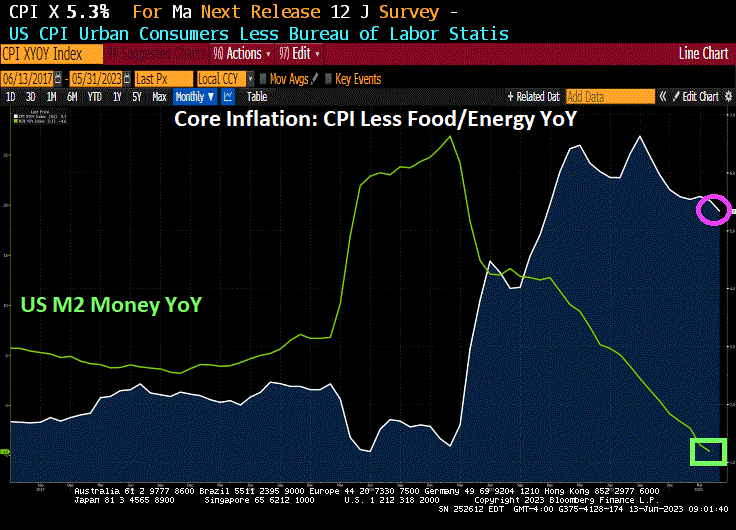
Fed Governor Christopher Waller said Friday headline inflation has been “cut in half” since peaking last year, but prices excluding food and energy (aka, CORE inflation) has barely budged over the last eight or nine months.
“That’s the disturbing thing to me,” Waller said during a question-and-answer session following a speech in Oslo, Norway. “We’re seeing policy rates having some effects on parts of the economy. The labor market is still strong, but core inflation is just not moving, and that’s going to require probably some more tightening to try to get that going down.”
At a separate event Friday, Richmond Fed President Thomas Barkin said inflation remained “too high” and was “stubbornly persistent.”
“I want to reiterate that 2% inflation is our target, and that I am still looking to be convinced of the plausible story that slowing demand returns inflation relatively quickly to that target,” Barkin said in a speech in Ocean City, Maryland. “If coming data doesn’t support that story, I’m comfortable doing more.”
The Federal Open Market Committee paused its series of interest-rate hikes Wednesday, but policymakers projected rates would move higher than previously expected in response to surprisingly persistent price pressures and labor-market strength.
The consumer price index this week showed headline inflation slowed, but core prices excluding food and energy continued to rise at a pace that’s concerning for Fed officials. Employers continued adding jobs at a rapid clip in May, and job openings climbed in April, recent data showed.
Barkin warned that prematurely loosening policy would be a costly mistake.
“I recognize that creates the risk of a more significant slowdown, but the experience of the ’70s provides a clear lesson: If you back off inflation too soon, inflation comes back stronger, requiring the Fed to do even more, with even more damage,” he said. “That’s not a risk I want to take.”
Policy Report
Separately, the Fed released a new report Friday that said tighter US credit conditions following bank failures in March may weigh on growth, and that the extent of additional policy tightening will depend on incoming data.
“The FOMC will determine meeting by meeting the extent of additional policy firming that may be appropriate to return inflation to 2% over time, based on the totality of incoming data and their implications for the outlook for economic activity and inflation,” the Fed said in in its semi-annual report to Congress.
Read More: Fed Says Tighter Credit Conditions to Weigh on US Growth
The Fed report, which provides lawmakers with an update on economic and financial developments and monetary policy, was published on the central bank’s website ahead of Chair Jerome Powell’s testimony before the House Financial Services Committee on June 21. He will appear before the Senate banking panel the following day.
“Evidence suggests that the recent banking-sector stress and related concerns about deposit outflows and funding costs contributed to tightening and expected tightening in lending standards and terms at some banks beyond what these banks would have reported absent the banking-sector stress,” the report said.
Between work at home, Bidenflation and The Feral Reserve, commercial real estate and regional banks are suffering … and it could get a lot worse. And Joe Biden (aka, Negan) in general. Living in Negan Country!
The work-from-home trend has been taking its toll on office landlords and is now making its way through to banks’ commercial loan portfolios, leading some analysts to predict that more trauma could be on the way for regional banks this year.
And in the current climate of bank failures, short sellers, and nervous depositors, banks with large exposures to commercial real estate (CRE) loans are racing to clean up and sell down their loan portfolios in hopes that they will not fall victim to another round of bank runs.
“There is an estimated $1.5 trillion of commercial property debt that will be due for repayment in about 18 months,” Peter Earle, an economist at the American Institute for Economic Research, told The Epoch Times. “It’s not improbable that even if interest rates have fallen by that time, some of that real estate debt will nevertheless be impaired and have an adverse impact on regional banks.”
In step with a recent trend in the CRE market, tech giant Google announced in May that it was attempting to sublease 1.4 million square feet of vacant office space in its Silicon Valley home base in order to “match the needs of our hybrid workforce.” Despite more employees returning to their offices this year, average office occupancy rates across the United States are still below 50 percent.
According to a report by Bank of America, 68 percent of CRE loans are held by regional banks. Approximately $450 billion in CRE loans will mature in 2023. JPMorgan Chase estimated that CRE loans comprise, on average 28.7 percent of the assets of small and regional banks, and projected that 21 percent of CRE loans will ultimately default, costing banks about $38 billion in losses.
Double Hit (of Biden’s Policies) Commercial mortgages are getting hit on two fronts: first, by the lack of demand for office space, leading to credit concerns regarding landlords, and second, by interest rate hikes that make it significantly more expensive for borrowers to refinance.
According to a June 12 report by Trepp, a CRE analytics firm, CRE loans that were originated a decade ago, when average mortgage rates were 4.58 percent, are now coming due, and in today’s market, fixed-rate CRE loan rates are averaging around 6.5 percent.
Banks that make CRE loans consider factors like debt service coverage ratios (DSCRs), which measure a property’s income relative to cash payments due on loans. Simulating mortgage interest rates from 5.5 percent to 7.5 percent, Trepp projected that between 28 percent and 44 percent, respectively, of currently outstanding CRE loans would fail to meet the 1.25 DSCR ratio today, and thus be ineligible for refinancing.
These calculations were done assuming current cash flows from properties stay the same and that loans are interest-only, but with vacancies rising, many landlords may have substantially less cash flow available. In addition, whereas interest-only CRE loans were 88 percent of the market in 2021, lenders are now switching to amortizing mortgages to reduce risk, which significantly increases debt service payments.
Refinancing Issues Fitch, a rating agency, projected that approximately one-third of commercial mortgages coming due between April and December of this year will be unable to refinance, given current interest rates and rental income.
“It’s a very different world now from the one in which the majority of these loans were made,” Earle said. “In a zero-interest-rate environment, before the COVID lockdowns saw many businesses shift to a remote work basis, many of these loan portfolios full of office properties looked great. Now, a substantial portion of them look quite vulnerable.”
The Trepp report highlighted several regional markets, such as San Francisco, where office sublease offers jumped 140 percent since 2020, and Los Angeles, where office vacancies hit a historic high of 22 percent. Available office space in Washington D.C. increased to 21.7 percent in the first quarter of 2023.
New York has been hit hard, as well. Office occupancy rates in New York City plummeted from 90 percent to 10 percent in 2020 during the COVID pandemic, but only recovered to 48 percent this year. Revenue from office leases fell by 18.5 percent between December 2019 and December 2022.
Vacancy Rates at 30-Year High Overall, according to a report by analysts at New York University and Columbia Business School, office vacancy rates are at a 30-year high in many American cities.
The report found that “remote work led to large drops in lease revenues, occupancy, lease renewal rates, and market rents in the commercial office sector.”
The authors predict that, even if office occupancy returns to pre-pandemic levels, “we revalue New York City office buildings, taking into account both the cash flow and discount rate implications of these shocks, and find a 44% decline in long run value. For the U.S., we find a $506.3 billion value destruction.”
As predicted, delinquencies in commercial mortgage loans are now creeping up. Missed payments in commercial mortgage-backed securities (CMBS) increased half a percent in May over the prior month to 3.62 percent, Trepp reports. The worst component of the CMBS market, which includes multi-unit rental buildings, medical facilities, malls, warehouses, and hotels, was offices, where delinquencies increased 125 basis points to more than 4 percent.
To put this in perspective, however, CMBS delinquencies exceeded 10 percent in 2012 and 2020. And analysts say that lending criteria for CRE have been more conservative than they were before the mortgage crisis of 2008, leaving more cushion on ratios relative to a decade ago.
All the same, the credit crunch at regional banks has created a vicious circle, where banks race to pare down their CRE portfolios, and the dearth of financing leaves more landlords facing default as outstanding loans mature. To make matters worse, commercial property values, which provide collateral for the loans, appear to be taking a hit as well.
In an effort to rapidly clean up their CRE loan portfolios and avoid the fate of failed banks like Silicon Valley Bank, Signature Bank, and First Republic Bank, banks are now attempting to sell off the loans, often taking a loss in the process.
In May, PacWest, a regional bank, sold $2.6 billion of construction loans at a loss. Citizens Bank reportedly has put $1.8 billion of its CRE loans up for sale during the first quarter of this year. Customers Bancorp reduced its CRE lending by $25 million and put $16 million of its existing portfolio up for sale.
Wells Fargo, one of the top four largest U.S. banks, is also downsizing its CRE portfolio, and in announcing the move CEO Charlie Scharf stated, “we will see losses, no question about it.”
“Between the Fed’s 500+ basis point hikes over the past 16 months and the failure of Silicon Valley Bank, and others, earlier this year, a credit tightening is already underway,” Earle said. “That has put a lot of pressure on regional lenders.”
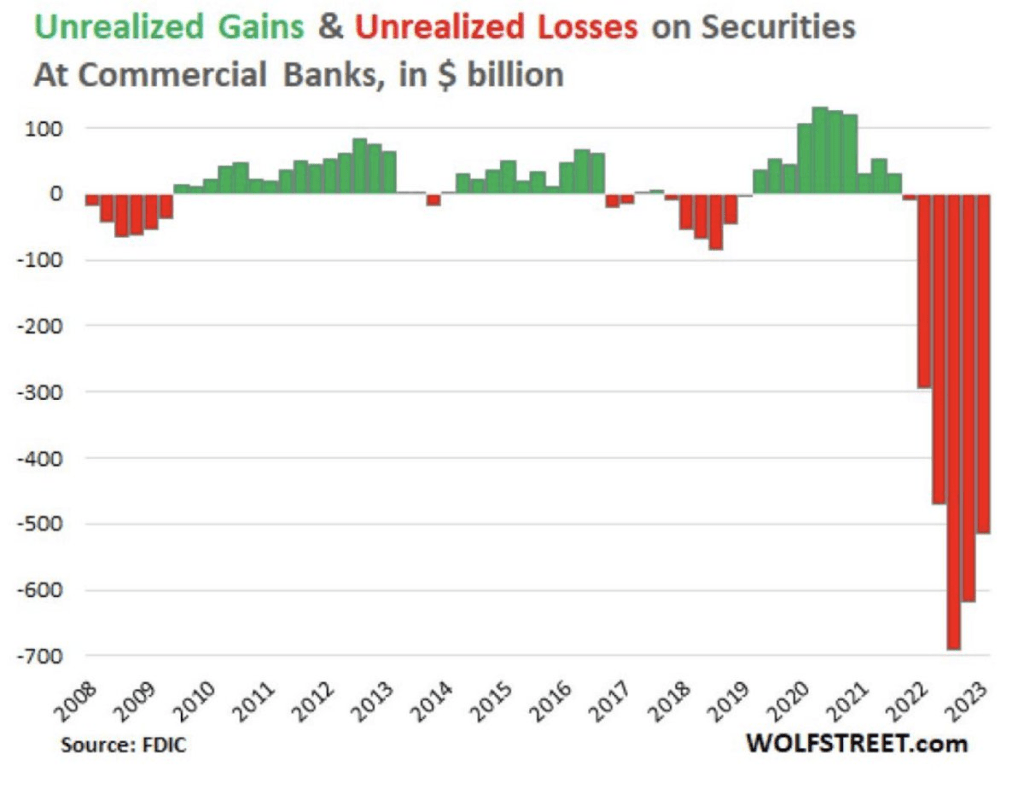
A March academic study titled “Monetary Tightening and U.S. Bank Fragility in 2023” stated that the market value of assets held by U.S. banks is $2.2 trillion lower than what is reported in terms of their book value. This represents an average 10 percent decline in the market value of assets across the U.S. banking industry, and much of this decline came from commercial real estate loans.
Consequently, the authors wrote, “even if only half of uninsured depositors decide to withdraw, almost 190 banks with assets of $300 billion are at a potential risk of impairment, meaning that the mark-to-market value of their remaining assets after these withdrawals will be insufficient to repay all insured deposits.”
61% of Bloomberg terminal respondents (including me, by the way) see Fed hikes leading to recession.
Bond traders are stepping up wagers that the Federal Reserve will steer the US economy into a recession.
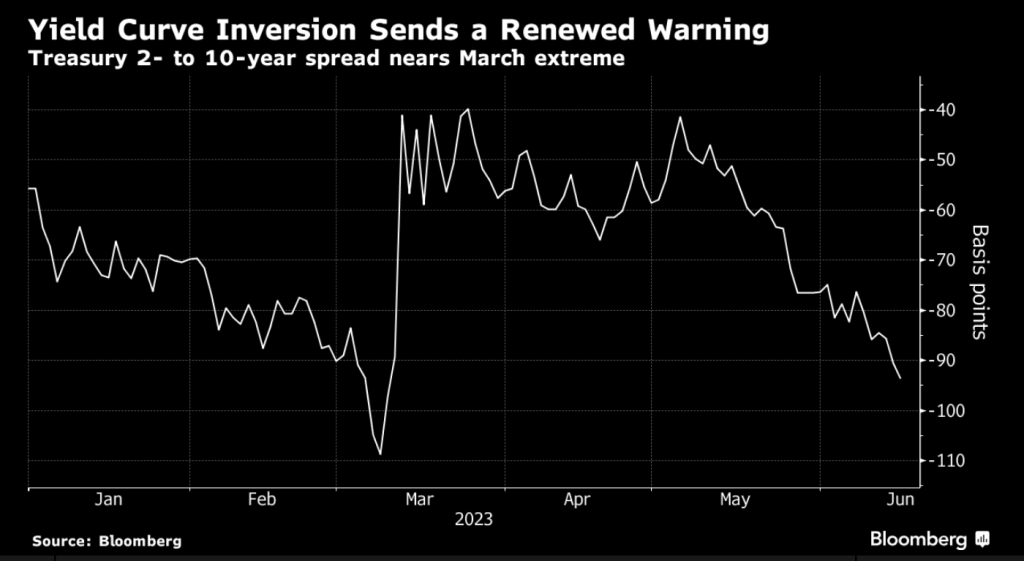
Policy-sensitive front-end Treasuries led a selloff Thursday, while longer-date bonds lagged, a day after Fed officials indicated that they’re prepared to raise interest rates by another half-point this year following the first pause in the central bank’s 15-month hiking campaign. That sent the yield-curve inversion, as measured by the gap between two- and 10-year securities, to 95 basis points — a level last sustained in March — and approaching this cycle’s 109-basis-point extreme.
The price action suggests bond traders are skeptical that policymakers can avoid a so-called hard landing as they continue to press the case for higher borrowing costs in an effort to get a handle on inflation that remains more than double their 2% target.
“The Fed runs the risk of solving one policy error of being too easy for too long with another policy error as they ignore the growing credit contraction and persistent losses from higher rates,” said George Goncalves, head of US macro strategy at MUFG. “The catch-22 is that for them to ease, something now has to break or the economy has to crack.”
It’s not just bond traders who are growing concerned.
Sixty-one percent of respondents in a Bloomberg poll of terminal users conducted in the hours after the Federal Open Market Committee decision said tighter monetary policy will ultimately cause a recession at some point in the next year.
“The Fed was clearly trying to send a hawkish message that they are not quite done yet and don’t think they have made enough progress on inflation,” said Michael Cudzil, portfolio manager at Pacific Investment Management Co. “You see curve flattening and rates not pricing in the full extent of hikes, so the thinking is that these hikes may bite and the Fed is closer to the end.”
Officials left their target range for the federal funds rate unchanged at 5% to 5.25% Wednesday, but projected the key rate will rise to 5.6% by the end of this year, implying two more quarter-point increases, up from 5.1% in March. They also revised higher estimates of core inflation for year-end to 3.9%, from 3.6%, owing to what Chair Jerome Powell called surprisingly persistent price pressures.
Still, markets aren’t convinced borrowing costs will rise as high as central bankers project.
The highest rate on swap contracts for future meetings by early Thursday was around 5.32% for both September and November, with July at 5.27%, compared to a current Fed effective rate of 5.08.
The Fed’s aggressive outlook for rate hikes through year-end may be an effort to dash bond-market expectations for cuts in the months ahead, according to Michael de Pass, global head of linear rates at Citadel Securities.
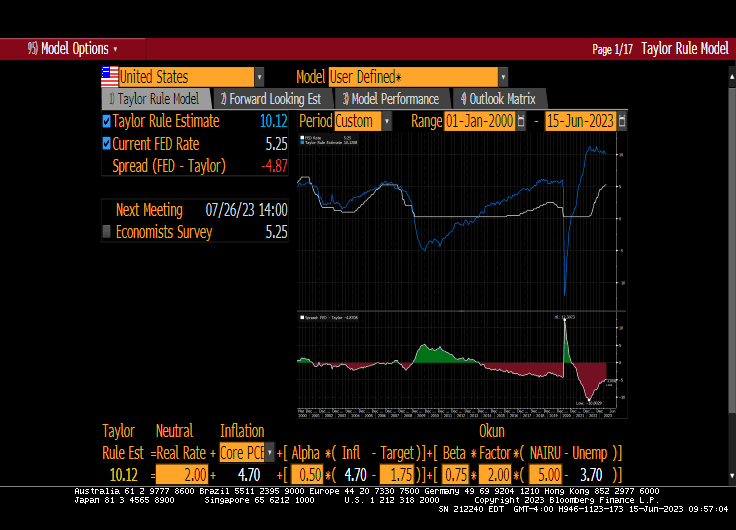
While The Fed paused at their recent FOMC meeting, they are expected to raise their target rate at the July meeting …. then stop. Despite being only a little over 50% of where they should be (10.12%) to cool inflation.
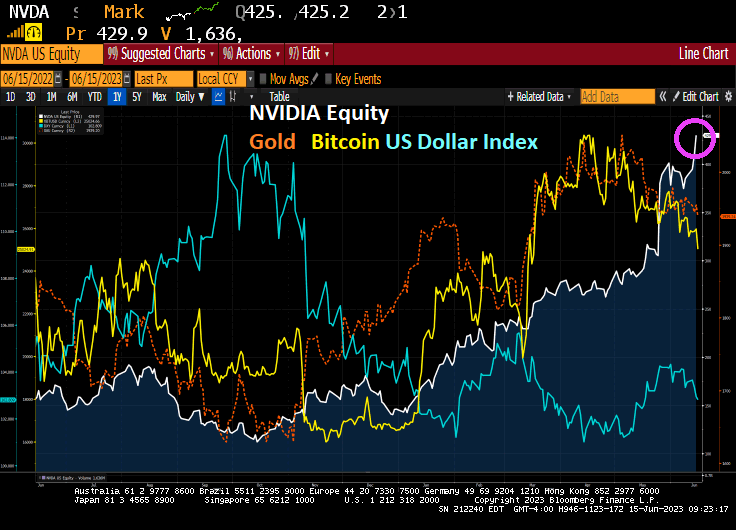
The Artificial intelligence (AI) boom is resulting in Nvidia’s stock soaring to 429.9. At the same time, Bitcoin (yellow), the US Dollar (blue) and Gold (gold) are declining.
Of course, markets are dynamic and gold/silver are likely to start up again along with bitcoin and other cryptos..
The leading crypto today? Dogecoin!
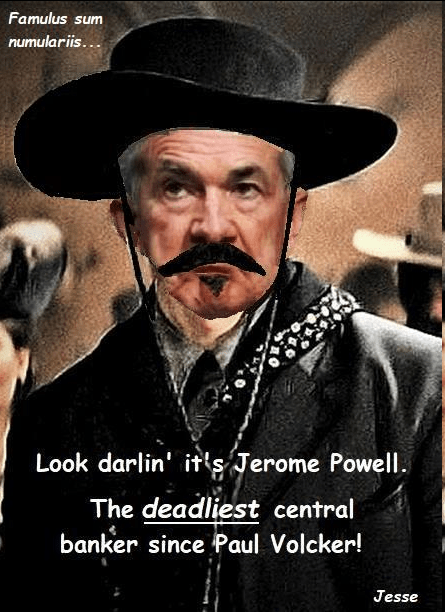
AI versus no intelligence. I give you Resident Joe Negan.
















 Confounded Interest - Anthony B. Sanders
You must be logged in to post a comment.