US Default? Since 2008, Net Interest Costs UP 192%, Social Security And Health Entitlements UP 140%, Nondefense Discretionary Spending UP 76% Based On 2032 Federal Budget

Newly-minted US House Speaker Kevin McCarthy faces a daunting task: trying to avoid a US debt default. As I have discussed many times before, nothing has been the same since the US housing bubble and near-collapse of the banking system that produced an expensive bailout of seemingly all financial institutions. After 2008, Federal spending has gone out of control. The budgetary hawks (or pigeons) in the US House of Representatives (with Pelosi, Boehner, Ryan then Pelosi again) went on Federal spending sprees of epic proportions.

The Manhattan Institute has a nice chart showing the explosion in the Federal budget since 2008. Of particular note, interest payments on the Federal debt has increased by a staggering 192%. On the non-interest spending front, Social Security and Health Entitlements have increased by 140% while Nondefense Discretionary Spending has increased 76%.
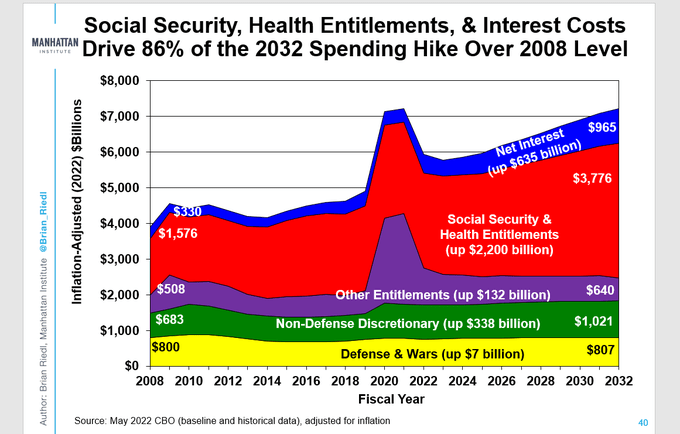
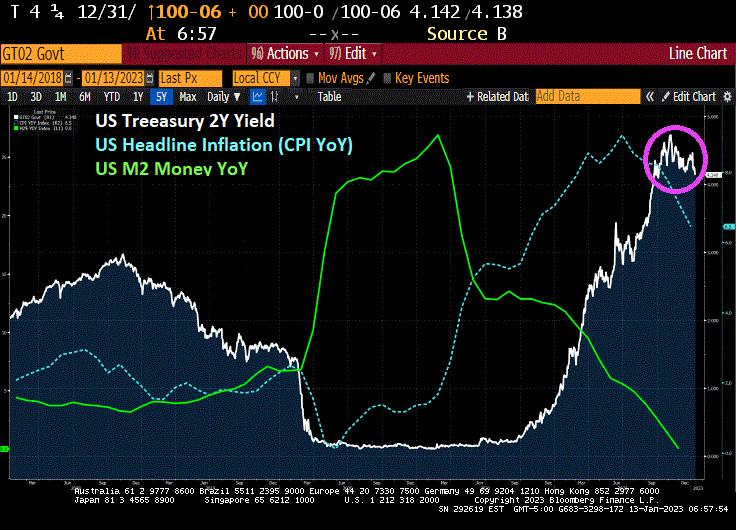
The massive increase in Federal debt interest is due to both increased Federal spending and rising interest rates thanks to The Federal Reserve raising rates to fight inflation.
But what will McCarthy and House Republicans recommend cuts in? Tighter restrictions on who qualifies for Social Security and particularly Social Security Disability payments?

The odd factoid is that Defense and Wars budget is up less than 1% from 2008 to 2032. So, Ukraine military aid is coming from somewhere, but not from the Defense budget. Is Ukraine another entitlement program?

Rest assured that after debate, the House will pass a budget and, provided that virtually nothing was cut, the Senate will gleefully agree to more spending and “Top Secret Documents” Biden will sign it.

After he parks his gorgeous Corvette Sting Ray, that is.

The Amazing, Disappearing Jumbo/Conforming Mortgage Spread Since Covid And Fed Intervention (Jumbo Spread At 1.67 Basis Points After Covid Fed Reaction)

Years ago, Brent Ambrose, Michael Lacour-Little and I wrote a paper on the US 30-year jumbo mortgage spread over conforming 30-year mortgage rates entitled “The effect of conforming loan status on mortgage yield spreads: a loan level analysis.” But that paper was written before Covid and the dramatic distortion caused in mortgage markets by The Federal Reserve’s massive increase in money.

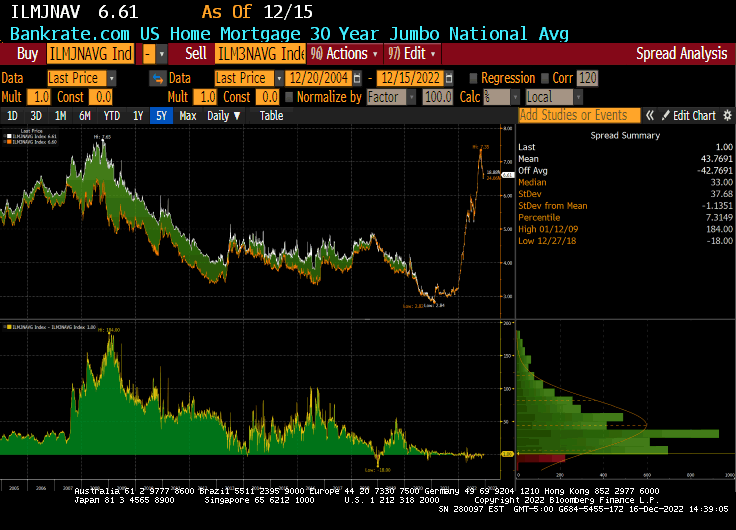
Here is the spread between Bankrate’s 30-year mortgage rate and their 30-year JUMBO mortgage. Notice that between 2007 and early 2020, the median “jumbo spread” was 49 basis points. But after Covid and The Fed’s counterattack (by printing M2 Money), the median Jumbo spread from 4/1/2020 to today is only 1 basis point.

In the following chart, you can see the jumbo mortgage rate (yellow) against the conforming mortgage rate (white) and there is almost always a spread between the two UNTIL 2020 where we saw M2 Money growth (green line) spike and The Fed increased their purchases of Agency MBS (purple line). Since Covid and The Fed’s massive reaction, the jumbo rate and conforming rate are virtually the same. In fact, the latest jumbo spread is 1 basis point over the conforming rate.

Why is this happening? One explanation is that demand from the investors who ultimately buy jumbo mortgages. The strong demand by investors appears to have driven down the yields on jumbos relative to conventional loans, especially as the use and accessibility to jumbos has grown.

A second explanation is that Loan Level Price Adjustments that were added to conforming loans post-financial crisis never went away (until just recently on selected loans). This makes jumbos and conforming loans very close in yield.

So, when will the mortgage market return to normal and jumbo mortgages go back to the normal 50 basis point spread? We may see normalization if The Fed speeds up its withdrawal from markets. Also, getting rid of Loan Level Price Adjustments would help normalized the mortgage market.

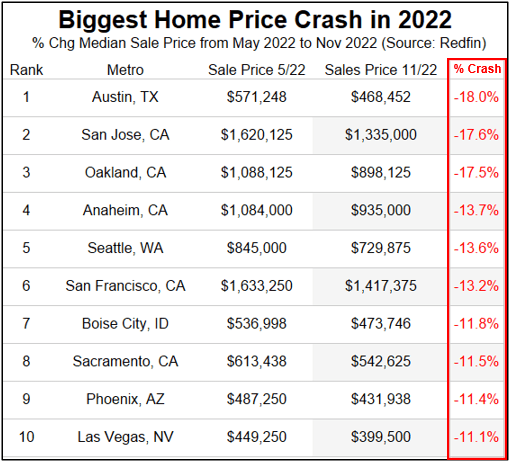
But things are getting stressed in jumboland (California) where home prices are crashing in 5 of the top 8 metro areas.

Harry Houdini couldn’t have created a more tantalizing mystery … and one I wish would go away.

Inflation Is SO Bad That REAL Home Price Growth Has Slowed To 2.23% YoY While REAL Wage Growth Is -3.31% YoY (As Fed’s M2 Money Growth Slows)

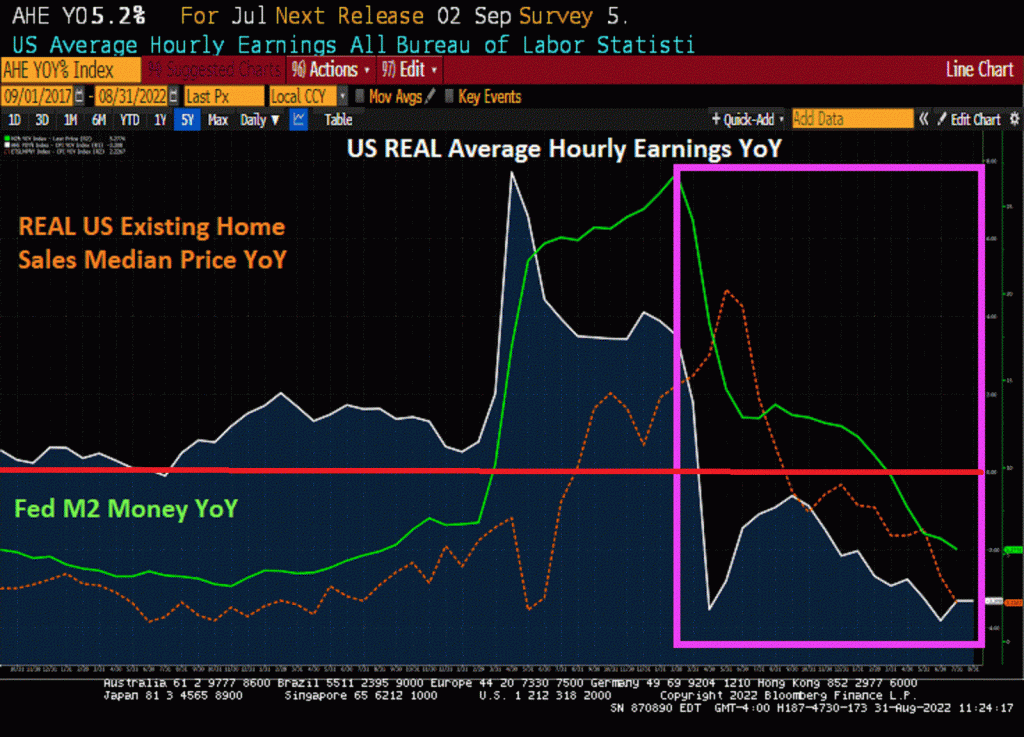
When inflation is so bad that REAL wage growth is negative (-3.31% YoY), I would hardly call that a strong economy for the middle class and low-wage workers.

We also see that REAL home price growth (existing home sales median price YoY – CPI YoY) has slowed to only 2.23% YoY in July.

As The Fed tightens, it is only growing to get worse.

Perhaps Biden can enthrall us with yet another “Corn Pop was a bad dude” story.

Pushin’ Too Hard? US Treasury Yield Curve Inverts To -45 Basis Points (Most Inverted Since 2000) Despite Senate Passing “Inflation Reduction” Boondoggle

Is The Federal Reserve pushin’ too hard on raising their target rate?

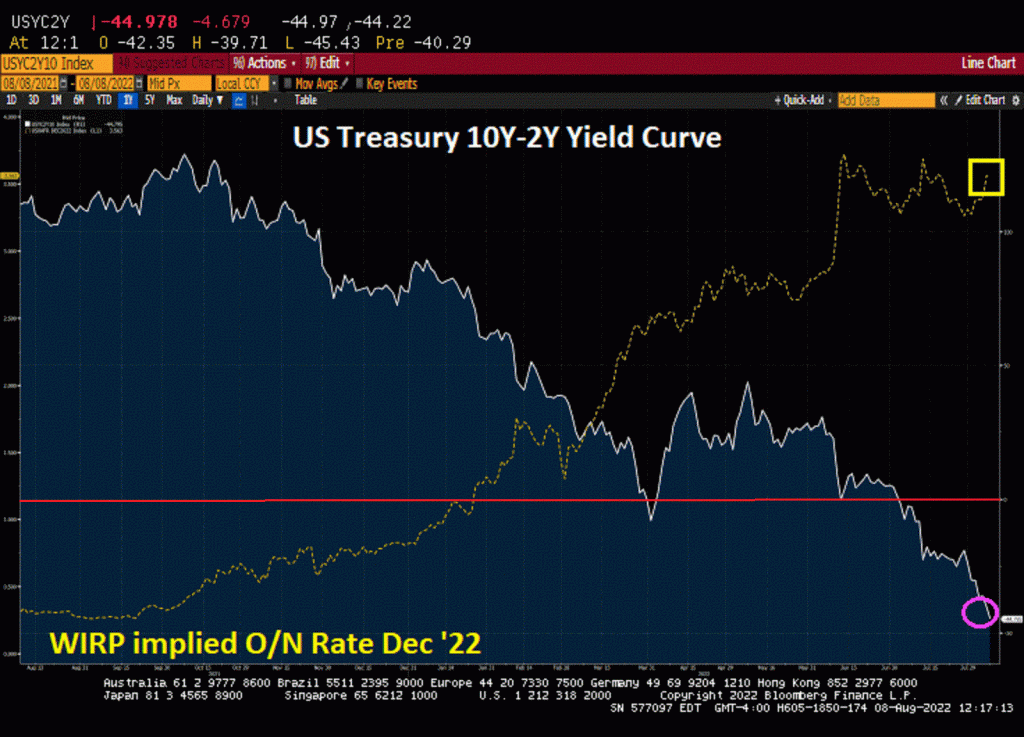
The US Treasury 10Y-2Y yield curve descended further into inversion, signaling impending recession.

The US unemployment rate (U-3) tends to be the lowest when the 10Y-2Y yield curve inverts, then explodes when recession strikes.

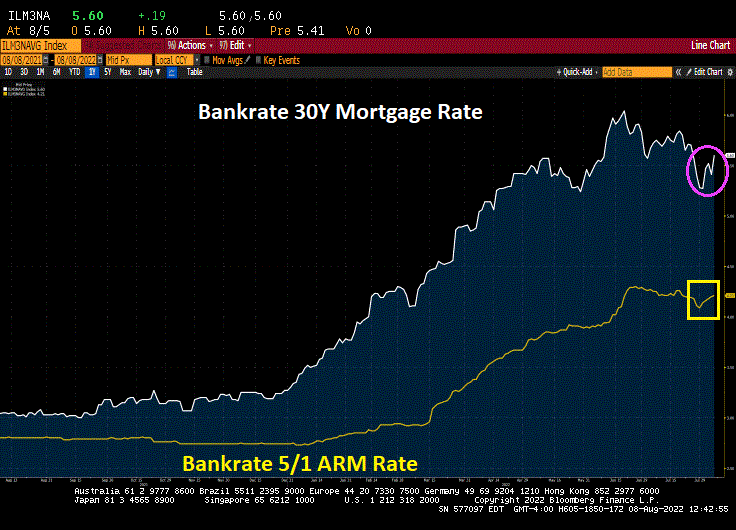
The spread between the Bankrate 30-year mortgage rate and the Bankrate 5/1 ARM rate widened to 139 basis points.

This is happening as The Fed is expected to keep raising their target rate (yellow line) and the US Senate passed its massive “inflation reduction” boondoggle that is expected to NOT reduce inflation, but raise taxes on the middle class and low-wage workers.

Stablecoin? US Senator Toomey Announces Legislation to Create Responsible Regulatory Framework for Stablecoins (Bad Day For Cryptos)

Stablecoin refers to a new class of cryptocurrencies which offer price stability and/or are backed by reserve asset. In recent times, stablecoins have gained enough traction as they attempt to offer the best of both world’s – the instant processing and security of payments of cryptocurrencies, and the volatility-free stable valuations of fiat currencies.

US Senator Pat Toomey, ranking member of the Banking, Housing and Urban Affairs Committee, announced today legislation to create a responsible regulatory framework for STABLECOINS.

Toomey Announces Legislation to Create Responsible Regulatory Framework for Stablecoins
Releases Discussion Draft of the Stablecoin TRUST Act

Washington, D.C. – U.S. Senate Banking Committee Ranking Member Pat Toomey (R-Pa.) today released a discussion draft of legislation establishing a new regulatory framework for payment stablecoins.

“While today stablecoins facilitate trading with cryptocurrencies, tomorrow stablecoins could be widely used in the physical economy. They have the potential, among other things, to speed up payments and automate transactions,” said Ranking Member Toomey. “The proposed regulatory framework I’m releasing today will allow this crypto-innovation to continue flourishing while protecting consumers and minimizing potential risks from stablecoins to the financial system. I look forward to receiving feedback on this legislation from my colleagues and stakeholders as Congress continues its work on stablecoin regulation.”

Key Components

·        Authorizes three different options to issue payment stablecoins:

o   Establishes a new federal license designed specifically for stablecoin issuers;

o   Preserves the state-registered money transmitter status for most existing stablecoin issuers; and

o   Clarifies that insured depository institutions are permitted to issue stablecoins.

·        Protects consumers by subjecting all payment stablecoin issuers—regardless of whether they are a state money transmitter or receiving a new federal license—to standardized requirements, including:

o   Disclosures regarding the reserve assets backing the stablecoin;

o   Clear redemption policies; and

o   Subjecting them to routine audits by registered public accounting firms.

·        Provides much-needed clarity that, at a minimum, stablecoins that do not offer interest are not securities.

o   Provides a clear regulatory framework for payment stablecoins and rejects the Securities and Exchange Commission’s approach of regulating through enforcement actions.

·        Applies privacy protections to transactions involving stablecoins and other virtual currencies.


Background

·        In August 2021, Ranking Member Toomey announced he was soliciting legislative proposals to ensure federal law supports the development of digital assets and its underlying technologies while protecting investors.

·        In December 2021, Ranking Member Toomey released a set of principles to lay the framework for forthcoming stablecoin legislation.

Crytpos in general are having a bad day, with Bitcoin down 4.78% today and Ethereum Classic down 12%.

Toomey’s proposal is a great step forward in the regulation of stablecoin.

What’s Wrong With This Picture? M2 Money Growth “SLOWS” To 12.8% YoY As Real Earnings Growth Slows To -1.6% YoY (Will Omarova As Comptroller Make This Better??)

Highlights for Children has a popular segment called “What’s Wrong With This Picture?”

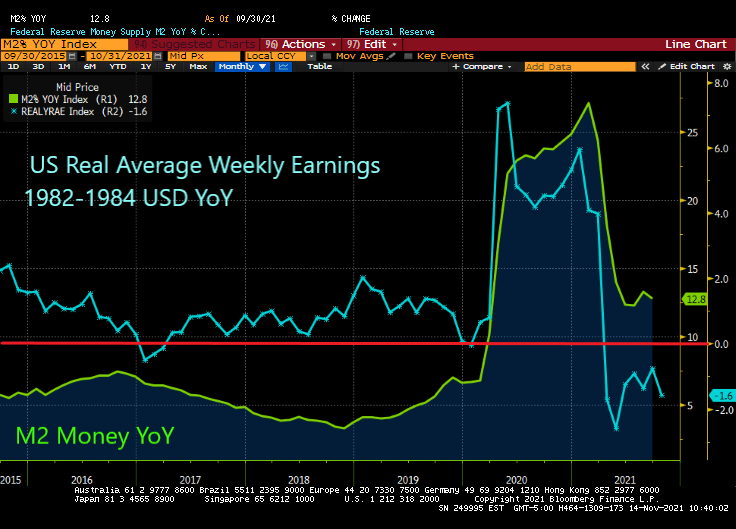
I give you my economics version of “What’s Wrong With This Picture?” It features The Federal Reserve’s M2 Money year–over-year compared with Real Average Weekly Earnings year-over-year.

Yes, M2 Money growth has “slowed” to 12.8% YoY while US Real Average Weekly Earnings YoY is now -1.6%. In other words, while M2 Money is still growing at a rapid pace, real weekly earnings growth is NEGATIVE.

The Fed continues to pump money into a bottle-necked economy while The Federal government pays people NOT to work.

The US Senate has a plan to fix the problem: Biden has nominated Saule Omarova, a dingbat law professor from Cornell (alma matter for The Office’s Andy Bernard), who proposes the following:

(1) Moving all bank deposits from commercial banks to so-called FedAccounts at the Federal Reserve;

(2) Allowing the Fed, in “extreme and rare circumstances, when the Fed is unable to control inflation by raising interest rates,” to confiscate deposits from these FedAccounts in order to tighten monetary policy;

And Ohio Senator Sherrod Brown (D-of course) thinks there is NO MORAL HAZARD PROBLEM with The Fed confiscating bank deposits for its own use?????

If I was attending Omarova’s confirmation hearing, my verdict would be ..

.

JOLT! Job Openings Changed Little (10.4 Million In September) As UMich House Buying Sentiment Declines Even Further (To 62 From 144 Last Year On This Date)

The Federal Reserve continues to JOLT markets with excessive monetary stimulus despite numerous reasons why they should back off.

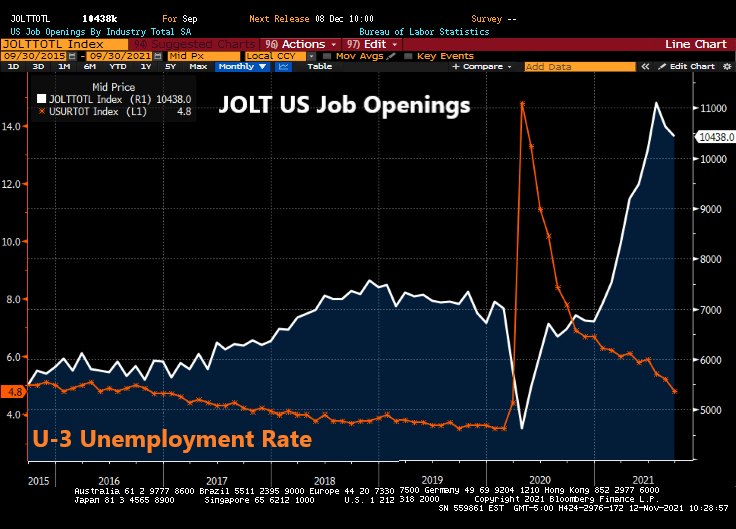
For example, today’s JOLT report (US job openings) revealed that 10.4 million jobs were open in September. This is the fourth consecutive month of 1 million plus job openings, yet The Fed refuses to raise their target rate.

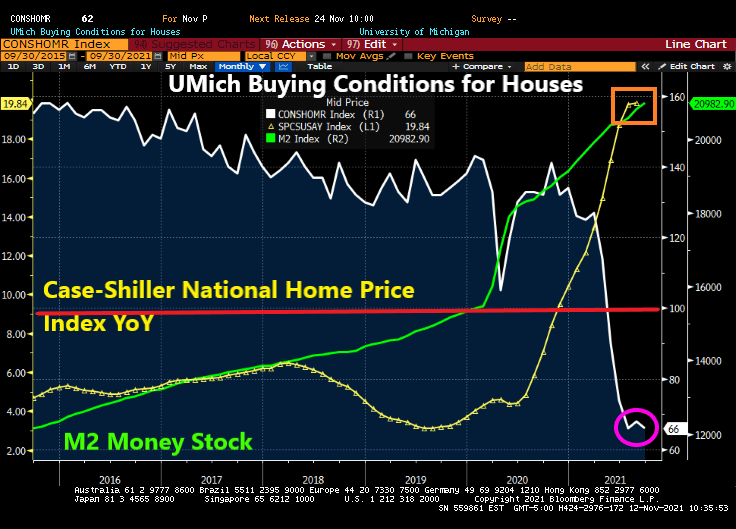
At the same time, the University of Michigan survey revealed that buying conditions for houses dropped to 66 (baseline of 100). To show how bad this is, buying conditions for houses was at 144 this time last year.

UPDATE: UMich revised their number downward to 62, the lowest since 1981.

In The Fed’s mind, they are still chasing at least 3.5% unemployment, the lowest rate under President Trump prior to COVID. But with perpetual million plus job openings GOING UNFILLED, trying to get to pre-COVID unemployment rate of 3.5% is a fool’s errand.

Of course, with The Fed helping to pump up house prices to largely unaffordable levels, it makes sense that enthusiasm for buying expensive homes has crashed.

Meanwhile, The Fed continues to JOLT the economy with excess stimulus.

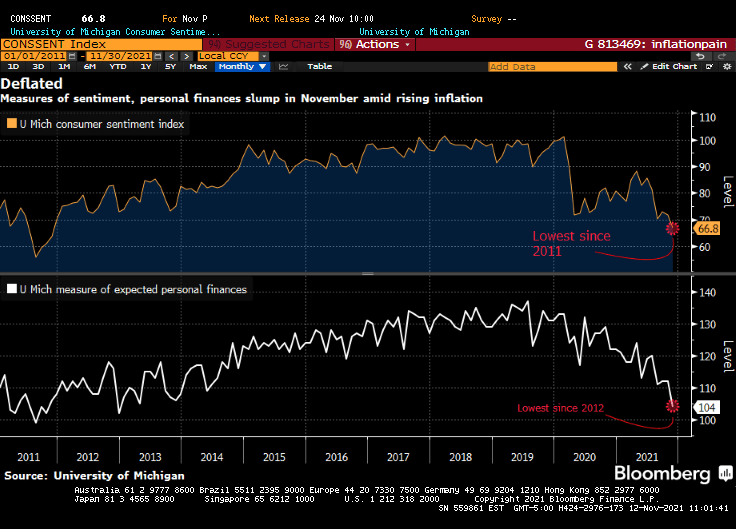
Overall inflation fears are leading to lowest consumer confidence since 2011.

PLEASE stop JOLTING US!!

Fed’s Ability to Set Rates Floor Is Weakening on Cash Deluge (“Charming” Powell Had At Least 350 Meetings, Dinners Or Phone Calls With Members Of Congress)

Powell and The Fed’s policies have veered from their mandate requiring Chairman Powell to meet 350 times with Congress to sell The Fed’s policies.

Bloomberg) — The Federal Reserve’s floor for overnight funding markets is proving to be no match for the deluge of cash. 

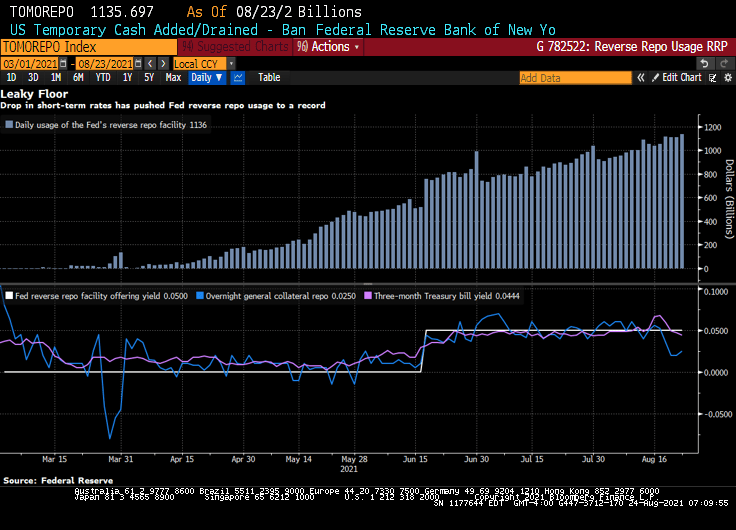
Money-market securities ranging from Treasury bills to repurchase agreements continue to trade below 0.05% — the offering rate on the overnight reverse repo facility, which is supposed to act like a floor for the front end. The Fed at its June meeting had raised the rate by five basis points to help support the smooth functioning of short-term funding markets.

Still, usage of the tool climbed to a record $1.136 trillion on Monday, eclipsing the previous high of $1.116 trillion on Aug. 18. 

Demand for the so-called RRP facility has surged as a flood of dollars threatens to overwhelm funding markets. That’s in part a result of the central bank’s long-standing asset purchases and drawdowns of the Treasury’s cash account, which is pushing reserves into the system. As a result, liquidity has been swelling, especially as the Treasury cuts supply to create more borrowing room under the debt ceiling.

The pressure pushing down overnight rates toward zero is proving a major headache for money-market funds. It hampers their ability to invest profitably, and can lead to further disruptions as they begin to waive fees to avoid passing on negative rates to shareholders. A number of firms including Vanguard Group shut down prime money-market funds last year after struggling to cover operating costs in the low-interest-rate environment.

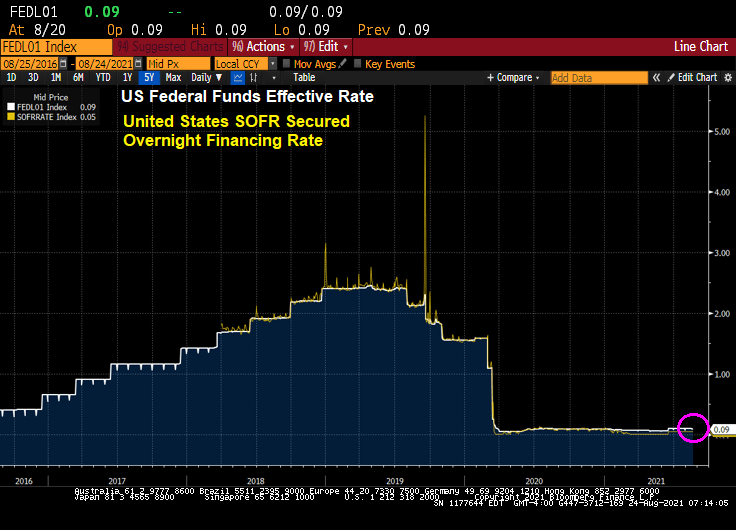
Yes, overnight rates such as the US SOFR rate, are near zero.

Powell’s Charm Offensive in Congress Positions Him to Keep Job

Perhaps that is why Federal Reserve Chair Jerome Powell is acting as a lobbyist with Congress for The Fed’s nontraditional approach to monetary policy.

(Bloomberg) Since he took the helm of the Fed in February 2018, through June of this year, he’s held at least 350 meetings, dinners or phone calls with members of Congress, according to his monthly calendars. That’s almost nine per month, and many of those included more than one lawmaker. The tally doesn’t count at least 16 appearances as chair before numerous congressional committees.

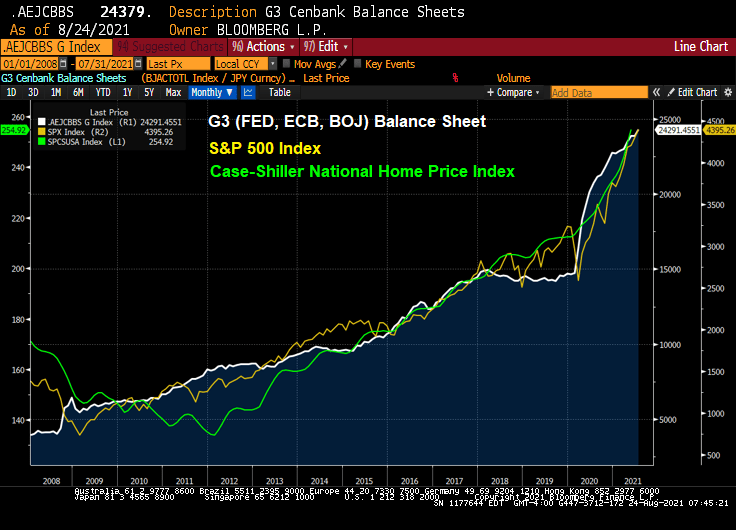
Well, the stock market has zoomed-up since Bernanke and The Fed adopted zero-interest rate (ZIRP) policies and the now famous quantitative easing (QE) policies in late 2008.

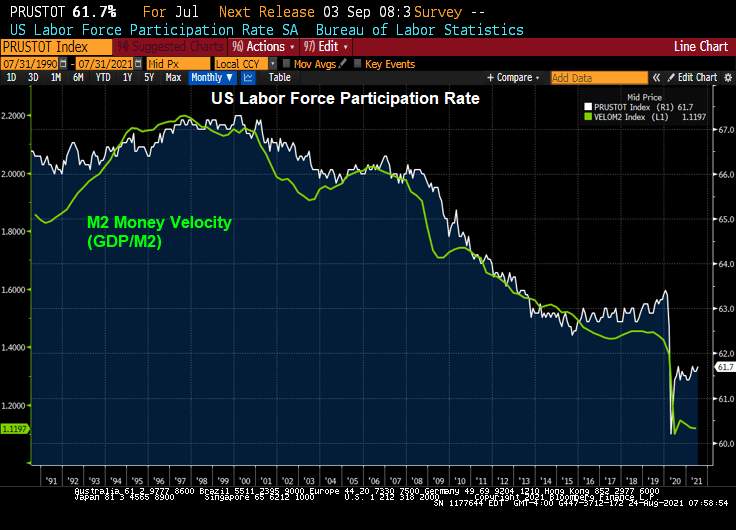
Congress member Alexandria Ocasio-Cortez asked Fed Chair Powell about the Fed helping with US unemployment. We are already at zero rates (on the short-end), and Congress should look at their policies on why labor force participation is slow to recover from the Covid epidemic.

Powell is sounding more and more like Parks and Recreation’s Tom Haverford in terms of schmoozing Congress for support.

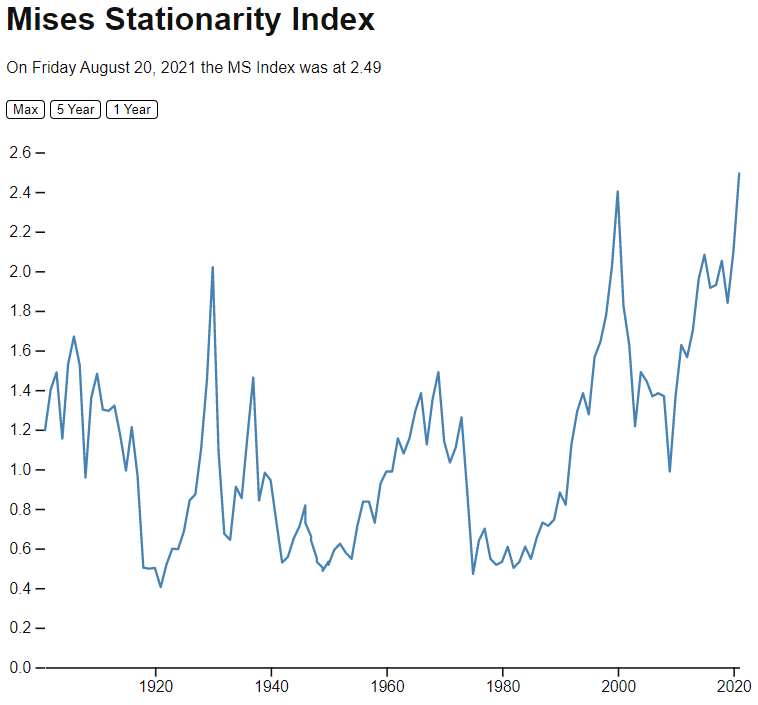
Update: The Mises Stationarity Index is flashing “BUBBLE.”

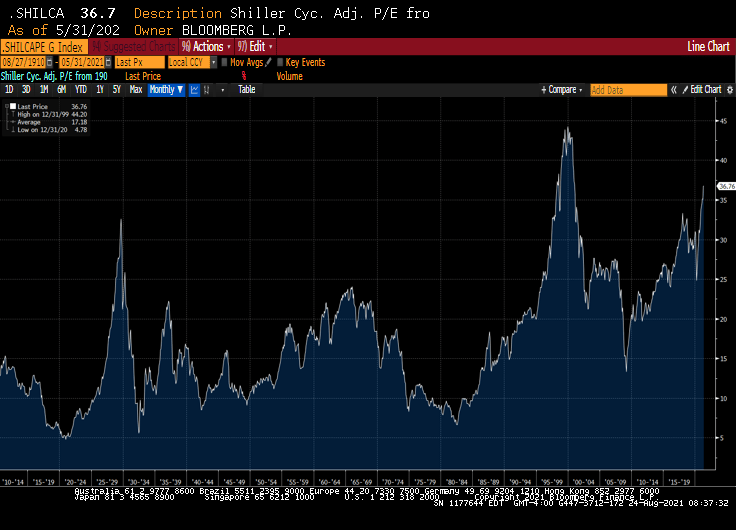
The Mises Stationarity Index is different than the Shiller CAPE index, which is showing equities as being overpriced, but not yet in dot.com bubble zone.

Alarm! Gold And Cryptos Rise As Covid Spreads (Again)

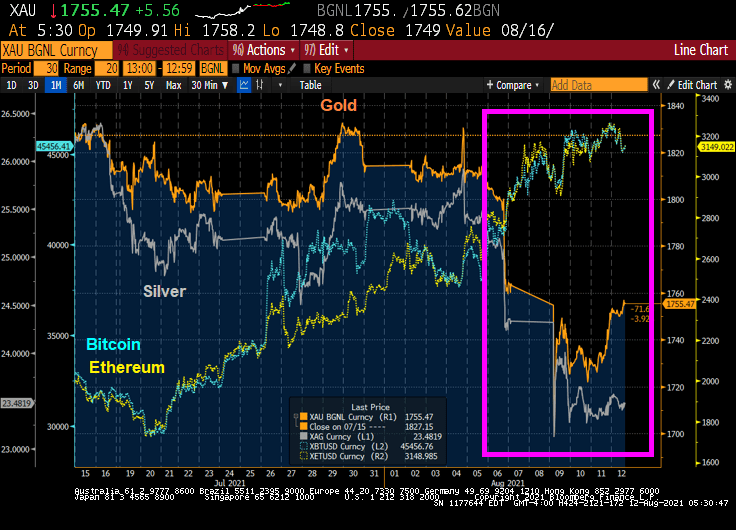
The Covid Delta Variant seems to be picking up steam, we are seeing “flight to safety” assets other than Treasuries rising.

Gold and Silver experienced some serious corrections last week, perhaps because things were looking up. Then we saw Anthony Fauci scaring everyone about Covid … again. So, there is enormous uncertainty about how this will play out. In other words, ALARM!

Bitcoin and Ethereum have been climbing since Gold and Silver corrected last week. But both are up this week, particularly Gold.

The US Dollar is down slightly since the same time last year and M2 Money Stock growth has slowed.

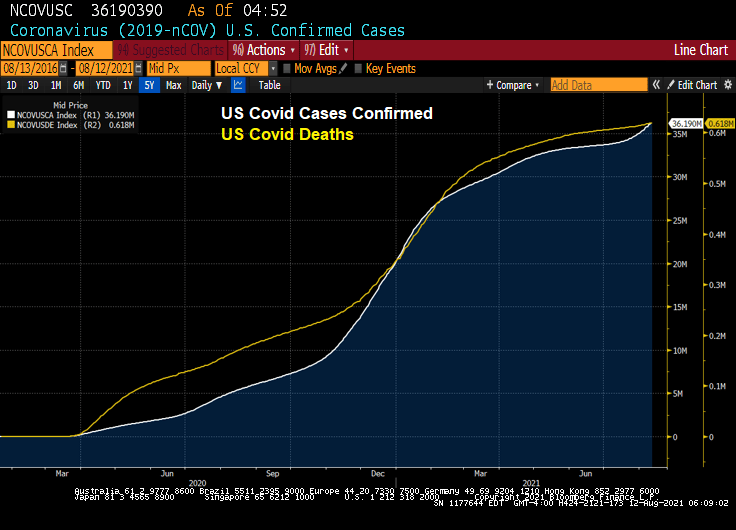
Here is a chart showing another fear factor: the rise of the Covid Delta Variant. Deaths are only 1.7% of confirmed cases (if we believe the actual cause of death).