Bond Traders Stare at Worst Real Returns Since Paul Volcker Era Thanks To Inflation (The Fed’s Famous Chili!)

Inflation-adjusted return of Treasuries fell to lowest since the 1980s. For bond investors, this is their version of Kevin’s Famous Chili from The Office! Or The Fed’s Famous Chili!

(Bloomberg) — Treasury investors are losing more money than they have in four decades, once inflation is taken into account. And if markets are right, they’re unlikely to come out ahead for years. 

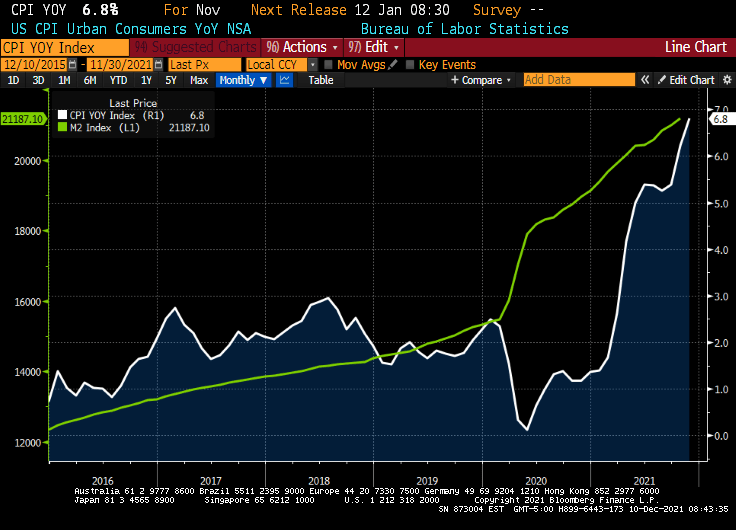
The federal government’s debt has already lost about 2% outright over the past year as the Federal Reserve started removing pandemic-era stimulus from the economy and inched closer toward raising interest rates. But on top of that, the consumer price index has surged 6.8%, putting investors even deeper in the hole. 

Taken together, that’s resulting in the worst real returns — or those adjusted for inflation — since the early 1980s, when then Fed Chair Paul Volcker was in the midst of fighting a wage-price spiral. What’s more, the dynamic isn’t expected to change: The bond market is projecting that 10-year Treasury yields will hold below the inflation rate for the next decade, meaning any investment income will be more than wiped out by the rising cost of living.

If we look at the REAL 10-year Treasury yield and REAL Fed Funds Target Rate, they are both negative.
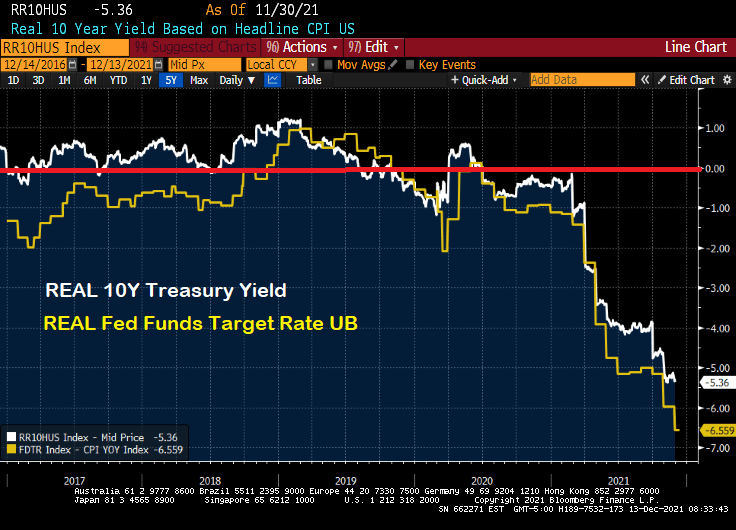
Let’s see if Powell spills his famous chili on Wednesday at 2:00PM EST. The Fed keeps saying they are serious about controlling inflation, just like Kevin Malone.

Psst! US Inflation Is REALLY >11% YoY (Not The Stated 6.9% YoY)

Earlier today I wrote about the horrible November Consumer Price Index (CPI) print of 6.9% YoY.

But that 6.9% YoY is very misleading because of the strange way the Bureau of Labor Statistics measures the largest asset in most households’ expenditures: housing.

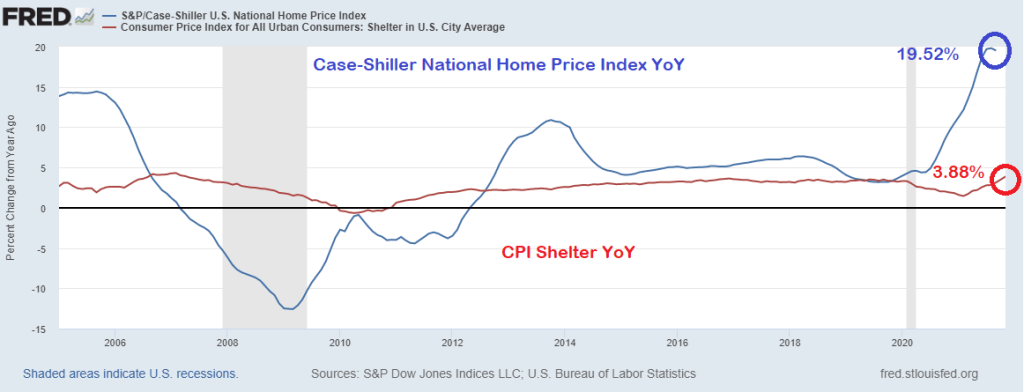
The BLS measures inflation in housing using the Shelter measurement. Which was only 3.88% YoY. The problem is that the Case-Shiller National Home Price Index was 19.52% in its last reading. That is quite a discrepancy.

So, if we substitute the Case-Shiller National home price index for the CPI Shelter, we get an inflation rate of greater than 11%.

And with the Zillow Rent for all homes index growing at 11.2%, this feels more like we are being hit over the head with. Or like trying to eat raw oyster stew … when the oyster fight back.

Here is a video of The Federal Reserve and the Biden Administration trying to control inflation.

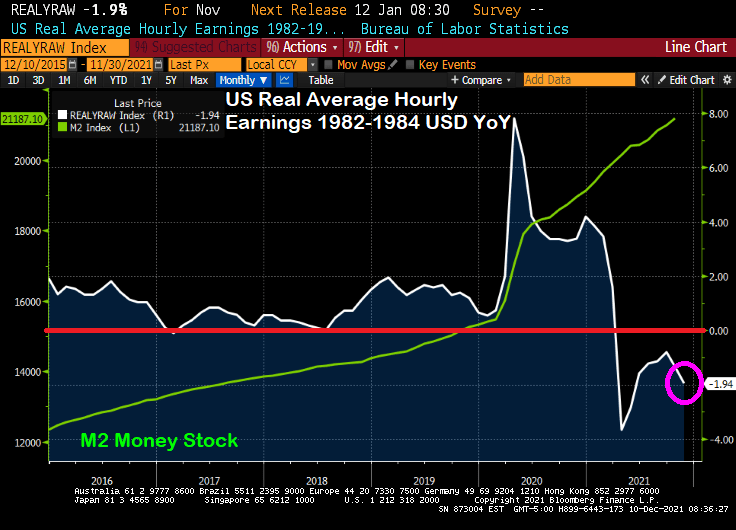
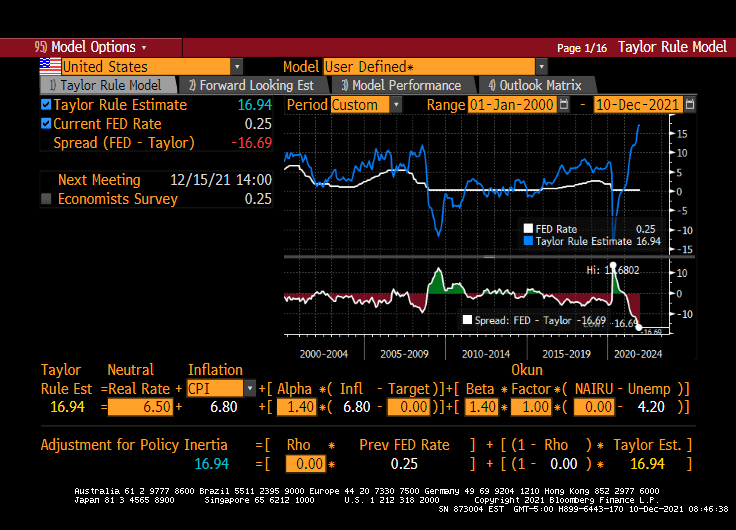
Real Wage Growth Falls To -1.9% As Inflation Rises To 6.8% In November (Taylor Rule Rate Rises To 16.94% While Fed Remains At 0.25%)

Inflation keeps rising and consumers keep getting hurt. No wonder President Biden’s team sent out a media splash asking them to put a smile on that face and hype the economic recovery.

Real wage growth fell to -1.9% YoY in the latest Consumer Price release. As The Fed keeps its massive foot on the monetary gas pedal.

The overall Consumer Price Index (CPI) rose 6.8% YoY.

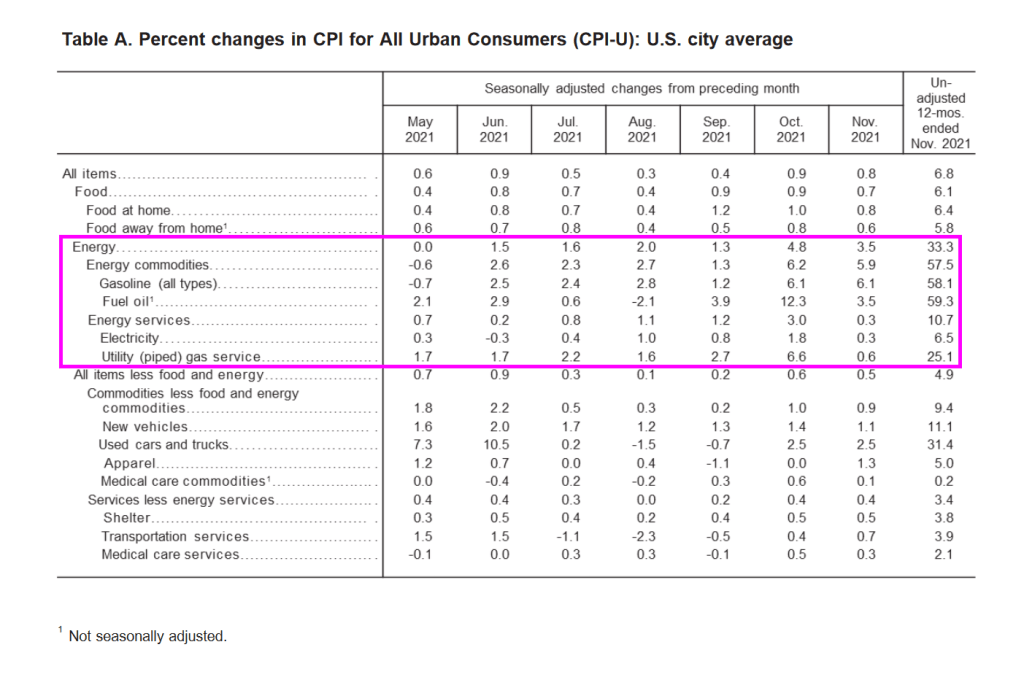
The biggest gains in Consumer Prices were for energy with gasoline rising 58.1% YoY. But almost nothing was spared the rod of government policies.

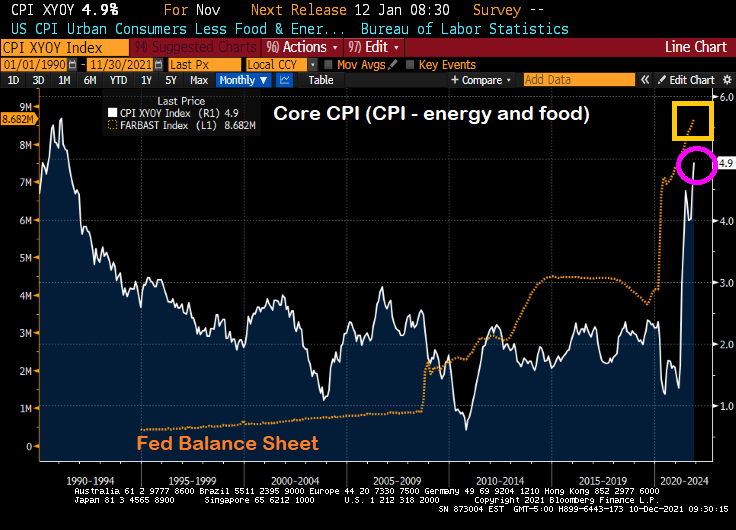
Core inflation (CPI – energy – food) rose to 4.9% YoY, the highest since 1991.

The Taylor Rule, what The Fed Funds Target rate SHOULD be, rose to 16.94%. Versus the current rate of 0.25%. Its as if The Fed Open Market Committee is watching Tik-Tok instead of the economic numbers.

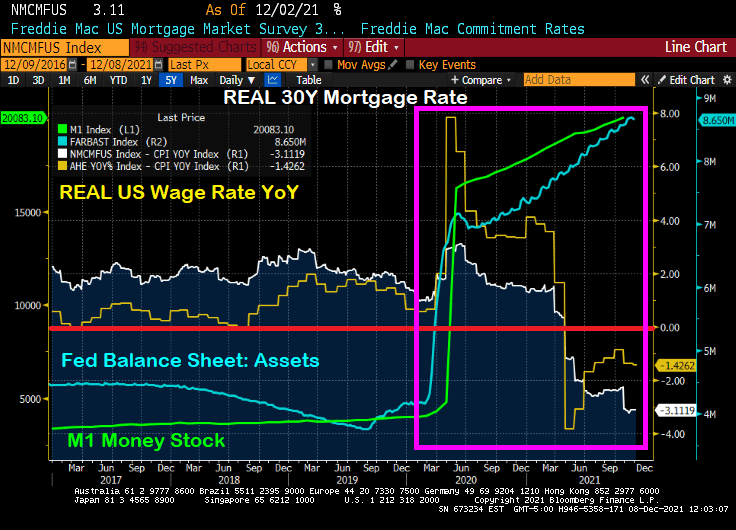
S&P 500 REAL Earnings Yield At -2.33% While REAL Wage Growth At -1.43% (REAL 30Y Mortgage Rate At -3.11%) “Weird, Wacky Stuff!”

As Parks and Recreation’s Martin Housely said, “Weird, wacky stuff.”

We now have the S&P 500 REAL earnings yield at -2.33%.

REAL US average hourly wage growth is at -1.43% and the REAL 30-year mortgage rate is at -3.11%.

The cause of this weird and wacky economic stuff? How about the surge in M1 Money and The Fed Balance Sheet?

I can almost see Fed Chair Jerome Powell imitating Martin Housely and saying “Weird, wacky stuff” in his testimony before Congress.

Fed Talk,Talk! Mortgage Applications SURGE 56% WoW As Treasury Yields Tank (Purchase Apps Spike 28% WoW)

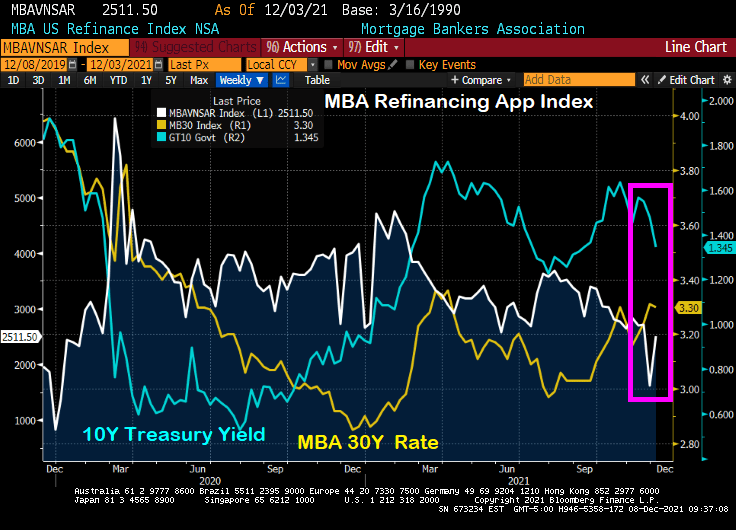
Despite the “Talk, Talk” from The Federal Reserve about balance sheet taper and rate “normalization,” we actually saw the 10-year Treasury yield fall from 1.6651% on 11/23/2021 to 1.343 on 12/3/2021. While the 30-year mortgage rate only fell from 3.31% to 3.3%, it is the SIGNAL that The Fed is sending that people should refinance their mortgages ASAP.

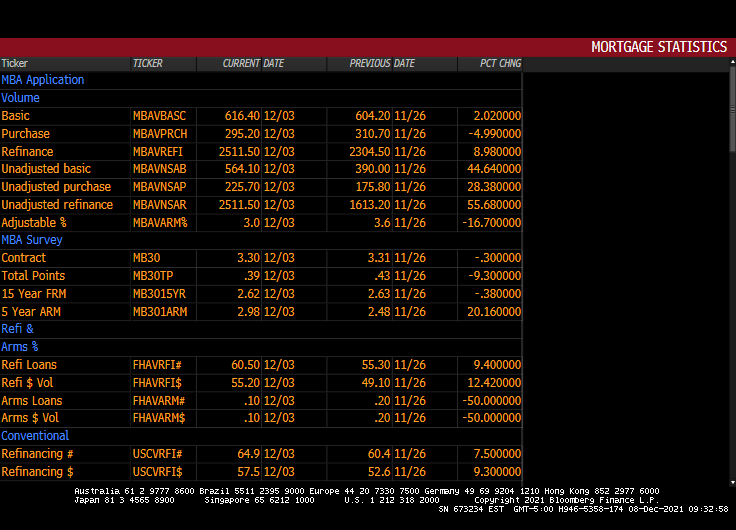
You can see the rise in mortgage refinancing applications of 56% week-over-week (WoW) (white line) with the drop in the 10-year Treasury yield (blue line) despite the relatively small drop in the Mortgage Bankers Association (MBA) tiny drop in their 30-year mortgage rate index.

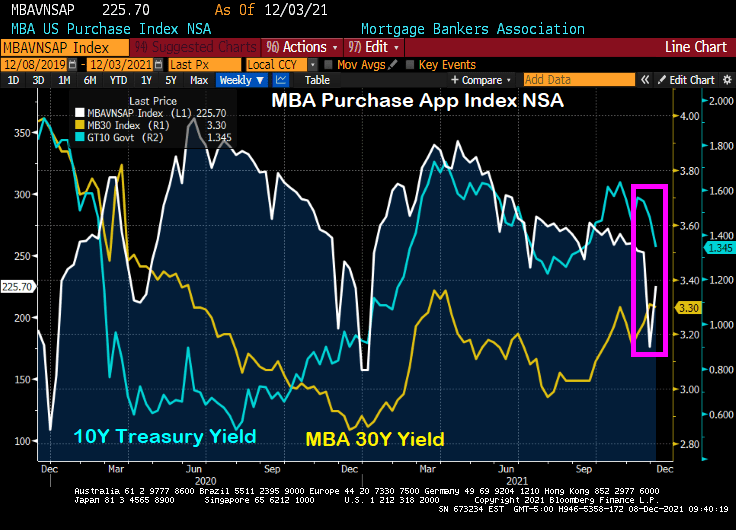
Ditto for the MBA mortgage purchase application index. The drop in the US Treasury yield (blue line) resulted in a 28% WoW increase in mortgage purchase applications.

Here is the table of MBA data for the week of 12/03.

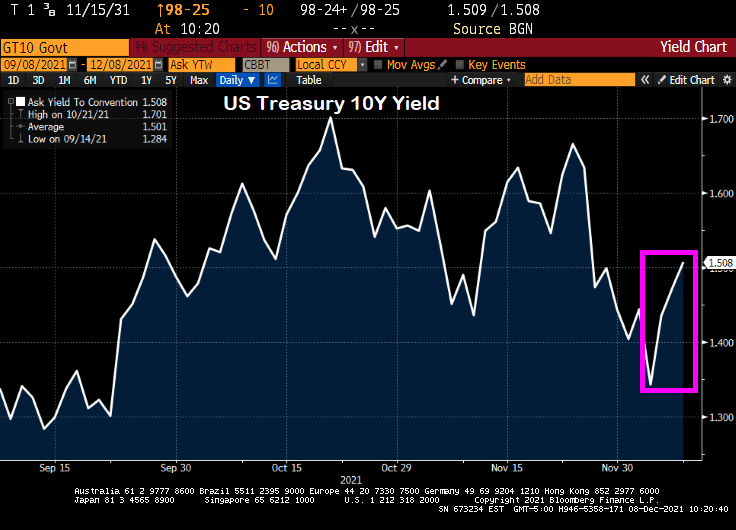
Please note that the 10-year Treasury yield have jumped since 12/03 indicating that mortgage application activity for the week of 12/10 will be lower.

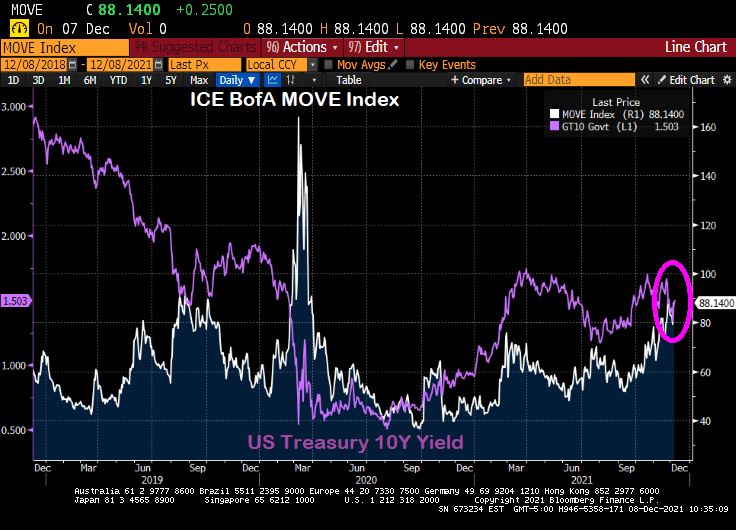
Here is the MOVE bond volatility index and the US Treasury 10-yield chart. Can you spot the COVID outbreak??

Here is a video of Fed Chair Jay Powell doing “Talk, talk” about tapering.

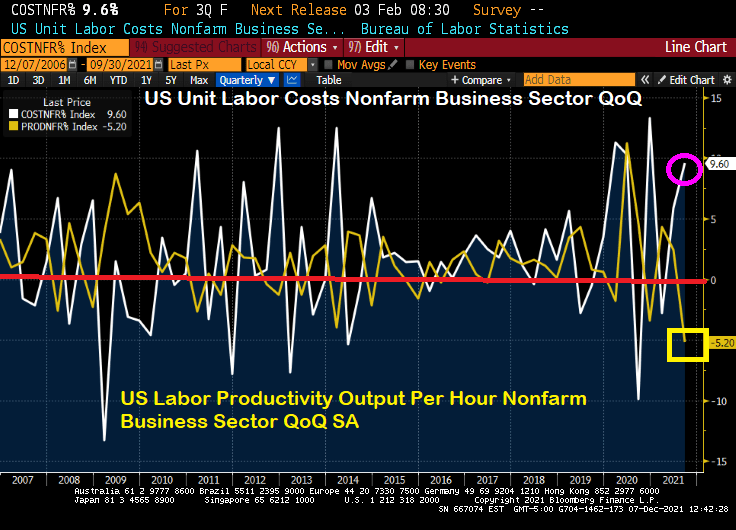
US Unit Labor Costs SOAR 9.60% QoQ As Labor Productivity DECLINES 5.20% QoQ (Worst Since 1960)

If this what the Biden Administration had in mind? Soaring labor costs at the same time that labor productivity is falling to its lowest level since 1960?

Powell and the Gang’s monetary approach doesn’t seem to be working for the labor market …

But is working extremely well for asset prices.

Wall Street parties while Main Street suffers worst decline in productivity since 1960.

Alarm! Treasury Dealer Short Positions Another Red Flag for Liquidity As Stock Market Surges On Realization The Fed May NOT Taper (And Fausti Oversold Omicron Threat)

Alarm!

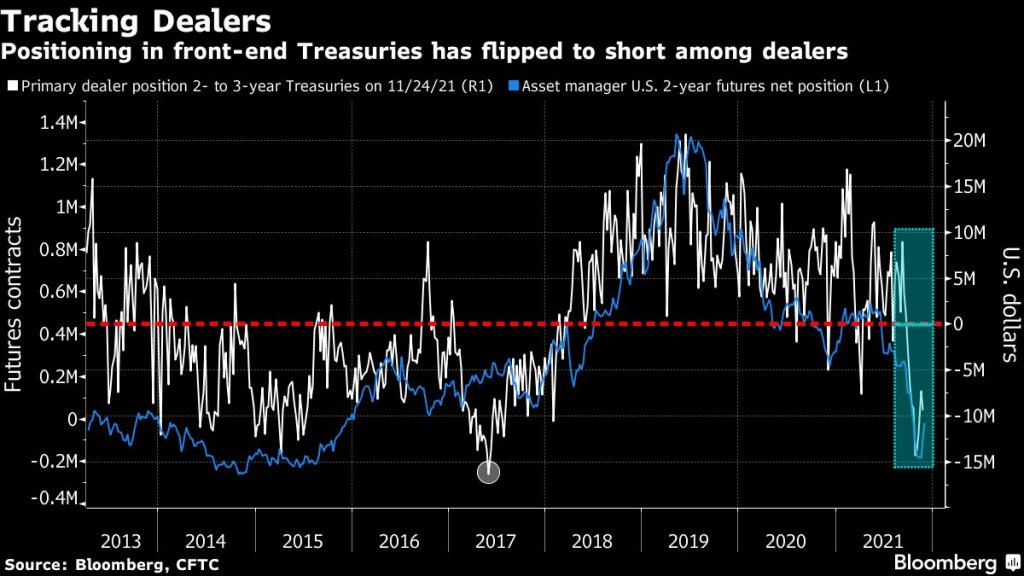
(Bloomberg) — The recent drop in primary-dealer holdings of front-end Treasuries is another warning of potential market dislocation heading into the year-end liquidity vacuum.

As of Nov. 24, primary dealers — which are mostly the large banks — were on the whole betting against two- to three-year Treasuries rather than buying. They had net short positions of just over $9 million, near the most bearish levels since 2017, signaling a pullback by buyers that provide crucial liquidity for older Treasury issues.

The positioning in the front-end of the curve “suggest less demand from the dealer community to fund off-the-run long positions,” Barclays strategists Anshul Pradhan and Andres Mok say in a Dec. 3 note. Off-the-run Treasuries are notes and bonds created in past years and traded less frequently than the newest issues; they’re the biggest part of the market and make up most of the Federal Reserve’s daily asset purchases, which are being scaled back. 

Short positioning increased on a relative basis as a result, “which may also have crowded demand to borrow particular issues over others,” the analysts wrote. 

Those forces together could contribute to an increase in market dislocations.

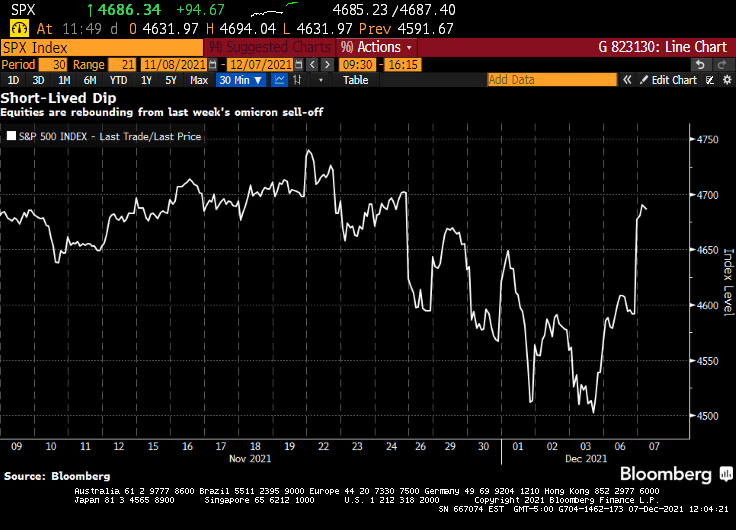
 Jerome Powell’s hawkish pivot shocked financial markets. A week later, stocks are higher.
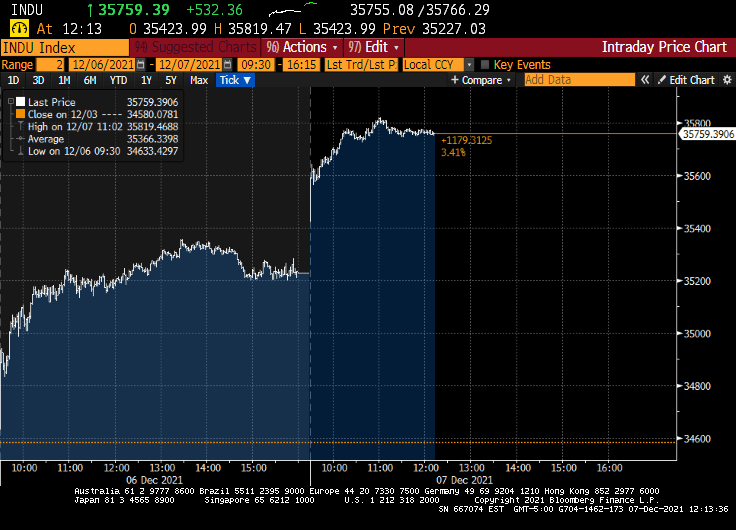
The S&P 500 staged its biggest rally since March to wipe out losses from the past week. The speculative fringe that was a smoldering wreck Friday was soaring Tuesday. An index of meme stocks rallied more than 4%, while one composed of airlines added 1.6%. A gauge of newly public companies advanced more than 4%, SPACs jumped more than 2% and even cryptocurrencies rallied, with Bitcoin powering back above $51,000.

It’s a stunning about-face for risk assets that went into a tail spin after the Federal Reserve chair suggested he favored accelerating the removal of monetary support. What follows are takes from market-watchers on why the market is looking past the Fed’s potential change in policy.

Also, the realization that Fausti was chicken-little and Omicron is not the planet killer.

Or could it be that with China easing, the US will be forced NOT to taper. Or taper only ever-so-slightly.

With the Dow up another 500+ points, it looks like no one is taking Powell and the Gang seriously about tapering. Or Fausti for that matter.

NIAID Director Anthony Fausti.

China’s Central Bank (PBOC) Cuts Reserve Requirements By 50 Basis Points To Stem Tide Of Economic Slowdown And Real Estate Development Problems (Big Trouble In Big China?)

Big Trouble In Big China?

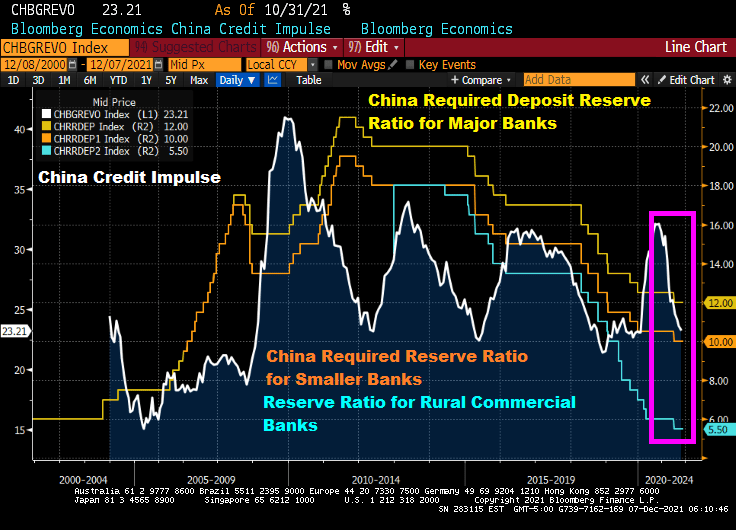
China cut the amount of cash most banks must hold in reserve, acting to counter the economic slowdown in a move that puts the central bank on a different policy path than many of its peers.

The People’s Bank of China will reduce the reserve requirement ratio by 0.5 percentage point for most banks on Dec. 15, releasing 1.2 trillion yuan (US$188 billion) of liquidity, according to a statement published Monday. 


The reduction was signaled by Premier Li Keqiang last week when he said that authorities would cut the RRR at an appropriate time to help smaller companies, and is the second reduction this year.

The decision comes after recent data showed the economy and industry stabilizing, although Beijing’s tightening curbs on the property market have led to a slump in construction and worsened a liquidity crisis at developer China Evergrande Group and other real estate firms. 

Evergrande’s ADR is collapsing (now 5.975) along with Evergrande debt falling to 23.12 (versus 100 par).

China’s credit impulse has nosedived (see pink box) as the PBOC drops bank reserve ratios to lowest level since 2007 in an effort to float the boat. Will the PBOC drop in reserve ratios stem the tide? Or is it peasant magic?

Yes, its big trouble in big China. Let’s hope it isn’t the Three Storms (commercial real estate bubble, low Central Bank reserve ratios and … fear).

Is The US Engaged In A Monetary Cold War With Russia? (Or Will The US Become A Tightener Rather Than A Loosener?)

Is the US engaged in a monetary cold war with Russia? It looks that way if we consider the Index of Global Easing and Tightening from the Council of Foreign Relations.

Russia and Brazil are tightening along with Mexico, Colombia, Peru, Argentina and Chile. Add Pakistan, The Czech Republic and Poland to the list of tighteners.

The looseners? The US, of course, with Canada, Australia, China, India, Western Europe, Turkey and Nigeria. New Zealand is the quickest loosener.

This looks very cold war-like. But a monetary cold war.

Let’s see if The Fed becomes a tightener rather than a loosener.

REAL Average Hourly Earnings Growth Falls To -1.378% YoY In November Jobs Report (Jobs Added Missed BIG At Only 210K, New Taylor Rule Estimate Is 15.50%)

Treasury Secretary Janet Yellen said yesterday that “It’s Fed’s Job to Avoid Any Wage-Price Spiral.” Well, The Fed is helping to avoid a wage increase in real terms, since the November jobs report revealed that REAL US Average Hourly Earnings growth YoY fell to -1.378%. In other words, inflation is greater than hourly earnings.

And in other jobs related news, nonfarm payrolls rose by only 210k versus expectations of 550k jobs to be added. Even NOMINAL hourly earnings growth (4.8% YoY) was less than expected (5.0%).

Labor force participation rose a bit to 61.8%, still well below the pre-COVID levels of 63.4% in January 2020.

The U-3 unemployment fell to 7.8%. Still higher than the pre-COVID rate of 7.0% in February 2020, but getting close! As for what this means for The Fed, the new target rate implied by the Taylor Rule is 15.50%.

After this lousy jobs report, 10-year Treasury yields dropped … like Biden’s approval ratings.

The dance number where The Fed keeps their target rate at 25 basis points while the Taylor Rule implies a target rate of 15.50% is the Yellen Boogie. By Powell and the Gang.