Fear The Talking Fed! Fed Loses $114.3 Billion In 2023 (Bank Credit Growth At Just -0.1% YoY)

As The Federal Reserve continues to support bad Bidenomics policies, they … like millions of Americans … are suffering catestrophic losses.

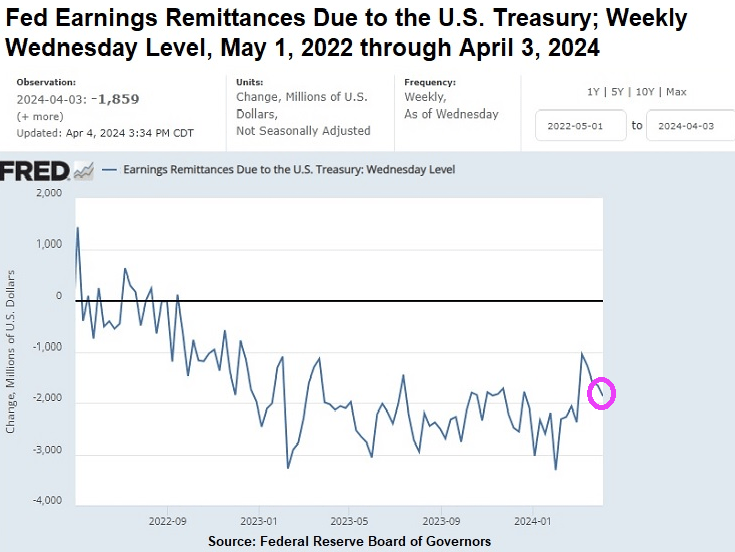
The #Fed said on Tuesday that it officially saw a net negative income of $114.3 billion in 2023, a record loss tied to expenses related to managing the U.S. central bank’s short-term interest rate target. The loss last year follows $58.8 billion in net income in 2022, the Fed said.

The good news? Bank credit growth is ALMOST back to 0%!

I wonder if KJP or Jared Bernstein will tout almost 0% credit growth as a sign that economists were wrong about Bidenomics?

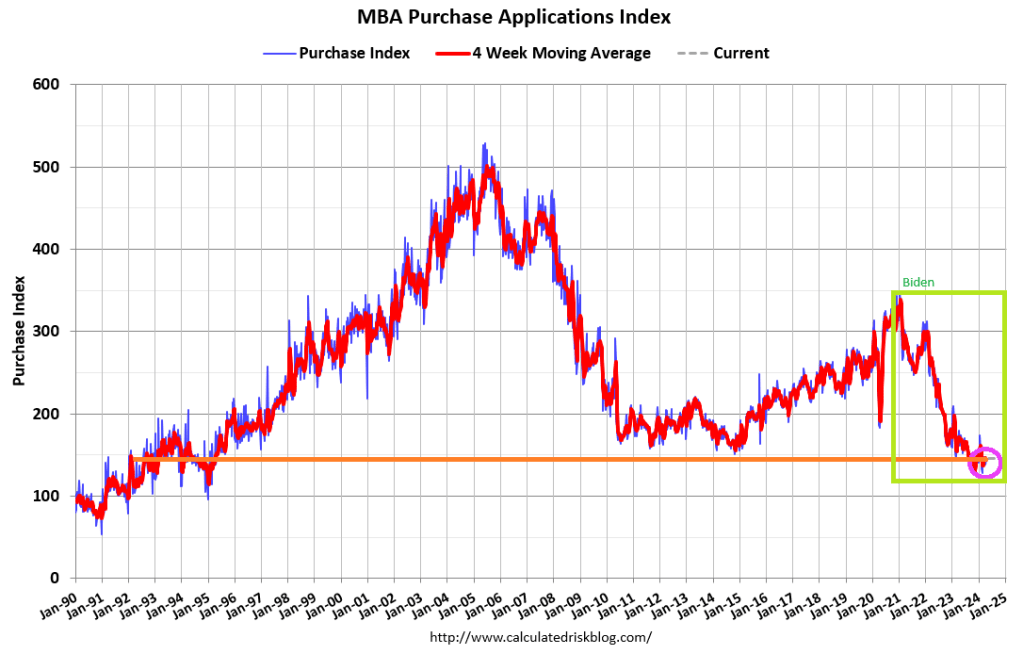
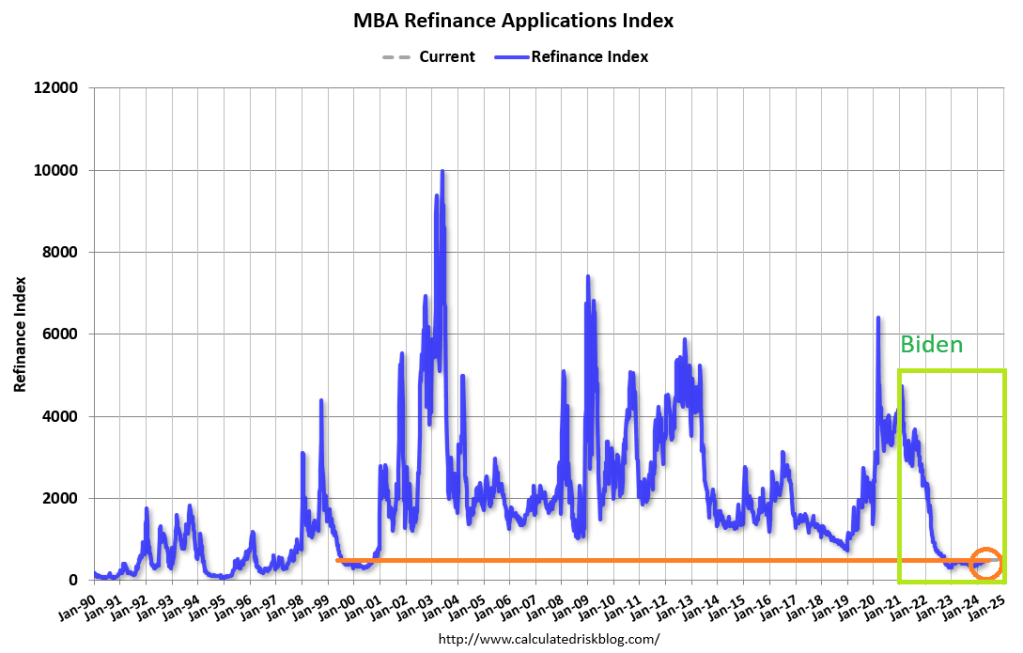
Bidenomics, The Key Bridge Collapse And The Collapsing US Mortgage Market (Mortgage Applications Collapse By 16% From Last Year)

The cargo ship craashing into and collapsing the Key bridge in Baltimore is emblematic of Bidenomics: an ongoing wreck. And the mortgage market is the Key bridge collapse over a longer period. Specifically, from the start of Biden’s Regime in 2021.

Mortgage applications decreased 0.7 percent from one week earlier, according to data from the Mortgage Bankers Association’s (MBA) Weekly Mortgage Applications Survey for the week ending March 22, 2024.

The Market Composite Index, a measure of mortgage loan application volume, decreased 0.7 percent on a seasonally adjusted basis from one week earlier. On an unadjusted basis, the Index decreased 0.4 percent compared with the previous week. The seasonally adjusted Purchase Index decreased 0.2 percent from one week earlier. The unadjusted Purchase Index increased 0.2 percent compared with the previous week and was 16 percent lower than the same week one year ago.

The Refinance Index decreased 2 percent from the previous week and was 9 percent lower than the same week one year ago.

Employment in mortgage lending has shrunk along with collapsing mortgage originations under Biden.

US Home Prices Rose For 12th Straight Month In January, Despite Soaring Rates (As Consumer Confidence Shrinks)

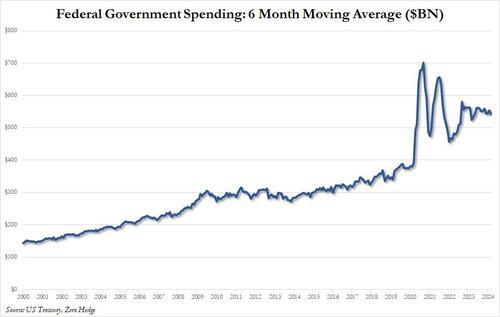
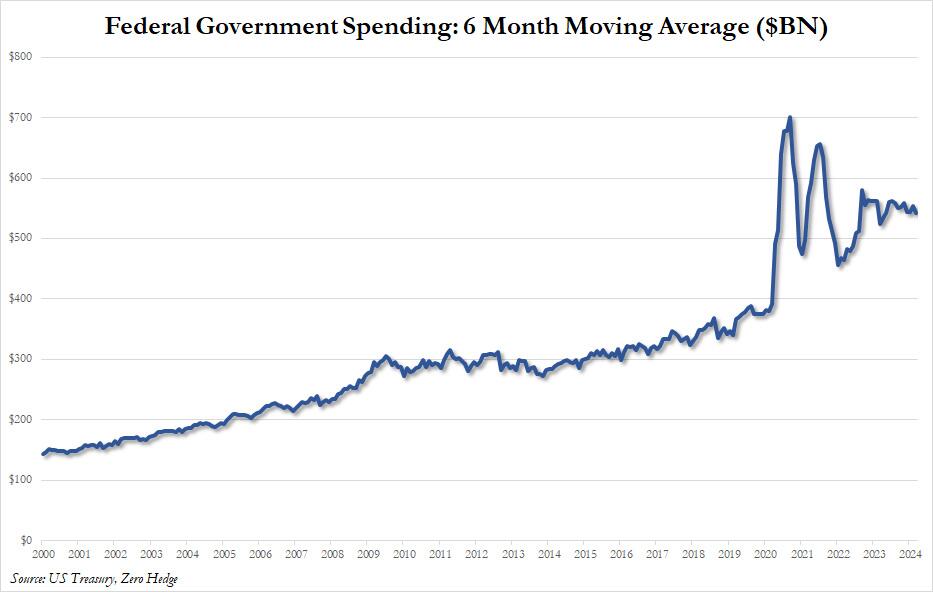
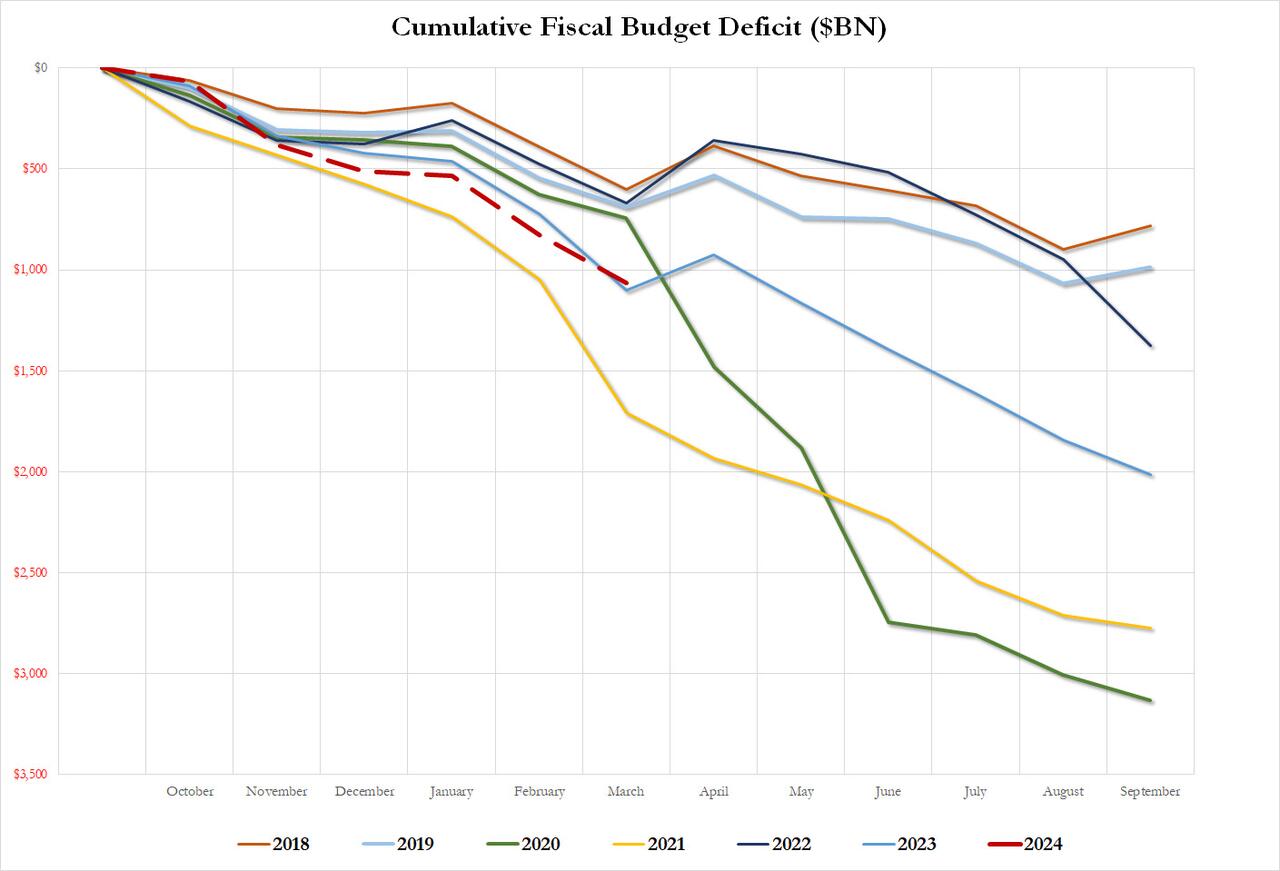
Federal government spending is that hideous strength that keeps on chugging along, despite higher rates.

Home prices in America’s 20 largest cities rose for the 12th straight month in January (the latest data released by S&P Global Case-Shiller today), up 0.14% MoM (less than the 0.2% exp)

Source: Bloomberg

That pushed the YoY price up to +6.59% (in line with the +6.60% exp).

“Our National Composite rose by 6% in January, the fastest annual rate since 2022.” According to Brian D. Luke, Head of Commodities, Real & Digital Assets at S&P Dow Jones Indices.

“For the second consecutive month, all cities reported increases in annual prices, with San Diego surging 11.2%”

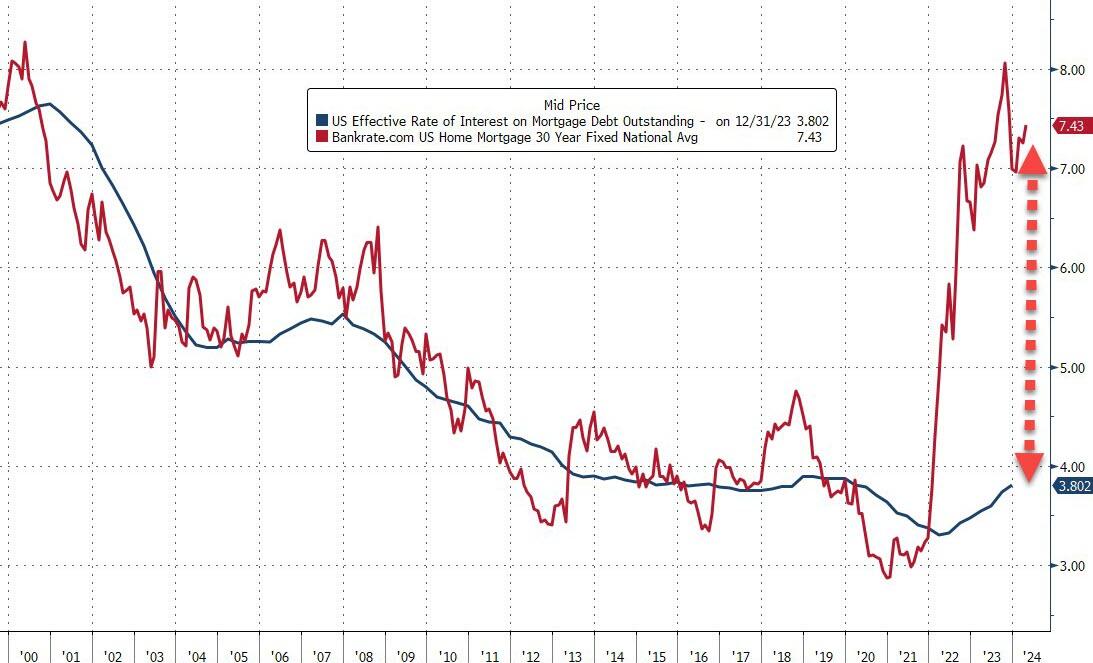
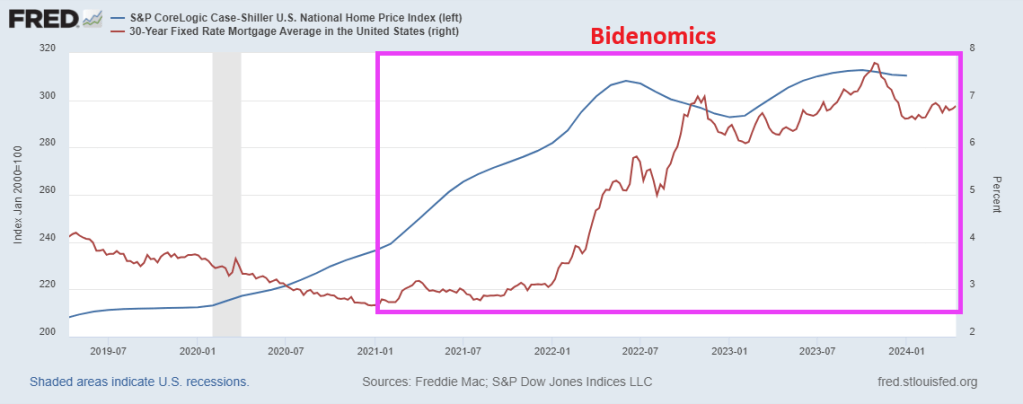
Given the smoothing and heavy lag in the Case-Shiller data, it’s hard to find a causal relationship between prices and mortgage rates, but with rates remaining above 7%, it seems hard to believe prices can continue their advance…

Source: Bloomberg

…and we just saw median new home prices tumble (though median existing home prices did increase).

How is Powell going to cut rates when home prices are rising at over 6% per year?

Meanwhile, after declining in February, analysts expected a small rebound in The Conference Board’s consumer confidence print in March, but instead it dropped further to 104.7 (vs 107.0 exp) from 106.7 as expectations plunged but current conditions improved

Source: Bloomberg

However, for the 5th straight month, the conference board’s headline confidence print was revised downward…

Source: Bloomberg

That is 13pts of ‘confidence’ erased in the last five months… to which we ask again – …how do you revise consumer confidence?

The Conference Board’s indicator inflation expectations rebounded modestly to +5.3% – still notably high but trend in the right direction…

Source: Bloomberg

The Board’s labor market indicator trended modestly weaker (after being revised higher)….

Source: Bloomberg

And finally, expectations for stocks to increase from here are at their highest since Jan 2018…

Source: Bloomberg

…that did not end well for stocks.

Government spending and debt are the hideous strength that is driving inflation.

Fear The Talking Fed! Global Debt Fast Approaching $100 Trillion As Fed Talks Rate Cuts In Election Year

Fear The Talking Fed!

Back in mid-December, after the Fed’s first, and very shocking, dovish pivot when just two weeks after Powell said it had been “premature” to speculate on rate cuts the Fed suddenly changed its mind (despite very strong economic reports in the interim) and unexpectedly revealed it had been “discussing a timeline to start rate cuts”…

… in the process, sparking the biggest market meltup in a decade, we explained that there was no mystery behind the Fed’s sudden change of heart: it had everything to do with Biden’s woeful performance in the polls.

… maybe what that happened in the past two weeks had nothing to do with economic data, the state of the US consumer, or how hot inflation is running and everything to do with… phone calls from the increasingly angry White House, the same White House which after seeing the latest polling data putting Biden at the biggest disadvantage behind Trump despite the miracle of “Bidenomics” decided to pull its last political level, and had a back room conversation with the Fed Chair, making it very clear that it is in everyone’s best interest if the Fed ends its tightening campaign and informs the market that rate cuts are coming. It certainly would explain why despite keeping the 2026 projected fed funds rate unchanged at 2.875%, the Fed just as unexpectedly decided to pull one full rate cut out of the non-election year 2025 and push it into the pre-election 2024.

Three months later, when Powell again shocked the world with yet another exceedingly dovish press conference, this time pushing the S&P to all time highs as it became increasingly clear the Fed has raised its inflation target to 3% or more, as we first discussed in “There Goes The Fed’s Inflation Target: Terminal Rate To Rise 100bps To 3.5% And More” and as Bloomberg confirmed today in “Powell Ready to Support Job Market Even If Inflation Lingers“, there was again some confusion, most notably from the likes of Jeff Epstein BFF Larry Summers who tweeted:

I don’t know why @federalreserve is in such a hurry to be talking about moving towards the accelerator. We’ve got unemployment, if anything, below what they think is full capacity. We’ve got inflation, even in their forecast, for the next two years above target. We’ve got GDP growth rising if anything faster than potential. We have financial conditions, the holistic measure of monetary policy, at a very loose level.

… to which we again replied that there is a very simple reason why the Fed is “moving toward the accelerator” and it again had to do with the fact that Biden approval rating is now imploding, so much so that even Time magazine has stepped in with an intervention.

But while once upon a time such a cynical, hyperbolic, and apocryphal view would have been relegated to the deep, dark corners of the financial blogosphere (duly shadowbanned and deboosted by the likes of such Democratic party stalwarts as Google, of course), that is no longer the case and in his latest note, SocGen’s in-house permaskeptic, Albert Edwards confirmed our view that the biggest driver behind the Fed’s decision making in recent months is neither the economy, nor the market, but rather the November presidential election, to wit:

The widening inequality chasm in this US election year will be a real issue for policy makers. What will the Fed do? Traditionally, the Fed would not pivot rates policy to cushion inequality, which is usually addressed by fiscal policy. But growing inequality has been a key issue ever since the 2008 Global Financial Crisis triggered a backlash against ‘The Establishment’ – most evident in the rise in popularism (although many, including myself, believe that the loose money/tight fiscal policy mix was primarily responsible).

Might the unfolding inequality crisis force the Fed to bow to intense political pressure to cut rates faster and deeper? I think that is entirely plausible. Indeed we on these pages have previously observed, somewhat cynically, that Powell’s recent ‘surprise’ December 2023 dovish pivot came exactly at a time when Donald Trump was pulling ahead in the polls – link. But it would be a diehard cynic who could contemplate that the Fed, as part of ‘The Establishment’, would balk at the thought of Trump winning in November and juice up the economy to try and lower the odds of such an outcome. (I am that cynic.)

To be fair, we find it remarkable that Edwards – a long-tenured and respected veteran of the SocGen macro commentariat – would confirm our own observations. We doubt he is the only one, of course, but the others are far more afraid of losing their jobs, at least for now.
What we find less remarkable is that Edwards – whose job is to track down gruesome and painful ways for the market to die a miserable death – has done just that again and this time, in the aftermath of the BOJ’s long overdue exit from NIRP, ETF buying and Yield Curve Control, predicts that it is now only a matter of time before the YCC that was spawned in Japan will soon shift to the west.

Edwards starts off by observing what has long been a “foolproof” signal of imminent recession: BOJ tightenging:

Market sentiment is now especially vulnerable to weak economic data because, as we pointed out last week, it seems everyone (and their dog) has left their recessionary worries far behind. But as my favorite bear, David Rosenberg, pointed out this week, recent weak retail sales, housing starts, and industrial production data might be setting us up for a negative US Q1 GDP print. Let’s see how the Fed reacts to that. And if you want one reliable predictor of a global recession, @PeterBerezinBCA notes that “In the history of modern finance, no single indicator has done a better job of predicting when the next global recession will start than when the Bank of Japan starts raising rates. Foolproof!”

He then recaps last week’s main event, namely that after almost a decade, Japan finally exited negative interest rates and Yield Curve Control (YYC), primarily on the back of soaring (nominal, not real) wage gains: “Rengo, Japan’s largest trade union confederation, announced last Friday that its members have so far secured pay deals averaging 5.28%, far outpacing the 3.8% squeezed out a year ago — itself the highest gain in 30 years (see Bloomberg here and SG Economist Jin Kenzaki’s analysis of this data and the BoJ’s move here).

Of course, the problem in Japan is not that nominal wages are surging: it is that in real terms they are crashing, as the next chart clearly shows, and is why the BOJ will have to dramatically tighten – certainly much, much more than the laughable “dovish hike” it delivered last week which sent the yen plunging to a multi-decade low and inviting even more imported inflation – to avoid total collapse in Japan’s economy as it gradually accelerates toward hyperinflation:

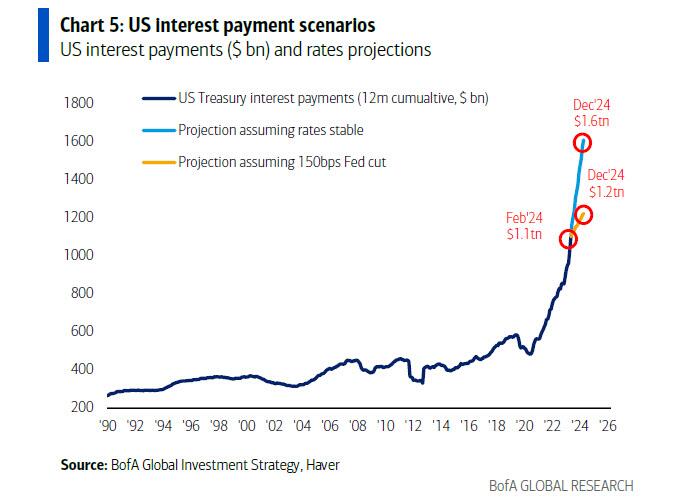
Of course, Japan can not actually tighten as that would instantly vaporize the economy and the bond market of a country whose central bank owns Japanese JGBs accounting for well more than 100% of GDP. But at least Japan has something goign for it: as Edwards notes, “the OCED estimates that interest on US debt amounts to 4½% of GDP, compared to only 0.1% of GDP for Japan (link). Hence the cyclically adjusted primary (ex-interest) deficit data show Japan as the most profligate borrower (see right hand chart). But the US still has to pay that interest somehow.” In other words, when adding interest payment, “it is the US that has been running the largest deficits since the 2008 GFC – bigger than even Japan (see left hand chart).”

Which brings us to Edwards’ punchline: “decades of excessively loose monetary policy has allowed governments to ruin their fiscal situations to the point that public debt to GDP ratios are on wholly unsustainable trajectories. Just look at the CBO’s projections for the US here. Yet with an ever-intensifying populist backlash against high levels of inequality, I can only see one way out of this mess for western economies. Nothing less than Financial Repression including Yield Curve Control – yes, the very same YCC that Japan has just abandoned.”

For those who may not have been around back in the 1940s when the US – and the Federal Reserve – was the first developed nation to utilize YCC to kickstart the US economy at a time of record debt to GDP, here is a quick primer from the SocGen strategist: “Financial Repression essentially entails holding interest rates below the rate of inflation for a lengthy period to allow debt to be ‘burned off’. This is a tried and trusted way for governments to wriggle free from excessive debt (eg the US after WW2). The leading economic historian Russell Napier explained how this works in an informative 2021 interview with The Market NZZ – link.”

And indeed, it was only a few years ago, just before the pandemic sparked a stimulus flood of epic proportions, that western policy makers were switching to average inflation targeting and stating that they would run economies hot to create that higher inflation (they got it but not because of AIT). That was the first notable attempt to shift toward Financial Repression, but as Edwards notes, “unfortunately they were too successful and let the rampant inflation cat out of the bag.”

Which brings up the $64 trillion question: “Do the Fed and ECB really want inflation to return to pre-pandemic inflation lows?” Well, with global debt now about 7x higher in just the 21st century, and fast approaching $100 trillion, meaning it will all have to be inflated away somehow…

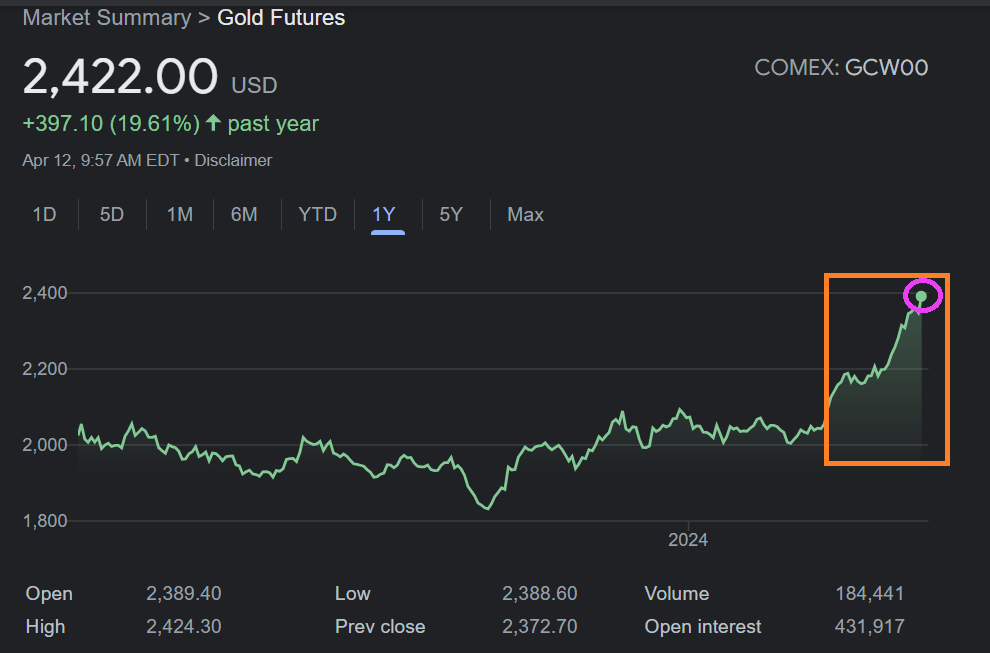
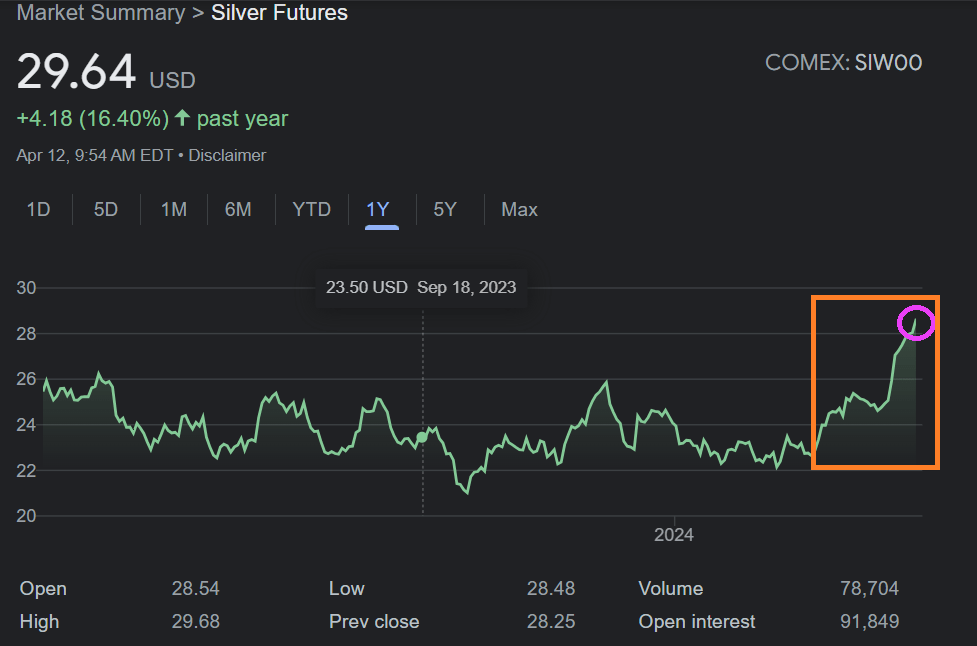
… Edwards’ answer is: “Not in my view.” And so while western economists deride Japan for its YCC policies, Albert says “that is where I think the US and Europe are heading as intractable government deficits drive up bond yields. During the next crisis, don’t be surprised to see yet more Japanification of western central bank policy. Plus ça change.”  And don’t be surprised if the dollar – while appreciating against the rest of the world’s doomed currencies in the closed fiat-system loop – hyperdevalues against such finite concepts which mercifully remain out of the fiat system, such as gold and crypto.

And wage inflation remains around 5%.

Hey Big Spenders! Broken Money And Neverending Inflation (Inflation STILL At 18%)

Face it. The Federal government is broken. Congress and the Biden Administration are addicted to spending money and running up massive debts. There is no attempt at fiscal restraint because they will always argue that “More money must be spent!” On what exactly? Usually pet projects (aka, pork) like the LGBTQ retirement home in Boston for $850 thousand and $15 million for Egyptian college tuition.

How does “broken money” work? Badly. Without any fiscal restraint, politicians can just give away thousands/millions of dollars to the donor class (donate $1, get $1,000 in return). As you can see, the net worth of the top 0.1% has exploded with each ensuing “crisis.” There was the 2008/2009 financial crisis and the 2008 Covid crisis. With each crisis, the top 0.1% get richer and richer. You will note that net worth for the top 0.1% is closely related to M2 Money printing. Like, who gets the money printed by Uncle Spam? The 0.1%, of course!

Broken money leads people to store their value in sub optimal vehicles like housing. This drives the cost of real estate up unnaturally and increases the gap between the “haves” and the “have nots”. Sowing seeds of animosity. Seeds that, when left to germinate and grow via the further degradation of the money people use, blossom into ugly flowers of Anarcho Tyranny.

This has manifested in the trend of people claiming other’s houses by squatting in them when they are left unattended for an extended period of time. The preferential treatment that has been given to squatters over homeowners in recent years can be seen as the regime which controls the money printers throwing the plebs a bone as they struggle to get by, an attempt to push the productive class to violence against a state unwilling to respect private property rights, or a combination of the two.

Look at inflation if we use pre-1983 methods. Inflation is still roaring at 18%!

Broken money incentivizes governments to allow their borders to be bum rushed by cheap laborers who will take low paying jobs that enable the systemically fragile economy to keep chugging along while simultaneously increasing the chaos that already exists and diluting the values that the natives of this country believe in.

The excess and decadence enabled by a world run on broken easy money allows people to live in a detached reality that leads them to push objectively false narratives. This is why there are running debates about gender and a retreat from merit based compensation.

All of this stems from broken money.

The chart above should act as a reminder to you all that the biggest problem in the world right now is the money. The chart above should also prove to you that the most powerful people throughout the economy are going to fight tooth and nail to protect the broken money because they benefit massively from the fact that it is broken.

Keep this in mind as the chaos increases and narratives begin to form around using bitcoin as money. But we will never see inflation “normalizing” as long as Congress and Biden keep spending money.

Here are 3 of the BIG SPENDERS, Obama, Biden and Insider trader pro Pelosi. Do any of them look like the care about the bottom 50% of net worth or inflation??

Biden, Schumer Fund Border Defense In Spending Bill! Jordan, Lebanon, Egypt, Tunisia and Oman Get Border Funding, NOT The US (US Falls To 23rd In Global Happiness Ranking)

Biden loves to blame Republicans for the border crisis. Although he has it in his power to close and secure the border, but won’t. It’s easier to blame the opposition, like “extreme MAGA Republicans.” Huh, I didn’t realize that as a conservative American I am considered extreme by the Biden Administration.

Unfortunately, Biden, Schumer and Johnson only provided financial support for Jordan, Lebanon, Egypt, Tunisia and Oman. In the form of $380 million.

As the US falls to 23rd in World Happiness ranking. Based, in part, on Biden’s idiotic open borders policy.

Pork Barrell Chuck And Gaslight Joe! $60 Million For Ukraine, $0 For US Border Disaster (Purchasing Power Of Dollar Down -16% Under Biden)

Its Pork Barrell Chuck Schumer and Gaslight Joe Biden! Always ready to lie (gaslight) and spend trillions that we don’t have.

A new $1.2 trillion government spending package Congress is trying to ram through faces significant headwinds in the House, where members are expected to vote on it later this morning.

The 1,012-page bill was introduced at around 3am Thursday morning – just 48 hours before a midnight Friday funding deadline. It must pass both the House and the Senate, after which President Biden will sign it (with crayons at the ready, we’re sure).

The package accounts for approximately 70% of discretionary government spending – and consists of six out of twelve total bills that Congress must pass each fiscal year to fund the government. The six others, around $460 billion in spending, were passed earlier this month.

According to Fox News, multiple GOP sources, two GOP lawmakers and one senior GOP aide think the package will pass, but by a tight margin.

On Thursday afternoon, however, the bipartisan deal hit turbulence – with one GOP lawmaker citing absurd pork contained within – including funding for LGBTQ centers and facilities that provide late-term abortions.

Pork City

As usual, Democrats slipped in as much pork as possible, including:– $850k for a gay senior home- $15 million to pay for Egyptian’s college tuitions- $400k for a gay activist group to teach elementary kids about being trans- $500k for a DEI zoo- $400k for a group to gives clothes to teens to help them hide their gender

$60,000,000,000 for Ukraine (of course). NOTHING for US border.

$1,140,000,000,0000 for pork barrelling

1.2 trillion in inflation, an increase of the money supply by 2% in a single spending bill.

The US Dollar’s purchasing power is down -16% under Gaslight Joe.


Existing Home Sales Prices Explode In February (Median Selling Price Rose 5.7% to $384,500 From Last Year, Highest For Any February Back To 1999)

February’s existing home sales are like a scoop of cottage cheese. Seemingly satisfying until you look more closely at the data (or get hungry 30 minutes later).

Existing home sales soared a stunning 9.5% MoM in February, smashing the expectation of a 1.3% decline and building on the 3.1% MoM in January. However, even with the big monthly jump, existing home sales remain down 3.3% YoY…

Source: Bloomberg

Total existing home sales SAAR surged to 4.38mm – a 12 month high…

Source: Bloomberg

Homeowners may be accepting that mortgage rates are settling into a new normal and can’t delay moving any longer, NAR Chief Economist Lawrence Yun said on a call with reporters.

“Additional housing supply is helping to satisfy market demand,” Yun said in a statement.

“Housing demand has been on a steady rise due to population and job growth, though the actual timing of purchases will be determined by prevailing mortgage rates and wider inventory choices.”

With a 2-month lag, we can see why existing home sales may have risen, but with mortgage rates rising since then, we suspect the fun and games may come to an end again soon (even if the NAR economist thinks otherwise)…

The number of previously owned homes for sale climbed to about 1.07 million last month, and Yun said he expects that will continue to go up. At the current sales pace, selling all the properties on the market would take 2.9 months, the lowest in about a year.

Realtors see anything below five months of supply as indicative of a tight market.

Even with greater inventory, strong demand put upward pressure on prices. The median selling price advanced 5.7% to $384,500 from a year ago, the highest for any February in data back to 1999.

Sales rose in three of four regions, led by a 16.4% surge in the West

First-time buyers made up 26% of purchases in February, matching the lowest on record.

Biden’s War On Gas Cars Will Cost Americans A Fortune, 5-year Cost To Own An Electric Vehicle Exceeds $92,000 (Too Expensive, Only 73% Of Chargers In Working Order)

Biden continues to try to force Americans to buy electric cars and support China’s EV and battery industries! And are EVs ever expensive!

The Environmental Protection Agency released what it calls the “strongest-ever pollution standards for cars,” which it claims will “expand consumer choice in clean vehicles.”

That’s a stretch: These new regulations, which are clearly beyond EPA’s defined powers, will limit overall vehicle choice and force Americans into expensive and unreliable electric vehicles.

The EPA expects plug-in electric vehicles to make up between 62% and 70% of the automotive market. But this unrealistic target ignores two key facts:

First, consumers are not lining up to purchase electric vehicles, which made up only 7.6% of 2023 vehicle sales despite heavy subsidies.

American drivers simply aren’t embracing EVs because they know these vehicles have shorter driving ranges and longer refueling times. Not to mention that they’re significantly more expensive.

The five-year cost to own an average electric vehicle is more than $92,000, according to the North American Auto Dealers Association. Compare that to a typical gas-powered vehicle, which over the same period costs $76,500.

Second, readily available charging infrastructure remains elusive for many EV users.

Many of the available chargers are level 2, which the magazine U.S. News notes “is fine if you have time to kill.”

Repair issues compound even the limited levels of charging, as only 73% of chargers in some major centers are in working order, according to Autoweek.

In the face of rapid decreases in the growth of electric vehicle sales, automakers are already scaling back EV production plans.

In December, Ford announced it was cutting planned production of its F-150 Lightning pickup in half due to “changing market demand.”

The Mackinac Center for Public Policy has warned automobile manufacturers for years that leaving consumers out of their long-term business plans was a recipe for failure.

Taxpayers not only pay with more expensive cars, they have to subsidize new production facilities.

In Michigan, lawmakers have already promised $200 million dollars of taxpayer money — and that’s just for one Ford battery plant in Marshall.

Notice that Biden has his right hand mysterioulsy over the cup holders where the transmission shifter would be on his gas-guzzling Corvette. When Biden drives a Nissan Leaf and sells his Corvette, I will almost believe Biden. No, he lies so much I can’t believe anything you see.

Mortgage Woes Continue! Purchase Applications (Demand) Now Down 14% From Last Year

The woes for the mortgage market continue under President Magoo.

Mortgage applications decreased 1.6 percent from one week earlier, according to data from the Mortgage Bankers Association’s (MBA) Weekly Mortgage Applications Survey for the week ending March 15, 2024.

The Market Composite Index, a measure of mortgage loan application volume, decreased 1.6 percent on a seasonally adjusted basis from one week earlier. On an unadjusted basis, the Index decreased 1 percent compared with the previous week. The seasonally adjusted Purchase Index decreased 1 percent from one week earlier. The unadjusted Purchase Index decreased 1 percent compared with the previous week and was 14 percent lower than the same week one year ago.

The Refinance Index decreased 3 percent from the previous week and was 3 percent lower than the same week one year ago.

Between The Fed’s announcement of rate changes and The Biden Crime hearings in DC (where Hunter of course failed to appear), there is plenty to keep us occupied.