61% of Bloomberg terminal respondents (including me, by the way) see Fed hikes leading to recession.
Bond traders are stepping up wagers that the Federal Reserve will steer the US economy into a recession.
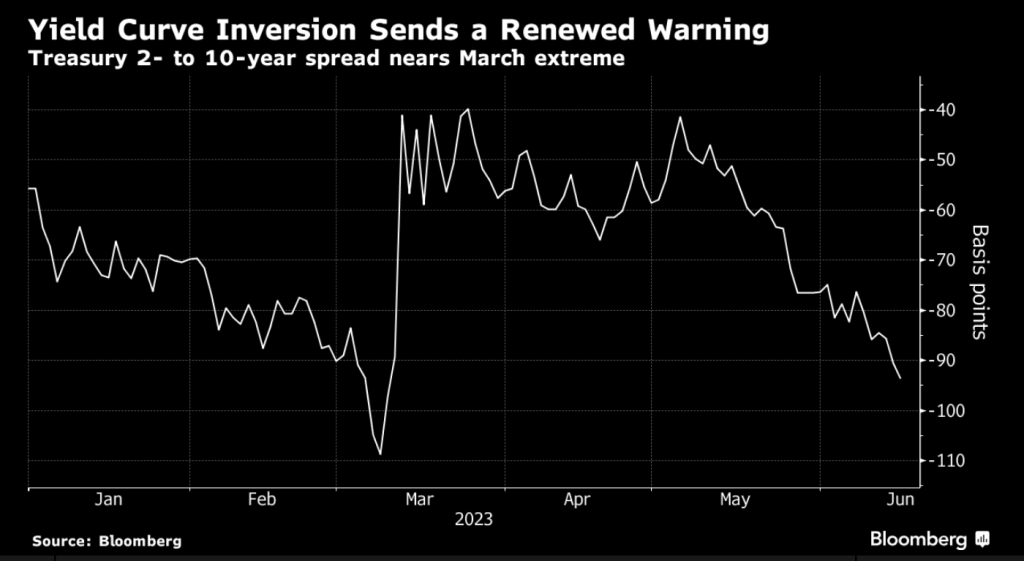
Policy-sensitive front-end Treasuries led a selloff Thursday, while longer-date bonds lagged, a day after Fed officials indicated that they’re prepared to raise interest rates by another half-point this year following the first pause in the central bank’s 15-month hiking campaign. That sent the yield-curve inversion, as measured by the gap between two- and 10-year securities, to 95 basis points — a level last sustained in March — and approaching this cycle’s 109-basis-point extreme.
The price action suggests bond traders are skeptical that policymakers can avoid a so-called hard landing as they continue to press the case for higher borrowing costs in an effort to get a handle on inflation that remains more than double their 2% target.
“The Fed runs the risk of solving one policy error of being too easy for too long with another policy error as they ignore the growing credit contraction and persistent losses from higher rates,” said George Goncalves, head of US macro strategy at MUFG. “The catch-22 is that for them to ease, something now has to break or the economy has to crack.”
It’s not just bond traders who are growing concerned.
Sixty-one percent of respondents in a Bloomberg poll of terminal users conducted in the hours after the Federal Open Market Committee decision said tighter monetary policy will ultimately cause a recession at some point in the next year.
“The Fed was clearly trying to send a hawkish message that they are not quite done yet and don’t think they have made enough progress on inflation,” said Michael Cudzil, portfolio manager at Pacific Investment Management Co. “You see curve flattening and rates not pricing in the full extent of hikes, so the thinking is that these hikes may bite and the Fed is closer to the end.”
Officials left their target range for the federal funds rate unchanged at 5% to 5.25% Wednesday, but projected the key rate will rise to 5.6% by the end of this year, implying two more quarter-point increases, up from 5.1% in March. They also revised higher estimates of core inflation for year-end to 3.9%, from 3.6%, owing to what Chair Jerome Powell called surprisingly persistent price pressures.
Still, markets aren’t convinced borrowing costs will rise as high as central bankers project.
The highest rate on swap contracts for future meetings by early Thursday was around 5.32% for both September and November, with July at 5.27%, compared to a current Fed effective rate of 5.08.
The Fed’s aggressive outlook for rate hikes through year-end may be an effort to dash bond-market expectations for cuts in the months ahead, according to Michael de Pass, global head of linear rates at Citadel Securities.
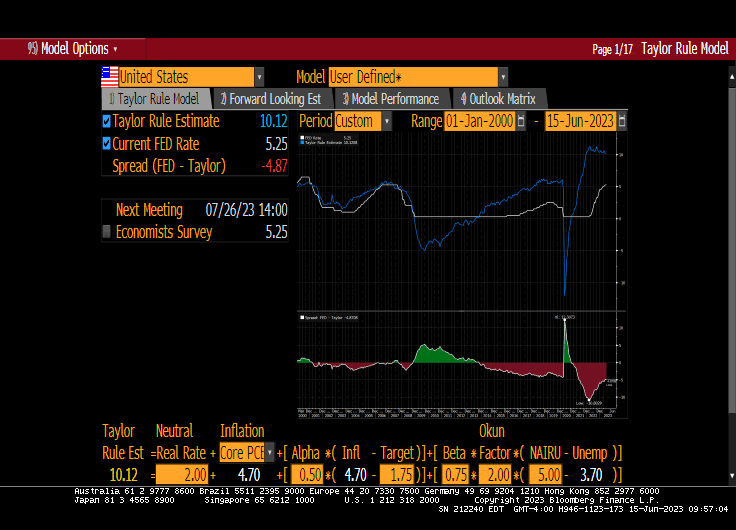
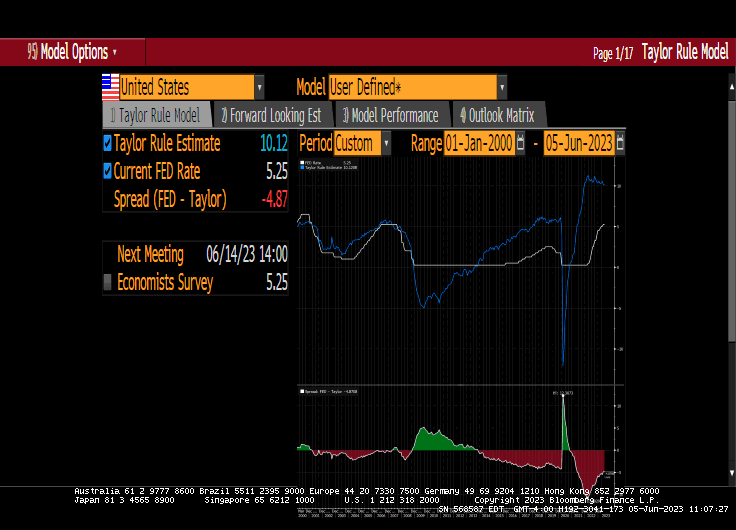
While The Fed paused at their recent FOMC meeting, they are expected to raise their target rate at the July meeting …. then stop. Despite being only a little over 50% of where they should be (10.12%) to cool inflation.
The Fed will annouce a pause at today’s FOMC meeting, so don’t look for mortgage rates to do much today.
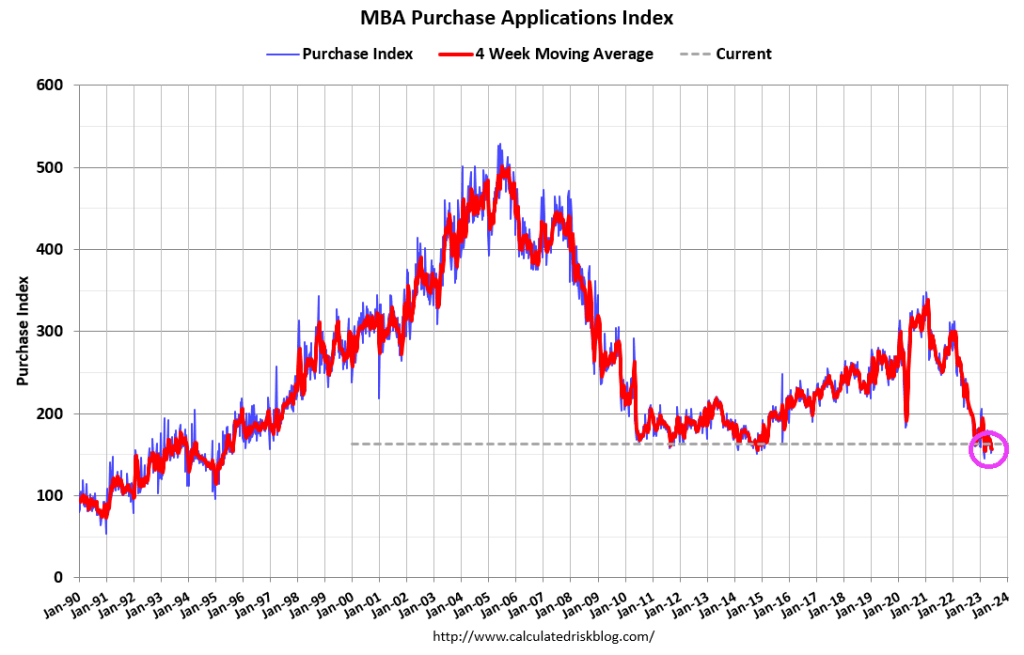
Mortgage applications increased 7.2 percent from one week earlier, according to data from the Mortgage Bankers Association’s (MBA) Weekly Mortgage Applications Survey for the week ending June 9, 2023.
The Market Composite Index, a measure of mortgage loan application volume, increased 7.2 percent on a seasonally adjusted basis from one week earlier. On an unadjusted basis, the Index increased 18 percent compared with the previous week. The Refinance Index increased 6 percent from the previous week and was 41 percent lower than the same week one year ago. The seasonally adjusted Purchase Index increased 8 percent from one week earlier. The unadjusted Purchase Index increased 17 percent compared with the previous week and was 27 percent lower than the same week one year ago.
Mortgage rates declined for the second straight week, with the 30-year fixed rate decreasing to 6.77 percent. Mortgage applications were up over the week, but remained well below levels from a year ago.
Joe Biden’s new nickname is “The 5 Million Dollar Bribe Man.” Sort of like Steve Austin.
Okay, Joe Biden was generally regarded as the dumbest member of the US Senate and mean-spirited (I won’t repeat podcaster Joe Rogan’s opinion of Biden). Now we realize how brazenly corrupt Biden is (taking bribes from China and Ukraine to influence American poliicies). Not only is Biden an attrocious human being, but his policies have damaged the US middle class terribly thanks to inflation.
Nicolas Maduro of Venezuela must be envious of Joe Biden. I don’t think even Maduro has the stones to have his politiical opponent charged with espionage in the run-up to a Presidential election. Particularly when the US President has been bribed by China and Ukraine and has similiar sensitive document hoarding issues (at least Trump didn’t leave boxes of sensitive documents in a garage like Biden did when he keeps his Chevy Corvette).
So where do we sit today after Biden has signed the debt ceiling increase and massive spending splurge?
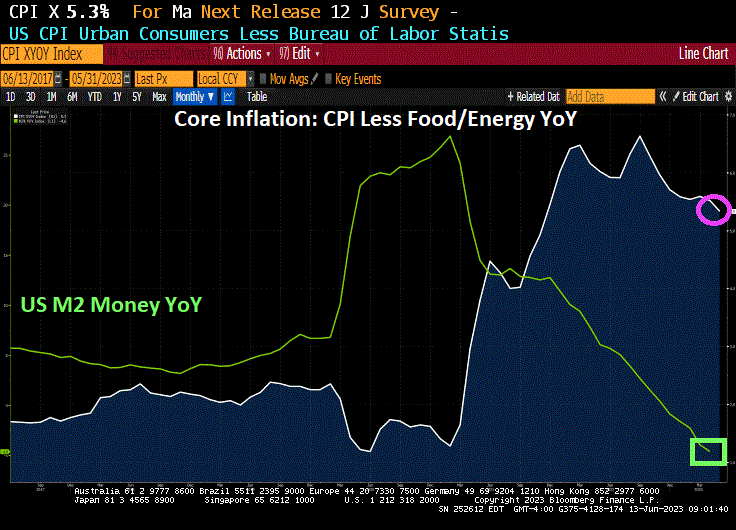
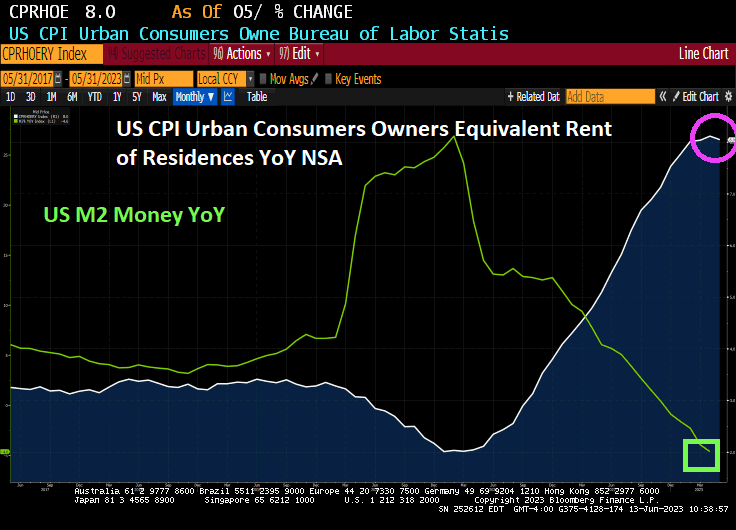
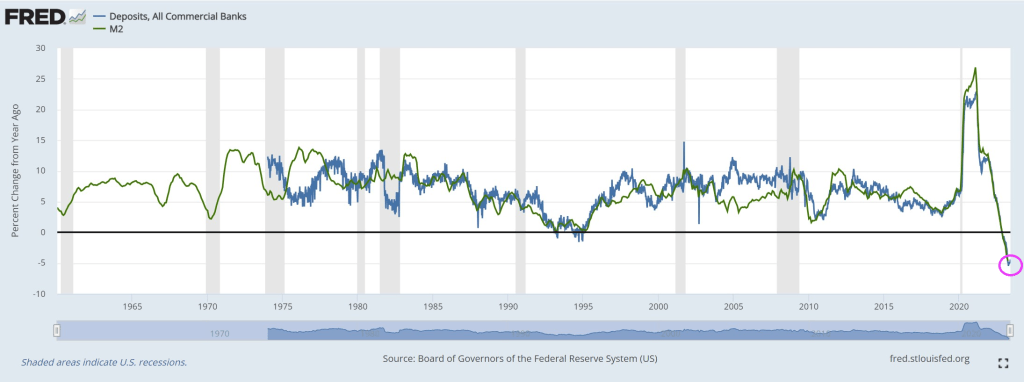
First, look at the crashing bank deposit problem. Well, the solution is for The Fed to fire up the money printing press! Keep on printing!
This not surprising if you have read Nobel Laureate George Stigler’s treastise on regulatory capture. Essentially, big corporations (big media, big tech, big banking, big pharma, big defense, big agriculture, etc.) essentially own Congress, the Biden Administration and Federal regulators. After all, Biden has been bribed with millions of dollars by China and Ukraine and, like a Banana Republic, has is avoiding prosecution and instead prosecuting his political opponent, Trump. Don’t worry, if they get Trump that will indict DeSantis for something.
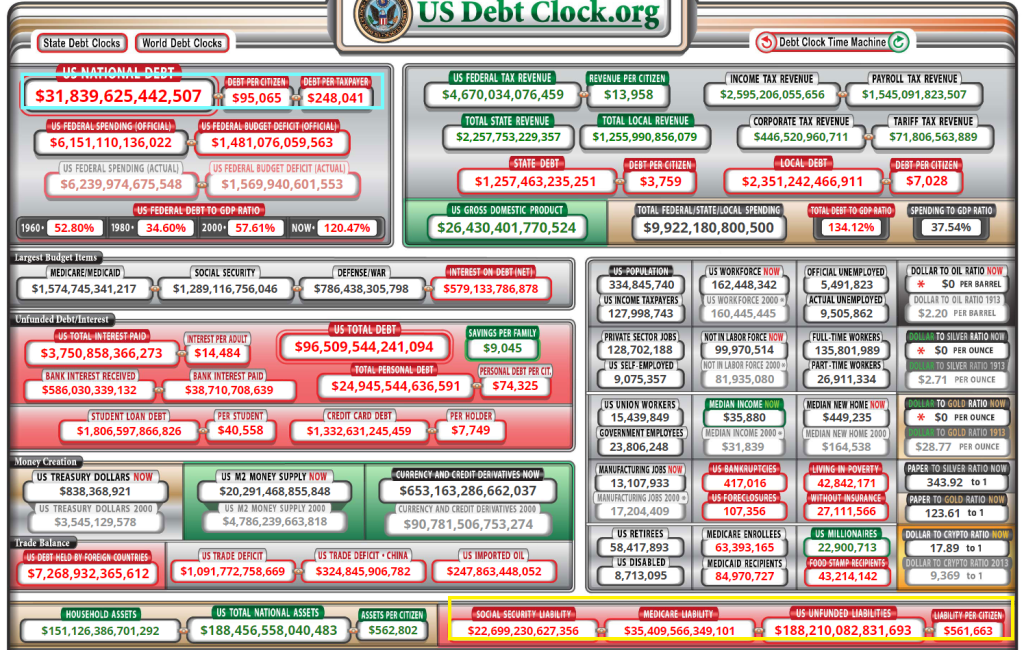
US debt stands at $31.8 TRILLION with $188 TRILLION in unfunded liabilities (which means higher personal taxes and much more debt).
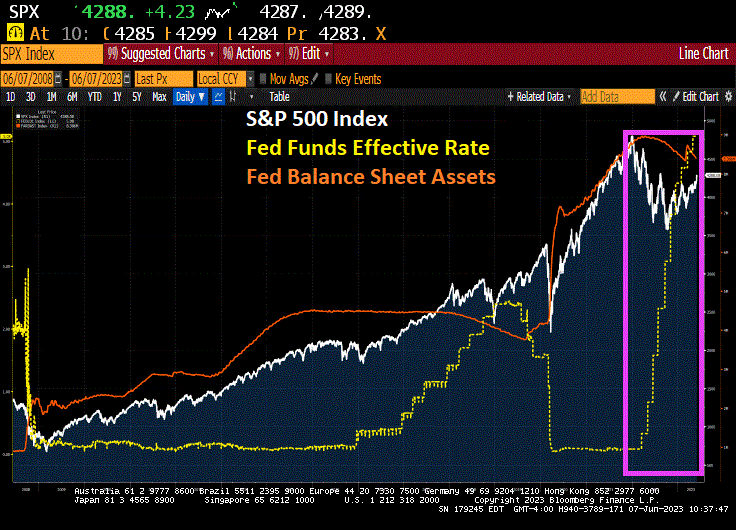
One has to wonder about The Feral Reserve. Since The Great Recession of 2008, The Federal Reserve has printed a staggering amount of money (know as QE). There is still about $8.3 TRILLION in monetary stimulus sloshing around the economy.
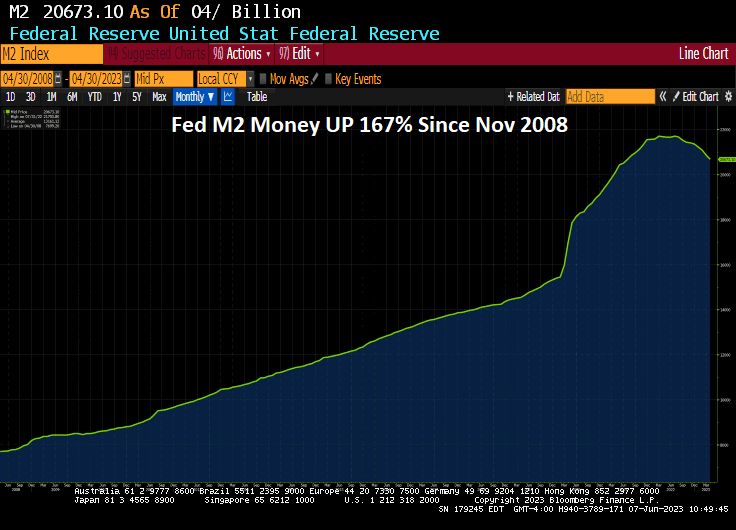
And M2 Money printing is up 167% since November 2008.
So, despite the talking heads from The Fed and CNBC, etc blathering about Fed tightening, there remains over $8 TRILLION in monetary stimulus chasing asset prices.
Is The Fed ACTUALLY the US economy? Or is The Fed the financing arm of the Democrat party?
Yes, The Fed looks like they are pausing .. rate hikes.
Biden signed the debt ceiling bill craftted by McCarthy (RINO-CA) and Schumer (Communist-NY). Its allows for uncontrolled spending and borrowing for at least 2 years. And as Milton Friedman once said “There is nothing more permanent than a temorary Federal program … or debt limitiations.
With Biden signaling that government has gone wild with no controls on fiscal responsibility (and Elizabeth Warren flailing her arms and screaming for regulations on cryptocurrencies), cryptos today are getting demolished.
China, Japan and the BRICs realize that there are no controls on ANYTHING coming out of Washington DC. Insane spending, an insane Federal Reserve, corrupt DOJ and FBI.
The US economy was sitting high on the global mountain top before Covid. Then Covid struck, The Federal Reserve and Congress went wild with stimulus spending and inflation went wild. This is Biden Country, a feeble shell of this once great nation.
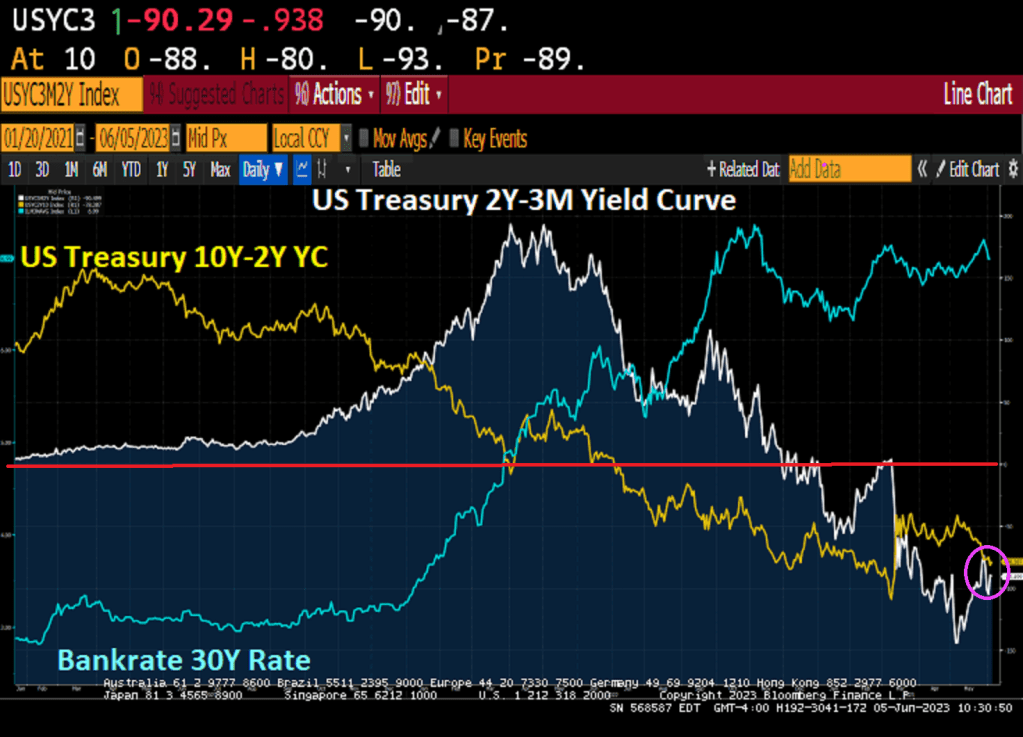
As The Fed tries to counter the years of excess monetary stimulus pre and post Covid by raising rates, we have seen mortgage rates rise 143% under Biden’s leadership. At the same time, the US Treasury yield curves (short 2Y-3m and long 10Y-2Y) remain deeply inverted.
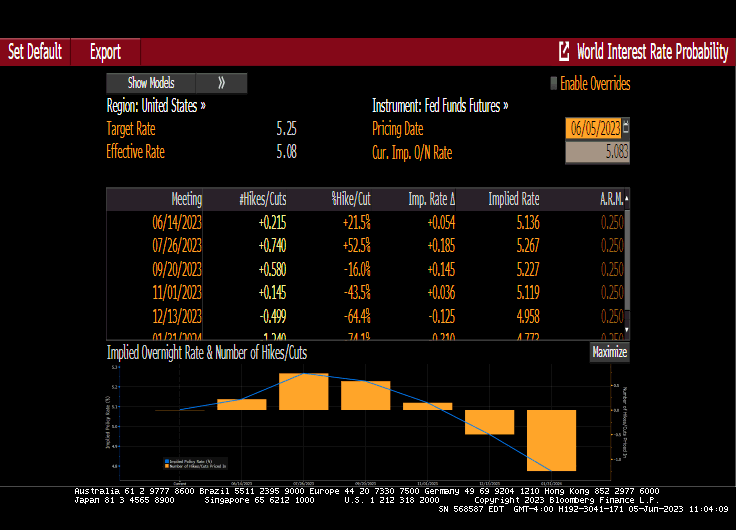
As of this AM, The Fed Funds Futures market is pricing in a chance of continued rate hikes by The Fed, but mostly we are at 5.25% at least until November when rates are forecast to begin declining.
And the Taylor Rule is still signaling rate hikes to 10.12%. We are at only 5.25%. And with Biden feebily running for reelection, the only path forward is rate CUTS.
Well, Kevin McCarthy (RINO-CA) and Patrick McHenry (RINO-NC) along with Jim Jordan (RINO-OH) and Marjorie Taylor Greene (RINO-GA) sold out America to Green Joe Biden (the Jolly Green Giant?) and pretty much guaranteed a Biden reelection as President and Democrats winning the House majority at the next election. Way to go McCarthy, McHenry, Jordan an Greene! You sold out America to the Progressive, destructive Left.
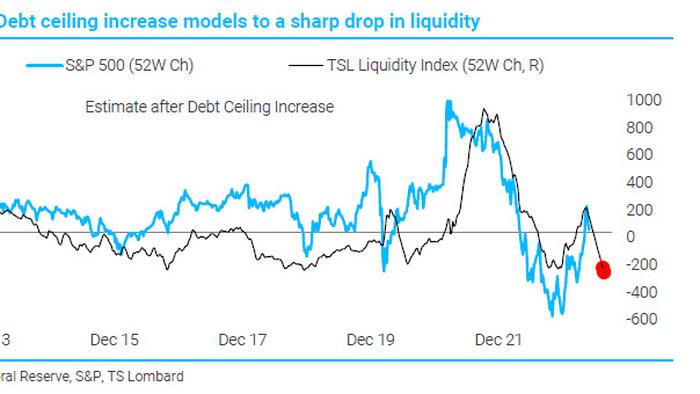
With a debt ceiling deal freshly inked, the US Treasury is about to unleash a tsunami of new bonds to quickly refill its coffers.This will be yet another drain on dwindling liquidity as bank deposits are raided to pay for it — and Wall Street is warning that markets aren’t ready.
The negative impact could easily dwarf the after-effects of previous standoffs over the debt limit. The Federal Reserve’s program of quantitative tightening has already eroded bank reserves, while money managers have been hoarding cash in anticipation of a recession.
JPMorgan Chase & Co. strategist Nikolaos Panigirtzoglou estimates a flood of Treasuries will compound the effect of QT on stocks and bonds, knocking almost 5% off their combined performance this year. Citigroup Inc. macro strategists offer a similar calculus, showing a median drop of 5.4% in the S&P 500 over two months could follow a liquidity drawdown of such magnitude, and a 37 basis-point jolt for high-yield credit spreads.
The sales, set to begin Monday, will rumble through every asset class as they claim an already shrinking supply of money: JPMorgan estimates a broad measure of liquidity will fall $1.1 trillion from about $25 trillion at the start of 2023.
“This is a very big liquidity drain,” says Panigirtzoglou. “We have rarely seen something like that. It’s only in severe crashes like the Lehman crisis where you see something like that contraction.”
It’s a trend that, together with Fed tightening, will push the measure of liquidity down at an annual rate of 6%, in contrast to annualized growth for most of the last decade, JPMorgan estimates.
The US has been relying on extraordinary measures to help fund itself in recent months as leaders bickered in Washington. With default narrowly averted, the Treasury will kick off a borrowing spree that by some Wall Street estimates could top $1 trillion by the end of the third quarter, starting with several Treasury-bill auctions on Monday that total over $170 billion.
What happens as the billions wind their way through the financial system isn’t easy to predict. There are various buyers for short-term Treasury bills: banks, money-market funds and a wide swathe of buyers loosely classified as “non-banks.” These include households, pension funds and corporate treasuries.
Banks have limited appetite for Treasury bills right now; that’s because the yields on offer are unlikely to be able to compete with what they can get on their own reserves.
But even if banks sit out the Treasury auctions, a shift out of deposits and into Treasuries by their clients could wreak havoc. Citigroup modeled historical episodes where bank reserves fell by $500 billion in the span of 12 weeks to approximate what will happen over the following months.
“Any decline in bank reserves is typically a headwind,” says Dirk Willer, Citigroup Global Markets Inc.’s head of global macro strategy.
Bitcoin Faces Downside Risks After Debt Deal Moves Forward
Just when markets appear to be moving past the months-long drama around the US debt ceiling, holders of risky assets such as cryptocurrencies are likely facing a fresh challenge while the Treasury looks to rebuild its depleted cash balance with an estimated $1 trillion Treasury-bill deluge.
“The impending reserve drawdown, due to the [Treasury General Account] rebuild, may prove to be a headwind,” Citi Research strategists including Alex Saunders wrote in a note.
Citi analyzed the performance of risky assets during drawdowns and found that they were vulnerable to higher volatility and weaker returns. As such, the near-term outlook doesn’t seem too rosy for Bitcoin and Ether. “Both coins average negative returns in these scenarios, and BTC has significantly underperformed in the median case,” the strategists wrote Thursday.
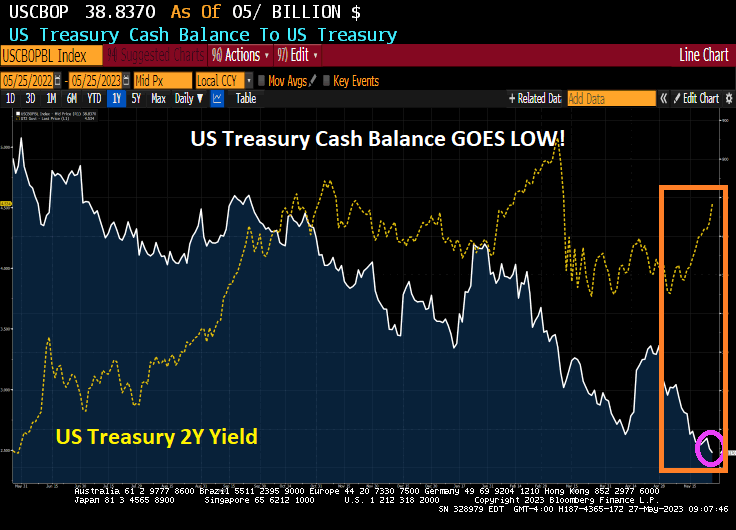
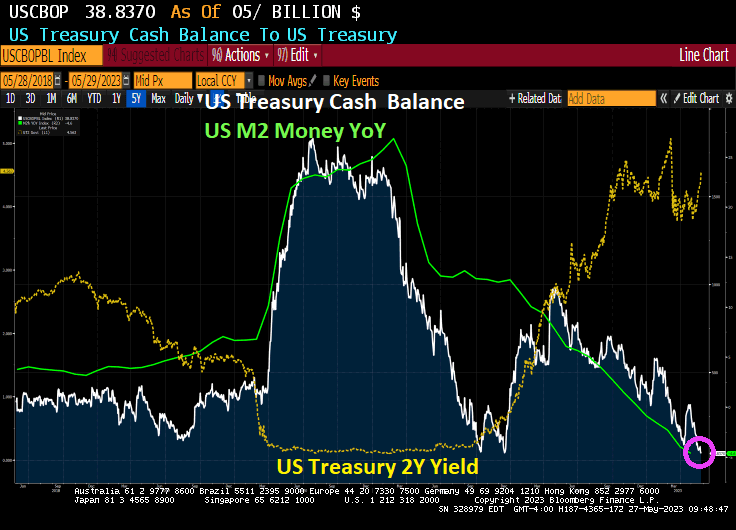
The TGA, which keeps money for the Treasury, ballooned during the pandemic. It expanded again last year and is now about as low as it has ever been. Treasury, as a result, will need to replenish its dwindling cash buffer to maintain its ability to pay its obligations through bill sales, estimated at well over $1 trillion by the end of the third quarter. This supply burst may drain liquidity from the banking sector and raise short-term funding rates against an economy many say is likely to fall into recession.
This doesn’t bode well for digital-asset investors, who were just recovering from fears of a no-deal scenario for the US debt ceiling. While Bitcoin edged higher on Friday, it’s still hovering around the $27,000-mark that it has failed to break away from for several weeks.
“Crypto markets were not immune to fears of the US defaulting on its debt, selling off on negative developments and rallying on headlines suggesting progress,” the strategists said. They added that crypto has typically “fared well” amid issues concerning traditional financial institutions, citing the banking turmoil in March, a period in which Bitcoin outperformed. But perhaps risks of an institution such as the US government defaulting “doesn’t paint a favorable outlook for decentralized digital assets.”
To illustrate, the strategists used the Cboe Volatility Index, or VIX, as an indicator of the market’s fear to gauge whether a resolution would be passed before hitting the ceiling. And whenever equity market concerns were eased, that’s when Bitcoin outperformed.
“While in theory the potential default of an institution as impactful as the US government would bode well for decentralized technologies and systems, this may not currently be the case given that the crypto industry is still in its infancy and regulation has yet to be well-defined,” they wrote. “Another theory is that not raising the debt ceiling would lead to reduced US government debt and a lower fiscal deficit, and provide more credibility to fiat, particularly the dollar.”
On Friday, the Senate passed legislation to suspend the US debt ceiling and impose restraints on government spending through the 2024 election. The measure now goes to President Joe Biden, who forged the deal with House Speaker Kevin McCarthy and plans to sign it just days ahead of a looming US default.
Year-to-date, Bitcoin has rebounded some 60% after starting the year at around $16,500. Such optimism comes after 2022’s 64% drop, its second-worst year in its history. It rose about 1% to $27,178 as of 3:32 p.m. in New York, and is marginally higher from last Friday.
Bitcoin’s support hovers around $26,500, said Fiona Cincotta, senior market analyst at City Index, adding that a break below $25,000 could mean a deeper sell-off.
“The problem is the macro backdrop, which is relatively uncertain going forward with recessionary fears,” she said. “I think what will be looking for to make Bitcoin shine is a nice dovish pivot from the Federal Reserve. That might be the tide where we will see another decent leg higher.”
Range-bound trading has been Bitcoin’s defining characteristic of late, with its 30-day volatility reigning low at 1.8%, firmly staying firm within its two-month-long trading range. Despite growing short-term volatility, options implied volatility trended lower over the past week, according to K33’s Bendik Schei and Vetle Lunde. Even so, Bitcoin exchange-traded products continued to see steady outflows while Bitcoin volumes — spot and futures — are trending lower.
McCarthy, McHenry, Jordan and Greene, honorary Frenchmen!
Worsening conditions in the US mortgage-backed securities market are doing little to ease fears over financial contagion as a recession looms.
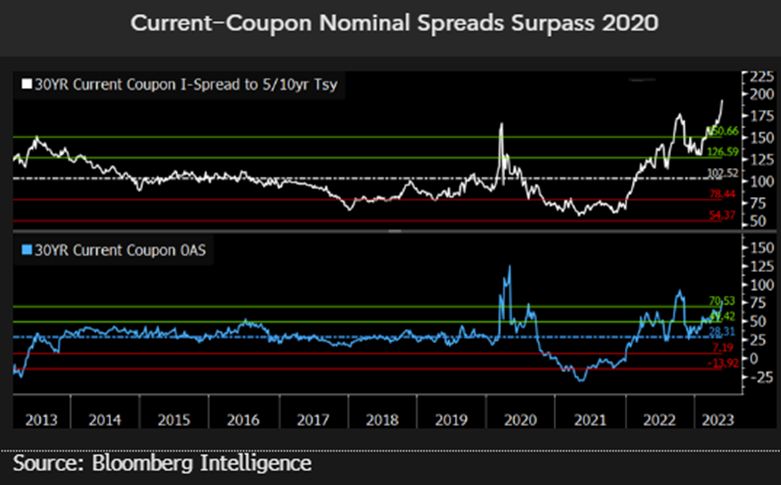
MBS current-coupon yield spreads over Treasuries are near the highest level since 2008 subprime crisis, as economic and political concerns weigh on performance, Erica Adelberg, a Bloomberg Intelligence strategist, wrote in a BI Chart Book. Mortgage-related exchange traded funds are seeing outflows, even as bond funds as a whole enjoy inflows. Applications for loans are near 25-year lows as the housing market languishes.
Use the GP tool for charting and run BI to search for research, data and chart books.
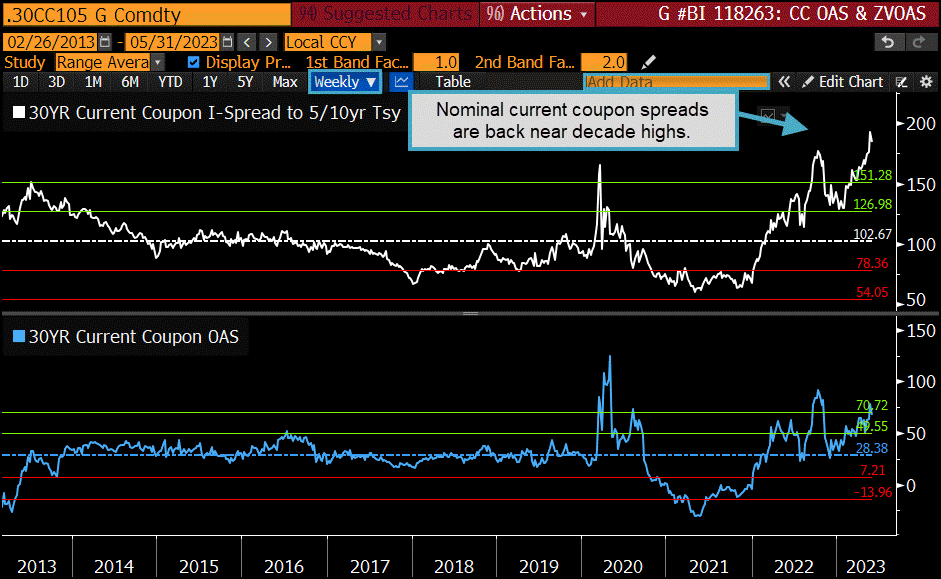
The top panel shows nominal current-coupon yield spreads are back near decade highs, surpassing those seen in the fourth quarter and reaching peak levels from the pandemic panic in March 2020. The bottom panel shows option-adjusted spreads are also wide, trading near two standard deviations of the average level, though slightly more in line than nominals, Adelberg wrote.
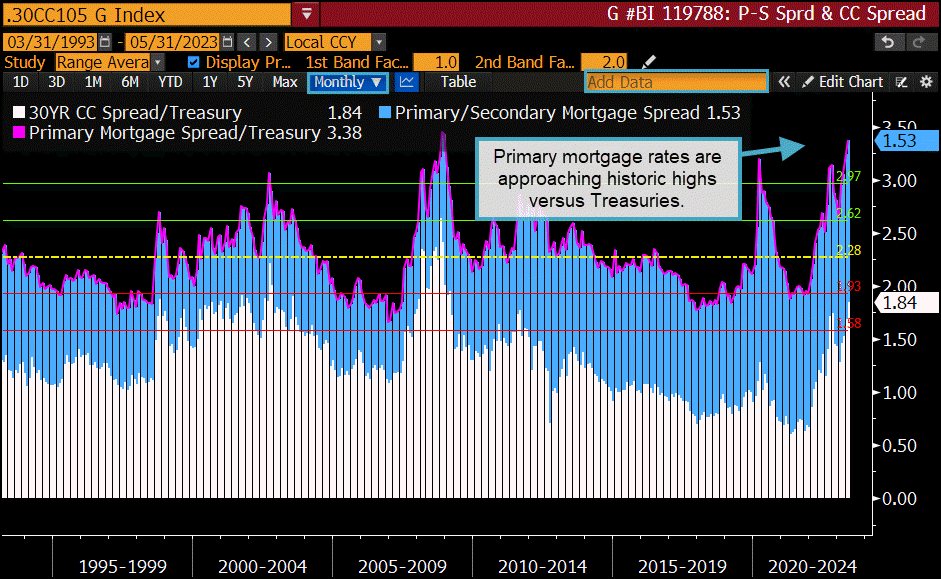
Primary mortgage rates are approaching historic highs versus Treasuries too.
Both the secondary mortgage spread to Treasuries (white) and the primary mortgage spread to secondaries (blue) have blown wider. That has increased the total spread between 30-year-fixed consumer mortgage rates and 10-year Treasuries (pink) to near financial-crisis levels.
Elevated spreads could make it harder for borrowers to find rate relief, even if Treasuries rally and secondary mortgage spreads tighten, Adelberg wrote.
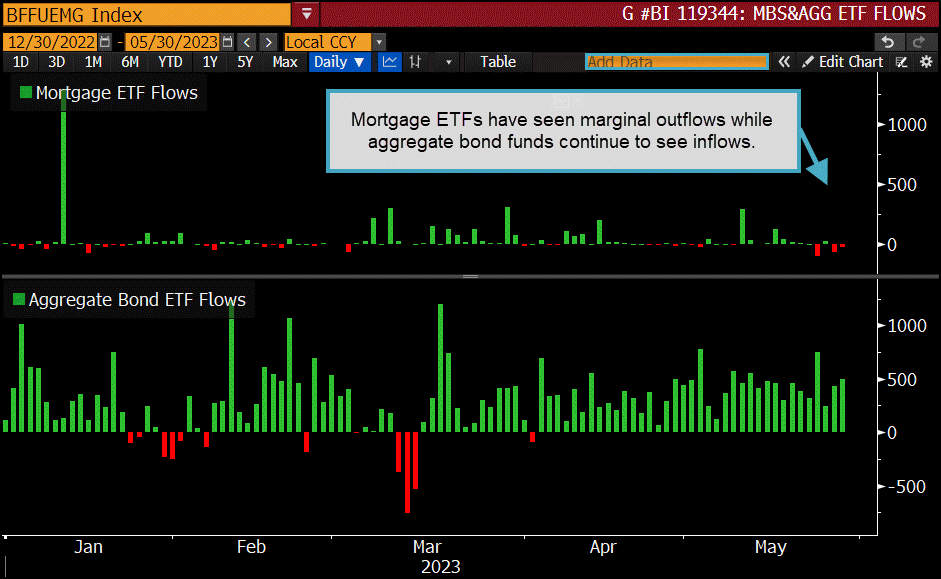
Mortgage ETFs saw marginal outflows while bond funds as a whole continued to see inflows. To monitor ETF flows:
Flows into US aggregate bond ETFs are mostly positive this year, as investor demand has improved on higher yields. Agency MBS-specific ETF flows, however, are more muted, Adelberg wrote.
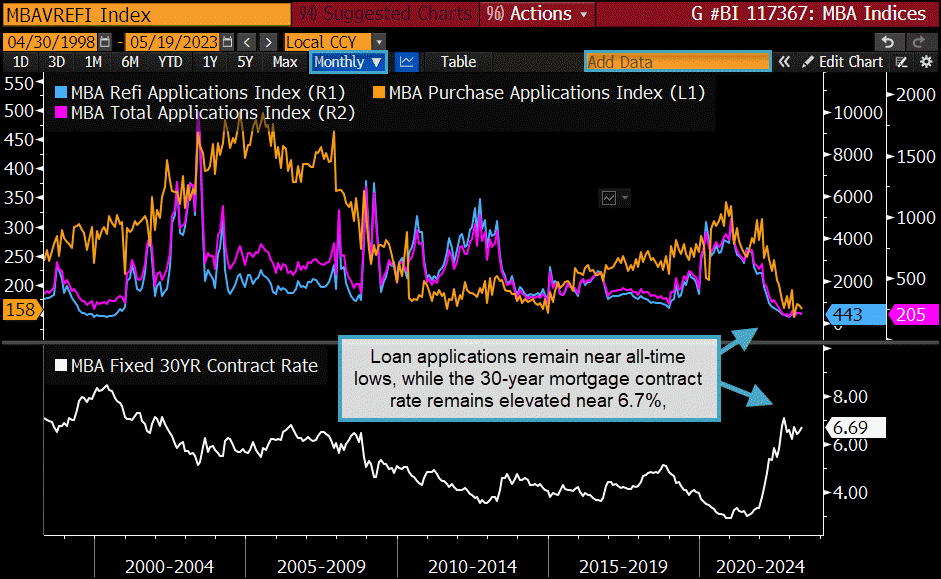
Loan applications remain near all-time lows, showing no signs of life yet.
Loan applications for refinancings and purchases are near 25-year lows as housing-market activity is still depressed, and most refinancings are uneconomical at current rates, Adelberg wrote. The 30-year fixed mortgage contract rate hovers around 6.7%.
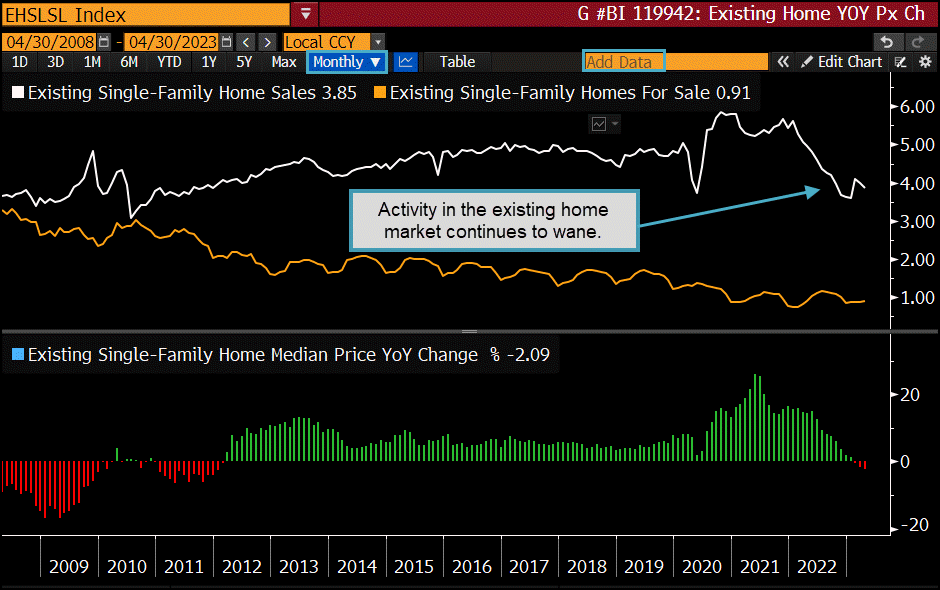
Activity in the existing-home market continues to wane.
Single-family existing-home sales in April fell 3.5% month-over-month and are down more than 20% from a year ago. Existing-home median prices continued to decline as well, seeing their largest year-over-year drop since early 2012, though this may partly reflect the mix of homes purchased. Low existing homes for sale, with many homeowners locked into low-rate mortgages, are depressing resale activity.
MBS spreads may remain under pressure until the economic and inflation outlooks become more optimistic, Adelberg wrote on May 31.
White House and Republican negotiators tentatively narrowed differences but were still clashing Friday on key issues as the Treasury Department signaled extra time was available before a potential US default.
Treasury Secretary Janet Yellen announced the department expects to be able to make payments on US debts up until June 5 if lawmakers fail to act on the US debt ceiling. That set a more pointed date for a potential default but is also four days later than her previous comments eyeing trouble as soon as June 1.
The new so-called X-date buys negotiators for House Speaker Kevin McCarthy and President Joe Biden more time to strike a deal. The negotiating teams haven’t met in person since Wednesday but spoke late into the night Thursday and were in regular communication throughout the day Friday.
Yes, there isn’t really a crisis folks. Treasury collects tax dollars continuously so Treasury can prioritze debt payments and other disbursements. The only crisis is in the minds of the media.
Deputy Treasury Secretary Wally Adeyemo warned Friday that payments to Social Security beneficiaries, veterans and others would be delayed if there’s a default. But he said he’s gaining some confidence an agreement will be reached.
We’re making progress and our goal is to make sure that we get a deal because default is unacceptable,” Adeyemo said in an interview on CNN. “The president has committed to making sure that we have good-faith negotiations with the Republicans to reach a deal because the alternative is catastrophic for all Americans.”
The accord would also include a measure to upgrade the nation’s electric grid to accommodate sham renewable energy, a key climate goal, while speeding permits for pipelines and other fossil fuel projects that the GOP favors, people familiar with the deal said.
The deal would cut $10 billion from an $80 billion budget increase for the Internal Revenue Service that Biden won as part of his Inflation Reduction Act (big whoop). Republicans have warned of a wave of agents and audits while Democrats said the increase would pay for itself through less tax cheating.
What is taking shape would be far more limited than the opening offer from Republicans, who called for raising the debt ceiling through next March in exchange for 10 years of spending caps. House conservatives were already balking Thursday at the notion of a small deal, with the House Freedom Caucus sending a letter to McCarthy demanding he hold firm.
Treasury’s cash balance is at a low point and The Administration threatens Social Security recipients and veterans of delayed payments … while Biden goes on vacation for Memorial Day weekend to honor veterans??
Of course, Yellen know that all The Fed has to do to increase M2 Money growth again.
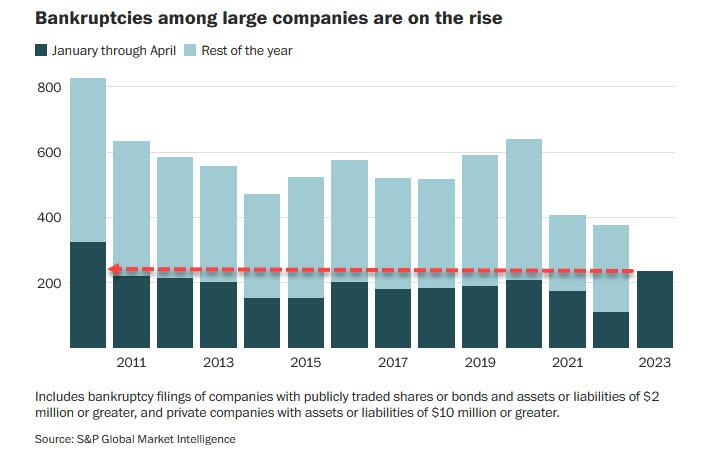
Meanwhile, bankrupties among large companies are highest since 2010.
In the mortgage market, current coupon nominal spreads 9Agency MBS 30Y coupon over Treasuries) are soaring.
Meanwhile, to honor US veterans, Biden goes on Memorial Day weekend and threaten veterans with delays in veteran benefits. Sigh.
Is Joe Biden REALLY Reverend Kane from Poltergeist II??















 Confounded Interest - Anthony B. Sanders
You must be logged in to post a comment.