U.S. Yield Curve Flattens as Traders Mull Half-Point March Hike (Fed’s March Of The Toreadors Killing The Bull Market)

Raphael Bostic and Goldman Sachs are both calling for dramatic rate increases to fight inflation … that they helped cause with their monetary stimulypto. I call this The Fed’s March of the Toreadors as The Fed now attempts to kill the bull market.

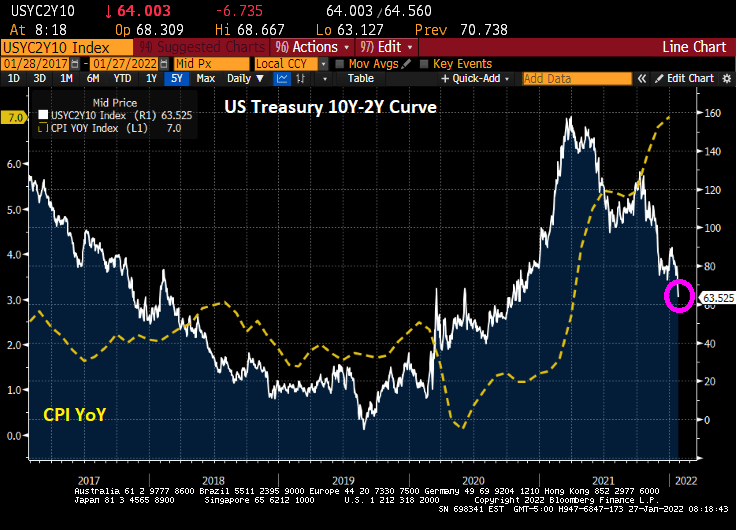
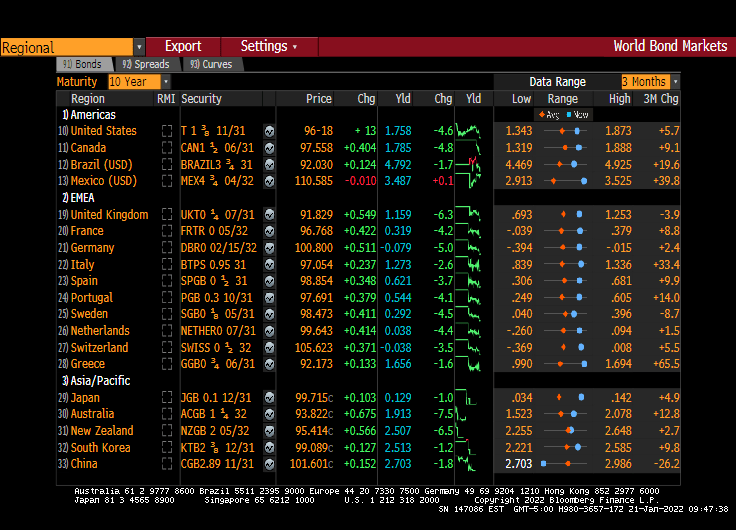
(Bloomberg) — The Treasury yield curve flattened to the lowest level in over a year on Monday as the prospect of a super-sized Federal Reserve rate increase in March gained traction, weighing disproportionately on shorter-dated tenors.

Two-year U.S. yields climbed as much as 4 basis points after Raphael Bostic, the president of the Fed’s Atlanta branch, said the U.S. central bank could raise its benchmark rate by 50 basis points if a more aggressive approach to taming inflation is needed. 

That narrowed the gap with ten-year counterparts — which rose about half as much — to the least since October 2020. The last time the Fed delivered a half-point increase to borrowing costs was at the height of the dot-com bubble in 2000.

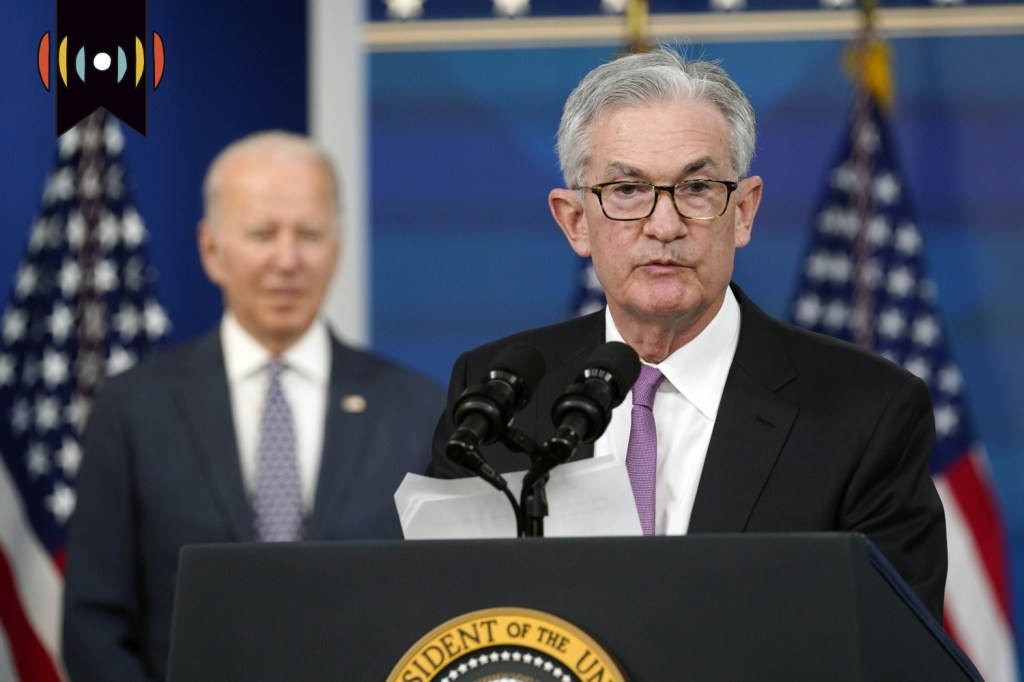
The repricing extended a move spurred last week, after Fed Chair Jerome Powell underscored the policy maker’s determination to put a lid on inflation. The market positioning may have been exacerbated by hedge funds that had been leaning the wrong way before Powell’s address.

Traders are currently betting the Fed will deliver 32 basis points of tightening in March, more than fully pricing an increase of a quarter-point. That puts the implied probability of a 50-basis-point increase at almost 30%. The odds of such a move in December were zero.

Consumer prices rose an annual 7% in December, the fastest pace in almost four decades. Powell left the door open to increasing rates at every meeting, and didn’t rule out the possibility of a 50-basis-point hike.

In an interview with the Financial Times, Bostic stuck to his call for three quarter-point interest rate increases in 2022, while saying that a more aggressive approach was possible if warranted by the economic data. Bostic is a non-voting member of the FOMC this year. 

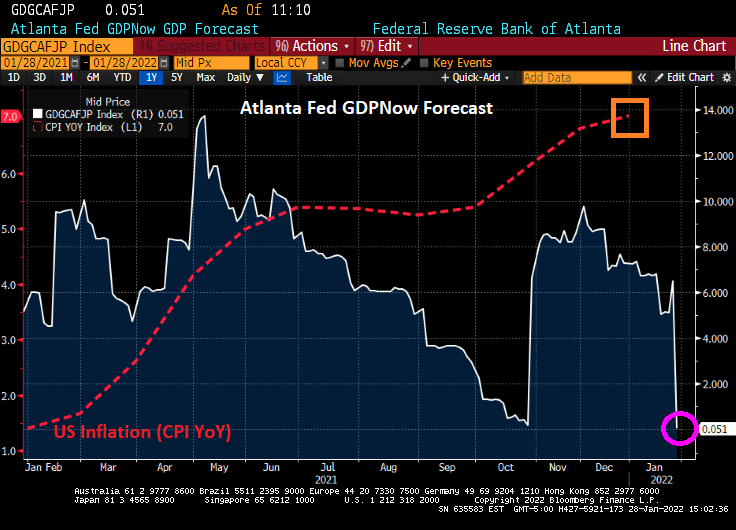
Since the rapid growth in inflation was caused by a combination of too much Fed stimulus, too much fiscal stimulus and “green” energy policies, it is unclear whether an increase of 50 basis points will do much, particularly if Bostic’s own Atlanta Fed GDPNow forecast of 0.051% is accurate. Raising rates if the economy is slowing??
To be clear, Bostic and others are trying to signal The Fed’s intent well in advance to avoid a surprise knock-down of the stock market. Or a killing of the bull market.

Here is a video of Raphael Bostic leading The Fed Toreadors in the slaying of the bull market.

Too Much Money! U.S. Consumer Spending Drops, Price Index Up Most Since 1982 (REAL Personal Spending Fell 1% In December)

This is a case of “Too much money” in the economy, courtesy of The Federal Reserve.

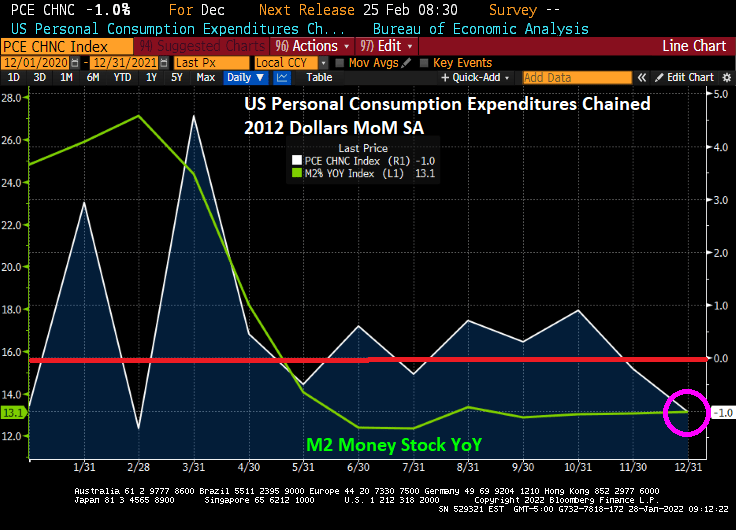
(Bloomberg) — U.S. inflation-adjusted consumer spending fell last month by the most since February, suggesting that Americans tempered their outlays amid the latest Covid-19 wave and the fastest inflation in nearly 40 years.

Purchases of goods and services, adjusted for changes in prices, decreased 1% from November, the Commerce Department said Friday. 

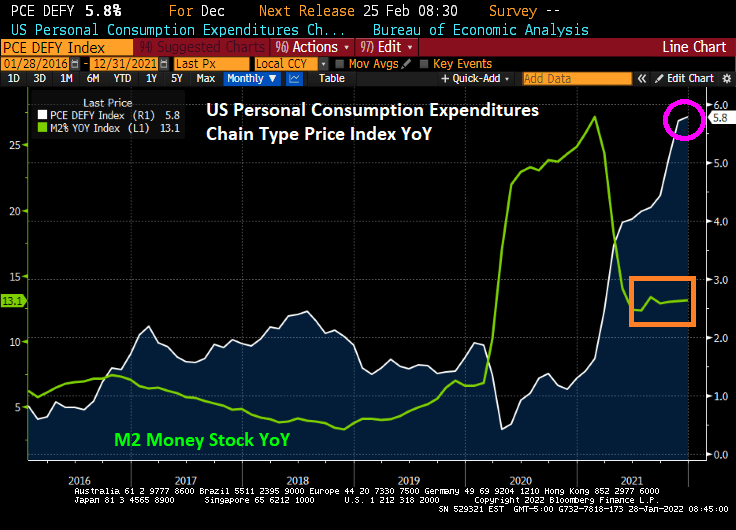
The personal consumption expenditures price gauge, which the Federal Reserve uses for its inflation target, rose 0.4% from a month earlier and 5.8% from December 2020, the most since 1982. Unadjusted for inflation, spending fell 0.6%, while incomes rose 0.3%.

Yes, the PCE Deflator YoY rose to 5.8% as M2 Money Stock is growing at a 13.1% YoY clip.

REAL personal spending declined 1% in December as prices rose in part thanks to the 13.1% growth in M2 Money stock YoY.

Too much money! Time to slow down, Jay Powell! Stop sucking the life out people with inflation.

US Q4 GDP Price Soars To 6.9% QoQ As Commodity Prices Skyrocket (10Y-2Y Treasury Curve Tanks)

Yes, The Federal Reserve could have raised their target rate at their January meeting, but chose not to raise rates. Instead, Chairman Powell said that rate increases are a comin’!

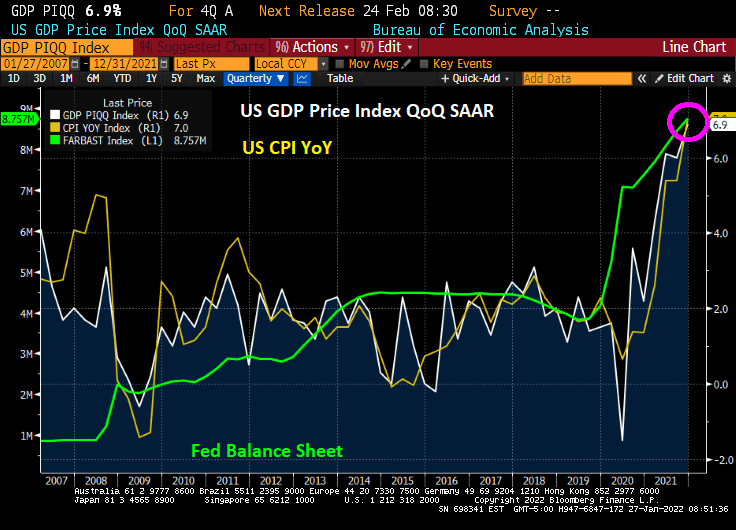
I hope Powell wasn’t hoping for a slowdown in inflation, because today’s Q4 GDP report showed a surge in GDP to 6.9% QoQ. But with that GDP surge we also got a surge in prices paid by consumers to 6.9% as well. Thanks to the continuing massive Federal stimulus being poured into markets.

Despite the positive news on Q4 GDP, we are still seeing 7% inflation and a diving 10Y-2Y yield curve.

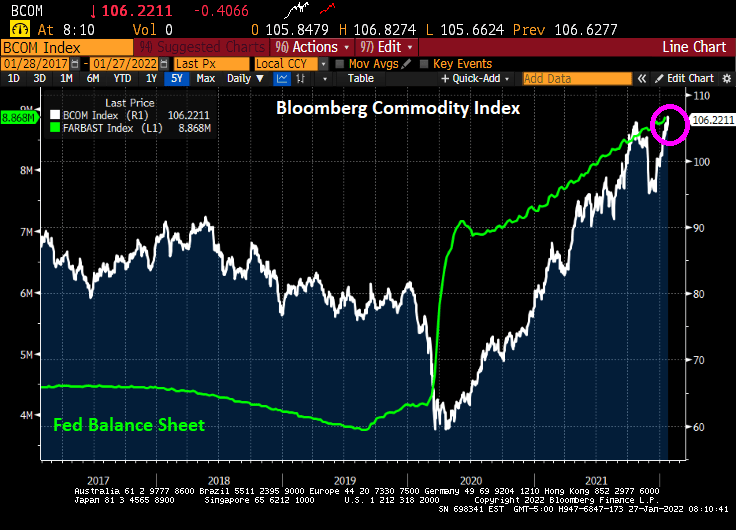
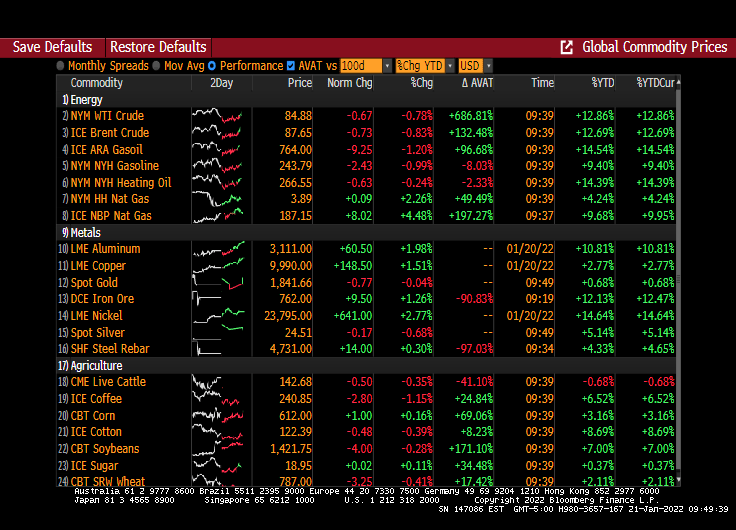
Along with that surprising GDP report, we are seeing the Bloomberg Commodity Index rising like a bat out of hell (RIP, Meatloaf).

Powell apparently found paradise by the dashboard light. So, why rock the boat? Oh yes. INFLATION.

Should Powell be renamed Meatloaf?

The Garbageman: Fed Rate Hikes Will Intensify Global Debt Crisis (NOW They Realize That Low-Rate Debt Is A Problem If Rates Rise??)

CNBC had an interesting Homer Simpson-moment when the Jubilee Debt Campaign suddenly realized that there was enormous debt outstanding, fueled by Central Banks and governments. They are only now realizing that Central Bank zero-interest rate policies leading to massive debt issuance may be a problem??

Interest rate hikes from the U.S. Federal Reserve and other central banks are likely to worsen a global debt crisis, particularly for developing countries, according to a new report from U.K. non-profit the Jubilee Debt Campaign.

The Federal Open Market Committee meets this week to decide the path for its tightening of monetary policy as it looks to contain soaring inflation. Some analysts are expecting the central bank to hike rates four times from their pandemic-era lows in 2022.

In a report published Sunday, the Jubilee Debt Campaign highlighted that developing countries’ debt payments rose 120% between 2010 and 2021, and are currently at their highest since 2001. The average portion of government revenues channeled toward external debt payments increased from 6.8% in 2010 to 14.3% in 2021, with payments shooting up in 2020.

The sharp increase in debt payments is hindering countries’ economic recovery from the pandemic, the report suggested, and rising U.S. and global interest rates in 2022 could exacerbate the problem for many lower income countries.

Kristalina Georgieva, managing director of the International Monetary Fund, said last week that Fed rate hikes could “throw cold water” on already weak recoveries in certain countries. Higher U.S. interest rates, and thus a rise in the greenback, could make it more expensive for countries to meet their dollar-denominated debt obligations.

“The debt crisis continues to engulf lower income countries, with no end in sight unless there is urgent action on debt relief,” said Heidi Chow, executive director of the Jubilee Debt Campaign.

“The debt crisis has already stripped countries of the resources needed to tackle the climate emergency and the continued disruption from Covid, while rising interest rates threaten to sink countries in even more debt.”

Chow called on G-20 leaders to stop “burying their heads in the sand” and argued that the global economy urgently needs a “comprehensive debt cancellation scheme which compels private lenders to take part in debt relief.”

Austin, Texas musician Cornell Hurd has a song that nicely summarizes Central Banks like the US Federal Reserve: The Garbageman.

You ask me what I do for a living,

You’re trying to get a feeling on how I’m fixed for cash.

My friends all say I’m a just garbageman, baby

I’m out in this honkeytonk market, picking up trash.

Today we may see The Federal Reserve raise their target rate (slightly) to measure how bad markets will receive the news.

The Garbageman, Jay Powell.

Bubble Burst? NASDAQ, WTI Crude Futures And Bitcoin All DOWN On Opening (Europe Stoxx Down 4%)

Is this the bubble burst many were expecting once The Federal Reserve starting raising rates?

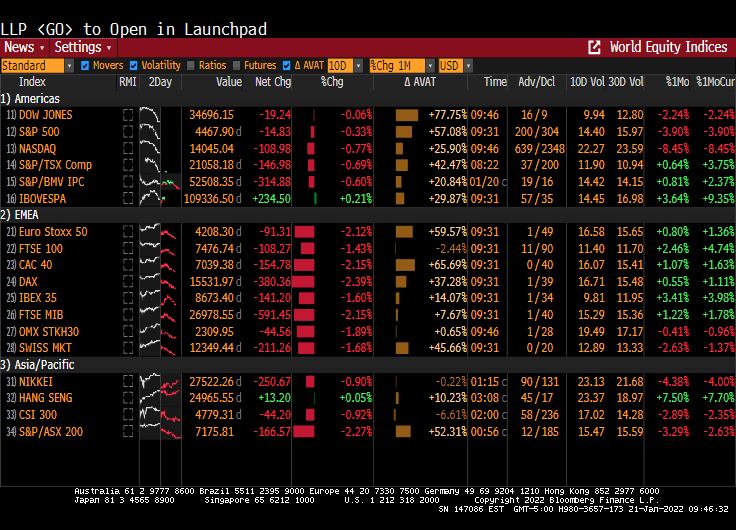
Well, if today’s market opening is an indication, the answer is yes. The NASDAQ Composite Index is down 1.36% and West Texas Intermediate Crude Oil futures prices are down 2%.

The S&P 500 index is down over 10% since January 3rd.

Drawdown is taking place.

But if you think the US equities are deflating, look at European equities. The Euro Stoxx 50 index is down 4.04%.

Is this a Don Ho “Tiny Bubble” burst? Or a slow deflation of asset prices as The Fed removes its stimulus?

Bad 7 Days For Cryptos And NASDAQ As Fed Quantitative Tightening Looms (Is Jerry Gergich Running The US Economy?)

It has been a tough 7 days for Bitcoin, Ethereum and the NASDAQ composite index as The Fed is anticipated to raise their target rate AND engage in quantitative tightening.

While the NASDAQ composite index has been deflating over past 7 days, Bitcoin and Ethereum plunged in recent days. What is going on??

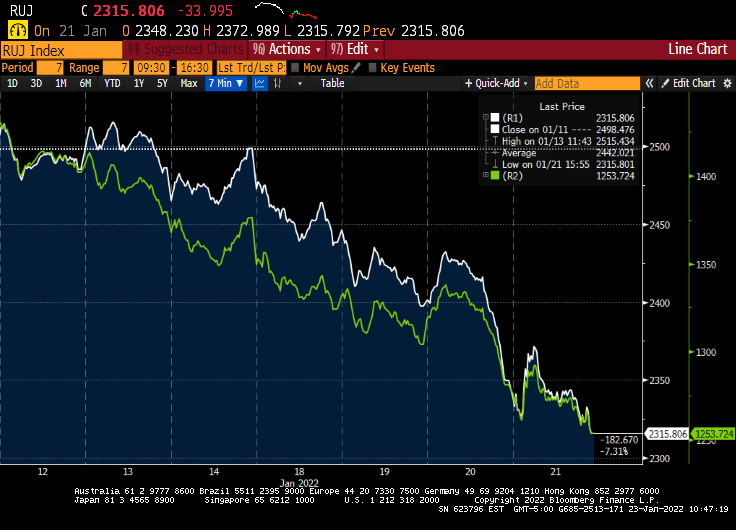
The Russell 2000 value (white) and growth (green) indices are both deflating.

With regards to anticipated Fed rate increases, Fed Funds Futures are signaling almost 4 rate hikes in 2022 and 4 by the February 2023 meeting.

Then we have the massive increase in The Fed’s balance sheet after COVID struck in early 2020. Now, with the S&P 500 skyrocketing (until 7 days ago), why is The Fed buying sooooo much Agency MBS??

With the supply chain broken thanks to Congress/Biden/The Fed pouring trillions into an economic system that was working … we now have an economic system that is broken. Clogged ports, meat-packing labor shortages, etc. It’s as if Park’s and Recreation’s Jerry Gergich is running the economy as opposed to Ron Swanson.

Fear! Crypto Crash Erases More Than $1 Trillion in Market Value (As Dow Tanks 430 Points)

For Bitcoin, there’s only been one constant recently: decline after decline after decline. And the superlatives have piled up really quickly.

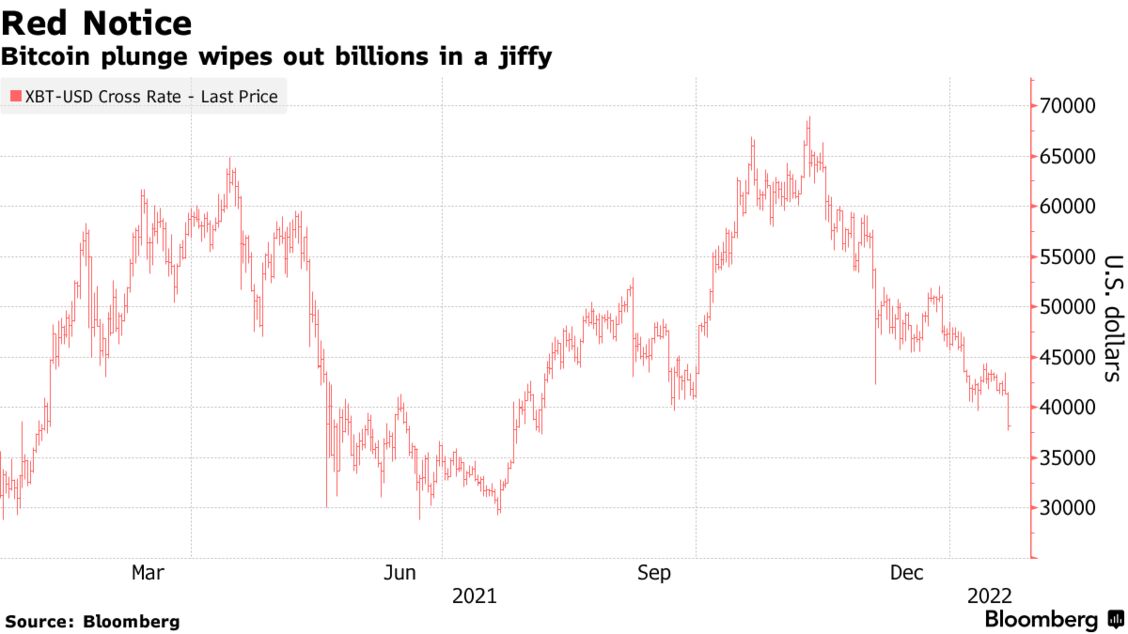
With the Federal Reserve intending to withdraw stimulus from the market, riskier assets the world over have suffered. Bitcoin, the largest digital asset, lost as much as 8.7% Friday and dropped below $38,000 to its lowest level in six months. Since its peak in November, it has lost 40% of its value. Other digital currencies have suffered just as much, if not more, with Ether and meme coins mired in similar drawdowns. 

Bitcoin’s decline since that November high has wiped out more than $570 billion in market value, and roughly $1.17 trillion has been lost from the aggregate crypto market. While there have been much larger percentage drawdowns for both Bitcoin and the aggregate market, this marks the second-largest ever decline in dollar terms for both, according to Bespoke Investment Group.

“It gives an idea of the scale of value destruction that percentage declines can mask,” wrote Bespoke analysts in a note. “Crypto is, of course, vulnerable to these sorts of selloffs given its naturally higher volatility historically, but given how large market caps have gotten, the volatility is worth thinking about both in raw dollar terms as well as in percentage terms.”

Bitcoin plunge wipes out billions in a jiffy
 Bloomberg

With the Fed’s intentions rocking both cryptocurrencies and stocks, a dominant theme has emerged in the digital-asset space: cryptos have twisted and turned in nearly exactly the same way as equities have. 

Bitcoin/Ethereum/Dow Slide As Gold Rebounds (Fun Times As $3.3 Trillion Options Expire)

Yes, it is fun times in markets this Friday as $3.3 trillion in options expire.

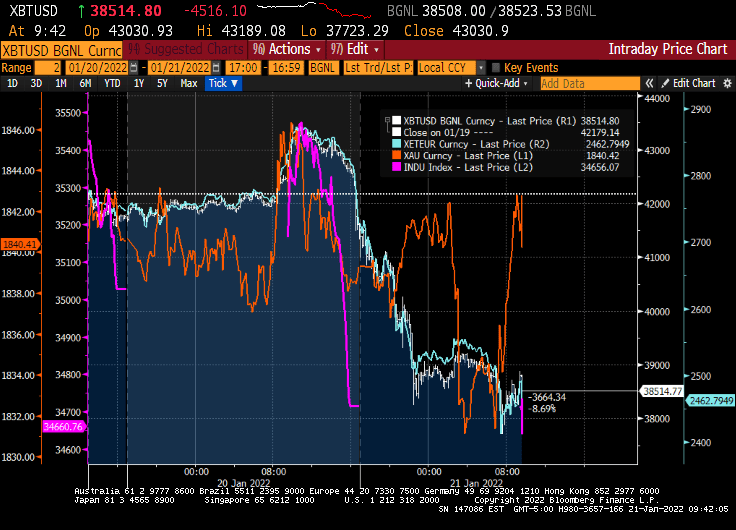
As of 9:52am EST, we see Bitcoin (white) and Ethereum (blue) falling along with the Dow (pink), while gold (gold) fell then rebounded.

European stock markets are down 2% today.

Global sovereign bond prices are up across the board internationally as yields decline.

Crude oil is down today while natural gas is soaring. In particular, look at UK natural gas prices!

Brrr.

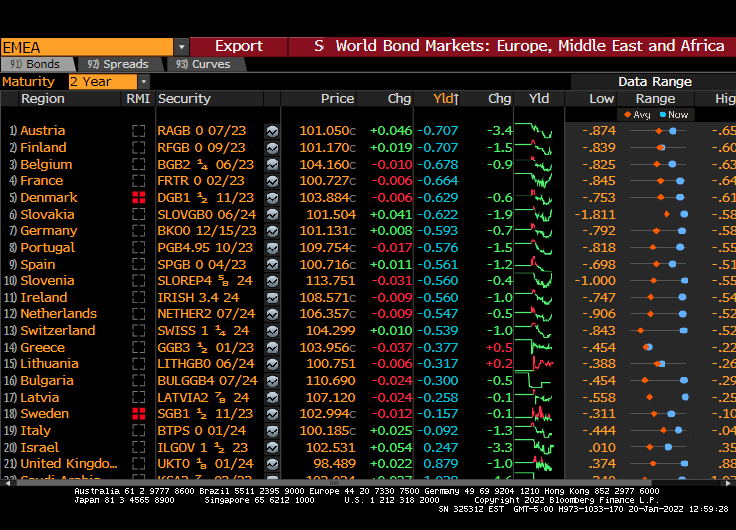
The Nervous 19! Nineteen European Nations Have Negative 2Y Sovereign Yields (Only One Rate Increase Expected In 2022, ECB’s Stiff Monetary Policy)

Let’s see how The Federal Reserve is going to compete with other central banks when 19 European nations have negative 2-year sovereign yields. Call them the “Nervous 19.” Note that France has the lowest 2Y yield of the big 3 (France -0.664%, Germany -0.593% and Italy -0.092%).

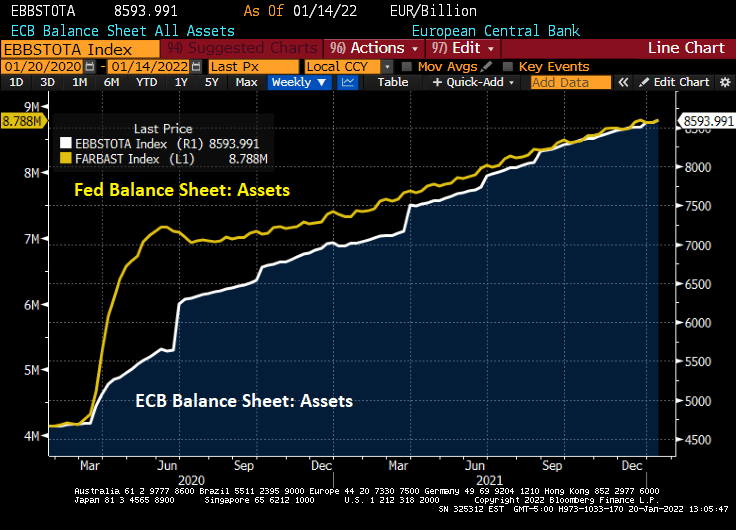
True, The Fed’s reaction to COVID shutdowns was more extreme than the ECB’s reaction.

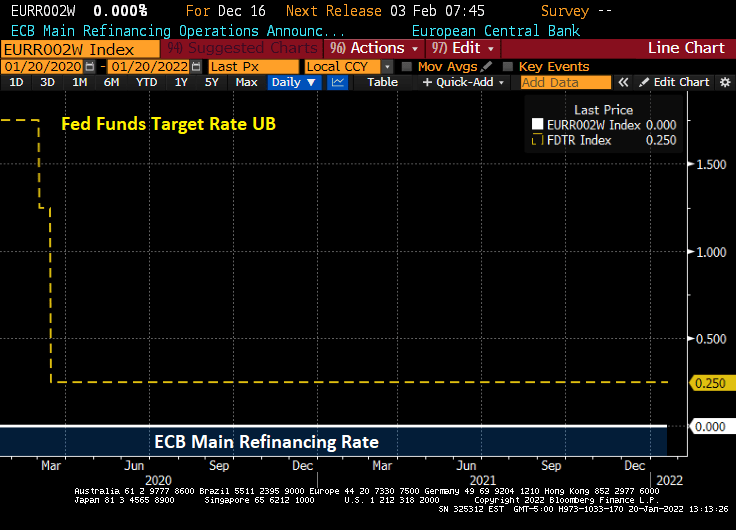
The ECB’s main refinancing rate is 0% and The Fed’s target rate is 0.25%.

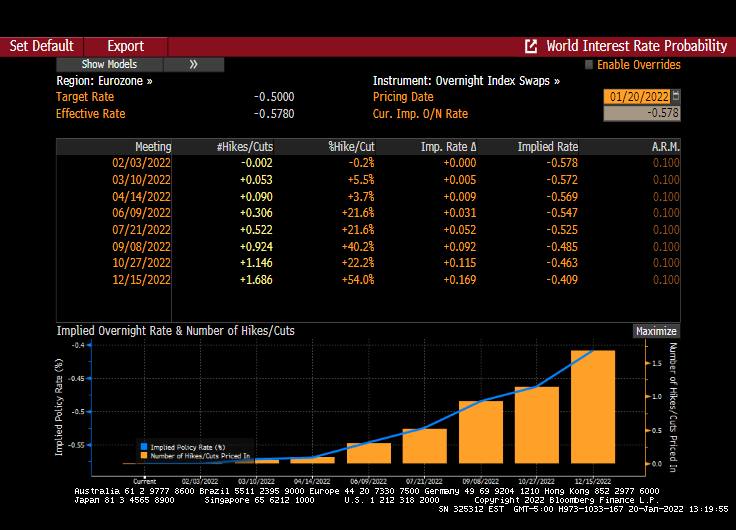
Unlike the US with its 4 expected rate increases, the Eurozone is pricing in only 1 rate increase for 2022 … in October.

The ECB’s monetary policy is as stiff as French President Emmanuel Macron.

US Treasury Yield Curve Keeps Inching Up, Just Wait For Fed To Raise Rates (Trouble With The Curve And Federal Financing Of Debt)

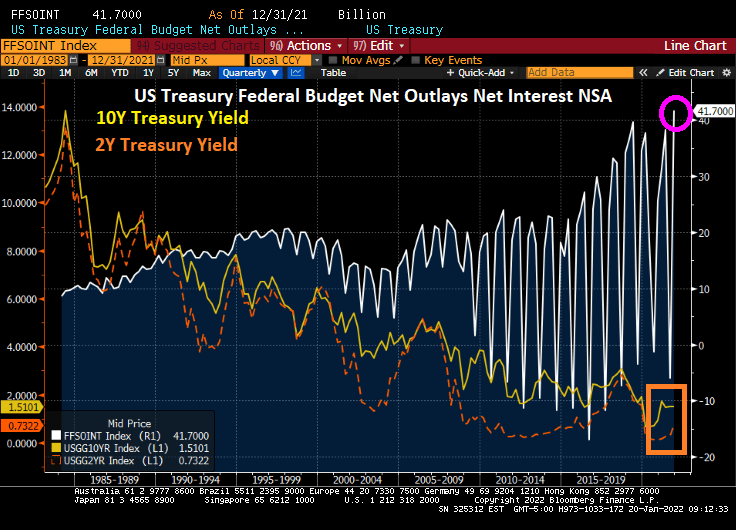
Treasury Secretary Janet Yellen is having trouble with the curve (yield curve, that is). It keeps inching up, meaning that Treasury’s cost of debt financing is inching up too.

As Treasury yields keep rising, so does the problem of financing the massive Federal debt load. Here is a chart showing the interest outlays in the Federal budget against the cost of Federal funding at the 10-year and 2-year tenors.

Now, The Fed is predicted to raise their target rate 4 times in 2022 (according to Fed Funds Futures data) and it looks like a whopping 100 basis points (or 1%). Holding the rest of the yield curve constant, this will considerably flatten the 10Y-3M Treasury curve. Resulting in a more expensive refinancing of the Federal Debt load.

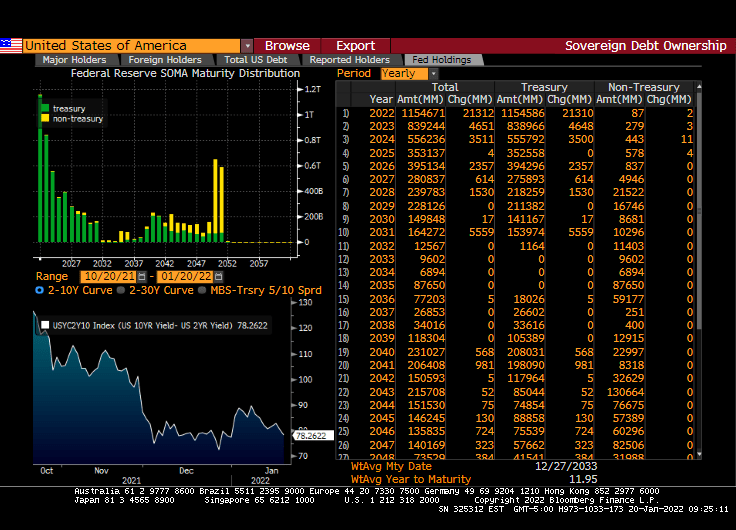
If we look at The Fed’s System Open Market Holdings (SOMH), we can see that The Fed’s holdings are primarily Treasuries with non-Treasuries (primarily agency mortgage-backed securities) not maturing (or running off) until 2050.

The majority of The Fed’s COVID expansion was picked-up by The Fed (light blue line).

How about the Treasury Inflation-protected Securities curve? Negative yields across the tenor range.

With Congress trying to spend trillions more (since Build Back Broke failed, Democrats are producing MORE spending legislation with the voting act included, of course), Treasury is going to have progressively more trouble with the (Treasury) curve.