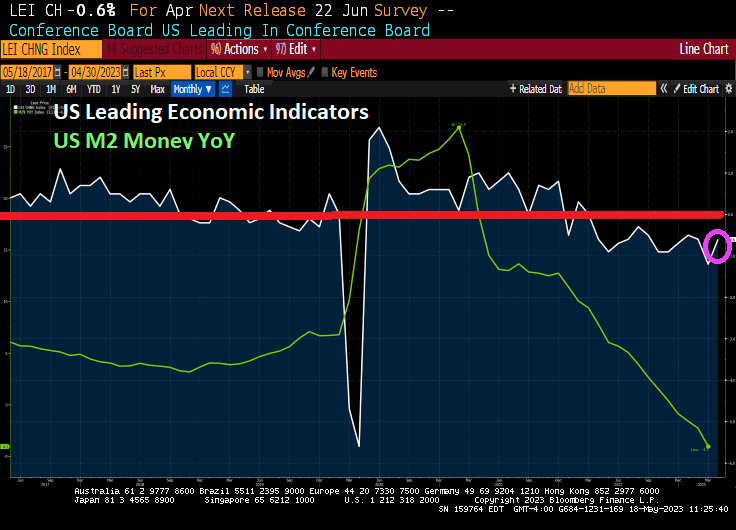
The biggest positive contributor to the leading index was stock prices at 0.16
The biggest negative contributor was average consumer expectations at -0.26
This is the 13th straight monthly decline in the LEI (and 14th month of 16) – the longest streak of declines since ‘Lehman’ (22 straight months of declines from June 2007 to April 2008).
Let’s go Brandon! He needs to finish the job! Or destroying the US economy and making the US a vassal state to China.
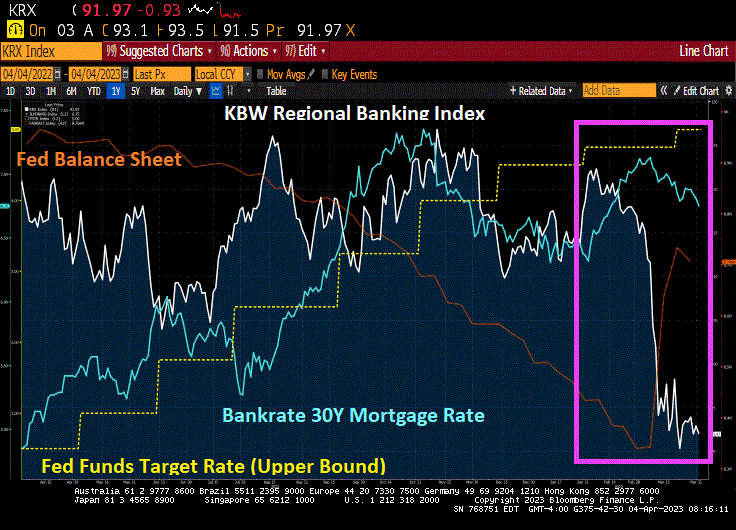
Bankrate’s 30-year mortgage rate is down slighty to 6.89%, but that masks the reality that mortgage rates were only 2.88% when Biden was sworn in as President. That is a staggering increase of 140 in the 30-year mortgage rate.
In fairness to Unaffordable Joe, Congress went on a crazy spending spree with Covid, much of which had nothing to do with Covid. Green energy spending for the donor class is helping drive core inflation up 291% since Biden was installed as President.
And yes, The Fed is playing catch up for former Fed Chair Janet Yellen’s “Too low for too long (TLTL) monetary policy. So, now she is creating mayhem as US Treasury Secretary. And she was a terrible Fed Chair, now a terrible Treasury Secretary.
And yes, The Fed looks like they are pausing rate hikes.
As part of the Biden administration’s plan to make housing affordable for everyone (we’ve seen this story before), upfront fees for loans backed by Fannie Mae and Freddie Mac will be adjusted based on the borrower’s credit score. Borrowers with high credit scores will pay more in fees, while those with lower credit scores will pay less.
The Wall Street Journal cited data from Evercore ISI that shows borrowers with credit scores between 720-759 who make around 15-20% down payments will see loan-level pricing adjustment (LLPA) costs rise by .750%. Inversely, under the new adjustments, risky borrowers with a credit score below 639 and who put down only 5% of the value of their home will only have to pay 1.750%, compared with 3.750% under old rules.
Backlash over LLPA changes prompted the FHFA to publish a statement last week, calling such concerns “a fundamental misunderstanding.” The Biden administration ensures the new changes are meant to help those with poor credit scores obtain homes amid the worst housing affordability in a generation. Note that Biden did not speak on this himself since he would undoubtedly get confused and call people names. And get lost leaving the podium.
According to the FHFA, the new adjustments will redistribute funds to reduce the interest rate costs paid by risky borrowers. This sounds like socializing home buying to us.
Even more alarming is data from the American Enterprise Institute found that default rates of Fannie/Freddie owner-occupied 30-year fixed-rate purchase loans acquired in 2006-2007 were between 39.3% and 56.2% for borrowers with credit scores between 620 and 639 and less than 4% down payments. Those with credit scores between 720 and 769 and 20% down payments had default rates between 4.2% and 8.8%.
Joe Biden’s new nickname is “The Punisher.” Not only for this sick and twisted theft from people who work hard and are careful with their credit, but also for his crazy obsession with going green and driving energy prices (and inflation) through the roof.
Silicon Valley Bank’s blunders were encouraged by US regulation, went untested by the Federal Reserve and were “hiding in plain sight” until Wall Street and depositors grew alarmed.
That’s JPMorgan Chase & Co. Chief Executive Officer Jamie Dimon’s assessment of the US banking crisis that sent markets careening last month, an episode he predicts is “not yet over” and will be felt for years. He said US authorities shouldn’t “overreact” with more rules.
In his wide-ranging annual letter to shareholders on Tuesday, Dimon described his firm’s aspirations for using artificial intelligence and ChatGPT, weighed in on geopolitics, and provided updates on JPMorgan’s activities in Ohio. This time, many of his sharpest remarks ripped at regulation, including capital rules that pushed banks to binge on low-interest assets that lost value as interest rates shot up.
“Ironically, banks were incented to own very safe government securities because they were considered highly liquid by regulators and carried very low capital requirements,” Dimon said. “Even worse,” he added, the Federal Reserve didn’t stress-test banks on what would happen as rates jumped.
When Silicon Valley Bank’s uninsured depositors realized it was losing money selling securities to keep up with withdrawal requests, they raced to pull their cash. Regulators then intervened and seized it.
Yes. Banking regulators were so focused on credit-exposure of banks (remember the subprime crisis of 2008?) that they really screwed up by having banks load-up on low credit-risk assets that usually have interest rate risk associated with them like Treasuries and mortgage-backed securities (MBS). What could go wrong?
What went wrong was that interest rates rose and unrealized losses on Treasuries and Agency MBS exploded.
Here is a chart of urealized losses on investment securities that banks have accumulated.
Apparently, The Fed and FDIC (and the myriad of Federal and State regulators) sit high on a mountain top and ignore interest rate risk.
Well, the University of Michigan consumer sentiment indices are out for March … and they are ugly.
As a baseline, consumer confidence in February 2020 (just before Covid) was 101. After Covid and massive Fed stimulus and Federal government spending spree, consumer confidence in March fell to 62.0, a far cry from 101 under Trump.
Even worse, the UMich buying conditions for housing hit 142 in February 2020 but has declined to 47 in March 2023.
Why would ANYONE have confidence in the US economy under a complete fool with dementia like “China Joe” Biden??
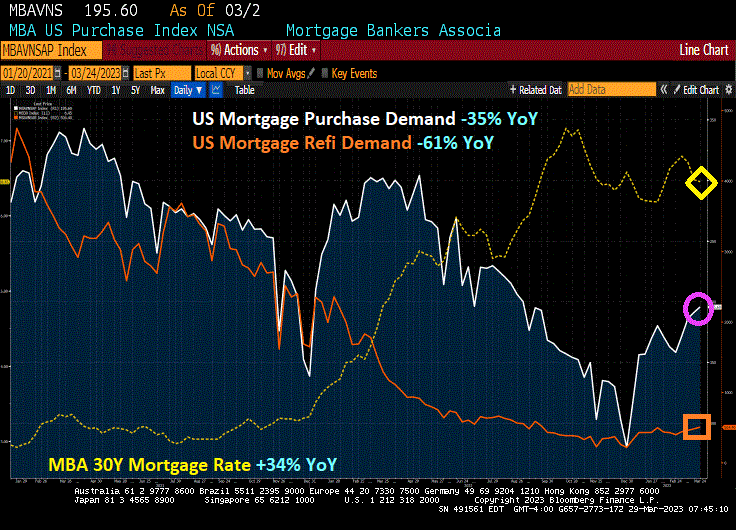
Well, the regional banking crisis has one positive outcome: mortgage rates dropped -46 basis points since last week. The result? Mortgage demand increased 2.9 percent week-over-week (WoW). Although I don’t recommend banking incompetence by bank management and “regulators” as a strategy to increase mortgage demand.
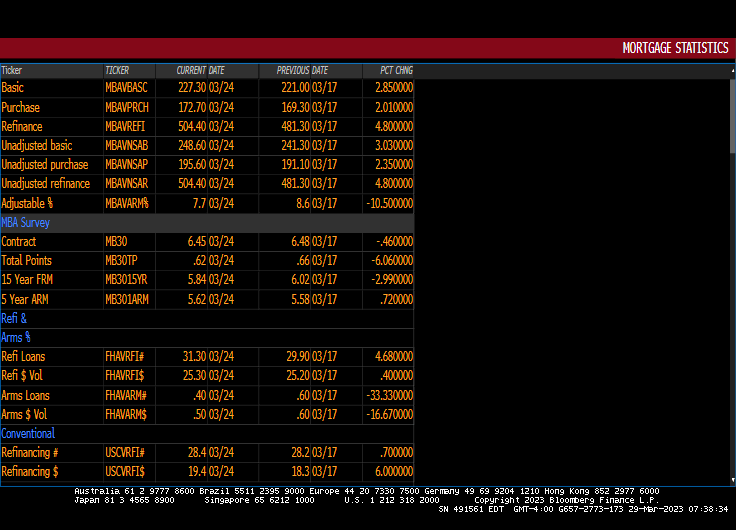
Mortgage applications increased 2.9 percent from one week earlier, according to data from the Mortgage Bankers Association’s (MBA) Weekly Mortgage Applications Survey for the week ending March 24, 2023.
The Market Composite Index, a measure of mortgage loan application volume, increased 2.9 percent on a seasonally adjusted basis from one week earlier. On an unadjusted basis, the Index increased 3 percent compared with the previous week. The Refinance Index increased 5 percent from the previous week and was 61 percent lower than the same week one year ago. The seasonally adjusted Purchase Index increased 2 percent from one week earlier. The unadjusted Purchase Index increased 2 percent compared with the previous week and was 35 percent lower than the same week one year ago.
The rest of the story.
We need a doctor to fix this mess, just not Dr. Yellen or Dr. Jill.
I feel like I am watching the Star Trek original series episode “The Doomsday Machine” as former Fed Chair and current US Treasury Secretary effectively just guaranteed ALL US bank deposits. Aka, a massive bank bailout. The episode was about a robot space vehicle that destroy planets … and anything in its path. And if it changed course to destroy something, it gradually returned to its original destructive path. Like The Federal Reseve.
But after a few days of declining Treasury yields because of the mess created by Bernanke/Yellen’s too low for too long policies, and the Biden/Congress insane spending, the US Treasury 2-year yield is up 16.1 basis points.
Whether it was politcally motivated to protect Obama/Biden or Obama/Biden’s economic recovery was terrible, The Fed only raised their target rate once before Trump’s election. And then Yellen raised rates like crazy. Only to hand her mess off to Powell who had to drop rates like a rock and massively expand the balance sheet … again … to fight Covid.
Apparently, the NEO financial crisis (not the subprime, but The Fed’s “too low for too long” crisis) is still with us.
Credit Suisse Group AG’s top shareholder, whose stake has lost more than one-third of its value in three months, ruled out investing any more in the troubled Swiss bank as a bigger holding would bring additional regulatory hurdles.
“The answer is absolutely not, for many reasons outside the simplest reason, which is regulatory and statutory,” Saudi National Bank Chairman Ammar Al Khudairy said in an interview with Bloomberg TV on Wednesday. That was in response to a question on whether the bank was open to further injections if there was another call for additional liquidity.
Credit Suisse says it has identified material weaknesses in its internal control over financial reporting as of December 31, 2022 and 2021, according to the annual report.
The material weaknesses relate to the failure to design and maintain an effective risk assessment to identify and analyze the risk of material misstatements in its financial statements and the failure to design and maintain effective monitoring activities relating to: – Providing sufficient management oversight over the internal control evaluation process to support the Group’s internal control objectives – Involving appropriate and sufficient management resources to support the risk assessment and monitoring objectives Assessing and communicating the severity of deficiencies in a timely manner to those parties responsible for taking corrective action
And it could simply be that Credit Suisse was caught in the Central Bank “Bear Trap” where banks get clobbered as interest rates rise.
Credit Suisse’s CDS (credit default swap) is soaring!
And on the “it ain’t over till its over” news from Credit Suisse, the US Treasury 2-year yield plunged -40.4 basis points.
And the US Treasury 10-year yield plunged -24.8 basis points.
The official logo of the Federal Reserve should be Munch’s The Scream.
You must be logged in to post a comment.