The US is short on supply of housing for a myriad of reasons (high costs, Not-in-my-backyard (NIMBY) local zoning laws, etc), but The Fed’s cranking up interest rates isn’t helping.
US housing starts, a measure of supply, declined -6.3% YoY in June as The Fed cranked up rates.
1-unit (aka, single family detached) starts dropped -8.05% MoM in June while 5+ unit (aka, multifamily) starts rose 15% MoM.
1-unit permits dropped -8% MoM in June while 5+ unit starts were up 13% MoM.
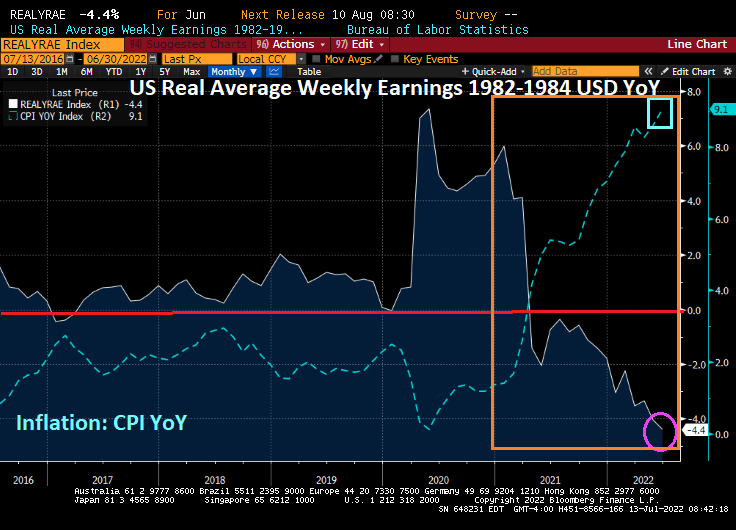
The reason? REAL weekly earnings growth declined -4.4% YoY in June thanks to Bidenflation.
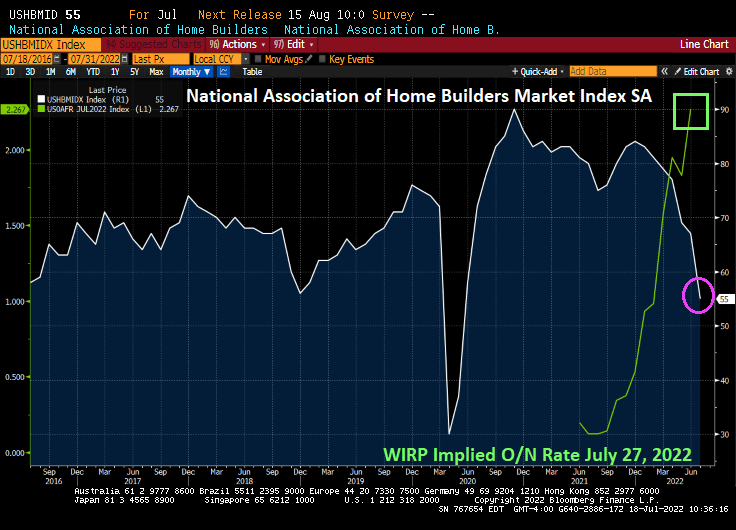
As The Fed Reserve prepares to raise their target rate in a week by 75 basis points to 2.50%, the NAHB Home Builder’s confidence index plunged.
The 30-year mortgage rate is up 89% under Biden as his green energy fiasco is helping drive inflation to its highest level in 40 years leading The Fed to tighten its monetary policies.
The dollar’s gain is the world’s pain — and based on its current trajectory, the world may be in for a whole lot more discomfort.
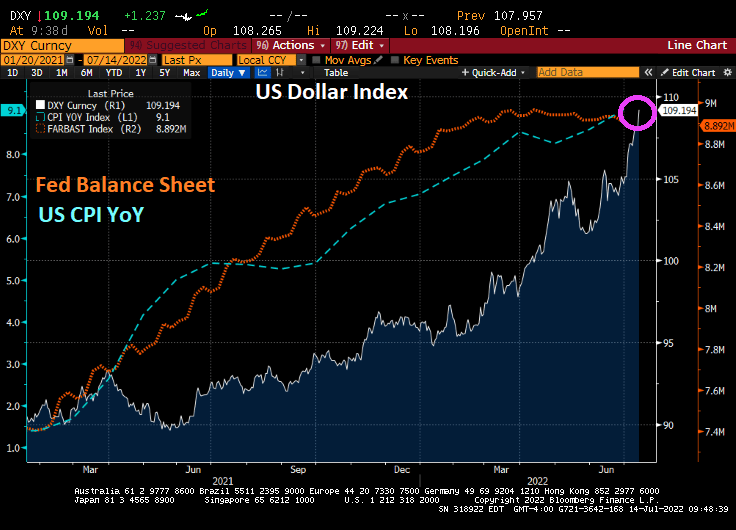
Concerns over global growth have recently sent the US Dollar Index to the strongest level on record, with the greenback hitting multi-decade highs against currencies like the euro and the yen.
But the move risks becoming a self-reinforcing feedback loop given that the vast majority of cross-border trade is still denominated in dollars, and a stronger US currency has historically translated into a broad hit to the world economy.
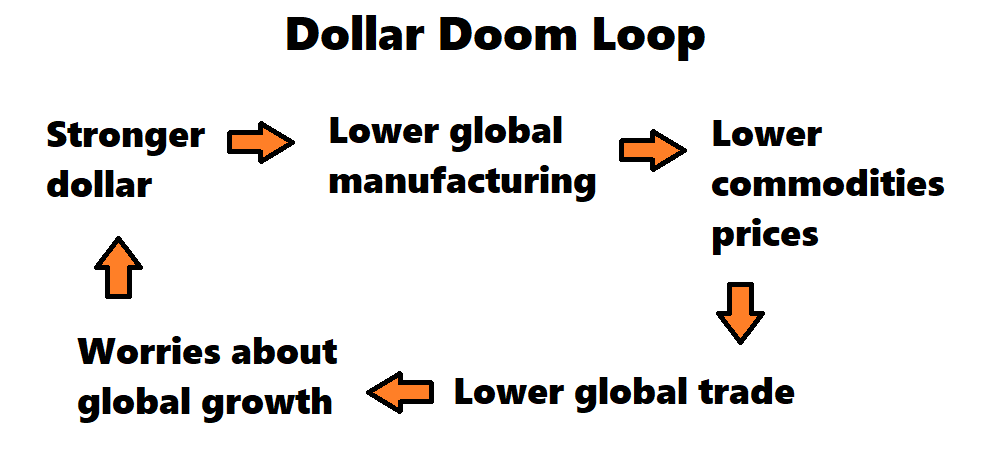
Against the backdrop of higher-than-expected inflation and still-elevated commodities prices, the concern is that we’re in for a dollar ‘doom loop’ like never before, according to Jon Turek, the founder of JST Advisors and author of the Cheap Convexity blog.
With the Federal Reserve hiking interest rates at the fastest pace in decades, he says, it’s much less clear what could break the feedback loop in the next few months.
The Dollar Doom Loop with US inflation causing The Fed to tighten
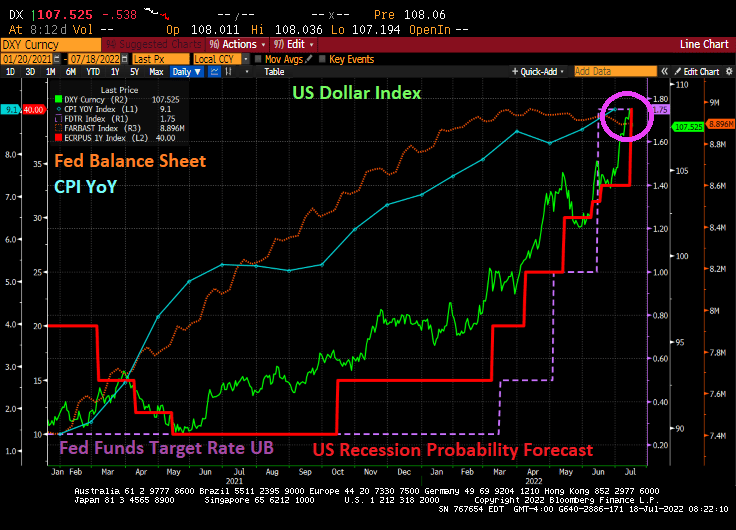
Under Biden’s policies, inflation hit a 40-year high (blue line), and the US Dollar (green line) is strengthening. Then we have The Fed raising the target rate (purple line) and the probability of recession rising with Fed tightening.
Is a US recession coming? The US Treasury 10Y-2Y yield curve is inverted at almost -20 basis points.
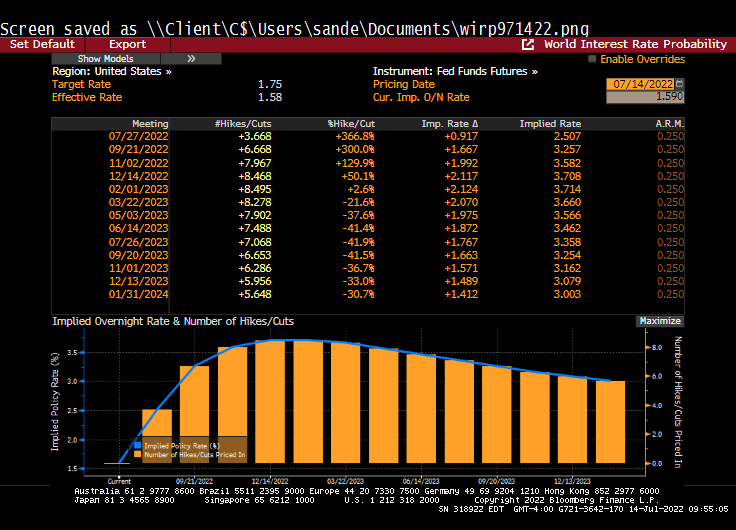
There is a Fed open market committee meeting in one week and they are expected to raise their target rate by 75 basis points according to Fed Fund Futures data. Inflation keeps rising as does the probability of a US recession. So, The Fed will keep on tightening.
The Federal Reserve has behaved like buckaroos! Why? Since the financial crisis, The Fed has left its enormous monetary stimulus outstanding for too long.
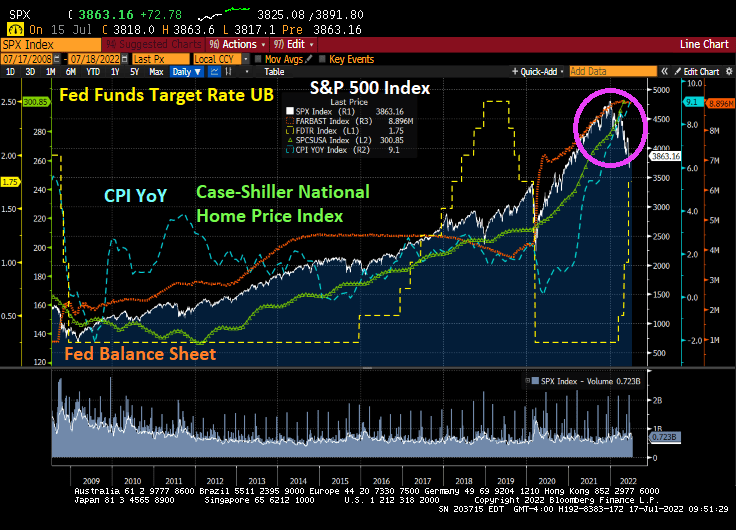
The Fed initiated asset purchases in a series of moves (aka, QE) culminating in Covid QE that has been barley removed. With The Fed’s stimulypto (and Federal spending), we have seen the S&P 500 index soar along with home prices.
Of course, this begs the question as to whether the stock market and housing market can withstand The Fed’s tightening plans.
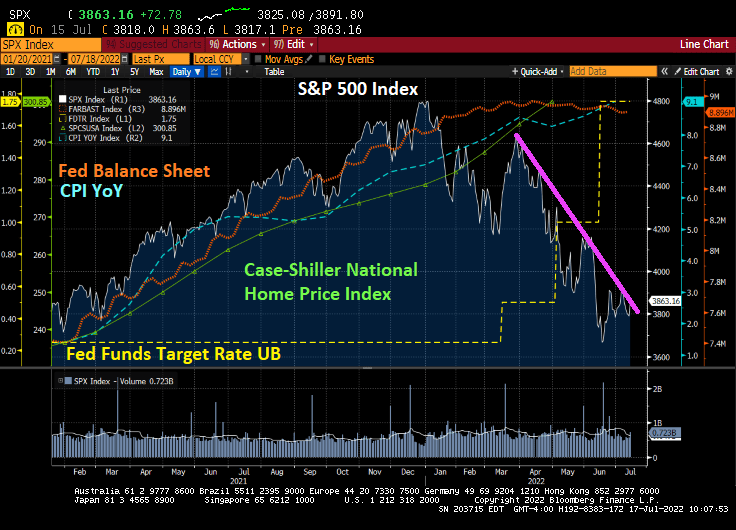
A closer look at the S&P 500 index and the Case-Shiller National home price index under Biden. The S&P 500 has been declining since The Fed started their monetary tightening. But the Case-Shiller National home price index as of April ’22 was still soaring.
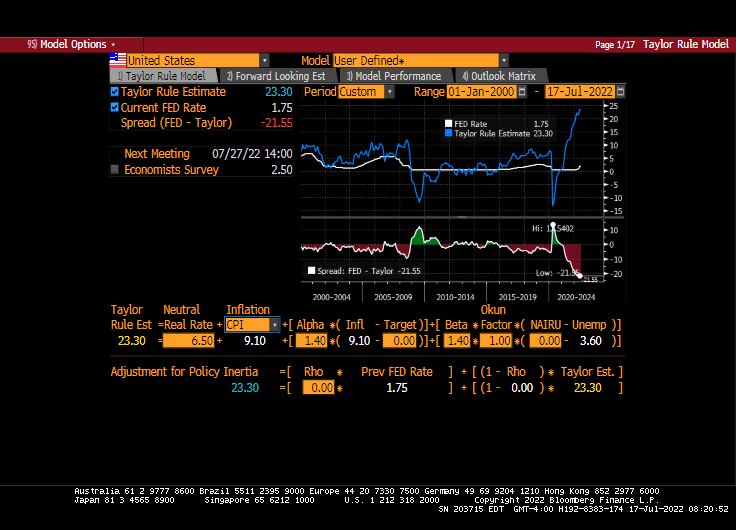
With inflation at a 40-year high, the Taylor Rule suggests a Fed target rate of … 23.30%. It is currently at 1.75%. That is an unrealistic target rate that The Fed will never do. It is, in fact, a Bridge Too Far.
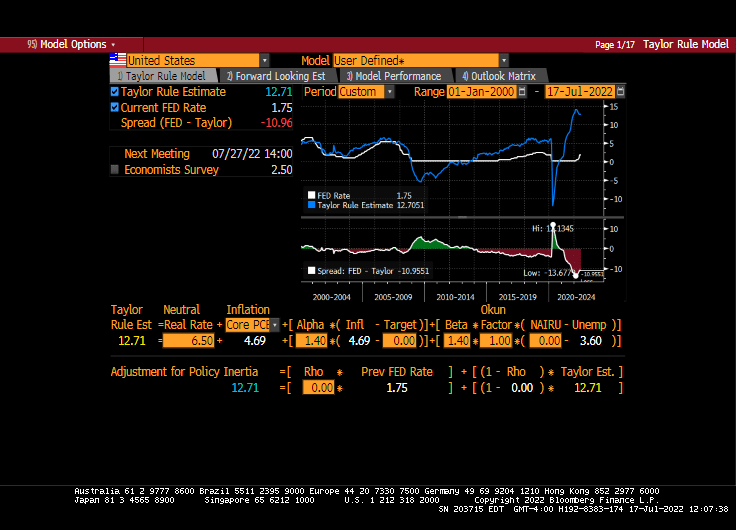
How about the Taylor Rule using Core PCE? It is still 12.71%. Still a bridge too far!
Markets are conditioned to massive Fed stimulypto, so how will markets react to stimulus reduction?
While The Fed is intent on withdrawing SOME of the enormous monetary stimulus, they are still buckaroos. And Biden/Congress still want to distort markets by Federal spending such as the Build Back (Inflation) Better bill that Manchin has blocked … so far.
Housing in the US is simply unaffordable for the middle class and low-wage workers. Combine rising food costs and gasoline/heating costs, and we have an economic disaster on our hands.
US existing home sales for June will be released on Wednesday. But can The Fed kill-off home price inflation?
A preliminary analysis of existing home sales for June is for a seasonally adjusted annual rate of 5.1 million, down 5.4% from May and down 14.2% from last June. As The Fed cranks up its target rate (green line) and eventually shrinking its balance sheet, we will see further shrinking of existing home sales this summer.
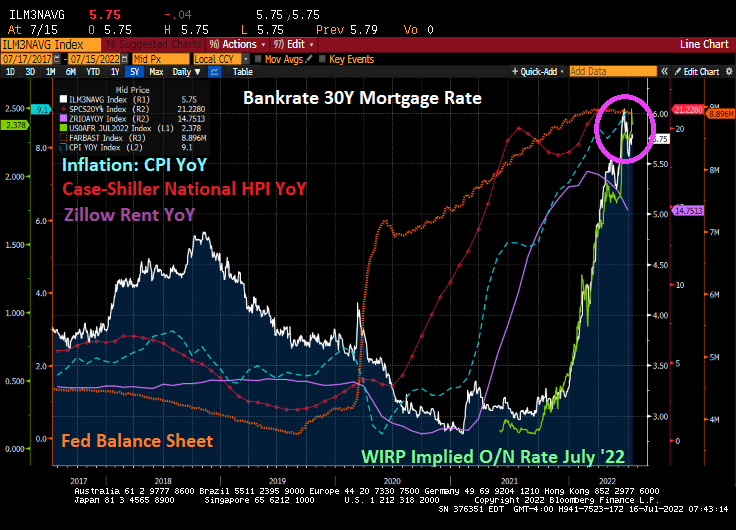
But home price inflation remains high (Case-Shiller National home price index at 21.23% YoY, Zillow’s rent index at 14.75% YoY) while the Consumer Price Index YoY is at 40-year high of 9.1% YoY. In other words, home price inflation is 233% of the stated inflation rate from Uncle Sam.
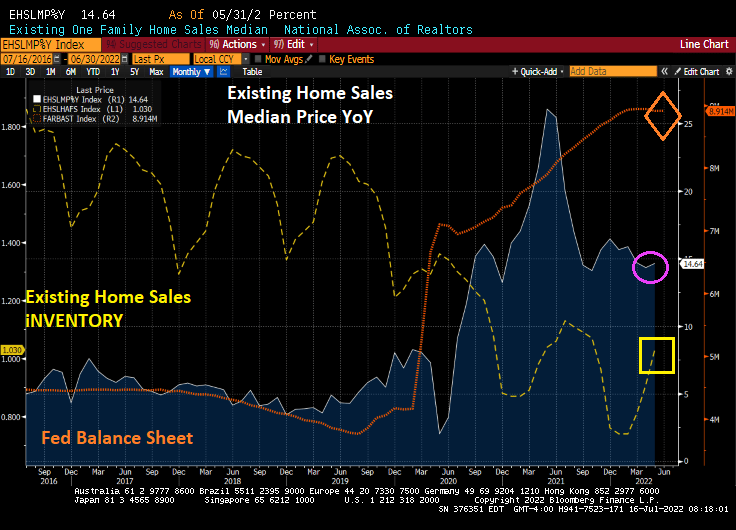
May’s existing home sales report was … sobering. There is still historically low levels of available inventory and median sales price of existing home sales was 14.64% YoY. Of course, the alternative to ownership is renting which is growing at 14.75% YoY. Simply unaffordable.
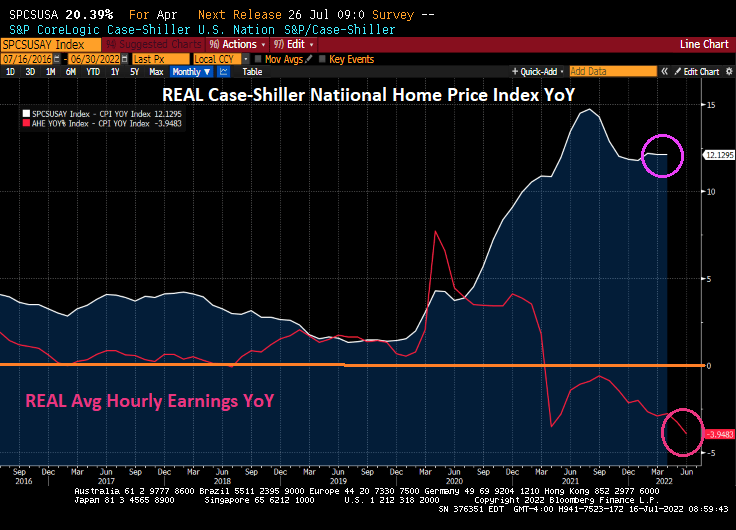
The gap between REAL home price growth (12.13% YoY) and REAL average hourly earnings (-3.95% YoY).
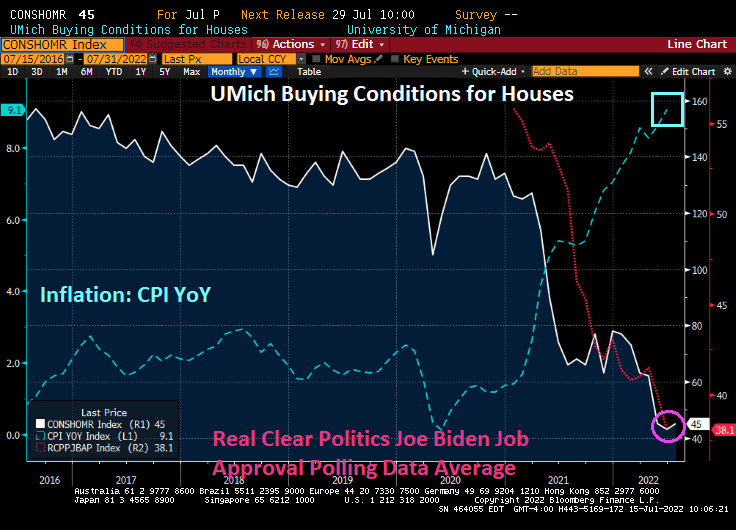
Consumer sentiment for housing is near the lowest level since 1982.
The Fed seems determined to remove the punch bowl in its efforts to crush inflation. But will The Fed’s efforts also crush the housing and mortgage market?
One measure of how bad things are in the US for the middle-class and low-wager workers ix consumer sentiment from University of Michigan. The latest University of Michigan survey of consumers remains depressed at 51.1.
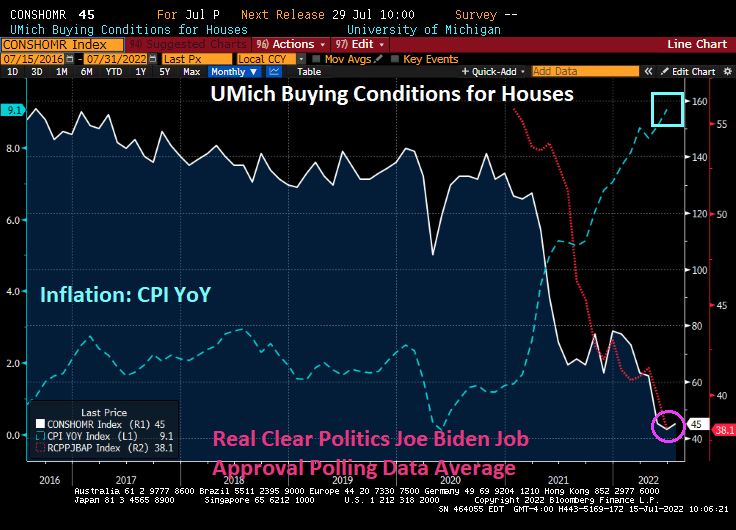
The consumer sentiment index was at 80.7 at the beginning of 2021, but has plunged dramatically with rising gasoline, food and inflation in general. Biden’s popularity has sunk from 55.8 in January 2021 to 38.1 today.
How about housing sentiment? Housing sentiment was 134.0 in January 2021 but has plunged to a depressing 45 with inflation and rising home prices (and rent). And with declining sentiment about housing, Biden’s popularity has plunged.
As Americans are painfully aware, inflation is the highest in 40 years prompting The Federal Reserve to remove the massive punch bowl. In fact, Federal Reserve Governor Christopher “Fats” Waller backed raising rates by 75 basis points this month.
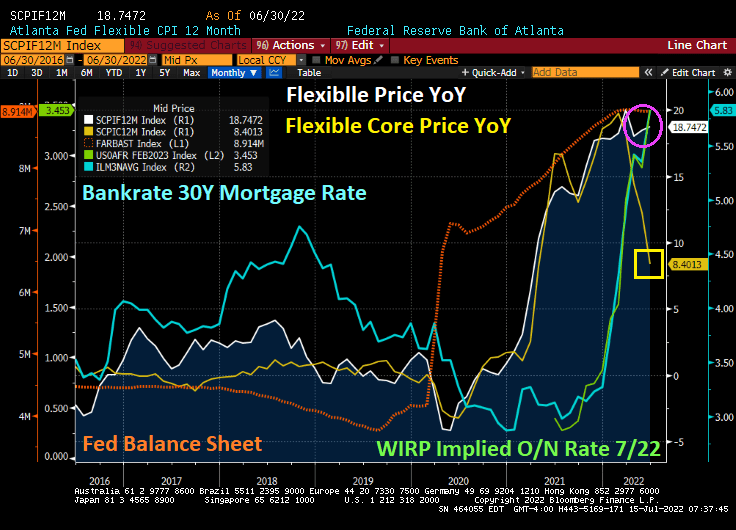
How hot was the recent inflation report? The Atlanta Fed’s flexible price index rose to 18.74% YoY. On the other hand, the CORE flexible price index (less energy and food) plunged to 8.46% YoY. The 30-year mortgage rate from Bankrate rose slightly to 5.83% as the implied overnight rate for the July FOMC meeting rose to 3.45%.
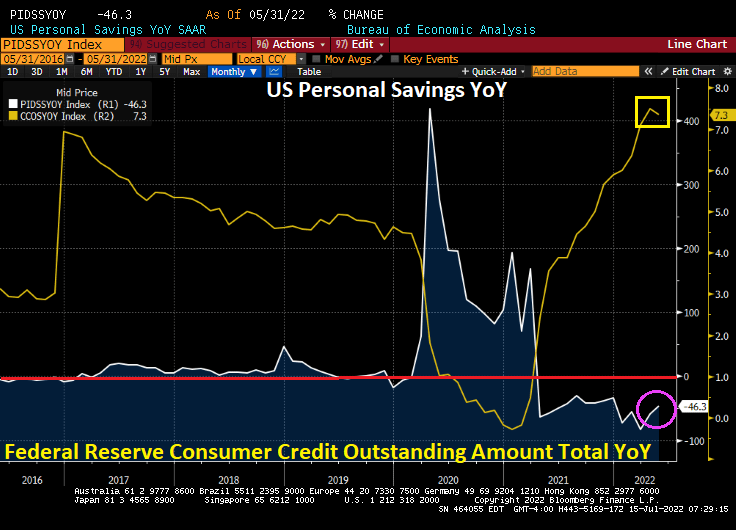
Inflation is ravaging consumers with the savings rate falling by -46.3% YoY while consumer credit rose 7.3% YoY. Yes, thanks to high inflation, consumers are saving less and borrowing more.
When even CORE flexible price inflation is 8.40% YoY, you know that The Fed and Federal government have made serious policy errors.
Bear in mind that a strong dollar is a two-edged sword. The US Dollar Index has risen 16% year-over-year, presenting a big hurdle for US firms with business overseas.
That strength of the greenback will rise until the Fed makes a dovish policy pivot.
And that pivot is forecast to occur at the Feb ’23 FOMC meeting.
Face it. The Biden Administration has little interest in trying to increase the supply fossil fuel energy which would anger his “green” base (like building more refineries or allowing for more crude oil and natural gas exploration). So, the burden of “inflation fighting” falls on the frail shoulders of The Federal Reserve.
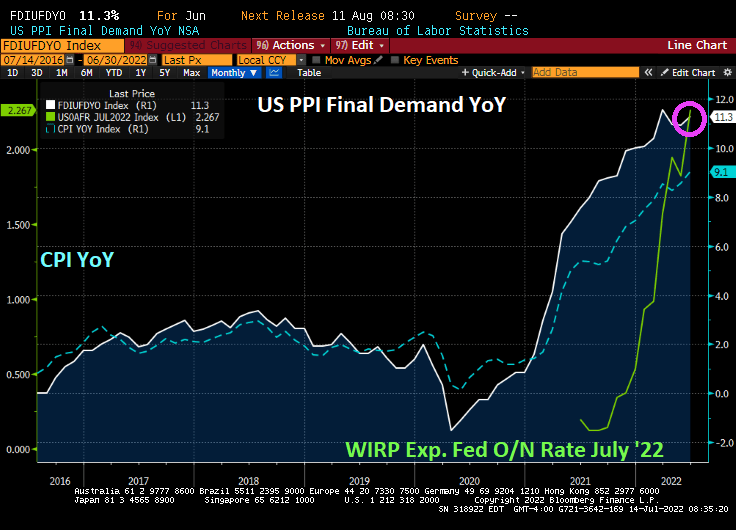
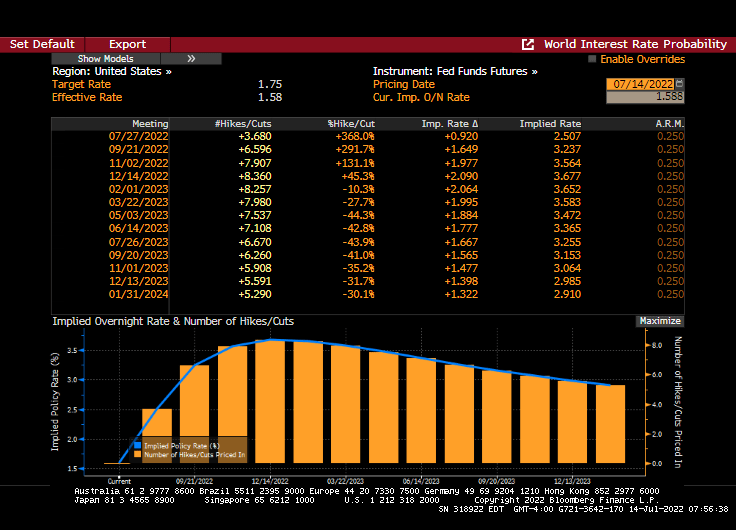
Given today’s US Producer Price Index Final Demand prices rising +11.3% YoY in June, it seems that The Fed has not been able to extinguish the “Tower of Inflation.” But, Fed Funds Futures are pointing to a near 100 basis point (or 1%) increase in The Fed Funds target rate at the July 27th Fed Open Market Committee (FOMC) meeting.
The Fed Funds Futures Data points to a +0.920 (almost 1%) increase at the July 27th FOMC meeting. Followed by rate cuts.
And with the fear of a near 100 basis point increase, today’s stock markets are a sea of red.
It is up to Fed Chair Jerome Powell and policy error brigade to extinguish price increases caused by 1) bad Biden energy policies and 2) too much spending by Biden and Congress. It is like trying to wave-down the Super Chief train with a cigarette lighter.
Yet, the Frail Fed will try to waive down The Super Chief inflation engine with Fed Fireballs. Aka, rate increases of 100 basis points.
The Federal Reserve is reversing its excessive monetary stimulus policies left over from the financial crisis of 2008 (and Covid) and the mortgage industry and potential home buyers are paying the price.
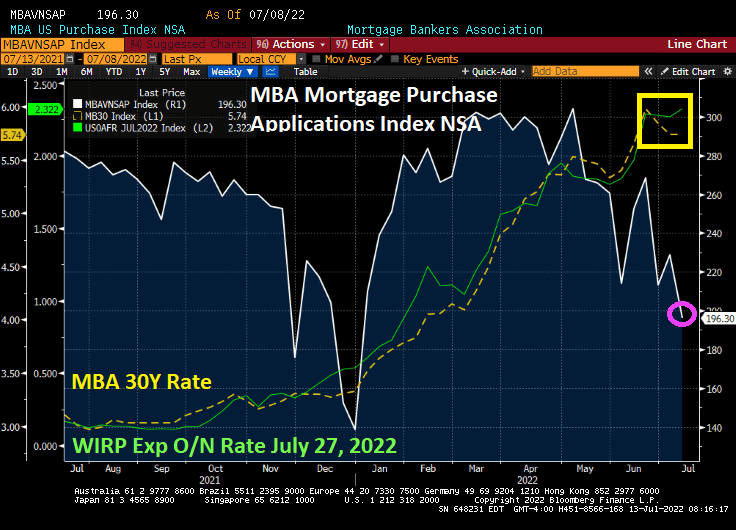
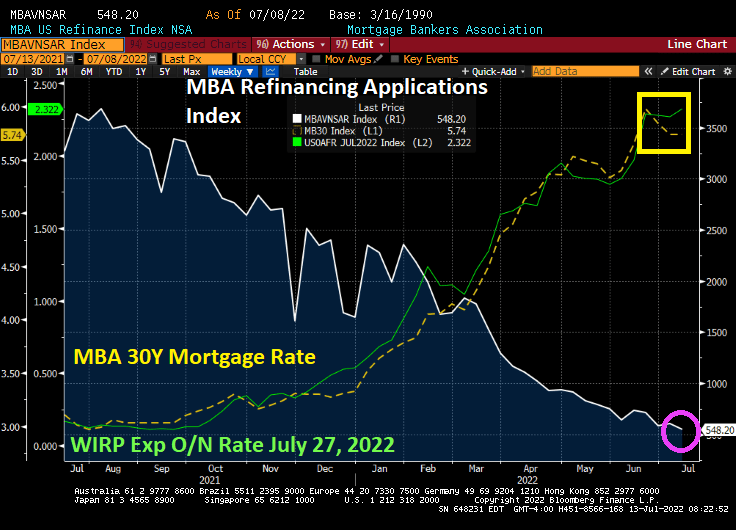
Mortgage applications decreased 1.7 percent from one week earlier, according to data from the Mortgage Bankers Association’s (MBA) Weekly Mortgage Applications Survey for the week ending July 8, 2022. This week’s results include an adjustment for the observance of Independence Day.
The seasonally adjusted Purchase Index decreased 4 percent from one week earlier. The unadjusted Purchase Index decreased 14 percent compared with the previous week and was 18 percent lower than the same week one year ago.
The Refinance Index increased 2 percent from the previous week and was 80 percent lower than the same week one year ago.

















 Confounded Interest - Anthony B. Sanders
You must be logged in to post a comment.