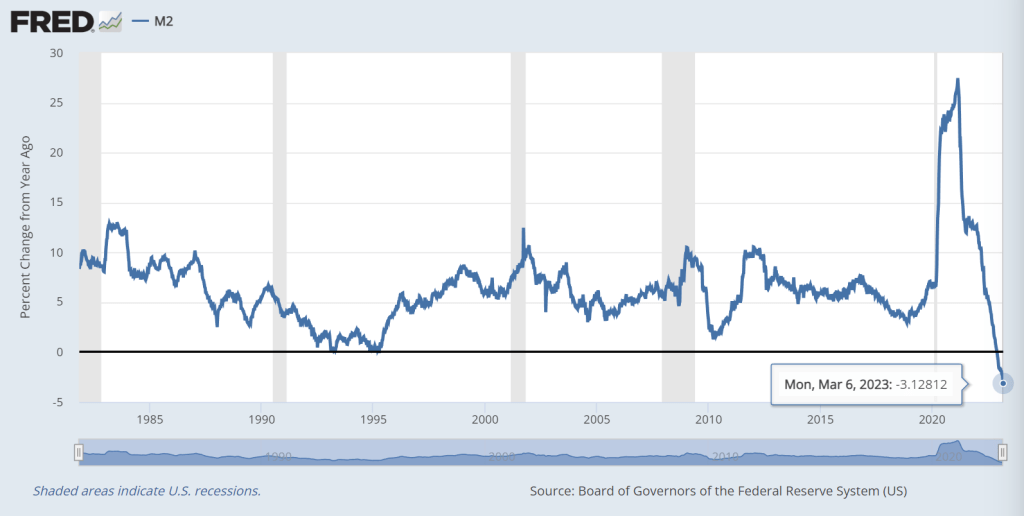
America’s mega bank, The Federal Reserve, is slowing M2 Money growth so rapidly that it looks like it is depthcharging the US economy.
Inflation in the US has been booming since 1) Biden attacked fossil fuels, 2) The Fed’s overresponse to Covid (+27.48% YoY on February 22, 2021 near the beginning of Biden’s Reign of Error). and 3) out of control Federal spending under Biden, Pelosi and Schumer.
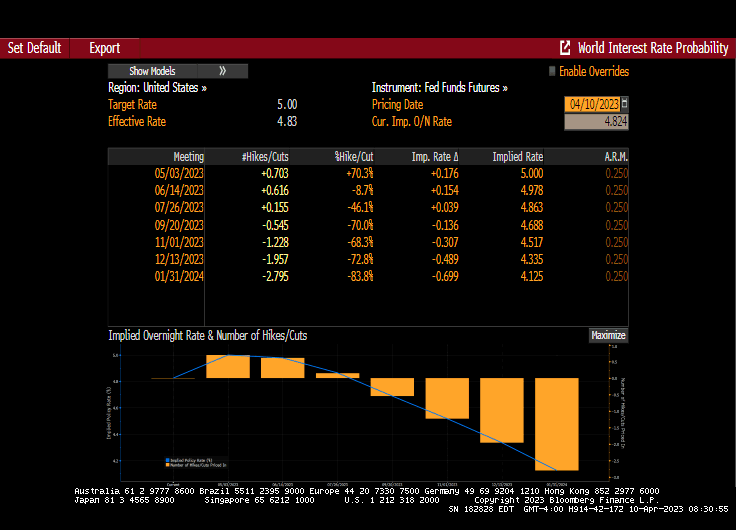
Fed Funds Futures point to two more Fed rate hikes before The Fed drop rates like a depthcharge. This depthcharge will help create a rekindling of asset bubbles.
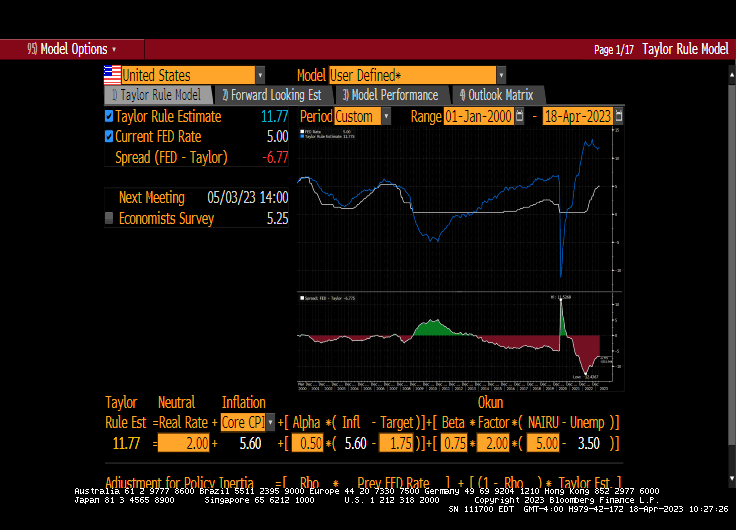
The Taylor Rule suggets a Fed Funds Target rate of 11.77 while the current target rate is only 5%. This is called “leading from behind.”
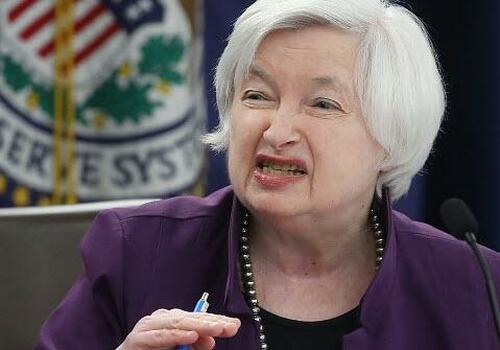
Here is The Fed monitoring the US economy in order to decide on firing more financial torpedos!
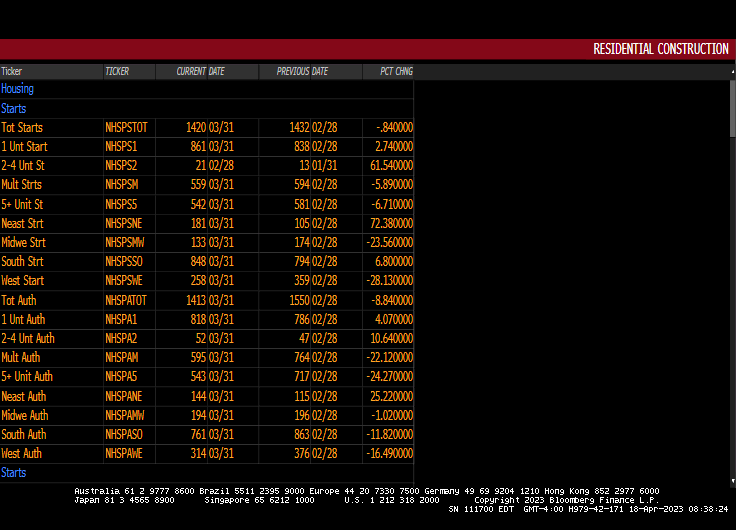
US housing starts have declined in March by -17.2% since the same time last year (YoY) as The Fed rapidly removes Covid-related monetary stimulus (green line).
On the positive side, 1-unit detached housing actually rose by 2.74% from February to March (MoM). However, 5+ unit (multifamily) starts decline -6.71% MoM. Permits are similar: 1-unit permits were up 4.07% in March from February while 5+ unit permits were down -24.27%.
Housing starts out west were down -28.13% MoM as people are escaping “Gruesome Newsom Land” (aka, California). Starts are up by 6.8% MoM in The South.
“Hey Aunt Nancy, do you think American voters will vote for me for President after I helped destroy California? Can I be President and spend like a mad man like you did as Speaker of the House??”
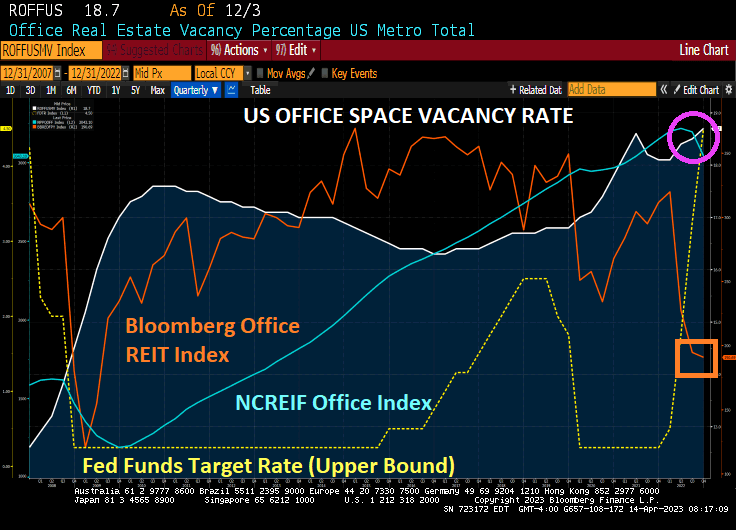
Office vacancy rate in the US has climbed to 20.2% in 2023
Financing for residential building is tepid despite demand
The Covid economic shutdowns have a disastrous effect on small businesses as we know. But office space is really getting crushed in terms of vacancy rates. In fact, it is so bad the investor Kyle Bass is suggesting that office space be torn down across the US much in the same way that FDR’s Agriculture Secretary Henry Wallace ordered the mass execution of hogs in order to drive up prices in a deflationary economy.
(Bloomberg) Kyle Bass has some advice for real estate investors: Tear it down.
The founder of Dallas-based Hayman Capital Management says office buildings in cities need to be demolished because demand isn’t returning and it’s impractical to turn most towers into apartments.
“It’s one asset class that just has to get redone, and redone meaning demolished,” said Bass.
The Dallas-based investor shot to fame more than a decade ago betting against subprime mortgages before the US housing collapse. He’s since pushed a series of contrarian investments that have occasionally burned investors such as predicting the collapse of Japanese government debt and Hong Kong’s dollar.
NCREIF’s office index is starting to decline, but Bloomberg’s Office REIT index (orange line) is really showing the pain being felt in the office market. But just wait to see what happens IF the market takes Bass’ advice and starts removing supply to help increase values. Unfortunately, my chart is only up through December 2022 and office vacancies have worsened in 2023 to a mind-boggling 20.2%.
In a classic Bill Lumbergh move (he was the office manager of Initech in Dallas Texas), JPMorgan now requires managing directors return to office 5 days a week and ‘be visible on the floor’ or else face ‘corrective action’.
An additional non-Bill Lumbergh issue is the rising crime in American cities causing companies like Whole Foods to leave their San Francisco (tenderloin district) location because 1) workers feel unsafe and 2) shop lifting is out of control. Even Washington DC where a large number of office building are leased by The Federal government is experiencing a boom in crime (particularly carjackings). And don’t get me started on Chicago (see Hey Jackass! for a Chicago crime map).
The face of micro-managing office managers, Bill Lumbergh. Or is this now JPMC’s CEO Jaime Dimon?
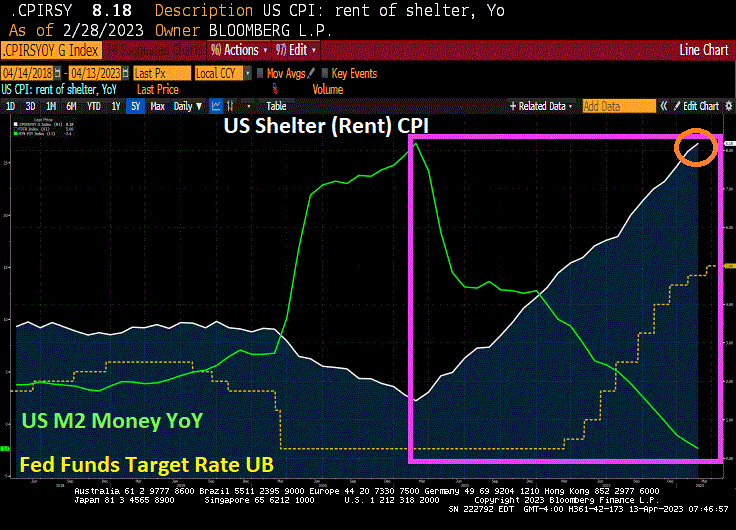
Two of the biggest items for consumer are housing and food. Shelter inflation (CPI) is still growing at 8.2% YoY and food is still growing at 8.5% YoY.
Federal Reserve officials appear on track to extend their run of interest-rate hikes when they meet next month, shrugging off their advisers’ warning of recession with a bet that they need to do a little more to curb inflation.
Minutes of last month’s policy meeting showed officials dialed back expectations of how high they’ll need to lift rates after a series of bank collapses roiled markets last month. Still, officials raised their benchmark lending rate a quarter point to a range of 4.75% to 5%, as they sought to balance the risk of a credit crunch with incoming data showing price pressures remained too high.
They did so even after hearing from Fed staff advisers that they were forecasting a “mild recession” later this year.
Officials agreed “some additional policy firming may be appropriate,” according to minutes of the Federal Open Market Committee gathering, a posture several Fed speakers have reiterated in recent days.
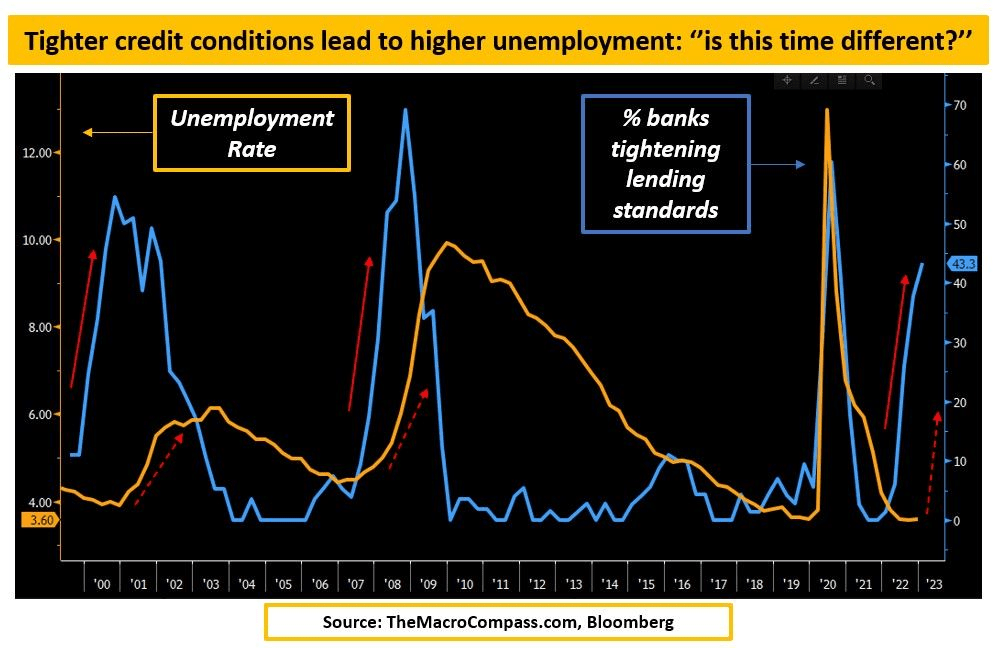
Policymakers “commented that recent developments in the banking sector were likely to result in tighter credit conditions for households and businesses and to weigh on economic activity, hiring and inflation,” the minutes said, though they agreed the extent of the effects was uncertain. “Against this background, participants continued to be highly attentive to inflation risks.”
Between inflation under Biden and The Fed’s counterattack to get inflation to 2%, I call this the Biden Blitz.
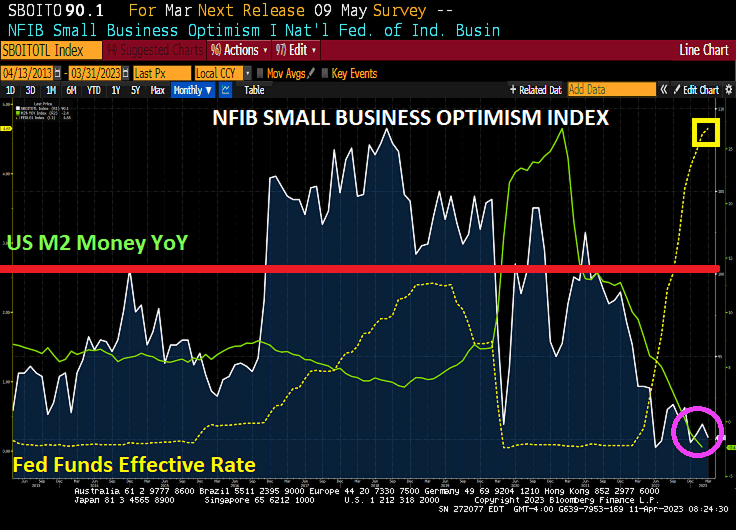
Unlike what the elites in Washington DC think, small business are the cornerstone of the US economy. Unfortunately, small business optimism is getting crushed and just fell in March to a level lower than that found during the Covid economic shutdowns of 2020. HOW is it possible for small businesses to be even less optimistic than it was in April 2002, the nadir of the Covid economic shutdown?
Small business optimism soared in November 2016 after the election of Donald Trump and remained high (above 100) until Covid struck in March 2020. Small business optimism rose above 100 again with the massive money printing by The Fed (green line) and Federal spending spree. But as M2 Money growth slowed, small business optimism hasn’t been above 100 since August 2021. It has been all downhill since then as The Fed started to raise The Fed Funds Target Rate quite rapidly.
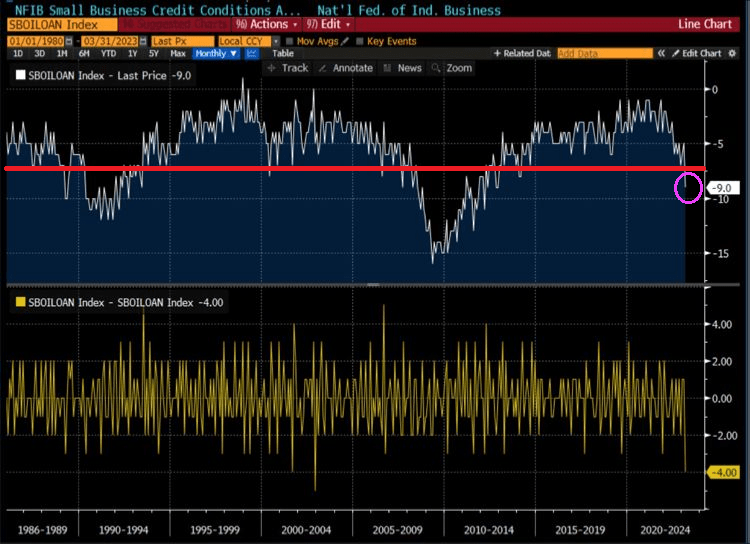
NFIB small business credit conditions are negative at -9.0 and sinking like The Titanic.
Biden is the face of big business (big banks, big pharma, big tech, big defense, big labor unions, big media, etc.). Biden just told Al Roker that he is indeed running for reelection, supported by …. big banks, big pharma, big tech, big defense, big labor unions, big media, etc.
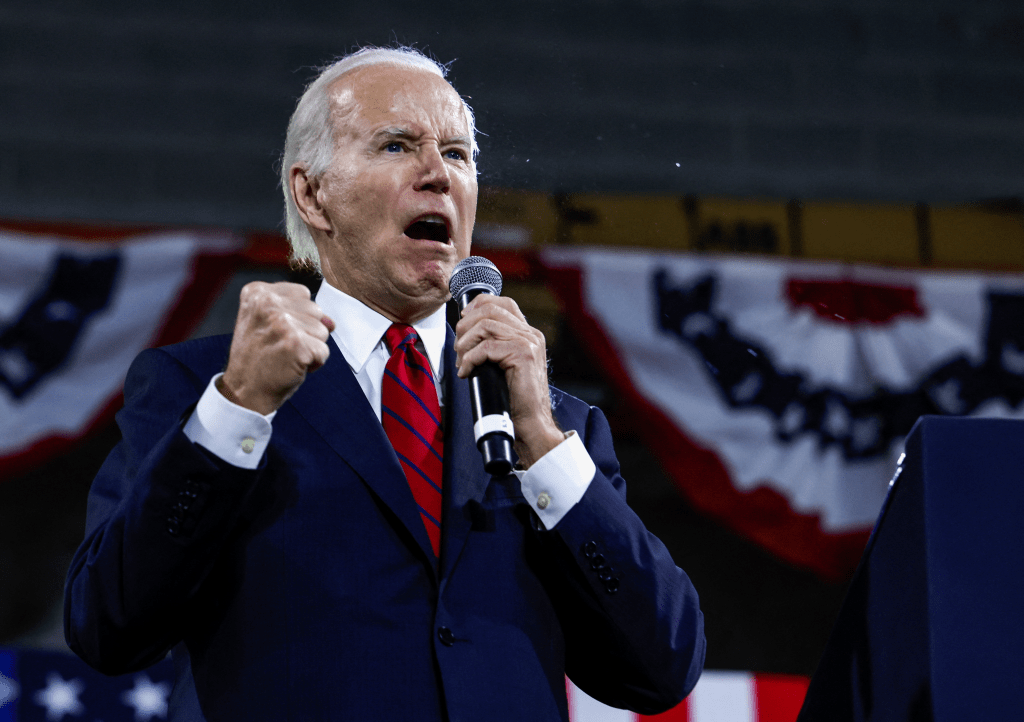
Biden is no longer a President, but an old-time preacher screaming about MAGA Republicans as if they were demons. This is called Blitzkrieg Biden.
I read over the weekend that the Biden Administration was planning to unleash its army of social influencers on us to hype Biden’s economic accomplishments before the Presidential election. I am not one of his preferred social influencers. In fact, the US economy is slippin’ into darkness under Biden.
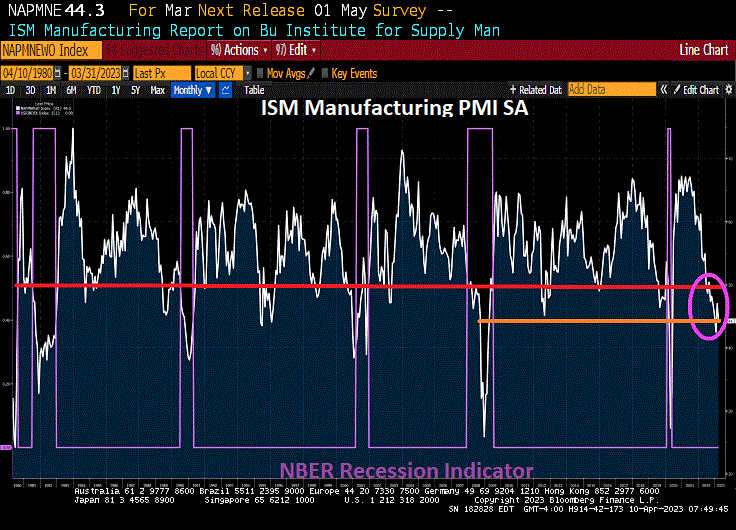
An example is ISM Manufacturing PMI which has declined to a level typically seen in prior recessions.
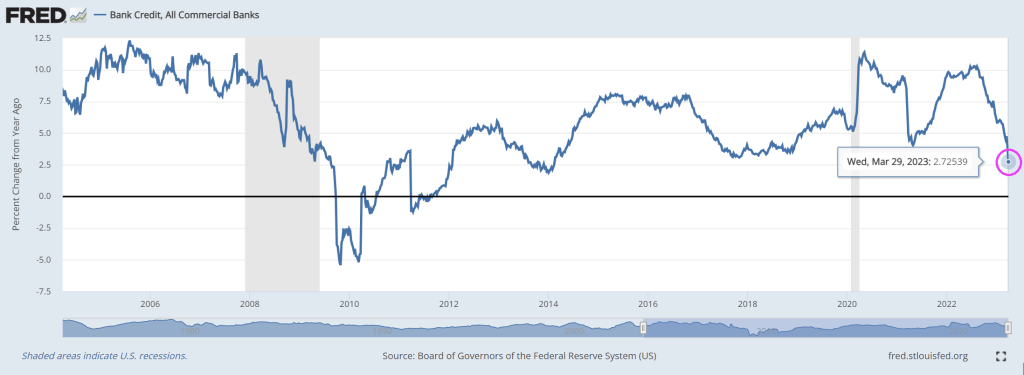
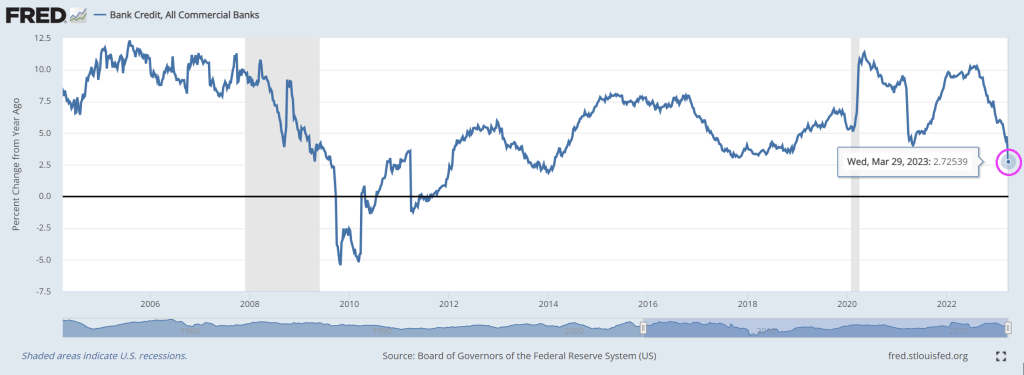
And then we have US bank credit growth which just crashed to the slowest growth rate since 2014.
Inflation started with Biden’s misguided war on US energy, then Biden/Congress helped inflation with an epic spending splurge. The Federal Reserve counterattacked with Fed rate hikes.
Over the past year, The Fed Funds Effective rate has risen and US bank credit has crashed to 2.73% year-over-year.
Do I detect a trend?
Since 2005, the crash in US bank credit is looking like 2008/2009 all over again.
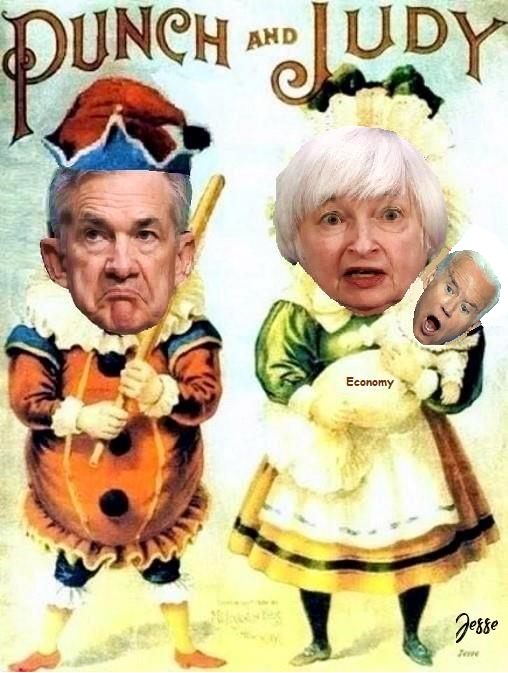
Whether Biden is Cap’n Crunch or Jerome Powell or Janet Yellen, they are all crunching the US economy.
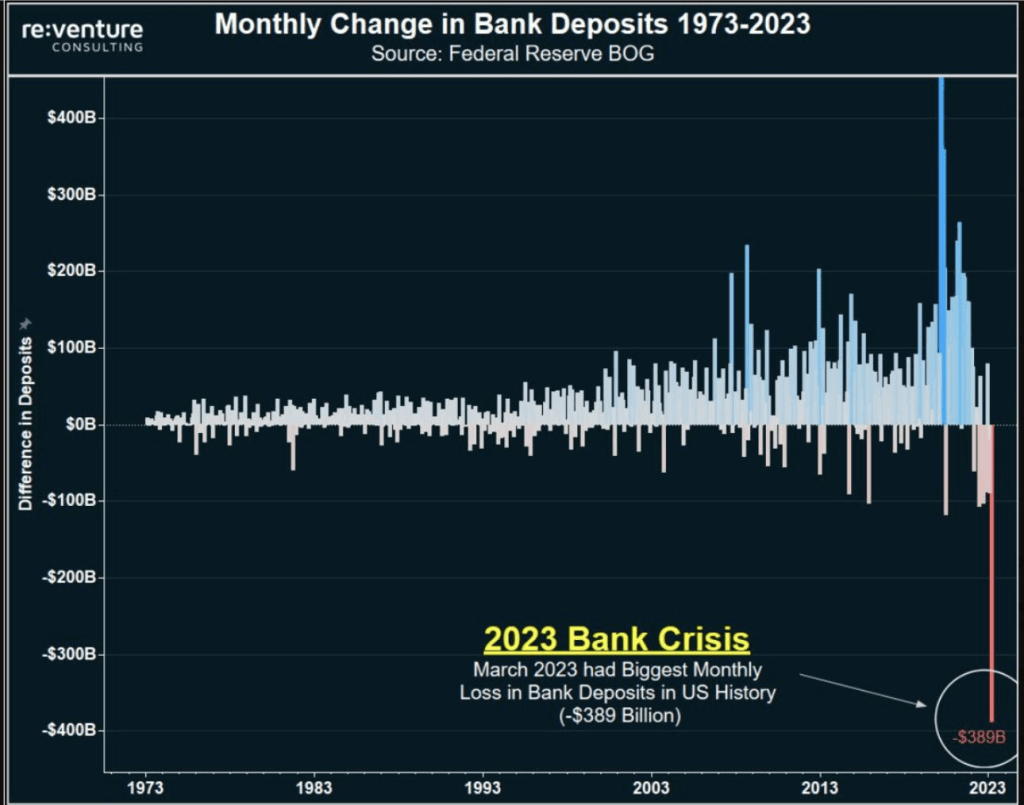
US commercial banks deposits (red line) had been slowly declining even before Silicon Valley Bank failed. Along with Signature Bank and First Republic Bank, not to mention Credit Suisse. And The Teutonic Titanic, Deutshe Bank, is on the ropes. But the failure of SVB saw an acceleration of the decline in commercial bank deposits as banks accelerated borrowing.
But never fear! The Fed will raise rates once or twice more, then drop them again.
“The banks will never behave on my watch as US Treasury Secretary, you have my word!” And don’t worry. Biden will bail them all out … again. Call it “The Biden Bailout Shake!”
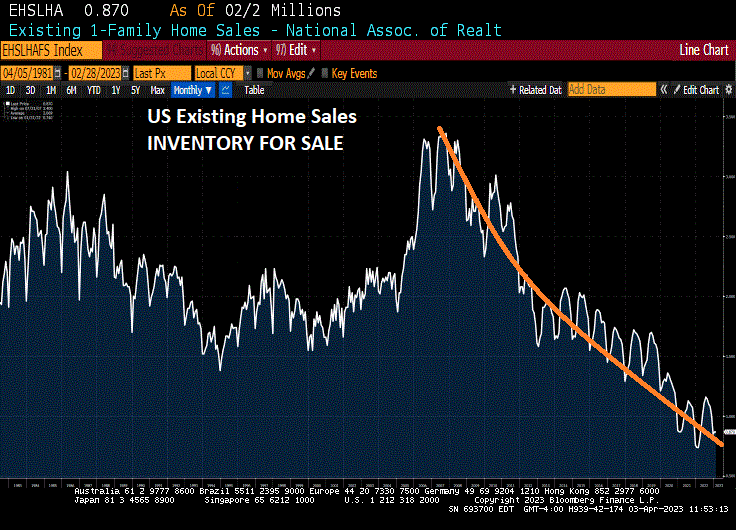
My friend Phill Hall asked me about the state of the US housing market yesterday. My answer? “Chaos.” Why chaos? Here is why: 23 consecutive months of NEGATIVE real wage growth, declining availability of homes for sale, still expensive home prices following the Covid spending surge, and rising mortgage rates as The Fed fights inflation.
And now we have mortgage demand shrinking 4.1% from the previous week according to the Mortgage Bankers Association’s (MBA) Weekly Mortgage Applications Survey for the week ending March 31, 2023.
The Market Composite Index, a measure of mortgage loan application volume, decreased 4.1 percent on a seasonally adjusted basis from one week earlier. On an unadjusted basis, the Index decreased 4 percent compared with the previous week. The Refinance Index decreased 5 percent from the previous week and was 59 percent lower than the same week one year ago. The seasonally adjusted Purchase Index decreased 4 percent from one week earlier. The unadjusted Purchase Index decreased 3 percent compared with the previous week and was 35 percent lower than the same week one year ago.
Throw in the declining inventory of homes for sales, and we have chaos.
Not to mention 23 consecutive months of negative REAL wage growth.
Well, at least REAL home prices are growing more slowly (-3.86% YoY) than REAL weekly wage growth -1.9% YoY). So much for housing as a hedge against inflation!
Thanks to Yellen’s catestrophic Too-Low-For-Too-Long (TLFTL) and insane Federal spending, we are seeing the aftermath of The Fed trying to fight inflation. A fire sale of failed bank assets!!
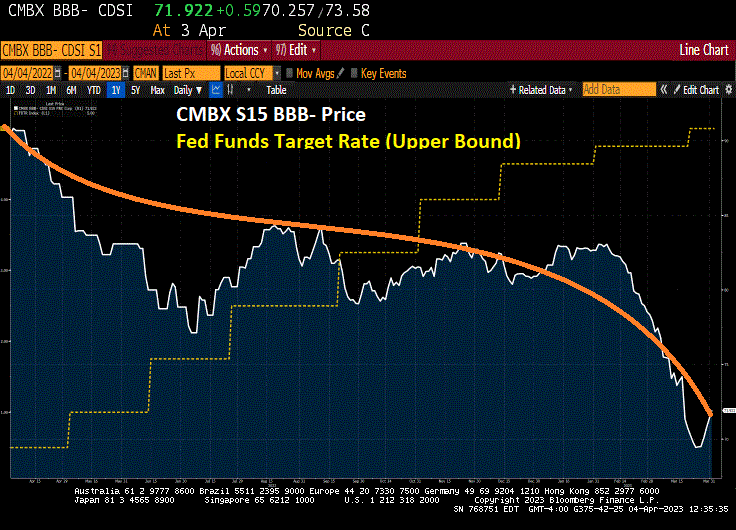
With interest rates still rising, prices retreating and credit evaporating—and a stressed-out banking system moving to shore up balance sheets—expect more fire sales of older CMBS loans and an acceleration of plunging CRE values in markets across the US.
Last month, a fire sale of CMBS loans was lit as $72B in assets from the failed Silicon Valley Bank (SVB) were sold. The SVB assets—including about $13B in real estate exposure and at least $2.6B worth of CRE loans—were sold at a discount of $16.5B, which translates into about 77 cents on the dollar, according to a report in MarketWatch.
The Federal Deposit Insurance Corp. has lit a fuse on an even larger fire sale of assets—a bonfire in terms of CRE loans—for NYC-based Signature Bank, which like SVB was a regional bank that collapsed and was taken over by regulators last month.
FDIC last week tapped Newmark to sell $60B in assets held by Signature, according to the Wall Street Journal, including nearly $36B in CMBS loans backed primarily by multifamily properties, the lion’s share of them in New York City. Since 2020, Signature initiated more than $13.4B in loans backed by NYC buildings, the most of any lender.
Experts who specialize in pricing CRE loans believe a discounted sale as large as the disposal of Signature’s assets will speed a markdown of valuations by banks who until recently have been reluctant to set off a downward spiral. The 77 cents on the dollar benchmark established by the SVB sale likely will be the top end of where prices are heading, the experts say.
“The SVB trade created a baseline for the market. To me, that’s the top end, not the bottom end, for CRE loans,” David Blatt, CEO of CapStack Partners, told MarketWatch. CapStack is a credit fund that buys CMBS loans from banks and originates short-term bridge loans and mezzanine debt.
“What everybody has been operating under is this hold-to-maturity veneer,” Blatt said, referring to banks that have continued to value loans at 100 cents on the dollar, known as par.
In the wake of the SVB asset sale, “there’s just no way these things get resolved at par,” Blatt said, adding “the write-down is kind of implied.”
“Everybody is dusting off their old playbook. There just hasn’t been [as] much distress for years,” Jack Mullen, founder of Summer Street Advisors, told Marketwatch. “People are not going to let it carry into next year. On the regulatory side, it’s coming to the front of the line. People are super-mindful about it.”
The rising cost of debt was cutting into the value of older, low-coupon loans before SVB and Signature were shut down. Now, everyone is guessing how low will prices go on CMBS loans in the wake of the fire sales of the fallen lenders’ portfolios.
A recent advisory from Cohen & Steers estimates the decline in values will likely be at least 25%. Loans associated with multifamily properties won’t be immune from the valuation hit; apartment rents declined for the fifth time in six months from January to February.
For office properties, especially in Manhattan, the decline in value will be much steeper. Older NYC office properties are facing a cliff-diving plunge of up to 70%.
CMBX S15 is plummeting like a paralyzed falcon after The Fed started raising rates.
As bank deposits continue to crash and burn.
Now we have banks tightening lending standards.
So instead of The Boston Strangler, we have the DC Strangler.











 Confounded Interest - Anthony B. Sanders
You must be logged in to post a comment.