I read over the weekend that the Biden Administration was planning to unleash its army of social influencers on us to hype Biden’s economic accomplishments before the Presidential election. I am not one of his preferred social influencers. In fact, the US economy is slippin’ into darkness under Biden.
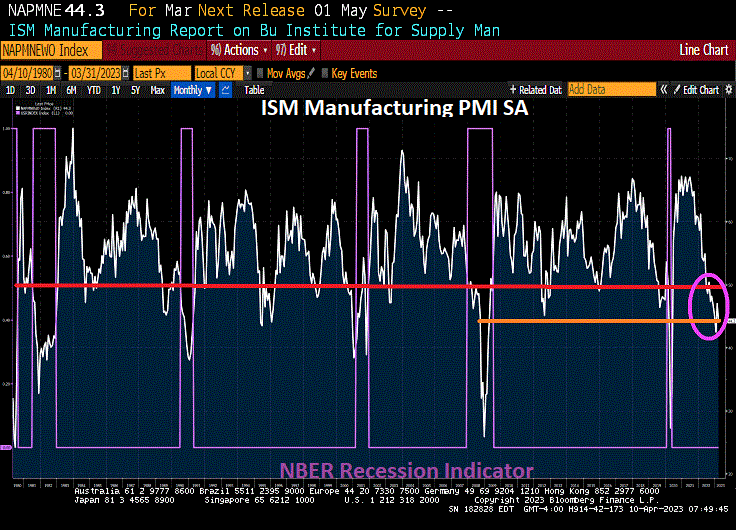
An example is ISM Manufacturing PMI which has declined to a level typically seen in prior recessions.
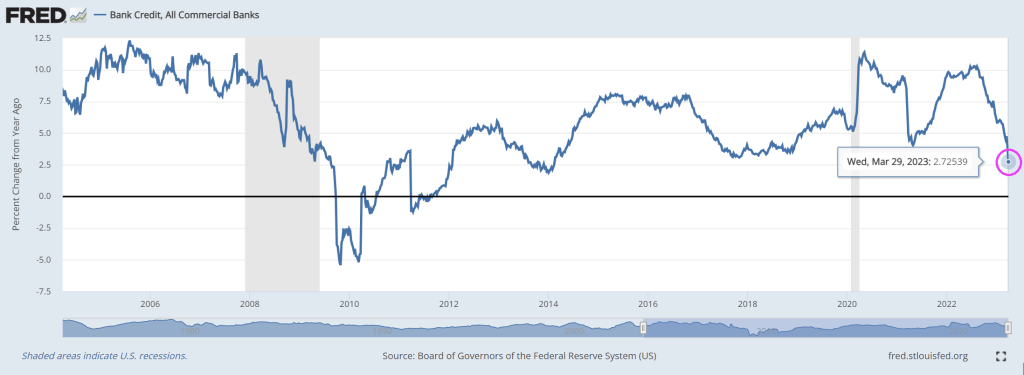
And then we have US bank credit growth which just crashed to the slowest growth rate since 2014.
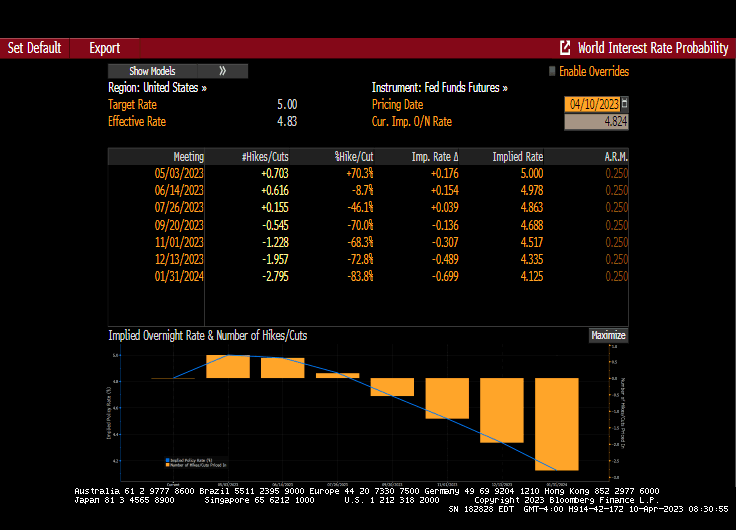
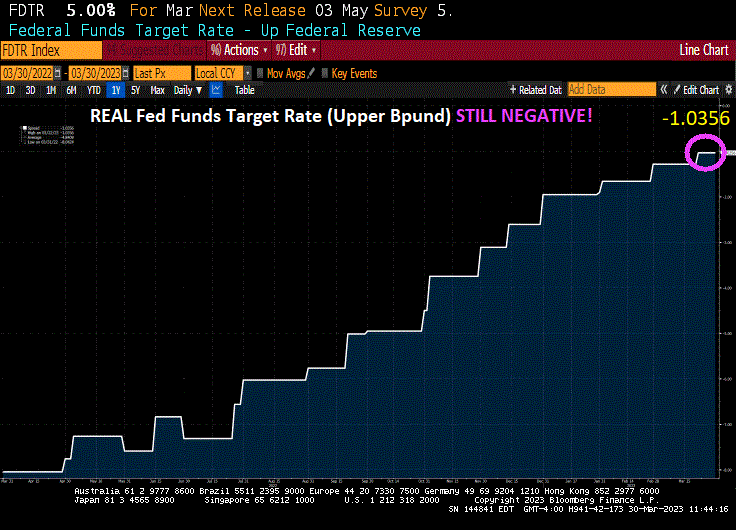
Inflation started with Biden’s misguided war on US energy, then Biden/Congress helped inflation with an epic spending splurge. The Federal Reserve counterattacked with Fed rate hikes.
Over the past year, The Fed Funds Effective rate has risen and US bank credit has crashed to 2.73% year-over-year.
Do I detect a trend?
Since 2005, the crash in US bank credit is looking like 2008/2009 all over again.
Whether Biden is Cap’n Crunch or Jerome Powell or Janet Yellen, they are all crunching the US economy.
Thanks to Yellen’s catestrophic Too-Low-For-Too-Long (TLFTL) and insane Federal spending, we are seeing the aftermath of The Fed trying to fight inflation. A fire sale of failed bank assets!!
With interest rates still rising, prices retreating and credit evaporating—and a stressed-out banking system moving to shore up balance sheets—expect more fire sales of older CMBS loans and an acceleration of plunging CRE values in markets across the US.
Last month, a fire sale of CMBS loans was lit as $72B in assets from the failed Silicon Valley Bank (SVB) were sold. The SVB assets—including about $13B in real estate exposure and at least $2.6B worth of CRE loans—were sold at a discount of $16.5B, which translates into about 77 cents on the dollar, according to a report in MarketWatch.
The Federal Deposit Insurance Corp. has lit a fuse on an even larger fire sale of assets—a bonfire in terms of CRE loans—for NYC-based Signature Bank, which like SVB was a regional bank that collapsed and was taken over by regulators last month.
FDIC last week tapped Newmark to sell $60B in assets held by Signature, according to the Wall Street Journal, including nearly $36B in CMBS loans backed primarily by multifamily properties, the lion’s share of them in New York City. Since 2020, Signature initiated more than $13.4B in loans backed by NYC buildings, the most of any lender.
Experts who specialize in pricing CRE loans believe a discounted sale as large as the disposal of Signature’s assets will speed a markdown of valuations by banks who until recently have been reluctant to set off a downward spiral. The 77 cents on the dollar benchmark established by the SVB sale likely will be the top end of where prices are heading, the experts say.
“The SVB trade created a baseline for the market. To me, that’s the top end, not the bottom end, for CRE loans,” David Blatt, CEO of CapStack Partners, told MarketWatch. CapStack is a credit fund that buys CMBS loans from banks and originates short-term bridge loans and mezzanine debt.
“What everybody has been operating under is this hold-to-maturity veneer,” Blatt said, referring to banks that have continued to value loans at 100 cents on the dollar, known as par.
In the wake of the SVB asset sale, “there’s just no way these things get resolved at par,” Blatt said, adding “the write-down is kind of implied.”
“Everybody is dusting off their old playbook. There just hasn’t been [as] much distress for years,” Jack Mullen, founder of Summer Street Advisors, told Marketwatch. “People are not going to let it carry into next year. On the regulatory side, it’s coming to the front of the line. People are super-mindful about it.”
The rising cost of debt was cutting into the value of older, low-coupon loans before SVB and Signature were shut down. Now, everyone is guessing how low will prices go on CMBS loans in the wake of the fire sales of the fallen lenders’ portfolios.
A recent advisory from Cohen & Steers estimates the decline in values will likely be at least 25%. Loans associated with multifamily properties won’t be immune from the valuation hit; apartment rents declined for the fifth time in six months from January to February.
For office properties, especially in Manhattan, the decline in value will be much steeper. Older NYC office properties are facing a cliff-diving plunge of up to 70%.
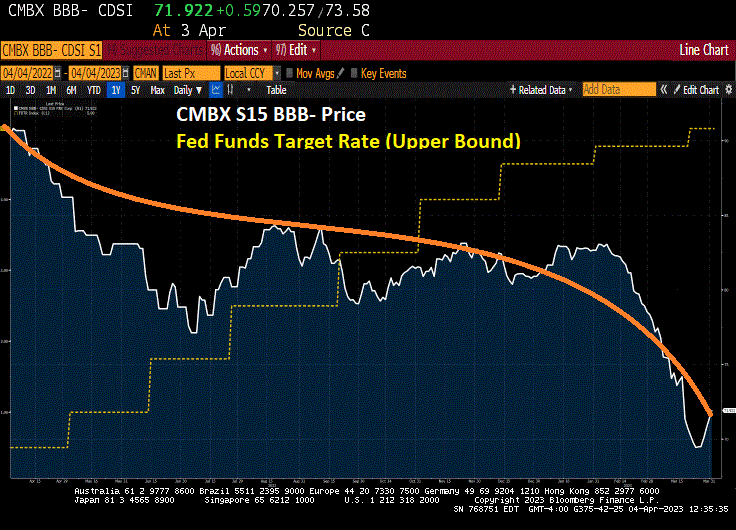
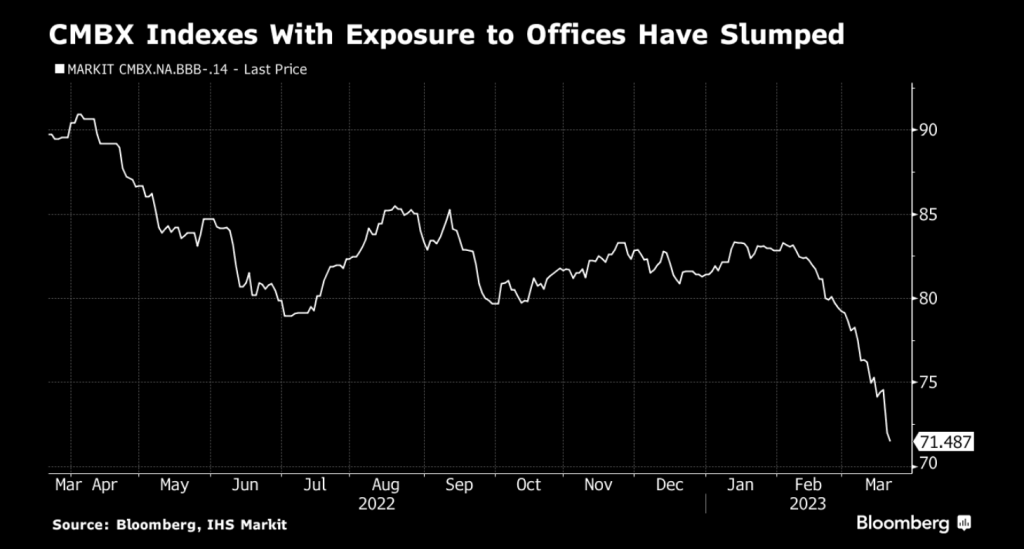
CMBX S15 is plummeting like a paralyzed falcon after The Fed started raising rates.
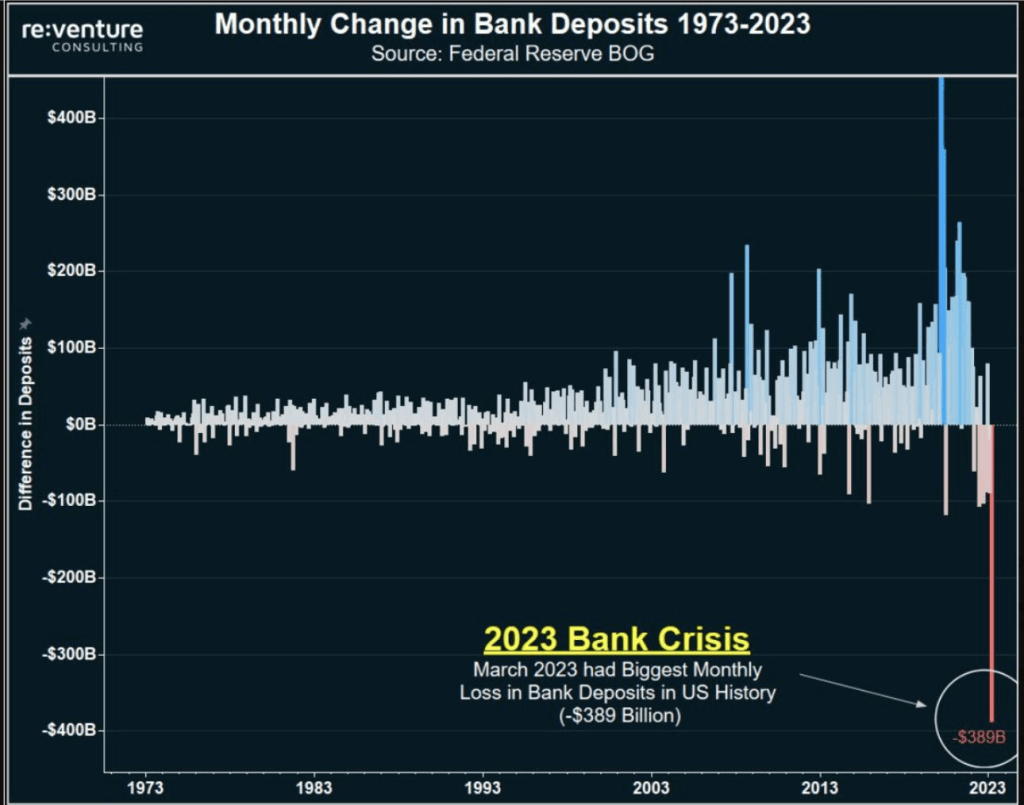
As bank deposits continue to crash and burn.
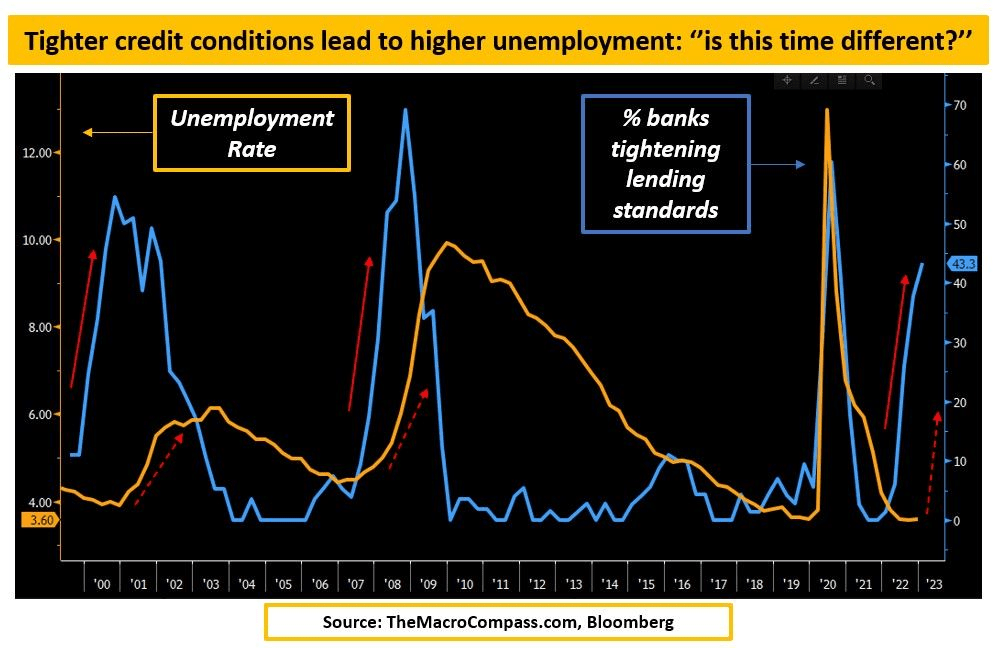
Now we have banks tightening lending standards.
So instead of The Boston Strangler, we have the DC Strangler.
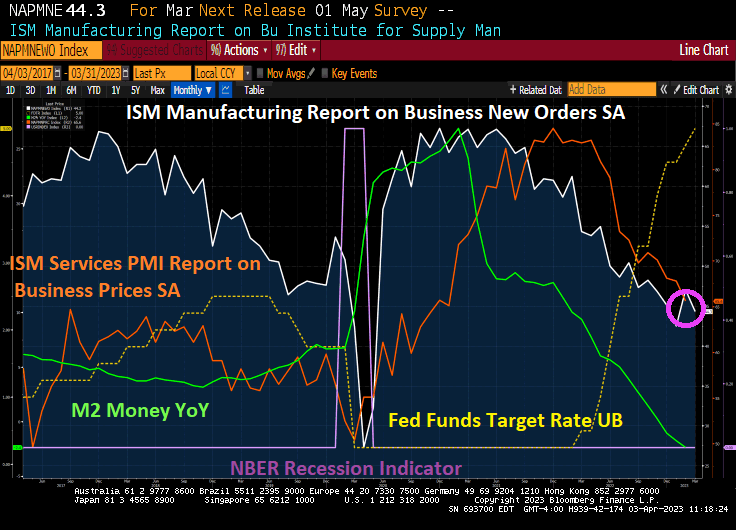
Not only did the ISM Manfacturimng Report on New Business Order fall to 44.3, but price PAID also fell as The Fed hikes rates (yellow line) and slowing M2 Money growth (green line).
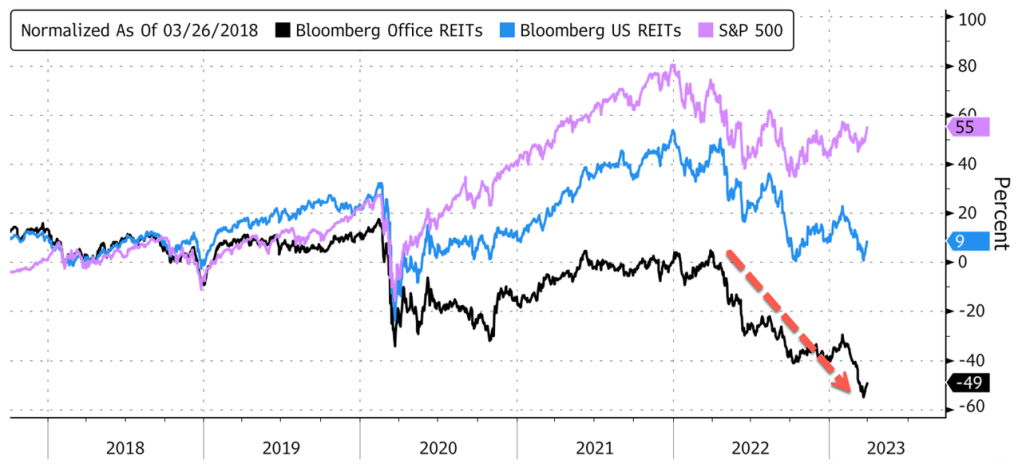
Office REITs are really hurting as Count Powellula sucks the blood (liquidity) from the market.
Count Powellula. “I vant to suck the blood from your economy.”
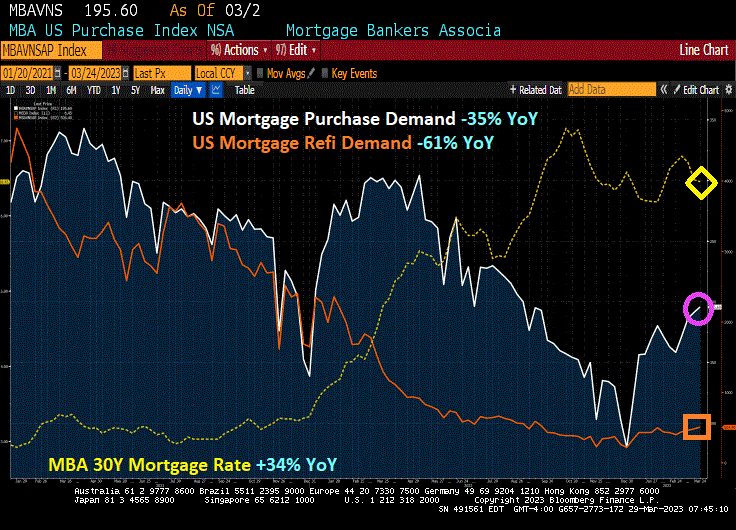
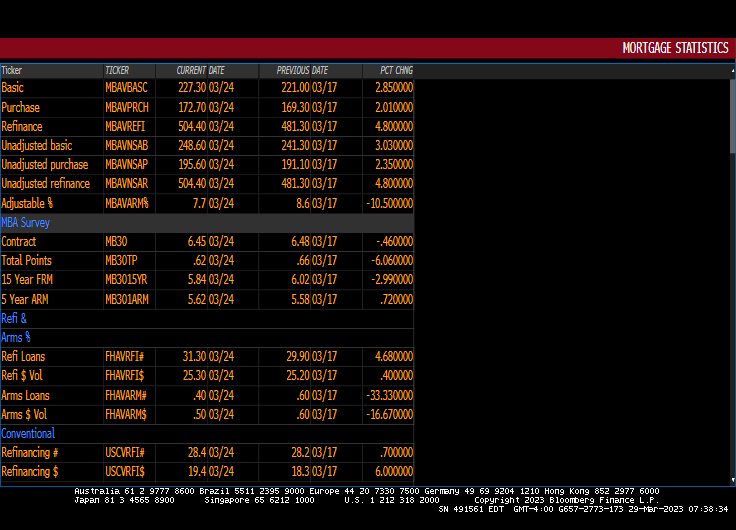
Well, the regional banking crisis has one positive outcome: mortgage rates dropped -46 basis points since last week. The result? Mortgage demand increased 2.9 percent week-over-week (WoW). Although I don’t recommend banking incompetence by bank management and “regulators” as a strategy to increase mortgage demand.
Mortgage applications increased 2.9 percent from one week earlier, according to data from the Mortgage Bankers Association’s (MBA) Weekly Mortgage Applications Survey for the week ending March 24, 2023.
The Market Composite Index, a measure of mortgage loan application volume, increased 2.9 percent on a seasonally adjusted basis from one week earlier. On an unadjusted basis, the Index increased 3 percent compared with the previous week. The Refinance Index increased 5 percent from the previous week and was 61 percent lower than the same week one year ago. The seasonally adjusted Purchase Index increased 2 percent from one week earlier. The unadjusted Purchase Index increased 2 percent compared with the previous week and was 35 percent lower than the same week one year ago.
The rest of the story.
We need a doctor to fix this mess, just not Dr. Yellen or Dr. Jill.
The US economy got beaten to a pulp by the Chinese Wuhan Covid virus outbreak in early 2020. The Fed intervened with massive money printing along with massive spending by Congress and the Administration. Result? 40-year highs in inflation and a Fed counterattack in terms of rate hikes.
The result of Fed rate hikes? Failing regional banks trying to cope with duration extention and scared depositors. And then we have the St Louis Fed Financial Stress index reaching its highest level since the Covid outbreak of early 2020. And with that, bond volatility is higher than that found during the Covid crisis.
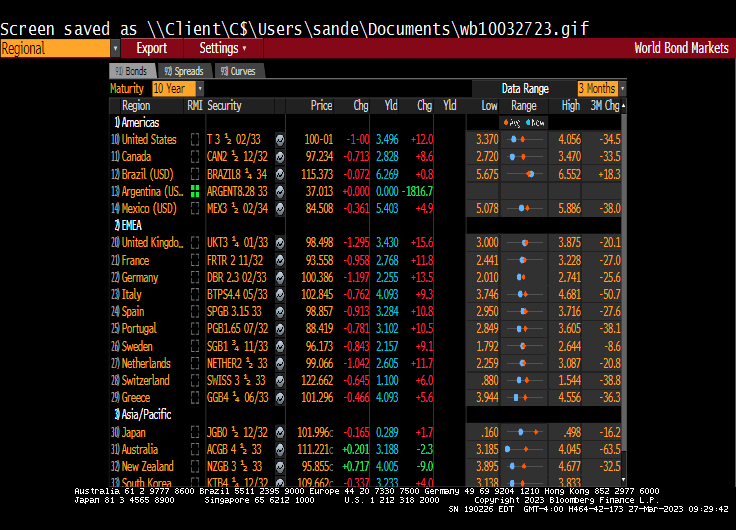
With the expectation of MORE rate hikes, the 10-year Treasury yield jumped 12 basis points.
The architect of The Fed’s “too long for too long” is also the US Treasury Secretary, Janet Yellen.
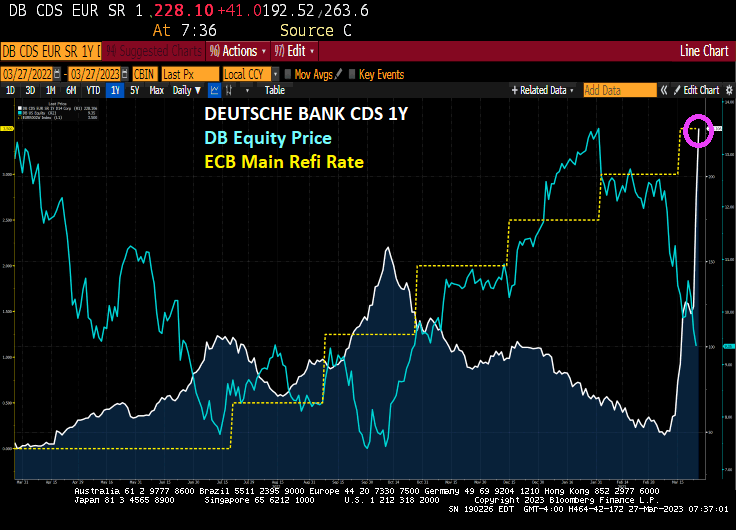
Are central banks like The Federal Reserve and European Central Bank ({ECB) sinking the banks?
Deutsche Bank, Germany’s largest bank (eerily like Germany’s World War II battleship The Bismarck) is seeing a blow out in its 1-year credit default swaps (CDS) as the ECB cranks up it main refinancing rate to fight inflation.
And then we have Deutsche’s Banks gross notional derivatives exposure (Euro 55.6 TRILLLION) dwarfing German GDP (Euro 2.7 Trillion). By a factor of greater than 20! Now, THAT’S a lot of derivatives exposure.
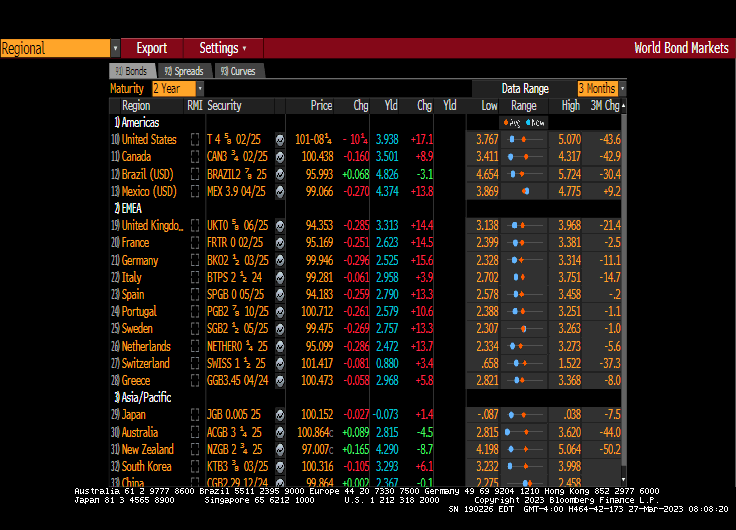
On the bond front (the NEW eastern front), we see the US Treasury 2-year yield rising 17.1 basis points. But European sovereign yields are up double digits as well (except for Italy).
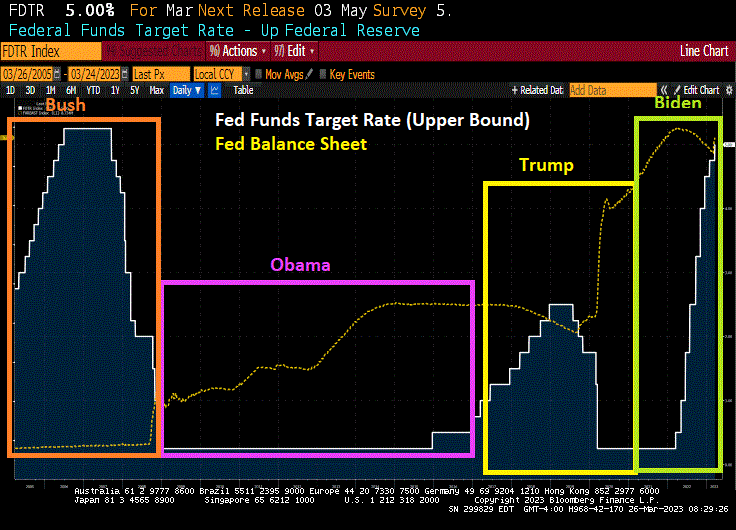
The Federal Reserve raised their target rate just once under President Obama until Donald Trump was elected. Then raised their target rate 8 times AFTER Trump was elected. In other words, Bernanke/Yellen kept the target rate near 0% for too long. When you throw the insane level of spending by Biden and Congress on top of the massive Fed stimulus. Now The Fed is trying to remove the excessive monetary stimulus by raising rates which is crushing banks.
Small bank reserces are low.
In any case, rate hikes are causing turmoil at small banks (as witnessed by the failures of SVB, Silvergate, First Republic and Signature Banks. Even worse, small banks hold 70% of commercial real estate loans.
Money managers have stepped up their bearish bets against office landlords, wagering that the US regional banking crisis will slash the availability of credit to property owners that were already suffering from the pandemic and rising interest rates.
Hedge funds are using credit derivatives and equities to bet against the companies and their debt. Almost 40% of shares in the iShares US Real Estate ETF are sold short, the highest proportion since June, according to data from analytics firm S3 Partners.
At Hudson Pacific Properties Inc., short interest reached a record 7.4% earlier this week before dropping to about 5% of shares outstanding, according to data compiled by IHS Markit Ltd. That’s almost double the level a month ago. For Vornado Realty LP, short interest is the highest since January.
Three regional banks have failed in the US, raising concerns about the implications for commercial real estate finance. Many lenders are losing deposits, which might cut into their ability to finance real estate in the future. Regional banks account for about 80% of bank lending to commercial properties, according to economists at Goldman Sachs Group Inc.
“What’s changed in the last few weeks is the credit markets,” said Rich Hill, chief of real estate strategy research at Cohen & Steers Capital Management Inc. “It went from a story of work-from-home and the impact on occupancy and the lack of rent growth to also the compounding of tighter financial conditions given everything happening with banks.”
Fears of tighter credit are adding to risks for offices that have been building for some time, Green Street analysts wrote in a Tuesday report. Hedge fund manager Jim Chanos, Marathon Asset Management and Polpo Capital Management founder Daniel McNamara are among those who have been betting for months that landlords will struggle to lure staff back to workplaces.
“This regional banking crisis is just throwing fuel on the fire,” McNamara said in a telephone interview. “I just don’t see a way out of this without a lot of pain in the office sector.”
Vulnerable Landlords
Real estate was already the most shorted industry across global equities, according to a March 17 report by S&P Global Inc. It was the third most-shorted sector in the US.
That’s in part because interest rates have been climbing for the last year, which pressures real estate owners. Defaults remain low for now. But office assets are the collateral for about $100 billion of the $400 billion of US commercial real estate debt maturing this year, according to MSCI Real Assets.
Workplaces worth nearly $40 billion face a higher probability of distress, more than apartments, hotels, malls or any other type of commercial real estate, MSCI said on Wednesday. Almost $20 billion of office loans that were bundled into commercial mortgage-backed securities and are due to mature by the end of next year are already potentially distressed, Moody’s Investors Service estimates.
Credit availability for commercial real estate was already challenged this year as investors have grown less interested in buying commercial mortgage bonds, JPMorgan Chase & Co. analysts including Chong Sin wrote in a note. Sales of CMBS deals without government backing have fallen more than 80% this year, according to data compiled by Bloomberg News.
Smaller banks potentially retreating may bring a credit crunch to smaller markets, the JPMorgan analysts wrote.
Lenders advanced a record $862 billion to commercial real estate last year, a 15% increase from a year prior, data provider Trepp estimates. Much of that was driven by banks, which originated 50% more loans in the period. The pace of growth has slowed since then, Federal Reserve data show, as the outlook for real estate grows increasingly negative.
The pressure on offices means lending standards are now being tightened, bad news for landlords that have high levels of leverage and putting lenders at a higher risk of defaults.
“Recent developments have increased downside risk to commercial real estate values from expectations of tightening lending standards,” Morgan Stanley analysts including Ronald Kamdem wrote in a note on Monday. Office REITs may have to sell assets to help them successfully refinance, they said.
Shorts soared on office landlords last year as rising interest rates weighed on the industry. They dropped subsequently as investors wagered that borrowing benchmarks would top out at a lower level than initially expected or the Federal Reserve would begin to cut the rates earlier than previously expected.
Cohen & Steers, which oversees about $80 billion, including $48 billion in real estate investments, went under weight on offices during the pandemic and will steer clear until the market shows signs of hitting a floor.
“I actually want to see more signs of weakness,” Hill said. “The more headlines I see that things are really, really bad, the closer I think we are to the end.”
Chanos Short
Chanos said on CNBC in January that he had been betting against SL Green Realty Corp., short interest in which reached the highest since the financial crisis in recent days. The landlord’s assets include a New York building occupied by Credit Suisse Group AG, the lender taken over by UBS Group AG after government-brokered talks. Short sellers borrow stock and sell it, planning to profit by buying it back at a lower price later.
An SL Green spokesperson directed Bloomberg to company comments at a March 6 investor conference, before the recent bank failures.
The landlord plans to sell $2 billion of properties, cut its debt by $2.5 billion and refinance a $500 million mortgage, Chairman and CEO Marc Holliday said at the Citigroup Inc. conference. Because the securitization market and life insurance financing weren’t receptive to deals, the firm is dependent on banks, which were already an uphill challenge.
“Banks are more likely to say no these days than to execute,” Holliday said. “Knock on wood, hopefully we can get that done.”
Mark Lammas, president of Hudson Pacific, said in an emailed statement that the firm is confident in its business fundamentals and long-term prospects. The company is investment-grade, a majority of its assets are unencumbered, it has $1 billion of liquidity, and no material debt maturities until 2025, Lammas said.
Chanos and representatives of Vornado and Boston Properties didn’t immediately reply to requests for comment.
‘The Widowmaker’
Hedge funds have also been using credit-default swaps indexes known as CMBX to bet against CMBS that are most exposed to offices. The derivatives are tied to portions of bonds backed by commercial mortgages and a number of them reached a record low this week amid fears about a number of regional banks.
Betting against commercial real estate has historically been a hard way to make money, because it can take a long time for losses to emerge, and the range of possible outcomes for even troubled property can be wide. “Shorting CMBX BBB- is regarded as the widowmaker — the undoing of many a young trader’s career,” Morgan Stanley trader Kamil Sadik wrote in a March 6 note.
But the spate of bad news means the BBB- portion of the 14th CMBX index is at the lowest level ever and the same part of the 13th index is at its lowest since the pandemic in 2020. Similar declines are also being seen in share prices of office landlords.
“Our conversation with investors suggests that there has been some capitulation and forced selling as the stocks have continued to underperformed,” Morgan Stanley analysts led by Kamdem wrote.
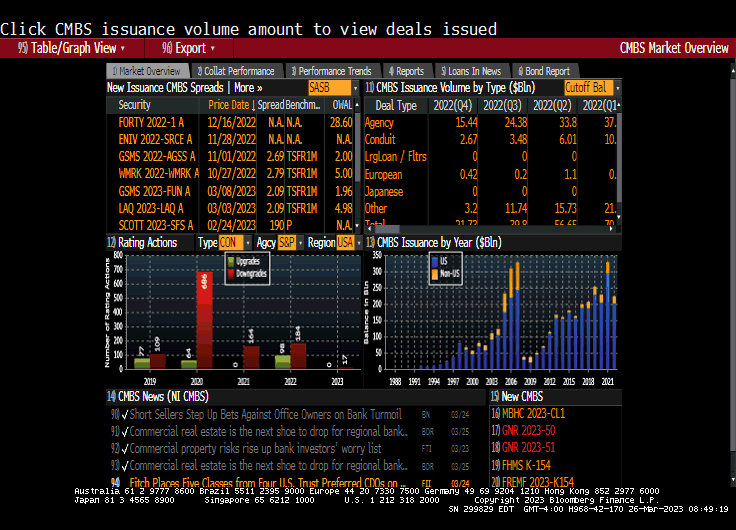
So far in 2023, there has been 17 downgrades of CMBS deals with no upgrades.
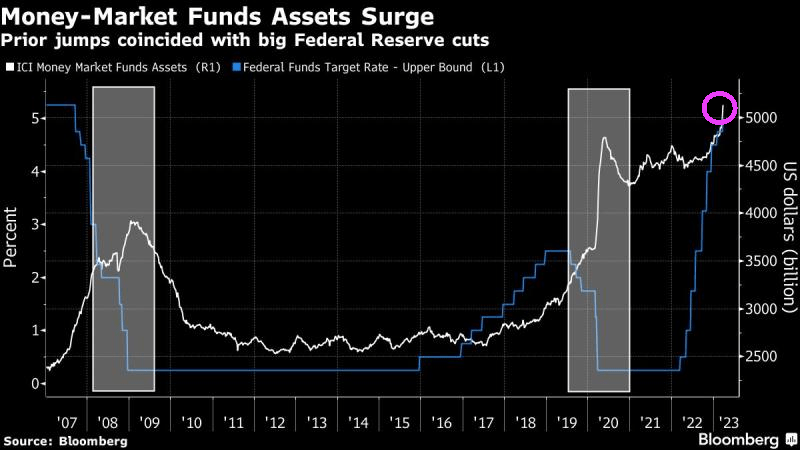
Investors are fleeing to money market funds as The Fed hits the brakes.
As The Fed attempts to fight inflation, rates are rising. Consequently, deposits are all commercial banks are falling.
The Fed just released its weekly commercial bank data dump showing deposit inflows/outflows.
Two things to note:
1) This is for the week up to 3/15/23 (which includes the SVB collapse but nothing more)
2) ‘Large Banks’ includes the top 25 banks (which means SVB was among that group, hence, we get no indication of SVB rotation flows)
The overall data shows that domestic commercial banks saw over $98 billion in deposit outflows (seasonally-adjusted) that week to just over $17.5 trillion (8th straight week of aggregate outflows).
Source: Bloomberg
That is the largest (seasonally-adjusted) outflow since April 2022 (tax-related?) as we suspect much of that flowed into money-markets. Deposits have been on a steady decline over the past year or so, falling $582.4 billion since February 2022.
There was a notable rotation however with the large banks seeing deposit inflows of $117.9 billion on a non-seasonally-adjusted basis (the biggest weekly inflow since Dec 2021).
Small banks, on the hand, saw a massive $111 billion outflow (non-seasonally-adjusted)…
Source: Bloomberg (note different scales)
That is the largest weekly outflow ever (by multiples) and drops ‘small bank’ total deposits to the lowest since Sept 2021…
Source: Bloomberg
Bear in mind this data does not include the last 10 days, where we have US regional banks all tumbling further and Yellen offering no guaranteed deposits, FRC stock collapse amid bailouts (though that will skew the data due to that $30bn infusion), and the fear of Credit Suisse’s collapse.
Will banks start to compete for deposits? (Well not the biggest ones, for sure)…
















 Confounded Interest - Anthony B. Sanders
You must be logged in to post a comment.