Jamie Dimon Warns US Banking Crisis Will Be Felt for Years, Regulators Didn’t Stress Test Rate Hikes! (This One’s Gonna Hurt Us)

JPMorgan Chase’s Jaime Dimon is channeling country crooners Marty Stuart and Travis Tritt by warbling “This One’s Gonna Hurt You (For A Long, Long Time).”

Silicon Valley Bank’s blunders were encouraged by US regulation, went untested by the Federal Reserve and were “hiding in plain sight” until Wall Street and depositors grew alarmed.

That’s JPMorgan Chase & Co. Chief Executive Officer Jamie Dimon’s assessment of the US banking crisis that sent markets careening last month, an episode he predicts is “not yet over” and will be felt for years. He said US authorities shouldn’t “overreact” with more rules.

In his wide-ranging annual letter to shareholders on Tuesday, Dimon described his firm’s aspirations for using artificial intelligence and ChatGPT, weighed in on geopolitics, and provided updates on JPMorgan’s activities in Ohio. This time, many of his sharpest remarks ripped at regulation, including capital rules that pushed banks to binge on low-interest assets that lost value as interest rates shot up.

“Ironically, banks were incented to own very safe government securities because they were considered highly liquid by regulators and carried very low capital requirements,” Dimon said. “Even worse,” he added, the Federal Reserve didn’t stress-test banks on what would happen as rates jumped.

When Silicon Valley Bank’s uninsured depositors realized it was losing money selling securities to keep up with withdrawal requests, they raced to pull their cash. Regulators then intervened and seized it.

Yes. Banking regulators were so focused on credit-exposure of banks (remember the subprime crisis of 2008?) that they really screwed up by having banks load-up on low credit-risk assets that usually have interest rate risk associated with them like Treasuries and mortgage-backed securities (MBS). What could go wrong?

What went wrong was that interest rates rose and unrealized losses on Treasuries and Agency MBS exploded.
Here is a chart of urealized losses on investment securities that banks have accumulated.

Apparently, The Fed and FDIC (and the myriad of Federal and State regulators) sit high on a mountain top and ignore interest rate risk.

The face of regulatory stupidity.

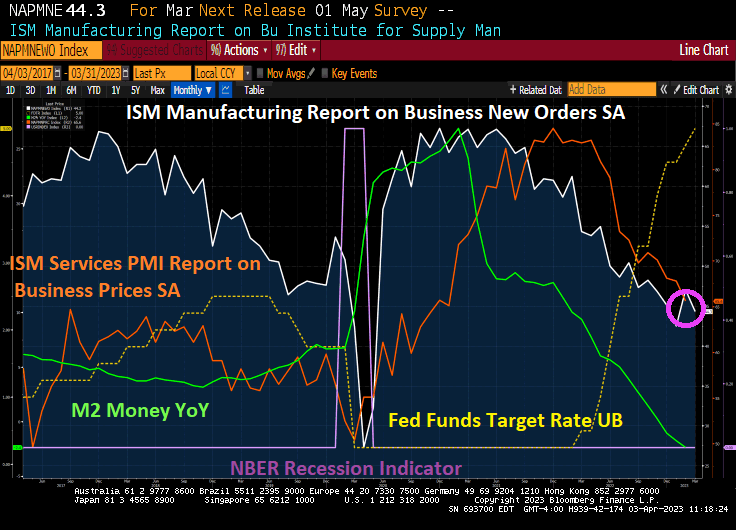
Recesion Alert? ISM Manufacturing New Orders Sinks To 44.3 In March (Lower Than During Trump) As Count Powellula Sucks Blood From Economy

Not only did the ISM Manfacturimng Report on New Business Order fall to 44.3, but price PAID also fell as The Fed hikes rates (yellow line) and slowing M2 Money growth (green line).

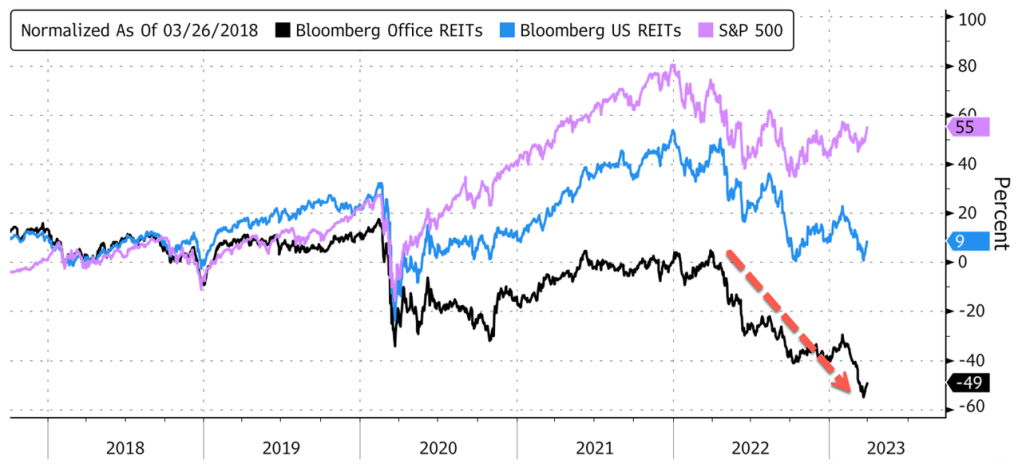
Office REITs are really hurting as Count Powellula sucks the blood (liquidity) from the market.

Count Powellula. “I vant to suck the blood from your economy.”

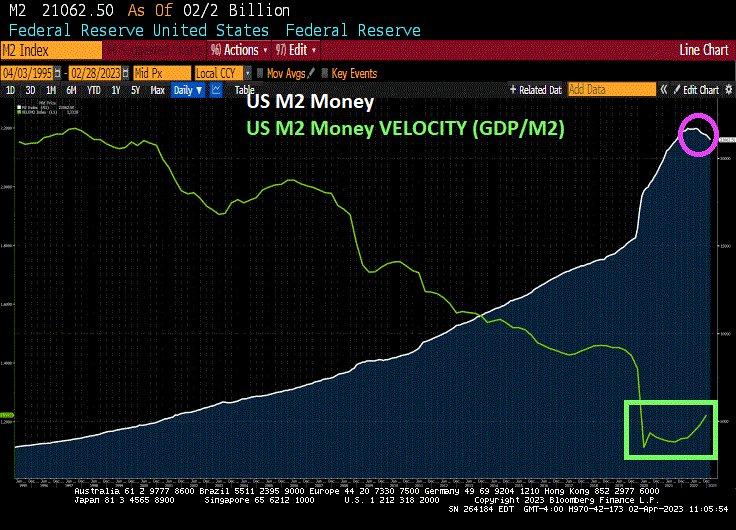
Sparkless! M2 Money Growth Crashes To -3.13% YoY As Fed Slams On Monetary Brakes To Fight TLFTL (Too Low For Too Long) Policies And Insane Federal Spending Spree (Fed Funds Effective Rate UP >5,000% YoY)

I love how the Supernatural character Dick Roman, a Levianthan, referred to Joe Biden as replaceable and having no spark. BUT Biden, Pelosi and Schumer did go on a historic spending spree helping to create massive inflation (so Biden and the gang did spark inflation).

To show you how Yellen/Powell’s Too Low For Too Long (TLFTL) monetary polices coupled with Biden/Pelosi/Schumer’s (add McConnell to this foul-smelling witches’ brew), Powell and The Gang (aka, The Fed) slammed on the monetary brakes. On a year-over-year basis, M2 Money growth has crashed tl -3.13%. The shocking number is The Fed Fund Effective Rate which rose over 5,000% YoY.

Actually, the US has been on a money printing spree since 1995, but it was Covid spending and monetary expansion in 2020 that crushed M2 Money Velocity (GDP/M2).

Here is Supernatural’s Leviathan monster Dick Roman handing an award to sparkless President Joe Biden. But Biden did spark massive inflation that crushed the US middle class and low wage workers.

US Consumer Confidence Dips To 62 In March, Never The Same After Covid And Joe Biden (UMich Buying Conditions For Houses Dips To 47 As Fed Withdraws Stimulus … For The Moment)

Well, the University of Michigan consumer sentiment indices are out for March … and they are ugly.

As a baseline, consumer confidence in February 2020 (just before Covid) was 101. After Covid and massive Fed stimulus and Federal government spending spree, consumer confidence in March fell to 62.0, a far cry from 101 under Trump.

Even worse, the UMich buying conditions for housing hit 142 in February 2020 but has declined to 47 in March 2023.

Why would ANYONE have confidence in the US economy under a complete fool with dementia like “China Joe” Biden??

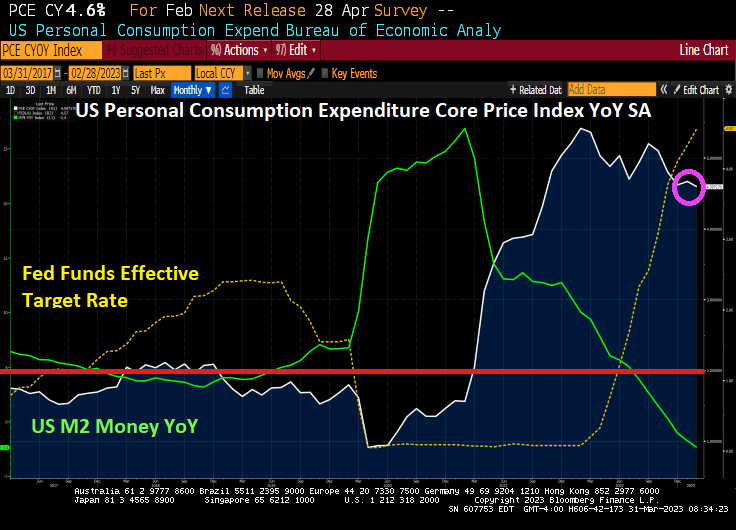
Inflation Slows A Little (Core PCE Price Growth 4.6% YoY) In February, But Remains High Despite Fed Withdrawal (Is US A Failed State?)

Inflation is slowing just a little. But my feeling about The Fed (that partly caused the problem in the first place by keeping rates too low for too long (TLTL) under Yellen is all I can do is laugh.

The US Core Deflator (Personal Consumption Expenditure CORE PRICE Index YoY fell only slightly in February to a still-high 4.6% in February despite The Fed jacking up interest rates and slowing M2 Money growth.

I thought Biden and Congress passed the inflation reduction act??

I forgot. Under Obama/Biden, the US is now a failed state. Or a banana republic without bananas. Way to go Joe!

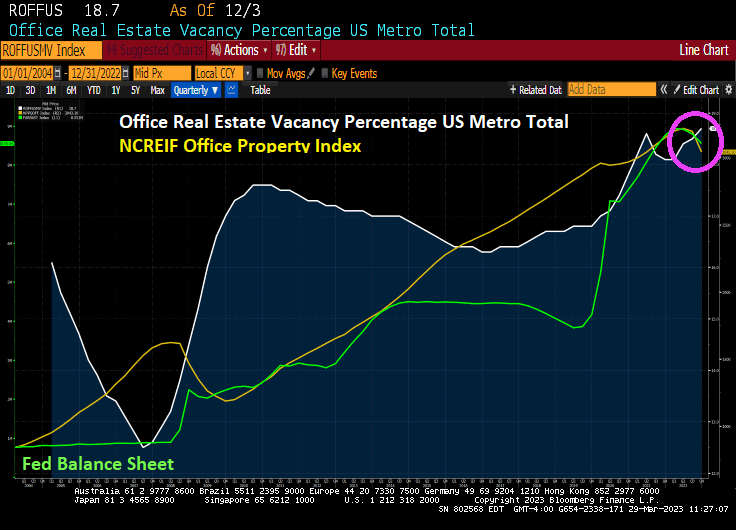
US Office Vacancies Hit All-Time High As Office Property Prices Decline (Fed Retreats)

US metro office vacancies hit an all-time high in Q4 2022 and office properties values began to decline as The Fed retreats as it fights inflation.

So much money printing. Its The Fed’s claim to fame.

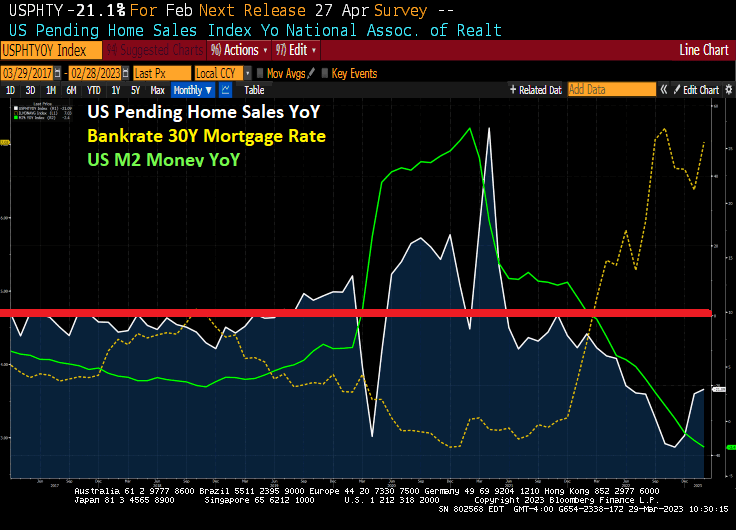
US Pending Home Sales Increased 0.8% in February But Down 21.1% Year-over-year As Fed Retreats (Negative YoY Growth For 20 Of Last 21 Months)

Pending home sales grew in February for the third consecutive month, according to the National Association of REALTORS®. Three U.S. regions posted monthly gains, while the West declined. All four regions saw year-over-year decreases in transactions.

The Pending Home Sales Index (PHSI)* — a forward-looking indicator of home sales based on contract signings — improved 0.8% to 83.2 in February. Year-over-year, pending transactions dropped by 21.1%. An index of 100 is equal to the level of contract activity in 2001.

More notably, the YoY growth rate has been NEGATIVE for 20 of the last 21 months. And 15 straight months.

Biden’s energy policies + insane Federal spending = inflation = Fed slowing M2 Money growth. Hence, pending home sales YoY is down -21.1%.

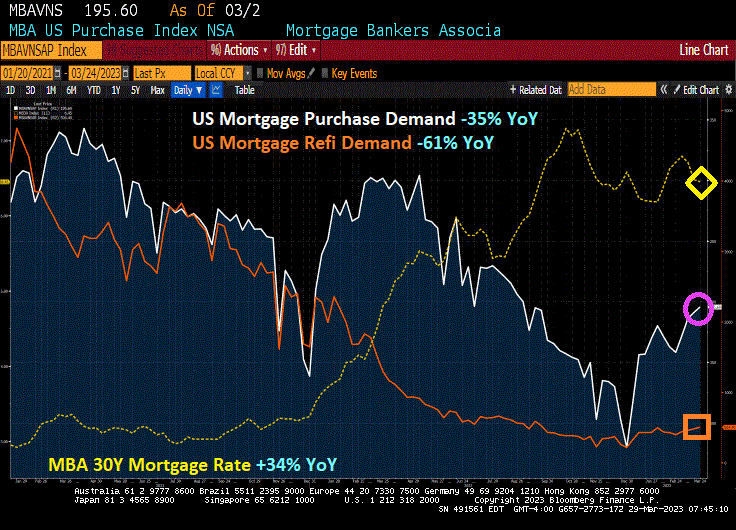
US Mortgage Demand Rises 2.9% Since Last Week, But Purchase Demand DOWN -35% Since Last Year (Refi Demand DOWN -61% YoY)

Well, the regional banking crisis has one positive outcome: mortgage rates dropped -46 basis points since last week. The result? Mortgage demand increased 2.9 percent week-over-week (WoW). Although I don’t recommend banking incompetence by bank management and “regulators” as a strategy to increase mortgage demand.

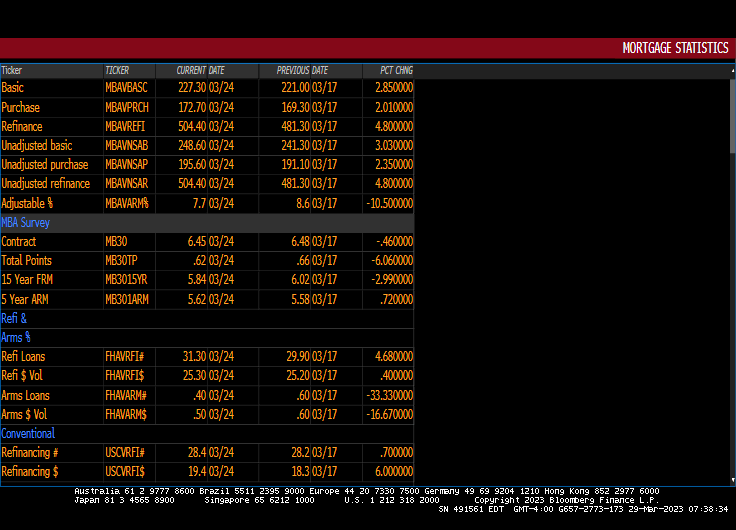
Mortgage applications increased 2.9 percent from one week earlier, according to data from the Mortgage Bankers Association’s (MBA) Weekly Mortgage Applications Survey for the week ending March 24, 2023.

The Market Composite Index, a measure of mortgage loan application volume, increased 2.9 percent on a seasonally adjusted basis from one week earlier. On an unadjusted basis, the Index increased 3 percent compared with the previous week. The Refinance Index increased 5 percent from the previous week and was 61 percent lower than the same week one year ago. The seasonally adjusted Purchase Index increased 2 percent from one week earlier. The unadjusted Purchase Index increased 2 percent compared with the previous week and was 35 percent lower than the same week one year ago.

The rest of the story.

We need a doctor to fix this mess, just not Dr. Yellen or Dr. Jill.

Conference Board Consumer Confidence Remains Much Lower Than Pre-Covid (Massive Federal Spending Spree And Fed Money Printing Failed To Return Consumer Confidence)

Consumer considence (according to the Conference Board) remains below pre-Covid levels despite the massive Federal spending spree and Fed money printing).

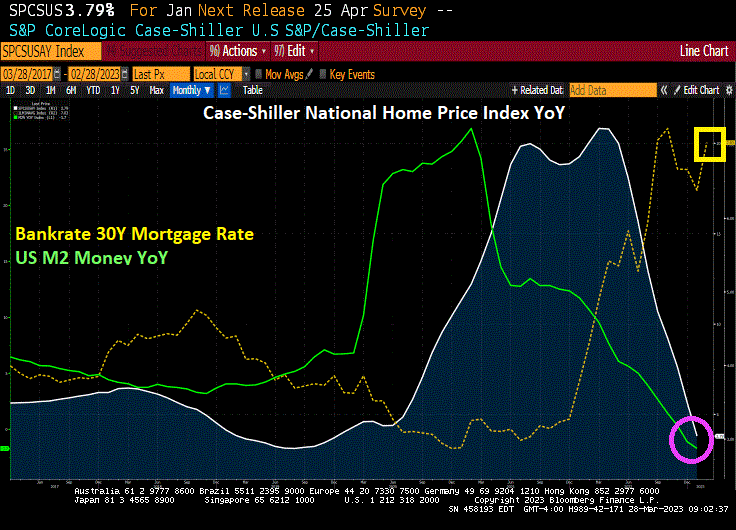
Case-Shiller January Home Prices Slow To 3.79% YoY As Fed Retreats (All 20 Metro Areas Decline MoM With Seattle And Las Vegas Declining The Fastest)

The Federal Reserve is in retreat and housing prices reflect the retreat.

Case-Shiller’s national home price index slowed to 3.79% YoY in January as The Fed slows its money printing.

All 20 cities were down MoM in January with Seatlle declining the fastest with Las Vegas the second fastest decliner.

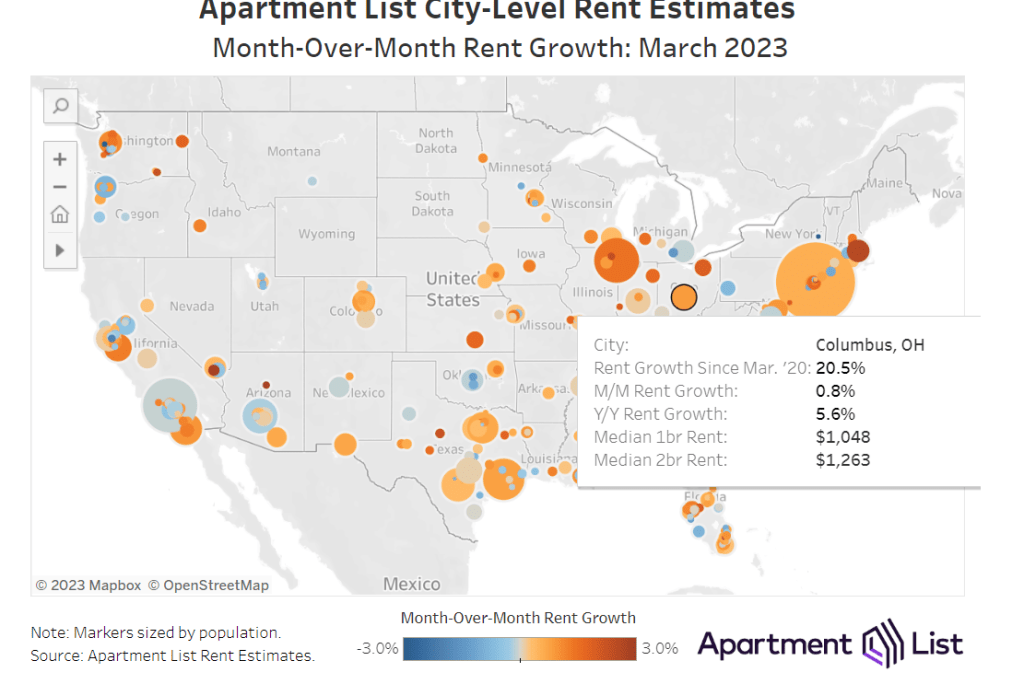
According to ApartmentList.com, apartment rents are up 20.5% YoY in Columbus Ohio (where I live).

Both Miami and Tampa are in double-digit YoY gains in housing prices.