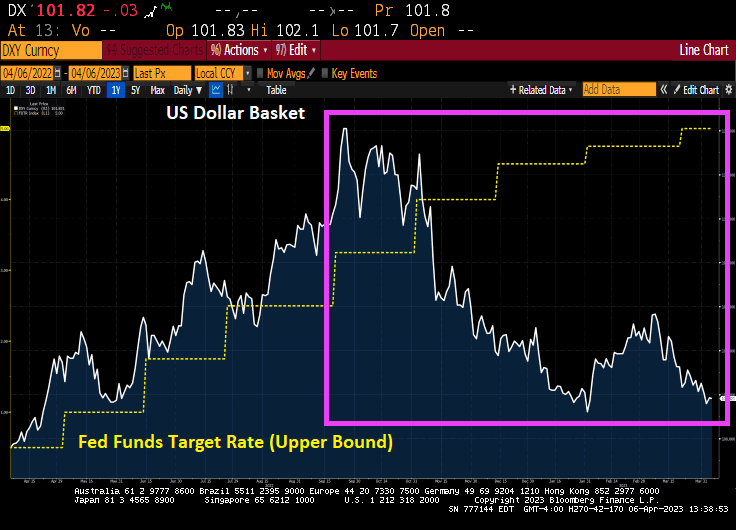
Biden, The Federal Reserve and insane Federal spending are killing King Dollar. Countries that used to use the US Dollar as reserve currency are dumping the dollar like a month old burrito.
What countries are dumping the dollar?
A lengthy list of countries are moving away from using the US dollar, which has long been the reserve currency of the world. The following countries are in the process of reducing their dependency on the dollar.
Russia
China
Iran
Brazil
Argentina
Saudi Arabia
UAE
India
The result?
Biden has vacationed 40% of the days he has been President. In his defense, he has probably needed that time to hunt down the classified documents has left strewn around his his home, vacation home, the Penn-Biden Center and Chinatown in DC.
We are truly addicted to gov! Or at least cheap money from The Federal Reserve.
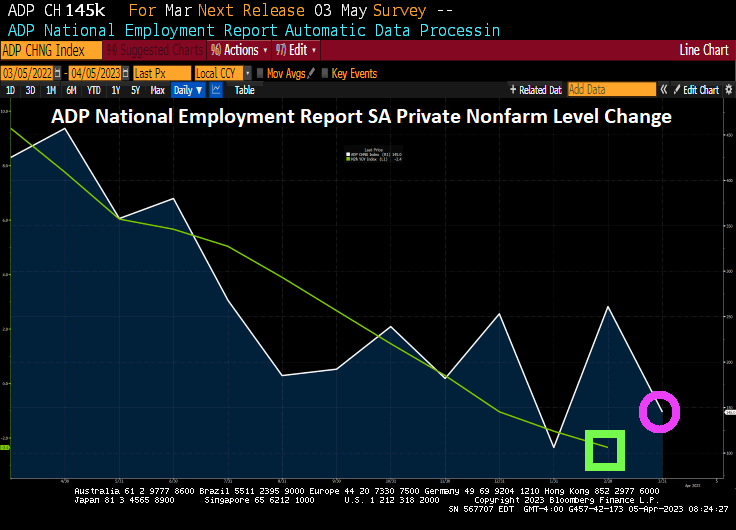
March’s ADP job report shows the US economy only added 145k jobs as The Fed removes its punch bowl. For the moment.
Its simply irresistable for the government to turn back on the printing press.
And then we have domestic banks reporting stronger demand for C&I Loans and real estate loan (for construction and development purposes) slumping to financial crisis lows.
Silicon Valley Bank’s blunders were encouraged by US regulation, went untested by the Federal Reserve and were “hiding in plain sight” until Wall Street and depositors grew alarmed.
That’s JPMorgan Chase & Co. Chief Executive Officer Jamie Dimon’s assessment of the US banking crisis that sent markets careening last month, an episode he predicts is “not yet over” and will be felt for years. He said US authorities shouldn’t “overreact” with more rules.
In his wide-ranging annual letter to shareholders on Tuesday, Dimon described his firm’s aspirations for using artificial intelligence and ChatGPT, weighed in on geopolitics, and provided updates on JPMorgan’s activities in Ohio. This time, many of his sharpest remarks ripped at regulation, including capital rules that pushed banks to binge on low-interest assets that lost value as interest rates shot up.
“Ironically, banks were incented to own very safe government securities because they were considered highly liquid by regulators and carried very low capital requirements,” Dimon said. “Even worse,” he added, the Federal Reserve didn’t stress-test banks on what would happen as rates jumped.
When Silicon Valley Bank’s uninsured depositors realized it was losing money selling securities to keep up with withdrawal requests, they raced to pull their cash. Regulators then intervened and seized it.
Yes. Banking regulators were so focused on credit-exposure of banks (remember the subprime crisis of 2008?) that they really screwed up by having banks load-up on low credit-risk assets that usually have interest rate risk associated with them like Treasuries and mortgage-backed securities (MBS). What could go wrong?
What went wrong was that interest rates rose and unrealized losses on Treasuries and Agency MBS exploded.
Here is a chart of urealized losses on investment securities that banks have accumulated.
Apparently, The Fed and FDIC (and the myriad of Federal and State regulators) sit high on a mountain top and ignore interest rate risk.
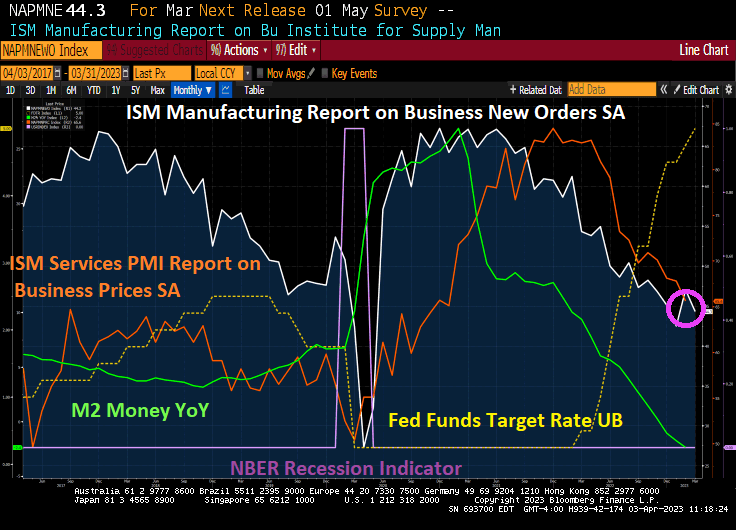
Not only did the ISM Manfacturimng Report on New Business Order fall to 44.3, but price PAID also fell as The Fed hikes rates (yellow line) and slowing M2 Money growth (green line).
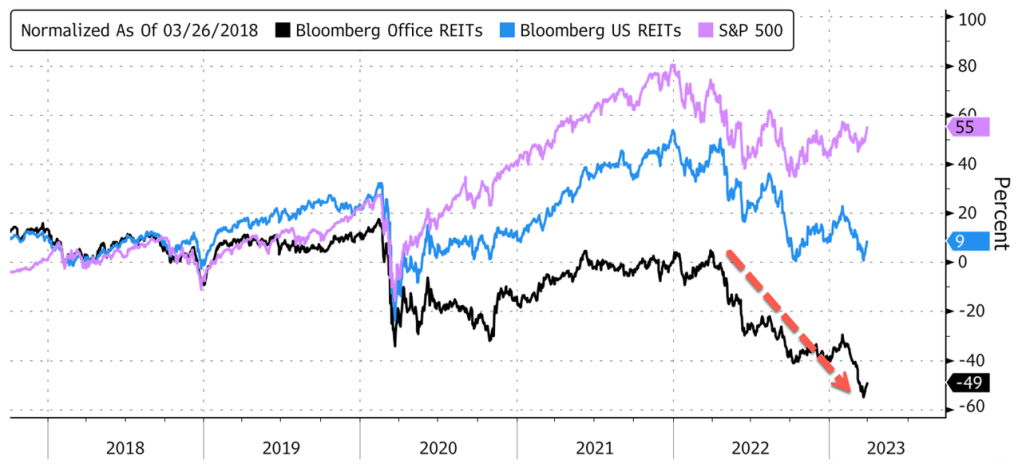
Office REITs are really hurting as Count Powellula sucks the blood (liquidity) from the market.
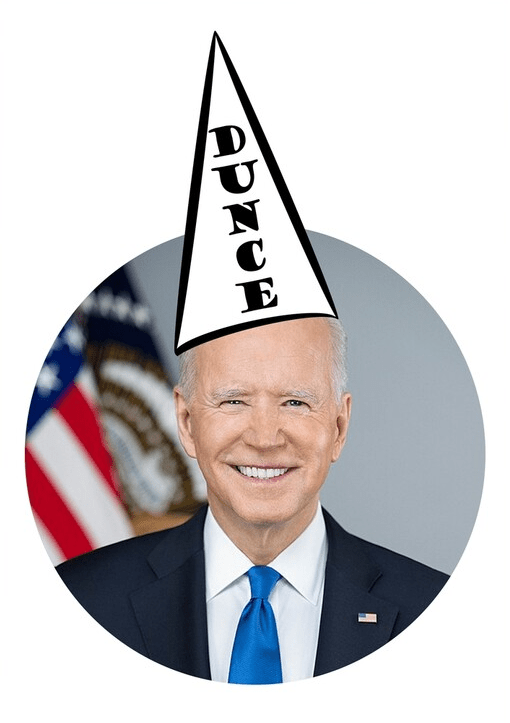
Count Powellula. “I vant to suck the blood from your economy.”
Well, the University of Michigan consumer sentiment indices are out for March … and they are ugly.
As a baseline, consumer confidence in February 2020 (just before Covid) was 101. After Covid and massive Fed stimulus and Federal government spending spree, consumer confidence in March fell to 62.0, a far cry from 101 under Trump.
Even worse, the UMich buying conditions for housing hit 142 in February 2020 but has declined to 47 in March 2023.
Why would ANYONE have confidence in the US economy under a complete fool with dementia like “China Joe” Biden??
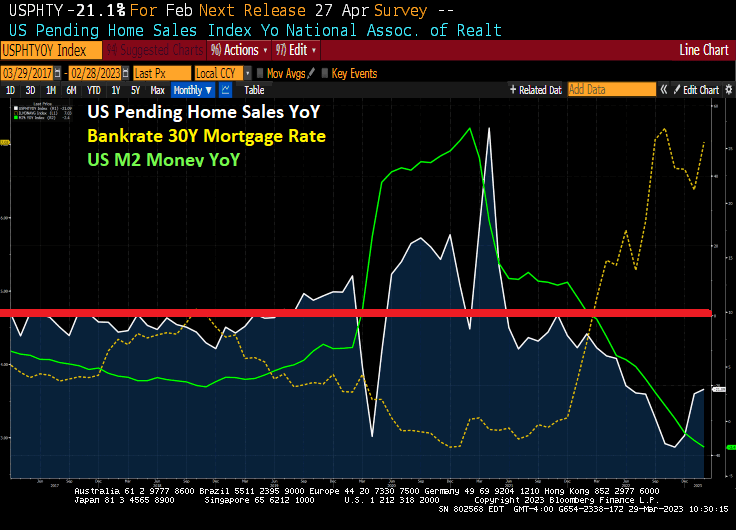
Pending home sales grew in February for the third consecutive month, according to the National Association of REALTORS®. Three U.S. regions posted monthly gains, while the West declined. All four regions saw year-over-year decreases in transactions.
The Pending Home Sales Index (PHSI)* — a forward-looking indicator of home sales based on contract signings — improved 0.8% to 83.2 in February. Year-over-year, pending transactions dropped by 21.1%. An index of 100 is equal to the level of contract activity in 2001.
More notably, the YoY growth rate has been NEGATIVE for 20 of the last 21 months. And 15 straight months.
Biden’s energy policies + insane Federal spending = inflation = Fed slowing M2 Money growth. Hence, pending home sales YoY is down -21.1%.
Consumer considence (according to the Conference Board) remains below pre-Covid levels despite the massive Federal spending spree and Fed money printing).
The US economy got beaten to a pulp by the Chinese Wuhan Covid virus outbreak in early 2020. The Fed intervened with massive money printing along with massive spending by Congress and the Administration. Result? 40-year highs in inflation and a Fed counterattack in terms of rate hikes.
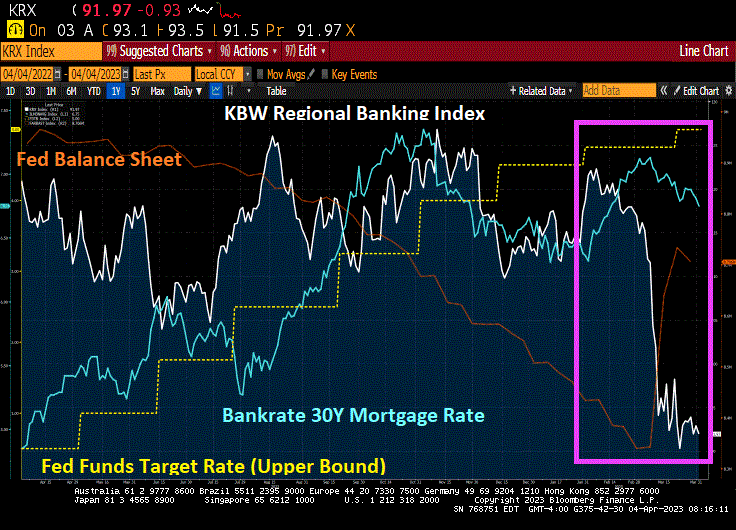
The result of Fed rate hikes? Failing regional banks trying to cope with duration extention and scared depositors. And then we have the St Louis Fed Financial Stress index reaching its highest level since the Covid outbreak of early 2020. And with that, bond volatility is higher than that found during the Covid crisis.
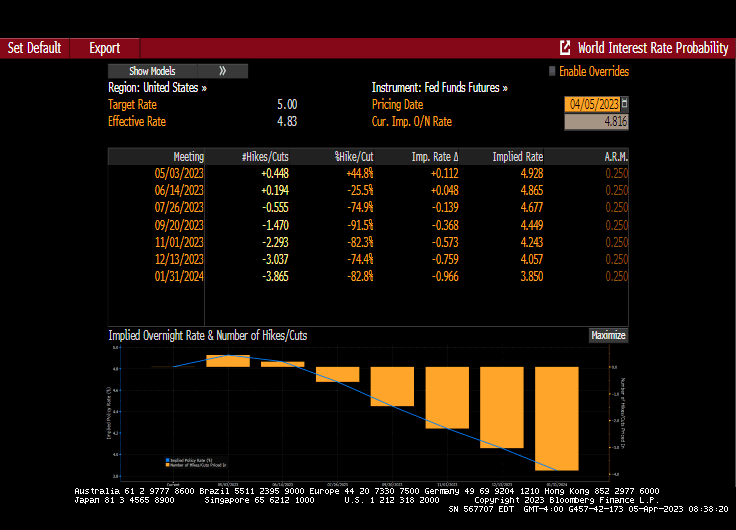
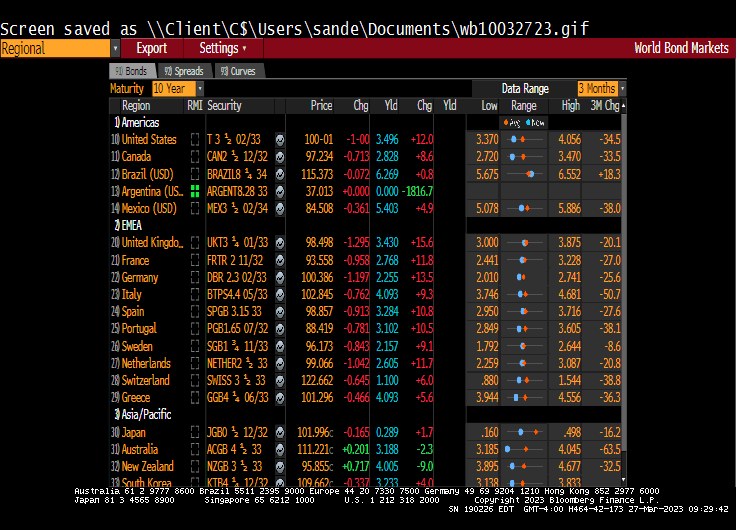
With the expectation of MORE rate hikes, the 10-year Treasury yield jumped 12 basis points.
The architect of The Fed’s “too long for too long” is also the US Treasury Secretary, Janet Yellen.
Are central banks like The Federal Reserve and European Central Bank ({ECB) sinking the banks?
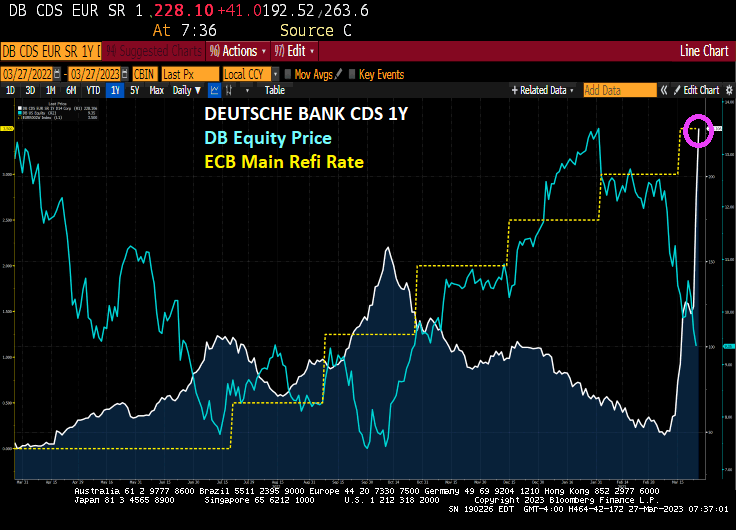
Deutsche Bank, Germany’s largest bank (eerily like Germany’s World War II battleship The Bismarck) is seeing a blow out in its 1-year credit default swaps (CDS) as the ECB cranks up it main refinancing rate to fight inflation.
And then we have Deutsche’s Banks gross notional derivatives exposure (Euro 55.6 TRILLLION) dwarfing German GDP (Euro 2.7 Trillion). By a factor of greater than 20! Now, THAT’S a lot of derivatives exposure.
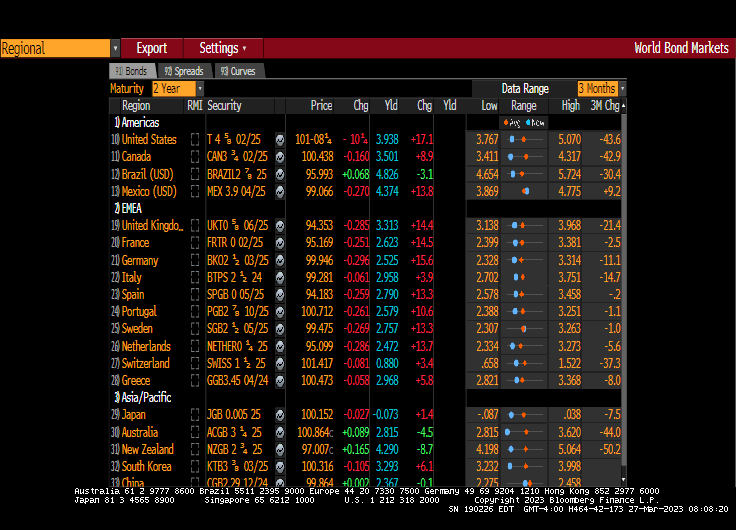
On the bond front (the NEW eastern front), we see the US Treasury 2-year yield rising 17.1 basis points. But European sovereign yields are up double digits as well (except for Italy).
As The Fed attempts to fight inflation, rates are rising. Consequently, deposits are all commercial banks are falling.
The Fed just released its weekly commercial bank data dump showing deposit inflows/outflows.
Two things to note:
1) This is for the week up to 3/15/23 (which includes the SVB collapse but nothing more)
2) ‘Large Banks’ includes the top 25 banks (which means SVB was among that group, hence, we get no indication of SVB rotation flows)
The overall data shows that domestic commercial banks saw over $98 billion in deposit outflows (seasonally-adjusted) that week to just over $17.5 trillion (8th straight week of aggregate outflows).
Source: Bloomberg
That is the largest (seasonally-adjusted) outflow since April 2022 (tax-related?) as we suspect much of that flowed into money-markets. Deposits have been on a steady decline over the past year or so, falling $582.4 billion since February 2022.
There was a notable rotation however with the large banks seeing deposit inflows of $117.9 billion on a non-seasonally-adjusted basis (the biggest weekly inflow since Dec 2021).
Small banks, on the hand, saw a massive $111 billion outflow (non-seasonally-adjusted)…
Source: Bloomberg (note different scales)
That is the largest weekly outflow ever (by multiples) and drops ‘small bank’ total deposits to the lowest since Sept 2021…
Source: Bloomberg
Bear in mind this data does not include the last 10 days, where we have US regional banks all tumbling further and Yellen offering no guaranteed deposits, FRC stock collapse amid bailouts (though that will skew the data due to that $30bn infusion), and the fear of Credit Suisse’s collapse.
Will banks start to compete for deposits? (Well not the biggest ones, for sure)…














You must be logged in to post a comment.