Addicted To Gov? Government Worker Wage Growth Hits Record High As Savings Rate Falls To 3.7% (Acyclical Core PCE inflation Remains Extremely High)

Americans are addicted to gov. And government is addicted to spending (and creating more debt).
Let’s look at wage growth for government apparatchiks relative to private sector workers. While wage growth overall was modest, it is government wage growth that is driving it – now at a record high!

Source: Bloomberg

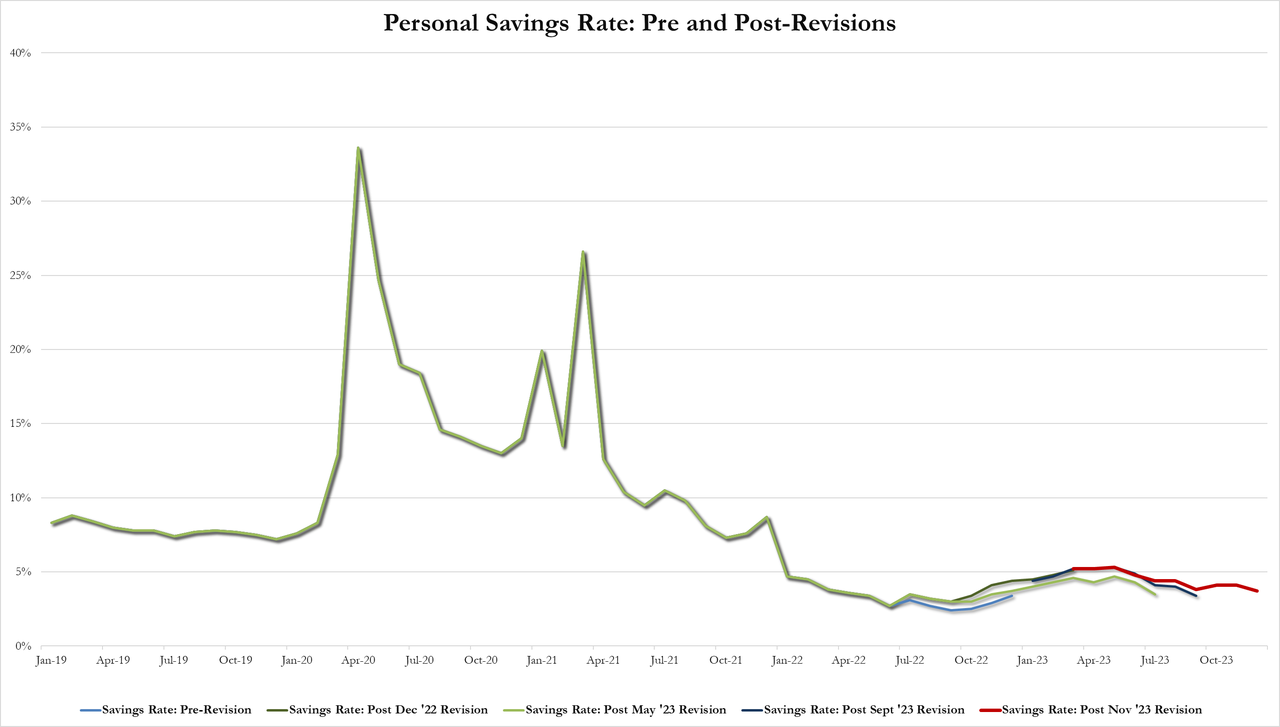
And on the back of that, the savings rate tumbled from 4.1% of DPI to 3.7%…

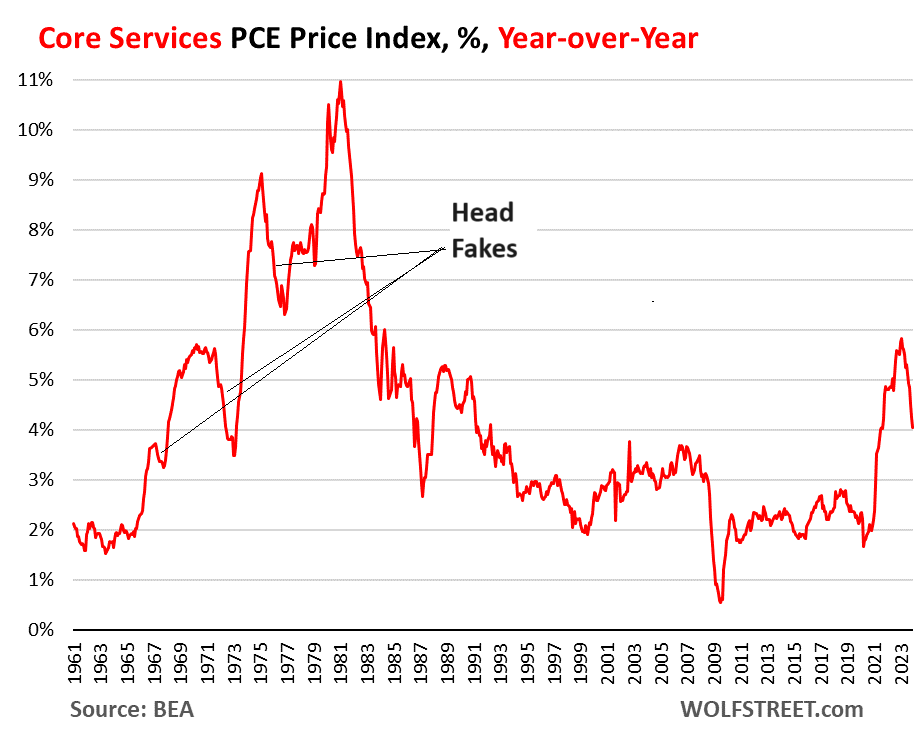
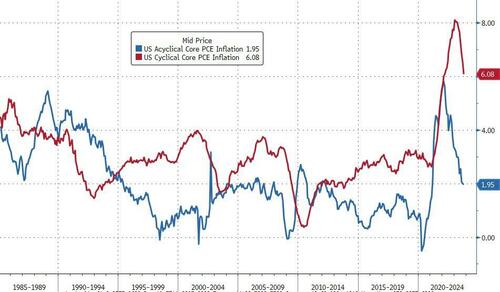
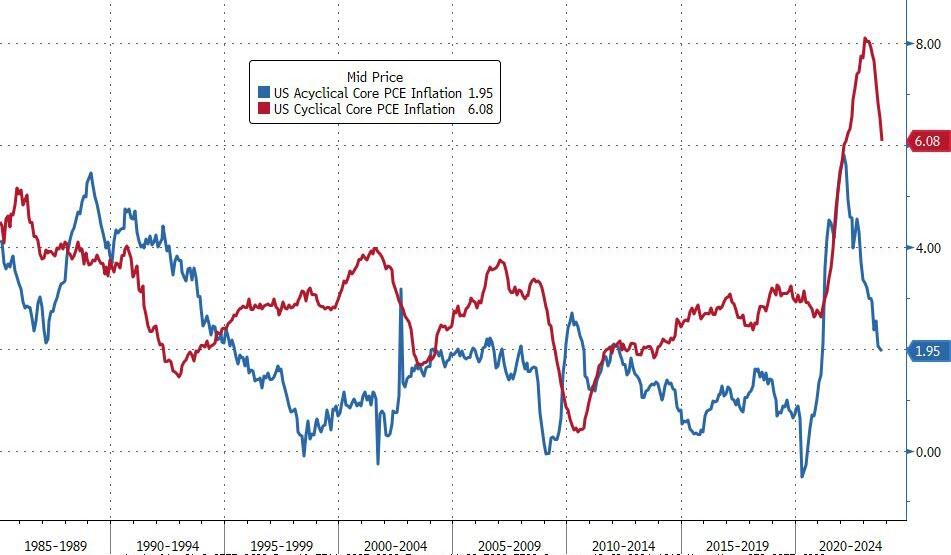
The vast majority of the reduction in inflation has been ‘cyclical’. Acyclical Core PCE inflation remains extremely high, although it has fallen from its highs.

Source: Bloomberg

Simply Unsustainable! GDP Grew By $182.6 Billion While Public Debt Grew By $834 Billion In Q4 (Public Debt By 4.5 Times GDP Growth)

Biden and Congress’ insane spending and debt issuance are simply unsustainable.

Isn’t it wonderful to be 81 years old like Biden and a have a credit card with seemingly no credit limit? And partner with other octogenarians like Pelosi and McConnell to bankrupt the US? Free-spending US Senate Demagogue Democrat Chuck Schumer is only 73. But all these elderly politicians are heaping debt on to backs of younger Americans.

The “surprise” Q4 GDP report showed GDP rising by $182.6 billion. Unfortunately, Biden had to borrow $834 billion to get $182.6 in GDP.

Graphically, we can Biden’s folly where Q4 public debt grew almost 5 times faster than real GDP.

Biden’s Housing Market! New Home Sales Disappoint, Rising Over 4% Versus 10% Expected As Existing Sales Hit Record Low

Sweet home ANYWHERE is getting more difficult under Biden’s vision for the economy.

On the heels of the worst year ever for existing home sales, new home sales were expected to rebound 10.0% MoM in December after plunging back to reality in November (-12.2%) as mortgage rates tumbled.

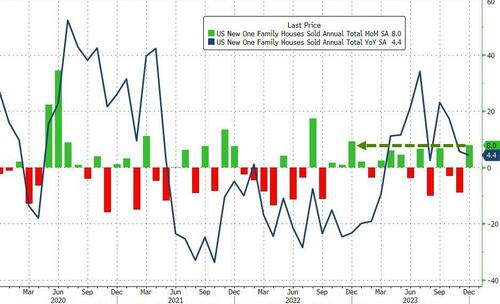
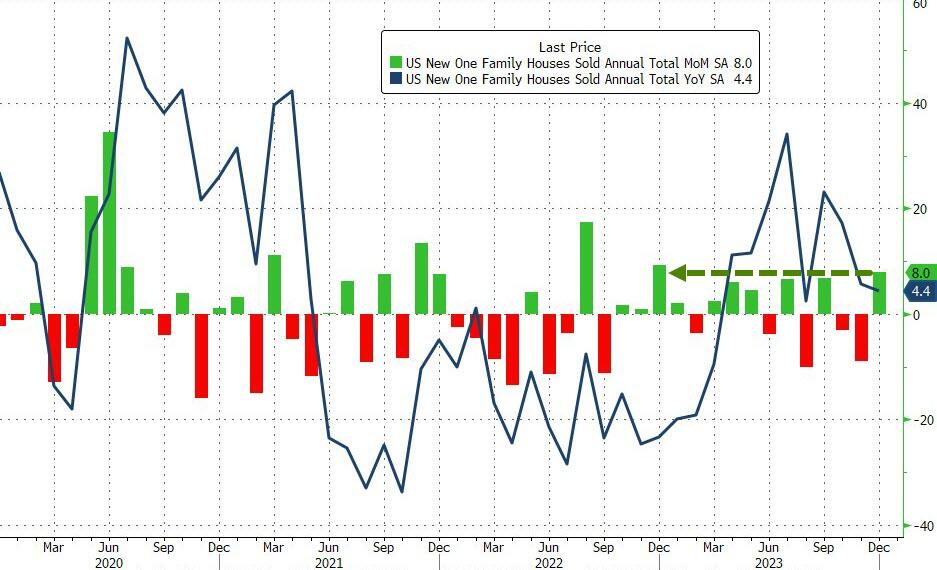
New home sales disappointed in December, rising just 8% MoM (vs 10% exp) but that is still the biggest MoM jump since last December.

Source: Bloomberg

Of course, having pointed out the dramatic series of downward revisions to this data series this year, November’s 12.2% plunge was revised up to a 8.0% drop

Source: Bloomberg

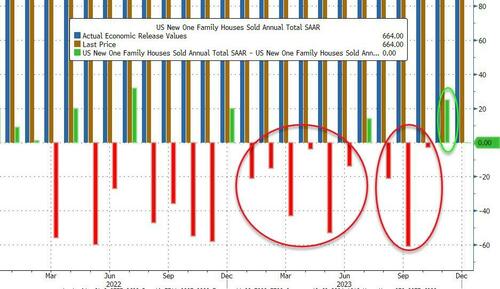
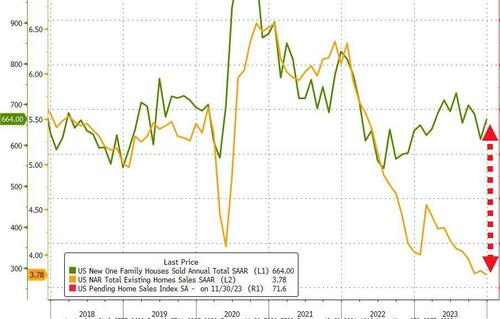
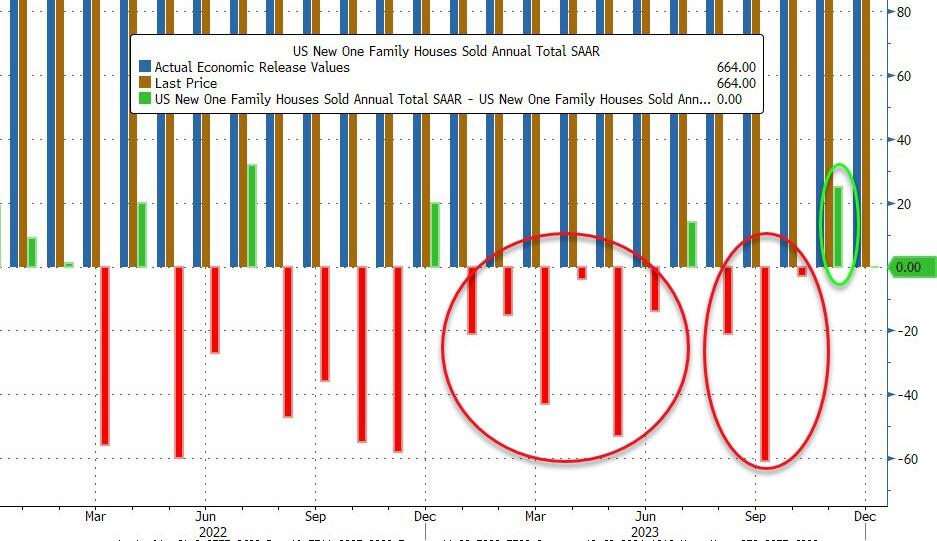
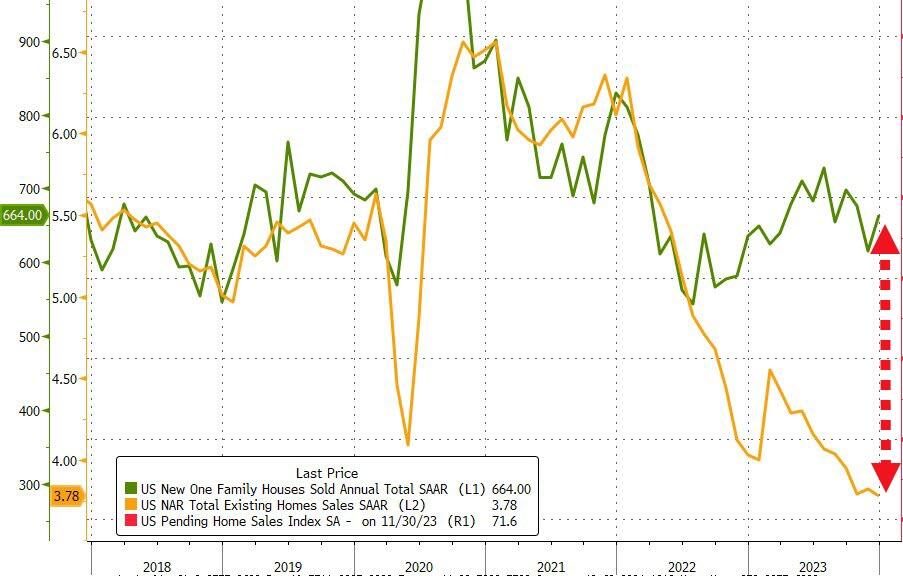
On a SAAR basis, new home sales ended at 664k (pre-COVID-lockdown levels), completely decoupled from existing home sales…

Source: Bloomberg

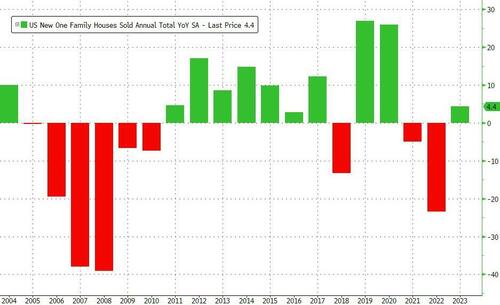
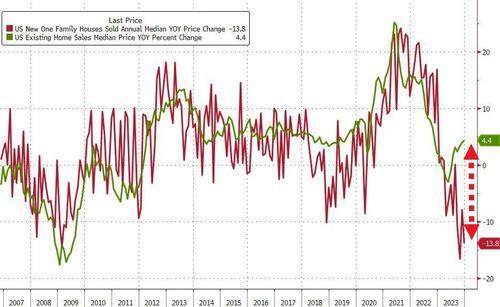
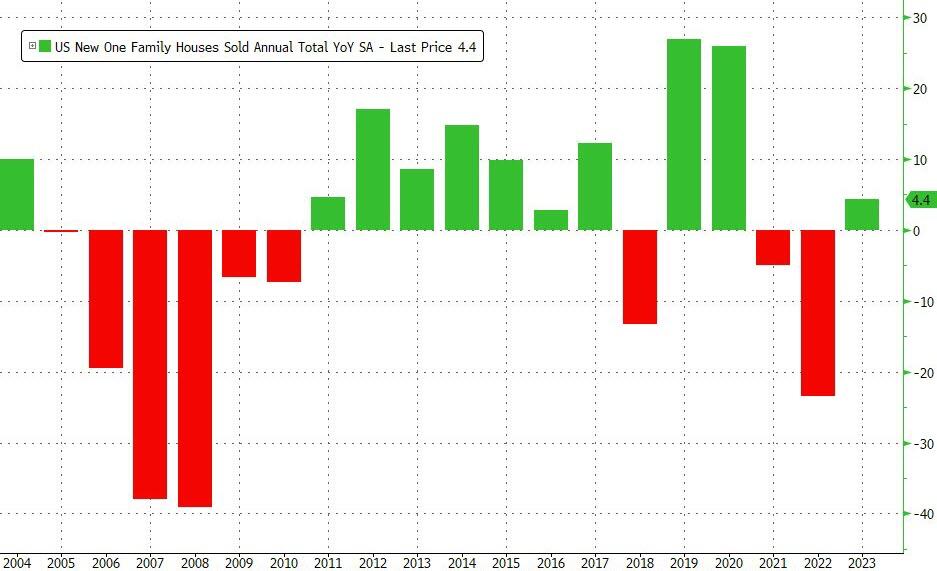
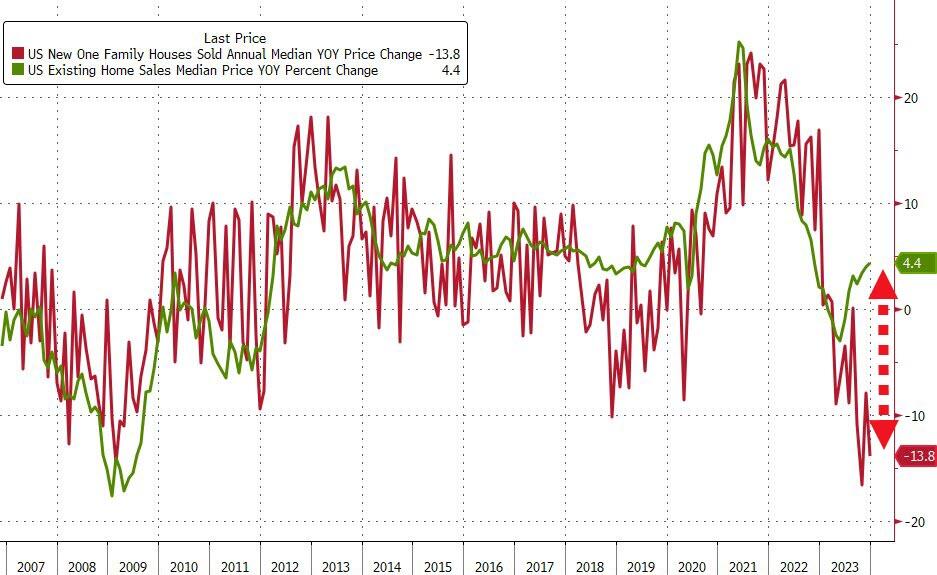
This left new home sales up 4.4% YoY…

Source: Bloomberg

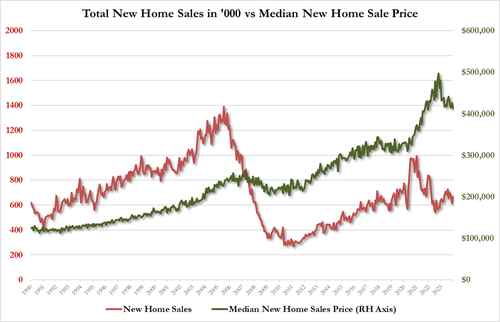
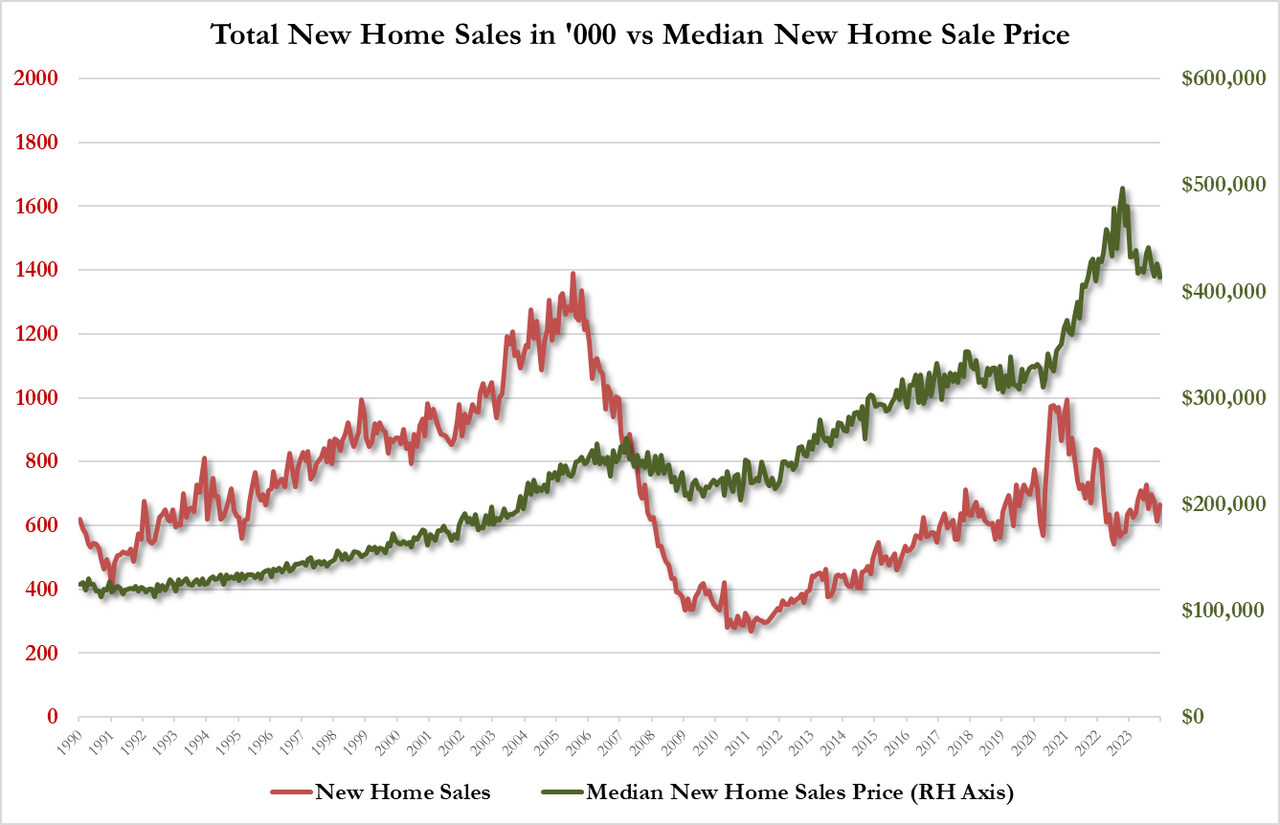
The median new home price fell 13.8% YoY to $413,200

Source: Bloomberg

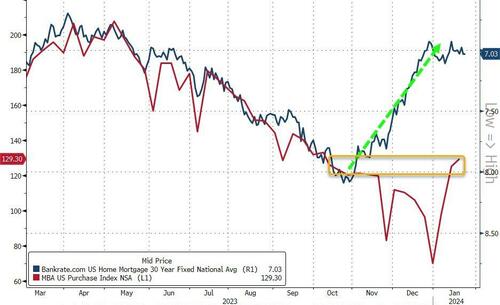
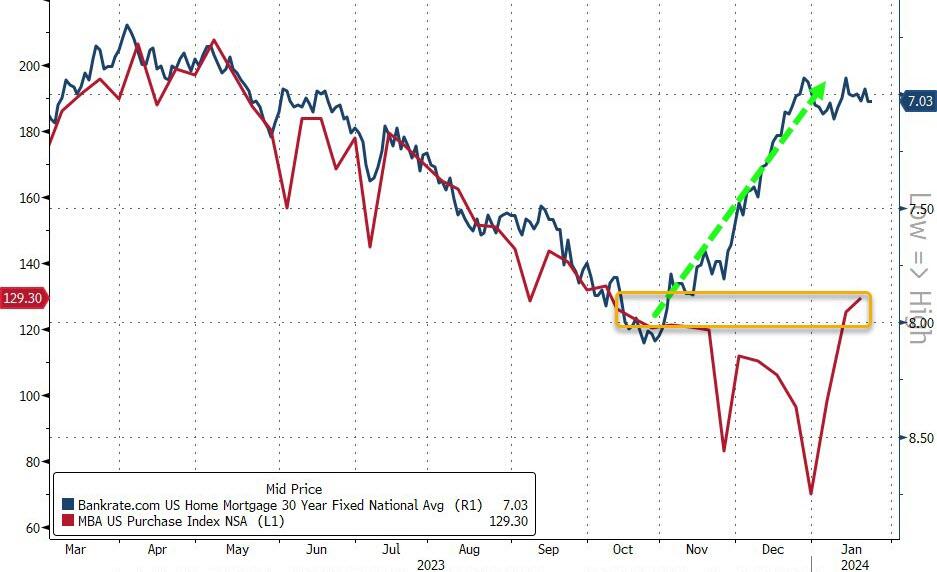
Trouble is, even as mortgage rates have plunged recently, applications for home purchases have only rebounded modestly…

Source: Bloomberg

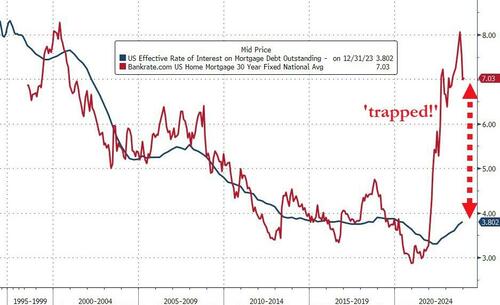
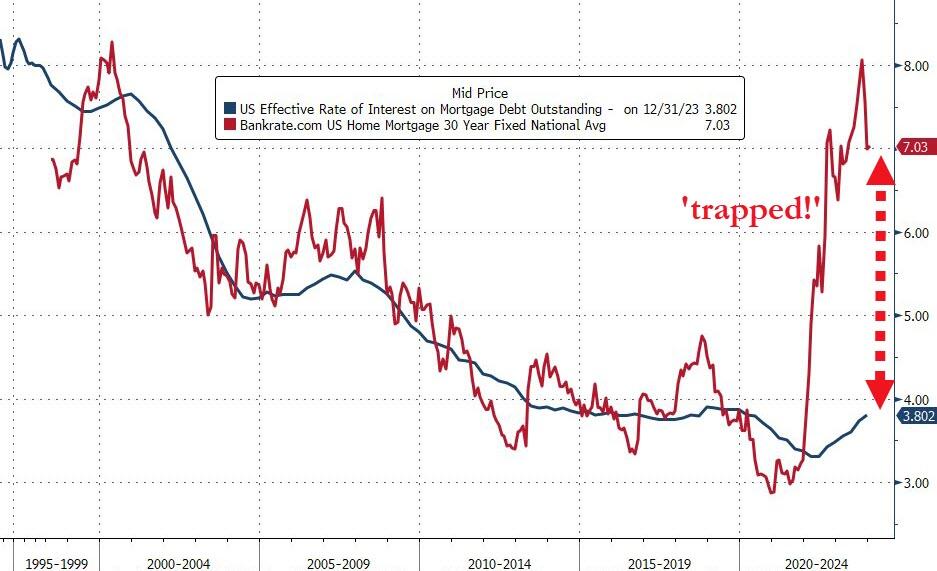
And while mortgage rates have declined (rapidly), they remain massively high relative to the effective mortgage rate for all Americans. That difference is the subsidy that homebuilders have to fill to enable buyers – and it’s still yuuuge!

Source: Bloomberg

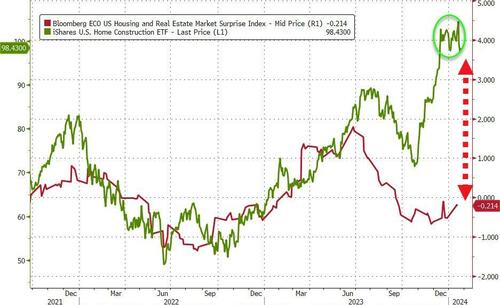
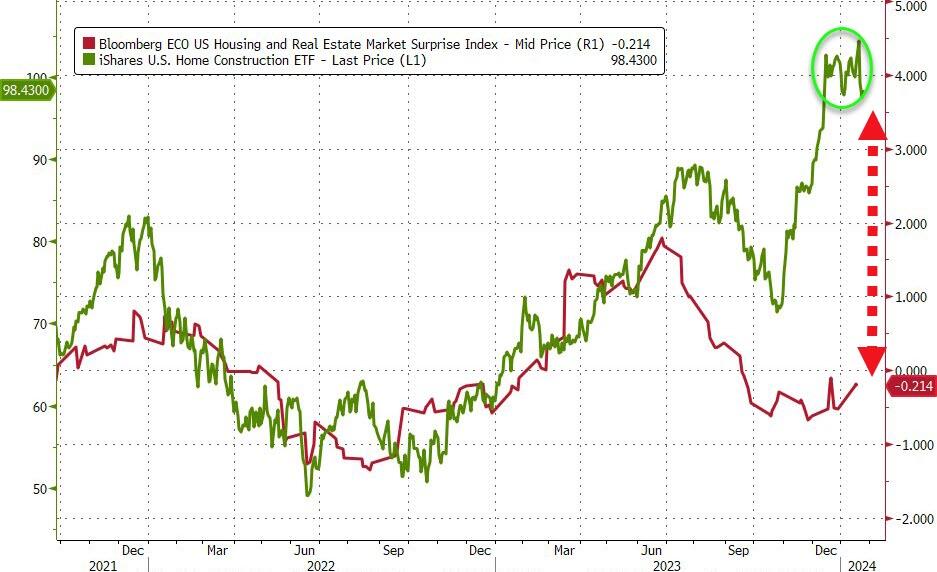
Of course, investors don’t care about actual fundamentals, rates are down so ‘buy buy buy’ the builders…

Source: Bloomberg

Finally, we note that supply shrank from 8.8 months to 8.2 months in December – so don’t expect new home prices to keep falling (they’ll be rising like the supply-constrained existing homes market)…

…and don’t expect The Fed cuts to prompt an excess-supply-driven decline in prices – it’s start your engines time on the next bubble.

Biden’s Presidential Portrait.

Biden’s Green Boondoggle! Mortgage Purchase Demand 18% Lower Than Last Year, Refi Demand Down 8% From Last Year

Biden’s green energy mandates, a boondoggle for China and lodestone for Americans, is leaking over to the mortgage market. That’s Bidenomics!

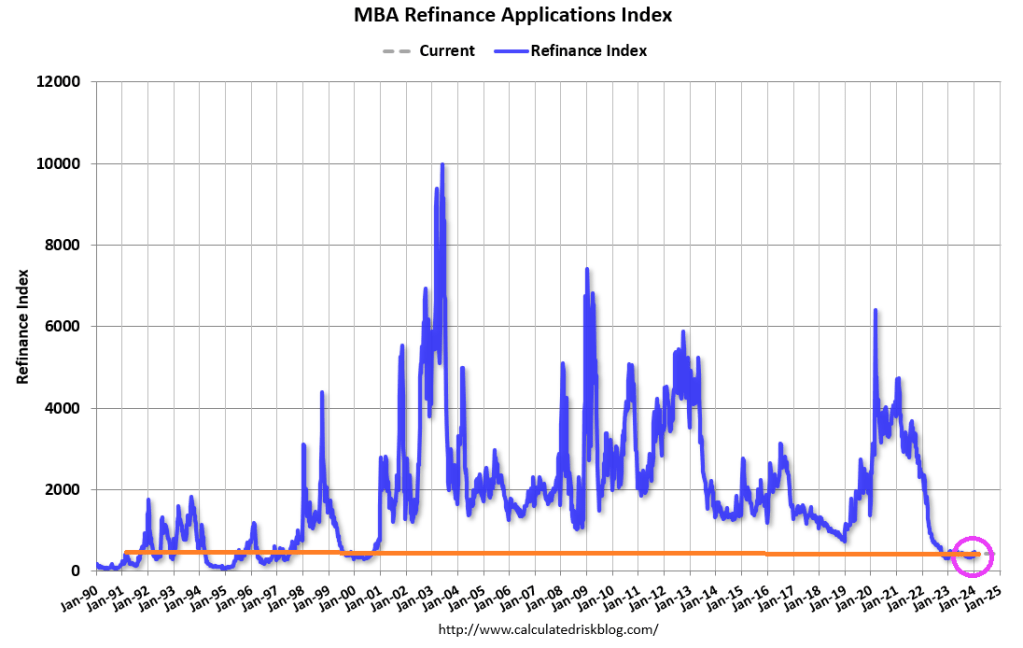
Mortgage applications increased 3.7 percent from one week earlier, according to data from the Mortgage Bankers Association’s (MBA) Weekly Mortgage Applications Survey for the week ending January 19, 2024. The results include an adjustment to account for the MLK holiday.

The Market Composite Index, a measure of mortgage loan application volume, increased 3.7 percent on a seasonally adjusted basis from one week earlier. On an unadjusted basis, the Index decreased 4 percent compared with the previous week. The holiday adjusted Refinance Index decreased 7 percent from the previous week and was 8 percent lower than the same week one year ago. The seasonally adjusted Purchase Index increased 8 percent from one week earlier. The unadjusted Purchase Index increased 3 percent compared with the previous week and was 18 percent lower than the same week one year ago.

The unadjusted Refinance Index decreased 16 percent from the previous week and was 8 percent lower than the same week one year ago. 

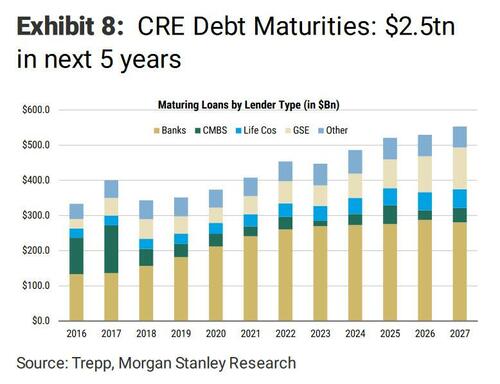
Bailout Part Deux? Prepare For “Very Ugly” Two Years Of CRE Turmoil With $2.5 Trillion In CRE Debt Maturing In Next 5 Years

Remember the massive bank bailout of “subprime” mortgage securities back that resulted in the Dodd-Frank banking legislation of 2010? Yes know, where they promised NO MORE BANK BAILOUTS EVER??? Particularly if Disease X is unleashed and we start shutting down economies and schools again. Will we see ANOTHER bank bailout??

Cantor Fitzgerald CEO Howard Lutnick spoke with Fox Business host Maria Bartiromo on the sidelines at the World Economic Forum in Davos, Switzerland, last week. He offered a bleak outlook on the commercial real estate sector, warning a “very ugly” two years is ahead. 

“Coming due in the next two and a half years at these higher rates – you’re not going to get proceeds, meaning when you have a $120 million loan on a building, and someone says I’ll give you 90 million at a much higher rate – than it throws the keys back to the lenders – and there’s going to be a lot of them that are going to get wiped out,” Lutnick told Bartiromo.

“I think $700 billion could default … The lenders are going to have to do things with them. They’re going to be selling. It’s going to be a generational change in real estate coming at the end of 2024 and all of 2025. We will be talking about real estate being just a massive change,” Lutnick said.

He warned: “I think it’s going to be a very, very ugly market in owning real estate over the next, you know, 18 months, two years.” 

Lutnick noted that loan sales are set to become a major business opportunity with the upcoming maturity of CRE mortgages. He highlighted that an estimated trillion dollars of CRE debt is coming due over the next 2.5 years.  

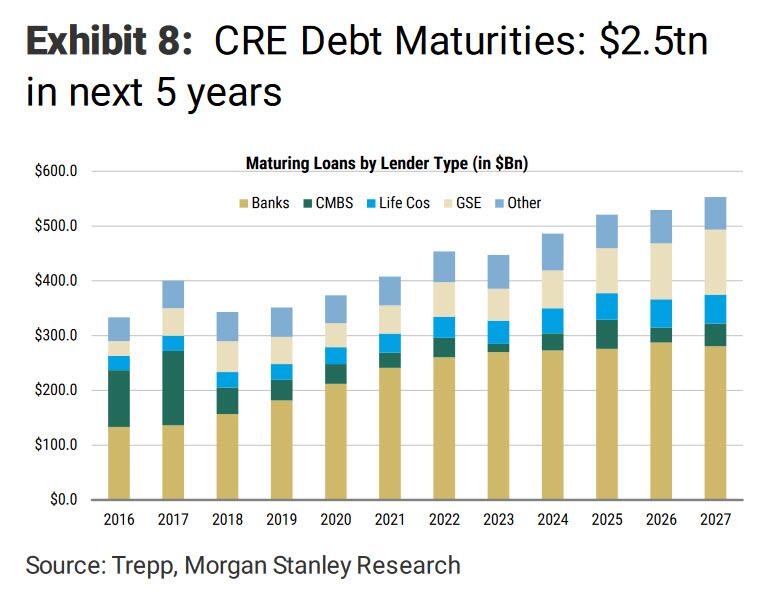
Shortly after the regional bank implosion in March 2023, Morgan Stanley penned a note to clients about a $2.5 trillion wall of CRE debt coming due over five years. 

A recent survey of Terminal users by Bloomberg’s Markets Live found most respondents believe the office tower market needs a deeper correction before a rebound materializes. 

Lutnick pointed out, “Real estate equity, REITS, are going to be in trouble … a lot of them are going to be wiped out, so many defaults, I think.” 

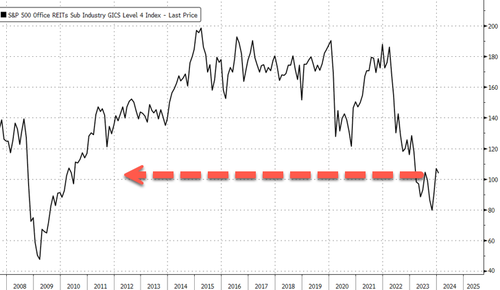
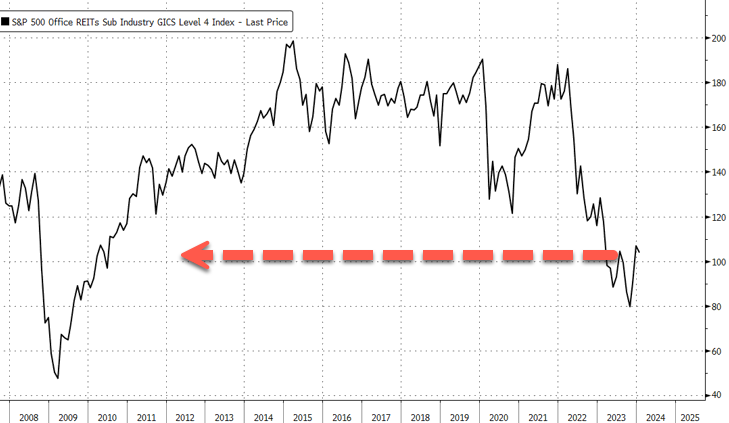
Bloomberg office REITs have been plunging since early 2022 when the Federal Reserve embarked on the most aggressive interest rate hiking cycle in a generation to tame inflation. 

“Commercial real estate is experiencing a meaningful repricing as cap rates correlate to long-term to interest rates,” Morgan Stanley told clients in a recent report, adding, “Patience is required while refinancing to higher debt costs gradually triggers valuation adjustments.” 

Lutnick’s not the only one with a dismal outlook on CRE. 

In a recent interview, Scott Rechler, Chairman and CEO of RXR Realty, told Goldman’s Allison Nathan that the CRE downturn is still in the early innings

The Bidenomics Roadmap! Existing Home Sales (4.09 million) Drop To Lowest Level Since 1995 (Lowest SAAR Since 2010)

American homebuyers are going down the road of Bidenomics and feeling bad. Is this the roadmap for the US??

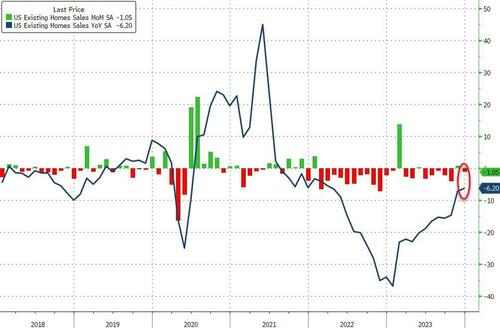
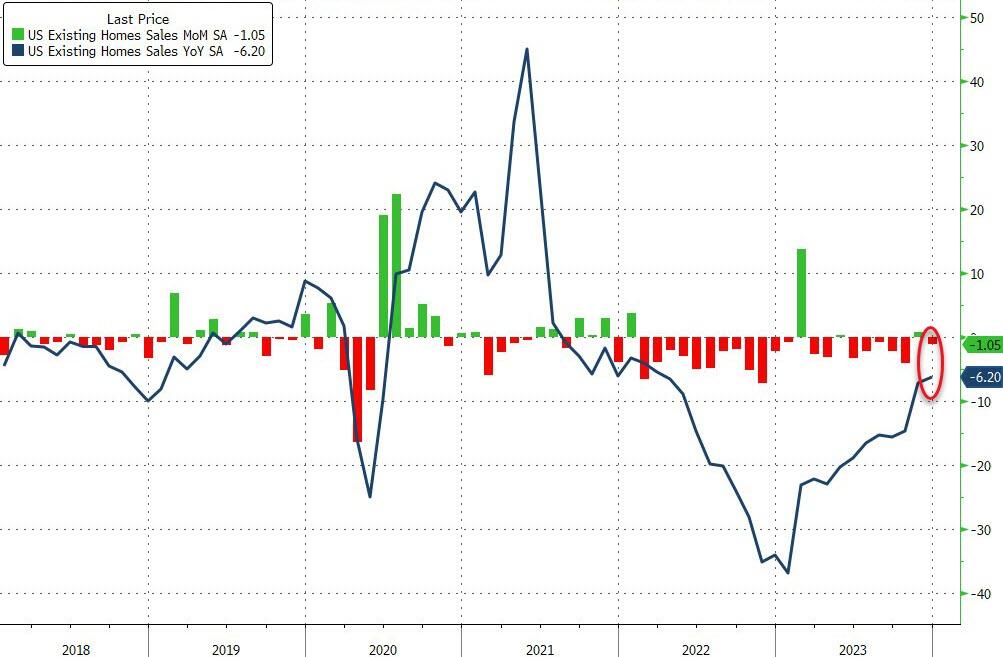
Existing Home Sales fell 1.0% MoM in December, worse than the +0.3% expected, leaving sales down

Source: Bloomberg

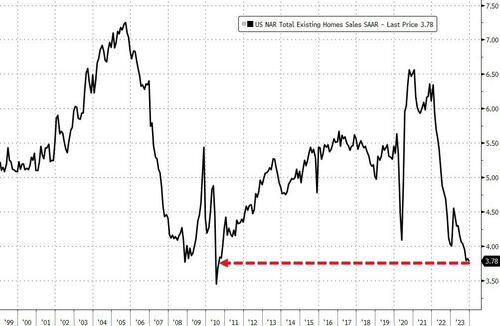
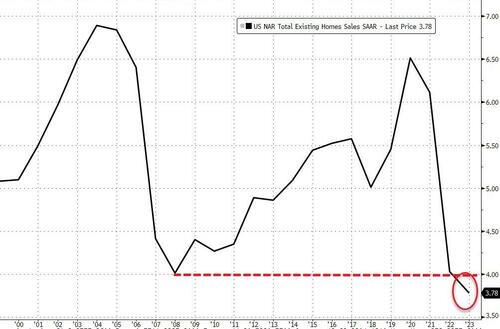
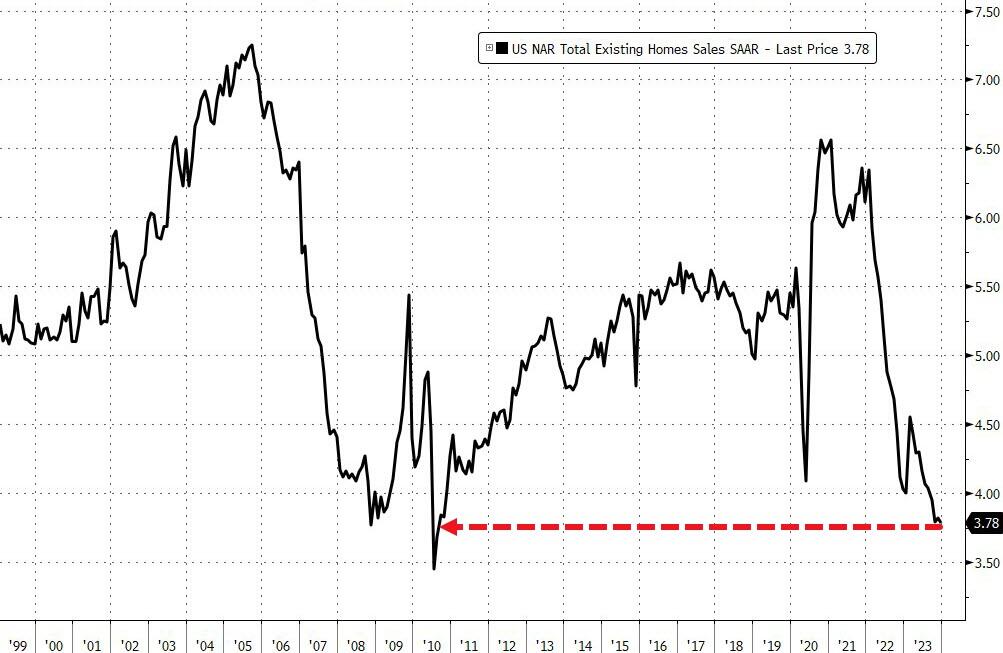
Total Existing Home Sales in December 2023 were 3.78mm – the lowest SAAR since 2010…

Source: Bloomberg

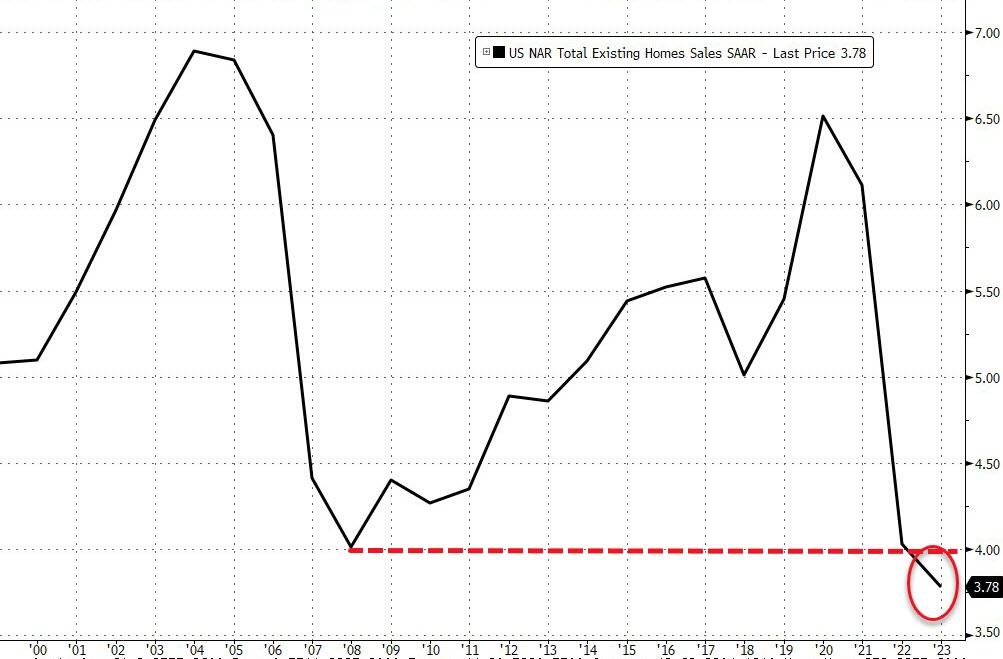
But, on an annual basis, this is the worst year on record (back to at least 1995)..

Source: Bloomberg

“The latest month’s sales look to be the bottom before inevitably turning higher in the new year,” said NAR Chief Economist Lawrence Yun. “Mortgage rates are meaningfully lower compared to just two months ago, and more inventory is expected to appear on the market in upcoming months.”

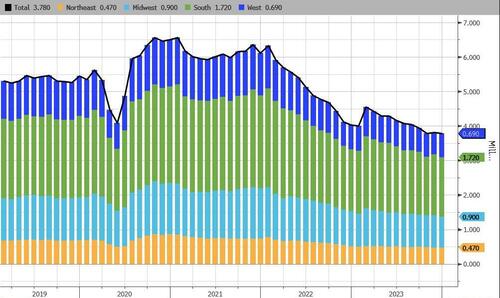
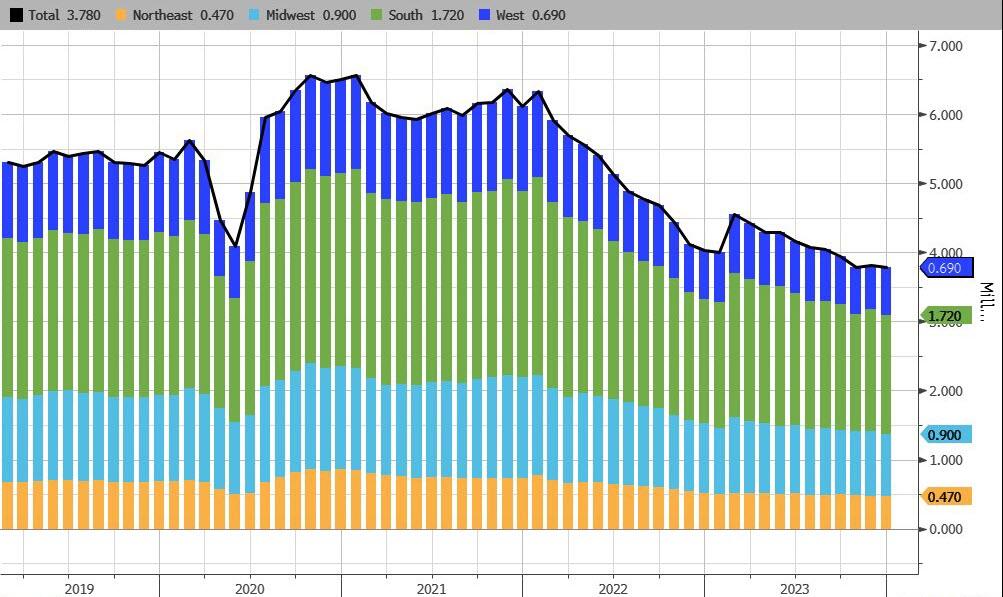
Existing Home Sales were flat in the Northeast, lower in the MidWest and the South, and up marginally in the West (driven by single-family-home sales as condo sales declined)…

Source: Bloomberg

Last month, the number of previously owned homes for sale dropped to 1 million, the lowest since March.

At the current sales pace, selling all the properties on the market would take 3.2 months.

Realtors see anything below five months of supply as indicative of a tight resale market.

That lack of inventory is helping to keep prices elevated.

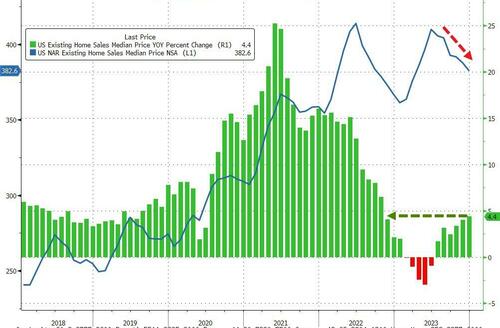
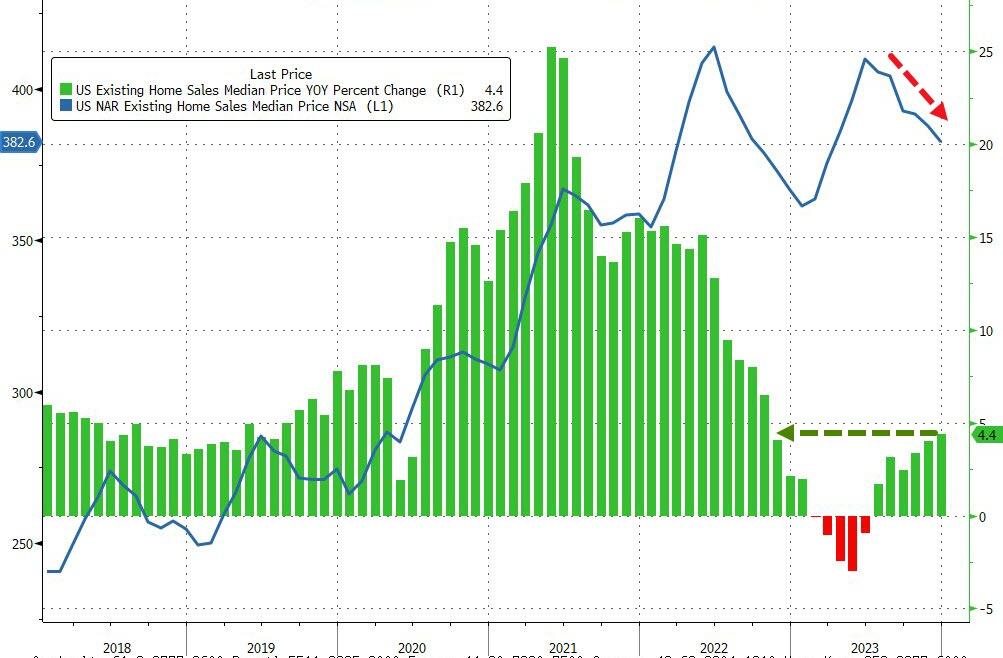
The median selling price climbed 4.4% to $382,600 in December from a year ago, reflecting increases in all four regions. Prices hit a record of $389,800 in 2023.

Source: Bloomberg

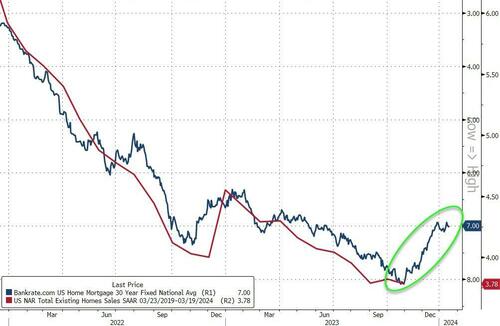
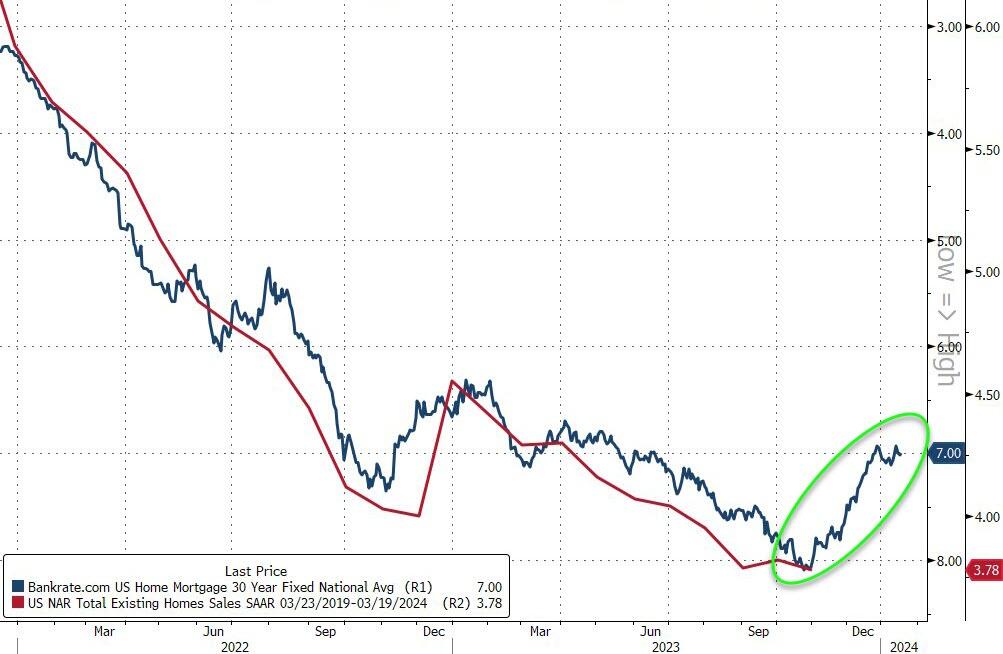
But, with mortgage rates having tumbled (and given the lagged responses), are sales about to start rising again?

Source: Bloomberg

So The Fed managed to kill sales, collapse inventories, send home prices higher, destroying affordability… and now what is going to happen?

Is Bidenomics the Highway To Hell?

Who designed this photoshoot for an accordian band?? Not sure I want to have a party with this crew!

Not Always Sunny! Dis-Inflation & Disappointment For Philly Fed Survey In January (-10.6, Worse Than Expected)

It’s not always sunny in Philadelphia! And not because the Eagles got stomped by Baker Mayfield and the Tampa Bay Bucs.

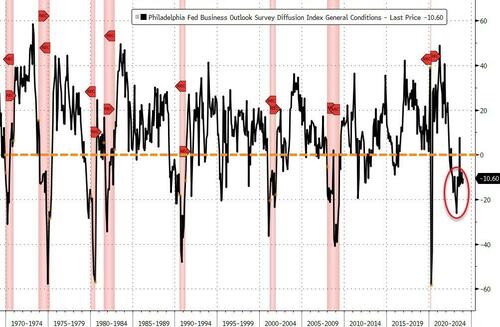
Manufacturing activity in the Philadelphia region continued to decline in January (for the 18th month of the last 20). The headline Philly Fed survey printed -10.6 (worse than the -6.5 expected) and apart from the insane outlier spike in August, this indicator screams recession…

Source: Bloomberg

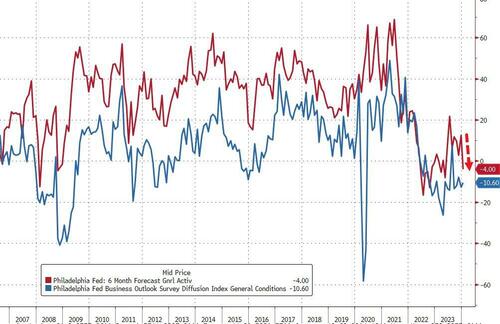
More worrying is the fact that hope appears to be dwindling fast as the six-month-forecast for the survey plunged back into contraction (from +12.6 to -4.00)…

Source: Bloomberg

Philly Fed’s demise is consistent with the collapse of hope as ‘soft’ survey data has slumped in the last month, back to its weakest since July (as ‘hard’ data improves relative to expectations)…

Source: Bloomberg

On the bright side for the doves, the dis-inflationary trend remains in tact as priced paid and prices received both plunged in January. However, we highlight the fact that Philly businesses expect price pressure to return in the next six months…

Source: Bloomberg

Overall, the ‘bad news’ in this report should buoy stocks and bonds (lower inflation and lower growth enables sooner and faster cuts)… But will it.

Green man (The Federal Reserve) will stike again!

WTF are dancing sandwiches??

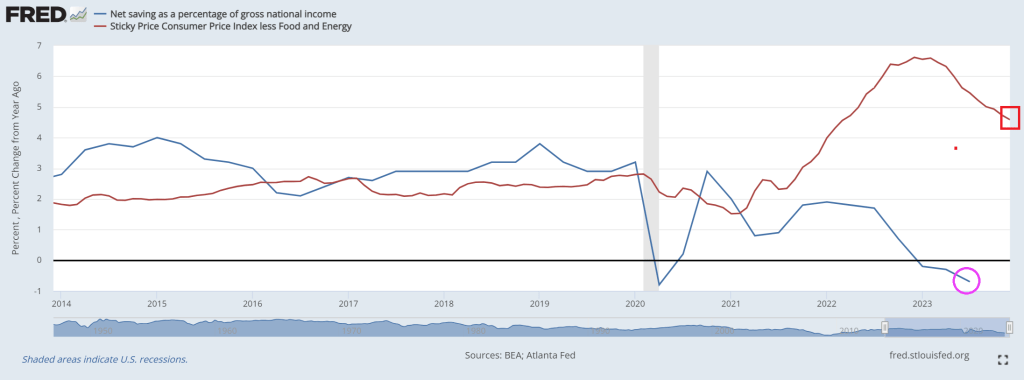
Biden In Wonderland! Savings As Percentage Of GDP Goes Negative As Consumer Still Cope With Inflation Of Over 4.50% (But At Least Yield Curve Is Normalizing!)

President Biden still shuffles around mumbling about Maga Republicans and defending democracy (while gettig his DOJ and affiliates to prosecute his leading Presidential opponent) even though …. consumers continue to struggle. While Biden is in wonderland, American consumers are in hell.

Savings as a percentage of GDP is actually NEGATIVE as sticky price inflation remains above 4%.

Any good news? At least the US Treasury yield curve (10Y-5Y) is normalizing.

How true!

Speaking of Biden, is this photo real? With AI, I wonder.

Fed Better Think Twice About Rate Cuts! 10-year Treasury Yield Surges To 4.10% After Strong Dec Retail Sales (Consumers Win, Fed/Treasury Lose)

The Fed had better think twice about expected rate cuts. The market just isn’t feeling it.

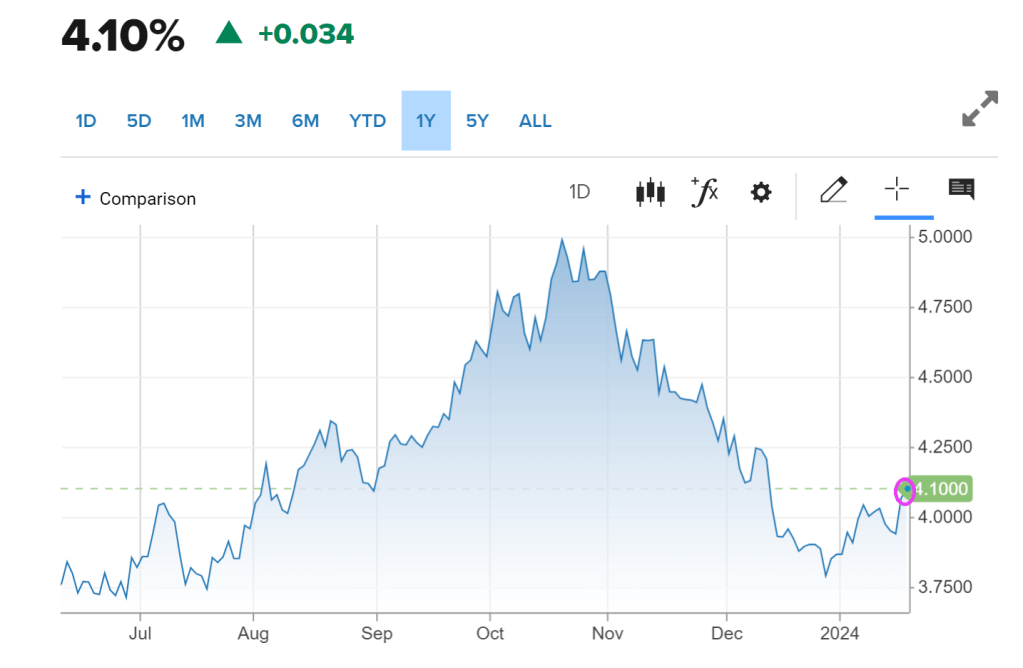
Treasury yields rose Wednesday, with the 10-year yield touching almost 4.10% as investors focused on stronger-than-expected December retail sales and the latest remarks from Federal Reserve members.

The yield on the 10-year Treasury note was recently up 4 basis points at 4.108% after briefly getting to 4.117%, the highest since Dec. 13. The 2-year Treasury yield rose by around 11 basis points to trade at 4.335%.

December’s retail sales data indicated strong consumer demand at the holidays. Retail sales increased 0.6% for the month, above economists’ estimates of 0.4%, as compiled by Dow Jones. Excluding autos, sales rose 0.4%, which also topped a 0.2% estimate.

On Tuesday, yields jumped after comments from Federal Reserve Governor Christopher Waller, who suggested that while the central bank will likely cut rates this year, it may take its time.

At the World Economic Forum in Davos, more European Central Bank members indicated that markets were getting ahead of themselves on rate cut projections.

The president of the Dutch central bank, Klaas Knot, told CNBC Wednesday that the euro zone’s central bank looked at overall financial conditions, and that “the more easing the market has already done for us, the less likely we will cut rates.” Knot was referring to the fact that higher stock and bond prices in the fourth quarter of last year acted as the equivalent of easier interest rate policy, while lower prices act as the equivalent of tighter policy.

Rising interest rates are going to bite a big chunk out of The Fed’s massive ass (I mean balance sheet). Of course, The Fed sends the bill to Treasury. Gee, no wonder Biden/Yellen want so much money!

There is something wrong with letting aging politicians like Biden (81), Grassley (90), Pelosi (83), etc. borrow vast sums of money to spend when they will likely not be around for another 10 years.

Debt Star! Massive Money-Printing Will Accelerate As Debt Soars ($34 Trillion In Current Federal Debt And $212 Trillion In Promises To The 99% Will Require LOTS Of Money Printing!!)

Biden and Congress continue their massive spending spree, mostly on themselves and their donors, creating a massive Debt Star capable of unfathomable economic destruction. This will require massive money printing to fund the US Debt Star.

But as of today, M2 Money growth is negative as is bank credit growth.

But all this is about to change.

The U.S. federal government published a December deficit of $129 billion, up 52% from the previous year. The private sector recession is clear as expenses continue to rise while tax receipts decline. If we look at the period between October and December 2023, the deficit ballooned to a staggering $510 billion.

You may remember that the Biden administration expected a significant deficit reduction from its tax increases and the expected benefits of its Inflation Reduction Act.

What Americans got was a massive deficit and persistent inflation.

According to Moody’s chief economist, Mark Zandi, the entire disinflation process seen in the past years comes from exogenous factors such as “fading fallout from the global pandemic on global supply chains and labor markets, and the Russian War in Ukraine and the impact on oil, food, and other commodity prices.” The complete disinflation trend follows the slump in money supply (M2), but the Consumer Price Index (CPI) should have fallen faster if deficit spending, which means more consumption of newly created currency, would have been under control. December was disappointing and higher than it should have been.

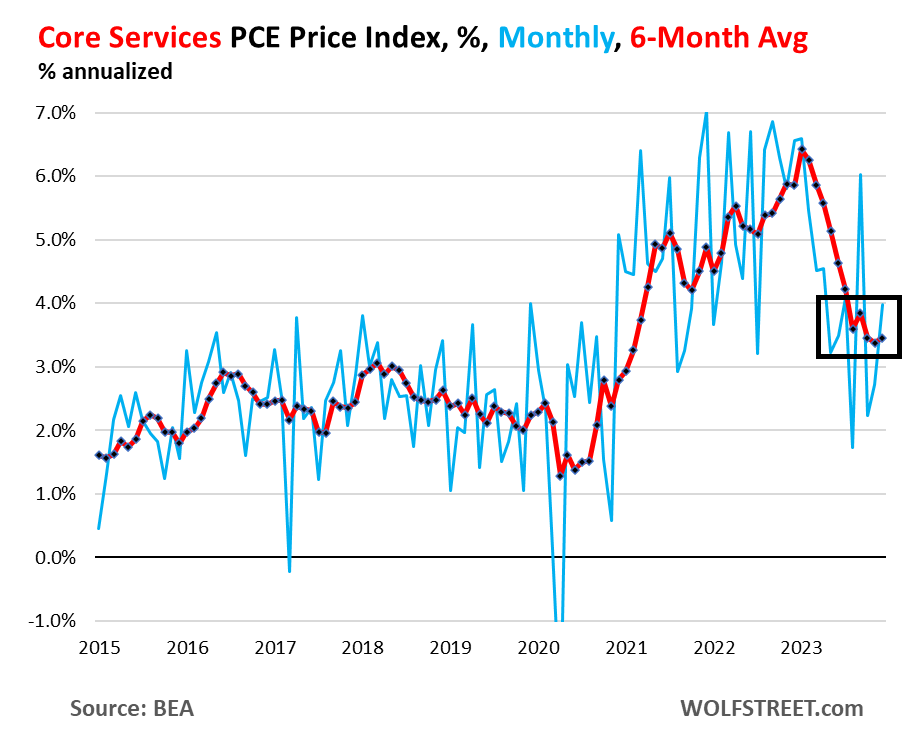
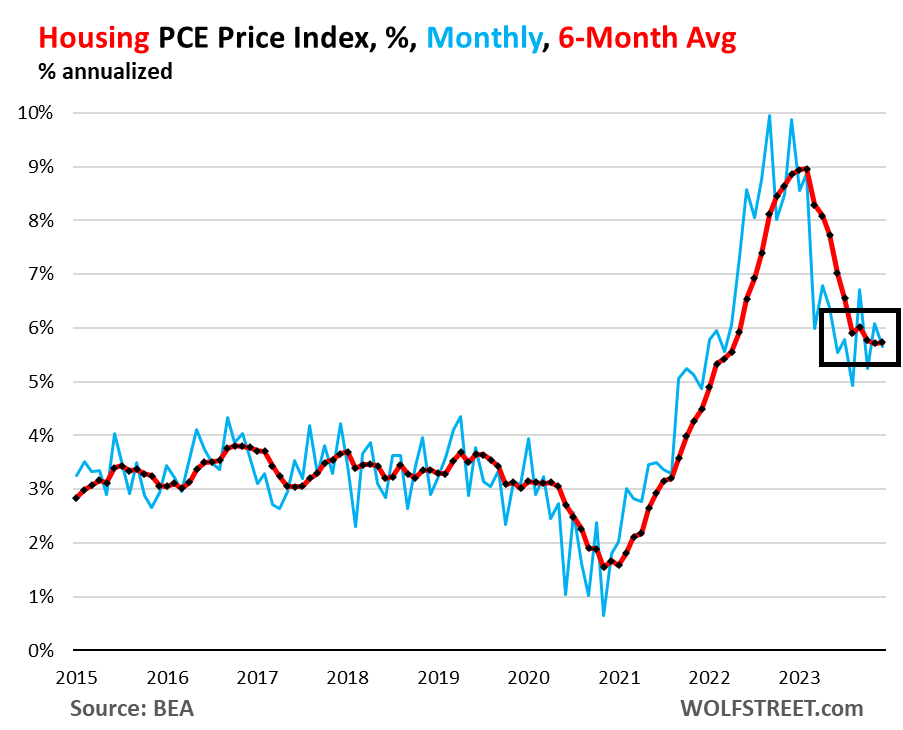
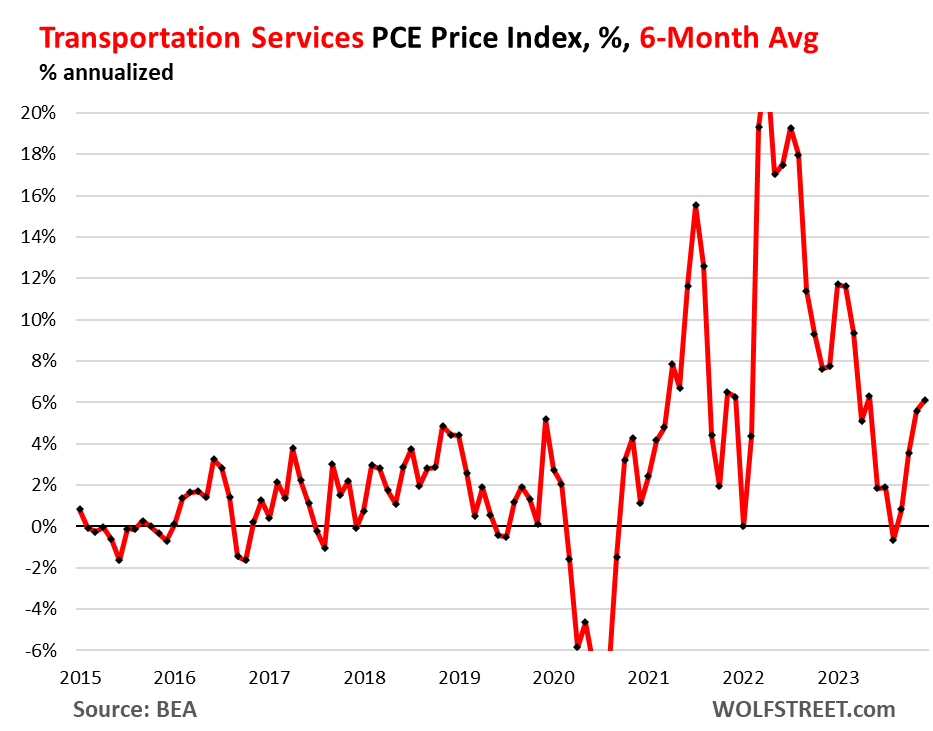
The United States annual CPI (+3.4%) came above estimates, proving that the recent bounce in money supply and rising deficit spending continue to erode the purchasing power of the currency and that the base effect generated too much optimism in the past two prints. Most prices rose in December, and only four items fell. In fact, despite a large decline in energy prices, annual services (+5.3%), shelter (+6.2%), and transportation services (+9.7%) continue to show the extent of the inflation problem.

The massive deficit means more taxes, more inflation, and lower growth in the future.

The Congressional Budget Office (CBO) expects an unsustainable path that still leaves a 5.0% deficit by 2027, growing every year to reach a massive 10.0% of GDP in 2053 due to a much faster growth in spending than in revenues. The enormous increase in debt will also lead to extremely poor growth, with real GDP rising much slower throughout the 2023–2053 period than it has, on average, “over the past 30 years.”

Deficits are not a tool for growth; they are tools for stagnation.

Deficits mean that the currency’s purchasing power will continue to vanish with money printing and that the real disposable income of Americans will be demolished with a combination of higher taxes and a weaker real value of their wages and deposit savings.

We must remember that, in Biden’s administration’s own estimates, the accumulated deficit will reach $14 trillion in the period to 2032.

Yes, the US has $34 trillion in national debt and $212 trillion in promises made to keep the 99% quiet while the 1% gut the economy for their own wealth. Think Biden, Clintons, and various Congress Critters who suddenly become millionaires.

The Debt Star was born under Obama and weaponized under Biden/Pelosi/Schumer.

Yes, national debt rose under Trump too. Bear in mind that spending originates in The House and Trump was saddled with warhawks like RINO Paul Ryan and insider trading expert and warhawk Nancy Pelosi.