Climate Interruptus? Financial Giants JPMorgan Chase And State Street Pull Assets From ESG Group (ESG Is A Losing Game!)

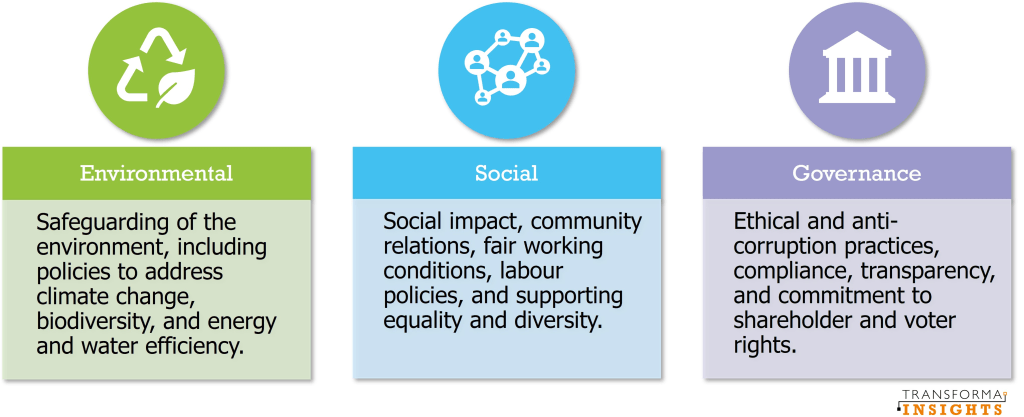
ESG (Environmental, social, and corporate governance is a losing game.

Two of the world’s largest financial institutions cut ties Thursday with Climate Action 100+, delivering the latest setback to the world’s biggest coalition of investors pressuring corporations to ditch fossil fuel assets.

The asset management arms of JPMorgan Chase and State Street dropped out of Climate Action 100+, home to more than 700 investment firms totaling $68 trillion in assets under management.

BlackRock, the world’s largest asset manager, with more than $10 trillion in assets, distanced its U.S.-based operations from Climate Action 100+ by transferring its membership to BlackRock International.

The coalition, founded in 2017, revealed plans last year to hold members more accountable by encouraging them to disclose more details about their investment decisions. Some high-profile members raised legal concerns about maintaining their fiduciary duties.

State Street said the changes jeopardized the company’s independence. Climate Action 100+ officials say they need the disclosure standards to chart a better course for corporations to reach net-zero emission portfolios by 2050.

“After careful review, State Street Global Advisors has concluded the enhanced Climate Action 100+ Phase 2 requirements for signatories will not be consistent with our independent approach to proxy voting and portfolio company engagement,” State Street spokesman Randall Jensen said. “As a result, we have decided to withdraw from Climate Action 100+.”

JPMorgan suggested that its in-house guidelines for environmental, social and corporate governance, or ESG, investing already exceeded the Climate Action 100+ goals.

Aka, MARXISM.

Ford learned that their ESG Ford F-150 Lightning Electric pick up truck was NOT in demand, so production is being curtailed. Harvard (which should be renamed Harvurd thanks to President Gay’s horrible record of plagiarism) and Biden’s leadership team of unqualified but ESG-friendly faces (“Admiral” Rachel Levine, formerly Richard Levine) symbolizes the failure of ESG.

Thunderstruck! Housing Starts Collapse In January As Producer Prices Soar (Back In Red?)

Its as if the US economy is thunderstruck! US housing starts collapsed in January as Producer Prices soared. NOT a good sign for the US economy.

After single-family home starts plunged in December, analysts did not expect much of a bounce back in January as rates remain high and some regions were affected by weather.

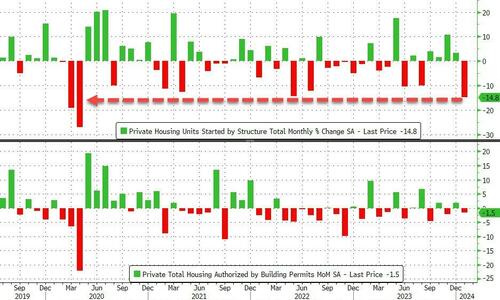
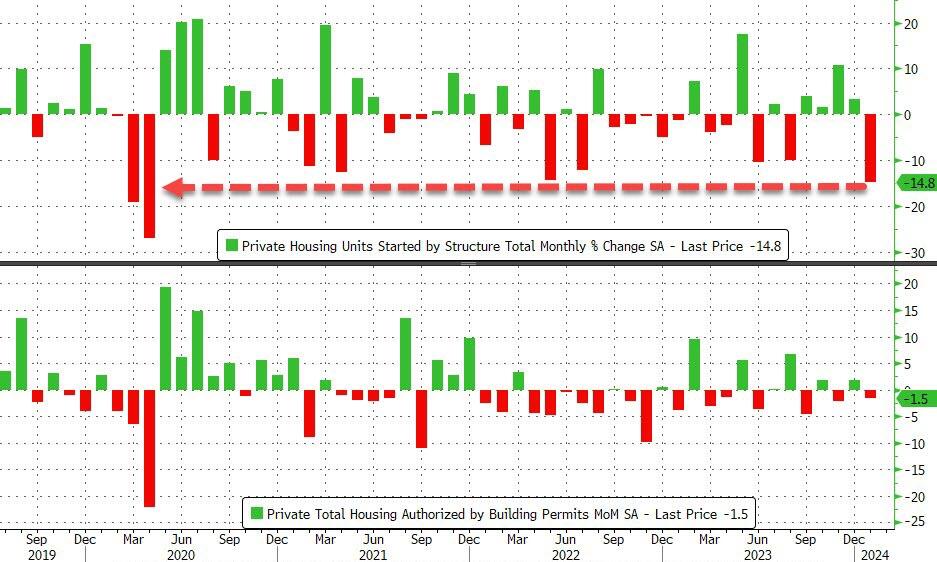
Analysts were way off. Housing Starts puked 14.8% MoM in January (vs unchanged exp), but December’s 4.3% MoM decline was revised up to a 3.3% MoM rise. Building Permits also tumbled, down 1.5% MoM (vs +1.3% exp) and well down from the +1.8% MoM in December…

Source: Bloomberg

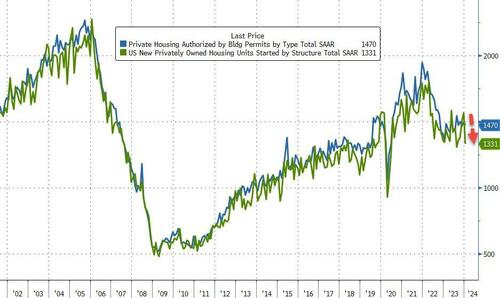
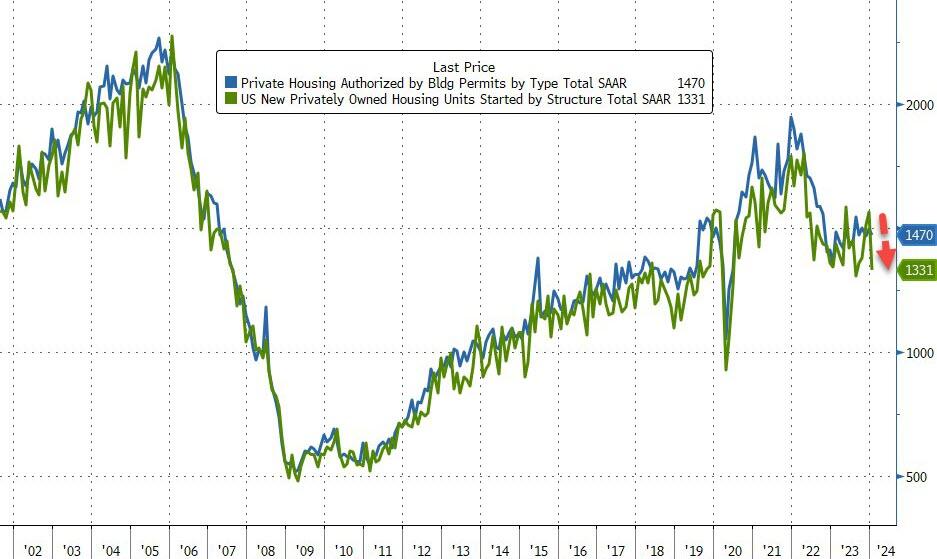
This pushed the Housing Starts SAAR back near post-COVID lows…

Source: Bloomberg

DO NOT BLAME THE WEATHER! It’s January – we know there are weather issues and that should be more than ‘priced-in’ on a seasonal adjustment basis.

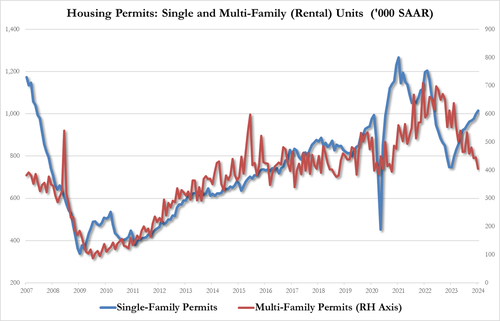
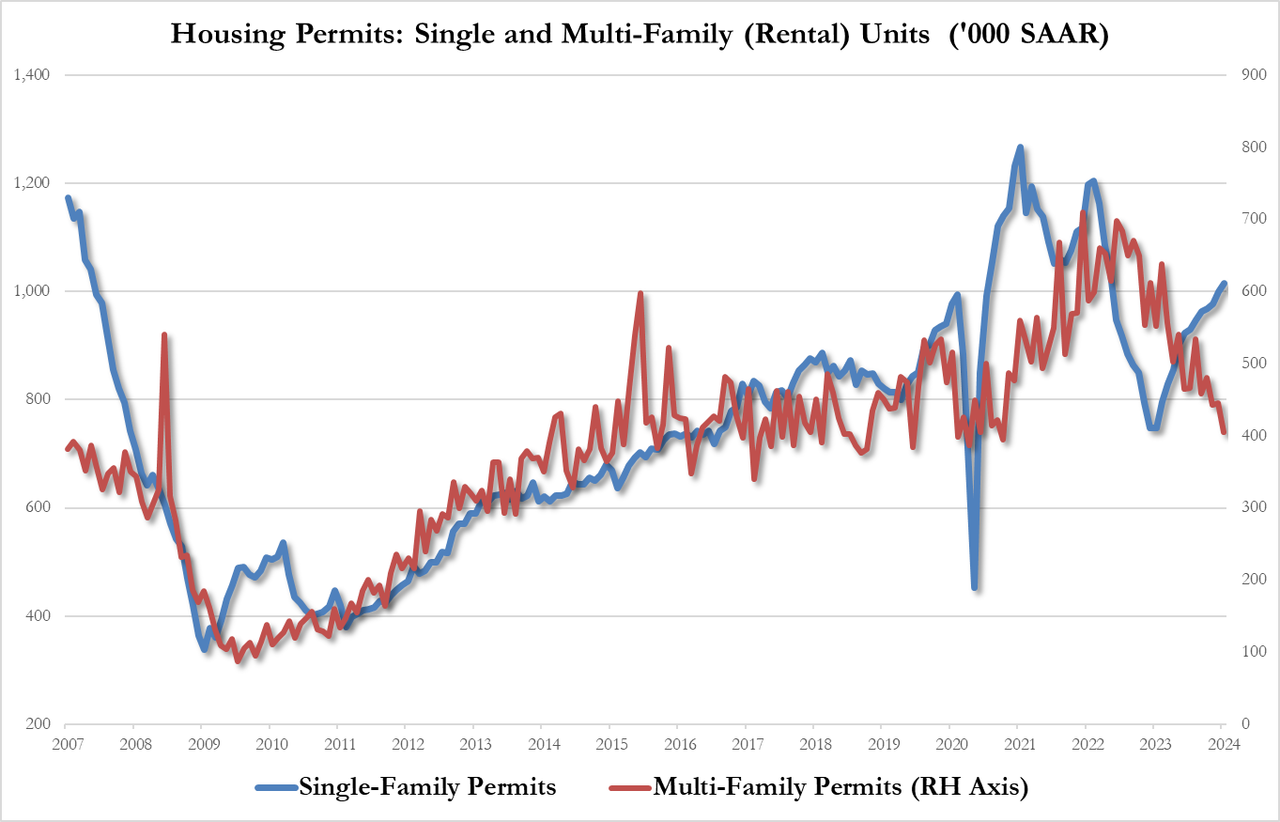
Multi-family permits cratered to their lowest since Oct 2020. Permits for one-family homes edged higher after rising consistently throughout 2023

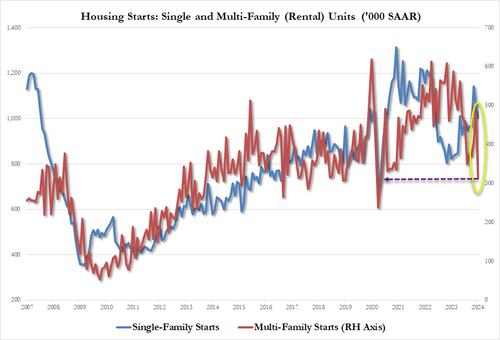
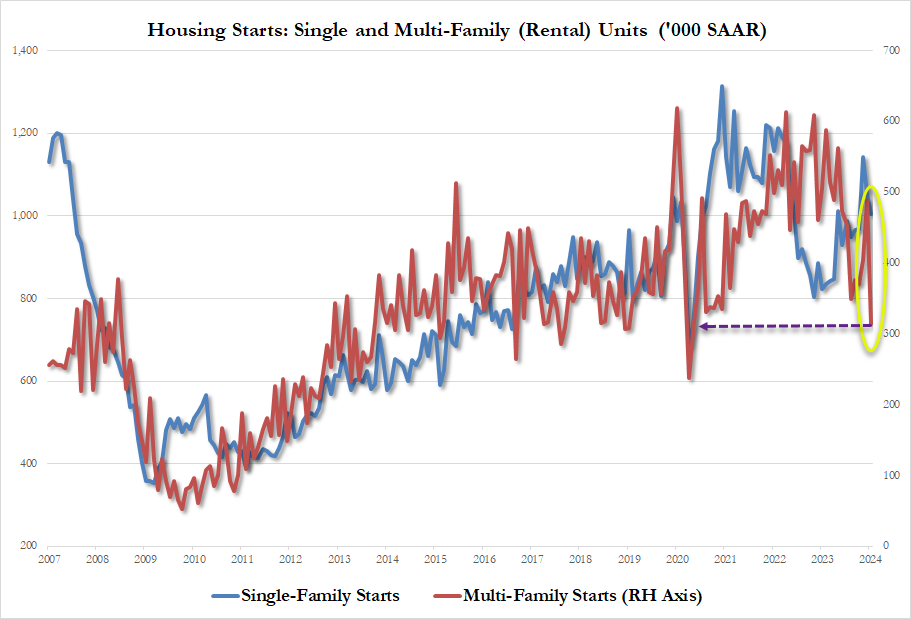
And multi-family starts were even worse, plunging from 489k SAAR to 314k SAAR – the lowest since May 2020 (when the economy was closed)…

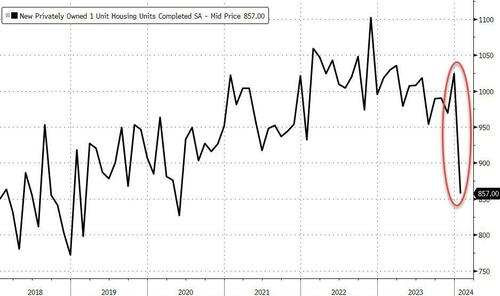
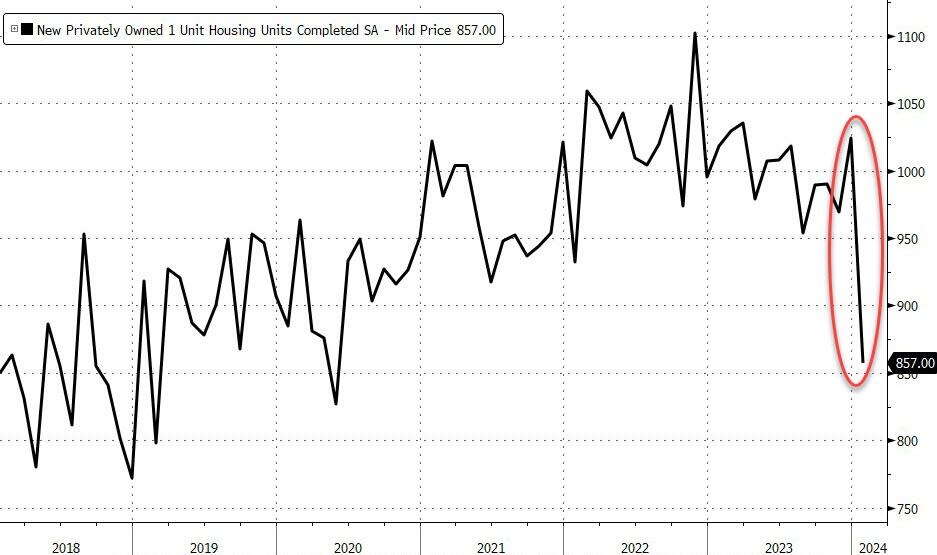
The government’s report showed housing starts fell in all four of the nation’s regions, led by the Midwest and Northeast. The number of single-family homes completed plunged to the lowest level since May 2020.

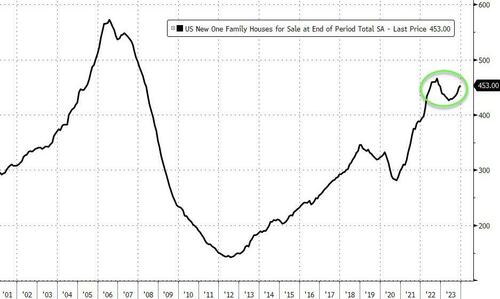
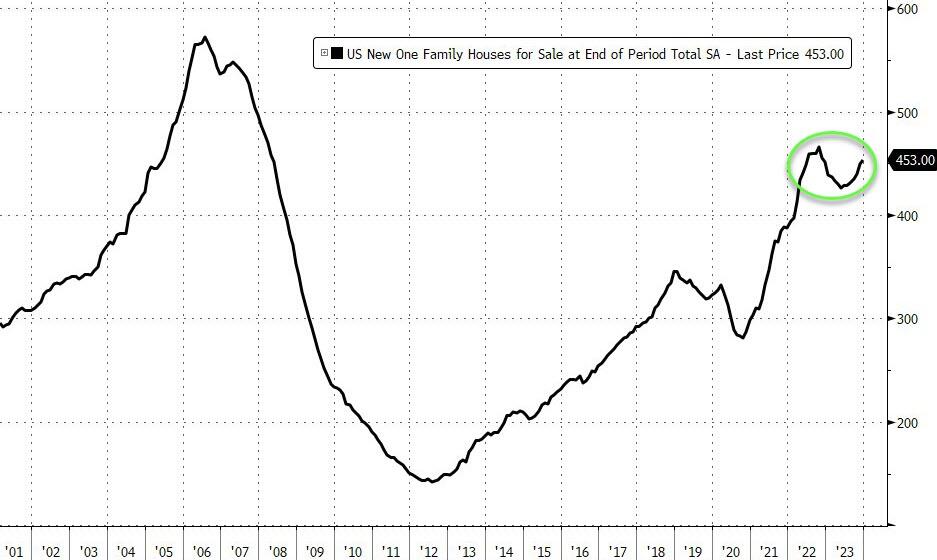
They built it, but no one came… the inventory of new houses for sale remains elevated and suggests builders may be cautious about beginning new projects.
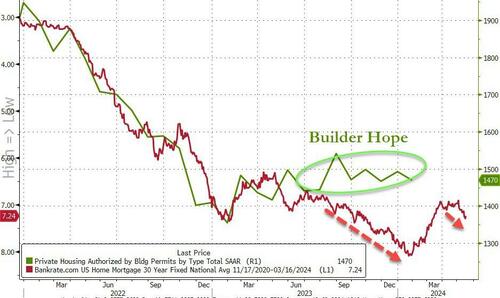
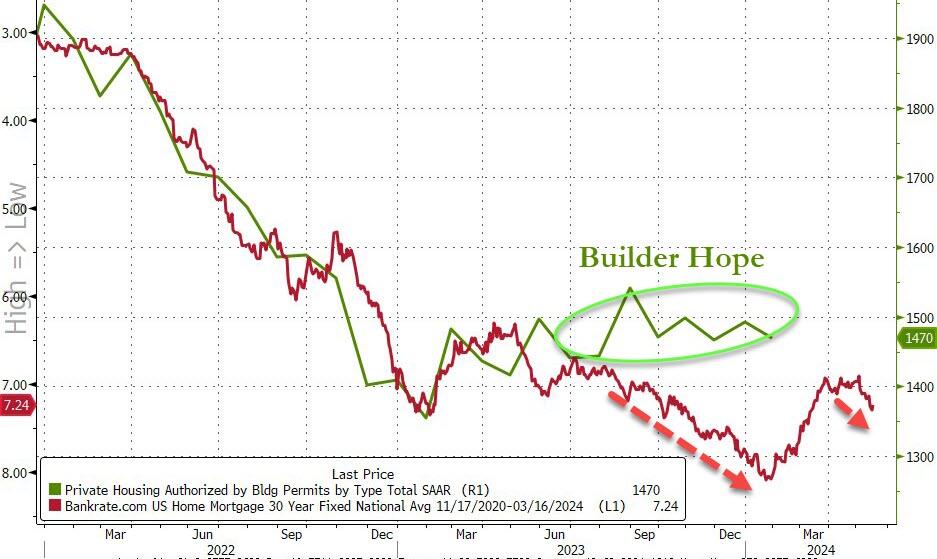
Don’t expect Permits to be reaccelerating anytime soon as mortgage rates have started to rise once again…

Source: Bloomberg

Which is not good news for CPI either as it suggests there is little rent relief coming soon.

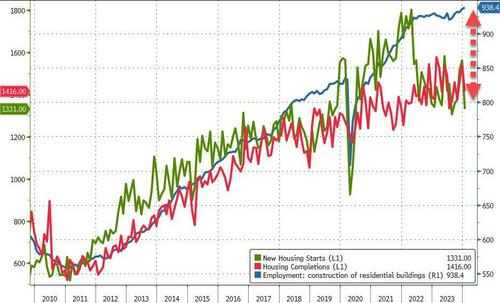
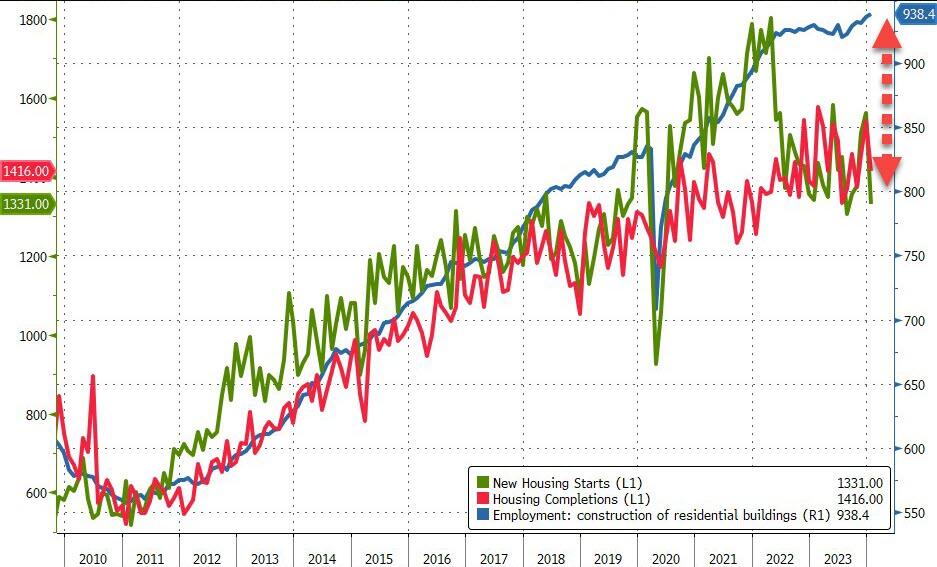
And finally, there is a record gap between what the government tells us about construction employment and actual construction activity…

Makes you wonder, eh? Did builders all suddenly get massively less productive? Or is the BLS just making shit up as usual?

And then we have producer price spiking in January.

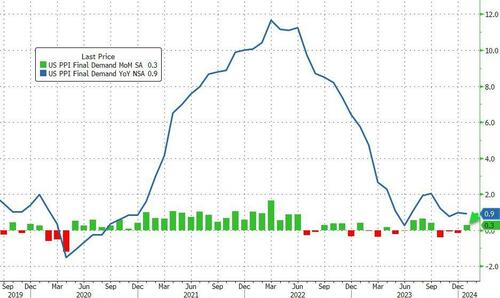
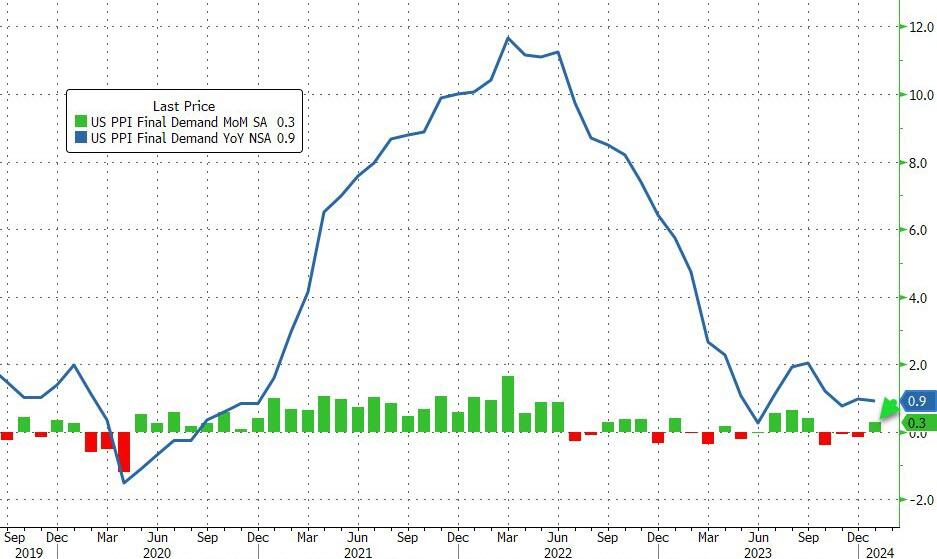
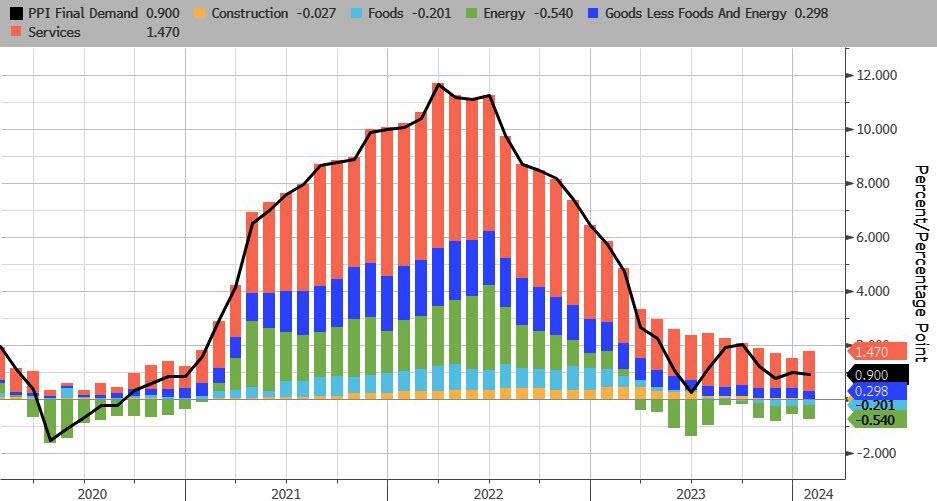
After the hotter-than-expected CPI (which has been shrugged off entirely by the stock market), Producer Prices were expected to rebound very modestly MoM but continue to slow on a YoY basis in January. Instead, like CPI, it re-accelerated with headline rising 0.3% MoM (+0.1% MoM exp), which left PPI up 0.9% YoY (down from December but hotter than the +0.6% exp)…

Source: Bloomberg

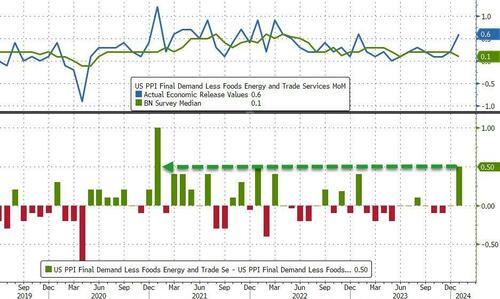
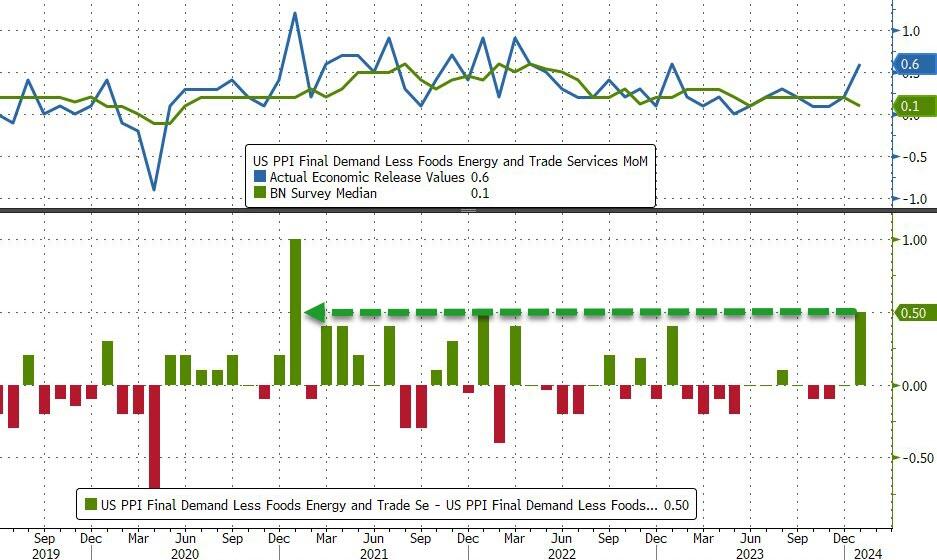
The picture was even worse under the hood with PPI ex food and energy up 0.5% MoM (vs +0.2% prior and +0.1% exp) and ex-food, energy, and trade up 0.6% MoM (vs +0.1% exp).

This was the biggest ‘beat’ for Core PPI since Jan 2021…

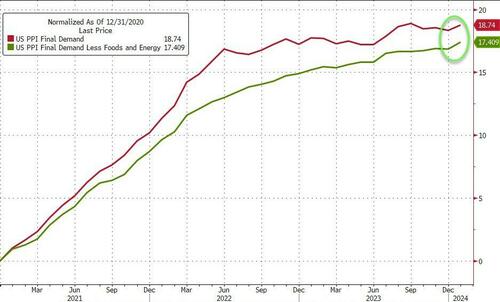
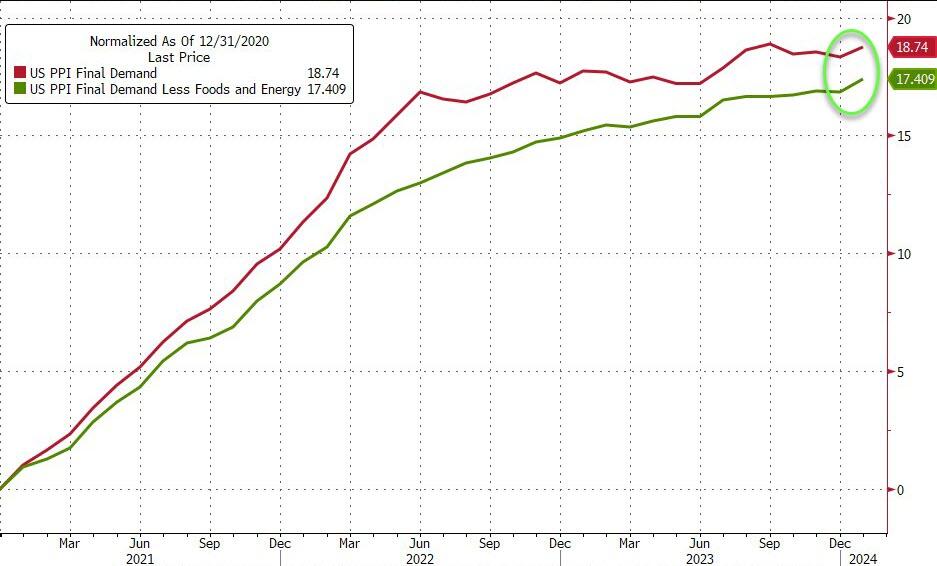
In fact, core PPI reached a new record high (reminder, disinflation does not mean lower prices), now up 17.4% since Biden was elected…

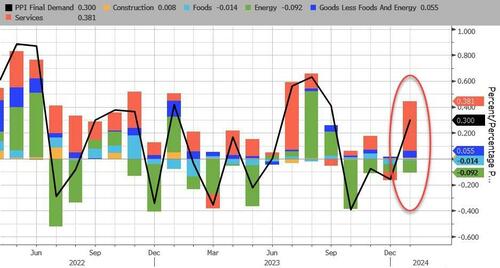
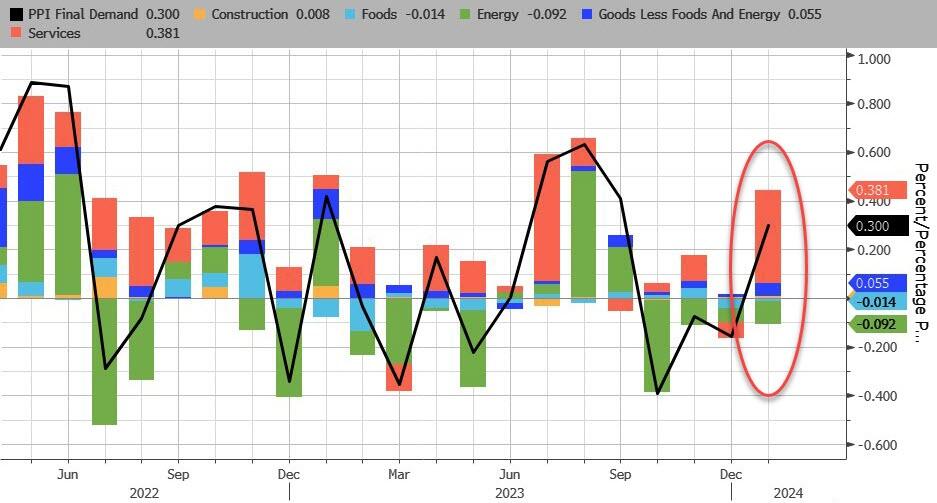
Services PPI soared MoM, and energy continues to be a driver of deflation (but is losing its power)…

Source: Bloomberg

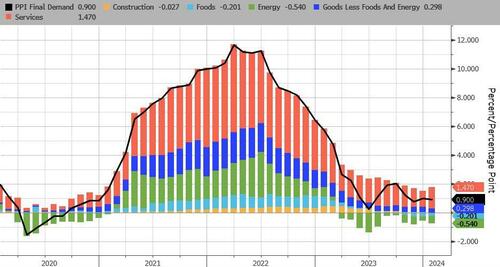
And on a YoY basis, Services PPI is also re-accelerating (+1.47% from +1.14%). Energy continues to be the deflationary driver…

Source: Bloomuberg

This is not good news for the disinflationistas. And it will stop President Biden’s narrative that ‘prices are coming down’…

Looks like the US economy is back in red.

Gimmie (Cheap) Shelter! Shelter Index CPI Increased 0.6 Percent In January (Largest Factor In Monthly Increase In Index) As Inflation Comes In Hotter Than Expected

Gimme (cheap) shelter!

As soon as Joe Biden started bragging on his low-energy campaign trail about inflation declining I knew it would go up. And it is increasing again.

Shelter cost (aka, housing) is still growing.

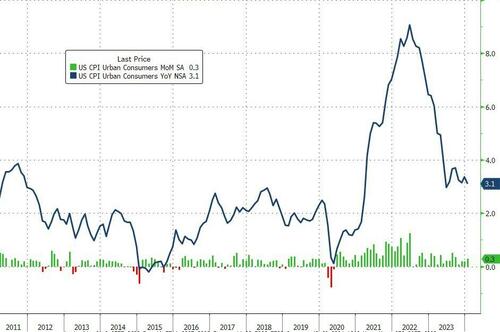
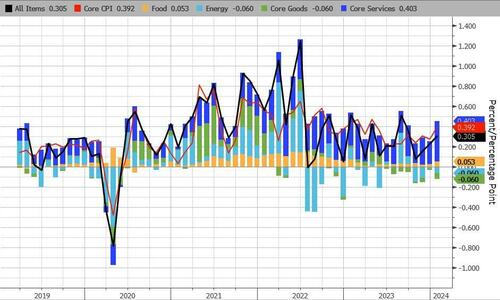
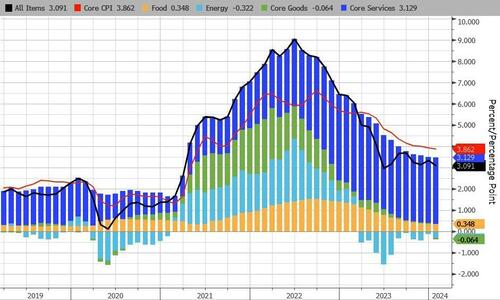
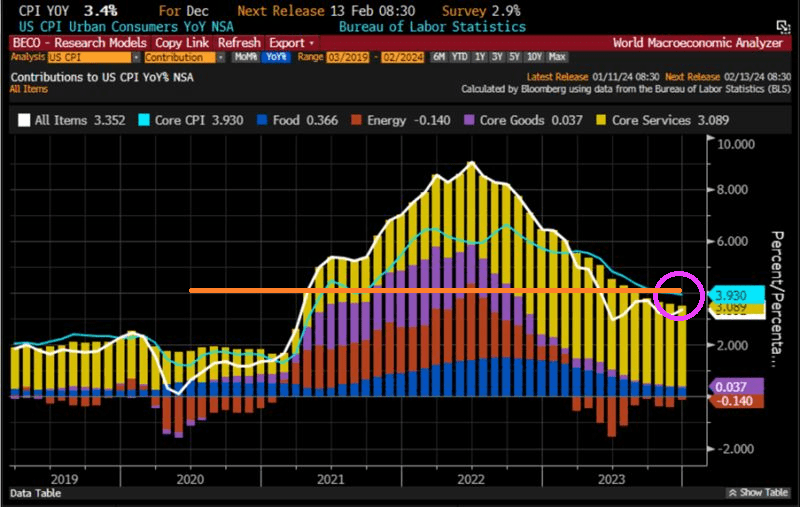
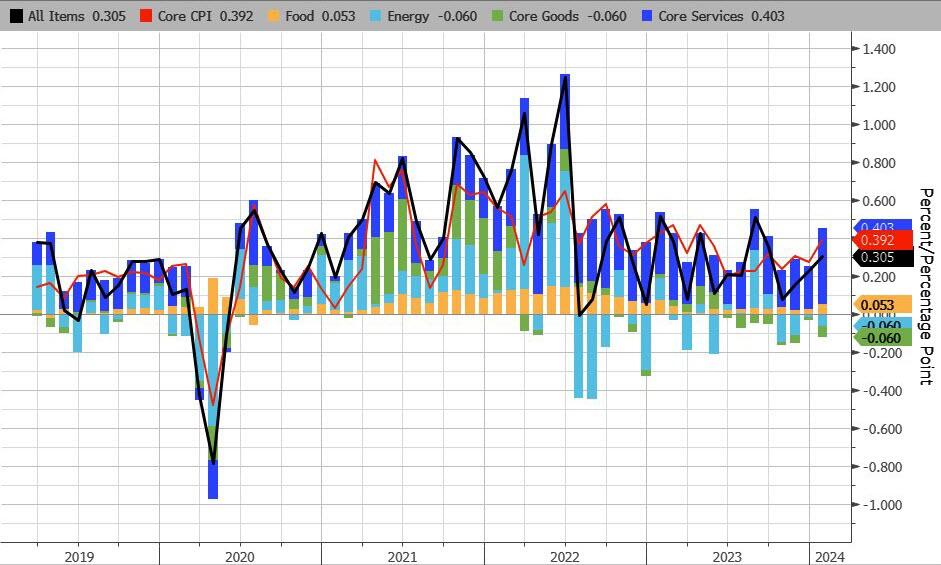
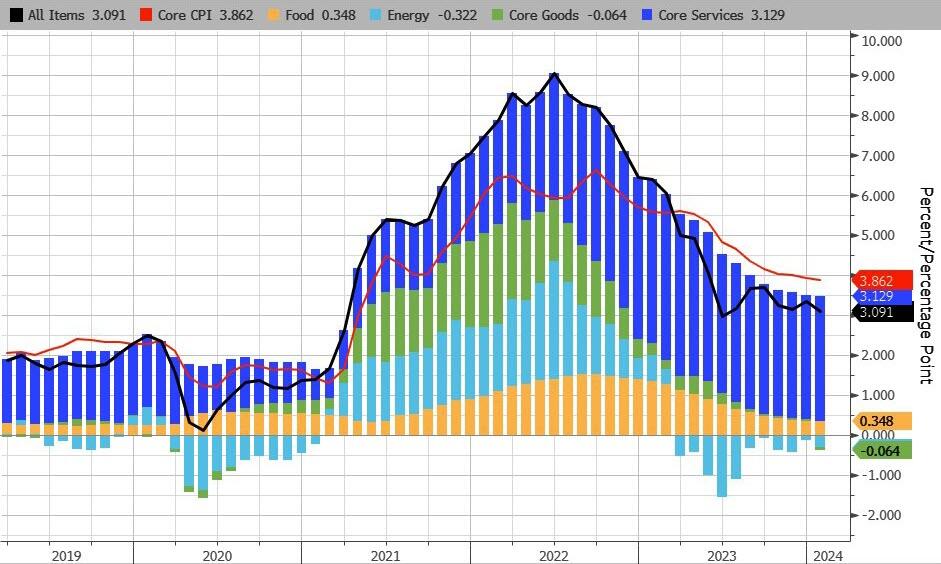
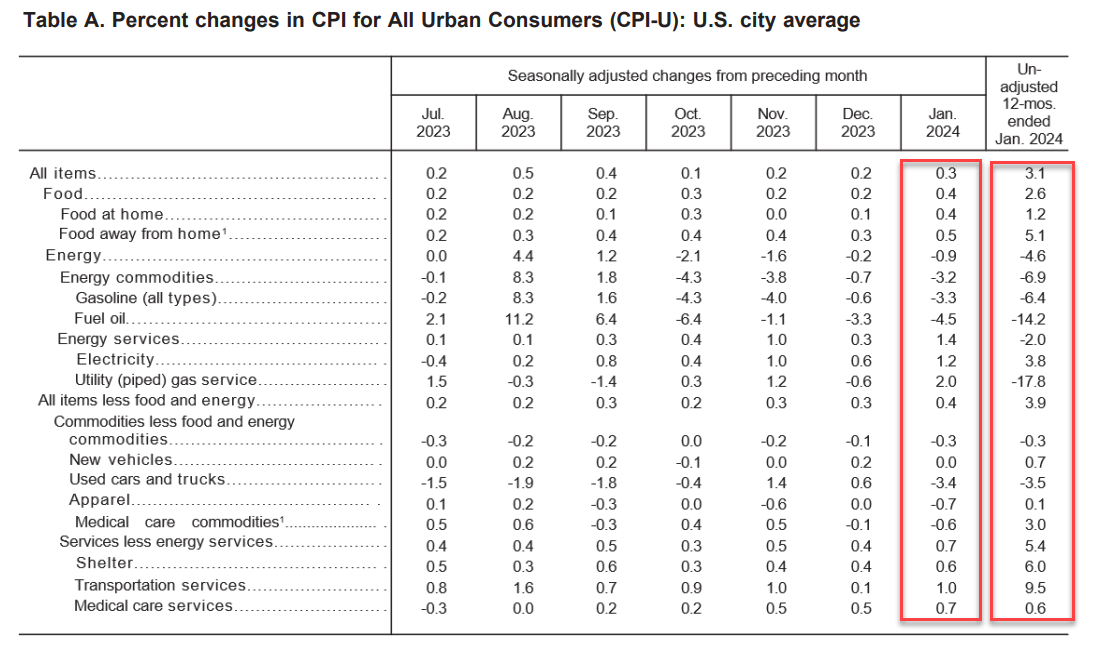
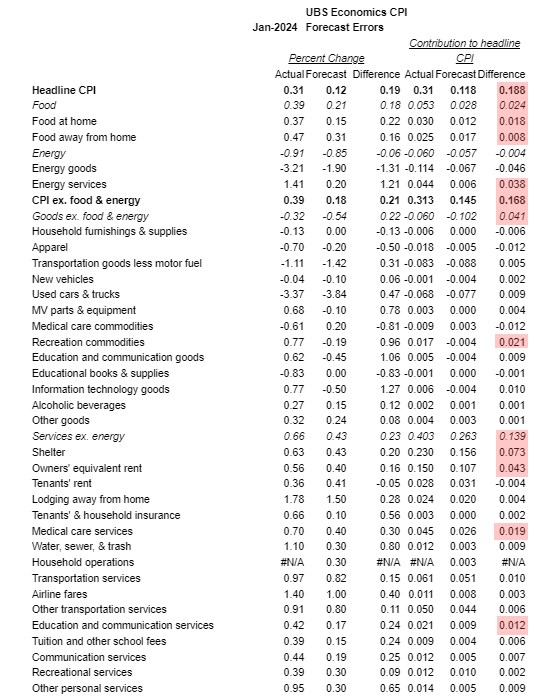
Expectations were for a big drop in the YoY consumer price index (from +3.4% to +2.9%) but instead it surprised to the upside (just as we warned) with a +3.1% YoY print for headline CPI (spoiling the sub-3% partiers). Consumer prices rose 0.3% MoM (more than the 0.2% exp) but the headline did decline from +3.4% to +3.1% YoY…

Source: Bloomberg

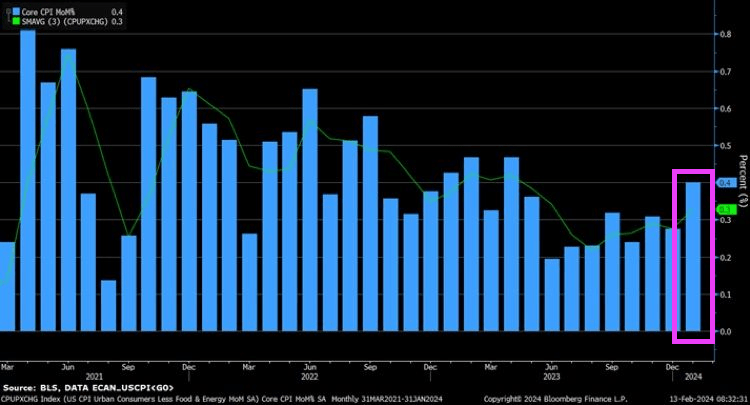
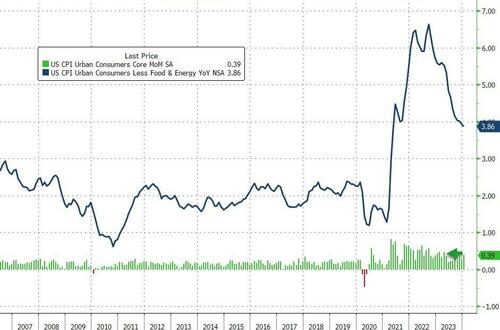
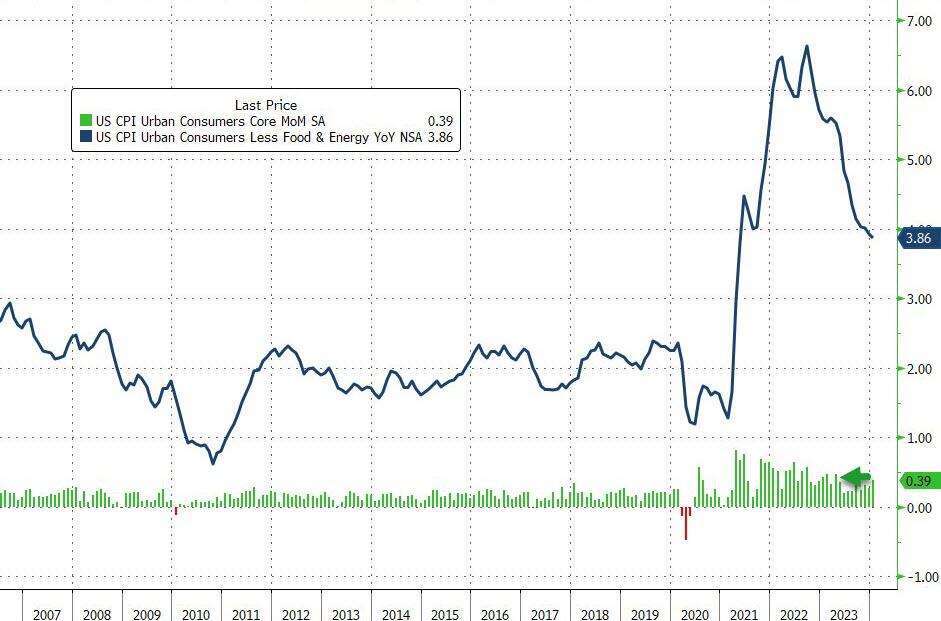
Core CPI fell below 4.00% YoY for the first time since May 2021, but the +3.86% YoY print was hitter than the 3.7% exp (with prices rising 0.4% MoM – the biggest jump since April 2023)…

Source: Bloomberg

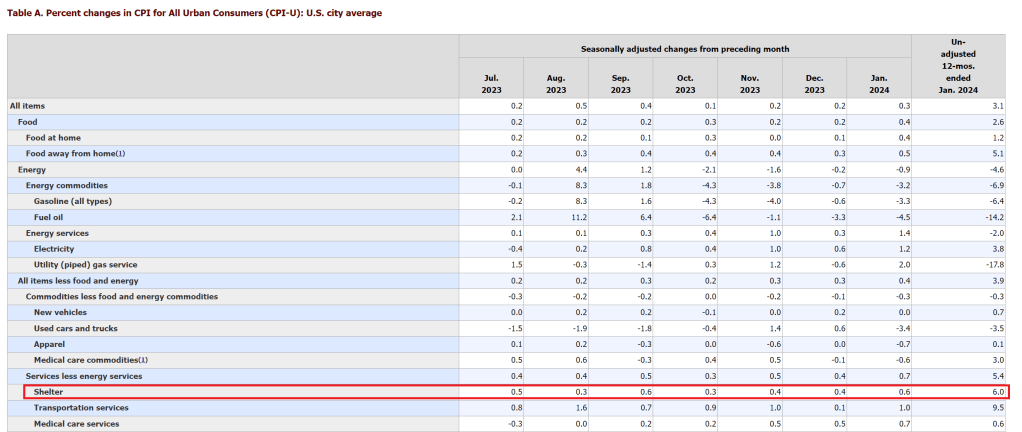
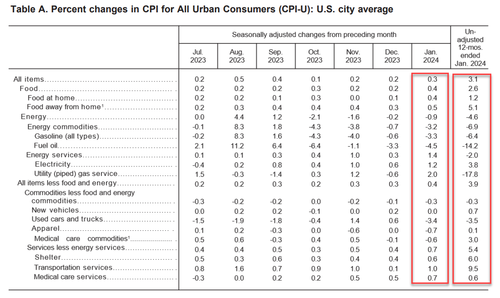
CPI Core: The index for all items less food and energy rose 0.4 percent in January.

  • The shelter index increased 0.6 percent in January, and was the largest factor in the monthly increase in the index for all items less food and energy.
    • The index for owners’ equivalent rent rose 0.6 percent over the month, while the index for rent increased 0.4 percent.
  • The lodging away from home index increased 1.8 percent in January. The motor vehicle insurance index increased 1.4 percent in January, and the recreation index rose 0.5 percent in January.
  • Among other indexes that rose in January were communication, personal care, airline fares, and education.
  • The medical care index rose 0.5 percent in January.
  • The index for hospital services increased 1.6 percent over the month and the index for physicians’ services increased 0.6 percent.
    • The prescription drugs index fell 0.8 percent in January.
  • The index for used cars and trucks fell 3.4 percent in January.
  • The index for new vehicles was unchanged in January.
  • The apparel index also decreased, falling 0.7 percent over the month.

Core Service inflation picked up MoM…

..and accelerated YoY

Source: Bloomberg

Under the hood, food and Energy services costs jumped MoM along with transportation services…

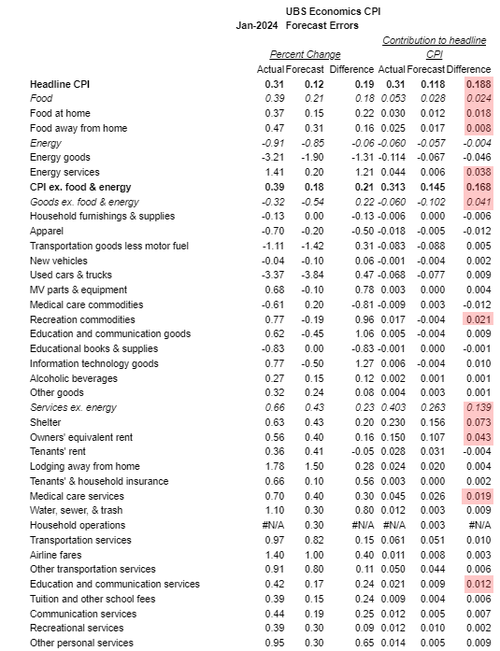
Here’s the biggest component upside surprises…

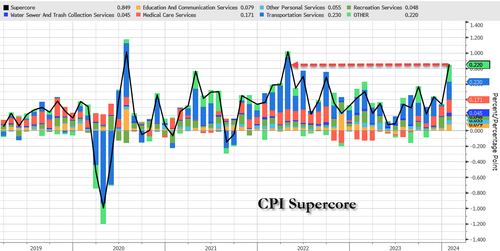
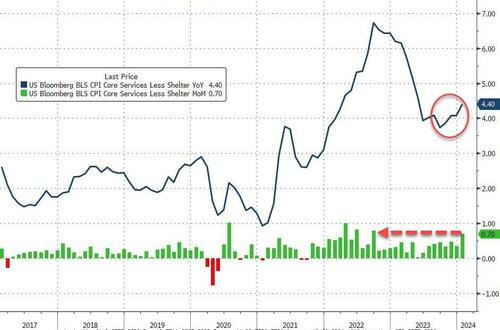
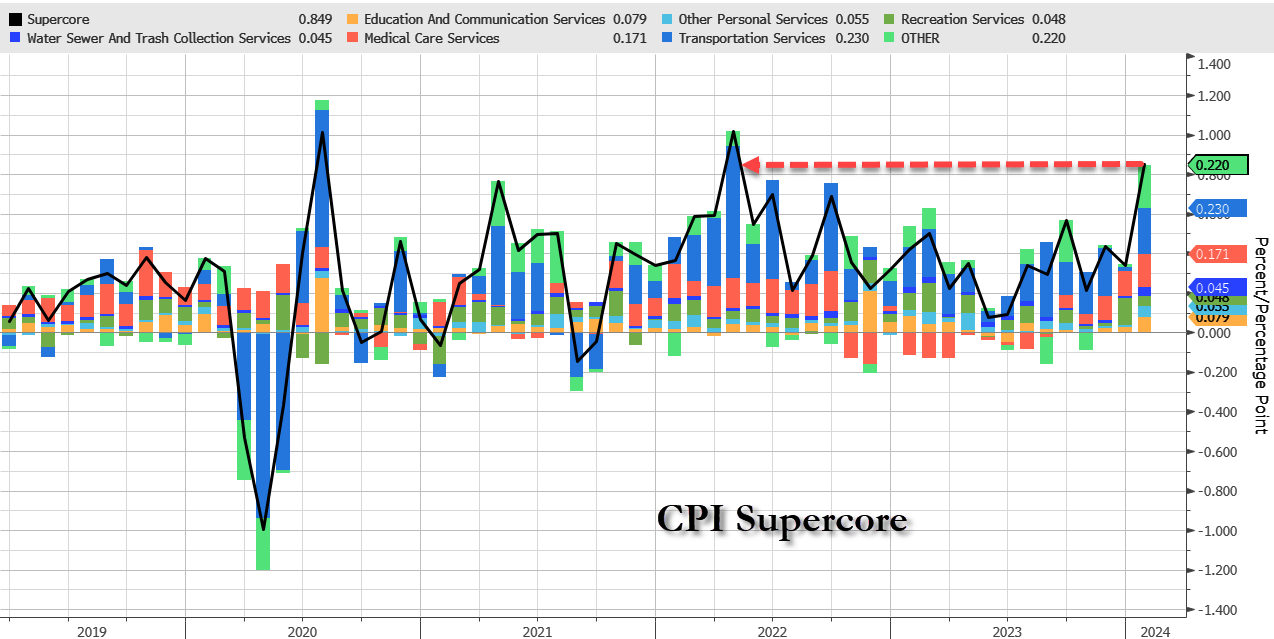
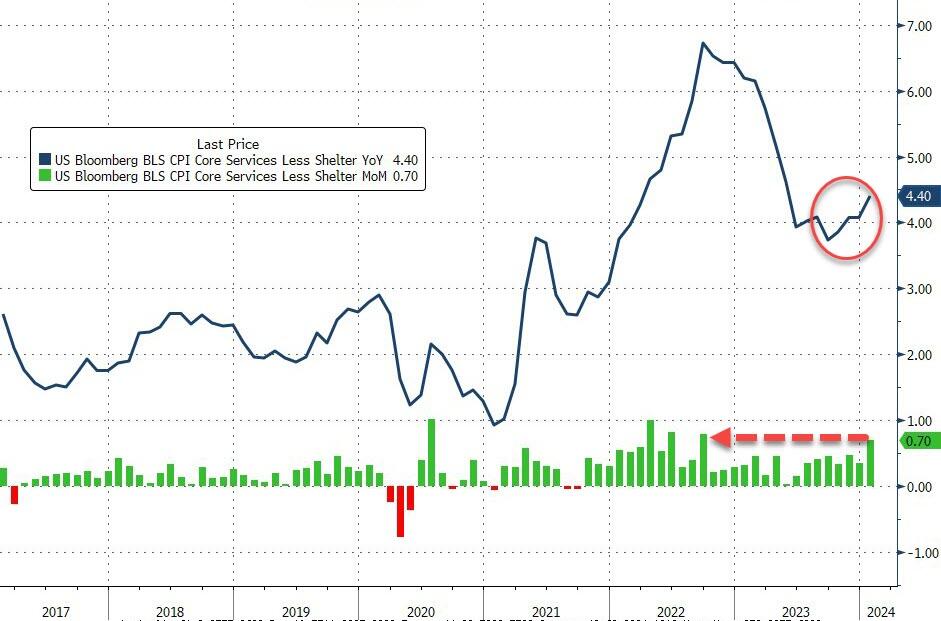
And one step deeper – the so-called SuperCore: Core CPI Services Ex-Shelter index – soared 0.7% MoM (the biggest jump since Sept 2022…

… driving the YoY change up to +4.4% – the hottest since May 2023….

Source: Bloomberg

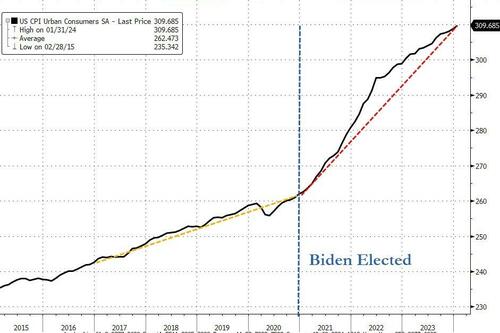
Finally, as a reminder, lower inflation does not mean lower prices.

Source: Bloomberg

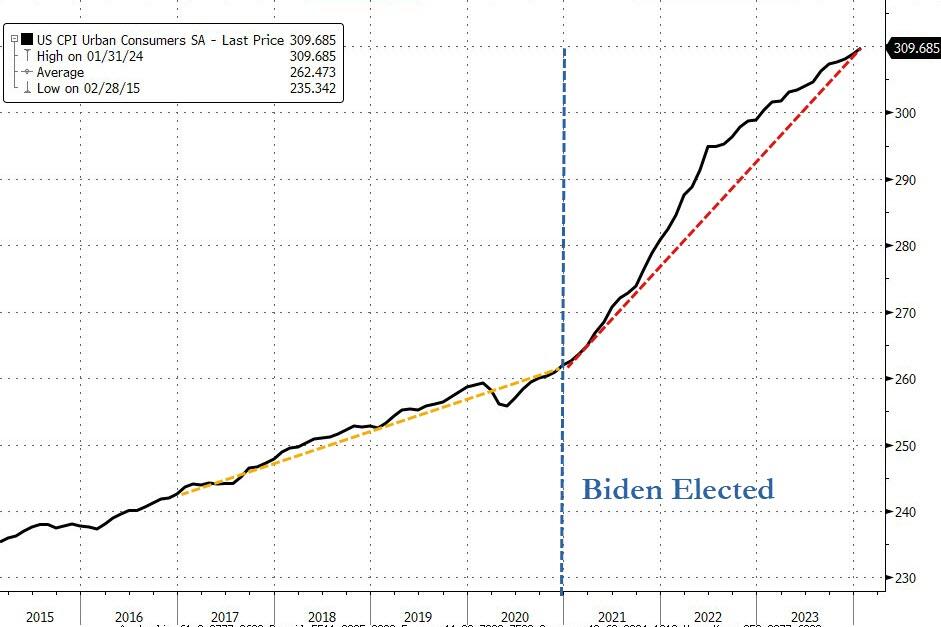
The actual index of consumer prices hit a new record high this month – and is up over 18% since President Biden’s term began (it was up 8% over President Trump’s full four year term).

And it gets worse…

Source: Bloomberg

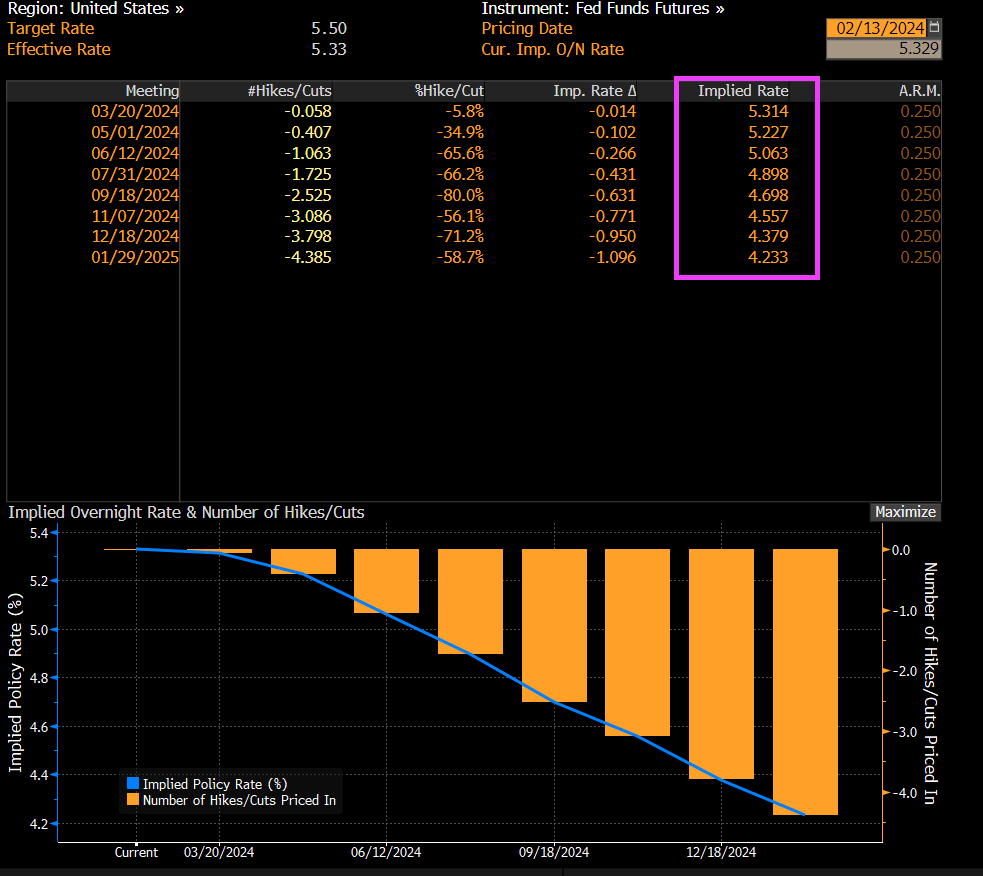
And on the higher than expected inflation report, we are still seeing bets on Fed Funds rate falling from 5.50% to 4.233% over the coming year.

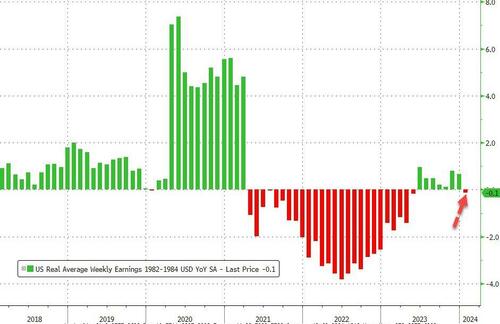
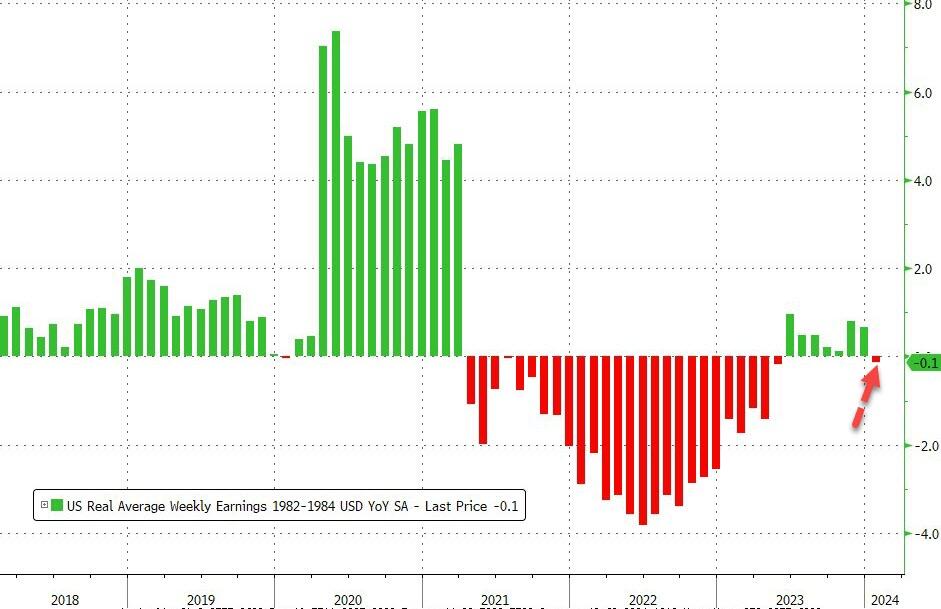
The re-accleration of inflation means wage growth is back in the red relative to prices.

That Foul Jobs Report! Full-time Jobs Tank Under Bidenomics As Serious Delinquencies On Auto Loans Soar To Highest Level Since The Great Recession (PPI Is Deflating But Inflation Remains Higher Than Under Trump)

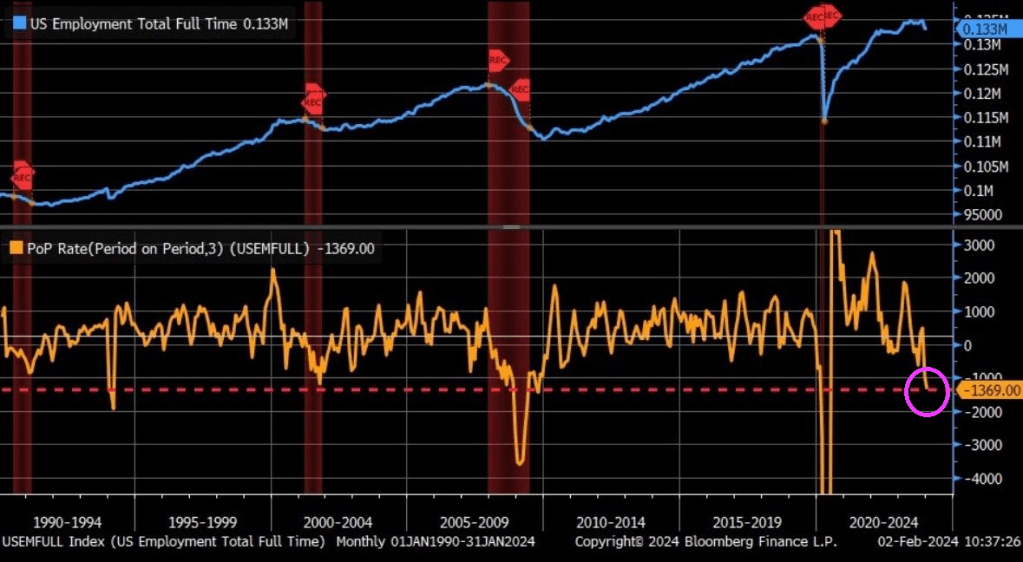
As some fans celebrate the Kansas City Chiefs Superbowl victory over the San Francisco 49ers (the game was so much like bread and circuses from the Roman Empire except for who is being thrown to the lions), we have been distracted from the horrible state of the US economy. Just review that horrible December Jobs report where the US actually LOST full-time jobs, replaced by part-time jobs.

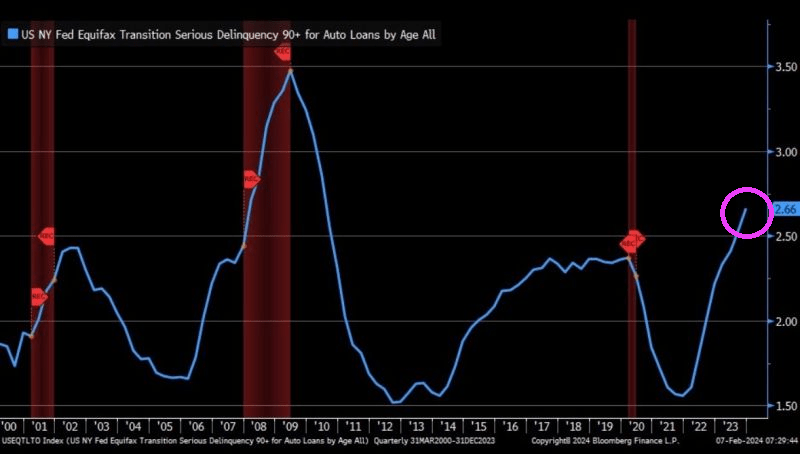
And with the God awful jobs report, serious delinquencies on auto loans is SOARING. To the highest rate since The Great Recession.

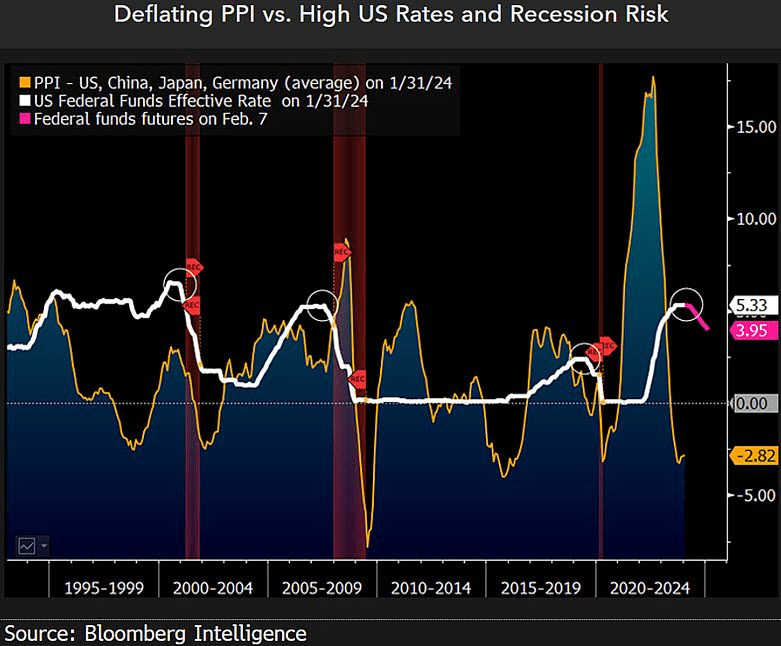
The Producers Price Index is deflating.

At least inflation is cooling down, but still higher than under he that can’t be mentioned on The View, Rachel Maddow or Morning Joe, Donald Trump, the Left’s Voldemort.

I admit, Travis Kelce should have been benched for shoving Head Coach Andy Reid during The Super Bowl. “Damn it, Taylor (Swift) flew here from Tokyo to watch me play and you aren’t throwing enough to me!” Welcome Travis Kelce to the elitist 1% who think the rules don’t apply to them. And your 2.0 GPA at University of Cincinnati certainly qualifies you to opine on the economy … on The View or MSNBC.

Fed’s Powell Admits Bidenomics Is Not Remotely Sustainable Or Fixable! Too Much Debt And Spending, Too Little Growth (GDP Growth Higher Than Debt Growth In Only 1 Quarter Under “Brainless Joe”)

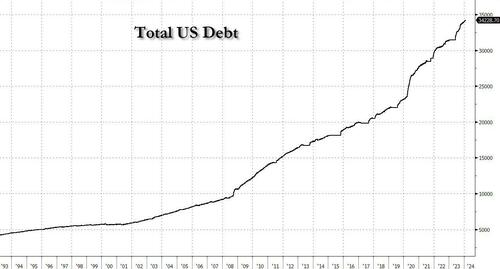
As Commander Cody sang, “We have too much debt.”

“The prices of some things will decline. Others will go up. But we don’t expect to see a decline in the overall price level,” said Federal Reserve Chair Jerome Powell, Nvidia stock hitting new highs, its market cap soaring to $1.78trln.

“That doesn’t tend to happen in economies, except in very negative circumstances. What you will see, though, is inflation coming down,” explained the Fed Chairman, the average American neither understanding nor caring about the nuance.

Bitcoin raced upward, its market cap roughly half of Nvidia. The market now values this remarkable maker of the semiconductor chips necessary to create an artificial life form at roughly twice the value of the most secure network in human history.

Fidelity added Bitcoin to a model portfolio, spurring investors to consider what happens to the price of a digital asset, whose supply is fixed at 21mm for all eternity, once passive investment products start really stacking Satoshis.

You see, the supply of everything in the universe expands as its price increases, but no matter how high the price of Bitcoin goes, its pre-defined pace of production will only ever decrease.

Nvidia (or any other stock) can be created at the click of a new issuance, or an executive equity option grant for that matter. The average investor neither understands this yet, nor cares for the nuance.

“I would say this. In the long run, the US federal government is on an unsustainable fiscal path,” said Powell, pointing out one of the most important top-down investment themes of the coming decade.

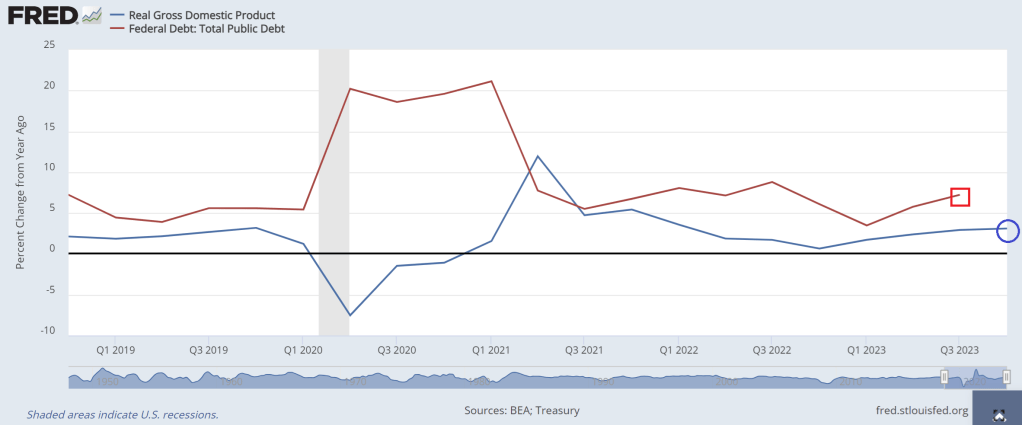
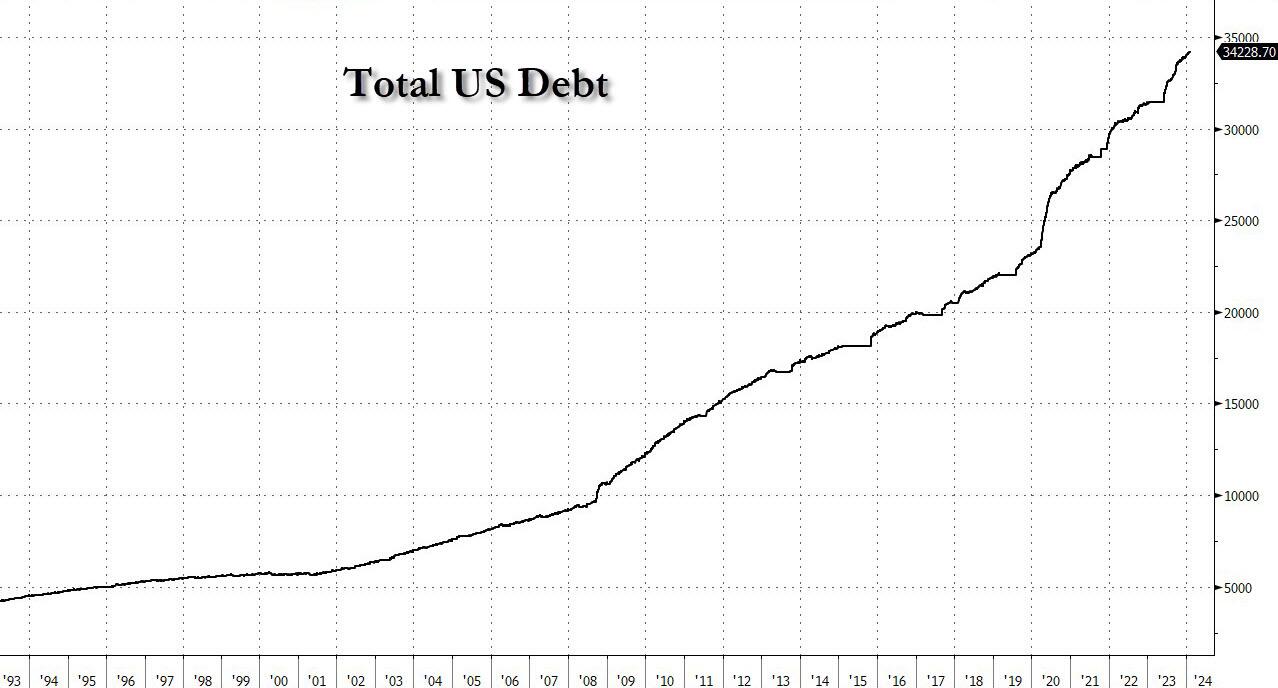
“And that just means that the debt is growing faster than the economy. So, it is unsustainable. I don’t think that’s at all controversial. And I think we know that we have to get back on a sustainable fiscal path. And I think you’re starting to hear now from people in the elected branches who can make that happen,” he added, without naming names, because there really aren’t any.

Under Brainless Joe and Dr. Janet Yellen, the US economy has experienced real GDP growth YoY only once (Q1 2021). Otherwise, debt growth YoY has always exceeded real GDP growth under Biden.

I admit I am rooting for the SF 49ers over the Kansas City Swifties. At least we won’t have to listen to Brainless Biden ramble on during the Super Bowl, unless they issue a pre-recorded propaganda piece for half time similar to the John Gill character from Star Trek.

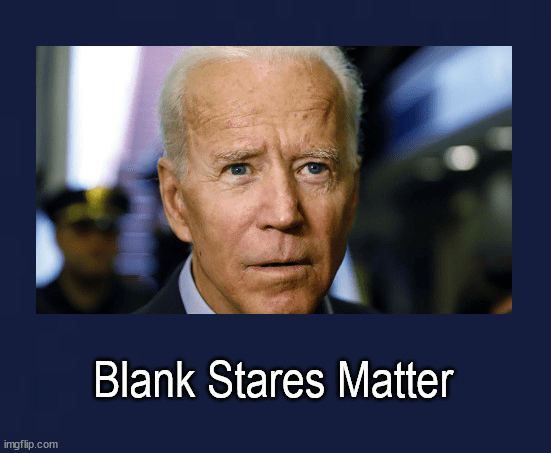
Blank stares matter should be Biden’s new campaign slogan!

Bidenomics Failing Farmers As Expected Incomes Crash The Most Since 2006 (Food Prices UP 21% Under Biden’s Reign Of Error)

This reminds me of “The Human Farm” episode of Parks and Recreation.

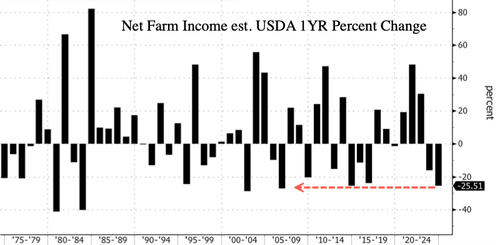
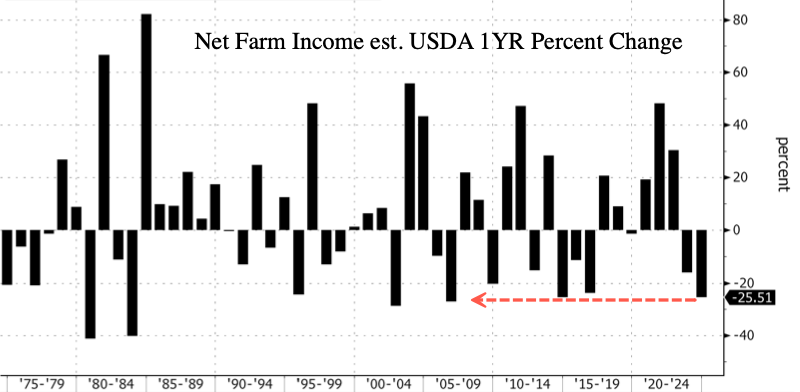
A new report from the US Department of Agriculture forecasts that US farmers are poised for another year of financial misery, facing the most significant decline in incomes in almost two decades as crop prices slide and US dominance in ag exports wanes. 

USDA forecasts net farm income, a broad measure of profits, to plunge $39.8 billion, or 25.5%, to $116.1 billion in 2024. This follows a forecasted decrease of $29.7 billion, or 16%, from 2022 to $155.9 billion in 2023. 

If the estimate holds, farmers face the largest income drop since 2006 and back-to-back years of financial pain

“With this expected decline, net farm income in 2024 would be 1.7 percent below its 20-year average (2003–22) of $118.2 billion and 40.9 percent below the record high in 2022 in inflation-adjusted dollars,” USDA wrote in the report. 

Simultaneously, farmers are witnessing a rapid decline in their leading role in the global grain market. Decades of corn export dominance were shredded by Brazil last year. 

Bidenomics is failing blue-collar workers who put food on America’s table.

Food prices (CPI) are up 21% under listless, dementia Joe Biden.

I am surprised that Orin from Parks and Recreation hasn’t been appointed to Biden’s cabinet as Secretary of Agriculture.

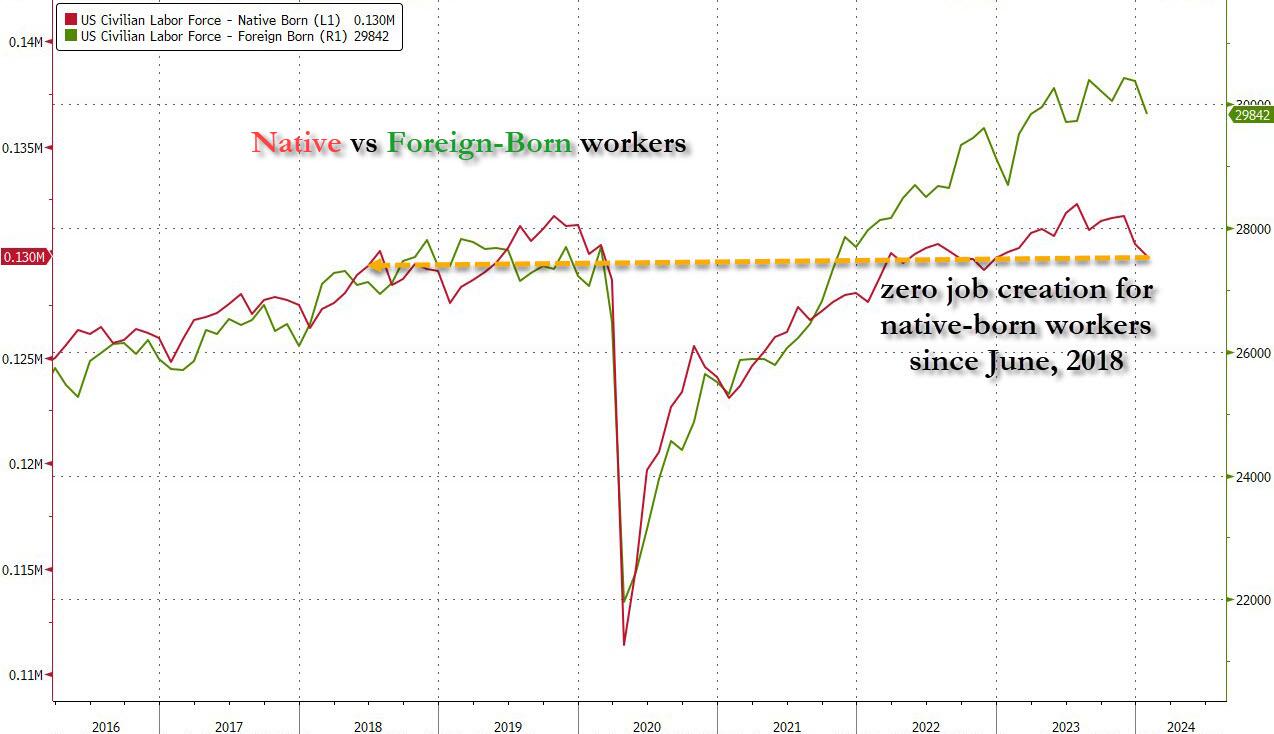
The Worst Jobs Report Of All-time Cloaked As A Biden Victory (All Job Creation Over Past 4 Years Has Been For Foreign-born Workers, Zero Job-creation For Native Born Workers Since July 2018!)

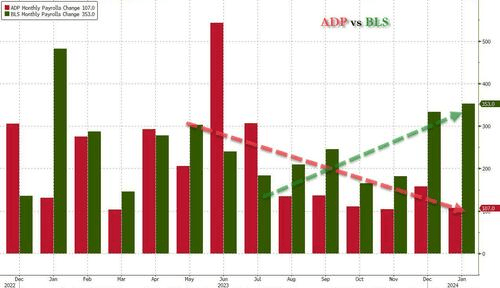
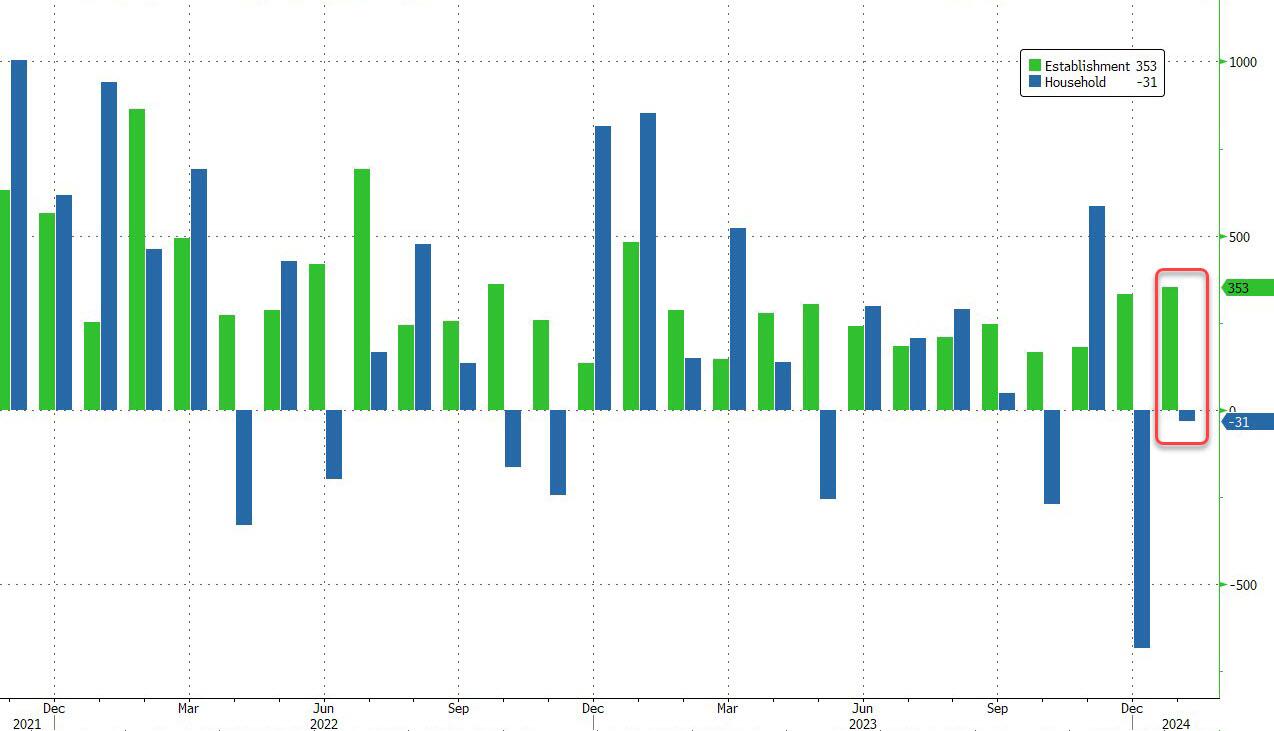
Today’s jobs report was UGLY! How when the US unexpectedly added 353K “jobs” – the most since January 2023. Remember, Biden is President. And apparenty El Presidente of Latin America, Africa and Asia.

Let me start with the official Biden jobs report versus the ADP jobs report from yesterday. BLS showed an amazing surge while ADP was sigalling a slowdown. Obviously, BLS is measuring employment differently (this is an election year after all). Like seasonal adjustments (always econometric voodoo).

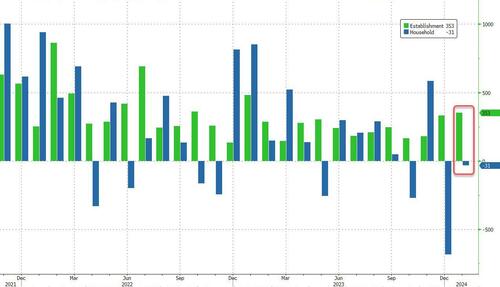
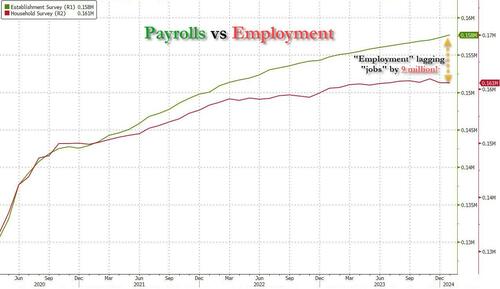
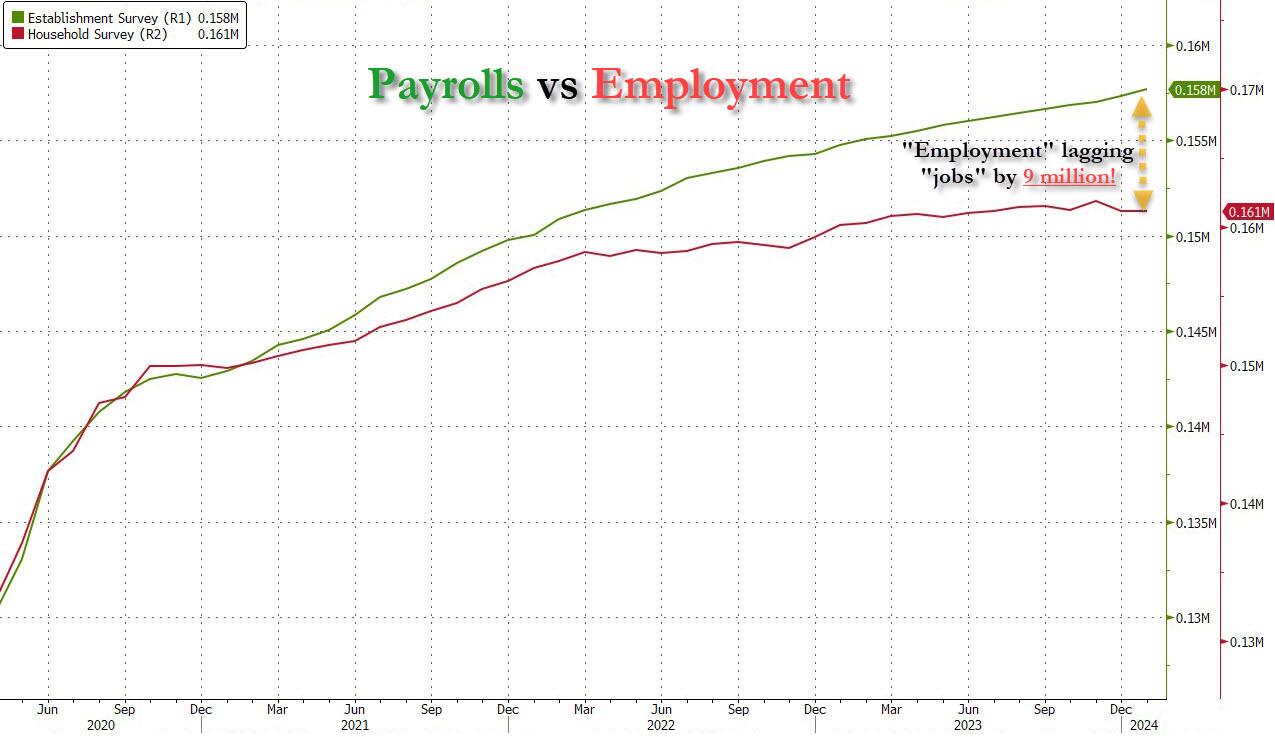
But it’s more than just the Biden admin hanging its “success” on seasonal adjustments: when one digs deeper inside the jobs report, all sorts of ugly things emerge… such as the latest divergence between the Establishment (payrolls) and much more accurate Household (actual employment) survey. To wit, while in January the BLS claims 353K payrolls were added, the Household survey found that the number of actually employed workers dropped again, this time by 31K (from 161.183K to 161.152K).

This means that while the Payrolls series hits new all time highs every month since December 2020 (when according to the BLS the US had its last month of payrolls losses), the level of Employment has barely budged in the past year. Worse, as shown in the chart below, such a gaping divergence has opened between the two series in the past 4 years, that the number of Employed workers would need to soar by 9 million (!) to catch up to what Payrolls claims is the employment situation.

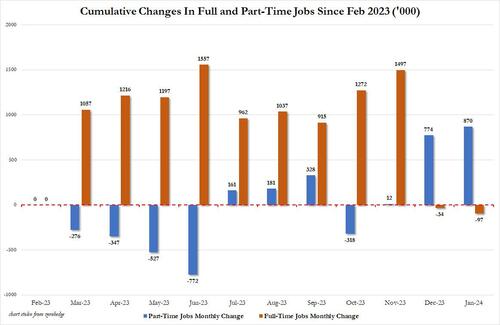
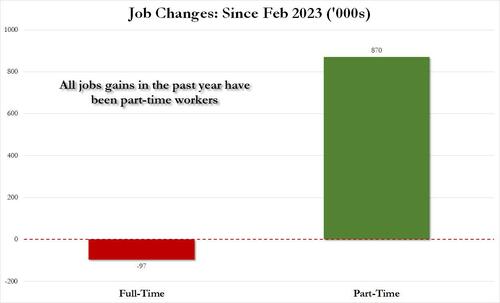
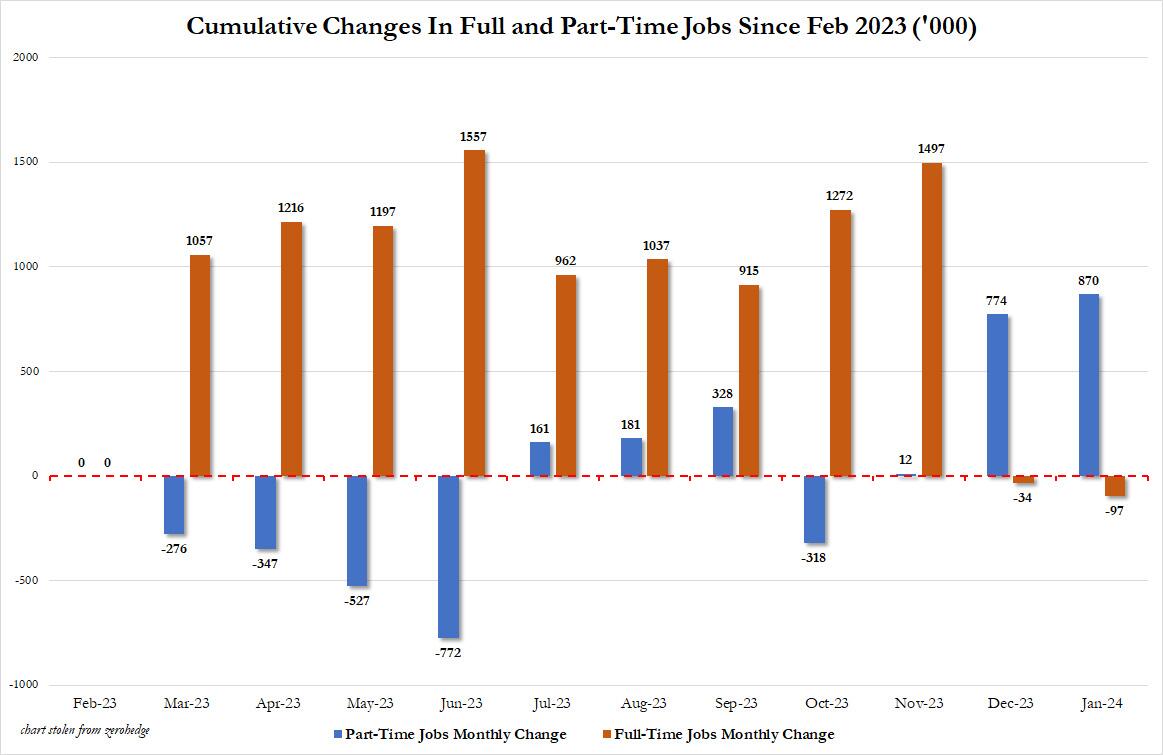
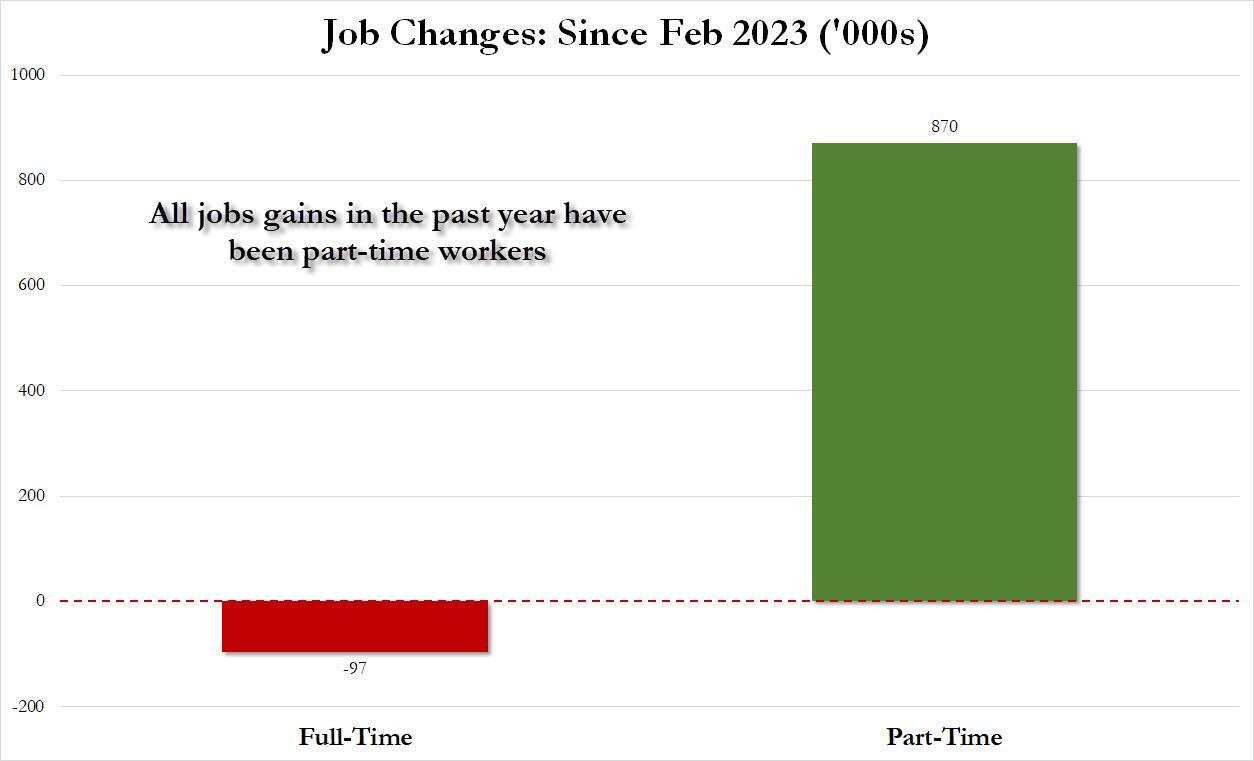
There’s more: shifting from a quantitative to a qualitative assessment, reveals just how ugly the composition of “new jobs” has been. Consider this: the BLS reports that in January 2024, the US had 133.1 million full-time jobs and 27.9 million part-time jobs. Well, that’s great… until you look back one year and find that in February 2023 the US had 133.2 million full-time jobs, or more than it does one year later! And yes, all the job growth since then has been in part-time jobs, which have increased by 870K since February 2023 (from 27.020 million to 27.890 million).

Here is a summary of the labor composition in the past year: all the jobs have been part-time jobs!

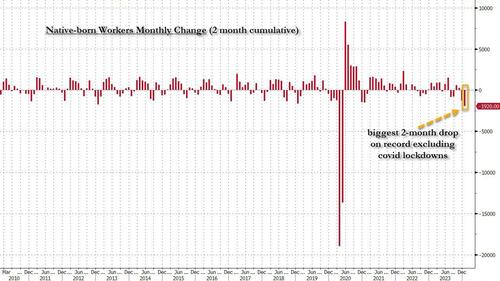
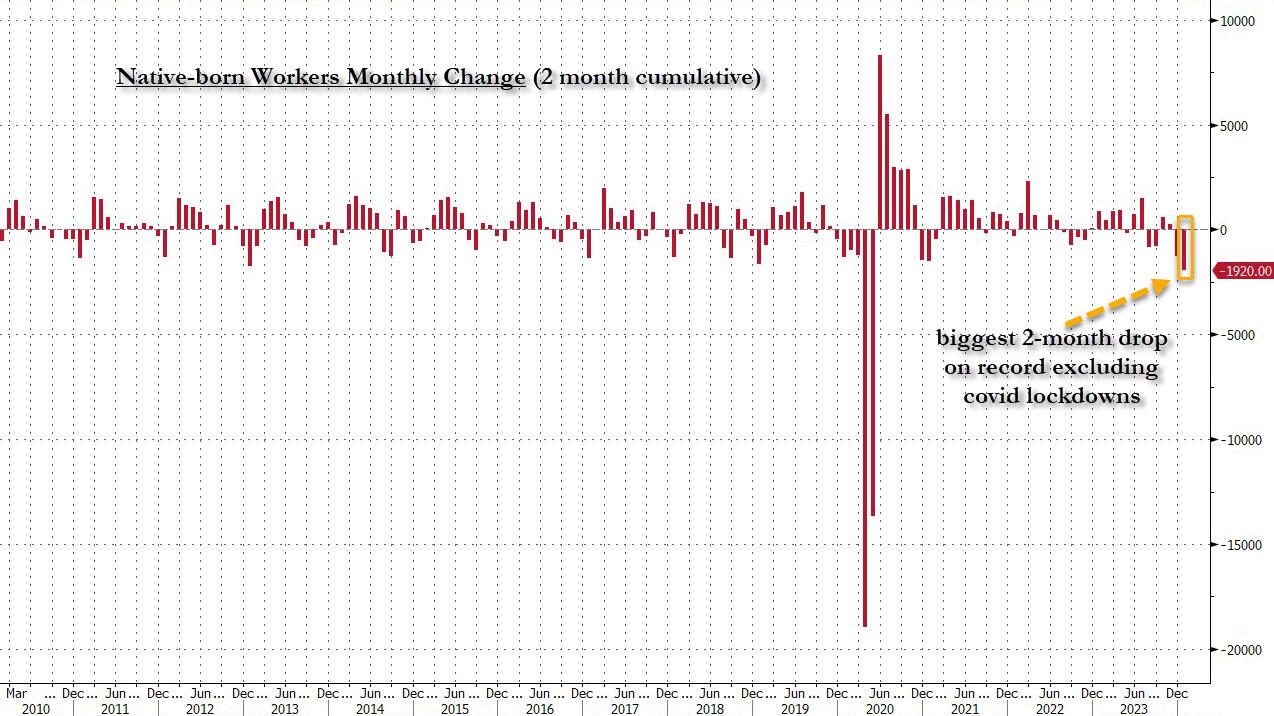
But wait there’s even more, because just as we enter the peak of election season and political talking points will be thrown around left and right, especially in the context of the immigration crisis created intentionally by the Biden administration which is hoping to import millions of new Democratic voters (maybe the US can hold the presidential election in Honduras or Guatemala, after all it is their citizens that will be illegally casting the key votes in November), what we find is that in January, the number of native-born worker tumbled again, sliding by a massive 560K to just 129.807 million. Add to this the December data, and we get a near-record 1.9 million plunge in native-born workers in just the past 2 months!

Said otherwise, not only has all job creation in the past 4 years has been exclusively for foreign-born workers, but there has been zero job-creation for native born workers since July 2018!

Source: St Louis Fed FRED Native Born and Foreign Born

This is a huge issue – especially at a time of an illegal alien flood at the border – and is about to become a huge political scandal, because once the inevitable recession finally hits, there will be millions of furious unemployed Americans demanding a more accurate explanation for what happened – i.e., the illegal immigration floodgates that were opened by the Biden admin.

Which is also why the Biden admin will do everything in his power to insure there is no official recession before November… and is why after the election is over, all economic hell will finally break loose. Until then, however, expect the jobs numbers to get more and more ridiculous.

I wonder if “Union Joe” is telling US labor union about no growth for native (American born) workers.

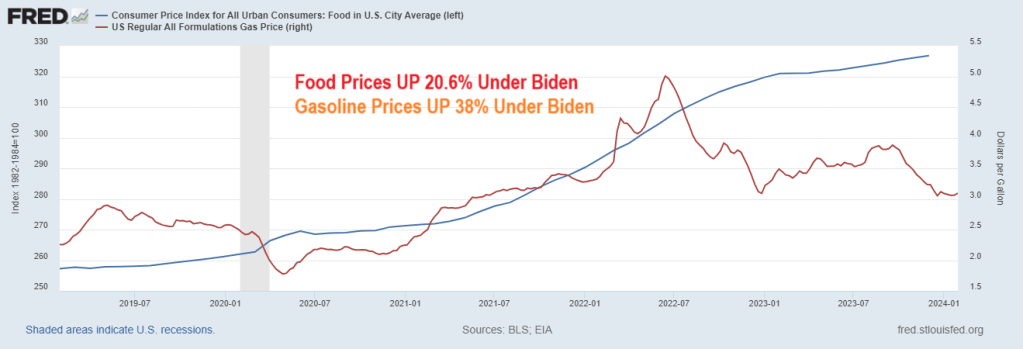
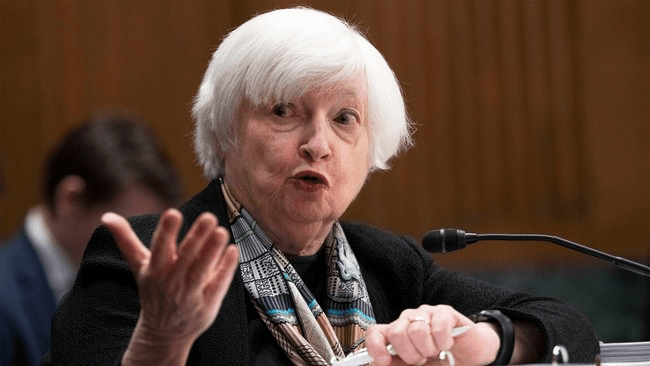
Captain Obvious Award Goes To … Treasury Secretary Yellen Who Admits “High Prices Here To Stay” (Food CPI UP 21%, Gasoline Prices UP 38% Under “Inflation Joe”, Home Prices UP 33.2%, Mortgage Rates UP 154%)

Treasury Secretary Janet Yellen just admitted what the rest of Americans already knew: high prices are here to stay. Example? Food prices (CPI) are up over 20% under Inflation Joe while gasoline prices are up 38% under Clueless Joe.

On the housing front, the Case-Shiller National Home Price Index is up 33.2% under Biden. And Freddie Mac’s 3-year mortgage rate is up 154% under Biden’s leadership (c’mon man! Obama is pulling the strings on Puppet Joe).

Speaking during an interview with ABC News Live over the weekend, Treasury Secretary Janet Yellen admitted prices aren’t going down, contradicting arguments repeatedly made by the Biden White House about easing inflation. In 2021, Yellen claimed inflation was “transitory.”

For months officials in the Biden administration have falsely claimed prices on everyday goods and services were going down. In reality, they’re getting more expensive at a slower pace. 

During a briefing at the White House last week, Press Secretary Karine Jean Pierre had trouble explaining complaints from Biden when he purchased a smoothie that cost $6. 

“Last Friday, the president was at a coffee shop in Pennsylvania, and he seemed to be surprised that the smoothie was $6 and how expensive it was,” a reporter asked. “I’m curious. So is the president now realizing the costs that Americans are bearing?”

“So, look, when he went over to you all, to the press corps, he was having a good time, right? And offered, as you know, offered to buy them coffee,” Jean Pierre responded. “There was a big group there, and he made sure everyone got coffee and pastries. So I just want to make that really clear.”

That is wonderful, KJP! The White House Press Corps got free coffee and pastries! Yippee!!!

But the rest of us in America are suffering from Bidenomics and inflation. Like food prices having risen 21% under Biden, gasoline prices UP 38%, home prices UP 33.2% and mortgage rates UP 154%.

Yellen wins the Captain Obvious Award.

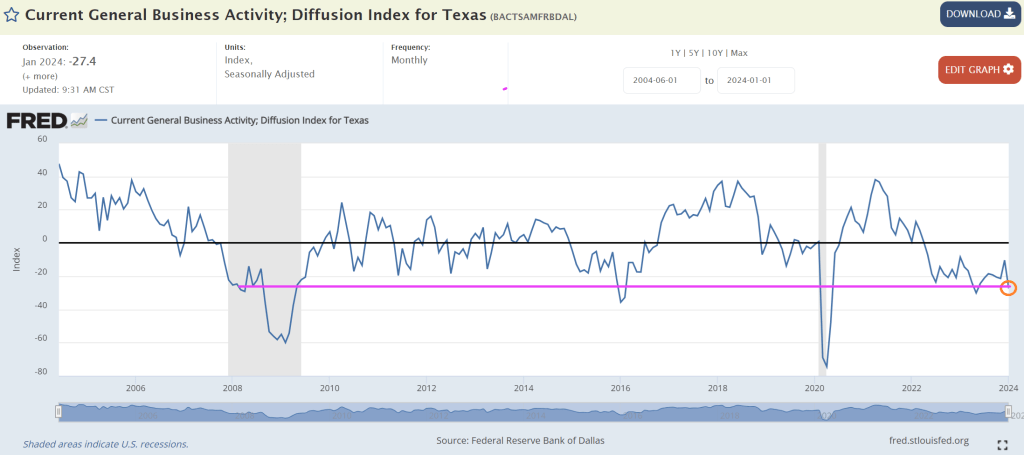
Texas Business Activity Index Falls To Recession-era Reading Of -27.4 (Biden Freezes Natural Gas Exports)

Texas is a state of mind and is currently under invasion. Encouraged by BIG AGRA Senator Lankford (RINO-Oklahoma).

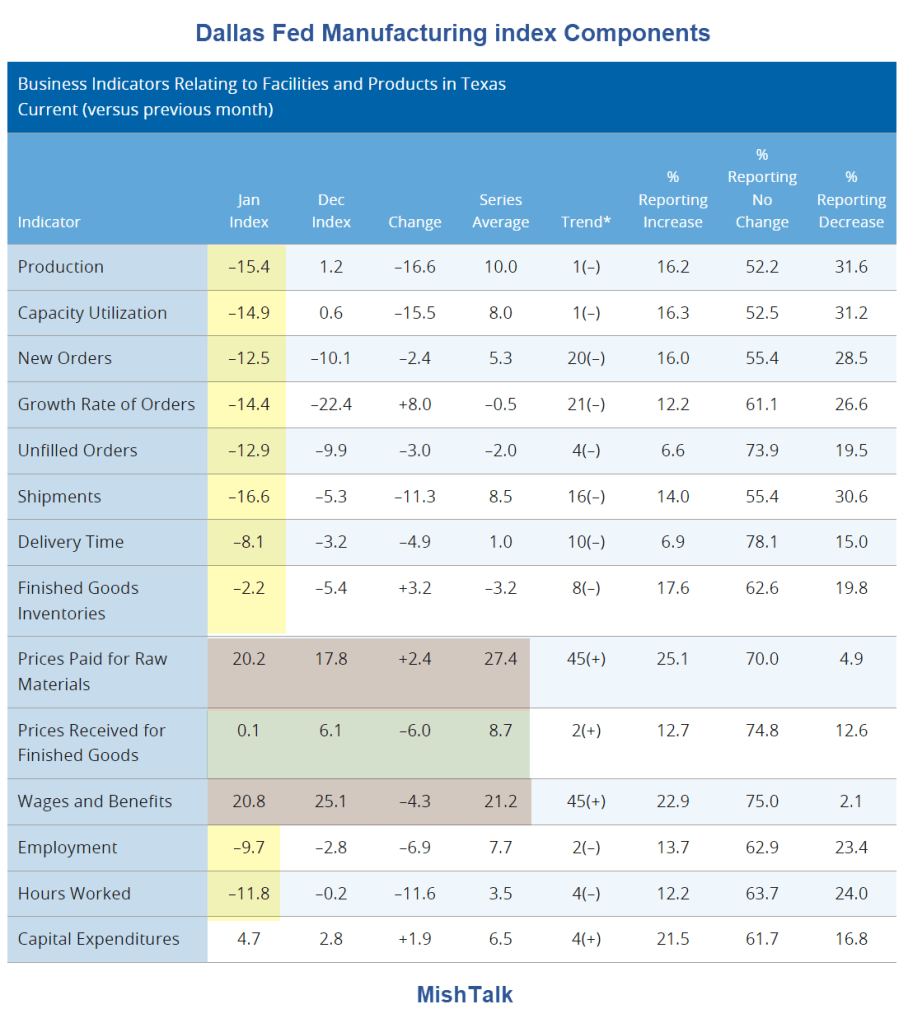
Texas factory activity contracted in January after stabilizing in December, according to business executives responding to the Texas Manufacturing Outlook Survey. The production index, a key measure of state manufacturing conditions, dropped 17 points to -15.4—its lowest reading since mid-2020.

Other measures of manufacturing activity also indicated contraction this month. The new orders index ticked down from -10.1 to -12.5 in January, while the growth rate of orders index remained negative but pushed up eight points to -14.4. The capacity utilization index dropped to a multiyear low of -14.9, and the shipments index slipped 11 points to -16.6.

Perceptions of broader business conditions continued to worsen in January. The general business activity index fell from -10.4 to -27.4, and the company outlook index fell from -9.4 to -18.2. The outlook uncertainty index held fairly steady at 20.9.

Note that prices paid for raw materials soared by 20.2%.

Meanwhile, The Fed is impressed by the growth in the economy (primarily government jobs) so will likely keep rates constant this week. I wish they would look at Texas slumping!

In apparent retaliation for trying to defend themselves against the mongrel hordes coming from Latin America, Africa, the Middle East and … China, Biden freezes natural gas exports (largely from Texas).

In Washington DC, Lankford, Schumer, McConnell and other anti-America, pro-World Economic Forum type gather to destroy the US.

Taper Tantrum? Bank Credit Growth Negative For 26th Straight Week As Fed Plans End Of QT (Fed’s Balance Sheet Remains Enormous!!)

Oh Susie QT. The Fed loves you. And The Fed has put a spell on the economy.

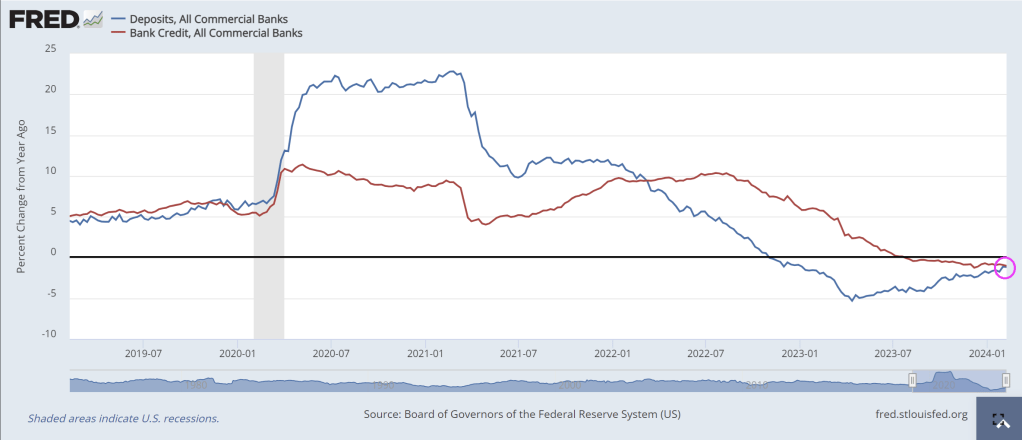
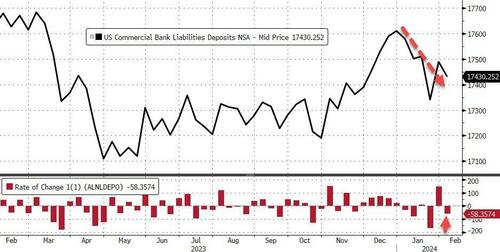
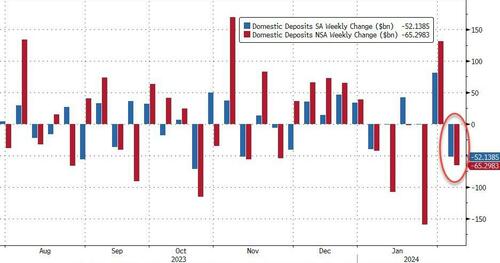
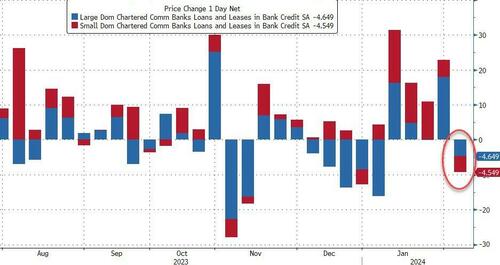
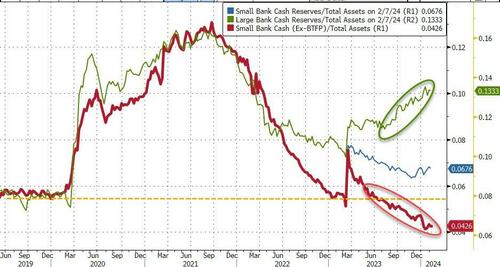
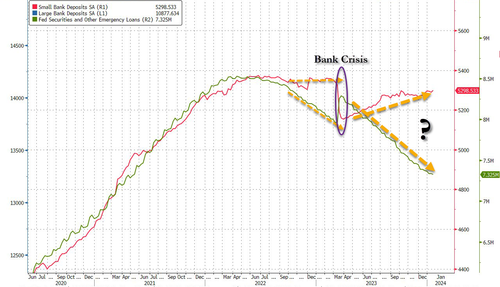
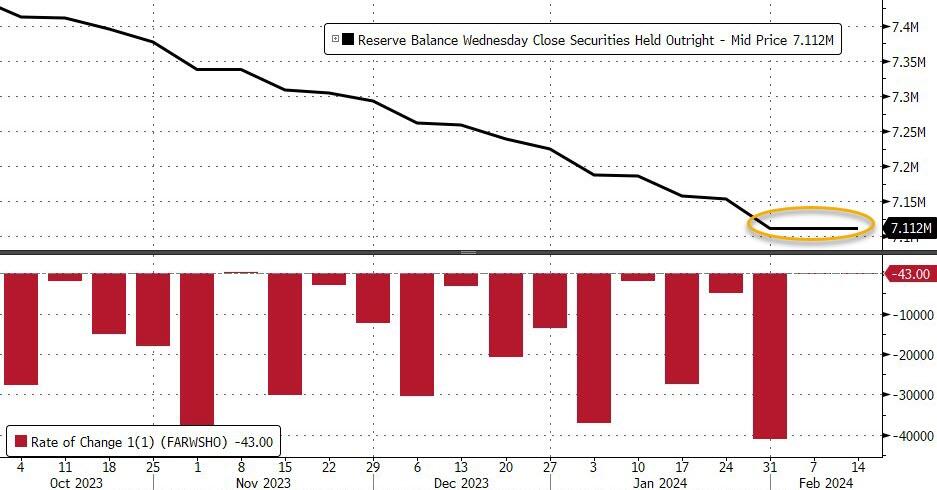
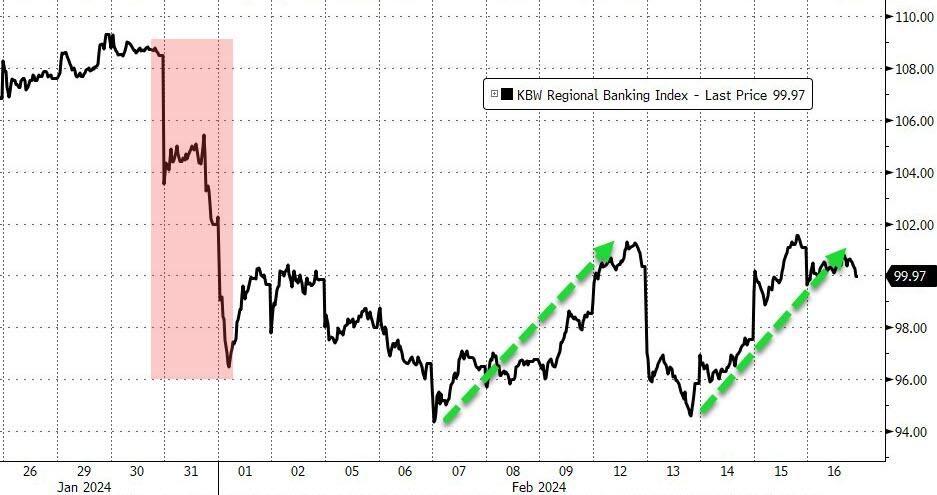
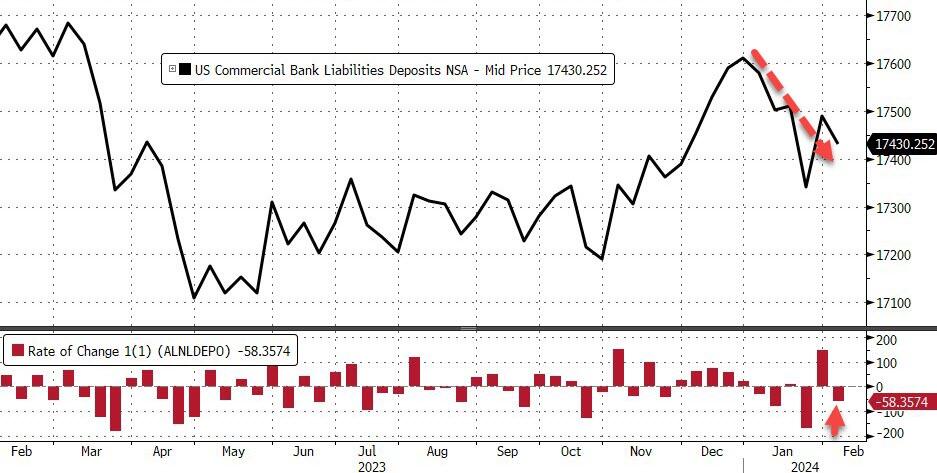
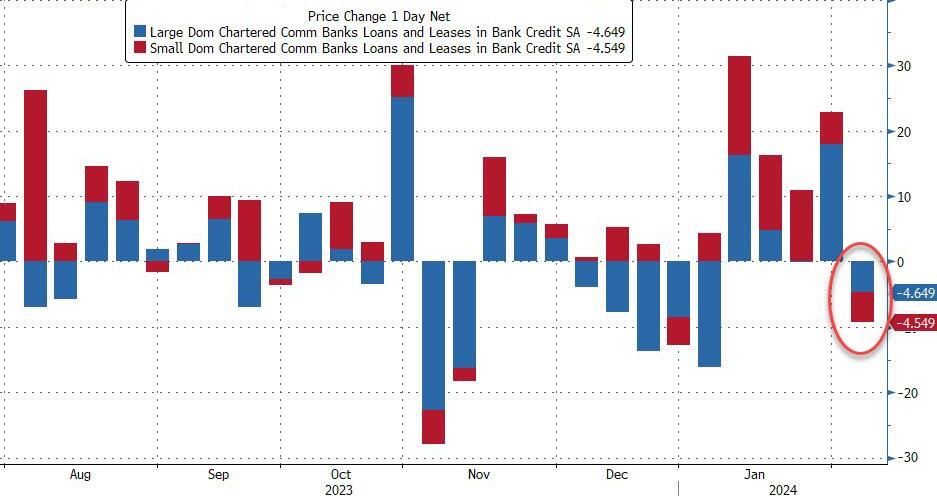
Where do we sit today? Bank credit growth has been negative for the last 26 weeks. As M2 Money growth has stalled.

What will The Fed do?

While the FOMC may start the discussions around tapering QT as soon as at this meeting, tapering itself is still a ways off, and the actual end of QT will come early next year.

In January and May 2022, the FOMC published the principles and then the plan for QT. The fact of a taper this year is not news. More recent communication from Fed officials (for example from President Logan and Governor Waller) reinforced a preference for the reverse repo (RRP) facility to be drawn down to zero, and we infer that getting the RRP near zero will be the starting point for the taper.

Historically, the FOMC has taken at least two meetings to finalize these types of plan, and the December minutes stressed a desire to give the market lots of advance notice. As a baseline, we think the FOMC announces the parameters for the QT taper at its May meeting and enacts that taper in June, by cutting the runoff of Treasury securities in half. Because the Fed’s RRP facility has been declining rapidly, that timing could shift earlier by a month or so.

The change to shedding $30 billion per month in Treasuries would slow the pace of runoff materially, but there is clearly a chance that the subsequent pace is even slower. President Logan pointed out that running off the balance sheet slowly could ultimately allow the Fed to shrink the balance sheet even more while mitigating the risk of money market disruptions. A June taper would be consistent with our house view on the path of the RRP facility, which we expect to stand at approximately $225 billion at the end of May and be depleted by August.

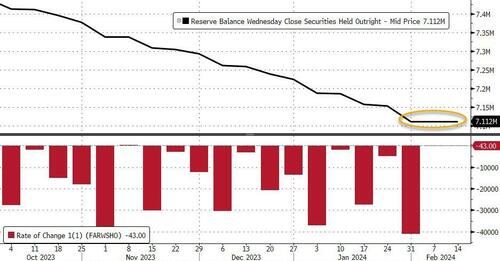
We anticipate that reserves will remain broadly around current levels until RRP is depleted. But from there, we think reserves will ultimately fall to roughly $3.2 trillion, around $300 billion below current levels, and the FOMC will call off QT in early 2025. That view on the ending level of reserves reflects our outlook on the SOFR – IORB (Secured Overnight Funding Rate – Interest on Reserve Balances) spread turning positive, indicating the end of abundant reserves.

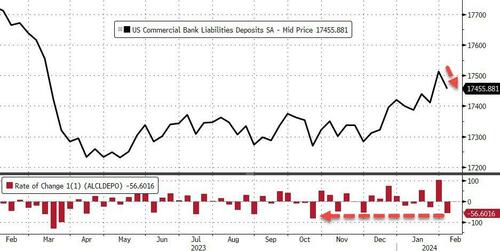
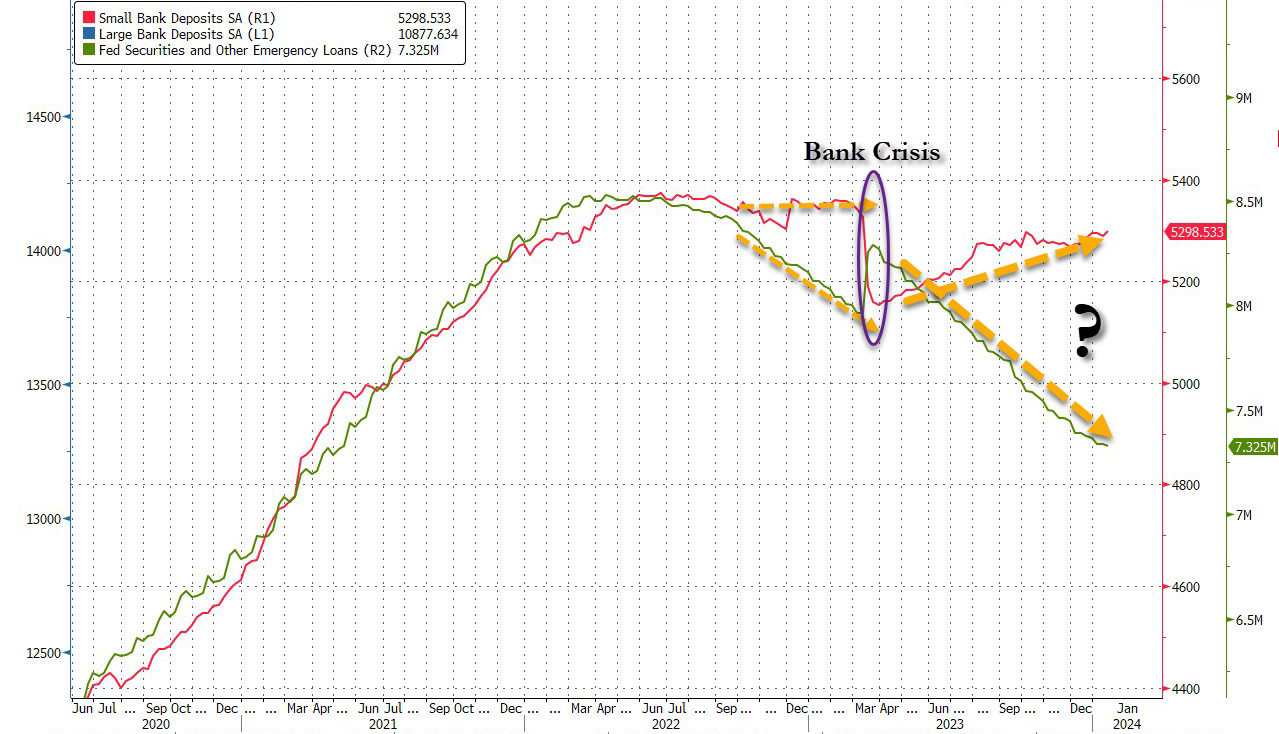
For broader markets, however, our strategy team does not expect the tapering and end of QT to be a significant event. Our rates strategists think the phenomenon is mostly in the price and, if anything, front-end swap spreads may have already overreacted to the news of an early taper. With a limited effect on rates, and the tapering and end of QT largely anticipated, our MBS and credit strategists similarly see few if any implications. Of course, some market narrative is focused on QT’s effects on the banking sector. While the intuitive notion that QT must destroy deposits is widespread, we have highlighted the data which show in fact that deposits have edged up, not down, in recent months as QT has progressed. Banks can always choose to bid for wholesale deposits, so instead of focusing on the quantity of “money” and how that changes, a better question is how bank funding costs are evolving.

So, the next step is for the Fed to shift from “talking about talking about tapering QT” to actually talking about tapering QT. Only after that step will we start to look for the end of QT, which the Fed will determine with an eye on money market conditions. In particular, the Fed is looking at whether SOFR is trading below the rate the Fed pays on reserves, in which case it will likely judge conditions to be accommodative, or above the rate the Fed pays on reserves, in which case the Fed’s calculus will change and the discussions about the end of QT will pick up steam.

The Fed’s balance sheet remains greatly expanded despite the increase in The Fed’s target rate. Nothing has been the same since the banking crisis of 2008-2009. And Covid in 2020.