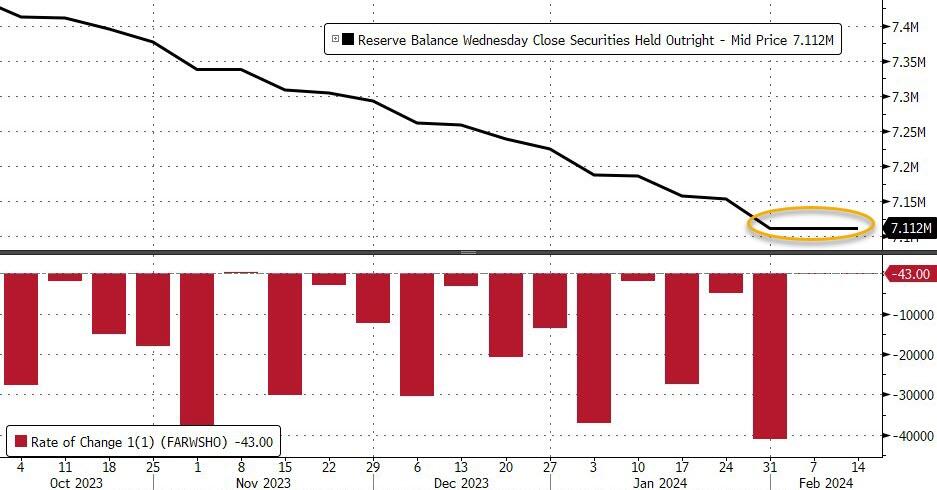
The Federal Reserve (aka, The Keep) is back in the saddle again. The Fed has been unable to control inflation since Federal government spending was so fast and furious after Covid that little thought was given to the long-term ramifications of insane spending. Not to mention The Fed’s overreaction to Covid.
Example?
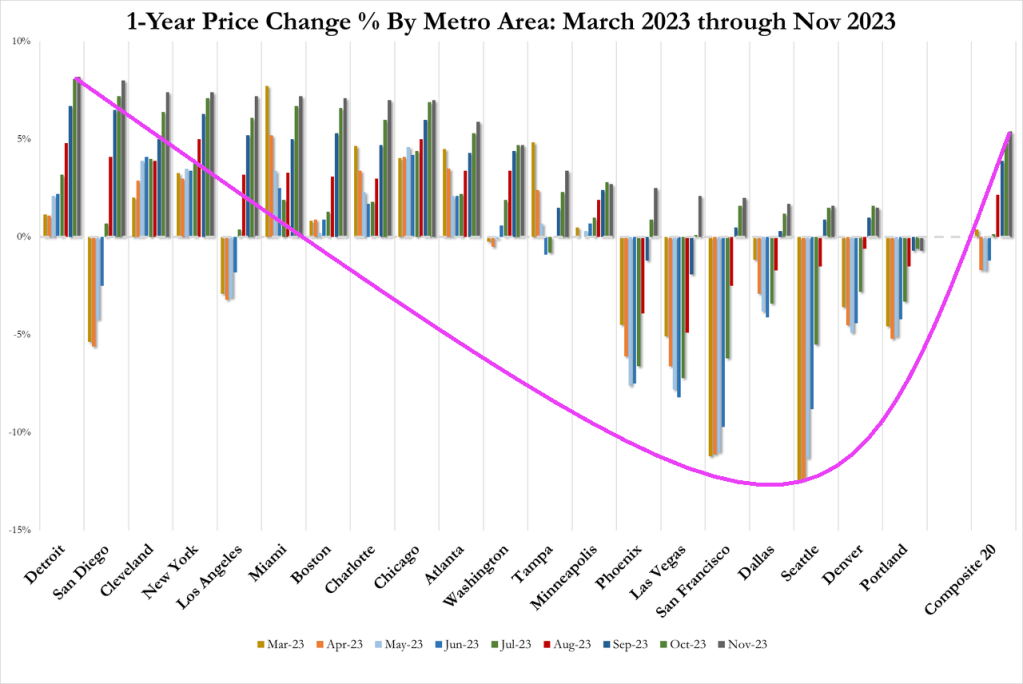
Home price growth is rising again. Home prices in traditional “bubble cities” out west were cooling, but are reaccelerating. Even Detroit and Cleveland are seeing rapid home price acceleration.
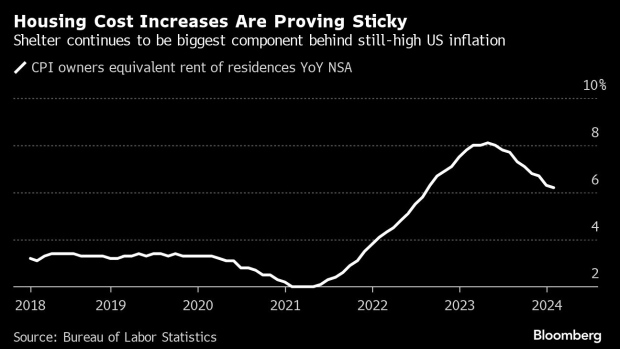
Yes, housing inflation is sticky.
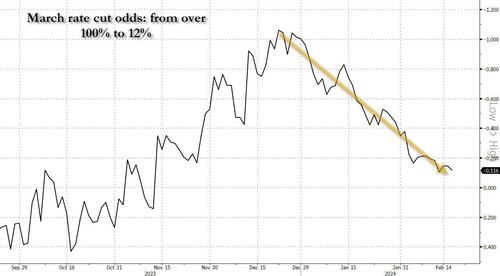
In retrospect, this wholesale dovish euphoria may have been rather short sighted, because after several strong economist reports hit the tape (with the Nov 2024 election growing closer by the day, that should hardly have been a surprise), March rate cut odds collapsed from over 100% in late December, to just 12% currently…
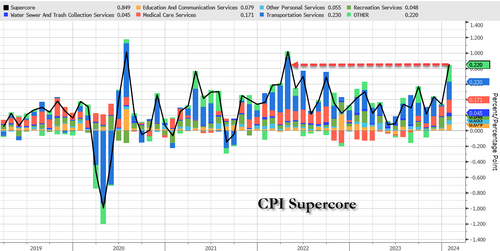
… as first the January CPI printed red blazing hot– with core coming in at 3.9% far higher than the 3.7% expected, with the 3-month annualized rate jumping to 4% from 3.3% and the 6-month annualized rate spiking to 3.7% vs 3.2%, but the biggest highlight was SuperCore CPI (i.e., core CPI services ex-Shelter) which soared 0.7% MoM, the biggest jump since Sept 2022…
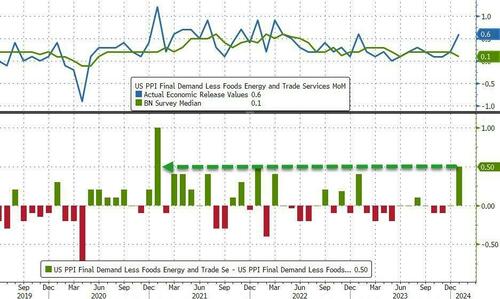
… and then the January PPI print come in even hotter, with a core component surging in January by 0.5%, smashing expectations and beating estimates by the most since Jan 2021.
The result: not only has the market rapidly priced out what if formerly saw as many as 6 rate cuts in 2024, but growing speculation that a rate cut may not come at all unless the Fed tightens some more first (and with the S&P500 now over 5000, it is pretty clear that the market has already priced in virtually all rate cuts and has cornered the Fed).
Of course, the mass migration across the Mexican border (who knows? could be up to 11 million under Biden’s Reign of Error). While Paul Krugman, the resident lunatic economist for the New York Times, extols the virtues of mass immigration for driving up GDP, fails to recognize that mass migration is helping drive up prices. This is inflation that The Fed can’t control. And Biden/Mayorkas want even MORE mass immigration.
This headline from Zero Hedge makes me so glad I have eaten heart-healthy Quaker Oats and Cheerios every morning for the last 20 years! Study Finds 80% Of Americans Exposed To Fertility-Lowering Chemicals In Cheerios, Quaker Oats. The chemical (chlormequat chloride) was detected in “92 percent of oat-based foods purchased in May 2023, including Quaker Oats and Cheerios.” But that was nothing compared to this Zero Hedge headline: EU “Suicide Pact” Threatens To Flood Continent With 75 Million More Migrants. Makes me wonder if Biden/Mayorkas are under orders from the UN/WEF/Soros to let immigrants pour across our southern border (including 20,000+ Chinese military age males). But back to the economy.
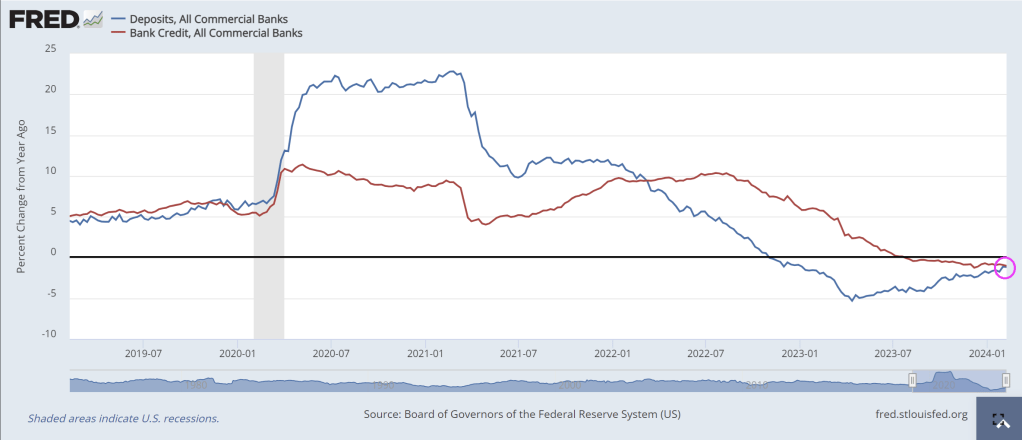
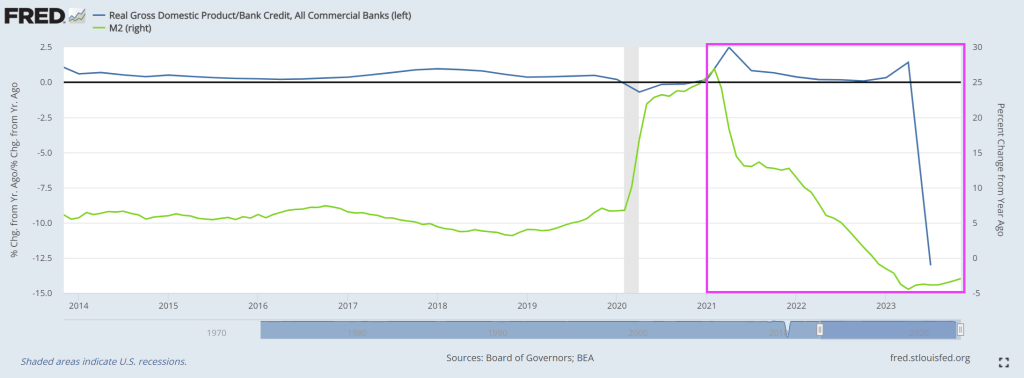
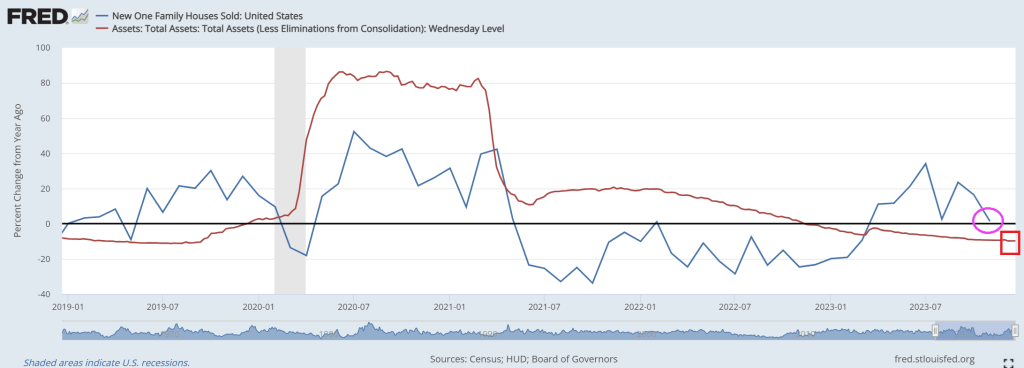
Both bank credit growth year-over-year (YoY) and bank deposit growth (YoY) are NEGATIVE. Covid resulted in massive Federal government stimulus spending (and Federal Reserve hyper stimulus) in 2020, but as the stimulus wears out, so does bank lending and deposits.
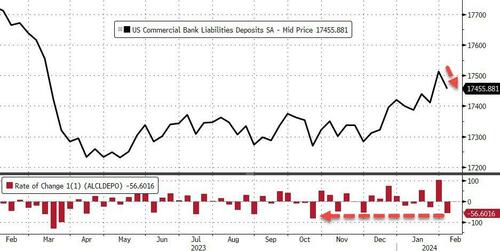
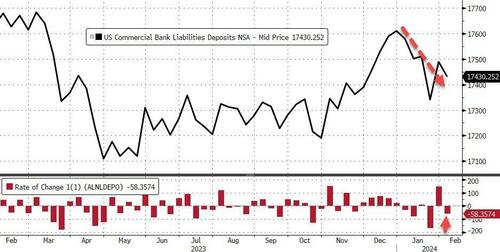
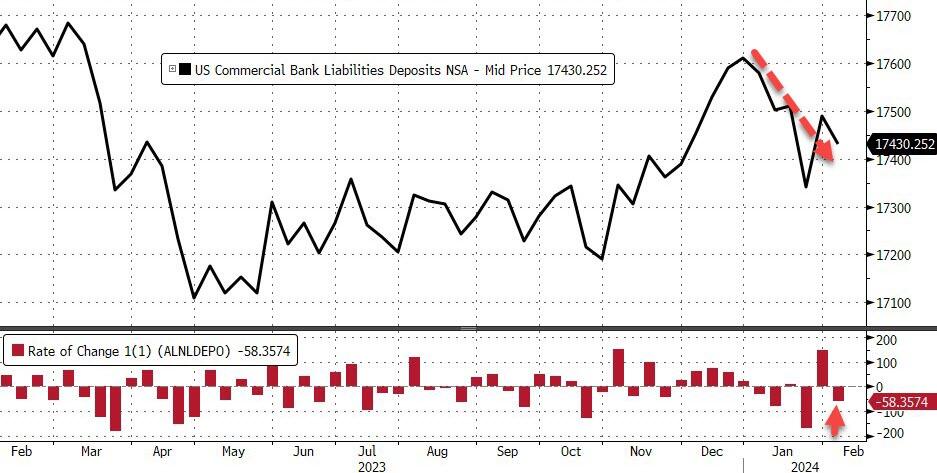
And after the prior week’s miraculous surge in deposits (again, according to The Fed), last week saw total bank deposits (seasonally-adjusted) drop $57BN – the biggest weekly drop since October…
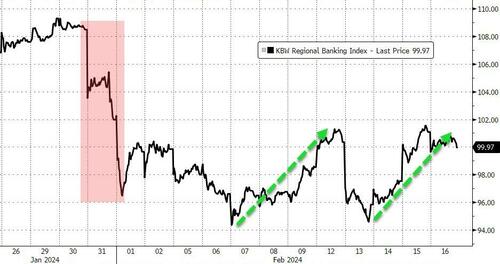
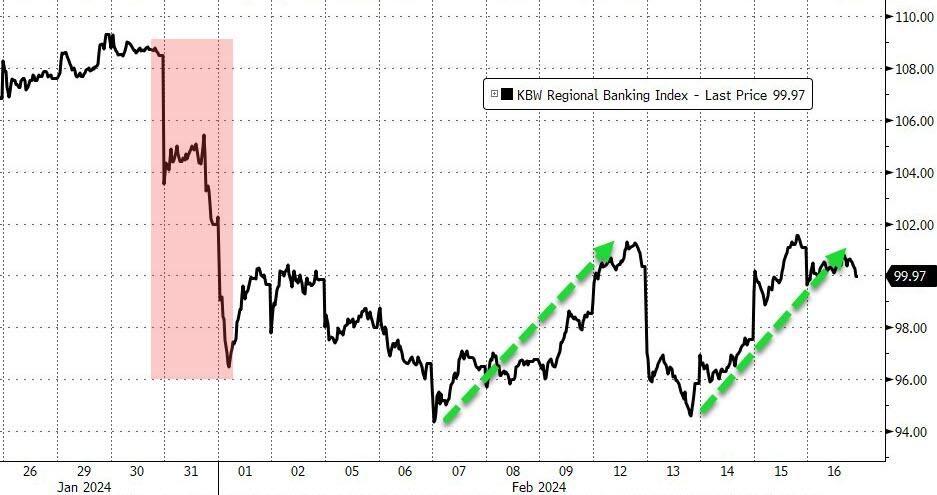
This data is from the week when Regional bank shares shit the bed thanks to NYCB…
Interestingly, on a non-seasonally-adjusted basis, total bank deposits declined about the same as SA -$58BN (and are down $180BN YTD)…
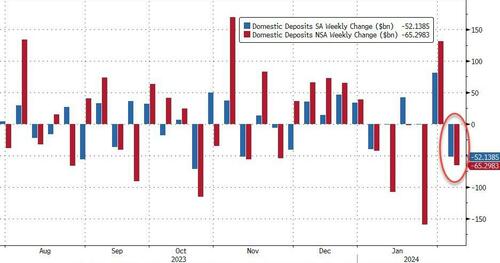
And, excluding foreign banks, domestic deposits dropped $52BN SA (Large Banks -$40BN, Small Banks -$12BN), and tumbled $65BN NSA (Large Banks -$57BN, Small Banks -$$8BN)
As the chart above shows, on an NSA basis, domestic banks have only seen one week of inflows in 2024.
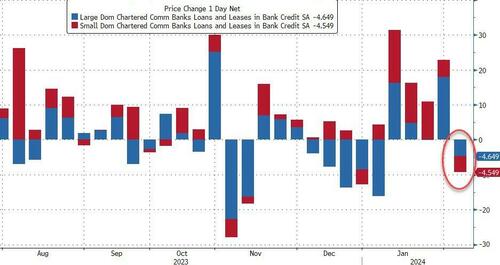
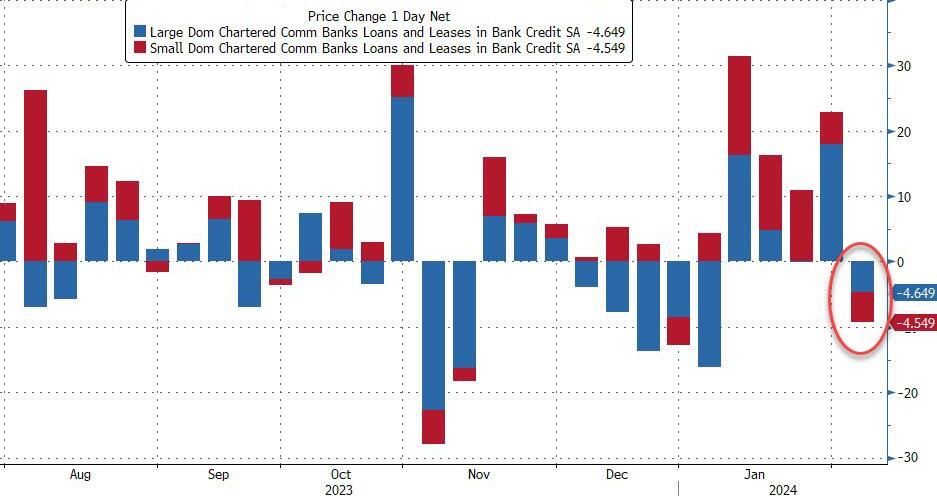
As one might expect, loan volumes shrank during that week by just over $9BN (Large banks -$4.6BN, Small banks -$4.4BN)…
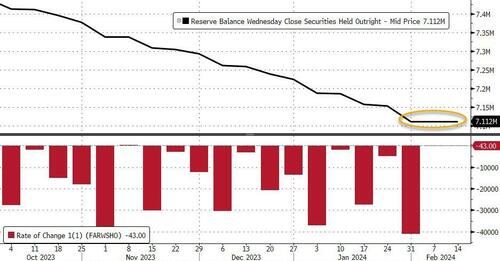
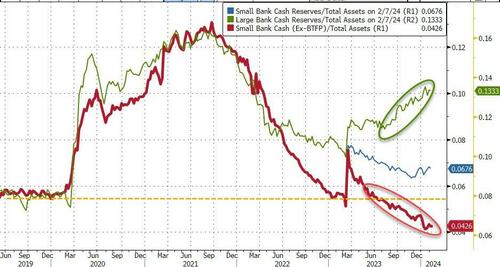
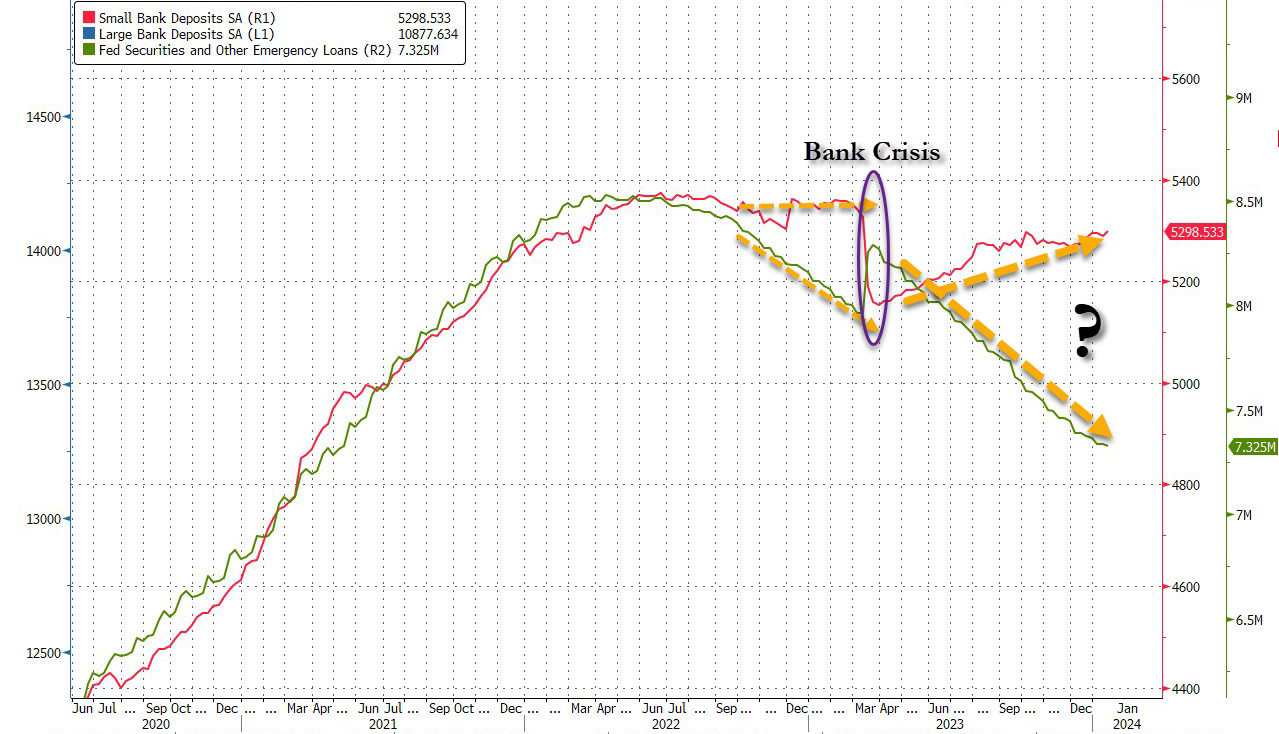
And finally, as a reminder – despite the rebound off the lows again this week in regional bank shares, which must mean everything is awesome, right? – the regional bank crisis is still very much alive as evidenced by the red line below (without The Fed’s imminently expiring BTFP facility)…
…what else are big banks (green line) going to do with all that cash burning a hole in their pockets?
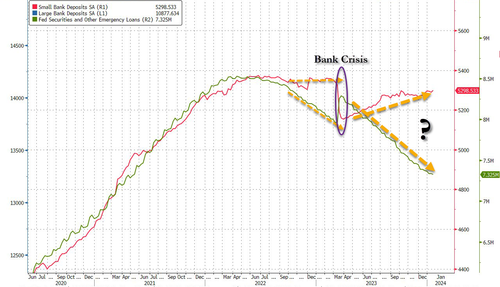
The bottom line is – this looks a lot like a ‘Small Bank’ crisis. The last time this happened, the crisis sparked a sudden $300BN ‘run’ in small bank deposits…
Is The Fed ‘hoping’ for a controlled bank-run this time – so as many small bank deposits are drained voluntarily, before they are drained all at once in a panic (and the Reverse Repo facility is empty, unable to provide any cushion)?
It is looking like a recession in mid-2024 as Covid Stimulypto has run its course. Is the US economy so lame that is requires constant Federal government and Federal Reserve manipulation??
Joe Biden (President of the top 1% of Americans) and his likely replacement “Greasy Gavin” Newsom, wrecker of the California economy. Two economy wreckers on the same stage.
Remember when Democrats were the party of the working man and Republicans (like George HW Bush) were called “Country Club Republicans”? Now Biden and Democrats represent the elitist top 1% of wealth and Trump/Republicans (that Biden snidely calls “Maga Republicans”) represent the bottom 99%. Who woulda thunk??
For visitors, Universal Studios Florida offers a chance to visit a fantastical land full of wizards, Minions and various characters from NBC Universal’s many film and television properties. But for the roughly 28,000 men and women who work at the 840-acre theme park and resort complex in Orlando, the troubles of the real world — like the rising cost of housing — are not far away.
Central Florida has seen some of the nation’s fastest pandemic-era rent increases, thanks to a confluence of job growth, migration and housing underproduction that has put a strain on residents. The average tenant in the region saw their monthly rent jump by $600 between early 2020 and early 2023. According to the National Low Income Housing Coalition, the Orlando-Kissimmee-Sanford metro area has one of the worst affordable housing shortages in the US, with only 15 available units for every 100 extremely low-income renter households.
The dire need for workforce housing is behind the entertainment conglomerate’s latest project in Central Florida: a 1,000-unit mixed-use development, set to open in 2026, that promises to give tenants who work in the service industry a short commute to the constellation of tourist attractions and hotels nearby. To launch the project, Universal donated 20 acres of land adjacent to the Orange County convention center. Called Catchlight Crossings and built in partnership with local developer Wendover Housing Partners, the project broke ground in November.
Universal’s nearby rival is also wading into affordable housing. In 2022, Walt Disney Co.announced plans to donate 80 acres for a proposed 1,450-unit affordable development a few miles to the southwest. Also set to open in 2026, the project would be built near Flamingo Crossings Village, a campus for participants in Disney’s college internship program that also leases units to some Disney World cast members. (Oh great, brainwashing by woke Disney types).
As housing costs in Central Florida have soared, the theme park giants have faced criticism for underpaying workers. In June, Universal raised its minimum wage by $2 to $17 an hour, while Disney, which employs 82,00 people in Florida, agreed to bump its starting hourly rate to $18 in 2024. Still, both lag behind the $18.85 that the Massachusetts Institute of Technology’s Living Wage Calculator estimates would be needed to support an adult with no children in Orange County.
Visitors throng Disney’s Magic Kingdom in Orlando.Photographer: David Ryder/Bloomberg
Even smaller theme parks in more affordable areas have become homebuilders in an effort to ease the housing crunch. In May, Indiana’s Holiday World opened a $7 million development called Compass Commons, which is meant to provide seasonal housing for up to 136 employees. It will replace a proposed theme park attraction that was set to open last summer.
Such partnerships between entertainment industry employers, developers and local government represent the latest spin on a solution for the ongoing scarcity of apartments for lower-income households. Catchlight Crossings is part of Universal’s Housing to Tomorrow initiative, which was inspired by the Orange County mayor’s Housing for All Task Force. The company represents almost 10% of the tax base of Orange County, which includes Orlando.
“What could we do that would be more than just the typical corporate response?” said John Sprouls, executive vice president and chief administrative officer at Universal Parks and Resorts. “If you’re going to provide affordable housing, providing affordable housing where the jobs are sure makes a lot of sense.”
The Truly Missing Middle
Workforce housing is a much-needed housing type without a precise definition. Unlike affordable housing, which must meet stringent rental rates matched to specific income levels to qualify for government support and subsidies — typically 40% of units need to be priced to support those households who make 60% of the area median income — workforce housing stands as more of a catch-all term. Some define it as housing that serves those making between 80% and 120% of median area income. Often, the term is used to invoke housing for teachers, first responders and other public servants who have been increasingly priced out of expensive metros.
Over the last decade, and through the recent pandemic-era surge in apartment construction, developers have largely ignored the lower end of the market, focusing instead on Class A apartments. Beginning in 2013, half or more of units delivered each year were considered high-end or luxury, according to statistics from the National Multifamily Housing Council. Only since the middle of 2022 has that shifted towards Class B, or more affordable units.
Seeking lower production costs and rents, a handful of big developers have created new sub-brands of apartments designed to appeal to less-monied tenants. Grubb Properties launched a series of “car-light” developments called Link, which emphasize accessibility to major urban employers, while Greystar’s Modern Living Solutions concept offers modular multifamily buildings that are assembled on site from factory-built elements in an effort to trim construction costs.
To promote more construction of this type of housing, a bipartisan coalition of federal lawmakers recently introduced the Workforce Housing Tax Credit Act. Like the low-income housing tax credit, the proposed legislation would provide tax credit to investors who build affordable apartments. The bill’s sponsors, including Oregon Senator Ron Wyden, say the credit would finance approximately 344,000 affordable rental homes. It’s been a pet issue for Wyden in particular; 70% of Oregon school districts have built or rented housing to provide support for their teachers.
Nationwide, the US is short approximately 2.2 million workforce units, according to a 2022 Fannie Mae study. Central Florida’s service-based economy has left it with one of the highest levels of need, Wendover founder and Chief Executive Officer Jonathan Wolf said. There are roughly 100,000 people living within a five-mile radius of Catchlight Crossings who would income-qualify for the development.
Besides pools for residents, the proposed Universal development will include such amenities as a preschool and adult education center.Credit: Wendover Housing Partners
Rents at the Universal-led project will range from $400 to $2,200, depending on income qualifications (the average two-bedroom unit in the area rents for just shy of $1,900 a month). The development will also contain medical offices, retail, community space including pools and fitness centers, bike and walking paths and a tuition-free Bezos Academy preschool and adult education center. A transit center will connect residents to buses, ride-hailing services and company shuttles; a stop on the proposed Sunshine Corridor, a new east-west rail line that’s designed to help tourism workers get around, may take shape nearby.
“You’re not creating an economic ghetto,” Wolf said. “You’re creating a lifestyle enhancement for so many people, giving folks the ability for mobility.”
The theme park giant owns a few thousand acres in the area, so this was a relatively small donation, according to Sprouls. It also comes during a time of booming profits: Central Florida’s tourism industry generated a record $87.6 billion in economic impact in 2022. And since Universal transferred the land via a 501c3 charity with deed restrictions, the donation can lower development costs and help ensure long-term affordability; lots of affordable housing tends to revert back to market-rate pricing after a set term.
Employer-sponsored projects like Catchlight Crossings can’t mandate that only their employees can be tenants — that would violate fair housing rules. But for a customer-facing company like Universal, working to close the region’s housing gap can pay direct benefits, Sprouls said. When employees can’t find housing nearby and need to drive hours to get to work, it impacts not just their performance, but the guest experiences that drive satisfaction and repeat visits.
Park guests arrive at the Universal Studios theme park in Orlando in 2020.Photographer: Zack Wittman/Bloomberg
“It helps us to be able to recruit because people are able to have jobs here,” Sprouls said. “Salaries go into making you an attractive employer in the area, but you also need to make this an attractive place to live.”
Corporate Housing’s Mixed Record
Still, it remains to be seen if privately financed efforts like the Universal and Disney investments can have a significant impact on the lives of local renters. Other industries, most notably tech, have poured hundreds of millions of dollars and even billions into financing the construction of workforce housing near their headquarters. Amazon.com Inc., Google and Meta Platforms Inc. have all done variations of this kind of development, with mixed results. Many such efforts took off after severe backlash to the impact tech jobs had on local housing markets, and most were in the forms of loans, financing and leases, which can be helpful but not exactly game-changing. Recent swings in interest rates and increases in housing costs, not to mention struggles in the tech industry, have curtailed many of these programs.
“There was a lot of energy, and then there wasn’t,” Alex Schafran, a visiting scholar at San Jose State University’s Institute for Metropolitan Studies and a former consultant for Facebook’s housing initiative, told the Guardian. “The balloon didn’t pop overnight, but now there’s very little air in it.”
And the support of powerful local employers can’t inoculate these projects from community pushback. At a town meeting for the Disney project in September, residents raised a host of familiar objections about traffic congestion, school crowding and site location. When it comes to building multifamily developments, even Goofy has to contend with NIMBYs.
Wendover’s Wolf argues that while the financing part is critical, it may not be enough. His firm has been very involved in pushing for more government support for the affordable housing projects they specialize in. Associate Ryan von Weller, for example, was among the local developers who consulted with Florida lawmakers on a state bill, Live Local, which directed more than $700 million into supporting affordable housing. (Sprouls said Universal won’t see any tax benefits from their land donation.) But Wolf believes the area’s big corporate employers need to play a bigger role in solving this crisis.
“We need your involvement in it in a very direct way to work alongside us, to make this a success,” he said. “It’s not just a simple check and walk away. We need the land. We need cooperation.”
Here is the REAL problem with the lack of housing stock. Growth of new housing units has slowed to negative speeds as mortgage rates soared, but aren’t growing again with declining mortgage rates which remain relatively high. Add in the 11 million or so illegal immigrants crossing the border and we have a major problem.
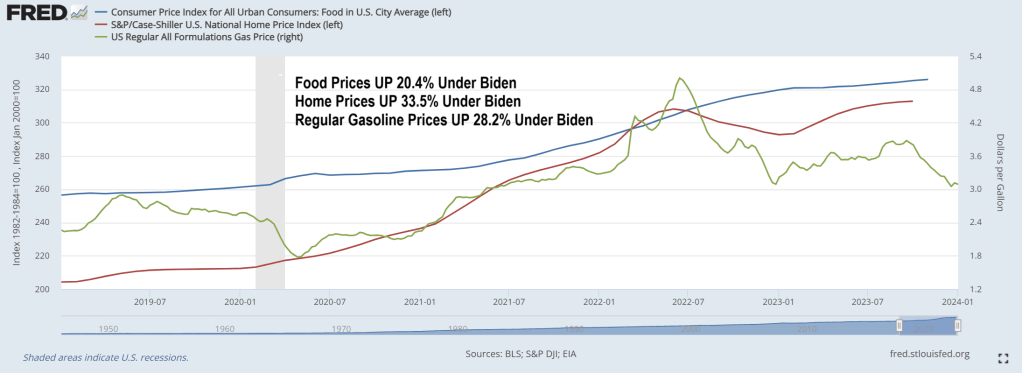
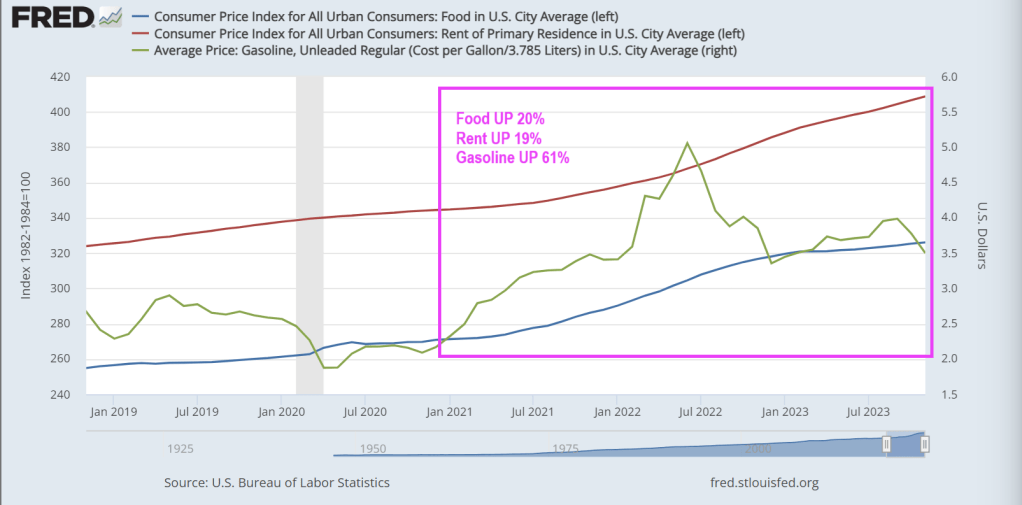
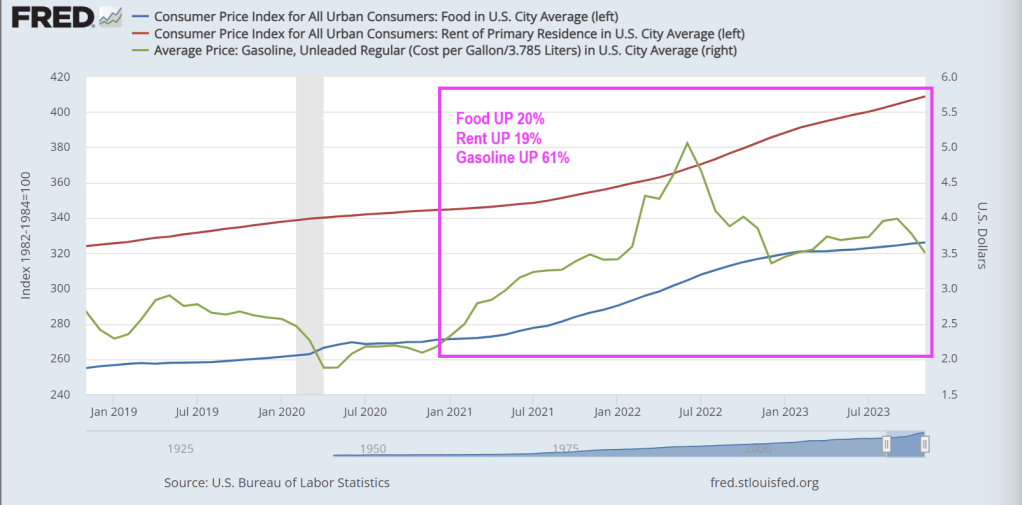
Bidenomics has taken the US economy to the underworld. Where households have to run up credit cards to ridiculous levels to cope with inflation under Bidenomics. Under Bidenomics, food prices are up 20.4%, home prices are up 33.5% and regular gasoline prices are up 28.2%. Whip out those credit cards!!!!!
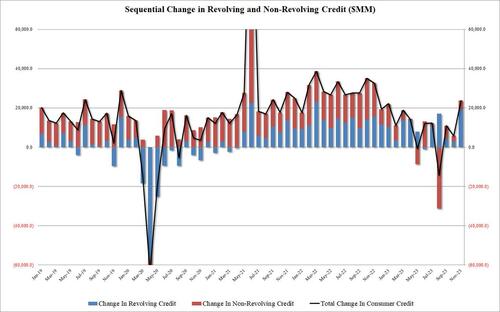
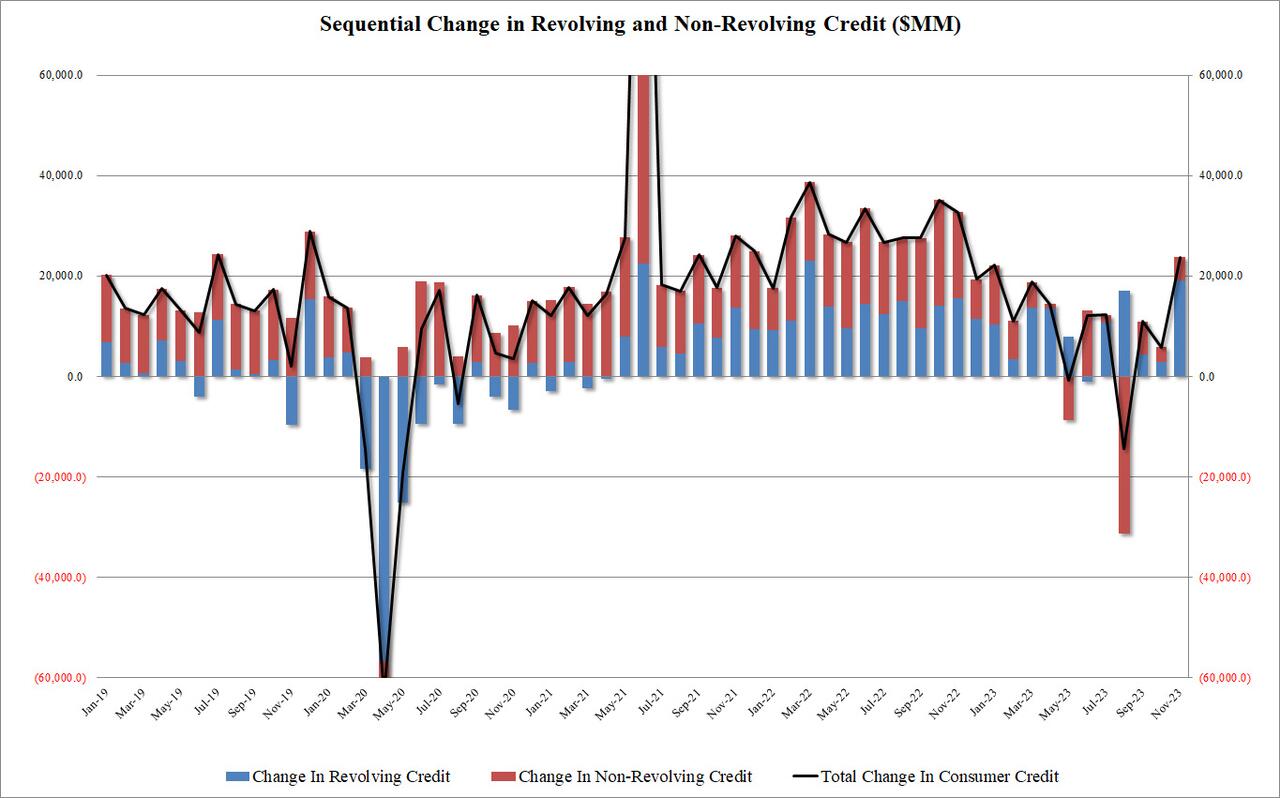
According to the latest monthly consumer credit report from the Fed, in November, consumer credit exploded higher by $24.75BN, blowing away expectations of a “modest” $9BN increase after the surprisingly subdued $5.8BN (upward revised from $.5.1BN) in October and the $4.3BN average of the past 6 months. This was the biggest monthly increase since last November, and was the first $20BN+ print since Jan 2023.
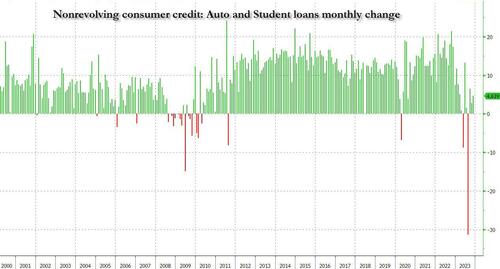
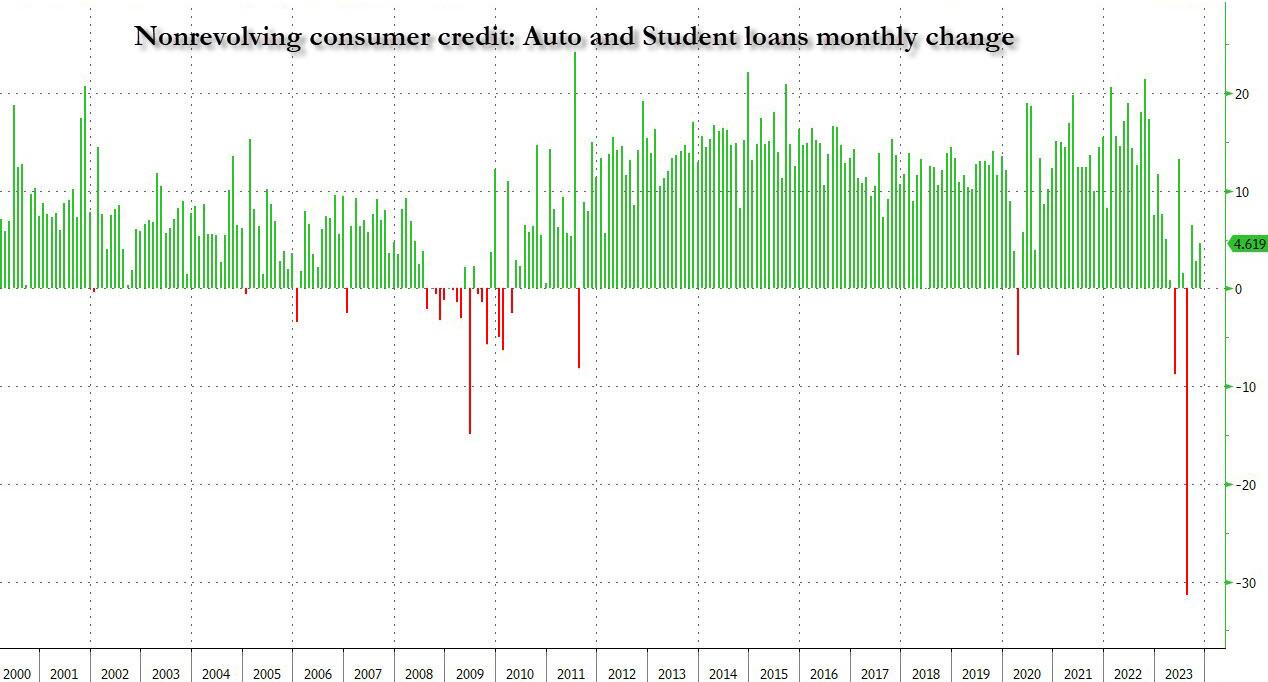
When looking into the details we find something remarkable: while non-revolving credit rose a modest $4.6BN…
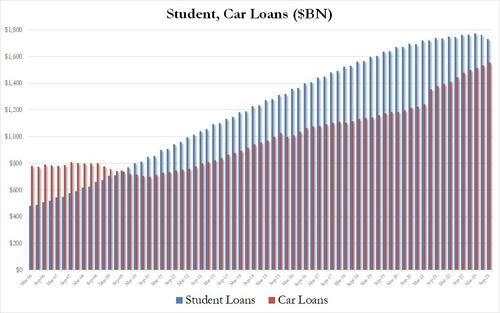
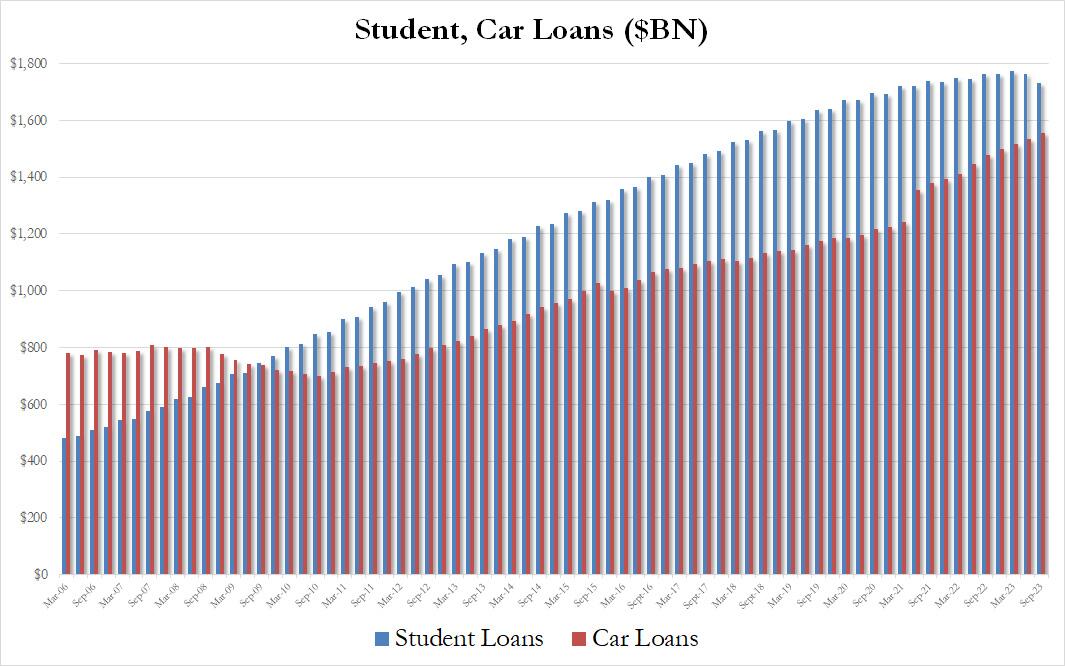
… in keeping with the subdued increase in recent months as rates on auto loans make them prohibitive for most consumers while student loans are actually shrinking for the 2nd quarter in a row…
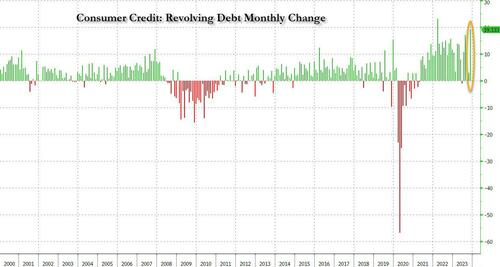
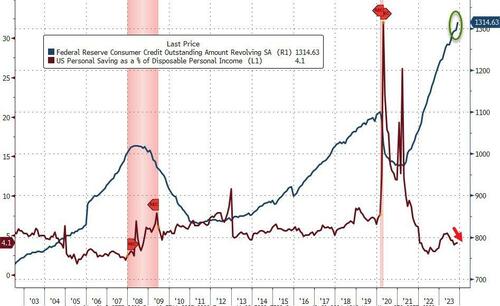
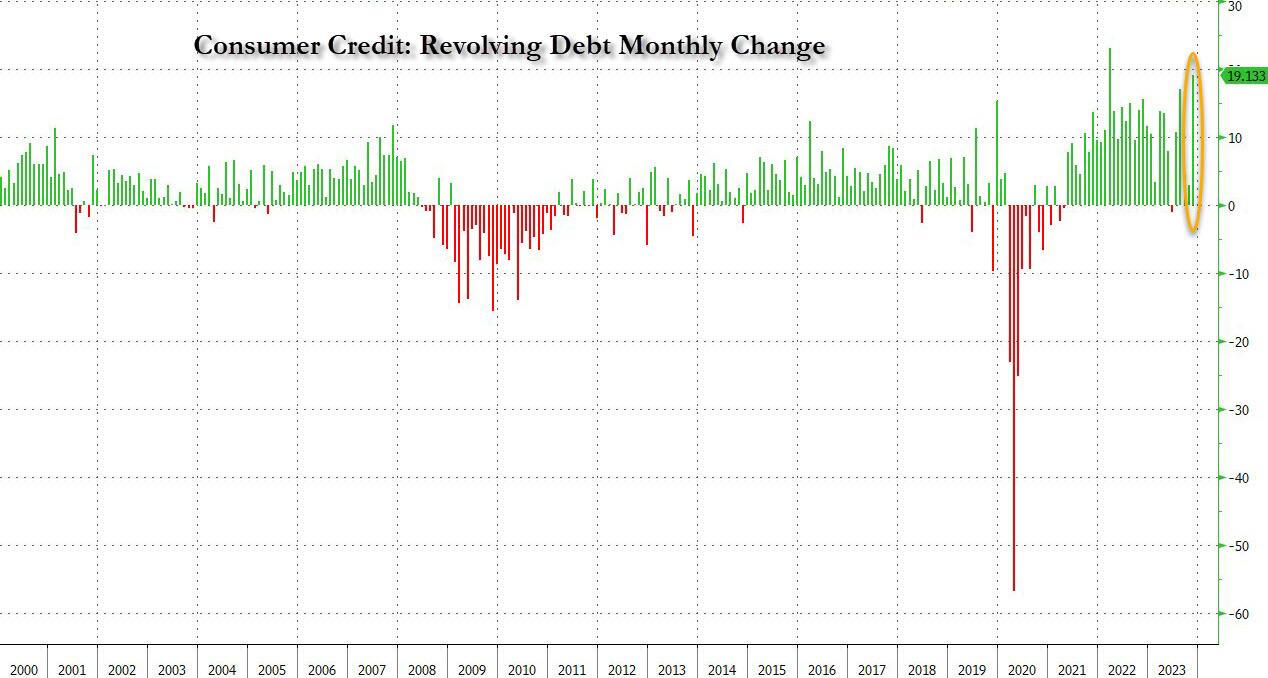
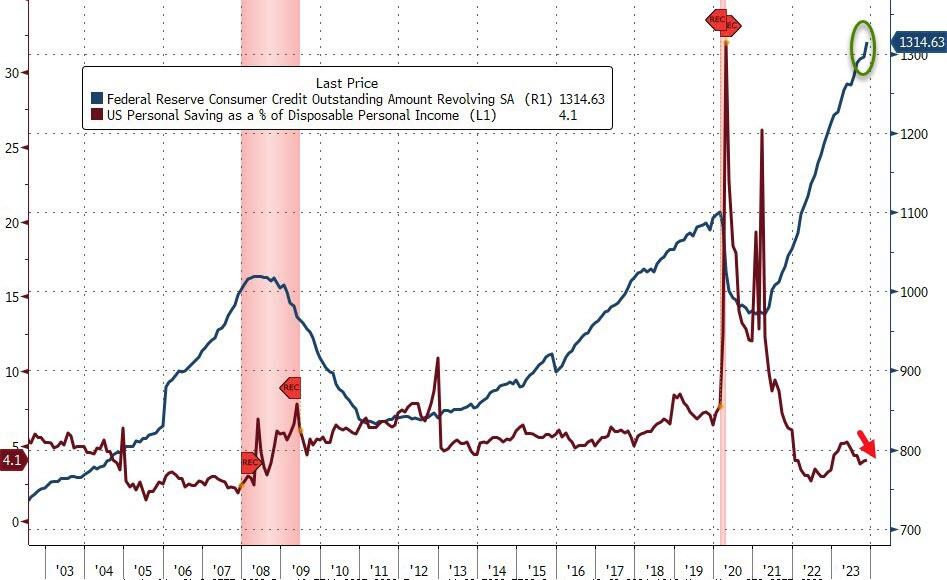
… what was the big shock in today’s data was the blowout surge in revolving credit, which in November exploded by a whopping $19.133BN, a record surge from the $2.9BN in October, and the second biggest monthly increase in credit card debt on record!
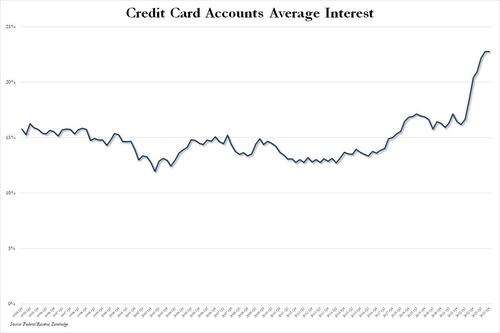
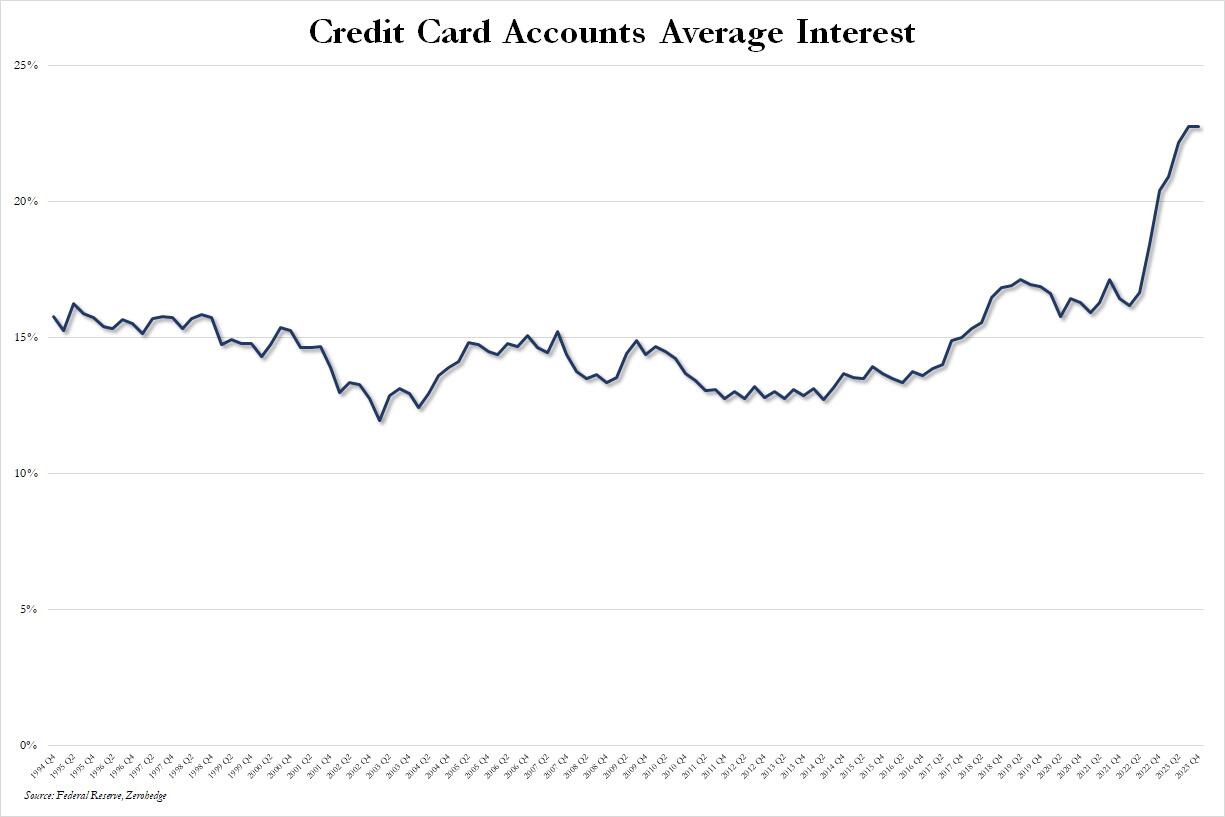
This, despite the average interest rate on credit card accounts in Q4 flat at a record high 22.75% for the second quarter in a row.
What is especially surprising about this conirmation that the bulk of holiday spending was on credit is that it takes place after several months of relative return to normaly, when consumers appeared increasingly reluctant to max out their credit cards due to record high rates, and at a time when the personal savings rate in the US has collapsed back near multi-decade lows in recent months.
Well, it now appears that Americans have once again done what they do so well: follow in the footsteps of their government and throw all caution to the wind, charging everything they can (and whatever they can’t put on installment plans which also hit a record late last year) including groceries, on their credit card, and praying for the best… or not even bothering to worry about what comes next.
Take a look at this chart of real GDP YoY / Bank Credit YoY on the left axis and M2 Money growth on the right axis. I call this the velocity of bank credit. And it is sucking wind! Crashing to -13 in Q3.
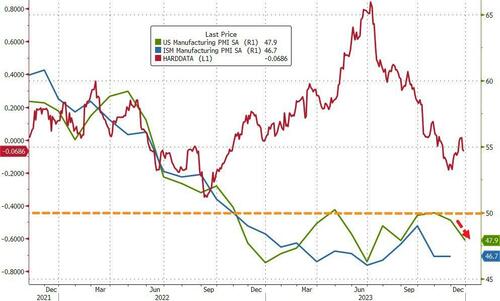
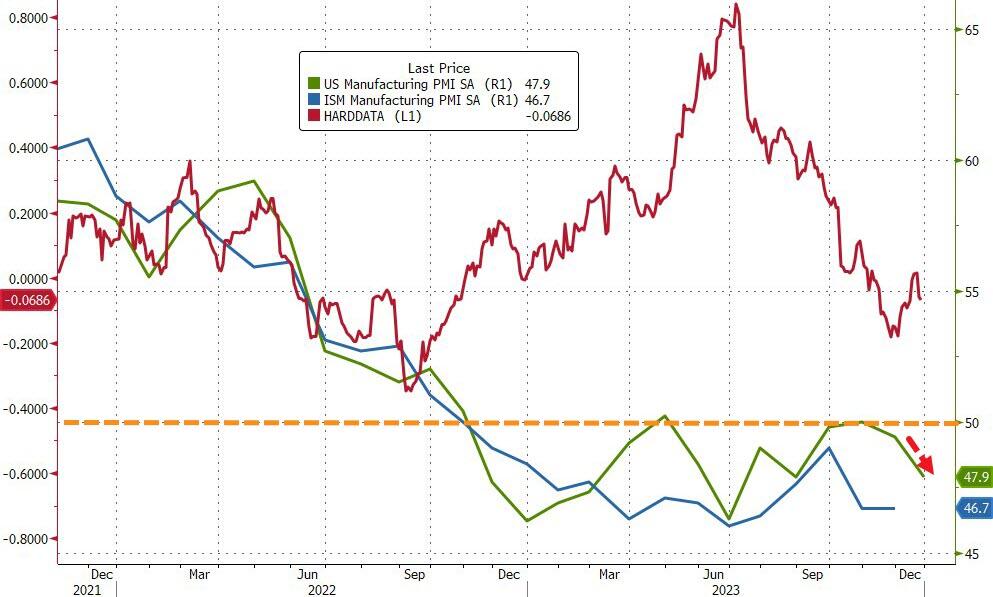
Then we have US manufacturing PMI saw only two months in 2023 that were not in contraction and ended on a decidedly poor note with the final December print dropping to 47.9 (from 48.2 flash and 49.4 prior).
Source: Bloomberg
Across the board it was ugly with:
Renewed contraction in output as orders fall at sharper pace
Rates of inflation pick up
Joint-fastest drop in employment since June 2020
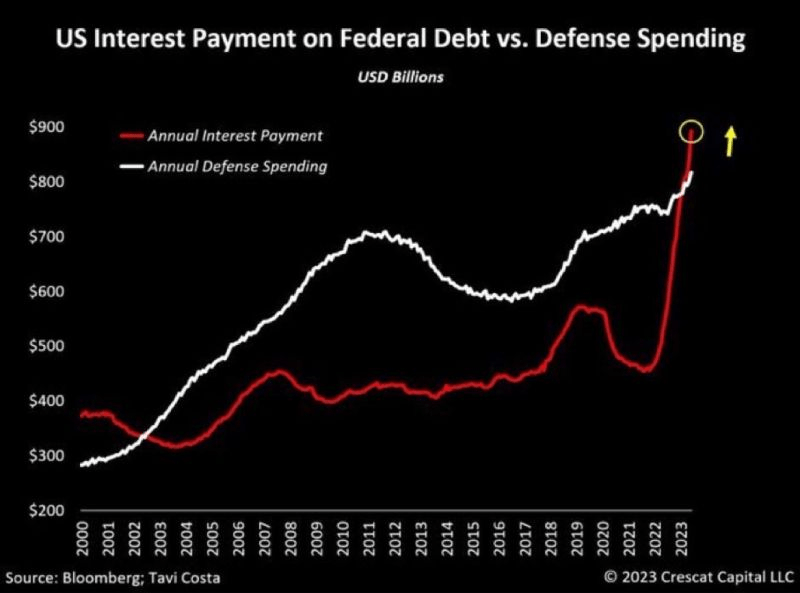
How bad is Biden’s fiscal policy? US interest payments on our bloated Federal debt is now higher than defense spending. Biden isn’t tuff enough to moderate spending or the border invasion.
C’mon Joe. The media has always reported bad news. Warm and fuzzy doesn’t anger people, but bad news does! And under Bidenomics, there has been a lot of bad news.
President Biden railed against corporate media before he and several family members headed by helicopter to Camp David, the presidential retreat in the mountains of western Maryland.
Before boarding the presidential helicopter, Biden was asked by one reporter: “What’s your outlook on the economy next year?”
The president responded: “All good,” adding, “Take a look. Start reporting it the right way.”
Sounds like Biden watched the Travola/Jackson flick “Basic” where the infamous line was uttered “Tell the story right.”
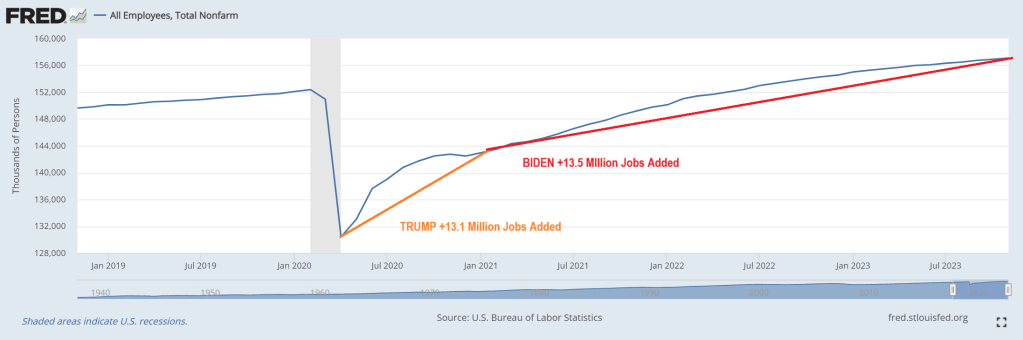
OK Joey, let’s tell the story right. After the horrendous economic shutdowns of local economics and schools in 2020, 15.1 million jobs were added after the shutdowns ended in just 10 months. Wow, that was simple! But under Biden’s Reign of Economic Error, only 15.5 million jobs were added over the next 34 months.
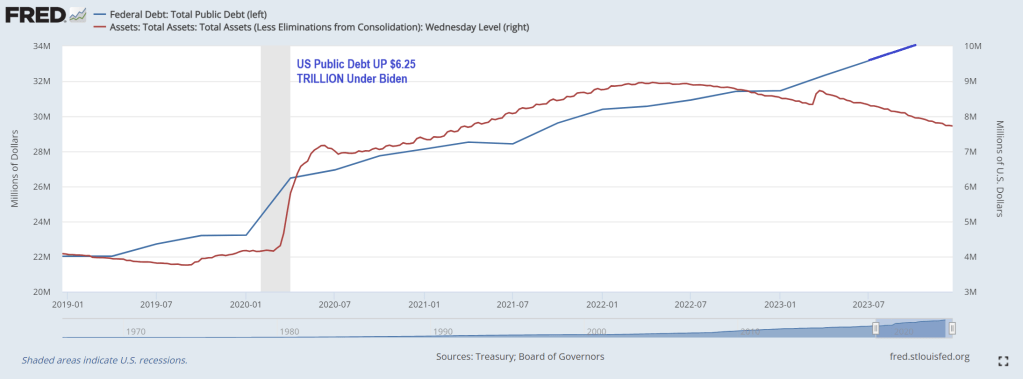
But Biden’s record on jobs comes at the expense of an additional $6.25 TRILLION IN PUBLIC DEBT.
With $34 trillion and rapdily growing debt and budget deficits, it is hard to find good news about Bidenomics.
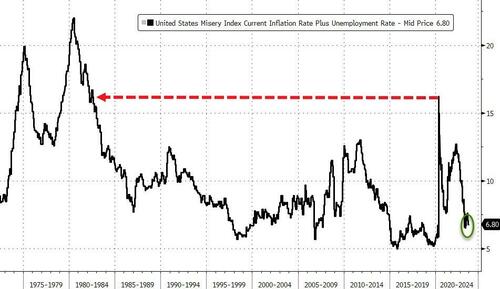
The ‘Misery Index’ is near its lowest level since pre-COVID, but Misery Index masks the true horrors of Bidennomics: 20% higher food prices, 19% higher rents and 61% higher gasoline prices under Bidenomics.
The sum of U.S. unemployment and inflation – known as the “misery index” – fell to 6.8% in November from 7.5% the previous month. That’s the lowest since the summer and fast approaching pre-Covid levels.
The misery index is calculated by adding up the current unemployment rate (3.7%) and the inflation rate (3.1%). The formula provides a simple way to gauge whether the well-being of Americans is improving or not.
Misery peaked in April 2020 when the index spiked to 15%, the highest since 1982. Conditions have improved since the early onset of Covid, but it hasn’t been smooth sailing.
After falling back to 7.7% in January 2021, the index re-accelerated over the next two years as inflation surged. The misery index was 12.5% in June 2022—the same month that annual inflation hit 9.1%.
The unemployment component of the index has been faring well since Covid emergency measures were lifted back in 2021. The unemployment rate has remained below 4% for nearly two years—even as the economy begins to slow.
But economists warn that the misery index doesn’t offer a complete picture of how the average American is doing.
You can tell just by asking them how they feel about the economy and personal finances.
How do Americans really feel?
Economist Greg Ip, who heads economic commentary at The Wall Street Journal, compared the misery index to the University of Michigan’s consumer sentiment index—one of the most closely-watched consumer surveys.
“Based on historic correlations, sentiment has been more depressed this year than you would expect given the level of economic misery,” Ip wrote, arguing that consumers are more pessimistic than the misery index would suggest.
A deeper dive into the sentiment data reveals that Americans are still frustrated about inflation and the impact of high interest rates on their finances. And while the consumer sentiment index rose in December—breaking a four-month skid—some economists attributed it to a temporary holiday boost ahead of Christmas.
“Consumer spirits are perking up for the holiday season which is a sign Christmas is still coming this year,” said Christopher Rupkey, chief economist at FWDBONDS, a New York-based financial research company.
A separate sentiment survey from LSEG/Ipsos paints an even less enthusiastic picture of the average consumer.
The December primary consumer sentiment index—which measures Americans’ attitudes toward jobs, investments, the economy, and personal finances—declined from November and was only up slightly compared to 12 months earlier.
According to the survey, attitudes toward the current situation, investments, and jobs “showed significant declines this month.”
The impact of cumulative inflation
As Creditnews Research reported in a recent study, Americans aren’t celebrating the slowdown in inflation because they’re still reeling from the cumulative price increases of the past three years.
While inflation has fallen to 3.1%, consumer prices have increased by a cumulative 19% since the start of 2020. Food prices are up a whopping 25% over that period.
Americans spent the better part of two years—April 2021 to January 2023—seeing inflation grow faster than their paychecks. That trend reversed in February of this year.
But even with stronger purchasing power this year, the vast majority of Americans (92%) said they reduced their spending in the six months through September, according to a Morning Consult survey for CNBC.
A majority of respondents across all wage brackets said current economic conditions negatively impacted their finances.
So, while the Misery Index indicates that the inflation RATE has slowed, it masks the fact that Americans are far worse off under Bidenomics.
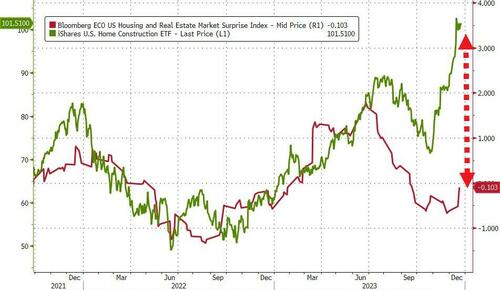
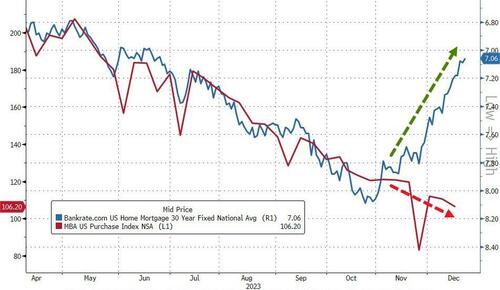
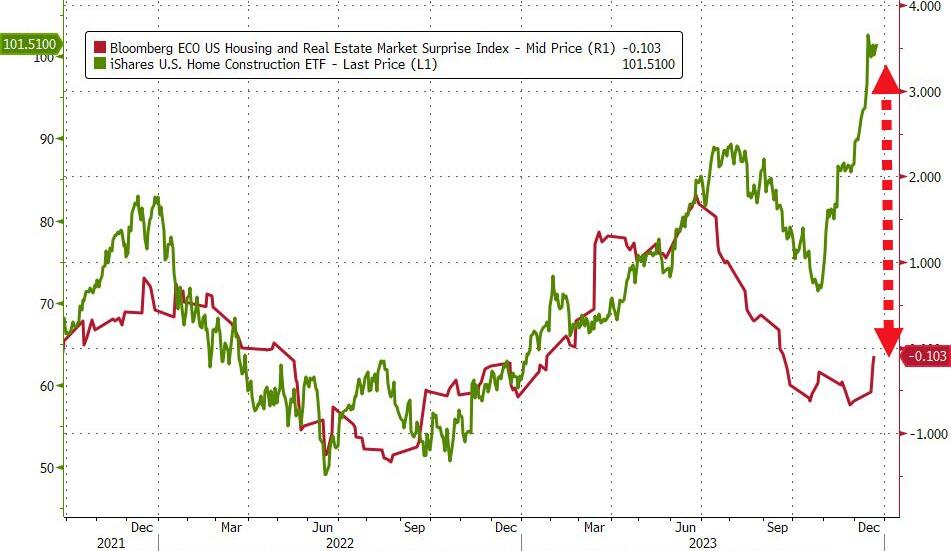
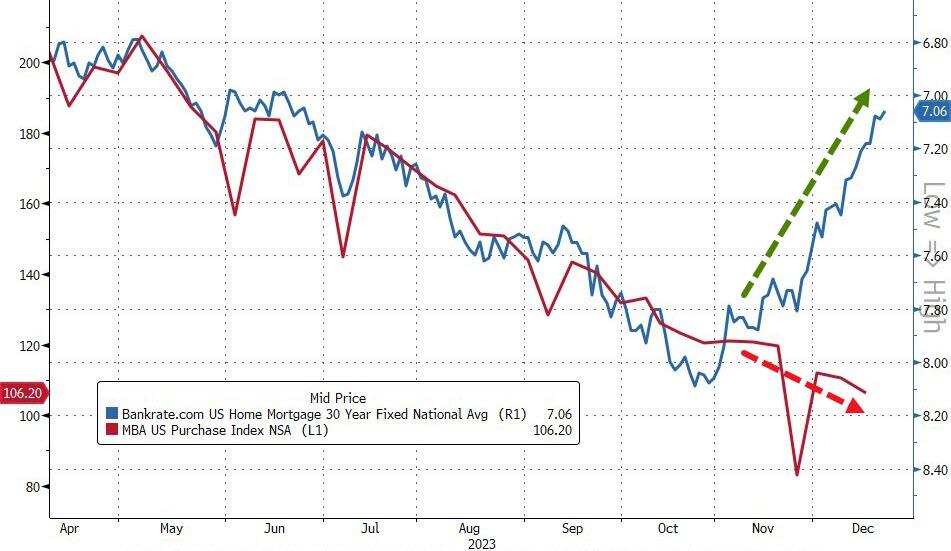
Of course, investors don’t care about actual fundamentals, rates are down so ‘buy buy buy’ the builders…
Source: Bloomberg
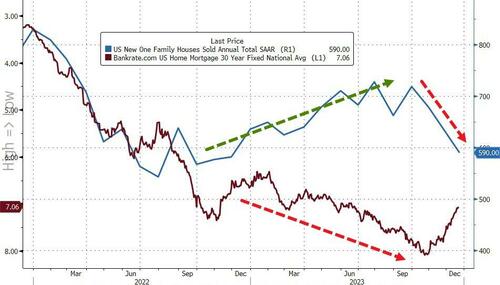
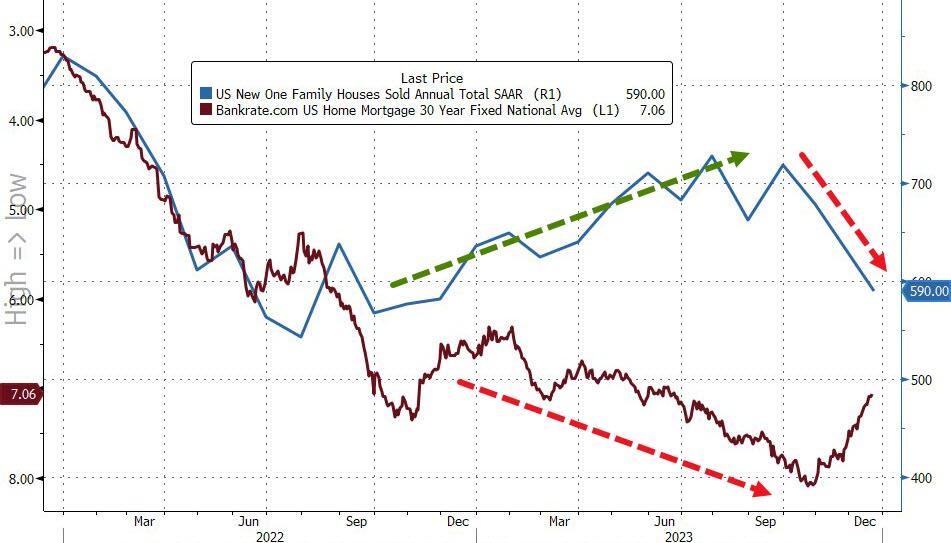
Trouble is, even as mortgage rates have plunged recently, applications for home purchases has continued to decline…
Source: Bloomberg
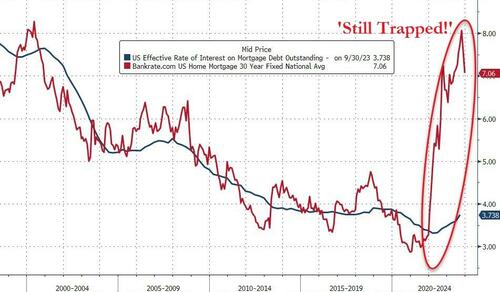
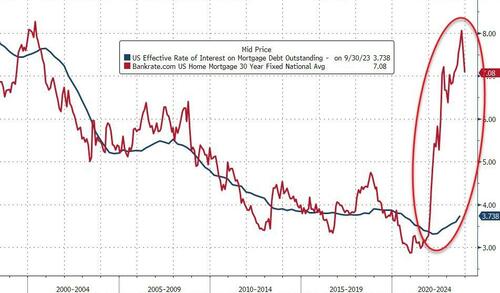
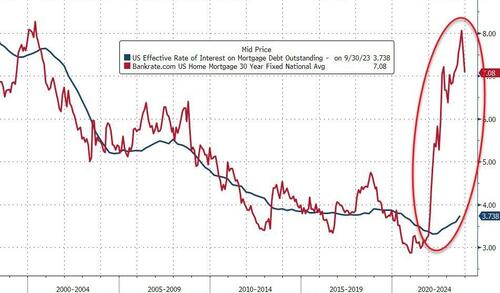
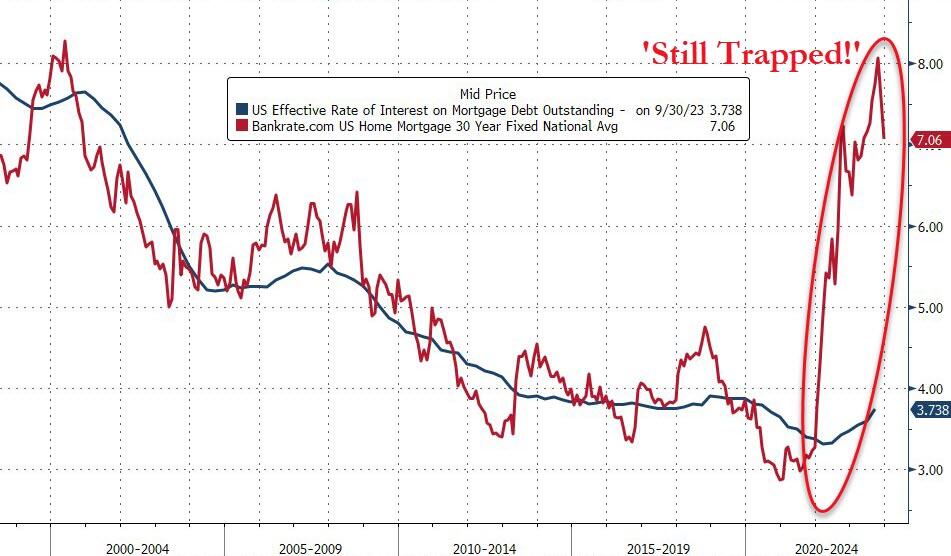
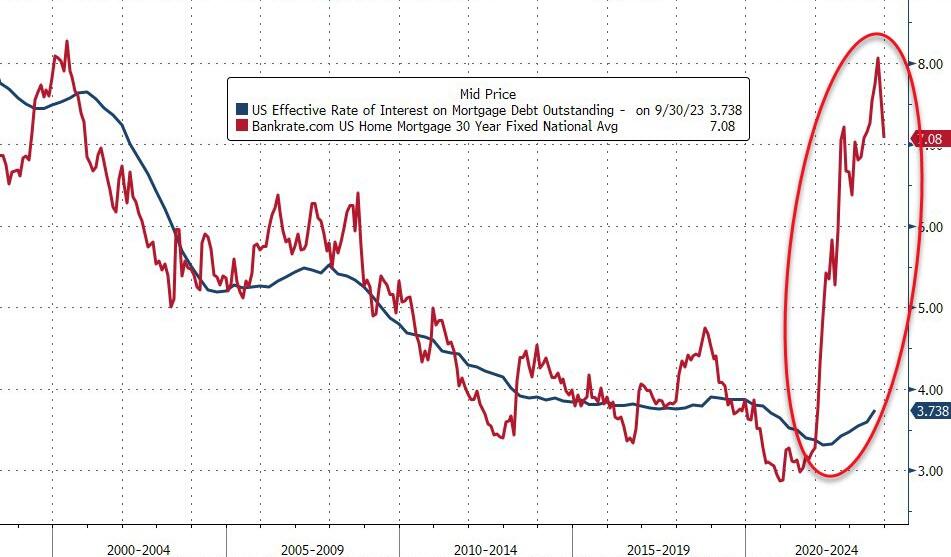
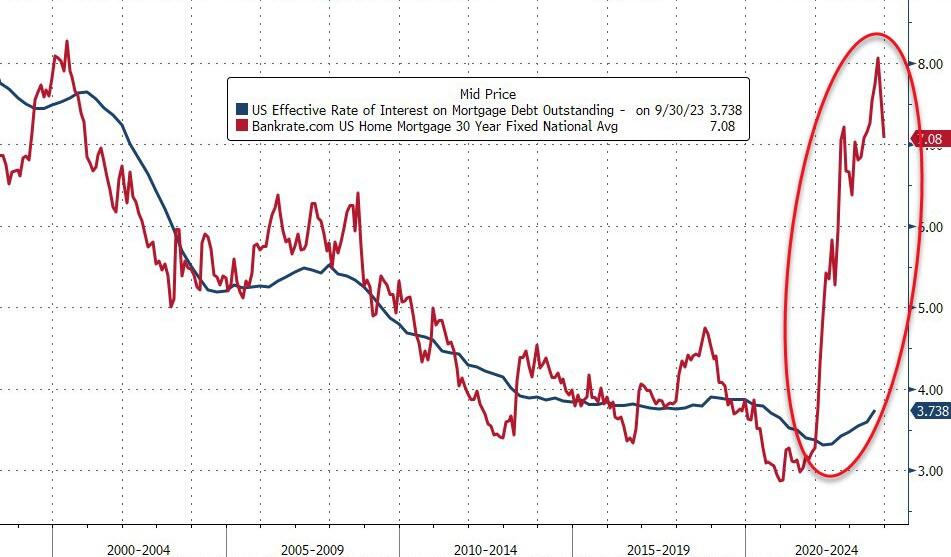
And while mortgage rates have declined (rapidly), they remain massively high relative to the effective mortgage rate for all Americans. That difference is the ‘subsidy‘ that homebuilders have to fill to enable buyers – and it’s still yuuuge!
Source: Bloomberg
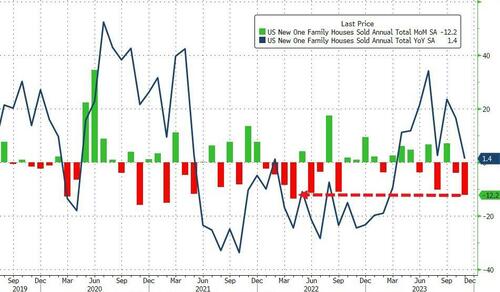
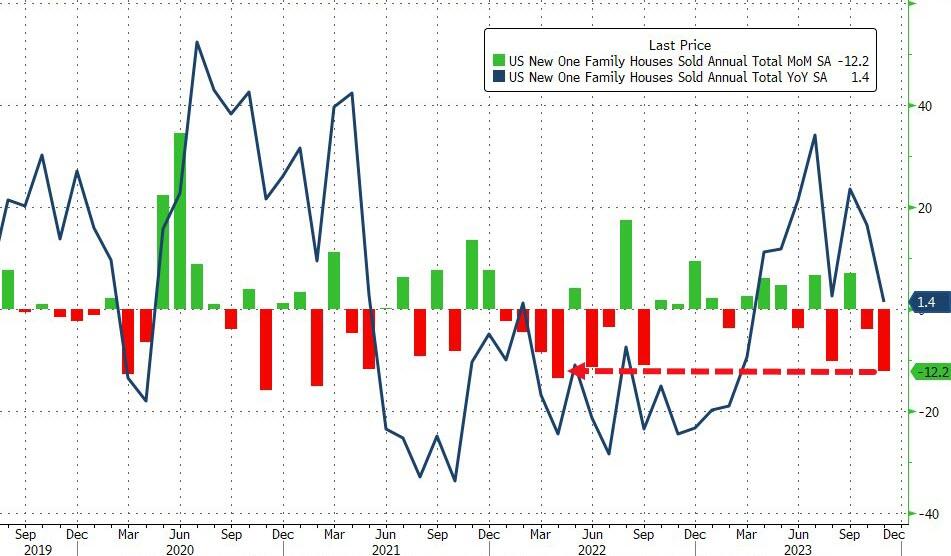
So, just how many new homes were sold in November?
The last few months have been very choppy for new home sales but November clarified that homebuilders just hit a wall on their subsidization!
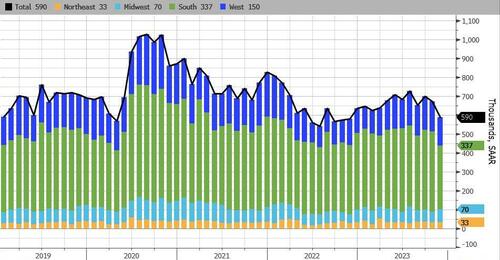
New home sales crashed 12.2% MoM – the biggest MoM drop since April 2022. That dragged the YoY change to just 1.4%…
Source: Bloomberg
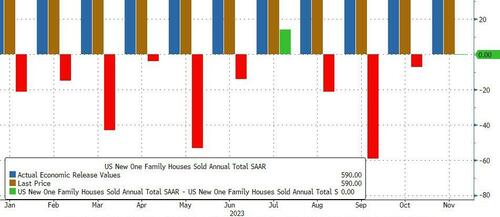
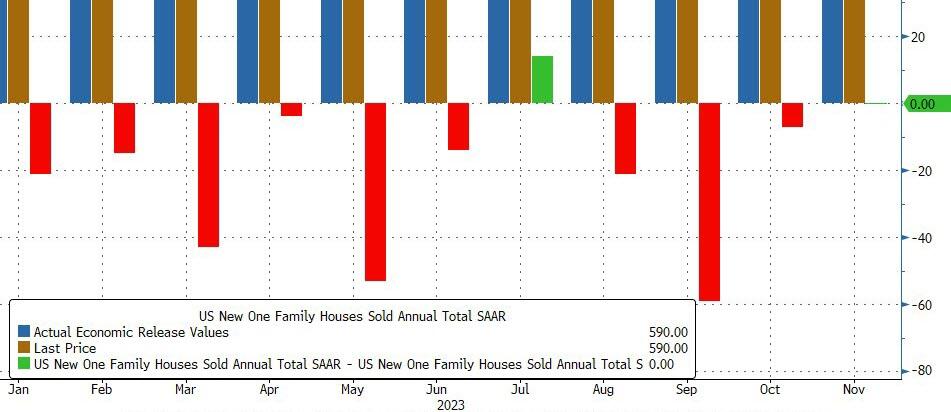
9 of the last 10 months have seen downward revisions to the new home sales SAAR!
Source: Bloomberg
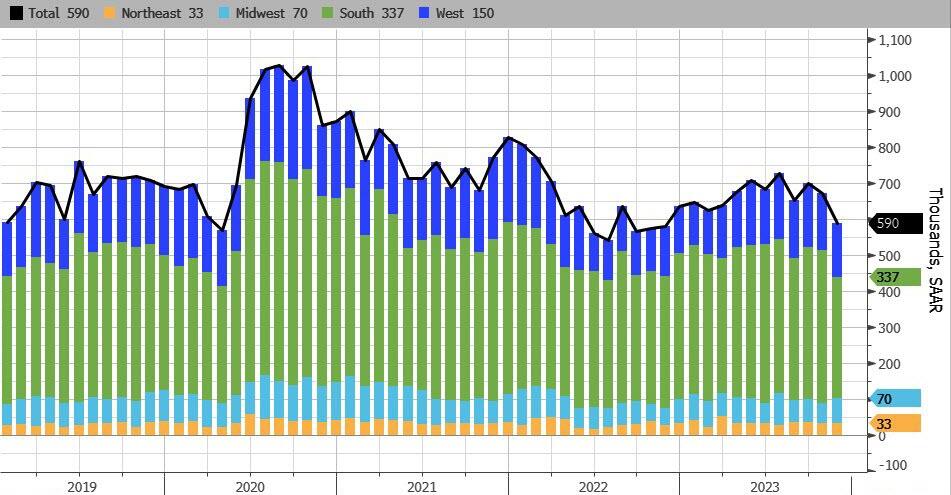
New home sales fell in the South by the most, followed by the West. The Northeast and Midwest saw increased sales…
Source: Bloomberg
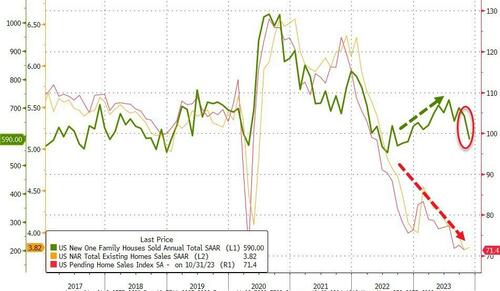
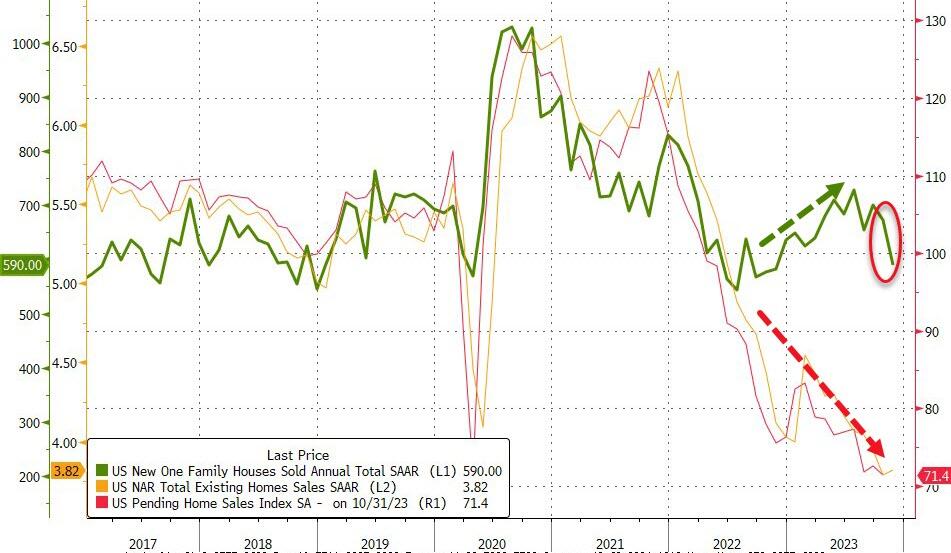
The new home sales SAAR printed 590k (well below the 690k exp) – the lowest since Nov 2022… catching down to existing home sales reality…
Source: Bloomberg
And another catch-up to reality for sales, even as rates tumble…
Source: Bloomberg
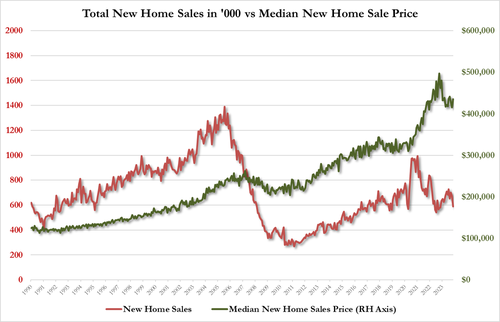
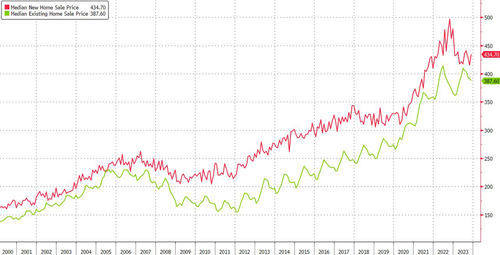
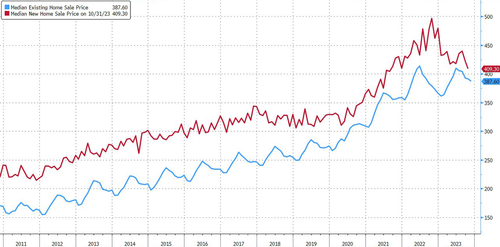
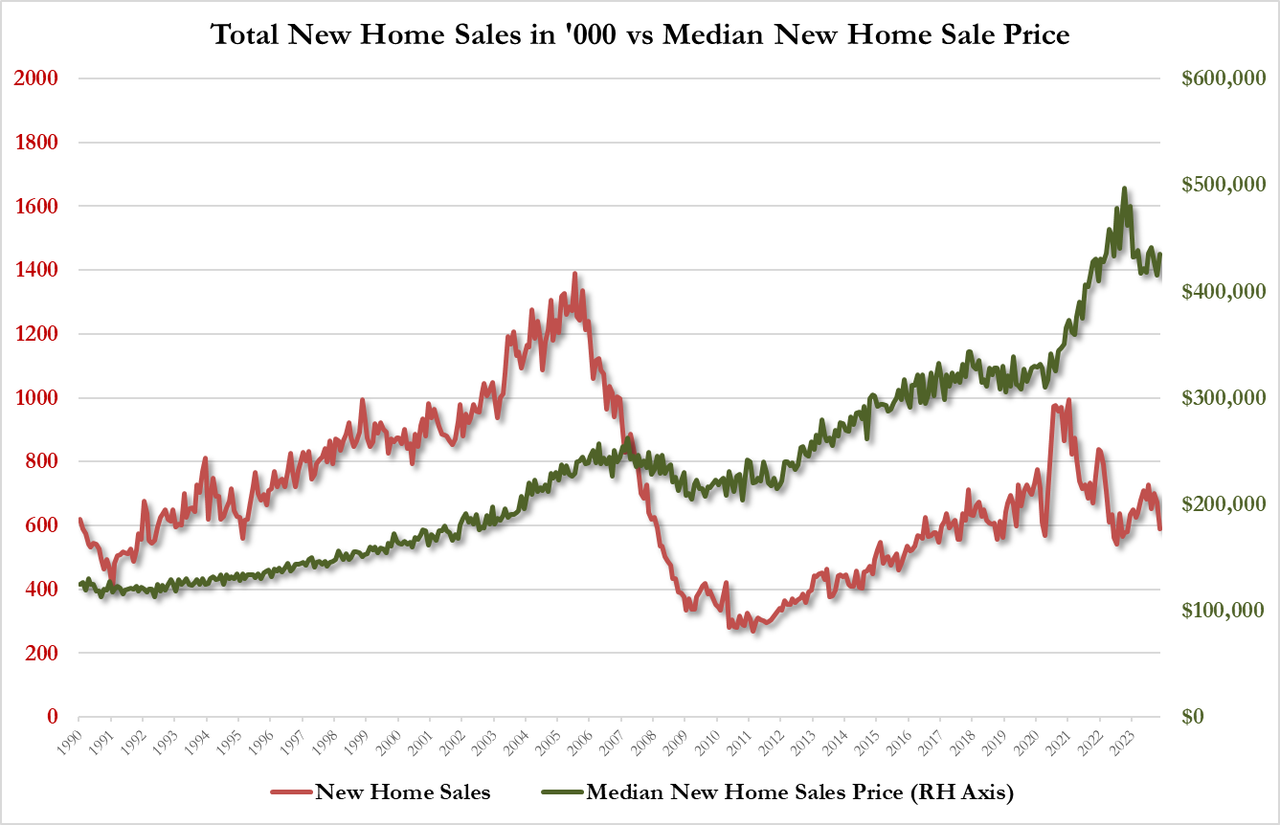
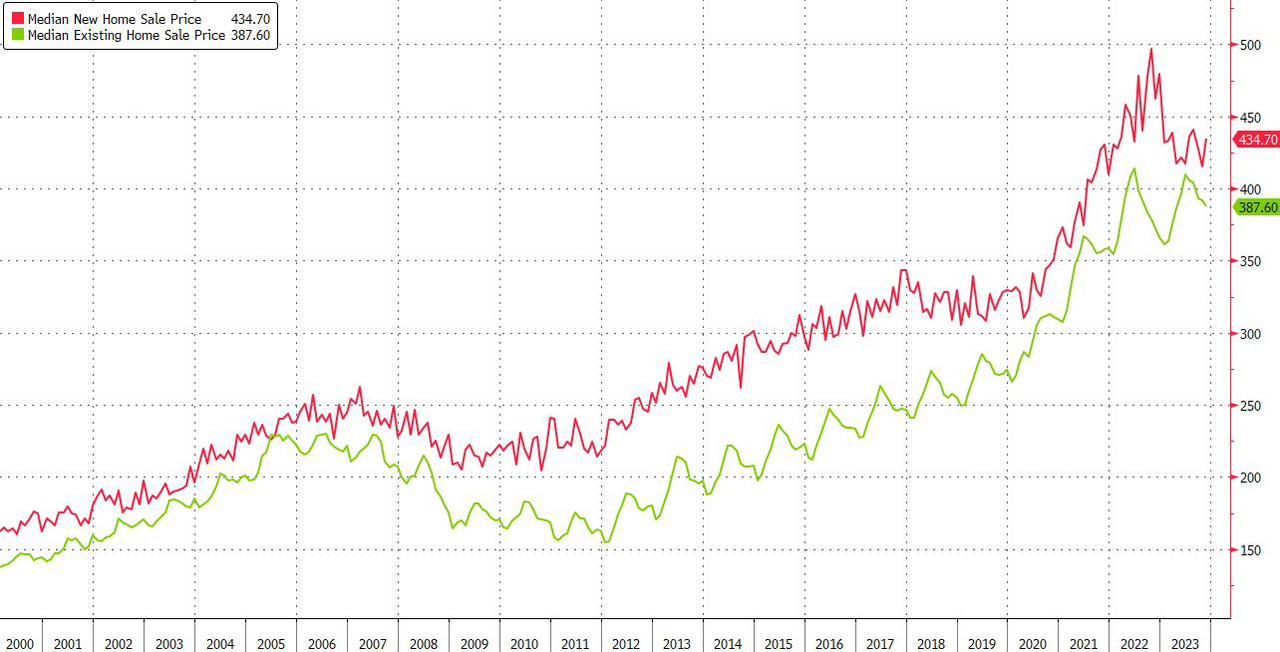
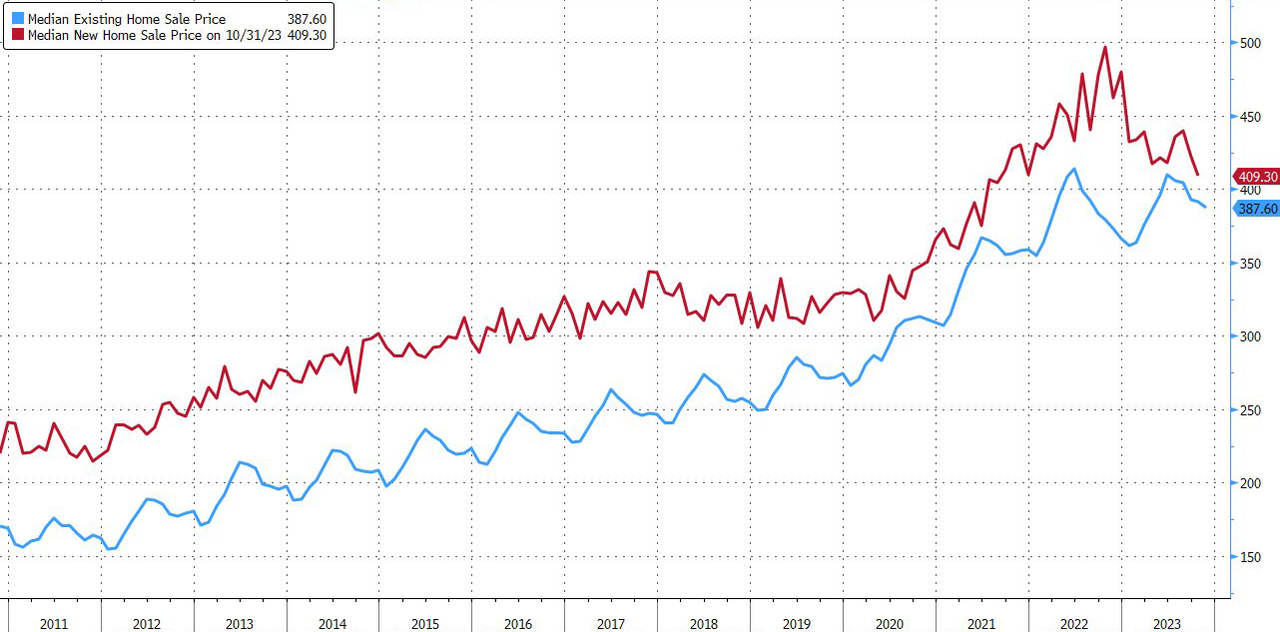
Finally, we note that the median new home priced jumped to $434.7k from $414.9k…
Source: Bloomberg
The median existing home price dropped to lowest since April while median new home price jumped to highest since August
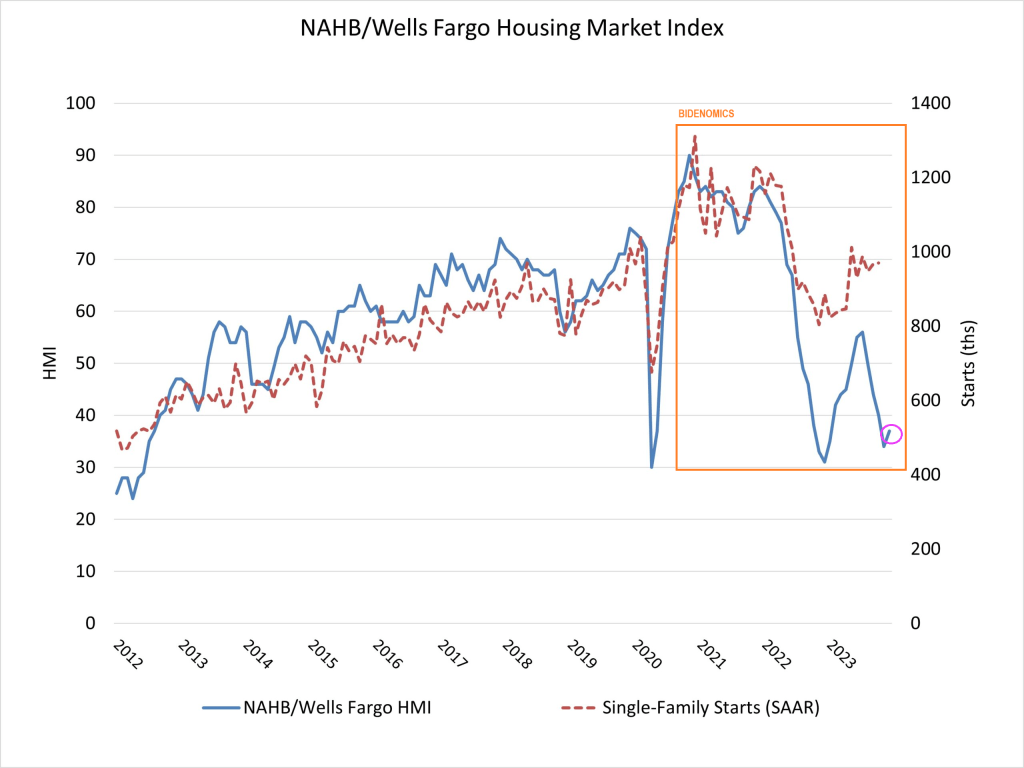
Odd that these ‘actual’ new home sales are plunging as ‘soft survey’ data shows homebuilder sentiment rising, and housing starts.
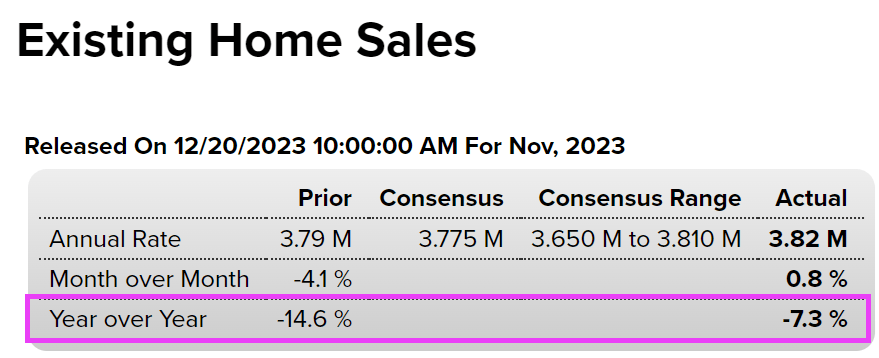
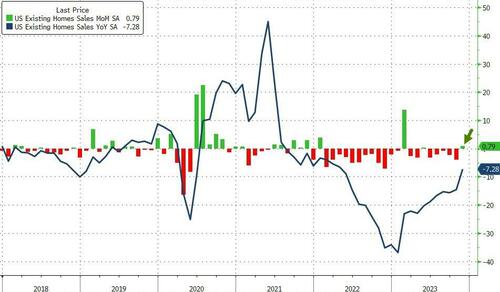
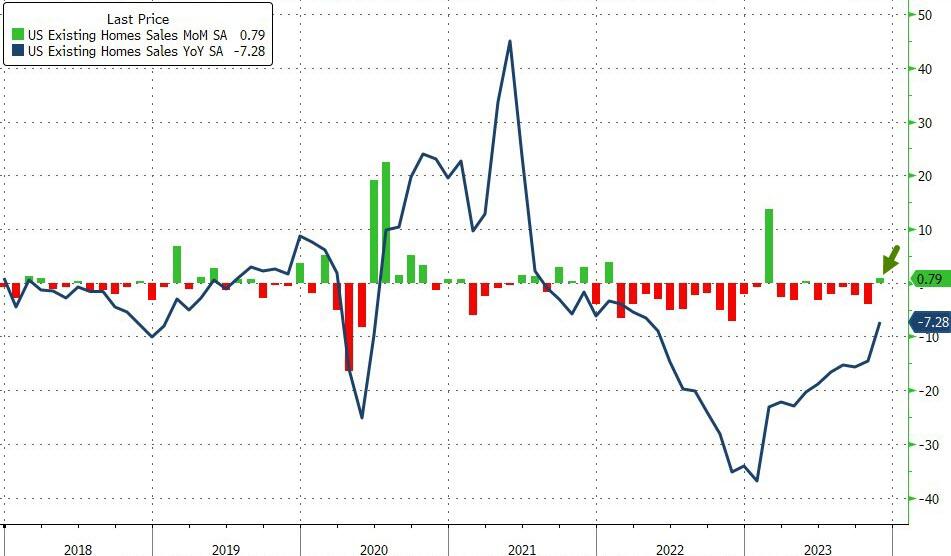
For November, US existing home sales are down -7.28% since last year. At least that is an improvement over -14.6% YoY in October.
Despite homebuilder sentiment ticking up (along with their stock prices) and housing starts soaring – buoyed by a 100bps decline from multi-decade highs in mortgage rates – analysts expected a small 0.4% MoM decline in existing home sales in November (after October’s big drop).
“The latest weakness in existing home sales still reflects the buyer bidding process in most of October when mortgage rates were at a two-decade high before the actual closings in November,” said NAR Chief Economist Lawrence Yun. “A marked turn can be expected as mortgage rates have plunged in recent weeks.”
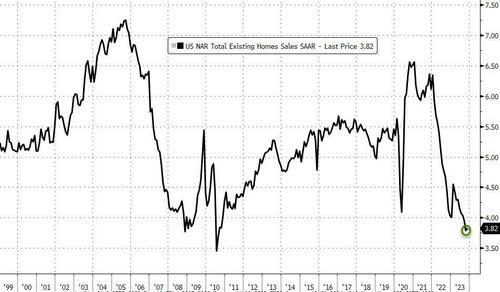
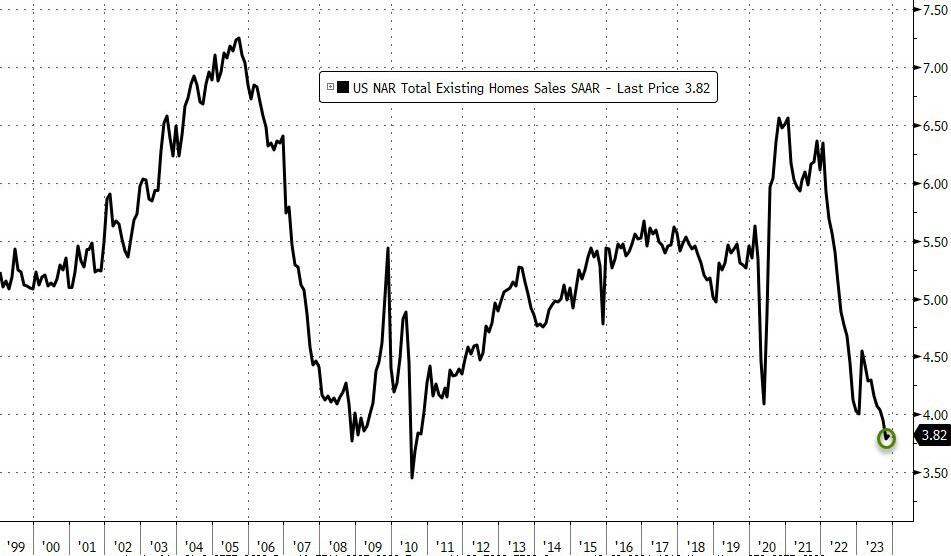
The total existing home sale SAAR bounced very marginally off record lows…
Source: Bloomberg
Regional sales were mixed:
Existing-home sales in the Northeast slipped 2.1% from October to an annual rate of 470,000 in November, down 13.0% from November 2022. The median price in the Northeast was $428,600, up 4.8% from the prior year.
In the Midwest, existing-home sales rose 1.1% from the previous month to an annual rate of 940,000 in November, down 8.7% from one year ago. The median price in the Midwest was $280,800, up 4.9% from November 2022.
Existing-home sales in the South improved 4.7% from October to an annual rate of 1.77 million in November, a decline of 4.3% from the prior year. The median price in the South was $351,500, up 3.4% from last year.
In the West, existing-home sales slumped 7.2% from a month ago to an annual rate of 640,000 in November, down 8.6% from one year before. The median price in the West was $603,200, up 5.3% from November 2022.
Mortgage rates are down, but leave a long way for home sale to drop still…
Source: Bloomberg
But, the gap between current rates and effective rates for Americans is still immense…
Source: Bloomberg
The median existing-home price for all housing types in November was $387,600, an increase of 4.0% from November 2022 ($372,700), but down MoM…
All four U.S. regions posted price increases.
“Home prices keep marching higher,” Yun added.
“Only a dramatic rise in supply will dampen price appreciation.”
Well, with housing starts accelerating in the latest data and Powell’s massive pivot, has The Fed re-ignited its 3rd housing bubble?
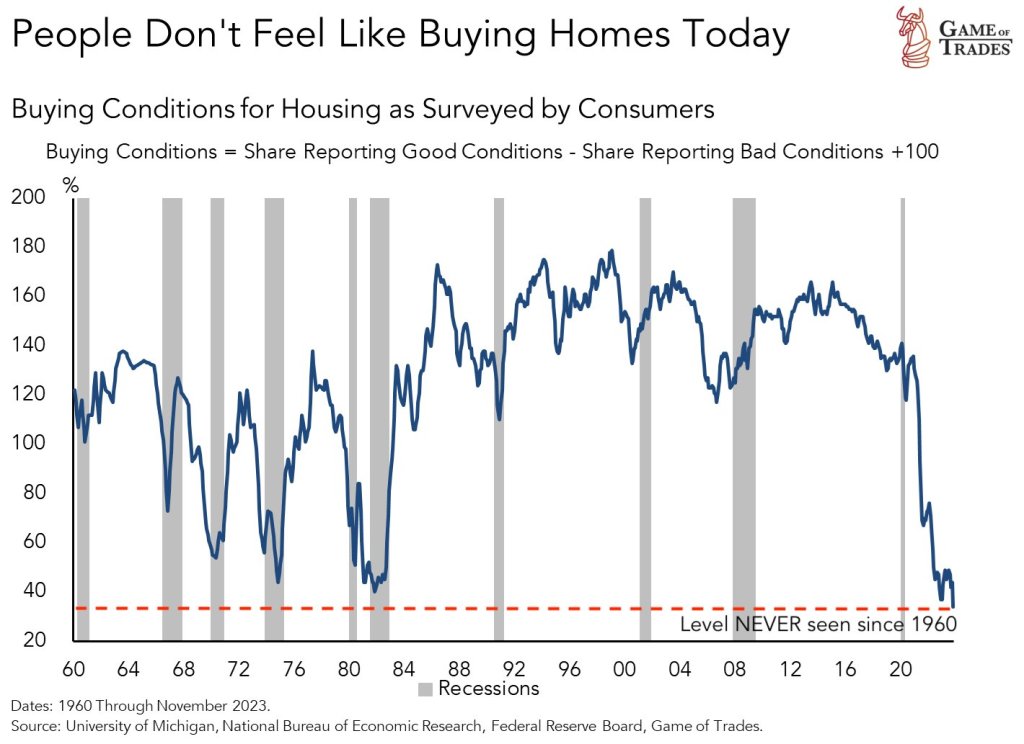
And the buying condition for housing sinks to all-time low.
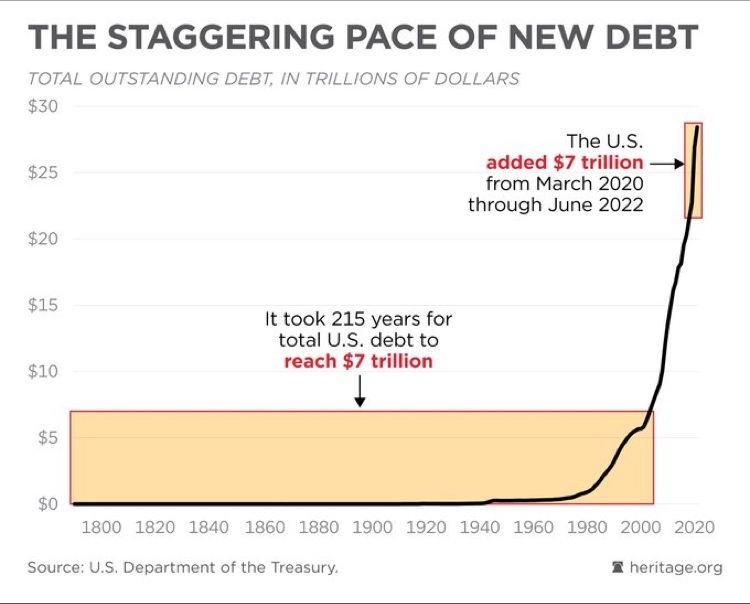
The Federal government added $7 trillion in debt since 2020 while it took 215 years to get to $7 trillion before Covid and Bidenomics.
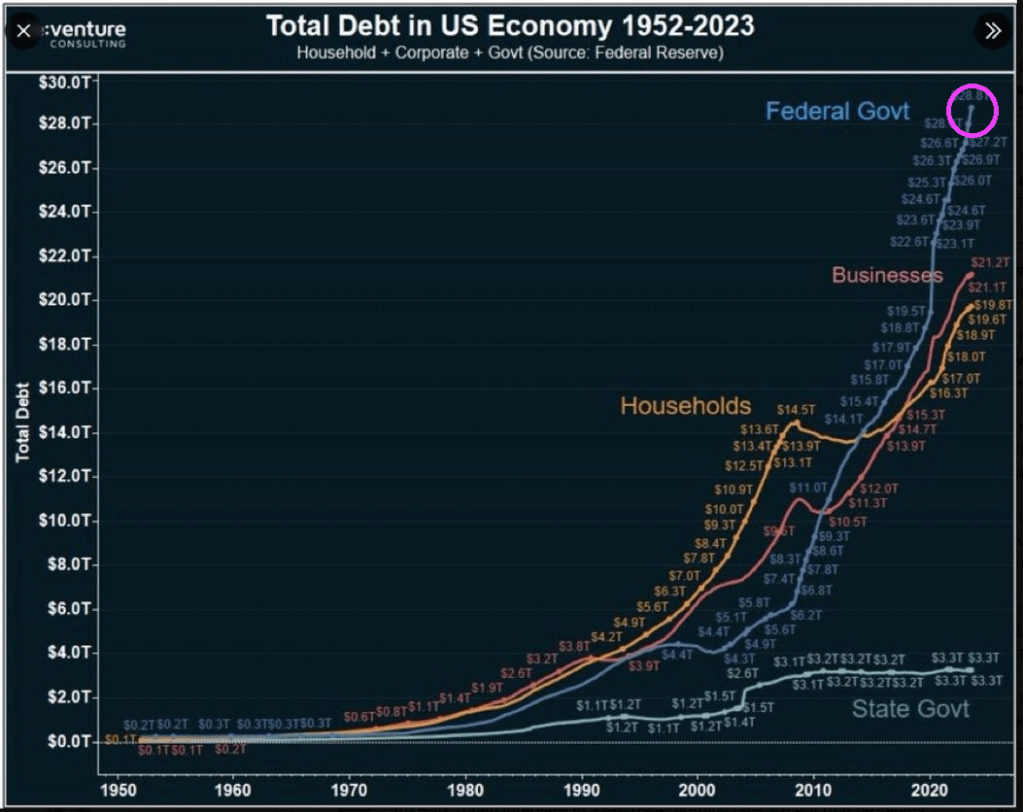
In what can simply be called fiscal insanity, The Federal government is borrowing like there is no tomorrow (given that Biden is 81 years old, this isn’t far off) displacing businesses and households. Heaven help us if the Federal government has to borrow more money to fight a real war like World War II.
So, the massive Federal debt gorging isn’t helping the housing market.












 Confounded Interest - Anthony B. Sanders





You must be logged in to post a comment.