But was it organic growth or simply The Federal Government funding the defense and green energy industies with trillions in spending?
One factor has been government spending which grew an unsustainably 4.7% in real terms over the last year. Outside the pandemic, this is one of the fastest rates in decades and works at a cross purpose with monetary policy objectives.
Bidenomics is code for massive Federal spending (and debt) to fund Federal priorities: wars in Ukraine, Israel and likely involvement around Taiwan. And the costly switch to green energy (but not nuclear, for some reason).
If the US economy growing simply to function as a war machine and wealth transfer mechanism from the middle class to the 1%, we are on the Highway To Hell. Personal consumption contributed 2.44% to the bottom line GDP print in Q3, down from the pre-revision number of 2.69% but well above Q2’s 0.55%.
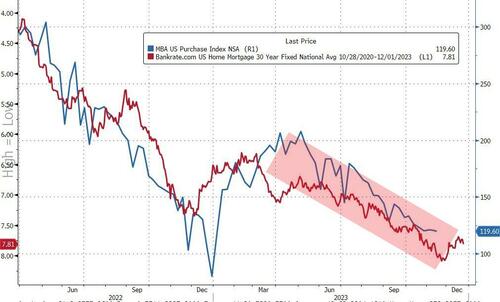
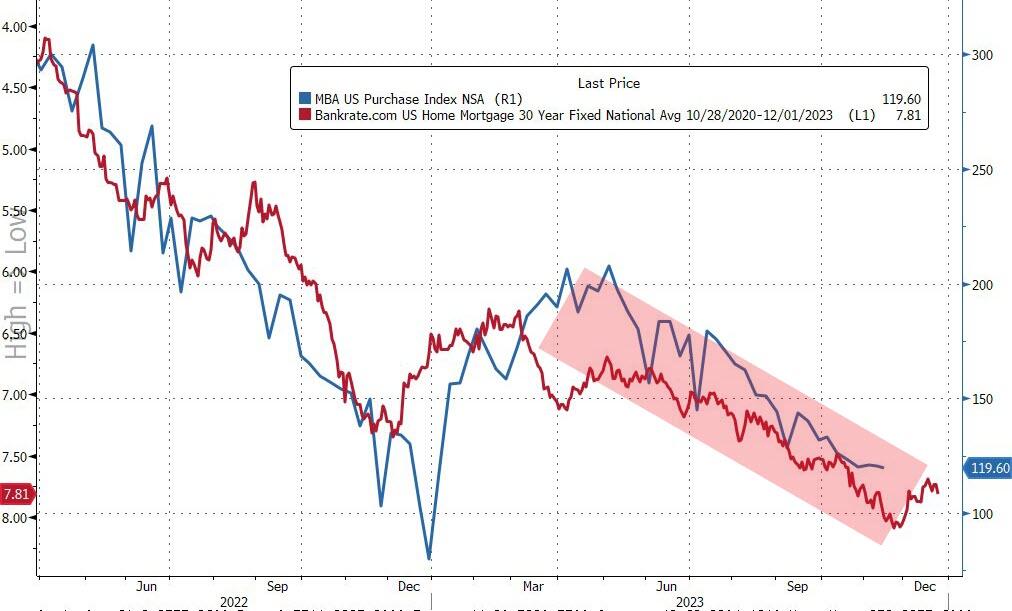
As a reminder, The Mortgage Bankers Association’s index of home-purchase applications tumbled to 120 – the lowest level since 1995 – as mortgage rates hit 8% for the first time in 23 years in October.
Source: Bloomberg
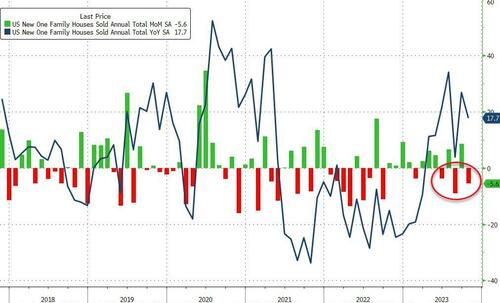
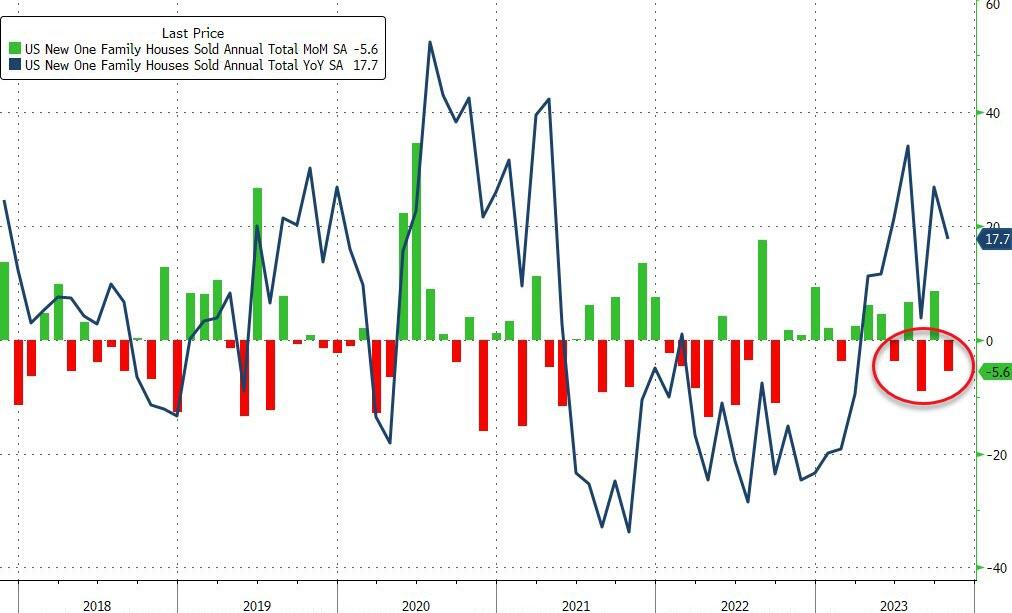
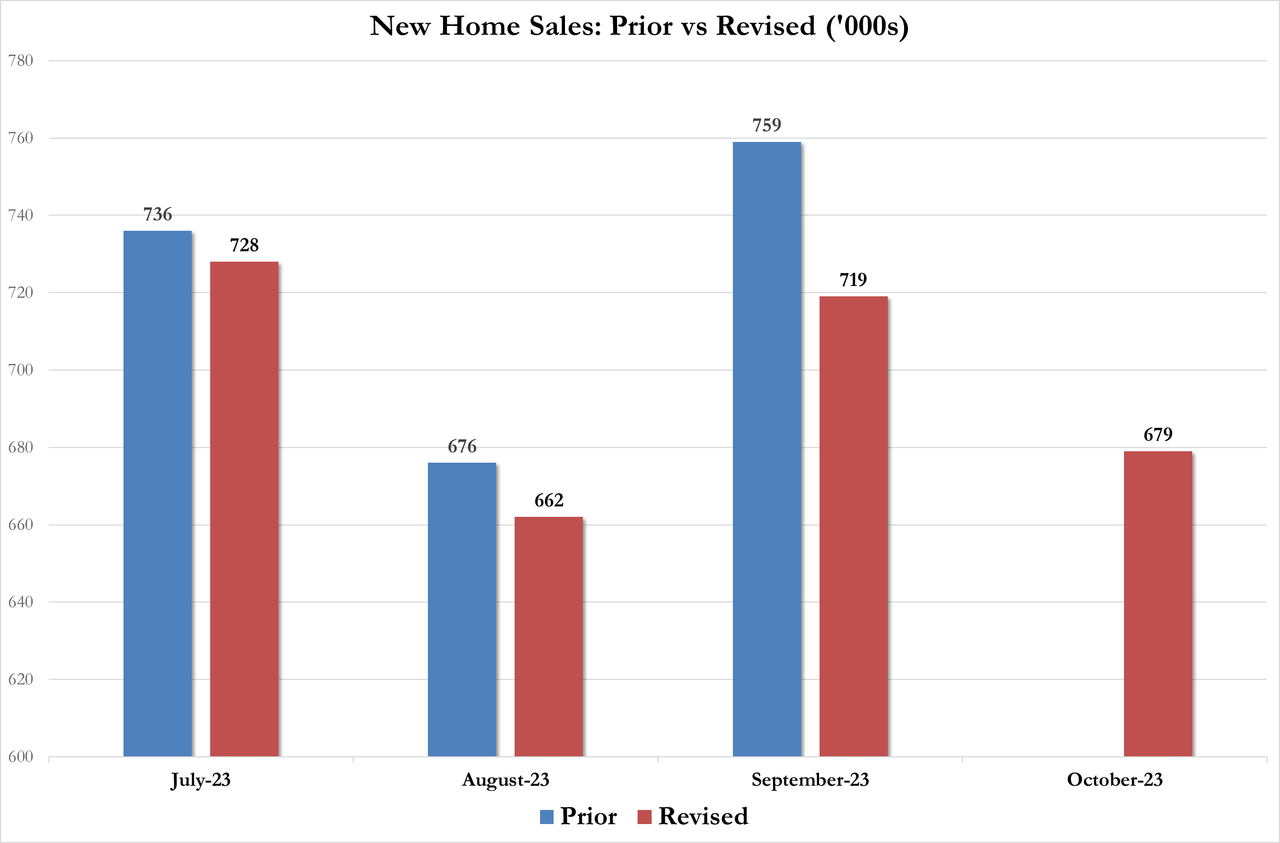
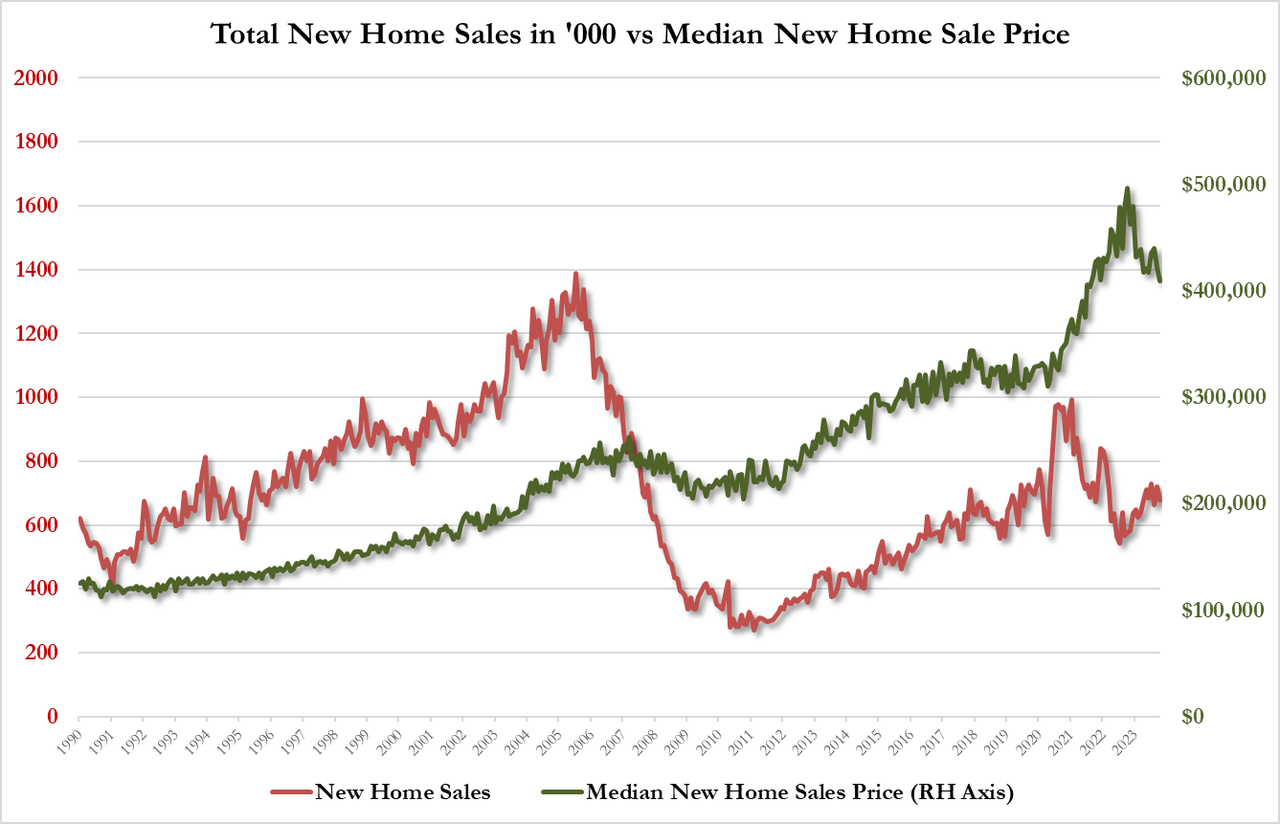
So, it should be no surprise that new home sales were even worse than expected, plunging 5.6% MoM (and making it even worse, the 12.3% MoM jump in Sept was revised down to +8.6%)…
Source: Bloomberg
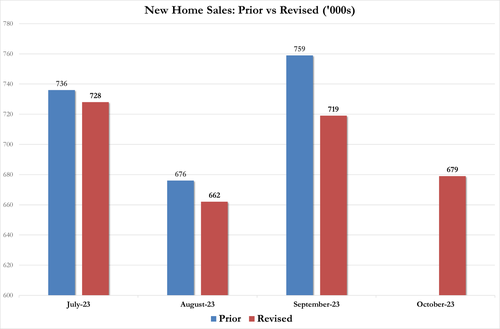
The trend of downward revisions continues…
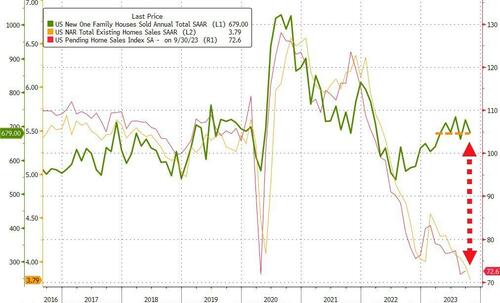
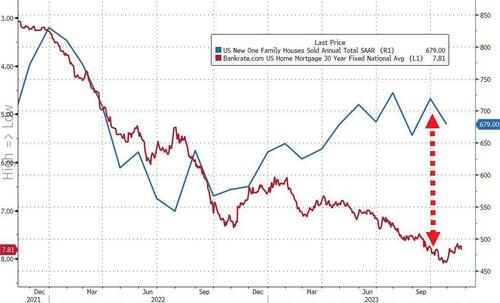
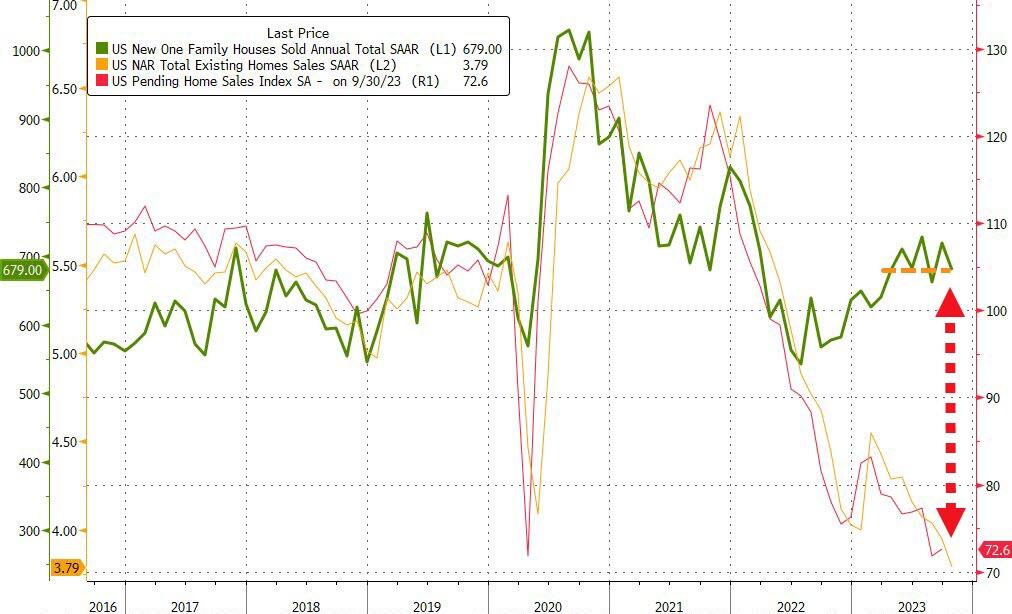
The New Home Sales SAAR of 679k is flat from April (that was below all economists’ forecasts)…
Source: Bloomberg
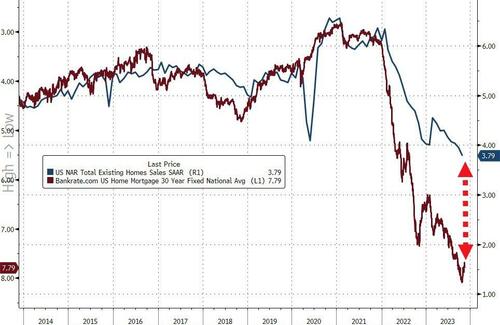
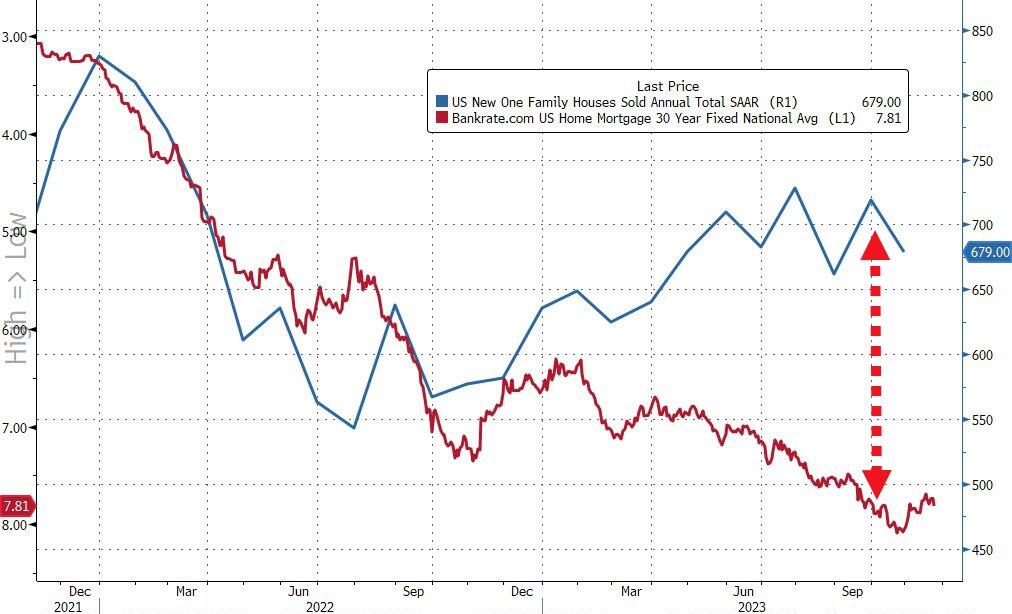
It appears the homebuilders finally hit their wall eating the gap between these two lines was just not sustainable…
Source: Bloomberg
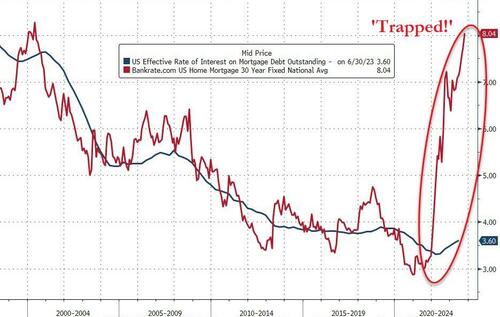
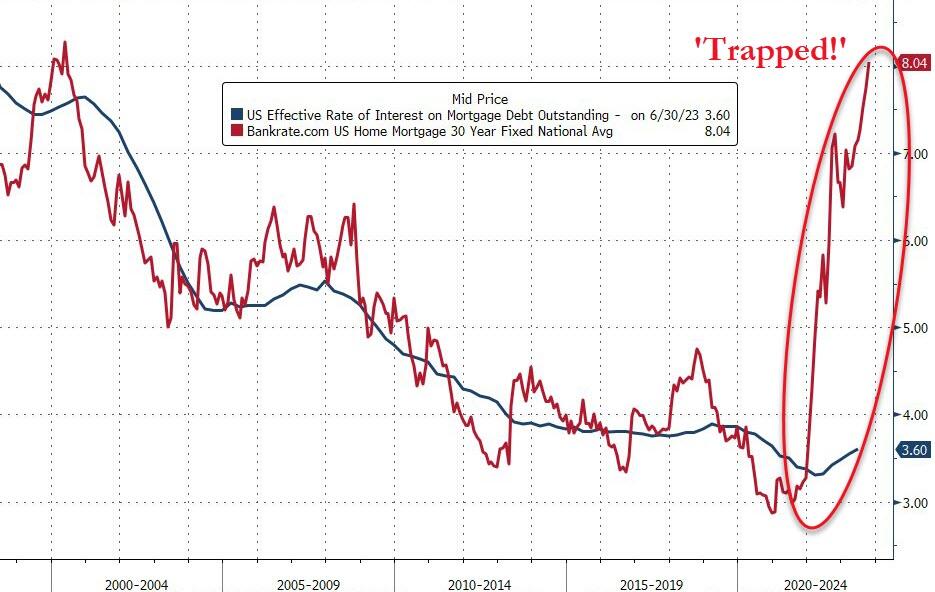
And as we noted previously, homebuilders can’t be filling this gap either – between the current 30Y mortgage rate and the effective rates that borrowers are currently paying on their home loans – (i.e. subsidizing new home sales) forever…
Source: Bloomberg
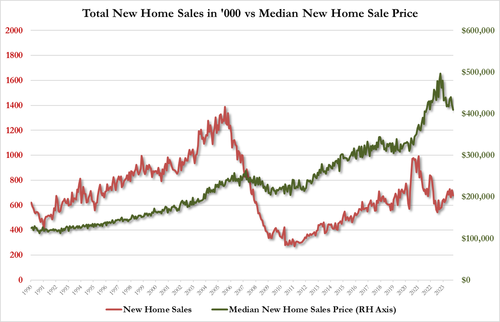
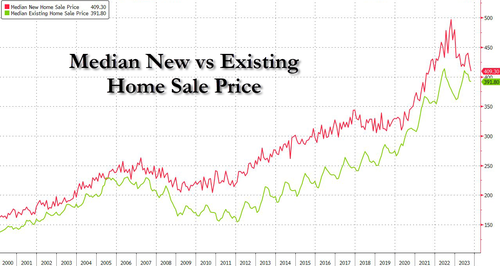
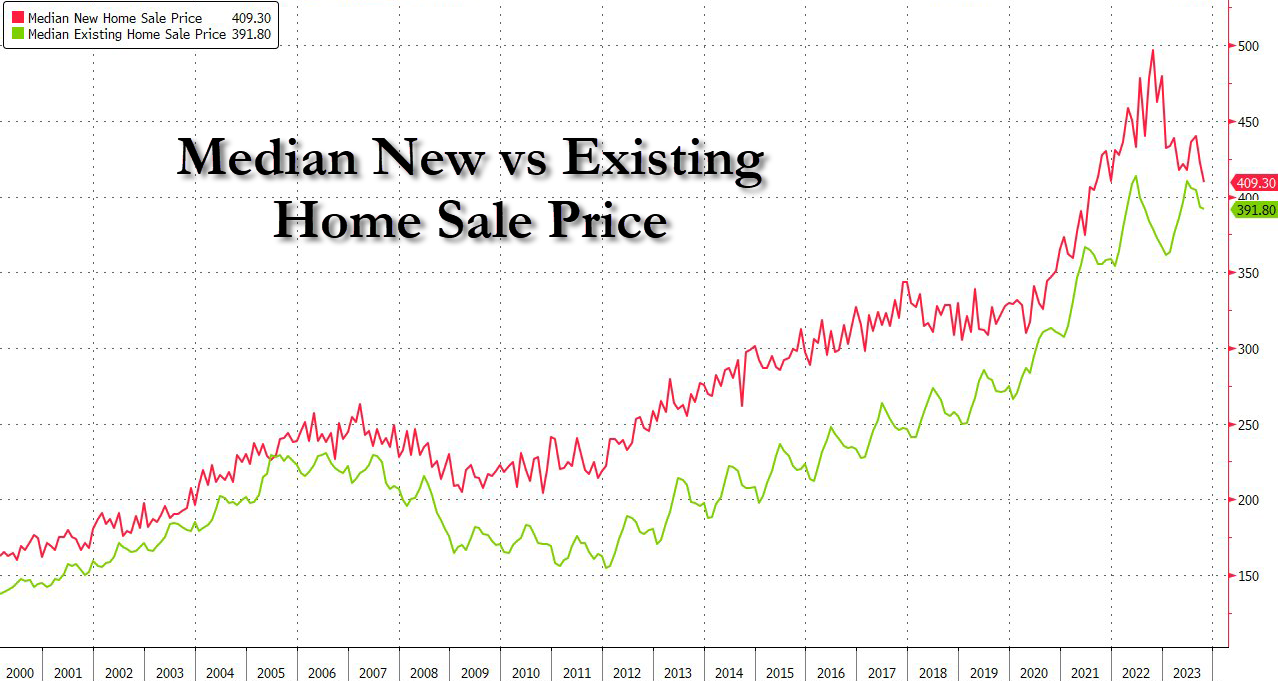
The median new home price fell 17.6% y/y to $409,300; average selling price at $487,000
That is the lowest median price since Aug 2021, catching back down to existing home prices…
Source: Bloomberg
Is Powell winning his war on affordability? Or crushing the middle class’s main source of wealth? Or is it Hammer Time??
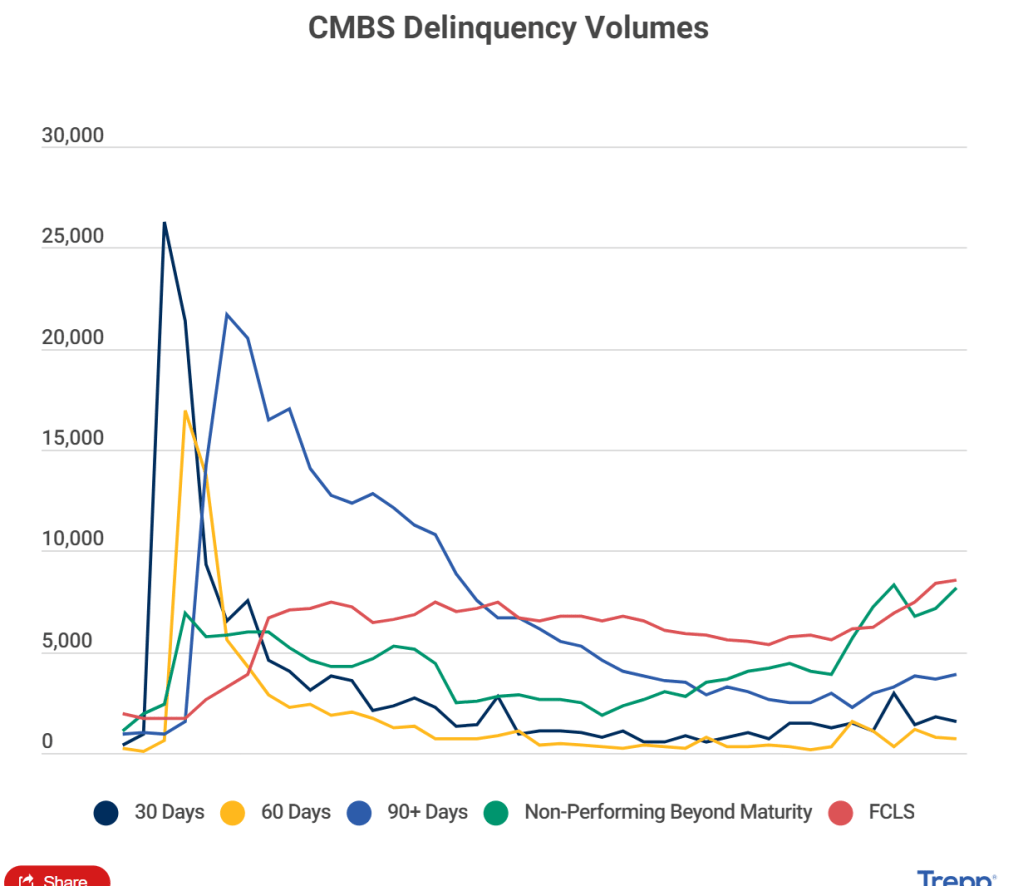
According to Trepp, the volume of CMBS delinquency increased 49.4% during 10 months through October.
Looking for more? This piece has been taken from Trepp and Commercial Real Estate Direct’s Q3 2023 Quarterly Data Review. Access the magazine here.
The volume of CMBS loans that are classified as delinquent increased by 49.4% during the 10 months through October to $27.91 billion. That volume amounts to 5.07% of the $601.98 billion universe tracked by Trepp. In contrast, delinquencies at the end of last year amounted to 3.03% of the $616.15 billion universe then extant.
Office Sector Drives Increase in Delinquency Volumes
The driver of the increase was the office sector, which had a 261% increase in delinquency volumes over the 10-month period through October. A total of 199 loans with a balance of $9.59 billion, or 5.91% of all CMBS office loans were at least 30 days late with their payments, as of the end of October. At the end of last year, 115 loans with a balance of $2.65 billion, or 1.63% of office loans, were delinquent.
The sector’s prospects are unlikely to improve as office occupancy rates have declined in most of the country’s major markets. That’s been driven by a substantial pullback in demand from office-using tenants.
Hit especially hard have been loans with floating coupons that are maturing and need interest-rate cap agreements in place before they qualify for term extensions. Those rate caps have skyrocketed in price in lockstep with interest rates.
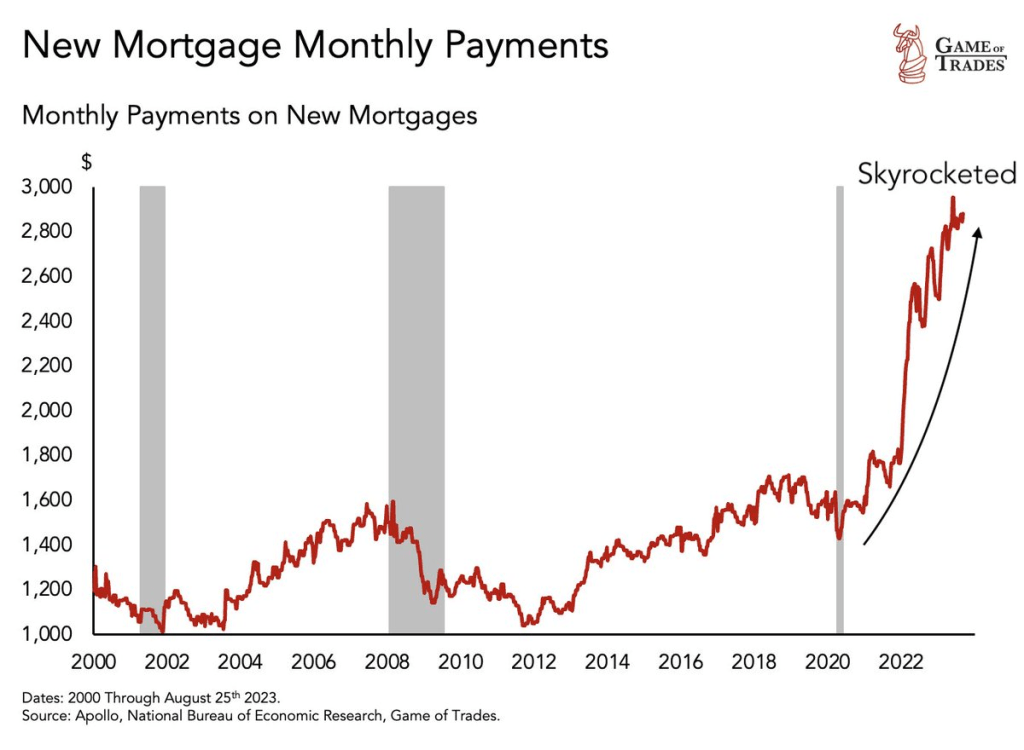
On the residential side, The Fed is helping drive mortgage payments through the roof!
The Federal Reserve reminds me of The Stones’ song “Tumbling Dice.” Why? The Fed can’t tell if inflation is cooling or re-accelerating. Hence, they are just rolling dice.
Let’s start with mortgage rates, a critical component of the housing and CRE markets. Mortgage rates remain up 163% since 2021, not great for housing affordability. Despite recent small declines in the mortgage rate. The 10Y-2Y Treasury curve is also going deeper into reversion … again.
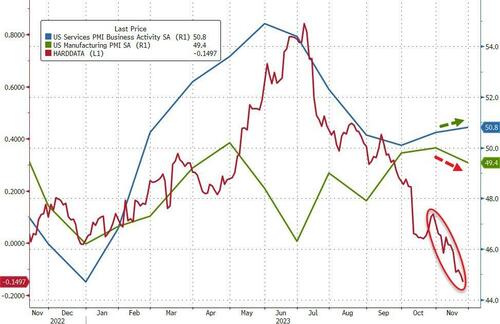
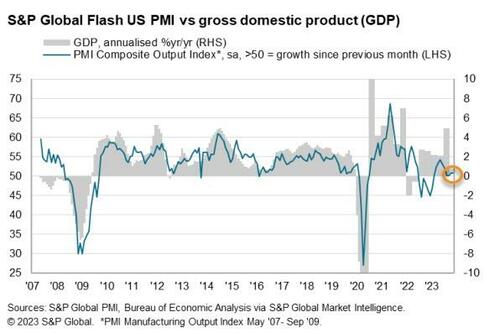
However, the data was more mixed with US Manufacturing falling more than expected to 49.4 – back into contraction – (vs 49.9 exp) from 50.0 in October. However, US Services unexpectedly rose from 50.6 to 50.8 (exp 50.3).
“The US private sector remained in expansionary territory in November, as firms signalled another marginal rise in business activity. Moreover, demand conditions – largely driven by the service sector – improved as new orders returned to growth for the first time in four months.
The upturn was historically subdued, however, amid challenges securing orders as customers remained concerned about global economic uncertainty, muted demand and high interest rates.
Businesses cut employment for the first time in almost three-and-a-half years in response to concerns about the outlook. Job shedding has spread beyond the manufacturing sector, as services firms signalled a renewed drop in staff in November as cost savings were sought.
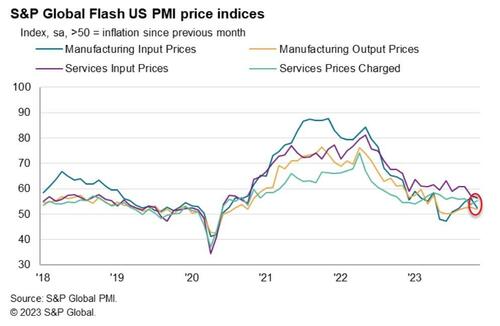
“On a more positive note, input price inflation softened again, with cost burdens rising at the slowest rate in over three years. The impact of hikes in oil prices appear to be dissipating in the manufacturing sector, where the rate of cost inflation slowed notably.
Although ticking up slightly, selling price inflation remained subdued relative to the average over the last three years and was consistent with a rate of increase close to the Fed’s 2% target.”
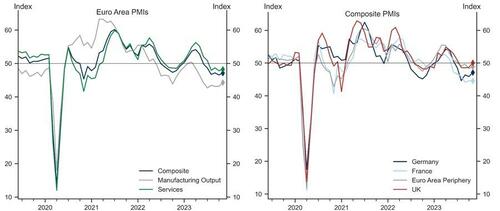
The US data comes after yesterday’s Euro area composite flash PMI increased by 0.6pt to 47.1, above consensus expectations, driven by a meaningful acceleration in Germany and the periphery, partially offset by a marginal decline in France. In the UK, the composite flash PMI improved meaningfully and entered expansionary territory at 50.1, above consensus expectations, on the back of a pickup in both sectors, with the services sector index entering positive territory at 50.5.
Goldman sees three main takeaways from today’s data.
First, we see a potential turning point in Euro area activity, with forward-looking indicators all improving in November, potentially setting a positive stage for the remainder of the year and the beginning of 2024. While the improvement seems to be broad-based, the upside surprises in the manufacturing sector in Germany and the Euro area as a whole may point to early signs of the sector’s revival.
Second, inflationary pressures, after moderating for some time, show signs of renewed intensification in the Euro area, as reflected by the output and input price components ticking up in November.
Third, UK growth momentum was meaningfully better than last month, and is picking up across the board, with the headline and services indices coming in above 50. This, however, is now accompanied by an increase in cost pressures, with both the input and output price indices edging up in November.
Finally, back to the US, S&P Global found that US business uncertainty was also heightened among US firms, as expectations regarding the year-ahead outlook slipped to the weakest since July.
A record 130.7 million people are expected to shop in stores and online in the U.S. on Black Friday this year, the National Retail Federation (NRF) estimates. The event is known for crowds lining up at big-box stores at dawn to scoop up discounted TVs and home appliances.
But at 6 a.m. on Friday at a Walmart in New Milford, Connecticut, the parking lot was only half full.
“It’s a lot quieter this year, a lot quieter,” said shopper Theresa Forsberg, who visits the same five stores with her family at dawn every Black Friday. She was at a nearby Kohl’s (KSS.N) store at 5 a.m.
Fifth Avenue, one of the world’s top shopping streets, is dead quiet on Black Friday — at least by New York’s boisterous standards.
The strip of high-end shops from brands like Louis Vuitton and Cartier has largely recovered since its pandemic lull, where vacancies had once reached nearly 30% in Midtown East. Some vestiges of that struggle remain, with a few empty storefronts covered up or filled with little art installations. Yet the street has managed to keep its title as the most expensive retail area on the planet by rent per square foot, according to Cushman & Wakefield.
Mortgage rates up 163% since 2021, manufacturing PMI in contraction and Black Friday shopping muted. Not good. The Fed is rolling the dice on what to do next.
Even Biden’s press secretary Karine Jean Pierre admitted that all the slogans and hype about Bidenomics is a losing message. The economy is terrible for the middle class and low-wage workers. But excellent for the 1% donor and political elite class. But housing is very important to the middle class … and housing is simply unaffordable.
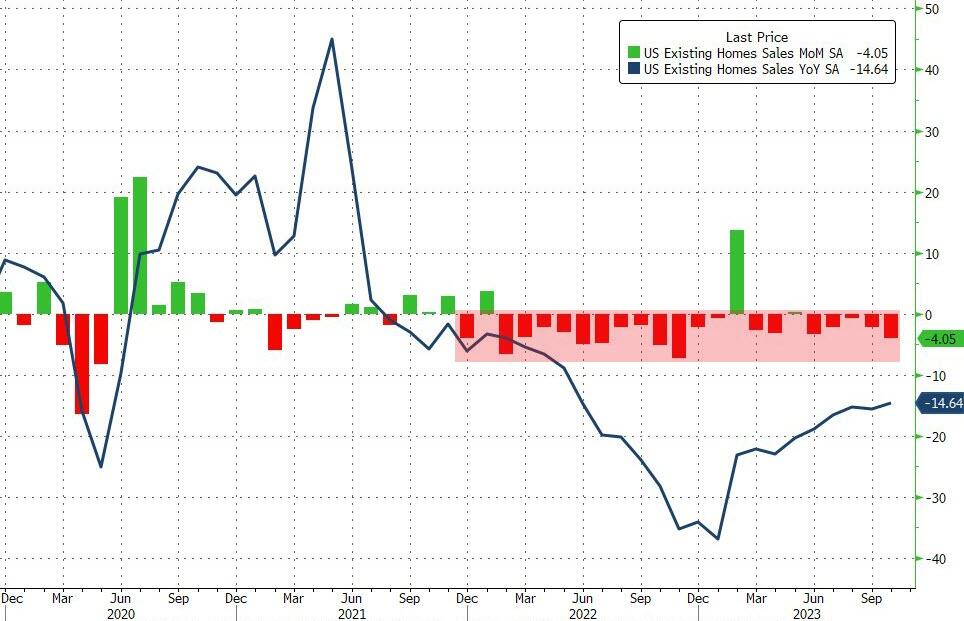
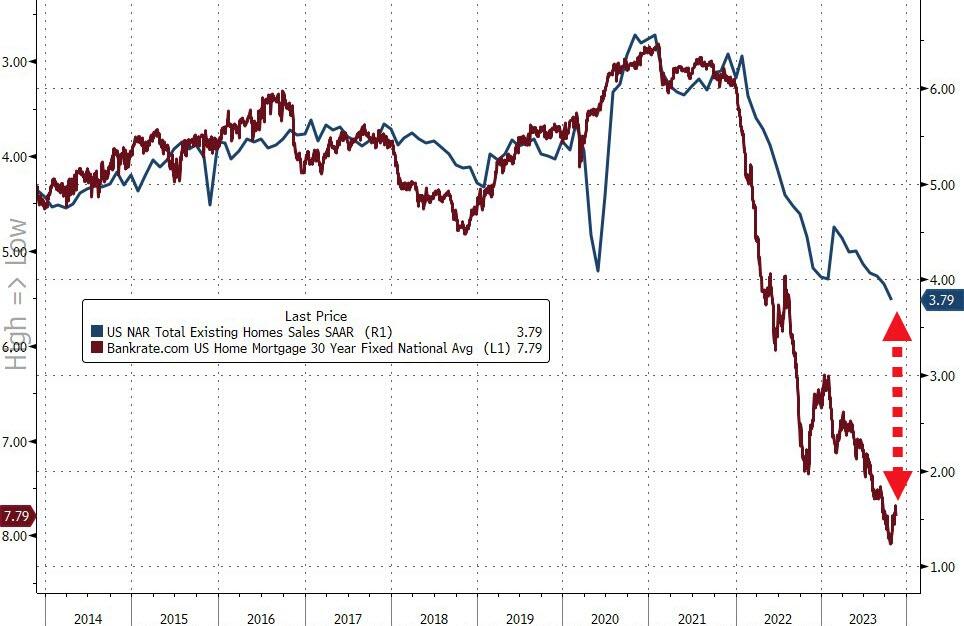
With housing affordability at its lowest since at least the early 1980s, (and homebuilder sentiment slumping as mortgage rates rose), it’s no surprise that analysts expected existing home sales in October to tumble 1.5% MoM.
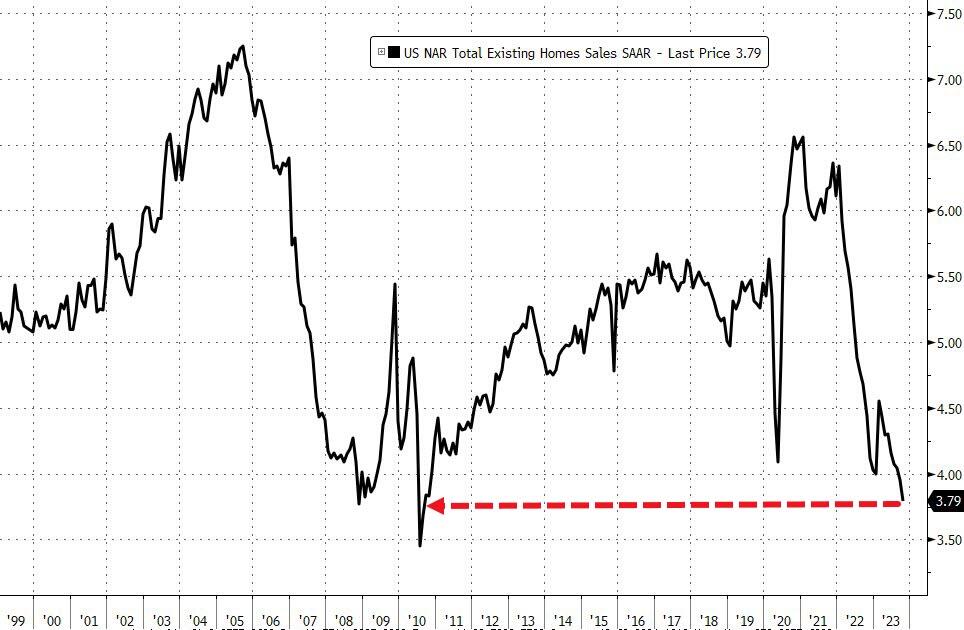
Sales actually fell 4.1% MoM (far worse than expected and down for the 20th time in the last 23 months) with September’s 2.0% MoM decline revised even lower to -2.2% MoM. That decline left existing home sales down 14.6% YoY.
Source: Bloomberg
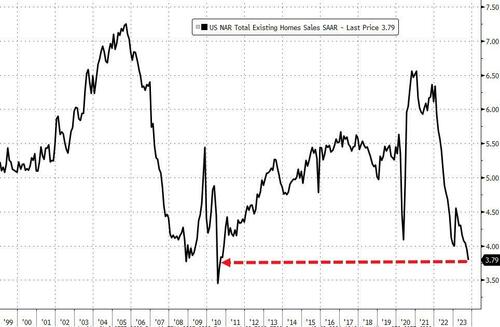
The total existing home sales SAAR plunged to 3.79mm – the lowest since the tax credit expired in Aug 2010…
Source: Bloomberg
Sales fell in three of four regions, while they were unchanged in the Midwest. They hit a record low in the West and matched an all-time low in the Northeast
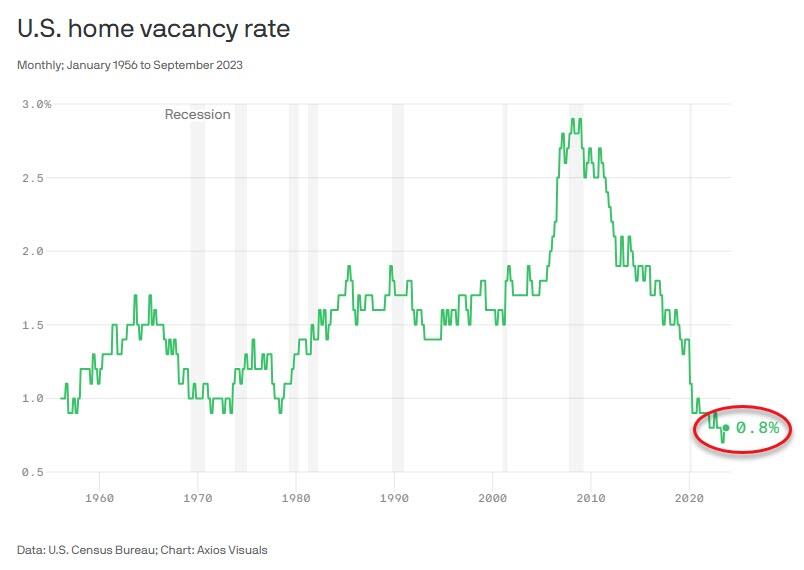
Finally, the percentage of homes that are vacant fell to the lowest level on record in August, and ticked up only slightly in September…
Ever the optimistic,Lawrence Yun, NAR’s chief economist, suggested that:
“Fortunately, mortgage rates have fallen for the third straight week, stirring up buying interest,” adding “though limited now, expect housing inventory to improve after this winter and heading into the spring.”
Good luck with that idea Larry!
Yun added that nearly a third of homes sold above their list price, indicating that multiple offers are still occurring with the median selling price climbed 3.4% from a year earlier to $391,800, the highest for any October in data back to 1999.
Even though the number of homes for sale ticked up from a month earlier to 1.15 million, it’s still the lowest for any October in the series.
Finally, first-time buyers made up a historically low 28% of purchases in October.
After all, the US economy and housing markets are addicted to goverment. (Addicted To Gov!)
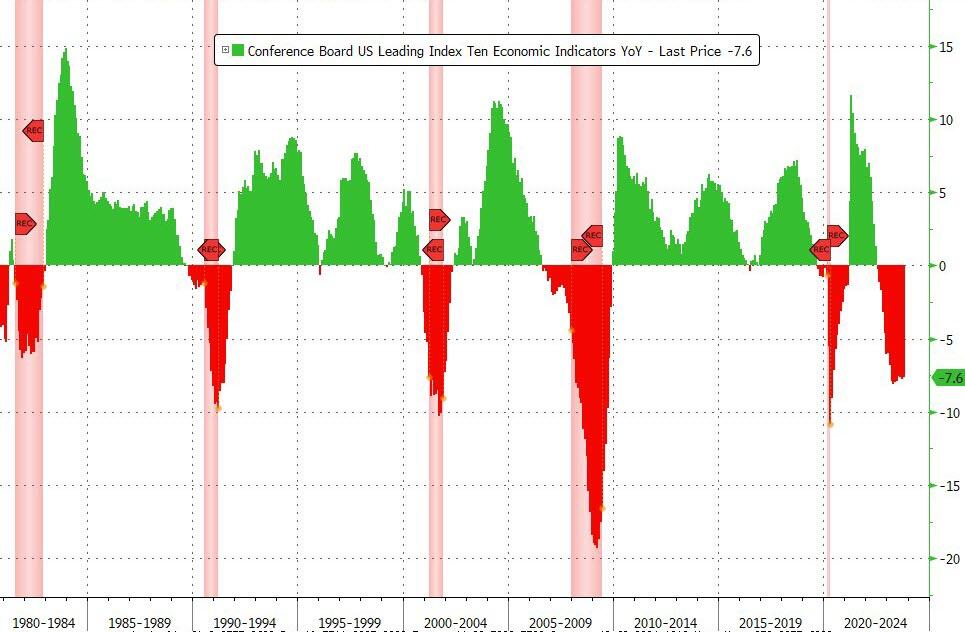
Bidenomics is the economy’s Highway to Hell! Massive, staggering misallocation of scare resources to fund endless wars, green energy fraud, and massive wealth transfers to immigrants while disabled veterans suffer. Now we see that the US leading economic indicators is down -7.6%, definitely smelling like a recession.
On a year-over-year (YoY) basis, the Leading Economic Indicators is down 7.6% (down YoY for 16 straight months) – close to its biggest YoY drop since 2008 (Lehman) outside of the COVID lockdown-enforced collapse.
On a monthly basis (MoM), leading economics indicators are down -0.8%. It has been going down for 16 straight months. Here are the components.
Most of the components are in red and need to be back in black for economic growth.
Treasury Secretary Janet Yellen, a mega pro-China elitist, acknowledges that Bidenomics isn’t popular but she attributes that to people not understanding how good Bidenomics is! It is good for the 1% elitist, donor class. But not for the US middle class.
At least Argentina elected AC/DC guitarist Angus Young as President!
Rubino says, “If the U.S. government is running crisis level deficits, which it is right now, borrowing money and paying interest on it means we are in a financial death spiral…”
“The debt goes up, the interest on the debt goes up and that raises the debt even further, and you just spiral out of control.
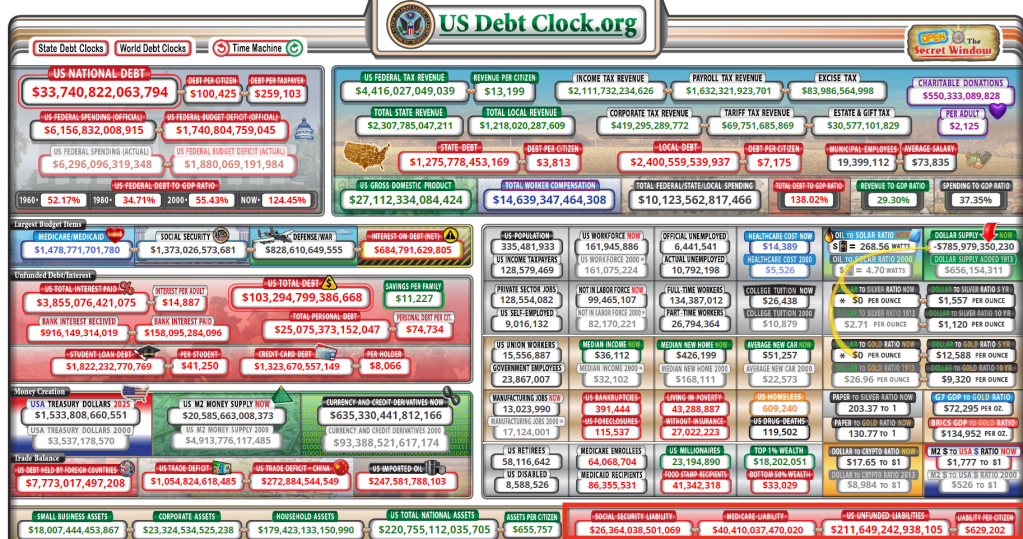
We are there right now. The official U.S. debt is $33.5 trillion. It’s growing by $1.7 trillion a year, and $1 trillion of that is interest costs.
Interest costs are rising as the overall debt goes up. Then throw in this incredibly reckless military spending in the guise of foreign aid, and you get a society that has completely lost control.
That’s where we are now.
We are in the blowoff stage of a 70-year credit super-cycle.
Those things do not end with a whimper, and they certainly do not end with a soft landing. They end with a bang, and the bang is going to be centered on the currency.
People are going to look at this and say, ‘Do I really want to hold the currency or bonds of a country that is destroying its finances at this trajectory and this scale?’ The answer will be ‘No.’
At that point, it is game over for a deeply indebted economy. We are headed that way fast, and these wars are taking us that way even faster.”
If the Fed keeps raising interest rates, the economy tanks, but you protect the dollar. If you cut interest rates, you spike inflation even more, and the U.S. dollar tanks.
Rubino says in the end, we get a “massive reset,” and the everything bubble explodes.
Rubino says the dollar is going to decline and, at some point, it starts to go into freefall in terms of buying power. Rubino explains,
“If a currency starts to decline in a disorderly way, then you have a massive financial crisis on your hands.
That is definitely where Japan is right now. The U.S. is headed that way fast.
So, once we reach that point, there is no fix.
Then it is only a matter of time that everybody realizes that there is no fix, and they just bail on the whole experiment, and that’s where we are headed.”
Rubino talks about plunging home prices, more trouble coming in the commercial real estate market and why you need gold and silver as core assets during a currency reset.
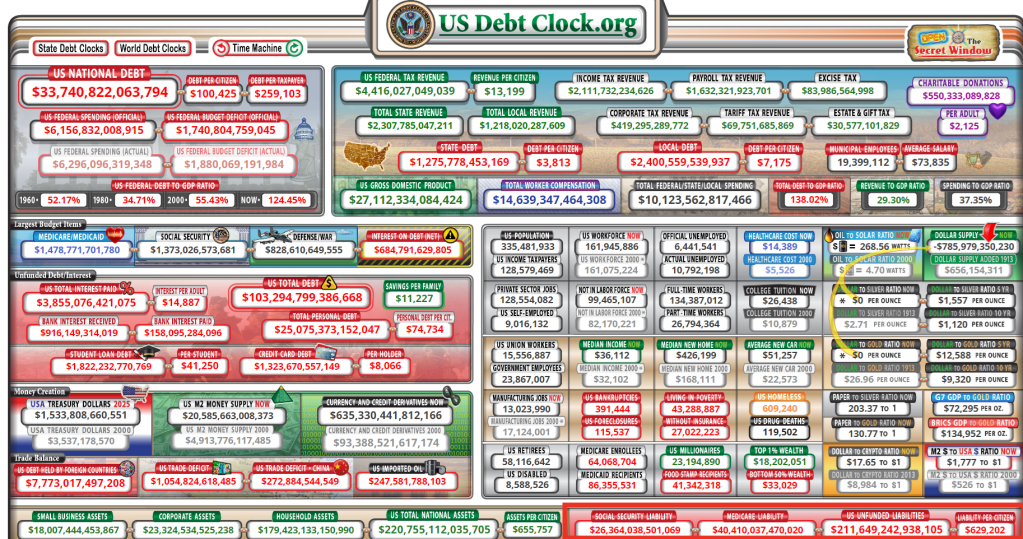
Riots, already happening in American cities (not to mention looting in New York City, Chicago, San Francisco and Los Angeles), will accelerate if Congress attempts to curtail entitlements (now at $211.65 TRILLION).
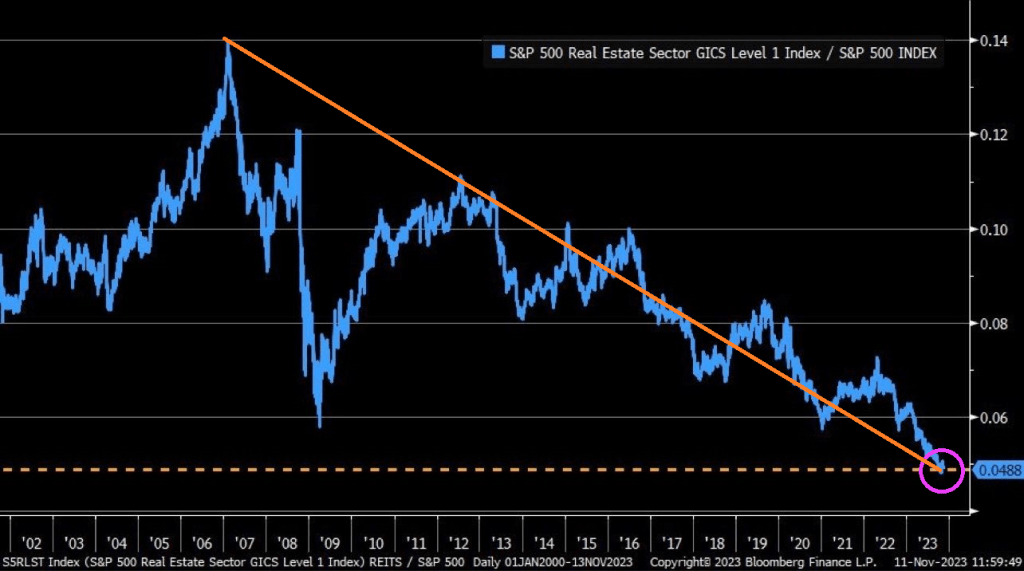
The S&P 500 real estate sector is now just 5% of the entire S&P 500.
Even at the 2008 low, in the worst real estate crisis of all time, this percentage barely dropped below 6%. Meanwhile, demand for commercial real estate (CRE) loans is now at 2008 levels.
Office building prices are down ~30% over the last year and apartments are down ~15%.
Also, Delinquent commercial real estate loans at US banks have hit their highest level in a decade.
The strength of the housing market is masking the weakness of CRE.
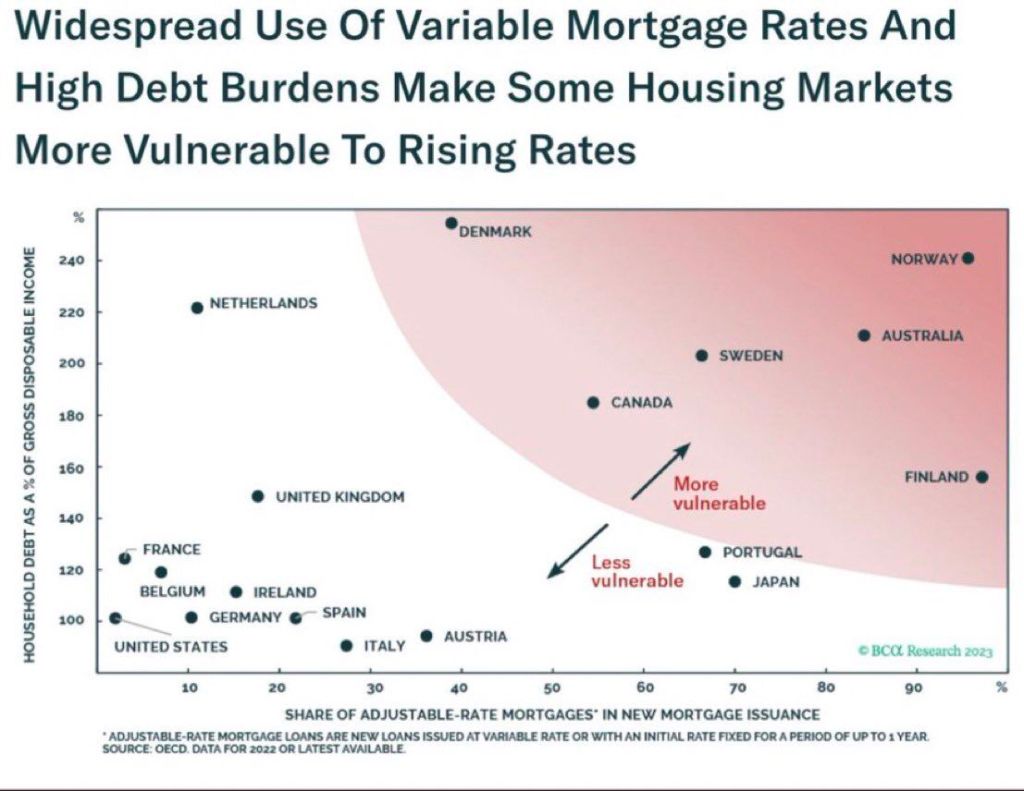
Speaking of the housing market, the US is overly dependent on the lopsided 30-year fixed-rate mortgage. Where under inflation and rising rate, the lender (investor) loses. If inflation cools and rates fall, the borrower refinances.
But these consumer benefits to the 30-year mortgage have costs. It is costly to provide a fixed nominal interest rate for as long as 30 years. And the prepayment option creates significant costs. If rates rise, the lender has a below market rate asset on its books. If rates fall, the lender again loses as the mortgage is replaced by another with a lower interest rate. To compensate for this risk, lenders incorporate a premium in mortgage rates that all borrowers pay regardless of whether they benefit from refinance. Exercise of the prepayment option in the contract also has significant transactions costs for the borrower and imposes additional operating costs on the mortgage industry.
Another major reason for the FRM’s dominance is government support and regulatory favoritism. The FRM is subsidized through the securitization activities of Fannie Mae, Freddie Mac and Ginnie Mae.
Their securities benefit from a government guarantee that lowers the relative cost of the instrument, which is their core product. These guarantees have a significant cost as the government backing of Fannie Mae and Freddie Mac has exposed taxpayers to large losses. Are the FRM’s benefits worth its costs? Would the FRM disappear if Fannie and Freddie stopped financing it? Are there mortgage alternatives that balance the needs of consumers and investors without exposing the taxpayer to inordinate risk?
The instrument’s supporters point out that it is easier for investors than consumers to manage interest-rate risk. It is true that lenders and investors have more tools at their disposal to manage interest-rate risk. But managing prepayment risk is costly and difficult and many institutions have suffered significant losses as a result (e.g., savings and loans in the 1980s; hedge funds and mortgage companies in the 1990s and 2000s).
Furthermore, borrowers rarely stay in the same home or keep the same mortgage for 15 to 30 years, so one can reasonably ask why rates should be fixed for such long periods (increasing the loan’s cost and risk). Also, the taxpayer ultimately bears a significant portion of the risk through support of Fannie Mae and Freddie Mac.
One of the lingering questions about government loan modification programs is why borrowers are refinanced into longer-term FRMs rather than less expensive ARMs, such as a 5/1 ARM.
ARMs allow protection for lenders (investors) from inflation and interest rate increases. Consider this another entitlement that elected officials give away and refuse to cut. After all, unfunded entitlements are already at $211.65 TRILLION.
But typically we get scare tactics about ARMs (or VRMs), like this one.
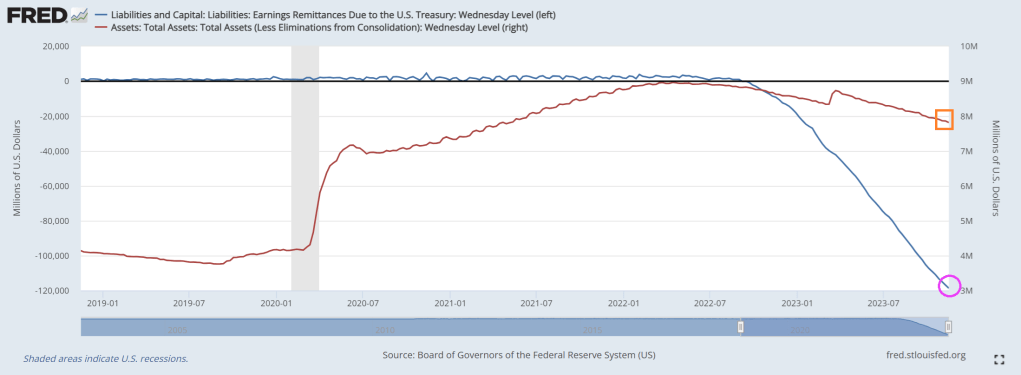
Biden’s terrible economic policies and horrid fiscal managment has put stress on The Federal Reserve. The Federal Reserve paid an estimated $76 billion to the Treasury in 2022 while banks’ willingness to lend has plummeted.
One of the key ways central banks absorb liquidity back out of the market is through reverse repo. These are short-term transactions where the Fed sells securities to banks and agrees to buy back at a higher price the next day.
This means banks are being paid to park cash with the Fed instead of injecting it into the economy through loans and fanning the fires of inflation.
That alone is costing the Fed $200M every single day.
In addition, the Fed is spending another $500M in daily interest payments on its reserve policy, i.e. balances that banks are holding in their reserve accounts at the Fed.
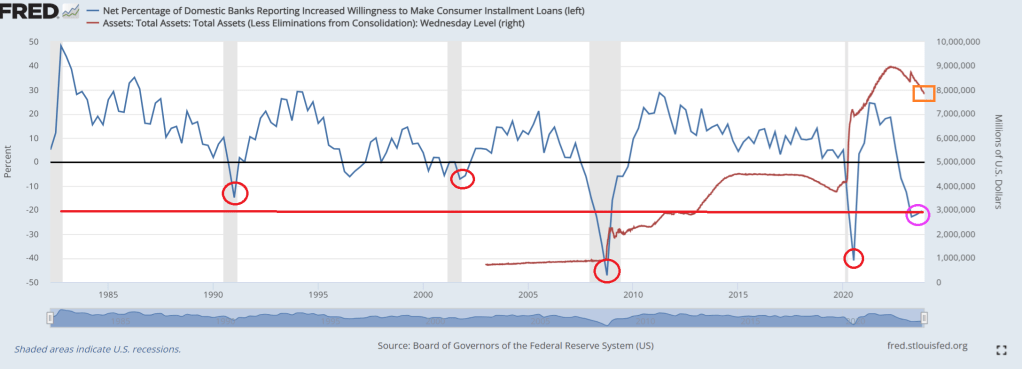
Banks’ willingness to lend has plummeted making credit availability increasingly tighter. Current levels have typically ended in recessions.This time is NOT different.
And on the energy side of the market, Biden Invokes ‘Wartime Powers’ to Attack Gas-Powered Furnaces. Of all the stupid things Biden has done, invoking wartime powers to make households use inefficent electric heat pumps instead of gas furnaces in stupid of two levels. First, invoking wartime powers for things unrelated to national defense is reckless and capricious. Second, electric heat pumps in the colder areas of the country is stupid as well. Electric heat pumps are inefficient, unless the goal of Biden and his Idiocracy is to “cull the herd” or kill off people during winter months (I had an electric heat pump in a condo I owned and it was terrible in winter months).
Yes, the Biden Administration and The Fed are economic mutilators!
President Biden reminds me of Cousin Eddie, the dimwitted cousin of Clark Griswold’s wife in the Vacation movies. Except that Cousin Eddie is a nice dimwit while Biden is a nasty dimwit. And politcal stooge.
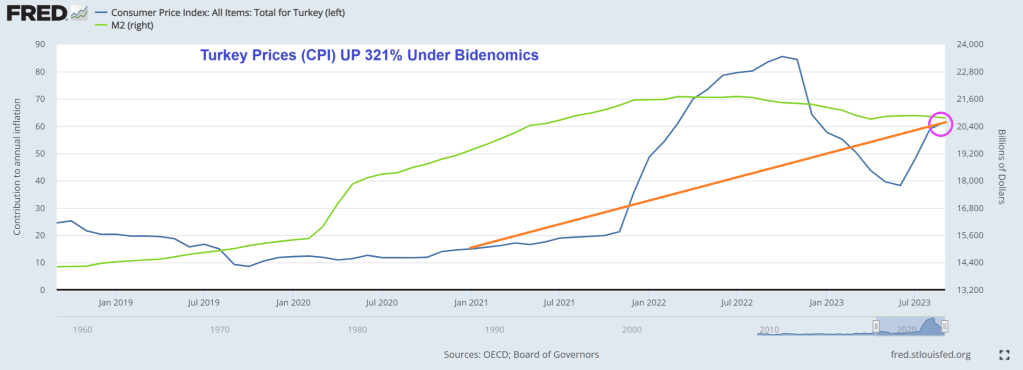
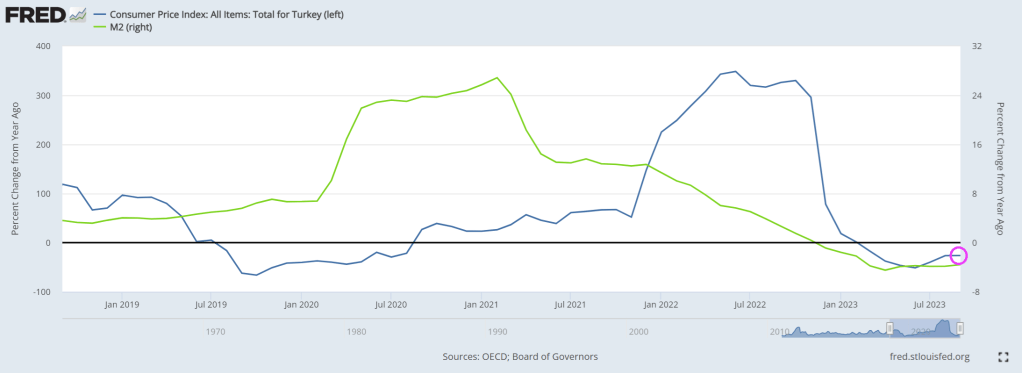
Given that turkey prices are up 321% under Biden, the famous Thanksgiving line “Save the neck for me, Clark” is most appropriate since we will be forced to eat every part of the turkey.
Of course, year-over-year growh in turkey prices (CPI) are now negative along with M2 Money growth. Note the surge in M2 Money growth (green line) followed by the surge in turkey prices (blue line). Now both are declining.
A Bidenomics turkey!
Here is Biden giving a Thanksgiving turkey a pardon, hoping he gets a pardon for his massive corruption. But which one is the turkey??











 Confounded Interest - Anthony B. Sanders


You must be logged in to post a comment.