Addicted To Gov? US Added $600 Billion In Debt In One Month And $10.47 TRILLION Since Covid Outbreak, Credit Card APR Now 28.93% As Credit Card Debt Exceeds $1 TRILLION, Family Healthcare Costs Surge 7% To $24,000, Q3 Real GDP Rises 4.9%

Bidenomics new theme song is “Addicted To Gov.” Bidenomics needs lots of Federal spending and borrowing to survive. But all this spending and borrowing is causing rapid price increases and other distortions.

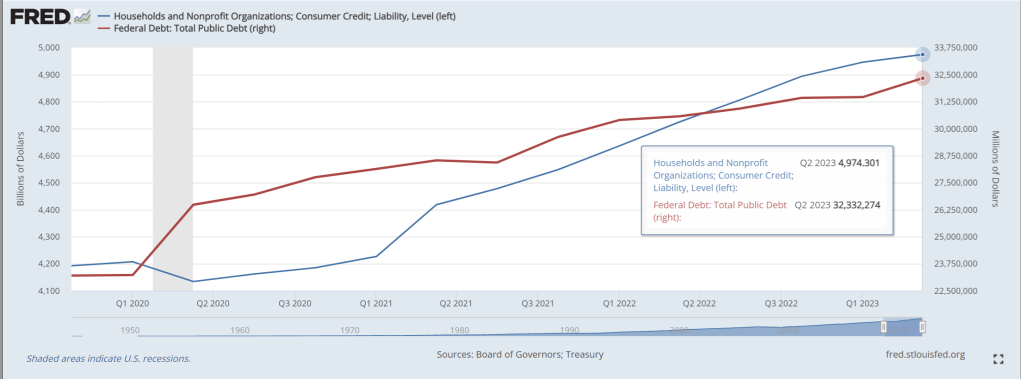
The US Federal government just added $600 billion in debt in ONE MONTH. And The Fed’s have borrowed $10.47 TRILLION since Covid in Q1 2020.

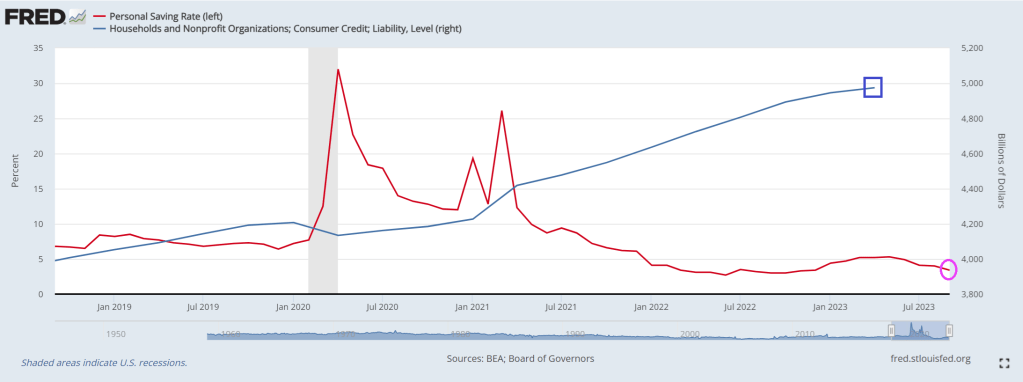
Meanwhile, retail credit card APR average just hit 28.93%! While credit card debt outstandnig just exceeded $1 trillion.

On the healthcare front, a family’s health insurance costs nearly $24,000 this year after the biggest increase in more than a decade.

.On the GDP front, Real gross domestic product (GDP) increased at an annual rate of 4.9 percent in the third quarter of 2023, according to the “advance” estimate released by the Bureau of Economic Analysis. In the second quarter, real GDP increased 2.1 percent.

Here is the breakdown.

But inflation is reaacelerating, harming the middle class.

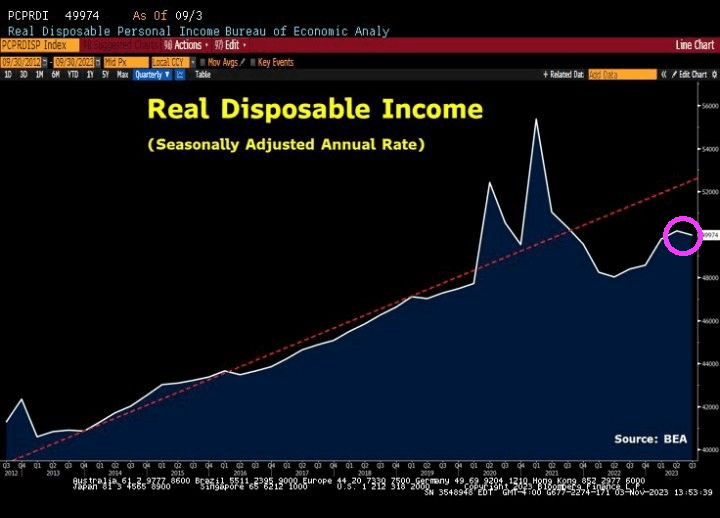
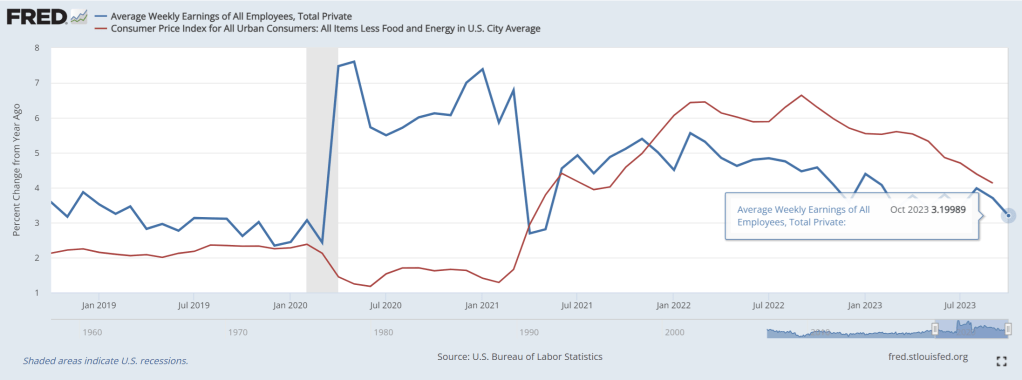
Real weekly earnings growth is falling again, down to 0.8% YoY.

And the US Dollar purchasing power keeps on falling. All together now!

Gavin Gruesom has a great smile like Joe Biden. Perhaps that is all you need to be a Democrat. President. Like Obama.

Mortgage Purchase Demand (Applications) Fell 2% Since Last Week And 22% Since Last Year As Mortgage Rates Hit Highest Level Since 2000 (Almost 8%)

The US is teetering on World War III with tensions soaring in the Middle East, Ukraine, and southeast Asia. And Biden wanders off to Rehobeth Beach Delaware to relax … while over 200 Americans are still held hostage by terrorist group Hamas. The bad news? Biden is back in Washington DC trying to make the border crisis even worse by demanding funding for “border security” in the form of transporting illegal immigrants to US cities. Is The Squad running The White House??

But on the housing/mortgage front, we have another week of declining mortgage demand/applications as mortgage rate hit almost 8%.

Mortgage applications decreased 1.0 percent from one week earlier, according to data from the Mortgage Bankers Association’s (MBA) Weekly Mortgage Applications Survey for the week ending October 20, 2023.

The Market Composite Index, a measure of mortgage loan application volume, decreased 1.0 percent on a seasonally adjusted basis from one week earlier. On an unadjusted basis, the Index decreased 1 percent compared with the previous week. The Refinance Index increased 2 percent from the previous week and was 8 percent lower than the same week one year ago. The seasonally adjusted Purchase Index decreased 2 percent from one week earlier. The unadjusted Purchase Index decreased 2 percent compared with the previous week and was 22 percent lower than the same week one year ago.

Mortgage rates followed Treasuries higher, with the 30-year fixed mortgage rate jumping 20 basis points to 7.9 percent – the highest since 2000. Rates have now risen seven consecutive weeks at a cumulative amount of 69 basis points.

Hey Joe, I’ll bet those 200+ US hostages held by Hamas aren’t enjoying ice cream cones.

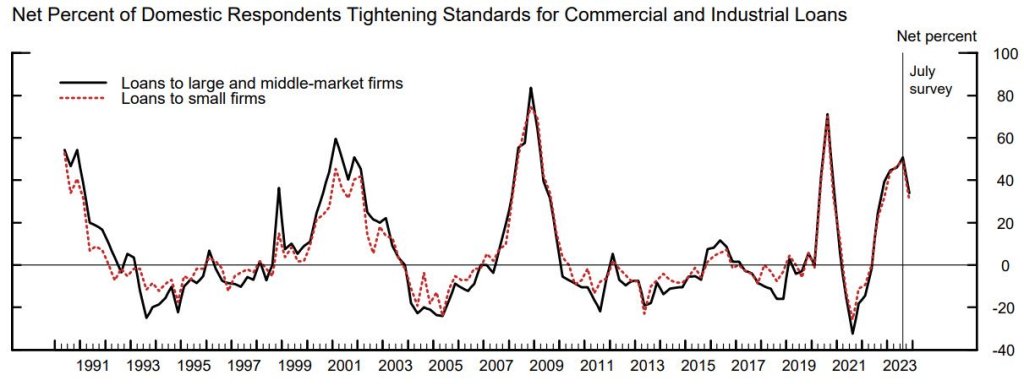
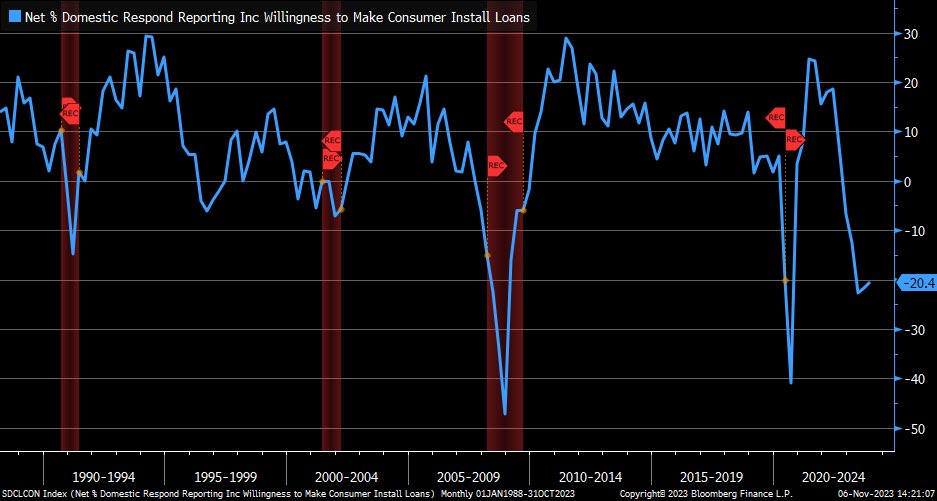
Back In Red! C&I Loan Lending Standards Tightening To Recession Era Levels (Bank Credit Growth Remains Negative For Twelve Straight Week)

Back in red? As US fiscal policy deteriorates further thanks to endless Federal spending (not to mention seemingly endless wars under Biden and Nobel Peace Prize winner Obama), we are seeing pain in the bank lending business.

Commercial and industrial (C&I) loan lending standards is tightening (blue line) to levels typically seen in recessions. Even though Barclays HY-10Y spreads remains low.

Bank credit growth remains negative for the twelve straight week.

Billions Biden’s spending spree has led to the budget gap has doubled in the last year.

CDS is now at 55.24, highest after the Covid shock.

Under Biden/Yellen’s economic model, the appropriate themesong is “Hell’s Bells.”

Can The Fed Fix Biden/Congress Spending Addiction? Volcker, Greenspan, Yellen, Powell All Pushed Rates Lower … Until Biden (Fed Still Ignoring Taylor Rule) Mortgage Rates Continue To Climb

I had a wonderful time speaking at the Passive Investors Conference last night. One question I was asked was “Why doesn’t Powell (the current Fed Chair) pull “a Volcker” to cool inflation. She was referring to former Fed Chair Paul Volcker’s sudden raising of The Fed’s target rate which resulted in a cooling of inflation, but also an increase in the 30-year fixed mortgage rate to 16.63% in 1981.

Notice the trend in the Fed’s target rate and 30-year mortgage rate after Volcker’s rate shock. The trend in both has been downward as inflation was cooled.

But, each Fed Chair ranged from hyperactive to hypoactive (meaning doing little). Volcker and Greenspan saw wild swings in The Fed’s target rate. Bernanke pretty much only lowered rates AND expanded the Quantitative Easing (QE) or asset purchases by The Fed. And nothing has been the same since.

Yellen, now Treasury Secretary, continued Bernanke’s practice of zero interest rate policies (ZIRP) and QE (asset purchases) … until Donald Trump was elected President. In fact, Yellen raise rates only once prior to Trump’s election as President. Then raises rates 8 consecutive times. This is why I call Yellen “TLTL Janet”. Too low for too long Janet.

The she was replaced with DC insider Jerome Powell. Trump’s economy was strong (one explanation for Yellen trying to cool the economy with 8 consecutive rate hikes). But the Covid struck and Powell/Fed Open Market Committee overreacted, lowered the target rate back to 25 basis points and massively expanded the balance sheet. Powell also oversaw a rapid increase in the target rate, very Volckerish! But Powell stopped short of the rate suggested by The Taylor Rule of around 6.5% to 8.17%. The current target rate is 5.50%. So, Powell stopped far short of rates need to cool inflation.

But with Bidenomis came Bidenflation and a reversal of misfortunes for The Fed. They started rapidly raising rates … again.

Mortgage rates continue to climb as The Fed stubbornly won’t reduce its balance sheet.

Biden/Congress have a broken fiscal model where spending is out of control. And The Fed can’t buy all the debt Biden/Yellen want to issue.

US deficits are the third highest on record.

We might as well have Taylor Swift as Fed Chair. And Travis Kelce as Treasury Secretary replacing TLTL Janet.

Going Down! Realtors Weekly Active Inventory Down 2.7% YoY, New Listings Down 4.4% YoY As Fed Threatens More Rate Hikes (Fed Balance Sheet Remains At Near $8 TRILLION)

Going down! The US housing market, that is!

Federal Reserve Jerome Powell said at the luncheon in New York City that “Inflation is still too high”, meaning that rate cuts are on hold and maybe a rate hike or two may come.

According to the National Association of Realtors,

• Active inventory declined, with for-sale homes lagging behind year ago levels by 2.7%. For 17 straight weeks, the number of homes available for sale has registered below that of the previous year.

• New listings–a measure of sellers putting homes up for sale–were down again this week, by 4.4% from one year ago. Since mid-2022, new listings have registered lower than prior year levels, as the mortgage-rate lock-in effect freezes homeowners with low-rate existing mortgages in place. Although the year over year declines are smaller now than the double-digit pace seen earlier in 2023, declines from the pre-pandemic period are still substantial.

Inventory remains far below levels seen before the financial crisis. But Case-Shiller National Home Price Index (blue) remains elevated along with The Fed’s balance sheet (red) which is barely below $8 TRILLION. And Powell didn’t say much about speeding up the trimming of The Fed ballast.

Bidenomics Strikes Again! US Existing Home Sales Tumble To Weakest In 13 Years (First-Time Buyers Historical Lows)

Bidenomics strikes … again. No, not his inane ramblings about Hamas being “the other team” or that Hamas has to learn to shoot straight. But his policies freezing effects on the economy. Like housing.

Existing-home sales faded in September, according to the National Association of REALTORS®. Among the four major U.S. regions, sales rose in the Northeast but receded in the Midwest, South and West. All four regions registered year-over-year sales declines.

Total existing-home sales – completed transactions that include single-family homes, townhomes, condominiums and co-ops – waned 2.0% from August to a seasonally adjusted annual rate of 3.96 million in September. Year-over-year, sales dropped 15.4% (down from 4.68 million in September 2022).

Total housing inventory registered at the end of September was 1.13 million units, up 2.7% from August but down 8.1% from one year ago (1.23 million). Unsold inventory sits at a 3.4-month supply at the current sales pace, up from 3.3 months in August and 3.2 months in September 2022.

The total existing home sales SAAR dropped back below 4mm for the first time since October 2010 (during the foreclosure crisis)

Source: Bloomberg

Sales fell in all regions except the Northeast in September… and in every price range…

Single-family home sales fell to an annualized 3.53 million pace, the lowest since 2010. Condominium and co-op sales also declined.

“As has been the case throughout this year, limited inventory and low housing affordability continue to hamper home sales,” said Lawrence Yun, NAR’s chief economist.

“The Federal Reserve simply cannot keep raising interest rates in light of softening inflation and weakening job gains.”

First-time buyers made up a historically low 27% of purchases, down from the prior month.

Cash sales represented 29% of total sales, matching the highest level in over a decade. Investors, who often purchase with cash and are therefore less sensitive to mortgage rates, made up 18% of the market.

“It would be very unusual to have higher cash compared to first time buyers,” Yun said on a call with reporters.

And, if mortgage rates (and thus affordability) are anything to go by, things are about to get real…

Source: Bloomberg

The median selling price rose 2.8% from a year earlier to $394,300, the highest September reading on record, pushing affordability even lower. But existing home prices are falling relative to new home prices (with the ratio near record lows)…

Finally, amid all this un-affordability for shelter, some Americans are turning elsewhere…and with mortgage rates back above 8%, it can only get worse.

It looks like The House may elect a RINO as Speaker (Patrick McHenry, RINO-NC) to replace McCarthy. One RINO replacing another RINO … all so The House can continue its insane, inflation inducing spending.

zombieapoc.png

Bidenomics At Work! US Government Is Virtually The Only Borrower Left Standing, Bank Credit Declines (No Wonder Yields Are Rising!)

Its the Biden Bop! As Bidenomics continues its blitzkrieg on the US economy with the Federal government massively expanding its debt while households and business cut back on debt.

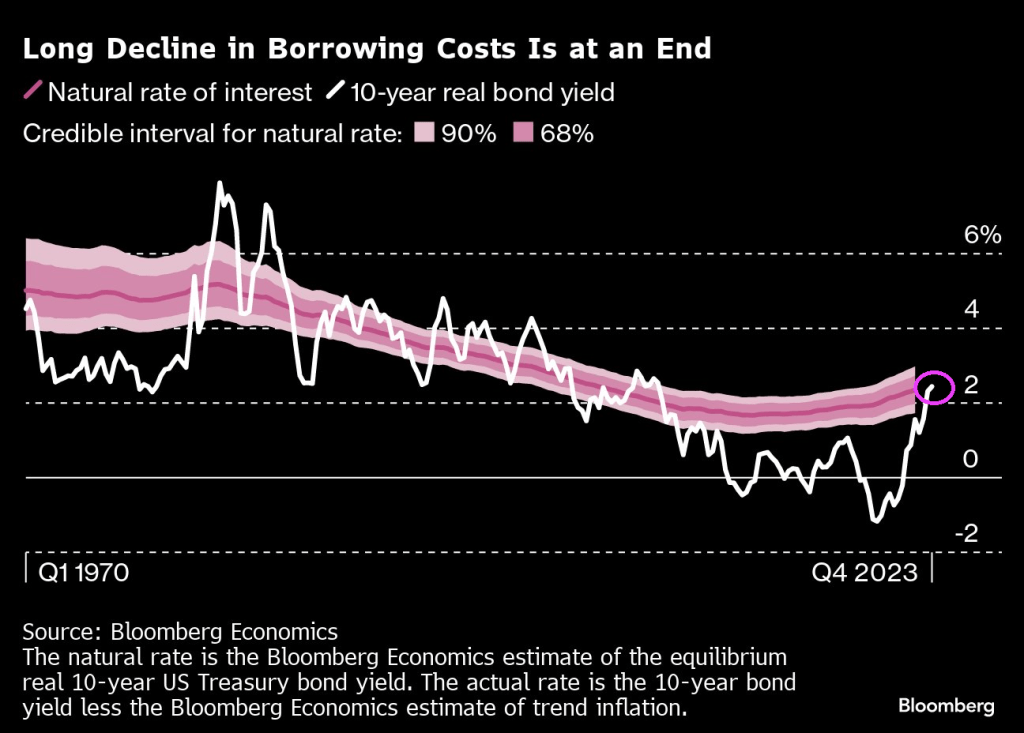
The US government is the only sector to have notably borrowed on a net basis over the last five years. The market sees that as inflationary, driving yields higher.

The pandemic saw an increase in the borrowing of all sectors. But it was the government that saw the biggest rise in GDP terms, and it is the government whose debt is still considerably higher than it was before the pandemic – the debt-to-GDP ratio is up 16 percentage points over the last five years.

In contrast, the household sector’s leverage is now lower than it was pre-pandemic, while the corporate sector’s is only marginally higher. The US government has become the borrower of first as well as last resort.

The market is picking up on this and is pricing accordingly. We can decompose nominal yields into a sum of expected short rate + real term premium + expected inflation + inflation term premium (see here for more).

Over the last three months, the main driver of rising yields in the US has been expected inflation, followed by the real risk premium. This marks a change from earlier in the year where the principal driver was the expected short rate, i.e. expectations of increases in the Federal Reserve’s policy rate.

Regressing the fiscal balance with the yield components shows that only inflation and the inflation risk premium have a negative sign, i.e. when the fiscal balance falls (greater deficit), expected inflation and the risks surrounding it increase.

Not only does increased government borrowing push up borrowing costs through greater inflation risks. When the sovereign is the only borrower, it crowds out the rest of the economy. With governments’ reputation for inefficiency, this depresses real growth.

The lost decades in Japan were primarily a result of the government stepping in to borrow as the private sector nursed its wounds from the late 1980s financial crash. But that perpetuated and entrenched the situation. With the Treasury now the sole borrower of any significance, the US risks going down a similar, yet more stagflationary path, hindering real growth, and keeping yields elevated.

On the private sector side, bank credit fell again last week.

Mountain Of Debt! Despite Biden’s Gloating, Deficits Are Rising And Expected To Keep Rising (Debt Mountain = $33+ Trillion And Growing) As Bank Balance Sheets Get Slammed!

The US is sitting on a mountain of debt! As in over $33 trillion!

Despite what whispering Joe Biden says, he didn’t reduce the budget deficit other than briefly. The budget deficit is forecast to run persistemly high because of endless, reckless spending and forever wars (Ukraine, Israel and … Taiwan?).

(Bloomberg) — The Federal Reserve faces potential policy pitfalls ahead as it wrestles with how to respond to investor angst about the US government’s $33.5 trillion mountain of debt.

It’s exceedingly difficult to have sound monetary policy without sound fiscal policy. Biden/Democrats do NOT equal sound fiscal policy.

Adding to the pain, the long end of the yield curve is getting clobbered.

And bank balance sheets are getting clobbered too.

The King of Endless War! Billlions Biden! Who Janet Yellen said is “vibrant.” This is vibrant??

Trust Biden to muddy the waters about US debt, deficits and foreign wars. Hell, Biden could only say that the infamous missile that landed on the Gaza hospital was launched by “the other team” like he was watching an Eagles/Giants football game instead of a slaughter of innocents by Hamas terrorists.

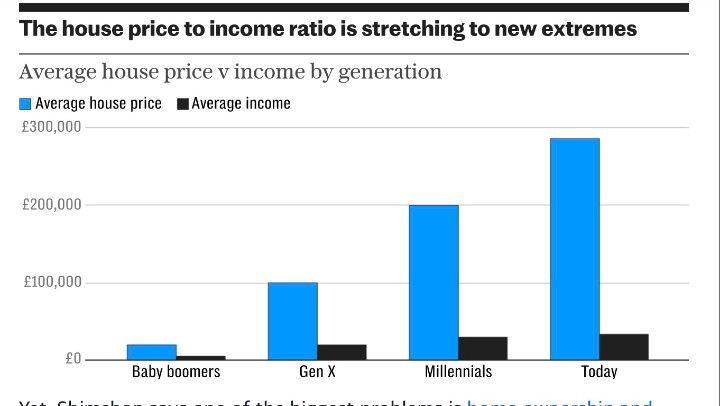
Simply Unaffordable! Homebuyers Must Earn $115,000 to Afford the Typical U.S. Home, UP 30% Under Biden (About $40,000 More Than the Typical American Household Earns) Mortgage Market Is Addicted To Gov!

Housing in the US is simply unaffordable!

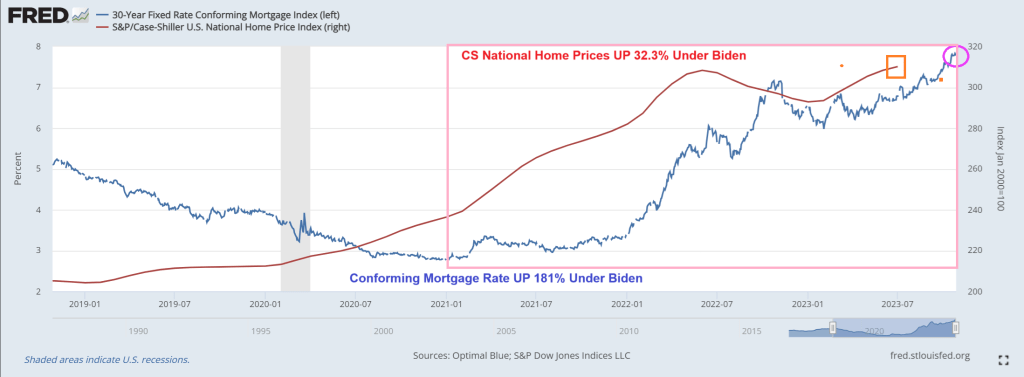
Under Bidenomics, home prices are up 30% while real weekly earnings growth has been negative for most of Biden’s Presidency. And mortgage rates are up 178% under Bidenomics.

Sky-high mortgage rates and still-rising home prices have made it harder than ever to afford a home, especially for first-time buyers. The typical buyer needs to earn 15% more than they did a year ago–and wages are only up 5%.

It’s harder than ever for Americans to afford a home. 

A homebuyer must earn $114,627 to afford the median-priced U.S. home, up 15% ($15,285) from a year ago and up more than 50% since the start of the pandemic. That’s the highest annual income necessary to afford a home on record. 

This is based on a Redfin analysis that compares median monthly mortgage payments for homebuyers in August 2023 and August 2022. The income data in this analysis is adjusted for inflation. See the bottom of this report for more on methodology. 

Housing costs are higher than ever because of the one-two punch of sky-high mortgage rates and rising home prices. The average rate on a 30-year fixed mortgage was 7.07% in August. Mortgage rates have climbed even higher since then, hitting 7.57% during the week ending October 12–their highest level in over two decades. But even though soaring mortgage rates have dampened demand, low inventory is causing home prices to increase. The typical U.S. home sold for about $420,000 in August, up 3% year over year and just about $12,000 shy of the all-time high hit in mid-2022. 

The typical U.S. homebuyer’s monthly mortgage payment is $2,866, an all-time high. That’s up 20% from $2,395 a year earlier, and by that time payments had already increased substantially from the beginning of the pandemic, a time of ultra-low mortgage rates and yet-to-skyrocket home prices. In August 2020, for instance, the typical monthly payment was $1,581, based on that month’s average mortgage rate of 2.94% and median home price of $329,000. At that time, a homebuyer would have needed to earn $75,000 per year to afford the typical home. 

The typical American household earns about $40,000 less than the income needed to buy a median-priced home. The median household income was roughly $75,000 in 2022, the most recent year for which annual income data is available. Hourly wages have risen in 2023, but not nearly as fast as the income necessary to afford a home is rising: The average U.S. hourly wage has increased by about 5% over the last year. 

“In a homebuyer’s ideal world, rising mortgage rates would push demand and home prices down enough to make up for high interest payments. But that’s not what’s happening now: Although new listings are ticking up slightly, inventory is still near record lows as homeowners hang onto their low mortgage rates–and that’s propping up prices,” said Redfin Economics Research Lead Chen Zhao. “Buyers–particularly first-timers–who are committed to getting into a home now should think outside the box. Consider a condo or townhouse, which are less expensive than a single-family home, and/or consider moving to a more affordable part of the country, or a more affordable suburb.”

Affordability is less of a problem for all-cash and move-up buyers. The major increase in income necessary to afford a home hits first-time homebuyers hardest. Buyers who can afford to pay cash aren’t impacted by high mortgage rates, and they likely earn more than the income necessary to purchase a home, anyway. Buyers who are selling a home to buy another one are in a better boat than first-timers because they have likely built up equity in their current home, which takes a bit of the sting out of soaring monthly payments. The caveat to the caveat is those who bought at the height of the pandemic-era market with an ultra-low mortgage rate and need to sell now: Not only are they giving up a low rate, they also may have lost money on their home. 

Metro-level highlights: Income needed to buy a home has risen in all major metros, with biggest uptick in Miami and smallest in Austin

August 2023, analysis includes 100 most populous U.S. metros for which data is available

  • Metros where necessary income has increased most: In both Miami and Newark, NJ, homebuyers must earn 33% more than a year ago to afford the typical home–the biggest percent increase of the major U.S. metros. Homebuyers in Miami need to earn $143,000 annually to afford the area’s typical monthly mortgage payment of $3,580, and Newark buyers need to earn roughly $160,000 to afford that area’s $3,989 payment.
  • Other metros where necessary income has increased by over 30%: The income necessary to afford a median-priced home has increased by over 30% in four other metros, all in the eastern half of the country: Bridgeport, CT ($183,000); Dayton, OH ($60,000); Rochester, NY ($66,000); and Hartford, CT ($95,000). 
  • Buyers need to earn more in every major metro: Skyrocketing mortgage rates have caused the income necessary to buy a home to increase in every major metro, even the places where prices have declined over the last year. 
  • Necessary income has increased least in pandemic homebuying hotspots: Austin, TX homebuyers must earn $126,000 to afford the median-priced home, 8% more than a year ago–the smallest increase of all the major U.S. metros. That’s despite Austin home prices falling 7% year over year in August after they skyrocketed during the pandemic, with remote workers flocking in. Boise, ID, another pandemic homebuying hotspot where demand has since dropped, experienced the next-smallest increase: up 9% to $127,000. Salt Lake City, Fort Worth, TX and Lakeland, FL come next, with year-over-year increases of about 13% each. Home prices are down from a year ago in all those metros.
  • Homebuyers must earn six figures to buy a home in half the major metros in the country:  In 50 of the 100 metros in this analysis, buyers must earn at least $100,000 to afford the median-priced home in their area. Buyers must earn at least $50,000 everywhere in the country. 
  • Bay Area buyers must earn $400,000: Buyers in the most expensive markets in the country–San Francisco and San Jose, CA–must earn more than $400,000 to afford the median-priced home in their area, both up nearly 25% year over year. The next five metros are all in California: Anaheim ($300,000), Oakland ($250,000), San Diego ($241,000), Los Angeles ($237,000) and Oxnard ($233,000). 
  • Rust Belt buyers need the  least income–but it’s still up from a year ago: Detroit homebuyers must earn about $52,000 to afford the area’s median-priced home, up 19% from a year ago. That’s the lowest income required to afford a home in the U.S. Next come three Ohio metros (Akron, Dayton and Cleveland) and Little Rock, AR, all of which require roughly $60,000 in annual income to buy a home. 

Face it, the US economy and housing/mortgage markets are addicted to gov!

Doctor, doctor (Yellen), we have a bad case of unaffordable housing!!

I like Yellen’s Space Invaders suit, so ’80s!

Bidenomics At Work! Mortgage Applications (Demand) Fall To 28-Years Lows As Mortgage Rates Highest Since November 2000 (Treasury 10Y Yield Climbs To 4.87%)

To paraphrase Paul Revere And The Raiders, “Mortgages keep getting harder to find.”

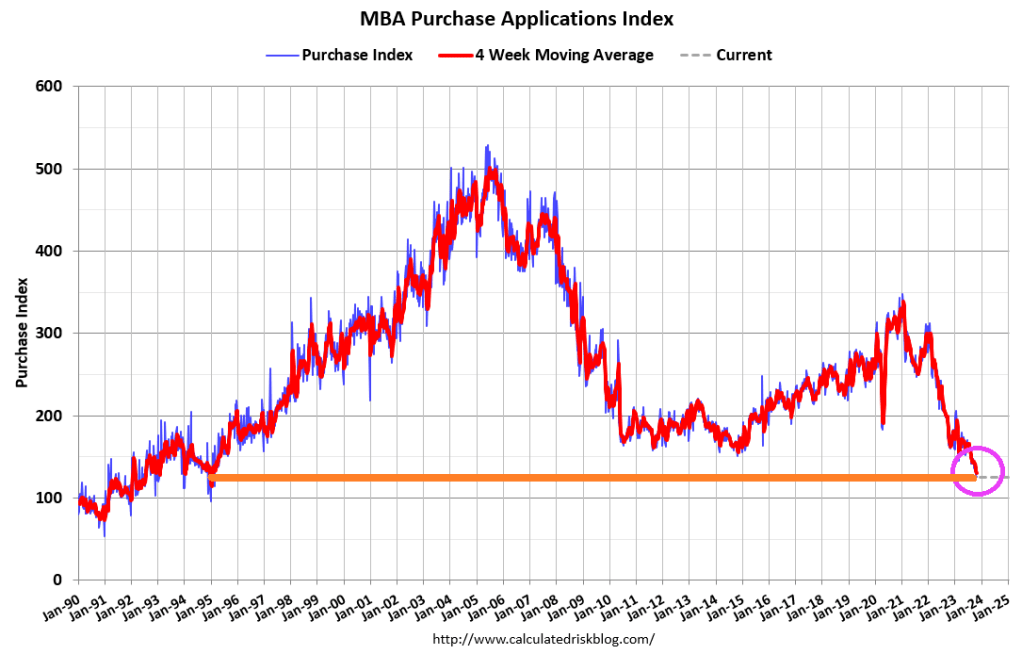
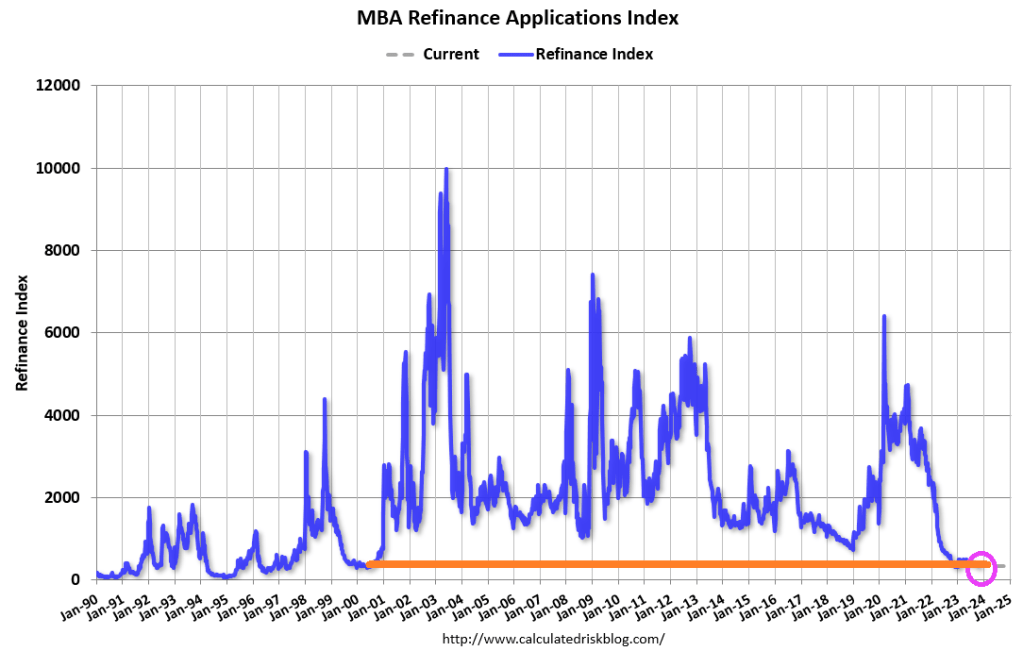
Mortgage applications decreased 6.9 percent from one week earlier, according to data from the Mortgage Bankers Association’s (MBA) Weekly Mortgage Applications Survey for the week ending October 13, 2023. Applications decreased to their lowest level since 1995, as the 30-year fixed mortgage rate increased for the sixth consecutive week to 7.70 percent – the highest level since November 2000.

The Market Composite Index, a measure of mortgage loan application volume, decreased 6.9 percent on a seasonally adjusted basis from one week earlier. On an unadjusted basis, the Index decreased 7 percent compared with the previous week. The Refinance Index decreased 10 percent from the previous week and was 12 percent lower than the same week one year ago. The seasonally adjusted Purchase Index decreased 6 percent from one week earlier. The unadjusted Purchase Index decreased 5 percent compared with the previous week and was 21 percent lower than the same week one year ago.

And the 10-year Treasury yield keeps rising.

Inflation or cheap mortgages? What’s it going to be??

The iShares 20+ year Treasury Bond ETF (TLT) now down 51% from all-time high.

On the commercial real estate side, we see that the CRE cap rate is now lower than the 10Y Treasury yield.