The Market Composite Index, a measure of mortgage loan application volume, decreased 6.0 percent on a seasonally adjusted basis from one week earlier. On an unadjusted basis, the Index decreased 6 percent compared with the previous week. The Refinance Index decreased 7 percent from the previous week and was 11 percent lower than the same week one year ago. The seasonally adjusted Purchase Index decreased 6 percent from one week earlier. The unadjusted Purchase Index decreased 6 percent compared with the previous week and was 22 percent lower than the same week one year ago.
The purchase market slowed to the lowest level of activity since 1995, as the rapid rise in rates pushed an increasing number of potential homebuyers out of the market. ARM loan applications picked up over the week and the ARM share increased to 8 percent, as some borrowers searched for ways to lower their payments.
The US 30-Year Mortgage Rate Tops 7.5% for First Time Since 2000.
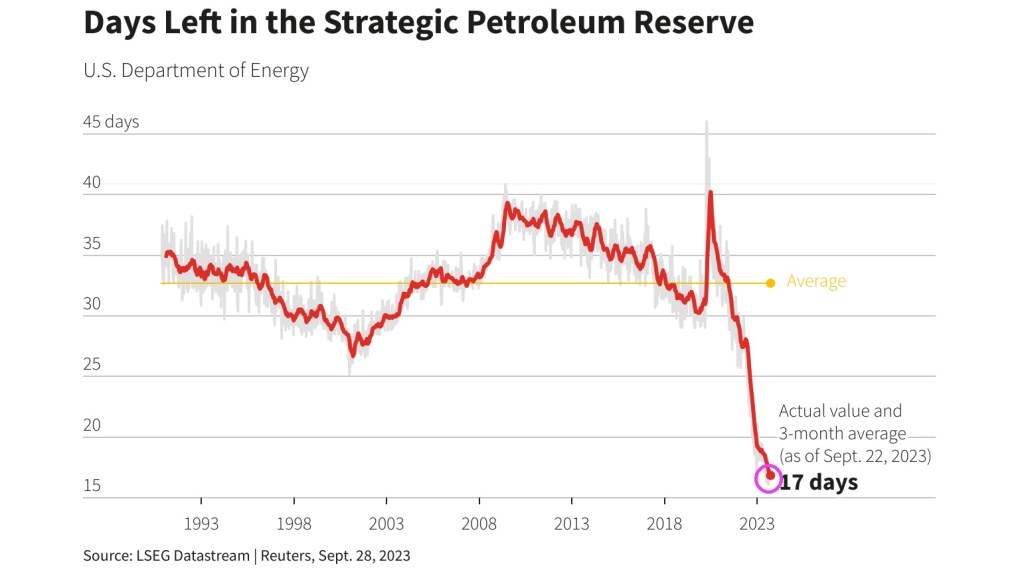
On the energy front, where we are represented by former Michigan governnor Jennifer Granholm and former South Bend Indiana mayor Pete Buttigieg, we see that the Strategic Petroleum Reserve is down to only 17 days left.
Joe Biden is an incredibly weak President. I am not talking about his age or his deteriorating mental faculties. I am talking about ordering his attorney general to indict his chief political opponent, Donald Trump. How does the world interpret this weakness? BADLY.
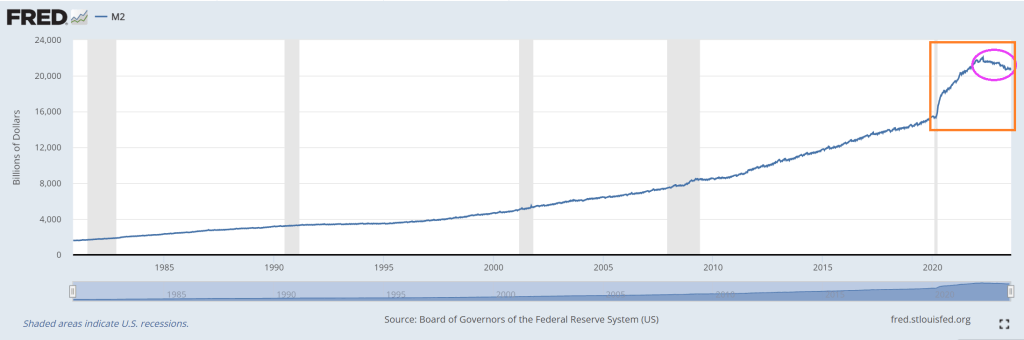
The US has gone off the rails in terms of printing money, particularly since COVID struck and money printing went wild.
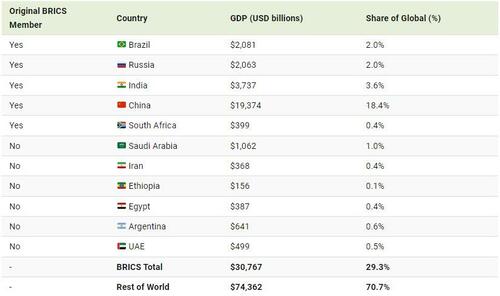
Under Biden’s Reign of Error and the US reckless money printing, more countries are abandoning King Dollar (based of fiat currency) and joining BRICS. Brazil, Russia, India, China, South Africa and a host of countries joining like Argentina, Saudi Arabia, Iran, Egypt, UAE, etc.
Now, the rest of the world is still stuck on the US Dollar as reserve currency … for now. But as Biden gets weaker and weaker, watch more countries join BRICs.
According to Reuters, there are over 40 countries that have expressed interest in joining BRICS. A smaller group of 16 countries have actually applied for membership, though, and this list includes Algeria, Cuba, Indonesia, Palestine, and Vietnam. Pretty soon, under Biden’s crazy leadership, we may be the last man standing in using the US Dollar as reserve currency.
Then we have the other shoe dropping with Bidenomics.
As soon as Biden took office, he set out to destroy industries that produce reasonably priced energy. He focused tremendous effort on deficit spending and borrowing to hand out “government goodies” to buy votes; recipients of this government largesse, in large part, included debt-saddled students, the green mafia, and leftist activists.
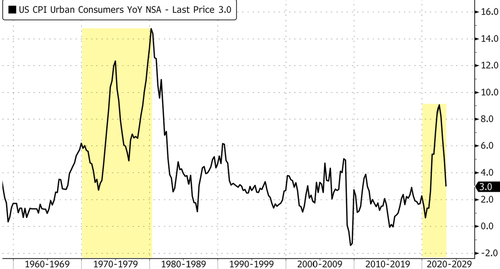
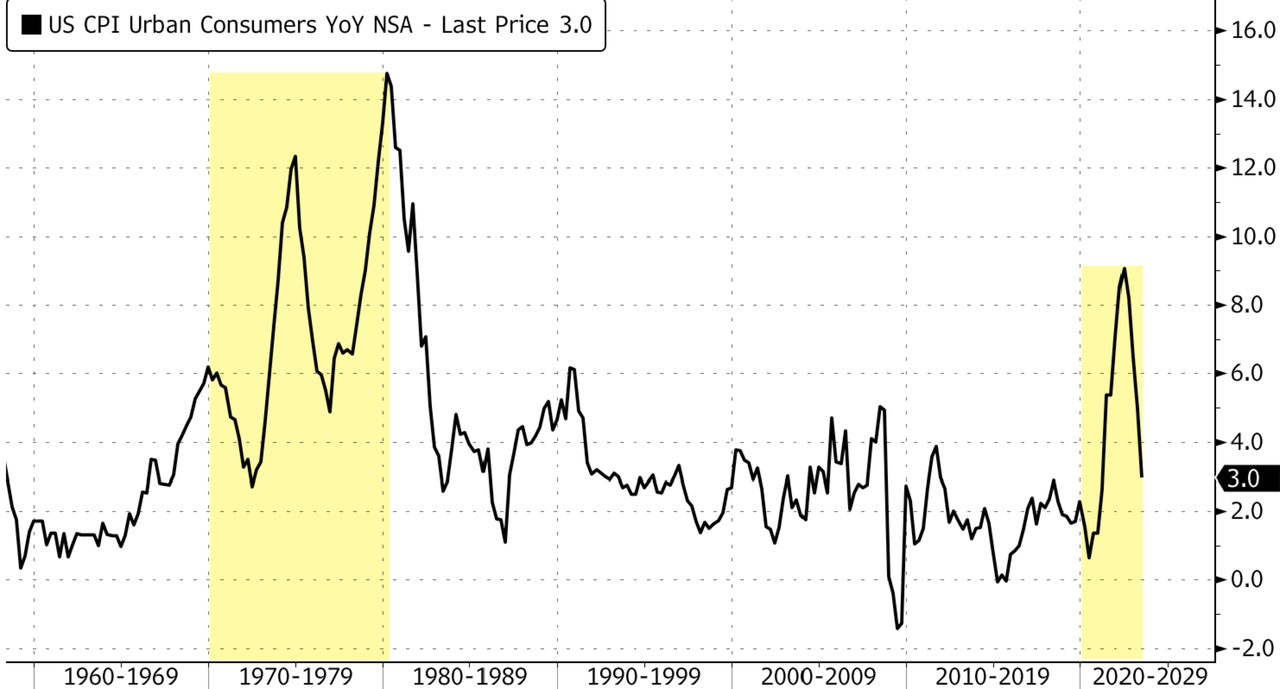
When Biden took office, inflation was under 2%, despite COVID and supply chain disruptions; shortly after, it skyrocketed to over 9%. Now inflation increases are “down” but prices remain exceptionally high compared to pre-Biden.
For example, crude oil prices, which affect almost everything and are used in over 6,000 products, are roughly double what they were when Biden took over.
President Trump focused on reduced regulations and energy independence, and implemented lower tax rates, all moves that greatly helped the American people. In contrast, Biden focuses on ensuring bureaucrats rapidly increase regulations which raises costs for everyday Americans; he’s waging economic war against us. Very few of Biden’s regulations go through Congress. From the White House archives:
Between FY 2017 and FY 2019, the Trump Administration has cut nearly eight regulations for every new, significant regulation….
The Council of Economic Advisers (CEA) estimates that this pro-growth approach to Federal regulation will raise real incomes by upwards of $3,100 per household per year.
Here are some recent reports of how well Biden policies are working:
Leading economic indicators have fallen for sixteen straight months. Maybe that is why people think the economy is moving in the wrong direction?
The current cost-of-living crisis is a manufactured one. As inflation rose, the Federal Reserve was forced to raise interest rates, which saw fewer people move. The cycle is very understandable, as simply explained in this one headline, “Housing Crunch: Home Sales Fall To Six Month Low…But Prices Rise Anyway”.
Parcel volumes are dropping by so much, freight pilots are “worried” about job security.
People are running up credit card debt and defaulting on car loans because of high inflation, and because their real wages haven’t been able to sustain them. Now, even more are falling behind on their payments. From CNN:
More Americans are failing to make payments on their credit cards and auto loans, another sign of rising financial pressure on consumers.
New credit card and auto loan delinquencies have now surpassed pre-Covid levels, according to a Wednesday report issued by Moody’s Investors Service.
After years of promoting and subsidizing electric cars, they represent around 6% of total sales, and demand is clearly slowing. It wasn’t that long ago that well-to-do people were buying these electric toys so quickly that they were placed on waiting lists; now, inventories are building because they are too impractical and expensive:
Auto News understands that there is currently a 103-day supply of unsold EVs in the United States. While it did not specify how many units are sitting on dealership lots, it says there is a higher supply of unsold EVs than any other automotive segment, except those in the ultra-luxury and high-end luxury segments with supplies also reaching over 100 days.
So what is Biden’s solution? Force people to buy them.
Here are some simple economics questions for the media and other Democrats:
Does flooding the U.S with illegals help or hurt housing availability and affordability?
Will the intentional destruction of oil and coal companies help or hurt the middle class and the poor?
Yet, the media and other Democrats brag that Biden’s economic policies are great, and when the public gives Biden poor marks, they say that we just don’t understand, and we’re not willing to get behind a candidate if they fail to make us feel “warm and fuzzy.”
Are journalists really that unaware?
Of course, they always sought to destroy Trump as his policies, even as poverty sank to record lows amongst minorities, because they don’t really care about anything but big government. According to Census data:
In 2019, the poverty rate for the United States was 10.5%, the lowest since estimates were first released for 1959.
Poverty rates declined between 2018 and 2019 for all major race and Hispanic origin groups.
Two of these groups, Blacks and Hispanics, reached historic lows in their poverty rates in 2019.
Results and facts haven’t mattered to the complicit leftist media for a long time.
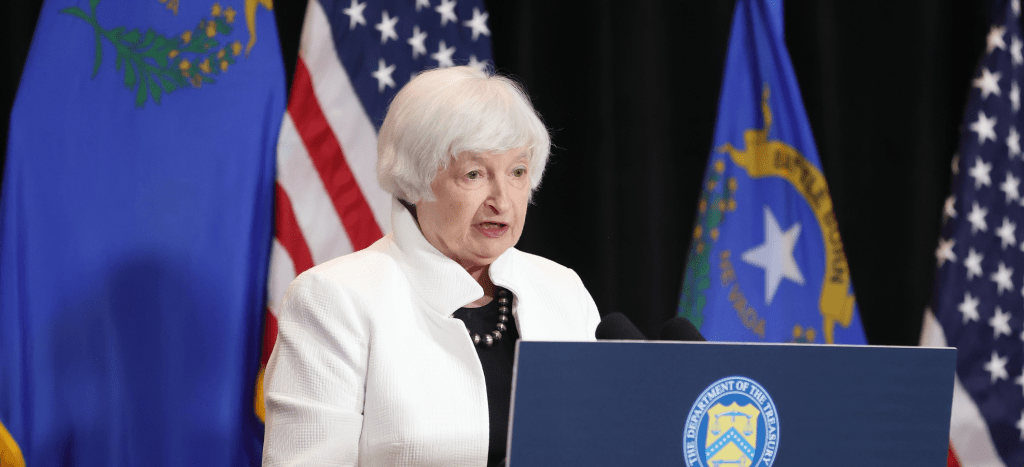
And perhaps the worst mistake Biden made (amongst his laundry list of horrible mistakes, [Afghanistan retreat, not showing up to E Palestine Ohio, Bidenomics that is a payoff to green donors and BIG corporate interests, an embarrasing visit to Maui two weeks after the fire, indicting his leading political opponent, ….) is the appointment of the WORST Federal Reserve Chair (Janet Yellen) as Treasury Secretary.
On Monday, Argentina’s central bank raised #interestrates to 118% as Argentina 30-year mortgage is now at a record 82.2%.
There is a record 350 Argentine Pesos for each US Dollar. All courtesy of Argentina’ version of Bidenomics … top down direction of spending and regulation and an out of control Central Bank.
Joe Biden said that Republicans will impeach him in the House of Representatives since inflation is coming down. Huh? No Joe, it is because your are the most corrupt President in history, a compulsive liar and your economic policies are pure World Economic Forum mandates (open borders, Central Bank Digital currency, green energy, etc). Biden started off his Presidency by declaring war on fossil fuels that helped drive prices through the roof. And the middle class are paying the price.
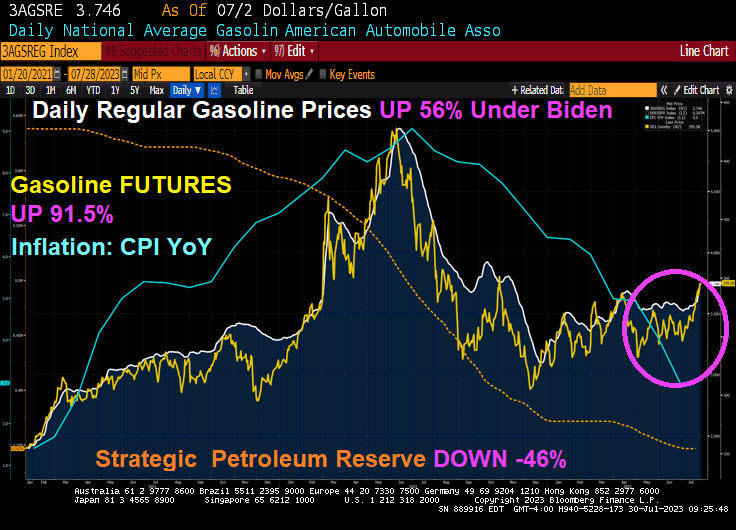
But as inflation cools (blue line) thanks in part to Biden draining the Strategic Petroleum Reserve (orange line), Biden can gloat. But remember, gasoline prices remain 56% higher under Biden’s Reign of Error. Even worse, gasoline FUTURES are up 91.5% under Biden. Yikes!
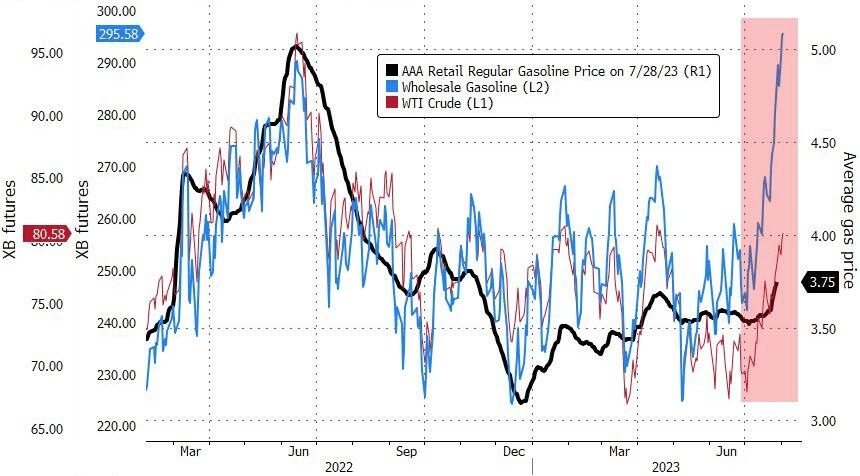
But look at how gasoline prices and gasoline futures have risen in July (pink circle). The last inflation report showed that inflation has declined to 3% (still higher than The Fed’s 2% target), gasoline prices are up almost 5% since July 19, 2023.
Gasoline, meanwhile, started the year at less than $2.50 per gallon. This week, gasoline topped $2.90 per gallon and may yet reach $3.
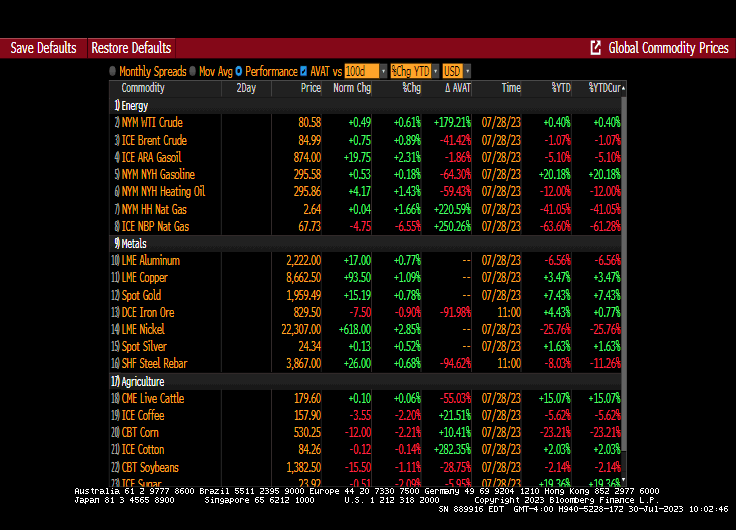
WTI Crude Oil futures have broken through the $80 barrier … again. Heating oil futures are up 1.43% today with WTI Crude futures up 0.61%.
So as energy prices keep rising (and Biden’s EPA keeps issuing green energy edicts and fails to recognize that our power grid can’t support all the electric cars and trucks envisioned by the Obama/Biden green dreamers). As such, energy prices will keep rising and with it … inflation.
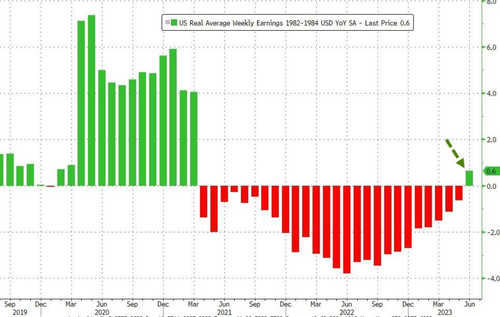
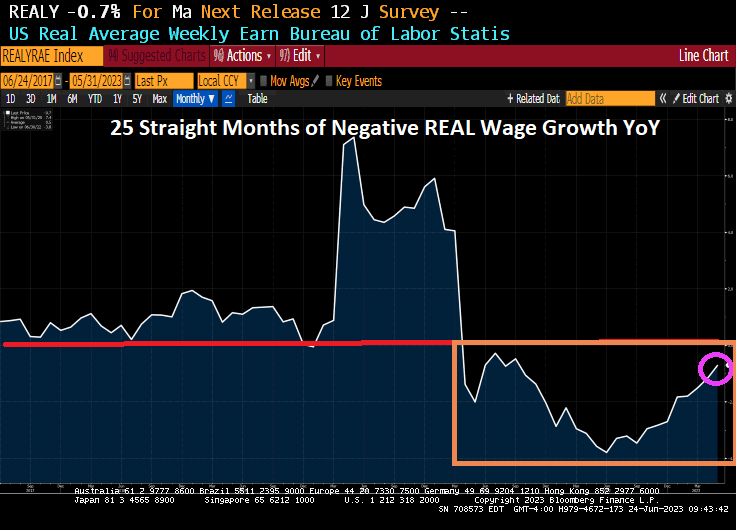
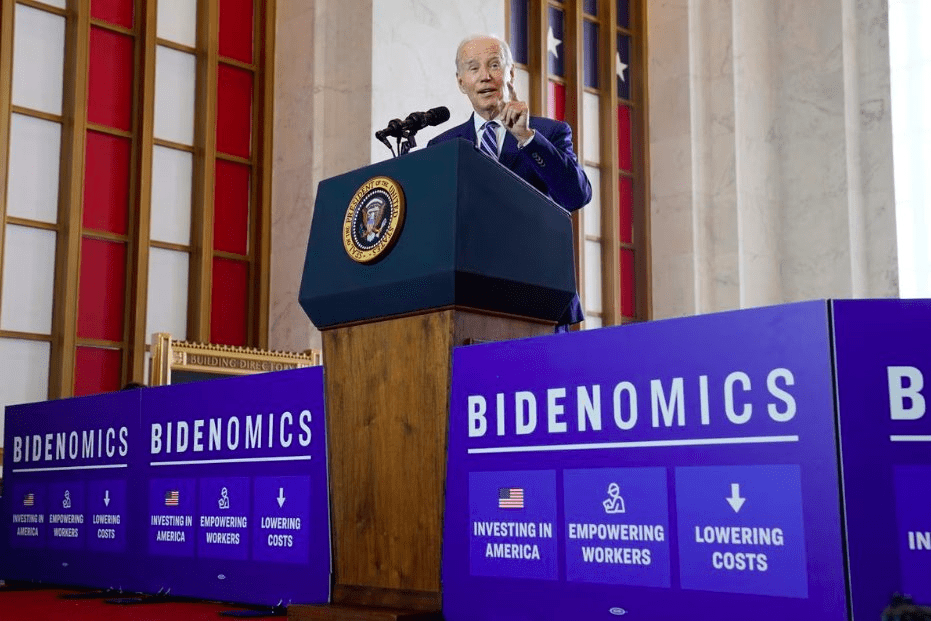
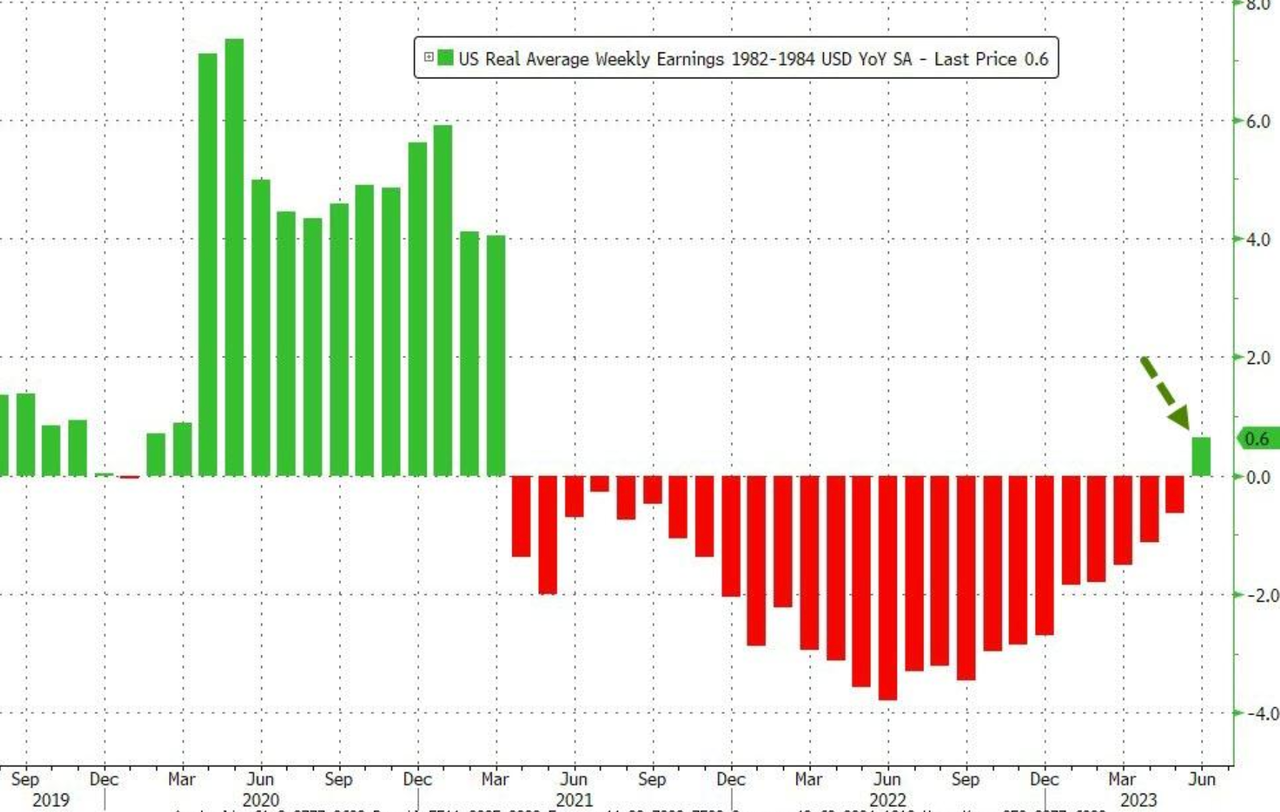
Joe Biden loves to tout “Bidenomics” which is a top-down command economy model with massive Federal spending directed primarily at green energy. But remember that a pillar of Bidenomics is support for labor unions. But “Union Joe” will be remembered as “Inflation Joe” as inflation remains hot. But now the labor unions are threatening to stall the recent rise in real weekly earnings (finally above 0%!).
So why is 2023 shaping up to be one of the biggest years of strikes in the US since the 1970s? Well, it didn’t happen overnight. Two years of negative real wage growth has crushed the working poor as they drained their savings and maxed out credit cards to make ends meet.
Unionized workers have taken advantage of upcoming contract expirations with companies to bargain for better wages and benefits. Many unions say companies can boost wages because profits have been off the charts.
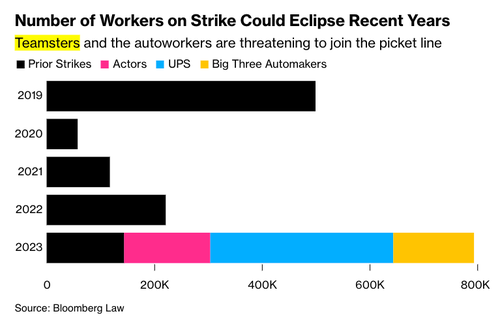
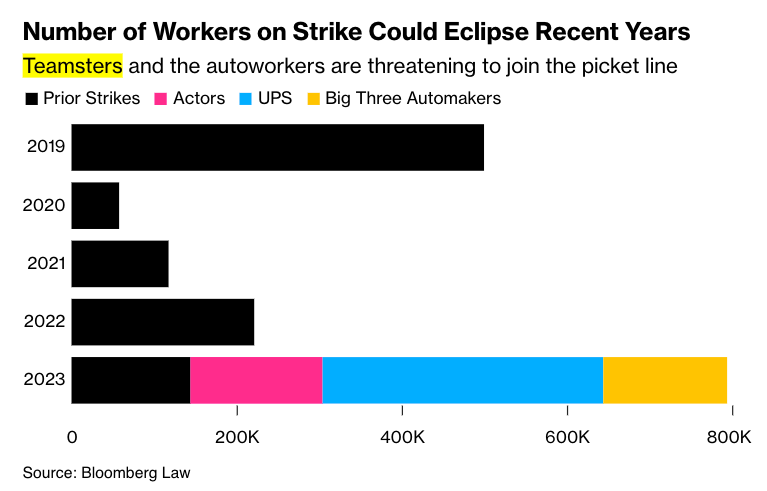
This summer might go down in history as the “Summer of Strikes” because 650,000 American workers are threatening to walk off the job imminently (some have already hit the picket lines):
Unions for United Parcel Service Inc. and Detroit’s Big Three automakers are poised to join them in coming weeks if contract negotiations fall through.
A Bank of America analyst warned a United Auto Workers strike is at 90% odds of happening as union contracts with automakers Ford, General Motors, and Stellantis expire in September. Some logistics experts believe Teamsters will reach a deal with UPS, but that deadline (July 31) is quickly approaching.
Labor historian Nelson Lichtenstein, who leads the University of California, Santa Barbara’s Center for the Study of Work, Labor, and Democracy, said this summer could “be the biggest moment of striking, really, since the 1970s.”
What’s shaping up to be a summer of strikes comes as inflation spiked to levels not seen since the 1970s. The good news is that it has cooled in recent quarters.
Still, two years of negative real wage growth crushed the working poor — many are in rough financial shape.
So far, strikes have not had a broad economic impact, but that could change overnight. Increasing labor actions are happening across the Western world, also in Europe, for the same reason in the US, due to a cost-of-living crisis sparked by high inflation.
Under O’Biden (the combined reign of economic errors of Presidents Obama and Biden), we won’t see any strike breaking for the good of the economy. Rather, the Biden Administration will be missing in action (or sending in Kamala Harris or Transportation Secretary Pete Buttigieg to do … nothing.
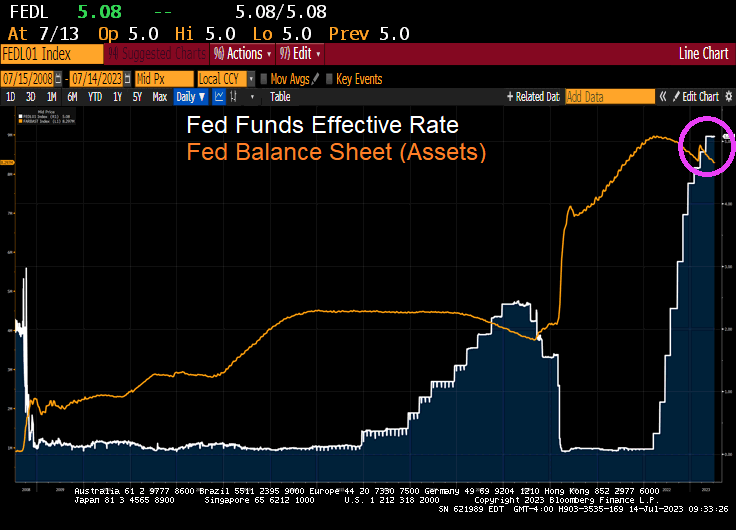
What screams may come! Actually, the aftermath of excessive monetary policies under Bernanke, Yellen and Powell are coming home to bit the big banks.
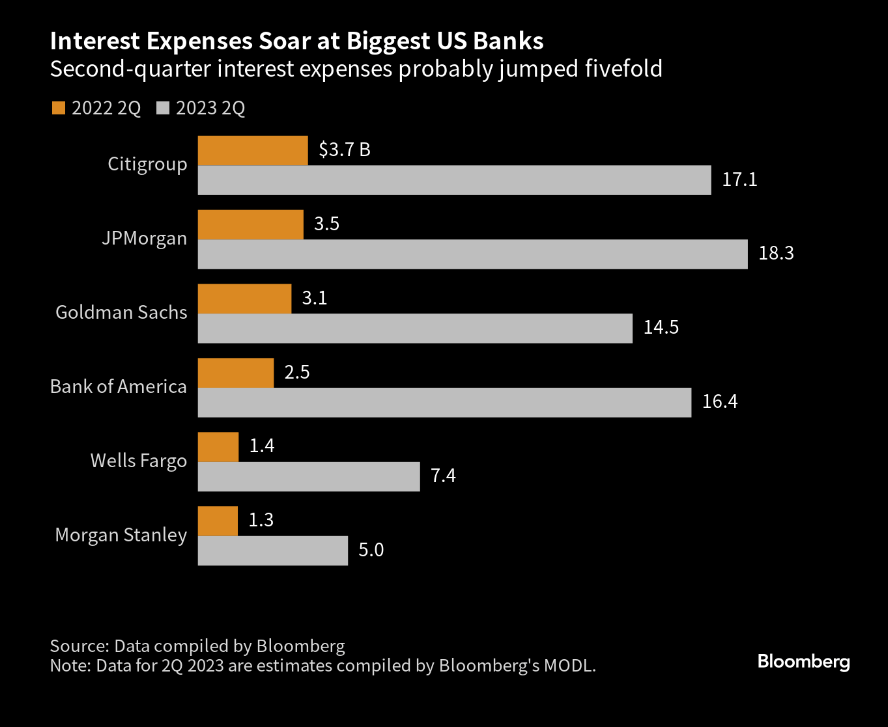
Interest expenses at big US banks are rising much more quickly than interest income. Across the six largest US banks, interest expenses are set to climb to roughly $78.7 billion from $15.5 billion in the same period last year.
There is still $8.3 Trillion in monetary stimulus sloshing around the monetary system.
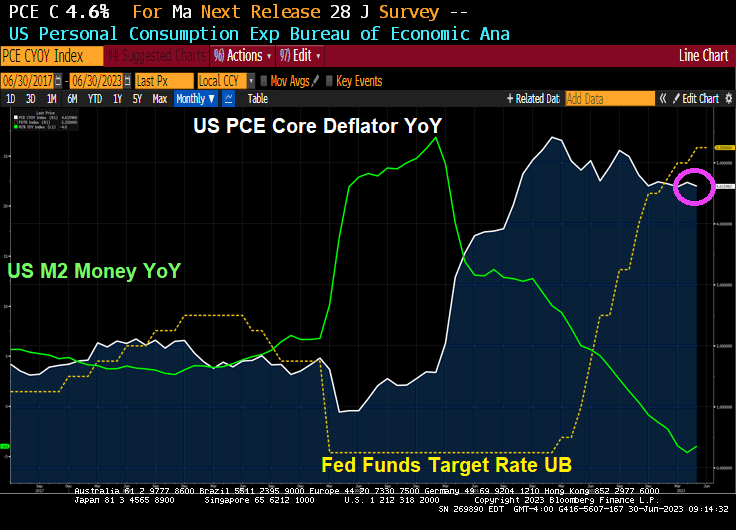
The film “The Core” was a silly film, but core inflation in the US is a serious problem for the middle class and low-wage workers. It remains elevated despite Treasury Secretary Janet “The Marxist Gnome” Yellen saying it was “transitory.” Looks pretty permanent to me!
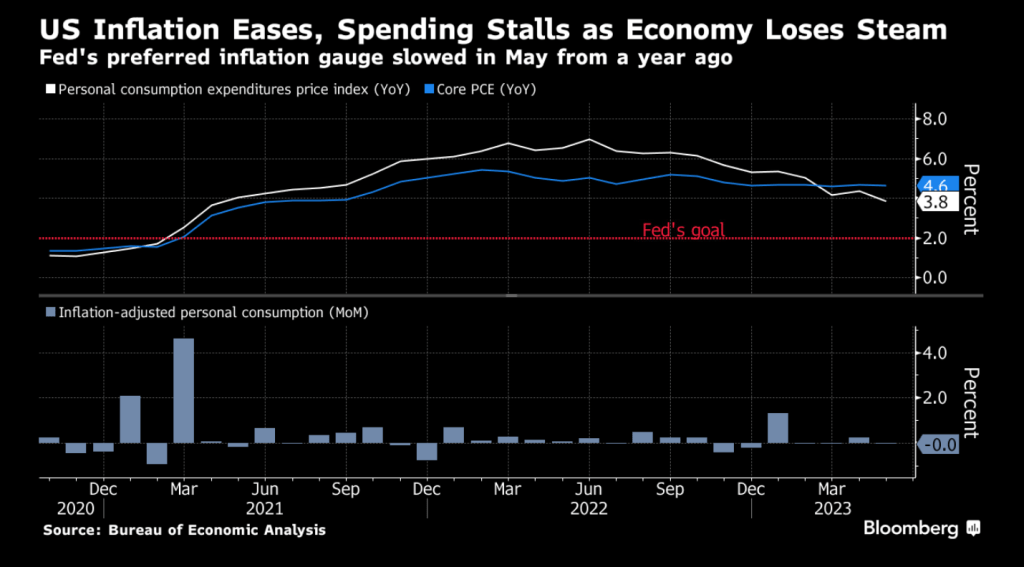
The Federal Reserve’s preferred measures of US inflation cooled (slightly) in May and consumer spending stagnated, suggesting the economy’s main engine is starting to lose some momentum.
The personal consumption expenditures price index rose 0.1% in May, Commerce Department figures showed Friday. From a year ago, the measure eased to the slowest pace in more than two years.
Consumer spending, adjusted for prices, was little changed after a downwardly revised 0.2% gain in April. From February through May, household spending has essentially stalled after an early-year surge. Spending on merchandise dropped, while outlays for services increased.
Excluding food and energy, the so-called core PCE price index increased 4.6% from May 2022. That’s in line with annual readings back to late 2022 and shows minimal relief from elevated price pressures. Economists consider this to be a better gauge of underlying inflation.
Indicator
Actual
Estimate
PCE price index (MoM)
+0.1%
+0.1%
Core PCE price index (MoM)
+0.3%
+0.3%
PCE price index (YoY)
+3.8%
+3.8%
Core PCE price index (YoY)
+4.6%
+4.7%
Real consumer spending (MoM)
0.0%
+0.1%
Under the hood of the government report, a key metric flagged by Fed Chair Jerome Powell showed a welcome slowdown. Services inflation excluding housing and energy services increased 0.2% in May from a month earlier, the smallest advance since July of last year, according to Bloomberg calculations. The figure was up 4.5% from a year ago.
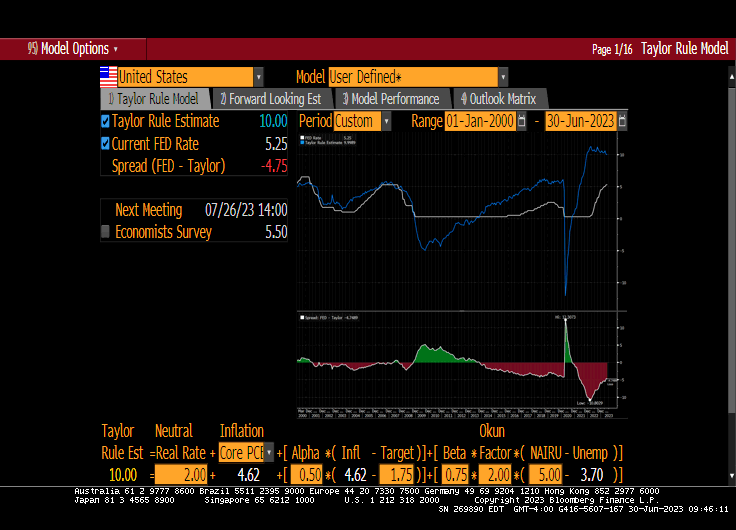
The Taylor Rule now suggests a target rate of 10%. We are just halfway to target!
Meanwhile, Yellen Plans July China Trip, While US Preps Investment Curbs. Trying to convince China that the US won’t default on its $32 TRILLION and growing debt?
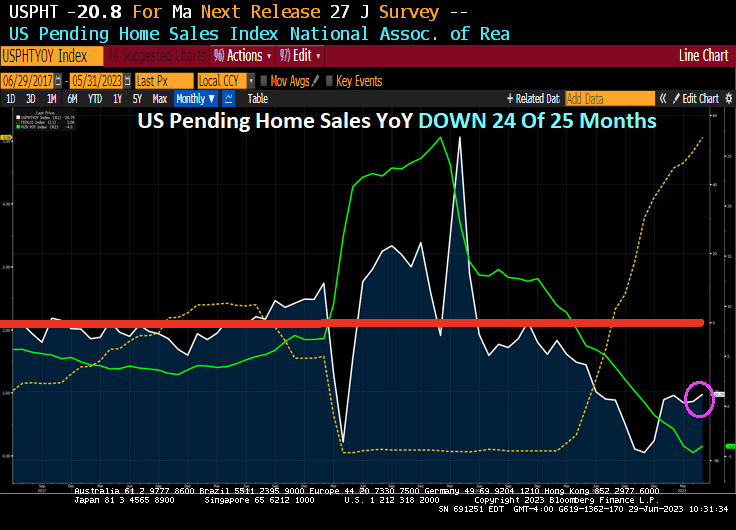
Bidenomics? Yes, an economy where inflation crushes the middle class and low wage workers with 2 years of negative wage growth and now 24 or the last 25 months of negative growth rates of Pending Home Sales YoY.
After existing home sales were flat and new home sales exploded higher, pending home sales once again are the tie-breaker on May’s housing market (and were expected to decline 0.5% MoM). The actual print was considerably worse than expected, down 2.7% MoM (and April was revised down from unchanged to -0.4% MoM). Pending Home Sales were down -20.8% YoY in May.
This is not exactly surprising given that Americans have suffered from 25 straight months of NEGATIVE real weekly earnings growth.
“C’mon man! The Biden clan is getting filthy rich with foreign bribes! Stop the malarkey about Bidenomics being a disaster!”
Yes, the ECB’s own Fabio … Panetta wants to ban any competition to Central Bank printing presses. Of course, like Elizabeth Warren (D-MA) and SEC’s Gary “The Ghoul” Genslar, he wants to protect The Deep State’s monopoly on money printing by banning competition.
According to Fabio Panetta, crypto volatility and aspects of blockchain technology made digital assets only suitable for gambling…
Fabio Panetta, an executive board member of the European Central Bank (ECB), has suggested a dark future for cryptocurrencies, in which digital assets may be used for little more than gambling among investors.
In written remarks for a panel at the Bank for International Settlements Annual Conference on June 23, Panetta said crypto’s perception among investors as a “robust store of value” began to dissipate in late 2021 and into 2022, when the total market capitalization fell by more than $1 trillion. According to the ECB official, the “highly volatile” nature of crypto assets made them suitable for gambling, and should be treated as such by global lawmakers.
“Due to their limitations, cryptos have not developed into a form of finance that is innovative and robust, but have instead morphed into one that is deleterious,” said Panetta.
“The crypto ecosystem is riddled with market failures and negative externalities, and it is bound to experience further market disruptions unless proper regulatory safeguards are put in place.”
He added:
“Policymakers should be wary of supporting an industry that has so far produced no societal benefits and is increasingly trying to integrate into the traditional financial system, both to acquire legitimacy as part of that system and to piggyback on it.”
Panetta claimed the “security, scalability and decentralisation” of crypto transactions was “not achievable,” saying the immutability of blockchains is a negative aspect of the space due to transactions often being unable to be reversed. He cited the collapse of FTX, as well as a recent lawsuit brought by the United States Securities and Exchange Commission again Binance, as “fundamental shortcomings” of the ecosystem.
“Crypto enthusiasts would do well to remember that new technology does not make financial risk disappear,” said the ECB official.
“It is like pressing a balloon on one side: it will change in shape until it pops on the other side. And if the balloon is full of hot air, it may rise for a while but will burst in the end.”
Panetta has previously backed parts of the ECB’s plans for a potential digital euro, currently being researched by the central bank.
He has also proposed banning crypto assets with an “excessive ecological footprint” as part of efforts to address risks to the environment.
Panetta is similar to anti-competition Statists like Senator Elizabeth Warren and SEC’s Gary “The Ghoul” Genslar who don’t want competition for The Fed’s massive printing press.
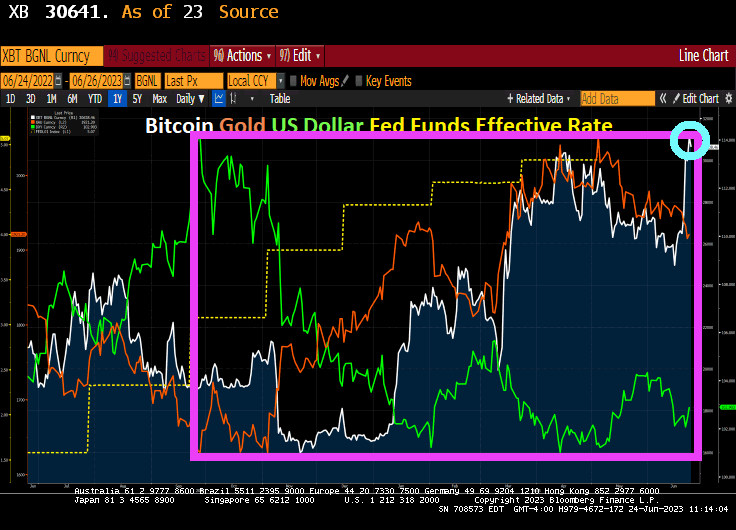
We know that Bitcoin along with Gold and Silver have done well the September 2022 when the US Dollar began to lose value.
Today, we are seeing a slight up-tick in Bitcoin (+0.05%) and Ethereum (+0.60%).
I wonder if Biden’s proposed railroad from the Pacific to the Indian Ocean will generate massive industrial production growth? Is this more Bidenomics??
Industrial production edged down 0.2 percent in May following two consecutive months of increases. The Bloomberg Econoday consensus was a small increase.
In May, the index for manufacturing ticked up 0.1 percent, while the indexes for mining and utilities fell 0.4 and 1.8 percent, respectively.
The index for motor vehicles and parts moved up 0.2 percent in May after jumping nearly 10 percent in April.
At 103.0 percent of its 2017 average, total industrial production in May was 0.2 percent above its year-earlier level.
Capacity utilization moved down to 79.6 percent in May, a rate that is 0.1 percentage point below its long-run (1972–2022) average.
Peak Months For 5 Indexes
Industrial Production: September 2022, 103.5
Manufacturing: October 2022, 101.2
Motor Vehicles and Parts, new high this month, 112.1
Consumer Durable Goods: April 2022, 109.4
Manufacturing Durable Goods: January and April 2023: 129.8
Despite the strength in autos, no debt led by Biden’s EV push and subsidies, manufacturing production is still below where it was seven month’s ago.
A long term chart better shows the trends.
Industrial Production Index Since 1972
Industrial production data from the Fed, Chart by Mish
Recession Lead Time After Industrial Production Peak
Industrial production data from the Fed, peak calculation and Chart by Mish
Peaks in industrial production tend to mark recessions.
Industrial production and manufacturing industrial production peaked eight and seven months ago respectively.
Politically speaking, if you are going to have a recession on your watch, it’s much better to have it early in your term than heading into an election campaign. But here we are.
Inflation is still not under control, and this economy is certainly not firing on all cylinders.














 Confounded Interest - Anthony B. Sanders

You must be logged in to post a comment.