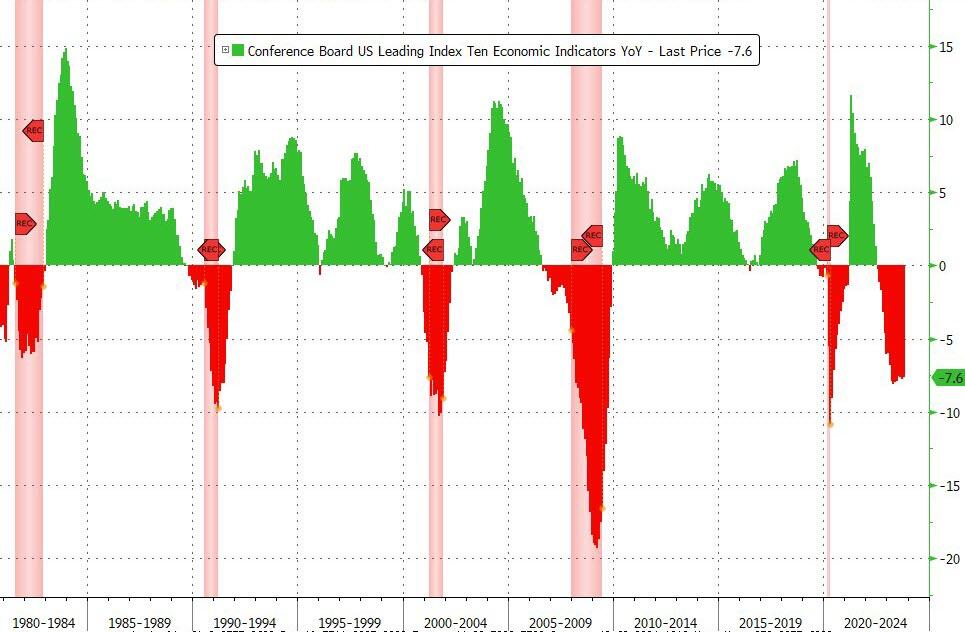
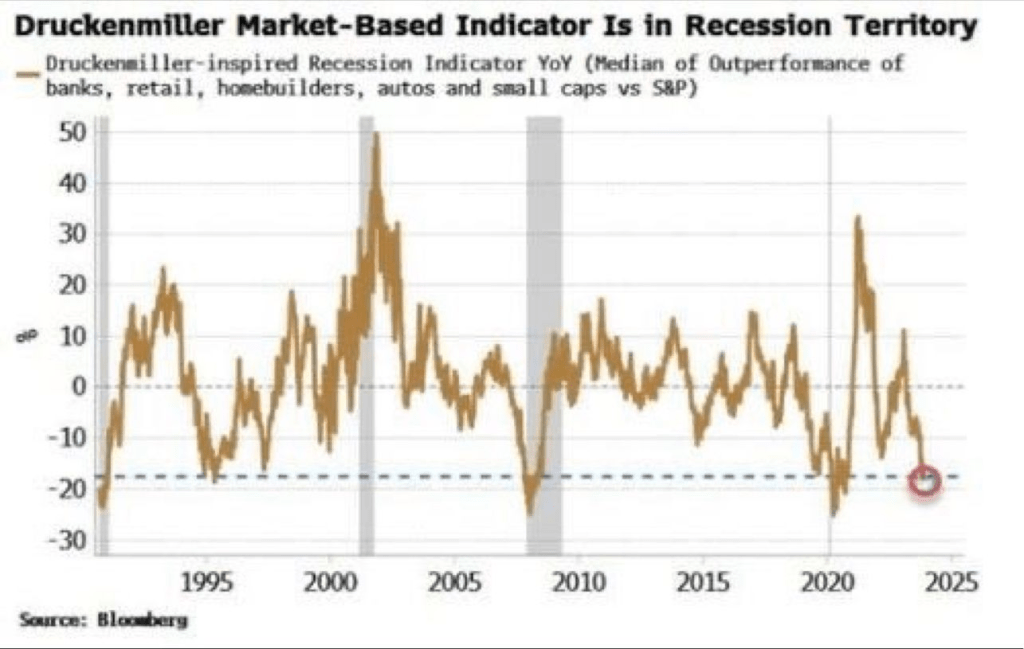
Bidenomics is the economy’s Highway to Hell! Massive, staggering misallocation of scare resources to fund endless wars, green energy fraud, and massive wealth transfers to immigrants while disabled veterans suffer. Now we see that the US leading economic indicators is down -7.6%, definitely smelling like a recession.
On a year-over-year (YoY) basis, the Leading Economic Indicators is down 7.6% (down YoY for 16 straight months) – close to its biggest YoY drop since 2008 (Lehman) outside of the COVID lockdown-enforced collapse.
On a monthly basis (MoM), leading economics indicators are down -0.8%. It has been going down for 16 straight months. Here are the components.
Most of the components are in red and need to be back in black for economic growth.
Treasury Secretary Janet Yellen, a mega pro-China elitist, acknowledges that Bidenomics isn’t popular but she attributes that to people not understanding how good Bidenomics is! It is good for the 1% elitist, donor class. But not for the US middle class.
At least Argentina elected AC/DC guitarist Angus Young as President!
Rubino says, “If the U.S. government is running crisis level deficits, which it is right now, borrowing money and paying interest on it means we are in a financial death spiral…”
“The debt goes up, the interest on the debt goes up and that raises the debt even further, and you just spiral out of control.
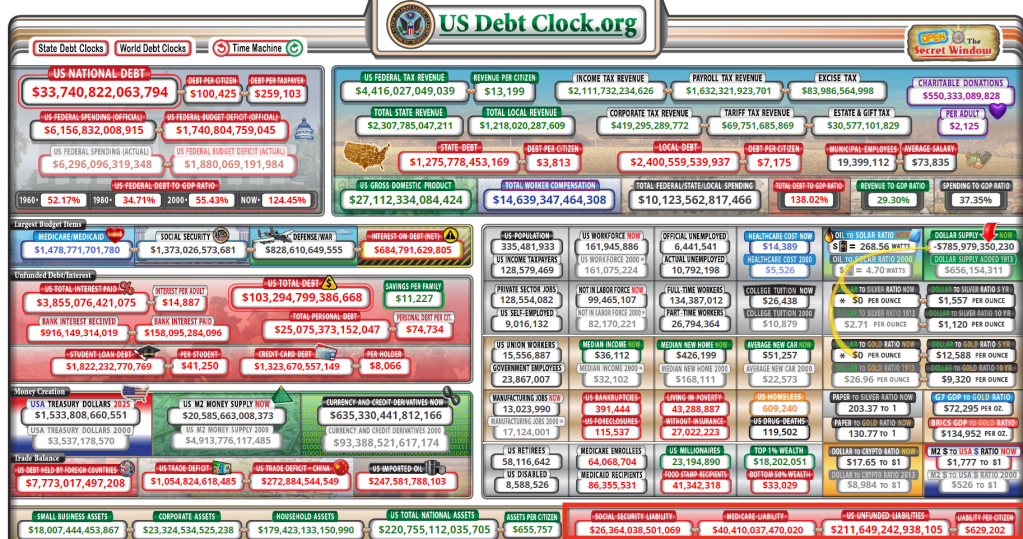
We are there right now. The official U.S. debt is $33.5 trillion. It’s growing by $1.7 trillion a year, and $1 trillion of that is interest costs.
Interest costs are rising as the overall debt goes up. Then throw in this incredibly reckless military spending in the guise of foreign aid, and you get a society that has completely lost control.
That’s where we are now.
We are in the blowoff stage of a 70-year credit super-cycle.
Those things do not end with a whimper, and they certainly do not end with a soft landing. They end with a bang, and the bang is going to be centered on the currency.
People are going to look at this and say, ‘Do I really want to hold the currency or bonds of a country that is destroying its finances at this trajectory and this scale?’ The answer will be ‘No.’
At that point, it is game over for a deeply indebted economy. We are headed that way fast, and these wars are taking us that way even faster.”
If the Fed keeps raising interest rates, the economy tanks, but you protect the dollar. If you cut interest rates, you spike inflation even more, and the U.S. dollar tanks.
Rubino says in the end, we get a “massive reset,” and the everything bubble explodes.
Rubino says the dollar is going to decline and, at some point, it starts to go into freefall in terms of buying power. Rubino explains,
“If a currency starts to decline in a disorderly way, then you have a massive financial crisis on your hands.
That is definitely where Japan is right now. The U.S. is headed that way fast.
So, once we reach that point, there is no fix.
Then it is only a matter of time that everybody realizes that there is no fix, and they just bail on the whole experiment, and that’s where we are headed.”
Rubino talks about plunging home prices, more trouble coming in the commercial real estate market and why you need gold and silver as core assets during a currency reset.
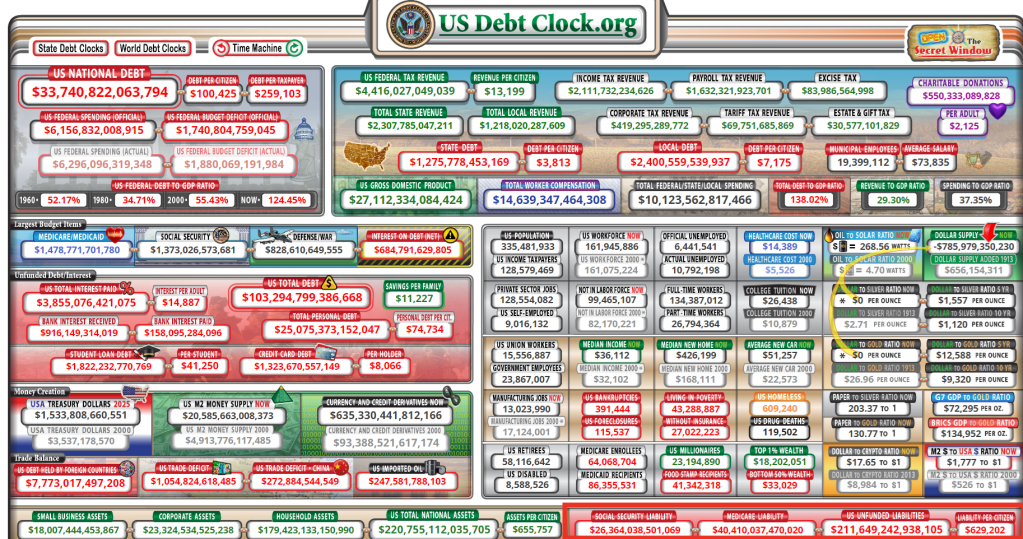
Riots, already happening in American cities (not to mention looting in New York City, Chicago, San Francisco and Los Angeles), will accelerate if Congress attempts to curtail entitlements (now at $211.65 TRILLION).
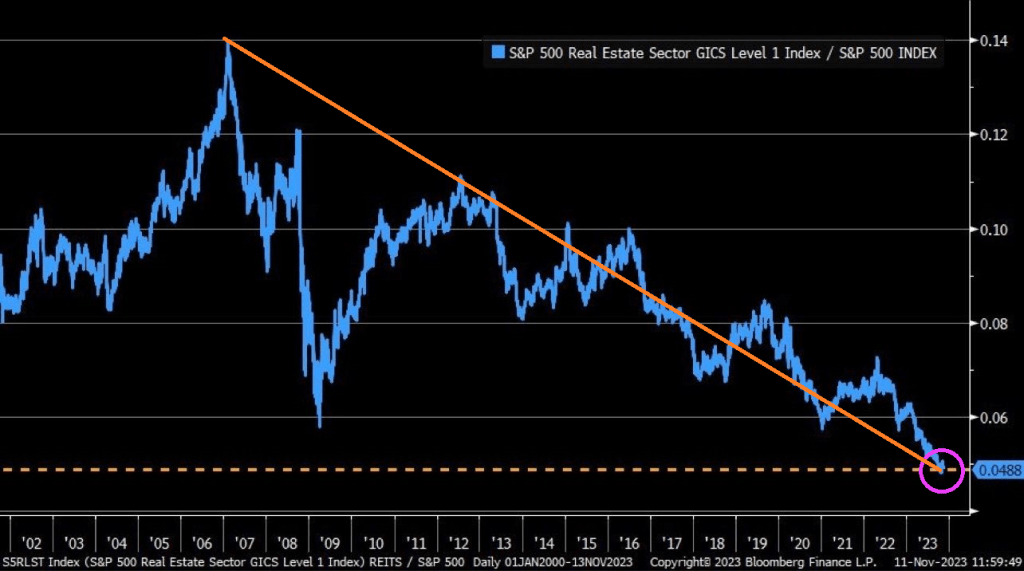
The S&P 500 real estate sector is now just 5% of the entire S&P 500.
Even at the 2008 low, in the worst real estate crisis of all time, this percentage barely dropped below 6%. Meanwhile, demand for commercial real estate (CRE) loans is now at 2008 levels.
Office building prices are down ~30% over the last year and apartments are down ~15%.
Also, Delinquent commercial real estate loans at US banks have hit their highest level in a decade.
The strength of the housing market is masking the weakness of CRE.
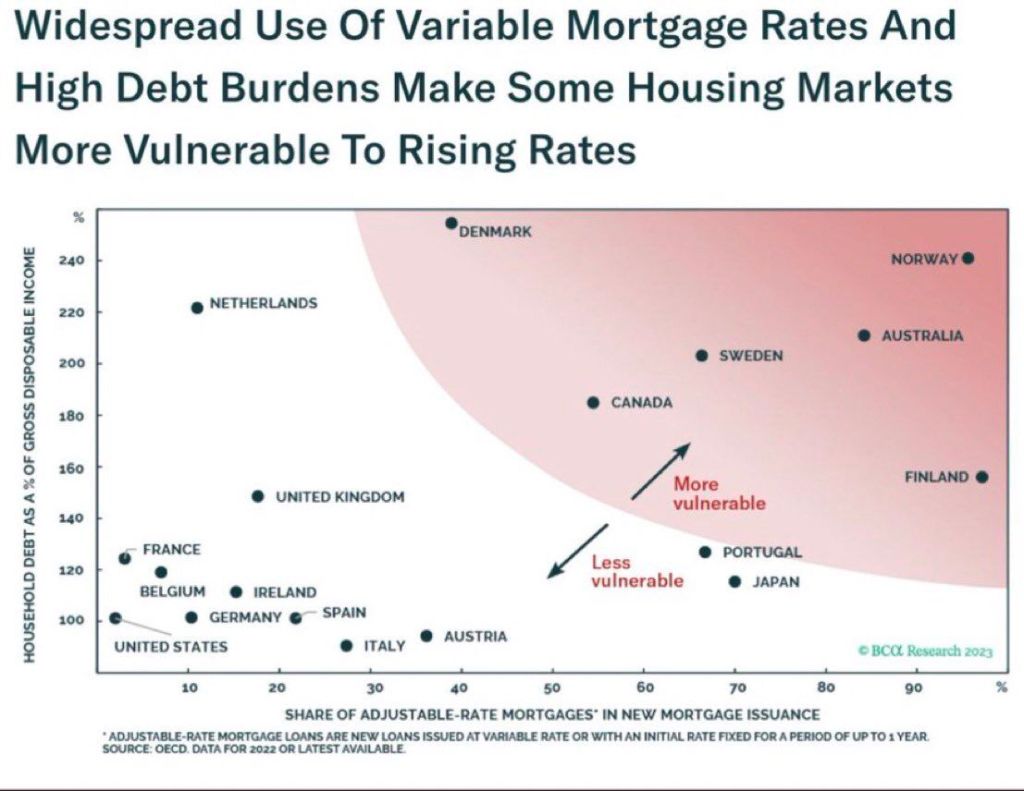
Speaking of the housing market, the US is overly dependent on the lopsided 30-year fixed-rate mortgage. Where under inflation and rising rate, the lender (investor) loses. If inflation cools and rates fall, the borrower refinances.
But these consumer benefits to the 30-year mortgage have costs. It is costly to provide a fixed nominal interest rate for as long as 30 years. And the prepayment option creates significant costs. If rates rise, the lender has a below market rate asset on its books. If rates fall, the lender again loses as the mortgage is replaced by another with a lower interest rate. To compensate for this risk, lenders incorporate a premium in mortgage rates that all borrowers pay regardless of whether they benefit from refinance. Exercise of the prepayment option in the contract also has significant transactions costs for the borrower and imposes additional operating costs on the mortgage industry.
Another major reason for the FRM’s dominance is government support and regulatory favoritism. The FRM is subsidized through the securitization activities of Fannie Mae, Freddie Mac and Ginnie Mae.
Their securities benefit from a government guarantee that lowers the relative cost of the instrument, which is their core product. These guarantees have a significant cost as the government backing of Fannie Mae and Freddie Mac has exposed taxpayers to large losses. Are the FRM’s benefits worth its costs? Would the FRM disappear if Fannie and Freddie stopped financing it? Are there mortgage alternatives that balance the needs of consumers and investors without exposing the taxpayer to inordinate risk?
The instrument’s supporters point out that it is easier for investors than consumers to manage interest-rate risk. It is true that lenders and investors have more tools at their disposal to manage interest-rate risk. But managing prepayment risk is costly and difficult and many institutions have suffered significant losses as a result (e.g., savings and loans in the 1980s; hedge funds and mortgage companies in the 1990s and 2000s).
Furthermore, borrowers rarely stay in the same home or keep the same mortgage for 15 to 30 years, so one can reasonably ask why rates should be fixed for such long periods (increasing the loan’s cost and risk). Also, the taxpayer ultimately bears a significant portion of the risk through support of Fannie Mae and Freddie Mac.
One of the lingering questions about government loan modification programs is why borrowers are refinanced into longer-term FRMs rather than less expensive ARMs, such as a 5/1 ARM.
ARMs allow protection for lenders (investors) from inflation and interest rate increases. Consider this another entitlement that elected officials give away and refuse to cut. After all, unfunded entitlements are already at $211.65 TRILLION.
But typically we get scare tactics about ARMs (or VRMs), like this one.
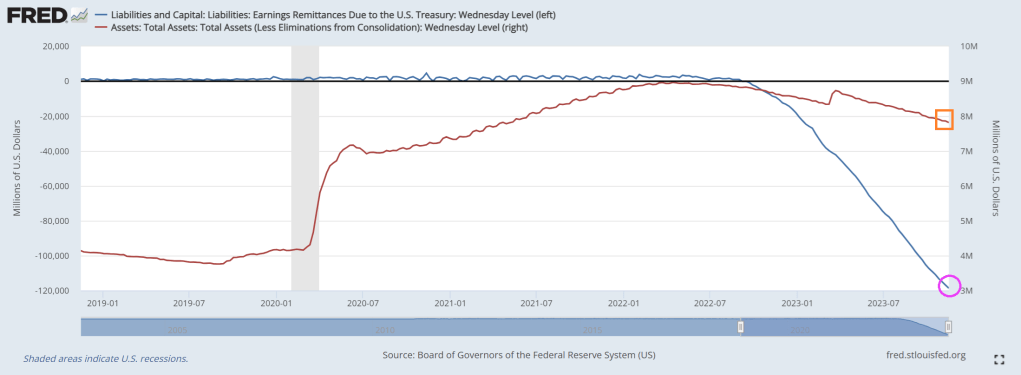
Biden’s terrible economic policies and horrid fiscal managment has put stress on The Federal Reserve. The Federal Reserve paid an estimated $76 billion to the Treasury in 2022 while banks’ willingness to lend has plummeted.
One of the key ways central banks absorb liquidity back out of the market is through reverse repo. These are short-term transactions where the Fed sells securities to banks and agrees to buy back at a higher price the next day.
This means banks are being paid to park cash with the Fed instead of injecting it into the economy through loans and fanning the fires of inflation.
That alone is costing the Fed $200M every single day.
In addition, the Fed is spending another $500M in daily interest payments on its reserve policy, i.e. balances that banks are holding in their reserve accounts at the Fed.
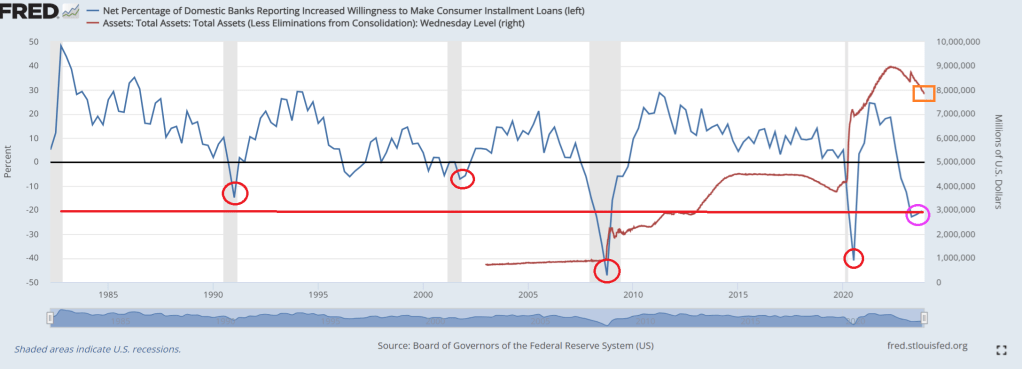
Banks’ willingness to lend has plummeted making credit availability increasingly tighter. Current levels have typically ended in recessions.This time is NOT different.
And on the energy side of the market, Biden Invokes ‘Wartime Powers’ to Attack Gas-Powered Furnaces. Of all the stupid things Biden has done, invoking wartime powers to make households use inefficent electric heat pumps instead of gas furnaces in stupid of two levels. First, invoking wartime powers for things unrelated to national defense is reckless and capricious. Second, electric heat pumps in the colder areas of the country is stupid as well. Electric heat pumps are inefficient, unless the goal of Biden and his Idiocracy is to “cull the herd” or kill off people during winter months (I had an electric heat pump in a condo I owned and it was terrible in winter months).
Yes, the Biden Administration and The Fed are economic mutilators!
President Biden reminds me of Cousin Eddie, the dimwitted cousin of Clark Griswold’s wife in the Vacation movies. Except that Cousin Eddie is a nice dimwit while Biden is a nasty dimwit. And politcal stooge.
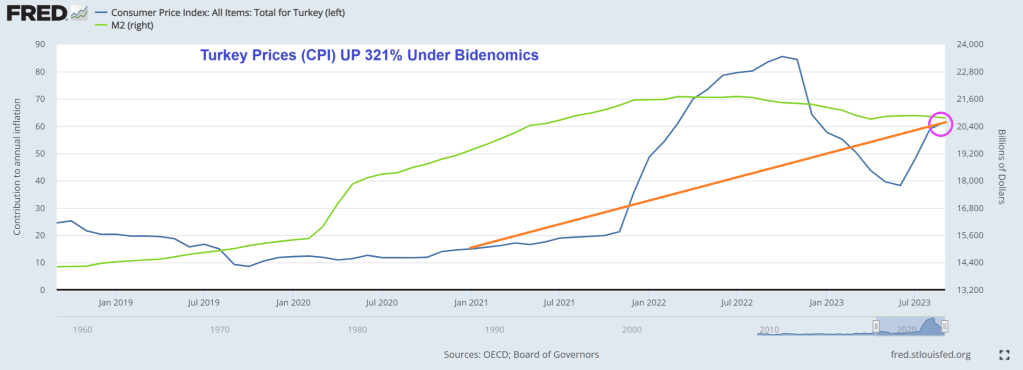
Given that turkey prices are up 321% under Biden, the famous Thanksgiving line “Save the neck for me, Clark” is most appropriate since we will be forced to eat every part of the turkey.
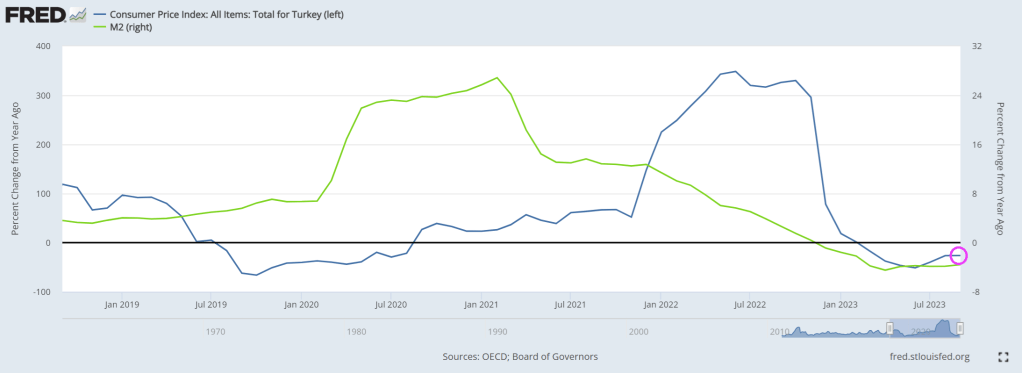
Of course, year-over-year growh in turkey prices (CPI) are now negative along with M2 Money growth. Note the surge in M2 Money growth (green line) followed by the surge in turkey prices (blue line). Now both are declining.
A Bidenomics turkey!
Here is Biden giving a Thanksgiving turkey a pardon, hoping he gets a pardon for his massive corruption. But which one is the turkey??
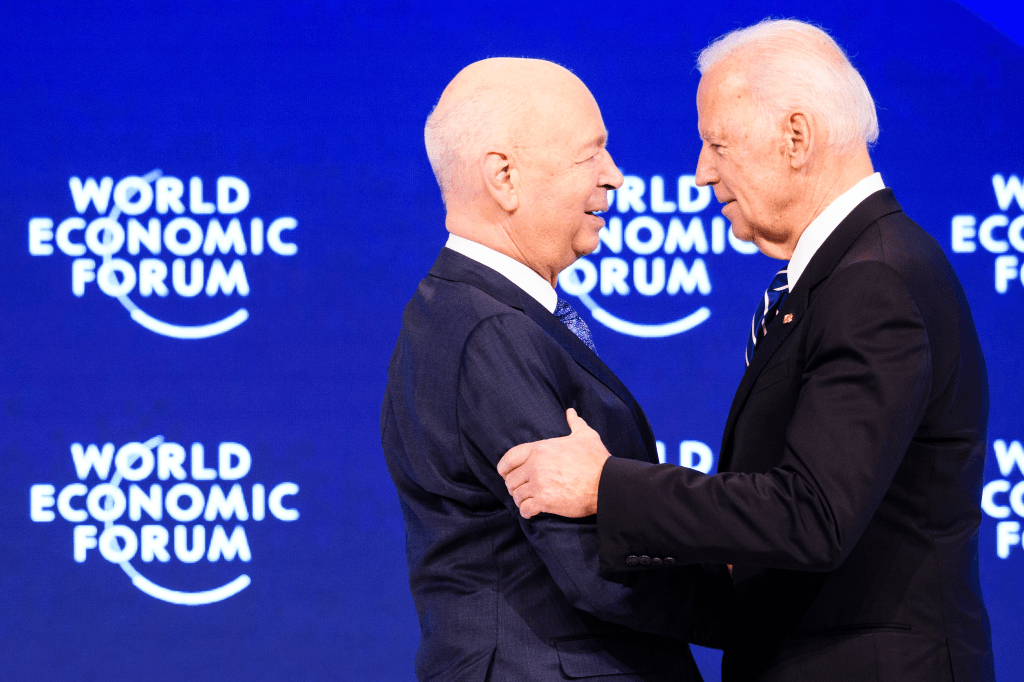
The World Economic Forum (WEF) is a leading pusher of the ESG drug, pushed by the elite class intending to control the world. Unfortunately, numerous American politicians and influencers have attended the Davos meetings and have openly praised the WEF and its leader Klaus Schwab.
ESG investing, or sustainable responsible investing (SRI), uses this information about a company to inform investment decisions that prioritize all stakeholders.
Here’s how the Forum’s partners are leading the switch to stakeholder capitalism.
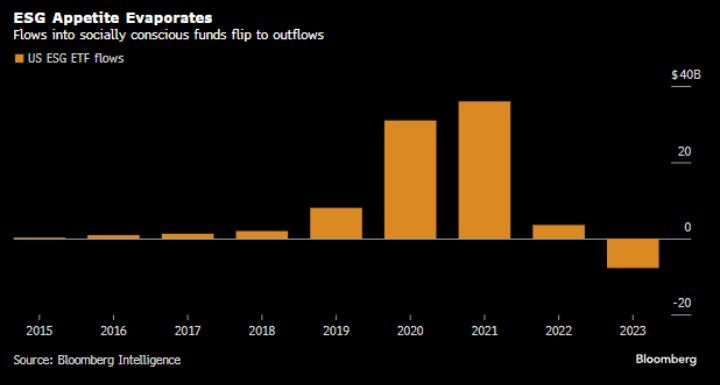
But all is not well with WEF’s ESG drug distribution. In fact, ESG flows into socially consious funds were a big thing during Covid (2020) and the first year of Biden’s Reign of Error. But ESG flows slowed sharply in 2022 and seeing net outflows in 2023.
US borrowers are retreating en masse from the world’s second-biggest ESG debt class.
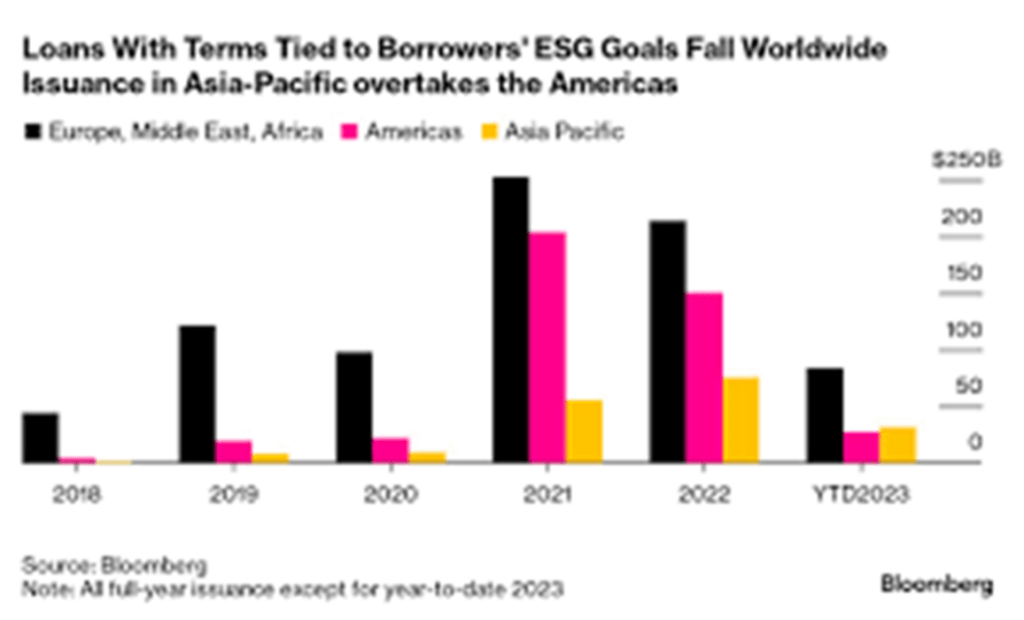
The $1.5 trillion market for sustainability-linked loans, in which borrowing is tied to environmental, social or governance goals, has seen an overall slowdown in volumes this year as both interest rates and greenwashing fears rise. But nowhere has the decline been as precipitous as in the US, where the number of new sustainability-linked loans is down 80% from a year earlier.
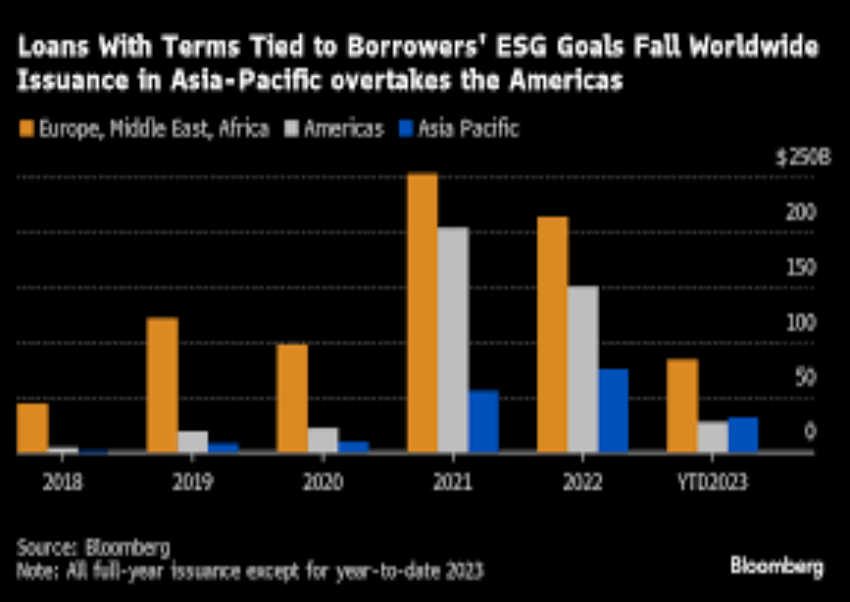
But ESG is still relatively popular in Europe, Middle East and Africa (orange). But taste for ESG is waning around the globe. But the selection of Biden as President in the US marked a surge in ESG -tied loans in 2021 and 2022 (not to mention the insane levels of spending out of Biden and Congress, much tied to the sustainability, green energy fantasy.
Loans with terms tied to borrower’s ESG goals have fallen worldwide.
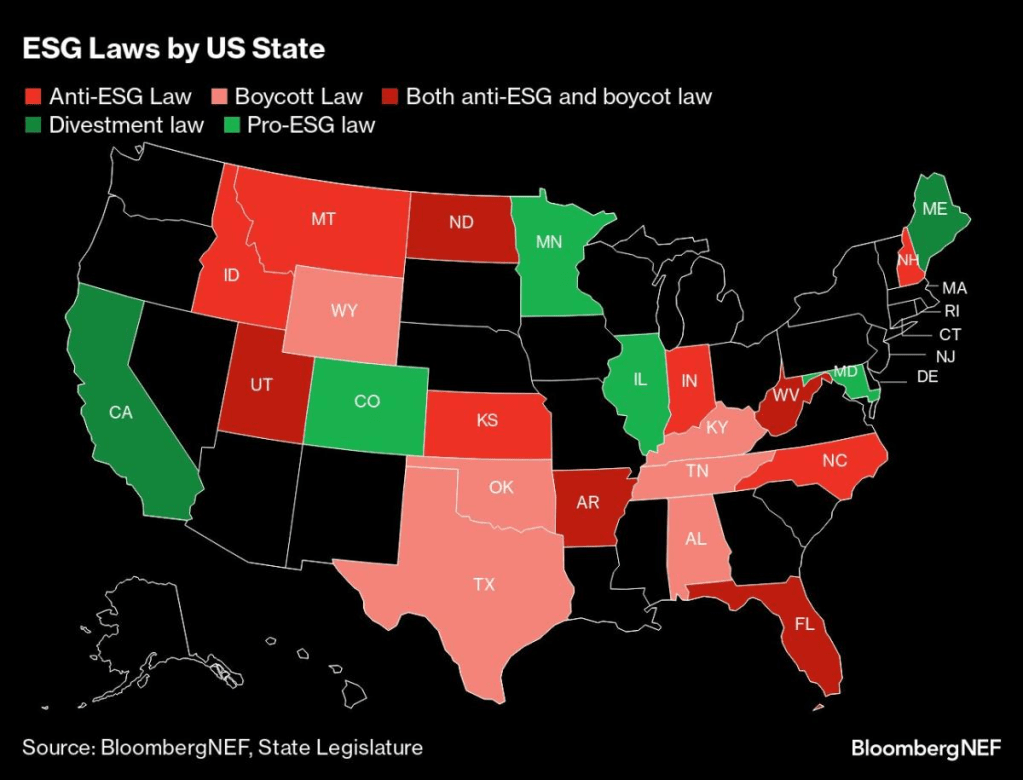
Several states (largely blue states like California, Minnesota, Illinois, and Colorado have pro-ESG laws) while several states have anti-ESG laws (largely red states like Montana, Idaho, North Dakota, Kansas, Utah, Indiana, Arkansas, Florida, and West Virginia).
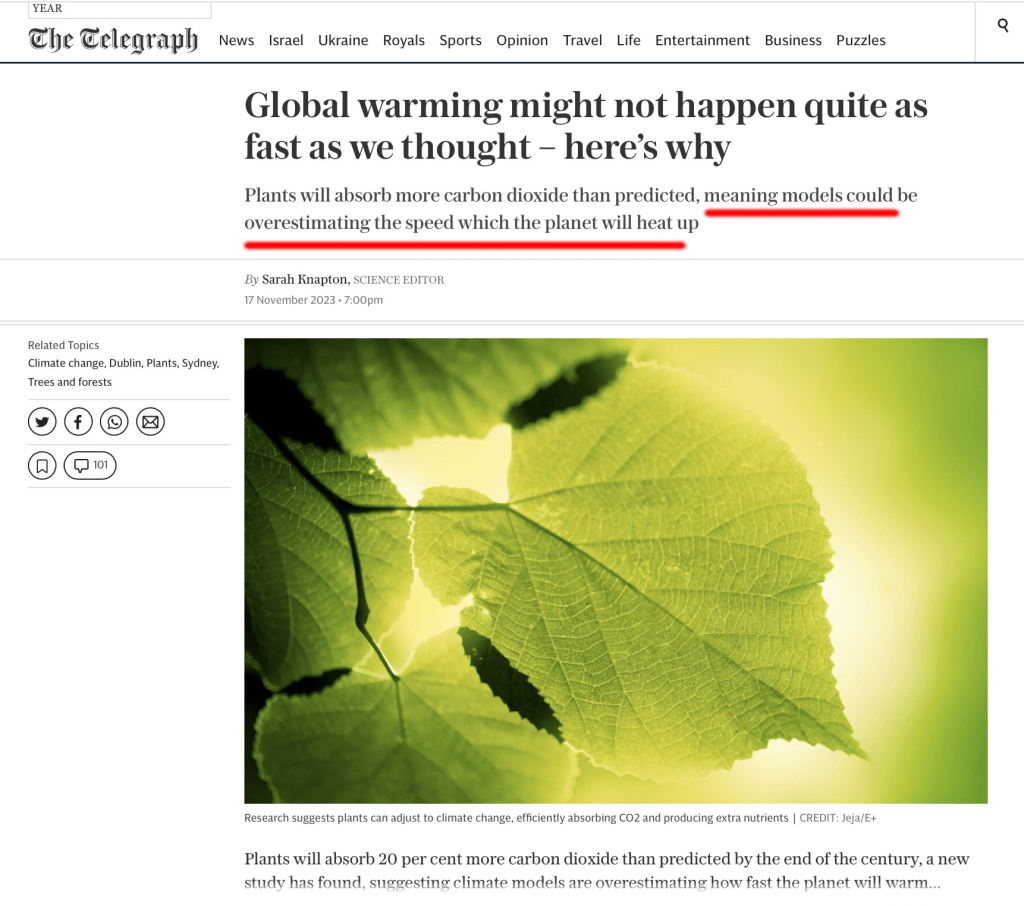
And of course, global warning may not be as dire as John Kerry and Greta Thunberg say.
WEF’s Klaus Schwab about to get sniffed by his 80-year old puppet, Joe Biden. In fact, Biden is singing “I’m your puppet.”
Here is Hunter Biden welcoming the Green Energy fairy and all the trillions in misallocated spending it brings.
Housing Starts: Privately‐owned housing starts in October were at a seasonally adjusted annual rate of 1,372, the October 2022 rate of 1,432,000. Single‐family housing starts in October were at a rate of 970,000; this is 0.2 percent above the revised September figure of 968,000. The October rate for units in buildings with five units or more was 382,000.
Building Permits: Privately‐owned housing units authorized by building permits in October were at a seasonally adjusted annual rate of 1,487,000. This is 1.1 percent above the revised September rate of 1,471,000, but is 4.4 percent below the October 2022 rate of 1,555,000. Single‐family authorizations in October were at a rate of 968,000; this is 0.5 percent above the revised September figure of 963,000. Authorizations of units in buildings with five units or more were at a rate of 469,000 in October.
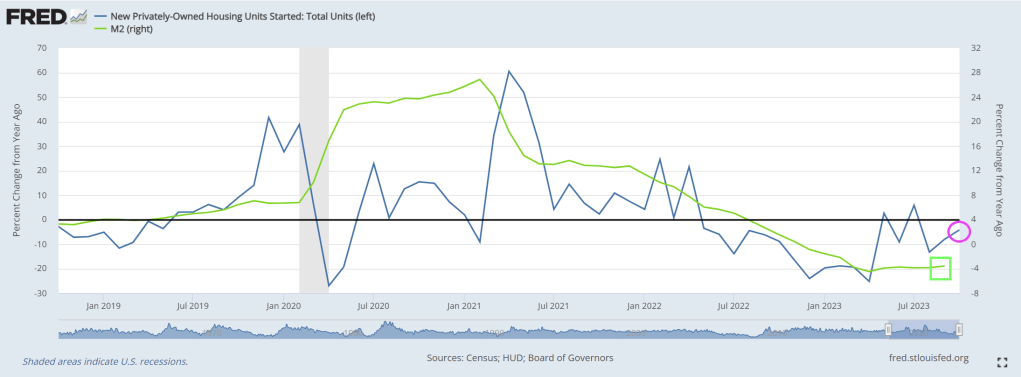
Total starts were down 4.2% in October compared to October 2022. And starts year-to-date are down 11.3% compared to last year.
In YoY terms (change since one year ago), shows housing starts declining with dying M2 Money growth.
Starts have been down year-over-year for 16 of the last 18 months (May and July 2023 were the exceptions), and total starts will be down this year – although the year-over-year comparisons are somewhat easier in Q4.
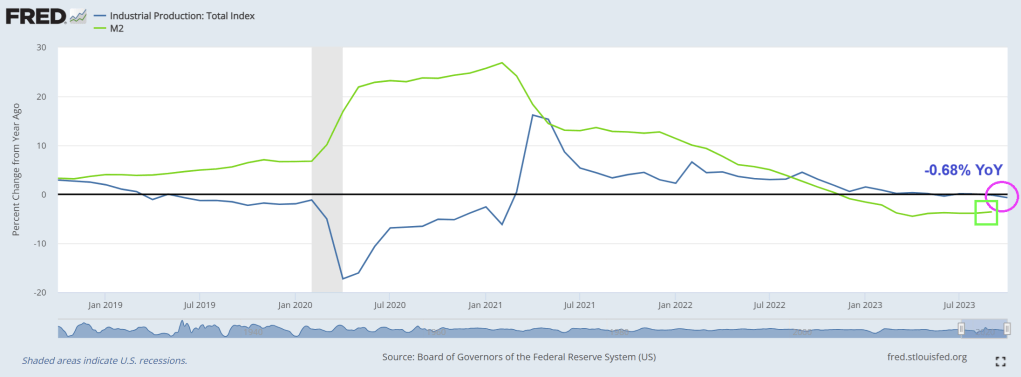
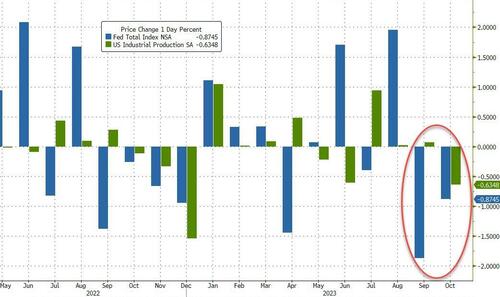
Notably, once again, the non-seasonally-adjusted industrial production tumbled more than then seasonally-adjusted data…
Source: Bloomberg
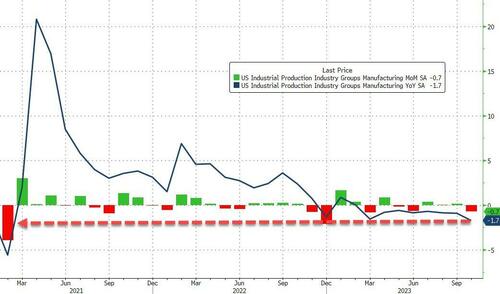
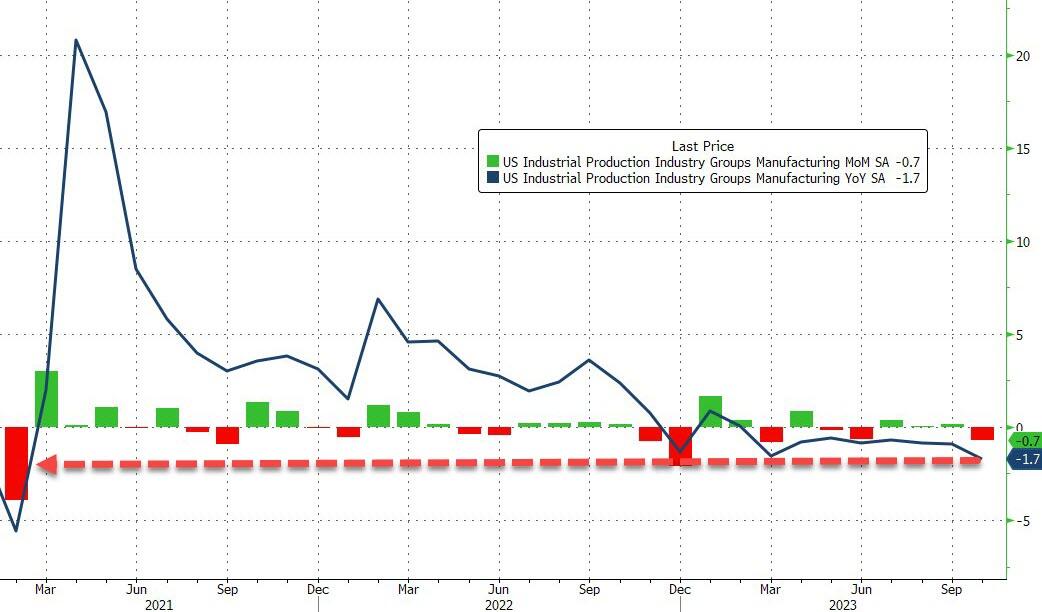
On the manufacturing specific sector, consensus was for a 0.4% drop MoM but it was considerably worse, dropping 0.7% MoM (and September’s print was revised down from +0.4% to +0.2% MoM). That is the biggest MoM drop since March and biggest YoY drop since the COVID lockdowns.
That is also the 8th straight month of YoY declines for Manufacturing production.
Source: Bloomberg
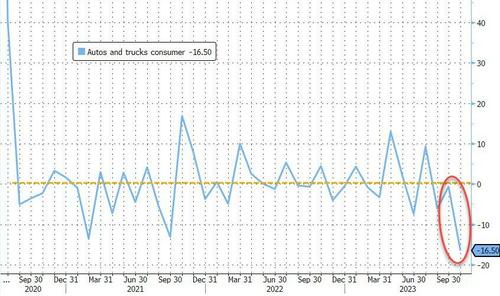
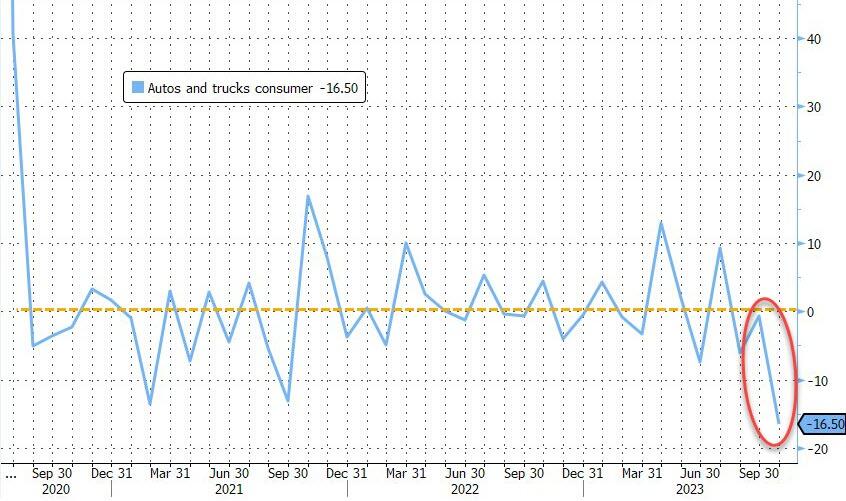
Output was weighed down by a 10% plunge in motor-vehicle production as the annualized rate of car assemblies dropped to 9.22 million units, the least since February 2022. Excluding parts production, autos and trucks production fell 16.5% MoM – the biggest drop since the COVID lockdowns…
Source: Bloomberg
Starting in September, the United Auto Workers union authorized targeted strikes against the Big Three Detroit automakers, disrupting production at the companies and at their suppliers. The UAW reached tentative agreements with management in late October, laying the groundwork for a rebound in factory output in November.
So theorteically, we should see bounce back next month. Unless demand – as WMT hinted at – has fallen off a cliff.
After listening in horror to Joe Biden’s press conference after his summit with China’s Xi, I had to ask the following question: what does Joe Biden has in common with Georgia Tech? Answer? They are both rambling wrecks. Biden made a horrendous foreign policy blunder by calling Xi a “dictator” and almost blew it by nearly spillling the beans on our foreign policy negotiations with Israel. SecState Blinken had to intervene. We are represented by Winken (Harris), Blinken and Nod (Biden, who usually looks asleep or confused).
But back to the horrors of a slowing economy.
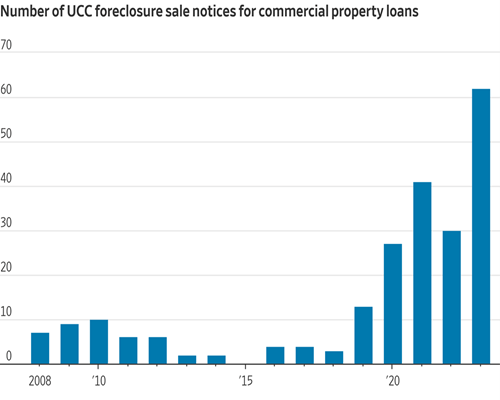
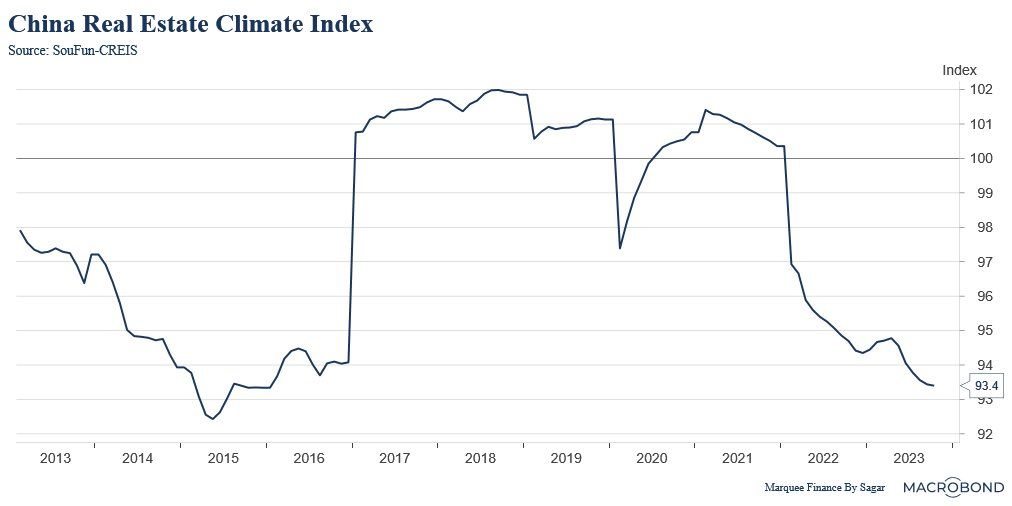
As the US economy slows down (like Biden himself), we are seeing further cracks in the real estate market. Foreclosure sale notices for commercial property loans are exploding.
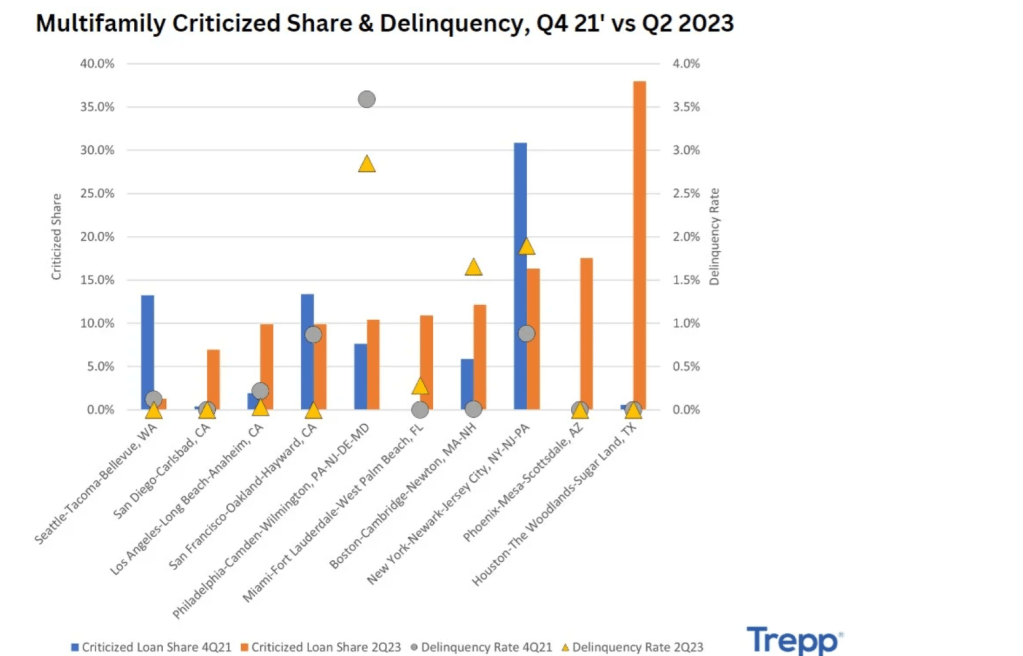
And depending on the MSA, multifamily delinquencies are booming, like in Houston, Texas, New York City and Phoenix AZ.
Then we have this headline: “Not Just Office Towers – Commercial Real Estate Sales Crater Throughout Los Angeles.” It’s difficult to find big commercial real estate deals of any kind in Los Angeles. A new report from NAI Capital reveals how severe and universal the decline in activity is throughout the region this year amid collapsing values, higher interest rates, and a new tax on property sales above $5 million.
Yes, I know, California’s real estate woes are mostly the fault of their politicians like Governor Gavin (Gruesome) Newsom. The same guy who ordered San Francisco’s homeless population to be moved creating a new Potemkin Village. But rising interest rates are the fault of excessive spending by Congress and the Biden Administration.
Biden says he wants 4 more years to finish the job. Like killing off the mortgage market completely, Joe?
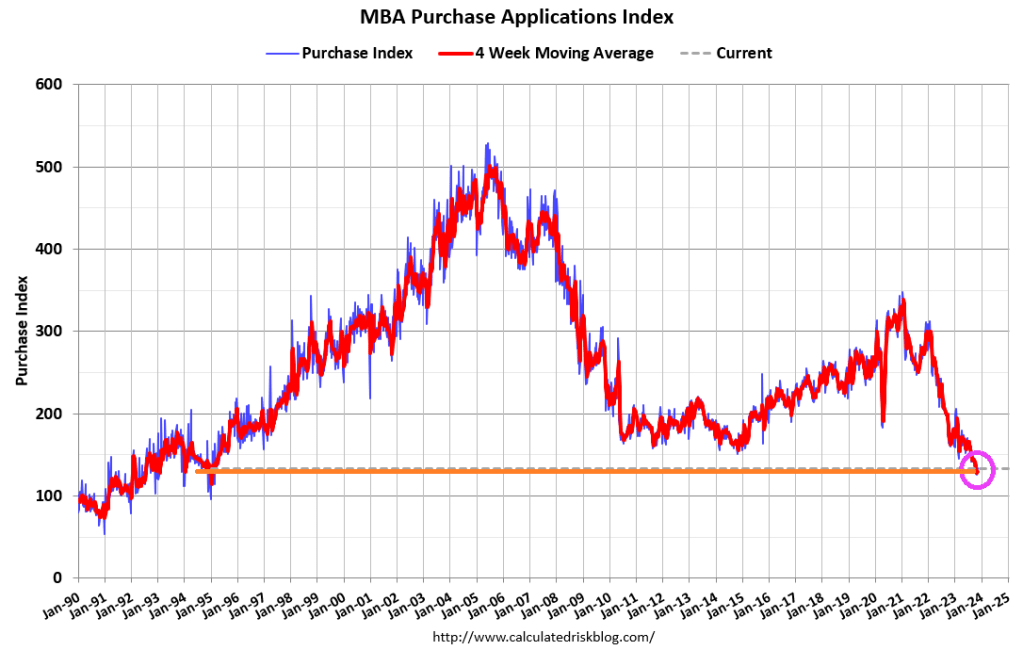
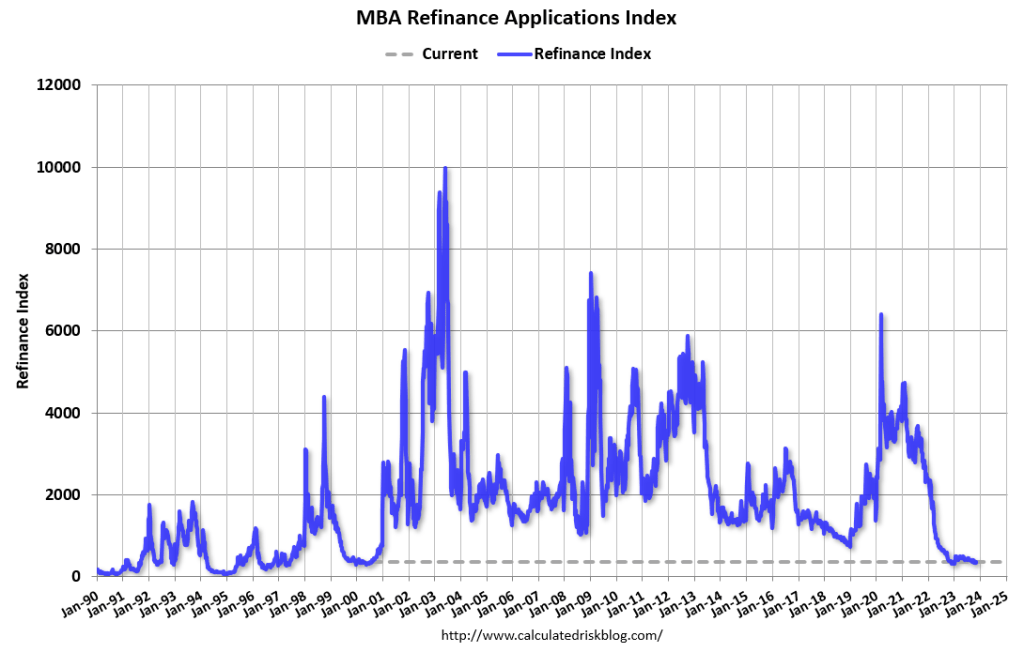
Mortgage applications increased 2.8 percent from one week earlier, according to data from the Mortgage Bankers Association’s (MBA) Weekly Mortgage Applications Survey for the week ending November 10, 2023.
The Market Composite Index, a measure of mortgage loan application volume, increased 2.8 percent on a seasonally adjusted basis from one week earlier. On an unadjusted basis, the Index increased 0.4 percent compared with the previous week. The seasonally adjusted Purchase Index increased 3 percent from one week earlier. The unadjusted Purchase Index decreased 0.3 percent compared with the previous week and was12 percent lower than the same week one year ago.
The Refinance Index increased 2 percent from the previous week and was 7 percent higher than the same week one year ago.
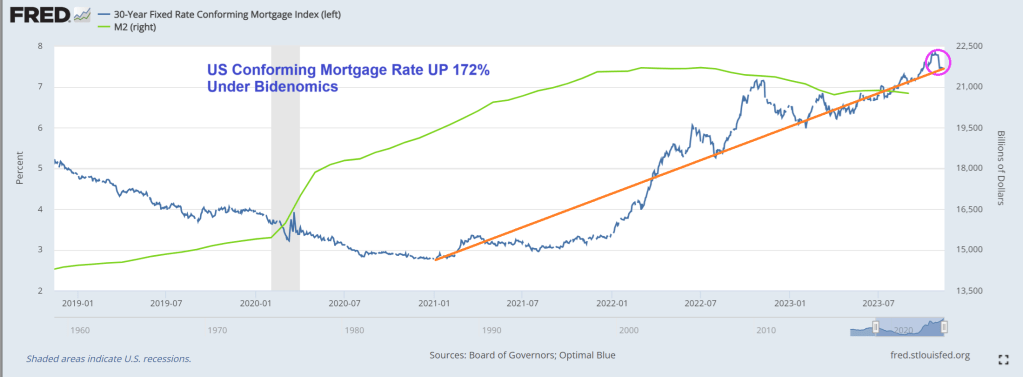
Of course, mortgage rates have been declining slightly over the past few weeks, but remain up 172% under Biden.
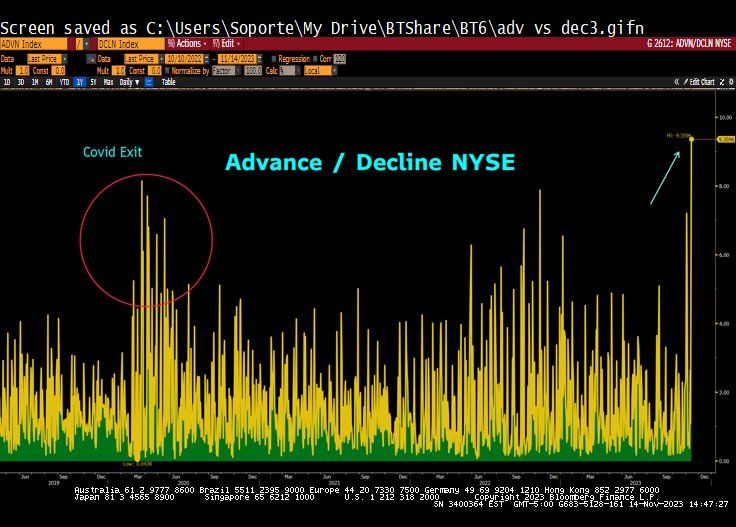
At least the stock market is booming after the inflation report signalled that The Fed is likely done with rate hikes.
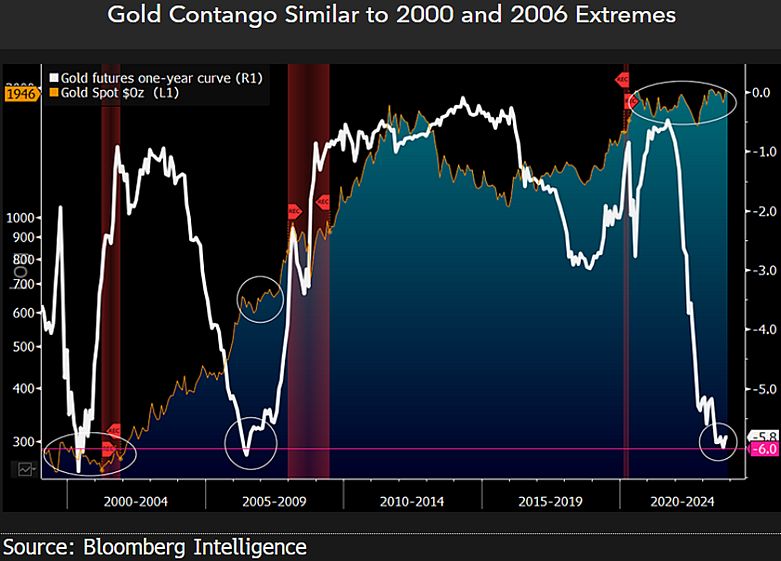
On the gold front, we are seeing evidence of contango.
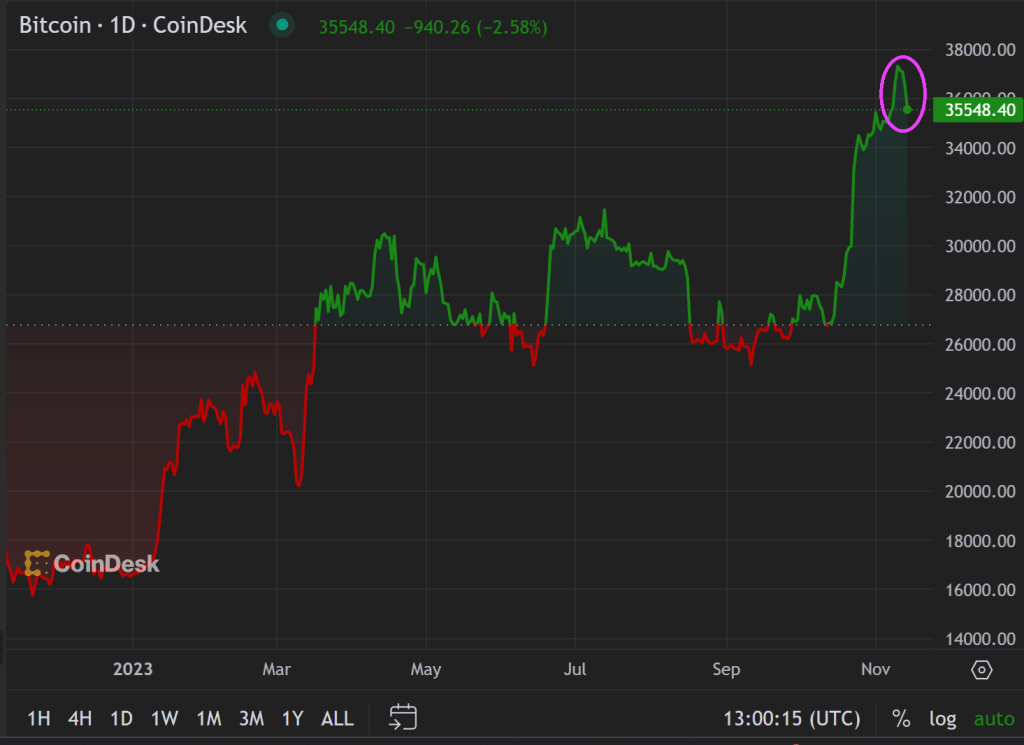
Bitcoin? Down a wee bit after a staggering rise in price over the past year.
Here is China’s Xi meeting with Biden’s likely replacement, “Greasy Gavin” Newsom and Newsom’s likely Treasury Secretary, Janet “Too Low For Too Long” Yellen. Newsom, Yellen and Xi all want havoc in America.










 Confounded Interest - Anthony B. Sanders
You must be logged in to post a comment.