The 2020 Covid outbreak led to a massive (and generally awful) reaction. There were economic shutdowns that caused extensive damage (particularly to small firms), but it was the massive overreaction by The Federal government in terms of Covid relief and The Federal Reserve’s expansion of the money supply that caused considerable damage.
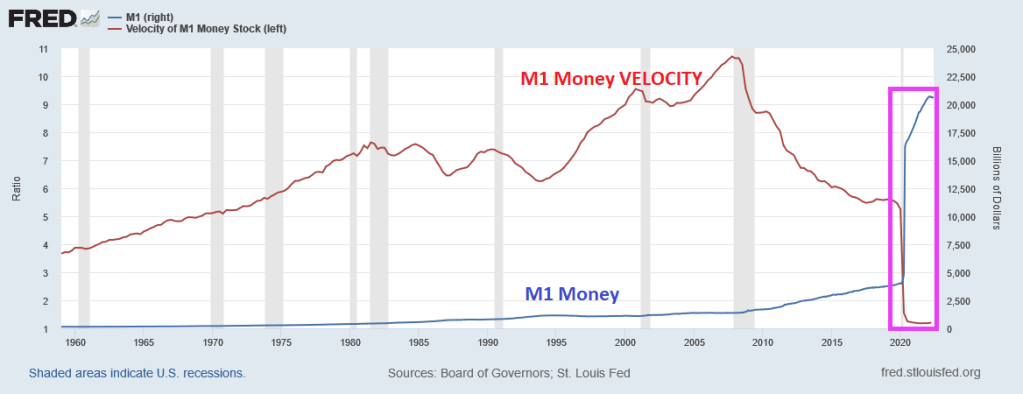
One truly horrific chart is that of M1 Money and M1 Money Velocity (M1/GDP). M1 Money surged with Covid driving M1 Money Velocity down to levels never seem before.
The broader measure of money, M2, isn’t as dramatic, but we also see that M2 Money VELOCITY has plunged to levels never seen before.
What does low money velocity indicate? Simply put, The Fed is printing trillions of dollars, but GDP isn’t moving much. But that won’t stop Congress from spending (and using The Fed to buy its debt).
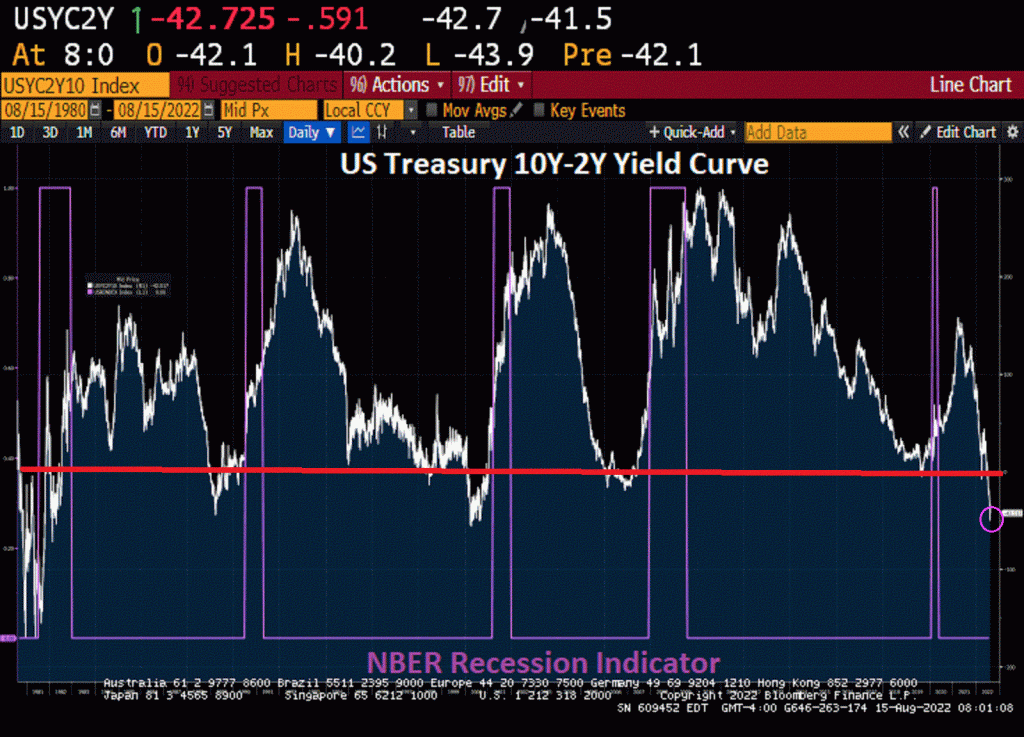
So, here we sit. This morning, the US Treasury yield curve (10Y-2Y) remains inverted. This AM, the curve inverted another -.591 basis points to -42.725, a sign of impending recession.
Yes, we are living through Jay Powell’s famous chili episode where money velocity is near historic lows and we have an inverted yield curve.
BTW, congratulations to Will Zalatoris (aka, Happy Gilmore’s caddy) for his first PGA Tour victory at the FedEx St. Jude Championship!
Mike Lea and I wrote a paper entitled “Do We Need The 30yr FRM (Fixed-rate Mortgage)”. We argue that millions of Americans would benefit from an adjustable-rate mortgage like the 5/1 ARM for a host of reasons.
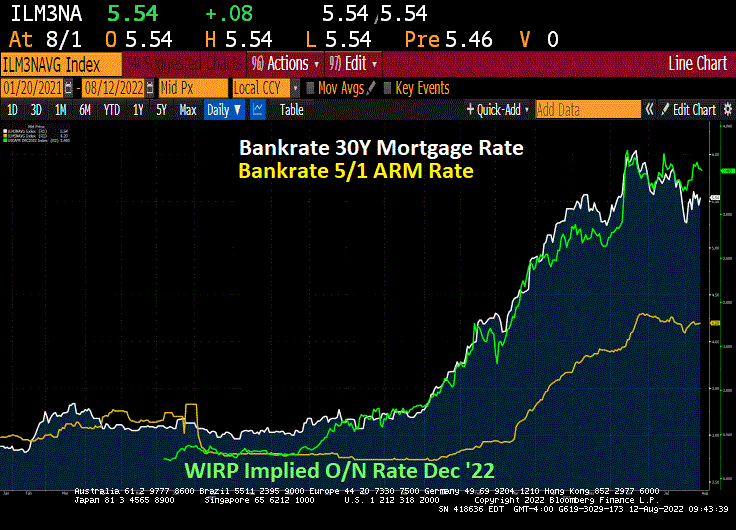
One good reason for a 5/1 ARM is the fact that it 134 basis points less expensive than the 30yr fixed-rate mortgage.
Mortgage rates have risen dramatically with the expectation of Fed rate tightening (green line).
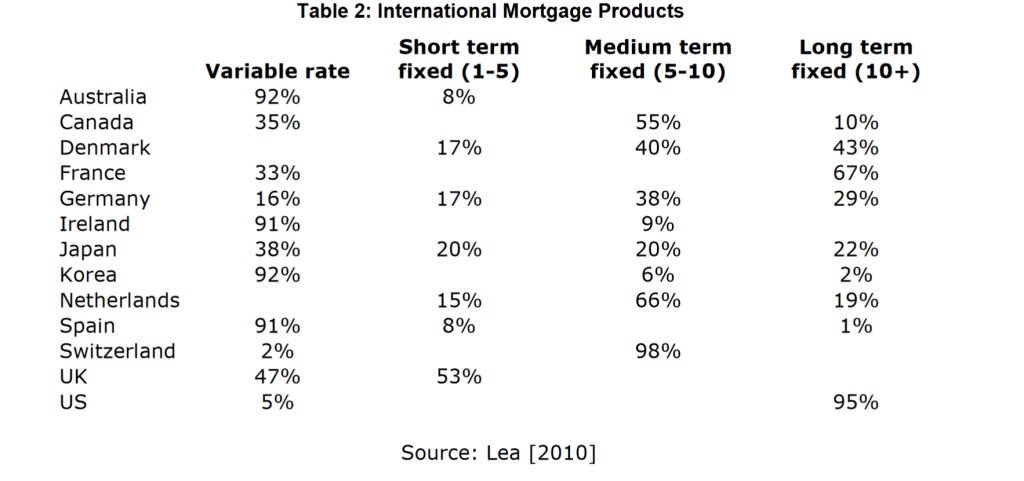
Yes, there is a “fear factor” built in the 30r FRM (“OMG! The mortgage market will collapse without the 30yr FRM!!!!) Hogwash. Or malarkey, as Joe Biden likes to say. The mortgage market actually see the US join the rest of the world in having adjustable-rate mortgage being the predominant mortgage product.
US ARM share peaked at 10.8% in June 2022 before retreating to 7.4% as the 30yr mortgage rate retreated.
The US economy may need to undergo a deeper and longer recession than investors currently anticipate before inflation can be brought under control, according to Zoltan Pozsar of Credit Suisse Group AG.
Markets expect the surge in consumer prices will soon peak and central banks will become less hawkish, but there’s a high risk that global cost pressures will remain elevated, Pozsar, global head of short-term interest-rate strategy at Credit Suisse in New York, wrote in a client note.
The world is being wracked by an economic war that’s undermining the deflationary relationships that have prevailed in recent decades where Russia and China supplied cheap goods and services to more developed nations such as the US and those in Europe, he said.
“War is inflationary,” Pozsar wrote. “Think of the economic war as a fight between the consumer-driven West, where the level of demand has been maximized, and the production-driven East, where the level of supply has been maximized to serve the needs of the West.” That pattern held “until East-West relations soured, and supply snapped back,” he said.
The result is that inflation is now a structural problem, rather than a cyclical one. Supply disruptions have arisen from the changes in Russia and China, along with tighter labor markets due to immigration restrictions and a reduction in mobility caused by the coronavirus pandemic, Pozsar said.
There’s now a risk the Federal Reserve under Chair Jerome Powell has to raise interest rates to 5% or 6% and keep them there to create a substantial and sustained reduction of aggregate demand to match the tighter supply profile, he said.
‘More Misguided’
Connect the dots on the biggest economic issues.Connect the dots on the biggest economic issues.Connect the dots on the biggest economic issues.
Dive into the risks driving markets, spending and saving with The Everything Risk by Ed Harrison.Dive into the risks driving markets, spending and saving with The Everything Risk by Ed Harrison.Dive into the risks driving markets, spending and saving with The Everything Risk by Ed Harrison.
Sign up to this newsletter
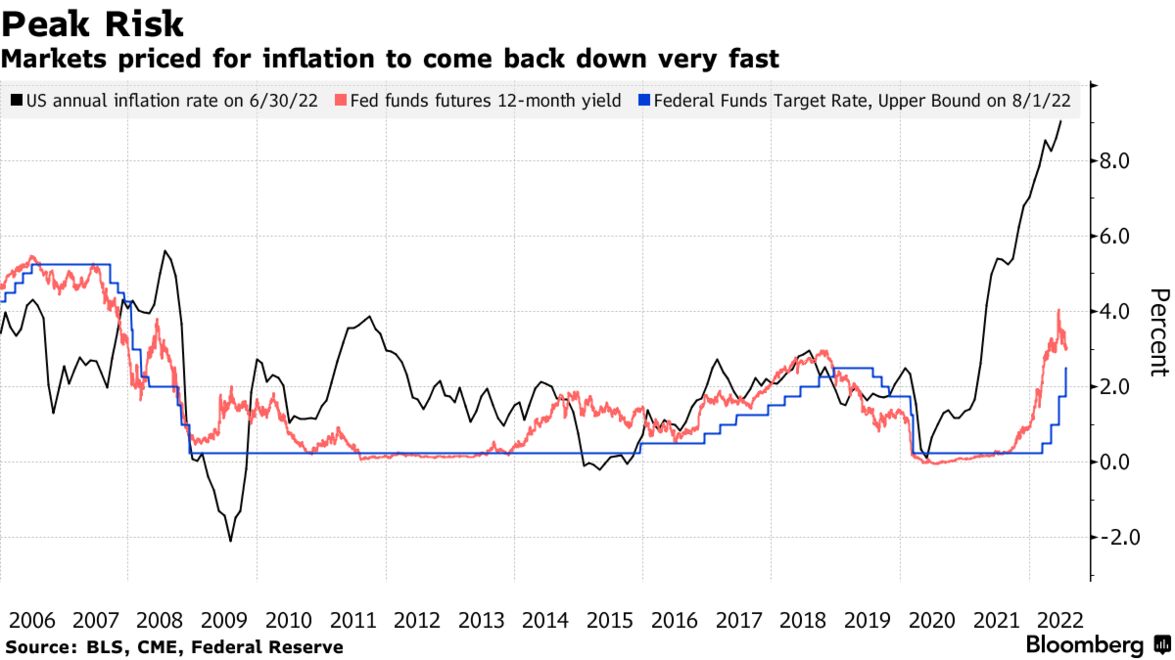
Pozsar’s warning that inflation will stay elevated puts him at odds with the Treasury market, which rallied last month as investors switched their focus to recession risks from inflation concern. While an economic slowdown typically weighs on consumer prices, the latest annual US inflation reading of 9.1% for June remains far above the Fed’s 2% goal, although the price surge is forecast to slow for the first time in three months to 8.8% in July according to a Bloomberg poll of economists.
The bond market is more misguided now than at any other time this year as traders wager the US central bank will start cutting rates in early 2023, Bloomberg Economics’ chief US economist Anna Wong and her colleagues said this week. Money markets are wagering on almost one percentage point of hikes by year-end followed by a quarter-point cut by June.
“Interest rates may be kept high for a while to ensure that rate cuts won’t cause an economic rebound (an ‘L’ and not a ‘V’), which might trigger a renewed bout of inflation,” Pozsar wrote in his note. “The risks are such that Powell will try his very best to curb inflation, even at the cost of a ‘depression’ and not getting reappointed.”
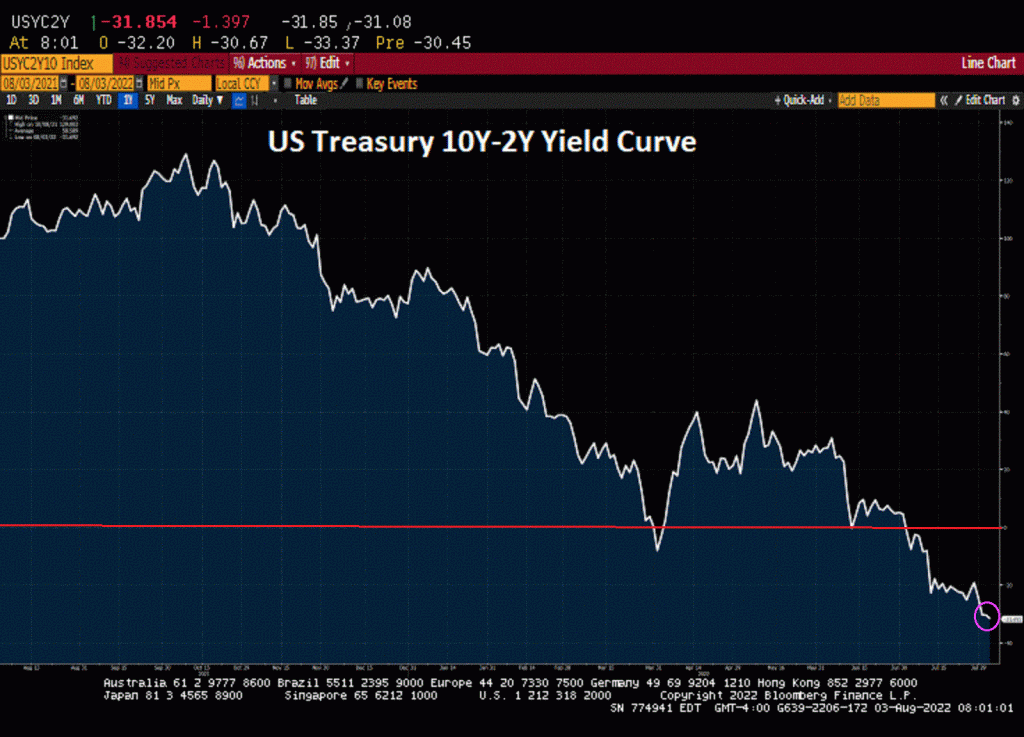
Speaking of “recession,” the US Treasury 10Y-2Y yield curve has inverted even further to -31.69 BPS.
TED refers to the difference between the three-month Treasury bill and the three-month LIBOR based in U.S. dollars, a measure of fear in the market.
The 3-month TED spread is rising awfully fast. A sign of impending recession.
US bank credit default swaps (CDS) are rising fast as inflation gets ugly.
The US Treasury 10Y-3M curve is bumping against the zero barrier.
I am still shaking my head at President Biden chastising gasoline stations for not lowering prices at the pump when refiners are near full capacity and the Biden Administration is doing nothing to increase the supply of US-source non-green energy.
Goldman Sachs Senior Chairman Lloyd Blankfein urged companies and consumers to gird for a US recession, saying it’s a “very, very high risk.”
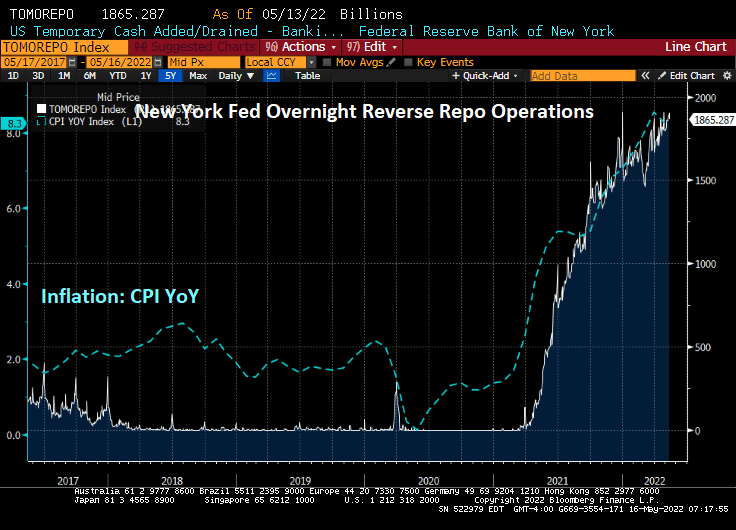
I am not surprised. Take a look at The Fed’s Overnight Reverse Repo operations. As inflation surged in 2021 and 2022, banks are parking more funds at The Fed. Fear?
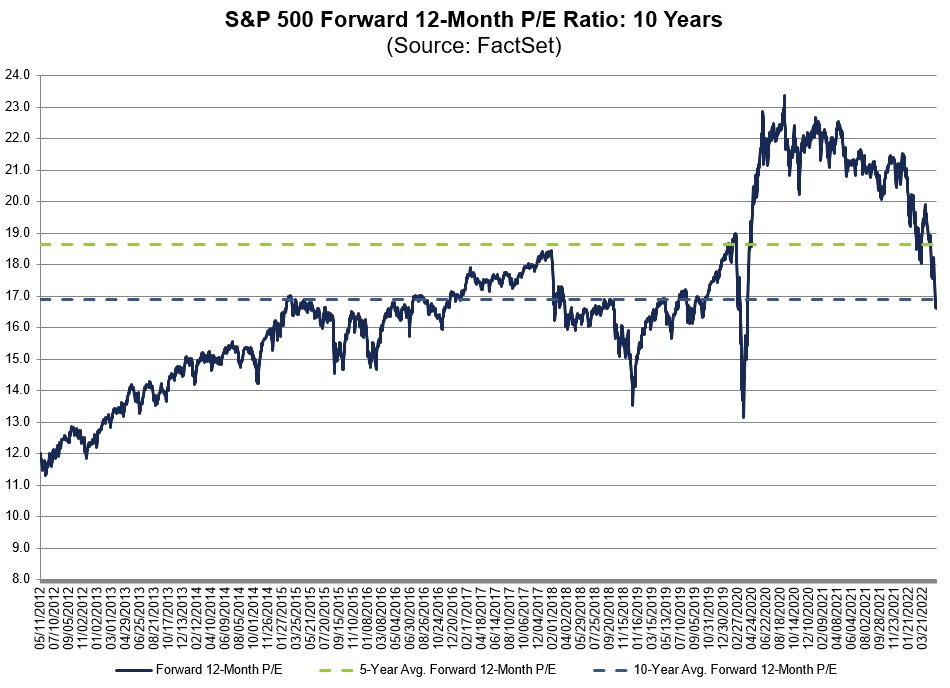
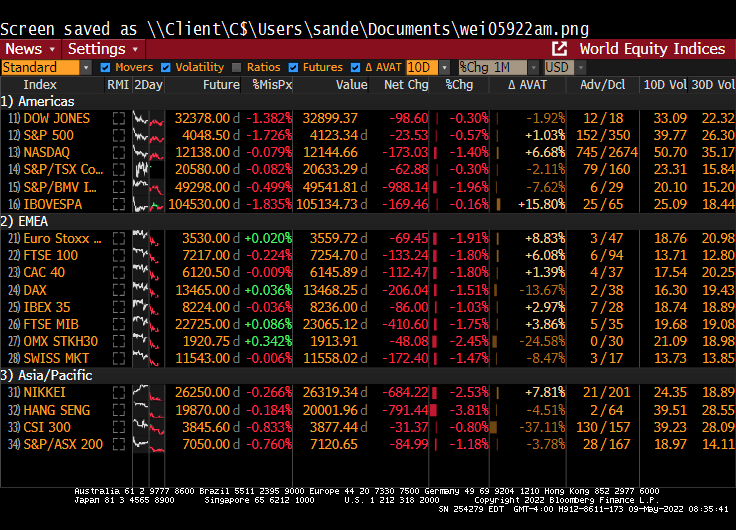
We are seeing the S&P 500 futures down today after a nice rally on Friday. The &P 500 forward 12-month P/E ratio is back to pre-Covid, pre Federal spending surge, pre Fed monetary Stimulypto of 2016.
Goldman Sachs see the 10-year Treasury yield rising to 3.3%. That bodes ill for 30-year mortgage rates, perhaps push mortgage rates up another 40 basis points to 5.80%.
As the US is engulfed in inflation while The Federal Reserve is engaged in trying to fight inflation (well, sort of), we are seeing markets taking a shellacking, particularly commodities.
One indicator of a slowdown is declining commodity prices. Crude oil futures are down around -2.5%. Iron Ore is down -5% and steel rebar is down -3.21%.
Inflation numbers are due out Wednesday and are forecast to be 8.1% YoY (based on headline CPI). But combined with a slowing global economy, we get the dreaded “STAGFLATION.”
Meanwhile, the S&P 500 index futures are down around 1.726% for Monday open. Asian markets already got clobbered with the Hang Seng down almost -4%.
On the bond side, the 10Y Treasury Note yield rose to 3.20% early in the morning, but has retreated to 3.1447% as of 8:40am EST.
Both stock and bond market volatility measures are increasing.
So, is it a Blue Monday effect? Or global stagflation?
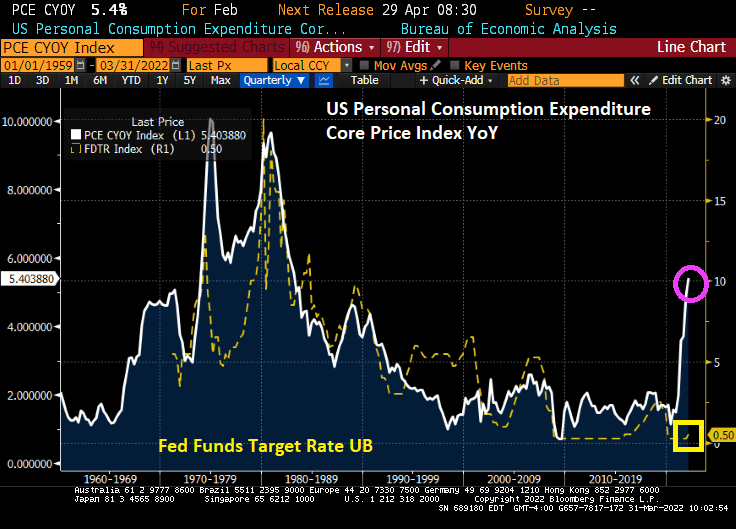
February’s Core Personal Consumption Expenditures (PCE) price YoY grew to 5.4%, the highest since 1983. The spread between the PCE Core Deflator and The Fed Funds Target Rate (upper bound)
In terms of the spread, it is the highest since the 1970s.
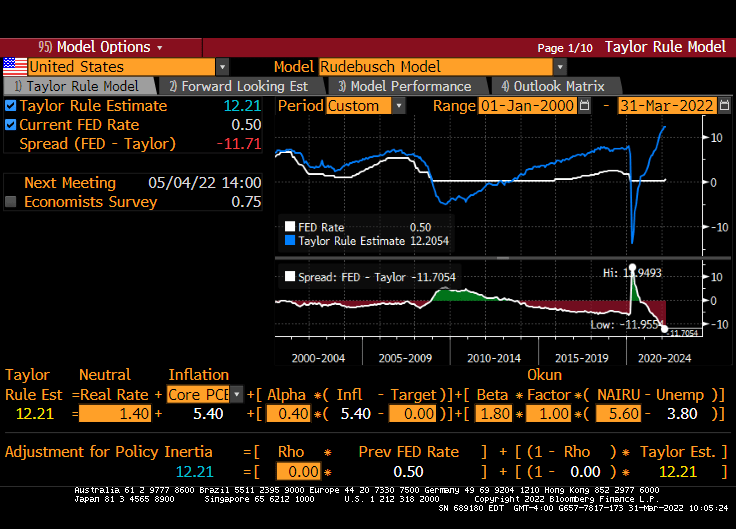
The Taylor Rule (which Jerome Powell probably thinks is the New Jersey breakfast meat “Taylor Ham”) indicates that The Fed’s target rate should be 12.21%. This is using the Rudebusch specification of the Taylor Rule.
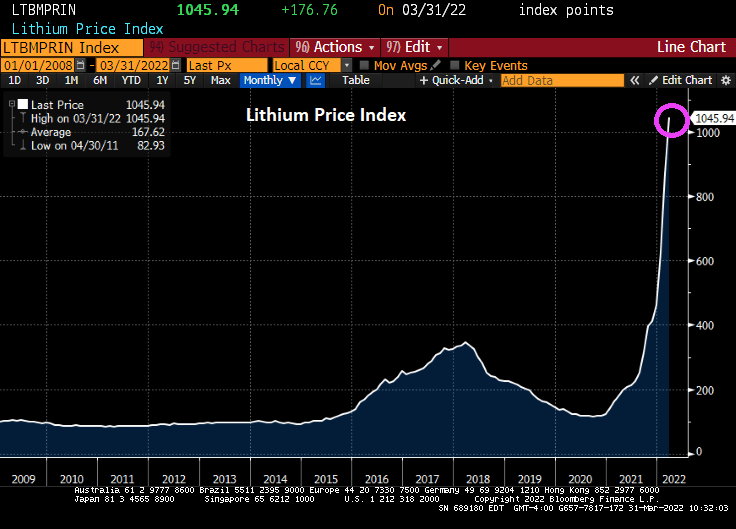
Now that the Biden Administration is going gangbusters on building electric cars, lithium prices are going through the roof.
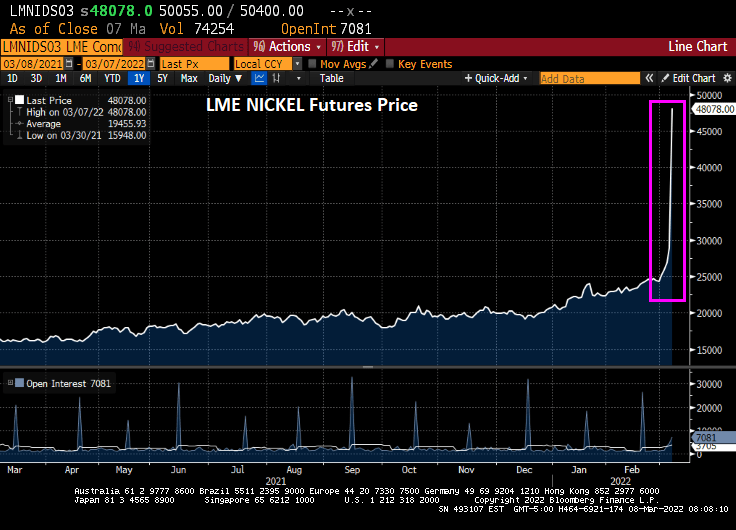
America is suffering a “nickel pickle.” As the US Federal government pushes their green energy agenda, Mayor Pete Buttigieg (aka, Transportation Secretary) on Monday said “the American people stand to benefit from having more electric vehicles on the road.” Unfortunately, electric vehicles use nickle in their production and guess who produces the most nickel? Russia.
Nickel futures were up +66.25%.
Unfortunately, Russia is the largest miner of nickel. But Brazil is second.
We are also seeing rising volatility of US stocks (VIX) and bonds (MOVE) as Russia’s invasion of Ukraine continues and crude oil prices soar.
While NYM WTI Crude volatility is up +296%, NYM DUBAI Crude is up +4,626.19%, and NYM JKM (Japan/Korea) natural gas volatilty is up 1,900%.
Now, US oil and gas exploration and drilling rig count has almost doubled under Biden as oil price surge.
We are in an American pickle since Russia is a major supplier of oil and natural gas as well as nickel.
Raphael Bostic and Goldman Sachs are both calling for dramatic rate increases to fight inflation … that they helped cause with their monetary stimulypto. I call this The Fed’s March of the Toreadors as The Fed now attempts to kill the bull market.
(Bloomberg) — The Treasury yield curve flattened to the lowest level in over a year on Monday as the prospect of a super-sized Federal Reserve rate increase in March gained traction, weighing disproportionately on shorter-dated tenors.
Two-year U.S. yields climbed as much as 4 basis points after Raphael Bostic, the president of the Fed’s Atlanta branch, said the U.S. central bank could raise its benchmark rate by 50 basis points if a more aggressive approach to taming inflation is needed.
That narrowed the gap with ten-year counterparts — which rose about half as much — to the least since October 2020. The last time the Fed delivered a half-point increase to borrowing costs was at the height of the dot-com bubble in 2000.
The repricing extended a move spurred last week, after Fed Chair Jerome Powell underscored the policy maker’s determination to put a lid on inflation. The market positioning may have been exacerbated by hedge funds that had been leaning the wrong way before Powell’s address.
Traders are currently betting the Fed will deliver 32 basis points of tightening in March, more than fully pricing an increase of a quarter-point. That puts the implied probability of a 50-basis-point increase at almost 30%. The odds of such a move in December were zero.
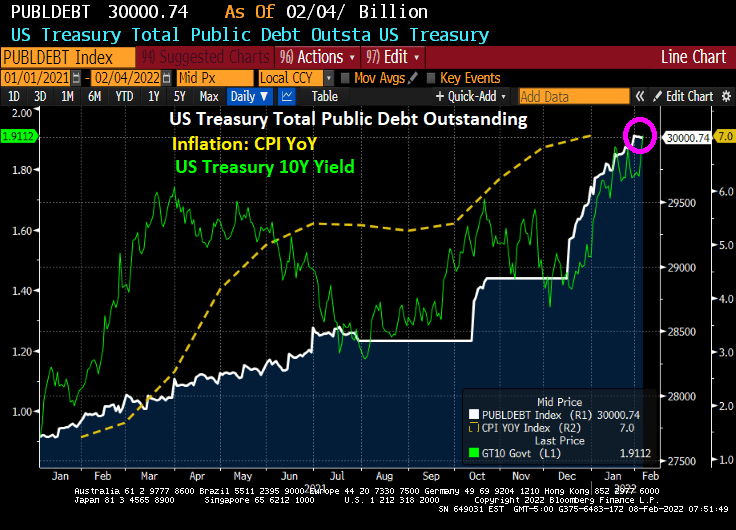
Consumer prices rose an annual 7% in December, the fastest pace in almost four decades. Powell left the door open to increasing rates at every meeting, and didn’t rule out the possibility of a 50-basis-point hike.
In an interview with the Financial Times, Bostic stuck to his call for three quarter-point interest rate increases in 2022, while saying that a more aggressive approach was possible if warranted by the economic data. Bostic is a non-voting member of the FOMC this year.
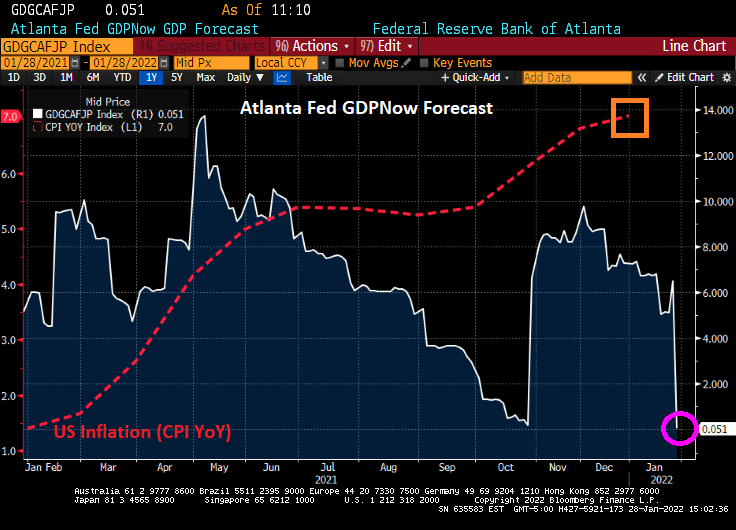
Since the rapid growth in inflation was caused by a combination of too much Fed stimulus, too much fiscal stimulus and “green” energy policies, it is unclear whether an increase of 50 basis points will do much, particularly if Bostic’s own Atlanta Fed GDPNow forecast of 0.051% is accurate. Raising ratesif the economy is slowing??
To be clear, Bostic and others are trying to signal The Fed’s intent well in advance to avoid a surprise knock-down of the stock market. Or a killing of the bull market.






















 Confounded Interest - Anthony B. Sanders
You must be logged in to post a comment.