The Federal Reserve’s two goals of price stability and maximum sustainable employment are known collectively as the “dual mandate.” Unfortunately, inflation is running away (bad) from employment gains (good). Sort of like “The Good, The Bad and The Ugly.” But just the Good and The Ugly combine to create the Misery Index.
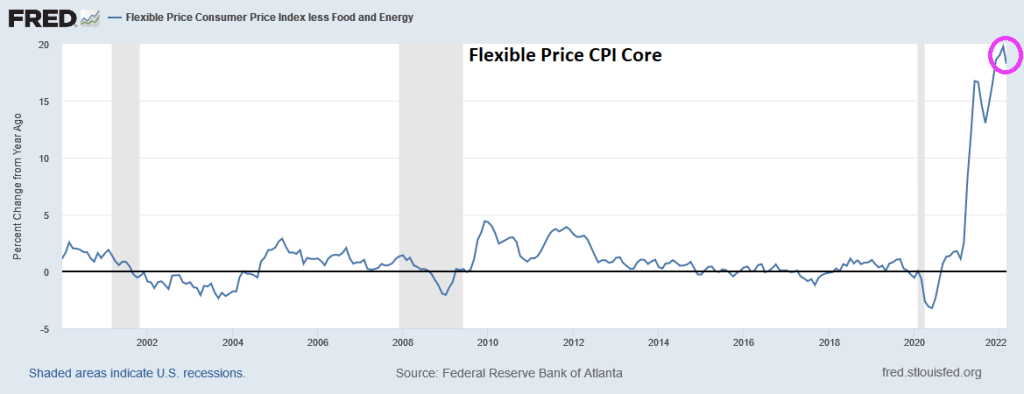
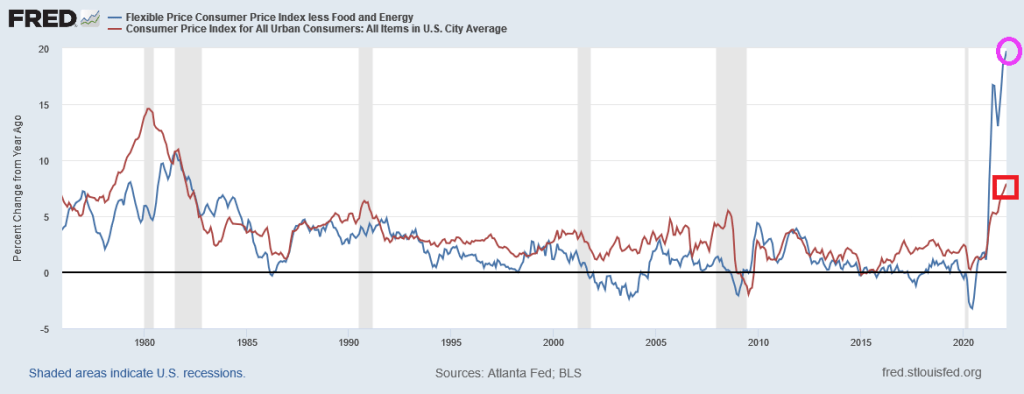
Here is the Atlanta Fed’s CORE flexible CPI YoY for March. The good news? Flexible Core CPI YoY was a little lower than the historic high reading in February. The bad news? We are still talking about 21.82%+ rise in prices (down from 23.56% in February).
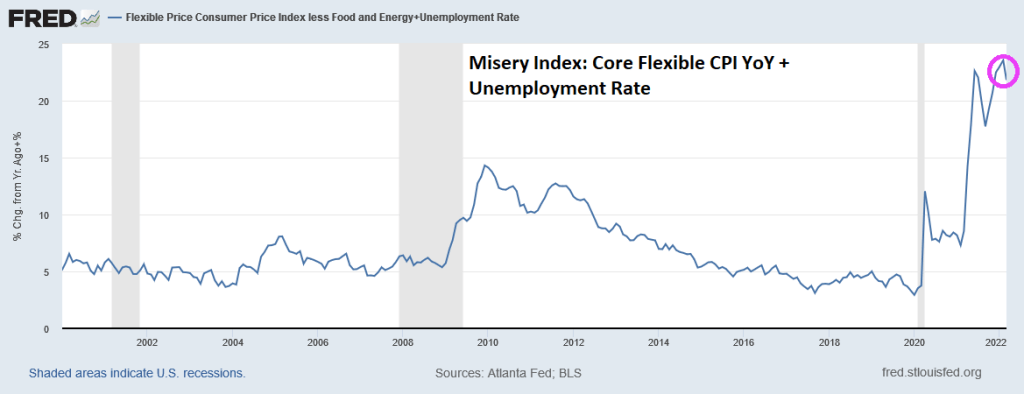
If I use the Atlanta Fed’s flexible consumer price CORE index combined with the U-3 unemployment rate, we see that March’s inflation report plus U-3 unemployment is generating a misery index that was last seen in July 2008 during The Great Recession. Unless we consider the July 2021 reading of 31.3%, so we have seen two horrible misery index readings under Biden.
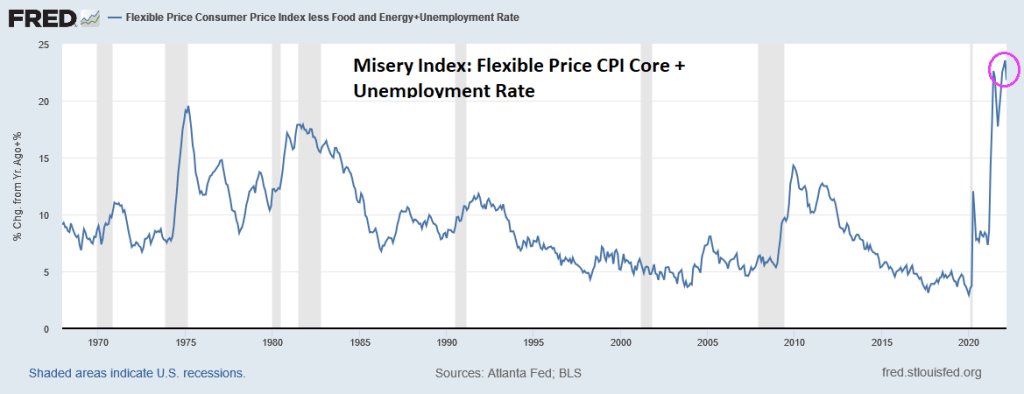
If we look at the Misery Index since 1967, we now have the GOAT (Greatest of All-time) Misery.
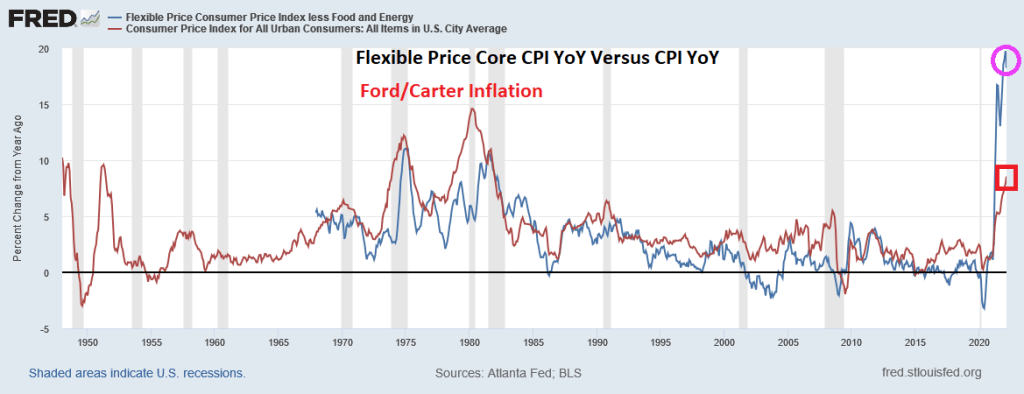
Now, inflation under Presidents Ford and Carter (red line) were higher than the flexible core price index (blue line) in the 1970s and 1980. But flexible core price CPI YoY is substantially higher than March’s CPI growth of 8.5%.
The bottom line is that inflation losses are far outweighing the employment gains, resulting in elevated misery.
US real average weekly earnings growth YoY is down to -3.60%. That is the lowest since 2007 and is worse than The Great Recession and financial crisis of 2008.
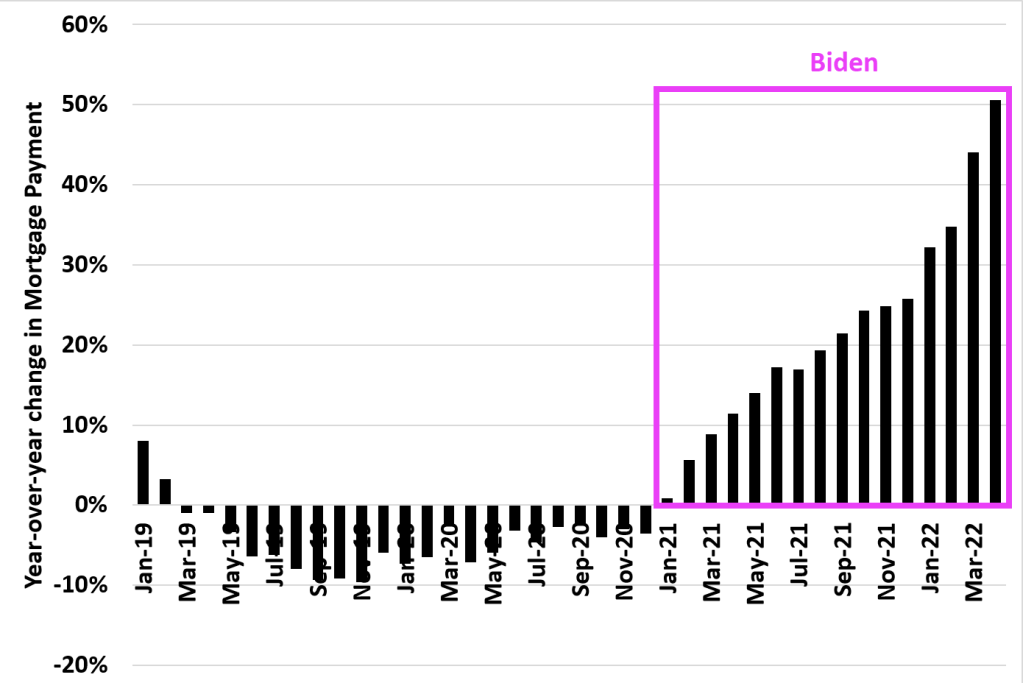
And look at this chart of mortgage payments under Biden. The US was actually experiencing DECLINING mortgage payments YoY in 2019 and 2020. But under Biden’s leadership, mortgage payments have increased by 50% making housing even MORE unaffordable for the middle class and lower-income households.
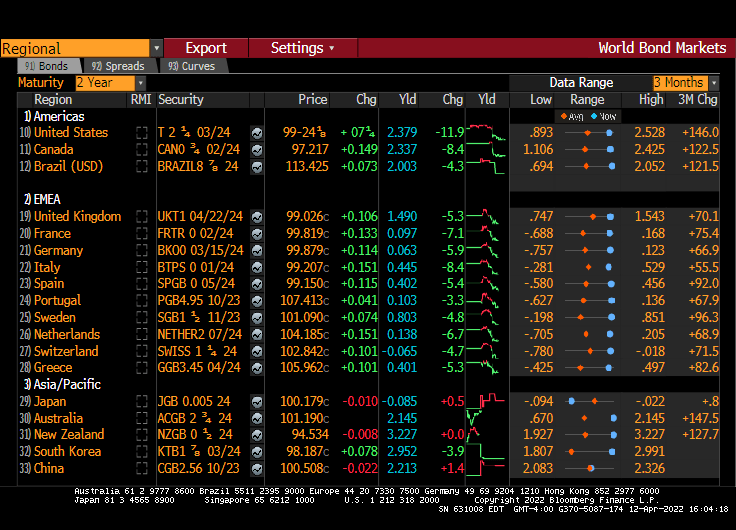
And now for something kind of scary. The US today suffered a 12 basis point decline in the 2-year Treasury yield, generally a bad sign for the economy. As if we needed more bad news for today.
Highest inflation in 40 years, worst wage growth since 2007 and rising mortgage payments. We will need all the luck we can get.
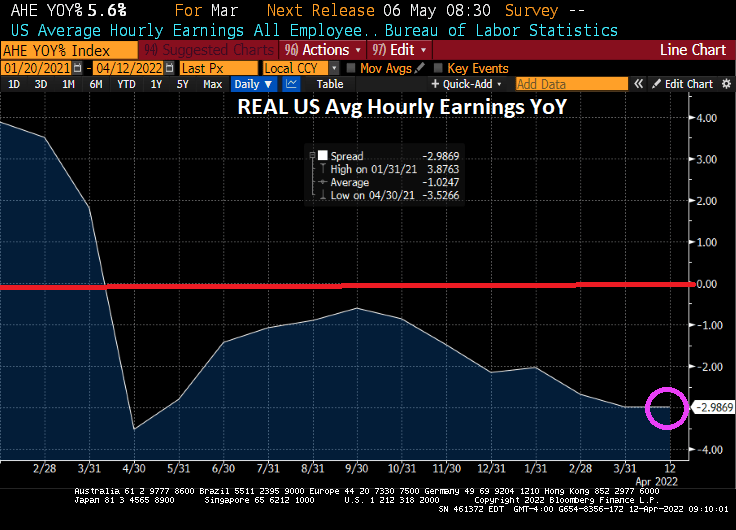
With 8.5% YoY inflation, REAL average hourly earnings growth fell to -3% YoY.
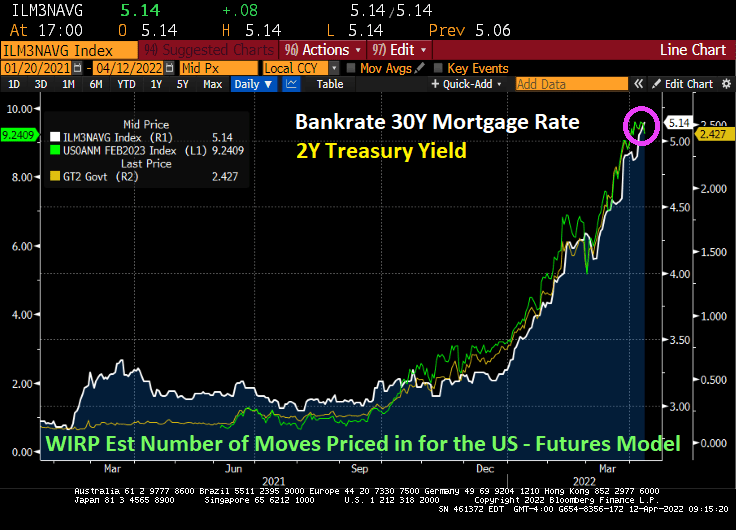
And with The Fed intent on extinguishing their part of the inflation, Bankrate’s 30Y mortgage rate rose to 5.14%.
Energy is the biggest culprit (fuel oil up 70.1% YoY) thanks to the double whammy of 1) Russia’s invasion of Ukraine and 2) Biden’s restrictions on oil and natural gas production. Food at home is up 10% YoY.
Here is a colorful chart of MoM growth in prices.
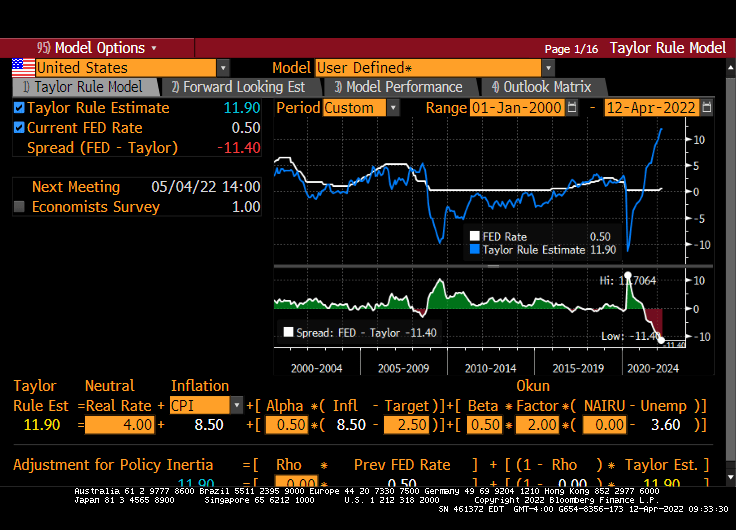
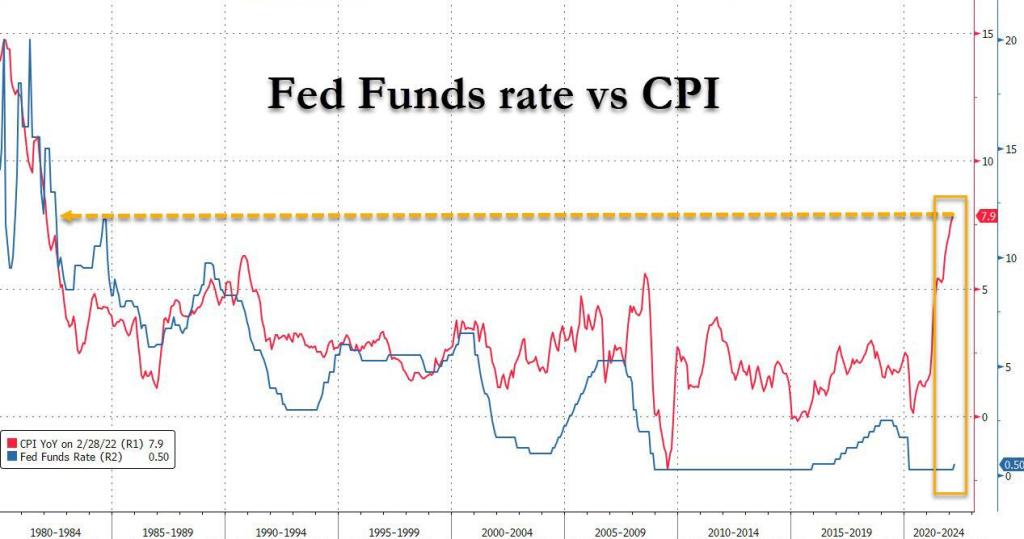
The Taylor Rule model now says that The Fed Funds Target Rate should be 11.90%. Hence, Fed Stimulypto is still in place with the signal that rates will increase.
How about WTI Crude and Brent Crude soaring over 4% today?
Once again, the Four Horsemen of the Inflation Apocalypse (Biden, Powell, Pelosi, Schumer) overstimulated the economy and financial markets with excessive monetary stimulus (Powell) and excessive Federal spending (Biden, Pelosi, Schumer) where demand soared for products and supply naturally hasn’t caught up.
As we are painfully aware, The Fed’s exaggerated monetary flood combined with Federal stimulus spending has led to horrible inflation.
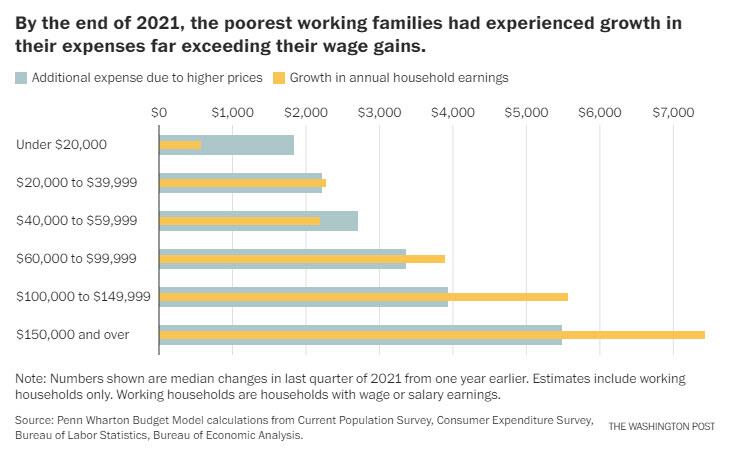
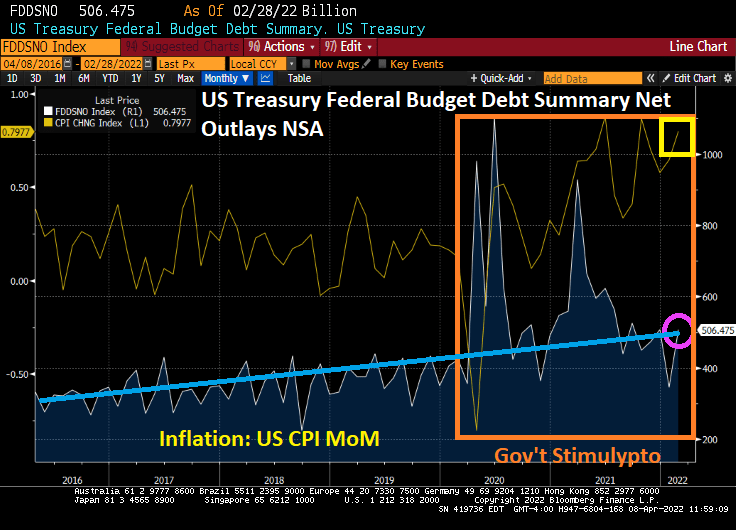
Yes, despite what government talking heads say, Federal stimulus increases demand for goods, the supply is generally slow to respond resulting in rising prices. Then government policies driving up energy prices also leads to highers prices. Throw in Federal Reserve monetary stimulypto and we have this chart from hell from Penn-Wharton. The chart shows that households earning less that $60,000 experience higher expenses due to rising prices than their gain in earnings.
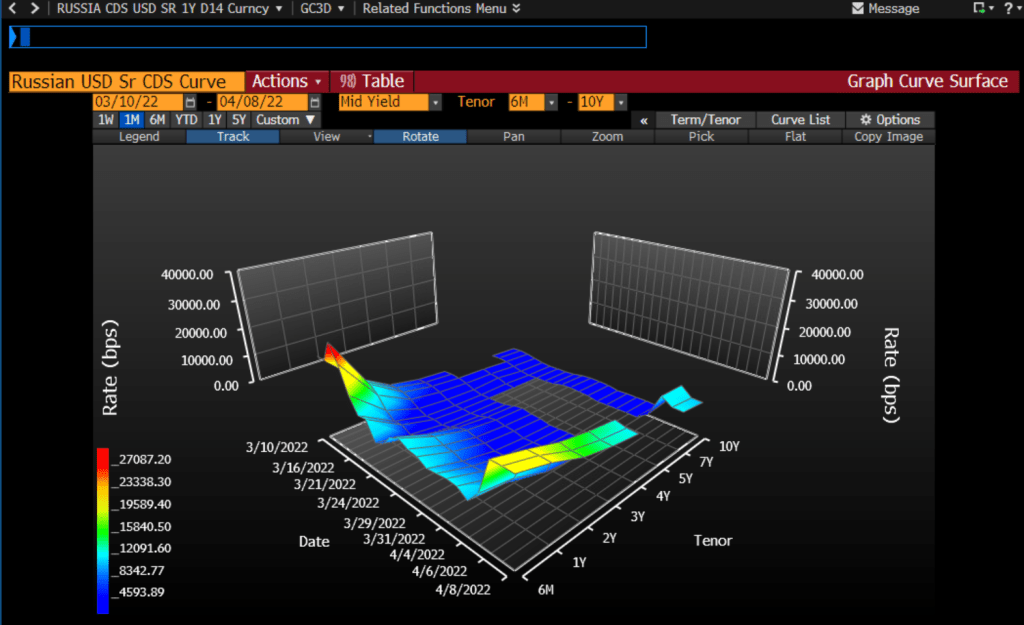
Another chart from hell is the Russian USD Credit Default Swap (CDS) curve. It is spiking at over 20,000.
The one-year Russian CDS is currently at a whopping 20,336 indicating that there is about a 99% of a Russian default over the coming year. As someone who lived through the 1998 Russian credit default scare on Wall Street, this will send a shock wave through credit and Treasury markets.
On the US Treasury front, this chart shows how steeply sloped the US Treasury actives curve has become. Steep until 3 years, then flat. I call this chart “T-Dazzle!” T-Dazzle because I can’t believe how badly the Biden Administration and The Federal Reserve are screwing up the country.
Crude oil? WTI Crude is back to almost $100 per barrel while Brent Crude is at $102.78 per barrel. Wheat is up 3.22% thanks largely to problems related to Russia invading Ukraine (Europe’s bread basket) and a dismal Chinese wheat harvest.
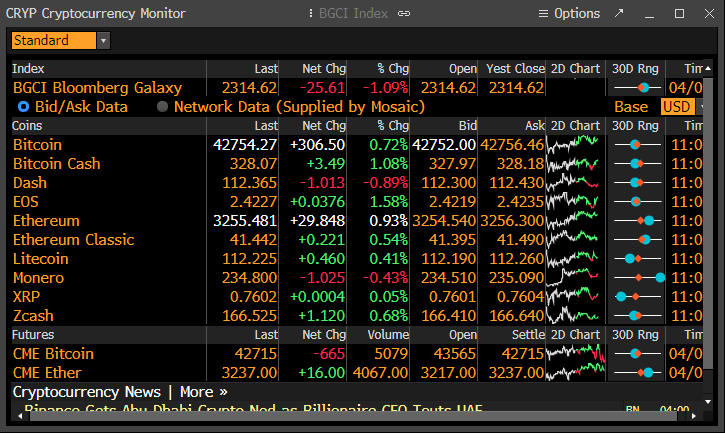
Cryptocurrencies, the alternatives to the US fiat dollar, are rising (in particular, Bitcoin and Ethereum).
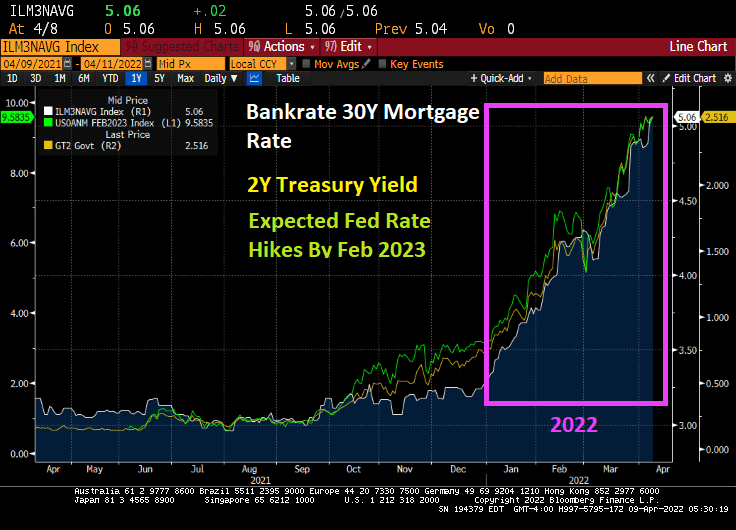
Of course, I have to finish up with the soaring 30-year mortgage rate.
2022 has been a tough year for bond investors and the mortgage industry.
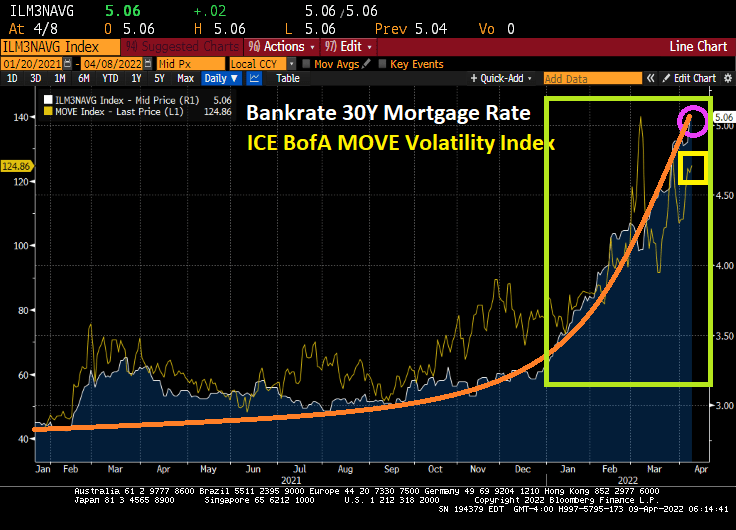
Doubleline’s Jeff Gundlach observed that the 2 Year Treasury yield is up 125 bp over the past month or so. I commented that the 2 Year Treasury Yield is up 179 bp since December 31, 2021 and the 30-year mortgage rate is also up 179 bp since the end of 2021. Yes, 2022 has been a dismal year for bonds and the mortgage market.
The ICE BofA MOVE index, a yield curve weighted index of the normalized implied volatility on 1-month Treasury options, has risen in 2022 along with the 30-year mortgage rate as the normally dormant Federal Reserve finally waking-up and trying to fight inflation.
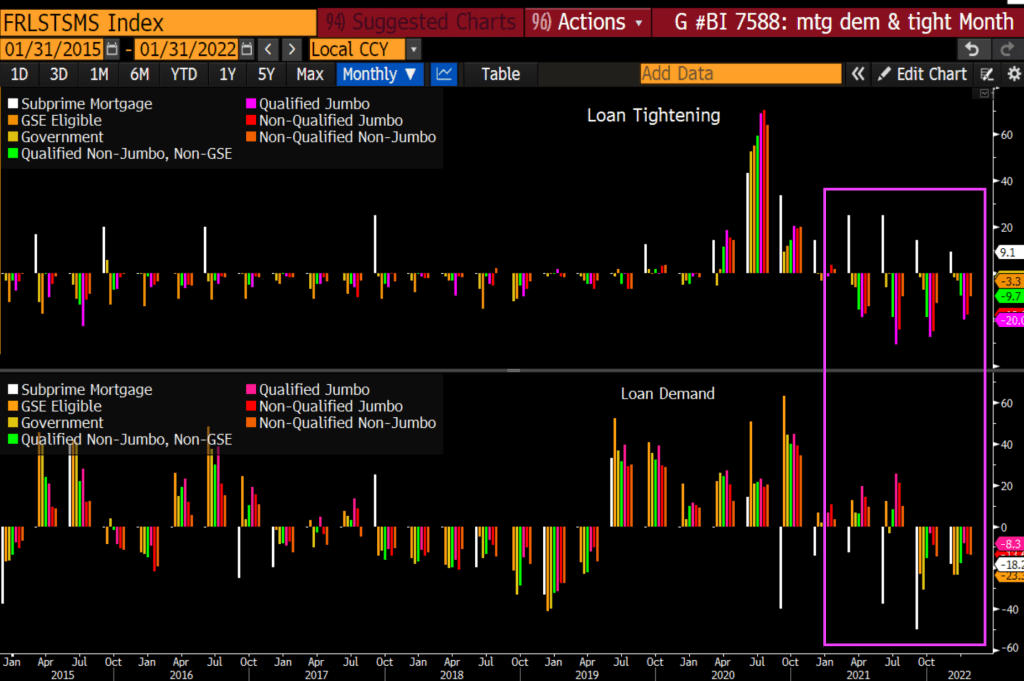
Mortgage demand backs off due to anticipated Fed rate hikes.
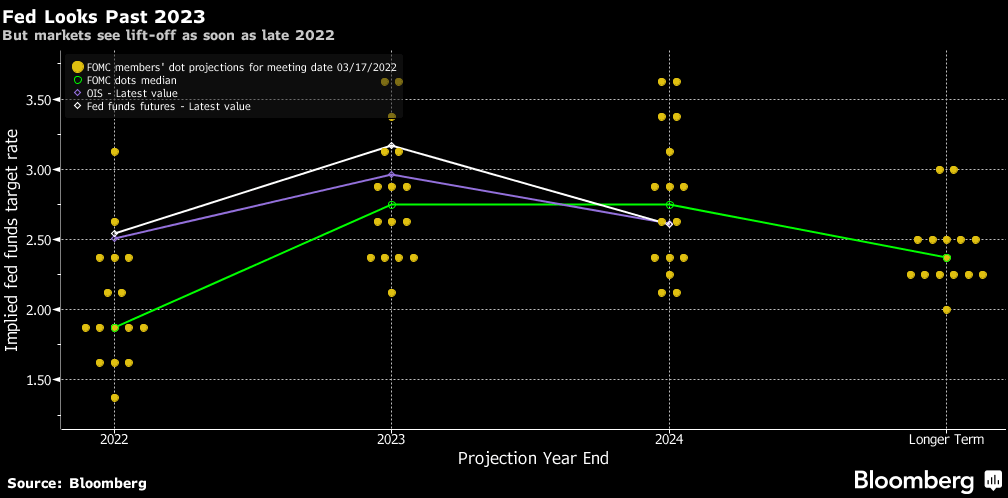
The latest Fed Dots Plot reveals that Fed Open Market Committee members are expecting Fed Funds rate increases in 2023, but remaining the same in 2024 (FOMC median projection). Then falling in the longer term.
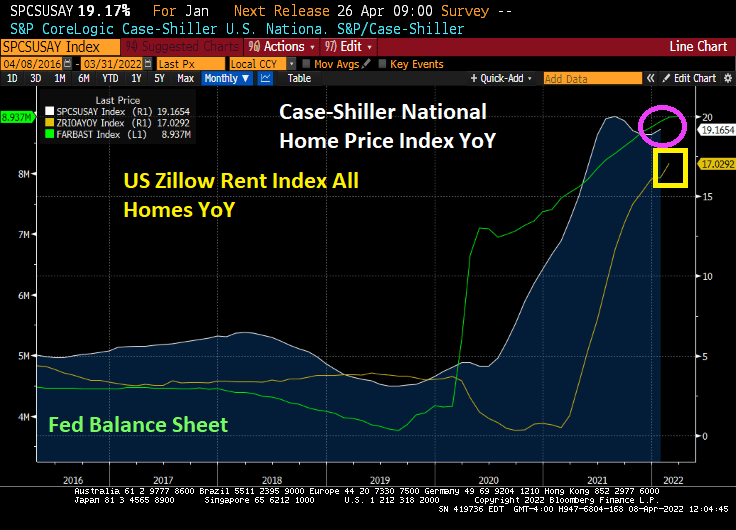
With home prices and rents soaring with Federal Reserve stimulus, let’s see how home prices and rents react to The Fed raising rates. My models forecast a slowdown in late summer 2022 to 6% home price growth YoY as The Fed actually implements their quantitative tightening.
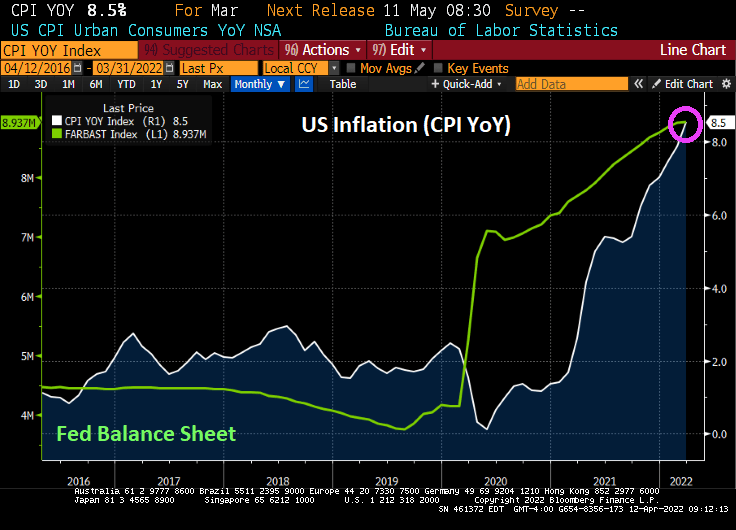
Inflation? CPI YoY is the highest in 40 years and FLEXIBLE Core CPI is 20% and the highest since … Lyndon B. Johnson was President (the flexible price index only goes back to 1968). Actually, Flexible Price inflation is even higher than it was under LBJ. Perhaps this is one of those accomplishments that Biden staffer are complaining never gets discussed.
On a side note, Sheila Bair has stepped down as CEO of government mortgage giant Fannie Mae.
Can The Federal Reserve ACTUALLY tighten monetary policy? Let’s look at the facts.
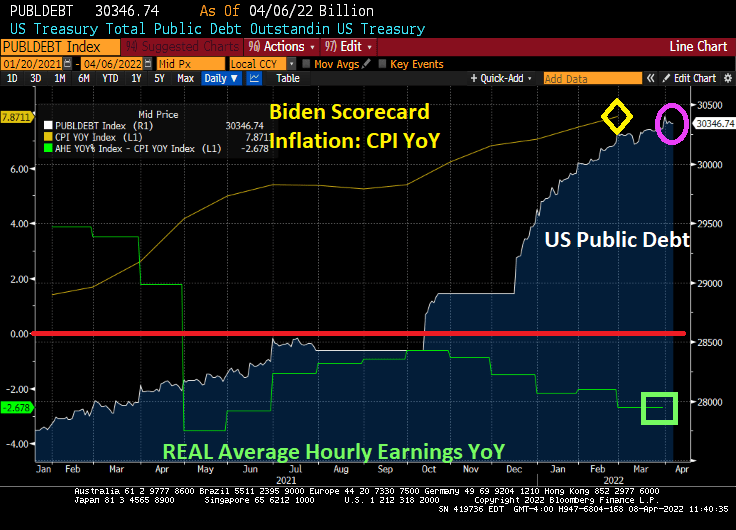
Under Biden, we have seen inflation rise from 1.4% to 7.9% (the latest inflation numbers will be out Monday). And we have seen Treasury public debt rise from $27.8 trillion to $30.346 trillion (actually, $30.371 trillion in real-time). Meanwhile, REAL average hourly earnings are declining. Well done, Washington DC! You deserve the Washington Redskins Commanders.
With real GDP growth less than 1%, a war raging in Ukraine, and 20% flexible price growth, the US economy is in a shambles, relying on The Federal government and The Federal Reserve to continues its insane level of spending and stimulus.
I am going against the box on this one and think The Fed will back off by summer when they realize that they have made another in a long line of policy errors.
As the US Treasury 2-year yield hits 2.507% (up from 0.128% when Biden was installed as President) and the number of Fed rate hikes over by February 2023 hits 9.6, Bankrate’s 30-year mortgage rate breached the 5% mark at 5.04%.
The most recent data from on existing home sales show YoY sales in negative territory as The Fed begins in monetary fireball tightening.
St Louis Fed’s Bullard said The Fed is “behind the curve.” Ya think??
The Fed’s minutes from the most recent meeting indicates that The Fed will shedding $95 billion a month from it swollen balance sheet. At almost $9 trillion mostly populated by Treasuries will be the first asset to run-off the balance sheet (there is almost $1 trillion of Treasuries maturing in 2022 and $856 billion maturity in 2023, etc), The Fed plans to shrink the balance sheet while, at the same, raising The Fed Funds target rate from it near zero levels.
The Federal Reserve has ignoring rules like the Taylor Rule since the financial crisis of 2008-2009, but seemingly are paying attention to the Taylor Rule because of 7.9% inflation. The Taylor Rule is suggesting a 20.42% Fed Funds target while the current target rate is 0.50%. Now THAT would be a real shock to the economy.
Well, the US have gone from “fastest economic recovery in history” to real GDP growth of less than 1% (Atlanta Fed GDPNow for Q1). In addition, the flexible price CPI less food and energy is a whopping 20%.
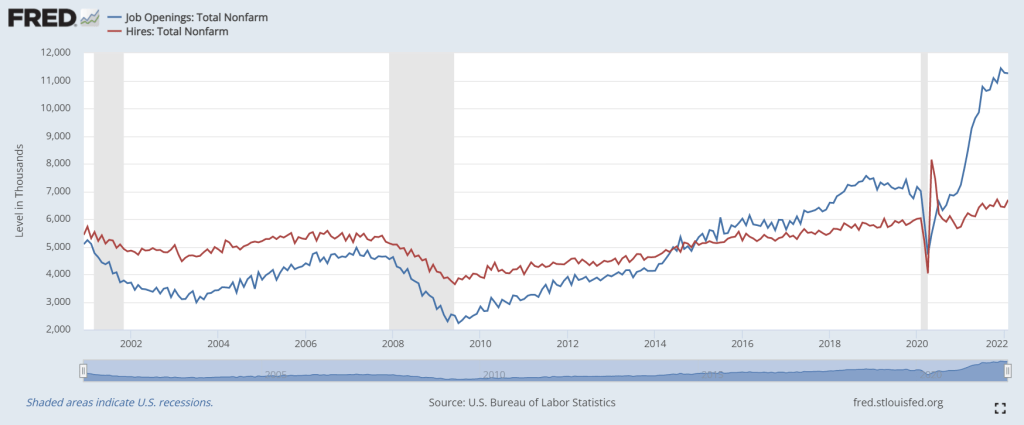
You can see “The Biden Miracle!” in the following chart. Hires (red line) dropped with Covid shutdowns, then spiked when governments opened economies again. Throw in the trillions of Federal government Covid stimulus and trillions in Fed monetary support, the Biden Miracle sees less like a miracle and more like an extremely expensive way to add jobs. But the interesting problem facing the Administration is the massive spike in job openings relative to hires (again, governments opening-up plus Federal Stimulypto).
Now for a real downer of a chart. Inflation is so toxic that REAL average hourly earnings YoY is down -2.72%. Hardly the best economic growth in history.
Now we have Jerome Powell and The Blackhearts threatening quantitative tightening starting in May. Here is The Fed’s theme song “We love printing money.”
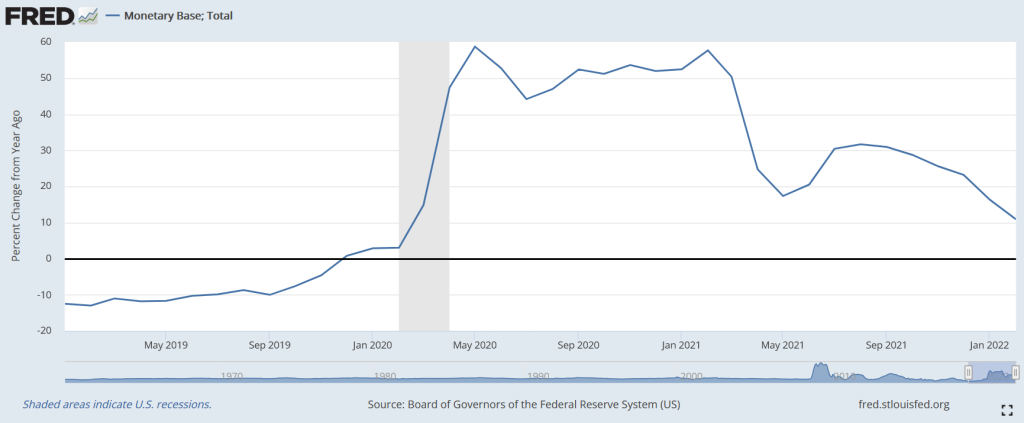
But The Fed is already slowing the growth of monetary base, although this Fed Stimulypto is still growing much faster than pre-Covid.
At least the 10Y-2Y Treasury curve is back above 0 bps as the Atlanta Fed’s GDPNow Q1 forecast falls to under 1%.
Remember, The Fed is planning on shrinking the balance sheet by $95 billion. The Fed’s balance sheet is just shy of $9 trillion. Which is around 1% per month.
With rising expectations of Fed quantitative tightening (QT), residential mortgage rates keep climbing.
Despite a slowing economy teetering on recession and a war raging in Europe, The Fed is tightening monetary policy. Allegedly to fight red-hot inflation.
Stablecoin refers to a new class of cryptocurrencies which offer price stability and/or are backed by reserve asset. In recent times, stablecoins have gained enough traction as they attempt to offer the best of both world’s – the instant processing and security of payments of cryptocurrencies, and the volatility-free stable valuations of fiat currencies.
US Senator Pat Toomey, ranking member of the Banking, Housing and Urban Affairs Committee, announced today legislation to create a responsible regulatory framework for STABLECOINS.
Toomey Announces Legislation to Create Responsible Regulatory Framework for Stablecoins Releases Discussion Draft of the Stablecoin TRUST Act
Washington, D.C. – U.S. Senate Banking Committee Ranking Member Pat Toomey (R-Pa.) today released a discussion draft of legislation establishing a new regulatory framework for payment stablecoins.
“While today stablecoins facilitate trading with cryptocurrencies, tomorrow stablecoins could be widely used in the physical economy. They have the potential, among other things, to speed up payments and automate transactions,” said Ranking Member Toomey. “The proposed regulatory framework I’m releasing today will allow this crypto-innovation to continue flourishing while protecting consumers and minimizing potential risks from stablecoins to the financial system. I look forward to receiving feedback on this legislation from my colleagues and stakeholders as Congress continues its work on stablecoin regulation.”
Key Components
· Authorizes three different options to issue payment stablecoins:
o Establishes a new federal license designed specifically for stablecoin issuers;
o Preserves the state-registered money transmitter status for most existing stablecoin issuers; and
o Clarifies that insured depository institutions are permitted to issue stablecoins.
· Protects consumers by subjecting all payment stablecoin issuers—regardless of whether they are a state money transmitter or receiving a new federal license—to standardized requirements, including:
o Disclosures regarding the reserve assets backing the stablecoin;
o Clear redemption policies; and
o Subjecting them to routine audits by registered public accounting firms.
· Provides much-needed clarity that, at a minimum, stablecoins that do not offer interest are not securities.
o Provides a clear regulatory framework for payment stablecoins and rejects the Securities and Exchange Commission’s approach of regulating through enforcement actions.
· Applies privacy protections to transactions involving stablecoins and other virtual currencies.
Background
· In August 2021, Ranking Member Toomey announced he was soliciting legislative proposals to ensure federal law supports the development of digital assets and its underlying technologies while protecting investors.
· In December 2021, Ranking Member Toomey released a set of principles to lay the framework for forthcoming stablecoin legislation.
Crytpos in general are having a bad day, with Bitcoin down 4.78% today and Ethereum Classic down 12%.
Toomey’s proposal is a great step forward in the regulation of stablecoin.
The 10-year Treasury term premium, the amount by which the yield on a long-term bond is greater than the yield on shorter-term bonds, remains steeply negative (white line) as The Federal Reserve steps up its attack (aka, monetary tightening). Meanwhile, the 10Y-2Y curve actually rose into positive territory.
Historically, the 10-year Treasury Term Premium declines before a recession.
Meanwhile, 3 month Treasury bill to Overnight Indexed Swaps spread is crashing to the lowest level since 2017.
But with inflation raging at the fastest pace in 40 years, the REAL 10-year Treasury yield remains negative at -5.236% while the REAL 30-year mortgage rate is -3.01%. Both were in positive territory when Biden was installed as President.
Speaking of interest rates, the infamous PIGS (Portugal, Italy, Greece, Spain) are all seeing surges in their 10-year sovereign yields. Sweden, while not a PIG has the largest spike today at 13.8 BPS.
Actually, the biggest spike in sovereign yields occurred in Ukraine where their 2-year yield popped +205.8 BPS. But Lebanon has the highest 2-year yield at 162.29%. Turkey is in third place in the sovereign demolition derby at 23.52%. Sadly, Poland’s 2-year yield is up 16 bps today.
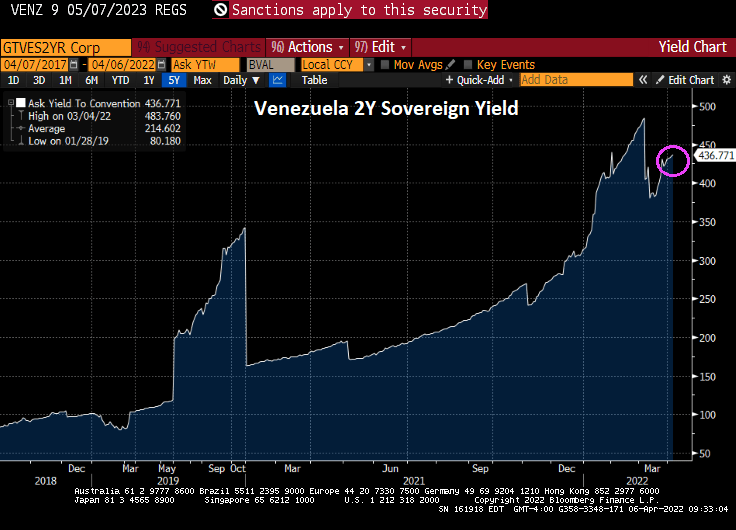
But the winner of the sovereign debt demolition derby is …. drumroll … VENEZUELA! At 436.77%.
I am really surprised that Biden hasn’t adopted Maduro’s fashion sense.























 Confounded Interest - Anthony B. Sanders
You must be logged in to post a comment.