We are living in a banker’s paradise. Where a top administrative official pushes to change forecasts of the economy. Hey, it’s a Presidential election year and literally anything goes.
The disagreement was over forecasts for 10-year Treasury yields in the budget, a linchpin estimate that is intertwined with other measures, like debt service costs.
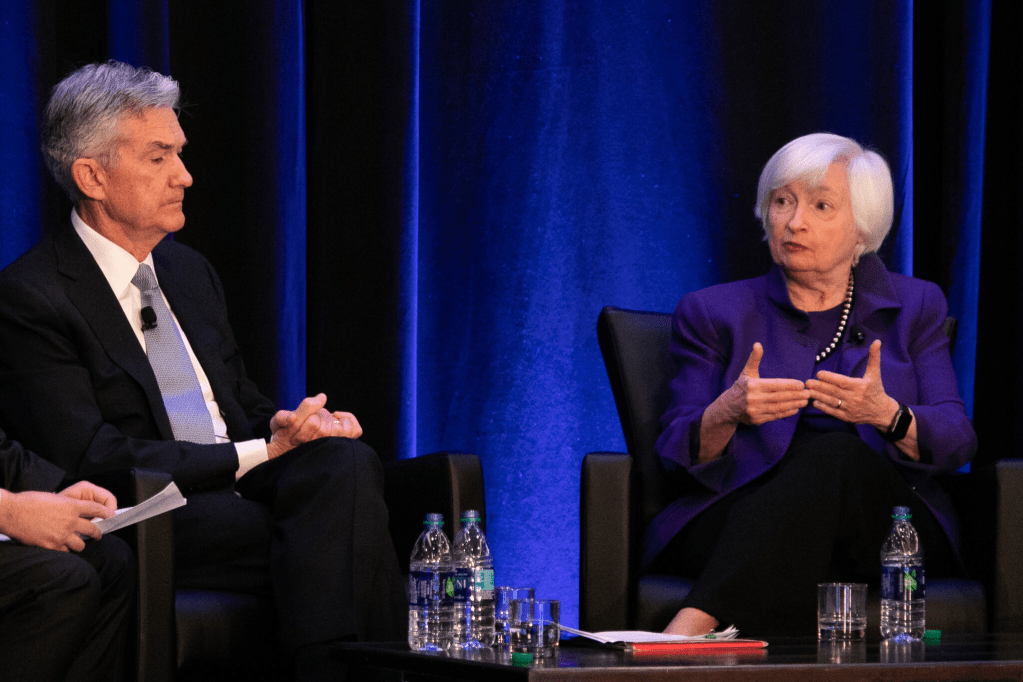
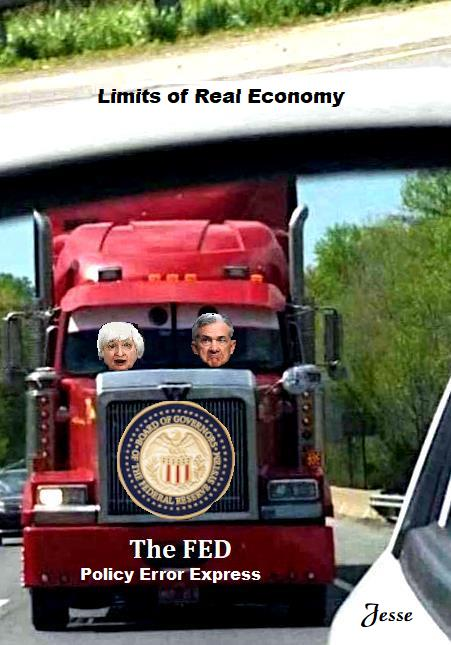
Forecasts in the president’s budget proposal — scheduled for release Monday — are typically set by Treasury Secretary Janet Yellen, Office of Management and Budget Director Shalanda Young and the chair of the Council of Economic Advisers, Jared Bernstein. The group is known in fiscal circles as the troika.
An October meeting, however, included a fourth invited principal: Brainard, who directs the National Economic Council. Brainard at one point disagreed with Yellen, Young and Bernstein on the 10-year interest rate projections and predicted a slightly lower rate, the people said, speaking on condition of anonymity to detail the discussions.
The difference between the forecasts was modest and both were well within range of private-sector estimates, the people said. The exact scope of Brainard’s changes aren’t clear.
Brainard’s forecast painted a modestly better picture for Biden. A lower interest-rate forecast would have the effect of an improved overall outlook by offering more support for growth and suggesting less concern about inflation. It also would lower borrowing cost projections at a time of rising worries about the US deficit and debt.
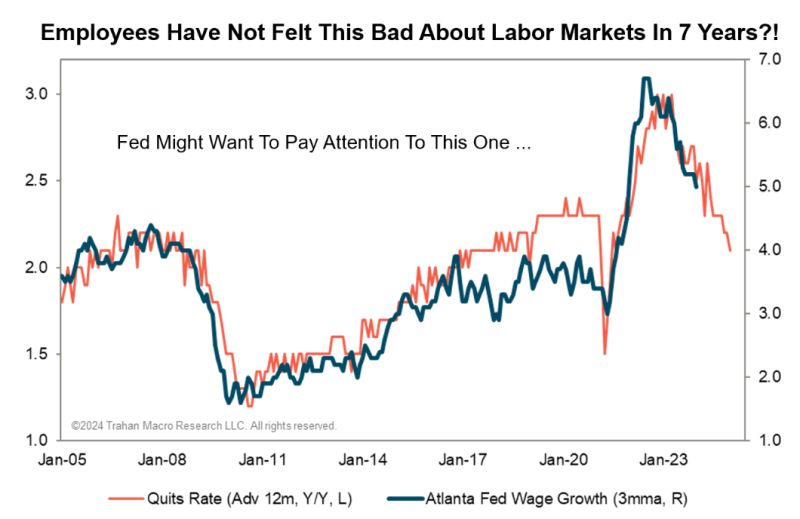
Let’s see what the Troika have to say about the quits rate.
Housing is simply unaffordable for millions of Americans. Home prices are up 33% under Biden’s Reign of Error, while mortgage rates are up 146% under Vacation Joe. Somehow I doubt if Biden will brag about home prices and mortgage rate in his State of the Union address.
On the mortgage side, the Market Composite Index, a measure of mortgage loan application volume, increased 9.7 percent on a seasonally adjusted basis from one week earlier. On an unadjusted basis, the Index increased 12 percent compared with the previous week. The seasonally adjusted Purchase Index increased 11 percent from one week earlier. The unadjusted Purchase Index increased 13 percent compared with the previous week and was 8 percent lower than the same week one year ago.
The Refinance Index increased 8 percent from the previous week and was 2 percent lower than the same week one year ago.
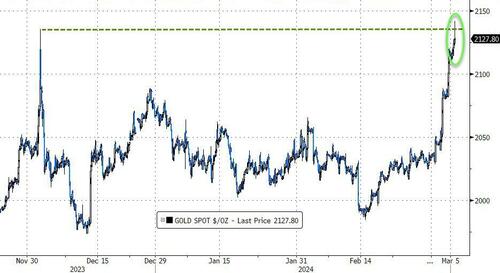
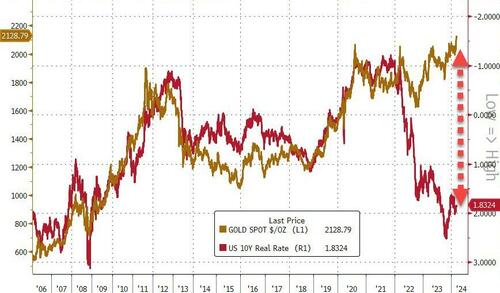
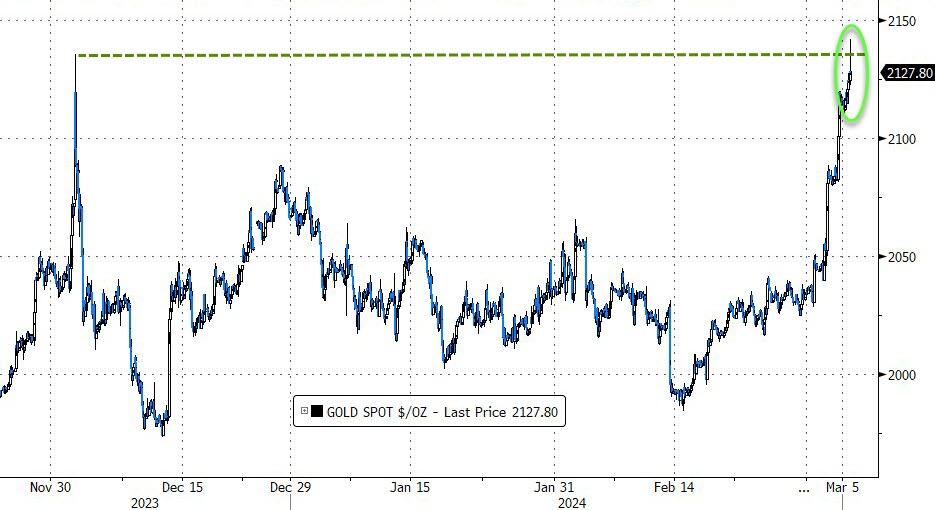
Let’s start with gold. Extending their run of the last few days, spot gold prices just exceeded their all-time highs, topping $2140 for the first time in history…
Source: Bloomberg
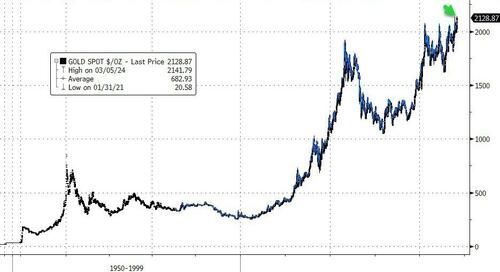
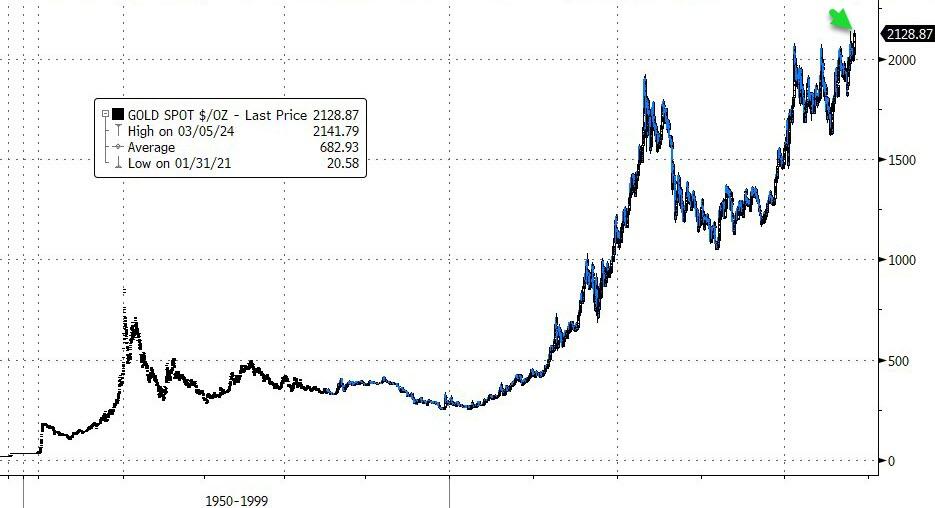
A longer view.
Source: Bloomberg
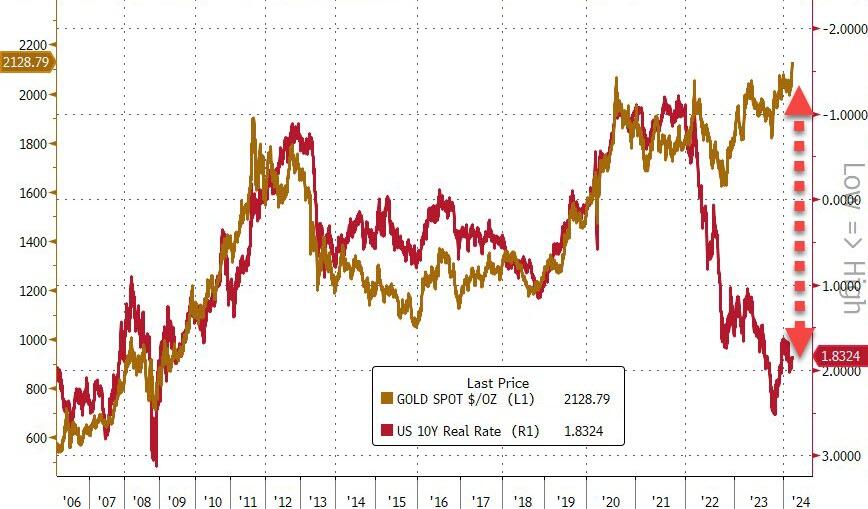
What is gold pricing in about future Fed action? Real rates dramatically negative? As Luke Gromen noted on X:
“When gold rises in your currency DESPITE positive real rates, the gold market is saying ‘Your government will have a debt spiral if real rates remain positive’.“
Source: Bloomberg
Bitcoin just hit $68,567.57, also an all-time high.
The Alt-Assets (gold, silver, Bitcoin) have counterattacked!!
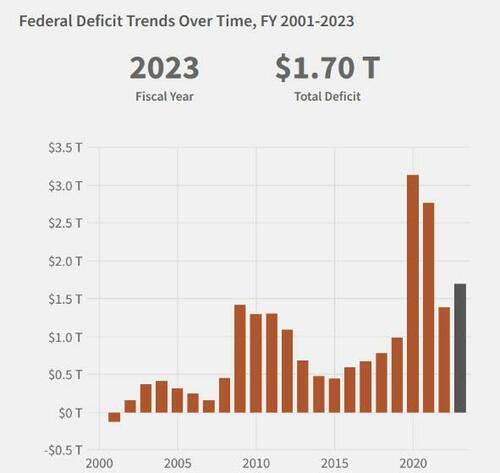
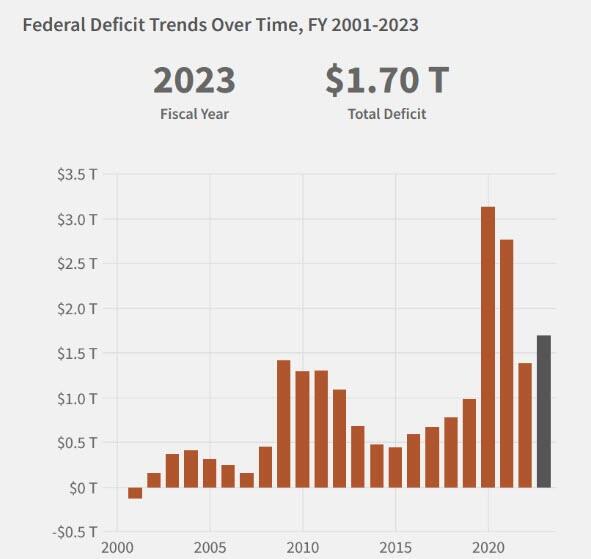
Too much debt! US politicians are spending too much money and borrowing too much. Unfortunately, that is what Biden and Bidenomics is all about: Federal targeted spending and loads of debt.
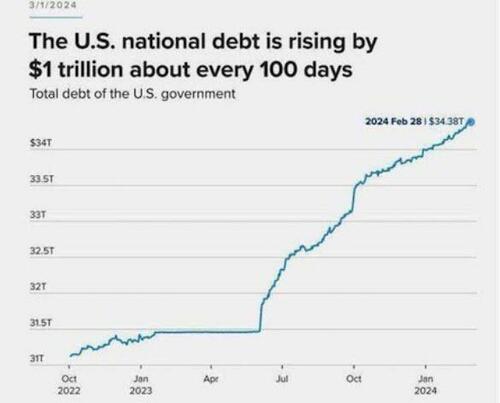
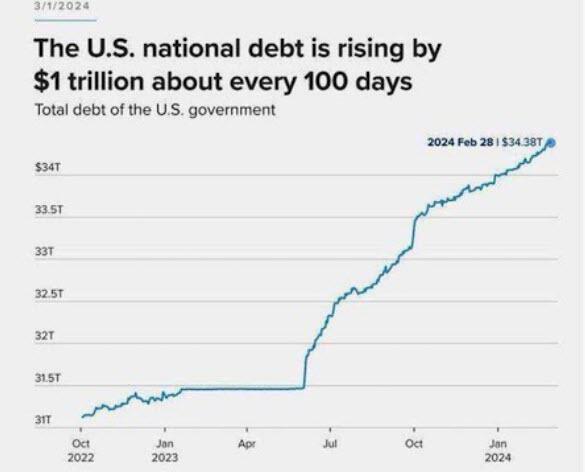
Now it requires $1 trillion of new debt every 100 days to achieve nothing but remaining static economically. The regime media pundits and the cabal on Wall Street tell us the economy is doing great. No recession in sight. All is well. The dumbed down and distracted ignorant masses don’t realize all the reported “economic growth” is “created” by the government, enabled by The Fed, spending billions on their wars in Ukraine and the Middle East, funneling the money into the Military Industrial Complex corporations; paying for the transportation, feeding, and housing of the illegal invading hordes; hiring more government drones to harass the citizenry, and desperately trying to prop up a corrupt tottering empire in its final death throes.
Anyone with even the slightest mathematical acumen knows increasing the national debt at a rate of $1 trillion every 100 days is a death wish. Why would those pulling the strings behind the scenes of this acceleration towards the cliff of national suicide be doing so at this point in time? It’s almost as if the November elections are a deadline for them to complete their exit strategy plan.
I believe we are entering the Great Taking phase of this clown show.
They are purposely creating a global financial disaster in order to take everything you and I have. It sounds crazy, but so is adding $1 trillion of debt every 100 days.
Robin Hood is a legendary heroic outlaw originally depicted in English folklore and subsequently featured in literature, theatre, and cinema. Traditionally depicted dressed in Lincoln green, he is said to have stolen from the rich to give to the poor. Politicians have created the new “Forgotten Man” by Amity Shlaes.
However, politicians like Joe Biden, Chuck Schumer, Mitch McConnell are “reverse Robin Hoods” dressed in business suits (although Jamie Raskin D-MD is often seen wearing a bandana and John Fetterman D-PA is often seen in a hoodie and shorts). They instead enact policies that steal from the middle class and give to themselves and the donor class. How do you think that politicians like the Bidens, Obama, Clintons and AOC go in broke and emerge as multi-millionaires?
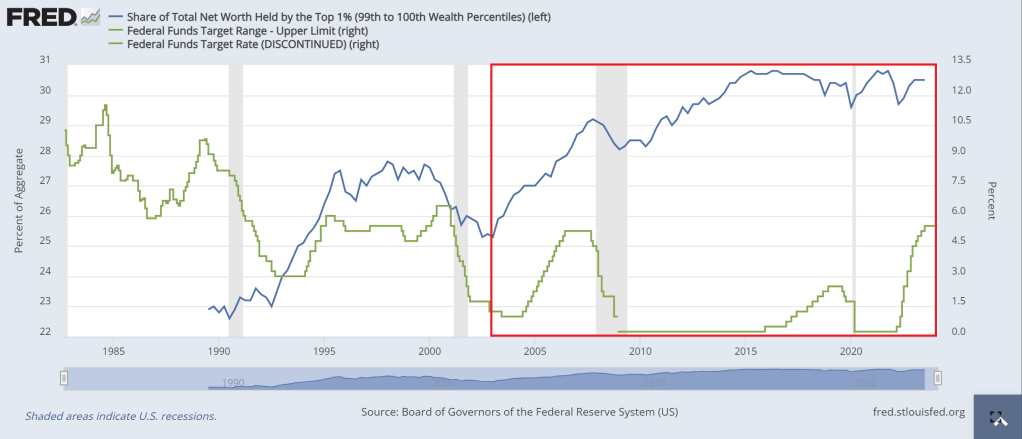
Part of the problem with the reverse Robin Hood model is the Federal Reserve itself. They helped punish the 99% with inflation due to excessive money printing. The share of total net worth held by the top 1% has exploded since The Fed’s rate cuts following the 2001 recession. The Fed has never lowered rates since to levels we saw prior to the 2001 recession, although The Fed is getting close.
Then we have the green energy hysteria (which like pornography excites the brain and distorts logical thinking). Wealthy donors have received a massive windfall (along with China) from Biden/Congress’s green energy spending (scam). The middle class and low-wage workers are now playing higher utility bills (sacrificial lambs on the altar of global warming … or cooling) along with seeing gasoline and diesel prices far higher than before Biden was elected. Gasoline prices are up 46.25% under Biden and diesel prices are up 55.6%.
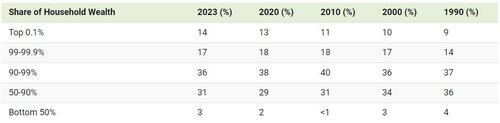
I like this chart of the distribution of household wealth by income group. The top 1% (the elite Pelosi class, are getting wealthier and wealthier. The 90-99% group are doing well, but not as well as the top 1%. The bottom 50% (who the Washington DC elite class seems to have forgotten about)
Here is a table of the same data.
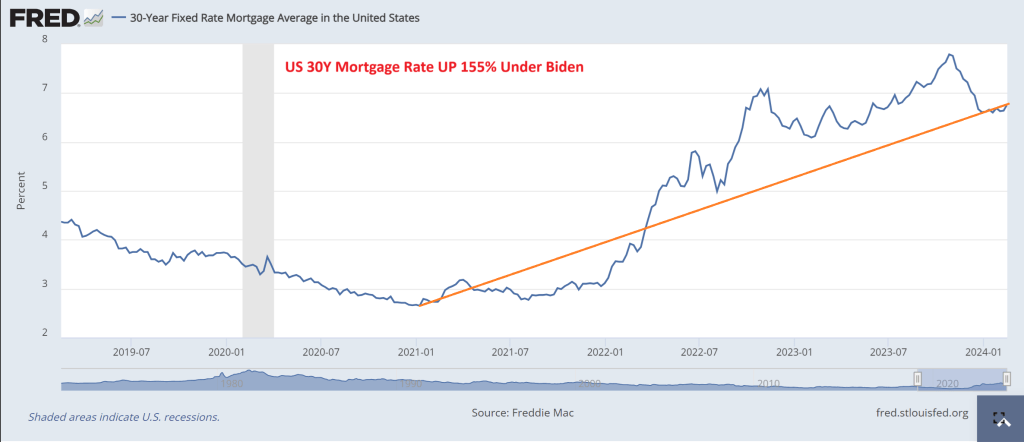
Then we have the exploding mortgage rates under Biden. Rates are up over 155% under Old Grandad Joe Biden. Another shot through the heart of the middle class. And Washington DC is to blame.
Speaking of Washington DC millionaire elites, I want to share this picture with you. Hillary Clinton is NOT Robin Hood but an example of a REVERSE Robin Hood.
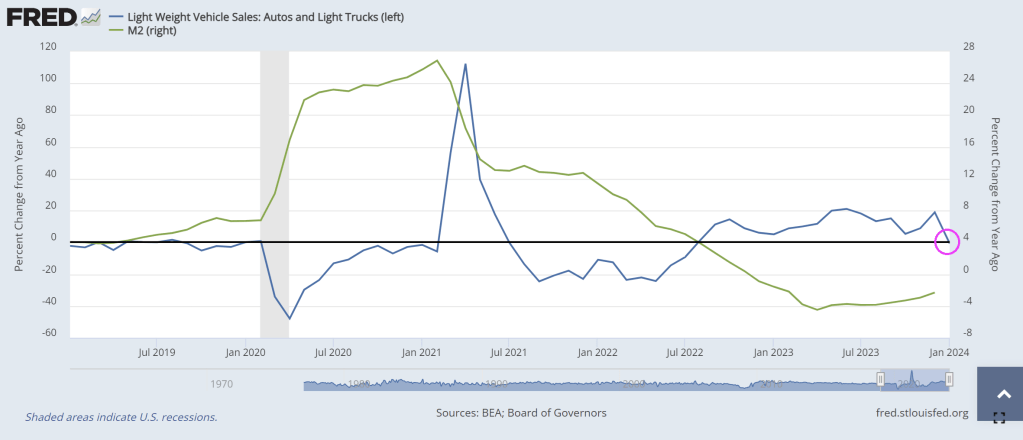
Cars and light trucks are seeing declining YoY sales in January (-0.7%) as M2 Money growth remains negative.
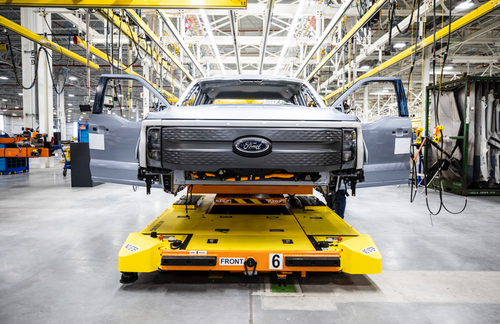
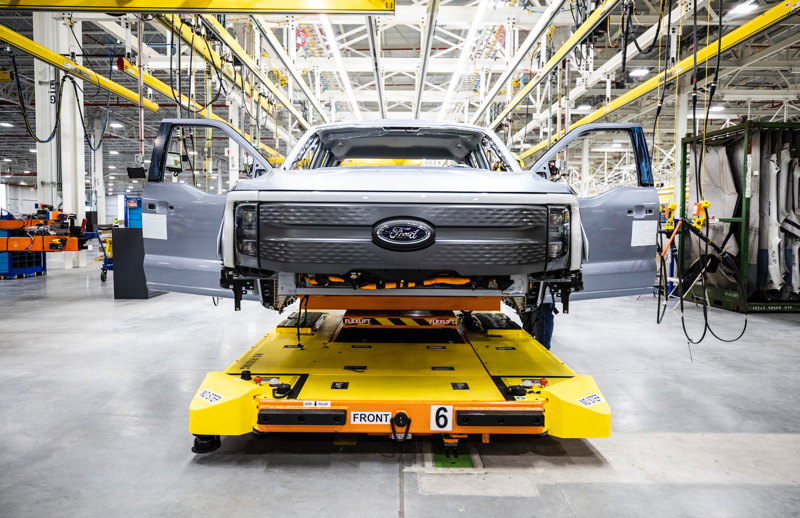
Automotive News was the first to report Ford Motor Co. halted shipments of all 2024 F-150 Lightning electric pickup trucks for an undisclosed quality control issue just weeks after slashing production volumes for the EV model due to sliding demand.
“We expect to ramp up shipments in the coming weeks as we complete thorough launch quality checks to ensure these new F-150s meet our high standards and delight customers,” company spokeswoman Emma Bergg wrote in a statement.
Last month, Ford announced plans to slash the Lightning production in April “to achieve the optimal balance of production, sales growth and profitability.”
The automaker (and many others, like Mercedes Benz) is recalibrating its electric vehicle strategy as the Biden administration plans to downshift the EV transition as demand plummets.
Thousands of auto dealers nationwide recently warned the ‘climate change warriors’ in the White House: the 2030 EV push is backfiring.
“Currently, there are many excellent battery electric vehicles available for consumers to purchase. These vehicles are ideal for many people, and we believe their appeal will grow over time. The reality, however, is that electric vehicle demand today is not keeping up with the large influx of BEVs arriving at our dealerships prompted by the current regulations. BEVs are stacking up on our lots,” the dealers said.
They warned: “Already, electric vehicles are stacking up on our lots which is our best indicator of customer demand in the marketplace.”
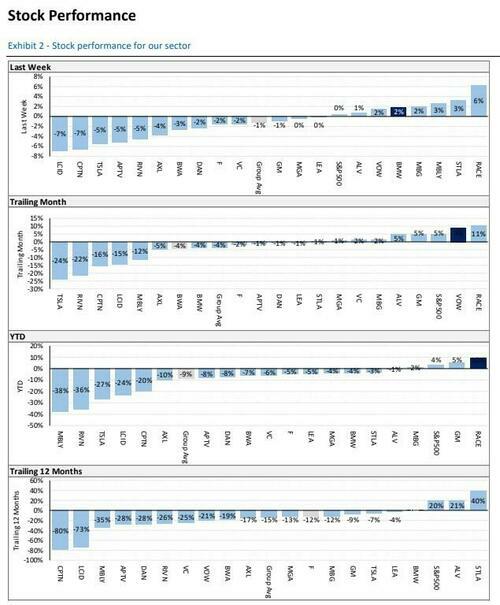
“Key takeaways thus far from earnings season are that the EV slowdown is not showing any evidence of an inflection, Level 4 autonomy headwinds continue to persist, and fears over supplier inventory overbuild are likely overblown.
The Hollies said it best: Stop, stop, stop. FIAT Money Printing that is.
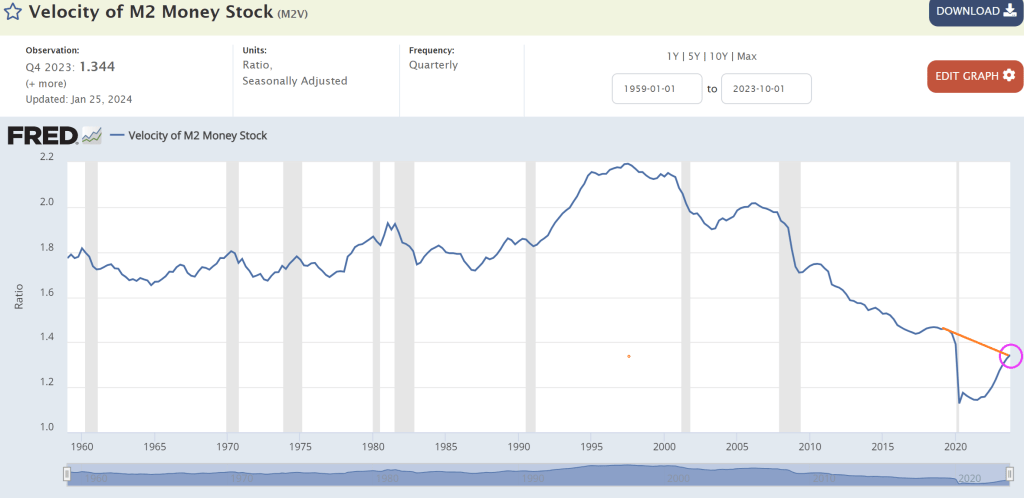
Typically, we look at M2 Money Velocity (GDP/M2) as a measure of how much the economy grows by expanding the money supply.
M2 Money Velocity is currently at 1.344, and still below where we were under Trump prior to Covid. After Powell printing palooza after Covid, M2 Money Velocity collapsed and is slowly rising, but remains low by historic standards.
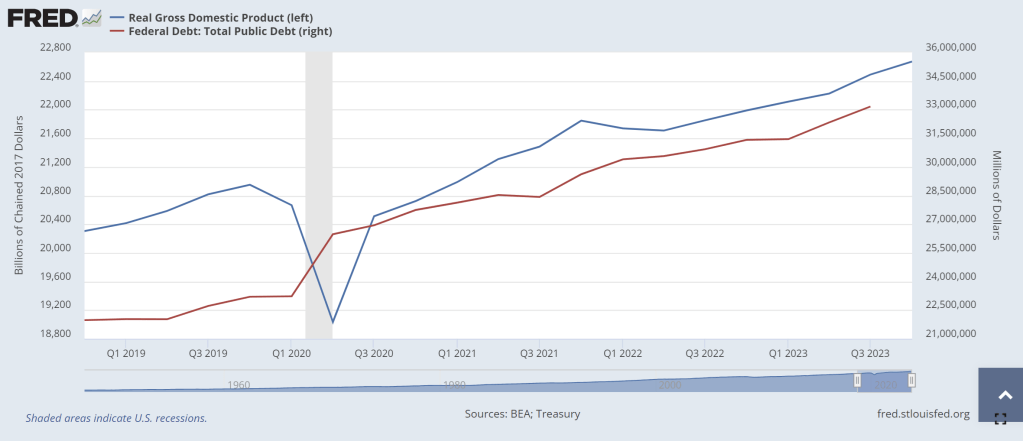
Perhaps a more interest velocity is DEBT velocity (GDP/DEBT). Under Biden’s Reign of Error, Federal debt has increased by $6,539,359 million while real GDP has increased by only $1,948.731 billion (or roughly $2 trillion in GDP growth after $6.54 trillion in debt). Or a DEBT velocity of 0.3. Yikes! No wonder China is bailing on US debt!
This chart makes debt issuance look better than it really is. Again, the DEBT VELOCITY of 0.3 is terrible meaning that for every $1 of Federal debt, we get 30 cents in Real GDP under Biden. One of my macroeconomics textbooks stated that debt growth is fine as long as real GDP growth rises faster than debt growth. Apparently, Treasury Secretary Janet Yellen didn’t read that textbook! Real GDP has grown by 9.43% under Biden while Federal debt has grown by … gulp .. 24%.
Yes, the US is borrowing like the proverbial drunken sailor while they “invest” in green energy, wars in Ukraine and the Middle East, and massive social welfare programs (like the old breads and circuses from the dying Roman Empire). When watching the media’s obsession with Taylor Swift and Chief’s Tight End Travis Kelce at The Super Bowl, it reminded me of “Breads and Circuses” as our nation is collapsing like a dying star. (That is why I Iike Gold, Silver and Bitcoin!)
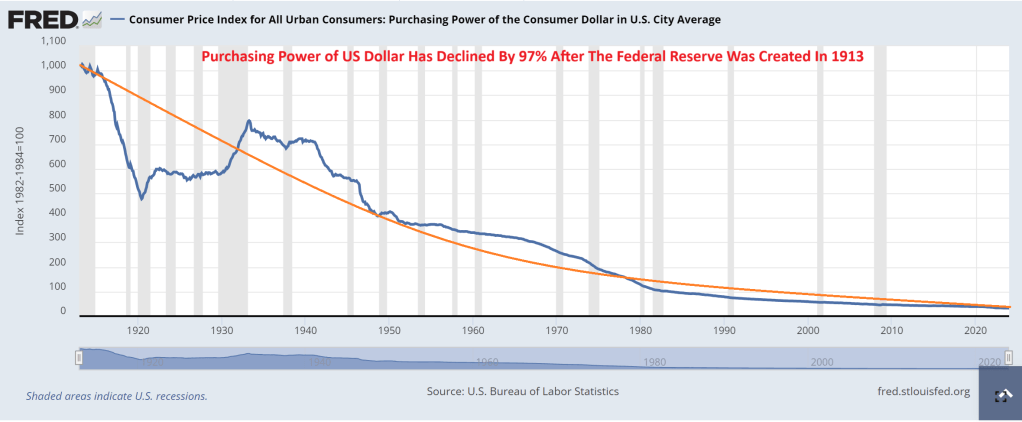
What about The Federal Reserve? It was created in 1913 after signed into existence by President Woodrow Wilson. Since The Fed’s inception, consumer purchasing power has declined by 97%.
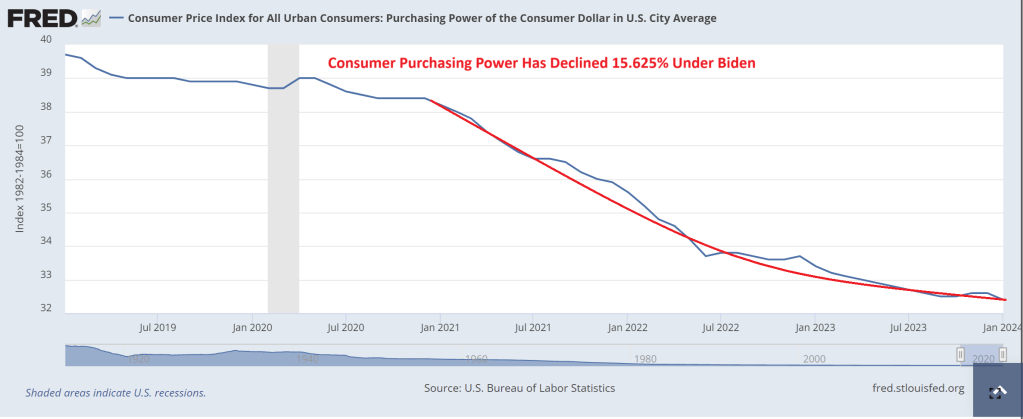
And under Biden, inflation has been so bad that consumer purchasing power is down 16%.
In summary, The Federal Reserve has been printing like crazy (I would say Batshit Crazy, but I actually think bats are adorable). And Treasury (under former Fed Chair Janet Yellen) has been borrowing like crazy too. While politicians claim the economy is in great shape, it is really because The Fed is printing wildly, Yellen is borrowing wildly, and much of US GDP is not due to the private sector, but Federal government spending … to the donor class. This is NOT a sustainable and will eventually crash into a ravine.
So, despite recent declines in energy prices, gasoline prices are still up 46.25% under “Green Joe” and the all important for shipping, diesel prices, are still up 55.6% under Brainless Joe.
One would think that massive rises in gasoline and diesel prices would make everyone buy an electric vehicle (EV). But alas, the high cost and unreliability of EVs is turning off consumers. (I own a hybrid and wish I didn’t).
This time it deals with supply chain logistics, with Bloomberg reporting this week that in the year and a half since passing the Inflation Reduction Act, automakers are finding out the hard way that the rigorous criteria for manufacturing batteries using materials from the United States and its free-trade allies could render them cost-inefficient compared to global competitors.
Companies like Tesla are instead taking advantage of a temporary shift in the rules to stock up with cheaper batteries from countries like China.
The Biden administration’s new rules will all but cut out China from the supply chain, however, which will make it tougher to find affordable metal suppliers.
This, in turn, will threaten President Biden’s goal to boost the domestic electric vehicle market. Bloomberg writes that mining companies and labor unions insist that without curtailing the influx of cheaper, Chinese-subsidized materials, the U.S. can’t develop a competitive EV market.
Meanwhile, the higher costs are driving automakers away from EVs. And as battery material requirements are set to double by 2027, fulfilling these mandates will be increasingly difficult, putting Biden’s ambitious EV strategy at risk.
The demand side of the equation also looks less than favorable. We wrote just hours ago about how Ford was slashing prices on its Mach E and Lightning 150. Tesla has been slashing prices to stoke demand for nearly a year now.
Both Ford and GM have said they’re going to curtail their investment in EVs. General Motors, who posted better than expected earnings earlier this month, said that it plans on changing its product lineup to include more hybrid vehicles, drifting away from pure electric vehicles.
CEO Mary Barra said on the earnings call: “Let me be clear, GM remains committed to eliminating tailpipe emissions from our light-duty vehicles by 2035, but, in the interim, deploying plug-in technology in strategic segments will deliver some of the environment or environmental benefits of EVs as the nation continues to build this charging infrastructure.”
Recall, a report from Consumer Reports last year found that electric vehicles have almost 80% more problems and are “generally less reliable” than conventional internal combustion engine cars.
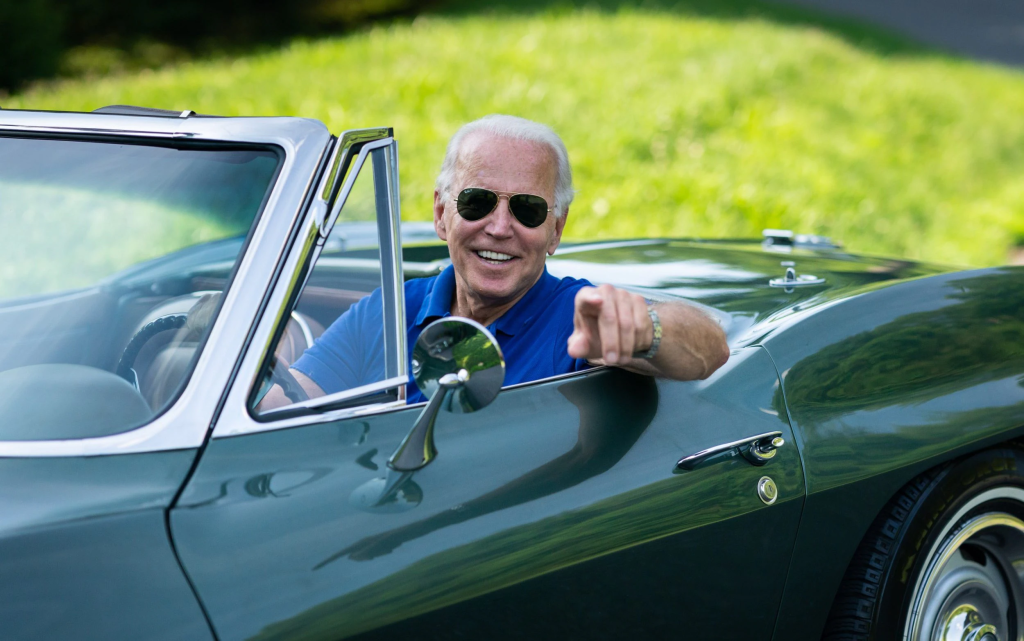
But hey, what good is a “free” market if the government doesn’t have complete and total control of consumer choice, right Joe? After all, Biden drives a gas guzzling Chevy Corvette. When Biden sells his Corvette and buys a Chevy Bolt, I might believe him. Nah!
So, the free market is standing up to Biden’s hard left tyranny.
My new nickname for Biden is Dopey. And Kamala Harris is Happy (because she laughs constantly). Mayorkas is Bashful (he doesn’t do anything). NY Senator Chuck Schumer is Grumpy. Jill Biden is Doc (for her pathetic PhD in Education). The intellectual seven dwarves are running our country into the ground.
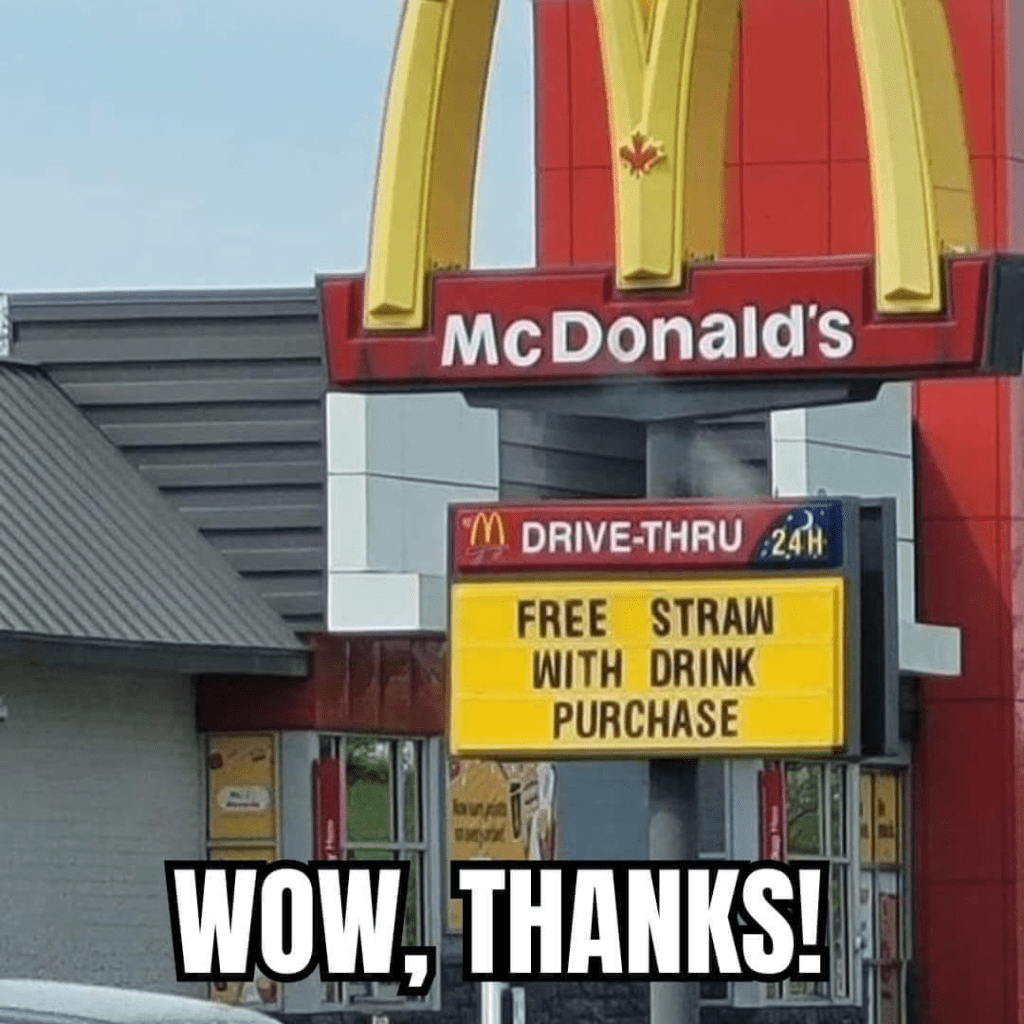
I remember the joke made by Jay Leno about Obama. Go to a McDonalds and order whatever you want and give the bill to the person behind you. Unfortunately, that is the Democrat playbook under Obama/Biden (hereafter termed “O’Biden”). For example, Biden is bragging about forgiving student loan debt relief in the amount of $1.2 Billion in student debt for roughly 153,000 borrowers. And bragging that he is ignoring the US Supreme Court like a banana republic dictator. Like the Jay Leno “joke,” SOMEONE has to pay for this election year vote pandering. But that is the beauty/tragedy of BIG government. It is so big and the numbers so monstrous that many kind of shrug and go “eh.” But someone pays and its the middle class in the form of taxes and inflation.
Who is going to pay for the 10 million illegal immigrants that have crossed the southern border under Biden? While Paul Krugman points to a higher GDP from immigration (illegals still buy goods and services), but mostly are a deadweight drag on social services such as welfare, Medicare, schools, healthcare system, etc.). And of course migrant crime is going off the charts. Who pays for Biden’s border fiasco? The middle class and low wage workers, of course. Elites benefit from uncontrolled immigration, generally live in compounds with private security that the rest of us can’t afford. Remember President Carter and the Cuban Mariel boat lift where Fidel Castro emptied his prisons and sent them to Florida creating absolute mayhem and a huge spike in crime? Biden and Cuba Pete Mayorkas turning up the heat on immigration and its accompanied crime wave.
O’Biden loves to spend other people’s money. Aka, OUR money. Case in point. According to the CBO, net interest on the exploding Federal debt under O’Biden now exceeds our defense spending and that gap is expected to explode. To be sure, the US is funding billions in the middle east, handing over billions to Zelensky and Ukrainian oligarchs, and we have China. What a mess!
So, when will “Billions Biden” stop spending other people’s money? Well, only a barely-held Republican House can stop Biden. Meanwhile I will focus on soaring food prices and eat cheap cabbage rolls and drink coffee. Until Biden kills off those pleasures.
But don’t worry! We might get Gavin Newsom, the ultimate used car salesman, to replace Biden against Trump. But Biden’s ego is so massive (why I have no idea) that he won’t go down without a fight. And what about Cacklin’ Kamala?
Silence is not golden. Particularly when it comes to a silent DEPRESSION. Talking is cheap, people follow like sheep. Particularly when are told by Biden, Press Secretary Karine Jean-Pierre and NY Times economic spinster Paul Krugman say its the best economy in decades. It isn’t. In fact, the US is in a silent depression.
Typically, a recession is defined as two consecutive quarters of negative GDP growth. If we use 2 consecutive quarter of negative GDP growth, we are not in a recession. But ….
Why these results? Bidenomics is based on costly Keynesian boom-and-bust policies. With so much whiplash, it’s no wonder people are conflicted about the economy.
In the latest jobs report for January, a net increase of 353,000 nonfarm jobs from the establishment survey appears robust, as it was well above the consensus estimate of 185,000 new jobs. But let’s dig deeper.
Last month, household employment declined by 31,000, contradicting the headlines. The divergence of jobs added between the household survey and the establishment survey has widened since March 2022. This period coincides with declining real gross domestic product in the first and second quarters of 2022 (usually that’s deemed a recession, but it hasn’t been yet). Indexing these two employment levels to 100 in January 2021, they were essentially the same until March 2022, but nonfarm employment was 2.5 percent higher in January 2024.
While this divergence mystifies some, a primary reason is how the surveys are conducted.
The establishment survey reports the answers from businesses and the household survey from individual citizens. The establishment survey often counts the same person working in multiple jobs, while the household survey counts each person employed. This likely explains much of the divergence, as many people work multiple jobs to make ends meet. The surge in part-time employment and more discouraged workers underscores
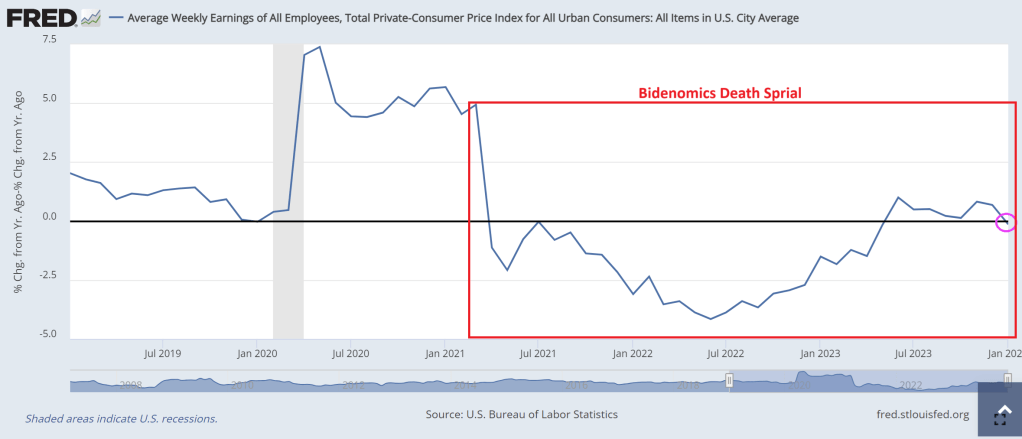
Though average weekly earnings increased by 3 percent in January over a year prior, this is below inflation of 3.1 percent. Real average weekly earnings had increased for seven months before falling last month. And there had been declines in year-over-year average weekly earnings for 24 of the prior 25 months before June 2023. These real wages are down 4.4 percent since Biden took office in January 2021.
As purchasing power declines, mounting debts become more urgent.
Total US household debt has reached unprecedented levels, with credit card debt soaring by 14.5 percent over the last year to a staggering $1.13 trillion in the fourth quarter of 2023. Such substantial growth in debt raises concerns about the current (unsustainable?) consumption trends, business investment, and a looming financial crisis.
The surge in mortgage rates to over seven percent for the first time since December and rising home prices exacerbate housing affordability challenges, particularly for aspiring homeowners. An integral component of what some consider the “American Dream,” housing affordability is a major factor discouraging Americans. Remember, Bidenomics has seen a 155% increase in mortgage rates.
The euphoria surrounding the January 2024 jobs report is misplaced. Policymakers should heed these warning signs and enact meaningful reforms to address root causes.
Biden’s policy approach undergirds most of these difficulties. Bidenomics focuses on his Build Back Better agenda that picks winners and losers by redistributing taxpayer money for supposed economic gains through large deficit spending (and most of the gains went to political donors).
We haven’t seen an agenda of this magnitude since LBJ’s Great Society in the 1960s or possibly since FDR’s New Deal in the 1930s. Both were damaging, as the Great Society dramatically expanded the size and scope of government, contributing to the Great Inflation in the 1970s, and the New Deal contributed to a longer and harsher Great Depression.
These four bills will add nearly $4.3 trillion to the national debt. But at least another $2.5 trillion will be added to the national debt for student loan forgiveness schemes, SNAP expansions, net interest increases, Ukraine funding, PACT Act, and more. In total over the past three years, excessive spending will lead to more than $7 trillion added to the national debt, which now totals $34 trillion — a 21 percent increase since 2021. There seems to be no end to soaring debt with the recent discussions of more taxpayer money to Ukraine, Israel, the border, and the “bipartisan tax deal,” collectively adding at least another $700 billion to the debt over a decade.
Record debts accrued by households and by the federal government (paid by households) are not signs of a robust economy. This will likely worsen before it improves, as household savings dry up. And with interest rates likely to stay higher for longer because of persistent inflation, debts will crowd out household finances and the federal budget.
The Federal Reserve has monetized much of this increased national debt over the last few years by ballooning its balance sheet from $4 trillion to $9 trillion and back down to a still-bloated $7.6 trillion. This helps explain persistent inflation, massive misallocation of resources, and costly malinvestments across the economy, keeping the economy afloat yet fragile.
Excessive deficit spending weighs heavily on future generations, saddling them with unsustainable debt levels they have no voice in. Today, everyone owes about $100,000, and taxpayers owe $165,000, toward the national debt. Of course, these amounts don’t include the hundreds of trillions of dollars in unfunded liabilities for the quickly-going-bankruptwelfare programs of Social Security and Medicare.
Future generations will be on the hook for even more national debt if Bidenomics continues and Congress doesn’t reduce government spending now. This is why the national debt is the biggest national crisis for America. We’re robbing current and future generations of their hopes and dreams.
Fortunately, there’s a better path forward if politicians have the willpower. This path should be chosen before we reap the major costs of a bigger crisis. Look at Argentina’s president Javier Milei who managed to balance the budget in 60 days and generate a whopping SURPLUS of $589,000,000. How? By cutting massive government waste and closing agencies and programs.
In short, we need a fiscal rule of a spending limit covering the entire budget based on a maximum rate of population growth plus inflation. There should also be a monetary rule that ideally reduces and caps the Fed’s current balance sheet to at least where it was before the lockdowns. My work with Americans for Tax Reform shows that had the federal government used this spending limit over the last 20 years, the debt would have increased by just $700 billion instead of the actual $20.2 trillion. That’s much more manageable and would point us in a more sustainable fiscal and monetary direction.
Together, fiscal and monetary rules that rein in government will help reduce the roles that politicians and bureaucrats have in our lives so we can achieve our unique American dreams. If not, we will have wasted many dreams on Bidenomics that can make things look good on the surface, but cause rot underneath.
Clarification: When Biden and various members of Congress tout Biden as having created more jobs that previous Presidents, that is the ultimate gaslighting of the American people. Trump actually saw more job creation than Biden until Covid struck and politicians shut down the economy (and schools closed). Then like magic, after Biden was elected, many jobs returned. Biden and his lackies take credit for the incredible job market, but NEW jobs (rather than simply old jobs returning) had nothing to do with Biden’s Keynesian policies. Rather, Biden’s policies have helped destroy the jobs market.
And yes, the US is under invasion by the United Nations who are helping millions of migrants ILLEGALLY cross the US border, creating horrible stress on the economy and helping keep inflation high. Not to mention soaring crime. Its as if Biden (and his master Obama) are using the Cloward-Piven strategy of overwhelming the economy so it breaks.
All we hear about from Biden and Schumer (and their ilk) is about spending billions MORE on Ukraine and their oligarchs to “protect their borders” while Biden and Mayorkas (Cuba Pete) leave American borders over to invasion.
Yes, Democrats like The Clintons, Obamas and Bidens LOVE the Cloward-Piven strategy. Hey, they are all multi-millionaires and are insulated from all the damage they inflict on the middle class and low wage workers.















 Confounded Interest - Anthony B. Sanders

You must be logged in to post a comment.