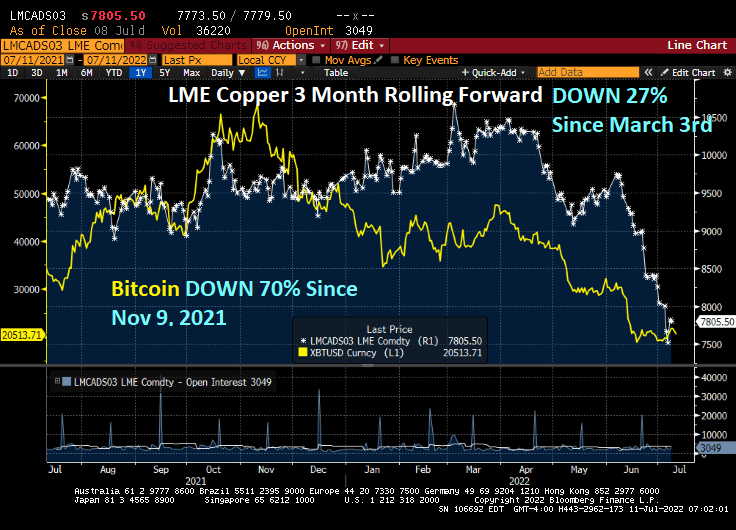
Copper, one of the economic measures of a growing economy, is down -27% since March 3, 2022 as recession looks more likely.
Let’s compare copper with another famous asset, Bitcoin. Bitcoin, a cryptocurrency, is down 70% since November 9, 2021.
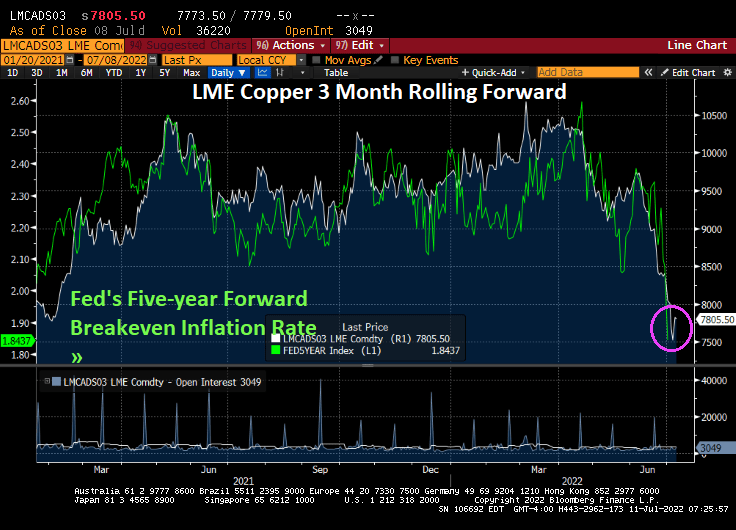
As I discussed yesterday, The Fed’s five-year forward breakeven inflation rate has plunged to its lowest levels under Biden as the global economy is slowing.
Notice that copper prices fit pretty well with The Fed’s 5-year breakeven inflation rate.
It looks like The Fed is killing-off the economy in their quest to tame inflation.
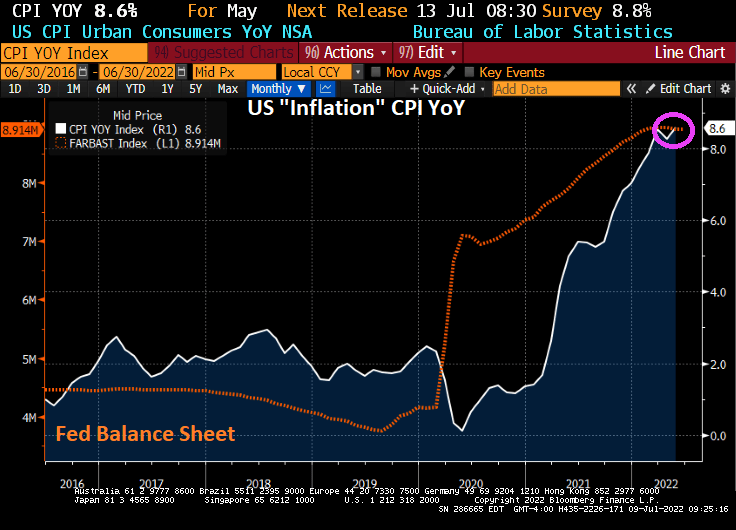
US inflation is the highest in 40 years, yet inflation may be slowing as 1) The Fed cranks up interest rates and 2) the global economy is slowing.
US inflation data in the coming week may stiffen the resolve of Federal Reserve policy makers to proceed with another big boost in interest rates later this month.
The closely watched consumer price index probably rose nearly 9% in June from a year earlier, a fresh four-decade high. Compared with May, the CPI is seen rising 1.1%, marking the third month in four with an increase of at least 1%.
While persistently high and broad-based inflation is seen persuading Fed officials to raise their benchmark rate 75 basis points for a second consecutive meeting on July 27, recession concerns are mounting. There are signs, though, that price pressures at the producer level are stabilizing as commodities costs — including energy — retreat.
But the expectations of inflation, as measured by The Fed’s 5-year forward breakeven inflation rate, just crashed to 1.8437%.
The breakeven inflation rate is a market-based measure of expected inflation. It is the difference between the yield of a nominal bond and an inflation-linked bond of the same maturity.
The USD Inflation Swap Forward 5Y5Y is also falling like a rock as The Fed hikes their target rate (green line).
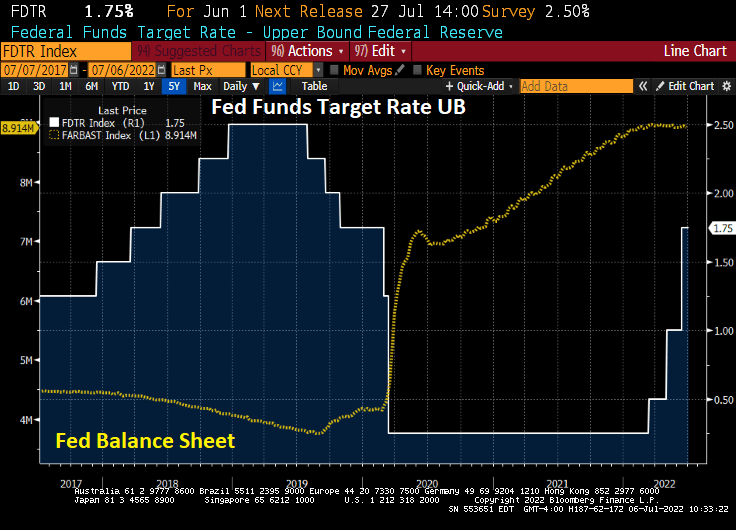
Could it be that inflation is cooling with Fed rate hikes (but not the shrinking of their $8 trillion balance sheet)?
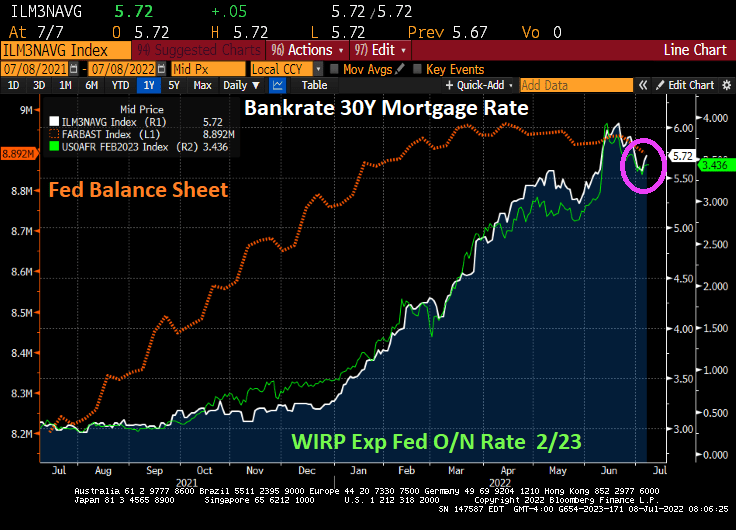
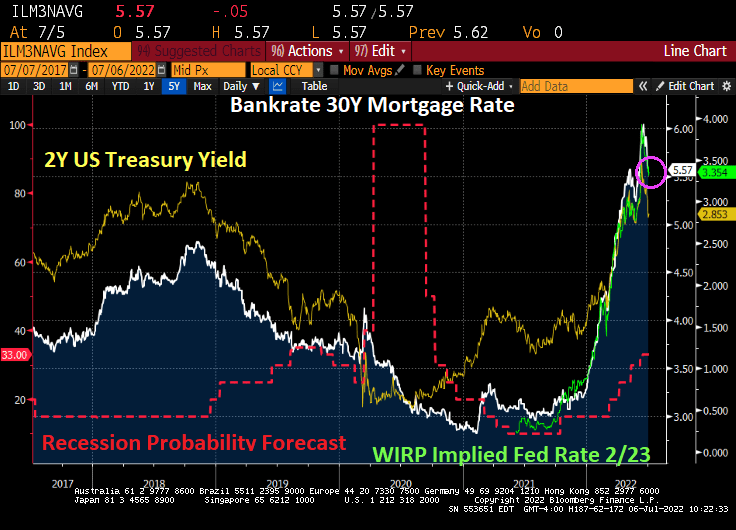
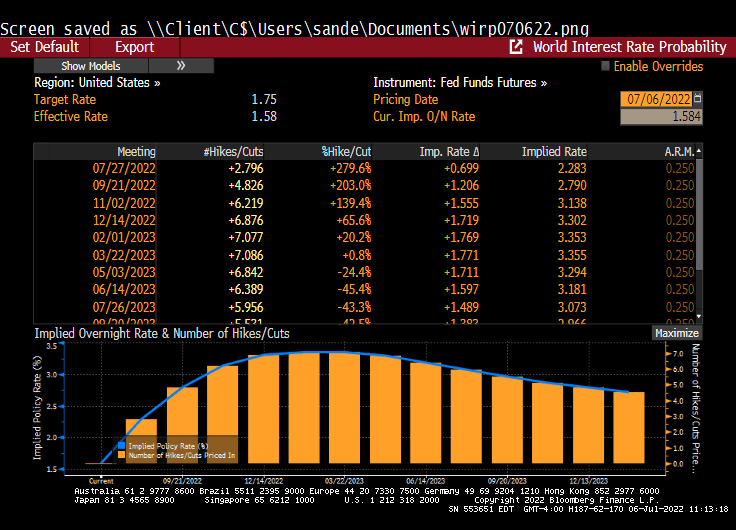
Currently, Fed Funds Futures are pointing to a Fed target rate of 3.552% by February 2023. And with that, Bankrate’s 30-year mortgage rate rose to 5.75%. Once again, like velociraptors from Jurassic Park, The Fed’s balance sheet is still out in force.
Fed Chair Jerome Powell and Atlanta Fed President Raphael Bostic are keeping The Fed’s balance sheet at near $9 trillion as they hunt assets to inflate.
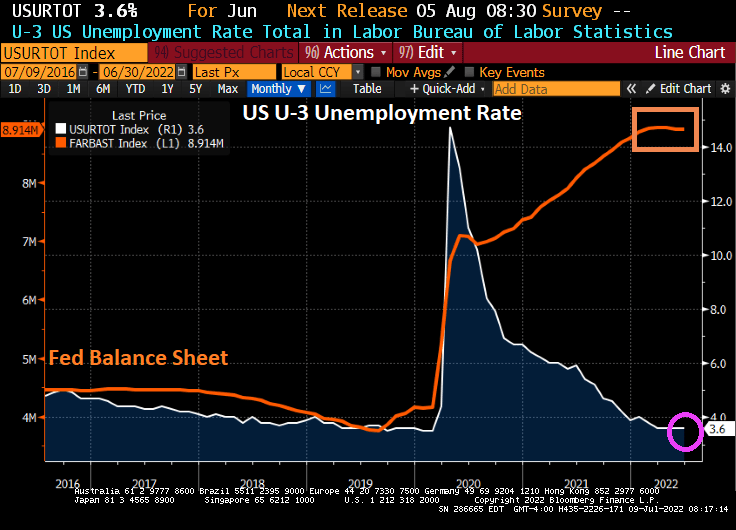
Take the US U-3 unemployment rate. The Biden Administration is proud of the unemployment rate of 3.6%. But if you look at the chart of unemployment relative to The Fed’s balance sheet expansion due to Covid lockdowns, there is still almost $9 trillion of Fed stimulus outstanding.
Of course, the lockdowns were pure economy killers, so opening the economies again led to the unemployment rate falling to 3.6% which is still higher than before the Covid outbreak. But The Federal Reserve has been painfully slow at shrinking its balance sheet, leaving almost $9 trillion in monetary stimulus outstanding.
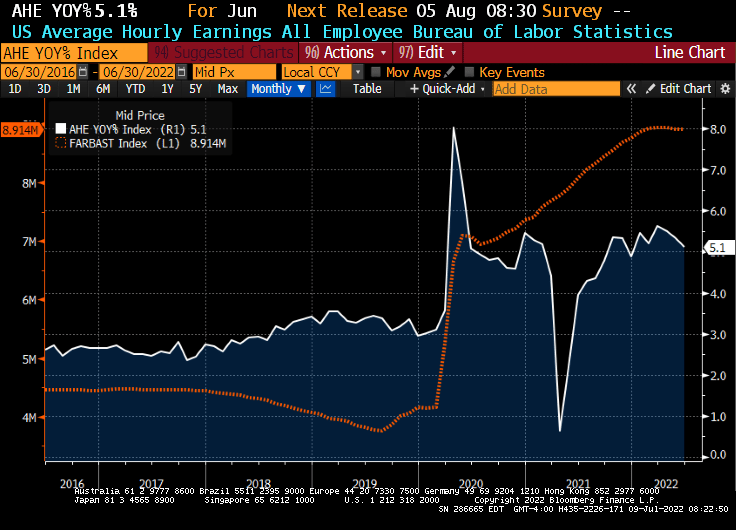
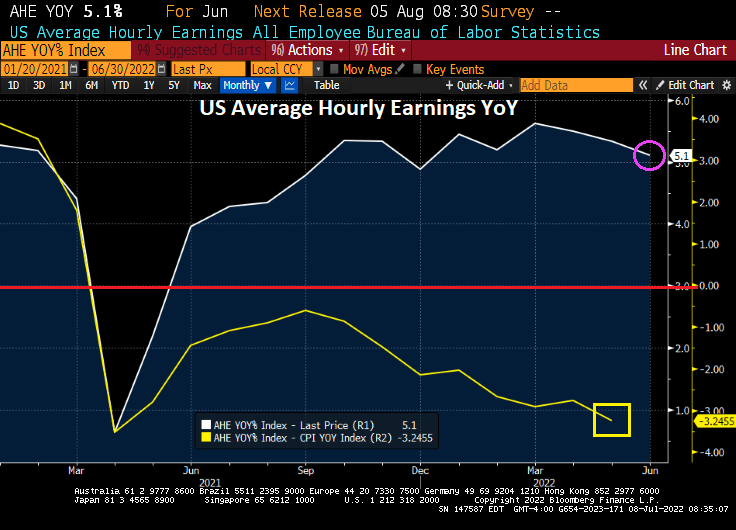
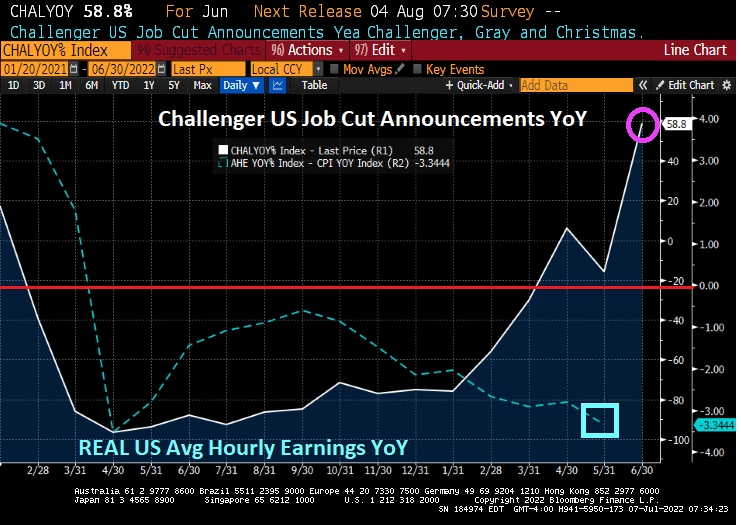
Take average hourly earnings growth. The media is all smiles as US wage growth declined to 5.1%, much higher than pre-Covid.
Then we have inflation, at 40-years highs thanks to massive Fed stimulus (and Federal spending).
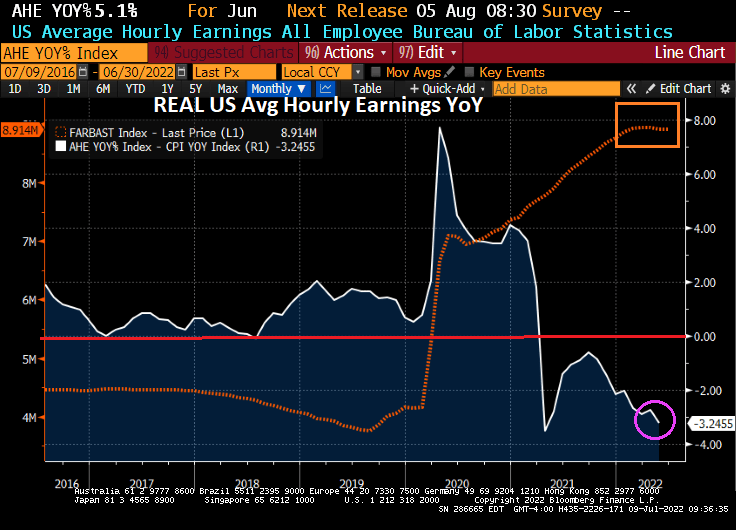
And if we deduct inflation from average hourly wage growth, we see REAL wage growth declining at a -3.25% YoY clip.
Lastly, we have the US Dollar. Nothing has been the same since the financial crisis of 2008 and the entrance of The Federal Reserve distorting the economy and prices. Not to mention the US Dollar.
The Fed leaving its monetary stimulus out in force for so long is a major policy error. So what happens when The Fed actually gets serious about withdrawing the monetary stimulus (likely after the midterm elections)?
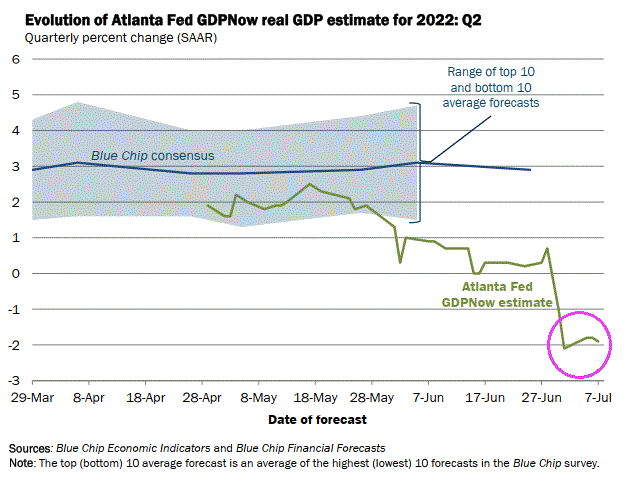
There is no doubt that the US economy is slowing, thanks in part to The Federal Reserve’s sudden crusade to slow inflation (caused by … The Federal Reserve and Federal spending).
My favorite chart is US Average Hourly Earnings YoY. It peaked in March at 5.6% and has been slowing to 5.1% in June. BUT historically high inflation has caused REAL US Average Hourly Earnings YoY to decline to -3.25%.
The good news? 372k jobs were added in June. The bad news? It was lower than jobs added in May (390k) showing a slowing trend.
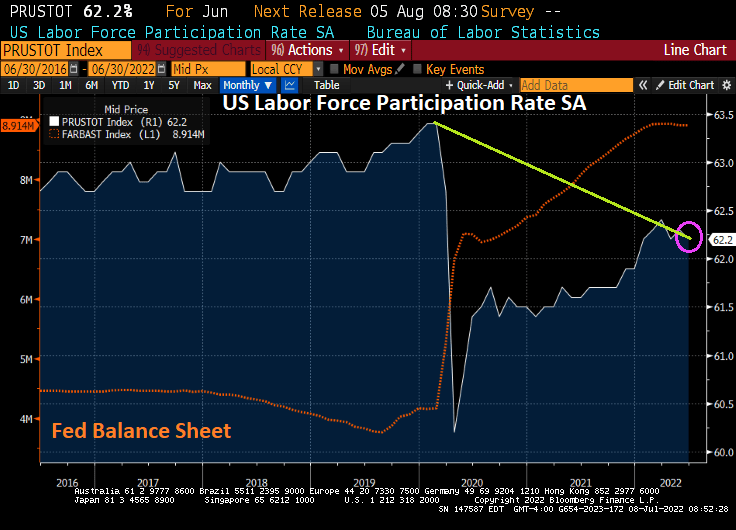
Unemployment remained at 3.6%. Labor force participation fell to 62.2%.
The US labor force participation remains below the pre-Covid levels despite staggering Fed monetary stimulus. But what happens when The Fed’s “Snake Juice” is withdrawn??
Here is a nice summary table.
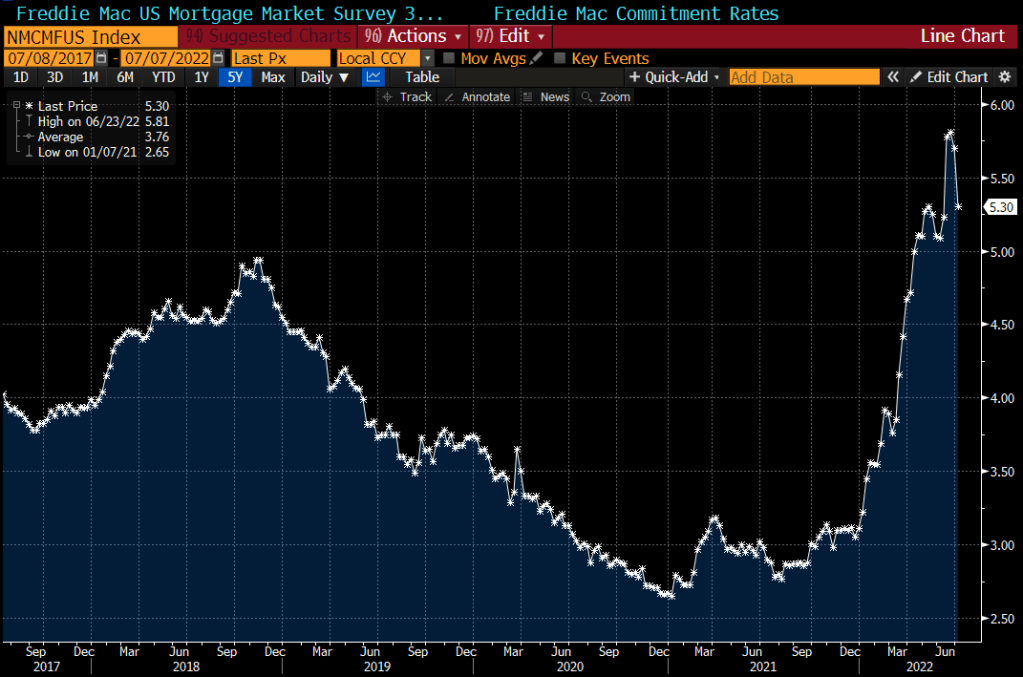
US 30 year mortgage rates resumed their vertical climb as The Fed continues to tighten their loose monetary policy.
But the jobs report was good enough to lead to the US Treasury 10Y yield to jump 10.3 basis points today.
Generally speaking, The Federal Reserve cuts rates as a recession approaches. But not this time!
The Federal Reserve is expected to raise their target rate by 75 basis points at the next FOMC meeting.
We are already seeing Fed rate hikes being priced into the mortgage markets, as Bankrate’s 30-year mortgage rate fell to 5.57% after rising above 6% in June. The reason? Recession fears have caused Treasury yields to fall.
The Fed is hiking their target rate, but has been sloth-slow in unwinding their balance sheet.
Yes, The Fed has been sloth-slow in removing the Covid-related stimulus. But is The Fed trying to pull a “Volcker” by raising rate to choke off inflation EVEN IF THE ECONOMY ENTERS RECESSION? Fed Funds Futures data is pointing to a reversal of Fed rate hikes by Feb 2023.
Here is Fed Chair Jerome Powell showing the amount of Covid-related stimulus removed recently.
TED refers to the difference between the three-month Treasury bill and the three-month LIBOR based in U.S. dollars, a measure of fear in the market.
The 3-month TED spread is rising awfully fast. A sign of impending recession.
US bank credit default swaps (CDS) are rising fast as inflation gets ugly.
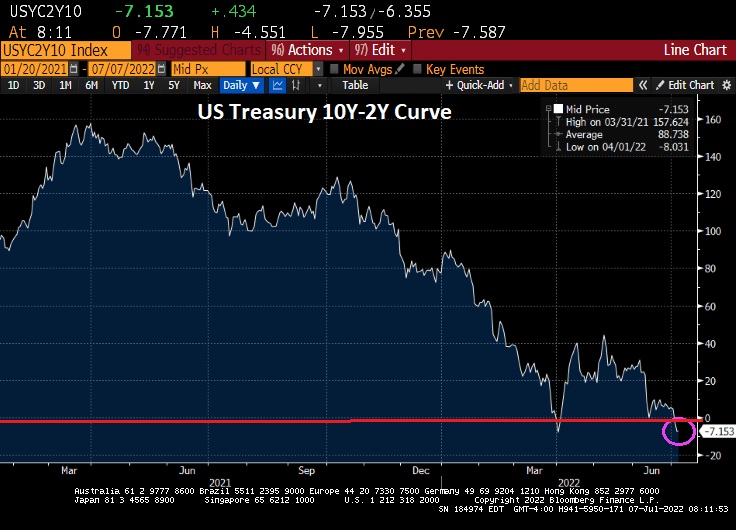
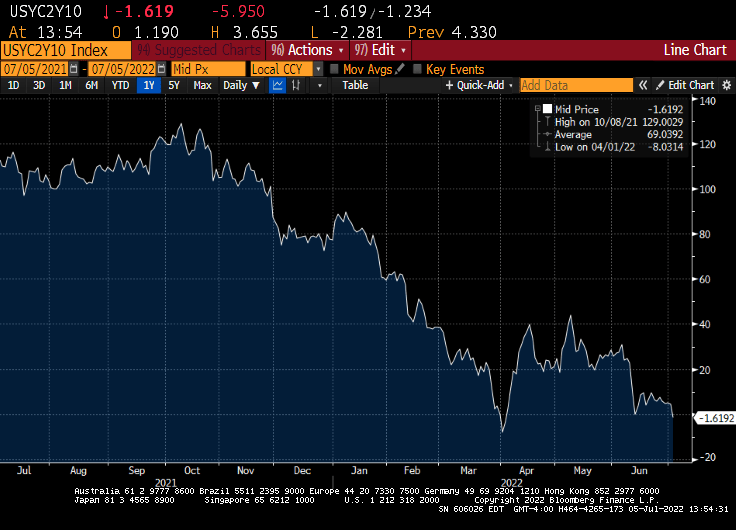
The US Treasury 10Y-3M curve is bumping against the zero barrier.
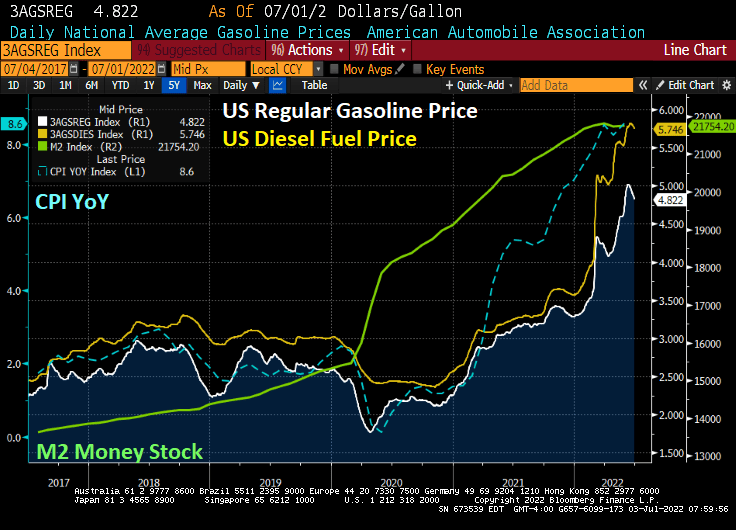
I am still shaking my head at President Biden chastising gasoline stations for not lowering prices at the pump when refiners are near full capacity and the Biden Administration is doing nothing to increase the supply of US-source non-green energy.
Hey, I thought Mayor Pete Buttigieg, the US Transportation Secretary, was supposed to unclog the supply-chain crisis! Instead, we get heartaches on heartaches as diesel prices rise 118% under Biden AND now the bottle-necks may get a lot worse.
A US Supreme Court decision that could force California’s 70,000 truck owner-operators to stop driving is set to create another choke point in already-stressed West Coast logistics networks, a truckers’ organization said.
“Gasoline has been poured on the fire that is our ongoing supply-chain crisis,” the California Trucking Association said in a statement following the Supreme Court’s decision to deny a judicial review of a decision of a lower court, a process known as certiorari.
“In addition to the direct impact on California’s 70,000 owner-operators who have seven days to cease long-standing independent businesses, the impact of taking tens of thousands of truck drivers off the road will have devastating repercussions on an already fragile supply chain, increasing costs and worsening runaway inflation,” the CTA said.
The association asked the Supreme Court for a review of a case challenging California’s Assembly Bill 5, a law that sets out three tests to determine whether a worker is an employee entitled to job benefits or an independent contractor who isn’t. The trucking industry relies on contractors, and has fought to be exempt from state regulations for years because of federal law.
With few exceptions, the relationship between independent truckers and their carriers, brokers and shippers will be governed by the tests.
As if US consumers aren’t getting crushed by rising prices already. In response to the Covid outbreak, The Fed slammed its foot on the money accelerator along with Federal government stimulus. Throw in Biden’s anti-drilling executive orders, and we have a nightmare.
Consumer confidence is already crumbling under inflation and rising energy prices.


















 Confounded Interest - Anthony B. Sanders
You must be logged in to post a comment.