Short Sellers Step Up Bets Against Office Owners on Bank Turmoil (Small Banks Hold 70% Of Commercial RE Loans As Fed Continues Its Fight Against Inflation)

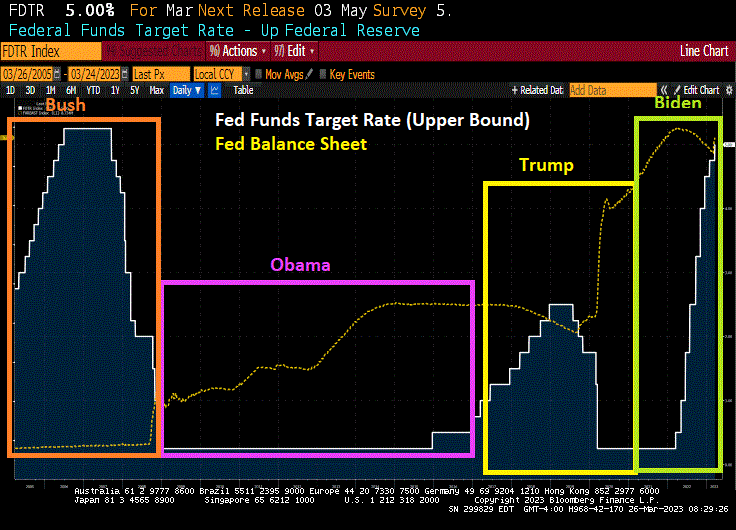
The Federal Reserve raised their target rate just once under President Obama until Donald Trump was elected. Then raised their target rate 8 times AFTER Trump was elected. In other words, Bernanke/Yellen kept the target rate near 0% for too long. When you throw the insane level of spending by Biden and Congress on top of the massive Fed stimulus. Now The Fed is trying to remove the excessive monetary stimulus by raising rates which is crushing banks.
Small bank reserces are low.

In any case, rate hikes are causing turmoil at small banks (as witnessed by the failures of SVB, Silvergate, First Republic and Signature Banks. Even worse, small banks hold 70% of commercial real estate loans.

Money managers have stepped up their bearish bets against office landlords, wagering that the US regional banking crisis will slash the availability of credit to property owners that were already suffering from the pandemic and rising interest rates.

Hedge funds are using credit derivatives and equities to bet against the companies and their debt. Almost 40% of shares in the iShares US Real Estate ETF are sold short, the highest proportion since June, according to data from analytics firm S3 Partners.

At Hudson Pacific Properties Inc., short interest reached a record 7.4% earlier this week before dropping to about 5% of shares outstanding, according to data compiled by IHS Markit Ltd. That’s almost double the level a month ago. For Vornado Realty LP, short interest is the highest since January.

Three regional banks have failed in the US, raising concerns about the implications for commercial real estate finance. Many lenders are losing deposits, which might cut into their ability to finance real estate in the future. Regional banks account for about 80% of bank lending to commercial properties, according to economists at Goldman Sachs Group Inc. 

“What’s changed in the last few weeks is the credit markets,” said Rich Hill, chief of real estate strategy research at Cohen & Steers Capital Management Inc. “It went from a story of work-from-home and the impact on occupancy and the lack of rent growth to also the compounding of tighter financial conditions given everything happening with banks.”

Fears of tighter credit are adding to risks for offices that have been building for some time, Green Street analysts wrote in a Tuesday report. Hedge fund manager Jim Chanos, Marathon Asset Management and Polpo Capital Management founder Daniel McNamara are among those who have been betting for months that landlords will struggle to lure staff back to workplaces. 

“This regional banking crisis is just throwing fuel on the fire,” McNamara said in a telephone interview. “I just don’t see a way out of this without a lot of pain in the office sector.” 

Vulnerable Landlords

Real estate was already the most shorted industry across global equities, according to a March 17 report by S&P Global Inc. It was the third most-shorted sector in the US.

That’s in part because interest rates have been climbing for the last year, which pressures real estate owners. Defaults remain low for now. But office assets are the collateral for about $100 billion of the $400 billion of US commercial real estate debt maturing this year, according to MSCI Real Assets. 

Workplaces worth nearly $40 billion face a higher probability of distress, more than apartments, hotels, malls or any other type of commercial real estate, MSCI said on Wednesday. Almost $20 billion of office loans that were bundled into commercial mortgage-backed securities and are due to mature by the end of next year are already potentially distressed, Moody’s Investors Service estimates.

Credit availability for commercial real estate was already challenged this year as investors have grown less interested in buying commercial mortgage bonds, JPMorgan Chase & Co. analysts including Chong Sin wrote in a note. Sales of CMBS deals without government backing have fallen more than 80% this year, according to data compiled by Bloomberg News.

Smaller banks potentially retreating may bring a credit crunch to smaller markets, the JPMorgan analysts wrote.

Lenders advanced a record $862 billion to commercial real estate last year, a 15% increase from a year prior, data provider Trepp estimates. Much of that was driven by banks, which originated 50% more loans in the period. The pace of growth has slowed since then, Federal Reserve data show, as the outlook for real estate grows increasingly negative.

The pressure on offices means lending standards are now being tightened, bad news for landlords that have high levels of leverage and putting lenders at a higher risk of defaults.

“Recent developments have increased downside risk to commercial real estate values from expectations of tightening lending standards,” Morgan Stanley analysts including Ronald Kamdem wrote in a note on Monday. Office REITs may have to sell assets to help them successfully refinance, they said.

Shorts soared on office landlords last year as rising interest rates weighed on the industry. They dropped subsequently as investors wagered that borrowing benchmarks would top out at a lower level than initially expected or the Federal Reserve would begin to cut the rates earlier than previously expected.

Cohen & Steers, which oversees about $80 billion, including $48 billion in real estate investments, went under weight on offices during the pandemic and will steer clear until the market shows signs of hitting a floor.

“I actually want to see more signs of weakness,” Hill said. “The more headlines I see that things are really, really bad, the closer I think we are to the end.” 

Chanos Short

Chanos said on CNBC in January that he had been betting against SL Green Realty Corp., short interest in which reached the highest since the financial crisis in recent days. The landlord’s assets include a New York building occupied by Credit Suisse Group AG, the lender taken over by UBS Group AG after government-brokered talks. Short sellers borrow stock and sell it, planning to profit by buying it back at a lower price later.

An SL Green spokesperson directed Bloomberg to company comments at a March 6 investor conference, before the recent bank failures.

The landlord plans to sell $2 billion of properties, cut its debt by $2.5 billion and refinance a $500 million mortgage, Chairman and CEO Marc Holliday said at the Citigroup Inc. conference. Because the securitization market and life insurance financing weren’t receptive to deals, the firm is dependent on banks, which were already an uphill challenge.

“Banks are more likely to say no these days than to execute,” Holliday said. “Knock on wood, hopefully we can get that done.” 

Mark Lammas, president of Hudson Pacific, said in an emailed statement that the firm is confident in its business fundamentals and long-term prospects. The company is investment-grade, a majority of its assets are unencumbered, it has $1 billion of liquidity, and no material debt maturities until 2025, Lammas said.  

Chanos and representatives of Vornado and Boston Properties didn’t immediately reply to requests for comment.

‘The Widowmaker’

Hedge funds have also been using credit-default swaps indexes known as CMBX to bet against CMBS that are most exposed to offices. The derivatives are tied to portions of bonds backed by commercial mortgages and a number of them reached a record low this week amid fears about a number of regional banks.
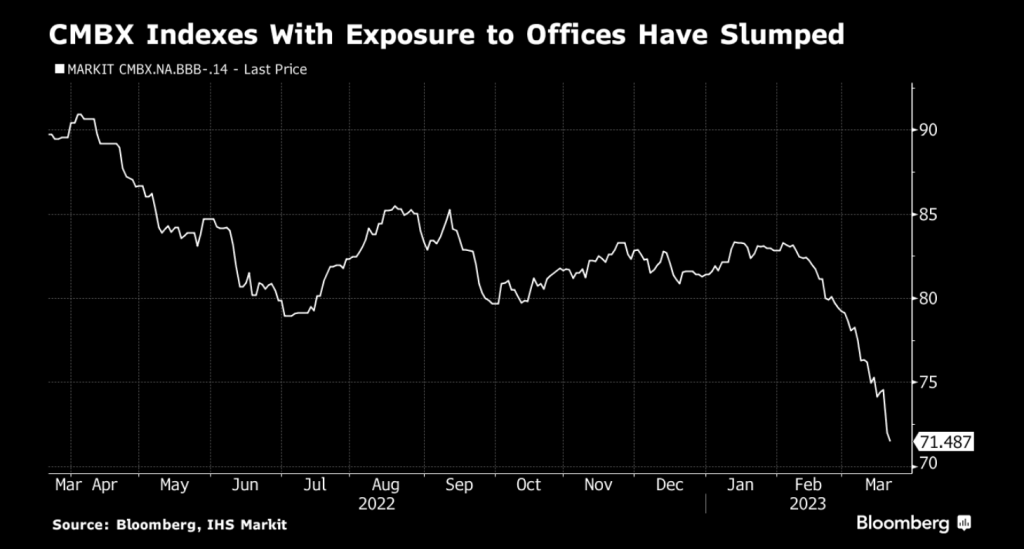
Betting against commercial real estate has historically been a hard way to make money, because it can take a long time for losses to emerge, and the range of possible outcomes for even troubled property can be wide. “Shorting CMBX BBB- is regarded as the widowmaker — the undoing of many a young trader’s career,” Morgan Stanley trader Kamil Sadik wrote in a March 6 note.   

But the spate of bad news means the BBB- portion of the 14th CMBX index is at the lowest level ever and the same part of the 13th index is at its lowest since the pandemic in 2020. Similar declines are also being seen in share prices of office landlords.

“Our conversation with investors suggests that there has been some capitulation and forced selling as the stocks have continued to underperformed,” Morgan Stanley analysts led by Kamdem wrote.

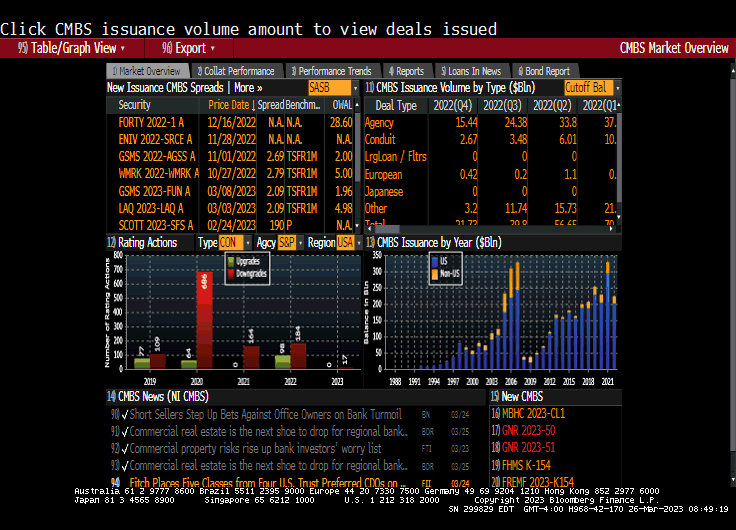
So far in 2023, there has been 17 downgrades of CMBS deals with no upgrades.
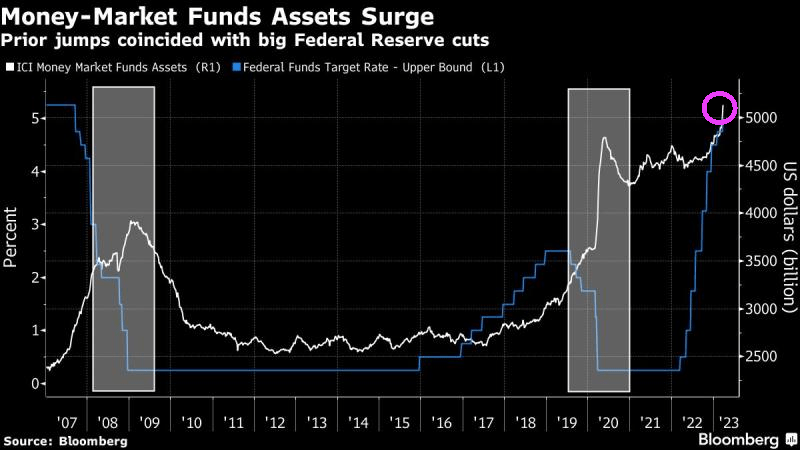
Investors are fleeing to money market funds as The Fed hits the brakes.
No Mystery To Me! US Banks on Bumpy Path as First Republic’s Troubles Persist (Senator Warren Calls For Investigation Into Banking)

Its no mystery to me that San Francisco’s First Republic Bank is hurting. Senator Elizabeth Warren (D-MA) is calling for hearings into the banking meltdown. Hey Liz, look at San Francisco’s First Republic Bank as a case study.

The infamous Covid surge in M2 Money supply (green line) produced a big surge in bank price stocks, thanks in part to the insane spending that Congress made following Covid (I’m looking at you, Liz!). But now The Fed is slowing M2 Money growth and banks like First Republic are paying the price.

As The Fed tightens, earnings per share for First Republic (red line) have crashed and burned. Along with its stock price.

So, its not mystery to me what happened. Bernanke and Yellen’s “too low for too long” monetary policies were suddenly taken away to fight inflation (partially caused by Biden and Congress’ spending spree).

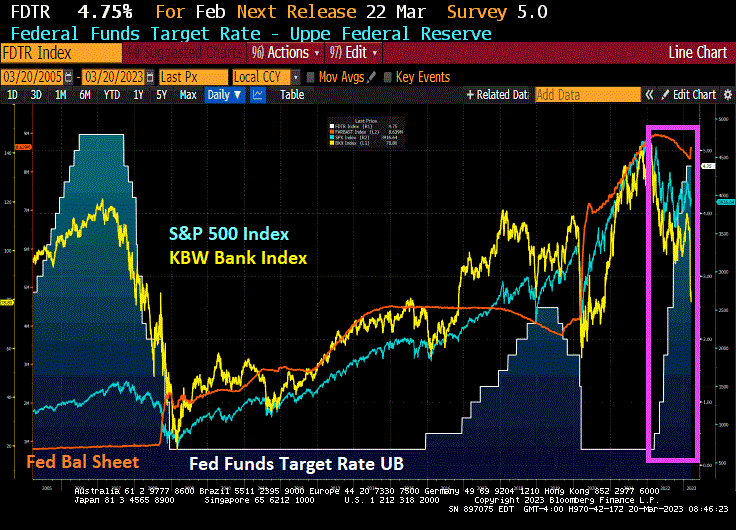
Since The Fed has been removing the punch bowl to fight inflation, the S&P 500 index and the KBW bank index have gotten crush. Since February 2nd, the S&P 500 index is down -6.3% while the KBW Bank index is down -31.4%.

In short, banks take in short-term deposits and lend long, earning the spread. But when rates start to rise, watch out!!

Strange Days! US Mortgage Rate Falls To 6.97% As Banking Crisis Persists (Yellen, Bank Consolidations, Bailouts And The Return Of QE)

Strange days, indeed.

Despite endless promises from Washington DC that there would never be another bank bailout, the Biden Administration bailed out Silicon Valley Bank (SVB) by removing the $250,000 cap on deposit insurance. Then Treasury Secretary Janet Yellen added that in the future, only banks that posed SYSTEMIC RISK to the economy will be bailed out. Translation: only the big four Too Big To Fail (TBTF) banks will be bailed out. Meaning that the Biden Administration prefers big banks to community banks. “Middle-class Joe” loves BIG Pharma, BIG defense, BIG tech, BIG media and now BIG banks. He should rename himself “Big Joe” Biden for the 2024 Presidential election.

Of course, we are aware of The Fed’s about face on shrinking their balance sheet (green line). While Bankrate’s 30-year mortgage rate has now declined below 7% to 6.97%, it has only fallen -15 basis points since the recent peak of 7.12% on 3/2/2023 when the 10-year Treasury yield was 4.056%. So, the 10-year Treasury yield has fallen -62.7 basis points since 3/2/2023 while the 30-year mortgage rate dropped only -15 basis points.

On the European banking front, Credit Suisse is kaput and both Swiss Bank and Deutsche Bank are considering buying the assets of Credit Suisse. In other words, MORE bank consolidation.

Here is a chart of US bank consideration as of 2009 with 37 banks in 1990 shriveling to 4 mega, TBTF banks in 2009 that remain today. But will the now unprotected community and local banks be absorbed into the 4 superbanks? Time will tell, but if history is repeated, the answer is yes.

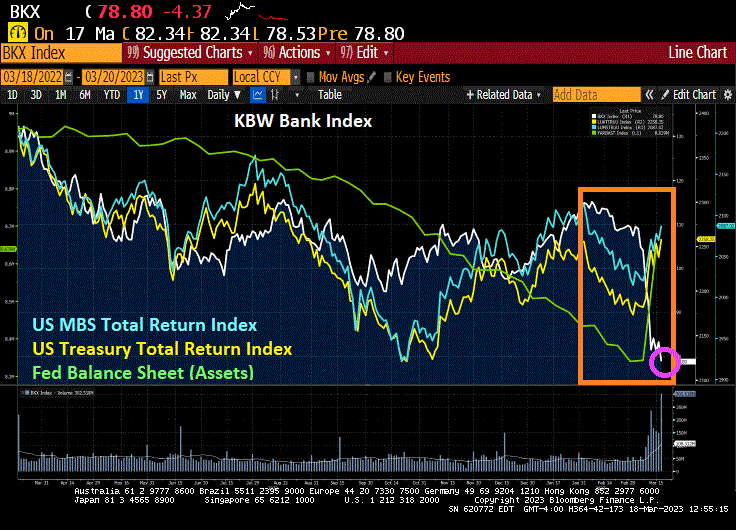
The KBW bank index continued to fall despite the bailouts of SVB and Signature Banks. But at least total returns on Treasuries and MBS that banks hold increased with the return of QE!

Yellen and Biden compete for the Knucklehead Of The Century Award. While not as sloppy as the sudden Afghanistan withdrawal, bailing out the Silicon Valley elites will not end well.

The NEW Banking Crisis In One Chart (Hint: Inflation = Fed Rate Hikes = Treasury/MBS Duration Increases = Bond Losses = Bank Runs) Bond Volatility Highest Since 2008

So, the Biden Administration made a horrible error by guaranteeing deposits at Silicon Valley Bank for deposits over $250,000. Essentially, Biden bailed out big tech that kept their deposits at SVB.

But what triggered the run on SVB and other banks? Simple. Biden and Congress spent like drunken sailors with Covid and The Federal Reserve went nuts printing money. Viola! We got inflation. But with inflation came The Fed’s attempt to get inflation back to its 2% target (difficult since Biden/Congress refuse to return spending to pre-Covid levels). But as interest rates rise, duration (weighted average life of MBS) rose dramatically meaning that risk increased. But banks like SVP ignored the risk, or didn’t hedge, or were spending time worrying about non-bank related issues.

So, what happened? Banks are holding Treasuries and MBS (orange line) that are getting clobbered with rate hikes (yellow line).

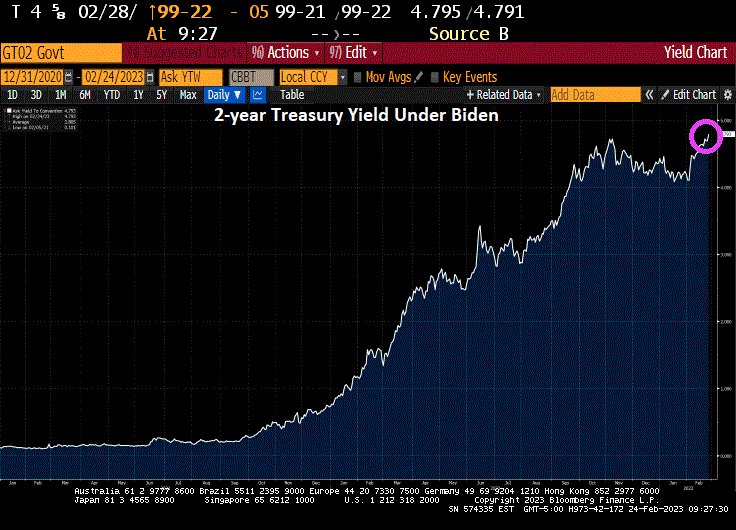
Talk about volatility. Today, the 2-year Treasury yield is up over 20 basis points as bond volatility hits levels last seen in 2008, just prior to the subprime credit crisis.

So, Biden’s bailout of SVP depositors stopped the deposit run for the moment. But if The Fed keeps hiking rates, banks are going to be hurting worse and worse. They could rebalance their portfolios and/or hedge. But with Uncle Spam (Biden) at the helm, bailouts are always on the table.

February Jobs Report Comes In Hot, Hot, Hot (Avg Hourly Earnings UP 4.6% YoY, Too Bad Inflation Is At 6.4% YoY)

According to the US Bureau of Labor Statistics (BLS)https://www.bls.gov/news.release/empsit.nr0.htm, the February jobs report came in hot, hot, hot.

One indicator that the Biden Administration will herald is that average hourly earnings rose to 4.6% Year-over-year (YoY). Too bad headline inflation is still at a whopping 6.4% YoY.

More jobs were added to the US economy than forecast (311k actual versus 225k forecast). The U-3 unemployment rate rose to 3.6% from 3.4% in January.

The biggest gainer in jobs? Food services and drinking places, of course, at 69.9 k jobs added.

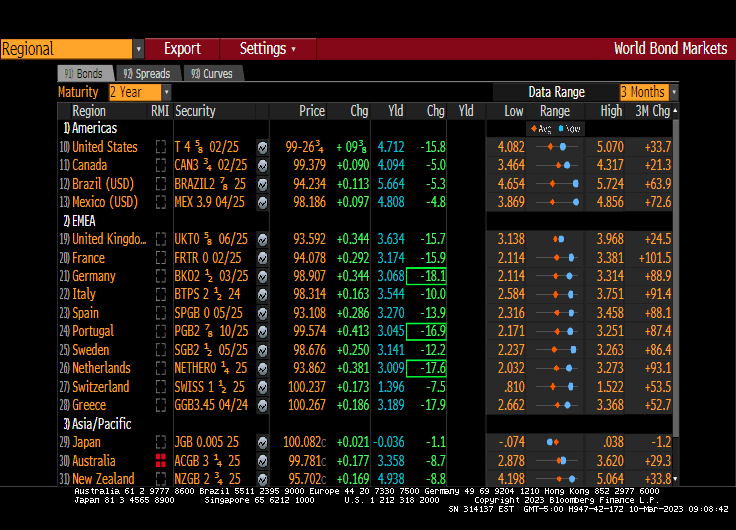
The aftermath of the jobs report? 2-year Treasury yields are down a whopping -15.8 basis points. But Europe is seeing double digit declines in sovereign yields as well.

At the 10-year tenor, we see the US Treasury yield drop -12.8 basis points. Much in line with European sovereign yield declines.

Big 4 Banks And SVB: Canaries In The Economic Coal Mine? (SVB Racing To Prevent a Bank Run As Funds Advise Pulling Cash)

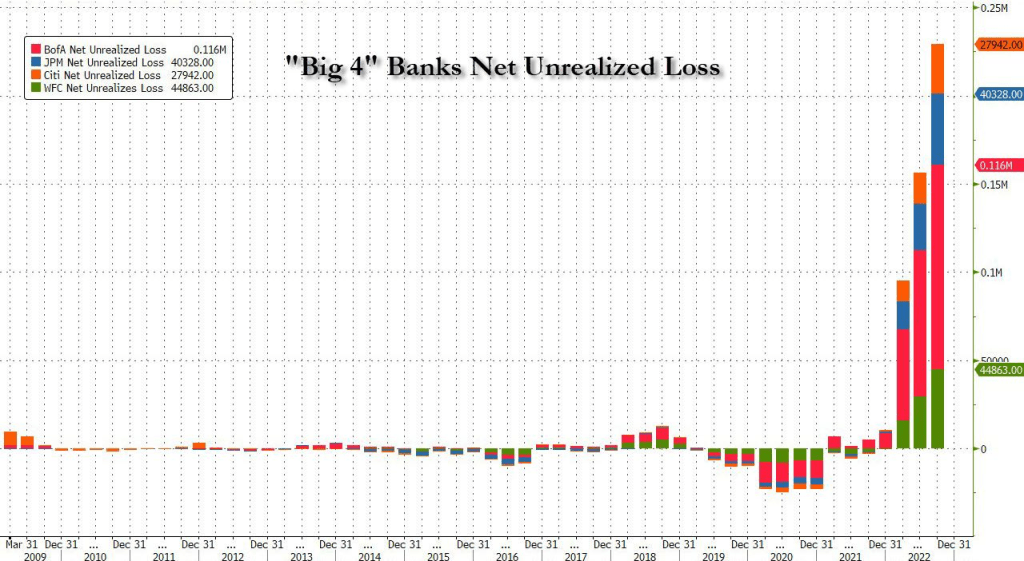
While waiting on the February jobs report from the US Bureau of Labor Statistics (BLS), I noticed that the big 4 banks (Bank of America, JPMorgan Chase, Citi and Wells Fargo) are drowning in net realized losses as The Federal Reserve combats 1) too many years of loose monetary policy under former Fed Chair Janet Yellen and 2) too much spending under Pelosi, Schumer and … McConnell.

At a micro level, we have Silicon Valley Bank (SVB) SVB Is racing to prevent a bank run as funds advise pulling cash.

Panic is spreading across the financial world as concerns about the financial stability of Silicon Valley Bank prompt prominent venture capitalists including Peter Thiel’s Founders Fund to advise startups to withdraw their money.

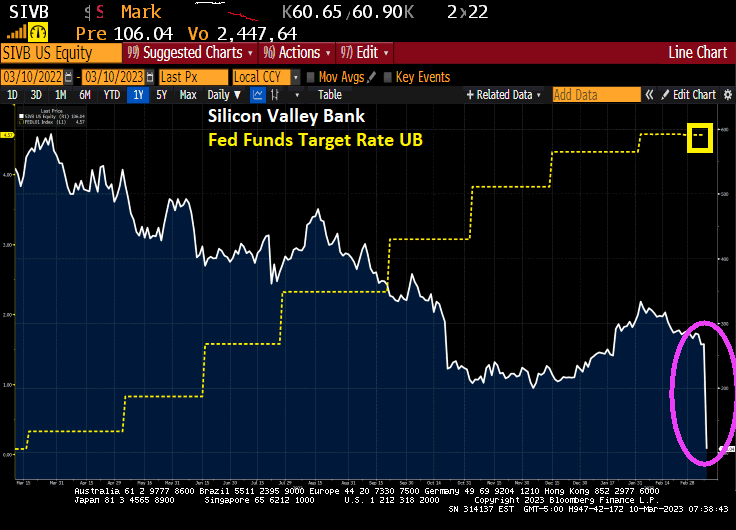
The turmoil followed a surprise announcement from Santa Clara, California-based SVB that it was issuing $2.25 billion of shares to bolster its capital position after a significant loss on its investment portfolio. The stock plunged 44% in premarket trading before exchanges opened in New York on Friday, set to extend its 60% decline on Thursday. Bonds had posted record declines, igniting a broad selloff in US bank shares that also spread to Asia and Europe.
In the US, the KBW Bank Index on Thursday had its worst day since June 2020, as its members shed more than $90 billion of value. In Europe, the biggest banks lost more than $40 billion from their market caps on Friday.

Management’s solution appears to have been to seek out yield through a lot of long-duration bonds. The bank started to lose deposits as VCs pulled cash/burnt through operating capital.

Are banks the canary in the economic coal mine?

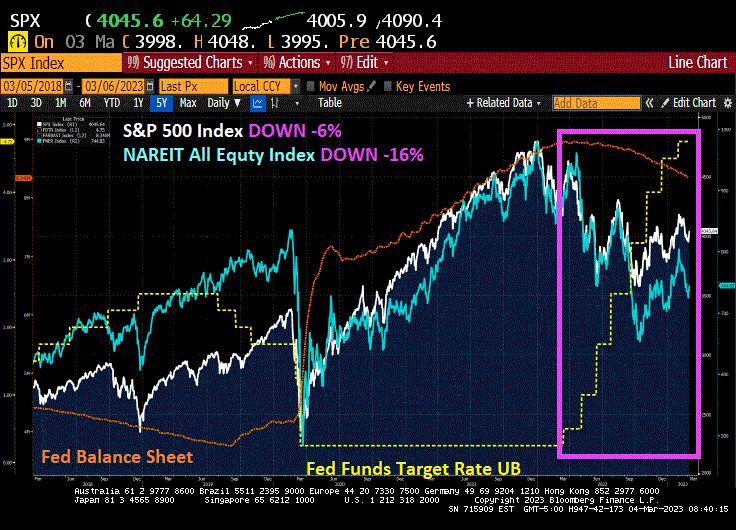
Sink The Economy! S&P 500 Down -6% Since Fed Started Raising Rates On May 4, 2022, Equity REITs Down -16% (Pension Pain From Interest Rate Increases)

Interest rates are an important driver of the economy and financial markets. And what has happened to the S&P 500 index since The Federal Reserve started raising their target rate on May 4, 2023 to fight surging inflation?

Since that fatal day, the S&P 500 index has fallen -6% and equity REITs (commercial real estate) has fallen -16%.

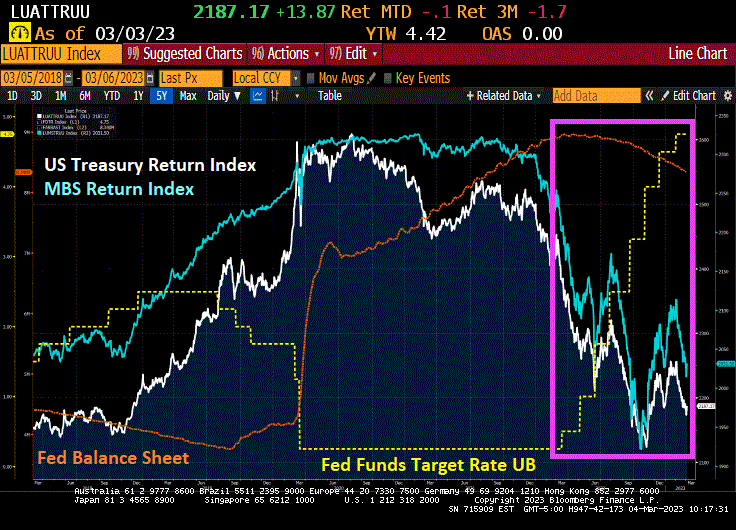
What about returns on US Treasuries and Mortgage-backed Securities (MBS)? Same thing. PAIN!

Although The Fed has pledged to keep raising rates to fight inflation (and further decimate retirement accounts), investors are pointing to a peak (terminal) Fed rate of 5.44% at the September 2023 FOMC meeting. Then rate cuts following the September 2023 meeting.

Of course, much of the blame belongs to former Fed Chair Ben (QE) Bernanke and current Treasury Secretary Janet “Too Low For Too Long” Yellen who never met a Fed rate hike that she liked. But Yellen LOVES giving away US taxpayer dollars … to Ukraine.

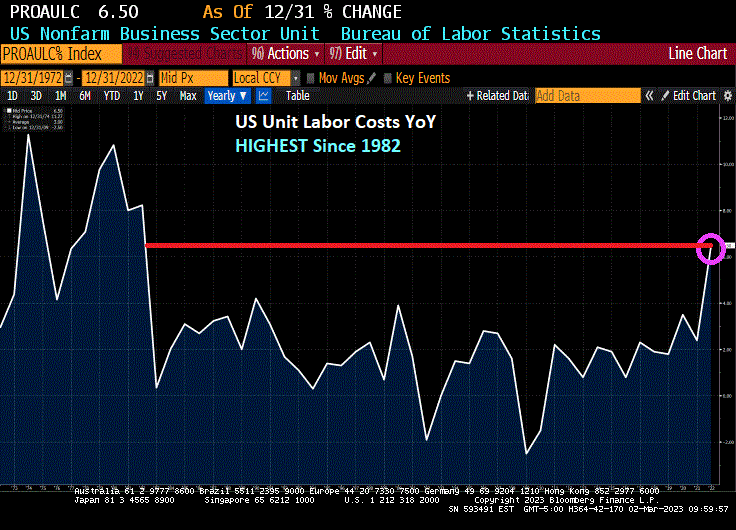
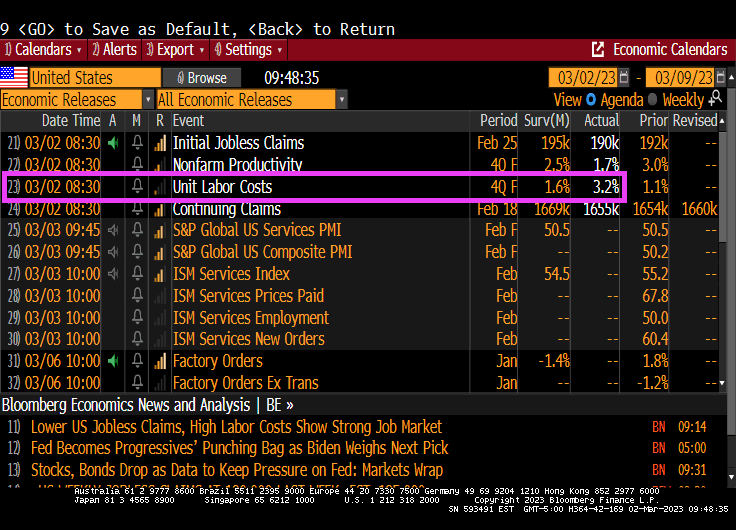
Inflation Alert! US Unit Labor Costs Soar in Q4 2022 To 3.2%, 2x Expectation Of 1.6%, UP 6.50% YoY (The Worst In 30 Years)

Despite Treasury Secretary Janet Yellen claiming that inflation was only transitory and likely to disappear, we are seeing continued inflation. Now we see that Unit Labor Costs are up 3.2% QoQ for Q4 2022.

Even worse, US unit labor costs rose 6.5% on a year-over-year (YoY) basis, the WORST since 1982.

And yes, Q4 2022 unit labor costs are up 2x the expectations.

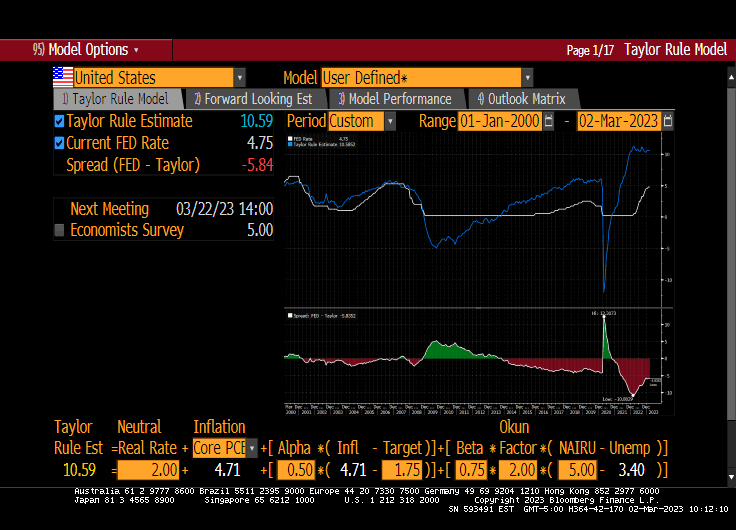
In normal times, The Federal Reserve would raise rates to cool down the economy. The Taylor Rule suggests a Fed target rate of 10.59% versus the current Fed rate of 4.75%. A long way to go!!

Damn it, Janet!

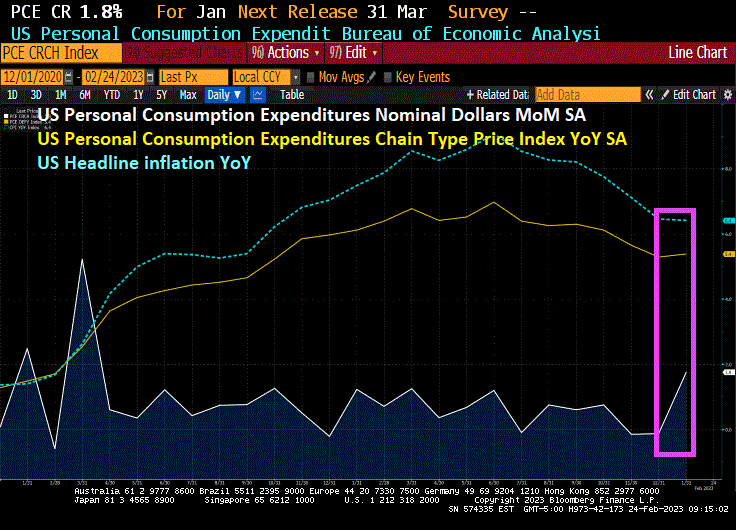
Uh-oh! January Personal Consumption Expenditures Soar 1.8% MoM, PCE Deflator UP 5.4% YoY, 2-year Treasury Yield Rises 10 Basis Points (Here Comes The Fed!)

Not really a surprise, but January’s personal spending numbers came in hot at 1.8% MoM. Also, Personal Consumption Expenditures PRICE index (aka, inflation) rose to 5.4% YoY.

Here comes The Fed! The 2-year Treasury yield rose 10 basis points this morning.

Pelsoi and Schumer (with McConnell) got the gold mine and American consumers got the shaft.

Is That All There Is? US Q4 Real GDP Up Only 0.91% YoY Despite $54.8 TRILLION In Federal Debt (+36%) Added Since January 2020

The US Federal government reminds me of the Peggy Lee song “Is That All There Is?” Since the outbreak of Covid in 2020 and the absurb spending spree by Pelosi and Schumer, the Federal government has increased their debt by 36% to help pay for the Federal spending spree. That amounts to $54.8 TRILLION in additional Federal debt since January 2020.

What did the US economy get for all that Federal spending? In Q4 2022, Real GDP rose by … 0.91% YoY. Seriously? Is that all there is from $54.8 TRILLION in additional Federal debt?

What do you expect when low-life lobbyists shuffle in and out of Congressional offices and the White House. Lobbyists don’t represent middle class America, but represent the elites.

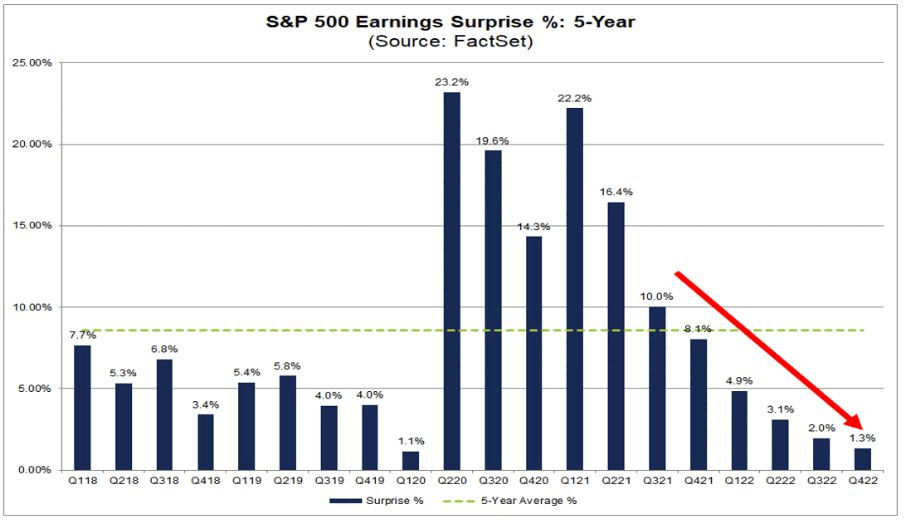
Another bit of lousy news. Look at the trend in S&P 500 Earnings Surprise (5 year).

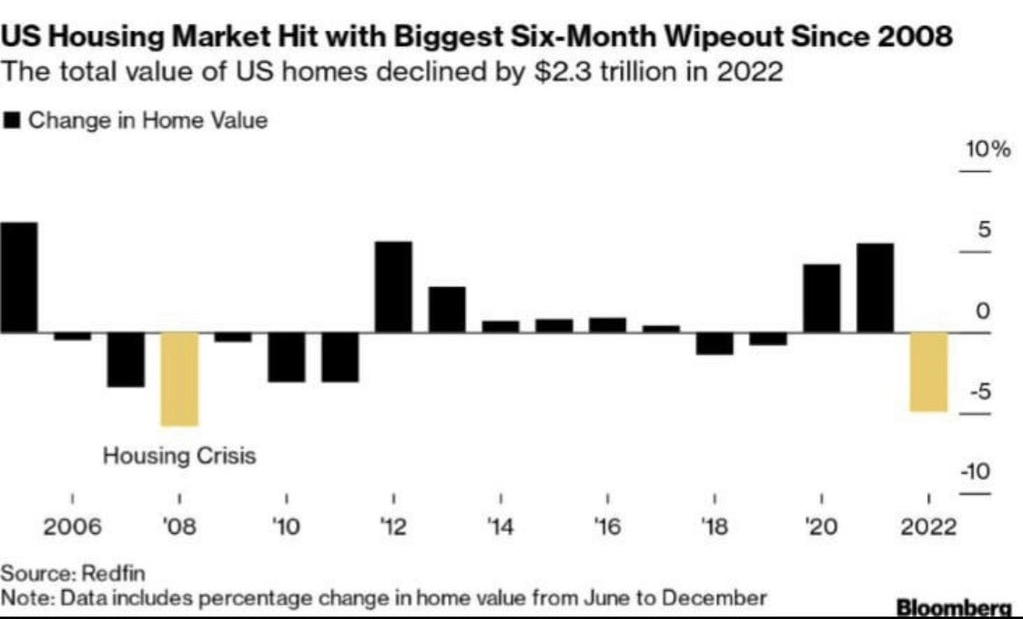
On the housing front, the US housing market was hit with the biggest six-month wipeout since 2008.

At least US Transportation Secretary “Pothole Pete” Buttigieg FINALLY showed up (three weeks after that East Palestine Ohio train disaster). Here is Buttigieg practising for his press conference.